Asteroids discovered in the Baldone Observatory between 2017 and 2022: The orbits of asteroid 428694 Saule and 330836 Orius
-
Ireneusz Wlodarczyk
 ,
Kazimieras Černis
,
Kazimieras Černis

Abstract
We discovered 83 asteroids at the Baldone Astrophysical Observatory (MPC code 069) in 2017–2022. We studied one of the dynamically interesting Apollo (Near Earth object) observed at the Baldone Astronomical Observatory, namely 428694 Saule (2008 OS9) and the Centaur-type asteroid 330836 Orius (2009 HW77). We studied the evolution of the asteroid Saule’s rotation period, obliquity, and spin axis together with its non-gravitational parameter
Acronyms
- CA
-
Close approach
- IAU MPC
-
International Astronomical Union Minor Planet Center
- LOV
-
Line of variation; LOV is a one-dimensional part of a (curved) line in the initial conditions space generally computed with the uniform sampling of the LOV parameter
- MPC
-
Minor planet center
- MPEC
-
Minor Planet electronic circulars
- NEO
-
Near Earth object
- NEODyS
-
Near Earth objects dynamical site
- NEODyS-2
-
Near Earth objects dynamic Site-2
- YORP effect
-
The Yarkovsky–O’Keefe–Radzievskii–Paddack effect
-
-
denotes the position along the line of variation (LOV), in the
-
-
Values of
- RMSast
-
root mean square error (of the residuals O–C) of the orbital fit
- RMSmag
-
root mean square error of observation’s magnitude
- VA
-
Virtual asteroid, clones
-
Symbols:
-
-
absolute magnitude of an asteroid
- pV
-
albedo
-
-
density
1 Introduction
In Cernis et al., (2015) and Wlodarczyk et al., (2020), we presented the discovered asteroids at the Baldone Observatory (located in Latvia) from 2008–2018. In the present work, we gather all discoveries of asteroids from 2017 through 2022. The work continues our discoveries and attempts to discover new asteroids. The discovery of any new object is valuable for science. There may be ordinary objects between them, especially a Near Earth object (NEO). Moreover, with standard observations, it is possible to find unique comets with hyperbolic orbits that may come to us from another star system.
All orbital computations of asteroids are made using the OrbFit software v.5.0.5 and v.5.0.6. In the last version, the NEODyS Team introduced the error weighing model described by Veres et al., (2017), as announced by F. Bernardi on the Minor Planet Mailing List. We used the JPL DE431 Ephemerides with 17 perturbing massive asteroids as was described in Farnocchia et al., (2013a,b) and similar to Wlodarczyk (2015).
2 Discoveries of minor planets at the Baldone Observatory in 2017–2022
Table 1 lists 83 asteroids discovered at the Baldone Astrophysical Observatory in Latvia, and Table 2 presents statistics and astrometric observations of the asteroids (both new and known) at the Baldone Observatory in 2017–2022.
List of asteroids discovered at the Baldone Observatory in 2017–2022
| No. | Date of discovery | Designation | Number | Status | MPC reference |
|---|---|---|---|---|---|
| 1 | 2017 Sep. 25 | 2017 SV33 | ID 4 op. | MPC 106,573 (2017 Nov. 5) | |
| 2 | 2017 Sep. 25 | 2017 SW33 | 512,962 | ID 9 op. | MPC 106,573 (2017 Nov. 5) |
| 3 | 2017 Sep. 26 | 2017 SX33 | ID 7 op. | MPC 106,573 (2017 Nov. 5) | |
| 4 | 2017 Sep. 28 | 2017 SY33 | 506,714 | ID 9 op. | MPC 106,573 (2017 Nov. 5) |
| 5 | 2017 Sep. 26 | 2017 SO42 | *3 op. | MPC 106,573 (2017 Nov. 5) | |
| 6 | 2017 Sep. 29 | 2017 SK134 | *6 op. | MPC 118,948 (2020 Jan. 9) | |
| 7 | 2017 Sep. 26 | 2017 SP136 | *60-day arc | MPC 118,948 (2020 Jan. 9) | |
| 8 | 2017 Sep. 25 | 2017 SY166 | *40-day arc | MPC 118,948 (2020 Jan. 9) | |
| 9 | 2017 Sep. 26 | 2017 SR169 | ID 5 op. | MPC 118,948 (2020 Jan. 9) | |
| 10 | 2017 Sep. 27 | 2017 SK170 | ID 45-day arc | MPC 118,948 (2020 Jan. 9) | |
| 11 | 2017 Sep. 26 | 2017 SM172 | ID 6 op. | MPC 118,948 (2020 Jan. 9) | |
| 12 | 2017 Sep. 26 | 2017 SF175 | ID 4 op. | MPC 118,948 (2020 Jan. 9) | |
| 13 | 2017 Sep. 29 | 2017 SX187 | *45-day arc | MPC 118,948 (2020 Jan. 9) | |
| 14 | 2017 Sep. 25 | 2017 SO205 | ID 6 op. | MPC 123,568 (2020 Aug. 7) | |
| 15 | 2017 Sep. 29 | 2017 SK220 | ID 4 op. | MPC 125,601 (2020 Nov. 17) | |
| 16 | 2017 Sep. 29 | 2017 SH213 | ID 4 op. | MPC 124,649 (2020 Sep. 24) | |
| 17 | 2017 Sep. 26 | 2017 SQ228 | *3 op. | MPC 129,111 (2021 Mar. 25) | |
| 18 | 2017 Sep. 29 | 2017 SM265 | *2 op. | MPC 134,098 (2021 Sep. 20) | |
| 19 | 2017 Sep. 27 | 2017 SA275 | *3 op. | MPC 134,098 (2021 Sep. 20) | |
| 20 | 2017 Sep. 25 | 2017 SR313 | *26-day arc | MPC 141,310 (2022 Jul. 19) | |
| 21 | 2017 Oct. 18 | 2017 UT9 | ID 3 op. | MPC 106,573 (2017 Nov. 5) | |
| 22 | 2017 Oct. 18 | 2017 UU9 | 585,101 | ID 7 op. | MPC 106,573 (2017 Nov. 5) |
| 23 | 2017 Oct. 19 | 2017 UO11 | 585,107 | ID 8 op. | MPC 106,573 (2017 Nov. 5) |
| 24 | 2017 Oct. 19 | 2017 UP11 | 50,7546 | ID 11 op. | MPC 106,573 (2017 Nov. 5) |
| 25 | 2017 Oct. 19 | 2017 UQ11 | ID 3 op. | MPC 106,573 (2017 Nov. 5) | |
| 26 | 2017 Oct. 19 | 2017 UR11 | 585,108 | ID 7 op. | MPC 106,573 (2017 Nov. 5) |
| 27 | 2017 Oct. 19 | 2017 US11 | 508,671 | ID 8 op. | MPC 106,573 (2017 Nov. 5) |
| 28 | 2017 Oct. 19 | 2017 UT11 | ID 4 op. | MPC 106,573 (2017 Nov. 5) | |
| 29 | 2017 Oct. 19 | 2017 UU11 | 540,601 | ID 11 op. | MPC 106,573 (2017 Nov. 5) |
| 30 | 2017 Oct. 19 | 2017 UV11 | ID 8 op. | MPC 106,573 (2017 Nov. 5) | |
| 31 | 2017 Oct. 21 | 2017 UV125 | *4 op. | MPC 129,111 (202 Mar. 25) | |
| 32 | 2017 Oct. 19 | 2017 UW11 | 508,672 | ID 12 op. | MPC 106,573 (2017 Nov. 5) |
| 33 | 2017 Oct. 19 | 2017 UX11 | 540,602 | ID 8 op. | MPC 106,573 (2017 Nov. 5) |
| 34 | 2017 Oct. 19 | 2017 UY11 | ID 5 op. | MPC 106,573 (2017 Nov. 5) | |
| 35 | 2017 Oct. 22 | 2017 UJ15 | 545,611 | ID 11 op. | MPC 106,573 (2017 Nov. 5) |
| 36 | 2017 Oct. 22 | 2017 UK15 | ID 6 op. | MPC 106,573 (2017 Nov. 5) | |
| 37 | 2017 Oct. 22 | 2017 UL15 | ID 5 op. | MPC 106,573 (2017 Nov. 5) | |
| 38 | 2017 Oct. 19 | 2017 UT56 | *80-day arc | MPC 118,948 (2020 Jan. 9) | |
| 39 | 2017 Oct. 19 | 2017 UU58 | ID 4 op. | MPC 118,948 (2020 Jan. 9) | |
| 40 | 2017 Oct. 18 | 2017 UB63 | ID 3 op. | MPC 118,948 (2020 Jan. 9) | |
| 41 | 2017 Oct. 23 | 2017 UR64 | *4 op. | MPC 118,948 (2020 Jan. 9) | |
| 42 | 2017 Oct. 19 | 2017 UV64 | ID 2 op. | MPC 118,948 (2020 Jan. 9) | |
| 43 | 2017 Oct. 19 | 2017 UY64 | ID 4 op. | MPC 118,948 (2020 Jan. 9) | |
| 44 | 2017 Oct. 19 | 2017 UX71 | ID 6 op. | MPC 118,948 (2020 Jan. 9) | |
| 45 | 2017 Oct. 21 | 2017 UB76 | ID 6 op. | MPC 118,948 (2020 Jan. 9) | |
| 46 | 2017 Oct. 19 | 2017 UK78 | *40-day arc | MPC 118,948 (2020 Jan. 9) | |
| 47 | 2017 Oct. 19 | 2017 UM95 | *6 op. | MPC 123,568 (2020 Aug. 7) | |
| 48 | 2017 Oct. 23 | 2017 UX95 | *7 op. | MPC 123,568 (2020 Aug. 7) | |
| 49 | 2017 Oct. 23 | 2017 UK101 | *6 op. | MPC 123,568 (2020 Aug. 7) | |
| 50 | 2017 Oct. 21 | 2017 UM164 | *3 op. | MPC 135,342 (2021 Oct. 27) | |
| 51 | 2017 Oct. 23 | 2002 AN214 | 567,580 | N9 op. | MPO 995 (2023 Jan. 23) |
| 52 | 2017 Nov. 17 | 2017 WT35 | ID 4 op. | MPC 118,948 (2020 Jan. 9) | |
| 53 | 2017 Nov. 17 | 2017 WW49 | *5 op. | MPC 125,601 (2020 Nov. 17) | |
| 54 | 2017 Nov. 16 | 2017 WG88 | *2 op. | MPC 141,310 (2022 Jul. 19) | |
| 55 | 2018 Mar. 18 | 2018 FU25 | ID 14 op. | MPC 109,684 (2018 Apr. 30) | |
| 56 | 2018 Mar. 18 | 2018 FV25 | ID 11 op. | MPC 109,684 (2018 Apr. 30) | |
| 57 | 2018 Mar. 16 | 2018 FL30 | *35-day arc | MPC 118,948 (2020 Jan. 9) | |
| 58 | 2018 Apr. 13 | 2018 GE3 | NEO object | ID 4-day arc | MPO 445,234 (2018 Apr. 30) |
| 59 | 2018 Apr. 10 | 2018 GU6 | ID 8 op. | MPC 109,684 (2018 Apr. 30) | |
| 60 | 2018 Apr. 10 | 2018 GV6 | 585,398 | ID 6 op. | MPC 109,684 (2018 Apr. 30) |
| 61 | 2018 Apr. 12 | 2018 GX8 | ID 2 op. | MPC 109,684 (2018 Apr. 30) | |
| 62 | 2018 Apr. 10 | 2018 GV15 | *5 op. | MPC 123,568 (2020 Aug. 7) | |
| 63 | 2018 Sep. 10 | 2018 RG17 | *5 op. | MPC 110,809 (2018 Sep. 25) | |
| 64 | 2018 Sep. 10 | 2018 RH17 | 542,935 | ID 8 op. | MPC 110,809 (2018 Sep. 25) |
| 65 | 2018 Sep. 13 | 2018 RW41 | *4 op. | MPC 118,948 (2020 Jan. 9) | |
| 66 | 2018 Oct. 6 | 2018 TL9 | ID 9 op. | MPC 112,836 (2019 May. 18) | |
| 67 | 2018 Oct. 6 | 2018 TM9 | *2 op. | MPC 112,836 (2019 May. 18) | |
| 68 | 2018 Oct. 7 | 2018 TF19 | 560,161 | ID 8 op. | MPC 118,948 (2020 Jan. 9) |
| 69 | 2019 Mar. 31 | 2019 FU4 | 603,184 | ID 8 op. | MPC 112,836 (2019 May. 18) |
| 70 | 2019 Apr. 1 | 2019 GJ8 | 573,235 | ID 6 op. | MPC 112,836 (2019 May. 18) |
| 71 | 2019 Apr. 1 | 2019 GK8 | 603,397 | ID 9 op. | MPC 112,836 (2019 May. 18) |
| 72 | 2019 Apr. 1 | 2019 GL8 | ID 2 op. | MPC 112,836 (2019 May. 18) | |
| 73 | 2019 Apr. 1 | 2019 GM8 | ID 7 op. | MPC 112,836 (2019 May. 18) | |
| 74 | 2019 Apr. 1 | 2019 GN8 | ID 6 op. | MPC 112,836 (2019 May. 18) | |
| 75 | 2019 Apr. 1 | 2019 GO8 | ID 9 op. | MPC 112,836 (2019 May. 18) | |
| 76 | 2019 Mar. 26 | 2019 FQ8 | *2 op. | MPC 118,948 (2020 Jan. 9) | |
| 77 | 2019 Sep. 22 | 2019 SN19 | 599,705 | ID 4 op. | MPC 118,948 (2020 Jan. 9) |
| 78 | 2019 Sep. 27 | 2019 SO29 | *40-day arc | MPC 118,948 (2020 Jan. 9) | |
| 79 | 2019 Sep. 26 | 2019 SH61 | *35-day arc | MPC 118,948 (2020 Jan. 9) | |
| 80 | 2019 Sep. 26 | 2019 SZ140 | *40-day arc | MPC 129,111 (2021 Mar. 25) | |
| 81 | 2019 Sep. 26 | 2019 SJ173 | *12-day arc | MPC 130,731 (2021 Jun. 1) | |
| 82 | 2019 Sep. 26 | 2019 SC183 | *4 op. | MPC 134,098 (2021 Sep. 20) | |
| 83 | 2020 Aug. 11 | 2020 PC10 | ID 42-day arc | MPC 125,601 (2020 Nov. 17) |
Noted: Main-belt Asteroid 567,580 (2002 AN214) was named Latuni.
mark ID denotes independent discovery.
op. – opposition.
N – named asteroid.
mark * denotes that discoverer credit will be done for Baldone, when the object is numbered.
Statistics of asteroid discoveries and astrometric observations of the asteroids (both new and known) at the Baldone Observatory in 2017–2022
| Year | Number of asteroid discoveries | Number of asteroid observations | Number of asteroids observed | MPC numbers |
|---|---|---|---|---|
| 2017 | 54 | 3,798 | 972 | 102,359, 103,149, 104,117, 104,989, 105,343, 105,715, 106,573, 107,170 |
| 2018 | 14 | 5,561 | 1,516 | 107,827, 108,759, 109,228, 109,684, 110,175, 110,809, 111,864 |
| 2019 | 14 | 3,807 | 1,071 | 112,836, 115,067, 115,989, 117,290, 118,277 |
| 2020 | 1 | 3,135 | 863 | 118,948, 120,147, 121,322, 122,837, 123,568, 124,648, 125,601 |
| 2021 | 0 | 3,749 | 879 | 127,456, 129,111, 13,731, 132,404, 134,098, 135,342 |
| 2022 | 0 | 9,492 | 470 | 136,731, 138,608, 140,114, 141,310, 142,136, 158,705 |
| Total | 83 | 29,542 | 5,771 |
In 2015–2017, only some orbits of objects were calculated because there needed to be complete information. The orbits of the following asteroids are computed with low accuracy because of their short observational arc: 2017 SR313, 2018 GE3, and 2019 SJ173.
This work presents the full set of discovered objects in 2017–2022. All discoveries and observations of asteroids at Baldone were made by K. Cernis (KC) and I. Eglitis (IE).
In Wlodarczyk et al., (2020), 37 asteroids were discovered in 2015–2018. In Wlodarczyk et al., (2020), in 2017, 21 objects were discovered; in the present paper (2023), there are 54 objects because the MPC has credited us with additional 33 discoveries in the last 3 years. In Wlodarczyk et al., (2022a) in 2018, 9 objects were discovered and 14 in the new paper (2023) because the Minor planet center (MPC) has made five additional discoveries in the last 3 years. At the same time, in the last 3 years, there have been a lot of new sightings of the objects mentioned in Wlodarczyk et al., (2020). We decided to show all objects from Wlodarczyk et al., (2020) and additional discoveries in 2017–2018. We have given references to each object’s MPC and MPO numbers, and MPC has given us new designations. Moreover, the number of published astrometric observations remained the same as in Wlodarczyk et al., (2020). We should have mentioned that the numbers in Table 2 refer to Minor Planet Circular numbers.
Recently, Quenzi Ye from the University of Maryland, USA, compiled an interesting statistic of asteroid discoveries: https://sbnmpc.astro.umd.edu/mpecwatch/obs.html. According to Quenzi, the designations in his list are as follows: F/U – follow-up;1st F/U – first to follow-up; Prec. – precovery. In detail, “First follow-up” means being the first to confirm an object. For example, here in https://minorplanetcenter.net/mpec/K22/K22WS5.html, G96 is the discoverer, and L01 was the first to follow up.
For now, this service only analyzes observations/discoveries announced by Minor Planet electronic circulars (NEOs, comets). Quenzi might include main belters in the future. Shortly, the discoveries of the asteroids from Baldone should also be included there.
3 Orbital and physical evolution of the asteroid 428694 Saule (2008 OS9)
KC and IE discovered asteroid 428694 Saule (2008 OS9) at Baldone on 2008-07-29. The orbit type of this asteroid is Apollo and Near Earth Asteroid. Asteroid 428694 Saule (2008 OS9) is named after Saule, a solar goddess, the solar deity in the Latvian and Lithuanian mythologies (MPC 10061).
3.1 Starting orbital elements
To compute starting orbital elements of the asteroid Saule, we used the OrbFit software with the JPL DE431 ephemerides, weighting and selecting observations according to the NEODyS-2[1], 17 additional massive asteroids, and the Yarkovsky effects. We searched for the non-gravitational parameter
According to the OrbFit v.5.0.7, we used the error model vfcc17 of Veres et al., (2017). Table 3 presents the starting nominal Keplerian orbital elements of the 428694 Saule (2008 OS9) asteroid computed using the mentioned OrbFit v.5.0.7 software.
Starting nominal Keplerian orbital elements of the 428694 Saule (2008 OS9) asteroid
|
|
|
|
|
|
|
|---|---|---|---|---|---|
| vfcc17 error model | |||||
| 17 additional massive asteroids | |||||
| 1.601243376 | 0.647927223 | 19.1403994 | 133.4127276 | 288.315140 | 200.179695 |
|
|
|
|
|
|
|
H = 19.368,
The angles
H: absolute magnitude, RMSast: uncertainty of the fitted orbit, RMSmag: uncertainty of the absolute magnitude,
It is worth noting that two other interesting recent methods of computations of the non-gravitational parameter
3.2 Starting physical parameters
Next, we used the mercury software of Fenucci and Novakovic (2022). As stated in https://github.com/Fenu24/mercury, this is a modified version of the N-body code mercury by Chambers (1999) (https://github.com/Fenu24/mercury/tree/master/doc), which includes the Yarkovsky and YORP effects for the dynamics of small solar system objects.
The Yarkovsky effect was discovered by the Polish-Russian civil engineer Ivan Osipovich Yarkovsky: https://en.wikipedia.org/wiki/Yarkovsky_effect.
We have a diurnal effect and a seasonal effect. Both effects produce a shift in the semimajor axis of the asteroid. The influence of the Yarkovsky effect on the motion of an object is evident over a long time, for example, in the motion of members of asteroid family e.g., Novakovic et al., (2022), Wlodarczyk and Leliwa-Kopystynski (2018), studying retrograde orbits in Wlodarczyk (2022b) or dangerous asteroids (Wlodarczyk 2020). To study the motion of asteroids and comets with the influence of the Yarkovsky effect, we use the non-gravitational parameters
As physical parameters in starting file yarkovsky.in, we used typical values of this type of asteroid, as was partially presented in Fenucci and Novakovic (2022):
the density
the thermal conductivity
the heat capacity
the diameter
the obliquity
the rotation period
the absorption coefficient
the emissivity
yorp_flag = 1
stoc_yorp_flag = 1
step_user = 1.0
dt_out = 1.0
one year.
An assessment of the diameter of the asteroid Saule is in our previous article by Cernis et al., (2010), where we used absolute magnitude
In computations of the Yarkovsky and YORP effects, we accept the asteroid has a mean diameter of 600 m, and its mean albedo is 0.15. Hence, we take the mean diameter of the asteroid Saule in our computation.
We can check NEOWISE observations of NEOs for some infrared data on Saule. Sometimes, this can help in the determination of the geometric albedo. In our case, we did not check NEOWISE data. We assume the albedo pV in the interval
From a discussion above, it follows that the effective diameter of Saule can be determined only approximately. For this reason, we will do computations for a set of values presented in Table 4.
Critical rotation periods for different starting physical parameters of the asteroid Saule
| Absolute magnitude, H | 19.34 | 19.39 | 19.44 | |||||||
| Visual albedo, pV | 0.49 | 0.27 | 0.05 | 0.49 | 0.27 | 0.05 | 0.49 | 0.27 | 0.05 | |
| Diameter, D (m) | 256 | 345 | 803 | 251 | 338 | 784 | 245 | 330 | 767 | |
| Density kg/
|
Bulk cohesion Pa | Critical rotation period | ||||||||
|---|---|---|---|---|---|---|---|---|---|---|
| Pa |
|
|||||||||
| 1,000 | 10 | 6.88 | 9.27 | 21.53 | 6.72 | 9.05 | 21.04 | 6.57 | 8.85 | 20.56 |
| 100 | 2.17 | 2.93 | 6.81 | 2.13 | 2.86 | 6.65 | 2.08 | 2.80 | 6.50 | |
| 1,500 | 10 | 8.42 | 11.35 | 26.37 | 8.23 | 11.09 | 25.77 | 8.04 | 10.84 | 25.18 |
| 100 | 2.67 | 3.59 | 8.34 | 2.60 | 3.51 | 8.15 | 2.54 | 3.43 | 7.96 | |
| 2,000 | 10 | 9.73 | 13.10 | 30.45 | 9.51 | 12.81 | 29.76 | 9.29 | 12.51 | 29.08 |
| 100 | 3.08 | 4.14 | 9.63 | 3.00 | 4.05 | 9.41 | 2.94 | 3.96 | 9.20 | |
| 2,500 | 10 | 10.87 | 14.65 | 34.04 | 10.63 | 14.32 | 33.27 | 10.39 | 13.99 | 32.51 |
| 100 | 3.44 | 4.63 | 10.77 | 3.36 | 4.53 | 10.52 | 3.28 | 4.42 | 10.28 | |
In turn, Table 4 indicates the calculation of the diameter of the asteroid Saule based on the range of observed H for 19.34, 19.39, and 19.44 mag and possible albedo, pV of 0.49, 0.27, and 0.05. For the diameters obtained in this way, we calculated the rotation periods of the asteroid for different bulk density densities of 1,000, 1,500, 2,000, and 2,500 kg
We then calculate the critical rotation period given by Hu et al., (2021):
where
Results are presented in Table 4. It turned out that the minimum periods of critical rotation are just over 2 h, for a density of 1,000 kg/
3.3 Long-time orbital and physical evolution
First, we computed orbital elements and non-gravitational elements of 101 clones of the asteroid 428694 Saule (2008 OS9) for epoch JD2459600.5 and the planets from Mercury to Neptune. We used the parameter
Next, the starting orbital elements of each clone are treated as inputs in one small.in the file, and all of them, one yarkovsky.in a file is included, the same for all clones. These are the inputs to the main mercury integrator program. Of course, you can associate each clone’s orbital elements with the same yarkovsky.in file. This way, we will have 101 input files with 101 data, yielding
Our additional computational tests showed that the computational results of one run of 101 clones yield similar to
Figure 1 presents starting non-gravitational parameter
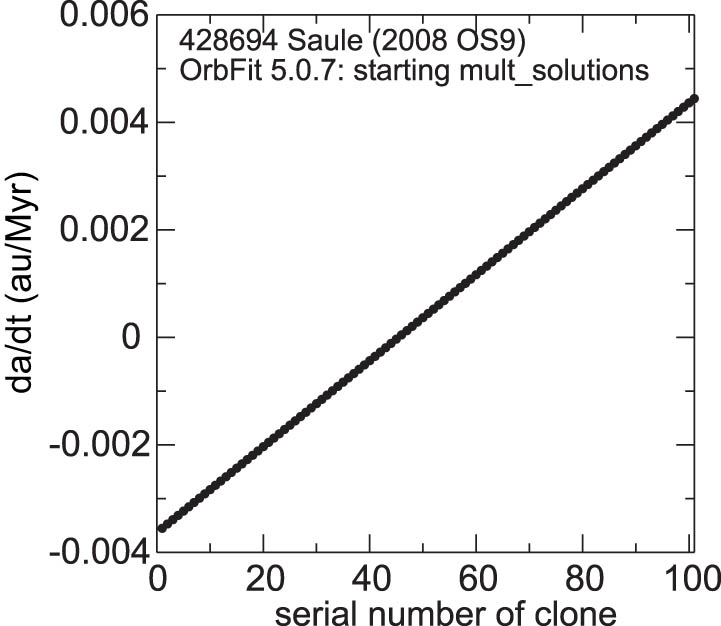
Starting non-gravitational parameter
Figure 2 presents the physical parameters of asteroid 428694 Saule (2008 OS9) after 0.5 Myr forward integration. They are the rotation period
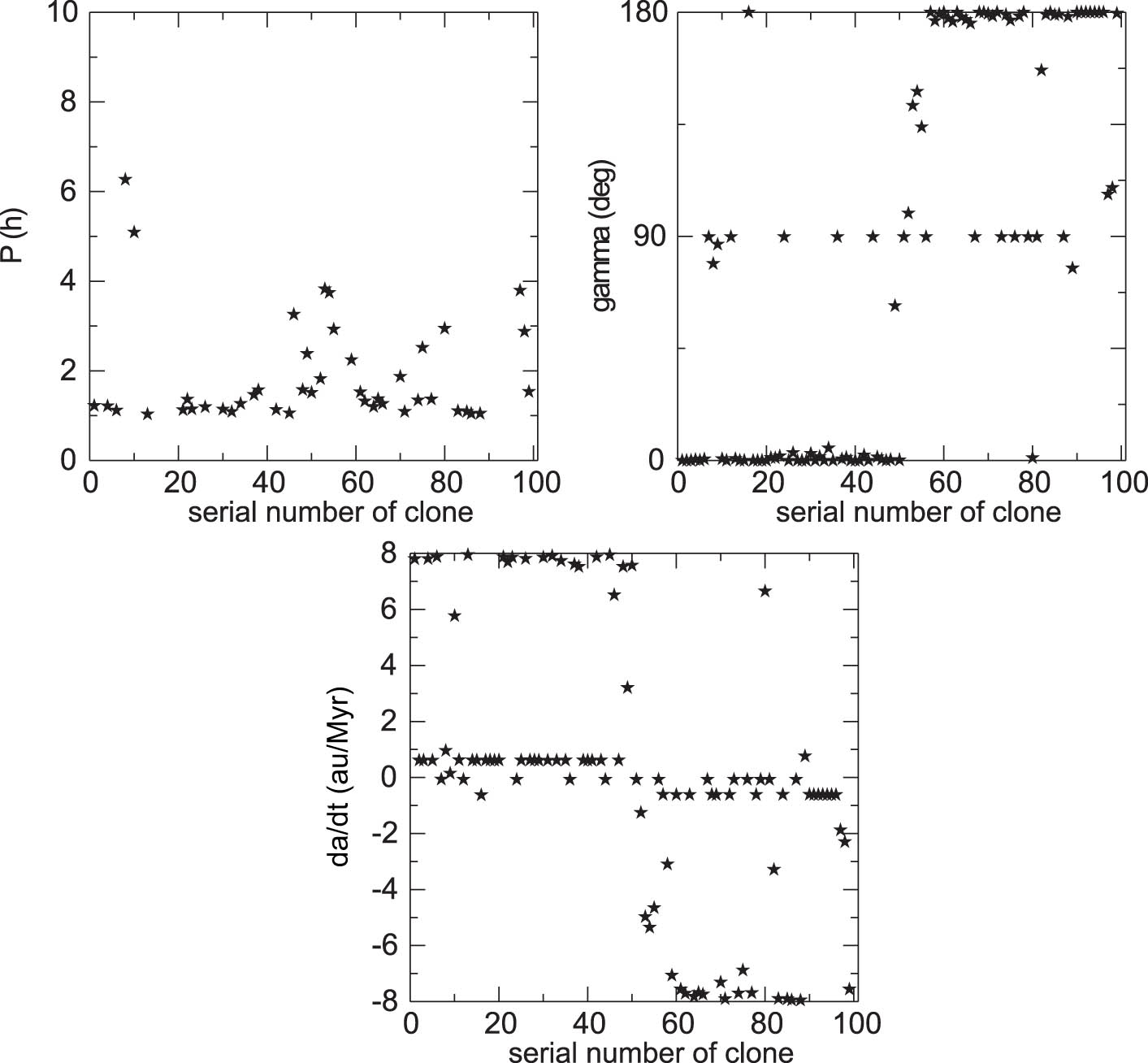
Physical parameters of asteroid 428694 Saule (2008 OS9) after 0.5 Myr forward integration. Parameter
Hence, this state has a minor significance for the Yarkovsky effect, the semimajor axis drift
Comparing
It is interesting that after a period of 0.5 Myr, the clones’
Hence, the dynamics of changes in the
Interesting is the distribution of the clonal rotation period. As shown in the left panel of Figure 2, the rotation period of the clones
Given the diameter of the asteroid Saule (D = 600 m) and its assumed density of 2,120 kg/
They write: “When the rotation period becomes smaller than
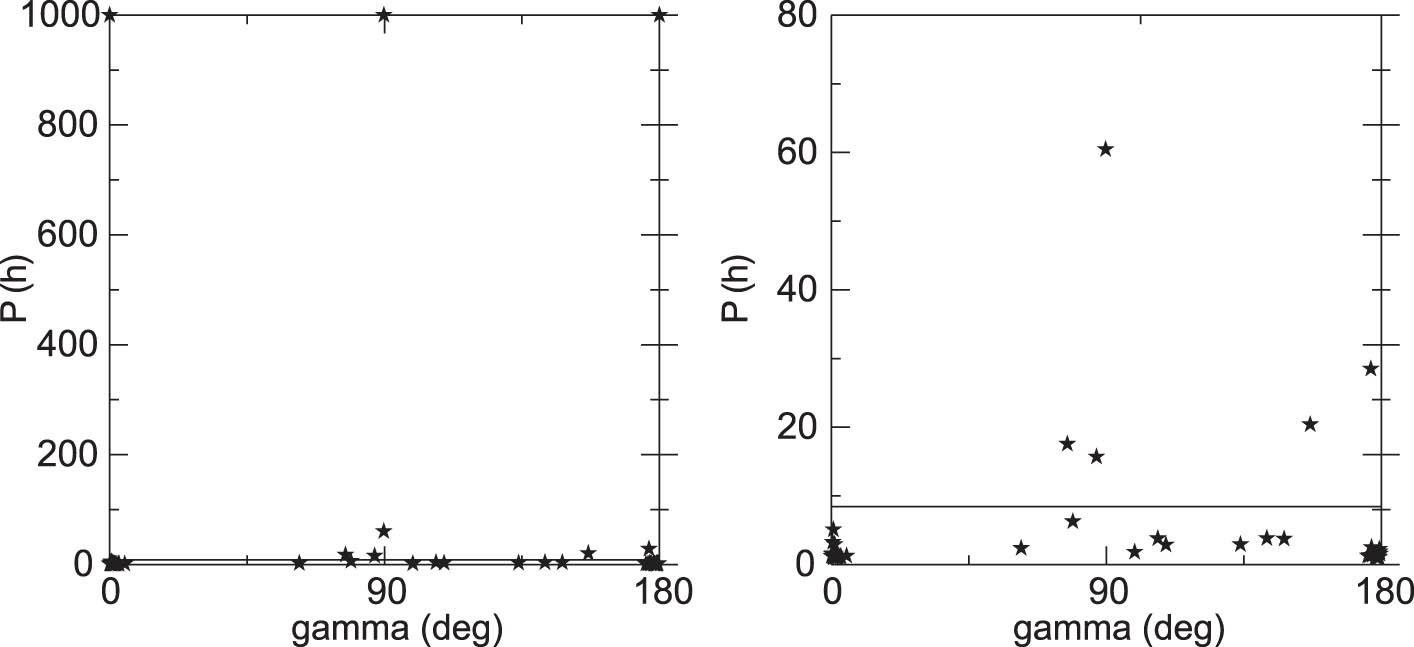
Left panel: Rotation period
Similarly interesting is the distribution in the inclination of the rotation axis of the clones to the ecliptic plane. Initially, we assumed that the neighboring clones differ by
Hence, our computations showed that the Yarkovsky effect plays a significant role after 0.5 Myr, and even signs of it are already visible after 0.1 Myr.
Figure 3 presents the rotation period
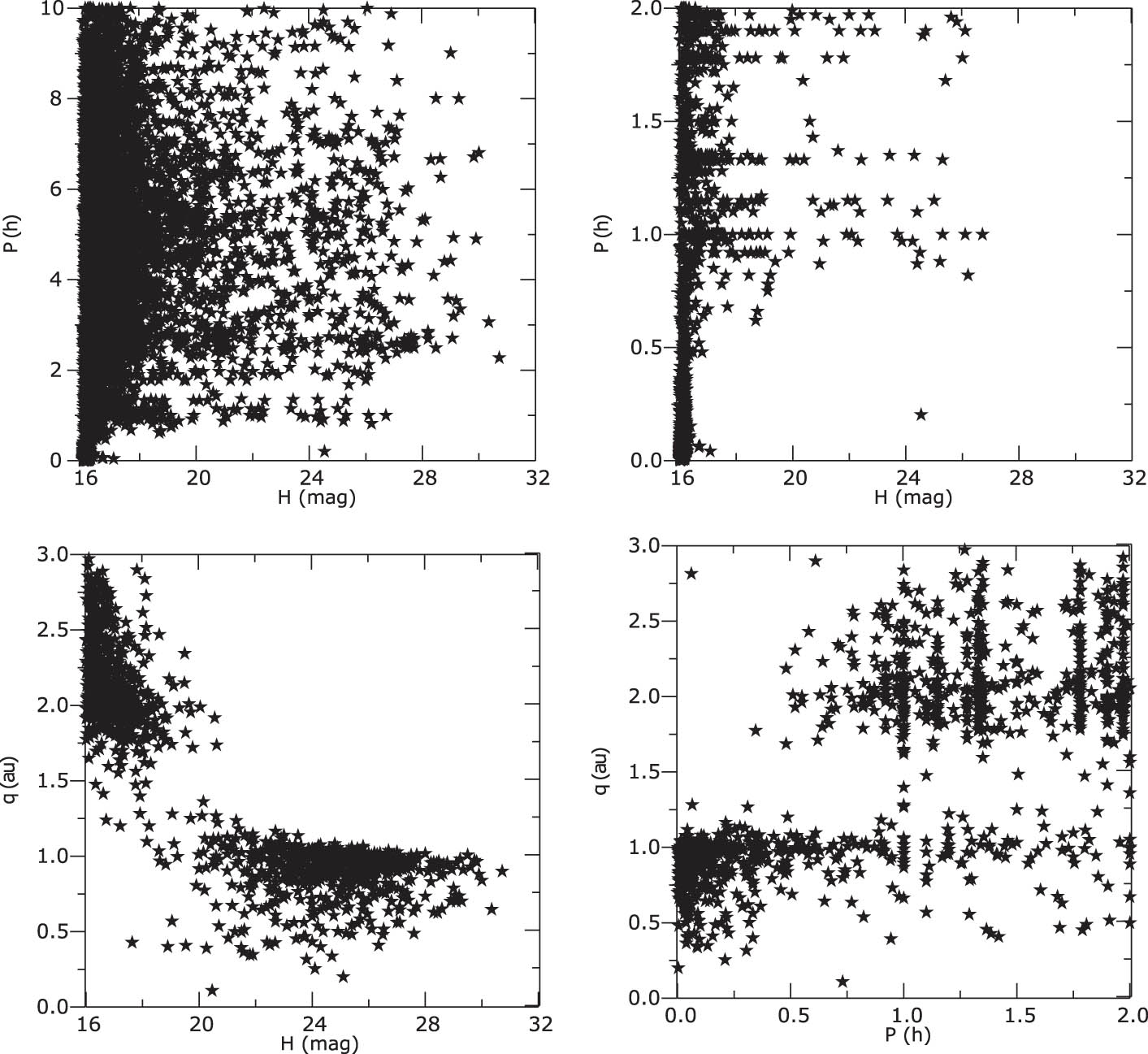
Known physical parameters of 31079 asteroids according to the MPC.
Table 5 shows the number of the first group of clones for the three spin-axis groups. It turned out that they take only three spin-axis values: 0, 90, and
Number of clones in a given state for
| Time | 10 ky | 100 ky | 500 ky |
|---|---|---|---|
| Number of clones | |||
|
|
|||
| 1,000 | 0 | 25 | 50 |
| 1–10 | 99 | 55 | 51 |
| Others | 2 | 21 | 0 |
| Gamma (
|
|||
| 0 | 1 | 8 | 23 |
| 90 | 4 | 6 | 13 |
| 180 | 1 | 13 | 32 |
| Others | 95 | 74 | 31 |
|
|
|||
|
|
51 | 51 | 53 |
|
|
50 | 50 | 48 |
Number of clones with
| Spin axis (
|
Number of clones (
|
|---|---|
| 0 | 22 (21.8) |
| 90 | 13 (12.9) |
| 180 | 15 (14.9) |
3.4 Known rotation periods of asteroids
According to the recent reliable database of the asteroid rotation periods: https://minplanobs.org/mpinfo/datazips/LCLIST_PUB_2023JUN.zipthere are 32778 asteroids with defined physical parameters.
According to the database, they introduce the U code, which assesses the quality of the period solution, not necessarily of the data per se, as stated there.
If we selected asteroids with criterion
Additionally, if we count objects which fulfill the following criteria:
4 Orbital evolution of the asteroid 330836 Orius (2009 HW77)
The centaur Orius, who lived in the mountains, was killed by Heracles when he tried to steal the wine Pholus.
4.1 Starting orbital elements
KC and IE discovered Asteroid 330836 Orius (2009 HW77) at Baldone on 2009-04-25. An orbit type of asteroid is a Distant object. To compute starting orbital elements of the asteroid Orius, we used the OrbFit software with the JPL DE431 ephemerides, weighting and selecting observations according to the (NEODyS-2)[3], 17 additional massive asteroids. We did not search for the non-gravitational parameter
According to the OrbFit v5.0.7, we used the error model vfcc17 (Veres et al., 2017). Table 5 presents the initial nominal Keplerian orbital elements of the 330836 Orius (2009 HW77) asteroid.
4.2 Long-time orbital evolution
The dynamical lifetime is the time between the start of integration and ejection from the integration. The studied asteroid 330836 Orius (2009 HW77), like other Centaurs, are planet-crossing object and has relatively short dynamical lifetimes of around 1 Myr (Horner et al., 2004) and short Lyapunov time, e.g., of about 4,260 year for Centaur asteroid (463,368) 2012 VU12 (Wlodarczyk et al., 2017).
Due to the lack of sufficiently precise physical parameters of the asteroid 2009 HW77, to study its orbital evolution we used SWIFT software, initially developed by H. Levison (https://www.boulder.swri.edu/∼hal/swift.html).
We included perturbations of all planets from Mercury to Neptune. We computed clones using the multiple solution methods for the 1
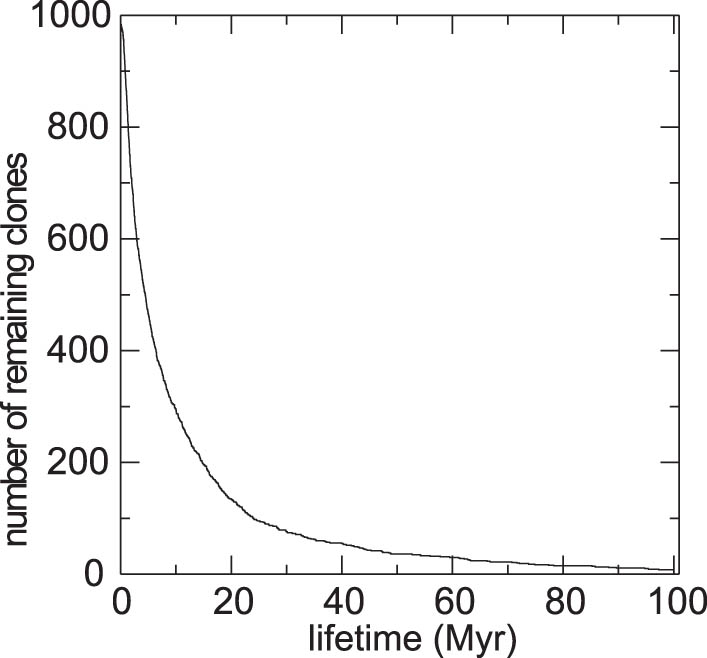
The Centaur 2009 HW77. The behavior of the lifetime of the remaining clones has an exponential shape. Hence we can compute the half-time of 1,001 clones in the forward 100 Myr RA15 integration. The computed half-time is 4.45 Myr.
5 Keplerian orbital elements of the asteroid 2017 UW42
It is also worth paying attention to the interesting asteroid 2017 UW42. According to the MPC site: https://minorplanetcenter.net/iau/mpc.htmlasteroid 2017 UW42 was first observed at Mt. Lemmon Survey on 2017-10-27. It was independently discovered by (KC, IE) on Sep. 26, 2017. Discoverer will be defined when the object is numbered. Table 7 presents initial nominal Keplerian orbital elements of the 330836 Orius (2009 HW77) asteroid. Interestingly, that studied asteroid has a significant value of the non-gravitational parameter
Initial nominal Keplerian orbital elements of the 330836 Orius (2009 HW77) asteroid
|
|
|
|
|
|
|
|---|---|---|---|---|---|
| vfcc17 error model | |||||
| 17 Additional massive asteroids | |||||
| 21.502244 | 0.4169934 | 17.8749641 | 50.451470 | 141.037047 | 54.14741 |
|
|
|
|
|
|
|
The angles
Starting nominal Keplerian orbital elements of the 2017 UW42 asteroid
|
|
|
|
|
|
|
|---|---|---|---|---|---|
| vfcc17 error model | |||||
| 17 additional massive asteroids | |||||
| 2.4556296374 | 0.4843383688 | 6.67099688 | 287.45079556 | 195.52571430 | 99.31791520 |
|
|
|
|
|
|
|
The angles
Figure 6 presents the orbital evolution of semimajor axis, eccentricity, inclination, perihelion distance, and aphelion distance of the asteroid 2017 UW42.
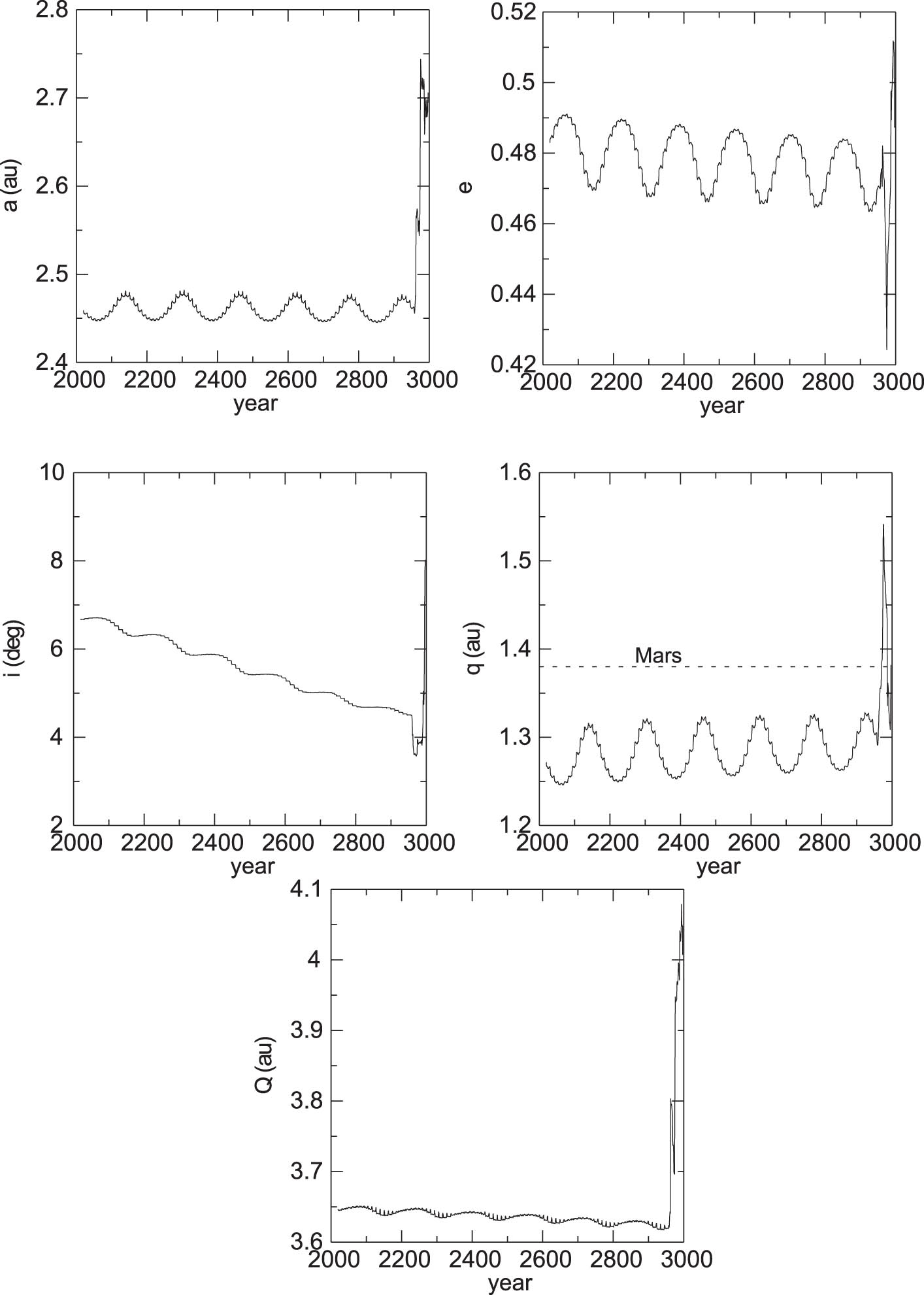
Asteroid 2017 UW42. The orbital evolution of the semimajor axis, eccentricity, inclination, perihelion distance, and aphelion distance of the asteroid 2017 UW42.
All orbital computations and analyses of results, including Figures 1, 2, 3, 4, 5, 6 using different software presented in this work was made by one of us (IW).
6 Summary
We discovered 83 asteroids at the Baldone Astrophysical Observatory (MPC 069) in 2017–2022. We studied one of the dynamically interesting Apollo (NEO) observed at the Baldone Astronomical Observatory, namely 428694 Saule (2008 OS9) and the Centaur-type asteroid 330836 Orius (2009 HW77). Additionally, we studied the orbit of the Amor-type asteroid 2017 UW42 with the significant non-gravitational parameter
Acknowledgement
We want to thank the anonymous reviewers for their many helpful suggestions. IW thanks the Space Research Center of the Polish Academy of Sciences in Warsaw for the chance to work on a computer cluster. Our thanks go to the ERDF Project No. 1.1.1.5/19/A/003.
-
Funding information: This work has been supported by the ERDF project No. 1.1.1.5/19/A/003 made by KC and IE.
-
Author contributions: All authors have accepted responsibility for the entire content of this manuscript and consented to its submission to the journal, reviewing all the results and approving the final version of the manuscript. KC and IE discovered all asteroids, and KC made Tables 1 and 2 with discoveries. IW developed the model code and performed the simulations. IW prepared the manuscript in Latex with contributions from all co-authors.
-
Conflict of interest: The authors state no conflict of interest.
-
Data availability statement: All starting data of orbital elements and the source code of the OrbFit software were accessed from: https://ssd.jpl.nasa.gov/tools/sbdb_lookup.html#/, https://minorplanetcenter.net/db_search and https://newton.spacedys.com/astdys/.
References
Bowell E, Chapman CR, Gradie JC, Morrison D, Zellner B. 1978. Taxonomy of asteroids. Icarus. 35:313–335. https://doi.org/10.1016/0019-1035(78)90085-4. Suche in Google Scholar
Chambers JE 1999. A hybrid symplectic integrator that permits close encounters between massive bodies. Monthly Notices R Astron Soc. 304:793–799. https://doi.org/10.1046/j.1365-8711.1999.02379.x. Suche in Google Scholar
Černis K, Eglitis I, Wlodarczyk I, Zdanavičius J, Zdanavičius K. 2010. The Apollo group asteroid 2008 OS9: Discovery, orbit, rotation and the Yarkovsky/YORP effects. Baltic Astron. 19:235–263. https://doi.org/10.1515/astro-2017-0424. Suche in Google Scholar
Černis K, Wlodarczyk I, Eglitis I. 2015. Observational data and orbits of the asteroids discovered at the Baldone Observatory in 2008–2013. Baltic Astron. 24:251–262. https://doi.org/10.1515/astro-2017-0226. Suche in Google Scholar
Dziadura K, Spoto F, Oszkiewicz D, Carry B, Bartczak P, Tanga P. 2022. Computing the Yarkovsky effect for asteroids in Gaia DR3. European Planetary Science Congress. https://doi.org/10.5194/epsc2022-649. Suche in Google Scholar
Farnocchia D, Chesley SR, Vokrouhlický D, Milani A, Spoto F, Bottke WF. 2013a. Near Earth asteroids with measurable Yarkovsky effect. Icarus. 224:1–13. https://doi.org/10.1016/j.icarus.2013.02.004. Suche in Google Scholar
Farnocchia D, Chesley SR, Chodas PW, Micheli M, Tholen DJ, Milani A, et al. 2013b. Yarkovsky-driven impact risk analysis for asteroid (99942) Apophis. Icarus 224:192–200. https://doi.org/10.1016/j.icarus.2013.02.020. Suche in Google Scholar
Fenucci M, Novaković B. 2022. MERCURY and ORBFIT packages for numerical integration of planetary systems: Implementation of the Yarkovsky and YORP effects. Serbian Astron J. 204:51–63. https://doi.org/10.2298/SAJ2204051F. Suche in Google Scholar
Fenucci M, Novaković B, Vokrouhlický D, Weryk RJ. 2021. Low thermal conductivity of the superfast rotator (499998) 2011 PT. Astron Astrophys. 647:A61. https://doi.org/10.1051/0004-6361/202039628. Suche in Google Scholar
Gustafsson A, Trilling DE, Mommert M, McNeill A, Hora JL, Smith HA, et al. 2019. Spitzer albedos of near-Earth objects. Astron J. 158:67. https://doi.org/10.3847/1538-3881/ab29ea. Suche in Google Scholar
Horner J, Evans NW, Bailey ME. 2004. Simulations of the population of Centaurs - I. The bulk statistics. Monthly Notices R Astron Soc. 354:798–810. https://doi.org/10.1111/j.1365-2966.2004.08240.x. Suche in Google Scholar
Hu S, Richardson DC, Zhang Y, Ji J. 2021. Critical spin periods of sub-km-sized cohesive rubble-pile asteroids: dependences on material parameters. Monthly Notices R Astronom Soc. 502:5277–5291. https://doi.org/10.1093/mnras/stab412. Suche in Google Scholar
Milani A 2006. Asteroid impact monitoring. Serbian Astronom J. 172:1–11. https://doi.org/10.2298/SAJ0672001M. Suche in Google Scholar
Milani A, Chesley SR, Sansaturio ME, Tommei G, Valsecchi GB. 2005a. Nonlinear impact monitoring: line of variation searches for impactors. Icarus 173:362–384. https://doi.org/10.1016/j.icarus.2004.09.002. Suche in Google Scholar
Milani A, Sansaturio ME, Tommei G, Arratia O, Chesley SR. 2005b. Multiple solutions for asteroid orbits: Computational procedure and applications. Astron Astrophys. 431:729–746. https://doi.org/10.1051/0004-6361:20041737. Suche in Google Scholar
Novakovic B, Fenucci M. 2022. Mercury and OrbFit packages for numerical orbit propagation: Implementation of the Yarkovsky and YORP effects. 16th Europlanet Science Congress. Spain: Palacio de Congresos de Granada.10.5194/epsc2022-620Suche in Google Scholar
Novaković B, Vokrouhlický D, Spoto F, Nesvornacute; D 2022. Asteroid families: properties, recent advances, and future opportunities. Celestial Mech Dyn Astron. 134:34. https://doi.org/10.1007/s10569-022-10091-7. Suche in Google Scholar
Perez-Hernandez J, Benet L. 2022. Non-zero Yarkovsky acceleration for near-Earth asteroid (99942) Apophis. AAS/Division Dynam Astron Meeting. 10.1038/s43247-021-00337-xSuche in Google Scholar
Pravec P, Vokrouhlický D, Polishook D, Scheeres DJ, Harris AW, Galad A, et al. 2010. Formation of asteroid pairs by rotational fission. Nature 466:1085–1088. https://doi.org/10.1038/nature09315. Suche in Google Scholar PubMed
Vereš P, Farnocchia D, Chesley SR, Chamberlin AB. 2017. Statistical analysis of astrometric errors for the most productive asteroid surveys. Icarus. 296:139–149. https://doi.org/10.1016/j.icarus.2017.05.021. Suche in Google Scholar
Wlodarczyk I, Cernis K, Eglitis I. 2011. Analysis of the orbit of the Centaur asteroid 2009 HW77. Monthly Notices R Astronom Soc 418:2330–2335. https://doi.org/10.1111/j.1365-2966.2011.19621.x. Suche in Google Scholar
Wlodarczyk I 2015. The Potentially Hazardous Asteroid (410777) 2009 FD. Acta Astronom. 65:215–231. Suche in Google Scholar
Wlodarczyk I, Černis K, Boyle RP. 2017. Discovery, orbit and orbital evolution of the distant object (463368) 2012 VU85. Acta Astronom. 67:81. https://doi.org/10.32023/0001-5237/67.1.6. Suche in Google Scholar
Włodarczyk I. 2018. Non-gravitational parameters in motion of asteroid. XXXVIII Polish Astron Soc Meet. 7:141–143. Suche in Google Scholar
Wlodarczyk I, Leliwa-Kopystynski J 2018. Forward orbital evolution of the Vesta Family with and without the Yarkovsky effect. Bulgarian Astron J. 28:79. Suche in Google Scholar
Wlodarczyk I. 2020. Bulgarian Astron J. 32:27. Suche in Google Scholar
Wlodarczyk I, Cernis K, Boyle RP. 2022a. Observational data and orbits of the asteroids discovered at the VATT Observatory in 2010–2012. Bulgarian Astron J. 2022;37:31.Suche in Google Scholar
Wlodarczyk I. 2022b. Non-gravitational parameters and orbital stability of asteroids in retrograde orbits. Monthly Notices R Astronom Soc. 516:6116–6122. https://doi.org/10.1093/mnras/stac2603. Suche in Google Scholar
© 2024 the author(s), published by De Gruyter
This work is licensed under the Creative Commons Attribution 4.0 International License.
Artikel in diesem Heft
- Research Articles
- A generalized super-twisting algorithm-based adaptive fixed-time controller for spacecraft pose tracking
- Retrograde infall of the intergalactic gas onto S-galaxy and activity of galactic nuclei
- Application of SDN-IP hybrid network multicast architecture in Commercial Aerospace Data Center
- Observations of comet C/1652 Y1 recorded in Korean histories
- Computing N-dimensional polytrope via power series
- Stability of granular media impacts morphological characteristics under different impact conditions
- Intelligent collision avoidance strategy for all-electric propulsion GEO satellite orbit transfer control
- Asteroids discovered in the Baldone Observatory between 2017 and 2022: The orbits of asteroid 428694 Saule and 330836 Orius
- Light curve modeling of the eclipsing binary systems V0876 Lyr, V3660 Oph, and V0988 Mon
- Modified Jeans instability and Friedmann equation from generalized Maxwellian distribution
- Special Issue: New Progress in Astrodynamics Applications - Part II
- Multidimensional visualization analysis based on large-scale GNSS data
- Parallel observations process of Tianwen-1 orbit determination
- A novel autonomous navigation constellation in the Earth–Moon system
Artikel in diesem Heft
- Research Articles
- A generalized super-twisting algorithm-based adaptive fixed-time controller for spacecraft pose tracking
- Retrograde infall of the intergalactic gas onto S-galaxy and activity of galactic nuclei
- Application of SDN-IP hybrid network multicast architecture in Commercial Aerospace Data Center
- Observations of comet C/1652 Y1 recorded in Korean histories
- Computing N-dimensional polytrope via power series
- Stability of granular media impacts morphological characteristics under different impact conditions
- Intelligent collision avoidance strategy for all-electric propulsion GEO satellite orbit transfer control
- Asteroids discovered in the Baldone Observatory between 2017 and 2022: The orbits of asteroid 428694 Saule and 330836 Orius
- Light curve modeling of the eclipsing binary systems V0876 Lyr, V3660 Oph, and V0988 Mon
- Modified Jeans instability and Friedmann equation from generalized Maxwellian distribution
- Special Issue: New Progress in Astrodynamics Applications - Part II
- Multidimensional visualization analysis based on large-scale GNSS data
- Parallel observations process of Tianwen-1 orbit determination
- A novel autonomous navigation constellation in the Earth–Moon system
