Political Rhetoric in the Hán Fēizǐ 韓非子
-
Lisa Indraccolo


Abstract
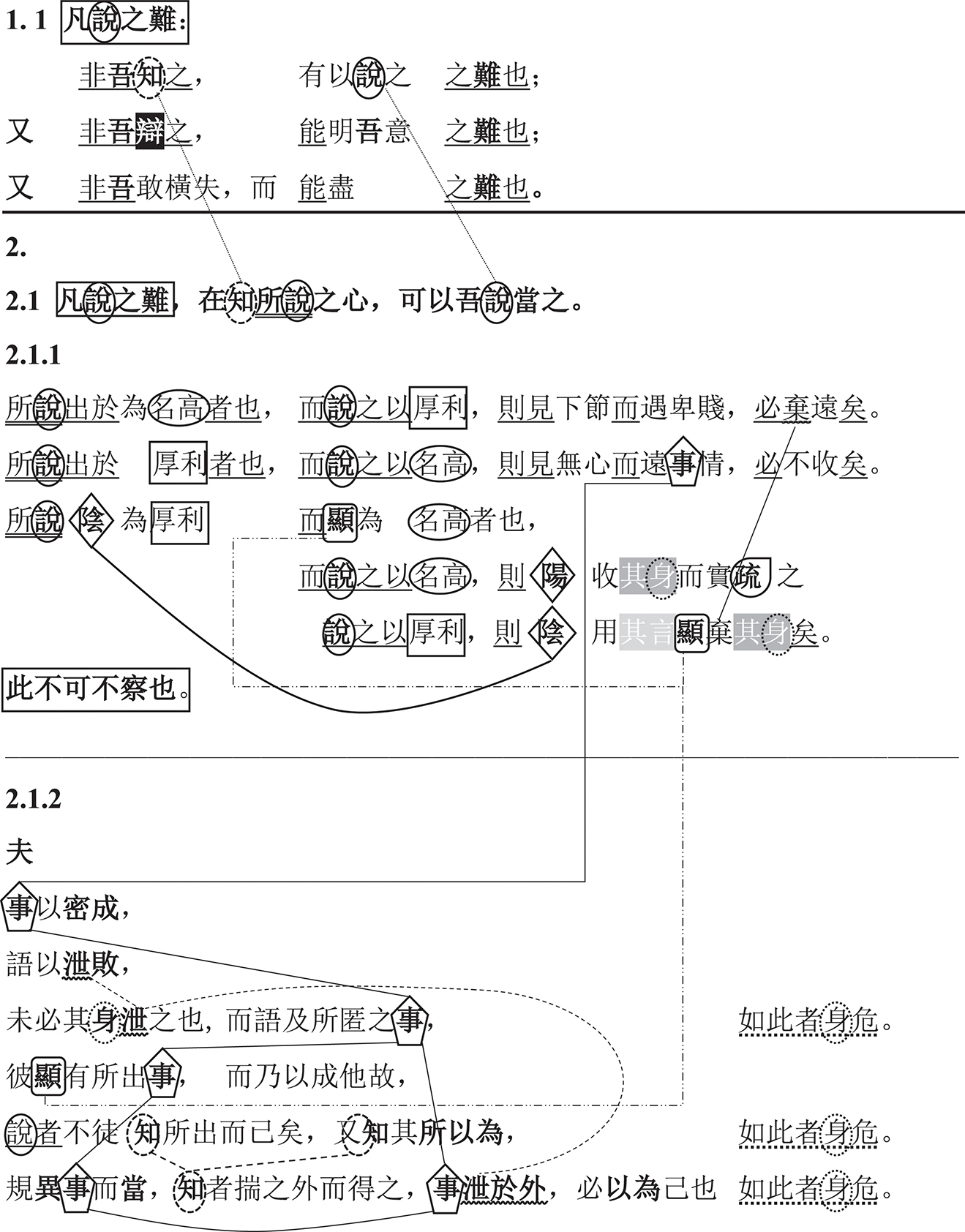
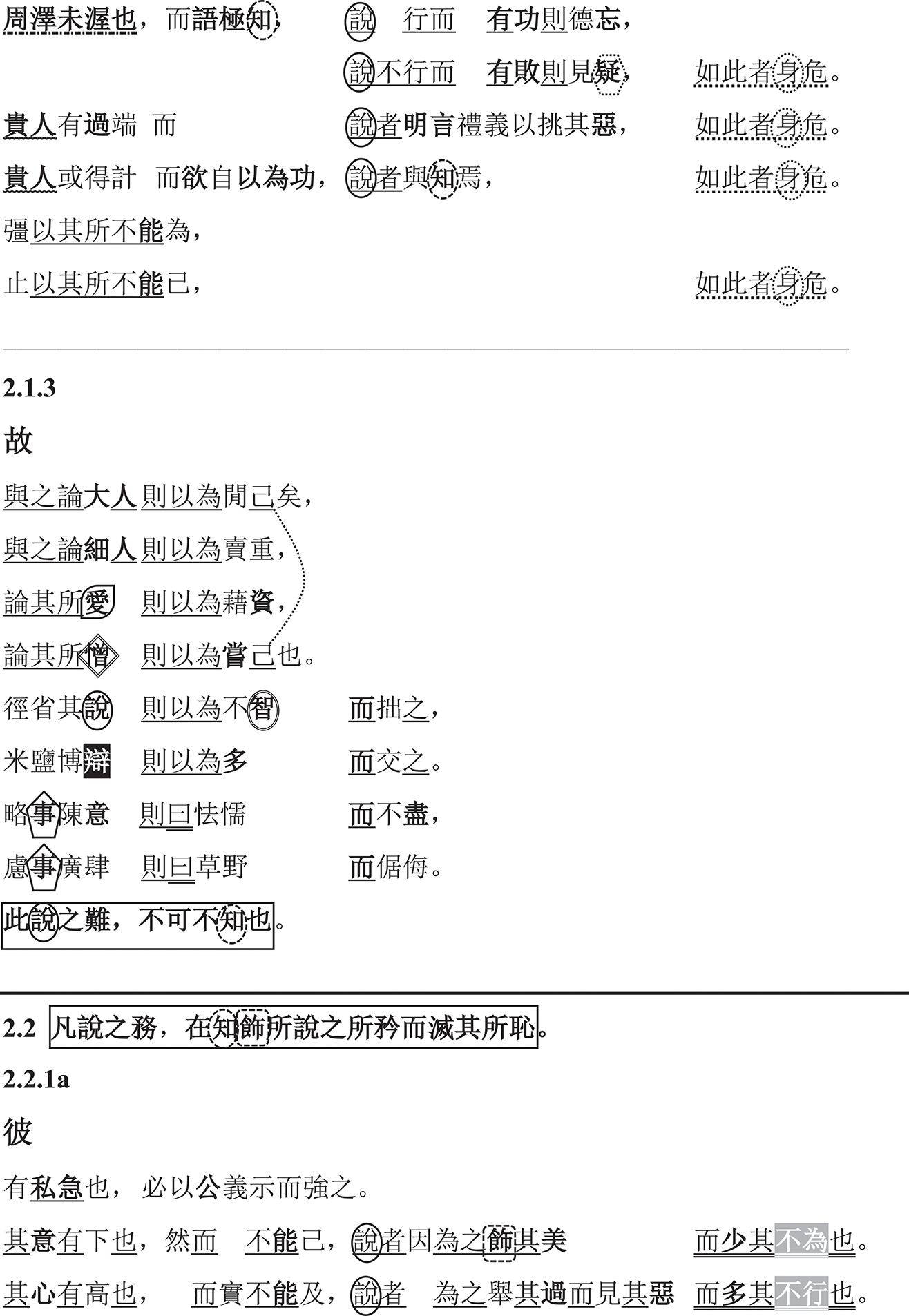
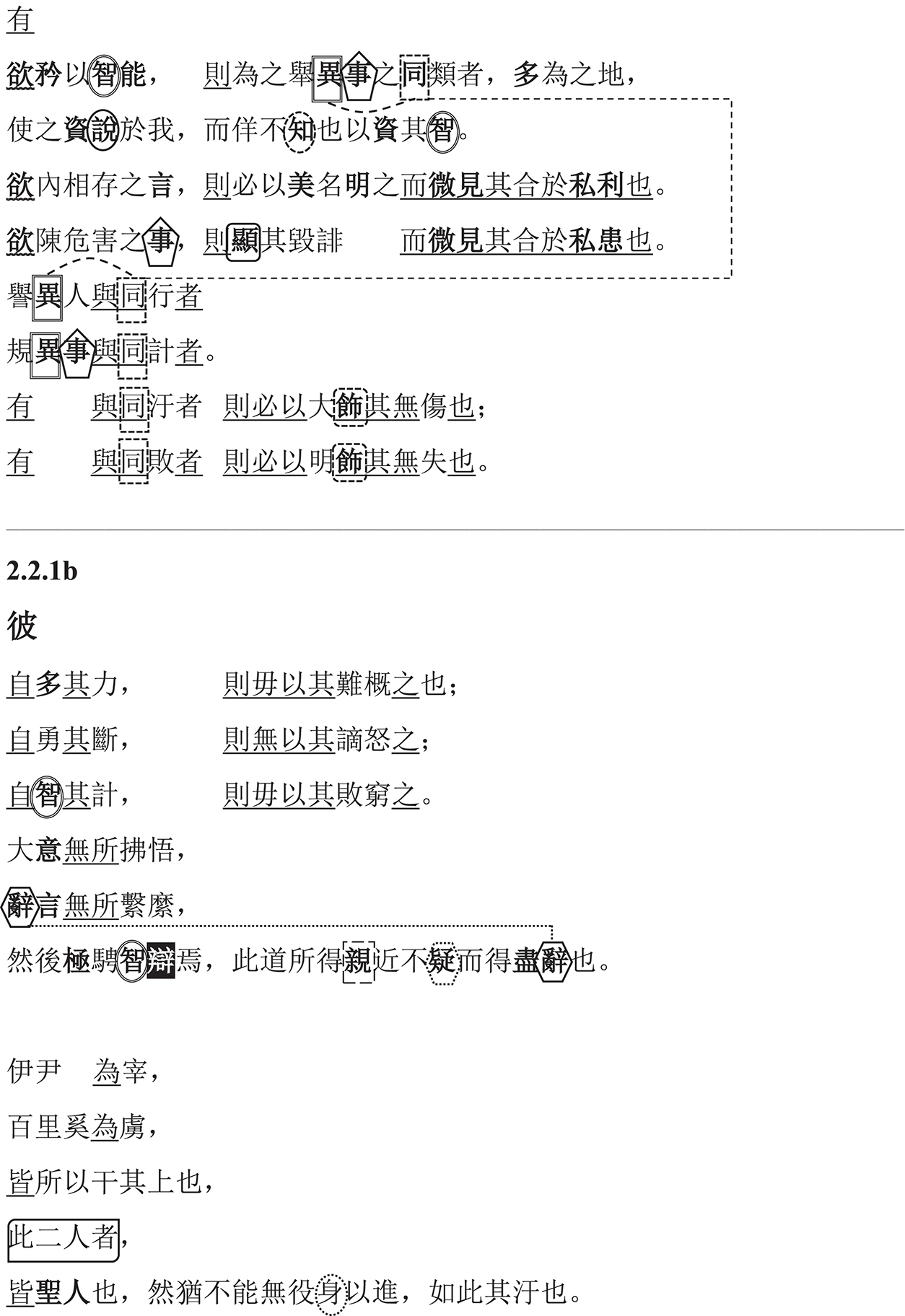
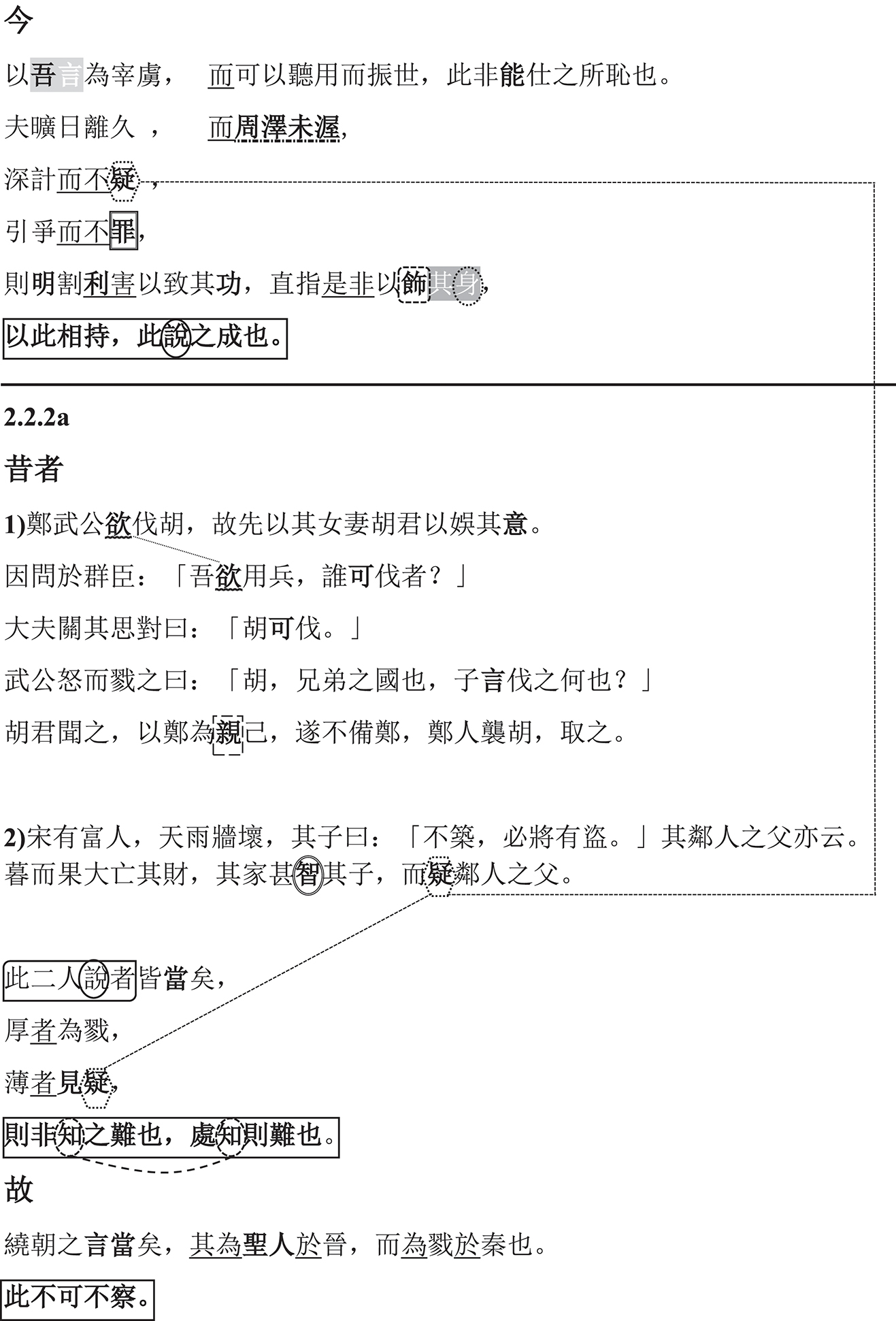
Persuasion is one of the main rhetorical techniques employed in debates by early Chinese “wandering persuaders,” as it is attested by several examples preserved in Classical Chinese pre-imperial and early imperial politico-philosophical literature. The present article contributes to the study of persuasion by providing a detailed structural analysis of one of the most famous texts that openly deals with this technique, Chapter 12 ‘Shuìnán’ 說難 (The Difficulties of Persuasion) of the composite “Masters text” Hán Fēizǐ 韓非子. Through such analysis, the article discloses the complex, multi-layered underlying rhetorical structure of the text, and the thick network of conceptual cross-references that are established among its different sections through the ingenious distribution of different kinds of text-structuring elements. As the present case study will show, this type of analysis is an invaluable hermeneutic tool that provides a substantial contribution to a better and fuller understanding of Classical Chinese texts.
Acknowledgements
I would like to thank Yuri Pines, Paul R. Goldin, Wolfgang Behr, and the two anonymous reviewers for providing useful feedback and helpful comments and suggestions for improvement on a previous version of this article. The present article is based on the paper “Though Talk – Power relations, political rhetoric and cunning speech in the Hán Fēizǐ 韓非子,” presented at the 21st International Conference on Chinese Philosophy, University of Berne, Switzerland, 2nd–5th July 2019.
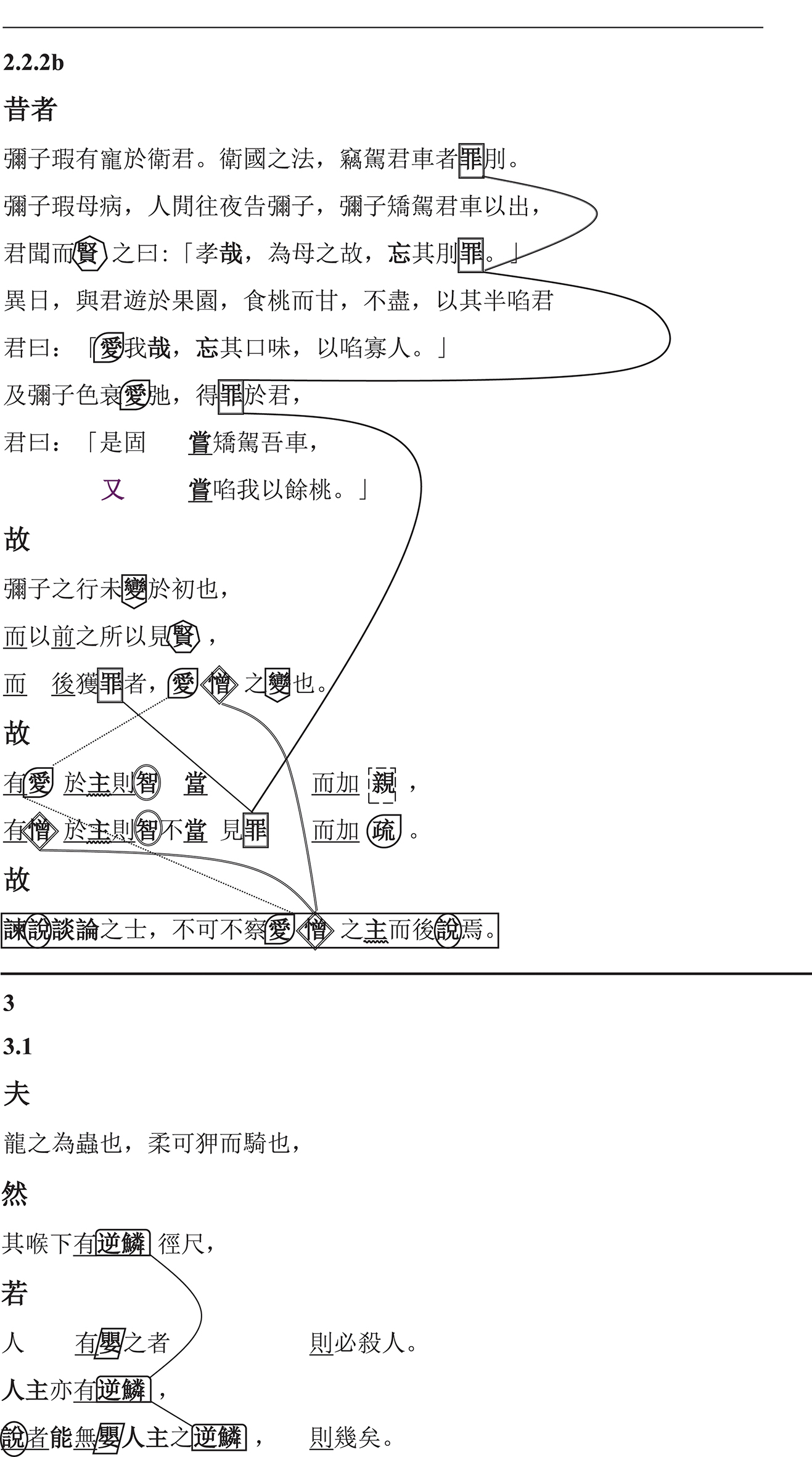
APPENDIX A: Table of binary opposites in orderof appearance in the text
| shuì 說 | biàn 辯 |
| mínggāo 名高 | hòulì 厚利 |
| shì 事 | yán 言 |
| yīn 陰 | yáng 陽 |
| gōng 功 | bài 敗 |
| ài 愛 | zēng 憎 |
| dàrén 大人 | xìrén 細人 |
| sī 私 | gōng 公 |
| shì 飾 | shǎo 少 |
| yì 意 | xīn 心 |
| yì 異 | tóng 同 |
| sīlì 私利 | sīhuàn 私患 |
| xián 賢 | zuì 罪 |
| qīn 親 | shū 疏 |
APPENDIX B: Structural analysis
1.
Bibliography
Behr, Wolfgang (2005): “Three Sound-correlated Text Structuring Devices in Pre-Qín Philosophical Prose.” In: Komposition und Konnotation – Figuren der Kunstprosa im alten China. Edited by Wolfgang Behr, Joachim Gentz. Special issue of Bochumer Jahrbuch zur Ostasienforschung 29: 15–33. Suche in Google Scholar
Behr, Wolfgang, Gentz, Joachim (eds.) (2005): Komposition und Konnotation – Figuren der Kunstprosa im alten China. Special issue of Bochumer Jahrbuch zur Ostasienforschung 29. Suche in Google Scholar
Behr, Wolfgang, Indraccolo, Lisa (eds.) (2014): Masters of Disguise? Conceptions and Misconceptions of ‘Rhetoric’ in Chinese Antiquity. Special issue of Asiatische Studien/Études Asiatiques 68.4. 10.1515/asia-2014-0064Suche in Google Scholar
Behr, Wolfgang, Indraccolo, Lisa (forthc.): “Transition Terms in the Hán Fēizǐ 韓非子.” In: Warp, Woof, Wen/Phoneme, Pattern, Pun – Structural Approaches to Early Chinese Texts. Edited by Wolfgang Behr, Lisa Indraccolo.Suche in Google Scholar
Boltz, Willian G. (1999): “The Fourth-Century B.C. Guodiann Manuscripts from Chuu and the Composition of the Laotzyy.” Journal of the American Oriental Society 119: 590–608.10.2307/604836Suche in Google Scholar
Boltz, Willian G. (2005): “The Composite Nature of Early Chinese Texts.” In: Text and Ritual in Early China. Edited by Martin Kern. Seattle: University of Washington Press, 50–78.10.1515/9780295800318-003Suche in Google Scholar
Chan, Shirley (2004): The Confucian Shi, Official Service, and the Confucian Analects. Lewiston, NY: Edwin Mellen.Suche in Google Scholar
Chemla, Karine (ed.) (1992): Regards obliques sur l’argumentation en China, Special issue of Extrême Orient-Extrême Occident 14.10.3406/oroc.1992.964Suche in Google Scholar
Chén Huìjuān 陳蕙娟 (2004): Hán Fēizǐ zhéxué xīntàn 韓非子哲學新探 (A New Discussion on Han Feizi’s Philosophy). Táiběi 台北: Wénshǐzhé 文史哲.Suche in Google Scholar
Crone, Thomas, Schwermann, Christian (eds.) (forthc.): The History of Remonstrance in China: From the Beginnings to the Medieval Period. Göttingen: Vandenhoeck & Ruprecht/Bonn University Press.Suche in Google Scholar
Crump, James I. Jr. (1964): 戰國策 Intrigues: Studies of the Chan-kuo Ts’e. Ann Arbor: The University of Michigan Press.Suche in Google Scholar
Crump, James I. Jr. (1979): Chan-kuo Ts’e. San Francisco: Chinese Materials Center Inc.Suche in Google Scholar
Csikszentmihalyi, Mark (2002): “Traditional Taxonomies and Revealed Texts in the Han.” In: Daoist Identity – History, Lineage, and Ritual. Edited by Livia Kohn, Harold D. Roth. Honolulu: University of Hawai’i Press, 81–101.10.1515/9780824862138-006Suche in Google Scholar
Csikszentmihalyi, Mark, Nylan, Michael (2003): “Constructing Lineages and Inventing Traditions through Exemplary Figures in Early China.” T’oung Pao 83: 59–99.10.1163/156853203322691329Suche in Google Scholar
Debon, Günther (1996) [1993]: „Der Reimspruch im philosophischen Schrifttums Chinas.“ So der Westen wie der Osten. Dichtung, Kunst und Philosophie in Deutschland und China. Edited by Günther Debon. Heidelberg: Guderjahn, 36–42.Suche in Google Scholar
Du, Heng (2010): The Tapestry of Vignette Collections – A Study of the “Chu Shuo” Chapters of the Hanfeizi, M.A. thesis, University of Colorado at Boulder, unpublished.Suche in Google Scholar
Du, Heng (2017): “From Villains Outwitted to Pedants Out-Wrangled: The Function of Anecdotes in the Shifting Rhetoric of the Han Feizi.” In: Between History and Philosophy – Anecdotes in Early China. Edited by Paul van Els, Sarah A. Queen. Albany: SUNY, 193–228.10.1515/9781438466132-008Suche in Google Scholar
Du, Heng (2020): “The Mastery of Miscellanea: Information Management and Knowledge Acquisition in the ‘Chu shuo’ Chapters of the Hanfeizi.” Journal of the American Oriental Society 140.1: 115–141.10.7817/jameroriesoci.140.1.0115Suche in Google Scholar
Galvany, Albert (2012): “Sly Mouths and Silver Tongues: The Dynamics of Psychological Persuasion in Ancient China.” In: Political Rhetoric in Early China/Rhétorique et politique en Chine ancienne. Edited by Paul van Els, Romain Graziani, Yuri Pines, Elisa Sabattini. Special issue of Extrême Orient/Extrême Occident 34: 15–40. 10.4000/extremeorient.250Suche in Google Scholar
Galvany, Albert (2017): “The Court as a Battlefield: The Art of War and the Art of Politics in the Han Feizi.” Bulletin of the School of Oriental and African Studies 80.1: 73–96.10.1017/S0041977X16001063Suche in Google Scholar
Garrett, Mary M. (1993): “Classical Chinese Conceptions of Argumentation and Persuasion.” Argumentation and Advocacy 29.3: 105–115.10.1080/00028533.1993.11951559Suche in Google Scholar
Gentz, Joachim (2005): “Zwischen den Argumenten lesen. Doppelt gerichtete Parallelismen zwischen Argumenten als zentrale Thesen in frühen chinesischen Texten.” In: Komposition und Konnotation – Figuren der Kunstprosa im alten China. Edited by Wolfgang Behr, Joachim Gentz. Special issue of Bochumer Jahrbuch zur Ostasienforschung Vol. 29: 35–56.Suche in Google Scholar
Gentz, Joachim (2007): “Zum Parallelismus in der chinesischen Literatur.” In: Parallelismus Membrorum. Edited by Andreas Wagner. Fribourg: Academic Press, Göttingen: Vendenhoeck and Ruprecht, 241–269.Suche in Google Scholar
Gentz, Joachim, Meyer, Dirk (eds.) (2015): Literary Forms of Argument in Early China. Leiden/Boston: E.J. Brill.10.1163/9789004299702Suche in Google Scholar
Goldin, Paul R. (1993): “Miching Mallecho: The Zhanguoce and Classical Rhetoric.” Sino-Platonic Papers 41: 1–27.Suche in Google Scholar
Goldin, Paul R. (2005a): “The Theme of the Primacy of the Situation in Classical Chinese Philosophy and Rhetoric.” Asia Major, Third Series 18.2: 1–25.Suche in Google Scholar
Goldin, Paul R. (2005b): “Rhetoric and Machination in Stratagems of the Warring States.” In: After Confucius – Studies in Early Chinese Philosophy. Goldin is the author of the volume, not the editor. Honolulu: University of Hawai’i Press, 76–89.Suche in Google Scholar
Goldin, Paul R. (2005c): “Han Fei’s Doctrine of Self Interest.” In: After Confucius – Studies in Early Chinese Philosophy. Goldin is the author of the volume, not the editor. Honolulu: University of Hawai’i Press, 58–65.Suche in Google Scholar
Goldin, Paul R. (ed.) (2013): Dao Companion to the Philosophy of Han Fei. Dordrecht/ Heidelberg/London/New York: Springer.10.1007/978-94-007-4318-2Suche in Google Scholar
Goldin, Paul R. (2020): The Art of Chinese Philosophy – Eight Classical Texts and How to Read Them. Princeton/Oxford: Princeton University Press.10.1515/9780691200811Suche in Google Scholar
Graziani, Romain (2012): “Rhetoric that Kills, Rhetoric that Heals.” In: Political Rhetoric in Early China/ Rhétorique et politique en Chine ancienne. Edited by Paul van Els, Romain Graziani, Yuri Pines, Elisa Sabattini. Special issue of Extrême Orient-Extrême Occident 34: 41–78.10.4000/extremeorient.252Suche in Google Scholar
Graziani, Romain (2017): “Monarch and Minister: The Problematic Partnership in the Building of Absolute Monarchy in the Han Feizi 韩非子.” In: Ideology of Power and Power of Ideology in Early China. Edited by Yuri Pines, Paul R. Goldin, Martin Kern. Leiden/Boston: E.J. Brill, 155–180.10.1163/9789004299337_007Suche in Google Scholar
Harbsmeier, Christoph (1997): “Xunzi and the Problem of Impersonal First Pronouns.” Early China 22: 181–220.10.1017/S0362502800003278Suche in Google Scholar
Heirman, Ann, Dessein, Bart (1998): “*NGO 吾 and *NGÂ 我.” Asiatische Studien/Études Asiatiques 52.3: 695–761.Suche in Google Scholar
Huáng Shèngzhāng 黃盛璋 (1963): ““Gǔ Hànyǔ de rénshēn dàicí yánjiū” 古漢語的人身代詞研究 (A Study of Personal Pronouns in Ancient Chinese)”. Zhongguó Yuwén 中国语文 6: 443–472.Suche in Google Scholar
Hunter, Michael (2013): “The Difficulty with the ‘Difficulties of Persuasion’ (“Shuinan” 說難).” In: Dao Companion to the Philosophy of Han Fei. Edited by Paul R. Goldin. Dordrecht/Heidelberg/London/New York: Springer, 169–195.10.1007/978-94-007-4318-2_9Suche in Google Scholar
Indraccolo, Lisa (2020): “Argumentation (Biàn 辯).” In: Dao Companion to Chinese Philosophy of Logic. Edited by Fung Yiu-ming. Dordrecht/Heidelberg/London/New York: Springer.10.1007/978-3-030-29033-7_10Suche in Google Scholar
Indraccolo, Lisa (forthc.): “Argumentation and Persuasion in Classical Chinese Literature.” In: Essays on Argumentation in Antiquity. Edited by Joseph Bjelde, David Merry, Christopher Roser. Dordrecht/Heidelberg/London/New York: Springer.Suche in Google Scholar
Karapet’janc, Artemij M. [=Карапетья́нц, Арте́мий Миха́йлович]/Krushinskij, Andrej A. [Крушинский, Андрей Андре́евич] (1998): “Современные достижения B Формальном aнализе ‘Дао Дэ Цзина’” (“Sovremennye dostiženija v formal’nom analize ‘Dao De Dzina’” “Recent Advances in the Formal Analysis of the ‘Dao De Jing’”). Оm mагической cилы k mоральному императиву: kатегория дэ b китайской культуре (Ot magičeskoj sily k moral’nomu imperativu: kategorija de v kitajskoj kul’ture). Moscow: Rossijskaja Akademija Nauk, 340–406.Suche in Google Scholar
Karapet’janc, Artemij M. [=Карапетья́нц, Арте́мий Миха́йлович] (2015): Раннекитайская Системология [Rannekitaiskaja Sistemologija, Early Chinese ‘Systemology’]. Moscow: Vostočnaja Literatura.Suche in Google Scholar
Kern, Martin (2000): “‘Persuasion’ or ‘Treatise’? the Prose Genre Shui 說 and Shuo 說 in the Light of the Guwenci Leizhuan of 1779.” Ad Seres et Tungusos – Festschrift für Martin Gimm zu seinem 65. Geburtstag am 25. Mai 1995. Edited by Lutz Bieg, Erling von Mende, Martina Siebert. Wiesbaden: Harassowitz Verlag, 221–245.Suche in Google Scholar
Kern, Martin (ed.) (2005): Text and Ritual in Early China. Seattle: University of Washington Press.Suche in Google Scholar
Kern, Martin (2015a): “Language and the Ideology of Kingship in the ‘Canon of Yao’.” In: Ideology of Power and Power of Ideology in Early China. Edited by Yuri Pines, Paul R. Goldin, Martin Kern. Leiden/Boston: E.J. Brill, 118–151.10.1163/9789004299337_006Suche in Google Scholar
Kern, Martin (2015b): “Speaking of Poetry: Pattern and Argument in the ‘Kongzi Shilun’.” In: Literary Forms of Argument in Early China. Edited by Joachim Gentz, Dirk Meyer. Leiden/Boston: E.J. Brill, 175–200.10.1163/9789004299702_008Suche in Google Scholar
Kern, Martin, Meyer, Dirk (eds.) (2017): Origins of Chinese Political Philosophy – Studies in the Composition and Thought of the Shangshu (Classic of Documents). Leiden/Boston: E.J. Brill.10.1163/9789004343504Suche in Google Scholar
Krijgsman, Rens (2014): “Traveling Sayings as Carriers of Philosophical Debate: From the Intertextuality of the *Yucong 語叢 to the Dynamics of Cultural Memory and Authorship in Early China.” Asiatische Studien/Études Asiatiques 68.1: 83–115.10.1515/asia-2014-0006Suche in Google Scholar
Kroll, Jurij L. (1985-86): “Disputation in Ancient Chinese Culture.” Early China 11–12: 119–145.10.1017/S0362502800003989Suche in Google Scholar
Levi, Jean (1992): “L’Art de la Persuasion à l’Epoque des Royaumes Combattants (Ve–IIIe Siècles a.v. J.C.).” Extrême Orient-Extrême Occident 14: 49–89.10.3406/oroc.1992.963Suche in Google Scholar
Lewis, Mark E. (1999): Writing and Authority in Early China. Albany: SUNY.Suche in Google Scholar
Lu, Xing Frank, David A. (1993): “On the Study of Ancient Chinese Rhetoric/Bian 辩.” Western Journal of Communication 57.4: 445–463.10.1080/10570319309374467Suche in Google Scholar
Lu, Xing (1998): Rhetoric in Ancient China, Fifth to Third Century B.C.E. – A Comparison with Classical Greek Rhetoric. Columbia, SC: University of South Carolina Press.Suche in Google Scholar
Lundahl, Bertil (1992): Han Fei Zi. The Man and the Work. Stockholm: Institute of Oriental Languages, University of Stockholm.Suche in Google Scholar
McCraw, David (1995): “Pursuing Zhuangzi as Rhymester: A Snark-hunt in Eight Fits.” Sino-Platonic Papers 67: 1–38.Suche in Google Scholar
McCraw, David (2006): “Criss-Cross: Introducing Chiasmus in Old Chinese Literature.” Chinese Literature: Essays, Articles, Reviews 28: 67–124.Suche in Google Scholar
Meyer, Dirk (2005): “A Device for Conveying Meaning: The Structure of the Guodian Tomb One Manuscript ‘Zhong xin zhi dao’”. In: Komposition und Konnotation – Figuren der Kunstprosa im alten China. Edited by Wolfgang Behr, Joachim Gentz. Special issue of Bochumer Jahrbuch zur Ostasienforschung 29: 57–78. Suche in Google Scholar
Meyer, Dirk (2005–6): “Structure as a Means of Persuasion as Seen in the Manuscript Qiong da yi shi 窮達以時 from Tomb One, Guodian.” Oriens Extremus 45: 173–210.Suche in Google Scholar
Meyer, Dirk (2011): Philosophy on Bamboo: Text and the Production of Meaning in Early China. Leiden/ Boston: E.J. Brill.10.1163/9789004208087Suche in Google Scholar
Meyer, Dirk (forthc.): Documentation and Argument in Early China: The Shàngshū 尚書 (Venerated Scriptures) and the “Shū” Traditions. Berlin: De Gruyter.10.1515/9783110708530Suche in Google Scholar
Meyer, Dirk, Indraccolo, Lisa (forthc.): “Sentences, Paragraphs, and Sections.” In: Literary Information in China – A History. Edited by Jack W. Chen, Anatoly Detwyler, Xiao Liu, Christopher Nugent, Bruce Rusk. New York: Columbia University Press.Suche in Google Scholar
Nylan, Michael (2000): “Textual Authority in Pre-Han and Han.” Early China 25: 205–258.10.1017/S0362502800004314Suche in Google Scholar
Nylan, Michael (2014): “Logical Connectives in the Huainanzi.” In: The Huainanzi and Textual Production in Early China. Edited by Sarah A. Queen, Michael J. Puett. Leiden/Boston: E.J. Brill, 225–266.10.1163/9789004265325_009Suche in Google Scholar
Olberding, Garret P. (ed.) (2013): Facing the Monarch – Modes of Advice in the Early Chinese Court. Cambridge, MA.: Harvard University Press.10.1163/9781684175345Suche in Google Scholar
Petersen, Jens Østergaard (1995): “Which Books Did the First Emperor of Ch’in Burn? On the Meaning of Pai Chia in Early Chinese Sources.” Monumenta Serica 43: 1–52.10.1080/02549948.1995.11731268Suche in Google Scholar
Pines, Yuri (2009): Envisioning Eternal Empire – Chinese Political Thought of the Warring States Era. Honolulu: University of Hawai’i Press.10.21313/hawaii/9780824832759.001.0001Suche in Google Scholar
Pines, Yuri (2012): The Everlasting Empire – The Political Culture of Ancient China and Its Imperial Legacy. Princeton: Princeton University Press.10.23943/princeton/9780691134956.001.0001Suche in Google Scholar
Pines, Yuri (2013): “From Teachers to Subjects: Ministers Speaking to the Rulers from Yan Ying 晏嬰 to Li Si 李斯.” In: Facing the Monarch – Modes of Advice in the Early Chinese Court. Edited by Garret P. Olberding. Cambridge, MA: Harvard University Press.10.1163/9781684175345_005Suche in Google Scholar
Pines, Yuri, Goldin, Paul R., Kern, Martin (eds.) (2015): Ideology of Power and Power of Ideology in Early China. Leiden/Boston: E.J. Brill.10.1163/9789004299337Suche in Google Scholar
Pohl, Karl-Heinz, Wöhrle, Georg (eds.) (2011): Form und Gehalt in Texten der griechischen und chinesischen Philosophie. Stuttgart: F. Steiner.Suche in Google Scholar
Queen, Sarah A., Puett, Michael (eds.) (2014): The Huainanzi and Textual Production in Early China. Leiden/Boston: E.J. Brill.10.1163/9789004265325Suche in Google Scholar
Reding, Jean-Paul (1985): Les fondements philosophiques de la rhétorique chez les sophistes grecs et chez les sophistes chinois. Berne/Frankfurt/New York: Peter Lang.Suche in Google Scholar
Reeve, Michael (2003): Demonstrating the World: Mind and Society in the ‘Shuo Lin’ Chapters of the Han Fei Zi, Ph.D. Diss, Princeton University, unpublished.Suche in Google Scholar
Richter, Matthias L. (2005): Guan ren: Texte der altchinesischen Literatur zur Charakterkunde und Beamtenrekrutierung. Bern: Peter Lang.Suche in Google Scholar
Richter, Matthias L. (2013): The Embodied Text – Establishing Textual Identity in Early Chinese Manuscripts. Leiden/Boston: E.J. Brill.10.1163/9789004243811Suche in Google Scholar
Richter, Matthias L. (2014): “Handling a Double-edged Sword: Controlling Rhetoric in Early China.” In: Masters of Disguise? Conceptions and Misconceptions of ‘Rhetoric’ in Chinese Antiquity. Edited by Wolfgang Behr, Lisa Indraccolo. Special issue of Asiatische Studien/Études asiatiques 68.4: 1021–1068. 10.1515/asia-2014-0048Suche in Google Scholar
Roetz, Heiner (2019): “On Political Dissent in Warring States China.” In: Criticising the Ruler in Pre-Modern Societies – Possibilities, Chances, and Methods. Edited by Karina Kellermann, Alheydis Plassmann, Christian Schwermann. Göttingen: Vandenhoeck & Ruprecht/Bonn University Press, 211–236.10.14220/9783737010887.211Suche in Google Scholar
Róng Zhàozǔ 容肇祖 (repr. 1982): “Hán Fēizǐ zhùzuò kǎo” 韓非子著作考 (“A Study on the Authorship of the Han Feizi”).” In: Gǔshǐ biàn 古史辨 (Distinguishing Ancient History). Edited by Gù Jiégāng 顧頡剛, Luó Gēnzé 羅根澤, Lǚ Sīmiǎn 呂思勉, Tóng Shūye 童書業. Vol. 4. Shànghǎi 上海: Shànghǎi Gǔjí Chūbǎnshè 上海古籍出版社, 653–674.Suche in Google Scholar
Ryden, Edmund (1996): “Was Confucius a Confucian? Confusion over the Use of the Term ‘School’ in Chinese Philosophy.” Early China News 9.5–9: 28–29.Suche in Google Scholar
Rykov, Stanislav (2016): “The ‘School of Structural Analysis’ in Modern Russian Sinology.” Journal of World Philosophies 1.1: 26–40.10.2979/jourworlphil.1.1.03Suche in Google Scholar
Schaberg, David (2002): A Patterned Past – Form and Thought in Early Chinese Historiography. Cambridge, MA: Harvard University Press.10.1163/9781684173617Suche in Google Scholar
Schaberg, David (2005): “Playing at Critique: Indirect Remonstrance and Formation of Shi Identity.” In: Text and Ritual in Early China. Edited by Martin Kern. Seattle: University of Washington Press, 194–225.10.1515/9780295800318-007Suche in Google Scholar
Schaberg, David (2015): “On the Range and Performance of Laozi-Style Tetrasyllables.” In: Literary Forms of Argument in Early China. Edited by Joachim Gentz, Dirk Meyer. Leiden/Boston: E.J. Brill, 87–111.10.1163/9789004299702_005Suche in Google Scholar
Schaberg, David (2016): “The Ruling Mind. Persuasion and the Origins of Chinese Psychology.” In: The Rhetoric of Hiddenness in Traditional Chinese Culture. Edited by Paula Varsano. Albany: SUNY.10.1515/9781438463049-004Suche in Google Scholar
Schilling, Dennis (2011): „Parataktische Strukturen in den Lehrsprüchen der frühen konfuzianischen Schulen. Eine Studie zum Zusammenhang von Form und Gehalt im Lun yǔ.“ In: Form und Gehalt in Texten der griechischen und chinesischen Philosophie. Edited by Karl-Heinz Pohl, Georg Wöhrle. Stuttgart: F. Steiner, 59–76.Suche in Google Scholar
Schwermann, Christian (2005): „Collage-Technik als Kompositionsprinzip klassischer chinesischer Prosa: Der Aufbau des Kapitels ‚Tāng wèn‘ (Die Fragen des Tāng) im Liè zǐ.“ In: Komposition und Konnotation – Figuren der Kunstprosa im alten China. Edited by Wolfgang Behr, Joachim Gentz. Special issue of Bochumer Jahrbuch zur Ostasienforschung 29: 125–160. Suche in Google Scholar
Smith, Kidder (2003): “Sima Tan and the Invention of Daoism, ‘Legalism’ Et Cetera.” The Journal of Asian Studies 62.1: 129–156.10.2307/3096138Suche in Google Scholar
Spirin, Vladimir S. [Спирин, Владимир Семёнович] (1976): Построение древнекитайских Tекстов [Postroenie drevnekitajskih tekstov, The Construction of Old Chinese Texts]. Moscow: Nauka.Suche in Google Scholar
Spirin, Vladimir S. (1991): “Composition des textes chinois anciens.” In: Modèles et structures des textes chinois anciens: les formalistes soviétiques en sinologie. Edited by Karine Chemla, Alexeï Volkov, Vera Dorofeeva-Lichtmann. Special issue of Extrême Orient-Extrême Occident 13: 31–57. 10.3406/oroc.1991.1042Suche in Google Scholar
Suddath, Virginia D. (2005): The Junzi Doth Protest. Toward a Philosophy of Remonstrance in Confucianism. Ph.D. Diss., University of Hawai’i, unpublished.Suche in Google Scholar
Tharsen, Jeffrey R. (2015): Chinese Euphonics. Phonetic Patterns, Phonorhetoric and Literary Artistry in Early Chinese Narrative Texts. Ph.D. Diss, University of Chicago, unpublished.Suche in Google Scholar
van Els, Paul, Graziani, Romain, Pines, Yuri, Sabattini, Elisa (eds.) (2012): Political Rhetoric in Early China/Rhétorique et politique en Chine ancienne, Special Issue of Extrême Orient-Extrême Occident 34.10.4000/extremeorient.247Suche in Google Scholar
van Ess, Hans (2005–06): “Argument and Persuasion in the First Chapter of the Huainanzi and Its Use of Particles.” Oriens Extremus 45: 250–270.Suche in Google Scholar
Volkov, Alexeï (1991): “La structure des textes chinois anciens: quelques remarques.” In: Modèles et structures des textes chinois anciens: les formalistes soviétiques en sinologie. Edited by Karine Chemla, Alexeï Volkov, Vera Dorofeeva-Lichtmann. Special issue of Extrême Orient-Extrême Occident 13: 155–161. 10.3406/oroc.1991.1048Suche in Google Scholar
Wagner, Rudolph G. (1980): “Interlocking Parallel Style: Laozi and Wang Bi.” Asiatische Studien/Études Asiatiques 34.1: 18–58.Suche in Google Scholar
Wagner, Rudolph G. (1999): “The Impact of Conceptions of Rhetoric and Style upon the Formation of Early Laozi Editions: Evidence from Guodian, Mawangdui and the Wang Bi Laozi.” Transactions of the International Conference of Eastern Studies 44: 32–56.Suche in Google Scholar
Wagner, Rudolph G. (2015): “A Building Block of Chinese Argumentation: Initial Fu 夫 as A Phrase Status Marker.” In: Literary Forms of Argument in Early China. Edited by Joachim Gentz, Dirk Meyer. Leiden/Boston: E.J. Brill, 37–66.10.1163/9789004299702_003Suche in Google Scholar
Weingarten, Oliver (2016): “The Singing Sage: Rhymes in Confucius Dialogues.” Bulletin of the School of Oriental and African Studies 79.3: 581–607.10.1017/S0041977X16000574Suche in Google Scholar
Weingarten, Oliver (2019): “Intertextuality and Memory in Early Chinese Writing: A Case Study from Huainanzi.” Early China 42: 201–236.10.1017/eac.2019.4Suche in Google Scholar
Xú Shìduān 徐适端 (1990): “Hán Fēizǐ rénchēng dàicí de shǐyòng tèdiǎn” 《韩非子》人称代词的使用特点 (The Characteristics of the Use of Personal Pronouns in the Hán Fēizǐ). Xinán Shifàn Dàxué Xuébào 西南师范大学学报 1: 102–111.Suche in Google Scholar
Zádrapa, Lukáš (transl.) (2011–13): Chan-fej-c’, Vol. 2 . Praha: Academia.Suche in Google Scholar
Zádrapa, Lukáš (2014): “A Weapon in the Battle of Definitions: A Special Rhetorical Strategy in Hanfēizǐ.” In: Masters of Disguise? Conceptions and Misconceptions of ‘Rhetoric’ in Chinese Antiquity. Edited by Wolfgang Behr, Lisa Indraccolo. Special issue of Asiatische Studien/Études Asiatiques 68.4: 969–999. 10.1515/asia-2014-0044Suche in Google Scholar
Zhào Púsōng 赵璞嵩 (2018): Shànggǔ Hànyǔ yùnsù yánjiū – yǐ ‘wú’ ‘wǒ’ wéi lì 上古汉语韵素研究—以 “吾” “我” 为例 (A Study of Mora in Old Chinese – Taking “I” (“wú”) and “I, me” (“wǒ”) as a case study). Běijīng 北京: Běijīng Yǔyán Dàxué Chūbǎnshè 北京语言大学出版社.Suche in Google Scholar
Zhōu Shēngyà 周生亚 (1980): “Lùn Shànggǔ Hànyǔ rénchēng dàicí fánfù de yuányīn” 论上古汉语人称代词繁复的原因 (“Debating the Diverse and Complex Origins of Personal Pronouns in Old Chinese”)”. Zhōngguó Yuwén 中国语文 2: 127–136, 139.Suche in Google Scholar
Zōu Qiūzhēn 邹秋珍 / Zhāng Yùjīn 张玉金 / Hú Wěi 胡伟 (2010): “Shànggǔ Hànyǔ dì yī rénchēng dàicí jùfǎ gōngnéng yánjiū” 上古汉语第一人称代词句法功能研究 (“A Study of the Syntactic Function of First-Person Pronouns in Old Chinese”)”. Níngxià Dàxué Xuébào 宁夏大学学报 32.5: 20–25.Suche in Google Scholar
© 2020 Walter de Gruyter GmbH, Berlin/Boston
Artikel in diesem Heft
- Frontmatter
- Numerical lists of foundational knowledge in early Chinese and early Buddhist traditions
- Marco Polo: From Hangzhou to Quanzhou
- Two keys to Pyongyang’s past and future – moral center and Korean War
- Ice Cream in the Cathedral: The Literary Failures and Social Success of Chinese Robot Poet Xiao Bing
- Le care pour les personnes âgées en contexte « chinois » : une analyse comparative structurelle entre Taiwan et la République Populaire de Chine
- Explicit and hidden zoological categories in early Chinese taxonomies
- The vital centre: understanding the concept of Yao 要 in the Han Feizi 韓非子
- Political Rhetoric in the Hán Fēizǐ 韓非子
- Worth Vs. Power: Han Fei’s “Objection to Positional Power” Revisited
- Stratégie Pour la Corée
- Buchbesprechungen – Comptes Rendus – Book Reviews
- Ho, Ming-sho: Challenging Beijing’s Mandate of Heaven: Taiwan’s Sunflower Movement and Hong Kong’s Umbrella Movement
- Müller Shing / Thomas O. Höllmann / Sonja Filip: Early Medieval North China: Archaeological and Textual Evidence
Artikel in diesem Heft
- Frontmatter
- Numerical lists of foundational knowledge in early Chinese and early Buddhist traditions
- Marco Polo: From Hangzhou to Quanzhou
- Two keys to Pyongyang’s past and future – moral center and Korean War
- Ice Cream in the Cathedral: The Literary Failures and Social Success of Chinese Robot Poet Xiao Bing
- Le care pour les personnes âgées en contexte « chinois » : une analyse comparative structurelle entre Taiwan et la République Populaire de Chine
- Explicit and hidden zoological categories in early Chinese taxonomies
- The vital centre: understanding the concept of Yao 要 in the Han Feizi 韓非子
- Political Rhetoric in the Hán Fēizǐ 韓非子
- Worth Vs. Power: Han Fei’s “Objection to Positional Power” Revisited
- Stratégie Pour la Corée
- Buchbesprechungen – Comptes Rendus – Book Reviews
- Ho, Ming-sho: Challenging Beijing’s Mandate of Heaven: Taiwan’s Sunflower Movement and Hong Kong’s Umbrella Movement
- Müller Shing / Thomas O. Höllmann / Sonja Filip: Early Medieval North China: Archaeological and Textual Evidence
