Translanguaging pedagogies in developing morphological awareness: the case of Japanese students learning Chinese in China
-
Mark Feng Teng
Mark Feng Teng is language teacher educator in China. His main research interests include L2 vocabulary acquisition and L2 writing. His latest publications appeared in
TESOL Quarterly, Foreign Language Annals, System, Applied Linguistics, Language Teaching Research ,Computer Assisted Language Learning, IRAL , and other international mainstream journals. His recent monographs were published by Springer, Routledge, and Bloomsbury. He has edited or co-edited special issues forAsian EFL Journal, TESOL Journal, SSLLT , andJournal of Writing Research.  und
Fan Fang
und
Fan Fang
Fan Fang obtained his PhD from the Centre for Global Englishes, University of Southampton, UK. He is currently Associate Professor at College of Liberal Arts, Shantou University, China. His research interests include Global Englishes, language ideology, language attitude, identity, intercultural communication and ELT. He has published articles in journals including
Language Teaching Research, System ,ELT Journal, Journal of Multilingual and Multicultural Development ,Language, Culture and Curriculum ,Language and Education ,English Today, Lingua ,Asia Pacific Journal of Education , among others. His latest volume (co-edited with Dr. Handoyo Puji Widodo)Critical Perspectives on Global Englishes in Asia: Language Policy, Curriculum, Pedagogy and Assessment (2019) was published by Multilingual Matters.


Abstract
This mixed-methods study explored the development of morphological awareness in learning Chinese as a third language, focusing on how the activation of a learner’s multilingual repertoire can influence morphological awareness. The study was conducted for a period of eight weeks with 62 Japanese students in a Chinese learning program at a university in China. The students are native Japanese speakers with English and Chinese as their second and third languages. The students were allocated into an experimental group and a control group. The experimental group received translanguaging instruction, while the control group completed learning through the monolingual approach for which the language of instruction was Chinese. The main aim of the translanguaging intervention was to help students utilize their multilinguistic repertoire across languages for their morphology learning. The results revealed that morphology learning scores were higher for the participants in the experimental group than the control group. The focus group interviews revealed that the students in the experimental group favorably perceived the use of translanguaging strategies for morphology learning. Moreover, the students in the experimental group reported cognitive, interactive, and affective benefits from translanguaging pedagogy. Finally, this paper presents relevant implications for the use of translanguaging pedagogy for teaching morphology.
1 Introduction
Morphemes are the smallest meaningful linguistic units that carry semantic information. Morphological awareness, operationalized as “the ability to reflect upon and manipulate morphemes and employ word formation rules” (Kuo and Anderson 2006, p. 161), has emerged as an important contributor to the development of word reading and comprehension skills (Zhang and Koda 2013). Along with phonological and orthographic awareness, morphological awareness plays an important role in developing Chinese and English morphology (Ku and Anderson 2003). Its development, such as the recognition, understanding, and use of morphological relations between word forms and meanings, is the building block for remediating reading and spelling skills as well as increasing a learner’s vocabulary.
The focus of vocabulary instruction has been described as providing direct instruction of vocabulary words for a specific text (Nation 2001; Schmitt 2010). Under this long-entrenched method, it is common to find school policies that follow a strict separation of languages, and the medium of instruction is often assigned to just one language at a time. Thus, morphemes are learned individually and receptively, without focusing on their inherent properties.
An alternative approach is to stimulate learners’ awareness of morphology because such awareness is concerned with word-part meanings and it plays an essential role in vocabulary learning (Carlisle 1995). However, developing morphological awareness in the classroom, for which students can be guided to learn morphology through translanguaging pedagogies, is insufficient because multilinguals can potentially use more linguistic resources than monolinguals to compare the morphologies of different languages by activating previous knowledge in their linguistic repertoire (Leonet et al. 2020). One implication is that language compartmentalization should not be the main direction. Rather, translanguaging, which involves multilingual, multi-semiotic, and multi-modal resources, can be a holistic multi-competence and a kind of pedagogy for language teaching and learning.
According to García and Wei (2014), translanguaging is beneficial for language instruction because it engenders a more dynamic learning environment, thus allowing opportunities to use various linguistic, semiotic, and multimodal resources for inclusive pedagogical purposes. A number of studies have also reported the benefits of translanguaging. For example, Moore and Nikula (2016) reported that translanguaging naturally flows from dynamic interactions and activities within the classroom, allowing the teacher and students to be intensely engaged in meaning-making activities related to the lessons. However, to date, few studies have explored the impact of translanguaging practices on learning Chinese morphology. In the present study, we aimed to address this research gap by operationalizing translanguaging as a practical theory of language (Li 2018). To bridge this gap, the study explored the development of morphological awareness of Japanese students learning Chinese in a summer program at a university in China and paid special attention to the students’ perceptions regarding their use of multilinguistic resources when learning Chinese morphology. The present study is one of the few to focus on the potential impact of translanguaging among foreign students learning the Chinese language in a Chinese context. The findings can shed light on morphology development through translanguaging pedagogies.
2 Literature review
2.1 Applying translanguaging in language learning
Translanguaging is a sociocultural, sociopolitical, and educational concept that goes beyond the traditional framework of second language (L2) acquisition to describe multilingual speakers’ linguistic, multimodal, and semiotic resources in learning (Cenoz and Gorter 2021; García and Wei 2014). Originating from Welsh bilingual education, translanguaging has been applied as an integrated concept in language learning that recognizes multilingual speakers’ “multiple discursive practices” (García 2009, p. 45). Translanguaging emphasizes the speakers’ multilingual repertoire in which “they share beliefs, values, practices and ways of talking and doing things” (Cenoz and Gorter 2021, p. 17). Notably, translanguaging recognizes the linguistic features of learning and views the integration of body language, tones, visual cues, sounds, and words as key components that facilitate learning (Fang et al. 2022; García and Wei 2014; Lin 2019). The learners’ linguistic repertoire is highly valued in the learning process for better communication, as it allows them to build new knowledge from their prior linguistic resources and utilize it for knowledge acquisition (Cenoz 2019). In particular, translanguaging, as an umbrella term with its polysemic nature, “goes against the tradition of language separation and breaks the boundaries of the strict allocation of one specific language for one subject or for one day or class session” (Cenoz and Gorter 2021, p. 7). It is a powerful concept used to develop language skills and academic skills across the curriculum, and it facilities learning through the planned or natural use of linguistic and multimodal resources from multilingual users within or beyond classroom settings.
Translanguaging has been applied as an educational theory in both language learning and content learning (Fang and Liu 2020; Lin 2019; Wang 2019a, 2019b). However, translanguaging has not yet been adopted in language policy because monolingual policy and ideology are still entrenched in various contexts (Jenkins and Mauranen 2019). Nevertheless, some studies have shown the complexity of language practice. For instance, Wang (2019a, 2019b) reported that teachers held positive attitudes toward translanguaging strategies, although they continued to rely on monolingual approaches. Furthermore, students are ambivalent about translanguaging strategies (Wang, 2019a, 2019b). Fang and Liu (2020) found that language and content teachers had mixed attitudes toward translanguaging, with content teachers being more flexible to this concept and language teachers preferring monolingual approaches. The students showed a positive attitude and tended to resist subscribing to a monolingual ideology (Fang and Liu 2020). However, it remains unclear whether students really understand and see the benefits of translanguaging for their learning or if they simply resist the concept of a monolingual ideology. The teacher participants in Fang and Liu’s (2020) study also reported their struggles in implementing translanguaging pedagogy from a language policy perspective and encouraging their students to avoid overusing their first language (L1). Currently, there is a need to investigate translanguaging pedagogy from a multilingual perspective to further unpack how the theory of translanguaging can benefit learning for multilingual students (e.g., their vocabulary acquisition and morphological awareness).
2.2 Morphological awareness in L2 and foreign language learning
Morphological awareness is essenetial to vocabulary learning because it can help learners infer the meanings of unknown and complex words. Morphological awareness is a powerful tool for improving many areas of literacy development. It primarily consists of knowledge about how complex words are made up of smaller units based on word formation rules, as well as the ability to recognize, comprehend, and manipulate those small units of meaning to generate a new word (Kuo and Anderson 2006). There were variations in terms of developing morphological awareness for learners (Teng and Zhang, 2022). One reason is that “an understanding of morphology requires familiarity with numerous aspects of knowledge, and it is impossible for learners to understand separate facets with equal strength, detail, and fluency” (Teng and Zhang 2022, p. 3). There are three types of morphological operations: inflection, derivation, and compounding. Inflectional processes allow for modification of the grammatical aspects of a word (e.g., boy-s; start-ed). Derivational operations generate new words by changing, in some cases, the meaning of the root (e.g., lucky; un-lucky). Compounding mechanisms generate new words by combining two autonomous lexical units (door and bell) into a new word (e.g., doorbell). Some words have only one morpheme (e.g., cat, dog), while many others consist of two or more morphemes (e.g., beautiful, enjoyment). For example, the two morphemes of beautiful [bju:tifl] include the stem [bju:ti], indicating a quality that pleases or delights the senses, and the suffix [fl], suggesting the degree of having the quality specified in the stem. In the case of Chinese, ménbáshŏu includes two morphemes, i.e., mén, denoting the meaning of door, and báshŏu, indicating the meaning of knob.
Morphological awareness is essential to Chinese learning because compounding is widely used in that language (Koda et al. 2014). According to Liu et al. (2013), if learners possess knowledge about how morphemes can be presented in a certain way to convey specific meanings, they are more likely to develop reading skills through multiple strategies, particularly in learning Chinese. Thus, it appears that the support provided by knowledge of morphological structure is essential to bootstrap text reading. This could be related to the nature of learning Chinese, as this language includes thousands of characters, and precisely remembering the visual configurations of all characters can be very challenging. Zhang et al. (2019) explored how morphological awareness contributes to reading development and how reading, in turn, affects the development of morphological awareness. In their study, the participants included 245 young Singaporean students who were learning Chinese. Their results showed that morphological awareness in Grade 3 significantly predicted reading comprehension at the Grade 4 level. Similarly, reading in Grade 3 significantly predicted morphological awareness in Grade 4. This finding is not surprising considering that morphological awareness is an important aspect in learning Chinese (Koda et al. 2014).
In summary, morphological awareness contributes to students’ reading and literacy outcomes, including vocabulary learning, word decoding, and reading comprehension (McCutchen et al. 2008; Zhang et al. 2014). Research on morphological awareness indicates the significance of learning morphology in language learning. Specifically, morphological awareness is important in learning Chinese, considering the number of Chinese characters that must be learned. Thus, overall, morphology is an important aspect that is closely linked to the learners’ literacy development.
2.3 Translanguaging and morphological awareness
Pedagogical translanguaging is different from theoretical translanguaging. Theoretical translanguaging highlights the natural and spontaneous social use of language while pedagogical translanguaging is adopted to assist with language learning (Cenoz and Santos 2020). When pedagogical translanguaging is applied to classroom teaching as a pedagogy, the tasks should be designed to engage learners in making meaning through both cognitive (awareness) and social factors (lived experiences), and students should be guided to use their entire repertoire and not only their L1 (Galante 2020). Cenoz and Gorter (2017) also distinguished between pedagogical and spontaneous translanguaging, referring to the former in its original meaning, defining it as “intentional translanguaging or classroom translanguaging, because it embraces instructional strategies that integrate two or more languages” (p. 904). Spontaneous translanguaging is more universal, happening both inside and outside the classroom. Such a distinction is helpful in unpacking the complexity of translanguaging as a new language practice. This is because pedagogical translanguaging might be planned and more controllable, while spontaneous translanguaging is far more fluid in the emergent communication and learning processes that occur both physically and intellectually. Pedagogical translanguaging should engage learners in comprehending complex content and texts and it should help them develop linguistic practices for academic contexts, enhance bilingual ways of understanding, and stimulate socioemotional development and social justice (García et al. 2017). Overall, pedagogical translanguaging aims to overcome the boundaries between languages and enable learners to develop literacy in the target language.
In vocabulary acquisition, pedagogical translanguaging from an intervention perspective has been reported to develop students’ metalinguistic awareness (Leonet et al. 2020). In fact, pedagogical translanguaging can be adopted to develop students’ morphological awareness because it helps them “relate word formation in the language(s) they know better to other languages” (Leonet et al. 2020, p. 44), including typologically distinct languages, such as Chinese and English (Ke and Xiao 2015). Pedagogical translanguaging can be useful for instruction in terms of developing morphological awareness because it teaches students how to relate word formation in the language(s) they are more fluent to other languages. This is particularly true in using pedagogical translanguaging tasks as strategies for learning both inside and outside the classroom. Vocabulary acquisition and translanguaging are highly relevant because instructors tend to adopt a translanguaging strategy when explaining a word or a term to students (Nation 2022), although it may not always be easy to distinguish whether they do so as spontaneous or pedagogical translanguaging (Cenoz and Gorter 2017). Meaning of a new word must be developed over repeated encounters with it in a supportive context (Teng 2019, 2020). Translanuaging is a very helpful and effective first step in building up this meaning (Nation 2022). This argument suggests the importance of investigating pedagogical translanguaging for morphological awareness development and vocabulary acquisition.
Morphological awareness plays a more important role in investigating Chinese language learning in comparison to English (Ku and Anderson 2003). This is because it is easier to identify morphemes in Chinese, while those in English may contain more than one syllable (e.g., the word “beautiful” indicated above). Furthermore, in Chinese there is no one-to-one correspondence between morphemes and syllables (Zhang et al. 2014). In a study on the development of morphological awareness in English as a third language, along with Basque and Spanish, Leonet et al. (2020) found that intervention through pedagogical translanguaging activated the students’ linguistic repertoire across languages, resulting in the students achieving higher scores in morphological awareness. Overall, while we noticed some evidence supporting the effect of instruction on morphological awareness across languages, few studies have investigated the use of pedagogical translanguaging for the instruction of Chinese morphology. Instructions across languages to develop morphological awareness should reach wider audiences because they can potentially help learners identify resources for morphological awareness from the entire multilingual repertoire.
2.4 Rationale for the present study
The studies discussed above provide some evidence of the effects of translanguaging pedagogies on morphological awareness. Thus, it is possible to gain insights into how instruction across languages can be used to develop morphological awareness. However, there is a lack of studies on the use of cross-linguistic strategies in learning Chinese morphology, particularly from the perspective of Chinese as a third language. The present study aimed to bridge this gap by providing insights into the use of translanguaging pedagogies for developing the morphological awareness of Japanese students in China who are learning the Chinese language. The intervention reported in this study encompasses three languages: Chinese, Japanese, and English. Although there is typological distance among the three languages, Chinese and Japanese share some similarities in terms of vocabulary use. Furthermore, the Chinese language has a significant influence on Japanese vocabulary, and vice versa.
Using a quasi-experimental mixed-methods approach, the present study aimed to address the following research questions:
RQ1. Can the translanguaging pedagogy intervention across the three languages influence students’ morphological awareness?
RQ2. What are students’ perceptions regarding the adoption of translanguaging pedagogy in morphology learning?
3 Methods
3.1 Participants
The study participants included 62 adult learners from Japan, with a mean age of 56.12 (SD = 8.12). The students were mostly from the Kansai region of Japan, and they came to China to learn Chinese due to their personal interests. They joined a Sino-Japanese association in Japan and were introduced to a summer Chinese learning program at a university located in southwest China. The program included five courses: Chinese vocabulary, Chinese reading, Chinese writing, Chinese speaking, and Chinese listening. Each course had two lessons per week. The present study was conducted during the vocabulary learning course.
The participants reported that Japanese is their first language and that it is the main language of instruction at school and is predominantly used in Japanese society. They learned English as a foreign language in secondary schools. They were interested in learning Chinese and they had spent some time engaged in that pursuit due to their personal interests.
Initially, the participants were asked to rate their language proficiency in the three languages (Japanese, English, and Chinese) on a scale from 1 (not very well) to 10 (very well). Table 1 presents the participants’ self-reported proficiency scores in the three languages. As can be expected, Japanese was rated higher while Chinese was rated lower than the two other languages, respectively. The participants were allocated into four classes; the students in two of the classes were assigned to the experimental group and the students in the other two classes were assigned to the control group. The experimental group (n = 32) received translanguaging pedagogical intervention, which gained approval from relevant teaching departments. The control group (n = 30) received instruction mostly in Chinese, which followed the regular program requirement.
Self-reported language proficiency.
| Listening | Speaking | Reading | Writing | |
|---|---|---|---|---|
| M (SD) | M (SD) | M (SD) | M (SD) | |
| Japanese | 9.12 (1.04) | 9.16 (1.13) | 9.08 (1.86) | 8.52 (1.85) |
| English | 4.34 (1.91) | 4.11 (1.84) | 4.98 (1.45) | 3.88 (1.52) |
| Chinese | 3.98 (1.34) | 3.45 (1.38) | 4.52 (1.56) | 4.13 (1.44) |
3.2 Instruction
This study adopted an embedded quasi-experimental design and used convenience sampling to identify the impact of the translanguaging intervention on Chinese morphology learning. The pedagogical intervention was carried out during a short summer vacation course on learning Chinese vocabulary at a university in China. During the course, the participants were provided with teacher guides and were supported by a team of student assistants. The participants were informed beforehand of the purpose of the study and were required to sign a consent form. Prior to the intervention, information about the content and activities in different languages (Chinese, English, and Japanese) was gathered to adapt the activities for teaching purposes.
For the instruction, the study participants were allocated into two groups: an experimental group and a control group. Learners in the experimental group received the instruction based on a translanguaging pedagogy intervention, while learners in the control group were exposed to regular learning. Learners from both groups received the same number of hours of instruction. The main differences were the use of translanguaging pedagogy strategies in the experimental group, while the learners in the control group mainly received regular teaching. All classes were taught by the first author, who was educated in Japan, Australia, and China. Appendix lists the details of the pedagogical design and regular teaching.
3.2.1 Translanguaging pedagogical intervention
In this study, the translanguaging pedagogical intervention was learner centered; it takes the multilingual speaker and his/her repertoire as the starting point. The intervention lasted for eight lessons, with two lessons held every week. The objectives of the pedagogical intervention were to improve the students’ multilingual competence in morphological awareness and to enhance their multilingual and metalinguistic awareness. The languages used in the pedagogical translanguaging approach included Japanese, Chinese, and English. The key feature of the pedagogical translanguaging approach employed in the present study was closely related to the concepts of “prior knowledge”, “scaffolding”, “connected growers” (Cenoz and Gorter 2021). The main purpose was to encourage students to use two or more languages and focus on analyzing and reflecting on languages cross-linguistically, thus enhancing metalinguistic awareness.
Each lesson included three sessions. The first session involved 10 min of instruction regarding translanguaging strategies. The purpose was to facilitate the learners’ ability to mobilize potential translanguaging pedagogical strategies. The strategies focused on metalinguistic awareness, such as accessing and building background knowledge about morphology, determining multilingual resources for learning morphology, developing graphic organizers using all language resources, and defining homonyms and ambiguous sentences based on a multilingual repertoire. The second session involved 30 min of activities focused on oral and written language in the areas of morphology and vocabulary. Sample activities included learning and identifying cognates, creating sentences using word compounds, playing communication games, analyzing structures in a text, and correcting ambiguous sentences.
The purpose was to encourage students to play an active role in developing metalinguistic awareness and strategies to improve their comprehension and production of morphology, as well as their vocabulary use, while comparing and understanding the similarities and differences in the word formation processes among the three languages. Those activities aimed to create an encouraging learning environment that fosters the students’ ability to mash up two or more different languages to communicate their ideas for learning morphology with each other. During this process, they can use their understandings of the world to create a translanguaging space. Another key component of those activities was to encourage the learners to use their multilingual repertoire to reflect on languages and develop metalinguistic awareness. As argued by García and Wei (2014), giving learners the opportunity to use their full language repertoire empowers them and enables them to reach their full potential. For instance, in one activity, two students formed a group, looked at two different pictures, and used the provided list of morphologies in multiple languages (e.g., shūjià, hondana, “bookshelf”) to determine the differences and similarities between the pictures. The pictures were employed to activate the use of multiple languages, varieties, registers, and other signs from multilingual speakers by providing multi-semiotic and multi-sensory resources of meaning making. The third session, which lasted 10 min, was devoted to the teachers’ summary of and comments on the activities. The development of the three sessions was in line with the principle of using two or more languages in the input and the output, as well as the use of multimodal and semiotic resources through translanguaging activities (Leonet et al. 2020; Lewis et al. 2012).
3.2.2 Control group
The control group received the teacher’s regular teaching on the use of Chinese morphology. While the main language was Chinese, Japanese was also used by the teacher to explain some difficult words. Each lesson included three sessions. The first session involved 10 min of instruction on learning strategies related to morphology, including learning about the meaningful relationships between words, e.g., how they sound, how they are spelled, and what their morphological structure is. The second session involved 30 min of exercises. The teacher played a dominant role in those exercises. The teacher explicitly explained the language structures, including the differences in the morphology and the use of different morphologies. For example, the teacher analyzed the word for recognizable morphemes, provided meaning based on the parts of the word, and checked the meaning of the word against the context. During this process, the students listened and took notes. While the teacher might ask some students to answer some questions related to the exercises, overall the students lacked opportunities to use their multilinguistic repertoire to communicate their ideas with each other, which is a key feature of pedagogical translanguaging. The third session, which lasted 10 min, was devoted to the teachers’ summary of and comments on this lesson.
3.3 Instruments for data collection
The quantitative part of this mixed-methods study was based on a test on morphological awareness. The qualitative part was based on focus group interviews.
3.3.1 Morphological awareness test
The morphological skills tasks were designed after consulting other tests designed for other contexts (Leonet et al. 2020; Shu et al. 2000). The two tasks served as a morphological awareness test, which was administered to measure the participants’ understanding of the meaning structure of words. During the first week, the participants took a morphology awareness test, and each learner took an average of 30 min to complete the pre-test. After a two-week gap, the learners received eight weeks of instruction (as mentioned above). They then took a post-test similar to the pre-test and attended a focus group discussion session. Two weeks after the treatment, the participants received the delayed test.
The morphological awareness test had two parts: (1) a morpheme discrimination task that assessed the learners’ ability to identify morphemes and (2) a morpheme production task to assess the learners’ ability to create new morphemes. The two tasks served as a pre-test, post-test, and a delayed test. This second task required the learners to have more explicit knowledge. The Cronbach’s alpha values for the two test parts were 0.83 and 0.81, respectively, indicating sound reliability. Three sets of 30 simple Chinese words (e.g., píngguŏ, apple) were each added to the pre-test, post-test, and delayed test. The purpose was to ease the difficulty level of the test because, based on a pilot study, most of the target morphemes were difficult for the participants. Moreover, adding simple words may divert the learners’ attention from placing the target words into deliberate memory, thus reducing the test-retest effects.
In the morpheme discrimination task, the instructor orally presented each learner with a group of three words, and each participant was required to judge the adequacy of morpheme use. The test includes 30 groups of words, each consisting of three words that share a part. The common part in two words has the same meaning. The students were required to distinguish the odd word in which the common part had a different meaning. For example, when hearing shāngpǐn (commodity), shāngdiàn (shop), and shāngliáng (negotiation), the test subject should be able to identify that shāngliáng is different from the other two words.
The morpheme production task was also administered individually. The instructor orally presented a two-morpheme Chinese word, of which one morpheme was the target item. Each participant was required to produce two morphemes that were identical in pronunciation to the target morpheme. Moreover, one morpheme had to be produced with the same meaning as the target morpheme. The other one should have a different meaning from its original meaning. For example, upon receiving the word mǎ’ān (saddle), the participant was asked to produce a new word with another morpheme (mǎ) in which mǎ had the same meaning as mǎ in mǎ’ān. For example, one acceptable answer could be mǎbèi (back of the horse). After that, the learners had to produce a word that included the morpheme [mǎ] with a different meaning than that in mǎ’ān. One acceptable answer could be mǎhu (careless). This test had 30 items.
For the morpheme identification task, the learners were given two points after locating two words that shared the same meaning. The maximum score for this task was 60. As for the morpheme production task, learners earned one point after producing a morpheme with the same meaning and another point after producing a morpheme with a different meaning from the provided word. The maximum score for this task was 60. Two raters scored the tests, and no differences in scoring were found.
3.3.2 Focus group interviews
The qualitative part of this mixed-methods study was based on a focus group interview discussion, which lasted about 20 min. Six volunteer students from the experimental group attended the focus group interviews after the post-tests. Compared to semi-structured interviews, focus group interviews are more helpful for students to exchange viewpoints and discuss the pedagogical design. This was an open discussion led by the first author. Six questions were asked to elicit the students’ perceptions of the use of translanguaging and their learning of morphology (e.g., “What is your perception regarding the use of Chinese, Japanese, and English simultaneously in learning Chinese morphology?” “In which aspects do you think it is difficult or easy for you to learn morphology through having multilingual resources?”). The languages that could be used in the open discussion were English, Japanese, and Chinese. The participants mostly spoke Japanese during the discussion, which was audio-recorded and then translated and transcribed by the first author for data analysis.
3.4 Data analysis
One-way ANCOVA was conducted separately in the prediction of morphology awareness post-test scores and delayed post-test scores with Treatment as the between-group variable. The pre-test scores were entered into the model as the covariate. Partial eta square was used to measure the effect size.
Inductive coding was adopted to analyze the focus group interview data. Here, we coded the data iteratively and simultaneously to generate preliminary open codes. We then categorized the codes to generate the categories. Overall, the process is in accordance with axial coding, which involves relating data to reveal the codes, categories, and subcategories grounded within the participants’ voices (Charmaz 2006). Finally, the identified categories were reassembled into four major themes or dimensions. We also counted the frequency of emerging themes, for which the inter-coder reliability reached 90%. We negotiated and resolved any coding disagreements to reach consensus. Credibility was ensured through an emic stance of the first author in the classroom and the etic stance of the second author, as well as several rounds of debriefing and member-checking of the data.
4 Findings
4.1 Quantitative results
The first research question explored the extent to which the translanguaging pedagogy intervention across the three languages can influence students’ morphological awareness. ANCOVA was performed to compare the overall performance of the experimental and control groups in the morphological awareness test, specifically the morpheme identification and morpheme production tasks.
Table 2 presents the results of the descriptive statistics for the morpheme identification task. As can be seen in the table, the learners in the experimental group seemed to achieve higher scores than those in the control group. Large standard deviations were observed in terms of the morpheme identification task administered three times. A graphic depiction of these results is presented in Figure 1.
Descriptive statistics of the morpheme identification task.
| N | M | Std. | Min. | Max. | ||
|---|---|---|---|---|---|---|
| Pre-test | EG | 32 | 9.43 | 3.473 | 1 | 15 |
| CG | 30 | 8.76 | 4.470 | 1 | 15 | |
| Total | 62 | 9.11 | 3.968 | 1 | 15 | |
| Post-test | EG | 32 | 27.21 | 8.871 | 5 | 41 |
| CG | 30 | 23.87 | 11.156 | 5 | 39 | |
| Total | 62 | 25.60 | 10.100 | 5 | 41 | |
| Delayed | EG | 32 | 22.53 | 8.747 | 2 | 36 |
| CG | 30 | 18.83 | 10.219 | 2 | 34 | |
| Total | 62 | 20.74 | 9.592 | 2 | 36 | |
-
EG, experimental group; CG, control group.
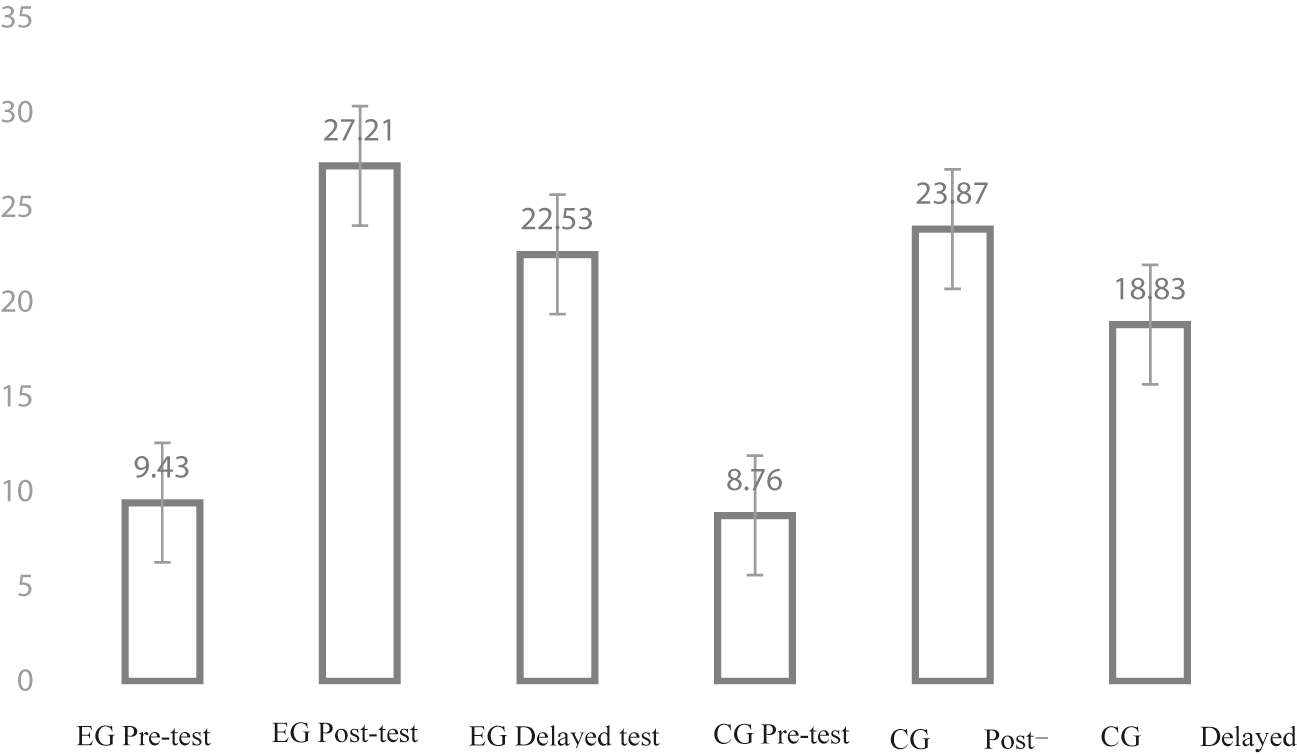
Graphic depiction of the results of the morpheme identification task.
One-way ANCOVA was conducted to determine any statistically significant differences in the morpheme identification test scores between the treatment groups while controlling for the pre-test as a covariate. Before conducting ANCOVA, the assumption of the homogeneity of the regression slopes was examined by the interaction between the post-test scores with Treatment as the between-group variable and the pre-test scores when predicting each dependent variable. The results showed a p value of less than 0.5 for the morpheme identification task in the post-test and delayed test, suggesting that the assumption of homogeneity of the regression slopes was met for each dependent variable.
The results of the multivariate tests revealed significant differences between the two groups in the morpheme identification task scores after controlling for the pre-test score [Wilks’ lambda = 0.899, F (2, 58) = 3.270, p < 0.05, η 2 p = 0.101]. The pre-test score, which served as the covariate, was significantly related to the scores for the morpheme identification task [Wilks’ lambda = 0.087, F (2, 58) = 302.607, p < 0.001, η 2 p = 0.533]. The tests of the within-subjects effects revealed a significant main effect of group treatment on the morpheme identification task post-test scores (F = 5.058, p < 0.05, η 2 p = 0.079) and morpheme identification task delay-test scores (F = 6.611, p < 0.05, η 2 p = 0.101). The tests of the within-subjects effects also revealed a significant main effect of the morpheme identification task pre-test scores on the post-test scores (F = 598.521, p < 0.001, η 2 p = 0.910) and the delay-test scores (F = 419.603, p < 0.001, η 2 p = 0.877).
The results of the simple effects test with Bonferroni correction revealed that the experimental group had significantly higher scores than the control group on the morpheme identification task post-test scores (p < 0.05) and delayed test scores (p < 0.05). The results of the simple effects test with Bonferroni correction also revealed the differences between Time in each treatment group. The analyses indicated that the immediate post-test scores were significantly higher than the pre-test scores for both the experimental (p < 0.001) and control groups (p < 0.001). Again, the immediate post-test scores were significantly higher than the delayed-test scores for both the experimental group (p < 0.001) and control group (p < 0.001).
Table 3 presents the results of the descriptive statistics of the morpheme production task. As shown in Table 3, learners in the experimental group seemed to achieve higher scores than learners in the control group in terms of the pre-test, post-test, and delayed test. Large standard deviations were observed in terms of the morpheme production test scores. A graphic depiction of these results is presented in Figure 2.
Descriptive statistics of the morpheme production task.
| N | M | Std. | Min. | Max. | ||
|---|---|---|---|---|---|---|
| Pre-test | EG | 32 | 12.96 | 3.403 | 3 | 18 |
| CG | 30 | 12.36 | 4.437 | 3 | 17 | |
| Total | 62 | 12.68 | 3.916 | 3 | 18 | |
| Post-test | EG | 32 | 33.03 | 9.758 | 11 | 46 |
| CG | 30 | 28.33 | 11.003 | 11 | 45 | |
| Total | 62 | 30.19 | 10.452 | 11 | 46 | |
| Delayed | EG | 32 | 27.03 | 9.607 | 6 | 41 |
| CG | 30 | 23.70 | 11.099 | 6 | 42 | |
| Total | 62 | 25.42 | 10.406 | 6 | 42 | |
-
EG, experimental group; CG, control group.
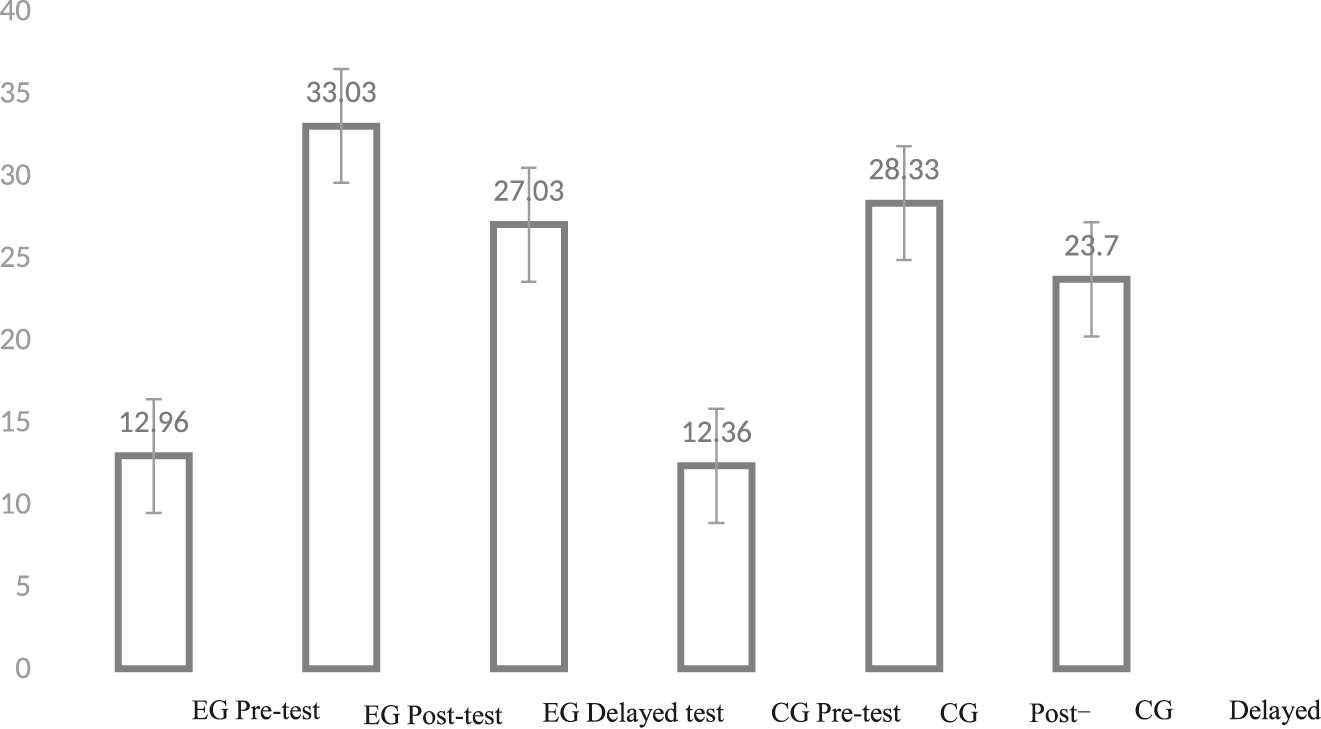
Graphic depiction of the results of the morpheme production task.
One-way ANCOVA was conducted to determine whether there were statistically significant differences in the morpheme production test scores between the treatment groups while controlling for the pre-test as a covariate. Again, the assumption of the homogeneity of the regression slopes was examined by the interaction between the post-test scores with Treatment as the between-group variable and the pre-test scores when predicting each dependent variable. The results showed a p value of less than 0.5 for the morpheme production task post-test and delayed-test, suggesting that the assumption of homogeneity of the regression slopes was met for each dependent variable.
The results of the multivariate tests showed that significant differences were not detected between the two groups on the morpheme production task scores after controlling for the pretest score [Wilks’ lambda = 0.919, F (2, 58) = 2.548, p = 0.087, η 2 p = 0.081]. The pre-test score, which served as the covariate, was significantly related to the scores for the morpheme production task [Wilks’ lambda = 0.128, F (2, 58) = 197.219, p < 0.001, η 2 p = 0.872]. The tests of the within-subjects effects revealed a significant main effect of group treatment on the morpheme production task post-test scores (F = 4.192, p < 0.05, η 2 p = 0.066), but not on the delay-test scores (F = 3.181, p = 0.08, η 2 p = 0.051). The tests of the within-subjects effects revealed a significant main effect of the morpheme production task pre-test scores on the post-test scores (F = 392.615, p < 0.001, η 2 p = 0.869) and the delay-test scores (F = 399.225, p < 0.001, η 2 p = 0.871).
The results of the simple effects test with Bonferroni correction revealed that the experimental group had significantly higher scores than the control group on the morpheme production task post-test scores (p < 0.001). However, there was no significant difference between the two groups in the delayed test scores (p = 0.08). Furthermore, the results of the simple effects test with Bonferroni correction revealed the differences between Time in each treatment group. The analyses indicated that the immediate post-test scores were significantly higher than the pre-test scores for both the experimental group (p < 0.001) and control group (p < 0.001). Again, the immediate post-test scores were significantly higher than the delayed-test scores for both the experimental group (p < 0.001) and control group (p < 0.001).
4.2 Focus group interviews
To answer the second research question, the focus group interviews revealed the participants’ perceptions of translanguaging pedagogies on their morphology learning. They expressed that translanguaging can “serve as a scaffolding for meaning-making,” “develop an awareness of multilingualism,” “facilitate communication,” and “increase motivation.”
4.2.1 Scaffolding for meaning-making
Translanguaging was adopted to serve as scaffolding for meaning-making. This theme was mentioned by the participants in the experimental group. For example:
In my opinion, comparing Japanese and Chinese characters can make me more clearly understand the concepts, making it easier for me to remember and use them. (Student 2)
Some words are available in both Japanese and English, such as “garden”; but the Chinese equivalence is huāyuán (花园), while Japanese has a word called teien (庭園, ていえん), which is interesting when I compare them. I understand how words are constructed to further understand their meaning and usage. (Student 1)
I could not understand some words, such as xiǎoqì (小气) – why is the gas small? Then the assistant explained to me in Japanese that it was kechi (けち). Ah, I suddenly understood. This is how low-level adult learners feel while learning Chinese. (Student 3)
In this case, translanguaging pedagogy helped the participants’ scaffold learning, as they reported comparing characters in Chinese and Japanese or looking for existing words in Chinese and Japanese. In this sense, the learners were able to use their multilingual linguistic resources and maximize vocabulary learning through an explicit expression of the development of morphological awareness (Student 1). Student 3 was puzzled when learning a new Chinese word, but was able to eventually understand it from its Japanese equivalent. This supports the notion that translanguaging enables students to make meaning and understand the topics at hand. Translanguaging also improves a learner’s understanding of the formation of words (Student 2). Another important scaffolding mentioned by these three students was the use of pictures, which can create multimodal and semiotic resources for them to make meaning and activate their multilingual repertoire.
4.2.2 Awareness of multilingualism
The participants also explained that translanguaging pedagogy enhanced their awareness of multilingualism, which could be beneficial for their future language learning and use. For example:
I didn’t expect that I would speak another language other than Japanese. Since I took the course, I have often tried to unconsciously compare a new Chinese word with a Japanese or English word. (Student 5)
I think the study during these weeks enabled me to understand that it is not by rote memorization that I can learn a new language. We must understand its culture and compare the similarities and differences of many languages to analyze and understand the meaning of a word. (Student 3)
The participants were all familiar with language use and they took their linguistic capacity and language-learning strategies for granted. As Student 5 mentioned, he never expected to learn another language, while Student 3 noted that learning a language cannot be done through rote memorization. It has been reported that the adoption of translanguaging pedagogy is especially helpful for adult learners (Zhang et al. 2014). In our study, it appeared that the learners’ multilingual awareness was developed through translanguaging when they linked a word to other languages (Student 5) and when they learned vocabulary beyond rote memorization as adult learners (Student 3).
4.2.3 Facilitating communication
Apart from the development of multilingual awareness, the participants also mentioned that translanguaging pedagogy facilitated communication because the practice of translanguaging was no longer regarded as a linguistic deficit; it was viewed as their linguistic capital in emergent communication (Fang and Liu 2020; García and Wei 2014; Wang 2019a). For example:
I had studied Chinese in Japan before, but the teacher mainly used Japanese to teach us Chinese. Now, I am learning Chinese in China, but with a mixture of English and Japanese, which is easier for communication, as we are able to use different linguistic resources. (Student 6)
In fact, I found it interesting to communicate through different languages. Such experiences give me a different feeling and enables me to convey different messages. (Student 1)
As multilingual speakers, only a few of the participants realized the importance of manipulating their linguistic repertoire for language learning before being exposed to translanguaging pedagogy. Through the activity, the participants learned to incorporate their linguistic repertoire into language learning and use, which facilitated communication, particularly “in a multilingual and multimodal manner,” (Student 1) to recognize the integrated nature of communication as a whole. In turn, this reinforced the usefulness of translanguaging pedagogy in enhancing the students’ understanding through the integration of linguistic resources (Student 6) and communication in a multilingual or multimodal manner (Student 1).
4.2.4 Increasing motivation
In addition to learning and communication, translanguaging pedagogy had psychological benefits for learning, mainly through improving the students’ motivation and their ease of learning. According to one participant:
When I can learn and compare in three languages, I feel that I am a multilingual speaker and learner, which gives me a feeling of pride. I feel more powerful and fulfilled. It is this sense of accomplishment that motivates me to continue. (Student 2)
Student 2 also said, “I felt at ease when being asked a question.” While Student 1 said: “I feel more involved and motivated in learning.” Furthermore, the enhancement of motivation through translanguaging pedagogy facilitated learning, as mentioned by one participant:
In this cross-language learning mode, the teacher said some words, such as xiàoyuán (校园), let me have the word yuán (园), I will go think in different languages and think of huāyuán, gōngyuán, etc. Then there are English words like “garden” and “park” – that’s quite interesting. (Student 3)
Notably, apart from the communication discussed above, the psychological benefits of translanguaging pedagogy also motivated the participants. For example, it encouraged them to reach out and ask questions to facilitate learning (e.g., morphological awareness) when they were able to shuttle between languages, as in the case of Student 3. It has also been argued that translanguaging is a glocalized strategy for using English as a medium of instruction (Tsou 2021), thus producing psychological and learning benefits. In the present study, the participants were motivated to use Chinese-Japanese cognates to learn (Student 3) and felt empowered to effectuate their multilingual resources for learning (Student 2).
4.2.5 Unfavorable comments towards translanguaging
We also found that not all of the participants valued the usefulness of translanguaging pedagogy. For example, Student 5 stated that even if he developed a sense of multilingual awareness, he was not sure about the effectiveness of translanguaging pedagogy. He said: “I found that different languages share a different vocabulary. I can remember the shape of a character in Chinese because it is similar to Japanese, but I don’t know how to pronounce the Chinese words.” Student 4 also expressed his confusion regarding translanguaging pedagogy, saying: “Because I have been learning in a monolingual language environment, I am a little confused when the situation turned multilingual. I am only good at Japanese and no other languages so I can’t quite catch up with the teacher.” Compared to some previous studies (Fang and Liu 2020; Wang and Kirkpatrick 2012), it should be noted that translanguaging pedagogy is not universal for all learners. In this case, the participants felt confused, particularly after adopting translanguaging pedagogy for vocabulary acquisition using languages with similar scripts but different pronunciations. We also found a preference for monolingual teaching; in the case of Student 4, Japanese was the dominant language in academic and social settings, leading to the uncertainty of translanguaging pedagogy for learning.
5 Discussion and conclusion
This quasi-experimental mixed-methods study aimed to explore the development of morphological awareness in learning Chinese as a third language and the Japanese students’ perceptions of translanguaging experiences in learning Chinese morphology. The results revealed that the participants in the translanguaging group obtained higher learning scores in morphological awareness than the participants in the monolingual group. A focus group interview also revealed that the learners in the experimental group had a favorable perception of using translanguaging strategies for morphology learning.
5.1 Development of morphological awareness
The first research question explored the influence of a translanguaging pedagogical intervention on learners’ morphological awareness. The findings revealed that learners who received translanguaging instruction outperformed those exposed to the monolingual approach in the morphology awareness tasks, i.e., morpheme identification and production. Our findings support those of previous studies that advocated for the use of translanguaging pedagogy instruction to develop morphological awareness (Leonet et al. 2020; Zhang 2016). Our findings are in line with those of Lyster et al. (2009), who reported that students who received instruction on biliteracy were encouraged to use cross-linguistic resources to obtain higher scores on the test of French morphological awareness. As argued by Cenoz and Gorter (2017), translanguaging pedagogical experiences may help learners develop morphological, lexical, and textual awareness. Furthermore, the resources in the learners’ linguistic repertoire may have activated the participants’ prior morphological knowledge. Thus, translanguaging could be regarded as an effective approach in teaching Chinese morphology, which supports previous studies that reported that translanguaging enhances students’ learning processes and helps them overcome the constraints of monolingual instruction and language separation (Yuzlu and Dikilitas 2022).
Moreover, the results of our study indicate that the learners in both groups obtained significantly higher scores in the delayed post-test than in the immediate post-test in the two tasks. It appears that, despite the effectiveness of translanguaging pedagogy, attrition in morphology learning is also a concern. Similar to vocabulary acquisition, morphology acquisition is not a simple linear activity with only incremental advancement and no backsliding (Schmitt 2010). On the contrary, the phenomenon of attrition demonstrates that partial morphological knowledge is in a state of flux, with both learning and forgetting occurring simultaneously. Related to this, Hansen et al. (2002) proposed that the rate of attrition is connected to the learners’ proficiency level; learners with larger vocabularies retain more residual knowledge of their vocabulary. As shown in the present study, the learners’ pre-test scores in morphology were significantly related to their post-test and delayed test scores in the two morpheme tasks.
The findings also suggest that group treatment had a significant main effect on the post-test and delayed test scores in the morpheme identification task and on the post-test scores in the morpheme production task. However, group treatment did not have an effect on the delayed test scores in the morpheme production task. Our results suggest that there are more differences in students’ scores in the morpheme production task than in the morpheme identification task. As delineated by Carlisle (2000), differences in morphology learning can be attributed to the different characteristics of the tasks. In the present study, the identification task mainly required relational knowledge, for which the participants may have already developed some skills in decomposing words. In contrast, morpheme production requires more complex abilities than morpheme identification because the former requires the learners to use knowledge of grammatical rules to produce new words. The fact that the students who received instruction on morphological awareness obtained significantly higher scores on the morpheme identification task can be explained by the instruction effect. This finding also indicates that when the task is less demanding, translanguaging pedagogy instruction has a greater effect (Leonet et al. 2020). In line with Koda et al. (2014), explicit biliteracy instruction facilitates the recognition of morphology, but learners may still find morphology production to be challenging.
In addition, morpheme production knowledge seems to be more prone to attrition than the recognition dimension. According to Teng (2019, 2020, receptive vocabulary knowledge does not often attrite dramatically, but when it does, it is likely that low-frequency but productive vocabulary knowledge will be lost. This is logical because morphemes are made up of irreducible units of meaning in a given language. Given the positive results, it is reasonable to operationalize attrition in terms of a loss of partial morphological knowledge rather than in terms of a complete elimination of morphological knowledge.
5.2 Students’ perceptions of their translanguaging experiences
The focus group interviews showed that, overall, the students had a positive perception of their translanguaging experiences in that the translanguaging instruction improved their morphological awareness and morphology acquisition. Translanguaging pedagogy not only enhanced the students’ language learning in relation to linguistic aspects, such as scaffolding and communication, it also developed their multilingual awareness and increased their motivation (cognitive and psychological effects). The students reported that they were able to link their multilingual resources as scaffolding to develop their morphological awareness. In this way, they developed a multilingual awareness – either consciously or unconsciously – through translanguaging pedagogy (Leonet et al. 2020). This reinforces the understanding that translanguaging can facilitate learning or communication as a whole to maximize students’ various linguistic and cultural resources for learning (Bourdieu 1991). Recognizing the various linguistic and cultural capitals would promote the use of a de-colonizing pedagogy to shift language education away from focusing on the monolingual perspective. For the theorization development of translanguaging in language education in the Asian context, it is especially important to challenge the traditional native-speakerism orientation in language policy and language education (Houghton and Rivers 2013; Liu and Fang 2022).
The students’ positive responses, in general, support the findings that “translanguaging pedagogies can potentially develop morphological awareness and the perception multilingual students have of their multilingual repertoire” (Leonet et al. 2020, p. 56). In particular, the present study has shown that when the similarities of morphemes in the studied languages can be identified (Leonet et al. 2020), students can improve their learning and morphological knowledge through translanguaging pedagogy in learning Chinese vocabulary (Liu et al. 2013). In particular, the results showed that pedagogical translanguaging helped maximize the students’ spontaneous translanguaging, both in their morphological awareness and motivation enhancement. The teacher served as an agent to promote translanguaging pedagogy to enhance the students’ morphological awareness. However, it is noted that, for a group of adult learners, translanguaging pedagogy can play a key role in both knowledge acquisition and psychological ease. In our study, the participants’ positive perceptions further demonstrated the effectiveness of translanguaging pedagogy for morphological awareness and knowledge, although it is important to further recognize individual needs for translanguaging pedagogy for morphological awareness and language learning.
5.3 Limitations and implications
Overall, the present study investigated the nuances of pedagogical translanguaging in enhancing morphological awareness among Japanese students learning Chinese in a summer program at a university in China. This study has some limitations that should be mentioned. It only included adult learners. Thus, using pedagogical translanguaging to enhance the morphological awareness of learners of different ages should be explored in future studies. Second, age and language proficiency level as variables were not controlled for in this study. Thus, some of the learning outcomes might be due to the participants’ accumulated years of language learning experiences. Third, we did not interview the students in the control group. Due to the lack of such data, we did not know much about the experience of the students in the control group. Fourth, this is a short-term study. In the future, a longitudinal study may provide a more in-depth understanding of morphological awareness (Teng and Zhang 2022). Finally, findings on the role of translanguaging pedagogies on morphological awareness should be interpreted with caution, as our study was conducted in a specific Chinese context and with a limited number of participants.
Despite these limitations, the present study supports the use of translanguaging pedagogies in acquiring morphological awareness. The improvement in morphology supports the need for using translanguaging as a practical theory. In particular, new words can be acquired by providing a translanguaging space in which learners can experience constructive, interactive, cognitive, and affective processes.
The findings provide implications for teacher educators and researchers desiring to consider using translanguaging strategies in foreign language teaching and learning. First, the systematic shuttling between Chinese, Japanese, and English as instructional and interactional languages should be viewed as being beneficial rather than detrimental. Pedagogical translanguaging fosters learners’ multilingual and metalinguistic awareness. It also offers opportunities for learners to become equal multilingual interlocutors with their teachers, rather than being passive receivers of linguistic norms in learning morphology, as is often the case with the traditional monolingual approach. As supported by Li and García (2022), translanguaging is a unitary repertoire; it can potentially help teachers engage with their students’ full repertoire of features and meanings. Hence, we highlight that pedagogical translanguaging should be helpful in developing morphological awareness, particularly from languages that belong to the same family, in this study, Chinese and Japanese, to maximize the learners’ linguistic repertoire. For example, Hanzi and Kanji are the Chinese characters that are a major part of the writing system of both languages. Thus, for a Chinese language learner to achieve a high level of fluency in Chinese, they are an essential element of any Chinese curriculum. Moreover, to some extent, both Hanzi and Kanji share a similar cultural context. Adopting the linguistic and cultural sources of Chinese and Japanese for morphonology instruction may help learners switch between different language scripts and writing systems.
Second, as revealed in the present study, the convergence of the quantitative and qualitative data indicates that morphological awareness occurred through pedagogical translanguaing. Thus, it may be time for policy-makers and educators to reconsider the monolingual ideology that forms the foundation of language teaching and learning policy and incorporate the Global Englishes perspective into language instruction (Fang and Xu 2022). Translanguaging practices can be integrated into the curricula, materials, and even evaluation criteria for vocabulary teaching and learning.
Finally, pedagogical translanguaging requires language teachers to distinguish between process and product in language learning and use, in which the gap of pedagogical translanguaging and standardized assessments can be narrowed – for instance – to promote formative assessment of vocabulary teaching to encourage students to maximize their linguistic repertoire to “leverage the students’ entire linguistic/semiotic repertoire to truly assess what students know and can do” (Li and García 2022, p. 10). Related to this, we agree with Wang (2019a) about the need to transform the teacher-student role. Teachers no longer possess the sole authority in the classroom. Pedagogical translanguaging should be practiced as a co-constructed strategy. Teachers and learners are responsible for creating a classroom environment where available language resources can be valued. Translanguaging is not about using L1 or shuttling between L1 and L2. It is about maximizing the learners’ full linguistic and cultural repertoire to facilitate learning. It is expected that Chinese language teaching practices and policies should reflect the current reality of language use and the diverse learning needs of multilingual students. Thus, it is hoped that further research can be conducted to explore the effectiveness of pedagogical translanguaging to increase morphological awareness and reinforce the use of a decolonizing pedagogy through collaboration of different stakeholders, for example, teachers and learners.
About the authors
Mark Feng Teng is language teacher educator in China. His main research interests include L2 vocabulary acquisition and L2 writing. His latest publications appeared in TESOL Quarterly, Foreign Language Annals, System, Applied Linguistics, Language Teaching Research, Computer Assisted Language Learning, IRAL, and other international mainstream journals. His recent monographs were published by Springer, Routledge, and Bloomsbury. He has edited or co-edited special issues for Asian EFL Journal, TESOL Journal, SSLLT, and Journal of Writing Research.
Fan Fang obtained his PhD from the Centre for Global Englishes, University of Southampton, UK. He is currently Associate Professor at College of Liberal Arts, Shantou University, China. His research interests include Global Englishes, language ideology, language attitude, identity, intercultural communication and ELT. He has published articles in journals including Language Teaching Research, System, ELT Journal, Journal of Multilingual and Multicultural Development, Language, Culture and Curriculum, Language and Education, English Today, Lingua, Asia Pacific Journal of Education, among others. His latest volume (co-edited with Dr. Handoyo Puji Widodo) Critical Perspectives on Global Englishes in Asia: Language Policy, Curriculum, Pedagogy and Assessment (2019) was published by Multilingual Matters.
-
Conflict of Interest: The authors declare that he has no conflict of interest.
Appendix: Pedagogical design for the experimental and control group
| Pedagogical design | 10 min of instruction on strategies | 30 min of activities/exercises | 10 min of teacher comments | Languages |
|---|---|---|---|---|
| Experimental group | Strategies: Accessing and building background knowledge towards morphology, determining multilingual resources for learning morphology, developing graphic organizers using all language resources, and defining homonyms and ambiguous sentences based on multilingual repertoire. |
Activities included: Learning and identifying cognates, creating sentences using word compounds, playing communication games, analyzing structures in a text, correcting ambiguous sentences, using different pictures to learn morphology, find sources in different languages, and change language for input and output. Teacher’s role: Guide Students’ role: Agent Features:
|
Teacher summarized and commented classroom performance | Multilingual repertoire: Japanese, Chinese, and English |
| Control group | Strategies related to understanding the meaningful relationships between words, including how they sound, how they are spelled, and what their morphological structure is. | Exercises included: The teacher analyzed the word for recognizable morphemes, provided meaning based upon the parts of the word, checked the meaning of the word against the context, explained sample examples, provided students with a list of complex words for them to practice identifying root words, instructed the learners to examine and sort the listed words based on their morphemes, and encouraged the students to compare and contrast the meanings of words. Teacher’s role: Explaining and instructing rules and examples Students’ role: Listen and finish the imposed requirements by the teacher. Features:
|
Teacher summarized and commented classroom performance | Mainly Chinese, but Japanese was also used for explanation. |
References
Bourdieu, Pierre. 1991. Language and symbolic power. In John B. Thompson (ed.), G. Raymond, & M. Adamson, trans.). Cambridge: Polity Press (Original work published in 1982).Suche in Google Scholar
Carlisle, Joanne F. 1995. Morphological awareness and early reading achievement. In Laurie Beth Feldman (ed.), Morphological aspects of language processing, 189–209. Hillsdale: Erlbaum.Suche in Google Scholar
Carlisle, Joanne F. 2000. Awareness of the structure and meaning of morphologically complex words: Impact on reading. Reading and Writing 12(3/4). 169–190. https://doi.org/10.1023/a:1008131926604.10.1023/A:1008131926604Suche in Google Scholar
Cenoz, Jasone. 2019. Translanguaging pedagogies and English as a lingua franca. Language Teaching 52(1). 71–85. https://doi.org/10.1017/s0261444817000246.Suche in Google Scholar
Cenoz, Jasone & Alaitz Santos. 2020. Implementing pedagogical translanguaging in trilingual schools. System 92. 102273. https://doi.org/10.1016/j.system.2020.102273.Suche in Google Scholar
Cenoz, Jasone & Durk Gorter. 2017. Minority languages and sustainable translanguaging: Threat or opportunity? Journal of Multilingual and Multicultural Development 38(10). 901–912. https://doi.org/10.1080/01434632.2017.1284855.Suche in Google Scholar
Cenoz, Jasone & Durk Gorter. 2021. Pedagogical translanguaging. Cambridge: Cambridge University Press.10.1017/9781009029384Suche in Google Scholar
Charmaz, Kathy C. 2006. Constructing grounded theory: A practical guide through qualitative analysis. London: Sage.Suche in Google Scholar
Fang, Fan & Yang Liu. 2020. ‘Using all English is not always meaningful’: Stakeholders’ perspectives on the use of and attitudes towards translanguaging at a Chinese university. Lingua 247. 102959. https://doi.org/10.1016/j.lingua.2020.102959.Suche in Google Scholar
Fang, Fan & Yidie Xu. 2022. Commonalities and Conflation of Global Englishes and Translanguaging for Equitable English Language Education. TESL-EJ (The Electronic Journal for English as a Second Language) 26(3). https://doi.org/10.55593/ej.26103a9.Suche in Google Scholar
Fang, Fan, Lawrence Jun Zhang & Pramod K. Sah. 2022. Translanguaging in language teaching and learning: Current practices and future directions. RELC Journal 53(2). 305–312. https://doi.org/10.1177/00336882221114478.Suche in Google Scholar
Galante, Angelica. 2020. Pedagogical translanguaging in a multilingual English program in Canada: Student and teacher perspectives of challenges. System 92. 102274. https://doi.org/10.1016/j.system.2020.102274.Suche in Google Scholar
García, Ofelia. 2009. Bilingual education in the 21st century: Global perspectives. Malden: Blackwell.Suche in Google Scholar
García, Ofelia & Li Wei. 2014. Translanguaging: Language, bilingualism and education. Basingstoke: Palgrave Macmillan.10.1057/9781137385765_4Suche in Google Scholar
García, Ofelia, Susana Ibarra Johnson & Kate Seltzer. 2017. The translanguaging classroom: Leveraging student bilingualism for learning. London: Caslon Publishing.Suche in Google Scholar
Hansen, Lynne, Yukako Umeda & Melanie McKinney. 2002. Savings in the relearning of second language vocabulary: The effects of time and proficiency. Language Learning 52(4). 653–678. https://doi.org/10.1111/1467-9922.00200.Suche in Google Scholar
Houghton, Stephanie Ann & Damian J. Rivers (eds.). 2013. Native-speakerism in Japan: Intergroup dynamics in foreign language education. Bristol: Multilingual Matters.10.21832/9781847698704Suche in Google Scholar
Jenkins, Jennifer & Anna Mauranen (eds.). 2019. Linguistic diversity on the EMI campus: Insider accounts of the use of English and other languages in universities within Asia, Australasia and Europe. Abingdon: Routledge.10.4324/9780429020865Suche in Google Scholar
Ke, Sihui & Feng Xiao. 2015. Cross-linguistic transfer of morphological awareness between Chinese and English. Language Awareness 24(4). 355–380. https://doi.org/10.1080/09658416.2015.1114624.Suche in Google Scholar
Koda, Keiko, Chan Lü & Dongbo Zhang. 2014. L1-induced facilitation in biliteracy development in Chinese and English. In Xi Chen, Qiuying Wang & Yang Cathy Luo (eds.), Reading development and difficulties in monolingual and bilingual Chinese Children, 141–169. Dordrecht: Springer.10.1007/978-94-007-7380-6_8Suche in Google Scholar
Ku, Yu-Min & Richard C. Anderson. 2003. Development of morphological awareness in Chinese and English. Reading and Writing 16(5). 399–422. https://doi.org/10.1023/a:1024227231216.10.1023/A:1024227231216Suche in Google Scholar
Kuo, Li Jen & Richard C. Anderson. 2006. Morphological awareness and learning to read: A cross-language perspective. Educational Psychologist 41(3). 161–180. https://doi.org/10.1207/s15326985ep4103_3.Suche in Google Scholar
Leonet, Oihana, Jasone Cenoz & Durk Gorter. 2020. Developing morphological awareness across languages: Translanguaging pedagogies in third language acquisition. Language Awareness 29(1). 41–59. https://doi.org/10.1080/09658416.2019.1688338.Suche in Google Scholar
Lewis, Gwyn, Bryn Jones & Colin Baker. 2012. Translanguaging: Origins and development from school to street and beyond. Educational Research and Evaluation 18(7). 641–654. https://doi.org/10.1080/13803611.2012.718488.Suche in Google Scholar
Li, Wei. 2018. Translanguaging as a practical theory of language. Applied Linguistics 39(1). 9–30. https://doi.org/10.1093/applin/amx044.Suche in Google Scholar
Li, Wei & Ofelia García. 2022. Not a first language but one repertoire: Translanguaging as a decolonizing project. RELC Journal 53(2). 313–324. https://doi.org/10.1177/00336882221092841.Suche in Google Scholar
Lin, Angel M. Y. 2019. Theories of trans/languaging and trans-semiotizing: Implications for content-based education classrooms. International Journal of Bilingual Education and Bilingualism 22(1). 5–16. https://doi.org/10.1080/13670050.2018.1515175.Suche in Google Scholar
Liu, Yang & Fan Fang. 2022. Translanguaging theory and practice: How stakeholders perceive translanguaging as a practical theory of language. RELC Journal 53(2). 391–399. https://doi.org/10.1177/0033688220939222.Suche in Google Scholar
Liu, Phil D., Catherine McBride-Chang, Terry T.-Y. Wong, Hua Shu & Antita M.-Y. Wong. 2013. Morphological awareness in Chinese: Unique associations of homophone awareness and lexical compounding to word reading and vocabulary knowledge in Chinese children. Applied Psycholinguistics 34(4). 755–775. https://doi.org/10.1017/s014271641200001x.Suche in Google Scholar
Lyster, Roy, Laura Collins & Susan Ballinger. 2009. Linking languages through a bilingual read-aloud project. Language Awareness 18(3–4). 366–383. https://doi.org/10.1080/09658410903197322.Suche in Google Scholar
McCutchen, Deborah, Laura Green & Robert D. Abbott. 2008. Children’s morphological knowledge: Links to literacy. Reading Psychology 29(4). 289–314. https://doi.org/10.1080/02702710801982050.Suche in Google Scholar
Moore, Pat & Tarja Nikula. 2016. Translanguaging in CLIL classrooms. In Tarja Nikula, Emma Dafouz, Pat Moore & Ute Smit (eds.), Conceptualising integration in CLIL and multilingual education, 211–234. Bristol: Multilingual Matters.10.21832/9781783096145-013Suche in Google Scholar
Nation, I. S. P. 2001. Learning vocabulary in another language. Cambridge: Cambridge University Press.10.1017/CBO9781139524759Suche in Google Scholar
Nation, Paul. 2022. Translanguaging and vocabulary learning. Teaching English as a Second Language Electronic Journal (TESL-EJ) 26(3). https://doi.org/10.55593/ej.26103a24.Suche in Google Scholar
Schmitt, Norbert. 2010. Researching vocabulary: A vocabulary research manual. Basingstoke: Palgrave Macmillan.10.1057/9780230293977Suche in Google Scholar
Shu, Hua, Richard C. Anderson & Ningning Wu. 2000. Phonetic awareness: Knowledge of orthography-phonology relationships in the character acquisition of Chinese children. Journal of Educational Psychology 92(1). 56–62. https://doi.org/10.1037/0022-0663.92.1.56.Suche in Google Scholar
Teng, Feng. 2019. The effects of context and word exposure frequency on incidental vocabulary acquisition and retention through reading. Language Learning Journal 47(2). 145–158. https://doi.org/10.1080/09571736.2016.1244217.Suche in Google Scholar
Teng, Feng. 2020. Retention of new words learned incidentally from reading: Word exposure frequency, L1 marginal glosses, and their combination. Language Teaching Research 24(6). 785–812. https://doi.org/10.1177/1362168819829026.Suche in Google Scholar
Teng, Feng & Lawrence Jun Zhang. 2022. Development of metacognitive knowledge and morphological awareness: A longitudinal study of ethnic minority multilingual young learners in China. Journal of Multilingual and Multicultural Development. https://doi.org/10.1080/01434632.2022.2052301.Suche in Google Scholar
Tsou, Wenli. 2021. Translanguaging as a glocalized strategy for EMI in Asia. In Wenli Tsou & Will Baker (eds.), English-Medium instruction translanguaging practices in Asia: Theories, frameworks and implementation in higher education, 3–17. Dordrecht: Springer.10.1007/978-981-16-3001-9_1Suche in Google Scholar
Wang, Danping. 2019a. Translanguaging in Chinese foreign language classrooms: Students and teachers’ attitudes and practices. International Journal of Bilingual Education and Bilingualism 22(2). 138–149. https://doi.org/10.1080/13670050.2016.1231773.Suche in Google Scholar
Wang, Danping. 2019b. Multilingualism and translanguaging in Chinese language classrooms. Basingstoke: Palgrave Macmillan.10.1007/978-3-030-02529-8Suche in Google Scholar
Wang, Danping & Andy Kirkpatrick. 2012. Code choice in the Chinese as a foreign language classroom. Multilingual Education 2. 3. https://doi.org/10.1186/2191-5059-2-3.Suche in Google Scholar
Yuzlu, Muhammet Yasar & Kenan Dikilitas. 2022. Translanguaging in the development of EFL learners’ foreign language skills in Turkish context. Innovation in Language Learning and Teaching 16(2). 176–190. https://doi.org/10.1080/17501229.2021.1892698.Suche in Google Scholar
Zhang, Dongbo. 2016. Morphology in Malay-English biliteracy acquisition: An intervention study. International Journal of Bilingual Education and Bilingualism 19(5). 546–562. https://doi.org/10.1080/13670050.2015.1026873.Suche in Google Scholar
Zhang, Dongbo & Keiko Koda. 2013. Morphological awareness and reading comprehension in a foreign language: A study of young Chinese EFL learners. System 41(4). 901–913. https://doi.org/10.1016/j.system.2013.09.009.Suche in Google Scholar
Zhang, Dongbo, Keiko Koda, Che Kan Leong & Elizabeth Pang. 2019. Cross-lagged panel analysis of reciprocal effects of morphological processing and reading in Chinese in a multilingual context. Journal of Research in Reading 42(1). 58–79. https://doi.org/10.1111/1467-9817.12135.Suche in Google Scholar
Zhang, Jie, Tzu-Jung Lin, Junli Wei & Richard C. Anderson. 2014. Morphological awareness and learning to read Chinese and English. In Xi Chen, Qiuying Wang & Yang Cathy Luo (eds.), Reading development and difficulties in monolingual and bilingual Chinese children, 3–22. Dordrecht: Springer.10.1007/978-94-007-7380-6_1Suche in Google Scholar
© 2022 the author(s), published by De Gruyter, Berlin/Boston
This work is licensed under the Creative Commons Attribution 4.0 International License.
Artikel in diesem Heft
- Frontmatter
- Special Issue: Power, Linguistic Discrimination and Inequality in English Language Teaching and Learning (ELTL): Reflection and Reform for Applied Linguistics from the Global South; Guest Editors: Fan Gabriel Fang and Sender Dovchin
- Editorial
- Reflection and reform of applied linguistics from the Global South: power and inequality in English users from the Global South
- Research Articles
- Translingual English discrimination: loss of academic sense of belonging, the hiring order of things, and students from the Global South
- Applied linguistics from the Global South: way forward to linguistic equality and social justice
- English high-stakes testing and constructing the ‘international’ in Kazakhstan and Mongolia
- The mundanity of translanguaging and Aboriginal identity in Australia
- Multimodal or multilingual? Native English teachers’ engagement with translanguaging in Hong Kong TESOL classrooms
- Epistemic injustice and neoliberal imaginations in English as a medium of instruction (EMI) policy
- Commentary
- Transidiomatic favela: language resources and embodied resistance in Brazilian and South African peripheries
- Special Issue: Translanguaging Outside the Centre: Perspectives from Chinese Language Teaching; Guest Editor: Danping Wang
- Editorial
- Translanguaging outside the centre: perspectives from Chinese language teaching
- Research Articles
- Translanguaging as a decolonising approach: students’ perspectives towards integrating Indigenous epistemology in language teaching
- Translanguaging as sociolinguistic infrastructuring to foster epistemic justice in international Chinese-medium-instruction degree programs in China
- Translanguaging as a pedagogy: exploring the use of teachers’ and students’ bilingual repertoires in Chinese language education
- A think-aloud method of investigating translanguaging strategies in learning Chinese characters
- Translanguaging pedagogies in developing morphological awareness: the case of Japanese students learning Chinese in China
- Facilitating learners’ participation through classroom translanguaging: comparing a translanguaging classroom and a monolingual classroom in Chinese language teaching
- A multimodal analysis of the online translanguaging practices of international students studying Chinese in a Chinese university
- Special Issue: Research Synthesis in Language Learning and Teaching; Guest Editors: Sin Wang Chong, Melissa Bond and Hamish Chalmers
- Editorial
- Opening the methodological black box of research synthesis in language education: where are we now and where are we heading?
- Research Article
- A typology of secondary research in Applied Linguistics
- Review Articles
- A scientometric analysis of applied linguistics research (1970–2022): methodology and future directions
- A systematic review of meta-analyses in second language research: current practices, issues, and recommendations
- Research Article
- Topics, publication patterns, and reporting quality in systematic reviews in language education. Lessons from the international database of education systematic reviews (IDESR)
- Review Article
- Bilingual education in China: a qualitative synthesis of research on models and perceptions
- Regular Issue Articles
- An interactional approach to speech acts for applied linguistics
- “Church is like a mini Korea”: the potential of migrant religious organisations for promoting heritage language maintenance
Artikel in diesem Heft
- Frontmatter
- Special Issue: Power, Linguistic Discrimination and Inequality in English Language Teaching and Learning (ELTL): Reflection and Reform for Applied Linguistics from the Global South; Guest Editors: Fan Gabriel Fang and Sender Dovchin
- Editorial
- Reflection and reform of applied linguistics from the Global South: power and inequality in English users from the Global South
- Research Articles
- Translingual English discrimination: loss of academic sense of belonging, the hiring order of things, and students from the Global South
- Applied linguistics from the Global South: way forward to linguistic equality and social justice
- English high-stakes testing and constructing the ‘international’ in Kazakhstan and Mongolia
- The mundanity of translanguaging and Aboriginal identity in Australia
- Multimodal or multilingual? Native English teachers’ engagement with translanguaging in Hong Kong TESOL classrooms
- Epistemic injustice and neoliberal imaginations in English as a medium of instruction (EMI) policy
- Commentary
- Transidiomatic favela: language resources and embodied resistance in Brazilian and South African peripheries
- Special Issue: Translanguaging Outside the Centre: Perspectives from Chinese Language Teaching; Guest Editor: Danping Wang
- Editorial
- Translanguaging outside the centre: perspectives from Chinese language teaching
- Research Articles
- Translanguaging as a decolonising approach: students’ perspectives towards integrating Indigenous epistemology in language teaching
- Translanguaging as sociolinguistic infrastructuring to foster epistemic justice in international Chinese-medium-instruction degree programs in China
- Translanguaging as a pedagogy: exploring the use of teachers’ and students’ bilingual repertoires in Chinese language education
- A think-aloud method of investigating translanguaging strategies in learning Chinese characters
- Translanguaging pedagogies in developing morphological awareness: the case of Japanese students learning Chinese in China
- Facilitating learners’ participation through classroom translanguaging: comparing a translanguaging classroom and a monolingual classroom in Chinese language teaching
- A multimodal analysis of the online translanguaging practices of international students studying Chinese in a Chinese university
- Special Issue: Research Synthesis in Language Learning and Teaching; Guest Editors: Sin Wang Chong, Melissa Bond and Hamish Chalmers
- Editorial
- Opening the methodological black box of research synthesis in language education: where are we now and where are we heading?
- Research Article
- A typology of secondary research in Applied Linguistics
- Review Articles
- A scientometric analysis of applied linguistics research (1970–2022): methodology and future directions
- A systematic review of meta-analyses in second language research: current practices, issues, and recommendations
- Research Article
- Topics, publication patterns, and reporting quality in systematic reviews in language education. Lessons from the international database of education systematic reviews (IDESR)
- Review Article
- Bilingual education in China: a qualitative synthesis of research on models and perceptions
- Regular Issue Articles
- An interactional approach to speech acts for applied linguistics
- “Church is like a mini Korea”: the potential of migrant religious organisations for promoting heritage language maintenance
