
Tunable quantum light by modulated free electrons
-
Valerio Di Giulio

 ,
Rudolf Haindl
und
Claus Ropers
,
Rudolf Haindl
und
Claus Ropers

Abstract
Nonclassical states of light are fundamental in various applications, spanning quantum computation to enhanced sensing. Fast free electrons, which emit light into photonic structures through the mechanism of spontaneous emission, represent a promising platform for generating diverse types of states. Indeed, the intrinsic connection between the input electron wave function and the output light field suggests that electron-shaping schemes, based on light-induced scattering, facilitate their synthesis. In this article, we present a theoretical framework capable of predicting the final optical density matrix emitted by a generic N-electron state that can also account for post-sample energy filtering. By using such a framework, we study the modulation-dependent fluctuations of the N-electron emission and identify regions of superradiant scaling characterized by Poissonian and super-Poissonian statistics. In this context, we predict that high-N modulated electron pulses can yield a tenfold shot-noise suppression in the estimation of the electron-light coupling when the output radiation intensity is analyzed. In the single-electron case, we show how coherent states with nearly 90 % purity can be formed by pre-filtering a portion of the spectrum after modulation, and how non-Gaussian states are generated after a precise energy measurement. Furthermore, we present a strategy combining a single-stage electron modulation and post-filtering to harness tailored light states, such as squeezed vacuum, cat, and triangular cat states, with fidelities close to 100 %.
1 Introduction
Fast electrons in scanning and transmission electron microscopes (SEM/TEM) offer the capability to measure different material properties with nanometer resolution, thanks to their exceptionally small wavelength. For instance, inelastically scattered electrons carry information about the excitations of a sample, such as phonons [1], [2], plasmonic resonances [3], [4], [5], [6], and geometrically confined dielectric modes [7], [8], which can be retrieved by analyzing their final spectrum through electron energy-loss spectroscopy (EELS) [9], [10].
In the past two decades, efforts to improve the spectral resolution, limited in EELS measurements by the broad-band nature of fast charged particles [9], and to achieve time-resolved imaging, have led to the integration of optical systems into TEM. In such instruments, a laser and an electron pulse interact at the sample, resulting in inelastic electron-light scattering (IELS) [11], [12]. In the form of photon-induced near-field electron microscopy (PINEM), this combination of techniques has produced remarkable results in studying the femtosecond dynamics of near fields carried by polaritons in nanostructures [13], [14], [15], [16], [17] and optical nonlinearities in dielectric resonators [18]. Beyond imaging, IELS has proven to be an important phenomenon for coherently shaping the longitudinal [19] and transverse [20], [21] full three-dimensional wave function of an electron beam (e-beam). In this context, a general IELS interaction with laser frequency ω L near a plane positioned at z along the propagation axis, brings an electron traveling with velocity v into the superposition state
composed of energy coefficients c ℓ and an envelope ψ 0(z). Controlling the amplitude and phase of these coefficients is crucial for attosecond bunching of the electron density [22], [23], [24]. Several schemes combining multiple IELS interaction zones have been proposed [16], [25], [26], [27], [28] to achieve extreme temporal compression, including the replacement of laser illumination with a quantum light source [29], [30], [31].
Free electrons in SEM/TEM also represent a unique platform for tailoring and probing quantum characteristics of polaritonic modes, either confined, or guided within photonic structures [32], [33], [34], [35]. In the case of bosonic statistics, it was shown that the incoming electron energy coefficients c ℓ and the output mode density matrix ρ p are directly related [30], [36], thus rendering a tailored IELS modulation an excellent means to control the latter. Under the usual conditions of electron-light coupling linear in the electric field of the mode [29], [32], Poissonian-distributed emission is predicted to arise from single-electron pulses, with a state purity determined by the temporal structure of the electron density [30]. Since a possible way of generating quantum light exploits a nonlinear interaction, schemes based on quadratic ponderomotive coupling to produce squeezing [37] or incorporating final electron energy filtering (post-filtering) have been proposed [36], [38] and applied to herald few-photon Fock states [39], [40]. Furthermore, more complex light states, such as cat and GKP states [41], were shown to be producible by employing multiple electrons shaped into idealized electron superpositions, characterized by energy coefficients with constant amplitudes at all orders and with corresponding phases ∝ℓ [42].
This article aims at exploring in detail the connection between electron energy modulation and light emission in a single photonic mode with a particular focus on quantum light synthesis. The work is organized as follows. In Section 2.1, we develop a general theoretical framework for a linear type – with an interaction Hamiltonian proportional to the mode electric field – of electron-light coupling capable of connecting, through an input-output relation, an incoming N-electron density matrix with ρ
p
. In addition, the action of an electron spectrometer is incorporated in the theory to account for the possibility of energy post-filtering. Without post-filtering, we predict super-Poissonian light emission arising from N > 1 bunches for most electron modulations and Poissonian statistics in specific limiting cases. We then apply parameter estimation theory to study how these types of electron pulses affect shot-noise limited measurements of electron-light interaction strengths. In Section 2.2, we analyze, for single-electron pulses, the coherence conditions and the corresponding modulation requirements to generate high-purity states, both with and without post-filtering. By focusing on the latter case, we propose a simple modulation scheme that combines a strong IELS interaction with an energy filter placed before the sample to significantly enhance electron coherence and state purity. Moreover, for electrons with coherence times longer than the optical cycle of the mode and incorporating post-filtering, we show that pure light states are produced regardless of the form of c
ℓ
. In Section 2.3, we leverage the implications of the previous result to explore how a standard IELS modulation can create cat states. Subsequently, in Section 2.4, we adopt an approach used for electron-pulse shaping [26] combined with an optimization algorithm to provide specific guidelines for designing near-field distributions to be used in an IELS interaction leading to the synthesis of more complex light states. We find that squeezed vacuum, cat, and triangular cat states can be generated with
In addition to their theoretical significance, our results represent a fundamental step towards developing practical methods for harnessing nonclassical light from free electrons.
2 Results and discussion
2.1 Output light density matrix after interaction with N electrons
In this work, we study the quantum properties of light emitted in a photonic structure by the interaction of an e-beam at kinetic energies in the keV range with a single optical mode of energy ℏω
0 and an electric field profile
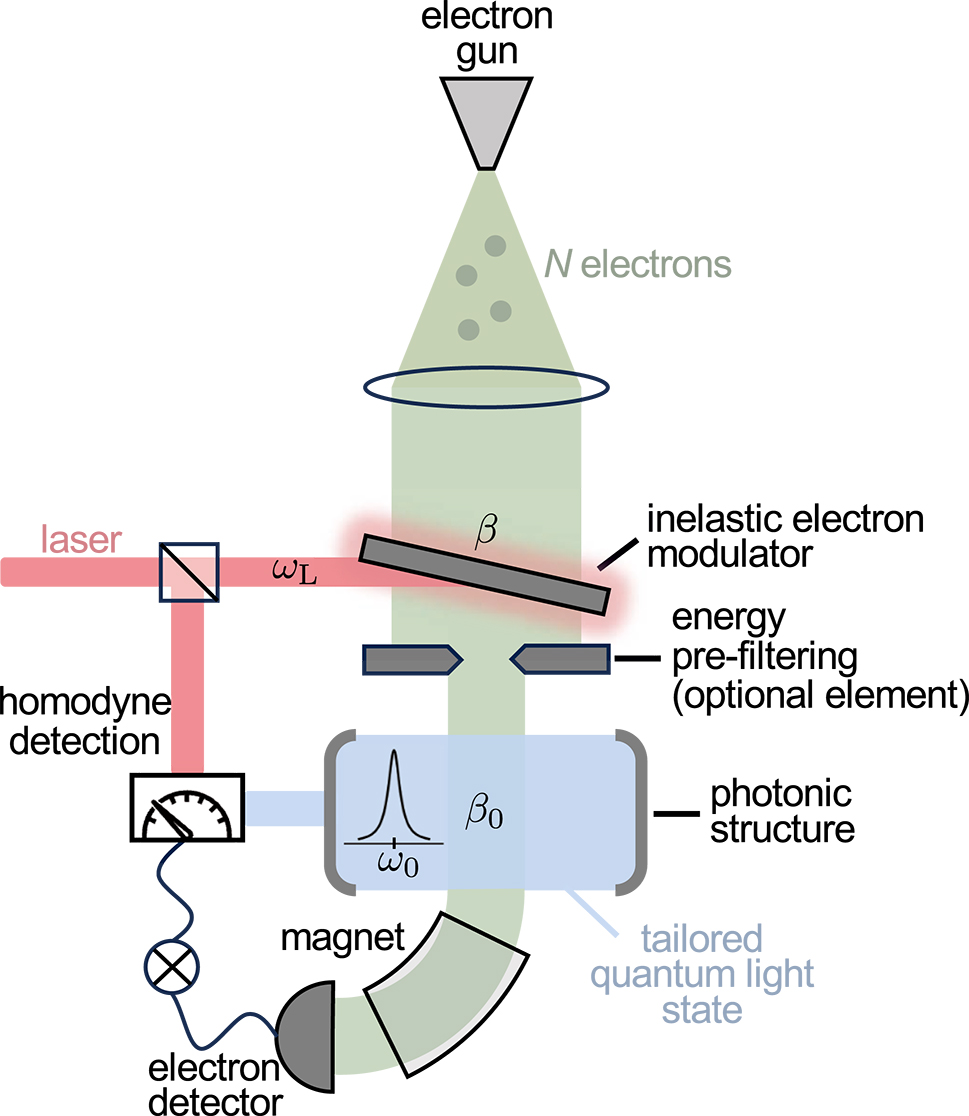
Creation and analysis of quantum light states generated by free electrons. An e-beam pulse composed by N electrons is directed into a light-based inelastic modulator that coherently reshapes the electron energy distribution through a single IELS interaction with coupling coefficient β and frequency ω L. An optional energy filter placed before the sample may eliminate electrons outside a selected energy range. The beam subsequently passes a nanostructure and emits photons into an optical mode with frequency ω 0 via spontaneous emission of strength β 0. After this interaction, the generated light is extracted from the structure, and its quantum state is analyzed using a homodyne detection scheme in coincidence with the energies measured by an electron spectrometer composed by a sector magnet and an electron detector.
Under these conditions, the quantum evolution of the joint electron-light state can be written by linearizing the electron dispersion, directly leading to the closed form of the scattering operator
written in terms of the electron
The single-mode assumption, underlying the validity of Eq. (1), strongly depends on the value of β 0 for the coupling to each mode allowed by the material and the configuration details of the photonic structure collecting the electron emission. Generally, narrow-band selectivity can be achieved in one-dimensional geometries through phase-matching, when the mode’s phase velocity ω 0/k 0 equals the electron group velocity v, i.e., when ω 0/k 0 ∼ v [39], [40], [48], [49]. However, somewhat weaker selectivity can also be achieved in confined resonances supported by nanostructures [50], [51].
To compute the statistical properties of the light emitted by electrons measured in a final set of longitudinal momenta q
N
= (q
1, …, q
N
), we begin with the calculation of the matrix
Under typical experimental conditions, the optical mode is either in the vacuum state or excited with a laser, while the N-electron bunch exists in a complex state arising from an incoherent ensemble average over stochastic fluctuations of the electron source, combined with the coherent operations of IELS modulation and energy pre-filtering. To best describe such initial conditions, we set as pre-interaction electron-light state
To account for general multi-electron post-filtering performed over a finite set of final momenta, we introduce the dimensionless detector function F(q
N
) which vanishes for values of q
N
outside the selected region. By integrating the product
where the function
Note that, if no post-filtering is performed
The CF is a measure of the coherence carried by each of the electrons at momentum k, quantified through the strength of the Fourier components of their densities. In practice, it defines the ability of the light emitted by the electrons to interfere with a second time-varying signal [44], [58]. For instance, if all electrons share the same density
where
In Figure 2, we explore the statistics of the light generated by identically modulated electrons yielding equal CF without keeping track of the post-interaction electron energies, as shown in the sketch of Figure 2a. In particular, in Figure 2b we look at electron densities leading to a purely imaginary and real CF at k = ω 0/v and 2ω 0/v, respectively. We motivate this particular choice after inspecting the form of the CF given by an electron after a single IELS modulation at ω L = ω 0 and a macroscopic propagation d from the interaction zone
which can be calculated from Eq. (3) and the energy coefficients
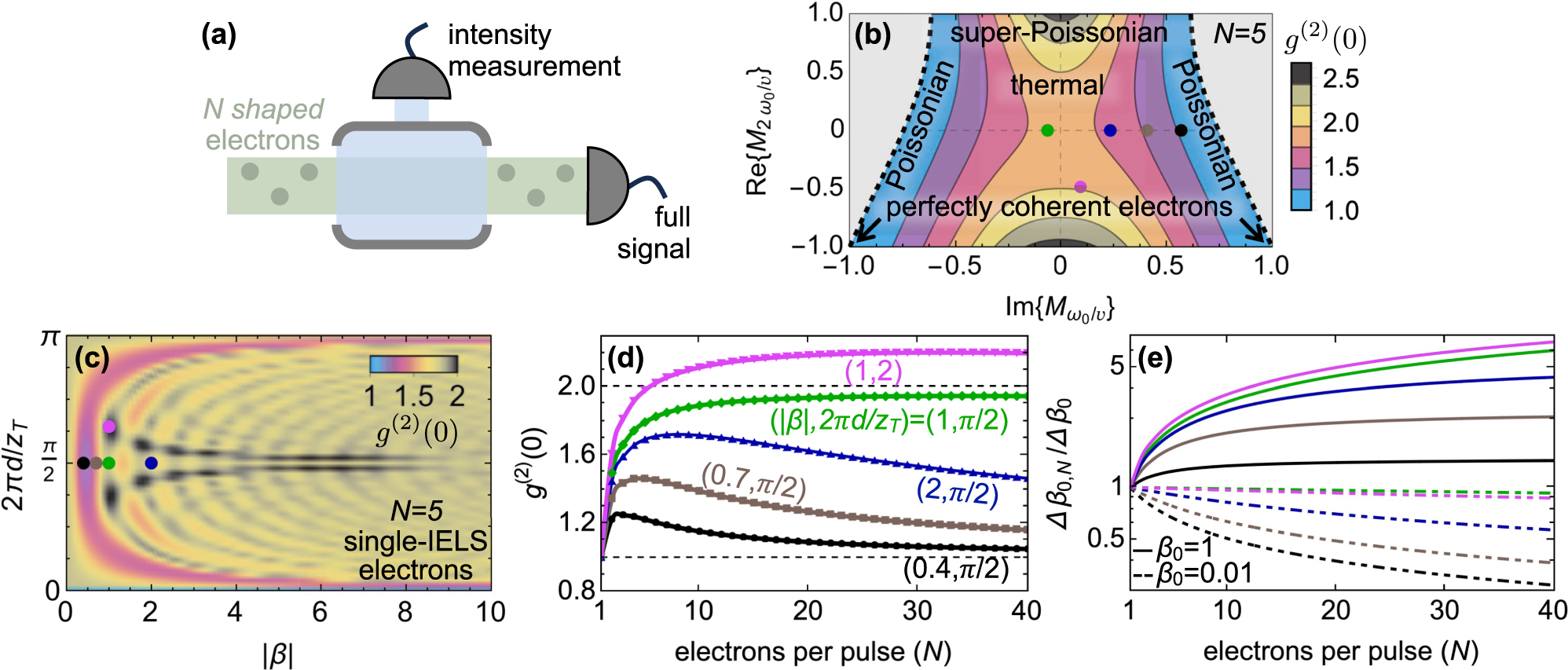
Intensity fluctuations for N modulated electrons. (a) N-electron modulated pulses emit light into a photonic mode. Its intensity is recorded together with its fluctuations by including all electron scattering events. (b) Second-order correlation function g
(2)(0) defining the statistics of the emitted light without post-filtering (see Eq. (4) and sketch in panel (a)) computed for N = 5 electrons. The electrons are assumed to undergo the same modulation yielding a coherence factor (CF) with imaginary
Interestingly, g
(2)(0) can also be tuned by varying the number of electrons under fixed IELS conditions, as shown in Figure 2d. This observation has important implications when estimating the coupling strength β
0 from light intensity measurements. Specifically, when using a total number of electrons K = RN, divided into R pulses each containing N particles, the root mean square error associated with the estimation of β
0, given by Δβ
0,N
= |∂β
0/∂I
K
|ΔI
K
, must be evaluated from the total measured intensity I
K
and its fluctuations
where we have defined the shot-noise-limited single-electron root mean square error as
A more complex situation is found for a general post-sample filtering function. In this case, the number representation ρ p = ∑ nn′ ρ p,nn′|n⟩⟨n ′| provides a clearer isolation of the role played by the input electron density matrix, which is otherwise obscured in the spatial dependence of the coherent states in Eq. (2). While again considering uncorrelated electrons and an initial vacuum state (α = 0), we calculate ρ p,nn′ from Eq. (2) through a combinatorial analysis leading to (see SI [43] for a detailed derivation)
where si = mi − mi′, si′ = pi − pi′, while the β
0-dependent coefficient
which we term projected coherence factor (PCF), as it plays a role similar to the CF when only a sub-set of scattering events are observed and it is defined through the electron Wigner function
2.2 Light-state purity and electron coherence
An ideal quantum state, unaffected by classical ensemble averages over initial conditions or mechanisms of decoherence, can be described by a pure state
First, we examine Eq. (2) in the case of uncorrelated electrons (although this assumption is not necessary for the following statement to hold) and observe that, if an infinitely precise post-filtering measurement with outcome
We now examine this result in the simple case of a single electron, for which Eq. (7) simplifies to the form (see SI [43])
In Figure 3a, we analyze the purity
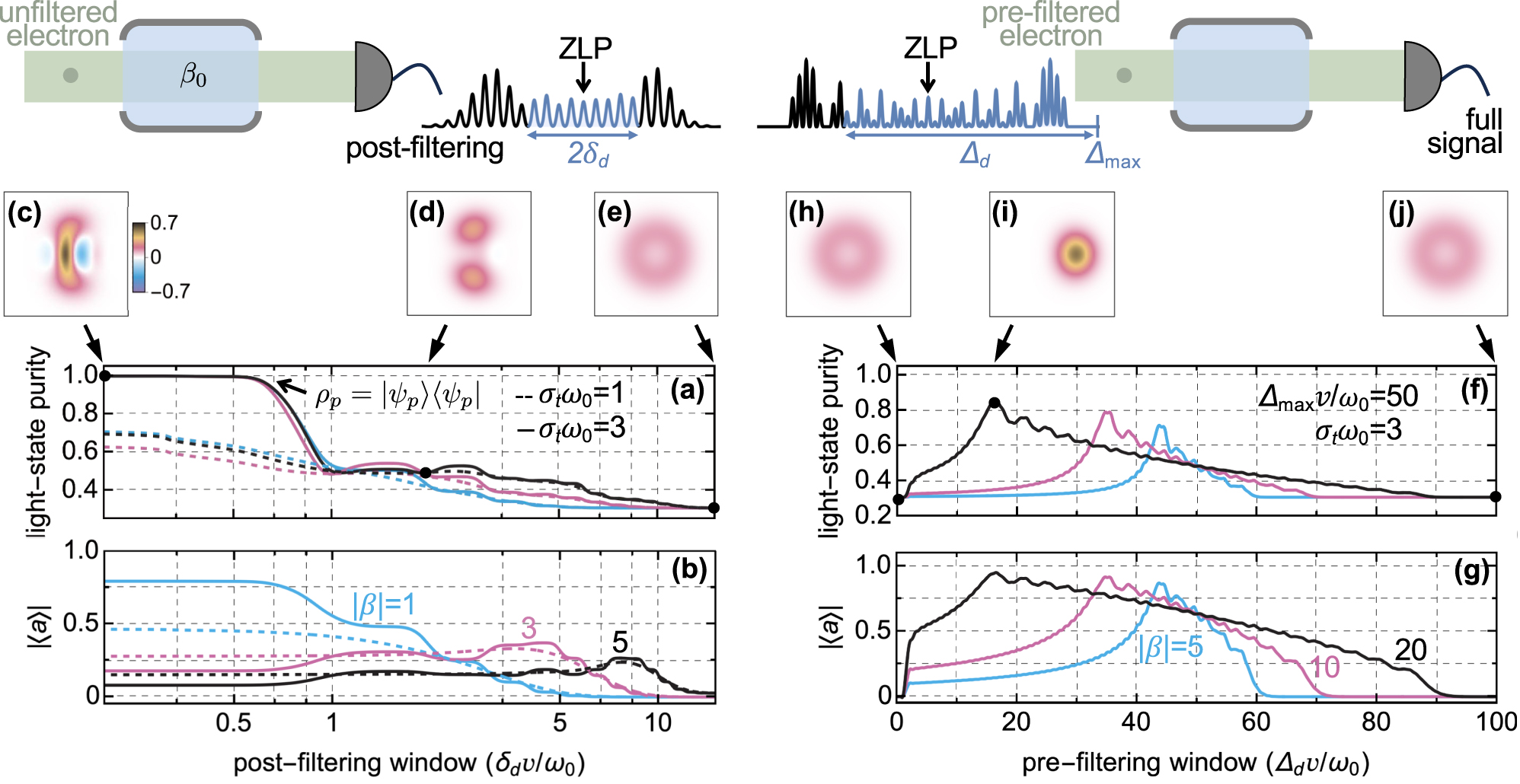
Properties of the light state generated by single electrons using energy post- or pre-filtering. An electron with an incoherent envelope of temporal width Δtω
0 ≫ 1 freely drifts over a negligible length with respect to the Talbot distance
As we previously observed, in addition to enabling access to high-purity states, the combination of post-filtering and shaped electrons provides a means to probe time-varying signals with an electron density that depends on its final measured energy and that can be visualized through the energy cuts of the electron Wigner function (see Figure 1a in the SI [43]). An example of this is the average electric field
A similar phenomenon of enhanced time localization occurs when an energy filter, selecting a fixed momentum range starting from Δmin = Δmax − Δ
d
and ending at Δmax relative to the central momentum, is placed between the IELS modulation and the interaction with the sample (see Figure 1 and the rightmost sketch in Figure 3). Indeed, since the CF can be re-expressed in terms of the PCF of an electron without pre-filtering
with
where ℓ
min = ⌊Δmin v/ω
0⌋ − min{0, m} + 1 and ℓ
max = ⌊Δmax
v/ω
0⌋ − max{0, m}, and ⌊x⌋ denotes the floor function of x. This expression reveals a significant increase in electron coherence, surpassing the absolute maximum of
Despite this high coherence for low m, Eq. (11) vanishes for ⌊Δmax v/ω 0⌋ −⌊Δmin v/ω 0⌋≤ |m|, thereby limiting the light-state purity in a manner dependent on the electron-mode coupling β 0. Finally, as previously demonstrated [30], ρ p oscillates between a quasi-pure and a phase-averaged coherent state as the electron coherence is varied through Δ d (see Figure 3h–j).
As expected, for nearly elastic attosecond imaging or diffraction experiments, it also becomes irrelevant if the filtering takes place before or after the sample. This is confirmed by the k → 0 limit of the integral in Eq. (10) that transforms to an integrated PCF over the collection range as it appears in Eqs. (7) and (9) for negligible ω 0.
2.3 Natural synthesis of cat states by IELS electrons
We now utilize the purity achieved through post-filtering performed around the s-th energy sideband in the high electron coherence limit of Figure 3a to examine the actual state of the generated light (see Figure 4a). Under these conditions, we can work in the σ
t
ω
0 ≫ 1 approximation for which the integral of the PCF in Eq. (9), taken around the post-filtering sideband, only selects specific energy coefficients from the modulated superposition and thus reduces to the simple product
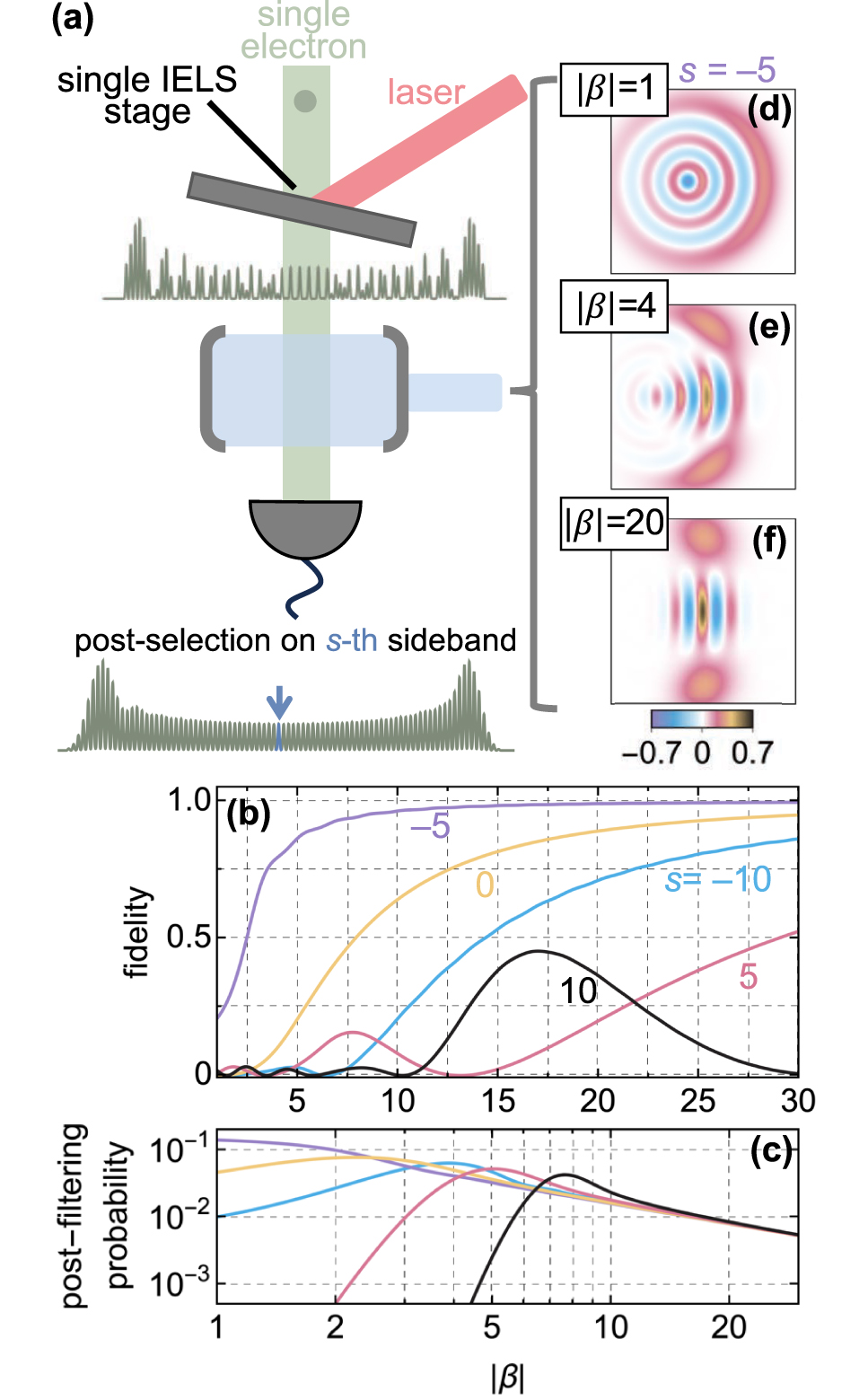
Natural formation of cat states after a single IELS stage. (a) Proposed scheme to produce high-purity cat states from an optical mode in a vacuum state involving a single IELS interaction of coupling parameter β and the post-filtering of the s-th sideband after spontaneous emission into the cavity with strength β 0 = 2. (b) Overlap between the light state generated by an electron after passing through the stages sketched in (a) and a cat state with amplitude χ = −iβ 0eiarg{−β} and relative phase θ = sπ + π/2 − 4|β| for different IELS couplings β and post-filtered sideband order s. (c) Post-filtering probabilities for the configurations reported in (b). (d–f) Post-interaction photonic Wigner function for s = −5 and |β| = 1, 4, 20. In all panels, we use arg{−β} = 0.
Equation (12) demonstrates that any target light state with finite support can be synthesized through appropriate shaping of the electron energy coefficients c
ℓ
. Intuitively, it predicts an average photon number that depends on β
0 but can exceed the probability of spontaneous emission,
In the special case of an electron immediately after a one-stage IELS interaction (c
ℓ
= J
ℓ
(2|β|)eiℓarg{−β}), we find that, beyond a certain high value of |β|, the electron naturally forms an approximate version of a cat state, α
p,n
∝ ⟨n|χ⟩[1 + eiθ
(−1)
n
], where χ = −iβ
0eiarg{−β} and θ = sπ + π/2 − 4|β|. Taking this state as the target state
2.4 On-demand quantum light generation by lateral IELS
The approach previously used to create a specific type of cat state can be generalized to a broader range of light states through Eq. (12) by accessing a wider set of electron energy coefficients c ℓ . Several schemes have been proposed to achieve such flexibility, primarily relying on either sequential combinations of IELS and free propagation stages [25] or focusing different lateral sections of an e-beam that has passed through a spatially dependent coupling coefficient β(R) [26]. A third strategy involves the use of shaping pulses composed of several harmonics [79], [80], however, its implementation would require a structure capable of sustaining strong IELS coupling strengths over a considerably broad spectral range, especially when operating in the visible regime. In this work, we adopt the scheme based on lateral field structuring whose capabilities are reported in Figure 5; however, a similar study could be conducted following the other methods.
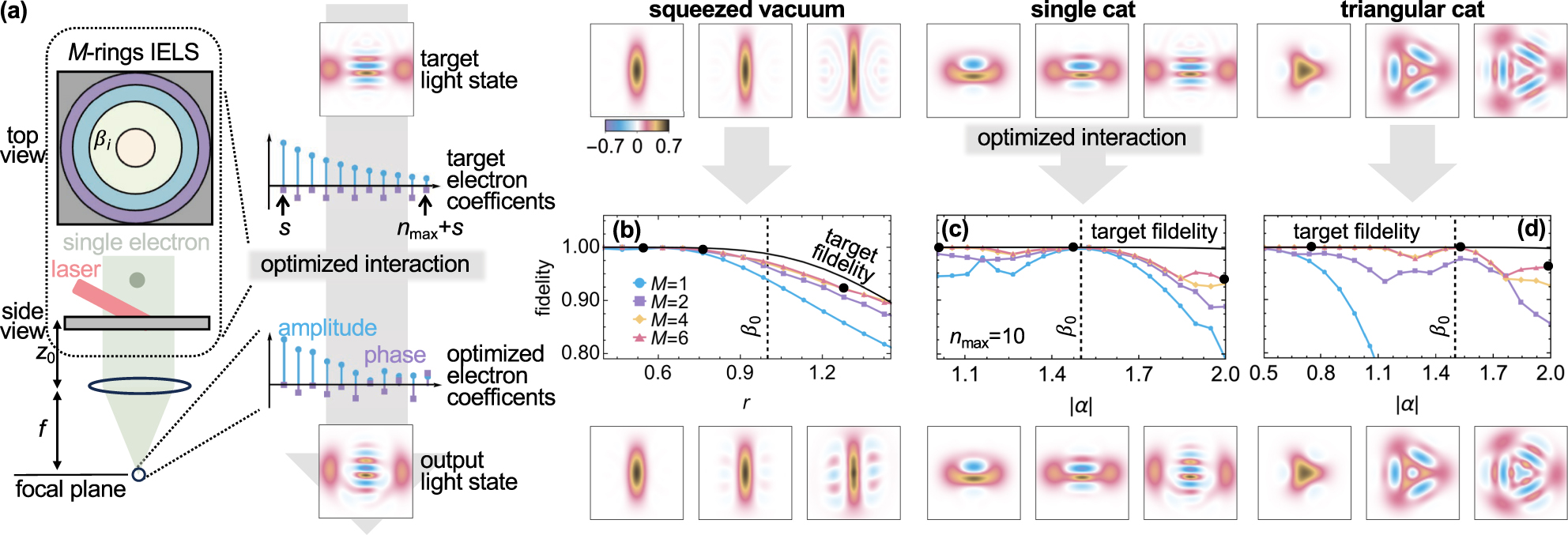
Lateral IELS patterning for electron energy coefficients optimization and quantum light generation. (a) Illustration of the steps employed for tailored synthesis of quantum light states. A set of electron energy amplitudes are obtained from Eq. (12) to approximate the first n
max = 10 coefficients of a given target photonic state
As detailed in the SI [43], the energy coefficients forming the wave function near the focal point of a lens acting on an electron previously shaped by a near field divided into M equal-area circular sectors, each producing constant IELS coefficients β i (see the modulation scheme in Figure 5a), are given by
where now d = z
0 + f is the sum of the lens’ separation from the IELS plane (z
0) and the focal distance (f). We use an optimization algorithm based on a steepest descent routine (see SI [43] for details) to determine the set of coupling strengths β
i
, lens position d, and post-filtering sideband s that maximize the overlap of the generated state
As target states, we select the first n
max coefficients, which define a maximum achievable target fidelity (black solid lines in Figure 5b–d), for a squeezed vacuum with
For the squeezed vacuum, we achieve fidelities of nearly 100 % for amounts of squeezing smaller than β
0 by modulating the electron at twice the fundamental frequency (ω
L = 2ω
0), which suppresses the emission of an odd number of photons for even s, simplifying the optimization. While this result is largely independent of the number of sectors for small r, when the average number of required photons exceeds
In Figure 5, we chose to run our optimization algorithm over the first n max = 10 coefficients to ensure computational efficiency. This limitation is reflected in the target fidelity curve which does not reach 100 % in all cases and produces target states that are not exact, as is the case of target squeezed vacuum states with r > 1.
3 Discussion and concluding remarks
In this work, we have presented a compact theoretical framework that enables the study of the light state generated by the interaction of N pre-modulated electrons with a single optical mode, within a specific subset of scattering events selected by a final electron spectrometer (see Figure 1).
We have demonstrated that, without final energy filtering, the resulting light density matrix ρ
p
can exhibit either Poissonian or super-Poissonian statistics due to inter-electron photon exchange. However, its purity is strongly constrained by the electron coherence, quantified by the absolute value of the coherence factor (CF)
To enhance the CF to approximately 95 %, we proposed retaining only the electrons exiting a strong (|β| ∼ 20) IELS modulation with energies inside a specific window, which effectively compresses the e-beam temporally. The advantage of this scheme, compared to others that combine longitudinal [25] or later IELS interactions [26], is that it relies only on a single homogeneous IELS stage – a resource increasingly common in ultrafast TEM – and an energy filter, such as a Wien filter [81], placed before the sample rather than after, as in energy-filtered EELS measurements [82]. At optical frequencies, the optimal energy window is approximately 20 eV (see Figure 3f), making the filtering requirements less stringent than in such experiments. Using this practical scheme for a single electron, we have shown that coherent states with a purity of approximately 90 % can be generated (see Figure 3f).
We have also examined how ρ
p
, and the associated light properties, are influenced by electron modulation when post-filtering is applied to a specific kinetic energy window. Specifically, we found that electron coherence is now quantified by the projected coherence factor (PCF) (see Eq. (8)), where the electron density appearing in the CF is replaced by the electron Wigner function
By leveraging this result, we have demonstrated several cases where quantum light can be harnessed using only a single IELS stage. We showed how cat states can be generated without lateral patterning of the IELS field or dispersive electron compression, achieving
Furthermore, to synthesize other types of light states, we proposed a scheme based on optimizing the c
ℓ
coefficients produced by an IELS interaction composed of M concentric sectors (see Eq. (13)). Applying this approach to the generation of squeezed vacuum, cat, and triangular cat states, we demonstrated that M = 6 sectors are sufficient to achieve their production with
In all analyzed cases, the creation of light states with strong quantum features, such as high squeezing or Wigner function negativity, requires a high average photon number, which in turn necessitates above-unity values of β
0. Recent experiments with electrons passing extended structures of about
Another possibility to increase the bare coupling strength β 0 is offered by the application of the optimization scheme to N-electron pulses, leveraging the superradiant enhancement to achieve an effective coupling strength of Nβ 0. In practice, such implementation only requires Eq. (7) in the σ t ω 0 ≫ 1 and exact post-filtering limits, available in the SI [43], in order to compute the fidelity between target and emitted light states. The exploration of this approach is left for future work.
The analysis presented here marks a fundamental step toward a more complete understanding of N-electron emission into free space and photonic structures under general coupling conditions. Our findings pave the way for superradiance-enhanced cathodoluminescence measurements and the practical realization of tunable sources of complex quantum light in photonic devices, with potential applications in electron-based low-dose spectroscopy as well as in quantum metrology and imaging.
Funding source: H2020 Future and Emerging Technologies
Award Identifier / Grant number: 101017720
Acknowledgments
We thank Hao Jeng, Aviv Karnieli, and F. Javier García de Abajo for helpful and enjoyable discussions.
-
Research funding: This work has been supported in part by the European project EBEAM (ID: 101017720).
-
Author contributions: VDG and CR provided the ideas. VDG developed the theory, performed the simulations, and produced the figures. All authors discussed the results and interpretation. VDG wrote the manuscript, with contributions and input from RH and CR. All authors have accepted responsibility for the entire content of this manuscript and consented to its submission to the journal, reviewed all the results and approved the final version of the manuscript.
-
Conflict of interest: The authors state no conflict of interest.
-
Data availability: Data sharing is not applicable to this article as no datasets were generated or analyzed during the current study.
References
[1] O. L. Krivanek, et al.., “Vibrational spectroscopy in the electron microscope,” Nature, vol. 514, no. 7521, p. 209, 2014, https://doi.org/10.1038/nature13870.Suche in Google Scholar PubMed
[2] F. S. Hage, D. M. Kepaptsoglou, Q. M. Ramasse, and L. J. Allen, “Phonon spectroscopy at atomic resolution,” Phys. Rev. Lett., vol. 122, no. 1, p. 016103, 2019, https://doi.org/10.1103/physrevlett.122.016103.Suche in Google Scholar
[3] J. Nelayah, et al.., “Mapping surface plasmons on a single metallic nanoparticle using sub-nm resolved EELS spectrum-imaging,” Microsc. Microanal., vol. 13, p. 144, 2007.10.1017/S1431927607076167Suche in Google Scholar
[4] U. Hohenester, H. Ditlbacher, and J. R. Krenn, “Electron-energy-loss spectra of plasmonic nanoparticles,” Phys. Rev. Lett., vol. 103, no. 4, p. 106801, 2009, https://doi.org/10.1103/physrevlett.103.106801.Suche in Google Scholar
[5] H. Duan, A. I. Fernández-Domínguez, M. Bosman, S. A. Maier, and J. K. W. Yang, “Nanoplasmonics: classical down to the nanometer scale,” Nano Lett., vol. 12, no. 3, p. 1683, 2012.10.1021/nl3001309Suche in Google Scholar PubMed
[6] J. Krehl, et al.., “Spectral field mapping in plasmonic nanostructures with nanometer resolution,” Nat. Commun., vol. 9, no. 1, p. 4207, 2018, https://doi.org/10.1038/s41467-018-06572-9.Suche in Google Scholar PubMed PubMed Central
[7] N. Li, et al.., “Direct observation of highly conned phonon polaritons in suspended monolayer hexagonal boron nitride,” Nat. Mater., vol. 20, no. 1, p. 43, 2021.10.1038/s41563-020-0763-zSuche in Google Scholar PubMed
[8] D. T. L. Alexander, V. Flauraud, and F. Demming-Jansen, “Near-field mapping of photonic eigenmodes in patterned silicon nanocavities by Electron Energy-Loss Spectroscopy,” ACS Nano, vol. 15, no. 10, p. 16501, 2021.10.1021/acsnano.1c06065Suche in Google Scholar PubMed
[9] F. J. García de Abajo, “Optical excitations in electron microscopy,” Rev. Mod. Phys., vol. 82, no. 1, p. 209, 2010, https://doi.org/10.1103/revmodphys.82.209.Suche in Google Scholar
[10] O. L. Krivanek, et al.., “Progress in ultrahigh energy resolution EELS,” Ultramicroscopy, vol. 203, p. 60, 2019, https://doi.org/10.1016/j.ultramic.2018.12.006.Suche in Google Scholar PubMed
[11] B. Barwick, D. J. Flannigan, and A. H. Zewail, “Photon-induced near-field electron microscopy,” Nature, vol. 462, no. 7275, p. 902, 2009, https://doi.org/10.1038/nature08662.Suche in Google Scholar PubMed
[12] S. T. Park, M. Lin, and A. H. Zewail, “Photon-induced near-field electron microscopy (PINEM): theoretical and experimental,” New J. Phys., vol. 12, no. 12, p. 123028, 2010, https://doi.org/10.1088/1367-2630/12/12/123028.Suche in Google Scholar
[13] J.-W. Henke, et al.., “Integrated photonics enables continuous-beam electron phase modulation,” Nature, vol. 600, no. 7890, p. 653, 2021, https://doi.org/10.1038/s41586-021-04197-5.Suche in Google Scholar PubMed PubMed Central
[14] Y. Kurman, et al.., “Spatiotemporal imaging of 2D polariton wave packet dynamics using free electrons,” Science, vol. 372, no. 6547, p. 1181, 2021, https://doi.org/10.1126/science.abg9015.Suche in Google Scholar PubMed
[15] Y. Auad, et al.., “μeV electron spectromicroscopy using free-space light,” Nat. Commun., vol. 14, no. 1, p. 4442, 2023, https://doi.org/10.1038/s41467-023-39979-0.Suche in Google Scholar PubMed PubMed Central
[16] J. H. Gaida, et al.., “Attosecond electron microscopy by free-electron homodyne detection,” Nat. Photonics, vol. 18, no. 5, p. 509, 2024, https://doi.org/10.1038/s41566-024-01380-8.Suche in Google Scholar
[17] S. Meuret, H. Lourenço-Martins, W. Sébastien, F. Houdellier, and A. Arnaud, “Photon-induced near-field electron microscopy of nanostructured metallic films and membranes,” ACS Photonics, vol. 11, no. 3, p. 977, 2024.10.1021/acsphotonics.3c01223Suche in Google Scholar
[18] Y. Yang, et al.., “Free-electron interaction with nonlinear optical states in microresonators,” Science, vol. 383, no. 6679, p. 168, 2024.10.1126/science.adk2489Suche in Google Scholar PubMed
[19] A. Feist, K. E. Echternkamp, J. Schauss, S. V. Yalunin, S. Schäfer, and C. Ropers, “Quantum coherent optical phase modulation in an ultrafast transmission electron microscope,” Nature, vol. 521, no. 7551, p. 200, 2015, https://doi.org/10.1038/nature14463.Suche in Google Scholar PubMed
[20] G. M. Vanacore, et al.., “Ultrafast generation and control of an electron vortex beam via chiral plasmonic near fields,” Nat. Mater., vol. 18, no. 6, p. 573, 2019, https://doi.org/10.1038/s41563-019-0336-1.Suche in Google Scholar PubMed
[21] Y. Fang, J. Kuttruff, D. Nabben, and P. Baum, “Structured electrons with chiral mass and charge,” Science, vol. 385, no. 6705, p. 183, 2024, https://doi.org/10.1126/science.adp9143.Suche in Google Scholar PubMed
[22] K. E. Priebe, et al.., “Attosecond electron pulse trains and quantum state reconstruction in ultrafast transmission electron microscopy,” Nat. Photonics, vol. 11, no. 12, p. 793, 2017, https://doi.org/10.1038/s41566-017-0045-8.Suche in Google Scholar
[23] M. Kozák, N. Schönenberger, and P. Hommelhoff, “Ponderomotive generation and detection of attosecond free-electron pulse trains,” Phys. Rev. Lett., vol. 120, no. 10, p. 103203, 2018, https://doi.org/10.1103/physrevlett.120.103203.Suche in Google Scholar
[24] Y. Morimoto and P. Baum, “Diffraction and microscopy with attosecond electron pulse trains,” Nat. Phys., vol. 14, no. 3, p. 252, 2018, https://doi.org/10.1038/s41567-017-0007-6.Suche in Google Scholar
[25] S. V. Yalunin, A. Feist, and C. Ropers, “Tailored high-contrast attosecond electron pulses for coherent excitation and scattering,” Phys. Rev. Res., vol. 3, no. 3, p. L032036, 2021, https://doi.org/10.1103/physrevresearch.3.l032036.Suche in Google Scholar
[26] F. J. García de Abajo and C. Ropers, “Spatiotemporal electron beam focusing through parallel interactions with shaped optical fields,” Phys. Rev. Lett., vol. 130, no. 24, p. 246901, 2023, https://doi.org/10.1103/physrevlett.130.246901.Suche in Google Scholar PubMed
[27] D. Nabben, J. Kuttruff, L. Stolz, A. Ryabov, and P. Baum, “Attosecond electron microscopy of sub-cycle optical dynamics,” Nature, vol. 619, no. 7968, p. 63, 2023, https://doi.org/10.1038/s41586-023-06074-9.Suche in Google Scholar PubMed
[28] T. Bucher, et al.., “Free-electron Ramsey-type interferometry for enhanced amplitude and phase imaging of nearfields,” Sci. Adv., vol. 9, no. 51, p. eadi5729, 2023, https://doi.org/10.1126/sciadv.adi5729.Suche in Google Scholar PubMed PubMed Central
[29] O. Kfir, “Entanglements of electrons and cavity photons in the strong-coupling regime,” Phys. Rev. Lett., vol. 123, no. 10, p. 103602, 2019, https://doi.org/10.1103/physrevlett.123.103602.Suche in Google Scholar PubMed
[30] V. Di Giulio and F. J. García de Abajo, “Free-electron shaping using quantum light,” Optica, vol. 7, no. 12, p. 1820, 2020.10.1364/OPTICA.404598Suche in Google Scholar
[31] R. Dahan, et al.., “Imprinting the quantum statistics of photons on free electrons,” Science, vol. 373, no. 6561, p. eabj7128, 2021, https://doi.org/10.1126/science.abj7128.Suche in Google Scholar PubMed
[32] V. Di Giulio, M. Kociak, and F. J. García de Abajo, “Probing quantum optical excitations with fast electrons,” Optica, vol. 6, no. 12, p. 1524, 2019, https://doi.org/10.1364/optica.6.001524.Suche in Google Scholar
[33] A. Karnieli and S. Fan, “Jaynes-Cummings interaction between low-energy free electrons and cavity photons,” Sci. Adv., vol. 9, no. 22, p. eadd2349, 2023, https://doi.org/10.1126/sciadv.adh2425.Suche in Google Scholar PubMed PubMed Central
[34] J. Abad-Arredondo and A. I. Fernández-Domínguez, “Electron-assisted probing of polaritonic light{matter states,” Nanophotonics, vol. 13, no. 11, p. 2015, 2024.10.1515/nanoph-2023-0907Suche in Google Scholar PubMed PubMed Central
[35] F. J. García de Abajo, et al.., arXiv preprint arXiv:2409.11300, 2025.Suche in Google Scholar
[36] A. B. Hayun, O. Reinhardt, J. Nemirovsky, A. Karnieli, N. Rivera, and I. Kaminer, “Shaping quantum photonic states using free electrons,” Sci. Adv., vol. 7, no. 11, p. eabe4270, 2021.10.1126/sciadv.abe4270Suche in Google Scholar PubMed PubMed Central
[37] V. Di Giulio and F. J. García de Abajo, “Optical-cavity mode squeezing by free electrons,” Nanophotonics, vol. 11, no. 21, p. 4659, 2022.10.1515/nanoph-2022-0481Suche in Google Scholar PubMed PubMed Central
[38] X. M. Bendaña, A. Polman, and F. J. García de Abajo, “Single-photon generation by electron beams,” Nano Lett., vol. 11, no. 12, p. 5099, 2011, https://doi.org/10.1021/nl1034732.Suche in Google Scholar PubMed
[39] A. Feist, et al.., “Cavity-mediated electron-photon pairs,” Science, vol. 377, no. 6607, p. 777, 2022, https://doi.org/10.1126/science.abo5037.Suche in Google Scholar PubMed
[40] G. Arend, et al.., arXiv preprint arXiv:2409.11300, 2024.Suche in Google Scholar
[41] D. Gottesman, A. Kitaev, and J. Preskill, “Encoding a qubit in an oscillator,” Phys. Rev. A, vol. 64, no. 1, p. 012310, 2001, https://doi.org/10.1103/physreva.64.012310.Suche in Google Scholar
[42] R. Dahan, G. Baranes, A. Gorlach, R. Ruimy, N. Rivera, and I. Kaminer, “Creation of optical cat and GKP states using shaped free electrons,” Phys. Rev. X, vol. 13, no. 3, p. 031001, 2023, https://doi.org/10.1103/physrevx.13.031001.Suche in Google Scholar
[43] See Supplementary Information for further details.Suche in Google Scholar
[44] V. Di Giulio, O. Kfir, C. Ropers, and F. J. García de Abajo, “Modulation of cathodoluminescence emission by interference with external light,” ACS Nano, vol. 15, no. 4, p. 7290, 2021, https://doi.org/10.1021/acsnano.1c00549.Suche in Google Scholar PubMed PubMed Central
[45] V. Di Giulio, E. Akerboom, and A. P. F. J. García de Abajo, “Toward optimum coupling between free electrons and conned optical modes,” ACS Nano, vol. 18, no. 22, p. 14255, 2024.10.1021/acsnano.3c12977Suche in Google Scholar PubMed PubMed Central
[46] V. Di Giulio and F. J. García de Abajo, “Electron diffraction by vacuum fluctuations,” New J. Phys., vol. 22, no. 10, p. 103057, 2020, https://doi.org/10.1088/1367-2630/abbddf.Suche in Google Scholar
[47] J.-W. Henke, H. Jeng, M. Sivis, and C. Ropers, arXiv preprint arXiv:2504.13047, 2025.Suche in Google Scholar
[48] O. Kfir, et al.., “Controlling free electrons with optical whispering-gallery modes,” Nature, vol. 582, no. 7810, p. 46, 2020, https://doi.org/10.1038/s41586-020-2320-y.Suche in Google Scholar PubMed
[49] Y. Adiv, et al.., “Observation of 2D Cherenkov radiation,” Phys. Rev. X, vol. 13, no. 1, p. 011002, 2023, https://doi.org/10.1103/physrevx.13.011002.Suche in Google Scholar
[50] F. Aguilar, H. Lourenço-Martins, D. Montero, X. Li, M. Kociak, and A. Campos, “Selective probing of longitudinal and transverse plasmon modes with electron phase-matching,” J. Phys. Chem. C, vol. 127, no. 45, p. 22252, 2023.10.1021/acs.jpcc.3c03998Suche in Google Scholar
[51] E. Akerboom, V. Di Giulio, N. J. Schilder, F. J. García de Abajo, and A. Polman, “Free electron–plasmon coupling strength and near-field retrieval through electron energy-dependent cathodoluminescence spectroscopy,” ACS Nano, vol. 18, no. 21, p. 13560, 2024, https://doi.org/10.1021/acsnano.3c12972.Suche in Google Scholar PubMed PubMed Central
[52] S. Meier, J. Heimerl, and P. Hommelhoff, “Few-electron correlations after ultrafast photoemission from nanometric needle tips,” Nat. Phys., vol. 19, no. 10, p. 1402, 2023, https://doi.org/10.1038/s41567-023-02059-7.Suche in Google Scholar
[53] R. Haindl, V. Di Giulio, A. Feist, and C. Ropers, arXiv preprint arXiv:2412.11929, 2024.Suche in Google Scholar
[54] S. Kumar, et al.., “Strongly correlated multielectron bunches from interaction with quantum light,” Sci. Adv., vol. 10, no. 19, p. eadm9563, 2024.10.1126/sciadv.adm9563Suche in Google Scholar PubMed PubMed Central
[55] A. Karnieli, N. Rivera, A. Arie, and I. Kaminer, “Superradiance and subradiance due to quantum interference of entangled free electrons,” Phys. Rev. Lett., vol. 127, no. 6, p. 060403, 2021, https://doi.org/10.1103/physrevlett.127.060403.Suche in Google Scholar
[56] R. Haindl, et al.., “Coulomb-correlated electron number states in a transmission electron microscope beam,” Nat. Phys., vol. 19, no. 10, p. 1410, 2023, https://doi.org/10.1038/s41567-023-02067-7.Suche in Google Scholar
[57] F. J. García de Abajo and V. Di Giulio, “Optical excitations with electron beams: challenges and opportunities,” ACS Photonics, vol. 8, no. 4, p. 945, 2021, https://doi.org/10.1021/acsphotonics.0c01950.Suche in Google Scholar PubMed PubMed Central
[58] O. Kfir, V. Di Giulio, F. J. García de Abajo, and C. Ropers, “Optical coherence transfer mediated by free electrons,” Sci. Adv., vol. 7, no. 18, p. eabf6380, 2021, https://doi.org/10.1126/sciadv.abf6380.Suche in Google Scholar PubMed PubMed Central
[59] H. Schwarz and H. Hora, “Modulation of an electron wave by a light wave,” Appl. Phys. Lett., vol. 15, no. 11, p. 249, 1969.10.1063/1.1652854Suche in Google Scholar
[60] A. Gover, “Superradiant and stimulated-superradiant emission in prebunched electron-beam radiators. I. Formulation,” Phys. Rev. ST Accel. Beams, vol. 8, no. 3, p. 030701, 2005, https://doi.org/10.1103/physrevstab.8.030701.Suche in Google Scholar
[61] A. Gover, E. Dyunin, Y. Lurie, Y. Pinhasi, and M. V. Krongauz, “Superradiant and stimulated-superradiant emission in prebunched electron-beam radiators. II. Radiation enhancement schemes,” Phys. Rev. ST Accel. Beams, vol. 8, no. 3, p. 030702, 2005, https://doi.org/10.1103/physrevstab.8.030702.Suche in Google Scholar
[62] W. P. Leemans, et al.., “Observation of terahertz emission from a laser-plasma accelerated electron bunch crossing a plasma-vacuum boundary,” Phys. Rev. Lett., vol. 91, no. 7, p. 074802, 2003.10.1103/PhysRevLett.91.074802Suche in Google Scholar PubMed
[63] R. Bonifacio and F. Casagrande, “Classical and quantum treatment of amplifier and superradiant free-electron laser dynamics,” J. Opt. Soc. Am. B, vol. 2, no. 1, p. 250, 1985, https://doi.org/10.1364/josab.2.000250.Suche in Google Scholar
[64] R. Bonifacio, F. Casagrande, and C. Pellegrini, “Preface,” Nucl. Instrum. Methods Phys. Res. Sect. A Accel. Spectrom. Detect. Assoc. Equip., vol. 239, no. 1, p. 36, 1985, https://doi.org/10.1016/0168-9002(85)90690-4.Suche in Google Scholar
[65] H. P. Freund and T. M. AntonsenJr., Principles of Free Electron Lasers, Cham, Switzerland, Springer, 2018.10.1007/978-3-319-75106-1Suche in Google Scholar
[66] Z. Zhao, X.-Q. Sun, and S. Fan, “Quantum entanglement and modulation enhancement of free-electron–bound-electron interaction,” Phys. Rev. Lett., vol. 126, no. 23, p. 233402, 2021, https://doi.org/10.1103/physrevlett.126.233402.Suche in Google Scholar PubMed
[67] B. Zhang, et al.., “Spontaneous photon emission by shaped quantum electron wavepackets and the QED origin of bunched electron beam superradiance,” Rep. Prog. Phys., vol. 88, no. 1, p. 017601, 2024, https://doi.org/10.1088/1361-6633/ad9052.Suche in Google Scholar PubMed
[68] E. Wigner, “On the quantum correction for thermodynamic equilibrium,” Phys. Rev., vol. 40, no. 5, p. 749, 1932, https://doi.org/10.1103/physrev.40.749.Suche in Google Scholar
[69] S. T. Park, O.-H. Kwon, and A. H. Zewail, “Chirped imaging pulses in four-dimensional electron microscopy: femtosecond pulsed hole burning,” New J. Phys., vol. 14, no. 5, p. 053046, 2012, https://doi.org/10.1088/1367-2630/14/5/053046.Suche in Google Scholar
[70] F. O. Kirchner, A. Gliserin, F. Krausz, and P. Baum, “Laser streaking of free electrons at 25 keV,” Nat. Photonics, vol. 8, no. 1, p. 52, 2014, https://doi.org/10.1038/nphoton.2013.315.Suche in Google Scholar
[71] A. Feist, et al.., “Ultrafast transmission electron microscopy using a laser-driven field emitter: femtosecond resolution with a high coherence electron beam,” Ultramicroscopy, vol. 176, p. 63, 2017, https://doi.org/10.1016/j.ultramic.2016.12.005.Suche in Google Scholar PubMed
[72] L. Mandel and E. Wolf, Optical Coherence and Quantum Optics, Cambridge, Cambridge University Press, 1995.10.1017/CBO9781139644105Suche in Google Scholar
[73] M. Chergui and A. H. Zewail, “Electron and X-ray methods of ultrafast structural dynamics: advances and applications,” ChemPhysChem, vol. 10, no. 1, p. 28, 2009, https://doi.org/10.1002/cphc.200800667.Suche in Google Scholar PubMed
[74] P. K. Suri and D. J. Flannigan, “Probing structural and electronic dynamics with ultrafast electron microscopy,” Chem. Mater., vol. 27, no. 9, p. 3178, 2015, https://doi.org/10.1021/acs.chemmater.5b00433.Suche in Google Scholar
[75] P. Baum, “Quantum dynamics of attosecond electron pulse compression,” J. Appl. Phys., vol. 122, no. 22, p. 223105, 2017, https://doi.org/10.1063/1.5006864.Suche in Google Scholar
[76] Y. Aharonov, D. Z. Albert, and L. Vaidman, “How the result of a measurement of a component of the spin of a spin-1/2 particle can turn out to be 100,” Phys. Rev. Lett., vol. 60, no. 14, p. 1351, 1988, https://doi.org/10.1103/physrevlett.60.1351.Suche in Google Scholar PubMed
[77] R. Dahan, et al.., “Resonant phase-matching between a light wave and a free-electron wavefunction,” Nat. Phys., vol. 16, no. 11, p. 1123, 2020, https://doi.org/10.1038/s41567-020-01042-w.Suche in Google Scholar
[78] M. Kozák, T. Eckstein, N. Schönenberger, and P. Hommelhoff, “Inelastic ponderomotive scattering of electrons at a high-intensity optical travelling wave in vacuum,” Nat. Phys., vol. 14, no. 2, p. 121, 2018, https://doi.org/10.1038/nphys4282.Suche in Google Scholar
[79] A. Konečná, V. Di Giulio, V. Mkhitaryan, C. Ropers, and F. J. García de Abajo, “Nanoscale nonlinear spectroscopy with electron beams,” ACS Photonics, vol. 7, no. 5, p. 1290, 2020, https://doi.org/10.1021/acsphotonics.0c00326.Suche in Google Scholar
[80] O. Reinhardt and I. Kaminer, “Theory of shaping electron wavepackets with light,” ACS Photonics, vol. 7, no. 10, p. 2859, 2020, https://doi.org/10.1021/acsphotonics.0c01133.Suche in Google Scholar
[81] K. Tsuno and D. Ioanoviciu, Chapter Six – Application of Wien Filters to Electrons, vol. 176, Amsterdam, Elsevier, 2013.10.1016/B978-0-12-408142-0.00006-7Suche in Google Scholar
[82] J. Verbeeck, D. Van Dyck, and G. Van Tendeloo, “Energy-filtered transmission electron microscopy: an overview,” Spectrochim. Acta B Atom Spectrosc., vol. 59, no. 10, p. 1529, 2004, https://doi.org/10.1016/j.sab.2004.03.020.Suche in Google Scholar
[83] F. A. Sabattoli, et al.., “A silicon source of frequency-bin entangled photons,” Opt. Lett., vol. 47, no. 23, p. 6201, 2022, https://doi.org/10.1364/ol.471241.Suche in Google Scholar PubMed
[84] Z. Xie, et al.., “Maximal quantum interaction between free electrons and photons,” Phys. Rev. Lett., vol. 134, no. 4, p. 043803, 2025.10.1103/PhysRevLett.134.043803Suche in Google Scholar PubMed
[85] Z. Zhao, “Upper bound for the quantum coupling between free electrons and photons,” Phys. Rev. Lett., vol. 134, no. 4, p. 043804, 2025, https://doi.org/10.1103/physrevlett.134.043804.Suche in Google Scholar
[86] A. Karnieli, C. Roques-Carmes, N. Rivera, and S. Fan, “Strong coupling and single-photon nonlinearity in free-electron quantum optics,” ACS Photonics, vol. 11, no. 8, p. 3401, 2024, https://doi.org/10.1021/acsphotonics.4c00908.Suche in Google Scholar
[87] H. Yan, et al.., “Damping pathways of mid-infrared plasmons in graphene nanostructures,” Nat. Photonics, vol. 7, no. 5, p. 394, 2013, https://doi.org/10.1038/nphoton.2013.57.Suche in Google Scholar
[88] R. Yu, J. D. Cox, J. R. M. Saavedra, and F. J. García de Abajo, “Analytical modeling of graphene plasmons,” ACS Photonics, vol. 4, no. 12, p. 3106, 2017, https://doi.org/10.1021/acsphotonics.7b00740.Suche in Google Scholar
Supplementary Material
This article contains supplementary material (https://doi.org/10.1515/nanoph-2025-0040).
© 2025 the author(s), published by De Gruyter, Berlin/Boston
This work is licensed under the Creative Commons Attribution 4.0 International License.
Artikel in diesem Heft
- Frontmatter
- Editorial
- Quantum light: creation, integration, and applications
- Reviews
- Low-dimensional solid-state single-photon emitters
- Solid-state single-photon sources operating in the telecom wavelength range
- Quantum super-resolution imaging: a review and perspective
- Perspectives
- New opportunities for creating quantum states of light and matter with intense laser fields
- On-chip frequency-bin quantum photonics
- Building photonic links for microwave quantum processors
- Remote quantum networks based on quantum memories
- Sensing with quantum light: a perspective
- Letter
- Electro-optic frequency shift of single photons from a quantum dot
- Research Articles
- Quantum efficiency of the B-center in hexagonal boron nitride
- Localized exciton emission from monolayer WS2 nanoribbon at cryogenic temperature
- Single-photon emitters in PECVD-grown silicon nitride films: from material growth to photophysical properties
- A fiber-pigtailed quantum dot device generating indistinguishable photons at GHz clock-rates
- Sub-MHz homogeneous linewidth in epitaxial Y2O3: Eu3+ thin film on silicon
- Multimodal Purcell enhancement and optical coherence of Eu3+ ions in a single nanoparticle coupled to a microcavity
- All-optical control of charge-trapping defects in rare-earth doped oxides
- Ultra-broadband and passive stabilization of ultrafast light sources by quantum light injection
- Tunable quantum light by modulated free electrons
- Second-harmonic radiation by on-chip integrable mirror-symmetric nanodimers with sub-nanometric plasmonic gap
- Mie metasurfaces for enhancing photon outcoupling from single embedded quantum emitters
- Design and fabrication of robust hybrid photonic crystal cavities
- Enhanced zero-phonon line emission from an ensemble of W centers in circular and bowtie Bragg grating cavities
- Freeform thin-film lithium niobate mode converter for photon-pair generation
- Luminescence thermometry based on photon emitters in nanophotonic silicon waveguides
- Collective single-photon emission and energy transfer in thin-layer dielectric and plasmonic systems
- Description of ultrastrong light–matter interaction through coupled harmonic oscillator models and their connection with cavity-QED Hamiltonians
- Bound polariton states in the Dicke–Ising model
- Collective multimode strong coupling in plasmonic nanocavities
- Improving quantum metrology protocols with programmable photonic circuits
- Fluorescence enabled phonon counting in an erbium-doped piezo-optomechanical microcavity
- Non-perturbative cathodoluminescence microscopy of beam-sensitive materials
Artikel in diesem Heft
- Frontmatter
- Editorial
- Quantum light: creation, integration, and applications
- Reviews
- Low-dimensional solid-state single-photon emitters
- Solid-state single-photon sources operating in the telecom wavelength range
- Quantum super-resolution imaging: a review and perspective
- Perspectives
- New opportunities for creating quantum states of light and matter with intense laser fields
- On-chip frequency-bin quantum photonics
- Building photonic links for microwave quantum processors
- Remote quantum networks based on quantum memories
- Sensing with quantum light: a perspective
- Letter
- Electro-optic frequency shift of single photons from a quantum dot
- Research Articles
- Quantum efficiency of the B-center in hexagonal boron nitride
- Localized exciton emission from monolayer WS2 nanoribbon at cryogenic temperature
- Single-photon emitters in PECVD-grown silicon nitride films: from material growth to photophysical properties
- A fiber-pigtailed quantum dot device generating indistinguishable photons at GHz clock-rates
- Sub-MHz homogeneous linewidth in epitaxial Y2O3: Eu3+ thin film on silicon
- Multimodal Purcell enhancement and optical coherence of Eu3+ ions in a single nanoparticle coupled to a microcavity
- All-optical control of charge-trapping defects in rare-earth doped oxides
- Ultra-broadband and passive stabilization of ultrafast light sources by quantum light injection
- Tunable quantum light by modulated free electrons
- Second-harmonic radiation by on-chip integrable mirror-symmetric nanodimers with sub-nanometric plasmonic gap
- Mie metasurfaces for enhancing photon outcoupling from single embedded quantum emitters
- Design and fabrication of robust hybrid photonic crystal cavities
- Enhanced zero-phonon line emission from an ensemble of W centers in circular and bowtie Bragg grating cavities
- Freeform thin-film lithium niobate mode converter for photon-pair generation
- Luminescence thermometry based on photon emitters in nanophotonic silicon waveguides
- Collective single-photon emission and energy transfer in thin-layer dielectric and plasmonic systems
- Description of ultrastrong light–matter interaction through coupled harmonic oscillator models and their connection with cavity-QED Hamiltonians
- Bound polariton states in the Dicke–Ising model
- Collective multimode strong coupling in plasmonic nanocavities
- Improving quantum metrology protocols with programmable photonic circuits
- Fluorescence enabled phonon counting in an erbium-doped piezo-optomechanical microcavity
- Non-perturbative cathodoluminescence microscopy of beam-sensitive materials
