Costa Rica Chemistry Congress: “Chemistry: a solution to global changes”
-
Isaac F. Céspedes-Camacho


For nearly four decades, Costa Rica went without a national chemistry conference until 2022, when the Chemistry Departments of the five national leading public universities (University of Costa Rica, UCR; National University, UNA; Tecnológico de Costa Rica, TEC; National Technical University, UTN; and State Distance University, UNED) joined forces to launch the Costa Rica Chemistry Congress (CR22) in San José. The success of the event, marked by overwhelming participation, inspired organizers to establish it as a biennial tradition.
Two years later, the second edition CR24 Congress took place in Heredia from July 23rd to July 26th, 2024, reaffirming its growing prominence. Again, it was organized by the five universities, the congress garnered robust support from the Costa Rica Chemical Society (Colegio de Químicos de Costa Rica, CQCR), the Cámara de Industrias, and the National Laboratory of Nanotechnology (LANOTEC). The participation of ten international sponsors represented the significance of the event not just locally, but across the region.
Aligned with Costa Rica’s global leadership in climate action, conservation, and sustainable energy, the congress adopted the theme Chemistry: A Solution to Global Challenges, bridging scientific innovation with pressing real-world issues.
CR24 Congress attracted over 200 participants from 14 countries, featuring 8 plenary lectures by renowned national and international chemists, 54 oral presentations, and 52 posters. Held together with the 3rd Costa Rican Biophysics Symposium, the event demonstrated its role as a key regional hub for cutting-edge chemistry, fostering collaboration among academia, industry, and policymakers (Figs. 1–4).

During the plenary lecture of Prof. Seth Marder (University of Colorado).
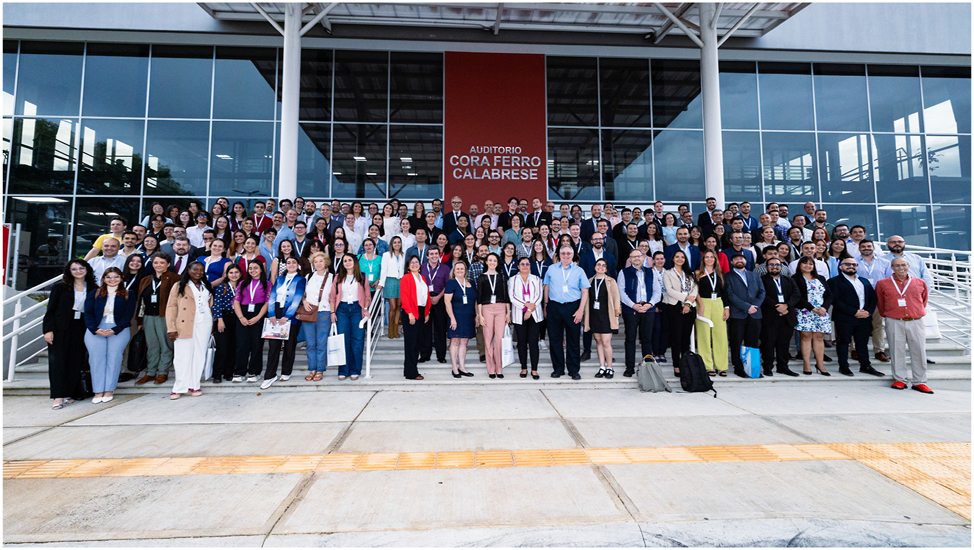
Group picture of the participants at CR24 Congress.

During one of the parallel sessions.

During the poster presentation at CR24.
Diversity, equity, and inclusion were central for the design of the congress. To overcome financial and geographical barriers, a parallel outreach program invited international speakers to deliver talks at multiple locations nationwide, ensuring broader access to world-class expertise.
With each iteration, the Costa Rica Chemistry Congress proves its transformative potential, revitalizing the country’s chemical sciences and uniting stakeholders to address global challenges through innovation.
The congress showcased a vibrant interdisciplinary and multidisciplinary approach, featuring ten key thematic areas that reflected the breadth of modern chemistry: i. Chemical education, ii. Chemistry in studies of emerging environmental pollutants, iii. Chemistry and technologies in information, iv. Chemistry in agricultural and food sciences, v. Chemistry in energy sources, vi. Chemistry and nanotechnology, vii. Chemistry and metrology, viii. Chemistry and interdisciplinary studies with the biological sciences, ix. Chemistry and environmental pollution and x. Chemistry and material sciences.
This diverse structure highlighted the Chemistry central role in addressing global challenges―from sustainability and energy to health and technology―while fostering collaboration across scientific disciplines.
The CR24 Congress saw remarkable participation from students, many of whom were awarded scholarships and grants to attend the event. Several of these emerging researchers contributed as co-authors to articles featured in this Special Issue, reflecting the interest of the Organizers on supporting the next generation of scientists.
Given the international scope of CR24, its interdisciplinary focus, and its commitment to fostering early-career researchers, the Scientific and Organizing Committees were honored to secure the endorsement of the IUPAC. This organization played an important role in promoting the event through their digital platforms. Furthermore, a representative of IUPAC was invited to deliver a keynote lecture during the congress, sharing insights into the organization’s mission, global initiatives, and its enduring support for advancing chemical sciences.
The Scientific and Organizing Committees of CR24 would like to express its gratitude to the Editorial Board of Pure and Applied Chemistry for their guidance and support to publish this Special Issue. Special acknowledge to the reviewers for their time and expertise, which greatly enhanced the quality of the published work. This Special Issue represents the dedication and innovation of researchers across Costa Rica and Latin America, marking a historic milestone: the first such collection dedicated to a Costa Rican chemistry conference. We are confident it will inspire future collaborations and set a precedent for years to come.
As President of the Scientific Committee of CR24 Congress I would like to invite the scientific community to explore the articles presented in this Special Issue. May these contributions inspire new discoveries and collaborations that advance not only Costa Rican science, but chemical research worldwide.
© 2025 IUPAC & De Gruyter
Articles in the same Issue
- Frontmatter
- Preface
- Costa Rica Chemistry Congress: “Chemistry: a solution to global changes”
- Review Articles
- Aflatoxin B1 chemical memo: a scientific review in a context of public health and food security crises
- Preliminary physicochemical characterization of biowaste from small restaurants in Costa Rica
- Research Articles
- Green synthesis of zinc oxide nanoparticles for the control of insects that damage historical and art pieces made of wood
- (Poly)phenol-rich extracts from six tropical fruits: antifungal and antimycotoxin activity against Fusarium verticillioides
- Comparative NMR-based profiling of polyphenols in Fragaria × ananassa cv. Marisol and Festival strawberry leaves
- Hyperacid lake monitoring from Poás Volcano, Costa Rica, using UAV (Unmanned Aerial Vehicle)
- Bioactive compounds profile and extraction yields in coffee (Coffea arabica L.) by-products: a comparative analysis using ethanol, methanol and acetone
- First measurements of the methane concentration and its carbon stable isotope composition in the breath of Costa Ricans
- Impact of sustainable polysaccharide coatings on shelf-life and quality parameters of bananas
- Synthesis and characterization of carbon quantum dots by microwave-assisted pyrolysis method from citrus juices and application in fluorescent bioimaging
- Pichichio extracts (Solanum mammosum) as a corrosion inhibitor of low carbon steel in an acidic environment
- Physicochemical, functional, and sensory analysis of a fiber made from a by-product of industrial peach palm heart (Bactris gasipaes) production
- Endotoxin detection in nanoliposomes using diluted Limulus Amebocyte Lysate and isothermal titration calorimetry
Articles in the same Issue
- Frontmatter
- Preface
- Costa Rica Chemistry Congress: “Chemistry: a solution to global changes”
- Review Articles
- Aflatoxin B1 chemical memo: a scientific review in a context of public health and food security crises
- Preliminary physicochemical characterization of biowaste from small restaurants in Costa Rica
- Research Articles
- Green synthesis of zinc oxide nanoparticles for the control of insects that damage historical and art pieces made of wood
- (Poly)phenol-rich extracts from six tropical fruits: antifungal and antimycotoxin activity against Fusarium verticillioides
- Comparative NMR-based profiling of polyphenols in Fragaria × ananassa cv. Marisol and Festival strawberry leaves
- Hyperacid lake monitoring from Poás Volcano, Costa Rica, using UAV (Unmanned Aerial Vehicle)
- Bioactive compounds profile and extraction yields in coffee (Coffea arabica L.) by-products: a comparative analysis using ethanol, methanol and acetone
- First measurements of the methane concentration and its carbon stable isotope composition in the breath of Costa Ricans
- Impact of sustainable polysaccharide coatings on shelf-life and quality parameters of bananas
- Synthesis and characterization of carbon quantum dots by microwave-assisted pyrolysis method from citrus juices and application in fluorescent bioimaging
- Pichichio extracts (Solanum mammosum) as a corrosion inhibitor of low carbon steel in an acidic environment
- Physicochemical, functional, and sensory analysis of a fiber made from a by-product of industrial peach palm heart (Bactris gasipaes) production
- Endotoxin detection in nanoliposomes using diluted Limulus Amebocyte Lysate and isothermal titration calorimetry
