Hunting for Hide. Investigating an Other-Than-Food Relationship Between Stone Age Hunters and Wild Animals in Northern Europe
-
Marianne Skandfer


Abstract
In archaeological hunter-gatherer research, animals are primarily seen as food. Alternatively, they are proposed to serve as symbols and devices for social structuring of human societies. A growing body of literature in humanities and social sciences now looks into the role of animals as social and sentient co-beings. It is becoming increasingly clear that the roles of animals as other-than-food providers are severely overlooked in Mesolithic research. This article considers hide as a vital resource in northern hunter-gatherer societies. Hide processing and manufacture in ethnographic records from the circumpolar region and experimental investigations are presented, followed by an analytical review of archaeological data from mid-Holocene coastal habitation sites in Norway. The results show that hide work was a central activity, and that various stages of hide processing may have taken place at different sites. It is suggested that hide procurement and processing would have required close planning and scheduling. Based on ethnographic accounts it is suggested that the different processing stages, combining raw materials and animal qualities into man-made objects, are articulations of human-animal social entanglements. Identifying practices related to hide processing in the archaeological record and viewing them as expressions of human-animal relationships, can contribute to fuller insight into Stone Age hunter-gatherer societies.
1 Introduction
“Killing is not an end in itself. It is the start of a process of utilization
of the animal that has been killed.” (Sharp & Sharp, 2015, p. 4).
“[Westerners] often forget or overlook the fact that the use hunting peoples make of their prey is but one part of a complex of practices, symbols, and values.” (Sharp & Sharp, 2015, pp. 170–171).
In Stone Age hunter-gatherer research, direct human-animal encounter situations are typically thought to be about killing. However, a growing debate on hunter-gatherer interaction including social engagement with their local environment argue for an alternative, non-anthropocentric interpretational framework. The recent “animal turn” in humanities and social sciences in general, and earlier ethno-ecology and traditional knowledge accounts, suggests that “hunting” construed as “killing for food” provides a very limited perspective into the past hunter-gatherer realities. The above quotes from “Hunting Caribou” by Sharp & Sharp (2015) indicate the complex relations between hunters and wild animals we should expect in prehistory. The potential of the “animal turn” for Mesolithic studies cannot be grasped without an understanding of the suite of relations between hunter-gatherer communities and wild animals. Hunter-gatherer communities were not only physically dependent on a variety of products provided by animals, but also socially engaged with them, through multiple types of actions and encounters.
Northern Stone Age hunter-gatherers have used hide and fur for a wide range of items vital for their survival such as clothes and shoes, but also for boat covers, dwelling covers, wrappings, sleeping mats, containers, bags, purses, straps, and lines, all which had to be replaced regularly. The extremely broad use spectrum of hide and fur, combined with scarcity of alternative materiale and constant need for renewal, gave the materials a special position in northern prehistoric hunter-gatherer societies. The acquisition of hides depended on the communities’ ability to approach wild animals appropriately.
This study focuses on hide as an obvious, but rarely addressed, critical other-than-meat resource obtained from hunting, and explores the role of hide procurement, processing, manufacture, maintenance, and repair in northern hunter-gatherer societies. What choices did the communities have; how did hide processing affect logistics and scheduling? What relevance do these vital and time-consuming processes have in terms of human-animal relationships? Hide craft activities and considerations in northern hunter-gatherer communities are first presented from ethnographic records. Then, indications of hide work are investigated in archaeological material from Stone Age hunter-gatherer sites in Norway. Finally, hide use and processing are discussed as intimate involvements by humans with animals, having human-animal relationships at their very core. The overall aim of this study is to stimulate more reflection on human-animal relationships in Stone Age hunter-gatherer societies in general, and on the vital role of hide in particular.
2 The Craft of Hide Processing and Manufacture
Ethnographic data from the northern regions of the world, primarily from the northern circumpolar area, has been reviewed to find descriptions of hide processing and use, which include specification of what types of skins were chosen for different purposes. Together with experimental work that also extends outside the northern regions, it provides insights into different activities and considerations related to hide work. While many accounts can be found on reindeer/caribou skin processing and a number of research on sealskin work and use, there is very little formal information on processing small fur-bearing mammals. There are, however, some sources on the use of small animal furs. The ethnography and experiments demonstrate how hide work includes a number of interdependent stages, each of which can be very time and resource consuming and thus dependent on scheduling.
2.1 Hide Qualities
To animals, skin and fur serve as protection, a sensory organ, waterproofing, and camouflage, with the primary role being thermoregulation. All of these qualities can be transferred to man-made objects if the hides are treated well. Raw hides and skins may be processed into leather, which is basically hides with the hair removed, and fur, where the hairs are kept. They can easily be cut into different sizes and shapes and stitched together into larger or smaller strong, light, flexible, and non-permeable, items. This makes hide an extremely adaptable material for a wide variety of purposes. Clothes, shoes, and tents made of sturdy hide and skin have served the purpose of sheltering the human body from cold or wet environments and keeping it sufficiently warm. Leather may have been sewn into bags, baskets, and purses suitable for storage and food preparation container purposes, and into carrying or protecting bags for large to very small objects. In addition, hide and skin were modified into water-resistant, strong and flexible snares, nets, fishing lines, tying ropes, and lashes of various lengths and widths to accommodate a large variety of different needs in a hunter-gatherer community.
Hides from the same types of animals vary in quality between seasons. Thick-hair growth is one of the defining characteristics of mammals, and Arctic mammals in particular have dense fur, which becomes more insulating and longer during late autumn and winter. Another characteristic of Arctic mammals is that several species shift colour seasonally. Many have white fur during the winter and darker colour during summer, such as hare, Arctic fox (Arctic region), mountain fox (North America), and marten, whereas other species change to a darker winter fur, such as the red squirrel. Seasonal colour co-varies with some general age-dependent qualities. Northern mammals give birth in late winter to late spring, meaning that hide from young individuals, with different fur colours and thinner skins than older individuals, can be obtained from spring to autumn. A seasonally related factor conditioning the hide quality of large ungulates is that they host various fly larvae, which leave holes in their skins during summer (Fauchald et al., 2007). Reindeer hair grows throughout the year, and with periods of shedding and re-growth, hides are in prime, full-grown fur condition only for a few weeks in late summer and early autumn. This is also when insect holes would begin to close. Rank fighting, particularly during mating season, can leave scars and thus weaken the skins of male walrus and seal (Petersen, 1986), possibly also hides of ungulates and other animals. Factors influencing the availability of good quality hide or skin thus include not only general climatic and topographical conditions but also extend to the individual animal level, including their size, age, sex, social rank, and general health condition.
One of the characteristics of the Arctic, including northernmost Europe, mammal fauna is that many species are only seasonally available in the local landscape. However, choice of hide for different purposes was not based strictly on availability. Different purposes have required different hide qualities and selection was based on profound knowledge and understanding of the distinct properties of different furs. The following ethnographic examples give some impression of the variety of quality preferences. Hides from large ungulates have been of particular importance for clothing in the circumpolar region, the light and flexible reindeer/caribou hides with their isolating air-filled hairs standing in a particular position. Distinctions in fur colour and skin thickness related to animal age and sex have, in addition, been highly relevant when selecting which hides were worn by children, women, and men, and used for a variety of other items (Chaussonnet, 1988; Hatt, 1914b, p. 9; Sharp & Sharp, 2015, pp. 171, 184–186). Seal skin, on the other hand, is not particularly warm but very strong and extremely water-repellent. It was used for kayakers’ jackets and other types of clothing among the Inuit and Aleut. Smaller clothing items, such as hoods, mittens, or trimmings, could be made from the skins of dog, fox, wolf, or smaller fur-bearing mammals such as beaver or marten – and bird skin with the feathers left on (the use of bird skins and feathers is not addressed further here). Even larger clothing items, such as particularly elaborate coats or parkas, could be made of combinations of fur exclusively from small animals (Chaussonnet, 1988; Hatt, 1914b; Schefferus, 1956, pp. 234–235).
Hides from different animal species not only have different physical qualities, but the various parts of each individual skin also possess distinct qualities and characteristics which have been selected for different purposes. The original shape and position of the animal skin and hair direction influenced the cut and design of circumpolar clothes, for practical, social, and spiritual reasons. Tailoring skin parts to cover the corresponding parts of the human body has been very common, not only for coats made of large body skins, but also seen in the use of, for example, bear paw fur for mittens and head skins from semi-large fur animals for hoods. Animal body parts could be accentuated as seen in head skin hoods with the ears preserved or tails kept at the lower back edge of coats (Chaussonnet, 1988, pp. 212–213; Issenman, 2007; Kleppe-Turunen, 2010, p. 48). The tough and hard to remove skin found on legs and heads of ungulates were used for shoes and boots among Inuits, Khanty, and Sámi (Chaussonnet, 1988; Hatt, 1914a, pp. 177–178; Schefferus, 1956, p. 235; Turi, 2012, p. 56).
Different types of hides are chosen for items other than clothing. Among the northern Canadian Denésuliné, the particularly tough hide on the lower leg of caribou has been a favoured material for sewing food-storage baskets (Sharp & Sharp, 2015, p. 6). Sámi herders preferred dried raw furs from reindeer as sleeping-mats placed atop a layer of cut branches in their mobile dwellings. Surgut Khanty in the Russian taiga used raw elk/moose skins for carpets in houses or on sledges (Glavatskaya, 2006, p. 122). Inuinnait in the northwest territories, Canada, used caribou, polar bear, and muskox hides on the sleeping platforms in their snow houses (Damas, 1984b, p. 405). Seal skins were used for summer tents and containers for water and oil among Netsilik Inuits (Balikci, 1984, p. 416). Regional and local variations are reported in choices of raw or dried seal or small whale skins according to species for boat covers (kayak, umiak, and similar wooden-frame boats) in North America and Greenland (Balikci, 1984; Chapelle, 2007; Luukkanen & Fitzhugh, 2020; Petersen, 1986). Within-species differentiation is also reported. For instance, traditional Greenland umiaks usually were covered at the stem and stern by two good quality male hooded seal hides, whereas smaller female hooded seal hides were used in the middle. Preferences in hide colours and patterning add to the selection criteria for boat covers. Although various quality considerations were made, often all skins collected during the year had to be used to get enough cover material (Petersen, 1986, pp. 138, 140).
2.2 Hide Craft Activities
Both ethnographic descriptions and anthropological accounts describe how all parts of the process of making a hide item, from the selection of hides and skins via butchering technology to cutting, fitting, and sewing, are performed with the final product in mind. This is in line with experimental traditional hide processing (Kleppe-Turunen, 2010). The selective use of hide and fur suggests that the process starts when the hide is still on a live animal. The main characteristic of a good hide is that it has no holes or severe weaknesses. This makes demands not only on flensing, butchering, and other processing practices, but also on the choice of method and performance of the kill. Hunting free-roaming animals with projectile weapons such as spears and bow and arrow necessarily perforated the hide, and it would have been difficult to hit a specific spot on the animal body. Multiple wounds made by penetrating projectile points may have been the outcome. Trapping animals in snares, hunting pits, or nets would have allowed for more precisely directed wounding, if at all necessary, and left larger and specific parts of hides unperforated. In the Arctic region, smaller animals as well as reindeer, elk/moose, and wolves are known to have been trapped (e.g., Jacobsen & Andersen, 1992; Lie, 2003; Nadasdy, 2007; Vorren, 1998).
Animals were skinned immediately after being killed. According to Sharp and Sharp (2015, p. 6), experienced Dénesuliné hunters in Subarctic Canada needed only to use their fists to skin a caribou once they had ringed off the head and legs with a sharp knife. In contrast, skinning the much larger moose was a much more complicated process and requires a large, strong knife, due to the heavy and thick skin. The cutting left a lot of tissue adhering to the skin and thus increased the work for the person preparing it afterwards (Sharp & Sharp, 2015, pp. 130–131). Dénesuliné women skinned rabbits mostly by hands, ripping it off in one piece, and used small, thin-bladed knives to remove the entrails from the skin (Jarvenpa & Brumbach, 2006b). Experimental processing has shown that slate knives with their rounded edge and blunt point, commonly found in Late Stone Age settlements in northern Fennoscandia, are particularly suited for skinning everything from large mammals to fish, as well as for removing fat. Even very small tools were found to be useful (Israelsson, 2010, p. 21; Rahme, 2010, pp. 32–33).
After skinning and before further processing, various tissues left from the butchering had to be removed. Hide cleaning and scraping was a complex, tiring, and demanding operation defined throughout the circumpolar regions in hunter-gatherer societies as a female activity (Arima 1984; Jarvenpa & Brumbach, 2006a,b). For example, 40 labour-intensive hours spread over 2–3 days are reported for women preparing a moose hide among the Dénesuliné (Sharp & Sharp, 2015). Scraping tools of different materials may be chosen for the different stages of the cleaning process (e.g., Arima, 1984, Figure 2). Sharp stone and later metal edged tools, but most frequently large, long bone, antler, or wood implements with blunter edges, as well as slate tools with some of the same qualities as bone, are described in ethnographic and experimental archaeology as scraping tools among northern hunter-gatherers (Hatt, 1914b; Steinbring, 1966; Steward, 1973; Tunón, 2010). Granular stone tools, including pumice, are known to have been used to remove tissue from the inside surface (Adams, 1988, 2014; Cristiani & Zupancich, 2020; Dubreuil, 2004; Hatt, 1914b, p. 39).
After the initial cleaning and scraping, hides and skins were further processed from either a fresh or dry condition. Raw hides are waterproof on the inside, but thinning and scraping removes the basement membrane. Fresh hides had to be stretched out before drying to prevent shrinking (Figure 1). This was most often, but not everywhere, done early in the preparation process (Hatt, 1914b, pp. 20–23). Seal hides used for kayaks in Greenland were, for example, not stretched before drying (Petersen, 1986, p. 31). Instead, the flexibility potential was taken advantage of when the dry hides, after having been soaked soft in sea water, were stretched over the boat frames.
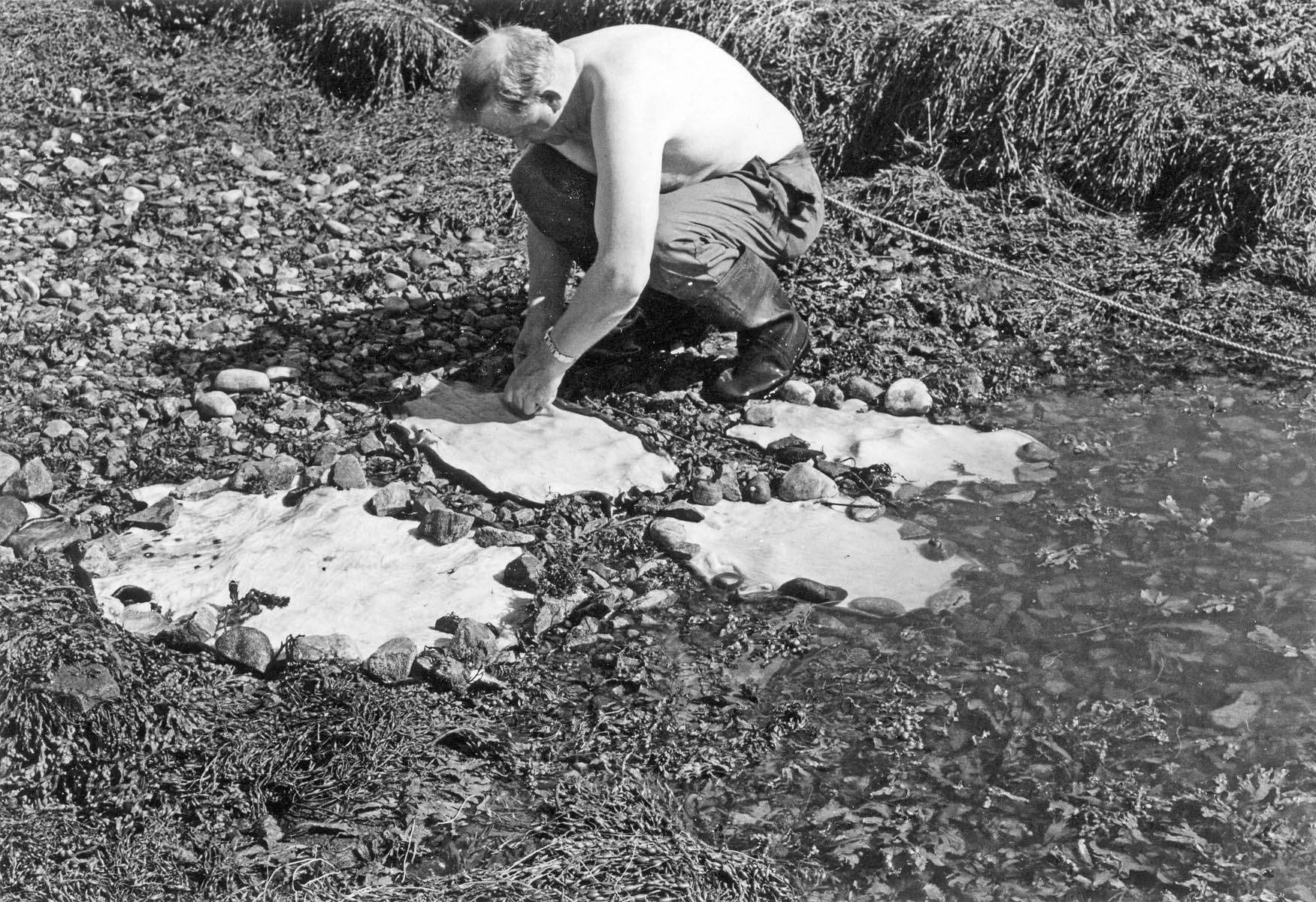
Habour seal (Phoca vitulina) hides stretched out and soaked in the tidal water zone, Måsvær, North Norway, in 1972. Harbour seal hides vary considerably in colour and pattern. Traditional hide processing documented by H. D. Bratrein, UiT – The Arctic University of Norway.
Dried hides, or parts of them, needed to be softened before being modified into clothes or other smaller, non-flat items. To a certain degree, softening could have been achieved through mechanical treatment, with every inch being rubbed, stretched, and handled repeatedly. Ethnographic records and experiments report that people primarily used their hands, feet, and teeth, or various tools made of substantial materials, including coarse granular handstones, to rub and soften hides (Adams 1988; Hatt, 1914b, p. 19; Jarvenpa & Brumbach, 2006a). Mechanical softening could have been combined with different types of tanning using fat, smoke, bark, ash, etc. the simplest perhaps being repeated freezing and thawing (Israelsson, 2010, p. 24).
Fat and smoke tanning are considered the oldest chemical tanning methods (Nesheim, 1964, pp. 201, 208; Rahme, 2010, p. 33), fat tanning being the most common among northern hunter-gatherers and particularly well-suited for tanning pelts. Fat tanning adds additional softness, water-resistance, and durability to the hide. It is suitable for skins from a variety of animals, such as seal, reindeer, elk/moose, beaver, and fox (Kleppe-Turunen, 2010, p. 46) and can also be used to produce effects in leather for decorative purposes. Particularly fatty hides need washing in order to remove some of the fat, whereas thin hides need additional fat. Depending on the fat content, a hide could be tanned in its own fat (Kleppe-Turunen, 2010; Swedjemark, 2010). Body fat, brain fat, liver from fish or seal, aquatic bird eggs, and roe and marrow extraction from boiled reindeer bones and hooves are only some of the fat sources known to have been used among northern hunter-gatherers, including those in northern Fennoscandia (Glavatskaya, 2006; Hatt, 1914b, p. 29; Kleppe-Turunen, 2010, p. 46).
Smoking may be the last distinct stage of a tanning process, but it can also be used in combination with fat processing in an earlier stage, as the slow heat helps the fat melt into the hide (Kleppe-Turunen, 2010; Sharp & Sharp, 2015, Chapter 10; Steinbring, 1966, p. 578). Antiseptic elements in smoke makes the hides more durable but can also change their colour depending on the firewood used. I have not come across materials other than wood being smoked for tanning. Smoking takes days or even a couple of weeks, depending on weather conditions and desired result (Steinbring, 1966, p. 578). Solutions of cooked or soaked bark from various trees, mixed with fat, was a well-known tanning procedure among hunter-gatherers, both for tanning dehaired leather and also to improve the ability of reindeer hides to keep the hairs (Hatt, 1914b, p. 32). But in northern Fennoscandia, it may have been a later technology than fat and smoke tanning (Nesheim, 1964, pp. 201, 208).
Bark could be gathered from a large variety of locally available species, and experiments with reindeer hides based on Sámi hide processing tradition have shown that different types of bark solutions act differently on the hides, leaving them harder or softer, thicker, lighter, or more or less shiny (Huuva & Håkansson, 2010, pp. 71–72). Bark tanning from different trees strongly affect colour, and this is probably part of the motivation for this treatment (Hatt, 1914b). The bark needs to stand in warm water for several hours before the hides are soaked into the acid solution and attended for days or even weeks. Afterwards, the hides need to be washed well and dried. Other chemical solutions known to have been used for tanning among northern hunter-gatherers are based on ash or certain types of red ochre (Hatt, 1914b, p. 35; Rifkin, 2011). Different tanning treatments provide the hides with different characteristics, including colours. For example, reindeer hides left covered in snow over winter turn into particularly light (white) leather. Sun exposure during drying, on the other hand, provides a golden hue. (Kleppe-Turunen, 2010; Swedjemark, 2010).
Hides that are to be prepared into leather must have the hairs removed. This could have been done by several means. Soaking them in water, snow, or urine, burying them under turf in a sunny spot or packing them tightly together in warm conditions indoors would all have activated a controlled acidic rotting process by which the hairs fell off or could easily be removed (Hatt, 1914b, pp. 24–25; Petersen, 1986, p. 138). A different method to dehair hides was by mechanically cutting and scraping off the hairs, hair-sacks, and upper-hide with a blunt-edged tool. Experiments have shown that a slate or bone knife or scraper is well suited (Rahme, 2010, p. 34). This mechanical treatment left a stronger and more durable leather (Hatt, 1914b, p. 24).
Clothes, shoes, boats, ropes, and lashes, and most other items of hide and fur used by northern hunter-gatherers were not manufactured from full-size raw hides, but from carefully processed and joined together cut pieces. Fitting and sewing were thus vital and time-consuming end stages of hide work. Hide clothes provided insulation but the design should enable the wearer as much free movement as possible. Clothes were therefore commonly fitted to individual persons (Chaussonnet, 1988). According to Hatt’s (1914b, pp. 39–46) ethnographic overview of Arctic clothing in Eurasia and America, knives were circumpolarly used to cut hides and skins, even in communities that had become familiar with scissors. Before sewing, the edges of the cut pieces could be chewed to render them supple (Marshall, 1996, p. 340). Thread was generally made of sinew from locally available large mammals, most often reindeer/caribou, but also whale or seal (Hatt, 1914b; Petersen, 1986; Swedjemark 2010, pp. 61–62). Sinew is extremely strong and flexible, and swells when wet, thus tightening the sewing holes and making clothes and footwear watertight. Sinew was cut out, stretched, and left to dry before being split, softened through mechanical treatment and moisturising, and then twined together and joined into long threads. Bone combs were used on both sides of the Bering Strait to split the sinew into narrower strings. Lashes made of thin skins, including fish-skins, are known to have been used as sewing thread in north Asia and north America (Hatt, 1914b). Hatt’s account suggests that there may have been a relation between what kind of sewing thread was used on which types of hides and skins, in that the two elements typically seem to originate from the same or similar animal species.
In north Asia and north America, needles with drilled eyes were made of bone prior to extensive European trade, which gave access to metal, as well as in later periods with a lack of steel needles. Ethnographically, needles are reported to have been made from fishbone and small bird-bone, and from caribou fibula (the smaller lower leg bone). Stitching holes could be pre-made by bone awls (Hatt, 1914b, pp. 39–46). From Hatt’s detailed description of Arctic hunter-gatherer and herder dressing, we learn that joints are pressed flat with smooth handstones or bone implements in order to prevent chafing the skin of the person wearing the item. Special effort has been put into footwear seams. These were often strengthened with additional thread, and sometimes the needle was not pushed all through the hide material, thus making the footwear particularly waterproof (Hatt, 1914b, pp. 43–44).
Choices in cutting, designing, and sewing were based on activities and local weather demands, available raw materials, and aesthetic values, but also on various characteristics and qualities held by the animals from which the skins originated. How the animal wore the hide typically guided the placement of different parts of a garment on the human body. Characteristics and qualities attributed to live animals were sought to be maintained in the finished garment and transferred to the wearer. Dressing up to appear as an animal has been seen as a “disguise” used by hunters approaching and killing animals (Anell, 1964), but according to northern ethnography, the use of hides was part of much more intricate and continual sets of human-animal relations. Elements from different species as well as individual animals were brought together in elaborate designs, using shapes, colours, types of fur and leather, hair-length, etc. to make representations of the animal(s) and reconcile these relationships (Chaussonnet, 1988). Intertwined in this, different garment cuts were important gender markers and conveyors of social identity in terms of lineage and regional belonging within hunter-gatherer communities.
Hide processing, evaluation, selection, and final production of items seem to have been regarded as an at least semi-specialist technological complex almost exclusively performed by women but aided by a number of other group members. The quality of the hide preparation and finished items established women’s self-esteem and the social reputation and status of her community, and particularly skilled women were highly valued and renowned (Balikci, 1984; Chaussonnet, 1988; Damas, 1984b; Glavatskaya, 2006, p. 130; Jarvenpa & Brumbach, 2006a,b; Petersen, 1986; Sharp & Sharp, 2015; Turi, 2012). Several ethnographic accounts describe how, during an intensive pre-winter sewing period, subsistence for the group could consist of ready-at-hand cached meat or fresh fish, both providing food at relatively low cost in a period of low mobility (Balikci, 1984; Damas, 1984b; Petersen, 1986; Turi, 2012). This suggests that investing relatively little time and labour in subsistence activities was one of the measures taken to direct effort towards preparing for winter.
2.3 How Much Hide Was Needed?
Prepared hide in adequate quality must have been a limited resource. Winter clothes seem throughout the circumpolar region to have included double layers of coats, the inner typically worn with the fur towards the human body and the outer with furs out, in addition to trousers, footwear, hoods, and mittens. Among reindeer herding Sámi, before textiles became common, summer coats and footwear were made of reindeer leather and winter clothes of reindeer pelts. It took at least four reindeer hides to make a Sámi coat and probably three to four for an inner shirt. Two hides were needed for a pair of trousers. In addition, reindeer herders used a short reindeer or bear pelt cape with or without hood, reindeer mittens, and headwear (Rheen, 1897; Schefferus, 1956, pp. 232, 235–239; Vorren & Manker, 1957). Among Siberian Surgut Khanty hunter-fisher-reindeer herders, approximately one reindeer per family member is estimated to be sufficient to provide hides for clothes over winter (Glavatskaya, 2006, p. 122), but this seems to be too low an estimate for pre-textile technology societies. Among Alaskan Iñupiaq, 12–15 caribou hides were needed annually to fulfil clothing demands for a family (Burch, 2012, pp. 38–39, 148). In pre-contact Denésuliné of subarctic Canada, winter clothing for one hunter required at least 7 caribou hides, and 22–27 hides were needed to cover a tent dwelling (Sharp & Sharp, 2015, pp. 174–189). Warm footwear, essential in northern areas, were particularly heavily worn and torn, and probably needed to be replaced most frequently. Reindeer or caribou hides acquired only as a biproduct of hunting for food through the year could hardly have covered the traditional demand because of the need for hides of specific qualities and characteristics for different purposes. As discussed earlier, the overall best quality would only have been available during a narrow temporal window in the autumn.
Experienced Greenland Inuit women could cover a normal-sized kayak with three large hides from harp seal. Hide from smaller seal species are used more frequently in the northern regions, and here five to six hides are needed for a full cover (Petersen, 1986, p. 31). Umiaks normally range from c. 4.5 to 18.5 m (c.15–60 feet) in length, the smaller ones sometimes being used for whaling and walrus hunting (Chapelle, 2007, p. 175). Hides were selected according to animal characteristics and hide quality. Depending on the type of hide and the size of the large transport umiak, it seems that between 3 and 20 hides were needed to cover a boat. In addition to the cover-skins, comes many meters of thin lashing straps, which required hide from two adult harp seals (Petersen, 1986, p. 142).
Working clothes made of reindeer/caribou hides only lasted for a year or winter season (Chaussonnet, 1988; Damas, 1984a; Hatt, 1914b; Sharp & Sharp, 2015, p. 179). Chaussonnet (1988, p. 211) refers to how Northern Alaskan and Bering Sea Inuits wore “[…] the tattered remains of winter clothing, the fur of which had been damaged by spring rain […]” during summer. This implies that full new outfits had to be produced annually. In addition, hides were needed for most, if not all, sleeping mattresses, roof covers, and leather and hide containers. Thongs for packing and harnessing draft animals and lines for making nets, traps, and fish lines may have had to be replaced more often. Other items probably did not need annual replacement, such as some containers or items including celebration or ceremonial clothing. Boat covers could last several years, depending on how much, and under which conditions, they were used. Greenland kayaks are reported to have been tenderly cared for, and that the covers lasted up to 3 years before they needed to be replaced, although many hunters preferred to change them annually or even twice a year (Petersen, 1986, p. 31). Earlier, umiak re-covering was done every year, sometimes twice, but with a decreasing seal population in Greenland, it became necessary to give extra greasing of seal oil and caribou fat to old umiak covers to make them last for 2 years. The hides could be treated with an extra greasing before long travels (Petersen, 1986, pp. 144–145).
Skilled sewers made the best items but were also best at economising with the hide. This reduced both the number of hides and the need for perforating stitching (e.g., Balikci, 1984; Damas, 1984b; Glavatskaya, 2006, p. 130; Petersen, 1986; Turi, 2012). Based on the above examples of hide use and maintenance, we should assume that measures were taken to make footwear, clothing, bags, tents, and boats last for as long as possible, but that few items lasted more than one to two winter seasons. Repair is seldom addressed in the ethnographic records and anthropological studies but should be taken into consideration when discussing how much hide was needed annually. Reindeer herding Sámi women in the mid-1900s devoted themselves to various production and mending activities during spare time at the summer camps, and in particular spent much time on producing new footwear (Vorren & Manker, 1957, pp. 43, 48). According to an older account, they chose to mend and make new clothes during winter, since this was the time of the mobility cycle when whole families were settled for a longer period and this gave the women time to unpack their tools and start tending wet, rotting, and torn clothes after repeated moving between camps (Turi, 2012, pp. 55–56). Although not mentioned explicitly, one could probably assume that some mending took place during shorter stops and on hunting expeditions, probably also by men.
3 Hide Craft in the Archaeological Record: A Norwegian Case
Faunal material can indicate which species were sought for hide and fur, and artefacts identified at a site can provide information on hide processing and manufacture. To identify the presence of such activities and related human-animal relationships in Mesolithic Norway, published sites with documented osseous material of some volume have been selected for this study. A substantial number of well-preserved hunter-gatherer settlement sites have been excavated in Norway. Sites with larger faunal assemblages are relatively rare, and with few exceptions situated along the coast. The study is based on published reports, scientific analyses, and digitally available records of archaeological datasets. General trends and local variation are sought identified by (1) presenting an overview of potential hide and fur bearing mammals from 36 Stone Age hunter-gatherer sites spread along the long Norwegian coast from southeast to northernmost Norway, and (2) looking more closely into a selection of nine radiocarbon dated case study sites situated in different regions and coastal landscape types. These also represent different settlement site categories: rockshelter/cave, open-air, and pit-house.
3.1 Geographic Setting: Coastal Norway
The archaeological material this study is based on is from Stone Age habitation sites situated along the north Atlantic and Barents Sea coasts of Norway in northernmost Europe (Figure 2). The region has a latitudinal span from 58 to 71°N, which is equivalent to central Greenland in the south up to northernmost Hudson’s Bay, Foxe Basin, and the northern part of Nunavut including Baffin, Victoria, and Banks Islands in Canada. The Norwegian coast benefits from the North Atlantic current, which provides warm surface water resulting in a mostly ice-free coastline, generally warmer winter temperatures than in other equivalently northern regions, and milder and moister climate than in inland valleys and mountains of Fennoscandia. The north-south gradient determines a general climatic condition of gradually lower mean temperatures traveling north. This general pattern can be traced back into the Stone Age, although temperature, precipitation, and wind conditions have fluctuated (e.g., Sjögren & Damm, 2019).

Fennoscandia with case study sites situated along the coast of Norway. 1. Auve, 2. Slettabø, 3. Vistehola, 4. Sævarhelleren, 5. Kotedalen, 6. Stiurhelleren, 7. Storbåthallaren, 8. Iversfjord, and 9. Rissebávti/Gressbakken Nedre Vest. Map by G. Skogvold, UiT – The Arctic University of Norway.
Climatic variations and fluctuations have affected vegetation types, presence of sea-ice cover, length of snow-cover, prevailing wind strength, and direction, to name some variables, and consequently conditioned which animals could be found in each landscape. The coastal topography varies considerably and includes large fjord systems, islands, and numerous sounds and bays. The mixture of local and super-local topographic features with related micro-climatic pockets provides conditions for a large variety of plants and animals within relatively small areas. Despite climatic changes and variations across the long timescale chosen, the large region possessed the same overall quality of local variations in Stone Age as today.
An important characteristic is that a number of fish, birds, and marine mammals seasonally migrate and are only present during parts of the year, including Atlantic cod, salmon, ducks, geese, swans, seals, and larger whales. Several land mammals, including the large ungulates red deer, reindeer, and elk, slightly change their habitats between sub-regions over the seasons to seek shelter from cold during winter and the critical spring calving period and to find the best grazing through the vegetation growing season. In addition, there are a few hibernating animals, including brown bear. This was also the situation during the Stone Age. Consequently, many hide-bearing animals could only be observed and hunted during certain parts of the year within an area.
3.2 The Archaeological Record
Several natural and social factors influence archaeological faunal material composition from chemical preservation conditions to practical and cultural butchering and deposition practices. In addition, the coarse excavation methods in early investigations must be considered. Available bone sample databases are thus a biased representation of what was originally deposited. Several samples have only been partly analysed, and sometimes preservation conditions have made only limited identification possible according to the species. Generally, we can assume that smaller, unburnt bones fully decompose more rapidly than larger bones, so that fish, bird, and small mammal bones, as well as small elements from extremities, have relatively lower representations in an osseous assembly of unburnt bones than larger bones. Most of the osseous material from several of the sites in southwestern Norway are, however, burnt. Burning favours small bones and bones from smaller animals, which will shrink but not fragment as much as larger bones. Larger bones in the material are generally heavily fragmented (Hufthammer, 1997, p. 45). Comparable standard faunal analysis results presenting number of bone fragments per species (NISP) are available in large part due to a Norwegian national cooperation between archaeologists and zoologists managed by the University of Bergen. Some project reports provide more details on minimum number of individuals, age of individual animals, and fragmentation state. Differences in excavation methods, preservation conditions, and detail level are addressed in this work by referring only to relative within-site differences in numbers between species and comparing which species are reported present at each site. A fundamental representativity issue in estimating the number and ratios of different species in archaeological osseous remains is that probably only parts of animals were taken from the killing site to the habitation site. In favour of an interpretation of a direct relation between identified bones and hide work, it can be suggested that hides were too valuable to leave behind, irrespective of size and quality. A common initial use was to wrap the hide around the killed animal or animal parts to which it belonged, in order to transport as much as possible to the camp (Sharp & Sharp, 2015).
Although biased in representation, the available information on osseous material provides insights into similarities and differences in the actual faunal representation at each site. This allows for making observations on a general, species-oriented level. Zooarchaeological determinations of faunal remains from 36 coastal sites in Norway, including the 9 case-study sites, are compiled in Tables 1 and 2. The table, roughly following a north-south gradient and thus reflecting regional variations in habitats on a general level, suggests which mammals could be encountered by humans in different coastal areas. Marine mammals, primarily seals and small whales, were probably important providers of large and water-repellent hides as well as meat in the entire study area. Small and medium-size whales, porpoise, and walrus were also hunted and provided for, among other things, skin. Other much sought meat as well as hide providers in the records are various ungulates. Reindeer, red deer, roe deer, and elk were probably the most important hide (and bone/antler) providers in this northern region. Other species were only available in parts of the area. For example, bones from wild boar and European polecat are only found at settlements in south Norway, and badger and red and roe deer are found up to 60°N. One of the general observations that can be made from the compilation is that a large variety of small and medium-sized species, such as otter, beaver, fox, hare, marten, squirrel, weasel, and polecat are found at several sites. Among larger fur-bearing terrestrial animals, regularly accounted are also several predators, including wolf, wolverine, lynx, badger, and dog. Although hare, otter, beaver, and squirrel were probably also eaten, most of these animals must solely or primarily have been sought for their fur, and the presence of bones indicates some kind of hide work.
Osseous remains from 36 Stone Age sites in coastal Norway, according to presence of identified land mammal species
| Site | Context | Reindeer | Elk | Red deer | Roe deer | Brown bear | Beaver | Otter | Badger | Wolf | Wolverine | Dog/Canide | Red fox | Arctic fox | Lynx | Polecat (Eu.) | Marten | Mountain hare | Squirrel | Weasel | Wild boar |
|---|---|---|---|---|---|---|---|---|---|---|---|---|---|---|---|---|---|---|---|---|---|
| Kalkillebukta house 7 | Pit house midden | x | |||||||||||||||||||
| Kalkillebukta house 17 | Pit house midden | x | x | x | x | ||||||||||||||||
| Advik house B | Pit house midden | x | x | x | x | x | |||||||||||||||
| Advik house F | Pit house midden | x | x | x | x | x | |||||||||||||||
| Advik house J | Pit house midden | x | x | ||||||||||||||||||
| Advik house N | Pit house midden | x | x | x | x | x | |||||||||||||||
| Lossoas hus | Open -air | x | x | ||||||||||||||||||
| Nyelv Nedre Vest, area 11 feature 11 | Midden | x | x | x | |||||||||||||||||
| Nyelv Nedre Vest, area 11 feature 9 | Midden | x | |||||||||||||||||||
| Nyelv Nedre Vest, area 11 feature 10 | Midden | x | x | ||||||||||||||||||
| Nyelv Nedre Vest, area 11 feature 11a | Midden | x | x | ||||||||||||||||||
| Nyelv Nedre Vest, area 11 feature 8 | Midden | x | |||||||||||||||||||
| Rissebávti/Gressbakken Nedre Vest house 3 | Pit house midden | x | x | x | x | x | x | x | x | x | x | x | x | ||||||||
| Rissebávti/Gressbakken Nedre Vest house 4 | Pit house midden | x | x | x | x | x | x | x | x | x | x | ||||||||||
| Rissebávti/Gressbakken Nedre Vest house 5 | Pit house midden | x | x | x | x | x | |||||||||||||||
| Rissebávti/Gressbakken Nedre Øst house 23 | Pit house midden | x | x | x | x | ||||||||||||||||
| Karlebotnbakken house 1 | Pit house midden | x | x | x | x | x | x | ||||||||||||||
| Bergeby house 18 | Pit house midden | x | x | x | x | x | x | x | x | ||||||||||||
| Mortensnes F8, R12 | Midden | x | x | ||||||||||||||||||
| Iversfjord by house 15 | Midden | x | x | x | x | x | |||||||||||||||
| Storbåthallaren | Rock shelter | x | x | x | x | x | x | x | |||||||||||||
| Stiurhelleren | Rock shelter | x | x | x | x | x | x | ||||||||||||||
| Kirkhelleren | Rock shelter | x | x | x | |||||||||||||||||
| Kotedalen north | Open-air | x | x | x | x | x | x | x | x | ||||||||||||
| Kotedalen south | Open-air | x | x | x | x | x | x | x | x | x | |||||||||||
| Skipshelleren | Rock shelter | x | (x) | (x) | x | x | x | x | x | ||||||||||||
| Vistehola | Rock shelter | x | x | x | x | x | x | x | x | x | x | x | x | x | |||||||
| Ruskeneset | Rock shelter | x | x | x | x | x | x | ||||||||||||||
| Grønehelleren | Rock shelter | x | x | x | x | x | x | x | |||||||||||||
| Sævarhelleren | Rock shelter | (x) | x | (x) | x | x | x | x | (x) | x | x | x | |||||||||
| Slettabø | Open-air | x | x | ||||||||||||||||||
| Sola flyplass | Open-air | x | x | x | x | x | x | ||||||||||||||
| Austbø | Open-air | x | x | x | x | ||||||||||||||||
| Auve | Open-air | x | x | x | x | x | x | x | |||||||||||||
| Saugbruk 1 | Open-air | x | |||||||||||||||||||
| Saugbruk 2 | Open-air | x | x | ||||||||||||||||||
| Saugbruk 3 | Open-air | x | x | x | x | x | x | x | |||||||||||||
| Frebergsvik | Open-air | x | x | x | |||||||||||||||||
| Torpum 9 | Open-air | x | |||||||||||||||||||
| Skoklefald | Open-air | x | x | x |
Case study sites marked in grey. Based on Albrektsen 2015; Bergsvik & David, 2015; Damm, 1995; Glørstad, 2010; Hodgetts 1999; Hufthammer, 1997; Hultgreen, 1988; Renouf, 1981; Schanche, 1994; Utne, 1973; and the Archaeological sub-fossil open-access database at the University Museum, University of Bergen https://reg.app.uib.no/apex/f?p=608:13.
x represents presence of identified species, (x) of probable species but with some uncertainty on species-specific level.
Animal species names in English and Latin
| Generic name | Latin name | Full name (English) |
|---|---|---|
| Ungulate herbivores | ||
| Elk | Alces alces | European elk (North America Moose) |
| Red deer | Cervus elaphus | Red deer |
| Roe deer | Capreolus capreolus | European roe |
| Reindeer | Rangifer tarandus | Reindeer (North America Caribou) |
| Wild boar | Sus scrofa | Wild boar |
| Smaller herbivores | ||
| Arctic fox | Vulpes lagopus | Arctic fox |
| Ground vole | Arvicola amphibius | Ground vole |
| Red fox | Vulpes vulpes | Red fox |
| Beaver | Castor fiber | Eurasian beaver |
| Hare | Lepus timidus | Mountain hare |
| Squirrel | Sciurus vulgaris | Red squirrel |
| Carnivores | ||
| Badger | Meles meles | European Badger |
| Brown bear | Ursus arctos | Brown bear |
| Lynx | Lynx lynx | Lynx |
| Dog | Canide (generic) | Dog |
| Polecat | Mustela putorius | European polecat |
| (European pine) Marten | Martes martes | European pine Marten |
| Otter | Lutra lutra | Eurasian otter |
| Weasel | Mustela nivalis | Least weasel |
| Wild cat | Felis silvestris | European wild cat |
| Wolf | Canis lupus | Eurasian wolf |
| Wolverine | Gulo gulo | Eurasian wolverine |
| Marine mammals | ||
| Bearded seal | Erignathus barbatus | Bearded seal/Square flipper seal |
| Grey seal | Halichoerus grypus | Grey seal |
| Harbour seal | Phoca vitulina | Common seal/Harbour seal |
| Harp seal | Pagophilus groenlandicus | Harp seal/Greenland seal/Saddleback seal |
| Ringed seal | Pusa hispida | Ringed seal |
| Seal (generic) | Phocidae | Seal |
| Walrus | Odobenus rosmarus | Atlantic walrus |
| Whale (generic) | Cetacea | Whale |
Table 1 demonstrates marked differences between sites when it comes to species variability. Despite the diverse coastal topography including water bodies restricting land animal mobility, bones from a number of forest and mountain animals are identified on several of the outer coast sites. Evidently, fur-bearing terrestrial mammals – or at least parts of them – were brought to Stone Age forager sites far outside their natural habitats. Local availability of specific hide- or fur providing animals may have been considered as a settlement location factor, but the variation may be a result not only of local availability of live animals in a given season, but also of differences in hide processing and manufacturing activities between the case study sites. Brown bear, a potential provider of fur, meat, and other materials, is among the species commonly identified. Many sites only include teeth, a situation which suggests a human-animal relationship of an ontological character more than a practical one.
3.3 Case Study Sites
The general similarities and variations demonstrated in Table 1 need to be investigated on a site-specific level. In the following section, faunal and artefact material from nine selected radiocarbon dated case study sites are discussed in relation to hide processing and manufacture (Figure 2). Presented in geographical order from southeast moving west and north-westwards, these are chosen as representatives of habitation sites from different parts of coastal Norway, and of various site types. Four are rockshelters/caves (Vistehola, Sævarhelleren, Storbåthallaren, and Stiurhelleren), three are open-air settlement sites (Slettabø, Auve, and Kotedalen, the last represented by two chronologically and topographically separate areas), and two are house-pit sites (Iversfjord and Rissebávti/Gressbakken Nedre Vest, the last one represented by two houses with middens). The sites were excavated between 1907 and 2006, and thus display varying documentation methods and quality. Hunter-gatherer layers are radiocarbon dated between c. 7300 BC and c. 1000 BC (Table 3). Several of the sites are multi-phased, with upper layers containing bones of domesticated animals and/or cultigens. Access to sheep wool and thus textiles is considered to have fundamentally altered humans’ ultimate need for wild animal hides. These younger contexts are thus omitted when possible.
Selected case study sites representing different regions and settlement types in Mesolithic coastal Norway
| Site | Region (Norway) | Settlement type | Excavated | Radiocarbon date span | Calendric years calibrated |
|---|---|---|---|---|---|
| Auve | Southeast | Open-air | 1977–1998 | 3410–4520 BP | 3340–2500 BC |
| Slettabø | Southwest | Open-air | 1963–1968 | 5380–3700 BP | 4250–1840 BC |
| Vistehola | Southwest | Rockshelter/cave | 1907–1941 | 8100–6100 BP | 7300–4750 BC |
| Kotedalen | West | Open-air | 1985–1987 | 7700–6800 BP (S)/5100–4200 BP (N) | 6560–5650 BC (S)/4040–2790 BC (N) |
| Sævarhelleren | West | Rockshelter/cave | 2005–2006 | 8000–7050 BP | 7000–5800 BC |
| Stiurhelleren | Mid/north | Rockshelter/cave | 1981–1982 | 4400–4000 BP | 3100–2500 BC |
| Storbåthallaren | Northwest | Rockshelter/cave | 1967–1971 | 5200–2000 BP | 3400 BC–BC/AD |
| Iversfjord | North | House-pit | 1974–1977 | 4200–3850 BP | 3100–2200 BC |
| Rissebávti/Gressbakken Nedre Vest | Northeast | House-pit | 1938–1957 | 3950–3500 BP | 2470–1785 BC |
Based on Glørstad, 1996; Helskog, 1983; Hultgreen, 1988; Olsen, 1992; Østmo, 2008; Schanche, 1994; Skjølsvold, 1977; Utne, 1973; and Bergsvik and David, 2015. Radiocarbon dates represent Stone Age hunter-gatherer settlement layers including faunal remains (dates from layers including domestic animals and/or cultivates are omitted).
3.3.1 Auve, Sandefjord, Southeast Norway
Auve is an open-air site situated in an outer coast environment. Most of the osseous material is burnt and heavily fragmented. Although therefore probably severely biased in terms of faunal representation, the subsistence strategy at the site seems to be strongly marine oriented, with high numbers of seal and small whale species but low frequency of fish (Table 1). The presence and combination of marine mammals suggests multiple specialised occupations between spring (April) and mid-winter (January), with the most intensive seal hunt during summer (Hufthammer, 1997, p. 57). Of the other mammals, otter and possibly hare are suggested to be considered at least partly as fur-bearing animals, as well as being valued for their meat (Hufthammer, 1997, p. 48; Østmo, 2008, p. 214). Surprising, in this outer coast landscape, is the incorporation of several inland forest species, including a fairly large number of beaver bones. Also present and considered “exotic elements” are bones from pine marten, wild cat, squirrel, fox/dog and ground vole, as well as wild boar, elk, and undetermined ungulates (Hufthammer, 1997, pp. 47–49; Østmo, 2008, pp. 214, 222).
Auve is interpreted as a hunting and fishing settlement site based on the faunal remains and bone and lithic tools. In the main publication (Østmo, 2008), most attention is given to the Neolithic pottery material. Lithic tools which can possibly be related to hide processing and manufacture include blades, a few blade knives, and many burins and scrapers, all made of flint and found in restricted parts of the site. In addition, there are pieces of pumice with wear-marks. Various points can be related to hunting. A few burnt bone tools include points and fragments of fishhooks, a harpoon, and also fragments possibly of needles or awls. Distribution maps of bones, pottery, and lithics are provided.
3.3.2 Slettabø, Bjerkreim, Southwest Norway
Slettabø was, when investigated around 1970, the first open-air habitation site in south Norway with preserved osteological material of some quantity, although preservation was rather poor (Skjølsvold, 1977, pp. 50, 66). The site at the time of use was situated on an island in an archipelago. Three separate culture layers have been identified, spanning c. 2500 years (Glørstad, 1996; Skjølsvold, 1977, Table 22). Sixteen different animal species are identified, including six mammals, six birds, and four fish (Table 1). Most are represented with only one element each, probably as a result of poor preservation conditions. Red deer/unspecific ungulates, otter, seal (unspecific), and harbour porpoise are the only potential hide/skin providers documented (Skjølsvold 1977, p. 68, Table 11), and of these, red deer, alternatively in addition to other ungulates, are comparatively well represented.
Lithic tools are predominantly made of flint, and include a high number of scrapers, blades, some burins, and some flint blade knives, all potentially relating to hide work. There are some pieces of pumice with wear-marks. No elements in the small and fragmented assemblage of preserved bone tools can be related to hide processing. The lithic material includes flint and slate projectile points of different sizes and shapes, non-flint axes, hammerstones, and net or fishline sinkers, and bone tools include fragmented fishhooks, harpoons, and points, in addition to decorated bone fragments (Skjølsvold 1977, pp. 51, 66–67). The site has provided a substantial and varied Stone Age pottery material, and the combination of pottery, representing an early farming material element, with hunter-gatherer subsistence, has gained the most attention in site discussions (Glørstad, 1996; Skjølsvold, 1977).
3.3.3 Vistehola, Randaberg, Southwest Norway
Vistehola is a shallow cave, with deposits more than 1 m thick representing Stone Age hunter-gatherer settlements. Despite coarse excavation methods and high fragmentation, the osseous material is rich in species (Table 1). A large variety of terrestrial, fur-bearing mammals includes hare, squirrel, European polecat, lynx, red fox, marten, weasel, badger, brown bear, and dog. Identified species which could have provided hide as well as other valued products, including meat, are otter, red deer, elk, wild boar, and grey and harp seal (Degerbøl, 1951, p. 54). The species composition shows that several animals which could not have been locally available in this outer coast environment were handled at the site, such as elk, lynx, and brown bear.
The lithic tool assemblage includes flint blades, microblades, burins, and some scrapers. Bone tools include wild boar tooth knives, bone, and antler chisels, but notably also a high number of assumed bone awls and two to three sewing needles, including a larger example with split end classified as a fish net needle (Lund, 1951). All these tools can potentially be related to hide work. Another tool type made from large long bones is interpreted as a possible smoothing implement with wear-polish at one end (Gjessing, 1943, p. 108, referred to in Lund, 1951, p. 31). A few flint projectile points, several bone points, and flint-slotted points were found. Bone tools include fishhooks, assumed harpoon or lister fork fragments, and polished flat bones with drilled holes interpreted as flutters (Bergsvik & David, 2015; Lund, 1951). Based on its favourable location in a marine resource-rich environment, the variety of the faunal material and the size of the site, Vistehola is interpreted as a repeatedly visited seasonal basecamp or a habitation site used over longer periods at a time (Bergsvik & David, 2015; Mikkelsen, 1979, p. 92; Storvik, 2011).
3.3.4 Kotedalen, Alver, Western Norway
Kotedalen is a multi-phased open-air habitation site situated close to the strong outer coast tidal current Fosnstraumen. Layers including faunal material from hunter-gatherer activities are confined to two areas, north (N) and south (S), with separate age spans (Table 2). The archaeological record points to discontinuous settlement with multiple re-use (Åstveit, 1999, p. 27; Olsen, 1992, p. 244). A comprehensive Neolithic pottery material, seen as a possible indicator of early farming, is debated (Åstveit, 1999; Glørstad, 1996; Olsen, 1992). Although burnt, heavily fragmented, and only partly analysed, the sieved faunal material points to a general orientation in both areas towards marine resources, with a variety of fish, generally of small size and evidencing summer fishing, marine birds, and several seal species present (Hufthammer, 1987). Seasonally migratory species suggest that the southern area was not settled during winter, but that the northern area could have been settled during all seasons (Hufthammer, 1992, pp. 48–49). Seal is the most common mammal identified in the southern settlement area whereas terrestrial mammals dominate in the northern, although seal is again the most prominent in the latest phases. There seems to be a marked increase in the use of marine birds in the younger northern area compared to the south. Identified terrestrial mammals are relatively few, but likely large ungulates and marine mammals are highly underrepresented due to fragmentation of the larger bones and thus hidden in the comprehensive “undetermined mammal bones” category. In comparison, the high ratio of red deer bones preserved in the unburnt osteological assemblage from nearby Skipshelleren (Olsen, 1976) serves to illustrate the preservation bias towards smaller bones and animals at Kotedalen. Otter is one of the most frequent species identified in both areas and was clearly an important resource, probably both for meat and hide. Other terrestrial fur-bearing animals recorded in the southern area are red deer and unspecified ungulate, elk, wild boar, marten, squirrel, brown bear, red fox, lynx, and dog, and in the northern and younger settlement area, red deer and unspecified ungulate, hare, marten, red fox, wild boar, and dog are identified (Hufthammer, 1987, 1992). Seemingly, otter and other fur-providing animals were evenly but infrequently hunted throughout the settlement periods in both areas (Table 1).
Lithic tools in the early faunal-bearing layers which may be related to hide work include flint blades, microblades, and burins. Lithics associated with the younger phase include flint knives, burins, and scrapers. A relatively rich but highly fragmented bone tool inventory of mostly fishhooks, harpoons, and points notably also includes 28 needles or awls (Olsen, 1992). The lithic tool assemblage in the older phase also holds transverse flint points, net or fishline sinkers, axes, and adzes in non-flint materials, and a variety of flint and polished slate points, axes, and adzes in the younger phase (Olsen, 1992). Differences in arrowheads and points in terms of shape as well as raw material qualities suggest they were used to hunt different animals (Nærøy, 1998, p. 71).
3.3.5 Sævarhelleren, Herand, Western Norway
Sævarhelleren is a rockshelter in the Hardangerfjord basin. Excavations in 2005 and 2006 recovered a well-preserved Stone Age osseous material. It included bones from 15 fish species, and the rockshelter is interpreted as a short-term summer occupation site with fishing as the prime activity (Bergsvik & David, 2015, pp. 196–197). The osteological material also included a rich variety of mammals (Bergsvik & Hufthammer, 2009; Ritchie, Hufthammer, & Bergsvik, 2016) (Table 1). Except from harbour seal, all identified species are terrestrial and include pine marten, otter, brown bear, red deer, reindeer, elk, squirrel, hare, and dog. Among the relatively few lithic tools found were flint microblades and scrapers and fragments of greenstone adzes. Among the bone tools were a large number of fishhooks, including fragments and preforms and a few points, fishing flutters and gorges, knives, and three awls (Bergsvik & David 2015, Table 2).
3.3.6 Stiurhelleren, Rana, Northern Norway
Stiurhelleren is a rockshelter situated in steep terrain at a land crossing between the deep Sjona and Rana fjord basins. In the publications of the excavation results (Hultgreen, 1988; Hultgreen, Johansen, & Lie, 1984), much focus is put on the findings of sheep/goat, cattle and pig bones, and charred barley grains from the final Stone Age habitation phase. The faunal material primarily consists of wild species. Marine fishing and a considerable element of bird catching seem to have been the main activities conducted from the site. Mammals are almost exclusively land animals (Hultgreen et al., 1984, Table 1; Hultgreen, 1988, Table 9) (Table 1). Although making up only 0.5% of the total faunal material and probably not being fully representative, the assemblage includes a surprisingly high number of primarily fur-bearing animals, including badger, marten, weasel, and squirrel, as well as otter, seal, reindeer, and hare potentially providing both hide/fur, meat, and other products, and dog.
The archaeological assemblage other than osseous material is extremely limited. Based on the fish and bird material year-round occupation is suggested (Hultgreen, 1988, p. 83; Hultgreen et al., 1984, p. 99). Fur, fat, sinew, and antler are mentioned as possible biproducts of a varied resource exploitation (Hultgreen, 1988, pp. 70, 82).
3.3.7 Storbåthallaren, Vestvågøy, Northern Norway
Storbåthallaren is a multi-phased Late Stone Age (LSA, c. 5000–2000 cal BC) and Early Metal Age (EMA, c. 2000 cal BC – BC/AD) rockshelter site situated on an outer coast island by a strong and skerried current in the Lofoten archipelago, in a seascape renowned for its rich cod fisheries. The habitation site lacks a natural harbour and at the same time is practically isolated from its land environment with difficult access other than by boat. The near surroundings are extremely sparsely vegetated, with local firewood, including driftwood, being practically absent. In the publication of the excavation results (Utne, 1973), focus was put on the beneficial location of the site in regard to exploitation of food resources, particularly fish, and the large rockshelter is interpreted as a close to year-round habitation site. Fish – in practice late winter migratory Arctic cod – totally dominates the faunal material with close to 80% of all identified elements, whereas a variety of large aquatic birds and sea and land mammals only make up small parts of the total. Seal, mostly pups of small species, together with whale, are most frequent among the identified mammal bones, particularly in the earliest phase. Given the extreme outer coast local environment, it is striking that red fox is well represented particularly in the phase I assemblage, and that red deer and reindeer and a few fragments of bear and beaver bones are identified in all layers. The excavator suggests that several other-than-food resources, specifically from seal, whale, otter, marten, red fox, and bear, were probable sought products for the inhabitants, but their potential role is not followed up (Utne, 1973, pp. 50–50).
Lithics include numerous polished slate knives, spear and arrow points, axes and chisels, whetstones, grinding stones, and some pumice with use-wear. Bone items include a single chisel, a large number of fishhooks, harpoons and points of different sizes and shapes, and much processed bone and reindeer antler. Stratigraphic and chronological control is a problem.
3.3.8 Iversfjord, Gamvik, Northernmost Norway
Iversfjord is a house-pit settlement of 45 dwelling structures at the Nordkyn Peninsula, situated at the time of habitation by a sound between the mainland and a large island (Helskog, 1983). This is the common dwelling site type in northernmost coastal Norway after c. 4500 BC. The pit house structures probably represent several occupation phases, re-use seemingly being common for coastal house-pits in the region (Damm et al., 2019, p. 10; Vollan, in press). All-year settlement with a strong marine orientation is suggested in the excavation publication, with fish as the stable subsistence factor (Helskog, 1983). The core of a midden deposit adjacent to one of the house structures held preserved osseous material. The midden has been radiocarbon dated to c. 3100–2200 BC (c. 4200–3850 BP) (Helskog, 1983, Table 3). Only half of the faunal material has been identified by species. Fish bones make up more than 96% of all identified elements, with cod dominating. Mammal bones represent different seal species (harbour, ring, and grey and harp seal) in large majority, but also walrus, whale, and porpoise. Although few in numbers, bones from reindeer, otter, red fox, arctic fox, dog, and brown bear are present, suggesting that these animals played a role as resources at the settlement as well (Table 1).
Lithics from the midden which can be related to hide work include more than 30 polished slate knives, knife fragments, and preforms, 3 scrapers, 3 burins and a drill/perforator, 3 chisels, and 4 implements registered as polishing or grinding stones. 16 polished slate projectile points and more than 50 net or fishline sinkers together with 6 bone points and a preform, and 4 bone fishhooks and 3 preforms point to hunting, foraging, and fishing. None of the few bone or antler tools preserved can be related to hide work.
3.3.9 Rissebávti/Gressbakken Nedre Vest, Unjárga/Nesseby, Northeastern Norway
Rissebávti/Gressbakken Nedre Vest is one of the several house-pit settlement sites excavated along Várjavuonna/Varangerfjorden, north-easternmost Norway with wall-midden deposits containing well-preserved faunal assemblages (Martens et al., 2017; Renouf, 1981, 1989; Schanche, 1988, 1994; Simonsen, 1961). Rissebávti/Gressbakken Nedre Vest is a settlement site of 15 pit-houses situated in a former shallow bay, with another cluster of structures (Gressbakken Nedre Øst) to the east (Simonsen, 1961, p. 271). Five house pits (Houses 1–5) at Rissebávti/Gressbakken Nedre Vest have been excavated, in addition to trenches through middens in front of the long walls of three more dwellings. The excavated houses and middens are radiocarbon dated between 2470 and 1785 BC (3950–3500 BP) (Schanche, 1994, p. 97).
The archaeological material varies considerably between the 5 excavated houses, houses 3 and 4 being the richest both in terms of lithic and bone tool inventory and when it comes to preserved osseous material. These are selected for further presentation here. The faunal assemblage from house 3 is only partly determined whereas the osteological material from house 4 is determined according to all classes (Hodgetts, 1999, 2010; Olsen, 1967, n.d.). A variety of marine fish, mainly cod, dominates both assemblages. In house 3, terrestrial mammals are represented by reindeer bones and small number of bones from a large variety of primarily fur-bearing land animals: wolf, red fox, Arctic fox, otter, wolverine, marten, weasel, and brown bear, as well as beaver and dog (Olsen, n.d., Table 6). There are no published data on marine mammals and birds. House 4 has relatively large number of bones from a variety of seal species (harp, ringed, harbour, bearded, and grey seal). There are also several whale and particularly small whale species in the material, and various birds. Notably, like for house 3, this midden includes bones from numerous terrestrial fur-providing animals (Hodgetts, 1999, p. 75; Olsen, 1967, Table 2, p. 16; n.d., Table 5) (Table 1).
Lithic tools from houses 3 and 4 include polished slate knives of various size, slate chisels, and regular scrapers in harder and coarser materials, all potentially associated with hide processing. Notably, the bone and antler tool inventories associated with the two houses include around 20 needles each, and even more bone awls, different types of bone scrapers and combs (Table 3), one of the combs being decorated. Among the tools are smaller projectile points and larger spear points in polished slate, line or net sinkers, and bone or antler points, fishhooks, lister forks, and harpoon heads, all suggesting varied animal capture methods (Schanche 1994, p. 52, Table 10; Simonsen, 1961).
4 Identifying Hide Work in the Archaeological Record
Stone Age resource use is largely focused on acquisition of food. Settlement sites in Norway are typically related to meat access, with a focus on tools involved in the act of killing animals, such as projectiles and fishhooks, and interpretations of preserved osseous materials as evidence primarily of local cuisine. Although some fishing and snare-hunting may have taken place nearby, the killing was conducted somewhere else than at the specific settlement sites. What must have taken place at the habitation sites is instead, among other things, a large variety of raw material processing, and making and mending of tools and other items. In this section, the archaeological osseous remains and tool inventories are discussed in terms of hide work.
4.1 Indications of Hide-Processing in the Osseous Remains
At all the case-study sites, varieties of fish, marine mammals, as well as mostly aquatic birds prevail in the faunal material (Table 1). Marine mammals were probably hunted partly for their hide. The presence of larger amounts of seal and whale bones at several of the settlements suggests that whale and larger seals were hunted and flensed relatively close. Since one would expect at least most of the larger, heavy bones to be left at the specific killing and flensing site, seal seem to have been intensively hunted in close proximity to Auve, Storbåthalleren, Iversfjord, Rissebávti/Gressbakken Nedre Vest, and Sævarhelleren, and possibly also at Kotedalen, here with an intensification in the southern area towards the later phases. Locally available pup seals seem to have been a particularly attractive resource at Storbåthallaren, whereas seal hunting was marginal at Slettabø.
Bones from large ungulates are commonly found, reindeer are almost omnipresent at the sites in northernmost Norway, red and roe deer bones are commonly identified in the middle and southern parts, and elk bones are sporadically found in the whole area. The animals could have been encountered by hunters as individuals or in herds depending on season, and at varying distances from the settlement sites. Thule hunters in Greenland are known to walk long distances to find caribou, to cut up the animal for transport and to travel in groups to divide the heavy weight of the dead animal (Pasda, 2019, p. 112). Having the opportunity to collect a heavy corpse by boat or sledge eases transport substantially (Sharp & Sharp, 2015), and killed animals may have been transported over some distances, with at least some of the bones attached, to the settlements.
Several of the case study sites demonstrate a conspicuously high variety of species in small and fur-bearing mammals, in particular at Vistehola, Sævarhelleren, Kotedalen (north), Stiurhelleren, and Rissebávti/Gressbakken Nedre Vest. All these have five to six different species present (Figure 3). In addition, two species of fur-bearing larger predators, i.e. other animals without food value, are represented at Vistehola and Rissebávti/Gressbakken Nedre Vest houses 3 and 4. Slettabø, on the other hand, has few hide providers of any kind represented in the preserved osseous material. Bones from smaller and primarily potential fur-providing animals, particularly when the species are in large numbers or in great variety, suggest local availability. Standing out from the general picture, the midden at Iversfjord hardly had any osseous material from fur-bearing terrestrial mammals, except from a relatively high proportion but yet small inclusion of reindeer, with the majority of mammal bones from seal. Storbåthallaren has bones from remarkably many and diverse hide- and fur-bearing animals considering its outer coast environment, but a large number of seal pups, which were probably present in the local seascape, suggest they were one of the dwelling location factors. The site could be oriented specifically towards seasonal seal and small whale encounters. Otter, frequently found at Stone Age coastal settlements in Norway and with fish-rich currents as their natural habitat (Hufthammer, 1992, p. 56), obviously was a valued prey among other places at Kotedalen, probably also for its fur. Access to specific types or qualities of hides may have been even more significant than big game hunting or large-scale fishing for food for (a) period(s) of the year. Environments with high potential for encounter situations with specific hide and fur animals should be considered to have been a seasonally dependent dwelling location factor.
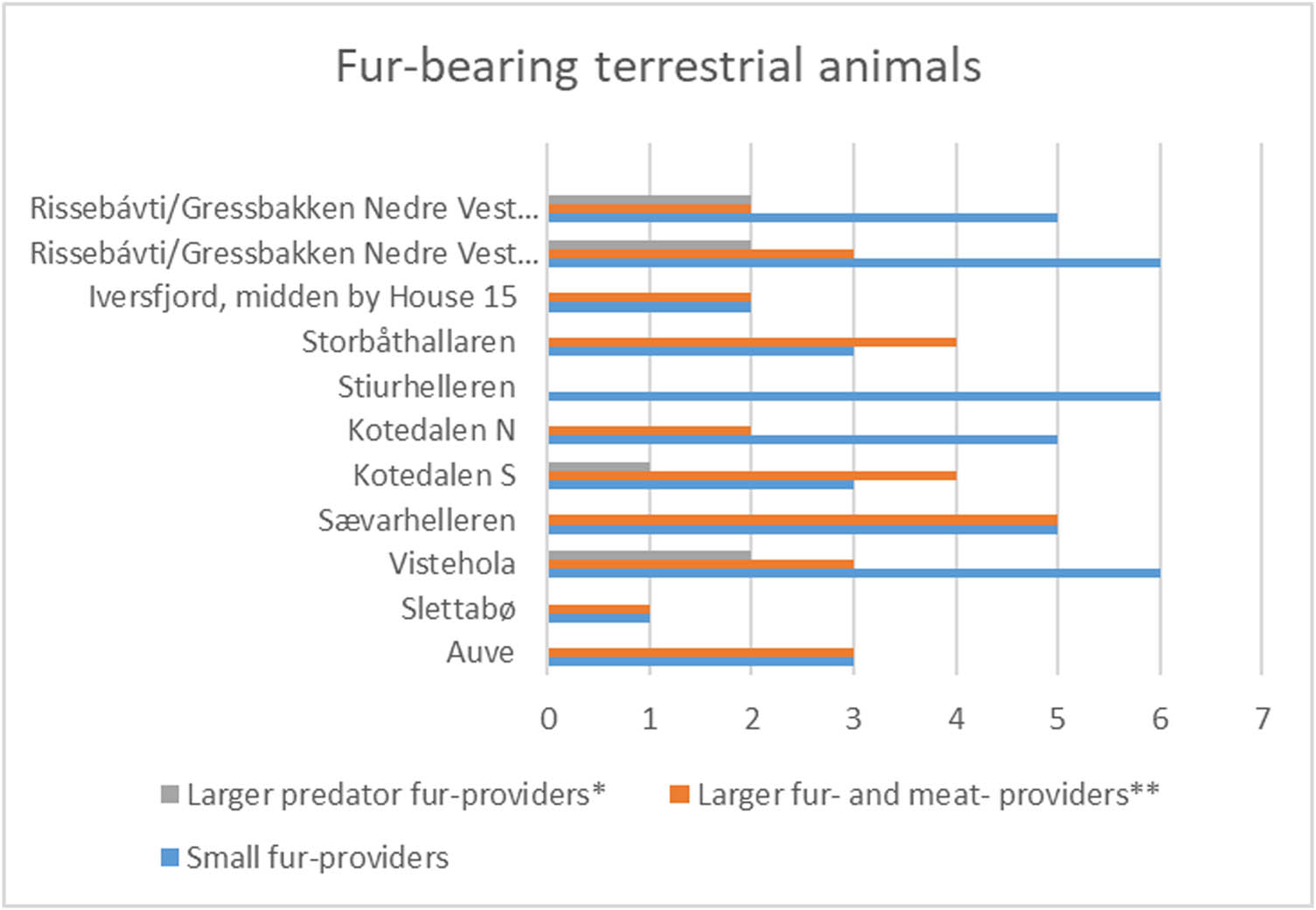
Diagram showing variations in number of terrestrial fur-bearing mammals at the case study sites, arranged north (top) – south (bottom). Animal species are sorted according to size and combined value as fur/hide- and meat-provider. Larger predators: wolf, wolverine, lynx, and badger (n = 4); Larger fur- and meat-providers: reindeer, red deer, roe deer, elk, brown bear, beaver, and wild boar (n = 7); Small fur-providers: otter, hare, red fox, Arctic fox, weasel, squirrel, polecat, and marten (n = 8).
However, with the ethnographic information in mind, the bones at the Stone Age hunter-gatherer sites should not merely be seen as reflections of locally available resources. They should instead be viewed as the result of careful and conscious selection of animals as raw materials, a selection process in which easy or plentiful access was probably merely one of several parameters considered. The animals not only include large key multi-resource (potentially hide, meat, bone, fat, and intestines) providers, such as ungulates, seal, and small whale, but also fur-bearing predators and small fur-bearing animals, species which have received little attention in the archaeological literature. The presence of reindeer, red deer, bear, and beaver bones at the outer coast Storbåthallaren case study site and the large number of beaver bones at coastal Auve provide evidence that at least parts of specific fur-bearing animals were brought to dwelling sites far from their natural living environments. Osseous material found far outside the animals’ natural habitats is indicated also for other sites listed in Table 1. Based on this evidence and in line with circumpolar ethnography, hide work can be suggested to have represented an important and intricate web of human-animal entanglements during the Mesolithic in coastal Norway. Different hides and furs not only had variable material, but probably also cultural and human-animal ontological, properties. Obtaining the necessary raw materials for clothes and other items required hunting and dwelling scheduling.
In addition to the basic need for hides, ethnographic records on hide processing and use inform us that fat, brain, and intestines were used in tanning, bones were used for a variety of hide processing and manufacturing of tools, and sinew was used for thread. This suggests that an interpretation of bones from various hide- or fur-bearing animals as remains from at least initial hide processing should be considered for all the case study sites.
4.2 Tools Involved in Hide Work
Ensuring high quality in hide preparation was of vital importance to a hunter-gatherer community, and moose hunting and processing toolkits used among the Khanty and Dénesuliné, respectively, included a number of implements (Glavatskaya, 2006, Table 5.3.; Jarvenpa & Brumbach, 2006b, pp. 63, 65–67). Many were made of bone or antler. The generally unfavourable preservation conditions in coastal Norway have left us with a meagre bone and antler tool inventory, and in addition, due to inconspicuous appearances and fragmented states, bone tools that may be associated with hide-craft are probably severely underrepresented compared to lithic tools. There are fundamental geographical differences in lithic technology during the Stone Age in Norway. Although formal tool types vary within the study area and lithic tools are of different materials and produced through different reduction methods, the general tool categories mostly offer the same functions in relation to hide working. All case study sites thus include lithic tool types that can be associated with hide processing. It is difficult from the inventory lists to suggest intensive or specific hide-processing activities except in cases where tools are reported to be found in particularly high numbers or in spatial concentrations. However, even general information suggests hide work activities.
Sharp cutting edges were necessary at different stages of hide processing, first, during the initial skinning of the killed animal, later to cut processed hide and skin during fitting of pieces to make items. Formal knives (Helskog et al. 1976, pp. 34–35), as well as slotted bone points (Yi et al., 2013), blades, and informal sharp-edged flakes may be considered as precise cutting tools for hide work. Formal flint knives or blades with worked edges are reported from most of the southern Norway case study sites in layers dated later than c. 4000/3500 BC, although in relatively small numbers, and earlier layers include microblades (Lund, 1951; Olsen, 1992; Østmo, 2008; Skjølsvold, 1977; Eigeland 2015; Solheim, 2012). Together with the osseous materials, the knives may point to initial skinning.
Ground slate knives are one of the most prevalent functional tool types in the north Norwegian Stone Age from around 5200/5000 BC (Jørgensen, 2021). They are primarily seen in relation to a marine fishing and hunting economy where they not only served as fish flensing knives, but also as mammal skinning tools, cutting tools, as part of larger hide-processing tool kits, or as multi-purpose tools (Andreassen 1985, pp. 202–205; Brøgger, 1909, p. 144; Clark, 1982, p. 113; Fitzhugh, 1974; Gjessing, 1942, p. 98; Helskog, 1983, pp. 93, 192). Because of their assumed relation to hide-work, they will receive some extra attention here. According to Fitzhugh (1974), the ground slate edges are less likely to damage hides during flensing, whereas the knives’ function as precise cutting tool has been questioned (Andreassen, 1985, p. 201). Slate can be worked and repeatedly re-shaped and re-sharpened into even edged and durable blunt edges, and strong similarities between ground slate and bone tool forms, and slate and bone shaping techniques, have been pointed out (Clark, 1982; Fitzhugh, 1974). Ground slate knives vary considerably in shape and size, from double to single edged and from just a few cm to over 30 cm in length. Functional differentiations based mainly on size have been suggested, the larger knives being marine flensing knives and the smallest used for making hide clothing or straps, alternatively they were used by children (Andreassen, 1985, p. 203). No typological studies have been undertaken on the extensive north Norwegian material, but local, regional, temporal as well as functionally related variation should be expected (Gjessing, 1942; Søborg, 1986). Polished slate knives and preforms evidencing on-site production are found at all the northern Norway case study sites. A high number of mostly fragmented knives and preforms are identified in the midden at Iversfjord (Helskog, 1983, p. 67), together with large quantities of seal and small whale bones. Numerous “miniature” knives (Figure 4), defined as 7 cm or less in length (Andreassen, 1985, p. 135; Simonsen, 1961, p. 374; Søborg, 1986, p. 47), larger variants, and preforms are well represented in the Rissebávti/Gressbakken Nedre Vest house 4 midden (Simonsen, 1961, p. 372), the variation in knife sizes accompanying large number of bones from fur-bearing animals of different sizes (Figure 3). Storbåthallaren also has numerous slate knives in combination with bones from many and diverse hide- and fur-bearing animals. The number of knives here can, however, be misleading since, compared to Iversfjord and Rissebávti/Gressbakken Nedre Vest house 4, the depositions span a much wider time frame, with artefacts having accumulated over many centuries.

A “miniature” slate knife and two lithic scrapers, one atypical spoon-shaped in slate and one in coarse quartz, all from Rissebávti/Gressbakken Nedre Vest house 4. Photo by M. Karlstad, UiT – The Arctic University of Norway.
Lithic scrapers are commonly related to hide-work. Typically retouched to create an extremely angled and thus strong edge at the distal end or along the side of a blade or flake (Helskog, Indrelid, & Mikkelsen, 1976), scrapers were used throughout the Norwegian Stone Age. They were made of hard materials such as quartz, quartzite, and chert (primarily in north Norway) or flint (primarily in south Norway). End- or side-scrapers were probably shafted into composite tools. Little has been done in terms of use-wear analysis on Norwegian Mesolithic material and hide processing has not been identified (Nærøy, 1998), but in addition to ethnographic accounts, various technical analyses have provided significant information on their role in skinning and hide processing (e.g., Broadbent & Knutsson, 1975; Gallagher, 1977; Keeley, 1980; Nissen & Dittemore, 1974; Steinbring, 1966, p. 577; Takase, 2010; Tringham, Cooper, Odell, Voytek, & Whitman, 1974; Yerkes, Barkai, Gopher, & Zutovski, 2016).
The number of scrapers differ significantly between the case-study sites. A high number is noted at Slettabø (Skjølsvold, 1977, p. 51) and scrapers are among the relatively few lithic tools found in Sævarhelleren (Bergsvik & David, 2015, Table 2), whereas only a few were found in Vistehola (Lund, 1951) and in the midden at Iversfjord (Helskog, 1983). According to find tables, there were none at Stiurhelleren and Storbåthallaren (Hultgreen, 1988; Utne, 1973). At Kotedalen, scrapers are associated with the younger phase (Olsen, 1992), which means they are contemporary with intensified seal hunting. At Auve, the 34 flint scrapers were confined to specific parts of the site, 14 of them within one small area (Østmo, 2008, p. 85). A comparison of the general distributions of bone waste material and scrapers (Hufthammer, 1997, Figures 2, 4, 5, and 7–13; Østmo, 2008, Figure 75) shows spatial overlap, particularly between scrapers and seal, porpoise, otter, and beaver bones. This may suggest that scrapers were used for initial cleaning and scraping of tissues from fresh hides, from marine as well as terrestrial animals. Spatial distributions are not published for any of the other case study sites, but the varying number of scrapers reported should at least be considered as indicative of different hide processing activities conducted at different sites or parts of sites, at different times and with variable intensity.
Rubbing, softening, and seam-flattening tools may be difficult to identify in an archaeological material. In ethnographic records people primarily are described as using their hands, feet, and teeth to rub and soften hides, and regular heavy teeth wear on Mesolithic skeletons (Grünberg, 2016) can be interpreted in this context. Experimental archaeology has shown that removing tissue from hides by rubbing them with granular abrading stones and water produces distinct chemical and physical use-wear patterns on the stone surface (Adams, 2014). No studies have been undertaken on a Norwegian material. Ethnographic examples show that granular handstones rough enough to abrade a softer contact surface are often preferred. Pumice may have had this quality, but typically only pieces with clear furrows assumed to be from slate, bone, or wood (arrow shaft) polishing have been collected during excavation. Pumice with narrow ground furrows may have been used to shape bone sewing needles or awls (Andreassen, 1985, p. 209). Particularly smooth pebbles that fit well into the hand are sometimes mentioned in excavation reports, but few have been collected. Four items from Iversfjord are registered as polishing and grinding stones. Pieces of pumice with wear-marks were recorded from Auve and Storbåthallaren, and one of the extremely few items at Stiurhelleren was also a piece of pumice with use-wear. At least some of the 33 polishing, grinding, and whetstones classified from houses 3 (n = 13) and 4 (n = 20) at Rissebávti/Gressbakken Nedre Vest could be handstones related to hide processing.
Formal bone or antler tools that can be associated with hide work are reported from most of the case study sites, although few in number at some (Table 4). According to ethnographic record and experimental study, scraping tools or “chisels” typically made of full-length leg bones of large ungulates or ribs should be considered as hide preparation tools (Christidou & Legrand-Pineau, 2005; Steinbring, 1966). These can have a straight, concave or even convex, and toothed working edge. Bone and antler scraping tools of various types are documented in exceptionally high numbers at Rissebávti/Gressbakken Nedre Vest houses 3 and 4 (Simonsen, 1961) (Table 3, Figure 5). Many are heavily worn and fragmented. Similar tools described in ethnographic records are mainly related not only to the initial defleshing, dehairing, and softening stages of fresh and wet hide processing but also to membraning and wringing. Due to inconspicuous appearances and fragmented states, bone scrapers are probably severely underidentified in Norwegian Stone Age archaeology.
Bone and antler tools used or possibly used in hide work from the case study sites
| Site, structure | Scraper | Needle | Awl | Comb |
|---|---|---|---|---|
| Auve | 1 | 1 | ||
| Slettabø | ||||
| Vistehola | 4 | 2 (+1*) | 70 | |
| Kotedalen | 31** | 31** | ||
| Sævarhelleren | 3 | |||
| Storbåthallaren | 1 | 31 | ||
| Stiurhelleren | 1*** | |||
| Iversfjord, midden by house 15 | ||||
| Rissebávti/Gressbakken Nedre vest, house 3 | 40 | 21 | 32 | 8 |
| Rissebávti/Gressbakken Nedre vest, house 4 | 25 | 20 | 39 | 12 |
| Rissebávti/Gressbakken Nedre vest, house 5 | 4 | 1 | 7 |
The scraper category includes tools classified as “chisels,” “daggers,” and “two-handed scrapers.” Needles refer to slim sewing needles and awls to sturdier, pointed tools. A needle, included in the table as (+1*), * has a split end and is classified as a fish net needle (Lund, 1951, p. 30). **“Needle” and “awl” (total n = 31) are combined in the excavation publication due to high degree of fragmentation (Bruen-Olsen, 1992, p. 160), and *** is classified as a bone pin (Hultgreen, 1988). Based on Bergsvik and David (2015), Bruen-Olsen (1992), Degerbøl (1951), Hultgreen (1988), Simonsen (1961), Skjølsvold (1977), and Utne (1973).
Figure 6 shows awls and needles representing the last stages of hide work, with awls used for drilling even holes for lashes or thread and needles for sewing new, and maintaining existing, items. Although preservation conditions probably play a part in the number of small bone implements identified, the variation between the case study sites could point to activity differences, with some sites being sewing camps where people made and maintained hide and skin items during a settled period of the year. Vistehola, both areas at Kotedalen and Storbåthallaren, and in particular the case study houses at Rissebávti/Gressbakken Nedre Vest all have high number of awls (Table 3). These are reported to be made from split bird or slim mammal bones. At all four sites, the many awls are found together with osseous materials from a variety of hide- and fur-bearing animals. At the two Rissebávti/Gressbakken Nedre Vest houses, more than 30 awls per house are accompanied by around 20 small, slim (less than 2 mm wide) sewing needles with cut-out holes in the top (Figure 6). As already discussed, the high number of needles and awls here are found together with numerous bone scrapers and slate knives of various sizes. Preparing different hides and sewing clothes which included fur from various fur-bearing animals seems to have been a major activity, and seemingly, the whole chain of hide work activities, from the initial flensing of animals to the finishing of items took place here. A high number of awls in combination with sewing needles may also be the case for Kotedalen, but here fragmentation is so high that only approximately 50% of all bone tools are classified, and needles and awls are not functionally divided (Olsen, 1992, p. 160). The variety of fur-bearing animals identified, and the particularly high proportion of otter remains may suggest that among other activities, sewing of new hide and fur items took place. At Vistehola and Storbåthallaren, large numbers of awls are found together with only one or two needles. However, given that the osseous materials from both includes several fur-bearing and even non-local animals, it cannot be ruled out that here also sewing was one of the (main) seasonal activities.

A bone-end-scraper from Rissebávti/Gressbakken Nedre Vest house 4 and two side-scrapers from house 3, all with heavy wear-marks and made of reindeer long-bone. Photo by M. Karlstad, UiT – The Arctic University of Norway.
A final tool category which deserves mentioning in relation to hide work is combs. Elaborate, sculptured, and pattern-incised combs from Rissebávti/Gressbakken Nedre Vest and similar adjacent sites in Varanger are seen as purely decorative items (Myrvoll, 1992; Olsen, 1994; Schanche, 1994; Simonsen, 1961). However, a mostly overlooked, simpler, and undecorated comb type (Figure 7) bears a strong resemblance to ethnographic sinew-splitting tools. It may thus be suggested that these were used to make sinew thread. If this interpretation is correct it adds to the impression of Rissebávti/Gressbakken Nedre Vest as – among other things – a sewing site.

Bone sewing needles with perforated holes and a bone awl, all from Rissebávti/Gressbakken Nedre Vest house 4. Photo by M. Karlstad, UiT – The Arctic University of Norway.

Bone comb, possibly used to split sinew into thin thread, from Rissebávti/Gressbakken Nedre Vest house 4. Photo by M. Karlstad, UiT – The Arctic University of Norway.
5 Hide Work and Human-Animal Relations
Interpretations of Stone Age hunter-gatherer materiality have focused on animals mainly as food resources. However, at least in the northernmost regions they must have been just as important as hide providers. Northern Mesolithic communities not only had few alternatives to hide and fur to make things vital for their survival, particularly for clothes and footwear, but also for boat and tent covers, other types of sheltering and containers, snares, nets and fishing lines, and for a variety of other practical purposes. In archaeology, the role of hide, skin, and fur-bearing animals in Stone Age hunter-gatherer communities is – if addressed – typically explained in general economic terms and understood from the perspective of human practical needs and human hide craft technologies to fulfil these. The practical significance of hide products is hardly addressed in Norwegian Stone Age research but may lie implicit in sporadic notions in excavation reports and publications of the importance of different resources provided particularly by large ungulates, beaver, and otter.
Recently, humanities and social science disciplines, including social zooarchaeology, has offered an alternative perspective to the anthropocentric economic view on human-animal relationships, advocating that it must be seen as a history of engagement, co-shaping, and “mutual becomings” (Ingold, 2000; Oma, 2007) between humans and animals. Starting to investigate what animals bring into this relationship in terms of qualities other than the “obvious” meat, hide, and antler resources, it is also suggested that animals other than generally recognised “key (food) species” were entangled in complex and meaningful human-nonhuman relationships (Overton, 2016; Overton & Hamilakis, 2013). The dependence on hides probably contributed substantially to quite particular sets of relationships between human and wild animals in Stone Age Norway. Human-animal relational ontologies are therefore a relevant social concern for investigating hide processing.
This study demonstrates that the conscious selection and combination of hide and fur from a large variety of animals described in ethnographic accounts is matched by variation and diversity in the remains of hide-bearing mammals in the Norwegian Stone Age record. The key role of ungulates and seals is unquestionable in having covered constant needs for large hides for a number of items. The variety of small animals and predators in the osseous remains demonstrates, however, that not only large key meat and hide providing species, but also primarily (in practical terms) fur-providing animals may have been significant co-beings. As Nick Overton reminds us: “Neither [animal] size nor frequency is necessarily directly related to their significance in the past” (Overton, 2016, p. 561). The general presence and variation in fur-bearing animals observed in the Norwegian material is particularly informative of hide work.
One could assume that various predator qualities, such as the physical strength of the bear, the endurance of the wolf, the lynx’s explosive speed and ability to kill much larger prey than itself, and the otter’s catching of fish in strong currents, were admired by Mesolithic hunters and fishers. But the beaver’s caring for its family and the squirrel’s curiosity could also have been appreciated qualities. Wild animals, many of them moving between different physical elements, seasonally displaying different appearances, and changing their modes of lives through the year, provided role models for proper lives in northern environments. Although direct information of belief systems is not available from the archaeological material, we must recognise that they most probably structured relations between humans, landscape, and animals and other beings fundamentally. We should assume that wild animals held important positions in mid-Holocene northern European ontology and cosmology, as hinted upon in their dominating presence in rock art and sculptures (Damm, in press).
Humans and animals became entangled through the different stages of hide processing long before the items were ready to use. Hunter-gatherer acquisition of hides depended on their ability to approach wild animals appropriately. From ethnographic examples, it can be learned that “to hunt” included numerous human-animal relation situations. Typically, it began with human encounter of animal behaviour, and, at some point after, followed a series of actions including killing (if the hunt was successful). A perspective found in many hunter-gatherer societies is that not only humans, but also wild animals and other entities all have personhood or soul, and that they share the capacities of consciousness and intentionality (e.g., Castro, 1998; Sabo & Sabo, 1985; Willerslev, 2007). One such capacity is being able to take part on equal terms in a generous relationship with the human hunter groups. This is seen in the notion of animals giving themselves to the hunter (Ingold, 2000; Sharp, 1988, 1994, 2001; Sharp & Sharp, 2015; Tanner, 1979; Willerslev, 2007). A frequently found understanding in hunter-gatherer cosmologies is also that of key animals having immortal protective Masters regulating the hunt and facilitating animal souls to switch between external appearances and even to regenerate into the human world, if treated properly (e.g. Campbell, 1988; Goldman, 1975; Hultkrantz, 1987; Slotten, 1965). Souls could, by wearing different hides, appear in animal form or regenerate as humans (Goldman, 1975, p. 125; Graeber, 2001, p. 205; Sharp, 2001, p. 67). After the killing where the animal gave itself, followed butchering, sharing, eating, processing other-than-meat resources, and depositing bones and waste. All of these steps should be conducted appropriately with respect for the animal or animal spirit to secure good relations, typically through ritualised behaviour (Berkes, 2012, pp. 111–117; Russell, 2012, p. 169; Tanner, 1979).
The insights from ethnographic and experimental hide processing and the attention to details the craft requires suggest that hide played a major role in human-animal relations. Given the total dependency on wild animals for survival, and by necessity the intimate knowledge of animals they possessed, we should assume that Stone Age hunter-gatherers in Norway did not only regard skin in economic and practical terms, but imbued hide and fur objects with meaning. One of the special properties inherent in hide and fur, more than for any other part of an animal, is how they provide to the experienced observer direct information about species, but also specific details regarding individual animals according to sex, gender, age, and temperament. In the northern regions, fur can also vary considerably in colour and quality through the year. This all creates almost endless possibilities for combining elements of animals and animal characteristics into meaningful human-made modifications. Characteristics and qualities attributed to a live animal could have been sought maintained, and accentuated by humans in finished garments and objects to be transferred to the wearer and user, and to reconcile humans and animals, as described in ethnographic records. The original shape and position of the animal skin had a significant influence on the cut and design of Arctic clothes, for practical, social, and spiritual reasons, and specific body parts were accentuated, such as the head, ears, and tail (Chaussonnet 1988, pp. 212–213; Issenman, 2007; Kleppe-Turunen, 2010, p. 48). Hide pieces from selected parts of animals were worn as amulets and specific items, such as belts passed down from parents to children, moving fringes or elements making sounds were conduits for communication and transformation (Chaussonnet, 1988). The end products – be it clothes, boats, or containers – were imbued with strong visual references to the animals from which the hide and furs originated. We need to consider that specific animal capacities and characteristics may have been seen as inherent in different elements also in the northern Mesolithic, and that these were believed to be transferred to humans wearing, using or keeping the hides as part of their outfit, but also to boats, dwelling constructions, and other objects.
Thus, appropriate behaviour and treatment should not be seen as confined to the act of tracing and killing but must also include the treatment of all animal products, including hides. The ability to access skin and fur with desired qualities must have been based on profound knowledge of a wide range of wild animals, obtained through comprehensive observation of their ways of living and acting in the shared world (Overton, 2016, 2019; Overton & Hamilakis, 2013; Skandfer, 2021). Pursuing encounters with animal individuals wearing attractive hides must have been combined with choice of hunting methods to avoid weakening or damaging the hide and fur as much as possible. Ethnographic records referred in this study demonstrate complex combinations of various hide and other animal products, tools, and human skill in the different hide processing activities following the killing, from the initial careful flensing to prevent making holes and weaknesses, via stretching, tanning, and softening, to making finished items. Hide preparation processes involved the use of other parts of animals, such as fat from different body parts, intestines, sinew, marrow, blood, brain, and bone. In the Stone Age, elements from different animals were likely similarly combined in various processes, and in addition, tools of different raw materials were involved.
6 Conclusion
A continuing narrow focus on hunting which tends to view animal killing as an end in itself, places a wide range of activities such as the preparation of hides and production of hide-related products in the background. The ethnographic and archaeological records have the potential for illuminating human-animal relations in a much broader context than that of man hunting for food in Stone Age forager societies. On the basis of ethnographic records, it can be argued that skin procurement, processing, and making and maintenance of hide and fur items were among the main activities in Mesolithic communities in northern Europe, including coastal Norway. The faunal and hide quality diversity together with ethnographic accounts suggest that procuring the right hide or fur quality in the Mesolithic was far from expedient. Instead, accessing hide and other resources from the right animals and of the appropriate quality at the best time of the year must have depended on minute preparation and close scheduling. The subsequent hide processing stages and fitting and making of finished objects were time and effort consuming. This all implies that hide work must have had a substantial influence on, among other things, settlement patterns, scheduling of resource harvesting, choice of dwelling site location, and composition and size of settlement groups. Few alternatives to hide in cold and wet environments imposed stringent requirements on how hides were treated, processed, and fitted, in order to make durable items suited for the northernmost regions. However, not only practical needs had to be met. People in the Mesolithic were fundamentally dependent on the generosity and good will of their various co-beings. Ethnography provides insights into intricate relations between northern hunter-gatherer societies and animals and other spirited entities, and how choice of animal parts used as raw materials was basically founded on animal capacities.
A re-reading of reports and records from 11 separate contexts at 9 archaeological sites with preserved osseous materials from the coast of Norway shows that local hide procurement and processing should be discussed as one of the activities performed at all of them. For some of the case study sites, hide work can be suggested to be one of the main activities, for others a side activity in combination with other. A comparison of their faunal records with 25 additional mid-Holocene sites in coastal Norway demonstrates a general potential and relevance in identifying hide processing activities in archaeological records. Although osseous material provides more direct insight into which animals were present at a site, tools and debris from tool making and maintenance can also inform on hide work. Identifying hide working tools of bone and antler deserves particular attention in future studies, since they seem to be under-represented in the current data records, together with residue and use-wear analysis on bone and lithic tools.
Human appreciation of animals for their various qualities may have operated on several levels, from generic animal groups through age or gender sub-groups down to individual animals. Specific characteristics could have been sought transferred to humans, negotiated through the making and use of objects of raw materials obtained from animals. Hide and fur have a particular ability to bear strong visual similarities with the original animal carrier. The ethnographic record implies that hide working was a significant way in which hunter-gatherers engaged with wild animals and their spirits, and that human-animal relationships were potentially involved in all stages of hide processing and skin-item use in northern European hunter-gatherer Stone Age societies. We should consider that the processing and use of hides and fur were performed as actions of recognition, in accordance with a fundamental system of re-gifting or other means to deal with animal spirits inherent in the hides. Choice of materials used in hide processing (as well as other activities) combined a number of elements from specific animals (and also other types of raw materials) with particular characteristics. These were selected based on their inherent practical qualities, but probably also on considerations of the provider’s characteristics as a social co-being. A focus on hide work as conducted within an intricate relationship between humans and animals in a shared world can contribute to broader culture-historical interpretations and new understandings of central dynamics in Stone Age hunter-gatherer lifeways.
Acknowledgements
I wish to thank all members of the StoneDem project group and the “umbrella” Stone Age Research Group for providing a stimulating research environment. Special thanks to Charlotte Damm for helpful suggestions and comments on the original version of this article. Two anonymous reviewers and editors have provided valuable inputs on the first version, and Stephen Wickler, UiT – The Arctic University of Norway, has contributed with language editing.
-
Funding information: This work is part of the “Stone Age Demographics” (StoneDem) research project held at UiT – The Arctic University of Norway. The project was funded (2017–2022) by the Norwegian Research Council (project code 261760).
-
Conflict of interest: The author has no conflict of interest.
-
Data availability statement: All data generated or analysed during the study are included in this published article. Database: Archaeological Sub-fossil Collection, the University Museum, Bergen University. https://reg.app.uib.no/apex/f?p=608:13.
References
Adams, J. L. (1988). Use-wear analyses on manos and hide-processing stones. Journal of Field Archaeology, 15(3), 307–315. doi: 10.1179/009346988791974394.Search in Google Scholar
Adams, J. L. (2014). Ground stone use-wear analysis: A review of terminology and experimental methods. Journal of Archaeological Science, 48, 129–138. doi: 10.1016/j.jas.2013.01.030.Search in Google Scholar
Albrektsen, C. (2015). A historical review of Norwegian archaeological field method and material analysis practices for the zooarchaeological osteological material from the Norwegian Stone Age using case study examples. (Master thesis in archaeology). University of Bergen, Bergen.Search in Google Scholar
Andreassen, R. L. (1985). Yngre steinalder på Sørøya: Økonomi og samfunn 4000–1000 f.Kr. (Magister thesis in archaeology). UiT The Arctic University of Norway, Tromsø.Search in Google Scholar
Anell, B. (1964). Animal hunting disguise among the north American Indians. In Lapponica. Essays presented to Israel Ruong 26.5.1963 (pp. 1–34, Studia Ethnographica Upsalensis 21). Uppsala: Uppsala Universitet.Search in Google Scholar
Arima, E. Y. (1984). Caribou Eskimo. In D. Damas (Ed.), Handbook of North American Indians volume 5: Arctic (pp. 447–462). Washington D.C: Smithsonian Institution Press.Search in Google Scholar
Åstveit, L. I. (1999). Keramikk i vitenskapelig kontekst. En studie over et neolittisk keramikkmateriale fra Radøy, Hordaland. (Master thesis in archaeology). University of Bergen, Bergen.Search in Google Scholar
Balikci, A. (1984). Netsilik. In D. Damas (Ed.), Handbook of North American Indians volume 5: Arctic. (pp. 415–430). Washington: Smithsonian Institution.Search in Google Scholar
Bergsvik, K. A., & David, E. (2015). European Journal of Archaeology, 18(2), 190–221. doi: 10.1179/1461957114Y.0000000073.Search in Google Scholar
Bergsvik, K. A., & Hufthammer, A. K. (2009). Stability and change among marine hunter-fishers in western Norway 7000–4500 cal BC. Results from the excavations of two rockshelters in Hardanger. In P. Crombé, M. Van Strydonck, & J. Sergant (Eds.), Chronology and Evolution within the Mesolithic of North-west Europe (pp. 435–449). Cambridge: Cambridge Scholars Publishing.Search in Google Scholar
Berkes, F. (2012). Sacred ecology. New York and London: Routledge, Taylor and Francis. doi: 10.4324/9780203123843.Search in Google Scholar
Broadbent, N., & Knutsson, K. (1975). An experimental analysis of quartz scrapers. Results and applications. Fornvännen, 70, 113–128.Search in Google Scholar
Brøgger, A. W. (1909). Den arktiske stenalder i Norge. Christiania: Videnskabs-Selskabet.Search in Google Scholar
Burch, E. S., Jr. (2012). Caribou herds of Northwest Alaska 1850–2000. Fairbanks: University of Alaska Press.Search in Google Scholar
Campbell, J. (1988). Historical atlas of world mythology 1: The way of the animal powers. London: Times Books.Search in Google Scholar
Castro, E. V. de. (1998). Cosmological Deixis and Amerindian Perspectivism. The Journal of the Royal Anthropological Institute, 4(3), 469–488. doi: 10.2307/3034157.Search in Google Scholar
Chapelle, H. I. (2007). Arctic skin boats. In E. T. Adney & H. I. Chapelle (Eds.), Bark canoes and skin boats of North America (pp. 174–211). New York: Skyhorse Publishing.Search in Google Scholar
Chaussonnet, V. (1988). Needles and animals: Women’s magic. In W. W. Fitzhugh & A. Crowell (Eds.), Crossroads of continents: Cultures of Siberia and Alaska (pp. 209–229). Washington D.C.: Smithsonian Institution Press.Search in Google Scholar
Christidou, R., & Legrand-Pineau, A. (2005). Hide working and bone tools: Experimentation design and applications Hide working and bone tools: Experimentation design and applications. In H. Luik, A. Choyke, C. Batey, & L. Lougas (Eds.), From Hooves to Horns, from Mollusc to Mammoth. Manufacture and use of bone artefacts from prehistoric times to the present: Proceeding of the 4th Meeting of the ICAZ Worked bone research group, at Tallinn, 26–31 of August 2003, 15 (pp. 385–396). https://hal.archives-ouvertes.fr/hal-01565072.Search in Google Scholar
Clark, D. W. (1982). An example of technological change in prehistory: The origin of a regional ground slate industry in South-Central Coastal Alaska. Arctic Anthropology, 19(1), 103–125.Search in Google Scholar
Cristiani, E., & Zupancich, A. (2020). Sandstone ground slate technology: A multi-level use wear residue approach to investigate the function of pounding and grinding tools. Journal of Archaeological Method and Theory, 28, 704–735. (2021). doi: 10.1007/s10816-020-09488-1.Search in Google Scholar
Damas, D. (1984a). Handbook of North American Indians volume 5: Arctic. Washington D.C.: Smithsonian Institution Press.Search in Google Scholar
Damas, D. (1984b). Copper Eskimo. In D. Damas (Ed.), Handbook of North American Indians volume 5: Arctic (pp. 397–414). Washington D.C.: Smithsonian Institution Press.Search in Google Scholar
Damm, C. (1995). Rapport fra utgravningene av Hus 23 på Gressbakken Nedre Øst, Nesseby k., Finnmark, september 1994. File in archive. Tromsø: UiT – Norges Arktiske Universitet.Search in Google Scholar
Damm, C. (in press). Forager cosmologies in northernmost Europe. In L. N. Stutz, R. P. Stjerna, & M. Törv (Eds.), The Oxford handbook of Mesolithic Europe. Oxford: Oxford University Press.Search in Google Scholar
Damm, C., Skandfer, M., Jørgensen, E. K., Sjögren, P., Vollan, K. W. B., & Jordan, P. D. (2019). Investigating long-term human ecodynamics in the European Arctic: Towards an integrated multi-scalar analysis of early and mid Holocene cultural, environmental and palaeodemographic sequences in Finnmark County, Northern Norway. Quaternary International, 549, 52–64. doi: 10.1016/j.quaint.2019.02.032.Search in Google Scholar
Degerbøl, M. (1951). Det osteologiske material. Knoglemateriale fra en ny udgravning i Vistehulen i Norge. In H. E. Lund (Eds.), Fangst-boplassen i Vistehulen. På Viste, Randaberg, Nord-Jæren (pp. 52–84). Stavanger: Stavanger Museum.Search in Google Scholar
Dubreuil, L. (2004). Long-term trends in Natufian subsistence: A use-wear analysis of ground stone tools. Journal of Archaeological Science, 31(11), 1613–1629. doi: 10.1016/j.jas.2004.04.003.Search in Google Scholar
Eigeland, L. (2015). Maskinmennesket i steinalderen: Endring og kontinuitet i steinteknologi fram mot neolitiseringen av Øst-Norge. (PhD thesis in archaeology). University of Oslo, Oslo.Search in Google Scholar
Fauchald, P., Rødven, R., Bårdsen, B.-J., Langeland, K., Tveraa, T., Yoccoz, N. G. & Ims, R. A. (2007). Escaping parasitism in the selfish herd: Age, size and density-dependent warble fly infestation in reindeer. Oikos, 116(3), 491–499. doi: 10.1111/j.0030-1299.2007.15390.x.Search in Google Scholar
Fitzhugh, W. (1974). Ground Slates in the Scandinavian younger stone age with reference to circumpolar maritime adaptations. Proceedings of the Prehistoric Society, 40, 45–58. Cambridge: Cambridge University Press. doi: 10.1017/S0079497X00011300.Search in Google Scholar
Gallagher J. P. (1977). Contemporary stone tools in Ethiopia: Implications for archaeology. Journal of Field Archaeology, 4, 407–414. doi: 10.2307/529396.Search in Google Scholar
Gjessing, G. (1942). Yngre steinalder i Nord-Norge. Oslo: Instituttet for Sammenlignende Kulturforskning 39.Search in Google Scholar
Gjessing, G. (1943). Træn-funnene. Oslo: Instituttet for Sammenlignende Kulturforskning 41.Search in Google Scholar
Glavatskaya, E. (2006). Khanty Hunter–Fisher–Herders. A task differentiation analysis of Trom´Agan women’s and men’s subsistence activities. In R. Jarvenpa & J. Brumbach (Eds.), Circumpolar lives and livelihood: A comparative ethnoarchaeology of gender and subsistence (pp. 115–157). Lincoln: University of Nebraska Press.Search in Google Scholar
Glørstad, H. (1996). Neolittiske smuler. Små teoretiske og praktiske bidrag til debatten om neolittisk keramikk og kronologi i Sør-Norge. Varia 33. Oslo: Universitetet i Oslo. https://www.duo.uio.no/handle/10852/66794.Search in Google Scholar
Glørstad, H. (2010). The structure and history of the Late Mesolithic societies in the Oslo Fjord area 6300–3800 BC. Lindome: Bricoleur Press.Search in Google Scholar
Goldman, I. (1975). The Mouth of Heaven: An introduction to Kwakiutl religious thought. New York: John Wiley and Sons. doi: 10.1007/BF00249475.Search in Google Scholar
Graeber, D. (2001). Toward an anthropological theory of value: The false coin of our own dreams. New York: Palgrave Macmillan.10.1057/9780312299064Search in Google Scholar
Grünberg, J. M. (2016). Mesolithic Burials – Rites, symbols and social organisation of early postglacial communities. In J. M. Grünberg, B. Gramsch, L. Larsson, J. Orschiedt, & H. Meller (Eds.), Mesolithic burials – Rites, symbols and social organisation of early postglacial communities. International Conference, Halle (Saale), Germany, 18th-21st September 2013 (pp. 13–24). Halle: Tagungen des Landesmuseums für Vorgeschichte Halle 13.Search in Google Scholar
Hatt, G. (1914a). Mokkasiner. Geografisk Tidskrift, 22, 172–182.Search in Google Scholar
Hatt, G. (1914b). Arktiske skinddragter i Eurasien og Amerika: En etnografisk studie. Copenhagen: J. H. Schultz.Search in Google Scholar
Helskog, E. T. (1983). The Iversfjord locality. A study of spatilal patterning during the Late Stone Age of Finnmark, north Norway. Tromsø: Tromsø Museums Skrifter 19.10.2307/2802340Search in Google Scholar
Helskog, K., Indrelid, S., & Mikkelsen, E. (1976). Morfologisk klassifisering av slåtte steinartefakter. Universitetets Oldsaksamlings årbok 1972–1974 (pp. 9–40).Search in Google Scholar
Hodgetts, L. (1999). Animal bones and human society in the late younger stone age of Arctic Norway (Vol. 1 and 2, PhD thesis in archaeology). Durham University, Durham.Search in Google Scholar
Hodgetts, L. (2010). Subsistence diversity in the younger Stone Age landscapes of Varangerfjord, northern Norway. Antiquity, 84, 41–54.10.1017/S0003598X00099750Search in Google Scholar
Hufthammer, A. K. (1987). Det osteologiske materialet fra Fosenstraumen. In L. Marstrander (Ed.), Ervervsstrategier i Norge i yngre steinalder. Forskningsstatus anno 1986 (pp. 35–36, Riksantikvarens rapporter 17). Oslo: Riksantikvaren.Search in Google Scholar
Hufthammer, A. K. (1992). De osteologiske undersøkelsene fra Kotedalen. In K. L. Hjelle, A. K. Hufthammer, P. E. Kaland, A. B. Olsen, & E. C. Soltvedt (Eds.), Kotedalen: En boplass gjennom 5000 år – 2. Naturvitenskapelige undersøkelser (pp. 9–64). Bergen: Historisk Museum, Universitetet i Bergen.Search in Google Scholar
Hufthammer, A. K. (1997). The vertebrate faunal remains from Auve – A palaeoecological investigation. In Auve II. Tekniske og naturvitenskapelige undersøkelser. Norske Oldfunn 17. Oslo: Institutt for Arkeologi, Kunsthistorie og Numismatikk, Universitets Oldsaksamling.Search in Google Scholar
Hultgreen, T. (1988). Yngre steinalder i Rana: En analyse av kyst og innlandsbosetninga mellom 4000–2000 BC. (Magister thesis in archaeology). UiT The Arctic University of Norway, Tromsø.Search in Google Scholar
Hultgreen, T., Johansen, O. S., & Lie, R. W. (1984). Stiurhelleren i Rana. Dokumentasjon av korn, husdyr og sild i yngre steinalder. Viking, 48, 83–102.Search in Google Scholar
Hultkrantz, Å. (1987). On beliefs in non-shamanic guardian spirits among the Saamis. In T. Ahlbäck (Ed.), Saami religion: Based on papers read at the Symposium on Saami Religion held at Åbo, Finland, on the 16th–18th of August 1984 (pp. 110–123, Donner Institute for Research in Religious and Cultural History). Åbo: Åbo Akademi University. doi: 10.30674/scripta.67157.Search in Google Scholar
Huuva, A., & Håkansson, A. (2010). Traditionell samisk garvning av ren- och viltskinn. In H. Tunón (Ed.), Seminarierapport. Traditionell skinngarvning (pp. 71–73, CBMs skriftserie 35. Bäckedals folkhögskola). Uppsala: Sveg & Naptek. https://www.slu.se/globalassets/ew/org/centrb/cbm/dokument/publikationer-cbm/cbm-skriftserie/skinnrapporten-skrift35.pdf.Search in Google Scholar
Ingold, T. (2000). The perception of the environment: Essays on livelihood, dwelling and skill. London: Routledge.Search in Google Scholar
Issenman, B. K. (2007). The art and technique of Inuit clothing. http://collections.musee-mccord.qc.ca/scripts/printtour.php?tourID=CW_InuitClothing_EN&Lang=2.Search in Google Scholar
Israelsson, I. (2010). Fiskskinnsgarvning på norra halvklotet – Experiment med traditionella metoder. In H. Tunón (Ed.), Seminarierapport. Traditionell skinngarvning (pp. 19–25. CBMs skriftserie 35. Bäckedals folkhögskola). Uppsala: Sveg & Naptek. https://www.slu.se/globalassets/ew/org/centrb/cbm/dokument/publikationer-cbm/cbm-skriftserie/skinnrapporten-skrift35.pdf.Search in Google Scholar
Jacobsen, H., & Andersen, R. (1992). Elgen og mennesket. Jakt og fangst gjennom tidene. Årbok for Norsk Skogbruksmuseum, 13, (1990–1992) (pp. 166–205). Elverum: Norsk Skogbruksmuseum.Search in Google Scholar
Jarvenpa, R., & Brumbach, H. J. (2006a). Circumpolar lives and livelihood: A comparative ethnoarchaeology of gender and subsistence. Lincoln: University of Nebraska Press.Search in Google Scholar
Jarvenpa, R., & Brumbach, H. J. (2006b). Chipewyan hunters. A task differentiation analysis. In R. Jarvenpa & H. J. Brumbach (Eds.), Circumpolar lives and livelihood: A comparative ethnoarchaeology of gender and subsistence (pp. 54–78). Lincoln: University of Nebraska Press.Search in Google Scholar
Jørgensen E. K. (2021). Scalar effects in ground slate technology and the adaptive consequences for circumpolar maritime hunter-gatherers. Journal of Archaeological Method and Theory, 28(2), 333–385.10.1007/s10816-020-09458-7Search in Google Scholar
Keeley, L. H. (1980). Experimental determination of stone tool uses. Chicago: The University of Chicago Press.Search in Google Scholar
Kleppe-Turunen, S. (2010). Råräckning och rökgarvning. In H. Tunón (Ed.), Seminarierapport. Traditionell skinngarvning (pp. 46–49, CBMs skriftserie 35. Bäckedals folkhögskola). Uppsala: Sveg & Naptek.Search in Google Scholar
Lie, R. O. (2003). Ulvefangst i ulvestuer. Spor: Fortidsnytt fra Midt-Norge, 2(2003), 10–13.Search in Google Scholar
Lund, H. E. (1951). Fangst-boplassen i Vistehulen. På Viste, Randaberg, Nord-Jæren. Stavanger: Stavanger Museum.Search in Google Scholar
Luukkanen, H., & Fitzhugh, W. W. (2020). The bark canoes and skin boats of Northern Eurasia. Washington DC: Smithsonian Books.Search in Google Scholar
Marshall, I. (1996). History and ethnography of the Beothuk. Montreal and Kingston: McGill-Queen’s University Press.10.1515/9780773565890Search in Google Scholar
Martens, V. V., Myrvoll, E. R., Bergersen, O., Vorenhout, M., Sandvik, P. U., & Denham, S. (2017). In situFarms. Archaeological deposits in a changing climate. Case Baŋkgohppi, Unjárgga gielda/Nesseby k., Finnmark. NIKU Rapport 77. Oslo: Norsk Institutt for Kulturminneforskning.Search in Google Scholar
Mikkelsen, E. (1979). Seasonality and Mesolithic adaptation in Norway. In K. Kristiansen & C. Paludan-Müller (Eds.), New directions in scandinavian archaeology (pp. 79–119). Copenhagen: National Museum of Denmark.Search in Google Scholar
Myrvoll, E. R. (1992). Stil og samfunn. En analyse av materiell symbolisme og sosiale relasjoner i Varanger 2200 f.Kr. – Kr.f. (Magister thesis in archaeology). UiT The Arctic University of Norway, Tromsø.Search in Google Scholar
Nadasdy, P. (2007). The gift in the animal: The ontology of hunting and human-animal sociality. American Ethnologist, 34(1), 25–43.10.1525/ae.2007.34.1.25Search in Google Scholar
Nissen, K., & Dittemore, M. (1974). Ethnographic data and wear pattern analysis: A study of socketed eskimo scrapers. Tebiwa, 17, 67–88.Search in Google Scholar
Nesheim, A. (1964). The Lapp fur and skin terminology and its historical background. In Lapponica. Essays presented to Israel Ruong 26.5.1963 (pp. 199–218, Studia Ethnographica Upsalensis 21). Uppsala: Uppsala Universitet.Search in Google Scholar
Nærøy, A. J. (1998). Stone Age living spaces in western Norway. (Dr.art. thesis in archaeology). University of Bergen, Bergen.Search in Google Scholar
Olsen, A. B. (1992). Kotedalen – En boplass gjennom 5000 år. 1: Fangstbosetning og tidlig jordbruk i vestnorsk steinalder: Nye funn og nye perspektiver. Bergen: Historisk Museum, Universitetet i Bergen.Search in Google Scholar
Olsen, B. (1994). Bosetning og samfunn i Finnmarks forhistorie. Oslo: Universitetsforlaget.Search in Google Scholar
Olsen, H. (1967). Osteologisk materiale: Innledning – Fisk – Fugl. Varanger-funnene 4. Tromsø: Tromsø Museum.Search in Google Scholar
Olsen, H. (1976). Skipshelleren: Osteologisk materiale. Bergen: Zoologisk Museum, Universitetet i Bergen.Search in Google Scholar
Olsen, H. (n.d.). Pattedyr. Varanger-funnene. Unpublished file in archive. Tromsø: UiT – Norges Arktiske Universitet.Search in Google Scholar
Oma, K. A. (2007). Human-animal relationships. Mutual becomings in Scandinavian and Sicilian households 900-500 BC. Oslo: Universitetet i Oslo.Search in Google Scholar
Østmo, E. (2008). Auve: En fangstboplass fra yngre steinalder på Vesterøya i Sandefjord. 1: Den arkeologiske del. Norske oldfunn 17. Oslo: Kulturhistorisk Museum.Search in Google Scholar
Overton, N. J., & Hamilakis, Y. (2013). A manifesto for a social zooarchaeology. Swans and other beings in the Mesolithic. Archaeological Dialogues, 20(2), 111–136. doi: 10.1017/S1380203813000159.Search in Google Scholar
Overton, N. J. (2016). More than skin deep: Reconsidering isolated remains of ‘fur-bearing species’ in the British and European Mesolithic. Cambridge Archaeological Journal, 26(4), 561–578. doi: 10.1017/S0959774316000391.Search in Google Scholar
Overton, N. J. (2019). Can hunters ever ‘get to know’ their prey? The role of environmental experiences and daily interactions in the formation of human-nonhuman relationships in the British Mesolithic and beyond. Hunter Gatherer Research, 4(2), 193–255. doi: 10.3828/hgr.2018.10.Search in Google Scholar
Pasda, K. (2019). Caribou hunting and utilization in West Greenland: Past and present variants. Anthropozoologica, 48(1), 111–123. doi: 10.5252/az2013n1a6.Search in Google Scholar
Petersen, H. C. (1986). Skinboats of Greenland. Ships and Boats of the North 1. Copenhagen and Roskilde: The National Museum of Denmark, The Museum of Greenland and The Viking Ship Museum in Roskilde.Search in Google Scholar
Rahme, L. (2010). Att lära av förhistorien. In H. Tunón (Ed.), Seminarierapport. Traditionell skinngarvning. (pp. 30–37, CBMs skriftserie 35. Bäckedals folkhögskola). Uppsala: Sveg & Naptek.Search in Google Scholar
Renouf, M. A. P. (1981). Prehistoric coastal economy in Varangerfjord, North Norway: The analysis of fauna material and the study of subsistence patterns in the inner area of Varangerfjord during the younger Stone Age, from 5800 to 2500 B.P. (PhD thesis in archaeology). University of Cambridge, Cambridge.Search in Google Scholar
Renouf, M. A. P. (1989). Prehistoric hunter-fishers of Varangerfjord, Northeastern Norway: Reconstruction of settlement and subsistence during the Younger Stone Age. Oxford: BAR International Series 487.10.30861/9780860546245Search in Google Scholar
Rheen, S. (1897). En kortt relation om lapparnes lefwarne och sedher, wijdskiepellsser, sampt i många stycken grofwe wildfarellsser. Bidrag til kännedom om de svenska landsmålen och svenskt folkliv 17(1). Uppsala: Harald Wretman.Search in Google Scholar
Rifkin, R. F. (2011). Assessing the efficacy of red Ochre as a Prehistoric Hide Tanning Ingredient. Journal of African Archaeology, 9(2), 131–158.10.3213/2191-5784-10199Search in Google Scholar
Ritchie, K., Hufthammer, A. K., & Bergsvik, K. A. (2016). Fjord fishing in Mesolithic Western Norway. Environmental Archaeology, 21(4), 309–316.10.1080/14614103.2015.1118212Search in Google Scholar
Russell, N. (2012). Social zooarchaeology: Humans and animals in prehistory. Cambridge: Cambridge University Press.10.1017/CBO9781139019712Search in Google Scholar
Sabo, G. III., & Sabo, D. R. (1985). Belief systems and the ecology of sea mammal hunting among the Baffinland Eskimo. Arctic Anthropology, 22(2), 77–86.Search in Google Scholar
Schanche, K. (1988). Mortensnes, en boplass i Varanger: En studie av samfunn og materiell kultur gjennom 10.000 år. (Magister thesis in archaeology). UiT The Arctic University of Norway, Tromsø.Search in Google Scholar
Schanche, K. (1994). Gressbakkentuftene i Varanger. Boliger og sosial struktur rundt år 2000 f.Kr. (PhD thesis in archaeology). Universitetet i Tromsø, Tromsø. https://hdl.handle.net/10037/3317.Search in Google Scholar
Schefferus, J. (1956) [1673]. Lappland. Acta Lapponica 8. Uppsala: Almqvist & Wicksell.Search in Google Scholar
Sharp, H. S. (1988). The transformation of bigfoot: Maleness, power, and belief among the Chipewyan community. American Ethnologist, 14(2), 226–235.10.1525/ae.1987.14.2.02a00030Search in Google Scholar
Sharp. H. S. (1994). Inverted Sacrifice. In T. Irimoto & T. Yamada (Eds.), Circumpolar religion and ecology: An anthropology of the north. Tokyo: University of Tokyo Press.Search in Google Scholar
Sharp, H. S. (2001). Loon. Memory, meaning and reality in a Northern Dene Community. Lincoln and London: University of Nebraska Press.Search in Google Scholar
Sharp, H. S., & Sharp, K. (2015). Hunting Caribou. Subsistence hunting along the northern edge of the boreal forest. Lincoln and London: University of Nebraska Press.10.2307/j.ctt1d9nhpnSearch in Google Scholar
Simonsen, P. (1961). Varanger-funnene 2. Fund og udgravninger på fjordens sydkyst. Tromsø Museums skrifter 7(2). Tromsø: Tromsø Museum.Search in Google Scholar
Sjögren, P., & Damm, C. (2019). Holocene vegetation change in northernmost Fennoscandia and the impact on prehistoric foragers 12 000–2000 cal. a BP – A review. Boreas, 48, 20–35. doi: 10.1111/bor.12344.Search in Google Scholar
Skandfer, M. (2021). The appreciation of reindeer: Rock carvings and Sámi Reindeer knowledge. In J. M. Gjerde & M. S. Arntzen (Eds.), Perspectives on differences in rock art (pp. 113–128). Sheffield: Equinox Publishing. doi: 10.1558/equinox.31925.Search in Google Scholar
Skjølsvold, A. (1977). Slettabøboplassen. Et bidrag til diskusjonen om forholdet mellom fangst- og bondesamfunnet i yngre steinalder og bronsealder. AmS skrifter 2. Stavanger: Arkeologisk Museum i Stavanger.Search in Google Scholar
Slotten, R. L. (1965). The Master of Animals: A study in the symbolism of ultimacy in primitive religion. Journal of Bible and Religion, 33(4), 293–302).10.1093/jaarel/XXXIII.4.293Search in Google Scholar
Solheim, S. (2012). Lokal praksis og fremmed opphav: Arbeidsdeling, sosiale relasjoner og differensiering i østnorsk tidligneolitikum. (PhD thesis in archaeology). University of Oslo, Oslo.Search in Google Scholar
Søborg, H. K. (1986). Skiferkniver sør for Polarsirkelen. En analyse av attributter, typer og geografisk fordeling med bakgrunn i det fennoskandiske skiferkomplekset. (Magister thesis in archaeology). University of Bergen, Bergen.Search in Google Scholar
Steinbring, J. (1966). The manufacture and use of bone defleshing tools. American Antiquity, 31(4), 575–581. doi: 10.2307/2694394.Search in Google Scholar
Steward, H. (1973). Artifacts of the Northwest Coast Indians. Surrey B.C: Hancock House Publishers.Search in Google Scholar
Storvik, I. N. (2011). Bruken av huler og hellere i Rogaland fra steinalder til middelalder. (Master thesis in archaeology). University of Bergen, Bergen. http://bora.uib.no/bitstream/handle/1956/4961/82634514.pdf?sequence=1&isAllowed=y.Search in Google Scholar
Swedjemark, S. (2010). Skoläder i alla väder. In H. Tunón (Ed.), Seminarierapport. Traditionell skinngarvning. (pp. 68–70, CBMs skriftserie 35. Bäckedals folkhögskola). Uppsala: Sveg & Naptek. https://www.slu.se/globalassets/ew/org/centrb/cbm/dokument/publikationer-cbm/cbm-skriftserie/skinnrapporten-skrift35.pdf.Search in Google Scholar
Takase, K. (2010). Use angle and motional direction of end scrapers: A case study of the Palaeolithic in Hokkaido, Japan. Asian Perspectives, 49, 363–379. doi: 10.1353/asi.2010.0013.Search in Google Scholar
Tanner, A. (1979). Bringing home animals. Religious ideology and mode of production of the Mistassini Cree hunters. New York: St. Martin’s Press.Search in Google Scholar
Tringham, R., Cooper, G., Odell, G., Voytek, B., & Whitman, A. (1974). Experimentation in the formation of edge-damage: A new approach to lithic analysis. Journal of Field Archaeology, 1, 171–196. doi: 10.1179/jfa.1974.1.1-2.171.Search in Google Scholar
Turi, J. (2012) [1910]. An account of the Sámi: A translation of Muitalus sámiid birra, based on the Sámi original. Translated and edited by Thomas A. DuBois. Karasjok: Čálliid Lágádus.Search in Google Scholar
Tunón, H. (Ed.). (2010). Seminarierapport. Traditionell skinngarvning. CBMs skriftserie 35. Bäckedals folkhögskola. Uppsala: Sveg & Naptek. https://www.slu.se/globalassets/ew/org/centrb/cbm/dokument/publikationer-cbm/cbm-skriftserie/skinnrapporten-skrift35.pdf.Search in Google Scholar
Utne, A. (1973). En veidekulturs-boplass i Lofoten: Storbåthallaren ved Nappstraumen (1–2). (Magister thesis in archaeology). UiT The Arctic University of Norway, Tromsø.Search in Google Scholar
Vollan, K. W. B. (2022). Adding people to the past: Discovering reuse of coastal Stone Age housepits in Arctic Norway by means of Bayesian modelling of radiocarbon dates. In D. E. F. Olsen & T. Jensen (Eds.), The Stone Age Conference 2017. Proceedings from the third Stone Age conference, Bergen 2017. UBAS – University of Bergen Archaeological Series. Bergen: Universitetet i Bergen.Search in Google Scholar
Vorren, Ø. (1998). Villreinfangst i Varanger fram til 1600–1700-årene. Tromsø Museums Skrifter 28. Stonglandseidet: Nordkalottforlaget.Search in Google Scholar
Vorren, Ø., & Manker, E. (1957). Samekulturen. Tromsø Museums skrifter 5. Tromsø: Tromsø Museum.Search in Google Scholar
Willerslev, R. (2007). Soul hunters: Hunting, Animism, and Personhood among the Siberian Yukaghirs. Berkeley: University of California Press. doi: 10.1525/j.ctt1pp8st.Search in Google Scholar
Yerkes, R. W., Barkai, R., Gopher, A., & Zutovski, K. (2016). The use of fan scrapers: Microwear evidence from Late Pottery Neolithic and Early Bronze Age, Ein Zippori, Israel. Journal of Lithic Studies, 3(1), 185–205). doi: 10.2218/jls.v3i1.1447.Search in Google Scholar
Yi, M., Barton, L., Morgan, C., Liu, D., Chen, F., Zhang, Y., … Bettinger, R. L. (2013). Microblade technology and the rise of serial specialists in north-central China. Journal of Anthropological Archaeology, 32, 212–223. doi: 10.1016/j.jaa.2013.02.001.Search in Google Scholar
© 2022 Marianne Skandfer, published by De Gruyter
This work is licensed under the Creative Commons Attribution 4.0 International License.
Articles in the same Issue
- Editorial
- Editorial: Open Archaeology in Challenging Times
- Regular Articles
- Caves, Senses, and Ritual Flows in the Iberian Iron Age: The Territory of Edeta
- Tutankhamun’s Polychrome Wooden Shawabtis: Preliminary Investigation for Pigments and Gilding Characterization and Indirect Dating of Previous Restorations by the Combined Use of Imaging and Spectroscopic Techniques
- When TikTok Discovered the Human Remains Trade: A Case Study
- Nuraghi as Ritual Monuments in the Sardinian Bronze and Iron Ages (circa 1700–700 BC)
- A Pilot Study in Archaeological Metal Detector Geophysical Survey
- A Blocked-Out Capital from Berenike (Egyptian Red Sea Coast)
- The Winery in Context: The Workshop Complex at Ambarçay, Diyarbakır (SE Turkey)
- Tracing Maize History in Northern Iroquoia Through Radiocarbon Date Summed Probability Distributions
- Faunal Remains Associated with Human Cremations: The Chalcolithic Pits 16 and 40 from the Perdigões Ditched Enclosures (Reguengos de Monsaraz, Portugal)
- A Multi-Method Study of a Chalcolithic Kiln in the Bora Plain (Iraqi Kurdistan): The Evidence From Excavation, Micromorphological and Pyrotechnological Analyses
- Potters’ Mobility Contributed to the Emergence of the Bell Beaker Phenomenon in Third Millennium BCE Alpine Switzerland: A Diachronic Technology Study of Domestic and Funerary Traditions
- From Foragers to Fisher-Farmers: How the Neolithisation Process Affected Coastal Fisheries in Scandinavia
- Enigmatic Bones: A Few Archaeological, Bioanthropological, and Historical Considerations Regarding an Atypical Deposit of Skeletonized Human Remains Unearthed in Khirbat al-Dusaq (Southern Jordan)
- Who Was Buried at the Petit-Chasseur Site? The Contribution of Archaeometric Analyses of Final Neolithic and Bell Beaker Domestic Pottery to the Understanding of the Megalith-Erecting Society of the Upper Rhône Valley (Switzerland, 3300–2200 BC)
- Erratum
- Erratum to “Britain In or Out of Europe During the Late Mesolithic? A New Perspective of the Mesolithic–Neolithic Transition”
- Review Article
- Archaeological Practices and Societal Challenges
- Special Issue Published in Cooperation with Meso’2020 – Tenth International Conference on the Mesolithic in Europe, edited by Thomas Perrin, Benjamin Marquebielle, Sylvie Philibert, and Nicolas Valdeyron - Part I
- Animal Teeth and Mesolithic Society
- A Matter of Scale: Responses to Landscape Changes in the Oslo Fjord, Norway, in the Mesolithic
- Chipped Stone Assemblage of the Layer B of the Kamyana Mohyla 1 Site (South-Eastern Ukraine) and the Issue of Kukrek in the North Meotic Steppe Region
- Rediscovered Mesolithic Rock Art Collection from Kamyana Mohyla Complex in Eastern Ukraine
- Mesolithic Montology
- A Little Mystery, Mythology, and Romance: How the “Pigmy Flint” Got Its Name
- Preliminary Results and Research Perspectives on the Submerged Stone Age Sites in Storstrømmen, Denmark
- Techniques and Ideas. Zigzag Motif, Barbed Line, and Shaded Band in the Meso-Neolithic Bone Assemblage at Zamostje 2, Volga-Oka Region (Russia)
- Modelling Foraging Cultures According to Nature? An Old and Unfortunately Forgotten Anthropological Discussion
- Mesolithic and Chalcolithic Mandibular Morphology: Using Geometric Morphometrics to Reconstruct Incomplete Specimens and Analyse Morphology
- Britain In or Out of Europe During the Late Mesolithic? A New Perspective of the Mesolithic–Neolithic Transition
- Non-Spatial Data and Modelling Multiscale Systems in Archaeology
- Living in the Mountains. Late Mesolithic/Early Neolithic Settlement in Northwest Portugal: Rock Shelter 1 of Vale de Cerdeira (Vieira do Minho)
- Enculturating Coastal Environments in the Middle Mesolithic (8300–6300 cal BCE) – Site Variability, Human–Environment Relations, and Mobility Patterns in Northern Vestfold, SE-Norway
- Why Mesolithic Populations Started Eating Crabs on the European Atlantic Façade Only Over the Past 15 Years?
- “Ain’t No Mountain High Enough” – Mesolithic Colonisation Processes and Landscape Usage of the Inner-Alpine Region Kleinwalsertal (Prov. Vorarlberg, Western Austria)
- Mesolithic Freshwater Fishing: A Zooarchaeological Case Study
- Consumers, not Contributors? The Study of the Mesolithic and the Study of Hunter-Gatherers
- Fish Processing in the Iron Gates Region During the Transitional and Early Neolithic Period: An Integrated Approach
- Hunting for Hide. Investigating an Other-Than-Food Relationship Between Stone Age Hunters and Wild Animals in Northern Europe
- Changing the Perspective, Adapting the Scale: Macro- and Microlithic Technologies of the Early Mesolithic in the SW Iberian Peninsula
- Fallen and Lost into the Abyss? A Mesolithic Human Skull from Sima Hedionda IV (Casares, Málaga, Iberian Peninsula)
- Evolutionary Dynamics of Armatures in Southern France in the Late Mesolithic and Early Neolithic
- Combining Agent-Based Modelling and Geographical Information Systems to Create a New Approach for Modelling Movement Dynamics: A Case Study of Mesolithic Orkney
- Pioneer Archaeologists and the Influence of Their Scientific Relationships on Mesolithic Studies in North Iberia
- Neolithisation in the Northern French Alps: First Results of the Lithic Study of the Industries of La Grande Rivoire Rockshelter (Isère, France)
- Late Mesolithic Individuals of the Danube Iron Gates Origin on the Dnipro River Rapids (Ukraine)? Archaeological and Bioarchaeological Records
- Special Issue on THE EARLY NEOLITHIC OF EUROPE, edited by F. Borrell, I. Clemente, M. Cubas, J. J. Ibáñez, N. Mazzucco, A. Nieto-Espinet, M. Portillo, S. Valenzuela-Lamas, & X. Terradas - Part II
- Early Neolithic Large Blades from Crno Vrilo (Dalmatia, Croatia): Preliminary Techno-Functional Analysis
- The Neolithic Flint Quarry of Pozarrate (Treviño, Northern Spain)
- From Anatolia to Algarve: Assessing the Early Stages of Neolithisation Processes in Europe
- What is New in the Neolithic? – A Special Issue Dedicated to Lech Czerniak, edited by Joanna Pyzel, Katarzyna Inga Michalak & Marek Z. Barański
- What is New in the Neolithic? – Celebrating the Academic Achievements of Lech Czerniak in Honour of His 70th Birthday
- Do We Finally Know What the Neolithic Is?
- Intermarine Area Archaeology and its Contribution to Studies of Prehistoric Europe
- Households and Hamlets of the Brześć Kujawski Group
- Exploiting Sheep and Goats at the Late Lengyel Settlement in Racot 18
- Colonists and Natives. The Beginning of the Eneolithic in the Middle Warta Catchment. 4500–3500 BC
- Is It Just the Location? Visibility Analyses of the West Pomeranian Megaliths of the Funnel Beaker Culture
- An Integrated Zooarchaeological and Micromorphological Perspective on Midden Taphonomy at Late Neolithic Çatalhöyük
- The Neolithic Sequence of the Middle Dunajec River Basin (Polish Western Carpathians) and Its Peculiarities
- Great Transformation on a Microscale: The Targowisko Settlement Region
- Special Issue on Digital Methods and Typology, edited by Gianpiero Di Maida, Christian Horn & Stefanie Schaefer-Di Maida
- Digital Methods and Typology: New Horizons
- Critique of Lithic Reason
- Unsupervised Classification of Neolithic Pottery From the Northern Alpine Space Using t-SNE and HDBSCAN
- A Boat Is a Boat Is a Boat…Unless It Is a Horse – Rethinking the Role of Typology
- Quantifying Patterns in Mortuary Practices: An Application of Factor Analysis and Cluster Analysis to Data From the Taosi Site, China
- Reexamining Ceramic Standardization During Agricultural Transition: A Geometric Morphometric Investigation of Initial – Early Yayoi Earthenware, Japan
- Statistical Analysis of Morphometric Data for Pottery Formal Classification: Variables, Procedures, and Digital Experiences of Medieval and Postmedieval Greyware Clustering in Catalonia (Twelfth–Nineteenth Centuries AD)
Articles in the same Issue
- Editorial
- Editorial: Open Archaeology in Challenging Times
- Regular Articles
- Caves, Senses, and Ritual Flows in the Iberian Iron Age: The Territory of Edeta
- Tutankhamun’s Polychrome Wooden Shawabtis: Preliminary Investigation for Pigments and Gilding Characterization and Indirect Dating of Previous Restorations by the Combined Use of Imaging and Spectroscopic Techniques
- When TikTok Discovered the Human Remains Trade: A Case Study
- Nuraghi as Ritual Monuments in the Sardinian Bronze and Iron Ages (circa 1700–700 BC)
- A Pilot Study in Archaeological Metal Detector Geophysical Survey
- A Blocked-Out Capital from Berenike (Egyptian Red Sea Coast)
- The Winery in Context: The Workshop Complex at Ambarçay, Diyarbakır (SE Turkey)
- Tracing Maize History in Northern Iroquoia Through Radiocarbon Date Summed Probability Distributions
- Faunal Remains Associated with Human Cremations: The Chalcolithic Pits 16 and 40 from the Perdigões Ditched Enclosures (Reguengos de Monsaraz, Portugal)
- A Multi-Method Study of a Chalcolithic Kiln in the Bora Plain (Iraqi Kurdistan): The Evidence From Excavation, Micromorphological and Pyrotechnological Analyses
- Potters’ Mobility Contributed to the Emergence of the Bell Beaker Phenomenon in Third Millennium BCE Alpine Switzerland: A Diachronic Technology Study of Domestic and Funerary Traditions
- From Foragers to Fisher-Farmers: How the Neolithisation Process Affected Coastal Fisheries in Scandinavia
- Enigmatic Bones: A Few Archaeological, Bioanthropological, and Historical Considerations Regarding an Atypical Deposit of Skeletonized Human Remains Unearthed in Khirbat al-Dusaq (Southern Jordan)
- Who Was Buried at the Petit-Chasseur Site? The Contribution of Archaeometric Analyses of Final Neolithic and Bell Beaker Domestic Pottery to the Understanding of the Megalith-Erecting Society of the Upper Rhône Valley (Switzerland, 3300–2200 BC)
- Erratum
- Erratum to “Britain In or Out of Europe During the Late Mesolithic? A New Perspective of the Mesolithic–Neolithic Transition”
- Review Article
- Archaeological Practices and Societal Challenges
- Special Issue Published in Cooperation with Meso’2020 – Tenth International Conference on the Mesolithic in Europe, edited by Thomas Perrin, Benjamin Marquebielle, Sylvie Philibert, and Nicolas Valdeyron - Part I
- Animal Teeth and Mesolithic Society
- A Matter of Scale: Responses to Landscape Changes in the Oslo Fjord, Norway, in the Mesolithic
- Chipped Stone Assemblage of the Layer B of the Kamyana Mohyla 1 Site (South-Eastern Ukraine) and the Issue of Kukrek in the North Meotic Steppe Region
- Rediscovered Mesolithic Rock Art Collection from Kamyana Mohyla Complex in Eastern Ukraine
- Mesolithic Montology
- A Little Mystery, Mythology, and Romance: How the “Pigmy Flint” Got Its Name
- Preliminary Results and Research Perspectives on the Submerged Stone Age Sites in Storstrømmen, Denmark
- Techniques and Ideas. Zigzag Motif, Barbed Line, and Shaded Band in the Meso-Neolithic Bone Assemblage at Zamostje 2, Volga-Oka Region (Russia)
- Modelling Foraging Cultures According to Nature? An Old and Unfortunately Forgotten Anthropological Discussion
- Mesolithic and Chalcolithic Mandibular Morphology: Using Geometric Morphometrics to Reconstruct Incomplete Specimens and Analyse Morphology
- Britain In or Out of Europe During the Late Mesolithic? A New Perspective of the Mesolithic–Neolithic Transition
- Non-Spatial Data and Modelling Multiscale Systems in Archaeology
- Living in the Mountains. Late Mesolithic/Early Neolithic Settlement in Northwest Portugal: Rock Shelter 1 of Vale de Cerdeira (Vieira do Minho)
- Enculturating Coastal Environments in the Middle Mesolithic (8300–6300 cal BCE) – Site Variability, Human–Environment Relations, and Mobility Patterns in Northern Vestfold, SE-Norway
- Why Mesolithic Populations Started Eating Crabs on the European Atlantic Façade Only Over the Past 15 Years?
- “Ain’t No Mountain High Enough” – Mesolithic Colonisation Processes and Landscape Usage of the Inner-Alpine Region Kleinwalsertal (Prov. Vorarlberg, Western Austria)
- Mesolithic Freshwater Fishing: A Zooarchaeological Case Study
- Consumers, not Contributors? The Study of the Mesolithic and the Study of Hunter-Gatherers
- Fish Processing in the Iron Gates Region During the Transitional and Early Neolithic Period: An Integrated Approach
- Hunting for Hide. Investigating an Other-Than-Food Relationship Between Stone Age Hunters and Wild Animals in Northern Europe
- Changing the Perspective, Adapting the Scale: Macro- and Microlithic Technologies of the Early Mesolithic in the SW Iberian Peninsula
- Fallen and Lost into the Abyss? A Mesolithic Human Skull from Sima Hedionda IV (Casares, Málaga, Iberian Peninsula)
- Evolutionary Dynamics of Armatures in Southern France in the Late Mesolithic and Early Neolithic
- Combining Agent-Based Modelling and Geographical Information Systems to Create a New Approach for Modelling Movement Dynamics: A Case Study of Mesolithic Orkney
- Pioneer Archaeologists and the Influence of Their Scientific Relationships on Mesolithic Studies in North Iberia
- Neolithisation in the Northern French Alps: First Results of the Lithic Study of the Industries of La Grande Rivoire Rockshelter (Isère, France)
- Late Mesolithic Individuals of the Danube Iron Gates Origin on the Dnipro River Rapids (Ukraine)? Archaeological and Bioarchaeological Records
- Special Issue on THE EARLY NEOLITHIC OF EUROPE, edited by F. Borrell, I. Clemente, M. Cubas, J. J. Ibáñez, N. Mazzucco, A. Nieto-Espinet, M. Portillo, S. Valenzuela-Lamas, & X. Terradas - Part II
- Early Neolithic Large Blades from Crno Vrilo (Dalmatia, Croatia): Preliminary Techno-Functional Analysis
- The Neolithic Flint Quarry of Pozarrate (Treviño, Northern Spain)
- From Anatolia to Algarve: Assessing the Early Stages of Neolithisation Processes in Europe
- What is New in the Neolithic? – A Special Issue Dedicated to Lech Czerniak, edited by Joanna Pyzel, Katarzyna Inga Michalak & Marek Z. Barański
- What is New in the Neolithic? – Celebrating the Academic Achievements of Lech Czerniak in Honour of His 70th Birthday
- Do We Finally Know What the Neolithic Is?
- Intermarine Area Archaeology and its Contribution to Studies of Prehistoric Europe
- Households and Hamlets of the Brześć Kujawski Group
- Exploiting Sheep and Goats at the Late Lengyel Settlement in Racot 18
- Colonists and Natives. The Beginning of the Eneolithic in the Middle Warta Catchment. 4500–3500 BC
- Is It Just the Location? Visibility Analyses of the West Pomeranian Megaliths of the Funnel Beaker Culture
- An Integrated Zooarchaeological and Micromorphological Perspective on Midden Taphonomy at Late Neolithic Çatalhöyük
- The Neolithic Sequence of the Middle Dunajec River Basin (Polish Western Carpathians) and Its Peculiarities
- Great Transformation on a Microscale: The Targowisko Settlement Region
- Special Issue on Digital Methods and Typology, edited by Gianpiero Di Maida, Christian Horn & Stefanie Schaefer-Di Maida
- Digital Methods and Typology: New Horizons
- Critique of Lithic Reason
- Unsupervised Classification of Neolithic Pottery From the Northern Alpine Space Using t-SNE and HDBSCAN
- A Boat Is a Boat Is a Boat…Unless It Is a Horse – Rethinking the Role of Typology
- Quantifying Patterns in Mortuary Practices: An Application of Factor Analysis and Cluster Analysis to Data From the Taosi Site, China
- Reexamining Ceramic Standardization During Agricultural Transition: A Geometric Morphometric Investigation of Initial – Early Yayoi Earthenware, Japan
- Statistical Analysis of Morphometric Data for Pottery Formal Classification: Variables, Procedures, and Digital Experiences of Medieval and Postmedieval Greyware Clustering in Catalonia (Twelfth–Nineteenth Centuries AD)
