On the number of perfect matchings in random polygonal chains
-
Shouliu Wei
 ,
Yongde Feng
,
Yongde Feng

Abstract
Let
1 Introduction
Let
The enumeration problems for maximum matchings and perfect matchings of a graph play an important role in graph theory and combinatorial optimization and have a wide applications in some field. In organic chemistry, there are strong connections between the number of the Kekulé structures and chemical properties for benzenoid hydrocarbons, coronoid hydrocarbons, and nonbenzenoid hydrocarbons such as azulenoid kekulene [2]. For instance, those edges that are present in comparatively few of the Kekulé structures of a (molecule) graph turn out to correspond to the bonds that are least stable, and the more Kekulé structures a (molecule) graph possesses, the more stable the corresponding benzenoid molecule will be [3]. Additionally, the number of Kekulé structures is an important topological index, which had been applied estimating the resonant energy and total
It is well known that the fusions of hydrocarbons composed of polygonal rings can be represented as a natural graph called polygonal systems [14], where the vertices symbolize carbons. Precisely, a polygonal system is a connected graph without cut-vertices in which all inner faces are regular polygons (or cycles) of length one, such that any two polygons are either disjoint or have exactly one common edge, and no three polygons share a common edge. For example, the benzenoid hydrocarbons correspond to hexagonal systems, which were profoundly studied by many researchers [2,15–19]. An important class of fused polygonal rings is the linear fusions of hydrocarbons composed of polygonal rings (or named catafusense polycyclic conjugated compounds, see [20]). Some results on this class were reported by Balaban [16,20], which include the enumeration of fusions in such class and the isomers in the fusions. The corresponding graph of this class is the so-called polygonal chain.
The characteristic graph of a given polygonal system

A hexagonal system and its characteristic graph.

(a) Chamaazulene, (b) phenylethylamine, (c) linear fusion of cyclopentance modules, (d) unbranched catacondensed benzenoid, (e) unbranched catacondensed polyomino, (f) indenoinene, and (g) unbranched catacondensed cyclooctane.
For a polygonal chain

k − 1 types of internal polygons.
A random even-polygonal chain of length
In this study, simple explicit formulae are further obtained for the expected value of the number of perfect matchings in random even-polygonal chains and for the asymptotic behavior of this expectation. Based on the formulae, we also give the average value of the number of perfect matchings with respect to the set of all even-polygonal chains with
2 Recursive formula for the number of perfect matchings
Recall the recursive formula for the perfect matchings in a graph
where
Lemma 2.1
Let
For
For
where
For
where
Proof
For
For
Case 1. Suppose that the
There is also a unique perfect matching without the edge
If
There is also a unique perfect matching without the edge
Therefore, by Formula (1), we have the conclusion, i.e.,
For the cases that the
Case 2. Suppose that the (
and
If
and
Therefore, by Formula (1), we have the conclusion, i.e.,
For the other cases that the
This completes the proof.□

Illustrations of type-1 when

Illustrations of type-1 when

Illustrations of type-2 when
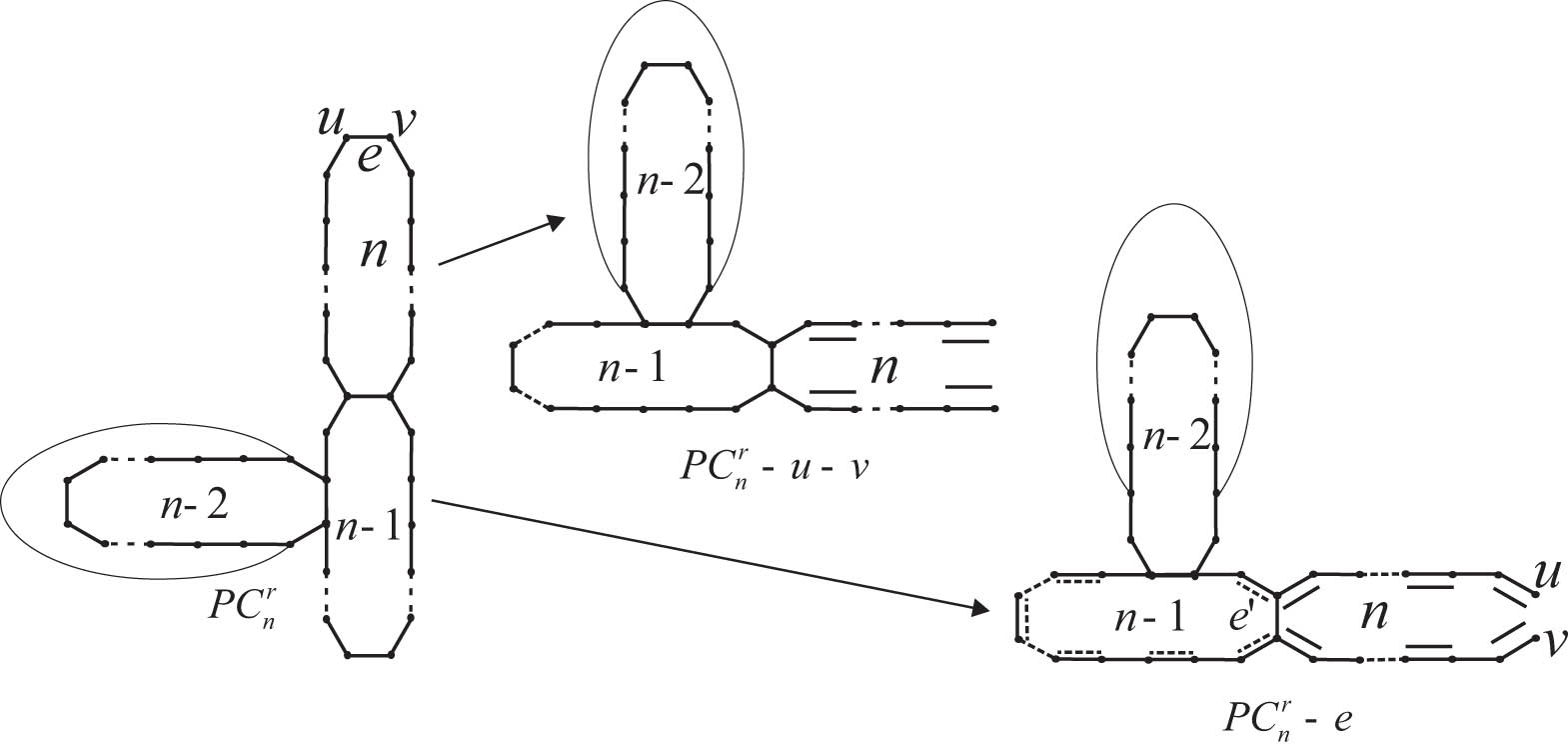
Illustrations of type-2 when
3 Expected value of the number of perfect matchings
Note that the probabilities
Lemma 3.1
Let
If k is even, then
If k is odd, then
Proof
Recall that the
If
The last equality follows from
Note that
when
when
Theorem 3.2
Let
If k is even and
(2)where
If k is even and
Proof
Let
If
Note that the characteristic equation of Formula (3) is
Therefore, the characteristic roots of Formula (4) are
and
Case 1. If
Substituting the initial conditions
The solution of the equations above is
Therefore,
which proves the first statement of the theorem.
Case 2. If
Substituting the initial conditions
which means that
For the case when
By Theorem 3.2, we can obtain the expected value of the number of perfect matchings in random 6-polygonal chain (i.e., hexagonal chain). The random 6-polygonal chain
Corollary 3.3
[24,25] Let
where
If
Corollary 3.4
Let
where
Proof
Keeping the notation defined in Theorem 3.2, we obtain that
Since
Let
Actually, this is the population mean of the number of perfect matchings of all elements in
Theorem 3.5
The average value of the number for the perfect matchings with respect to
Proof
By Theorem 3.2, we obtain
Acknowledgements
We are grateful to the reviewers for providing us the valuable suggestions. This work was partially completed while the first author visited School of Mathematics and Statistics, Lanzhou University.
-
Funding information: This work was supported by Natural Science Foundation of China (Nos. 12061007, 12071194, 11961067, and 11571155) and Natural Science Found of Fujian Province (No. 2020J01844).
-
Author contributions: S. L. Wei and Y. D. Feng contributed to the supervision, methodology, validation, project administration, and formal analysis. X. L. Ke and J. W. Huang contributed to the investigation, resources, and some computations and wrote the initial draft of this article, which was investigated and approved by Y. D. Feng and S. L. Wei who wrote the final draft. All authors have read and agreed to the published version of the manuscript.
-
Conflict of interest: The authors declare that they have no potential conflicts of interest.
-
Data availability statement: No data were used to support this study.
References
[1] J. A. Bondy and U. S. R. Murty, Graph Theory with Applications, Macmillan, London, 1976. 10.1007/978-1-349-03521-2Search in Google Scholar
[2] S. J. Cyvin and I. Gutman, Kekulé Structures in Benzenoid Hydrocarbons, Springer, Berlin, 1988. 10.1007/978-3-662-00892-8Search in Google Scholar
[3] R. Swinborne-Sheldrake, W. C. Herndon, and I. Gutman, Kekulé structures and resonance energies of benzenoid hydrocarbons, Tetrahedron Lett. 16 (1975), no. 10, 755–759, DOI: https://doi.org/10.1016/S0040-4039(00)71975-7. 10.1016/S0040-4039(00)71975-7Search in Google Scholar
[4] G. G. Hall, A graphic model of a class of molecules, Int. J. Math. Educ. Sci. Technol. 4 (1973), 233–240, DOI: https://doi.org/10.1080/0020739730040302. 10.1080/0020739730040302Search in Google Scholar
[5] L. Pauling, The Nature of Chemical Bond, Cornell University Press, New York, 1939. Search in Google Scholar
[6] E. Clar, The Aromatic Sextet, Wiley, London, 1972. Search in Google Scholar
[7] P. John, H. Sachs, and H. Zerntic, Counting perfect matchings in polyominoes with applications to the dimer problem, Appl. Math. (Warsaw) 19 (1987), 465–477. 10.4064/am-19-3-4-465-477Search in Google Scholar
[8] P. W. Kasteleyn, The statistics of dimer on a lattice I, The number of dimer arrangement on a quadratic lattice, Physica 27 (1961), 1209–1225, DOI: https://doi.org/10.1016/0031-8914(61)90063-5. 10.1016/0031-8914(61)90063-5Search in Google Scholar
[9] M. D. Plummer, Matching Theory-a sampler: from Dénes Konig to the present, Discrete Math. 100 (1992), no. 1–3, 177–219, DOI: https://doi.org/10.1016/0012-365X(92)90640-2. 10.1016/0012-365X(92)90640-2Search in Google Scholar
[10] L. Lovász and M. D. Plummer, Matching Theory, North Holland, New York, 1986. Search in Google Scholar
[11] L. G. Valiant, The complexity of computing the permanent, Theoret. Comput. Sci. 8 (1979), no. 2, 410–421, DOI: https://doi.org/10.1016/0304-3975(79)90044-6. 10.1016/0304-3975(79)90044-6Search in Google Scholar
[12] S. Wei, X. Ke, and F. Lin, Perfect matchings in random polyomino chain graphs, J. Math. Chem. 54 (2016), no. 3, 690–697, DOI: https://doi.org/10.1007/s10910-015-0580-9. 10.1007/s10910-015-0580-9Search in Google Scholar
[13] L. Zhang, S. Wei, and F. Lu, The number of Kekulé structures of polyominos on the torus, J. Math. Chem. 51 (2013), 354–368, DOI: https://doi.org/10.1007/s10910-012-0087-6. 10.1007/s10910-012-0087-6Search in Google Scholar
[14] M. Su and J. Qian, On the number of perfect matchings in polygonal chains, J. Math. Study 3 (2000), no. 1, 9–16. Search in Google Scholar
[15] I. Gutman and S. J. Cyvin, Introduction to the Theory of Benzenoid Hydrocarbons, Springer, Berlin, Heidelberg, New York, 1989. 10.1007/978-3-642-87143-6Search in Google Scholar
[16] A. T. Balaban and I. Tomescu, Alternating 6-cycles in perfect matchings of graphs representing condensed benzenoid hydrocarbons, Discrete Math. 19 (1988), no. 1–3, 5–16, DOI: https://doi.org/10.1016/0166-218X(88)90003-0. 10.1016/0166-218X(88)90003-0Search in Google Scholar
[17] I. Gutman, Extremal hexanonal chains, J. Math. Chem. 12 (1993), 197–210, DOI: https://doi.org/10.1007/BF01164635. 10.1007/BF01164635Search in Google Scholar
[18] A. Chen, X. Xiong, and F. Lin, Distance-based topological indices of the tree-like polyphenyl systems, Appl. Math. Comput. 281 (2016), 233–242, DOI: http://dx.doi.org/10.1016/j.amc.2016.01.057. 10.1016/j.amc.2016.01.057Search in Google Scholar
[19] X. Guo and F. Zhang, k-cycle resonant graphs, Discrete Math. 135 (1994), no. 1–3, 113–120, DOI: https://doi.org/10.1016/0012-365X(93)E0086-J. 10.1016/0012-365X(93)E0086-JSearch in Google Scholar
[20] A. T. Balaban, Chemical Applications of Graph Theory, Academic Press, London, 1976. Search in Google Scholar
[21] C. Xiao, H. Chen, and L. Liu, Perfect matchings in random pentagonal chains, J. Math. Chem. 55 (2017), 1878–1886, DOI: https://doi.org/10.1007/s10910-017-0767-3. 10.1007/s10910-017-0767-3Search in Google Scholar
[22] C. Xiao and H. Chen, Kekulé structures of square Chexagonal chains and the Hosoya index of caterpillar tree, Discrete Math. 339 (2016), 506–510, DOI: http://dx.doi.org/10.1016/j.disc.2015.09.018. 10.1016/j.disc.2015.09.018Search in Google Scholar
[23] C. Xiao, H. Chen, and A. M. Raigorodskii, A connection between the Kekulé structures of pentagonal chains and the Hosoya index of caterpillar trees, Discrete Appl. Math. 232 (2017), 230–234, DOI: http://dx.doi.org/10.1016/j.dam.2017.07.024. 10.1016/j.dam.2017.07.024Search in Google Scholar
[24] I. Gutman, The number of perfect matchings in a random hexagonal chain, Graph Theory Notes New York 16 (1989), 26–28. Search in Google Scholar
[25] I. Gutman, J. W. Kennedy, and L. V. Quintas, Perfect matchings in random hexagonal chain graphs, J. Math. Chem. 6 (1991), 377–383, DOI: http://doi.org/10.1007/BF01192592. 10.1007/BF01192592Search in Google Scholar
[26] A. Chen and F. Zhang, Wiener index and perfect matchings in random phenylene chains, MATCH Commun. Math. Comput. Chem. 61 (2009), no. 3, 623–630, DOI: http://dx.doi.org/10.1117/12.676730. 10.1117/12.676730Search in Google Scholar
[27] C. Xiao and H. Chen, Dimer coverings on random polyomino chains, Z. Naturforsch. 70 (2015), 465–470. 10.1515/zna-2015-0121Search in Google Scholar
[28] S. Wei and W. C. Shiu, The number of perfect matchings in random polyazulenoid chains, J. Combin. Math. Combin. Comput. 105 (2018), 21–33. Search in Google Scholar
[29] S. Wei, N. Chen, X. Ke, G. Hao, and J. Huang, Perfect matchings in random octagonal chain graphs, J. Math. 2021 (2021), 2324632, DOI: https://doi.org/10.1155/2021/2324632. 10.1155/2021/2324632Search in Google Scholar
© 2023 the author(s), published by De Gruyter
This work is licensed under the Creative Commons Attribution 4.0 International License.
Articles in the same Issue
- Special Issue on Future Directions of Further Developments in Mathematics
- What will the mathematics of tomorrow look like?
- On H 2-solutions for a Camassa-Holm type equation
- Classical solutions to Cauchy problems for parabolic–elliptic systems of Keller-Segel type
- Control of multi-agent systems: Results, open problems, and applications
- Logical perspectives on the foundations of probability
- Subharmonic solutions for a class of predator-prey models with degenerate weights in periodic environments
- A non-smooth Brezis-Oswald uniqueness result
- Luenberger compensator theory for heat-Kelvin-Voigt-damped-structure interaction models with interface/boundary feedback controls
- Special Issue on Fractional Problems with Variable-Order or Variable Exponents (Part II)
- Positive solution for a nonlocal problem with strong singular nonlinearity
- Analysis of solutions for the fractional differential equation with Hadamard-type
- Hilfer proportional nonlocal fractional integro-multipoint boundary value problems
- A comprehensive review on fractional-order optimal control problem and its solution
- The θ-derivative as unifying framework of a class of derivatives
- Review Articles
- On the use of L-functionals in regression models
- Minimal-time problems for linear control systems on homogeneous spaces of low-dimensional solvable nonnilpotent Lie groups
- Regular Articles
- Existence and multiplicity of solutions for a new p(x)-Kirchhoff problem with variable exponents
- An extension of the Hermite-Hadamard inequality for a power of a convex function
- Existence and multiplicity of solutions for a fourth-order differential system with instantaneous and non-instantaneous impulses
- Relay fusion frames in Banach spaces
- Refined ratio monotonicity of the coordinator polynomials of the root lattice of type Bn
- On the uniqueness of limit cycles for generalized Liénard systems
- A derivative-Hilbert operator acting on Dirichlet spaces
- Scheduling equal-length jobs with arbitrary sizes on uniform parallel batch machines
- Solutions to a modified gauged Schrödinger equation with Choquard type nonlinearity
- A symbolic approach to multiple Hurwitz zeta values at non-positive integers
- Some results on the value distribution of differential polynomials
- Lucas non-Wieferich primes in arithmetic progressions and the abc conjecture
- Scattering properties of Sturm-Liouville equations with sign-alternating weight and transmission condition at turning point
- Some results for a p(x)-Kirchhoff type variation-inequality problems in non-divergence form
- Homotopy cartesian squares in extriangulated categories
- A unified perspective on some autocorrelation measures in different fields: A note
- Total Roman domination on the digraphs
- Well-posedness for bilevel vector equilibrium problems with variable domination structures
- Binet's second formula, Hermite's generalization, and two related identities
- Non-solid cone b-metric spaces over Banach algebras and fixed point results of contractions with vector-valued coefficients
- Multidimensional sampling-Kantorovich operators in BV-spaces
- A self-adaptive inertial extragradient method for a class of split pseudomonotone variational inequality problems
- Convergence properties for coordinatewise asymptotically negatively associated random vectors in Hilbert space
- Relating the super domination and 2-domination numbers in cactus graphs
- Compatibility of the method of brackets with classical integration rules
- On the inverse Collatz-Sinogowitz irregularity problem
- Positive solutions for boundary value problems of a class of second-order differential equation system
- Global analysis and control for a vector-borne epidemic model with multi-edge infection on complex networks
- Nonexistence of global solutions to Klein-Gordon equations with variable coefficients power-type nonlinearities
- On 2r-ideals in commutative rings with zero-divisors
- A comparison of some confidence intervals for a binomial proportion based on a shrinkage estimator
- The construction of nuclei for normal constituents of Bπ-characters
- Weak solution of non-Newtonian polytropic variational inequality in fresh agricultural product supply chain problem
- Mean square exponential stability of stochastic function differential equations in the G-framework
- Commutators of Hardy-Littlewood operators on p-adic function spaces with variable exponents
- Solitons for the coupled matrix nonlinear Schrödinger-type equations and the related Schrödinger flow
- The dual index and dual core generalized inverse
- Study on Birkhoff orthogonality and symmetry of matrix operators
- Uniqueness theorems of the Hahn difference operator of entire function with a Picard exceptional value
- Estimates for certain class of rough generalized Marcinkiewicz functions along submanifolds
- On semigroups of transformations that preserve a double direction equivalence
- Positive solutions for discrete Minkowski curvature systems of the Lane-Emden type
- A multigrid discretization scheme based on the shifted inverse iteration for the Steklov eigenvalue problem in inverse scattering
- Existence and nonexistence of solutions for elliptic problems with multiple critical exponents
- Interpolation inequalities in generalized Orlicz-Sobolev spaces and applications
- General Randić indices of a graph and its line graph
- On functional reproducing kernels
- On the Waring-Goldbach problem for two squares and four cubes
- Singular moduli of rth Roots of modular functions
- Classification of self-adjoint domains of odd-order differential operators with matrix theory
- On the convergence, stability and data dependence results of the JK iteration process in Banach spaces
- Hardy spaces associated with some anisotropic mixed-norm Herz spaces and their applications
- Remarks on hyponormal Toeplitz operators with nonharmonic symbols
- Complete decomposition of the generalized quaternion groups
- Injective and coherent endomorphism rings relative to some matrices
- Finite spectrum of fourth-order boundary value problems with boundary and transmission conditions dependent on the spectral parameter
- Continued fractions related to a group of linear fractional transformations
- Multiplicity of solutions for a class of critical Schrödinger-Poisson systems on the Heisenberg group
- Approximate controllability for a stochastic elastic system with structural damping and infinite delay
- On extremal cacti with respect to the first degree-based entropy
- Compression with wildcards: All exact or all minimal hitting sets
- Existence and multiplicity of solutions for a class of p-Kirchhoff-type equation RN
- Geometric classifications of k-almost Ricci solitons admitting paracontact metrices
- Positive periodic solutions for discrete time-delay hematopoiesis model with impulses
- On Hermite-Hadamard-type inequalities for systems of partial differential inequalities in the plane
- Existence of solutions for semilinear retarded equations with non-instantaneous impulses, non-local conditions, and infinite delay
- On the quadratic residues and their distribution properties
- On average theta functions of certain quadratic forms as sums of Eisenstein series
- Connected component of positive solutions for one-dimensional p-Laplacian problem with a singular weight
- Some identities of degenerate harmonic and degenerate hyperharmonic numbers arising from umbral calculus
- Mean ergodic theorems for a sequence of nonexpansive mappings in complete CAT(0) spaces and its applications
- On some spaces via topological ideals
- Linear maps preserving equivalence or asymptotic equivalence on Banach space
- Well-posedness and stability analysis for Timoshenko beam system with Coleman-Gurtin's and Gurtin-Pipkin's thermal laws
- On a class of stochastic differential equations driven by the generalized stochastic mixed variational inequalities
- Entire solutions of two certain Fermat-type ordinary differential equations
- Generalized Lie n-derivations on arbitrary triangular algebras
- Markov decision processes approximation with coupled dynamics via Markov deterministic control systems
- Notes on pseudodifferential operators commutators and Lipschitz functions
- On Graham partitions twisted by the Legendre symbol
- Strong limit of processes constructed from a renewal process
- Construction of analytical solutions to systems of two stochastic differential equations
- Two-distance vertex-distinguishing index of sparse graphs
- Regularity and abundance on semigroups of partial transformations with invariant set
- Liouville theorems for Kirchhoff-type parabolic equations and system on the Heisenberg group
- Spin(8,C)-Higgs pairs over a compact Riemann surface
- Properties of locally semi-compact Ir-topological groups
- Transcendental entire solutions of several complex product-type nonlinear partial differential equations in ℂ2
- Ordering stability of Nash equilibria for a class of differential games
- A new reverse half-discrete Hilbert-type inequality with one partial sum involving one derivative function of higher order
- About a dubious proof of a correct result about closed Newton Cotes error formulas
- Ricci ϕ-invariance on almost cosymplectic three-manifolds
- Schur-power convexity of integral mean for convex functions on the coordinates
- A characterization of a ∼ admissible congruence on a weakly type B semigroup
- On Bohr's inequality for special subclasses of stable starlike harmonic mappings
- Properties of meromorphic solutions of first-order differential-difference equations
- A double-phase eigenvalue problem with large exponents
- On the number of perfect matchings in random polygonal chains
- Evolutoids and pedaloids of frontals on timelike surfaces
- A series expansion of a logarithmic expression and a decreasing property of the ratio of two logarithmic expressions containing cosine
- The 𝔪-WG° inverse in the Minkowski space
- Stability result for Lord Shulman swelling porous thermo-elastic soils with distributed delay term
- Approximate solvability method for nonlocal impulsive evolution equation
- Construction of a functional by a given second-order Ito stochastic equation
- Global well-posedness of initial-boundary value problem of fifth-order KdV equation posed on finite interval
- On pomonoid of partial transformations of a poset
- New fractional integral inequalities via Euler's beta function
- An efficient Legendre-Galerkin approximation for the fourth-order equation with singular potential and SSP boundary condition
- Eigenfunctions in Finsler Gaussian solitons
- On a blow-up criterion for solution of 3D fractional Navier-Stokes-Coriolis equations in Lei-Lin-Gevrey spaces
- Some estimates for commutators of sharp maximal function on the p-adic Lebesgue spaces
- A preconditioned iterative method for coupled fractional partial differential equation in European option pricing
- A digital Jordan surface theorem with respect to a graph connectedness
- A quasi-boundary value regularization method for the spherically symmetric backward heat conduction problem
- The structure fault tolerance of burnt pancake networks
- Average value of the divisor class numbers of real cubic function fields
- Uniqueness of exponential polynomials
- An application of Hayashi's inequality in numerical integration
Articles in the same Issue
- Special Issue on Future Directions of Further Developments in Mathematics
- What will the mathematics of tomorrow look like?
- On H 2-solutions for a Camassa-Holm type equation
- Classical solutions to Cauchy problems for parabolic–elliptic systems of Keller-Segel type
- Control of multi-agent systems: Results, open problems, and applications
- Logical perspectives on the foundations of probability
- Subharmonic solutions for a class of predator-prey models with degenerate weights in periodic environments
- A non-smooth Brezis-Oswald uniqueness result
- Luenberger compensator theory for heat-Kelvin-Voigt-damped-structure interaction models with interface/boundary feedback controls
- Special Issue on Fractional Problems with Variable-Order or Variable Exponents (Part II)
- Positive solution for a nonlocal problem with strong singular nonlinearity
- Analysis of solutions for the fractional differential equation with Hadamard-type
- Hilfer proportional nonlocal fractional integro-multipoint boundary value problems
- A comprehensive review on fractional-order optimal control problem and its solution
- The θ-derivative as unifying framework of a class of derivatives
- Review Articles
- On the use of L-functionals in regression models
- Minimal-time problems for linear control systems on homogeneous spaces of low-dimensional solvable nonnilpotent Lie groups
- Regular Articles
- Existence and multiplicity of solutions for a new p(x)-Kirchhoff problem with variable exponents
- An extension of the Hermite-Hadamard inequality for a power of a convex function
- Existence and multiplicity of solutions for a fourth-order differential system with instantaneous and non-instantaneous impulses
- Relay fusion frames in Banach spaces
- Refined ratio monotonicity of the coordinator polynomials of the root lattice of type Bn
- On the uniqueness of limit cycles for generalized Liénard systems
- A derivative-Hilbert operator acting on Dirichlet spaces
- Scheduling equal-length jobs with arbitrary sizes on uniform parallel batch machines
- Solutions to a modified gauged Schrödinger equation with Choquard type nonlinearity
- A symbolic approach to multiple Hurwitz zeta values at non-positive integers
- Some results on the value distribution of differential polynomials
- Lucas non-Wieferich primes in arithmetic progressions and the abc conjecture
- Scattering properties of Sturm-Liouville equations with sign-alternating weight and transmission condition at turning point
- Some results for a p(x)-Kirchhoff type variation-inequality problems in non-divergence form
- Homotopy cartesian squares in extriangulated categories
- A unified perspective on some autocorrelation measures in different fields: A note
- Total Roman domination on the digraphs
- Well-posedness for bilevel vector equilibrium problems with variable domination structures
- Binet's second formula, Hermite's generalization, and two related identities
- Non-solid cone b-metric spaces over Banach algebras and fixed point results of contractions with vector-valued coefficients
- Multidimensional sampling-Kantorovich operators in BV-spaces
- A self-adaptive inertial extragradient method for a class of split pseudomonotone variational inequality problems
- Convergence properties for coordinatewise asymptotically negatively associated random vectors in Hilbert space
- Relating the super domination and 2-domination numbers in cactus graphs
- Compatibility of the method of brackets with classical integration rules
- On the inverse Collatz-Sinogowitz irregularity problem
- Positive solutions for boundary value problems of a class of second-order differential equation system
- Global analysis and control for a vector-borne epidemic model with multi-edge infection on complex networks
- Nonexistence of global solutions to Klein-Gordon equations with variable coefficients power-type nonlinearities
- On 2r-ideals in commutative rings with zero-divisors
- A comparison of some confidence intervals for a binomial proportion based on a shrinkage estimator
- The construction of nuclei for normal constituents of Bπ-characters
- Weak solution of non-Newtonian polytropic variational inequality in fresh agricultural product supply chain problem
- Mean square exponential stability of stochastic function differential equations in the G-framework
- Commutators of Hardy-Littlewood operators on p-adic function spaces with variable exponents
- Solitons for the coupled matrix nonlinear Schrödinger-type equations and the related Schrödinger flow
- The dual index and dual core generalized inverse
- Study on Birkhoff orthogonality and symmetry of matrix operators
- Uniqueness theorems of the Hahn difference operator of entire function with a Picard exceptional value
- Estimates for certain class of rough generalized Marcinkiewicz functions along submanifolds
- On semigroups of transformations that preserve a double direction equivalence
- Positive solutions for discrete Minkowski curvature systems of the Lane-Emden type
- A multigrid discretization scheme based on the shifted inverse iteration for the Steklov eigenvalue problem in inverse scattering
- Existence and nonexistence of solutions for elliptic problems with multiple critical exponents
- Interpolation inequalities in generalized Orlicz-Sobolev spaces and applications
- General Randić indices of a graph and its line graph
- On functional reproducing kernels
- On the Waring-Goldbach problem for two squares and four cubes
- Singular moduli of rth Roots of modular functions
- Classification of self-adjoint domains of odd-order differential operators with matrix theory
- On the convergence, stability and data dependence results of the JK iteration process in Banach spaces
- Hardy spaces associated with some anisotropic mixed-norm Herz spaces and their applications
- Remarks on hyponormal Toeplitz operators with nonharmonic symbols
- Complete decomposition of the generalized quaternion groups
- Injective and coherent endomorphism rings relative to some matrices
- Finite spectrum of fourth-order boundary value problems with boundary and transmission conditions dependent on the spectral parameter
- Continued fractions related to a group of linear fractional transformations
- Multiplicity of solutions for a class of critical Schrödinger-Poisson systems on the Heisenberg group
- Approximate controllability for a stochastic elastic system with structural damping and infinite delay
- On extremal cacti with respect to the first degree-based entropy
- Compression with wildcards: All exact or all minimal hitting sets
- Existence and multiplicity of solutions for a class of p-Kirchhoff-type equation RN
- Geometric classifications of k-almost Ricci solitons admitting paracontact metrices
- Positive periodic solutions for discrete time-delay hematopoiesis model with impulses
- On Hermite-Hadamard-type inequalities for systems of partial differential inequalities in the plane
- Existence of solutions for semilinear retarded equations with non-instantaneous impulses, non-local conditions, and infinite delay
- On the quadratic residues and their distribution properties
- On average theta functions of certain quadratic forms as sums of Eisenstein series
- Connected component of positive solutions for one-dimensional p-Laplacian problem with a singular weight
- Some identities of degenerate harmonic and degenerate hyperharmonic numbers arising from umbral calculus
- Mean ergodic theorems for a sequence of nonexpansive mappings in complete CAT(0) spaces and its applications
- On some spaces via topological ideals
- Linear maps preserving equivalence or asymptotic equivalence on Banach space
- Well-posedness and stability analysis for Timoshenko beam system with Coleman-Gurtin's and Gurtin-Pipkin's thermal laws
- On a class of stochastic differential equations driven by the generalized stochastic mixed variational inequalities
- Entire solutions of two certain Fermat-type ordinary differential equations
- Generalized Lie n-derivations on arbitrary triangular algebras
- Markov decision processes approximation with coupled dynamics via Markov deterministic control systems
- Notes on pseudodifferential operators commutators and Lipschitz functions
- On Graham partitions twisted by the Legendre symbol
- Strong limit of processes constructed from a renewal process
- Construction of analytical solutions to systems of two stochastic differential equations
- Two-distance vertex-distinguishing index of sparse graphs
- Regularity and abundance on semigroups of partial transformations with invariant set
- Liouville theorems for Kirchhoff-type parabolic equations and system on the Heisenberg group
- Spin(8,C)-Higgs pairs over a compact Riemann surface
- Properties of locally semi-compact Ir-topological groups
- Transcendental entire solutions of several complex product-type nonlinear partial differential equations in ℂ2
- Ordering stability of Nash equilibria for a class of differential games
- A new reverse half-discrete Hilbert-type inequality with one partial sum involving one derivative function of higher order
- About a dubious proof of a correct result about closed Newton Cotes error formulas
- Ricci ϕ-invariance on almost cosymplectic three-manifolds
- Schur-power convexity of integral mean for convex functions on the coordinates
- A characterization of a ∼ admissible congruence on a weakly type B semigroup
- On Bohr's inequality for special subclasses of stable starlike harmonic mappings
- Properties of meromorphic solutions of first-order differential-difference equations
- A double-phase eigenvalue problem with large exponents
- On the number of perfect matchings in random polygonal chains
- Evolutoids and pedaloids of frontals on timelike surfaces
- A series expansion of a logarithmic expression and a decreasing property of the ratio of two logarithmic expressions containing cosine
- The 𝔪-WG° inverse in the Minkowski space
- Stability result for Lord Shulman swelling porous thermo-elastic soils with distributed delay term
- Approximate solvability method for nonlocal impulsive evolution equation
- Construction of a functional by a given second-order Ito stochastic equation
- Global well-posedness of initial-boundary value problem of fifth-order KdV equation posed on finite interval
- On pomonoid of partial transformations of a poset
- New fractional integral inequalities via Euler's beta function
- An efficient Legendre-Galerkin approximation for the fourth-order equation with singular potential and SSP boundary condition
- Eigenfunctions in Finsler Gaussian solitons
- On a blow-up criterion for solution of 3D fractional Navier-Stokes-Coriolis equations in Lei-Lin-Gevrey spaces
- Some estimates for commutators of sharp maximal function on the p-adic Lebesgue spaces
- A preconditioned iterative method for coupled fractional partial differential equation in European option pricing
- A digital Jordan surface theorem with respect to a graph connectedness
- A quasi-boundary value regularization method for the spherically symmetric backward heat conduction problem
- The structure fault tolerance of burnt pancake networks
- Average value of the divisor class numbers of real cubic function fields
- Uniqueness of exponential polynomials
- An application of Hayashi's inequality in numerical integration
