An asymptotic property of branching-type overloaded polling networks
-
 and
and

Abstract
Remerova et al. [Random fluid limit of an overloaded polling model, Adv. Appl. Probab., 2014, 46, 76–101] studied the fluid asymptotics of the joint queue length process for an overloaded cyclic polling system with multigated service discipline by exploiting the connection with multi-type branching processes. In contrast to the heavy traffic behaviors, the cycle time of the overloaded polling system increases by a deterministic times over times under passage to the fluid dynamics and the fluid limit preserves some randomness. The present paper aims to extend the overloaded asymptotics in Remerova et al. [Random fluid limit of an overloaded polling model, Adv. Appl. Probab., 2014, 46, 76–101] to the corresponding polling system with general branching-type service disciplines and customer re-routing policy. A unifying overloaded asymptotic property is derived. Due to the exhaustiveness, the property is a natural extension of the classical polling model with multigated service discipline in Remerova et al. [Random fluid limit of an overloaded polling model, Adv. Appl. Probab., 2014, 46, 76–101] and provides new exact results that have not been observed before for rerouting policy. Additionally, a stochastic simulation is undertaken for the validation of the fluid limit and the optimization of the gating indexes to minimize the total population is considered as an example to demonstrate the usefulness of the random fluid limit.
1 Introduction
In this paper, we consider a cyclic N-queue (Q1, ⋯, QN, N ≥ 2) polling system with general branching-type service discipline within each queue and customer re-routing policies: after completing service at Qi, a customer is either routed to Qj with probability pi,j or leaves the system with probability pi,0. The possibility for re-routing of customers further enhances the already-extensive modeling capabilities of polling models, since in many applications, customers require service at more than one facility of the system. Actually, the models of customer re-routing arise naturally in various models of computer, communication and robotic systems (see [1, 2, 3, 4] and references therein). One obvious example is a local area network in which terminals are interconnected in either a physical or logical structure (see [5]).
In the vast majority of papers that have appeared on polling models, it is almost invariably assumed that the system is stable and the stable performance measures are then concerned. With the advent of the era of Internet+, the study of critically or strictly super-critically loaded polling systems is vigorously pioneered due to the overloaded Internet channel or online shopping orders.
The heavy traffic (ρ → 1, ρ is the load of the system) behaviors have gained an ascending attention in the last two decades pioneered by Coffman et al. [6, 7]. By utilizing the connection with multi-type branching process, van der Mei[8] considered a unifying theory on branching-type polling models under heavy-traffic assumptions. In the similar way, Boon et al.[1] discussed the heavy-traffic asymptotic behaviors of a gated polling system with customer re-route policy. Furthermore, Liu et al.[9] extended the results in[1] to the analogous system with a general branching-type service policy in the same form. As an example for non-branching type polling systems, Liu et al.[10] investigated the heavy-traffic behavior of a priority polling system consisting of three M/M/1 queues with threshold policy and proved that the scaled queue-length of the critically loaded queue is exponentially distributed, independent of that of the stable queues.
The study of overloaded (ρ > 1) service system is important to control or predict how fast it blows up over time. However, hardly any attention has been given to the overloaded polling system. The few literature refers to [11, 12, 13, 14]. By using measure-valued state descriptor, Puha et al.[11] proved that the overloaded GI/GI/1 processor sharing queues converge in distribution to supercritical fluid models and a fluid limit result is proved as first order approximations to overloaded processor sharing queues. Using both fluid and diffusion limits, Jennings et al.[13] showed that the virtual waiting time process of an overloaded Multi-class FIFO(first-in-first-out) queue with abandonments converges to a limiting deterministic fluid process. Instead Remerova et al.[14] showed the fluid asymptotic process for the joint queue length process on an overloaded branching-type cyclic polling system by using the asymptotic properties of multi-type branching processes.
The motivation of the present paper is twofold. First, we dedicate to the investigation of a unified overloaded asymptotic fluid process for a very general class of branching-type polling models. Resing[15] observed that for a large class of polling models, including for example cyclic polling models with exhaustive and gated service, the evolution of the system at successive polling instants at a fixed queue can be described as a multi-type branching process with immigration. Models that satisfy this MTBP-structure allow for an exact analysis, whereas models that violate the MTBP-structure are often more intricate. Moreover, van der Mei[8] has given a unifying and insightful theory on branching-type polling models under heavy-traffic assumptions, which shows particularly attractive features. Second, by considering the polling system with re-routing policy, we aim to study how the strikingly simple overloaded fluid limit depends on the system parameters and in particular, on the routing probabilities pi,j. Actually, the work carried out here is a natural progression from[9] and a natural extension of[14] due to the exhaustiveness. Our resulting expressions are very insightful, simple to implement and suitable for optimization purposes. Numerical results are presented to assess the accuracy of the results.
The rest of the paper is organized as follows. In Section 2, we describe precisely the polling model. In Sections 3, we introduce the multi-type branching process-structure of polling system. Section 4 provides the main results. Section 5 provides the proofs of Theorems 4.1 and 4.2. Section 6 discusses some numerical issues including the stochastic simulation to test the validity of the overloaded asymptotic behaviors and the optimization of gating indexes to minimize the average growth rate of the total population as an example. Section 7 concludes and provides an outlook on potential further research of our paper.
2 Model description
Consider an asymmetric polling network that consists of N ≥ 2 queues, Q1, ⋯, QN, and attended by a single server that visits the queues in a cyclic order. Customers arrive at Qi according to a Poisson process Ei(⋅) with rate λi. The service time of each customer at Qi is a random variable Bi with finite mean value 𝔼Bi = 1/μi. Indices throughout the paper are modulo N, so QN+1 actually refers to Q1. The interarrival times and the service times (for different queues and for different visits) are assumed to be mutually independent.
In addition, we will consider the impact of customer rerouting policy. Upon completion of service at Qi, i = 1, ⋯, N, a customer is either routed to Qj, j = 1, ⋯, N with probability pi,j or leaves the system with probability pi,0, where
We assume that all the switches of customers or servers between queues are instantaneous and when the system becomes empty, the server travels a full cycle and subsequently stops right before Q1 until a new arrival occurs and then cycles along the queues to serve that customer.
Denote the total arrival rate at Qi by γi, which is the unique solution of the following set of linear equation[2]:
For all i, we assume γi/μi < 1 and for overload we assume
In this paper, we will focus on branching-type service disciplines in a general parameter setting which satisfy the following property (see[15]).
Property 1
(Branching property ([15], Property 1)) If the server arrives at Qi to find ki customers there, then during the course of the server’s visit, each of these ki customers will effectively be replaced in an i.i.d. manner by a random population having probability generating function (p.g.f) hi(z1, z2, …, zN), which can be any N-dimensional p.g.f..
According to this property, many classical service disciplines belong to the branching-type service discipline including exhaustive service discipline(per visit the server continues to serve all customers at a queue until it empties), gated service discipline (per visit the server serves only those customers at a queue which are found there upon his visit), binomial-gated[16] and binomial-exhaustive policies[15].
Furthermore, the multigated (Xi-gated) service discipline discussed in[14] is just a special case of Property 1. In Section 4, we can see that Theorem 4.2 in Section 4 is also an extention of[14] (for the special case of multigated (Xi-gated) service discipline and without customer rerouting policy (i.e. pi,j = 0, i, j = 1, ⋯, N)). Moreover, we can know how the re-routing policy effect the queue length process from Figures 1 and 2 in Section 4.
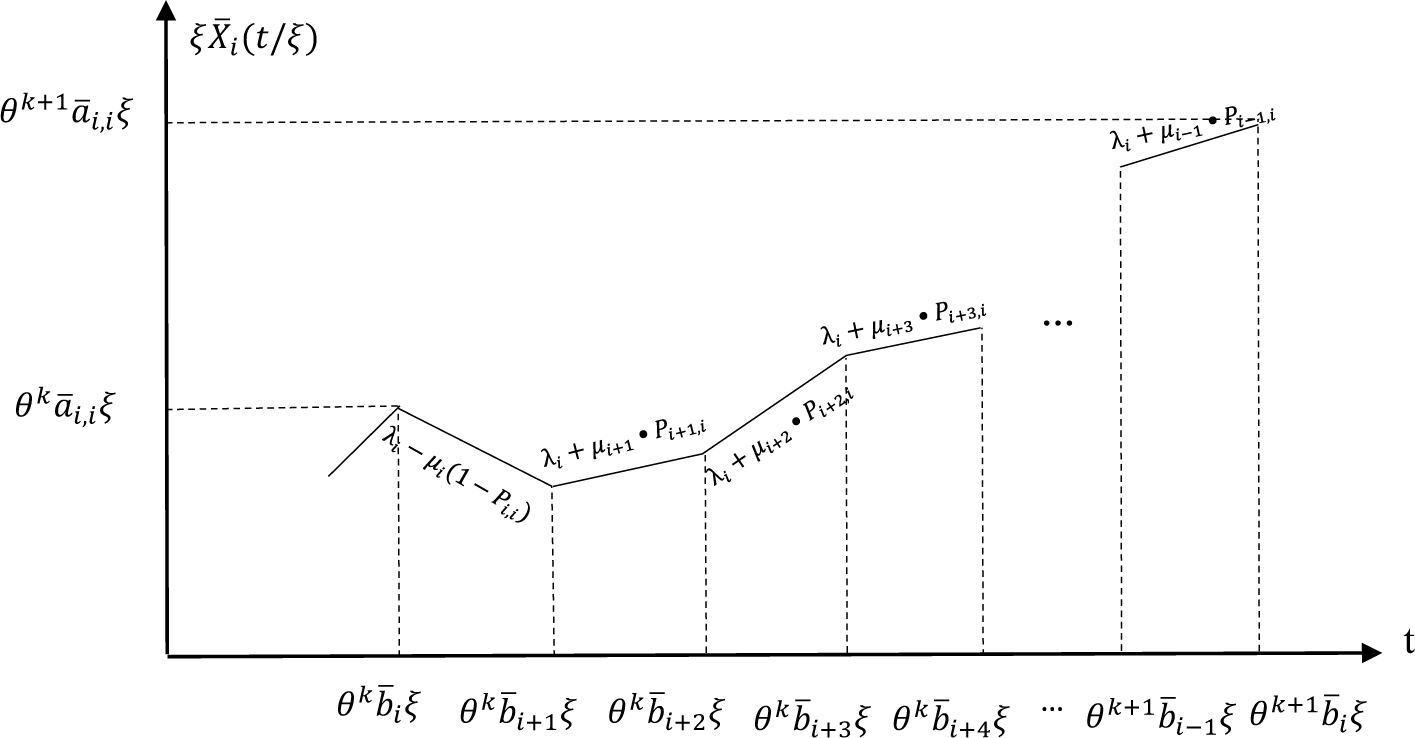
Fluid limit of Qi.
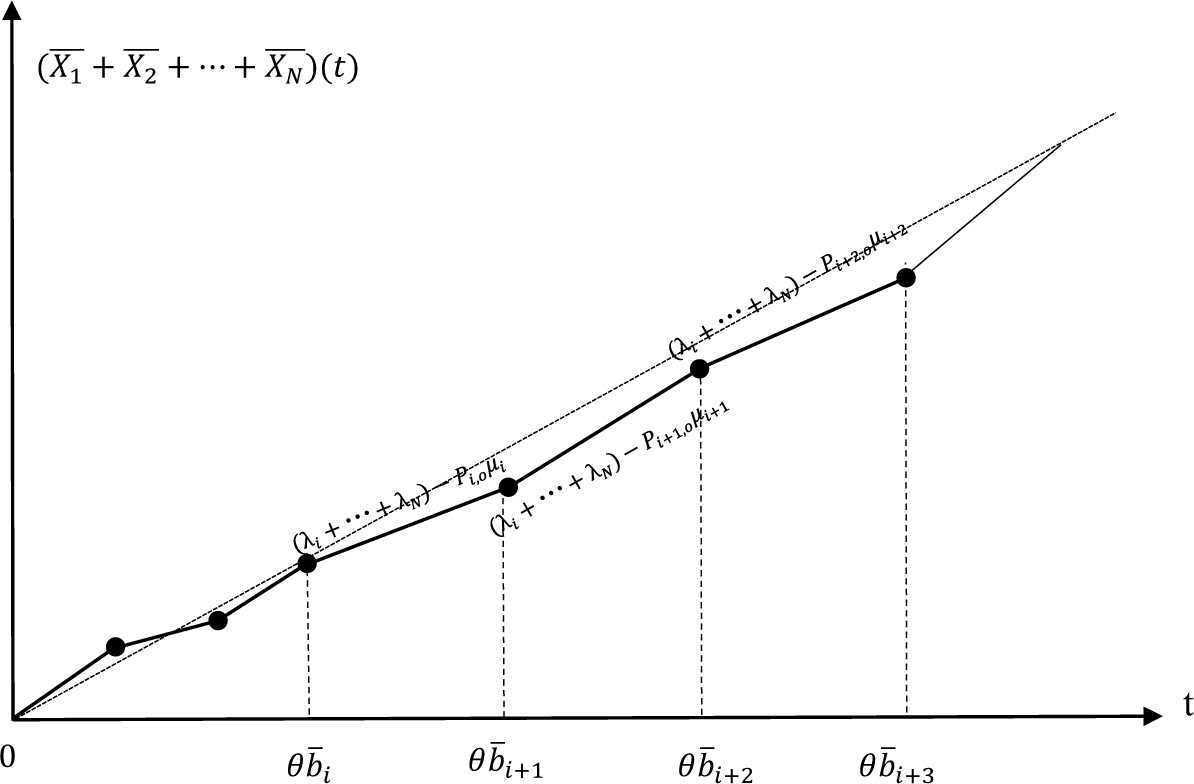
Fluid limit of total population X̄1 + ⋯ + X̄N.
Define t(n) as the time point that the server reaches right before Q1 for the nth time and
Let X(t(n)) = (X1(t(n)), ⋯, XN(t(n))), n ∈ ℕ be the queue length process at time t(n), where Xi(t(n)) is the number of customers at Qi at time t(n). By Resing[15], branching property implies that the queue length sequence {X(t(n))}n∈ℕ forms a multi-type branching process with immigration in state 0.
In this paper, we assume that all vectors are N-dimensional row vectors, all vectors are typeset in bold italic. The vector with all coordinates equal to 0 is denoted by 0 and the vector with coordinate i equals to 1 and the other coordinates equal to 0 by ei.
3 The MTBP-structure of polling system
In the above section, we have known the queue length process {X(t(n))}n∈ℕ forms a multi-type branching process with immigration in state 0. Let M =
To start with, we give some notations associated with the branching-type polling system.
Define Ľi = (Ľi,1, ⋯, Ľi,N) as the visit offspring of a customer at Qi, which equals in distribution to X(
Define Li := (Li,1, ⋯, Li,N) as the session offspring of a customer at Qi, which equals in distribution to X(t(n+1)) given that X(t(n)) = ei (its distribution does not depend on n) with mi = (mi,1, ⋯, mi,N) = 𝔼Li. In order to ensure the non-degenerate, we assume that 𝔼Li,j log Li,j < ∞ for all 1 ≤ i, j ≤ N.
To proceed, we need further to define the exhaustiveness fi of the service descipline at Qi by (see[18], (55), (56))
It has an appealing interpretation: during the course of the server’s visit at Qi, each customer present at the start of the visit to Qi will be replaced by a number of customers with mean 1 – fi at the end of the visit to Qi.
Remark 3.1
In particular, the exhaustiveness of the multigated (Xi-gated) service discipline at Qi in [14] (where Xi = 1 and ∞ of gating index corresponding to conventional gated and exhaustive, respectively) equals
Let
Define Ti as the busy period in Qi. This busy period consists of the service of its first customer at Qi, the services of the customers arriving at Qi during the service of the first customer (i.e., the children), the services of the customers arriving at Qi during the service of the children (i.e., the grandchildren), and so forth. Then, we have
By Lemma 1 in [9], the mean offspring matrix M is given in the following proposition.
Proposition 3.1
For the cyclic branching-type polling system, the mean matrix M is given by
where
where δF denotes the indicator function on F.
Actually, Mk is the mean session offspring during the visit time on Qk. Hence, for all i,
Proof
In the Multi-type branching process, by the definition of M =
where z = (z1, ⋯, zN) and p(i)(j1, ⋯, jN) = the probability that a type i parent produces j1 particles of type 1, j2 of type 2, ⋯, jN of type N.
Let X(t(n)) = (X1(t(n)), ⋯, XN(t(n))), n ∈ ℕ be the queue length process at time t(n), where Xi(t(n)) is the number of customers at Qi at time t(n). By Resing [15], branching property implies that the queue length sequence {X(t(n))}n∈ℕ forms a multi-type branching process with immigration in state 0. Therefore, we have
where
where
It follows that the auxiliary process {X(t(n))}n∈ℕ has the following asymptotics (see [17], Theorem 5.6.1), which will be important for proving the main results in the next section.
Proposition 3.2
If the first arriving customer arrives at Qi after t = 0, then
where the distribution of the random variable ζi has a jump of magnitude qi = ℙ(X(t(n)) = 0 for some n|X(t(0)) = ei) < 1 at 0 and a continuous density function on (0, ∞) and 𝔼ζi = ui.
4 Main results
To give the main results, three more notations are needed.
Let B̄i be the total service time of a customer arriving at Qi from outside, c̄i = 𝔼B̄i, we have c̄i = 1/μi +
For n ∈ ℕ, let
For n ∈ ℕ, define the scaled queue length process X̄(n)(t) :=
Theorem 4.1
There exist constants b̄i ∈ (0, ∞) and āi = (āi,1, ⋯, āi,N) ∈ [0, ∞)N, i = 1, ⋯, N + 1, and a random variable ξ with values in [1, θ) such that, for all k ∈ ℕ and i = 1, 2, ⋯, N,
The b̄i and āi are given by
and for j = 1, ⋯, N,
where
The distribution of ξ see [14].
Proof
See Section 5.□
Remark 4.1
Specially, for a polling model with multigated (Xi-gated) service discipline and without customer rerouting policy (i.e. pi,j = 0, i, j = 1, ⋯, N), the asymptotics in Theorem 4.1 remains true while the b̄i and āi turn to be
and for j = 1, ⋯, N,
where
Theorem 4.2
There exists a deterministic function X̄(⋅) = (X̄1, ⋯, X̄N)(⋅) ∈ [0, ∞)N such that,
uniformly on compact sets. For all i = 1, ⋯, N, the function X̄(⋅) is continuous and piecewise linear as depicted in Figure 1 and specified by
where λ = [λ1, ⋯, λN] and pi = [pi,1, ⋯, pi,i–1, pi,i – 1, pi,i+1, ⋯, pi,N].
Proof
See Section 5.□
Remark 4.2
Theorem 4.2 is also an extention of [14] (for the special case of multigated (Xi-gated) service discipline and without customer rerouting policy (i.e. pi,j = 0, i, j = 1, ⋯, N)).
Corollary 4.1
Under passage to the fluid dynamics, the fluid total population (X̄1 + X̄2 + ⋯ + X̄N)(⋅) grows at the rate
when t ∈ [θk b̄i, θk b̄i+1) for all k ∈ ℕ and i = 1, ⋯, N. (see Figure 2)
Remark 4.3
In [9], the fluid asymptotics of the queue length process in the heavy traffic for the same polling model have been discussed. In the heavy traffic, the total scaled workload is effectively constant while the individual queue workload is emptied and refilled at a rate during the course of a cycle. In contrast to the heavy traffic asymptotics, the total overloaded asymptotic workload is always increasing as shown in Corrollary 4.1 during the course of a cycle. In addition, the overloaded fluid limit always contains a random variable ξ. However, the individual queue workload is emptied and refilled at the same rate as in the heavy traffic like a fluid model. Hence, our result is a further progress of[9].
Remark 4.4
For different branching-type service discipline, our main results have shown that the overloaded fluid asymptotics just depend on the exhaustiveness of each service discipline, which also applies to the heavy traffic asymptotics in [9] and the asymptotics with the large-switchover times in [18]. This can be easily interpreted by the fluid approximation. It also proves that the branching-type polling system deserves much more attention.
Remark 4.5
The rerouting policy only affects the flow rate both in the heavy traffic asymptotics (see [9]) and in the overloaded asymptotics. In Theorem 4.2, we can see that the fluid limit depends on the re-routing probability pi,j. Upon completion of service at Qi, i = 1, ⋯, N, a customer is either routed to Qi with probability pi,i, which leads the decreasing rate of the length of Qi to be λi – μi(1 – pii), or routed to Qj, j ≠ i with probability pi,j, which leads the increasing rate of the length of Qj to be λj + μi pi,j at time [θkb̄i, θkb̄i+1).
According to Theorem 4.2 and Corrollary 4.1, the fluid limit processes both demonstrate an oscillation waveform with increasing amplitude and cycle time over time. To be more specific, the amplitude and cycle time both increase by θ – 1 times each cycle. Hence, the average growth rate of the scaled total population, denoted by β, equals to the average growth rate in each cycle, as shown in Figure 2. Therefore, we have
which yields
By the definition of the scaled queue length process, the fluid limit could approximate the original queue length process in steady state. Furthermore, the average growth rate in (4.3) allows us to study the optimization problem of how to choose the gating indexes of each queue to minimize the total queue length. Since each of the queues adheres to a branching-type service discipline, we study how to choose the exhaustiveness fi with the same objective in mind. We would provide an optimization example by utilizing the genetic algorithm in Section 6.
5 Proof of Theorems 4.1 and 4.2
5.1 Proof of Theorem 4.1
Proof
By the tool of Lemma 8 in [14], if we can prove
where bi = αb̄i, ai = αāi, then Theorem 4.1 is concluded. Hence, we focus on the proof of (5.1).
Limit of
By the total workload process, we have, for n > ν,
where
Since, we know that
Therefore, by (5.2), we have, as n → ∞,
where
Limit of
It remains to prove the iteration of bi, which refers to (4) below.
Limit of Xj(
where
Let Ai be the position of a customer after completion of service at Qi, for i = 1, ⋯, N, i.e.,
Then ℙ(Ai = j) = pi,j, j = 0, 1, ⋯, N. Hence, we have
where
where
The iteration of bi. Recall that
where
By (5.5) and the SLLN, we obtain
Then the iteration of bi can be proved by substituting (5.7) into (5.6).
The equivalence of bN+1 and θb1. By
where I is the identity matrix, ⋅⊤ denotes the operation of transposition and c̄ = (c̄1, …, c̄N). Substituting the above equation into (5.6) yields
where ai = (ai,1, ⋯, ai,N), which gives immediately
□
5.2 Proof of Theorem 4.2
Proof
For each i, by (4.2), we know that the function X̄i(⋅) might have discontinuities only at t = 0 and t = θk b̄i for each k ∈ ℕ. Since the function X̄i(⋅) is càdlàg, the continuity of X̄(⋅) is evident in combination with the definition of ai. Additionally, the uniform convergence on compact sets can be proved in the same way as in the proof of Theorem 2 in [14]. Hence, it suffices to prove the point-wise convergence (4.2) for each i = 1, 2, …, N.
For t = 0, the convergence of (4.2) holds since the system starts empty. For each i = 1, …, N, if t ∈ [θk b̄i, θk b̄i+1), it remains to prove
For all n big enough,
Combining the above equation with Theorem 4.1, we have
where the right hand-side actually equals
6 Numerical validation and optimization of gating indexes
6.1 Numerical validation
This subsection is devoted to test the validity of the fluid limits of the scaled queue length process. For simplicity, we consider a 3-queue polling system described in Table 1 with exponentially distributed service time. For this model, it is readily to obtain ρ1 = 0.4749, ρ2 = 0.5194, ρ3 = 0.8625 and ρ = 1.8568, which belongs to the overloaded traffic case studied in this paper.
Parameter values in 3-queue polling network.
| Parameter | Considered parameter values |
|---|---|
| Arriving rate | λ1 = λ2 = λ3 = 1 |
| Service rate | μ1 = 8, μ2 = 5, μ3 = 2 |
| Transition probability |
We utilize the SimEvents toolbox of Matlab to undertake the simulations of the polling networks. The exhaustive and gated service policies are taken for example and some vital variables are given in Table 2. In order to illustrate the convergence of the scaled queue length process, we take n = 1, 5, 8, 10 in polling network with exhaustive service policies and n = 1, 10, 18, 20 in the gated counterpart. The corresponding scaled queue length process of Q2 and the scaled total queue length process are depicted in Figure 3 and Figure 4, respectively. Apparently, the scaled queue length sample paths get closer and closer as n increases.
Essential variable values in 3-queue polling network.
| Variable | Values | |
|---|---|---|
| Exhaustive | Gate | |
| Gating index | ∞ | 1 |
| Exhaustiveness | 1 | |
| Maximum eigenvalue | θ = 3.7497 | θ = 1.6394 |
| Left eigenvector | v = [0.9731, 0.683, 0] | v = [0.7454, 0.5301, 0.4774] |
Moreover, as shown in Figure 3 and Figure 4, the fluid limit processes both demonstrate an oscillation waveform with increasing amplitude and cycle time forward and oscillate at an infinite rate when approaching zero. According to Theorem 4.2, the amplitude and cycle time increase by θ – 1 times within each cycle, which has been easily illustrated by the sample paths.
![Figure 3
The scaled queue length process of Q2 for different n (left:t ∈ [0, 100], right:t ∈ [0, 8]) with exhaustive service policy.](/document/doi/10.1515/math-2019-0116/asset/graphic/j_math-2019-0116_fig_003.jpg)
The scaled queue length process of Q2 for different n (left:t ∈ [0, 100], right:t ∈ [0, 8]) with exhaustive service policy.
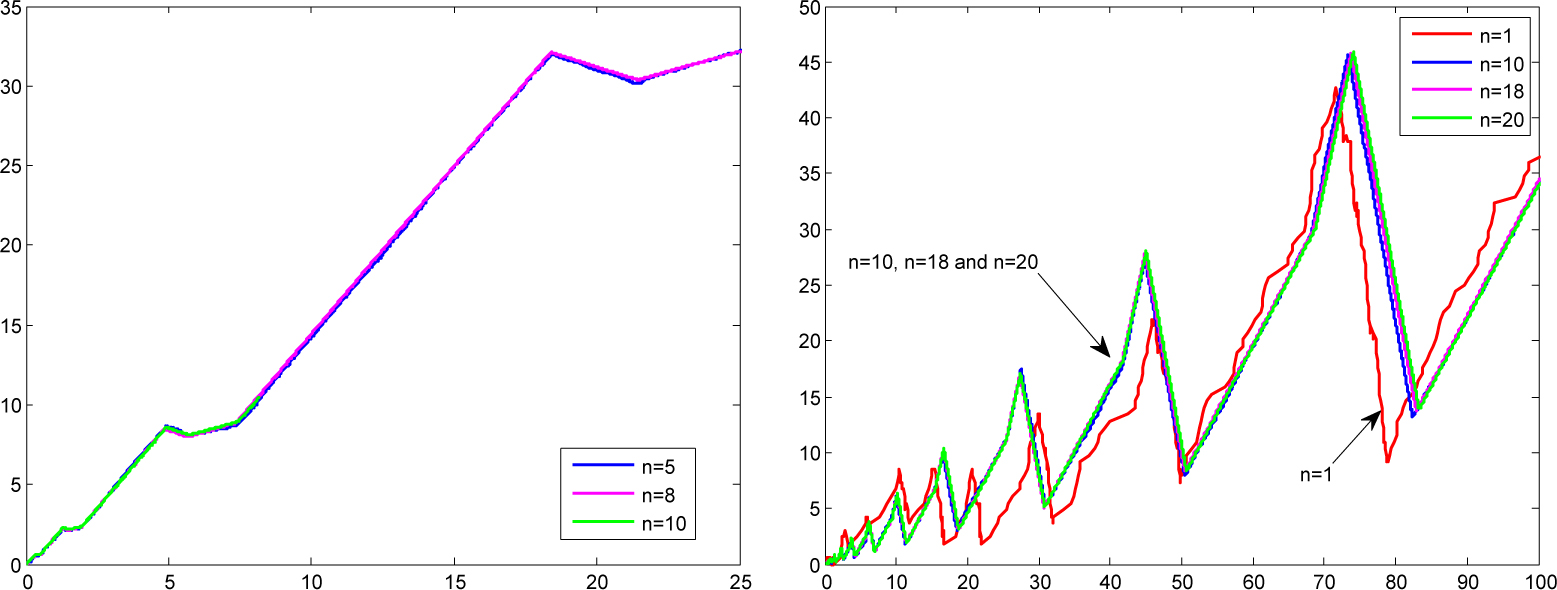
Left: the scaled total queue length process for different n with exhaustive service policy. Right: the scaled queue length process of Q2 for different n with gated service policy.
6.2 Optimization of gating indexes
Subsequently, we consider the optimization of the gating indexes by numerical method. We assume that the gating indexes are integers. Virtually, the fluid limits only depend on the exhaustiveness of the service discipline at each queue (moment of gating index), which allows us to minimize the total queue length through the accommodation of the integer gating indexes.
By (4.3), the average growth rate of the total queue length process β with exhaustive and gated service policies equals 1.5025 and 1.2416 respectively (see Figure 5). This can be intuitively interpreted from the growth rate during each visiting period on different queues. The visiting period at Q3 with the maximal growth rate (minimal service rate) takes 4 times as much time as others in exhaustive service policy. Instead, it takes less than 2 times as much time as others in gated service policy. Therefore, to minimize the average growth rate, we need to increase the visiting time at Q1 and Q2 and decrease the visiting time at Q3.
To optimize the gating indexes turns to be an integer programming with three variables. The GA toolbox of Matlab is undertaken here to search for the optimal gating indexes. For our model, it just takes 51 iterations to find the optimal solution: Q1 and Q2 both take exhaustive service policy while Q3 takes gated service policy. The minimal average growth rate equals to 1.19262 and the corresponding exhaustiveness is f1 = f2 = 1, f3 = 0.25. Figure 5 depicts the process of the optimal average growth rate in each generation. Apparently, the convergence process turns to be very effective. Hence, the average growth rate of the fluid limit provides a simple and transparent method to optimize the gating index.

Left: the fluid limit of the scaled total queue length process (exhaustive and gated). Right: the convergence process of the optimal average growth rate by GA solver.
7 Conclusions and further Research
Inspired by [14], we present the fluid limit of an overloaded polling system with general branching-type service discipline and customer re-routing policies. These results provide new fundamental insight in the impact of exhaustiveness. As a by-product, we propose an optimization problem of gating indexes to minimize the total queue length.
This work gives rise to a variety of directions for further research. A logical follow-up step would be to study the case with non-zero switch-over time. In addition, the asysmptotic behaviors of discrete-time polling systems are also direct extensions to this study. Furthermore, the fluid limit allows us to propose control strategies of the growth depression, which requires substantially more effort.
Acknowledgement
This research is partially supported by the National Natural Science Foundation of China (11901186, 11671404) and by the Fundamental Research Funds for the Central Universities (WUT: 2017 IVA 069, WUT: 2018IB018). The authors would like to thank the anonymous reviewers for their valuable comments and suggestions.
References
[1] Boon M.A., Van der Mei R.D., Winands E.M., Queueing networks with a single shared server: light and heavy traffic, ACM SIGMETRICS Perform. Eval. Rev., 2011, 39(2), 44–46.10.1145/2034832.2034843Search in Google Scholar
[2] Boon M.A., Van der Mei R.D., Winands E.M., Waiting times in queueing networks with a single shared server, Queueing Syst., 2013, 74(4), 403–429.10.1007/s11134-012-9334-6Search in Google Scholar
[3] Boon M.A., van der Mei R.D., Winands E.M., Heavy traffic analysis of roving server networks, Stochastic Models., 2017, 33(2), 171–209.10.1080/15326349.2016.1226142Search in Google Scholar
[4] Sidi M., Levy H., Customer routing on polling systems, In: King P.J.B., Mitrani I., Pooley R.J. (Eds.), Performance, North-Holland, Amsterdam, 1990, 319–331.Search in Google Scholar
[5] Sidi M., Levy H., Fuhrmann S.W., A queueing network with a single cyclically roving server, Queueing Syst., 1992, 11(1), 121–144.10.1007/BF01159291Search in Google Scholar
[6] Coffman Jr E., Puhalskii A., Reiman M., Polling systems with zero switchover times: a heavy-traffic averaging principle, Ann. Appl. Probab., 1995, 681–719.10.1214/aoap/1177004701Search in Google Scholar
[7] Coffman Jr E., Puhalskii A., Reiman M., Polling systems in heavy traffic: A bessel process limit, Math. Oper. Res., 1998, 23(2), 257–304.10.1287/moor.23.2.257Search in Google Scholar
[8] Van der Mei R.D., Towards a unifying theory on branching-type polling systems in heavy traffic, Queueing Syst., 2007, 57(1), 29–46.10.1007/s11134-007-9044-7Search in Google Scholar
[9] Liu Z., Chu Y., Wu J., The asymptotic behavior of a branching-type polling network in heavy traffic, Sci. China-Math. (Chinese Series), 2015, 45(5), 515–526.10.1360/N012015-00044Search in Google Scholar
[10] Liu Z., Chu Y., Wu J., Heavy-traffic asymptotics of priority polling system with threshold service policy, Comput. Oper. Res., 2016, 65, 19–28.10.1016/j.cor.2015.06.013Search in Google Scholar
[11] Puha A.L., Stolyar A.L., Williams R.J., The fluid limit of an overloaded processor sharing queue, Math. Oper. Res., 2006, 31(31), 316–350.10.1287/moor.1050.0181Search in Google Scholar
[12] Talreja R., Whitt W., Fluid models for overloaded multiclass many-server queueing systems with first-come, first-served routing, Manage. Sci., 2008, 54(8), 1513–1527.10.1287/mnsc.1080.0868Search in Google Scholar
[13] Jennings O.B., Reed J.E., An overloaded multiclass FIFO queue with abandonments, Oper. Res., 2012, 60(5), 1282–1295.10.1287/opre.1120.1095Search in Google Scholar
[14] Remerova M., Foss S., Zwart B., Random fluid limit of an overloaded polling model, Adv. in Appl. Probab., 2014, 46(1), 76–101.10.1239/aap/1396360104Search in Google Scholar
[15] Resing J., Polling systems and multitype branching processes, Queueing Syst., 1993, 13(4), 409–426.10.1007/BF01149263Search in Google Scholar
[16] Levy H., Analysis of cyclic polling systems with binomial-gated service, In: Hasegawa T., Takagi H., Takahashi Y. (Eds.), Performance of Distributed and Parallel Systems, North-Holland, Amsterdam, 1989, 127-139.Search in Google Scholar
[17] Athreya K.B., Ney P.E., Branching Processes, Springer: Berlin Heidelberg, 1972.10.1007/978-3-642-65371-1Search in Google Scholar
[18] Van der Mei R.D., Polling systems with switch-over times under heavy load: moments of the delay, Queueing Syst., 2000, 36(4), 381–404.10.1023/A:1011041520533Search in Google Scholar
© 2019 Yuejiao Wang et al., published by De Gruyter
This work is licensed under the Creative Commons Attribution 4.0 Public License.
Articles in the same Issue
- Regular Articles
- On the Gevrey ultradifferentiability of weak solutions of an abstract evolution equation with a scalar type spectral operator of orders less than one
- Centralizers of automorphisms permuting free generators
- Extreme points and support points of conformal mappings
- Arithmetical properties of double Möbius-Bernoulli numbers
- The product of quasi-ideal refined generalised quasi-adequate transversals
- Characterizations of the Solution Sets of Generalized Convex Fuzzy Optimization Problem
- Augmented, free and tensor generalized digroups
- Time-dependent attractor of wave equations with nonlinear damping and linear memory
- A new smoothing method for solving nonlinear complementarity problems
- Almost periodic solution of a discrete competitive system with delays and feedback controls
- On a problem of Hasse and Ramachandra
- Hopf bifurcation and stability in a Beddington-DeAngelis predator-prey model with stage structure for predator and time delay incorporating prey refuge
- A note on the formulas for the Drazin inverse of the sum of two matrices
- Completeness theorem for probability models with finitely many valued measure
- Periodic solution for ϕ-Laplacian neutral differential equation
- Asymptotic orbital shadowing property for diffeomorphisms
- Modular equations of a continued fraction of order six
- Solutions with concentration and cavitation to the Riemann problem for the isentropic relativistic Euler system for the extended Chaplygin gas
- Stability Problems and Analytical Integration for the Clebsch’s System
- Topological Indices of Para-line Graphs of V-Phenylenic Nanostructures
- On split Lie color triple systems
- Triangular Surface Patch Based on Bivariate Meyer-König-Zeller Operator
- Generators for maximal subgroups of Conway group Co1
- Positivity preserving operator splitting nonstandard finite difference methods for SEIR reaction diffusion model
- Characterizations of Convex spaces and Anti-matroids via Derived Operators
- On Partitions and Arf Semigroups
- Arithmetic properties for Andrews’ (48,6)- and (48,18)-singular overpartitions
- A concise proof to the spectral and nuclear norm bounds through tensor partitions
- A categorical approach to abstract convex spaces and interval spaces
- Dynamics of two-species delayed competitive stage-structured model described by differential-difference equations
- Parity results for broken 11-diamond partitions
- A new fourth power mean of two-term exponential sums
- The new operations on complete ideals
- Soft covering based rough graphs and corresponding decision making
- Complete convergence for arrays of ratios of order statistics
- Sufficient and necessary conditions of convergence for ρ͠ mixing random variables
- Attractors of dynamical systems in locally compact spaces
- Random attractors for stochastic retarded strongly damped wave equations with additive noise on bounded domains
- Statistical approximation properties of λ-Bernstein operators based on q-integers
- An investigation of fractional Bagley-Torvik equation
- Pentavalent arc-transitive Cayley graphs on Frobenius groups with soluble vertex stabilizer
- On the hybrid power mean of two kind different trigonometric sums
- Embedding of Supplementary Results in Strong EMT Valuations and Strength
- On Diophantine approximation by unlike powers of primes
- A General Version of the Nullstellensatz for Arbitrary Fields
- A new representation of α-openness, α-continuity, α-irresoluteness, and α-compactness in L-fuzzy pretopological spaces
- Random Polygons and Estimations of π
- The optimal pebbling of spindle graphs
- MBJ-neutrosophic ideals of BCK/BCI-algebras
- A note on the structure of a finite group G having a subgroup H maximal in 〈H, Hg〉
- A fuzzy multi-objective linear programming with interval-typed triangular fuzzy numbers
- Variational-like inequalities for n-dimensional fuzzy-vector-valued functions and fuzzy optimization
- Stability property of the prey free equilibrium point
- Rayleigh-Ritz Majorization Error Bounds for the Linear Response Eigenvalue Problem
- Hyper-Wiener indices of polyphenyl chains and polyphenyl spiders
- Razumikhin-type theorem on time-changed stochastic functional differential equations with Markovian switching
- Fixed Points of Meromorphic Functions and Their Higher Order Differences and Shifts
- Properties and Inference for a New Class of Generalized Rayleigh Distributions with an Application
- Nonfragile observer-based guaranteed cost finite-time control of discrete-time positive impulsive switched systems
- Empirical likelihood confidence regions of the parameters in a partially single-index varying-coefficient model
- Algebraic loop structures on algebra comultiplications
- Two weight estimates for a class of (p, q) type sublinear operators and their commutators
- Dynamic of a nonautonomous two-species impulsive competitive system with infinite delays
- 2-closures of primitive permutation groups of holomorph type
- Monotonicity properties and inequalities related to generalized Grötzsch ring functions
- Variation inequalities related to Schrödinger operators on weighted Morrey spaces
- Research on cooperation strategy between government and green supply chain based on differential game
- Extinction of a two species competitive stage-structured system with the effect of toxic substance and harvesting
- *-Ricci soliton on (κ, μ)′-almost Kenmotsu manifolds
- Some improved bounds on two energy-like invariants of some derived graphs
- Pricing under dynamic risk measures
- Finite groups with star-free noncyclic graphs
- A degree approach to relationship among fuzzy convex structures, fuzzy closure systems and fuzzy Alexandrov topologies
- S-shaped connected component of radial positive solutions for a prescribed mean curvature problem in an annular domain
- On Diophantine equations involving Lucas sequences
- A new way to represent functions as series
- Stability and Hopf bifurcation periodic orbits in delay coupled Lotka-Volterra ring system
- Some remarks on a pair of seemingly unrelated regression models
- Lyapunov stable homoclinic classes for smooth vector fields
- Stabilizers in EQ-algebras
- The properties of solutions for several types of Painlevé equations concerning fixed-points, zeros and poles
- Spectrum perturbations of compact operators in a Banach space
- The non-commuting graph of a non-central hypergroup
- Lie symmetry analysis and conservation law for the equation arising from higher order Broer-Kaup equation
- Positive solutions of the discrete Dirichlet problem involving the mean curvature operator
- Dislocated quasi cone b-metric space over Banach algebra and contraction principles with application to functional equations
- On the Gevrey ultradifferentiability of weak solutions of an abstract evolution equation with a scalar type spectral operator on the open semi-axis
- Differential polynomials of L-functions with truncated shared values
- Exclusion sets in the S-type eigenvalue localization sets for tensors
- Continuous linear operators on Orlicz-Bochner spaces
- Non-trivial solutions for Schrödinger-Poisson systems involving critical nonlocal term and potential vanishing at infinity
- Characterizations of Benson proper efficiency of set-valued optimization in real linear spaces
- A quantitative obstruction to collapsing surfaces
- Dynamic behaviors of a Lotka-Volterra type predator-prey system with Allee effect on the predator species and density dependent birth rate on the prey species
- Coexistence for a kind of stochastic three-species competitive models
- Algebraic and qualitative remarks about the family yy′ = (αxm+k–1 + βxm–k–1)y + γx2m–2k–1
- On the two-term exponential sums and character sums of polynomials
- F-biharmonic maps into general Riemannian manifolds
- Embeddings of harmonic mixed norm spaces on smoothly bounded domains in ℝn
- Asymptotic behavior for non-autonomous stochastic plate equation on unbounded domains
- Power graphs and exchange property for resolving sets
- On nearly Hurewicz spaces
- Least eigenvalue of the connected graphs whose complements are cacti
- Determinants of two kinds of matrices whose elements involve sine functions
- A characterization of translational hulls of a strongly right type B semigroup
- Common fixed point results for two families of multivalued A–dominated contractive mappings on closed ball with applications
- Lp estimates for maximal functions along surfaces of revolution on product spaces
- Path-induced closure operators on graphs for defining digital Jordan surfaces
- Irreducible modules with highest weight vectors over modular Witt and special Lie superalgebras
- Existence of periodic solutions with prescribed minimal period of a 2nth-order discrete system
- Injective hulls of many-sorted ordered algebras
- Random uniform exponential attractor for stochastic non-autonomous reaction-diffusion equation with multiplicative noise in ℝ3
- Global properties of virus dynamics with B-cell impairment
- The monotonicity of ratios involving arc tangent function with applications
- A family of Cantorvals
- An asymptotic property of branching-type overloaded polling networks
- Almost periodic solutions of a commensalism system with Michaelis-Menten type harvesting on time scales
- Explicit order 3/2 Runge-Kutta method for numerical solutions of stochastic differential equations by using Itô-Taylor expansion
- L-fuzzy ideals and L-fuzzy subalgebras of Novikov algebras
- L-topological-convex spaces generated by L-convex bases
- An optimal fourth-order family of modified Cauchy methods for finding solutions of nonlinear equations and their dynamical behavior
- New error bounds for linear complementarity problems of Σ-SDD matrices and SB-matrices
- Hankel determinant of order three for familiar subsets of analytic functions related with sine function
- On some automorphic properties of Galois traces of class invariants from generalized Weber functions of level 5
- Results on existence for generalized nD Navier-Stokes equations
- Regular Banach space net and abstract-valued Orlicz space of range-varying type
- Some properties of pre-quasi operator ideal of type generalized Cesáro sequence space defined by weighted means
- On a new convergence in topological spaces
- On a fixed point theorem with application to functional equations
- Coupled system of a fractional order differential equations with weighted initial conditions
- Rough quotient in topological rough sets
- Split Hausdorff internal topologies on posets
- A preconditioned AOR iterative scheme for systems of linear equations with L-matrics
- New handy and accurate approximation for the Gaussian integrals with applications to science and engineering
- Special Issue on Graph Theory (GWGT 2019)
- The general position problem and strong resolving graphs
- Connected domination game played on Cartesian products
- On minimum algebraic connectivity of graphs whose complements are bicyclic
- A novel method to construct NSSD molecular graphs
Articles in the same Issue
- Regular Articles
- On the Gevrey ultradifferentiability of weak solutions of an abstract evolution equation with a scalar type spectral operator of orders less than one
- Centralizers of automorphisms permuting free generators
- Extreme points and support points of conformal mappings
- Arithmetical properties of double Möbius-Bernoulli numbers
- The product of quasi-ideal refined generalised quasi-adequate transversals
- Characterizations of the Solution Sets of Generalized Convex Fuzzy Optimization Problem
- Augmented, free and tensor generalized digroups
- Time-dependent attractor of wave equations with nonlinear damping and linear memory
- A new smoothing method for solving nonlinear complementarity problems
- Almost periodic solution of a discrete competitive system with delays and feedback controls
- On a problem of Hasse and Ramachandra
- Hopf bifurcation and stability in a Beddington-DeAngelis predator-prey model with stage structure for predator and time delay incorporating prey refuge
- A note on the formulas for the Drazin inverse of the sum of two matrices
- Completeness theorem for probability models with finitely many valued measure
- Periodic solution for ϕ-Laplacian neutral differential equation
- Asymptotic orbital shadowing property for diffeomorphisms
- Modular equations of a continued fraction of order six
- Solutions with concentration and cavitation to the Riemann problem for the isentropic relativistic Euler system for the extended Chaplygin gas
- Stability Problems and Analytical Integration for the Clebsch’s System
- Topological Indices of Para-line Graphs of V-Phenylenic Nanostructures
- On split Lie color triple systems
- Triangular Surface Patch Based on Bivariate Meyer-König-Zeller Operator
- Generators for maximal subgroups of Conway group Co1
- Positivity preserving operator splitting nonstandard finite difference methods for SEIR reaction diffusion model
- Characterizations of Convex spaces and Anti-matroids via Derived Operators
- On Partitions and Arf Semigroups
- Arithmetic properties for Andrews’ (48,6)- and (48,18)-singular overpartitions
- A concise proof to the spectral and nuclear norm bounds through tensor partitions
- A categorical approach to abstract convex spaces and interval spaces
- Dynamics of two-species delayed competitive stage-structured model described by differential-difference equations
- Parity results for broken 11-diamond partitions
- A new fourth power mean of two-term exponential sums
- The new operations on complete ideals
- Soft covering based rough graphs and corresponding decision making
- Complete convergence for arrays of ratios of order statistics
- Sufficient and necessary conditions of convergence for ρ͠ mixing random variables
- Attractors of dynamical systems in locally compact spaces
- Random attractors for stochastic retarded strongly damped wave equations with additive noise on bounded domains
- Statistical approximation properties of λ-Bernstein operators based on q-integers
- An investigation of fractional Bagley-Torvik equation
- Pentavalent arc-transitive Cayley graphs on Frobenius groups with soluble vertex stabilizer
- On the hybrid power mean of two kind different trigonometric sums
- Embedding of Supplementary Results in Strong EMT Valuations and Strength
- On Diophantine approximation by unlike powers of primes
- A General Version of the Nullstellensatz for Arbitrary Fields
- A new representation of α-openness, α-continuity, α-irresoluteness, and α-compactness in L-fuzzy pretopological spaces
- Random Polygons and Estimations of π
- The optimal pebbling of spindle graphs
- MBJ-neutrosophic ideals of BCK/BCI-algebras
- A note on the structure of a finite group G having a subgroup H maximal in 〈H, Hg〉
- A fuzzy multi-objective linear programming with interval-typed triangular fuzzy numbers
- Variational-like inequalities for n-dimensional fuzzy-vector-valued functions and fuzzy optimization
- Stability property of the prey free equilibrium point
- Rayleigh-Ritz Majorization Error Bounds for the Linear Response Eigenvalue Problem
- Hyper-Wiener indices of polyphenyl chains and polyphenyl spiders
- Razumikhin-type theorem on time-changed stochastic functional differential equations with Markovian switching
- Fixed Points of Meromorphic Functions and Their Higher Order Differences and Shifts
- Properties and Inference for a New Class of Generalized Rayleigh Distributions with an Application
- Nonfragile observer-based guaranteed cost finite-time control of discrete-time positive impulsive switched systems
- Empirical likelihood confidence regions of the parameters in a partially single-index varying-coefficient model
- Algebraic loop structures on algebra comultiplications
- Two weight estimates for a class of (p, q) type sublinear operators and their commutators
- Dynamic of a nonautonomous two-species impulsive competitive system with infinite delays
- 2-closures of primitive permutation groups of holomorph type
- Monotonicity properties and inequalities related to generalized Grötzsch ring functions
- Variation inequalities related to Schrödinger operators on weighted Morrey spaces
- Research on cooperation strategy between government and green supply chain based on differential game
- Extinction of a two species competitive stage-structured system with the effect of toxic substance and harvesting
- *-Ricci soliton on (κ, μ)′-almost Kenmotsu manifolds
- Some improved bounds on two energy-like invariants of some derived graphs
- Pricing under dynamic risk measures
- Finite groups with star-free noncyclic graphs
- A degree approach to relationship among fuzzy convex structures, fuzzy closure systems and fuzzy Alexandrov topologies
- S-shaped connected component of radial positive solutions for a prescribed mean curvature problem in an annular domain
- On Diophantine equations involving Lucas sequences
- A new way to represent functions as series
- Stability and Hopf bifurcation periodic orbits in delay coupled Lotka-Volterra ring system
- Some remarks on a pair of seemingly unrelated regression models
- Lyapunov stable homoclinic classes for smooth vector fields
- Stabilizers in EQ-algebras
- The properties of solutions for several types of Painlevé equations concerning fixed-points, zeros and poles
- Spectrum perturbations of compact operators in a Banach space
- The non-commuting graph of a non-central hypergroup
- Lie symmetry analysis and conservation law for the equation arising from higher order Broer-Kaup equation
- Positive solutions of the discrete Dirichlet problem involving the mean curvature operator
- Dislocated quasi cone b-metric space over Banach algebra and contraction principles with application to functional equations
- On the Gevrey ultradifferentiability of weak solutions of an abstract evolution equation with a scalar type spectral operator on the open semi-axis
- Differential polynomials of L-functions with truncated shared values
- Exclusion sets in the S-type eigenvalue localization sets for tensors
- Continuous linear operators on Orlicz-Bochner spaces
- Non-trivial solutions for Schrödinger-Poisson systems involving critical nonlocal term and potential vanishing at infinity
- Characterizations of Benson proper efficiency of set-valued optimization in real linear spaces
- A quantitative obstruction to collapsing surfaces
- Dynamic behaviors of a Lotka-Volterra type predator-prey system with Allee effect on the predator species and density dependent birth rate on the prey species
- Coexistence for a kind of stochastic three-species competitive models
- Algebraic and qualitative remarks about the family yy′ = (αxm+k–1 + βxm–k–1)y + γx2m–2k–1
- On the two-term exponential sums and character sums of polynomials
- F-biharmonic maps into general Riemannian manifolds
- Embeddings of harmonic mixed norm spaces on smoothly bounded domains in ℝn
- Asymptotic behavior for non-autonomous stochastic plate equation on unbounded domains
- Power graphs and exchange property for resolving sets
- On nearly Hurewicz spaces
- Least eigenvalue of the connected graphs whose complements are cacti
- Determinants of two kinds of matrices whose elements involve sine functions
- A characterization of translational hulls of a strongly right type B semigroup
- Common fixed point results for two families of multivalued A–dominated contractive mappings on closed ball with applications
- Lp estimates for maximal functions along surfaces of revolution on product spaces
- Path-induced closure operators on graphs for defining digital Jordan surfaces
- Irreducible modules with highest weight vectors over modular Witt and special Lie superalgebras
- Existence of periodic solutions with prescribed minimal period of a 2nth-order discrete system
- Injective hulls of many-sorted ordered algebras
- Random uniform exponential attractor for stochastic non-autonomous reaction-diffusion equation with multiplicative noise in ℝ3
- Global properties of virus dynamics with B-cell impairment
- The monotonicity of ratios involving arc tangent function with applications
- A family of Cantorvals
- An asymptotic property of branching-type overloaded polling networks
- Almost periodic solutions of a commensalism system with Michaelis-Menten type harvesting on time scales
- Explicit order 3/2 Runge-Kutta method for numerical solutions of stochastic differential equations by using Itô-Taylor expansion
- L-fuzzy ideals and L-fuzzy subalgebras of Novikov algebras
- L-topological-convex spaces generated by L-convex bases
- An optimal fourth-order family of modified Cauchy methods for finding solutions of nonlinear equations and their dynamical behavior
- New error bounds for linear complementarity problems of Σ-SDD matrices and SB-matrices
- Hankel determinant of order three for familiar subsets of analytic functions related with sine function
- On some automorphic properties of Galois traces of class invariants from generalized Weber functions of level 5
- Results on existence for generalized nD Navier-Stokes equations
- Regular Banach space net and abstract-valued Orlicz space of range-varying type
- Some properties of pre-quasi operator ideal of type generalized Cesáro sequence space defined by weighted means
- On a new convergence in topological spaces
- On a fixed point theorem with application to functional equations
- Coupled system of a fractional order differential equations with weighted initial conditions
- Rough quotient in topological rough sets
- Split Hausdorff internal topologies on posets
- A preconditioned AOR iterative scheme for systems of linear equations with L-matrics
- New handy and accurate approximation for the Gaussian integrals with applications to science and engineering
- Special Issue on Graph Theory (GWGT 2019)
- The general position problem and strong resolving graphs
- Connected domination game played on Cartesian products
- On minimum algebraic connectivity of graphs whose complements are bicyclic
- A novel method to construct NSSD molecular graphs
