Attraction of released male Mediterranean fruit flies to trimedlure and an α-copaene-containing natural oil: effects of lure age and distance
-
Todd Shelly

 and
Thomas Fezza
and
Thomas Fezza

Abstract
Fruit flies (Diptera: Tephritidae) pose a serious threat to global agriculture, and many countries operate trapping programs to detect incursions of pest tephritids. Surveillance relies heavily on male-specific attractants, termed male lures. Trimedlure is a widely used male lure that targets the genus Ceratitis, which includes the Mediterranean fruit fly (medfly) Ceratitis capitata (Wiedemann). However, trimedlure is not a potent lure, and alternatives are being developed. Recent trapping studies have shown that a natural oil with an elevated concentration of the sesquiterpene α-copaene is significantly more attractive than trimedlure. The present study further compares the relative attractiveness of trimedlure and this natural oil via release-recapture trials of C. capitata males in a macadamia nut orchard in Hawaii. The experimental design involved the release of male medflies from different distances around a single, centrally located trap. Comparisons of the two lures were based on captures of males released near or far (15 or 30 m) from fresh or aged (weathered < 2 weeks or 10–12 weeks, respectively) lures. For the 15 m releases, fresh trimedlure and fresh natural oil attracted similar numbers of male medflies, whereas traps baited with aged natural oil captured significantly more medflies than traps baited with aged trimedlure. For the 30 m releases, both fresh and aged natural oil-baited traps captured significantly more male medflies than traps baited with comparably weathered trimedlure. Together with the trapping data from wild populations, these release-recapture results suggest that the natural oil lure is a viable replacement for trimedlure.
Resumen
Las moscas de la fruta (Diptera: Tephritidae) representan una grave amenaza para la agricultura mundial, y en muchos países se implementan programas de trampas para detectar incursiones de plagas de tefrítidos. La vigilancia se basa en gran medida en atrayentes específicos para machos, denominados señuelos para machos. Trimedlure es un señuelo ampliamente utilizado que se dirige al género Ceratitis, el cual incluye la mosca mediterránea de la fruta (moscamed) Ceratitis capitata (Wiedemann). Sin embargo, trimedlure no es un señuelo potente, y se están desarrollando alternativas. Estudios recientes de trampas han demostrado que un aceite natural, con una concentración elevada del sesquiterpeno α-copaeno, es significativamente más atractivo que trimedlure. El presente estudio compara el atractivo relativo de trimedlure y de este aceite natural mediante ensayos de liberación-recaptura de machos de C. capitata en un huerto de nueces de macadamia en Hawái. El diseño experimental consistió en la liberación de machos de mosca de la fruta desde diferentes distancias alrededor de una única trampa ubicada centralmente. Las comparaciones de los dos señuelos se basaron en la captura de machos liberados a distancias cercanas o lejanas (15 o 30 m) desde señuelos frescos o envejecidos (con menos de dos semanas de exposición o de 10 a 12 semanas de exposición, respectivamente). En las liberaciones a 15 m, el trimedlure fresco y el aceite natural fresco atrajeron un número similar de machos de moscamed, mientras que las trampas cebadas con aceite natural envejecido capturaron significativamente más moscamed que las trampas cebadas con trimedlure envejecido. En las liberaciones a 30 m, tanto las trampas cebadas con aceite natural fresco como las envejecidas capturaron significativamente más machos de moscamed que las trampas cebadas con trimedlure con una exposición comparable. Junto con los datos de captura de poblaciones silvestres, estos resultados de liberación-recaptura sugieren que el señuelo de aceite natural es un sustituto viable del trimedlure.
Tephritid fruit flies (Diptera: Tephritidae) pose a threat to global agriculture owing to increased movement of people and commodities as well as global warming that is allowing range expansion of pest species (Papadopoulos et al. 2024). Many countries operate monitoring programs to detect incursions of pest tephritids (Kean et al. 2024). These programs rely on trapping networks based primarily on so-called male lures, which are synthetic or natural compounds attractive to males only. The most commonly used male lures are: cue-lure (for certain Bactrocera and Zeugodacus species), methyl eugenol (for certain Bactrocera species), and trimedlure (for certain Ceratitis species) (Tan et al. 2014). Of these, methyl eugenol is considered the most potent lure and trimedlure perhaps the weakest (McInnis et al. 2017). Attempts to improve detection of Ceratitis males involve modifications of trimedlure (e.g., ceralure [Warthen et al. 1994] and capilure [Leonhardt et al. 1984]) or complete replacement with natural oil-based lures.
The attractiveness of particular natural oils to males of the Mediterranean fruit fly (medfly), Ceratitis capitata (Wiedemann), derives largely from the presence of the compound α-copaene (Guiotto et al. 1972), and studies in sub-Saharan Africa (Manrakhan et al. 2017) reported that enriched ginger root oil (so named, because the natural concentration of α-copaene was increased via fractional distillation) was more attractive to certain Ceratitis spp. than trimedlure. More recently, data from Tunisia, Costa Rica, and Hawaii showed that a natural oil, with enhanced α-copaene content, consistently attracted more C. capitata males than trimedlure (Kharrat et al. 2024; Shelly et al. 2023).
The present study provides additional data regarding the relative attractiveness of trimedlure and the aforementioned natural oil via release-recapture trials of male medflies. Specifically, we compared the two lures based on captures of males released near or far (15 or 30 m) from fresh or aged (weathered < 2 weeks or 10–12 weeks, respectively) lures. Shelly et al. (2023) found that, when trimedlure and natural oil baits were weathered for the same duration, the natural oil lure consistently attracted more wild male medflies than trimedlure. Consequently, we predicted that, for each release distance, fresh and aged natural oil would attract more males than comparably aged trimedlure.
Trials were conducted in a macadamia nut orchard (Macadamia integrifolia Maiden & Betche, Proteaceae; 19.6428611 °N, 155.0800361 °W) near Hilo, Hawaii. Macadamia is neither an ovipositional nor adult food source, thus eliminating these parameters as potentially influencing fly movement. Trees were uniform in size (4–5 m high) and planted in a grid, with rows 8–9 m apart and trees within a row separated by 4–5 m. Releases were performed during July 2024 to February 2025. Average daily minimum and maximum temperatures on release days (N = 32) were 18.1 °C (range: 15.9–19.7 °C) and 26.8 °C (range: 24.2–27.8 °C), respectively. Rainfall was < 4 mm on all release days except for one instance (16.2 mm on 27 November 2024).
Flies were captured using Jackson traps, which are widely used in fruit fly monitoring programs (FAO/IAEA 2018; Scentry Biologicals Inc., Billings, Montana, USA). Jackson traps are white, ‘delta’ traps made of thick waxed paper (12.7 L × 9.5 W × 8.4 H cm), with a removable, sticky floor panel. Trimedlure plugs (Scentry Biologicals Inc.) and natural oil bulbs (ChemTica Intl.; Heredia, Costa Rica) both loaded with 4 g of active ingredient) were placed inside perforated, plastic baskets suspended above the sticky floor of the trap. Operationally, fresh lures were those weathered for < 2 weeks, while aged lures were weathered for 10–12 weeks. Weathering occurred outdoors on a covered porch at the United States Department of Agriculture, Agricultural Research Service (USDA-ARS) laboratory in Hilo under environmental conditions similar to the field site. Use of these intervals was based on earlier results (Shelly et al. 2023) that revealed (i) neither trimedlure nor natural oil showed significant decline in attractiveness over the first 2 weeks of weathering and (ii) both trimedlure and natural oil weathered > 10 weeks were significantly less attractive than their fresh counterparts. Traps were suspended 2.0–2.5 m above ground from branches in the tree canopy.
Males for release were obtained from the California Department of Food and Agriculture (CDFA) Medfly Rearing Facility, Waimanalo, Hawaii, which rears a tsl genetic sexing strain for a sterile insect technique program operated in California. Non-dyed, non-irradiated male pupae were shipped overnight in chilled, insulated boxes and placed in cubical (30 cm per side) screen-mesh cages (excepting one side that was clear plexiglass; 10 mL or approximately 600 pupae per cage). Non-dyed flies were used, as wild medflies were absent at the study site. Based on CDFA quality control measurements, which follow international guidelines (FAO/IAEA/USDA 2019), adults emerged successfully from 85 % of the pupae, and 78 % of these adults were flight-capable (i.e., 100 pupae yielded 66 flight-capable adults; values based on averages of measurements obtained for daily batches [N = 32] of flies used in the experiment). Emerged flies were maintained at the USDA-ARS laboratory at 22.5 ± °C and 55 ± 3 % relative humidity under a 14:10 (L:D) photoperiod and were provided food (a 3:1 mixture of sugar and protein hydrolysate) and water ad libitum.
On a given test day, one trap containing trimedlure or natural oil was placed in each of two focal trees (separated by > 400 m). A focal tree (with trap) was located at the center of a circle with fly releases made at four points along the circumference corresponding to N, E, S, or W directions from the focal tree. The same combination of variables (i.e., new or old lures with near or far releases) was tested at both focal trees used on a given test day. For the releases, which occurred between 7 and 8 AM, cages were placed on the ground beneath the release trees, the sliding plexiglass side of the cage was gently lifted, and flies exited on their own volition. After 30 min, cages were tapped to induce flight among remaining males. For releases at 15 m, approximately 1,600 males was released (one cage or approximately 400 flight-capable males per release site), and for releases at 30 m, approximately 3,200 males were released (two cages or approximately 800 flight-capable males per release site). Traps were collected 2 days later and returned to the laboratory for counting. The release distances and male numbers were selected to insure sufficiently large recaptures for statistical analysis.
Tests were performed weekly and used alternate pairs of release trees, i.e., four different focal trees were used over the study (week 1: trees A + B; week 2: trees C + D; week 3: trees A + B and so on). This protocol resulted in a 2-week interval between successive releases around a given focal tree and thereby maximized the likelihood that captured flies derived from the most recent release. Also, over successive test days for a given pair of focal trees, the positions of the trimedlure and natural oil dispensers were rotated between trees. Releases were performed at each of two focal trees (one with trimedlure, the other with natural oil) on 8 days for each of the four combinations of variables (new or old lures each with near or far releases; 8 days × two releases (one per focal tree) per day × four treatment combinations = 64 total releases over 32 days).
For each combination of release distance and lure age, captures between trimedlure and natural oil lures were compared using a paired t-test (df = 7 in all cases), as (i) same-day releases were made at two focal trees containing a trimedlure- or natural oil-baited trap, respectively, and (ii) raw or log10 transformed data met the parametric assumptions in all cases. For a given release distance, captures for fresh and aged trimedlure plugs or natural oil bulbs were compared with an unpaired t test (df = 14 in all cases).
For the 15 m releases, fresh trimedlure and natural oil attracted similar numbers of male medflies, whereas traps baited with aged natural oil captured significantly more medflies than traps baited with aged trimedlure (Figure 1). For the 30 m releases, both fresh and aged natural oil bulbs attracted significantly more male medflies than weathered trimedlure plugs (Figure 1). Surprisingly, captures for 15 m releases were significantly higher for aged than fresh lures for both trimedlure and natural oil (P < 0.05 in both cases). This finding appears to suggest that male attraction increased as the release rate of the lures decreased with weathering. For trimedlure at least, this interpretation does not appear to be correct, as male attraction to new and aged trimedlure plugs were found to be similar in several studies (Dean et al. 2018; Shelly and Kurashima 2020). Comparable data are not available for the natural oil lure. Again, somewhat unexpectedly, captures for 30 m releases were not significantly different between fresh and aged baits for either lure (P > 0.05 in both cases).
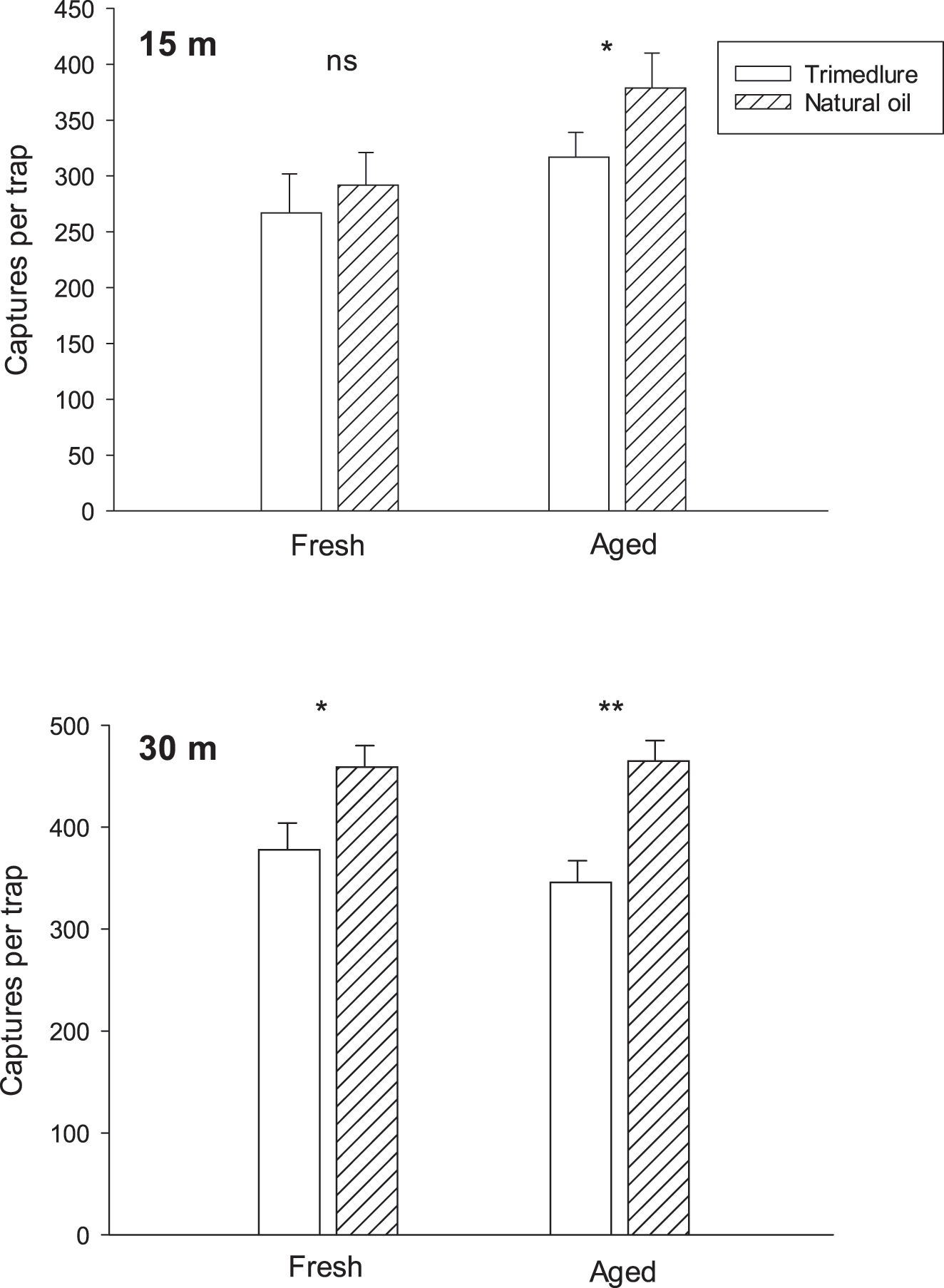
Captures of Ceratitis capitata males released at 15 or 30 m from Jackson traps baited with fresh or aged trimedlure or α-copaene enriched natural oil in a macadamia nut orchard in Hawaii. Bar heights represent average number (±1 SE) per trap (N = 8 replicates). Statistical results: ns – not significantly different; *P < 0.05; **P < 0.01.
Overall, these results confirm the greater attractancy of natural oil over trimedlure. Aside from 15 m releases with fresh lures, greater numbers of male C. capitata were captured in traps baited with natural oil than those baited with trimedlure. Recapture for 30 m releases (data from fresh and aged lures combined) were 11.3 % and 14.4 % for trimedlure and natural oil traps, respectively. Other studies performed releases 30–46 m from a central trimedlure-baited trap and reported recapture of 1 % (Meats and Smallridge 2007), 3 % (Lance and Gates 1994), 6 % (Shelly et al. 2014), and 36 % (Cunningham and Couey 1986). This latter study (like the present one) was conducted in a Hawaiian macadamia nut orchard, and the relatively high recapture values observed in this habitat suggest that the uniform, unbroken distribution of trees resulted in higher recapture than observed in residential areas.
Acknowledgments
We thank Island Princess Mac Nut Inc. for their cooperation.
-
Research ethics: Not applicable.
-
Informed consent: Not applicable.
-
Author contributions: T.S.: Conceptualization, Formal Analysis, and Writing-original draft; T.F.: Investigation, Data Curation, and Writing – review and editing. The authors have accepted responsibility for the entire content of this manuscript and approved its submission.
-
Use of Large Language Models, AI and Machine Learning Tools: None declared.
-
Conflict of interest: The authors state no conflict of interest.
-
Research funding: None declared.
-
Data availability: Data available upon request from the corresponding author.
References
Cunningham, R.T. and Couey, H.M. (1986). Mediterranean fruit fly (Diptera: Tephritidae): distance/response curves to trimedlure to measure trapping efficiency. Environ. Entomol. 15: 71–74, https://doi.org/10.1093/ee/15.1.71.Search in Google Scholar
Dean, D., Pierre, H., Mosser, L., Kurashima, R., and Shelly, T. (2018). Field longevity and attractiveness of trimedlure plugs to male Ceratitis capitata in Florida and Hawaii. Fla. Entomol. 101: 441–446, https://doi.org/10.1653/024.101.0322.Search in Google Scholar
FAO/IAEA (Food and Agriculture Organization/International Atomic Energy Agency) (2018). Trapping guidelines for area-wide fruit fly programs. Enkerlin, W.R., and Reyes-Flores, J. (Eds.), 2nd ed. FAO, Rome, Italy.Search in Google Scholar
FAO/IAEA/USDA (Food and Agriculture Organization/International Atomic Energy Agency/US Department of Agriculture) (2019). Product quality control for sterile mass-reared and released tephritid fruit flies, version 7.0. International Atomic Energy Agency, Vienna, Austria.Search in Google Scholar
Guiotto, A.A., Fornasiero, U.U., and Baccichetti, F.F. (1972). Investigations on attractants for males of Ceratitis capitata. Farmaco Sci. 27: 663–669.Search in Google Scholar
Kean, J.M., Manoukis, N.C., and Dominiak, B.C. (2024). Review of surveillance systems for tephritid fruit fly threats in Australia, New Zealand, and the United States. J. Econ. Entomol. 117: 8–23, https://doi.org/10.1093/jee/toad228.Search in Google Scholar PubMed PubMed Central
Kharrat, S., Gonzalez, F., Rodriguez, C., Calvo, C., and Oehlschlager, C. (2024). Relative captures and detection of male Ceratitis capitata using a natural oil lure or trimedlure plugs. Fla. Entomol. 107: 20240022, https://doi.org/10.1515/flaent-2024-0022.Search in Google Scholar
Lance, D.R. and Gates, D.B. (1994). Sensitivity of detection trapping systems for Mediterranean fruit flies (Diptera: Tephritidae) in Southern California. J. Econ. Entomol. 87: 1377–1383, https://doi.org/10.1093/jee/87.6.1377.Search in Google Scholar
Leonhardt, B.A., Rice, R.E., Harte, E.M., and Cunningham, R.T. (1984). Evaluation of dispensers containing trimedlure, the attractant for the Mediterranean fruit fly (Diptera: Tephritidae). J. Econ. Entomol. 77: 744–749, https://doi.org/10.1093/jee/77.3.744.Search in Google Scholar
Manrakhan, A., Daneel, J.H., Beck, R., Virgilio, M., Meganck, K., and De Meyer, M. (2017). Efficacy of trapping systems for monitoring of Afrotropical fruit flies. J. Appl. Entomol. 141: 825–840, https://doi.org/10.1111/jen.12373.Search in Google Scholar
McInnis, D.O., Hendrichs, J., Shelly, T., Barr, N., Hoffman, K., Rodriguez, R., Lance, D.R., Bloem, K., Suckling, D.M., Enkerlin, W., et al.. (2017). Can polyphagous invasive tephritid pest populations escape detection for years under favorable climatic and host conditions? Am. Entomol. 63: 89–99, https://doi.org/10.1093/ae/tmx038.Search in Google Scholar
Meats, A. and Smallridge, C.J. (2007). Short- and long-range dispersal of medfly, Ceratitis capitata (Dipt., Tephritidae), and its invasive potential. J. Appl. Entomol. 131: 518–523, https://doi.org/10.1111/j.1439-0418.2007.01168.x.Search in Google Scholar
Papadopoulos, N.T., De Meyer, M., Terblanche, J.S., and Kriticos, D.J. (2024). Fruit flies: challenges and opportunities to stem the tide of global invasions. Annu. Rev. Entomol. 69: 355–373, https://doi.org/10.1146/annurev-ento-022723-103200.Search in Google Scholar PubMed
Shelly, T. and Kurashima, R. (2020). Field capture of male Mediterranean fruit flies (Diptera: Tephritidae) in traps baited with varying amounts of trimedlure. Fla. Entomol. 103: 16–22, https://doi.org/10.1653/024.103.0403.Search in Google Scholar
Shelly, T., Nishimoto, J., and Kurashima, R. (2014). Distance-dependent capture probability of male Mediterranean fruit flies in trimedlure-baited traps in Hawaii. J. Asia Pac. Entomol. 17: 525–530, https://doi.org/10.1016/j.aspen.2014.05.001.Search in Google Scholar
Shelly, T., Oehlschlager, C., and Kurashima, R. (2023). Natural oil lure outperforms trimedlure in capturing males of the Mediterranean fruit fly, Ceratitis capitata (Diptera: Tephritidae). Neotrop. Entomol. 52: 1138–1143, https://doi.org/10.1007/s13744-023-01079-5.Search in Google Scholar PubMed
Tan, K.H., Nishida, R., Jang, E.B., and Shelly, T.E. (2014). Pheromones, male lures, and trapping of tephritid fruit flies. In: Shelly, T., Epsky, N., Jang, E.B., Reyes-Flores, J., and Vargas, R.I. (Eds.). Trapping and the detection, control, and regulation of tephritid fruit flies. Springer, Dordrecht, The Netherlands, pp. 15–74.10.1007/978-94-017-9193-9_2Search in Google Scholar
Warthen, J.D., Cunningham, R.T., DeMilo, A.B., and Spencer, S. (1994). Trans-ceralure isomers: differences in attraction for Mediterranean fruit fly, Ceratitis capitata (Weid.) (Diptera: Tephritidae). J. Chem. Ecol. 20: 569–578, https://doi.org/10.1007/bf02059598.Search in Google Scholar PubMed
© 2025 the author(s), published by De Gruyter on behalf of the Florida Entomological Society
This work is licensed under the Creative Commons Attribution 4.0 International License.
Articles in the same Issue
- Frontmatter
- Research Articles
- Life history descriptions of two aquatic Florida moth species (Lepidoptera: Crambidae)
- Higher Apoidea activity on centipedegrass lawns than on dicotyledonous plants
- Dynamics of citrus pest populations following a major freeze in northern Florida
- Control of Drosophila melanogaster (Diptera: Drosophilidae) by trapping with banana vinegar
- Establishment, distribution, and preliminary phenological trends of a new planthopper in the genus Patara (Hemiptera: Derbidae) in South Florida, United States of America
- Comparative evaluation of the infestation of five varieties of citrus by the larvae of Anastrepha ludens (Diptera: Tephritidae)
- Impact of land use on the density of Bulimulus bonariensis (Stylommatophora: Bulimulidae) and its parasitic mite, Austreynetes sp. (Trombidiformes: Ereynetidae)
- First record of native seed beetle Stator limbatus (Coleoptera: Chrysomelidae) on invasive earleaf acacia in Florida
- Establishment and monitoring of a sentinel garden of Asian tree species in Florida to assess potential insect pest risks
- Parasitism of Halyomorpha halys and Nezara viridula (Hemiptera: Pentatomidae) sentinel eggs in Central Florida
- Genetic differentiation of three populations of the fall armyworm, Spodoptera frugiperda (Lepidoptera: Noctuidae), in Mexico
- Tortricidae (Lepidoptera) associated with blueberry cultivation in Central Mexico
- First report of Phidotricha erigens (Lepidoptera: Pyralidae: Epipaschiinae) injuring mango inflorescences in Puerto Rico
- Seed predation of Sabal palmetto, Sabal mexicana and Sabal uresana (Arecaceae) by the bruchid Caryobruchus gleditsiae (Coleoptera: Bruchidae), with new host and distribution records
- Genetic variation of rice stink bugs, Oebalus spp. (Hemiptera: Pentatomidae) from Southeastern United States and Cuba
- Selecting Coriandrum sativum (Apiaceae) varieties to promote conservation biological control of crop pests in south Florida
- First record of Mymarommatidae (Hymenoptera) from the Galapagos Islands, Ecuador
- First field validation of Ontsira mellipes (Hymenoptera: Braconidae) as a potential biological control agent for Anoplophora glabripennis (Coleoptera: Cerambycidae) in South Carolina
- Field evaluation of α-copaene enriched natural oil lure for detection of male Ceratitis capitata (Diptera: Tephritidae) in area-wide monitoring programs: results from Tunisia, Costa Rica and Hawaii
- Abundance of Megalurothrips usitatus (Bagnall) (Thysanoptera: Thripidae) and other thrips in commercial snap bean fields in the Homestead Agricultural Area (HAA)
- Performance of Salvinia molesta (Salviniae: Salviniaceae) and its biological control agent Cyrtobagous salviniae (Coleoptera: Curculionidae) in freshwater and saline environments
- Natural arsenal of Magnolia sarcotesta: insecticidal activity against the leaf-cutting ant Atta mexicana (Hymenoptera: Formicidae)
- Ethanol concentration can influence the outcomes of insecticide evaluation of ambrosia beetle attacks using wood bolts
- Post-release support of host range predictions for two Lygodium microphyllum biological control agents
- Missing jewels: the decline of a wood-nesting forest bee, Augochlora pura (Hymenoptera: Halictidae), in northern Georgia
- Biological response of Rhopalosiphum padi and Sipha flava (Hemiptera: Aphididae) changes over generations
- Argopistes tsekooni (Coleoptera: Chrysomelidae), a new natural enemy of Chinese privet in North America: identification, establishment, and host range
- A non-overwintering urban population of the African fig fly (Diptera: Drosophilidae) impacts the reproductive output of locally adapted fruit flies
- Fitness of Bactrocera dorsalis (Hendel) (Diptera: Tephritidae) on four economically important host fruits from Fujian Province, China
- Carambola fruit fly in Brazil: new host and first record of associated parasitoids
- Establishment and range expansion of invasive Cactoblastis cactorum (Lepidoptera: Pyralidae: Phycitinae) in Texas
- A micro-anatomical investigation of dark and light-adapted eyes of Chilades pandava (Lepidoptera: Lycaenidae)
- Scientific Notes
- Evaluation of food attractants based on fig fruit for field capture of the black fig fly, Silba adipata (Diptera: Lonchaeidae)
- Exploring the potential of Amblyseius largoensis (Acari: Phytoseiidae) as a biological control agent against Aceria litchii (Acari: Eriophyidae) on lychee plants
- Early stragglers of periodical cicadas (Hemiptera: Cicadidae) found in Louisiana
- Attraction of released male Mediterranean fruit flies to trimedlure and an α-copaene-containing natural oil: effects of lure age and distance
- Co-infestation with Drosophila suzukii and Zaprionus indianus (Diptera: Drosophilidae): a threat for berry crops in Morelos, Mexico
- Observation of brood size and altricial development in Centruroides hentzi (Arachnida: Buthidae) in Florida, USA
- New quarantine cold treatment for medfly Ceratitis capitata (Diptera: Tephritidae) in pomegranates
- A new invasive pest in Mexico: the presence of Thrips parvispinus (Thysanoptera: Thripidae) in chili pepper fields
- Acceptance of fire ant baits by nontarget ants in Florida and California
- Examining phenotypic variations in an introduced population of the invasive dung beetle Digitonthophagus gazella (Coleoptera: Scarabaeidae)
- Note on the nesting biology of Epimelissodes aegis LaBerge (Hymenoptera: Apidae)
- Mass rearing protocol and density trials of Lilioceris egena (Coleoptera: Chrysomelidae), a biological control agent of air potato
- Cardinal predation of the invasive Jorō spider Trichophila clavata (Araneae: Nephilidae) in Georgia
- Book Reviews
- Review: Harbach, R.E. 2024. The Composition and Nature of the Culicidae (Mosquitoes). Centre for Agriculture and Bioscience International and the Royal Entomological Society, United Kingdom. ISBN 9781800627994
- Retraction
- Retraction of: Examining phenotypic variations in an introduced population of the invasive dung beetle Digitonthophagus gazella (Coleoptera: Scarabaeidae)
Articles in the same Issue
- Frontmatter
- Research Articles
- Life history descriptions of two aquatic Florida moth species (Lepidoptera: Crambidae)
- Higher Apoidea activity on centipedegrass lawns than on dicotyledonous plants
- Dynamics of citrus pest populations following a major freeze in northern Florida
- Control of Drosophila melanogaster (Diptera: Drosophilidae) by trapping with banana vinegar
- Establishment, distribution, and preliminary phenological trends of a new planthopper in the genus Patara (Hemiptera: Derbidae) in South Florida, United States of America
- Comparative evaluation of the infestation of five varieties of citrus by the larvae of Anastrepha ludens (Diptera: Tephritidae)
- Impact of land use on the density of Bulimulus bonariensis (Stylommatophora: Bulimulidae) and its parasitic mite, Austreynetes sp. (Trombidiformes: Ereynetidae)
- First record of native seed beetle Stator limbatus (Coleoptera: Chrysomelidae) on invasive earleaf acacia in Florida
- Establishment and monitoring of a sentinel garden of Asian tree species in Florida to assess potential insect pest risks
- Parasitism of Halyomorpha halys and Nezara viridula (Hemiptera: Pentatomidae) sentinel eggs in Central Florida
- Genetic differentiation of three populations of the fall armyworm, Spodoptera frugiperda (Lepidoptera: Noctuidae), in Mexico
- Tortricidae (Lepidoptera) associated with blueberry cultivation in Central Mexico
- First report of Phidotricha erigens (Lepidoptera: Pyralidae: Epipaschiinae) injuring mango inflorescences in Puerto Rico
- Seed predation of Sabal palmetto, Sabal mexicana and Sabal uresana (Arecaceae) by the bruchid Caryobruchus gleditsiae (Coleoptera: Bruchidae), with new host and distribution records
- Genetic variation of rice stink bugs, Oebalus spp. (Hemiptera: Pentatomidae) from Southeastern United States and Cuba
- Selecting Coriandrum sativum (Apiaceae) varieties to promote conservation biological control of crop pests in south Florida
- First record of Mymarommatidae (Hymenoptera) from the Galapagos Islands, Ecuador
- First field validation of Ontsira mellipes (Hymenoptera: Braconidae) as a potential biological control agent for Anoplophora glabripennis (Coleoptera: Cerambycidae) in South Carolina
- Field evaluation of α-copaene enriched natural oil lure for detection of male Ceratitis capitata (Diptera: Tephritidae) in area-wide monitoring programs: results from Tunisia, Costa Rica and Hawaii
- Abundance of Megalurothrips usitatus (Bagnall) (Thysanoptera: Thripidae) and other thrips in commercial snap bean fields in the Homestead Agricultural Area (HAA)
- Performance of Salvinia molesta (Salviniae: Salviniaceae) and its biological control agent Cyrtobagous salviniae (Coleoptera: Curculionidae) in freshwater and saline environments
- Natural arsenal of Magnolia sarcotesta: insecticidal activity against the leaf-cutting ant Atta mexicana (Hymenoptera: Formicidae)
- Ethanol concentration can influence the outcomes of insecticide evaluation of ambrosia beetle attacks using wood bolts
- Post-release support of host range predictions for two Lygodium microphyllum biological control agents
- Missing jewels: the decline of a wood-nesting forest bee, Augochlora pura (Hymenoptera: Halictidae), in northern Georgia
- Biological response of Rhopalosiphum padi and Sipha flava (Hemiptera: Aphididae) changes over generations
- Argopistes tsekooni (Coleoptera: Chrysomelidae), a new natural enemy of Chinese privet in North America: identification, establishment, and host range
- A non-overwintering urban population of the African fig fly (Diptera: Drosophilidae) impacts the reproductive output of locally adapted fruit flies
- Fitness of Bactrocera dorsalis (Hendel) (Diptera: Tephritidae) on four economically important host fruits from Fujian Province, China
- Carambola fruit fly in Brazil: new host and first record of associated parasitoids
- Establishment and range expansion of invasive Cactoblastis cactorum (Lepidoptera: Pyralidae: Phycitinae) in Texas
- A micro-anatomical investigation of dark and light-adapted eyes of Chilades pandava (Lepidoptera: Lycaenidae)
- Scientific Notes
- Evaluation of food attractants based on fig fruit for field capture of the black fig fly, Silba adipata (Diptera: Lonchaeidae)
- Exploring the potential of Amblyseius largoensis (Acari: Phytoseiidae) as a biological control agent against Aceria litchii (Acari: Eriophyidae) on lychee plants
- Early stragglers of periodical cicadas (Hemiptera: Cicadidae) found in Louisiana
- Attraction of released male Mediterranean fruit flies to trimedlure and an α-copaene-containing natural oil: effects of lure age and distance
- Co-infestation with Drosophila suzukii and Zaprionus indianus (Diptera: Drosophilidae): a threat for berry crops in Morelos, Mexico
- Observation of brood size and altricial development in Centruroides hentzi (Arachnida: Buthidae) in Florida, USA
- New quarantine cold treatment for medfly Ceratitis capitata (Diptera: Tephritidae) in pomegranates
- A new invasive pest in Mexico: the presence of Thrips parvispinus (Thysanoptera: Thripidae) in chili pepper fields
- Acceptance of fire ant baits by nontarget ants in Florida and California
- Examining phenotypic variations in an introduced population of the invasive dung beetle Digitonthophagus gazella (Coleoptera: Scarabaeidae)
- Note on the nesting biology of Epimelissodes aegis LaBerge (Hymenoptera: Apidae)
- Mass rearing protocol and density trials of Lilioceris egena (Coleoptera: Chrysomelidae), a biological control agent of air potato
- Cardinal predation of the invasive Jorō spider Trichophila clavata (Araneae: Nephilidae) in Georgia
- Book Reviews
- Review: Harbach, R.E. 2024. The Composition and Nature of the Culicidae (Mosquitoes). Centre for Agriculture and Bioscience International and the Royal Entomological Society, United Kingdom. ISBN 9781800627994
- Retraction
- Retraction of: Examining phenotypic variations in an introduced population of the invasive dung beetle Digitonthophagus gazella (Coleoptera: Scarabaeidae)
