An exponential-related function for decision-making in engineering and management
-
Daniel O. Aikhuele
 and
Faiz Mohd Turan
and
Faiz Mohd Turan

Abstract
An intuitionistic fuzzy TOPSIS model, which is based on an exponential-related function (IF-TOPSIS) and a fuzzy entropy method, has been proposed in this study. The exponential-related function, which represents the aggregated effect of positive and negative evaluations in the performance ratings of the alternatives, based on the intuitionistic fuzzy set (IFS) data. Serves, as a computational tool for measuring the separation distance of decision alternatives from the intuitionistic fuzzy positive and negative ideal solution to determine the relative closeness coefficient. The main advantage of this new approach is that (1) it uses a subjective and objective based approach for the computation of the criteria weight and (2) its simplicity both in its concept and computational procedures. The proposed method has successfully been implemented for the evaluation of some engineering designs related problems including the selection of a preferred floppy disk from a group of design alternatives, the selection of the best concept design for a new air-conditions system and finally, the selection of a preferred mouse from a group of alternatives as a reference for a new design. Also, for each of the three case studies, the method has been compared with some similar computational approaches.
1 Introduction
The intuitionistic fuzzy set (IFS), which is an expansion of the traditional fuzzy set (FSs) theory was first proposed by Atanassov in 1986 [1]. It comprises of a membership and a non-membership function, which are used for the management of vagueness and uncertainty. As indicated by Wan and Li [2] and Aikhuele & Turan [3], the IFS are more adaptable, functional and capable than the traditional FS theory at handling uncertainty and vagueness in practices. The advantages of applying the IFS have been reported in [5] to include: (1) Its ability to model unknown information using hesitation degree, when the Decision-makers (DMs) are unsure about the preferences of an assessment. (2) It represents three grades of membership function, which include membership degree, non-membership degree, and hesitancy degree. Hence, the IFS can be said to consider opinions from three sides to arrive at the preferred one. (3) All the fuzzy numbers in the IFS theory can all be used to represent vagueness of “agreement”, although, they cannot be used to depict the “disagreement” of the DMs.
As a mathematical tool, the IFS has demonstrated the ability to deal with fuzziness and uncertainty in information and data in a real-life situation and this has resulted in its many applications in diverse fields of study mostly for solving multiple criteria decision making (MCDM) problems [3, 6-10]. However, among the numerous applications of IFS for MCDM, the technique for order preference by similarity to the ideal solution (TOPSIS) by Hwang and Yoon [11] has remained the most extensively used method. TOPSIS method is based on the concept that the most appropriate alternative should have the shortest distance from the positive ideal solution and the farthest distance from the negative ideal solution and has remained one of the most reliable and practical decision-making tools which depend on preference information provided by the DMs [12, 13].
In matching up the preference information given by the DMs which are expressed in IFS, some metric methods were introduced, that is the score and accuracy functions as described in [14-17] and applied for solving MCDM problems. However, a recent investigation by Wu [17] suggests that the results obtained using the score and accuracy functions are not always consistent, while they also produce a negative priority vector in their applications. In addressing this issue, Wu [17], introduced the exponential score function. Although, the exponential score function appears to address these shortcomings, the function is only effective for determining priority weight that involves pairwise comparison.
In this study, the exponential score function which have been extended in [18] (exponential-related function) is adopted in the intuitionistic fuzzy TOPSIS (IF-TOPSIS) model with intuitionistic fuzzy entropy method, for determining the criteria weight when the performance ratings are expressed in intuitionistic fuzzy number (IFN). The adoption of the new exponential-related function (ER) in the intuitionistic fuzzy decision-making method is undertaken to provide a flexible and a whole new approach to solving MCDM problems. In computing the weight of the criteria, the intuitionistic fuzzy entropy (IFE) originally proposed by Ye, [19] was adopted.
The main contribution and advantages of the new method and approach lies in the use of an objective approach for the computation of the criteria weight, which allows for complete assessment of the actual performance and value of each of the criteria. The application of the matrix method (i.e. the exponential-related function), which represent the aggregated effect of the positive and negative evaluations in the performance ratings of the alternatives based on the intuitionistic fuzzy set (IFS) data. The integration of the exponential-related function and the intuitionistic fuzzy entropy into the traditional intuitionistic fuzzy TOPSIS model, introduction of the MCDM method, which can be described as simple both in its concept and computational procedures, compared to other existing methods and finally. The exponential-related function, which serves as a parameter and a better alternative to the Euclidian distance that often has correlation issues, in the computation of the separation measures of each alternative from the intuitionistic fuzzy positive and negative ideal solution which is used in the determination of the relative closeness coefficient.
The rest of the paper is organized as follows; in section 2, the concept of the IFS, the intuitionistic fuzzy entropy, and the exponential-related function are presented. The algorithm of the Intuitionistic Fuzzy TOPSIS model based on the exponential-related function (IF-TOPSIS) and the intuitionistic fuzzy entropy (IFE) method are presented in section 3. In section 4, a numerical case study is presented to demonstrate the effectiveness of the model. While some come conclusions are presented in section 5.
2 The Basic Concept of IFS and the Exponential-Related Function
This section presents, the fundamental definitions and concepts of the IFS theory as described in [1] and the proposed exponential-related function with the IFE.
2.1 Intuitionistic Fuzzy Set
Definition 1
If the IFS A in X = {x is defined fully in the form A = {〈x, µA (x), vA (x), ᅲA (x)〉 |x ∈ X, where µA : X → [0, 1], vA : X → [0, 1] and ᅲA : X → [0, 1]. The different relations and operations for the IFS are shown in Eq. (1) to (4).
In the proceeding definition, comparisons between the IFS are presented, by introducing the score and accuracy functions as described in [14-16].
Definition 2
Let A = (µ, v) be an intuitionistic fuzzy number, a score function S and an accuracy function H of an intuitionistic fuzzy value can be represented as follow.
Definition 3
Let A = (µ, v) be the intuitionistic fuzzy number, according to Wu (2015) the exponential score function Se of the intuitionistic fuzzy number can be represented as:
2.2 The Exponential Related Function (ER)
Definition 4 [18]
Let A = (µ, v) be the intuitionistic fuzzy number. The new exponential-related function ER of the intuitionistic fuzzy number can be defined as:
Theorem 1
Let A = (µ, v) and B = (µ1, v1) be two intuitionistic fuzzy set, if A ⊆ B then ER (A) ≤ ER (B).
Proof
Assume that A = (µ, v) and B = (µ1, v1) are two comparable alternatives with intuitionistic fuzzy numbers based on some criteria ci such that A ⊆ B without loss of generality, let assume that
By Definition 4, we have that:
and
Then
This can be rewritten as:
Let assume the power of the exponential is multiply by 3, and then we have;
Since, A ⊆ B,
Then it follows that ER (B) − ER (A) ≥ 0. □
Theorem 2
Let A = (µ, v) and B = (µ1, v1) be two intuitionistic fuzzy set, from the above theorem (1), we can conclude:
ER (B) > ER (A), if and only if B > A
ER (B) > ER (A), if and only if
2.3 The intuitionistic fuzzy entropy (IFE)
Following the operations of the IFS, let us consider an intuitionistic fuzzy set A in the universe of discourse X = {x1, x2x3,..., xn.The intuitionistic fuzzy set A is transformed into a fuzzy set to structure an entropy measure of the intuitionistic fuzzy set by means of µĀ (xi) = (µA (xi) + 1 - vA (xi))/2. Based on the definition of fuzzy information entropy Ye (2010) proposes the intuitionistic fuzzy entropy as follows:
When the criteria weights are completely unknown, we can use the IFE to determine the weights. The criteria weight is given as:
where Wj ∈ [0, 1],
3 Algorithm of the IF-TOPSIS and Intuitionistic Fuzzy Entropy (IFE) Method
In this section, the algorithm for the IF-TOPSIS and the IFE Method is concisely expressed using the stepwise procedure. The schematic diagram of the proposed model is shown in Fig. 1.
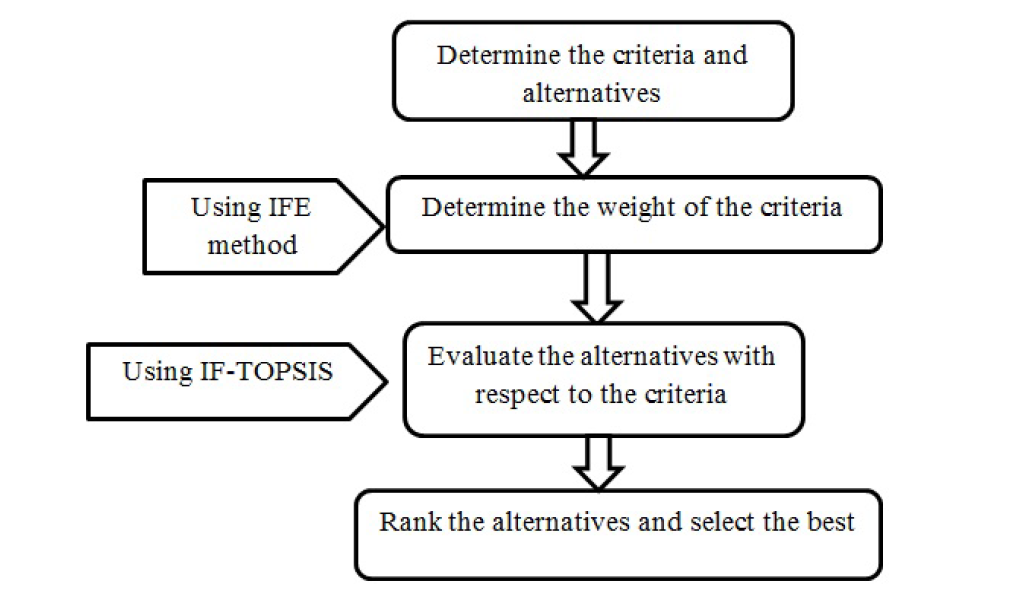
The schematic diagram of the proposed model
Step 1
Set up a group of Decision Makers (DMs) and aggregate their evaluations using Intuitionistic Fuzzy Weighted Geometric (IFWG) operator [20]. Once the DMs has given their judgment using linguistic variables, the variables are then converted to the intuitionistic fuzzy number (IFNs), as shown in Table 1. The weight vector λ = (λ1, λ2, λ3, .., λl)T is used to aggregate all the DMs individual assessment matrices Dk (k = 1, 2, 3,..., l) into the group assessment matrix (i.e. intuitionistic fuzzy decision matrix) Ryxz(xij).
Fuzzy numbers for approximating the linguistic variable
| Linguistic terms | Intuitionistic fuzzy number |
|---|---|
| Very low (VL) | (0.30, 0.40) |
| Low (L) | (0.50, 0.50) |
| Good (G) | (0.50, 0.60) |
| High (H) | (0.70, 0.80) |
| Excellent (EX) | (0.90, 0.90) |
Step 2
Determine the weight of each of the evaluating criteria wj using the IFE method.
Step 3
Using the exponential related function ER (i.e. equation 8) convert the intuitionistic fuzzy decision matrix Ryxz(xij) to form the exponential related matrix EMyxz (ERij (aij)), which represents the aggregated effect of the positive and negative evaluations in the performance ratings of the alternatives based on the intuitionistic fuzzy set (IFS) data.
Step 4
Define the IFPIS A+ = (µj, vj) and IFNIS A− = (µj, vj) for the alternatives.
Step 5
Compute the exponential-related function-based separation measures in intuitionistic fuzzy environment
where wj is the weight of the criteria.
Step 6
Compute the relative closeness coefficient, (CCi), which is defined to rank all possible alternatives with respect to the positive ideal solution A+. The general formula is given as;
where CCi (i = 1, 2, ..n) is the relative closeness coefficient of Ai with respect to the positive ideal solution A+ and 0 ≤ CCi ≤ 1.
Step 7
Rank the alternatives in the descending order.
4 Illustrative Examples
Case 1
Let’s consider a practical decision-making problem originally reported in [21]. In this case, the original problem is modified to make a new example, however, using the same decision matrices while the attributes weight are derived using the intuitionistic fuzzy entropy method.
Suppose a product manufacturing company want to select a preferred floppy disk from a group of candidates; S1, S2, and S3 as a reference disk for a new design. A group of three experts with the following weights values λ = {0.35, 0.36, 0.28} respectively, are to make a decision about the floppy disk with respect to the following criteria: Performance (C1), Appearance (C2) and Cost (C3). The experts’ preference judgments are given as shown in Table 2. Using the algorithm of the IF-TOPSIS and the IFE as given in section 3, the best floppy disk design from the three design alternatives with respect to the three criteria is selected.
The expert’s individual preference judgments
| C1 | C2 | C3 | ||
|---|---|---|---|---|
| E1 | S1 | (0.013, 0.129) | (0.028, 0.144) | (0.021, 0.136) |
| S2 | (0.013, 0.107) | (0.038, 0.139) | (0.047, 0.155) | |
| S3 | (0.003, 0.042]) | (0.018, 0.054) | (0.014, 0.150) | |
| E2 | S1 | (0.040, 0.161) | (0.034, 0.093) | (0.047, 0.199) |
| S2 | (0.047, 0.127) | (0.040, 0.081) | (0.102, 0.206) | |
| S3 | (0.014, 0.113) | (0.016, 0.086) | (0.030, 0.187) | |
| E3 | S1 | (0.006, 0.118) | (0.004, 0.053) | (0.003, 0.174) |
| S2 | (0.015, 0.046) | (0.001, 0.026) | (0.021, 0.157) | |
| S3 | (0.009, 0.034) | (0.005, 0.019) | (0.011, 0.103) |
In Steps 1&2, the individual expert’s assessments for the three designs with respect to the criteria are aggregated using the IFWG operator. The final comprehensive group assessment matrix for the expert’s assessment, called the intuitionistic fuzzy decision matrix R3x3(xij), is given in Table 3. The criteria weight is calculated from the intuitionistic fuzzy matrix using the IFE method which can be calculated by inputting the formula in a Microsoft excel program. The final result is given as w = {0.29, 0.23, 0.47 respectively.
Intuitionistic fuzzy decision matrix
| C1 | C2 | C3 | |
|---|---|---|---|
| S1 | (0.01572, 0.137701) | (0.017381, 0.100663) | (0.016271, 0.169955) |
| S2 | (0.021565, 0.097692) | (0.01392, 0.087304) | (0.049624, 0.174406) |
| S3 | (0.007142, 0.06619) | (0.012031, 0.056134) | (0.017245, 0.150849) |
In step 3–5, using the exponential-related function, the intuitionistic fuzzy decision matrix R3x3(xij) is converted to form the exponential related matrix EM3x3 (ERij (aij)), while the exponential related function-based separation measures
The relative closeness coefficients for the three design alternatives
| C1 | C2 | C3 | CCi | Ranking | |||
|---|---|---|---|---|---|---|---|
| S1 | 1.387 | 1.391 | 1.382 | 0.2224 | 0.8011 | 0.7827 | 2 |
| S2 | 1.391 | 1.392 | 1.380 | 0.2223 | 0.8010 | 0.7828 | 1 |
| S3 | 1.394 | 1.394 | 1.385 | 0.2245 | 0.8032 | 0.7816 | 3 |
From the ranking result of the three floppy design alternatives, we can conclude therefore that the design concept S2 is the best design based on the three evaluating criteria provided by the three Expert’s preference judgments. Table 5 shows that the result is totally in agreement with the result in [21]. This proves the effectiveness and feasibility of the proposed model at handling uncertainty and for decision-making.
Case 2
Let’s consider another decision-making problem originally reported by Joshi & Kumar [22]. In this case, the problem has been modified to make a new example using the same decision matrix, while the attributes weights are derived using the intuitionistic fuzzy entropy method.
Suppose a design company wants to select the best concept design for a new air-conditions system from the following alternatives S1, S2, S3, and S4. The DMs are to evaluate and select the best concept design with respect to Safety (C1), Attractive design (C2) and Reliability criteria (C3) design cost (C4) and compatibility design (C5). The aggregated DMs preference judgments are presented in Table 6 (i.e. Intuitionistic fuzzy decision matrix). From these the best concept design for the new air-conditions system can be selected based on the IF-TOPSIS and IFE method.
Intuitionistic fuzzy decision matrix
| C1 | C2 | C3 | C4 | C5 | |
|---|---|---|---|---|---|
| S1 | (0.230, 0.587) | (0.610, 0.200) | (0.192, 0.630) | (0.220, 0.750) | (0.196, 0.620) |
| S2 | (0.260, 0.554) | (0.200, 0.610) | (0.633, 0.192) | (0.094, 0.875) | (0.620, 0.196) |
| S3 | (0.620, 0.197) | (0.610, 0.200) | (0.259, 0.560) | (0.310, 0.660) | (0.227, 0.590) |
| S4 | (0.197, 0.620) | (0.360, 0.454) | (0.337, 0.484) | (0.150, 0.820) | (0.322, 0.500) |
Using the IF-TOPSIS algorithm we select the best concept design for an air conditions system, where the criteria weight is calculated from the intuitionistic fuzzy matrix using the IFE method. The result of the evaluation is given as:
respectively.
Using the exponential-related function, the intuitionistic fuzzy decision matrix R4x5(xij) is converted to form the exponential related matrix EM4x5 (ERij (aij)), while the exponential related function-based separation measures
The relative closeness coefficients for the four design alternatives
| C1 | C2 | C3 | C4 | C5 | CCi | Ranking | |||
|---|---|---|---|---|---|---|---|---|---|
| S1 | 1.5381 | 1.2494 | 1.5736 | 1.6565 | 1.5662 | 0.3056 | 0.8056 | 0.7250 | 2 |
| S2 | 1.5115 | 1.5590 | 1.2362 | 1.7961 | 1.2436 | 0.3467 | 0.8403 | 0.7079 | 4 |
| S3 | 1.2438 | 1.2494 | 1.5151 | 1.5628 | 1.5406 | 0.2582 | 0.7567 | 0.7456 | 1 |
| S4 | 1.5660 | 1.4317 | 1.4529 | 1.7332 | 1.4654 | 0.3311 | 0.8309 | 0.7151 | 3 |
From the ranking result of the four air-conditions system design alternatives, we conclude that the S3 is the best design with respect to the five evaluating criteria. The result is totally in agreement with the result in [22] (Table 8).
Case 3
Finally, Let us consider a practical MCDM problem originally reported by Ye [23] and adopted by Liu & Ren [24]. In this case, the original problem has been modified to make a new example, however, using the same decision matrix.
Suppose a computer manufacturing company wants to select a preferred mouse from a group of candidates; A1, A2, A3 and A4 as a reference mouse for a new design. Again, a group of experts is asked to make a decision with respect to Performance (C1), Cost (C2) and Appearance (C3). The experts aggregated evaluations are given in Table 9. We select the preferred mouse using the IF-TOPSIS method.
Intuitionistic fuzzy decision matrix
| C1 | C2 | C3 | |
|---|---|---|---|
| A1 | (0.45, 0.35) | (0.50, 0.30) | (0.20, 0.55) |
| A2 | (0.65, 0.25) | (0.65, 0.25) | (0.55, 0.15) |
| A3 | (0.45, 0.35) | (0.55, 0.35) | (0.55, 0.20) |
| A4 | (0.75, 0.15) | (0.65, 0.20) | (0.35, 0.15) |
Using the IFE method, the criteria weight is calculated from the intuitionistic fuzzy matrix and the result is given as w = {0.377, 0.311, 0.313 respectively. Using the exponential-related function, just as in case 1&2, the intuitionistic fuzzy decision matrix R4x3 (xij) is converted to form the exponential related matrix and the exponential related function-based separation measures
The relative closeness coefficients of the four candidates
| C1 | C2 | C3 | CCi | Ranking | |||
|---|---|---|---|---|---|---|---|
| A1 | 1.3589 | 1.3231 | 1.5232 | 0.2348 | 0.8111 | 0.7755 | 4 |
| A2 | 1.2378 | 1.2378 | 1.2712 | 0.1438 | 0.7233 | 0.8342 | 1 |
| A3 | 1.3589 | 1.3143 | 1.2787 | 0.1881 | 0.7671 | 0.8031 | 3 |
| A4 | 1.1657 | 1.2285 | 1.3499 | 0.1446 | 0.7188 | 0.8325 | 2 |
From the ranking result of the four alternative mouse designs, we conclude that the A2 is the best design with respect to the three evaluating criteria, and the ranking result is in agreement with the result in [23, 24] as shown in Table 11.
5 Conclusion
In this paper, we have proposed a new matrix method (i.e. the exponential-related function (ER)) for comparing intuitionistic fuzzy sets, and as a replacement for the traditional exponential score function originally proposed by Wu [17], which have been found ineffective for solving some MCDM problems. The new exponential-related function (ER), which has been developed and adopted in the intuitionistic fuzzy TOPSIS model and intuitionistic fuzzy entropy is used for solving MCDM problems in which the weight of the evaluating criteria are completely unknown and the performance ratings of the alternatives are expressed in IFN. The criteria weight here, have been calculated using the intuitionistic fuzzy entropy method originally proposed by Ye [19].
The main advantage and contribution of the new method and approach is that (1) it uses an objective approach for the computation of the criteria weight, which allows for complete assessment of the actual performance of each of the criteria by assisting in the identification of the difference between the present situation (which is considered to be ideal) and the level of performance it intended to achieved in the future. (2) Simplicity in the MCDM method both in its concept and computational procedures as compared to other existing methods. (3) The application of the exponential-related function, which stands to represent the aggregated effect of the positive and negative evaluations in the performance ratings of the alternatives based on the intuitionistic fuzzy set (IFS) data and (4) finally, it serves as a parameter and a better alternative to the Euclidian distance that often has correlation issues, in the computation of the separation measures of each alternative from the intuitionistic fuzzy positive and negative ideal solution which is used in the determination of the relative closeness coefficient.
To validate the feasibility and effectiveness of the method, the IF-TOPSIS, model has been applied for the assessment of some engineering designs related problems including selection of a preferred floppy disk from a group of design alternatives, the selection of the best concept design for a new air-conditions system and finally, for the selection of a preferred mouse from a group of alternatives as a reference for a new design. In the future, we will continue working on the application of the proposed method in other domain, specifically for problems with more criteria and alternatives and to make some comparisons with the adaptive fuzzy control of strict-feedback nonlinear time-delay systems, which have recently found applications in the intuitionistic fuzzy environment.
References
[1] Atanassov K. T., Intuitionistic fuzzy sets, Fuzzy Sets Syst., 1986, 20 (1), 87-9610.1016/S0165-0114(86)80034-3Search in Google Scholar
[2] Wan S. P., Li D. F., Fuzzy mathematical programming approach to heterogeneous multiattribute decision-making with interval-valued intuitionistic fuzzy truth degrees, Inf. Sci. (Ny)., 2015, 325, 484-50310.1016/j.ins.2015.07.014Search in Google Scholar
[3] Aikhuele D. O., Turan F. B. M., An Improved Methodology for Multi-criteria Evaluations in the Shipping Industry, Brodogradnja/Shipbuilding, 2016, 67 (3), 59-7210.21278/brod67304Search in Google Scholar
[4] Xu Z., Member S., Liao H., Intuitionistic fuzzy analytic hierarchy process, IEEE Trans. Fuzzy Syst., 2014, 20 (4), 749-76110.1109/TFUZZ.2013.2272585Search in Google Scholar
[5] Xu Z., Approaches to multiple attribute group decision making based on intuitionistic fuzzy power aggregation operators, Knowledge-Based Syst., 2011, 24 (6), 749-76010.1016/j.knosys.2011.01.011Search in Google Scholar
[6] Tsaura S. H., Chang T. Y., Yen C. H., The evaluation of airline service quality by fuzzy MCDM, Tour. Manag., 2002, 23 (2), 107-11510.1016/S0261-5177(01)00050-4Search in Google Scholar
[7] Chen W., Wang L., Lin M., A Hybrid MCDM Model for New Product Development?: Applied on the Taiwanese LiFePO 4 Industry, Math. Probl. Eng., 2014, 2015, 1-1510.1155/2015/462929Search in Google Scholar
[8] Azizi A., Aikhuele D. O., Souleman F. S., A Fuzzy TOPSIS Model to Rank Automotive Suppliers, Procedia Manuf., 2015, 2, 159-16410.1016/j.promfg.2015.07.028Search in Google Scholar
[9] Huang C., Hung Y., Tzeng G., Using Hybrid MCDM Methods to Assess Fuel Cell Technology for the Next Generation of Hybrid Power Automobiles, J. Adv. Comp. Intell. & Intelligent informatics, 2011, 15 (4) 406-41810.20965/jaciii.2011.p0406Search in Google Scholar
[10] Aikhuele D. O., Turan F. B. M., Intuitionistic fuzzy-based model for failure detection, Springerplus, 2016, 5 (1), 1-1510.1186/s40064-016-3446-0Search in Google Scholar PubMed PubMed Central
[11] Hwang C. L., Yoon K., Multiple Attribute Decision Making Methods and Applications. Berlin: Springer, 198110.1007/978-3-642-48318-9Search in Google Scholar
[12] Aikhuele D. O., Turan F. M., A modified exponential score function for troubleshooting an improved locally made Offshore Patrol Boat engine, J. Mar. Eng. Technol., (in press), DOI:10.1080/20464177.2017.128684110.1080/20464177.2017.1286841Search in Google Scholar
[13] Aikhuele D. O., Turan F. M., An Interval Fuzzy-Valued M-TOPSIS Model for Design Concept Selection, Natl. Conf. Postgrad. Res. 2016, Univ. Malaysia Pahang, 2016, 374-384Search in Google Scholar
[14] Hong D. H., Choi C.H., Multi-criteria fuzzy decision making problems based on vague set theory, Fuzzy Sets Syst., 2000, 114 (1), 103-11310.1016/S0165-0114(98)00271-1Search in Google Scholar
[15] Chen S.M., Tan J.M., Handling multicriteria fuzzy decisionmaking problems based on vague set theory, Fuzzy Sets Syst., 1994, 67 (2), 163-17210.1016/0165-0114(94)90084-1Search in Google Scholar
[16] Xu Z., Intuitionistic preference relations and their application in group decision making, Inf. Sci. (Ny)., 2007, 177 (11), 2363-237910.1016/j.ins.2006.12.019Search in Google Scholar
[17] Wu J., Consistency in MCGDM Problems with Intuitionistic Fuzzy Preference Relations Based on an Exponential Score Function, Gr. Decis. Negot., 2015, 25 (2), 399-42010.1007/s10726-015-9447-5Search in Google Scholar
[18] Aikhuele D. O., Turan F. M., Extended TOPSIS model for solving multi-attribute decision making problems in engineering, Decis. Sci. Lett., vol. 6, pp. 365-376, 201710.5267/j.dsl.2017.2.002Search in Google Scholar
[19] Ye J., Two effective measures of intuitionistic fuzzy entropy, Comput. (Vienna/New York), 2010, 87 (2), 55-6210.1007/s00607-009-0075-2Search in Google Scholar
[20] Xu Z., Yager R. R., Some geometric aggregation operators based on intuitionistic fuzzy sets, Int. J. Gen. Syst., 2006, 35 (4), 417-43310.1080/03081070600574353Search in Google Scholar
[21] Yue Z., An extended TOPSIS for determining weights of decision makers with interval numbers, Knowledge-Based Syst., 2011, 24 (1), 146-15310.1016/j.knosys.2010.07.014Search in Google Scholar
[22] Joshi D., Kumar S., Intuitionistic fuzzy entropy and distance measure based TOPSIS method for multi-criteria decision making, Egypt. Informatics J., 2014, 15 (2), 97-10410.1016/j.eij.2014.03.002Search in Google Scholar
[23] Ye J., Fuzzy decision-making method based on the weighted correlation coefficient under intuitionistic fuzzy environment, Eur. J. Oper. Res., 2010, 205 (1), 202-20410.1016/j.ejor.2010.01.019Search in Google Scholar
[24] Liu M., Ren H., A New Intuitionistic Fuzzy Entropy and Application in Multi-Attribute Decision Making, Information, 2014, 5 (4), 587-60110.3390/info5040587Search in Google Scholar
© 2017 Daniel O. Aikhuele and Faiz Mohd Turan
This work is licensed under the Creative Commons Attribution-NonCommercial-NoDerivatives 3.0 License.
Articles in the same Issue
- Regular Articles
- The Differential Pressure Signal De-noised by Domain Transform Combined with Wavelet Threshold
- Regular Articles
- Robot-operated quality control station based on the UTT method
- Regular Articles
- Regression Models and Fuzzy Logic Prediction of TBM Penetration Rate
- Regular Articles
- Numerical study of chemically reacting unsteady Casson fluid flow past a stretching surface with cross diffusion and thermal radiation
- Regular Articles
- Experimental comparison between R409A and R437A performance in a heat pump unit
- Regular Articles
- Rapid prediction of damage on a struck ship accounting for side impact scenario models
- Regular Articles
- Implementation of Non-Destructive Evaluation and Process Monitoring in DLP-based Additive Manufacturing
- Regular Articles
- Air purification in industrial plants producing automotive rubber components in terms of energy efficiency
- Regular Articles
- On cyclic yield strength in definition of limits for characterisation of fatigue and creep behaviour
- Regular Articles
- Development of an operation strategy for hydrogen production using solar PV energy based on fluid dynamic aspects
- Regular Articles
- An exponential-related function for decision-making in engineering and management
- Regular Articles
- Usability Prediction & Ranking of SDLC Models Using Fuzzy Hierarchical Usability Model
- Regular Articles
- Exact Soliton and Kink Solutions for New (3+1)-Dimensional Nonlinear Modified Equations of Wave Propagation
- Regular Articles
- Entropy generation analysis and effects of slip conditions on micropolar fluid flow due to a rotating disk
- Regular Articles
- Application of the mode-shape expansion based on model order reduction methods to a composite structure
- Regular Articles
- A Combinatory Index based Optimal Reallocation of Generators in the presence of SVC using Krill Herd Algorithm
- Regular Articles
- Quality assessment of compost prepared with municipal solid waste
- Regular Articles
- Influence of polymer fibers on rheological properties of cement mortars
- Regular Articles
- Degradation of flood embankments – Results of observation of the destruction mechanism and comparison with a numerical model
- Regular Articles
- Mechanical Design of Innovative Electromagnetic Linear Actuators for Marine Applications
- Regular Articles
- Influence of addition of calcium sulfate dihydrate on drying of autoclaved aerated concrete
- Regular Articles
- Analysis of Microstrip Line Fed Patch Antenna for Wireless Communications
- Regular Articles
- PEMFC for aeronautic applications: A review on the durability aspects
- Regular Articles
- Laser marking as environment technology
- Regular Articles
- Influence of grain size distribution on dynamic shear modulus of sands
- Regular Articles
- Field evaluation of reflective insulation in south east Asia
- Regular Articles
- Effects of different production technologies on mechanical and metallurgical properties of precious metal denture alloys
- Regular Articles
- Mathematical description of tooth flank surface of globoidal worm gear with straight axial tooth profile
- Regular Articles
- Earth-based construction material field tests characterization in the Alto Douro Wine Region
- Regular Articles
- Experimental and Mathematical Modeling for Prediction of Tool Wear on the Machining of Aluminium 6061 Alloy by High Speed Steel Tools
- Special Issue on Current Topics, Trends and Applications in Logistics
- 10.1515/eng-2017-0001
- Special Issue on Current Topics, Trends and Applications in Logistics
- The Methodology of Selecting the Transport Mode for Companies on the Slovak Transport Market
- Special Issue on Current Topics, Trends and Applications in Logistics
- Determinants of Distribution Logistics in the Construction Industry
- Special Issue on Current Topics, Trends and Applications in Logistics
- Management of Customer Service in Terms of Logistics Information Systems
- Special Issue on Current Topics, Trends and Applications in Logistics
- The Use of Simulation Models in Solving the Problems of Merging two Plants of the Company
- Special Issue on Current Topics, Trends and Applications in Logistics
- Applying the Heuristic to the Risk Assessment within the Automotive Industry Supply Chain
- Special Issue on Current Topics, Trends and Applications in Logistics
- Modeling the Supply Process Using the Application of Selected Methods of Operational Analysis
- Special Issue on Current Topics, Trends and Applications in Logistics
- Possibilities of Using Transport Terminals in South Bohemian Region
- Special Issue on Current Topics, Trends and Applications in Logistics
- Comparison of the Temperature Conditions in the Transport of Perishable Foodstuff
- Special Issue on Current Topics, Trends and Applications in Logistics
- E-commerce and its Impact on Logistics Requirements
- Topical Issue Modern Manufacturing Technologies
- Wear-dependent specific coefficients in a mechanistic model for turning of nickel-based superalloy with ceramic tools
- Topical Issue Modern Manufacturing Technologies
- Effects of cutting parameters on machinability characteristics of Ni-based superalloys: a review
- Topical Issue Desktop Grids for High Performance Computing
- Task Scheduling in Desktop Grids: Open Problems
- Topical Issue Desktop Grids for High Performance Computing
- A Volunteer Computing Project for Solving Geoacoustic Inversion Problems
- Topical Issue Desktop Grids for High Performance Computing
- Improving “tail” computations in a BOINC-based Desktop Grid
- Topical Issue Desktop Grids for High Performance Computing
- LHC@Home: a BOINC-based volunteer computing infrastructure for physics studies at CERN
- Topical Issue Desktop Grids for High Performance Computing
- Comparison of Decisions Quality of Heuristic Methods with Limited Depth-First Search Techniques in the Graph Shortest Path Problem
- Topical Issue Desktop Grids for High Performance Computing
- Using Volunteer Computing to Study Some Features of Diagonal Latin Squares
- Topical Issue on Mathematical Modelling in Applied Sciences, II
- A polynomial algorithm for packing unit squares in a hypograph of a piecewise linear function
- Topical Issue on Mathematical Modelling in Applied Sciences, II
- Numerical Validation of Chemical Compositional Model for Wettability Alteration Processes
- Topical Issue on Mathematical Modelling in Applied Sciences, II
- Innovative intelligent technology of distance learning for visually impaired people
- Topical Issue on Mathematical Modelling in Applied Sciences, II
- Implementation and verification of global optimization benchmark problems
- Topical Issue on Mathematical Modelling in Applied Sciences, II
- On a program manifold’s stability of one contour automatic control systems
- Topical Issue on Mathematical Modelling in Applied Sciences, II
- Multi-agent grid system Agent-GRID with dynamic load balancing of cluster nodes
Articles in the same Issue
- Regular Articles
- The Differential Pressure Signal De-noised by Domain Transform Combined with Wavelet Threshold
- Regular Articles
- Robot-operated quality control station based on the UTT method
- Regular Articles
- Regression Models and Fuzzy Logic Prediction of TBM Penetration Rate
- Regular Articles
- Numerical study of chemically reacting unsteady Casson fluid flow past a stretching surface with cross diffusion and thermal radiation
- Regular Articles
- Experimental comparison between R409A and R437A performance in a heat pump unit
- Regular Articles
- Rapid prediction of damage on a struck ship accounting for side impact scenario models
- Regular Articles
- Implementation of Non-Destructive Evaluation and Process Monitoring in DLP-based Additive Manufacturing
- Regular Articles
- Air purification in industrial plants producing automotive rubber components in terms of energy efficiency
- Regular Articles
- On cyclic yield strength in definition of limits for characterisation of fatigue and creep behaviour
- Regular Articles
- Development of an operation strategy for hydrogen production using solar PV energy based on fluid dynamic aspects
- Regular Articles
- An exponential-related function for decision-making in engineering and management
- Regular Articles
- Usability Prediction & Ranking of SDLC Models Using Fuzzy Hierarchical Usability Model
- Regular Articles
- Exact Soliton and Kink Solutions for New (3+1)-Dimensional Nonlinear Modified Equations of Wave Propagation
- Regular Articles
- Entropy generation analysis and effects of slip conditions on micropolar fluid flow due to a rotating disk
- Regular Articles
- Application of the mode-shape expansion based on model order reduction methods to a composite structure
- Regular Articles
- A Combinatory Index based Optimal Reallocation of Generators in the presence of SVC using Krill Herd Algorithm
- Regular Articles
- Quality assessment of compost prepared with municipal solid waste
- Regular Articles
- Influence of polymer fibers on rheological properties of cement mortars
- Regular Articles
- Degradation of flood embankments – Results of observation of the destruction mechanism and comparison with a numerical model
- Regular Articles
- Mechanical Design of Innovative Electromagnetic Linear Actuators for Marine Applications
- Regular Articles
- Influence of addition of calcium sulfate dihydrate on drying of autoclaved aerated concrete
- Regular Articles
- Analysis of Microstrip Line Fed Patch Antenna for Wireless Communications
- Regular Articles
- PEMFC for aeronautic applications: A review on the durability aspects
- Regular Articles
- Laser marking as environment technology
- Regular Articles
- Influence of grain size distribution on dynamic shear modulus of sands
- Regular Articles
- Field evaluation of reflective insulation in south east Asia
- Regular Articles
- Effects of different production technologies on mechanical and metallurgical properties of precious metal denture alloys
- Regular Articles
- Mathematical description of tooth flank surface of globoidal worm gear with straight axial tooth profile
- Regular Articles
- Earth-based construction material field tests characterization in the Alto Douro Wine Region
- Regular Articles
- Experimental and Mathematical Modeling for Prediction of Tool Wear on the Machining of Aluminium 6061 Alloy by High Speed Steel Tools
- Special Issue on Current Topics, Trends and Applications in Logistics
- 10.1515/eng-2017-0001
- Special Issue on Current Topics, Trends and Applications in Logistics
- The Methodology of Selecting the Transport Mode for Companies on the Slovak Transport Market
- Special Issue on Current Topics, Trends and Applications in Logistics
- Determinants of Distribution Logistics in the Construction Industry
- Special Issue on Current Topics, Trends and Applications in Logistics
- Management of Customer Service in Terms of Logistics Information Systems
- Special Issue on Current Topics, Trends and Applications in Logistics
- The Use of Simulation Models in Solving the Problems of Merging two Plants of the Company
- Special Issue on Current Topics, Trends and Applications in Logistics
- Applying the Heuristic to the Risk Assessment within the Automotive Industry Supply Chain
- Special Issue on Current Topics, Trends and Applications in Logistics
- Modeling the Supply Process Using the Application of Selected Methods of Operational Analysis
- Special Issue on Current Topics, Trends and Applications in Logistics
- Possibilities of Using Transport Terminals in South Bohemian Region
- Special Issue on Current Topics, Trends and Applications in Logistics
- Comparison of the Temperature Conditions in the Transport of Perishable Foodstuff
- Special Issue on Current Topics, Trends and Applications in Logistics
- E-commerce and its Impact on Logistics Requirements
- Topical Issue Modern Manufacturing Technologies
- Wear-dependent specific coefficients in a mechanistic model for turning of nickel-based superalloy with ceramic tools
- Topical Issue Modern Manufacturing Technologies
- Effects of cutting parameters on machinability characteristics of Ni-based superalloys: a review
- Topical Issue Desktop Grids for High Performance Computing
- Task Scheduling in Desktop Grids: Open Problems
- Topical Issue Desktop Grids for High Performance Computing
- A Volunteer Computing Project for Solving Geoacoustic Inversion Problems
- Topical Issue Desktop Grids for High Performance Computing
- Improving “tail” computations in a BOINC-based Desktop Grid
- Topical Issue Desktop Grids for High Performance Computing
- LHC@Home: a BOINC-based volunteer computing infrastructure for physics studies at CERN
- Topical Issue Desktop Grids for High Performance Computing
- Comparison of Decisions Quality of Heuristic Methods with Limited Depth-First Search Techniques in the Graph Shortest Path Problem
- Topical Issue Desktop Grids for High Performance Computing
- Using Volunteer Computing to Study Some Features of Diagonal Latin Squares
- Topical Issue on Mathematical Modelling in Applied Sciences, II
- A polynomial algorithm for packing unit squares in a hypograph of a piecewise linear function
- Topical Issue on Mathematical Modelling in Applied Sciences, II
- Numerical Validation of Chemical Compositional Model for Wettability Alteration Processes
- Topical Issue on Mathematical Modelling in Applied Sciences, II
- Innovative intelligent technology of distance learning for visually impaired people
- Topical Issue on Mathematical Modelling in Applied Sciences, II
- Implementation and verification of global optimization benchmark problems
- Topical Issue on Mathematical Modelling in Applied Sciences, II
- On a program manifold’s stability of one contour automatic control systems
- Topical Issue on Mathematical Modelling in Applied Sciences, II
- Multi-agent grid system Agent-GRID with dynamic load balancing of cluster nodes
