Usability Prediction & Ranking of SDLC Models Using Fuzzy Hierarchical Usability Model
-
 ,
,

Abstract
Evaluation of software quality is an important aspect for controlling and managing the software. By such evaluation, improvements in software process can be made. The software quality is significantly dependent on software usability. Many researchers have proposed numbers of usability models. Each model considers a set of usability factors but do not cover all the usability aspects. Practical implementation of these models is still missing, as there is a lack of precise definition of usability. Also, it is very difficult to integrate these models into current software engineering practices.
In order to overcome these challenges, this paper aims to define the term ‘usability’ using the proposed hierarchical usability model with its detailed taxonomy. The taxonomy considers generic evaluation criteria for identifying the quality components, which brings together factors, attributes and characteristics defined in various HCI and software models. For the first time, the usability model is also implemented to predict more accurate usability values. The proposed system is named as fuzzy hierarchical usability model that can be easily integrated into the current software engineering practices. In order to validate the work, a dataset of six software development life cycle models is created and employed. These models are ranked according to their predicted usability values. This research also focuses on the detailed comparison of proposed model with the existing usability models.
1 Introduction
Over the few decades the software engineering practices have been changing to produce good quality software products. According to International Standard Organization (ISO) [1] there have been different quality factors like efficiency, effectiveness, reliability, usability etc. The general quality factors are Functionality, Reliability, Usability, Efficiency, Maintainability and Portability.
Among these quality factors, usability is a significant software quality factor that needs to be considered during software development. The term usability is derived from user friendly. Many software engineering experts define usability in their own term.
In simplest term, software usability is the ease of use, remembrance and learnability of a human-made object. The object can be a website, software application, tool, book, machine, process, or anything a human interacts with. A usability study must be conducted as a primary job by usability analyst or as a secondary job by designers, marketing personnel, technical writers, and others. Basically, usability eases the human computer interaction so that the user can communicate better with the software system. Usability can also be defined as an extent to which a product can be used by a specific group of users to achieve the specified usability goals like effectiveness, efficiency and satisfaction.
There are various standards, characterizing the quality of software and defines the term usability as follows:
The ISO/IEC 9126 defines the usability in terms of the effort needed for use [2].
The ISO/IEC 9126 again redefines the definition of usability as capability of the software to be understood by user under certain conditions.
The ISO 9241-11 defines usability in terms of efficiency, effectiveness, and effectiveness in a specified context of use [1].
The IEEE Std.610.12-1990 defines usability in terms of learnability, input and output efficiency of system [3].
2 Literature review
Different usability models have been proposed for quantifying and assessing the software usability. In this section, some of these models are described, highlighting the attributes on which usability depends. Some research practitioners have proposed the following usability models:
The usability attributes classified by Nielsen (1993) and Nielsen et al. (2006) refer to learnability, efficiency, memorability, errors, and satisfaction [4]. Holzinger (2005), considers these usability attributes to be widely accepted attributes.
Quesenbery (2001, 2003, and 2004) has listed the attributes of a usable product as effectiveness, efficiency, engagement, error tolerance, and ease of learning.
Abran et al. (2003) has extended the ISO 9241-11 definition by adding two further attributes, namely, learnability (already adopted by IEEE, 1990; ISO/IEC 9126-1, 2001; Nielsen, 1993) and security [6].
The classification by Seffah et al. (2006) also departs from ISO 9241-11. Seffah et al. (2006) has provided more elaborative classification of usability, as it defines 10 usability factors (efficiency, effectiveness, productivity, satisfaction, learnability, safety, trustfulness, accessibility, universality, and usefulness) with 26 measurable usability criteria. Each of these criteria is associated with other (interrelated factors)—for example, privacy with trustfulness, universality, and usefulness [7].
Usability attributes in various proposed usability models
| Author name, who proposed usability models | Usability Attributes |
|---|---|
| Abran et al. [6] | Efficiency, Effectiveness, Satisfaction, Learnability, Security |
| Alonso-Rios et al. [8] | Knowability, Operability, Efficiency, Robustness, Safety, Subjective Satisfaction |
| Bass et al. [9] | Modifiability, Scalability, Reusability, Performance, Security |
| Bevan et al. [10] | Type of Product, Type of User, Ease of Use, Acceptability |
| Boehm [11] | Portability, Maintainability |
| Dix et al. [12] | Learnability, Flexibility, Robustness |
| Donyaee et al. [13] | Efficiency, Effectiveness, Productivity, Satisfaction, Learnability, Safety, Trustfulness, Accessibility, Universality, Usefulness |
| Dubey et al. [14] | Effectiveness, Efficiency, Satisfaction, Learnability |
| IEEE Std. 1061 [3] | Comprehensibility, Ease of Learning, Communicativeness |
| ISO 9126-1 [2] | Understandability, Learnability, Operability, Attractiveness, Usability compliance |
| ISO 9241-11 [1] | Effectiveness, Efficiency, Satisfaction |
| McCall [15] | Operability, Training, Communicativeness |
| Nielsen [4] | Learnability, Efficiency, Memorability, Errors, Satisfaction |
| Preece et al. [5] | Safety, Effectiveness, Efficiency, Enjoyableness |
| Preece et al. [5] | Learnability, Efficiency, Throughput, Flexibility, Attitude |
| Schneiderman et al. [16] | Time to learn, Speed of Performance, Rate of Errors by users, Retention over time, Subjective Satisfaction. |
| Shackel [17] | Effectiveness, Learnability, Flexibility, Subjectively Pleasing |
3 The proposed hierarchical usability model
In [1–13, 15–17], we have seen and studied a large number of international standards and usability models, which describe usability covering different attributes in nonhomogeneous manner. Therefore, it creates confusion among research practitioners or experts for its usage and applications. This inconsistent approach among usability model is creating major challenge for evaluation of usability of application. Researchers can’t attain consensus for usability’s definition and have poor information for deciding a set of usability factor. This research theme requires a hierarchical based usability model which should be consolidated to incorporate consistency in usability. Hence, usability model should be generic so that developers can measure usability without any confusion.
3.1 Proposed Hierarchical Usability Model
This section proposes a consolidated, hierarchical usability model with its detailed taxonomy. This model can easily measure the usability of the software product. Specifically, the new model combines’ usability factors, attributes, characteristics for software product quality and explain them in a consistent way. The proposed model defines the usability using seven factors that are mentioned below:
Efficiency, it is a measure of software product that enables user to produce desired results with respect to investment of resources.
Effectiveness, it is a measure of software product with which user can accomplish specified tasks and desired results with completeness and certainty.
Satisfaction, it is a measure of responses, feelings of user when users are using the software i.e. freedom from discomfort, likeability.
Memorability, it is defined as the property of software product that enables the user to remember the elements and the functionality of the system product.
Security, it is defined as the degree to which risks and damages to people or other resources i.e. hardware and software can be avoided.
Universality, it reflects the accommodation of different cultural backgrounds of diverse users with software product and practical utility of software product.
Productivity: it is defined as the amount of useful output with the software product.
3.2 Taxonomy of proposed hierarchical usability model
The proposed model consists of the 7 factors, each representing a specific facet of usability. These factors are decomposed into a total of 23 attributes, where each attributes is defined using any of the 42 characteristics. The factors and their attributes are related to each other in a hierarchical manner and are shown in Figure 1.
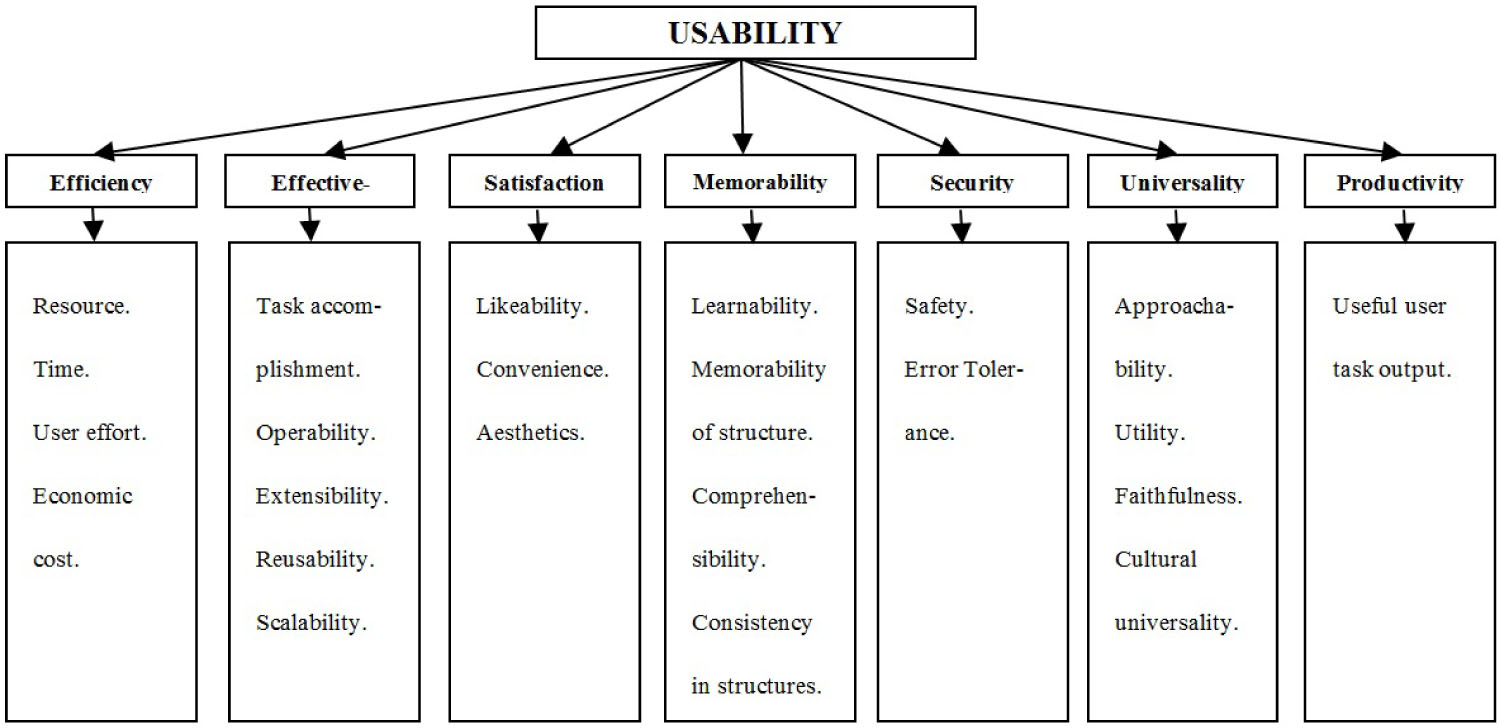
Detailed taxonomy of the hierarchical proposed model.
4 Implementation of proposed hierarchical usability model
In this paper, a series of steps have been carried out for the implementation of the proposed hierarchical usability model. Figure 2 represents series of these. An attempt has been made to rank the software development life cycle(SDLC) models. The ranking of these models can be done through Fuzzy Logic Controller. A dataset has been employed which includes six SDLC models having same functionalities. Hence these SDLC models are being evaluated using the proposed model. Seven factors and their 23 attributes of proposed model have been used for analyzing the SDLC models. Each step is discussed in detail in the trailing section.

Steps for implementing the proposed model
4.1 Evaluation Criteria
Based on detailed literature review, 6 SDLC model are analyzed using the 23 attributes of the proposed model. These SDLC models are as summarized in Table 2 along with usability factors and attributes.
Detailed analysis of SDLC models using seven factors and 23 attributes of the proposed model
| Factors | Attributes | Build & Fix [19] | Waterfall [20, 21] | Evolutionary [21] | RAD [21, 22] | Iterative [20, 21] | Spiral [20, 21] |
|---|---|---|---|---|---|---|---|
| Resource | 0 | 0 | 1 | 1 | 1 | 1 | |
| Efficiency | Time | 0 | 1 | 0 | 0 | 0 | 0 |
| User Effort | 0 | 0 | 1 | 1 | 0 | 1 | |
| Economic Costs | 0 | 1 | 1 | 1 | 0 | 0 | |
| Likeability | 0 | 1 | 0 | 0 | 1 | 1 | |
| Satisfaction | Convenience | 0 | 0 | 1 | 1 | 0 | 0 |
| Aesthetics | 0 | 0 | 1 | 0 | 1 | 1 | |
| Task accomplishment | 0 | 0 | 1 | 1 | 1 | 1 | |
| Operability | 1 | 1 | 1 | 1 | 1 | 1 | |
| Effectiveness | Extensibility | 0 | 1 | 0 | 1 | 0 | 0 |
| Reusability | 0 | 0 | 0 | 1 | 0 | 1 | |
| Scalability | 0 | 1 | 1 | 0 | 0 | 1 | |
| Approachability | 1 | 1 | 0 | 0 | 0 | 0 | |
| Universality | Utility | 0 | 1 | 1 | 1 | 1 | 1 |
| Faithfulness | 0 | 0 | 1 | 0 | 0 | 1 | |
| Cultural universality | 0 | 0 | 1 | 0 | 1 | 1 | |
| Productivity | Useful user task O/p | 0 | 0 | 1 | 0 | 0 | 1 |
| Learnability | 1 | 1 | 1 | 1 | 1 | 1 | |
| Memorability | Memorability | 0 | 0 | 0 | 1 | 1 | 1 |
| Comprehensibility | 1 | 1 | 0 | 1 | 1 | 0 | |
| Consistency | 0 | 0 | 0 | 0 | 1 | 1 | |
| Security | Safety | 0 | 1 | 1 | 1 | 1 | 1 |
| Error Tolerance | 0 | 0 | 0 | 0 | 1 | 1 | |
The values in Table 2 are computed on the basis of the literature review of all the 6 SDLC models. The SDLC model that includes the attribute in it, assigns a value 1 and if a model excludes the attribute from it, then it assigns the value 0. For example ‘Build & Fix’ model includes only ‘operability’, ‘approachability’, ‘learnability’ and ‘comprehensibility’, these 4 attributes are assigned values 1 while other attributes are assigned value 0. Using the detailed analysis of SDLC models, the values of the seven factors of the proposed model can be mapped on the scale of 0-9 using probability. The intuition of chance and probability develops at very early ages [18].
However, a formal, precise definition of the probability is elusive. The probability of an event tells that how likely the event will happen. The Factorvalue can be computed by finding the probability using the equation (1) and (2):
where: P(factor) is the probability of a factor of a SDLC model; Factorvalue is the value generated for each factor of a SDLC model; Maxvalue is the maximum value of the scale i.e. 9 as we are mapping it in scale of 0–9.
Equation (1) computes the probability of a factor of a SDLC model i.e. number of available attributes out of all the attributes of a factor in an SDLC model and then equation (2), maps the value in a scale of 0–9. All these generated values have been stored in Table 3.
Mapped Factorvalue for SDLC models on the scale of 0–9
| SDLC Models | Effectiveness | Eficiency | Satisfaction | Universality | Security | Productivity | Memorability |
|---|---|---|---|---|---|---|---|
| Build & Fix [19] | 1.8 | 0 | 0 | 2.25 | 0 | 0 | 4.5 |
| Waterfall [20, 21] | 5.4 | 4.5 | 3 | 4.5 | 4.5 | 0 | 4.5 |
| Evolutionary [21] | 5.4 | 6.75 | 6. | 6.75 | 4.5 | 9 | 2.25 |
| RAD [21] | 7.2 | 6.75 | 3 | 2.25 | 4.5 | 0 | 6.75 |
| Iterative [20, 21] | 3.6 | 2.25 | 6 | 4.5 | 9 | 0 | 9 |
| Spiral [20, 21] | 7.2 | 4.5 | 6 | 6.75 | 9 | 9 | 6.75 |
For example in Table 2, effectiveness has total of 5 attributes, and evolutionary model have only three attributes whose value is 1, thus the final mapped Factorvalue of effectiveness is (3/5)⋆9 = 5.4.
4.2 Fuzzy Logic
The concept of Fuzzy Logic is introduced as a way of processing data by allowing partial set membership by Lotfi Zadeh. Fuzzy theory can play a significant role in dealing with this kind of evaluation situation. To design fuzzy model for predicting usability, the Mamdani [23] fuzzy systems is utilized. Fuzzy set is characterized by membership function that uses a value between 0 and 1 indicating complete non-membership and complete membership respectively. This can be represented as:
“X is the universe of discourse whose each element are assigned the value between 0 and 1 for a fuzzy set A” [24]. Membership functions allow fuzzy sets to be represented graphically using triangular fuzzy number (TFN) approach to represent the uncertainty or vagueness of linguistic terms [25, 26].
A TFN as shown in figure 3 is defined by a lower limit l, an upper limit u, and a value m, where l<m<u as given below using the membership function [25]:

Triangular fuzzy number (TFN) approach
4.3 Implementation of the proposed model using Fuzzy Simulink
The Proposed hierarchical usability model can be implemented using fuzzy logic controller by defining the membership function of each input (7 factors of proposed model) and output (usability). For each member function, linguistic values are defined ranging 0–9 and certain fuzzy rules are defined and on the basis of these values and rules the fuzzy logic controller generates the desired output. To reduce the total number of fuzzy rules, the fuzzy logic controller can be multistage by grouping the 7 factors as shown in Table 4.
Grouping of factors
| Group | Critical Factors |
|---|---|
| Software Related | Effectiveness, Security, Universality, and Productivity |
| End User Related | Efficiency, Memorability, and Satisfaction |
Once the inputs have been fuzzified, all possible combinations of inputs are considered to design the rule base. Each rule corresponds to one of the outputs based on the expert opinions. The input to the fuzzy operator is two or more membership values from fuzzified input variables. Fuzzy rules are always written in the following form:
if (input 1 is membership function 1) and/or (input 2 is membership function 2) and/or… then (outputn is output membership function n).
Matlab Simulink has been employed, in order to develop model for stage-wise fuzzy reasoning. This model connects all the intermediate FIS i.e. sub-us-1, sub-us-2, sub-us-3, soft-us, and end-user to generate the final usability value (US). Figure 4 shows a fully functional the fuzzy hierarchical usability model.
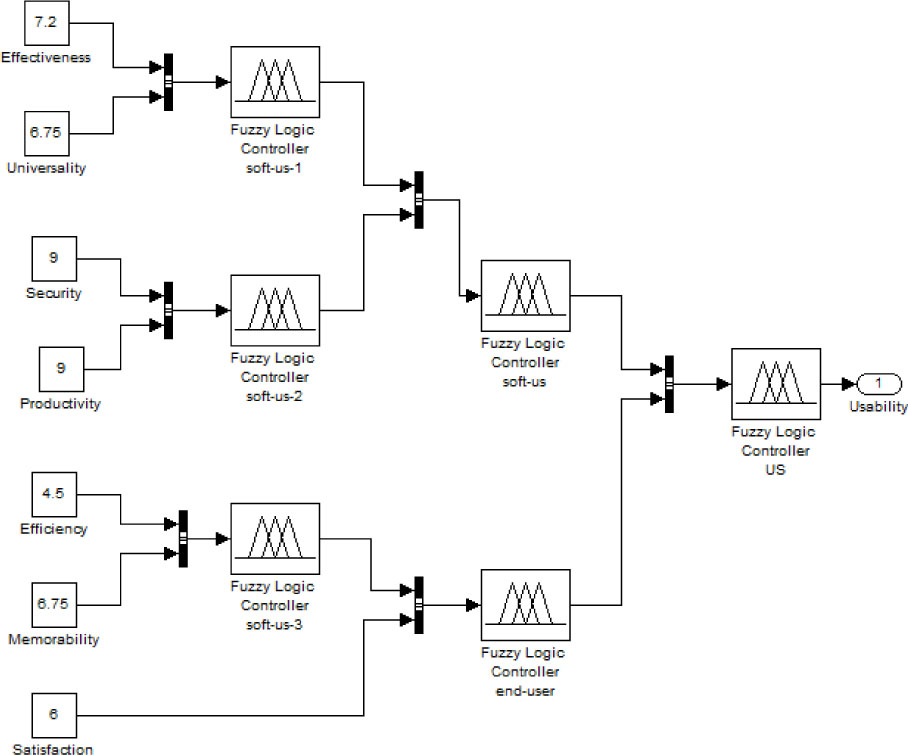
Simulation of the proposed hierarchical usability model
Usability model considers all the inputs (the usability factors) together, so that generates too many rules and additionally it is difficult for the experts to consider all formulates rules with proper emphasis, since each input parameter has three linguistic values (Low, Medium and High). Hence, the proposed model with seven usability factors has a maximum number of 37 = 2187 rules. This means, the Matlab-Fuzzy Tool Box isn’t applicable, since the number of inputs is limited to two in the Matlab [27]. Therefore, we have decomposed the factors into sub-categories just to minimize a huge number of rules as discussed in Table 4. Total six Fuzzy Interface System (FIS) namely sub-us- 1, sub-us-2, soft-us, sub-us-3, end-user, and US have been created in Matlab using a Fuzzy Logic toolbox [27]. Consequently, input/output variables, their membership functions, and fuzzy control rules have also been created for each FIS. Table 5 shows an example of fuzzy interface system.
Decomposing Inputs & outputs to minimize the total rules.
| Fuzzy Interface System (FIS) | Inputs | Output |
|---|---|---|
| FIS-1 | Effectiveness, Universality | Sub-us-1 |
| FIS-2 | Security, Productivity | Sub-us-2 |
| FIS-3 | Efficiency, Memorability | Sub-us-3 |
| FIS-4 | Sub-us-1, sub-us-2 | Soft-us |
| FIS-5 | Sub-us-3, Satisfaction | End-user |
| FIS-6 | Soft-us, End-user | US(Final Usability Value) |
Each of the seven usability factors have been given a universe of discourse (UOD) of range [0-9] and have been fuzzified with three linguistic values (fuzzy sub set: Low, Medium, and High) using linear triangular membership functions [28]. On the other hand, in order to achieve more accurate output, all the fuzzified output parameters have been fuzzified with four linguistic values (fuzzy sub set: Low, Medium, High, and Very High).
5 Results and discussion
The dataset generated in Table 3 is applied to the fuzzy hierarchical usability model shown in Figure 4 to compute the usability of 6 SDLC models. On the basis of the usability computed, we have ranked all of them such that the model with maximum usability is ranked first and the model with lowest usability is ranked last. The usability and ranking of each SDLC model using fuzzy hierarchical usability model is given in Table 6. As seen in the Table 6, Spiral SDLC model is having the highest usability value; as it has higher values of effectiveness, universality, satisfaction and efficiency; therefore it is the best model and rank 1is assigned to it whereas Build & Fix SDLC model is having the lowest usability value; as it has lowest values of all the major factors; therefore it is the worst SDLC model and rank 6 is assigned to it. As seen in the results, the models with higher values of effectiveness, universality, satisfaction and efficiency are having higher usability value. After detailed analysis of results, we have identified a hierarchy of the factors to increase the usability of the SDLC models. Hence, all the 7 factors of the proposed model are arranged in hierarchical order as given below:
usability & ranking of SDLC models
| SDLC Models | Usability (0-9) | Ranking |
|---|---|---|
| Build & Fix | 1.5006 | 6 |
| Waterfall | 3.5002 | 5 |
| Evolutionary | 5.4991 | 2 |
| RAD | 4.5002 | 3 |
| Iterative | 3.9400 | 4 |
| Spiral | 5.9401 | 1 |
Now, the existing usability models [4, 6, 8, 13] in literature review are evaluated using the proposed fuzzy hierarchical usability model. The SDLC models are evaluated to generate the values in the scale of 0–9 of all the proposed 7 factors. Comparison of the seven factors of existing models with the proposed model is also shown in Figures 5. As seen in the Figure 5, the proposed hierarchical usability models have highest values of effectiveness, universality, productivity, and security. The Donyaee usability model [13] has highest satisfaction and efficiency while the Neilson usability model [4] has highest memorability.

Detailed Comparison of the usability models.
As per the detailed analysis, authors can conclude the following key points:
Proposed model is effective i.e. it accomplishes tasks and generates desired results with completeness and certainty.
Proposed model is universal i.e. it can accommodate different cultural background of diverse users.
Proposed model is more productive.
Proposed model is more secure.
Proposed model also have some degree of satisfaction and efficiency respectively but its satisfaction and efficiency is lower than the Donyaee.
Proposed model have some degree of memorability.
6 Conclusion
In this paper, a software usability model is proposed based upon hierarchical approach. The proposed model defines the term ‘usability’ using seven factors and their 23 attributes in a hierarchical manner. This hierarchical usability model is consolidated and presented with detailed taxonomy for specifying and identifying the quality components. The main goal of developing such fuzzy hierarchical based usability model is to predict usability value for an application and to keep this research work as simple and understandable as possible. To achieve this significant goal, the proposed model is implemented using fuzzy logic controller. After its implementation, the model is being simulated using Matlab Simulink (Figure 4); the usability of an application or software product can be predicted. The inputs of this proposed model consists of seven usability factors and it generated the total usability of the application under test (Figure 2). A dataset is employed and the SDLC models are analyzed in detail (Table 2 & Table 3). The result in Table 6 shows the usability and ranks the SDLC models. The result shows that the SDLC model having higher effectiveness, universality, satisfaction and efficiency, contain higher usability value. In order to validate this work, detailed comparison of the proposed model with the existing models is also presented as shown in Figure 5. At last, authors conclude that the proposed hierarchical based usability model is very effective and better model as compared to the existing usability model for usability prediction (as per the SDLC dataset for an application or a software product).
References
[1] ISO, W. 9241-11. Ergonomic requirements for oflce work with visual display terminals (VDTs), The international organization for standardization 1998, 45Search in Google Scholar
[2] International Standard Organization. ISO/IEC 9126: Information Technology-Software Product Evaluation-Quality Characteristics and Guidelines for Their Use. 1991Search in Google Scholar
[3] Radatz J., Geraci A., Katki F., IEEE standard glossary of software engineering terminology, IEEE Std 610121990.121990,1990,3Search in Google Scholar
[4] Nielsen J., Usability engineering. Elsevier, 199410.1016/B978-0-08-052029-2.50007-3Search in Google Scholar
[5] Preece J., Benyon D., A guide to usability: Human factors in computing, Addison-Wesley Longman Publishing Co., Inc., 1993Search in Google Scholar
[6] Abran A., et al., Usability meanings and interpretations in ISO standards, Software Quality Journal 2003,11(4), 325-33810.1023/A:1025869312943Search in Google Scholar
[7] Seffah A., et al., Usability measurement and metrics: A consolidated model, Software Quality Journal 2006, 14(2), 159-17810.1007/s11219-006-7600-8Search in Google Scholar
[8] Alonso-Ríos D. et al., Usability: a critical analysis and taxonomy, International Journal of Human-Computer Interaction 2009, 26(1), 53-7410.1080/10447310903025552Search in Google Scholar
[9] Bass L., John B. E., Linking usability to software architecture patterns through general scenarios, Journal of Systems and Software 2003, 66(3), 187-19710.1016/S0164-1212(02)00076-6Search in Google Scholar
[10] Bevan N., Kirakowski J., Maissel, J., What is usability?, Proceedings of the 4th International Conference on HCI, 1991, 651–655Search in Google Scholar
[11] Boehm B. W., Characteristics of software quality. Vol. 1. North-Holland, 1978Search in Google Scholar
[12] Dix F. J., Abowd G., Beale R., Human-Computer Interaction, 2nd ed. Prentice-Hall, 1998Search in Google Scholar
[13] Donyaee M., Seffah A., QUIM: An integrated model for specifying and measuring quality in use, Eighth IFIP Conference on Human Computer Interaction, Tokyo, Japan. 2001Search in Google Scholar
[14] Dubey S. K., Gulati A., Rana A., Integrated model for software usability, International Journal on Computer Science and Engineering 2012, 4(3), 429-437.Search in Google Scholar
[15] McCall J. A., Richards P. K., Walters, G.F., Factors in software quality, Vols II, Rome Aid Defence Centre, Italy, 1977Search in Google Scholar
[16] Shneiderman B., Plaisant C., Designing the user interface: Strategies for effective human-computer interaction, ACM SIGBIO Newsletter 1987, 9(1), 610.1145/25065.950626Search in Google Scholar
[17] Shackel B., Usability-context, framework, definition, design and evaluation, Human factors for informatics usability, 1991, 21-37.10.1016/j.intcom.2009.04.007Search in Google Scholar
[18] Piaget J., Inhelder B., The Origin of the Idea of Chance in Children, W. W. Norton & Comp., N.Y, 1976Search in Google Scholar
[19] Aggarwal K. K., Singh Y., A book on software engineering, New Age International (P) Ltd, 2001Search in Google Scholar
[20] Munassar N. M. A., Govardhan A., A comparison between five models of software engineering, IJCSI 2010, 7(5), 95-101Search in Google Scholar
[21] Pressman R. S., Software engineering: a practitioner’s approach, Palgrave Macmillan, 2005Search in Google Scholar
[22] Ruparelia N. B., Software development lifecycle models, ACM SIGSOFT Software Engineering Notes 2010, 5(3), 8-13.10.1145/1764810.1764814Search in Google Scholar
[23] Lin C.C., Chen S. C., Chu Y. M., Automatic price negotiation on the web: An agent-based web application using fuzzy expert system, Expert Systems with Applications 2011, 38(5), 5090-510010.1016/j.eswa.2010.09.142Search in Google Scholar
[24] Satty T.L., Decisionmaking with dependence and feedback: The analytic network process, RWS Publication 1996Search in Google Scholar
[25] Kumar D. N., Multi criterion analysis in engineering and management, PHI Learning Pvt. Ltd., 2010Search in Google Scholar
[26] Nagpal R. et al., Rank university websites using fuzzy AHP and fuzzy TOPSIS approach on usability, International Journal of Information Engineering and Electronic Business 2015, 7(1), 29.10.5815/ijieeb.2015.01.04Search in Google Scholar
[27] MathWorks, Inc, & Wang, W. C., Fuzzy Logic Toolbox: for Use with MATLAB: User’s Guide. MathWorks, Incorporated 1998Search in Google Scholar
[28] Yen J., Langari R., Fuzz Logic: Intelligence, Control and Information, Prentice Hall, 1999Search in Google Scholar
[29] Gupta D., Ahlawat A., Sagar K., A critical analysis of a hierarchy based Usability Model, Contemporary Computing and Informatics (IC3I), 2014 International Conference on. IEEE, 201410.1109/IC3I.2014.7019810Search in Google Scholar
[30] Bevan N., Quality in use: Meeting user needs for quality, Journal of systems and software 1999, 49(1), 89-9610.1016/S0164-1212(99)00070-9Search in Google Scholar
[31] Boehm B. W., A spiral model of software development and enhancement, Computer 1988, 21(5), 61-7210.1016/B978-0-08-051574-8.50031-5Search in Google Scholar
[32] Iyatomi H., Hagiwara M., Adaptive fuzzy inference neural network, Pattern Recognition 2004, 37(10), 2049-205710.1016/j.patcog.2004.04.003Search in Google Scholar
[33] Juang Y. S., Lin S. S, Kao H. P., Design and implementation of a fuzzy inference system for supporting customer requirements, Expert Systems with Applications 2007, 32(3), 868-87810.1016/j.eswa.2006.01.052Search in Google Scholar
[34] Haji A., Assadi M., Fuzzy expert systems and challenge of new product pricing, Computers & Industrial Engineering 2009, 56(2), 616-63010.1016/j.cie.2007.03.005Search in Google Scholar
© 2017 Deepak Gupta et al.
This work is licensed under the Creative Commons Attribution-NonCommercial-NoDerivatives 3.0 License.
Articles in the same Issue
- Regular Articles
- The Differential Pressure Signal De-noised by Domain Transform Combined with Wavelet Threshold
- Regular Articles
- Robot-operated quality control station based on the UTT method
- Regular Articles
- Regression Models and Fuzzy Logic Prediction of TBM Penetration Rate
- Regular Articles
- Numerical study of chemically reacting unsteady Casson fluid flow past a stretching surface with cross diffusion and thermal radiation
- Regular Articles
- Experimental comparison between R409A and R437A performance in a heat pump unit
- Regular Articles
- Rapid prediction of damage on a struck ship accounting for side impact scenario models
- Regular Articles
- Implementation of Non-Destructive Evaluation and Process Monitoring in DLP-based Additive Manufacturing
- Regular Articles
- Air purification in industrial plants producing automotive rubber components in terms of energy efficiency
- Regular Articles
- On cyclic yield strength in definition of limits for characterisation of fatigue and creep behaviour
- Regular Articles
- Development of an operation strategy for hydrogen production using solar PV energy based on fluid dynamic aspects
- Regular Articles
- An exponential-related function for decision-making in engineering and management
- Regular Articles
- Usability Prediction & Ranking of SDLC Models Using Fuzzy Hierarchical Usability Model
- Regular Articles
- Exact Soliton and Kink Solutions for New (3+1)-Dimensional Nonlinear Modified Equations of Wave Propagation
- Regular Articles
- Entropy generation analysis and effects of slip conditions on micropolar fluid flow due to a rotating disk
- Regular Articles
- Application of the mode-shape expansion based on model order reduction methods to a composite structure
- Regular Articles
- A Combinatory Index based Optimal Reallocation of Generators in the presence of SVC using Krill Herd Algorithm
- Regular Articles
- Quality assessment of compost prepared with municipal solid waste
- Regular Articles
- Influence of polymer fibers on rheological properties of cement mortars
- Regular Articles
- Degradation of flood embankments – Results of observation of the destruction mechanism and comparison with a numerical model
- Regular Articles
- Mechanical Design of Innovative Electromagnetic Linear Actuators for Marine Applications
- Regular Articles
- Influence of addition of calcium sulfate dihydrate on drying of autoclaved aerated concrete
- Regular Articles
- Analysis of Microstrip Line Fed Patch Antenna for Wireless Communications
- Regular Articles
- PEMFC for aeronautic applications: A review on the durability aspects
- Regular Articles
- Laser marking as environment technology
- Regular Articles
- Influence of grain size distribution on dynamic shear modulus of sands
- Regular Articles
- Field evaluation of reflective insulation in south east Asia
- Regular Articles
- Effects of different production technologies on mechanical and metallurgical properties of precious metal denture alloys
- Regular Articles
- Mathematical description of tooth flank surface of globoidal worm gear with straight axial tooth profile
- Regular Articles
- Earth-based construction material field tests characterization in the Alto Douro Wine Region
- Regular Articles
- Experimental and Mathematical Modeling for Prediction of Tool Wear on the Machining of Aluminium 6061 Alloy by High Speed Steel Tools
- Special Issue on Current Topics, Trends and Applications in Logistics
- 10.1515/eng-2017-0001
- Special Issue on Current Topics, Trends and Applications in Logistics
- The Methodology of Selecting the Transport Mode for Companies on the Slovak Transport Market
- Special Issue on Current Topics, Trends and Applications in Logistics
- Determinants of Distribution Logistics in the Construction Industry
- Special Issue on Current Topics, Trends and Applications in Logistics
- Management of Customer Service in Terms of Logistics Information Systems
- Special Issue on Current Topics, Trends and Applications in Logistics
- The Use of Simulation Models in Solving the Problems of Merging two Plants of the Company
- Special Issue on Current Topics, Trends and Applications in Logistics
- Applying the Heuristic to the Risk Assessment within the Automotive Industry Supply Chain
- Special Issue on Current Topics, Trends and Applications in Logistics
- Modeling the Supply Process Using the Application of Selected Methods of Operational Analysis
- Special Issue on Current Topics, Trends and Applications in Logistics
- Possibilities of Using Transport Terminals in South Bohemian Region
- Special Issue on Current Topics, Trends and Applications in Logistics
- Comparison of the Temperature Conditions in the Transport of Perishable Foodstuff
- Special Issue on Current Topics, Trends and Applications in Logistics
- E-commerce and its Impact on Logistics Requirements
- Topical Issue Modern Manufacturing Technologies
- Wear-dependent specific coefficients in a mechanistic model for turning of nickel-based superalloy with ceramic tools
- Topical Issue Modern Manufacturing Technologies
- Effects of cutting parameters on machinability characteristics of Ni-based superalloys: a review
- Topical Issue Desktop Grids for High Performance Computing
- Task Scheduling in Desktop Grids: Open Problems
- Topical Issue Desktop Grids for High Performance Computing
- A Volunteer Computing Project for Solving Geoacoustic Inversion Problems
- Topical Issue Desktop Grids for High Performance Computing
- Improving “tail” computations in a BOINC-based Desktop Grid
- Topical Issue Desktop Grids for High Performance Computing
- LHC@Home: a BOINC-based volunteer computing infrastructure for physics studies at CERN
- Topical Issue Desktop Grids for High Performance Computing
- Comparison of Decisions Quality of Heuristic Methods with Limited Depth-First Search Techniques in the Graph Shortest Path Problem
- Topical Issue Desktop Grids for High Performance Computing
- Using Volunteer Computing to Study Some Features of Diagonal Latin Squares
- Topical Issue on Mathematical Modelling in Applied Sciences, II
- A polynomial algorithm for packing unit squares in a hypograph of a piecewise linear function
- Topical Issue on Mathematical Modelling in Applied Sciences, II
- Numerical Validation of Chemical Compositional Model for Wettability Alteration Processes
- Topical Issue on Mathematical Modelling in Applied Sciences, II
- Innovative intelligent technology of distance learning for visually impaired people
- Topical Issue on Mathematical Modelling in Applied Sciences, II
- Implementation and verification of global optimization benchmark problems
- Topical Issue on Mathematical Modelling in Applied Sciences, II
- On a program manifold’s stability of one contour automatic control systems
- Topical Issue on Mathematical Modelling in Applied Sciences, II
- Multi-agent grid system Agent-GRID with dynamic load balancing of cluster nodes
Articles in the same Issue
- Regular Articles
- The Differential Pressure Signal De-noised by Domain Transform Combined with Wavelet Threshold
- Regular Articles
- Robot-operated quality control station based on the UTT method
- Regular Articles
- Regression Models and Fuzzy Logic Prediction of TBM Penetration Rate
- Regular Articles
- Numerical study of chemically reacting unsteady Casson fluid flow past a stretching surface with cross diffusion and thermal radiation
- Regular Articles
- Experimental comparison between R409A and R437A performance in a heat pump unit
- Regular Articles
- Rapid prediction of damage on a struck ship accounting for side impact scenario models
- Regular Articles
- Implementation of Non-Destructive Evaluation and Process Monitoring in DLP-based Additive Manufacturing
- Regular Articles
- Air purification in industrial plants producing automotive rubber components in terms of energy efficiency
- Regular Articles
- On cyclic yield strength in definition of limits for characterisation of fatigue and creep behaviour
- Regular Articles
- Development of an operation strategy for hydrogen production using solar PV energy based on fluid dynamic aspects
- Regular Articles
- An exponential-related function for decision-making in engineering and management
- Regular Articles
- Usability Prediction & Ranking of SDLC Models Using Fuzzy Hierarchical Usability Model
- Regular Articles
- Exact Soliton and Kink Solutions for New (3+1)-Dimensional Nonlinear Modified Equations of Wave Propagation
- Regular Articles
- Entropy generation analysis and effects of slip conditions on micropolar fluid flow due to a rotating disk
- Regular Articles
- Application of the mode-shape expansion based on model order reduction methods to a composite structure
- Regular Articles
- A Combinatory Index based Optimal Reallocation of Generators in the presence of SVC using Krill Herd Algorithm
- Regular Articles
- Quality assessment of compost prepared with municipal solid waste
- Regular Articles
- Influence of polymer fibers on rheological properties of cement mortars
- Regular Articles
- Degradation of flood embankments – Results of observation of the destruction mechanism and comparison with a numerical model
- Regular Articles
- Mechanical Design of Innovative Electromagnetic Linear Actuators for Marine Applications
- Regular Articles
- Influence of addition of calcium sulfate dihydrate on drying of autoclaved aerated concrete
- Regular Articles
- Analysis of Microstrip Line Fed Patch Antenna for Wireless Communications
- Regular Articles
- PEMFC for aeronautic applications: A review on the durability aspects
- Regular Articles
- Laser marking as environment technology
- Regular Articles
- Influence of grain size distribution on dynamic shear modulus of sands
- Regular Articles
- Field evaluation of reflective insulation in south east Asia
- Regular Articles
- Effects of different production technologies on mechanical and metallurgical properties of precious metal denture alloys
- Regular Articles
- Mathematical description of tooth flank surface of globoidal worm gear with straight axial tooth profile
- Regular Articles
- Earth-based construction material field tests characterization in the Alto Douro Wine Region
- Regular Articles
- Experimental and Mathematical Modeling for Prediction of Tool Wear on the Machining of Aluminium 6061 Alloy by High Speed Steel Tools
- Special Issue on Current Topics, Trends and Applications in Logistics
- 10.1515/eng-2017-0001
- Special Issue on Current Topics, Trends and Applications in Logistics
- The Methodology of Selecting the Transport Mode for Companies on the Slovak Transport Market
- Special Issue on Current Topics, Trends and Applications in Logistics
- Determinants of Distribution Logistics in the Construction Industry
- Special Issue on Current Topics, Trends and Applications in Logistics
- Management of Customer Service in Terms of Logistics Information Systems
- Special Issue on Current Topics, Trends and Applications in Logistics
- The Use of Simulation Models in Solving the Problems of Merging two Plants of the Company
- Special Issue on Current Topics, Trends and Applications in Logistics
- Applying the Heuristic to the Risk Assessment within the Automotive Industry Supply Chain
- Special Issue on Current Topics, Trends and Applications in Logistics
- Modeling the Supply Process Using the Application of Selected Methods of Operational Analysis
- Special Issue on Current Topics, Trends and Applications in Logistics
- Possibilities of Using Transport Terminals in South Bohemian Region
- Special Issue on Current Topics, Trends and Applications in Logistics
- Comparison of the Temperature Conditions in the Transport of Perishable Foodstuff
- Special Issue on Current Topics, Trends and Applications in Logistics
- E-commerce and its Impact on Logistics Requirements
- Topical Issue Modern Manufacturing Technologies
- Wear-dependent specific coefficients in a mechanistic model for turning of nickel-based superalloy with ceramic tools
- Topical Issue Modern Manufacturing Technologies
- Effects of cutting parameters on machinability characteristics of Ni-based superalloys: a review
- Topical Issue Desktop Grids for High Performance Computing
- Task Scheduling in Desktop Grids: Open Problems
- Topical Issue Desktop Grids for High Performance Computing
- A Volunteer Computing Project for Solving Geoacoustic Inversion Problems
- Topical Issue Desktop Grids for High Performance Computing
- Improving “tail” computations in a BOINC-based Desktop Grid
- Topical Issue Desktop Grids for High Performance Computing
- LHC@Home: a BOINC-based volunteer computing infrastructure for physics studies at CERN
- Topical Issue Desktop Grids for High Performance Computing
- Comparison of Decisions Quality of Heuristic Methods with Limited Depth-First Search Techniques in the Graph Shortest Path Problem
- Topical Issue Desktop Grids for High Performance Computing
- Using Volunteer Computing to Study Some Features of Diagonal Latin Squares
- Topical Issue on Mathematical Modelling in Applied Sciences, II
- A polynomial algorithm for packing unit squares in a hypograph of a piecewise linear function
- Topical Issue on Mathematical Modelling in Applied Sciences, II
- Numerical Validation of Chemical Compositional Model for Wettability Alteration Processes
- Topical Issue on Mathematical Modelling in Applied Sciences, II
- Innovative intelligent technology of distance learning for visually impaired people
- Topical Issue on Mathematical Modelling in Applied Sciences, II
- Implementation and verification of global optimization benchmark problems
- Topical Issue on Mathematical Modelling in Applied Sciences, II
- On a program manifold’s stability of one contour automatic control systems
- Topical Issue on Mathematical Modelling in Applied Sciences, II
- Multi-agent grid system Agent-GRID with dynamic load balancing of cluster nodes
