Skin popping scars – a telltale sign of past and present subcutaneous drug abuse
-
Amos Grunebaum
 und
Daniel Skupski
und
Daniel Skupski

Abstract
Background: Identifying women with past and present drug abuse is an essential aspect of prenatal care.
Case: Despite having typical telltale physical signs of prior subcutaneous drug injections, a 33-year-old pregnant woman who had regular prenatal care visits with multiple obstetric care providers was only identified as a drug abuser after a cesarean section, when her skin scars were identified by one provider as the result of “skin popping” related to injections of illicit drugs before this pregnancy.
Conclusion: This case demonstrates that obstetricians must become aware of the telltale signs of drug abuse, such as subcutaneous injections (skin popping) with illicit drugs leading to scaring of the arms and other parts of the body.
Introduction
Illicit use of drugs has been reported to lead to adverse pregnancy outcomes such as abruptio placentae, intrauterine growth restriction, and preterm birth, and is also associated with an increased risk of sexually transmitted diseases such as HIV and hepatitis C.
Women who have used drugs before pregnancy or are using drugs during pregnancy are an elusive population, and common beliefs that substance abuse occurs only in the ethnic minority, the poor, or the young population are inaccurate. Because these women often do not openly admit to using drugs, they are often not identified by their practitioners and are thus deprived of optimal medical care.
Case
A 33-year-old primiparous pregnant woman was admitted to the hospital at 38 weeks with a history of premature rupture of membranes (PROM) about 5 h before admission. She received prenatal care from a private obstetrician from the 6th week of pregnancy. At 34 weeks, she moved to a different city where she continued prenatal care with another private obstetrician.
She did not mention her history of drug use during her prenatal care, and physical examinations done by both obstetricians were unremarkable. On admission, her cervix was 1 cm dilated, not effaced, with the vertex at −3 station. The estimated fetal weight was 3600 g, and the fetal heart rate was reassuring. The patient initially refused oxytocin, but eventually gave informed consent for induction with oxytocin at about 15 h after PROM. Oxytocin was gradually increased until there were regular uterine contractions. Throughout labor, the patient rejected recommendations to have an epidural catheter placed. Approximately 24 h after admission, fetal tachycardia and maternal fever occurred, and the diagnosis of chorioamnionitis was made. At that time, the vertex was still at −3 station and the cervix was essentially unchanged. The delivery mode was discussed with the patient, and she gave informed consent for cesarean delivery. She was brought to the operating room and after spinal anesthesia was given, a low-segment cesarean delivery was performed through a Pfannenstiel skin incision. During the cesarean, scars on both of the patient’s arms (Figures 1–3) were detected by the nursing staff and the obstetrician who performed the surgery. The infant was of normal size and after assessment by the pediatrician was sent to the normal nursery with an uneventful course. After the conclusion of the cesarean, the patient was questioned about these scars. She initially said that she was burned as a child and is now looking for a good plastic surgeon. However, when the obstetrician pointed out to her that these scars did not look like typical burns, she immediately admitted that these were scars from prior drug use through subcuticular cocaine injections (“skin popping”). The patient said she had been drug free for many years and had rejected epidural anesthesia because she was concerned about the morphine in the epidural.

Right forearm with typical scars from skin popping.

Close-up of scars from skin popping.
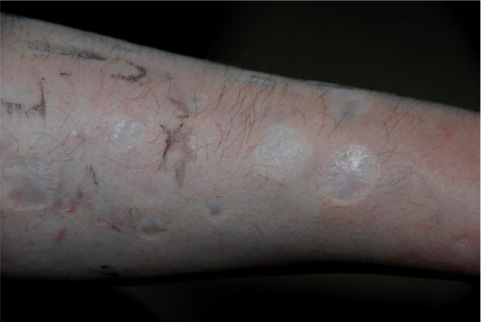
Close-up left forearm.
Comment
There are several potential differential diagnoses for skin scarring, including keloids, chronic folliculitis, contracture scars after burns, hypertrophic scars, and acne scars. Occasionally, malignant tumors such as sarcomas and basal cell carcinomas can resemble keloid or hypertrophic scars.
In this case, the reason for the scarring was repetitive subcutaneous injections with heroin and cocaine, also known as skin popping. Skin popping is defined as the act when drugs, usually heroin or “speedballs” (heroin plus cocaine), are injected subcutaneously or intramuscularly. Skin popping is done for different reasons: some drug abusers may have difficulties injecting intravenously because of difficulties in finding a vein, while others inject subcutaneously because it results in slower drug absorption, gives less of a “rush,” may allow the drug to last longer, and can also decrease the risk of overdosing.
Opiate use in pregnancy seems to be increasing. European researchers reported an apparent increase in skin popping [3, 9] in drug users. A search on PubMed found 21 citations of skin popping, most of them related to major complications such as abscesses and cellulitis [2, 4], botulism [3, 6, 9, 13], and necrotizing fasciitis [11]. Women seem more likely than men to develop skin and soft tissue infections after skin popping [4]. A breast abscess in a woman as a complication of skin popping has been reported [1].
In addition, injecting drugs has been associated with infections such as HIV, hepatitis B and C, and also with other problems such as rhesus alloimmunization [7]. There has been no report of skin popping in a pregnant patient.
Drug and heroin use in pregnancy has been associated with many adverse effects, including higher rates of fetal acidemia and demise, lower Apgar scores, growth restriction, increase in prematurity and neonatal death, an increase in attention deficit hyperactivity disorder, and adverse neurodevelopmental outcomes [8, 12, 14, 15]. In addition to the obstetrician and the pediatrician, the anesthesiologist is also challenged by drug-dependent pregnant women with complications such as difficult intravenous access and hepatitis C exposures [5].
The common perception that substance abuse is solely a problem of poor, ethnic minority, and young individuals is inaccurate [10]. As this case demonstrates, even though the patient was repeatedly seen by several different obstetricians during her pregnancy, her past heroin use was never identified despite clear telltale signs of skin popping. One reason could be that obstetricians are not sufficiently trained to identify drug use in pregnant women who do not fit the typical stereotype of a drug user. At the first prenatal visit as well as the subsequent visits, a cursory examination of her upper extremities would have easily identified the typical scars associated with skin popping and past heroin use.
Patients with a history of drug use are at increased risks for several complications, including sexually transmitted diseases and cardiac and liver problems such as hepatitis C and HIV. When a patient presents with this history, special attention should be paid to these complications and patients should be screened for medical complications including hepatitis C and HIV. In addition, there is an increased risk of recurrent drug use during pregnancy, and this may specifically affect the newborn baby. Therefore, patients with a history of drug should be screened for drug use during pregnancy and at the time of delivery.
In conclusion, the typical physical signs of skin popping (Figures 1–3) should have alerted the patient’s physicians to her past drug use.
References
[1] Alvi A, Ravichandran D. An unusual case of breast ulceration. Breast. 2006;15:115–6.10.1016/j.breast.2004.11.004Suche in Google Scholar
[2] Binswanger IA, Kral AH, Bluthenthal RN, Rybold DJ, Edlin BR. High prevalence of abscesses and cellulitis among community-recruited injection drug users in San Francisco. Clin Infect Dis. 2000;30:579–81.10.1086/313703Suche in Google Scholar
[3] Brett MM, Hallas G, Mpamugo O. Wound botulism in the UK and Ireland. J Med Microbiol. 2004;53(Pt 6):555–61.10.1099/jmm.0.05379-0Suche in Google Scholar
[4] Brown PD, Ebright JR. Skin and soft tissue infections in injection drug users. Curr Infect Dis Rep. 2002;4:415–9.10.1007/s11908-002-0008-0Suche in Google Scholar
[5] Cassidy B, Cyna AM. Challenges that opioid-dependent women present to the obstetric anaesthetist. Anaesth Intensive Care. 2004;32:494–501.10.1177/0310057X0403200406Suche in Google Scholar
[6] Centers for Disease Control and Prevention (CDC). Wound botulism – California, 1995. MMWR Morb Mortal Wkly Rep. 1995;44:889–92.Suche in Google Scholar
[7] Dimer JA, David M, Dudenhausen JW. Intravenous drug abuse is an indication for antepartum screening for RH alloimmunization. A case report and review of literature. Arch Gynecol Obstet. 1999;263:73–5.10.1007/s004040050266Suche in Google Scholar
[8] Fajemirokun-Odudeyi O, Sinha C, Tutty S, Pairaudeau P, Armstrong D, Phillips T, et al. Pregnancy outcome in women who use opiates. Eur J Obstet Gynecol Reprod Biol. 2006;126:170–5.10.1016/j.ejogrb.2005.08.010Suche in Google Scholar
[9] Galldiks N, Nolden-Hoverath S, Kosinski CM, Stegelmeyer U, Schmidt S, Dohmen C, et al. Rapid geographical clustering of wound botulism in Germany after subcutaneous and intramuscular injection of heroin. Neurocrit Care. 2007;6:30–4.10.1385/NCC:6:1:30Suche in Google Scholar
[10] Hans SL. Demographic and psychosocial characteristics of substance-abusing pregnant women. Clin Perinatol. 1999;26:55–74.10.1016/S0095-5108(18)30072-1Suche in Google Scholar
[11] Kimura AC, Higa JI, Levin RM, Simpson G, Vargas Y, Vugia DJ. Outbreak of necrotizing fasciitis due to Clostridium sordellii among black-tar heroin users. Clin Infect Dis. 2004;38:e87–91.10.1086/383471Suche in Google Scholar
[12] Ornoy A, Segal J, Bar-Hamburger R, Greenbaum C. Developmental outcome of school-age children born to mothers with heroin dependency: importance of environmental factors. Dev Med Child Neurol. 2001;43:668–75.10.1017/S0012162201001219Suche in Google Scholar
[13] Passaro DJ, Benson Werner S, McGee J, Mac Kenzie WR, Vugia DJ. Wound botulism associated with black tar heroin among injecting drug users J Am Med Assoc. 1998;279:859–63.10.1001/jama.279.11.859Suche in Google Scholar
[14] Steinhausen HC, Blattmann B, Pfund F. Developmental outcome in children with intrauterine exposure to substances. Eur Addict Res. 2007;13:94–100.10.1159/000097939Suche in Google Scholar
[15] Wagner CL, Katikaneni LD, Cox TH, Ryan RM. The impact of prenatal drug exposure on the neonate. Obstet Gynecol Clin North Am. 1998;25:169–94.10.1016/S0889-8545(05)70364-8Suche in Google Scholar
-
The authors stated that there are no conflicts of interest regarding the publication of this article.
©2012 by Walter de Gruyter Berlin Boston
Artikel in diesem Heft
- Masthead
- Masthead
- Editorial
- Editorial
- Case reports – Obstetrics
- Sonographic presentations of uterine rupture following vaginal birth after cesarean – report of two cases 12 h apart
- Prenatal diagnosis of thrombocytopenia-absent radius syndrome
- Cervico-isthmic pregnancy with cervical placenta accreta
- Prelabor uterine rupture and extrusion of fetus with intact amniotic membranes: a case report
- Hyperreactio luteinalis in a spontaneously conceived pregnancy associated with polycystic ovarian syndrome and high levels of human chorionic gonadotropin
- Should clinicians advise terminating a pregnancy following the diagnosis of a serious fetal cardiac abnormality?
- Absence of hemolytic disease of fetus and newborn (HDFN) in a pregnancy with anti-Yka (York) red cell antibody
- Congenital midgut malrotation causing intestinal obstruction in midpregnancy managed by prolonged total parenteral nutrition: case report and review of the literature
- Skin popping scars – a telltale sign of past and present subcutaneous drug abuse
- Botulinum toxin for the treatment of achalasia in pregnancy
- Thrombotic stroke in association with ovarian hyperstimulation and early pregnancy rescued by thrombectomy
- Normal pregnancy outcome in a woman with chronic myeloid leukemia and epilepsy: a case report and review of the literature
- Three-dimensional power Doppler assessment of pelvic structures after unilateral uterine artery embolization for postpartum hemorrhage
- Deep congenital hemangioma: prenatal diagnosis and follow-up
- Case reports – Fetus
- Diagnosis of cleft lip-palate during nuchal translucency screening – case report and review of the literature
- Vein of Galen aneurysm that was diagnosed prenatally and supracardiac obstructed total anomalous pulmonary venous return with pulmonary hypertension: case report
- A fetus with 19q13.11 microdeletion presenting with intrauterine growth restriction and multiple cystic kidneya
- Prenatal detection of periventricular pseudocysts by ultrasound: diagnosis and outcome
- Twin-to-twin transfusion syndrome and limb ischemia: a case report
- Prenatal surgery in a triplet pregnancy complicated by a double twin reversed arterial perfusion (TRAP) sequence
- A case of a four-vessel umbilical cord: don’t stop counting at three!
- Case reports – Newborn
- Supratentorial hemorrhage suggested on susceptibility-weighted magnetic resonance imaging in an infant with hydranencephaly
- Differential diagnosis of pseudotrisomy 13 syndrome
- Carey-Fineman-Ziter syndrome: a spectrum of presentations
Artikel in diesem Heft
- Masthead
- Masthead
- Editorial
- Editorial
- Case reports – Obstetrics
- Sonographic presentations of uterine rupture following vaginal birth after cesarean – report of two cases 12 h apart
- Prenatal diagnosis of thrombocytopenia-absent radius syndrome
- Cervico-isthmic pregnancy with cervical placenta accreta
- Prelabor uterine rupture and extrusion of fetus with intact amniotic membranes: a case report
- Hyperreactio luteinalis in a spontaneously conceived pregnancy associated with polycystic ovarian syndrome and high levels of human chorionic gonadotropin
- Should clinicians advise terminating a pregnancy following the diagnosis of a serious fetal cardiac abnormality?
- Absence of hemolytic disease of fetus and newborn (HDFN) in a pregnancy with anti-Yka (York) red cell antibody
- Congenital midgut malrotation causing intestinal obstruction in midpregnancy managed by prolonged total parenteral nutrition: case report and review of the literature
- Skin popping scars – a telltale sign of past and present subcutaneous drug abuse
- Botulinum toxin for the treatment of achalasia in pregnancy
- Thrombotic stroke in association with ovarian hyperstimulation and early pregnancy rescued by thrombectomy
- Normal pregnancy outcome in a woman with chronic myeloid leukemia and epilepsy: a case report and review of the literature
- Three-dimensional power Doppler assessment of pelvic structures after unilateral uterine artery embolization for postpartum hemorrhage
- Deep congenital hemangioma: prenatal diagnosis and follow-up
- Case reports – Fetus
- Diagnosis of cleft lip-palate during nuchal translucency screening – case report and review of the literature
- Vein of Galen aneurysm that was diagnosed prenatally and supracardiac obstructed total anomalous pulmonary venous return with pulmonary hypertension: case report
- A fetus with 19q13.11 microdeletion presenting with intrauterine growth restriction and multiple cystic kidneya
- Prenatal detection of periventricular pseudocysts by ultrasound: diagnosis and outcome
- Twin-to-twin transfusion syndrome and limb ischemia: a case report
- Prenatal surgery in a triplet pregnancy complicated by a double twin reversed arterial perfusion (TRAP) sequence
- A case of a four-vessel umbilical cord: don’t stop counting at three!
- Case reports – Newborn
- Supratentorial hemorrhage suggested on susceptibility-weighted magnetic resonance imaging in an infant with hydranencephaly
- Differential diagnosis of pseudotrisomy 13 syndrome
- Carey-Fineman-Ziter syndrome: a spectrum of presentations
