Arterial infusion of rapamycin in the treatment of rabbit hepatocellular carcinoma to improve the effect of TACE
-
 ,
,

Abstract
Background
Hepatocellular carcinoma is one of the leading causes of cancer-related death. Hepatic transcatheter arterial chemo-embolization (TACE) is commonly used clinically for advanced hepatocellular carcinoma treatment.
AIM
The aim of this study was to evaluate whether arterial infusion of rapamycin can improve the effect of TACE in treatment of rabbit hepatocellular carcinoma.
Material and Methods
Eighteen healthy New Zealand white rabbits weighing 2.6 ± 0.3 kg were used in a standardised hepatocellular carcinoma model and randomly divided into three groups of 6 rabbits. Group A: the rabbits were treated with rapamycin and TACE by administering arterial perfusion of 2 mg/kg rapamycin + 1 mg/kg epirubicin, 0.2 mg/kg mitomycin, and lipiodol emulsion embolization. Group B: rapamycin was reduced to 1 mg/kg. And for Group C, the rabbits received only TACE treatment. 14 days post operation, CT scan and digital subtraction angiography (DSA) was performed to examine TACE efficacy. The rabbits were killed by air embolism and the expression of HIF-1a, VEGF, iNOS, and CD34 were measured in an immunohistochemical assay of thetumor tissue.
Results
HIF-1a, VEGF and iNOS protein expression in Group A was significantly lower than that of Group B and Group C (P<0.05). The tumor MVD in group C was significantly higher than that of group A and group B (P<0.05); and the tumor MVD of group B was significantly higher than group A (P<0.05).
Conclusion
Arterial infusion of rapamycin combined with TACE can improve treatment efficacy by decreasing HIF-1a, VEGF, iNOS and CD34 expression.
1 Introduction
Hepatocellular carcinoma exhibits a high degree of malignancy and commonly occurs as an occult condition in its early stages [1]. Therefore, most patients are diagnosed at an advanced stage and have consequently missed the opportunity for timely surgical resection [2]. Patients unsuitable for surgery, and those who have experienced postoperative recurrence, are typically treated with hepatic transcatheter arterial chemo-embolization (TACE) therapy [3]. However, recurrence and metastasis rates after TACE are high [456]. The therapeutic goal of complete embolism may not occur despite TACE successfully embolizing the nourishing blood vessels of the tumor, as it cannot inhibit tumor angiogenesis. Tumor tissues are in an anoxic state after TACE, and this stimulates the overexpression of VEGF, HIF-1a, and iNOS, inducing tumor angiogenesis and proliferation [7]. Tumor angiogenesis is the basis for tumor recurrence and metastasis.
Rapamycin is a new type of large-ring lactone immunosuppressive agent. With effective immunosuppression, rapamycin can inhibit the growth of various cancer cells, such as liver [8], kidney, colon, breast [9], and ovarian cancers. Cell-based tests, and experiments involving animals given rapamycin orally, have revealed that this agent exhibits a remarkable inhibitory effect on tumor angiogenesis and induces apoptosis and autophagy of hepatoma cells. In the present study, arterial perfusion with rapamycin combined with TACE was administered to improve the therapeutic effect of TACE in treating hepatocellular carcinoma in rabbits.
2 Materials and methods
2.1 Modeling
To establish a rabbit hepatocellular carcinoma model, 18 healthy New Zealand white rabbits weighing 2.6 ± 0.3 kg were placed in the same cage, fed, and provided with unlimited access to drinking water. VX2 tumor was inoculated into the muscle tissue of the hind legs of the rabbits to create a tumor with a block length of 1–2 cm after 2 weeks. The tumor-bearing rabbits were intraperitoneally injected with 5% pentobarbital. Under aseptic conditions, the tumor was peeled from the thigh muscle tissue, and the necrotic tissue capsule was removed. White fresh tumor tissue was cut, placed in a sterile petri dish containing 1640 fluid, and sectioned into 1 mm3 blocks using eye shears. The rabbits were given general anesthesia and fixed in a supine position on the experimental platform. Fur on the upper abdomen was removed, and the area was disinfected. Gelatin was aspirated with an 18 G puncture needle and a sponge bar until a tube length of 2 cm was reached. The gelatin was then cut into 2–4 tumor blocks measuring 1 mm3 [10]. The left lobe of the liver was punctured under the guidance of CT. The lump and gelatin sponge strips were pushed into the liver parenchyma by using a flat-head thimble. The needle was pulled out, and the punctured area was disinfected and bandaged. For 3 days, 40 million U of penicillin was intramuscularly injected to prevent infection. A CT scan was performed after 2 weeks to check tumor growth at 2 cm to the left and right of the tumor foci and to confirm whether the model was successfully established (Figure 1).

Modeling of rabbit liver transplantation tumor (hepatic tumor red arrow)
Ethical approval: The research related to animals use has been complied with all the relevant national regulations and institutional policies for the care and use of animals.
2.2 Grouping and treatment
The successfully established rabbit hepatocellular carcinoma models were randomly divided into three groups with six rabbits in each group. In group A (APR-TACE 1 group), the rabbits were treated with rapamycin and TACE by administering an arterial infusion of 2 mg/kg rapamycin + 1 mg/kg epirubicin, 0.2 mg/kg mitomycin, and lipiodol emulsion embolization. In the group B (APR-TACE 2 group), the rabbits were given an arterial infusion of 1 mg/kg rapamycin + 1 mg/kg epirubicin, 0.2 mg/kg mitomycin, and lipiodol emulsion embolization. In the third group (TACE group), the rabbits received a simple TACE treatment that included 1 mg/kg epirubicin, 0.2 mg/kg mitomycin, and an emulsion embolism made of iodized oil. A 2.7 F micro-catheter (Terumo Company, Japan) was implanted into the femoral artery of each rabbit. The femoral artery was determined via total hepatic artery angiography to identify the location, size, and staining of the tumor. Tumor-nourishing vessels were further selected, and the rabbits were subjected to perfusion embolism according to the group scheme. The degree of embolism was the standard to achieve the complete embolization of tumor vessels (Figure 2).

Hepatic arterial chemoembolization of rabbit with transplantation tumor (A: Intraoperative exposure of femoral artery; B: Selective embolization of hepatic artery; C: Lipiodol deposition after embolization; D: Selective hepatic arteriography after hepatic artery embolization showed tumor vascular disappearance)
Fourteen days after operation, computer tomography (CT) scan and DSA were performed to assess treatment efficacy (Figure 3). The rabbits were killed by air embolism. The necrotic region and surrounding liver tissue were taken from the peripheral tumor. The expression levels of HIF-1a, VEGF, iNOS, and CD34 of the tumor tissue were measured by western blot assay. Tumor microvessel density (MVD) was calculated through immunohistochemical assay.

CT image of the tumor after two weeks TACE (A: CT image of rabbit hepatic tumor, Axial; B: CT image of rabbit hepatic tumor, coronal view)
2.3 Statistical analysis
Statistical analysis was performed using STATA 11.0 statistical software (http://www.stata.com), measurement data was expressed by x̄ ± s and the comparison between groups was made based on the F-test of the sample mean. P<0.05 was considered as statistical significance.
3 Results
3.1 HIF-1a, VEGF and iNOS protein expression
Western blot showed HIF-1a, VEGF and iNOS protein expression were significantly different in Group A, B and group C. HIF-1a, VEGF and iNOS protein expression in Group A was significantly lower than those of Group B and Group C, (Figure 4).

HIF-1a, VEGF and iNOS protein expression through western blot assy
3.2 Tumor microvessel density analysis
Tumor microvessel density (MVD) were calculated according to CD34 expression by immunohistochemical assay. There were significant differences in tumor MVD between groups A, B and C. The tumor MVD in group C was significantly higher than those of group A and group B (P<0.05); and tumor MVD of group B was significantly higher than group A (P<0.05), see Figure 5.
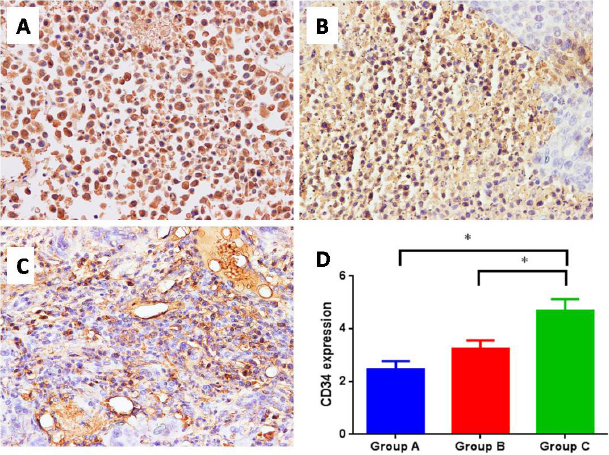
CD34 relative expression analysis of immunohistochemical assay (A: group A; B: group B; C: group C; D: bar graph of CD34 expression demonstrated group C significant higher than that of group A and B)
4 Discussion
Arterial perfusion with rapamycin can inhibit the expression of iNOS, HIF-1a, and VEGF proteins which promote angiogenesis, thus preventing tumor neovascularization. Our results revealed that the MVD in the peripheral tissue of the rapamycin group was significantly lower than that of the TACE group. We confirmed that arterial perfusion with rapamycin can inhibit tumor angiogenesis after a liver tumor is subjected to transcatheter embolization. Arterial perfusion with rapamycin combined with TACE could also improve the effect of TACE on the treatment of hepatocellular carcinoma in rabbits.
Different rapamycin doses (1 and 2 mg/kg) for arterial infusion elicit various inhibitory effects on angiogenesis after TACE, and the group administered with arterial perfusion of 2 mg/kg rapamycin exhibited strong inhibitory effects on iNOS, HIF-1A, and VEGF. The MVD in the tumor peripheral tissue decreased. This experiment was designed with two different dosage groups of rapamycin for the treatment of hepatocellular carcinoma in a rabbit model. Arterial perfusion with high rapamycin doses corresponded to strong inhibitory effects on tumor-nourishing vessels because rapamycin is an immunosuppressive agent [111213]. The greater the dosage, the stronger the immune inhibition of organisms and the stronger the effect on liver cancer will be.
Previously published studies showed that rapamycin can inhibit tumor angiogenesis primarily by blocking the expression of the mTOR signaling pathway [14] and cytokines [15], including iNOS, HIF-1a, and VEGF [12, 13] which was in accordance with our present study. Rapamycin and rapamycin target protein (mTOR) combines with FK506-binding protein12 to form RAPAMYCIN/FKBP12 complex [16, 17]. The complex subsequently binds to mTOR FKBP12-rapamycin binding domain, suppresses mTOR downstream 4e-bp1 and S6K1 phosphorylation, and blocks mRNA translation to reduce the synthesis of uric acid decarboxylase and cyclin D1, which are proteins required for cell cycle differentiation from the G1 phase to the S phase [18, 19].
In summary, arterial perfusion with rapamycin combined with TACE for the treatment of hepatocellular carcinoma in a rabbit model can enhance the curative effect of TACE.
Acknowledgements
This work was supported by National Natural Science Foundation of China (No.81501567)
Conflict of interest: Authors state no conflict of interest
References
[1] Erstad DJ, Tanabe KK. Hepatocellular carcinoma: early-stage management challenges. J Hepatocell Carcinoma 2017;4:81-92.10.2147/JHC.S107370Search in Google Scholar PubMed PubMed Central
[2] Ozer ED, Suna N, Boyacioglu AS. Management of Hepatocellular Carcinoma: Prevention, Surveillance, Diagnosis, and Staging. Exp Clin Transplant 2017;15:31-35.Search in Google Scholar
[3] Murata S, Mine T, Ueda T, Nakazawa K, Onozawa S, Yasui D, et al. Transcatheter arterial chemoembolization based on hepatic hemodynamics for hepatocellular carcinoma. Scientific World Journal 2013;2013:479805.10.1155/2013/479805Search in Google Scholar PubMed PubMed Central
[4] Kim JH, Choi EK, Yoon HK, Ko GY, Sung KB, Gwon DI. Transcatheter arterial chemoembolization for hepatic recurrence after curative resection of pancreatic adenocarcinoma. Gut Liver 2010;4:384-8.10.5009/gnl.2010.4.3.384Search in Google Scholar PubMed PubMed Central
[5] Shuqun C, Mengchao W, Han C, Feng S, Jiahe Y, Wenming C, et al. Combination transcatheter hepatic arterial chemoembolization with thymosin alpha1 on recurrence prevention of hepatocellular carcinoma. Hepatogastroenterology 2004;51:1445-7.Search in Google Scholar
[6] Murakami R, Yoshimatsu S, Yamashita Y, Sagara K, Arakawa A, Takahashi M. Transcatheter hepatic subsegmental arterial chemoembolization therapy using iodized oil for small hepatocellular carcinomas. Correlation between lipiodol accumulation pattern and local recurrence. Acta Radiol 1994;35:576-80.10.1177/028418519403500613Search in Google Scholar
[7] Jiang FQ, Lu W, Yang C, Du P, Ma JP, Yang J, et al. Curative effect of transcatheter arterial chemoembolization combined with radiofrequency ablation in treating hepatic cell carcinoma and its effect on serum markers. Cancer Biomark 2017;20:17-22.10.3233/CBM-160508Search in Google Scholar PubMed
[8] Wang YF, Li T, Tang ZH, Chang LL, Zhu H, Chen XP, et al Baicalein Triggers Autophagy and Inhibits the Protein Kinase B/Mammalian Target of Rapamycin Pathway in Hepatocellular Carcinoma HepG2 Cells. Phytother Res 2015;29:674-9.10.1002/ptr.5298Search in Google Scholar PubMed
[9] Tengku DTA, Seeni A, Khairi WN, Shamsuddin S, Jaafar H. Effects of rapamycin on cell apoptosis in MCF-7 human breast cancer cells. Asian Pac J Cancer Prev 2014;15:10659-63.10.7314/APJCP.2014.15.24.10659Search in Google Scholar
[10] Chen JH, Lin YC, Huang YS, Chen TJ, Lin WY, Han KW. Induction of VX2 carcinoma in rabbit liver: comparison of two inoculation methods. Lab Anim 2004;38:79-84.10.1258/00236770460734434Search in Google Scholar PubMed
[11] Tan W, Jia W, Sun V, Mihm MC, Nelson JS. Topical rapamycin suppresses the angiogenesis pathways induced by pulsed dye laser: molecular mechanisms of inhibition of regeneration and revascularization of photocoagulated cutaneous blood vessels. Lasers Surg Med 2012;44:796-804.10.1002/lsm.22101Search in Google Scholar PubMed PubMed Central
[12] Sekiguchi Y, Zhang J, Patterson S, Liu L, Hamada C, Tomino Y, et al. Rapamycin inhibits transforming growth factor β-induced peritoneal angiogenesis by blocking the secondary hypoxic response. J Cell Mol Med 2012;16:1934-45.10.1111/j.1582-4934.2011.01493.xSearch in Google Scholar PubMed PubMed Central
[13] Sun ZJ, Chen G, Zhang W, Hu X, Huang CF, Wang YF, et al. Mammalian target of rapamycin pathway promotes tumor-induced angiogenesis in adenoid cystic carcinoma: its suppression by isoliquiritigenin through dual activation of c-Jun NH2-terminal kinase and inhibition of extracellular signal-regulated kinase. J Pharmacol Exp Ther 2010;334:500-12.10.1124/jpet.110.167692Search in Google Scholar PubMed
[14] Chan S. Targeting the mammalian target of rapamycin (mTOR): a new approach to treating cancer. Br J Cancer 2004;91:1420-4.10.1038/sj.bjc.6602162Search in Google Scholar PubMed PubMed Central
[15] Palmes D, Zibert A, Budny T, Bahde R, Minin E, Kebschull L, et al. Impact of rapamycin on liver regeneration. Virchows Arch 2008;452:545-57.10.1007/s00428-008-0604-ySearch in Google Scholar PubMed
[16] Castedo M, Ferri KF, Blanco J, Roumier T, Larochette N, Barretina J, et al. Human immunodeficiency virus 1 envelope glycoprotein complex-induced apoptosis involves mammalian target of rapamycin/FKBP12-rapamycin-associated protein-mediated p53 phosphorylation. J Exp Med 2001;194:1097-110.10.1084/jem.194.8.1097Search in Google Scholar PubMed PubMed Central
[17] Brunn GJ, Fadden P, Haystead TA, Lawrence JC. The mammalian target of rapamycin phosphorylates sites having a (Ser/Thr)-Pro motif and is activated by antibodies to a region near its COOH terminus. J Biol Chem 1997;272:32547-50.10.1074/jbc.272.51.32547Search in Google Scholar PubMed
[18] Choi JH, Bertram PG, Drenan R, Carvalho J, Zhou HH, Zheng XF. The FKBP12-rapamycin-associated protein (FRAP) is a CLIP-170 kinase. EMBO Rep 2002;3:988-94.10.1093/embo-reports/kvf197Search in Google Scholar PubMed PubMed Central
[19] Desai BN, Myers BR, Schreiber SL. FKBP12-rapamycin-associated protein associates with mitochondria and senses osmotic stress via mitochondrial dysfunction. Proc Natl Acad Sci U S A 2002;99:4319-24.10.1073/pnas.261702698Search in Google Scholar PubMed PubMed Central
© 2018 Tao Wu et al., published by De Gruyter
This work is licensed under the Creative Commons Attribution-NonCommercial-NoDerivatives 4.0 License.
Articles in the same Issue
- Research Article
- Purification of Tea saponins and Evaluation of its Effect on Alcohol Dehydrogenase Activity
- Runt-related transcription factor 3 promoter hypermethylation and gastric cancer risk: A meta-analysis
- Risk Factors for Venous Thromboembolism in Hospitalized Patients in the Chinese Population
- Value of Dual-energy Lung Perfusion Imaging Using a Dual-source CT System for the Pulmonary Embolism
- A new combination of substrates: biogas production and diversity of the methanogenic microorganisms
- mTOR modulates CD8+ T cell differentiation in mice with invasive pulmonary aspergillosis
- Direct Effects on Seed Germination of 17 Tree Species under Elevated Temperature and CO2 Conditions
- Role of water soluble vitamins in the reduction diet of an amateur sportsman
- Aberrant DNA methylation involved in obese women with systemic insulin resistance
- 16S ribosomal RNA-based gut microbiome composition analysis in infants with breast milk jaundice
- Characterization of Haemophilus parasuis Serovar 2 CL120103, a Moderately Virulent Strain in China
- MiRNA-145 induces apoptosis in a gallbladder carcinoma cell line by targeting DFF45
- Telmisartan induces osteosarcoma cells growth inhibition and apoptosis via suppressing mTOR pathway
- Optimizing the Formulation for Ginkgolide B Solid Dispersion
- Determination of the In Vitro Gas Production and Potential Feed Value of Olive, Mulberry and Sour Orange Tree Leaves
- Factors Influencing the Successful Isolation and Expansion of Aging Human Mesenchymal Stem Cells
- The Value of Diffusion-Weighted Magnetic Resonance Imaging in Predicting the Efficacy of Radiation and Chemotherapy in Cervical Cancer
- Chemical profile and antioxidant activity of Trollius europaeus under the influence of feeding aphids
- SSR Markers Suitable for Marker Assisted Selection in Sunflower for Downy Mildew Resistance
- A Fibroblast Growth Factor Antagonist Peptide Inhibits Breast Cancer in BALB/c Mice
- Antihyperglycemic and antihyperlipidemic effects of low-molecular-weight carrageenan in rats
- Microbial indicators and environmental relationships in the Umhlangane River, Durban, South Africa
- TUFT1 promotes osteosarcoma cell proliferation and predicts poor prognosis in osteosarcoma patients
- Long non-coding RNA-2271 promotes osteogenic differentiation in human bone marrow stem cells
- The prediction of cardiac events in patients with acute ST segment elevation myocardial infarction: A meta–analysis of serum uric acid
- Risk expansion of Cr through amphibious clonal plant from polluted aquatic to terrestrial habitats
- Overexpression of Zinc Finger Transcription Factor ZAT6 Enhances Salt Tolerance
- Sini decoction intervention on atherosclerosis via PPARγ-LXRα-ABCA1 pathway in rabbits
- Soluble myeloid triggering receptor expressed on myeloid cell 1 might have more diagnostic value for bacterial ascites than C-reactive protein
- A Preliminary Study on the Newly Isolated High Laccase-producing Fungi: Screening, Strain Characteristics and Induction of Laccase Production
- Hydrolytic Enzyme Production by Thermophilic Bacteria Isolated from Saudi Hot Springs
- Analysis of physiological parameters of Desulfovibrio strains from individuals with colitis
- Emodin promotes apoptosis of human endometrial cancer through regulating the MAPK and PI3K/ AKT pathways
- Down-regulation of miR-539 indicates poor prognosis in patients with pancreatic cancer
- Inhibitory activities of ethanolic extracts of two macrofungi against eggs and miracidia of Fasciola spp.
- PAQR6 expression enhancement suggests a worse prognosis in prostate cancer patients
- Characterization of a potential ripening regulator, SlNAC3, from Solanum lycopersicum
- Expression of Angiopoietin and VEGF in cervical cancer and its clinical significance
- Umbilical Cord Tissue Derived Mesenchymal Stem Cells Can Differentiate into Skin Cells
- Isolation and Characterization of a Phage to Control Vancomycin Resistant Enterococcus faecium
- Glycogen Phosphorylase Isoenzyme Bb, Myoglobin and BNP in ANT-Induced Cardiotoxicity
- BAG2 overexpression correlates with growth and poor prognosis of esophageal squamous cell carcinoma
- Relationship between climate trends and grassland yield across contrasting European locations
- Review Articles
- Mechanisms of salt tolerance in halophytes: current understanding and recent advances
- Salivary protein roles in oral health and as predictors of caries risk
- Nanoparticles as carriers of proteins, peptides and other therapeutic molecules
- Survival mechanisms to selective pressures and implications
- Up-regulation of key glycolysis proteins in cancer development
- Communications
- In vitro plant regeneration of Zenia insignis Chun
- DNA barcoding of online herbal supplements: crowd-sourcing pharmacovigilance in high school
- Case Reports
- Management of myasthenia gravis during pregnancy: A report of eight cases
- Three Cases of Extranodal Rosai-Dorfman Disease and Literature Review
- Letters to the Editor
- First report of Chlamydia psittaci seroprevalence in black-headed gulls (Larus ridibundus) at Dianchi Lake, China
- Special Issue on Agricultural and Biological Sciences - Part II
- Chemical composition of essential oil in Mosla chinensis Maxim cv. Jiangxiangru and its inhibitory effect on Staphylococcus aureus biofilm formation
- Secondary metabolites of Antarctic fungi antagonistic to aquatic pathogenic bacteria
- Study of Seizure-Manifested Hartnup Disorder Case Induced by Novel Mutations in SLC6A19
- Transcriptome analysis of Pinus massoniana Lamb. microstrobili during sexual reversal
- Mechanism of oxymatrine-induced human esophageal cancer cell apoptosis by the endoplasmic reticulum stress pathway
- Methylation pattern polymorphism of cyp19a in Nile tilapia and hybrids
- A Method of Biomedical Information Classification based on Particle Swarm Optimization with Inertia Weight and Mutation
- A novel TNNI3 gene mutation (c.235C>T/ p.Arg79Cys) found in a thirty-eight-year-old women with hypertrophic cardiomyopathy
- Remote Sensing-Based Extraction and Analysis of Temporal and Spatial Variations of Winter Wheat Planting Areas in the Henan Province of China
- Topical Issue on Precision Medicine
- Serum sTREM-1, PCT, CRP, Lac as biomarkers for death risk within 28 days in patients with severe sepsis
- IL-17 gene rs3748067 C>T polymorphism and gastric cancer risk: A meta-analysis
- Efficacy of Danhong injection on serum concentration of TNF-α, IL-6 and NF-κB in rats with intracerebral hemorrhage
- An ensemble method to predict target genes and pathways in uveal melanoma
- Evaluation of the quality of CT images acquired with smart metal artifact reduction software
- NPM1A in plasma is a potential prognostic biomarker in acute myeloid leukemia
- Arterial infusion of rapamycin in the treatment of rabbit hepatocellular carcinoma to improve the effect of TACE
- New progress in understanding the cellular mechanisms of anti-arrhythmic drugs
Articles in the same Issue
- Research Article
- Purification of Tea saponins and Evaluation of its Effect on Alcohol Dehydrogenase Activity
- Runt-related transcription factor 3 promoter hypermethylation and gastric cancer risk: A meta-analysis
- Risk Factors for Venous Thromboembolism in Hospitalized Patients in the Chinese Population
- Value of Dual-energy Lung Perfusion Imaging Using a Dual-source CT System for the Pulmonary Embolism
- A new combination of substrates: biogas production and diversity of the methanogenic microorganisms
- mTOR modulates CD8+ T cell differentiation in mice with invasive pulmonary aspergillosis
- Direct Effects on Seed Germination of 17 Tree Species under Elevated Temperature and CO2 Conditions
- Role of water soluble vitamins in the reduction diet of an amateur sportsman
- Aberrant DNA methylation involved in obese women with systemic insulin resistance
- 16S ribosomal RNA-based gut microbiome composition analysis in infants with breast milk jaundice
- Characterization of Haemophilus parasuis Serovar 2 CL120103, a Moderately Virulent Strain in China
- MiRNA-145 induces apoptosis in a gallbladder carcinoma cell line by targeting DFF45
- Telmisartan induces osteosarcoma cells growth inhibition and apoptosis via suppressing mTOR pathway
- Optimizing the Formulation for Ginkgolide B Solid Dispersion
- Determination of the In Vitro Gas Production and Potential Feed Value of Olive, Mulberry and Sour Orange Tree Leaves
- Factors Influencing the Successful Isolation and Expansion of Aging Human Mesenchymal Stem Cells
- The Value of Diffusion-Weighted Magnetic Resonance Imaging in Predicting the Efficacy of Radiation and Chemotherapy in Cervical Cancer
- Chemical profile and antioxidant activity of Trollius europaeus under the influence of feeding aphids
- SSR Markers Suitable for Marker Assisted Selection in Sunflower for Downy Mildew Resistance
- A Fibroblast Growth Factor Antagonist Peptide Inhibits Breast Cancer in BALB/c Mice
- Antihyperglycemic and antihyperlipidemic effects of low-molecular-weight carrageenan in rats
- Microbial indicators and environmental relationships in the Umhlangane River, Durban, South Africa
- TUFT1 promotes osteosarcoma cell proliferation and predicts poor prognosis in osteosarcoma patients
- Long non-coding RNA-2271 promotes osteogenic differentiation in human bone marrow stem cells
- The prediction of cardiac events in patients with acute ST segment elevation myocardial infarction: A meta–analysis of serum uric acid
- Risk expansion of Cr through amphibious clonal plant from polluted aquatic to terrestrial habitats
- Overexpression of Zinc Finger Transcription Factor ZAT6 Enhances Salt Tolerance
- Sini decoction intervention on atherosclerosis via PPARγ-LXRα-ABCA1 pathway in rabbits
- Soluble myeloid triggering receptor expressed on myeloid cell 1 might have more diagnostic value for bacterial ascites than C-reactive protein
- A Preliminary Study on the Newly Isolated High Laccase-producing Fungi: Screening, Strain Characteristics and Induction of Laccase Production
- Hydrolytic Enzyme Production by Thermophilic Bacteria Isolated from Saudi Hot Springs
- Analysis of physiological parameters of Desulfovibrio strains from individuals with colitis
- Emodin promotes apoptosis of human endometrial cancer through regulating the MAPK and PI3K/ AKT pathways
- Down-regulation of miR-539 indicates poor prognosis in patients with pancreatic cancer
- Inhibitory activities of ethanolic extracts of two macrofungi against eggs and miracidia of Fasciola spp.
- PAQR6 expression enhancement suggests a worse prognosis in prostate cancer patients
- Characterization of a potential ripening regulator, SlNAC3, from Solanum lycopersicum
- Expression of Angiopoietin and VEGF in cervical cancer and its clinical significance
- Umbilical Cord Tissue Derived Mesenchymal Stem Cells Can Differentiate into Skin Cells
- Isolation and Characterization of a Phage to Control Vancomycin Resistant Enterococcus faecium
- Glycogen Phosphorylase Isoenzyme Bb, Myoglobin and BNP in ANT-Induced Cardiotoxicity
- BAG2 overexpression correlates with growth and poor prognosis of esophageal squamous cell carcinoma
- Relationship between climate trends and grassland yield across contrasting European locations
- Review Articles
- Mechanisms of salt tolerance in halophytes: current understanding and recent advances
- Salivary protein roles in oral health and as predictors of caries risk
- Nanoparticles as carriers of proteins, peptides and other therapeutic molecules
- Survival mechanisms to selective pressures and implications
- Up-regulation of key glycolysis proteins in cancer development
- Communications
- In vitro plant regeneration of Zenia insignis Chun
- DNA barcoding of online herbal supplements: crowd-sourcing pharmacovigilance in high school
- Case Reports
- Management of myasthenia gravis during pregnancy: A report of eight cases
- Three Cases of Extranodal Rosai-Dorfman Disease and Literature Review
- Letters to the Editor
- First report of Chlamydia psittaci seroprevalence in black-headed gulls (Larus ridibundus) at Dianchi Lake, China
- Special Issue on Agricultural and Biological Sciences - Part II
- Chemical composition of essential oil in Mosla chinensis Maxim cv. Jiangxiangru and its inhibitory effect on Staphylococcus aureus biofilm formation
- Secondary metabolites of Antarctic fungi antagonistic to aquatic pathogenic bacteria
- Study of Seizure-Manifested Hartnup Disorder Case Induced by Novel Mutations in SLC6A19
- Transcriptome analysis of Pinus massoniana Lamb. microstrobili during sexual reversal
- Mechanism of oxymatrine-induced human esophageal cancer cell apoptosis by the endoplasmic reticulum stress pathway
- Methylation pattern polymorphism of cyp19a in Nile tilapia and hybrids
- A Method of Biomedical Information Classification based on Particle Swarm Optimization with Inertia Weight and Mutation
- A novel TNNI3 gene mutation (c.235C>T/ p.Arg79Cys) found in a thirty-eight-year-old women with hypertrophic cardiomyopathy
- Remote Sensing-Based Extraction and Analysis of Temporal and Spatial Variations of Winter Wheat Planting Areas in the Henan Province of China
- Topical Issue on Precision Medicine
- Serum sTREM-1, PCT, CRP, Lac as biomarkers for death risk within 28 days in patients with severe sepsis
- IL-17 gene rs3748067 C>T polymorphism and gastric cancer risk: A meta-analysis
- Efficacy of Danhong injection on serum concentration of TNF-α, IL-6 and NF-κB in rats with intracerebral hemorrhage
- An ensemble method to predict target genes and pathways in uveal melanoma
- Evaluation of the quality of CT images acquired with smart metal artifact reduction software
- NPM1A in plasma is a potential prognostic biomarker in acute myeloid leukemia
- Arterial infusion of rapamycin in the treatment of rabbit hepatocellular carcinoma to improve the effect of TACE
- New progress in understanding the cellular mechanisms of anti-arrhythmic drugs
