Saving resources without sacrificing results: an empirical investigation of the dishwashing reality of British consumers in an international comparison
-
Thomas Alt
Thomas Alt is an international marketing manager for the automatic dishwashing category at Henkel Consumer Brands. He holds a PhD in the field of brand management as well as a bachelor ’s and master ’s degree in Business Administration of the University of Münster.
Antje Gebert-Schwarzwälder obtained her PhD in Organic Chemistry at the University of Freiburg i.Br. She has worked in Henkel ’s research and development in the fields of hair colourations, laundry detergents and is currently product developer for automatic dishwashing detergents.
Arnd Kessler graduated from Georg-Simon-Ohm University of Applied Sciences in Nuremberg in Chemical Engineering (Dipl.Ing.). In 1998 he joined Henkel ’s corporate research team. From 2000 until 2011 he worked as a product developer for automatic dishwashing detergents. Since 2011 Mr. Kessler heads Henkel ’s Laundry & Homecare appliance technology team.
Claudia Berto graduated in Industrial Chemistry at the University of Venice. Since then she has been working in R&D across different categories, Household, Personal Care, HealthCare. Since May 2020 she has been working for Henkel as the head of R&D Operations for UK & IE.
Rainer Stamminger, University of Bonn. After 17 years of practical experience in the development of washing machines and dishwashers with AEG Hausgeräte, Germany. Rainer Stamminger was appointed Professor of Appliance and Process Engineering at the University of Bonn. Main areas of research at the University are consumer behaviour of household work with and without using appliances, new products or features, smart appliances, robots for household application and questions of sustainability of housekeeping.


Abstract
Routine household tasks, such as laundry or dishwashing, are complex socio-technical systems in which a variety of factors and actors interact, including manufacturers, technologies, regulators, consumer practices, cultural norms and infrastructures. A deep understanding of these socio-technical systems is necessary to find the right recommendations on how to optimise this system in order to achieve relevant savings in resource consumption without requiring a complete renewal of the infrastructure installed. In our case, we focus on automatic dishwashing in the United Kingdom and try to find out what an optimised consumer use of the dishwashers installed can look like and how many savings can be achieved. Accordingly, we modelled the base of dishwashers installed and conducted a consumer survey on dishwasher usage behaviour in sufficient detail to understand the interplay between the various factors. By simulating a change in usage behaviour, we find a potential energy saving of 21.3 % simply by following basic rules for selecting the appropriate programmes without the risk of a loss of performance.
1 Introduction
The continuing rise in greenhouse gas emissions will lead to considerable damage in many parts of the world in the coming decades. 1 The goal of reducing greenhouse gas emissions can only be achieved if all sectors that contribute to these emissions act responsibly. Households have an important role to play, as they consume a relevant proportion of global energy and water resources. 2 , 3 They form socio-technical systems that involve a complex interplay between a variety of factors and stakeholders, including manufacturers, technologies, regulators, consumer practices, cultural norms and infrastructures. 4 Routine household tasks, such as doing the laundry or washing the dishes, are all components of such a socio-technical system. 5 It is important to understand how social processes influence the growth and demand for natural and non-renewable resources. There is an urgent need for research to focus more on the way people act while consuming water and energy in their private environments and the reasons and conditions that influence their habits. Although this is a global task, it is recognised that consumer habits and practices vary in different parts of the world, between countries and even within countries. In this paper, we will focus on the dishwashing infrastructure available and the dishwashing behaviour of consumers from the United Kingdom (UK) and try to shed some light on the subject. At best, we will look for ways in which consumers can reduce the energy and water consumption of dishwashing with the existing infrastructure (i.e. the base of dishwashers installed and dishwashing detergents available) without compromising the performance achieved.
Early studies in the 1990s reported that dishwashers were used on average 4.9 times per week and consumed an average of 1.96 kWh for a 65 °C cleaning cycle, compared to 1.34 kWh for a 50 °C cycle. 6 At that time, 17 % of the households in the UK were reported to own an automatic dishwasher. This has increased drastically with a representative survey of 250 respondents in 2007 reporting that 75 % of households had an automatic dishwasher. 7 According to the data, 80 % of these dishwashers are less than six years old. Of the households that do not own a dishwasher, 61.9 % cite a lack of space in the kitchen as the main reason. More than half (56 %) of the consumers who own a dishwasher rate its influence on household energy consumption as high or very high. This proportion is significantly higher than the proportion of households without a dishwasher that estimate this influence (42 %). An average of 4.5 cycles per week are performed in the dishwasher, of which 12 % are done at a cleaning temperature of 70 °C, 39 % at 65 °C, 29.5 % at (50–55) °C and 19.5 % at (35–45) °C. The average temperature is calculated as 58.6 °C.
This data is roughly confirmed by the fact that in a consumer observational study of dishwasher users, an average temperature of 60.1 °C was recorded in a diary of each wash cycle performed by the 40 consumers over a two-week observation period. 8 This study also showed that in the UK about 9 % of the total number of dishes cleaned in a dishwasher have been pre-rinsed. This pre-rinsing takes an average about 4.4 L of water per dishwasher cycle for the UK (compared to 19.7 L for Italy)! This shows that it is not only important that the infrastructure is optimised, but also the performance must be provided to avoid such dispensable additional resource use.
It was shown in an empirical study with a representative sample of 150 consumers from the UK in 2010 that those who washed their dishes by hand used an average of 49 L of water and 1.7 kWh of energy, while the dishwasher at that time used an average of 13 L of water and 1.3 kWh of energy for the same amount of soiled dishes under the conditions tested. 9
In 2016, an online consumer behaviour study with 600 representative consumers from the UK revealed that 32 % of UK consumers normally pre-rinse their dish items under the tap. 10 The reasons given by 53 % of consumers for pre-rinsing were to avoid bad odours, 43 % were concerned that the dishwasher could not cope with the amount of soil on the dishes and 37 % thought that the dishes might not come out clean in the dishwasher without pre-rinsing (multiple answers were possible). 11 Overall, the average number of dishwasher cycles in this study was reported to be 5.3 per week and the programme use is divided between eco programme: 19 %; (45–55) °C: 24 %; (60–65) °C: 17 %; (70–75) °C: 8 %; auto/sensor: 8 %; gentle: 5 %; short/quick: 12 % and rinse and hold: 12 %. This shows that there is a vast diversity of programmes offered by newer dishwashers, and that consumers seem to be overstrained to select the most appropriate programme, especially when combining the requirements of achieving the necessary performance at the lowest resource used. These requirements were identified as the number 1 (performance) and number 3 (low energy and water consumption) of the most important features a dishwasher should have out of a list of 19 different given features (number 2 was low purchase price). In this study, the consumers ’ reasons for using short/quick programmes are also investigated in more detail. Nearly two-thirds (64 %) of the consumers in the UK claim they do it to save energy and water, 40 % because the dishes are only slightly dirty, 16 % because they do not have time and 5 % out of habit (multiple answers allowed). It is very surprising that the time argument only plays a minor rule, while it is fully understandable that slightly soiled dishes do not need a long-running normal programme. The assumption that short or fast programmes are used to save energy and water is mostly incorrect. 12
All of this shows that there is still a great lack of understanding of the socio-technical systems of automatic dishwashing in sufficient detail for the UK, and especially to find the right recommendations for optimising this system to achieve relevant resource savings without having to ask for a complete refurbishment of the existing infrastructure. This task can only be fulfilled if, on the one hand, the base of dishwashers installed in the UK is known, including their resource use and, on the other hand, the behaviour of the consumer when using these dishwashers is known in a detailed and representative way. If both are available, it will be possible to model the average use of resources (e.g. per household and per week) and, in a next step, to simulate what a changed, optimised consumer use of the dishwasher base installed would look like and how many savings could be realised. All of this needs to be done under the overarching target of maintaining the performance of the dishwasher.
2 Materials and methods
2.1 Consumer use of dishwashers in the UK
Consumer use of dishwashers in the UK was assessed by a professional marketing company through an online survey of 1,200 consumers who needed to have an automatic dishwasher at home and have to operate the dishwasher mainly by themselves (e.g. selecting programmes, dosing detergents). Besides this, the panellists had to be representative regarding the demographic depiction of age (between 20 and 69) and household size in the UK. The interviews were conducted in April 2021.
The questionnaire included questions about not only the dishwashers installed and their use, including the programme selection, but also the use of modifiers on these programmes and the average degree of soiling of the dishes of all programmes used. Answers given were controlled by adding the same question in different parts of the questionnaire and checking the consistency of the answers. After eliminating those who had given inconsistent answers, a reliable database of panellists remained (n = 702).
Over half (52.1 %) of all dishwashers reported were less than or equal to three years old, 79.3 % are less than or equal to 5 years old and 95.0 % are less than or equal to 10 years old. The average age of dishwashers in the UK is 4.2 years, according to the respondents of this survey.
As every automatic dishwasher offers a more or less broad range of different, predefined programmes, but the names and symbols vary from brand to brand and model to model, the first task was to define a generic definition of the programmes and to establish a correlation with the specific name and symbol on the dishwasher and is the description in the manual. By reviewing many dishwashers in use, such a correlation was established (Table 1) by defining programmes generically and referring to existing programmes by name or symbol. Both were shown to the panellists of the survey. They were asked about the usual frequency of use of each programme (if available on their dishwasher) and could answer by selecting options between “once in four weeks” and “more than once per day”. Those answers were decoded into a frequency of use per week.
Characterisation of seven different programmes of a dishwasher and examples of representation on a dishwasher with name (related symbols are omitted).
| Example of the name of programme on the dishwasher | Short name | Programme characteristic |
|---|---|---|
| Eco | Eco | Energy-saving programme; programme for the energy label for normally soiled dishes with proven cleaning efficiency |
| Normal/regular/everyday | Nor | Normal programme for everyday use for normally soiled dishes |
| Intense/pots & pans/heavy | Int | Programme for heavy soiled and dried-on dishes, for example, pots and pans |
| Auto/sensor | Aut | Programme which adjusts its operation according to the features detected |
| Gentle/delicate/glasses wash | Gen | Programme for lightly soiled dishes, glassware and delicate items |
| Quick/fast/short (45°, jet, 30′, express, …) | Qul | Quick programme for lightly soiled dishes |
| Quick/fast/short (65°, power, plus, …) | Quh | Quick programme for normally soiled dishes |
Panellists used their dishwashers an average of 6.5 times per week, which splits into the distribution of use of all programmes per week, as shown in Table 2. This is well in line with what was reported in former studies, 7 , 11 although the naming of the programmes has changed so that a direct comparison is hardly possible.
Relative frequency of programme selection for a cycle-based average.
| Programme | Relative frequency of programme selection per week (n = 5226) |
|---|---|
| Eco | 29 % |
| Normal/regular/everyday | 41 % |
| Intense/pots & pans/heavy | 11 % |
| Auto/sensor | 4 % |
| Gentle/delicate/glasses wash | 3 % |
| Quick/fast/short (45 °C, jet, …) | 8 % |
| Quick/fast/short (65 °C, power, plus, …) | 5 % |
| Sum | 100 % |
As well as selecting a specific programme on the dishwasher, consumers had the opportunity to add options (here called ‘modifiers ’) to the programme selection. A list of five options was extracted from the market analysis and consumers were asked whether these options were available on their dishwasher (Table 3). The modifier “express/speed/quick/time saving” was by far the most available. At least 80 % of these respondents used this modifier in combination with other of the programmes at least rarely or more often.
Percentage of dishwashers where a modifier is available (multiple answers allowed).
| Modifiers available | Availability on dishwashers in the UK |
|---|---|
| Express/speed/quick/time saving | 38.9 % |
| Half load | 34.0 % |
| Hygiene | 13.5 % |
| Intensive | 34.9 % |
| Extra dry | 15.4 % |
| There is no modifier | 13.0 % |
How often this modifier “express/speed/quick/time saving” was used was assessed for each programme by utilising a five-point Likert scale and the answers were transferred into relative percentage values (Table 4).
Relative usage of the modifier “express/speed/quick/time-saving” per programme.
| Programme | % of cycles per week the modifier “express/speed/quick/time-saving” was used (calculated: always = 100 %, often = 75 %, sometimes = 50 %, rarely = 25 %, never = 0 % of cycles) |
|---|---|
| Eco | 21 |
| Normal/regular/everyday | 17 |
| Intense/pots & pans/heavy | 17 |
| Auto/sensor | 27 |
| Gentle/delicate/glasses wash | 20 |
| Quick/fast/short (45 °C, jet, …) | 21 |
| Quick/fast/short (65 °C, power, plus, …) | 27 |
| Of all cycles per week | 20 |
The “express/speed/quick/time-saving” modifier allows the user to reduce the programme duration while maintaining the cleaning performance of the programme. This can only be achieved by increasing the resource consumption, as stated in most of the instruction manuals, but without giving clear values of how much the additional resources are used. However, Stiftung Warentest, the German consumer magazine, has tested 11 automatic dishwashers in the “eco” programme and the “eco” programme plus the modifier “express/speed/quick/time-saving” over a 3-year period. The average of all these test results shows an average increase in energy consumption of 44 % (individual values between 34 % and 65 %) and an increase in water consumption of 25 %, with a reduction in programme duration of 57 % (Table 5). Of course, this is not a representative selection of dishwashers, neither for Germany nor for the UK. However, almost all of the instruction manuals inspected contain some explanation that such an option increases the resource use to balance the performance if a time reduction is desired by the consumer. Nevertheless, these values should be treated with caution, especially in relation to other programmes, as the uncertainty of their precise value is high. Such publicly available details could not be found for any of the other modifiers identified.
Effect of using the modifier “express/speed/quick/time-saving” on the consumption of water and energy and the programme duration of various automatic dishwashers tested by Stiftung Warentest (test 06/2016, 07/2017, 11/2018, 10/2019).
| Effect of the modifier “express/speed/quick/time-saving” | Energy in kWh | Water in litres | Duration in h:min |
|---|---|---|---|
| Average eco programme | 0.87 | 9.7 | 3:40 |
| Average eco programme + modifier “express/…” | 1.25 | 12.1 | 1:34 |
| Change in % | +44 | +25 | −57 |
Additionally, the soiling level of the dishes for all programmes selected by panellists was gathered. Those were characterised by verbal descriptions when asking participants about “the level of soiling that is most common when you use that programme”:
“Lightly soiled (e.g. breadcrumbs)”
“Normally soiled (e.g. sauce residues, teacups)”
“Heavily/highly soiled (e.g. grease/baked-in stains)”
These answers (Tables 6 and 7) show that all programmes were used to some extent on all three soil levels. This reflects the well-known fact that consumers choose those programmes which deliver a satisfying performance for their needs. Once this was established, they tended to stick to the positive experience and continued to use this programme. This positive experience can also explain the relatively high use of the “Quick/fast/short (45 °C, Jet, …)” programme for their “normally soiled” dishes. However, a clear separation of the soiling level for different programmes is achieved by all panellists. These results on a non-parametric scale were transferred into an interval scale 1-2-3 and used to calculate the arithmetic means of the soiling level for each programme and combination of programme with the modifier “express/speed/quick/time-saving”, if used.
Distribution of soil levels for each of the programmes used by the panellists (most frequently selected soiling level is indicated in red).
| Eco | Normal/regular/everyday | Intense/pots & pans/heavy | Auto/sensor | Gentle/delicate/glasses wash | Quick/fast/short (45°, Jet, 30′, express, …) | Quick/fast/short (65°, power, plus, …) | |
|---|---|---|---|---|---|---|---|
| n = | 455 | 576 | 370 | 145 | 183 | 279 | 208 |
| Lightly soiled (e.g. breadcrumbs) | 42.7 % | 11.5 % | 7.9 % | 20.2 % | 54.2 % | 43.9 % | 28.5 % |
| Normally soiled (e.g. sauce residues, teacups) | 53.7 % | 76.7 % | 21.9 % | 60.9 % | 34.3 % | 49.2 % | 58.5 % |
| Heavy/highly soiled (e.g. grease/baked-in stains) | 3.7 % | 11.8 % | 70.2 % | 18.9 % | 11.4 % | 6.9 % | 13.0 % |
Distribution of soil levels for each of the programmes where the modifier “express/speed/quick/time saving” was used by the panellists (most frequently selected soiling level is indicated in red).
| Eco | Normal/regular/everyday | Intense/pots & pans/heavy | Auto/sensor | Gentle/delicate/glasses wash | Quick/fast/short (45°, Jet, 30′, express, …) | Quick/fast/short (65°, power, plus, …) | |
|---|---|---|---|---|---|---|---|
| + “express/speed/quick/time saving modifier” | |||||||
|
|
|||||||
| n = | 153 | 187 | 126 | 60 | 74 | 102 | 91 |
| Lightly soiled (e.g. breadcrumbs) | 45.4 % | 22.2 % | 14.8 % | 24.2 % | 46.7 % | 37.9 % | 28.1 % |
| Normally soiled (e.g. sauce residues, teacups) | 46.7 % | 72.6 % | 33.7 % | 59.7 % | 43.5 % | 55.5 % | 58.1 % |
| Heavy/highly soiled (e.g. grease/baked-in stains) | 7.9 % | 5.2 % | 51.5 % | 16.1 % | 9.8 % | 6.5 % | 13.8 % |
The habit of pre-rinsing dishes by hand is not really necessary in modern dishwashers,[1] but it is practised by quite a lot of people. Panellist were, therefore, asked to rate how often they pre-rinsed their dishes by hand before loading the dishwasher in terms of “always”, “often”, “sometimes”, “rarely” and “never”. Although this question does not allow one to identify whether only some or almost all items of a dishwasher load were pre-rinsed, it shows that this practice is widespread. Coding the Likert scale in percentages (never = 0 % … always = 100 %) shows that, on average, about 50 % of the loads are pre-rinsed (Table 8).
Distribution of answers about pre-rinsing of dishes by hand before loading the dishwasher.
| Question pre-rinsing | Possible answers | Number of answers | Answers in % |
|---|---|---|---|
| How often do you pre-rinse your dishes by hand before loading the dishwasher? | Never | 71 | 10.2 |
| Rarely | 159 | 22.7 | |
| Sometimes | 247 | 35.2 | |
| Often | 136 | 19.4 | |
| Always | 88 | 12.5 | |
| All households | 702 | 100.0 |
2.2 Base of dishwashers installed
The publication Which?, “the UK ’s consumer champion”,[2] included 183 models of dishwasher available on the UK market in 2021. These dishwashers were not only new models but also included models from previous years because the publication Which? can be used to advertise these models. These models were taken as a quasi-representative overview of the dishwashers installed in UK households, the “base of dishwashers installed”. However, consumption data for all the programmes need to be taken from the individual instruction manuals of these dishwashers, where available. All in all, 166 dishwasher models could be analysed and datasets for 852 programmes could be extracted. Applying the effect of use of the modifier “express/speed/quick/time-saving” (Table 5), an additional 852 datasets are created taking into account the use of the modifier.
However, not all brands in the Which? database are equally represented in the households. The overall representation of the major brands is available from Passport[3] (Table 9). Not all brands have an independent manufacturing base, but a lot of brands are produced on the same production line. Therefore, they use very similar technology but just have, for example, a different exterior design. It is assumed that each model of a brand/mother manufacturer in the Which? database has the same average market representation, which is given by the market share of the brands whose models are included divided by the number of models in the Which? database (Table 9). This means, for example, that the resource use figures of every dishwasher in the model database of a dishwasher from Bosch + Neff + Siemens gets a relative weight of 44/166 = 33 % (Table 9) for the dishwasher representativeness. Where no market share data was available or no model was included in the Which? database, these brands are subsumed in the category “Others”.
Manufacturer company and associated brands and their relative average market share (source: passport 08-02-2021 and Which? database on dishwashers tested).
| Manufacturer brand name ass. to manufacturer | Passport market share (based on retail volume in units sold 2011–2020) | Passport market share of brands where models are included in Which? database | number of models in Which? database | number of models in Which? database where brand shares are available |
|---|---|---|---|---|
| Bosch + Neff + Siemens | 33 % | 33 % | 44 | 44 |
| Beko + Blomberg + Grundig | 21 % | 21 % | 23 | 23 |
| Whirlpool + Hotpoint + Indesit | 17 % | 17 % | 26 | 26 |
| Miele | 4 % | 4 % | 20 | 20 |
| Electrolux + AEG + Zanussi | 12 % | 12 % | 14 | 14 |
| Haier + Fisher&Paykel + Hoover + Candy | 3 % | 3 % | 3 | 3 |
| Smeg | 2 % | 2 % | 12 | 12 |
| Lamona (Howden Joinery Group Plc) | 1 % | |||
| IKEA (Inter Ikea Systems BV) | 1 % | 1 % | 3 | 3 |
| Private label | 1 % | |||
| Samsung | 4 | |||
| Kenwood | 1 | |||
| Others | 4 % | 6 % | 16 | 21 |
| Total | 100 % | 100 % | 166 | 166 |
3 Model of the resource use of dishwashers
By combining the consumption data of all 1704 datasets of programmes with the relative market share of these brands, a representative model of the average energy and water consumption and programme duration of the dishwashing programmes of dishwashers installed in UK households is built, called the “UK model”. Table 10 shows the average resource use and duration for each of the seven programmes with and without the use of the modifier “express/speed/quick/time-saving” for each programme. The ECO programme, which is one of the programmes recommended for cleaning normally soiled dishes (see Table 1), consumes an average of 0.87 kWh and 9.9 L. All the other programmes consume considerably more resources. However, the ECO programme also takes the longest duration of about 3½ h. This is explained by the fact that in the ECO programme the wash and drying temperatures are reduced to save energy, while the wash and drying times are extended to achieve the required performance. However, these dependencies are not well-known to consumers. 12
Average energy and water consumption and programme duration for the average, cycle-based, consumer behaviour regarding programme choice including the modifier “express …” and soil level for this programme. Note: “S” is added to the short name if the modifier “express …” is used. Weighted sums are highlighted in bold.
| Programme (plus modifier) | Short name | Consumer choice | Energy | Water | Duration | Soil level |
|---|---|---|---|---|---|---|
| Eco | Eco | 23.0 % | 0.87 | 9.9 | 215 | 1.61 |
| Eco + “express/speed/quick/time saving” modifier | EcoS | 6.0 % | 1.26 | 12.3 | 92 | 1.62 |
| Normal/regular/everyday | Nor | 33.6 % | 1.19 | 13.8 | 129 | 2.00 |
| Normal/regular/everyday + “express/speed/quick/time saving” modifier | NorS | 7.1 % | 1.71 | 17.2 | 55 | 1.83 |
| Intensive/pots & pans/heavy | Int | 8.7 % | 1.40 | 14.6 | 149 | 2.62 |
| Intensive/pots & pans/heavy + “express/speed/quick/time saving” modifier | IntS | 1.8 % | 2.02 | 18.2 | 64 | 2.37 |
| Auto/sensor | Aut | 2.8 % | 1.08 | 11.5 | 133 | 1.99 |
| Auto/sensor + “express/speed/quick/time saving” modifier | AutS | 1.1 % | 1.55 | 14.3 | 57 | 1.92 |
| Gentle/delicate/glasses wash | Gen | 2.4 % | 0.91 | 12.0 | 104 | 1.57 |
| Gentle/delicate/glasses wash + “express/speed/quick/time saving” modifier | GenS | 0.6 % | 1.31 | 15.0 | 45 | 1.63 |
| Quick/fast (45°, jet, 30′, express, …) | Qul | 6.4 % | 0.73 | 9.8 | 32 | 1.63 |
| Quick/fast (45°, jet, 30′, express, …) + “express/speed/quick/time saving” modifier | QulS | 1.7 % | 1.05 | 12.2 | 14 | 1.69 |
| Quick/fast (65°, power, plus, …) | Quh | 3.6 % | 1.16 | 10.7 | 58 | 1.85 |
| Quick/fast (65°, power, plus, …) + “express/speed/quick/time saving” modifier | QuhS | 1.3 % | 1.66 | 13.4 | 25 | 1.86 |
| Weighted sum | 100 % | 1.16 | 12.7 | 128 |
Combining this with the probability that a certain programme is selected (Table 2) and, eventually, the modifier “express/speed/quick/time-saving” is used (Table 4), it is possible to calculate the representative household average of the consumption values of the programmes of dishwashers installed in UK households (Table 10).
The average consumption of 1.16 kWh of energy and 12.7 L of water is considered the base case for this study as it best represents the average use of resources of dishwashers per cycle in UK households. The average energy and water consumption in the UK is 33 % higher for electricity and 29 % higher for water when using the ECO programme was used alone. Compared to automatic dishwashing in other European countries, 13 the consumers in the UK use the Eco programme and the Normal programme slightly more often. The average consumption data agree very well with recent data from another study, which found that the average energy consumption of the dishwashers on the UK market was 1.11 kWh of energy and 12.35 L of water for an average programme duration of 129 min. 13
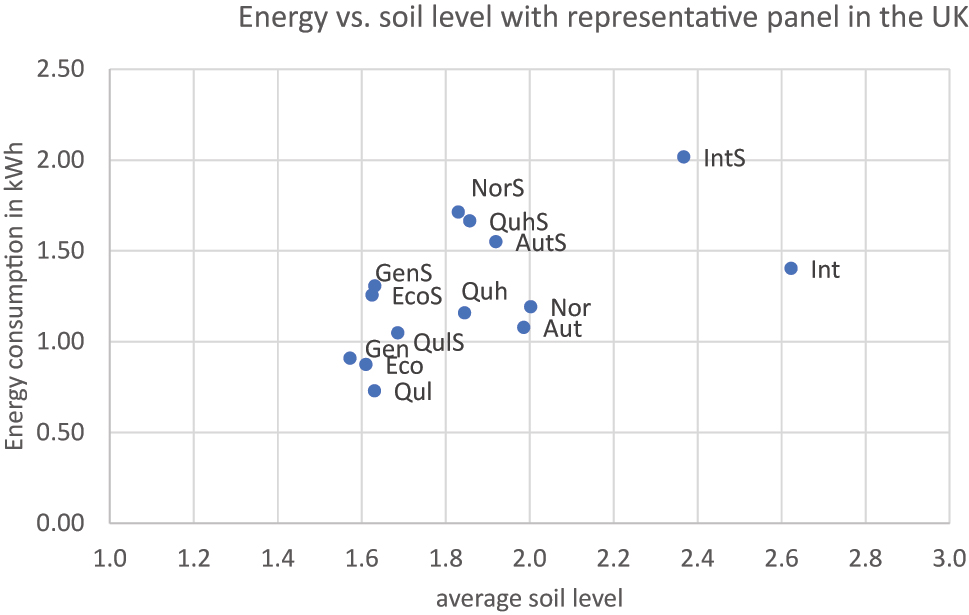
From the consumer survey, it is known how consumers rate the degree of soiling of the dishes cleaned in the selected programmes. This makes it possible to present the average energy consumption of the programmes used for the levels of soiling encountered by the user (coding: light soiling = 1, normal = 2, heavy = 3). This shows (Figure 1), on the one hand, that the consumer makes a clear distinction when selecting a programme (especially for the intensive programme) and, on the other hand, that there is a wide range of programmes available for almost the same level of soiling between ∼1.6 and 2.0.
4 Simulation of savings
The base case of the scenario simulation is the situation of the dishwasher as installed in UK households (via the “UK model”) and the consumer behaviour as assessed by the consumer questionnaire (representative consumer survey). Both together give an average consumption of 1.16 kWh of energy and 12.7 L of water per cycle.
Based on this, a scenario can be imagined where the intention is to use only those programmes for a given soil level that use the least amount of energy (Figure 1). Firstly, this means that the use of the modifier “express/speed/fast/time saving” should generally be avoided, as it significantly increases resource consumption. This would mean, for example, stopping the use of the “IntS” program and instead moving those program uses to the “Int” program. The same applies to all other uses of this modifier. Secondly, the use of the gentle ‘Gen’ programme should and could be shifted to the quick low temperature ‘Qul’ programme, as the levels of soiling encountered by consumers are quite similar and both programmes are recommended for lightly soiled dishes. Thirdly, the use of the normal/regular/daily (Nor), automatic/sensor (Aut) and quick high temperature (Quh) programmes should be replaced by the ECO (Eco) programme (Figure 1), as all these programmes are defined to clean normally soiled dishes. This seems justified for the ‘Nor’, ‘Aut’ and ‘Quh’ programmes, where consumers already associate a similar level of soiling, but not for the ‘Eco’ programme.
However, the “Eco” programme is the one where most stringent requirements on cleaning normally soiled dishes, for example, soiled with sauce residues or teacups, are requested. This programme is used as the basis for the Ecodesign requirements requested by Commission Regulation (EU) 2019/2022 of 1 October 2019 (and earlier versions) (valid also after the withdrawal of the UK from the European Union) and requests that “the cleaning performance index shall be >1.12”, i.e. the cleaning of dishes (including pots), soiled with seven types of food and dried in for 2 h at 80 °C, must be 12 % better than the reference programme on a Miele reference machine. This “Eco” programme is also the one used by Which? to assess the cleaning performance of dishwashers under test conditions. Thus, it is well-suited for cleaning normally soiled dishes.
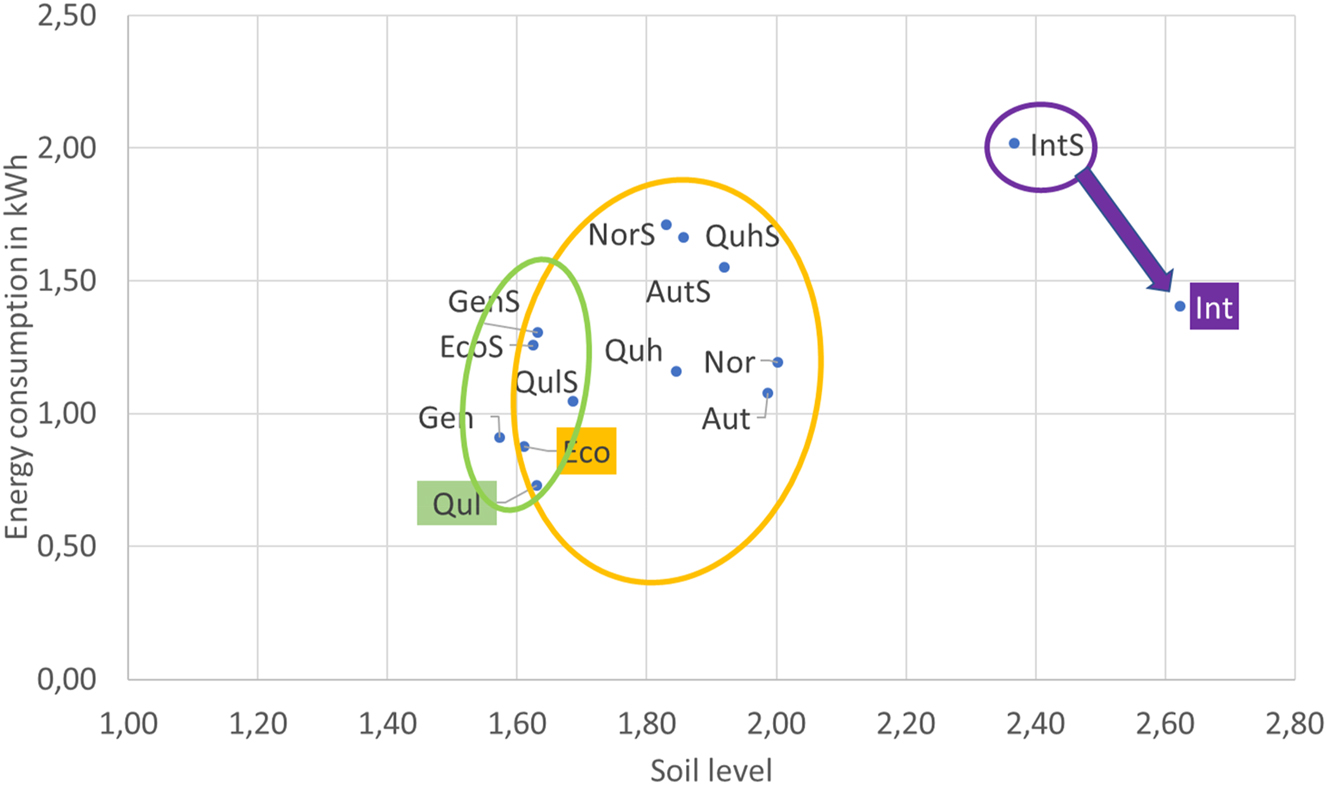
Average energy consumption of the programme versus the average soil level of the dishes. Coloured marks and circles show the most energy-saving strategy of shifting programmes.
Only three programmes remain (Figure 2) when this is done: eco, intensive and quick (low temperature) and the modifier “express/speed/quick/time-saving” is no longer used. This results in (Table 11) an average energy consumption of 0.91 kWh and water consumption of 10.4 L, corresponding to savings of 21.3 % in energy and 18 % in water consumption. This is at an expense of 60 min prolongation of the programme duration (from an average of 128 min to 188 min).
Average energy and water consumption and programme duration for the simulation of a changed consumer behaviour regarding programme choice. Changes in the programme selection are indicated in the column “simulation UK” and are reflected in the column “consumer choice” as simulated programme selection. Weighted sums are highlighted in bold.
| Programme | Short name | Simulation “UK” | Consumer choice | Energy | Water | Duration |
|---|---|---|---|---|---|---|
| Eco | Eco | +EcoS + Nor + AutS + NorS + Aut + Quh + QuhS | 78.4 % | 0.87 | 9.9 | 215 |
| Intensive/pots & pans/heavy | Int | +IntS | 10.5 % | 1.40 | 14.6 | 149 |
| Quick/fast (45°, jet, 30′, express, …) | Qul | +QulS + Gen + GenS | 11.0 % | 0.73 | 9.8 | 32 |
| Weighted sum | 100 % | 0.91 | 10.4 | 188 |
This can be identified as the most energy-saving scenario, maintaining the association to the soil level by the consumer and not requesting an unacceptable prolongation of the average programme duration.
Implementing this learning in consumer communication would require the following messages to be conveyed:
Do not use the programme modifier “express/speed/quick/time-saving” as it may require significant additional resources (energy, water).
Use the ECO programme for all normally soiled dish loads and accept the longer programme duration, as this will provide a good cleaning with a low amount of resources (energy, water).
Use the Quick/fast (45 °C, Jet, 30′, express, …) programme for lightly soiled dishes.
A comparison of these results with data from other European countries 14 (Figure 3), where similar observations and simulations have been carried out, shows that energy and water saving options are of a similar magnitude. This means that the saving options can be implemented at least on a European level.
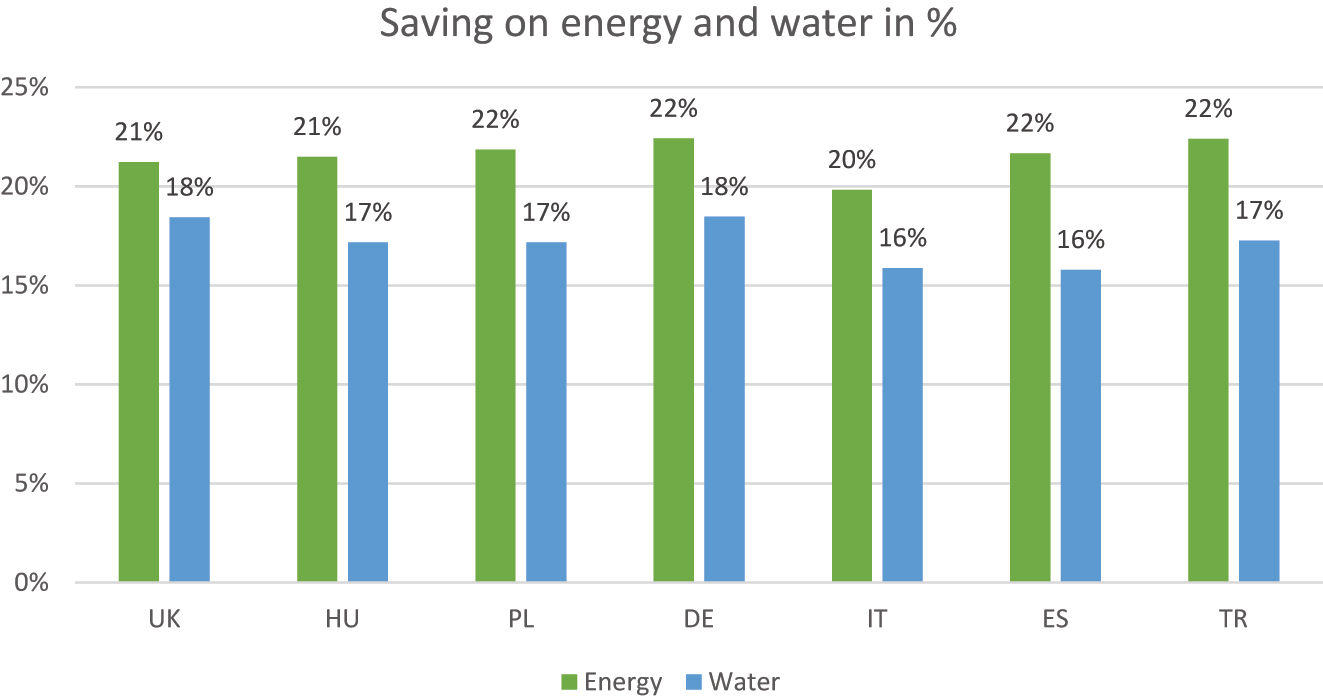
Comparison of the savings possible for UK with results of similar approaches in other European countries (HU = Hungary, PL = Poland, DE = Germany, IT = Italy, ES = Spain, TR = Turkey).
5 Discussion and conclusion
The research question was to understand the socio-technical systems of automatic dishwashing in sufficient detail for the UK and, in particular, to find the right recommendations for optimising this system in order to achieve relevant savings in resource use without requiring a complete refurbishment of the infrastructure installed. This is done especially by understanding that the consumer selects the programme on the dishwasher based mainly on the soil level the dishes have. Most of the selections are considered correct, with two exceptions. Firstly, the modifier “express/speed/quick/time-saving” is used without realising that this will cause a considerable increase in the resources used, which is in clear contrast to the third of the top priorities for consumers, namely saving energy and water. Secondly, the “Eco” programme is used at a rather low soil level of the dishes. This is in contrast to what this programme is designed for and verified by the government, as it is the basis for the energy label and consumer organisations, such as Which?.
Correcting these points in the consumer behaviour means giving the consumer three simple messages, that everyone can easily follow, regardless of the brand of dishwasher they have installed in their home. As the simulation shows, this will save, 21.3 % in energy and 18 % in water consumption. With the carbon intensity of electricity generation in the UK at 265 g of CO2 per kWh, this will save 0.3 Mt of CO2 emissions per year. This saving requires no additional costs or investments and can be realised immediately. It only needs the understanding that long running dishwashing programmes at a low temperature (such as the “Eco” programme uses) provide sufficient time to clean dishes as well as short programmes at a higher temperature, but save a lot of electrical energy. Comparison with results from other European countries shows that this saving option also works well in other countries. The main advantage of the proposed recommendations – compared to many others – is that the consumer ’s expectations of a sufficiently good cleaning result are met, as the three programmes are clearly classified according to the degree of soiling of the dishes to be cleaned, as perceived by the consumer.
Despite all this, when using the dishwasher, it is still important to observe the well-known rules of avoiding pre-cleaning the dishes under running water, using the full load capacity and cleaning the filters regularly. Researchers should pay more attention to the aspect of resource consumption when using modifiers, and manufacturers should provide clearer information in their instructions for use on how these modifiers affect resource consumption, and should actively promote the use of the eco programme.
About the authors
Thomas Alt is an international marketing manager for the automatic dishwashing category at Henkel Consumer Brands. He holds a PhD in the field of brand management as well as a bachelor ’s and master ’s degree in Business Administration of the University of Münster.
Antje Gebert-Schwarzwälder obtained her PhD in Organic Chemistry at the University of Freiburg i.Br. She has worked in Henkel ’s research and development in the fields of hair colourations, laundry detergents and is currently product developer for automatic dishwashing detergents.
Arnd Kessler graduated from Georg-Simon-Ohm University of Applied Sciences in Nuremberg in Chemical Engineering (Dipl.Ing.). In 1998 he joined Henkel ’s corporate research team. From 2000 until 2011 he worked as a product developer for automatic dishwashing detergents. Since 2011 Mr. Kessler heads Henkel ’s Laundry & Homecare appliance technology team.
Claudia Berto graduated in Industrial Chemistry at the University of Venice. Since then she has been working in R&D across different categories, Household, Personal Care, HealthCare. Since May 2020 she has been working for Henkel as the head of R&D Operations for UK & IE.
Rainer Stamminger, University of Bonn. After 17 years of practical experience in the development of washing machines and dishwashers with AEG Hausgeräte, Germany. Rainer Stamminger was appointed Professor of Appliance and Process Engineering at the University of Bonn. Main areas of research at the University are consumer behaviour of household work with and without using appliances, new products or features, smart appliances, robots for household application and questions of sustainability of housekeeping.
Acknowledgments
This research was supported by Henkel UK although this company is not on the market for auto-dishwashing products.
-
Research ethics: Not applicable.
-
Author contributions: The authors have accepted responsibility for the entire content of this manuscript and approved its submission.
-
Competing interests: The authors state no conflict of interest. The author Rainer Stamminger is involved in several third party projects funded by different companies producing dishwashers and cleaners.
-
Research funding: None declared.
-
Data availability: The data that supports these findings are available upon reasonable request from the corresponding author. Select data may not be available due to privacy or business practices.
References
1. Anderson, C. M.; Defries, R. S.; Litterman, R.; Matson, P. A.; Nepstad, D. C.; Pacala, S.; Schlesinger, W. H.; Shaw, M. R.; Smith, P.; Weber, C.; Field, C. B. Natural Climate Solutions are Not Enough. Science 2019, 363 (6430), 933–934. https://doi.org/10.1126/science.aaw2741.Suche in Google Scholar PubMed
2. Roshan, A.; Kumar, M. Water End-Use Estimation Can Support the Urban Water Crisis Management: A Critical Review. J. Environ. Manage. 2020, 268, 110663. https://doi.org/10.1016/j.jenvman.2020.110663.Suche in Google Scholar PubMed
3. Nauges, C.; Wheeler, S. A. The Complex Relationship Between Households’ Climate Change Concerns and Their Water and Energy Mitigation Behaviour. Ecol. Econ. 2017, 141, 87–94. https://doi.org/10.1016/j.ecolecon.2017.05.026.Suche in Google Scholar
4. Elzen, B.; Geels, F. W.; Green, K. Chapter 1: General Introduction: System Innovation and Transitions to Sustainability. In System Innovation and the Transition to Sustainability: Theory, Evidence and Policy; Elzen, B., Geels, F. W., Green, K., Eds.; Edward Elgar Publishing: Cheltenham/Northampton, MA, 2004; pp. 1–16.10.4337/9781845423421.00010Suche in Google Scholar
5. Shove, E. Sustainability, System Innovation and the Laundry. In System Innovation and the Transition to Sustainability: Theory, Evidence and Policy; Elzen, B., Geels, F. W., Green, K., Eds.; Edward Elgar Publishing: Cheltenham/Northampton, MA, 2004; pp. 76–93.10.4337/9781845423421.00014Suche in Google Scholar
6. G. O. E. A. GEA Background Report 1 – Washing Machines, Driers and Dishwashers – Basic Assumptions, Test Methods and Consumer Aspects; Danish Energy Agency: Copenhagen, Denmark, 1995.Suche in Google Scholar
7. Presutto, M.; Stamminger, R.; Scaldoni, R.; Mebane, W.; Esposito, R. Preparatory Study of Eco-Design Requirements of EuPs; Lot 14: Domestic Washing Machines and Dishwashers; Task 3–5; ISIS: Freiburg, Germany, 2007.Suche in Google Scholar
8. Richter, C. P. Usage of Dishwashers: Observation of Consumer Habits in the Domestic Environment. Int. J. Consum. Stud. 2011, 35, 180–186. https://doi.org/10.1111/j.1470-6431.2010.00973.x.Suche in Google Scholar
9. Berkholz, P.; Stamminger, R.; Wnuk, G.; Owens, J.; Bernarde, S. Manual Dishwashing Habits: An Empirical Analysis of UK Consumers. Int. J. Consum. Stud. 2010, 34, 235–242. https://doi.org/10.1111/j.1470-6431.2009.00840.x.Suche in Google Scholar
10. Stamminger, R.; Schmitz, A.; Hook, I. Why Consumers in Europe Do Not Use Energy Efficient Automatic Dishwashers to Clean Their Dishes? Energy Effic. 2019, 12, 567–583. https://doi.org/10.1007/s12053-018-9648-2.Suche in Google Scholar
11. Hook, I.; Schmitz, A.; Stamminger, R. Dishwashing Behaviour of European Consumers (Schriftenreihe der Haushaltstechnik Bonn); Shaker-Verlag: Aachen, 2018; p. 192.Suche in Google Scholar
12. Hook, I.; Schmitz, A.; Stamminger, R. Dishwashing Behaviour of European Consumers With Regard to the Acceptance of Long Programme Cycles. Energy Effic. 2018, 11, 1627–1640. https://doi.org/10.1007/s12053-017-9539-y.Suche in Google Scholar
13. Tewes, T. J.; Harcq, L.; Bockmühl, D. P. Use of Automatic Dishwashers and Their Programs in Europe With a Special Focus on Energy Consumption. Clean. Technol. 2023, 5, 1067–1079. https://doi.org/10.3390/cleantechnol5030054.Suche in Google Scholar
14. Alt, T.; Boivin, D.; Altan, M.; Kessler, A.; Schmitz, A.; Stamminger, R. How Many Resources Can be Saved by Changing Consumers’ Automatic Dishwashing Behaviour? Tenside Surfact. Det. 2023, 60, 191–202. https://doi.org/10.1515/tsd-2022-2489.Suche in Google Scholar
© 2024 Walter de Gruyter GmbH, Berlin/Boston
Artikel in diesem Heft
- Frontmatter
- Short Communication
- Removal of indomethacin from water using covalent organic polymers
- EU CLP Regulation
- The EU Detergent Industry Network ‘DetNet’ – an industry approach for the EU CLP classification of detergent and cleaning products for skin and eye effects
- Dishwashing
- Short and sweet: balancing energy savings and cleaning performance to identify efficient short-cycles for domestic dishwashers
- Saving resources without sacrificing results: an empirical investigation of the dishwashing reality of British consumers in an international comparison
- Synthesis
- Synthesis and emulsification properties of polyglyceryl estolides prepared from fatty acids
- Hydroformylation of branched olefins catalyzed by Co2(CO)8 for synthesis of branched alcohol ethoxylates and their surfactant properties
- Physical Chemistry
- Rheological characterization on novel viscoelastic tetrameric polyhydroxy cationic surfactant/sodium chloride micelle solutions
- Dynamic light scattering study on quercetin/surfactant/solvent system
- Comparative studies on physicochemical properties of cadmium and neodymium soaps in solid-state
- Enhanced removal of toxic Disperse Blue 35 dye through cloud point extraction: influence of parameters and solvent regeneration
- Review Article
- Cationic Gemini surfactants: a review on synthesis and their applications
Artikel in diesem Heft
- Frontmatter
- Short Communication
- Removal of indomethacin from water using covalent organic polymers
- EU CLP Regulation
- The EU Detergent Industry Network ‘DetNet’ – an industry approach for the EU CLP classification of detergent and cleaning products for skin and eye effects
- Dishwashing
- Short and sweet: balancing energy savings and cleaning performance to identify efficient short-cycles for domestic dishwashers
- Saving resources without sacrificing results: an empirical investigation of the dishwashing reality of British consumers in an international comparison
- Synthesis
- Synthesis and emulsification properties of polyglyceryl estolides prepared from fatty acids
- Hydroformylation of branched olefins catalyzed by Co2(CO)8 for synthesis of branched alcohol ethoxylates and their surfactant properties
- Physical Chemistry
- Rheological characterization on novel viscoelastic tetrameric polyhydroxy cationic surfactant/sodium chloride micelle solutions
- Dynamic light scattering study on quercetin/surfactant/solvent system
- Comparative studies on physicochemical properties of cadmium and neodymium soaps in solid-state
- Enhanced removal of toxic Disperse Blue 35 dye through cloud point extraction: influence of parameters and solvent regeneration
- Review Article
- Cationic Gemini surfactants: a review on synthesis and their applications
