Properties and applications of warm mix asphalt in the road construction industry: a comprehensive review and insights toward facilitating large-scale adoption
-
Thaar Alqahtani


Abstract
Warm mix asphalt (WMA) is a sustainable innovation in road construction that enables bituminous mixtures to be produced and compacted at lower temperatures than traditional hot mix asphalt (HMA). This reduction in temperature significantly decreases greenhouse gas (GHG) emissions and other pollutants, supporting global climate change mitigation efforts. WMA technology enhances energy efficiency while maintaining the performance and durability of road surfaces, offering an environmentally responsible alternative for the construction industry. Its adoption reflects a commitment to reducing the carbon footprint of infrastructure projects. These innovations are anchored in three primary techniques, chemical additives, organic additives, and foaming processes, each of which contributes uniquely to reducing energy consumption while improving pavement performance. Extensive research has revealed the multifaceted advantages of WMA. Mechanically, WMA demonstrates exceptional properties, including enhanced resistance to stripping, fatigue, thermal cracking, and rutting, which collectively contribute to the longevity and resilience of asphalt pavements. Environmentally, the reduced energy demands of WMA production not only reduce emissions but also provide an opportunity to integrate recycled materials and industrial byproducts, further reinforcing its eco-friendly credentials. Economically, the lower production temperatures translate into operational cost savings, although a detailed analysis of long-term cost implications is essential to fully understand its financial viability. This review highlights the historical development, material innovations, and advanced techniques underpinning WMA, providing a thorough evaluation of its rheological and fractured properties. This research aims to support the widespread implementation of WMA in pavement applications. This study also emphasized the critical role of life cycle assessment (LCA) in quantifying the sustainability benefits of WMA mixtures. Moreover, the study explores the emerging trends and challenges in the widespread adoption of WMA, emphasizing the need for robust evaluations of its economic, environmental, and safety aspects. Ultimately, WMA technologies represent a pivotal innovation, offering an integrative solution to modernize the road construction industry while addressing pressing environmental concerns.
1 Introduction
The rapid expansion and modernization of road infrastructure worldwide have posed substantial challenges for the asphalt industry, particularly in terms of resource depletion, environmental sustainability, rising material costs, and the growing need for eco-friendly alternatives. Asphalt pavements serve as a fundamental component of transportation systems, significantly contributing to economic development and daily mobility across nations at varying stages of growth [1]. With increasing traffic volume, there is widespread recognition of the need for enhanced asphalt binders and mixtures that exhibit superior performance characteristics, ensuring the longevity and resilience of road networks [2]. In response to these challenges, the development of ecologically green and energy-efficient pavement technologies has garnered significant attention in recent years [3]. The emergence of WMA technologies can be linked to the global commitment to reducing GHG emissions, which was initially emphasized by the Kyoto Protocol [4]. WMA technologies are commonly categorized into three main classifications on the basis of their approach to lowering production temperatures: foaming techniques, organic modifiers, and chemical additives (Figure 1) [5]. This commitment has been further reinforced through subsequent international climate agreements and initiatives, including the United Nations Climate Summit held in New York in 2014, where world leaders and organizations pledged substantial reductions in carbon emissions [6]. WMAs are produced via specialized techniques and the addition of specific modifiers, allowing them to be manufactured at temperatures between 100 °C and 150 °C, which is considerably lower than the approximately 200 °C required for conventional HMA [7]. This substantial decrease in production temperature results in lower energy demand and a notable reduction in carbon emissions, offering both environmental and economic benefits.
![Figure 1:
WMA technologies (adapted with improvement and permission from [5]).](/document/doi/10.1515/rams-2025-0187/asset/graphic/j_rams-2025-0187_fig_001.jpg)
WMA technologies (adapted with improvement and permission from [5]).
Several comprehensive reviews have recently addressed warm mix asphalt (WMA) technologies, yet their scopes differ from those of the present study (Table 1). These studies concentrated on the environmental emissions and performance of the Evotherm-modified WMA, providing valuable data but limited to a single chemical additive [8]. WMA has been examined primarily from the standpoint of reclaimed asphalt pavement (RAP) utilization and mix design, without a broad evaluation of other additive classes or sustainability metrics [9]. A detailed review of WMA mix design, performance, and LCA has been presented, but additive-specific effects or barriers to large-scale field implementation [10] have not been analyzed. Design and performance trends are discussed, but an integrative comparison of environmental, mechanical, and economic aspects is lacking [1]. Another study focused solely on foam-mix asphalt, which represents only one subset of WMA technologies [11].
Comparative summary of recent review studies on WMA technologies and the distinct contributions of the present study.
| Ref. | Focus area | Limitations | Distinct contribution of this study |
|---|---|---|---|
| [8] | Emissions and performance of evotherm-based WMA | Limited to one chemical additive | Broader comparison across all additive and process types |
| [9] | RAP utilization and mix design in WMA | Focused on RAP; minimal environmental/economic analysis | Integrates sustainability and life-cycle aspects |
| [10] | Mix design, construction temperature, performance, LCA | Did not discuss additive-specific differences or adoption barriers | Connects LCA findings with implementation challenges |
| [1] | General review on design and performance | Lacked integrated environmental/economic evaluation | Presents multidimensional analysis (mechanical + environmental + economic) |
| [11] | Foam-mix asphalt only | Narrow technological focus | Covers all WMA classifications (chemical, organic, foaming) in one framework |
In contrast, the present review provides a comprehensive synthesis that spans chemical, organic, and foaming WMA technologies (Figure 1), integrating mechanical, rheological, environmental, and economic performance. It further emphasizes LCA and implementation pathways toward large-scale adoption, which have not been systematically discussed in prior works. By combining the classification of WMA technologies with cross-cutting analyses of emissions, energy demand, and sustainability, this paper bridges laboratory findings and field applications, offering actionable insights for researchers and industry practitioners seeking mainstream WMA in modern pavement construction.
Among the innovative advancements in asphalt production, WMA has gained prominence because of its distinct benefits, including improved workability, lower fuel consumption, reduced GHG emissions, and the ability to facilitate longer transport distances. Under specific conditions, WMA has demonstrated performance that is either comparable to or superior to that of conventional HMA [12]. The extent to which production temperatures can be lowered depends on the specific WMA technology implemented and the type and quantity of additives or processes utilized [13]. Critical insights into the development and optimization of WMA technologies are also provided, offering valuable guidance for researchers in this field [14]. Comparative analyses between WMA and HMA indicate that the integration of WMA additives can lead to energy savings of approximately 5 %–13 %, depending on the degree of temperature reduction achieved during production [15].
Asphalt mixtures are generally categorized on the basis of the temperature required during their production [16]. These classifications consist of four main types, ranked from the highest to the lowest production temperatures: HMA, WMA, half-WMA, and cold mix asphalt [17], 18]. Among these, WMA has garnered significant attention because of its ability to achieve mechanical properties and field performance comparable to those of conventional HMA [19]. The production of HMA involves heating the asphalt binder to elevated temperatures to reduce its viscosity sufficiently, ensuring uniform coating of aggregate particles and strong adhesion [20]. Conversely, WMA employs specialized agents that facilitate adequate adhesiveness at substantially lower temperatures than those required for HMA [14]. These agents fall into three primary technological categories: foaming processes, chemical modifiers, and organic additives [21]. These chemical additives function differently by incorporating a blend of emulsifiers, anti-stripping agents, surfactants, polymers, and performance enhancers [22]. Unlike foaming and organic additives, chemical agents do not directly alter binder viscosity; instead, they improve workability by reducing internal friction between the aggregates and binder, optimizing surface tension, and enhancing adhesion properties [23], 24].
Conventional HMAs are growing concerns over worker health, construction site safety, and environmental sustainability, which have driven significant advancements in asphalt technology. Among these priorities, conserving fossil fuel resources, reducing energy consumption, and minimizing GHG emissions are critical objectives that have spurred the development of WMA technologies [25]. WMA represents a transformative innovation in asphalt materials that is comparable in significance to the introduction of recycling practices. This groundbreaking technology has far-reaching implications for both the asphalt paving industry and environmental stewardship [26]. WMA is a broad term that refers to a range of technologies and additives designed to facilitate the production, placement, and compaction of asphalt mixtures at lower temperatures while maintaining performance and durability standards. By lowering production and application temperatures from 10 °C to 20 °C, WMA offers substantial benefits, including reduced fuel consumption, lower costs, and decreased GHG emissions [1], 27].
WMA technology contributes to minimizing GHG emissions. It also enhances workability, decreases binder aging [28], supports paving in colder weather conditions, and allows for longer haul distances to construction sites [29]. Despite the diverse range of WMA solutions available, all technologies share common goals: lowering binder viscosity, improving workability, and reducing emissions during asphalt mixture production [30]. The rate at which asphalt mixtures cool is primarily determined by the temperature differential between the mixture and its surrounding environment, with a smaller gradient resulting in a slower cooling process [30]. Additionally, RAP, which is derived from the milling or removal of aged and deteriorated pavement during maintenance or rehabilitation, has emerged as a valuable material. The integration of RAP into asphalt mixtures offers substantial economic and environmental benefits, making it a sustainable choice for modern pavement engineering [31]. Figure 2 shows the economic and environmental aspects of WMA mixtures [7].
![Figure 2:
Economic and environmental aspects of WMA products (adapted with permission from [7]).](/document/doi/10.1515/rams-2025-0187/asset/graphic/j_rams-2025-0187_fig_002.jpg)
Economic and environmental aspects of WMA products (adapted with permission from [7]).
However, when used independently, both the RAP and WMA technologies present certain challenges. Combining WMA with RAP has been shown to mitigate these drawbacks, offering a synergistic approach that leverages the strengths of both technologies while addressing their limitations [32]. The economic and environmental advantages of WMA mixtures are illustrated in Figure 2, emphasizing their dual role in advancing sustainability and cost efficiency in asphalt pavement construction [7]. WMA technology offers numerous advantages over conventional HMA, including enhanced workability, reduced fuel consumption [7], lower GHG emissions, and the ability to support longer transport distances. Under similar conditions, WMA has demonstrated performance that matches or even exceeds that of HMA [33]. The extent of temperature reduction achieved varies depending on the specific WMA technology and the amount of additives used. Comprehensive reviews on these technologies are accessible in the literature, offering valuable insights for researchers in the field [34]. By lowering both production and compaction temperatures, WMA technologies yield a variety of benefits, including increased economic efficiency, increased environmental sustainability, improved safety, and superior outcomes in terms of production, paving, and performance [35]. Recent studies have emphasized the economic and ecological advantages of WMA, underscoring its ability to reduce both energy consumption and emissions [36]. Furthermore, the implementation of WMA has been linked to improved working conditions and enhanced safety for construction workers [37]. Reducing production and compaction temperatures is considered the most effective approach for minimizing carbon dioxide emissions during asphalt manufacturing and road construction [34]. In addition, the widespread adoption of WMA is driven primarily by six key benefits: environmental sustainability, improved safety, cost effectiveness, enhanced paving quality, superior performance, and more efficient production processes [38]. Furthermore, Figure 3 displays the chronological distribution of articles on WMAs.
![Figure 3:
Chronological distribution of articles on WMAs (adapted with permission from [39]).](/document/doi/10.1515/rams-2025-0187/asset/graphic/j_rams-2025-0187_fig_003.jpg)
Chronological distribution of articles on WMAs (adapted with permission from [39]).
Although extensive studies have emphasized the environmental, mechanical, and economic advantages of WMA, significant gaps still exist in understanding its long-term performance, especially when it is subjected to diverse climatic conditions and heavy traffic volumes. Moreover, although the use of recycled materials and industrial byproducts in WMA has been investigated, comprehensive studies evaluating their impacts on the rheological and fracture properties of asphalt mixtures are still lacking. This review aims to address these critical gaps by synthesizing and critically examining recent developments in WMA technologies, focusing on material properties, performance metrics, and sustainable applications. Particular attention is given to sustainability indicators, including LCA, to evaluate the environmental and economic implications of WMA. The novelty of this work lies in its integrative approach, which combines technical, mechanical, and economic analyses to generate actionable insights that bridge the gap between academic research and practical implementation. By identifying emerging trends, unresolved challenges, and opportunities for widespread adoption, this review aims to provide valuable resources for researchers, industry stakeholders, and policymakers committed to advancing sustainable road construction practices. The interdisciplinary nature and comprehensive scope of this study underscore its importance as a timely contribution, offering innovative, solution-driven perspectives to support the ongoing evolution of the road construction sector. The work is designed to resonate with both academic reviewers and practitioners seeking impactful, forward-thinking research in this critical area.
2 Structure and evidence-gathering protocol adopted for the collection of literature reviews
This review started searching major scholarly databases (Scopus, Web of Science, ScienceDirect, ASCE Library, IEEE Xplore, SpringerLink) and reputable industry and agency sources such as AASHTO/ASTM) for publications from 2000 to 2025, giving extra weight to 2015–2025, when warm mix asphalt (WMA) technologies matured and field use expanded. The search terms combined WMA types (chemical, organic, and foaming, including proprietary names) with outcomes of interest, such as materials and production/compaction practices; laboratory and field properties (rheology, fracture/fatigue, rutting, moisture damage); sustainability and LCA; costs and energy use; safety and performance; practical applications; and adoption barriers and trends. Studies that tested or applied WMA via any of the three main approaches and reported at least one relevant outcome (mechanical/rheological or field performance, environmental indicators such as emissions/energy or LCA, or economic/implementation evidence) were also included. We excluded HMA-only or cold-mix papers without WMA analysis, patents without evaluative data, editorials/news items, and records without accessible full texts. A standardized extraction form captured the WMA class and additive dosage, production and compaction temperatures, binder grade and RAP content, test standards (AASHTO/ASTM), mechanical and durability metrics, environmental indicators (e.g., GHG emissions, energy intensity, LCA scope and assumptions), economic and implementation notes, safety observations, and deployment details. Because studies vary in materials, dosages, boundary conditions, and test methods, they synthesize results narratively and use simple direction-of-effect summaries where fair comparisons exist; a meta-analysis was not performed owing to methodological incompatibilities. Full search strings, screening decisions, and appraisal/extraction templates are archived to ensure transparency and reproducibility. Furthermore, it is believed that this paper can offer a methodologically transparent, practical reference for researchers, practitioners, and transportation-infrastructure designers worldwide.
3 Historical development
The first Asphalt was initially used for road building in Babylon. The ancient Greeks, who called it “asphaltos” meaning “secure”, returned to 625 B.C. (Figure 4). Moreover, the development of WMA technology can be traced back to Europe, although the initial concept was pioneered in 1956 by Professor Csanyi at Iowa State University [40]. The first documented WMA trials were conducted in Norway and Germany between 1995 and 1999 [41]. In 1996, regulatory authorities in Germany, specifically the Ministry of Labor and Social Affairs, introduced new workplace safety standards aimed at reducing exposure to asphalt fumes by decreasing the temperatures of asphalt mixtures [42]. The earliest significant experimentation with WMA technology occurred in 1995, when a German company conducted tests using Aspha-min zeolite to induce foaming in asphalt mixtures.
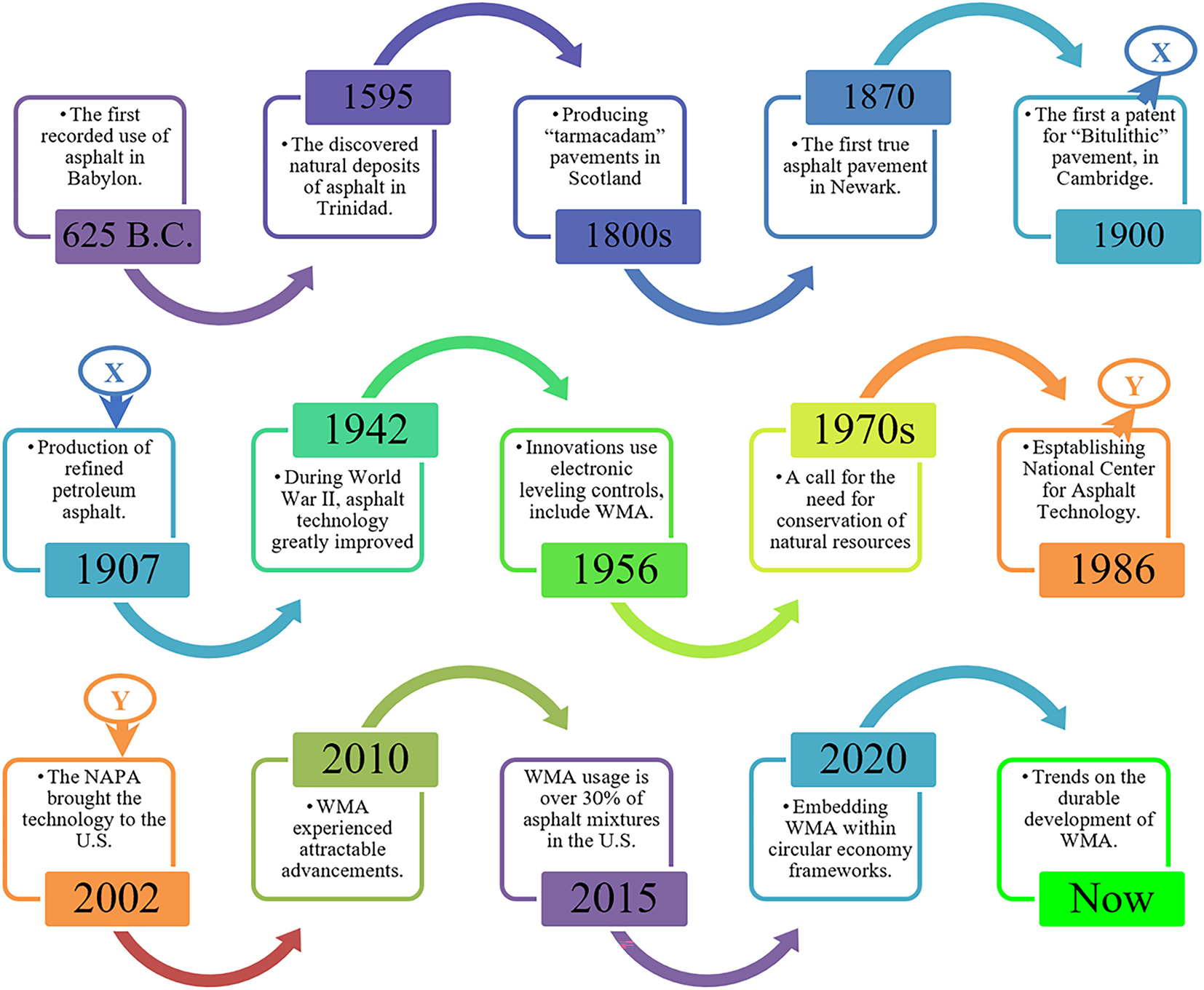
Historical development trends of WMA.
Concurrently, Norwegian researchers in 1996 experimented with a WAM emulsion, a precursor to WAM foam, which became one of the earliest forms of foaming technology [42]. In 1997, the introduction of wax-modified WMA in Hamburg marked a pivotal development in refining WMA formulations [43]. This innovation was followed by significant progress in 1999, with the first field trials of WMA using foam asphalt (Table 2) and Aspha-min zeolite conducted in Norway and Germany, respectively. The global adoption of WMA grew rapidly during the early 2000s, with the National Asphalt Pavement Association (NAPA) bringing the technology to the United States in 2002 [34] (Figure 4). In the same year, the FHWA, in collaboration with several State Departments of Transportation, initiated WMA trials across the U.S. The incorporation of foaming methods such as WAM-Foam™ from Norway, along with chemical additives such as Evotherm in the U.S., played a crucial role in broadening the range of WMA applications. By 2003, the NCHRP launched comprehensive studies to assess the performance and environmental advantages of WMA, which significantly propelled its widespread adoption in the U.S. market.
Effects of foam asphalt on various properties, as reported by previous researchers.
| Asphalt type | Temperature sensitivity | Low temperature performance | Fatigue resistance | High temperature performance | Rutting resistance | Ref. |
|---|---|---|---|---|---|---|
| SBS modified bitumen | Increased | Unsignificant change | Increased | Increased | Increased | [44] |
| Latex modified asphalt | Unsignificant change | – | – | – | Unsignificant change | [45] |
| PG70-22, PG64-22 | – | – | – | Increased | – | [46] |
| A 50/70 and 35/50 | Increased | Increased | Unsignificant change | Decreased | – | [47] |
| Epoxy asphalt | Increased | – | – | Decreased | Decreased | [48] |
| 70/100 bitumen | Unsignificant change | Unsignificant change | – | Decreased | Decreased | [49] |
In the early 2000s, amid growing concerns over climate change and tightening environmental regulations, advancements in WMA technologies were directed toward reducing carbon dioxide emissions and energy consumption (Saarinen et al. 2015). This has led to extensive research and innovation, resulting in further enhancements to WMA production methods [50]. By 2010, WMA had gained widespread acceptance as a sustainable alternative to conventional HMA. The introduction of advanced foaming techniques, such as the Double Barrel Green process, significantly improved the temperature reduction efficiency and asphalt mix production. Moreover, comprehensive studies confirmed that WMA maintained or enhanced pavement durability, reduced fuel usage during manufacturing, and minimized worker exposure to hazardous emissions, thereby reinforcing its technological advantages (Figure 6).
From 2010 onward, WMA technologies experienced attractable advancements and widespread adoption, driven by intensified research, technological improvements, and a growing global focus on sustainability [51] (Figure 4). The formalization of WMA specifications by AASHTO marked a pivotal step in standardizing its use across the United States [52]. By this time, state transportation agencies had widely integrated WMA into their infrastructure projects, with the NAPA reporting that WMA accounted for nearly 10 % of total asphalt production in the U.S. [53].
Between 2010 and 2015, the industry saw continuous refinement of WMA methodologies, particularly in foaming systems and chemical additives [54]. Innovations such as the Double Barrel Green system have gained popularity for producing high-quality mixes at significantly reduced temperatures. Concurrently, research has highlighted the compatibility of WMA with higher proportions of recycled materials, such as RAP [55]. By 2015, WMA usage in the U.S. had increased, representing more than 30 % of asphalt mixtures, reflecting confidence in its performance, economic viability, and environmental benefits [52].
From 2016 to 2020, advancements in WMA technology emphasized improving mix durability and broadening its applicability across various climatic conditions [13], 18]. Countries such as India and China accelerated their adoption of WMA through government-led sustainability programs and the development of region-specific technologies. In the United States, federal and state agencies increasingly promoted WMA for high-traffic roads and urban environments to curb energy consumption and mitigate urban heat island effects [34]. Research during this period also explored the integration of WMA with emerging innovations, including biobased additives, nanomaterials, and enhanced reclaimed asphalt pavement (RAP) utilization [30]. Since 2020, the focus has shifted toward embedding WMA within circular economy frameworks, prioritizing lifecycle sustainability [56]. With global commitments to reduce GHG emissions under agreements such as the Paris Accord, WMA has evolved into a key element of green infrastructure strategies [5]. Innovations include carbon-neutral or carbon-negative additives and the use of smart monitoring systems to assess mix performance during and after construction [57]. Furthermore, WMA is increasingly combined with other sustainable practices, such as cold in-place recycling and low-carbon binders. Presently, WMA accounts for nearly half of the asphalt production in leading markets such as the U.S., signifying its transformation from an emerging technology to a mainstream industry standard.
4 Classification of asphalt mixture technologies
Asphalt mixtures, which are essential for the construction and maintenance of roadways and parking lots, are composed of aggregates, asphalt binder, and filler materials [34]. The aggregate components may include crushed rock, sand, gravel, or industrial byproducts such as slag. Typically, asphalt cement serves as the binding agent, and when combined with heated aggregates, it forms what is commonly known as HMA or conventional asphalt mixtures [58]. The performance characteristics of asphalt mixtures are significantly influenced by temperature variations. Elevated temperatures lead to a considerable reduction in the viscosity of the binder, thereby weakening the adhesive bond between aggregate particles [59]. Simultaneously, the mixture’s stiffness decreases, resulting in increased susceptibility to permanent deformation under repetitive loading conditions [60]. To address these challenges, extensive research efforts have been directed toward developing innovative technologies that allow asphalt mixture production at lower temperatures without altering the mechanical integrity of the mixture.
Several asphalt production technologies, including HMA, WMA, and CMA, have been introduced to improve energy efficiency and environmental sustainability [61]. HMA serves as the conventional benchmark and is produced at high temperatures (typically 150–180 °C) to ensure proper aggregate coating and mixture workability. In contrast, CMA and WMA represent innovations that enable the production and compaction of asphalt at lower temperatures, thereby reducing fuel consumption and emissions. Despite these advantages, both CMA and certain WMA formulations exhibit performance limitations [30]. CMA faces challenges such as inadequate aggregate coating, increased air-void content, and extended curing periods. HMA, on the other hand, while providing excellent mechanical performance, suffers from increased energy demand, increased emissions, and worker safety concerns due to elevated production temperatures [62]. WMA technology offers a balanced alternative by lowering production temperatures while maintaining satisfactory engineering performance [63]. The adoption of WMA presents multiple advantages, including enhanced workability, minimized emissions, reduced fuel consumption, improved occupational safety, and an extended paving season [12]. Despite these benefits, the rigorous assessment and widespread implementation of WMA in pavement construction remain limited [56]. Figure 5 contrasts HMA and WMA technologies across key production and sustainability metrics. HMA operates at relatively high production temperatures (150–180 °C), does not require additives, and is associated with high energy consumption, greenhouse gas emissions (e.g., CO2), and overall cost. By comparison, WMA lowers the production temperature to 110–140 °C using additives, which correspondingly reduces the energy demand, emissions, and cost. Collectively, the diagram underscores WMA’s operational and environmental advantages relative to HMA, notwithstanding the requirement for chemical or foaming additives (Milad et al. 2022).
![Figure 5:
Comparison of WMA and HMA mixture technology (adapted with permission from [64]).](/document/doi/10.1515/rams-2025-0187/asset/graphic/j_rams-2025-0187_fig_005.jpg)
Comparison of WMA and HMA mixture technology (adapted with permission from [64]).
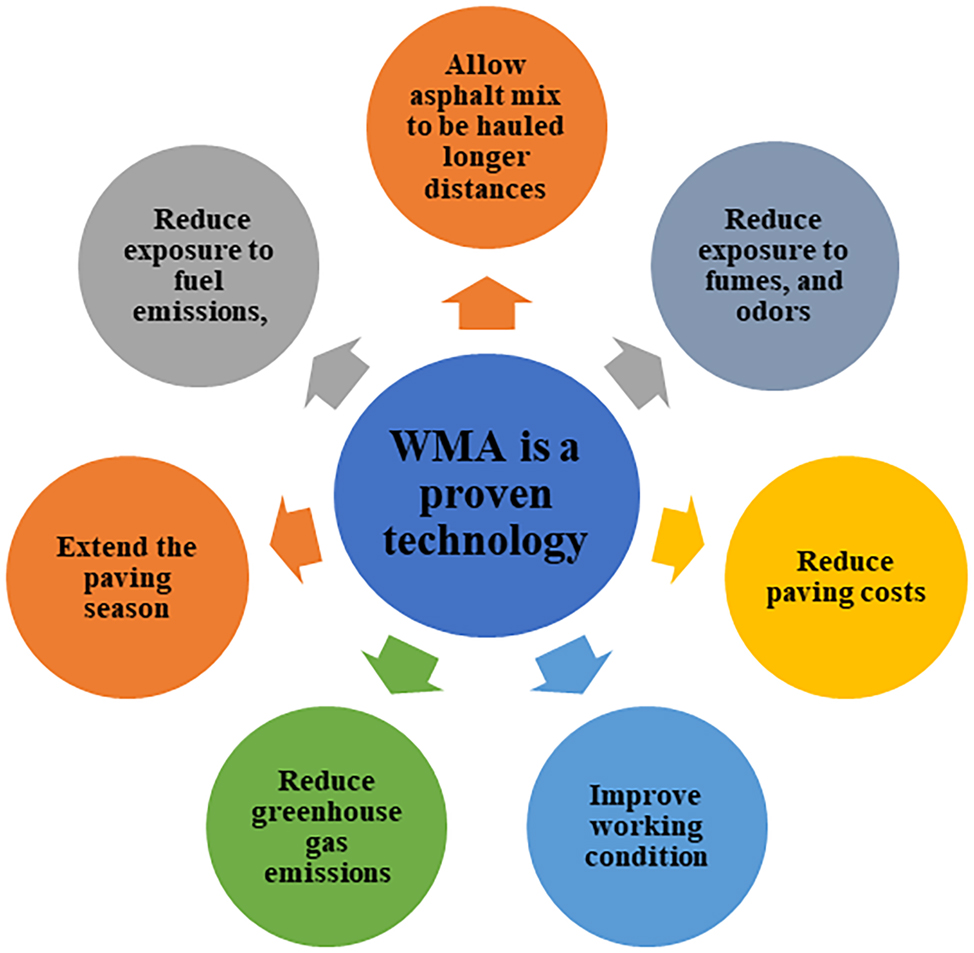
Beneficial-technological characteristics of WMA.
In WMA mixtures, temperature reduction during production is achieved through three primary methods [65]. This includes the foaming process, which mainly introduces water into the asphalt binder, either directly via specialized nozzles or indirectly through water-laden materials such as zeolites [66]. Studies indicate that the addition of water temporarily increases the binder’s volume, lowering its viscosity and allowing for more effective and consistent aggregate coatings, thereby improving the workability [34]. Common foaming techniques include water-based zeolites and water-infused methods such as WAM foam [39]. Organic additives, such as waxes and fatty amides, also contribute to lowering production temperatures by decreasing the viscosity of the asphalt binder. These additives typically melt at temperatures between 80 and 120 °C, facilitating better mixing and compaction during production [27], 30]. As these substances cool below their melting point, they crystallize and form a structural network, which can significantly improve the rheological and mechanical characteristics of the asphalt binder. Organic-based WMA technologies, such as Sasobit, are examples of additives that utilize this crystallization process to enhance binder performance [67].
Chemical additives, primarily composed of surfactants, emulsifiers, polymers, or a combination of these compounds, operate through a mechanism that differs significantly from foaming and organic-based methodologies [56]. These agents contribute to lowering the internal slip resistance, thereby minimizing the surface tension between the asphalt binder and aggregate particles [68]. By reducing surface tension, these additives enhance the coating efficiency of aggregates even at lower production temperatures [13]. A key advantage of chemical WMA technologies is that they do not substantially modify the viscosity or rheological characteristics of the asphalt binder [69]. Some of the most commonly utilized chemical additives in asphalt production include Zycotherm, Rediset, Cecabase, and Evotherm, all of which have been extensively studied and validated for their effectiveness [34]. Further detailed discussions regarding these technologies can be found in the literature [70].
A substantial body of research has investigated the impact of mixing and compaction temperatures on the mechanical properties of asphalt mixtures. When the mixing temperature falls below the required threshold, the binder may fail to adequately coat the aggregate, leading to an increased risk of moisture-induced damage [71]. Conversely, if compaction temperatures are excessively reduced, the densification process of the asphalt mixture in the field may be compromised, resulting in insufficient in-place density [72]. Moreover, excessively high temperatures during asphalt production and placement pose additional performance concerns [73]. Overheating accelerates the aging process of the asphalt binder, promoting oxidative hardening, which in turn facilitates the development of premature pavement cracks [74]. Studies estimate that inadequate compaction accounts for nearly 80 % of early pavement failures [63]. To address these challenges, researchers have explored various methods to determine the optimal mixing and compaction temperatures for asphalt mixtures [75]. While standardized guidelines exist for establishing the production temperatures of HMA, there remains no universally accepted criterion for defining the optimal mixing and compaction temperatures of WMA. Moreover, Figure 5 shows different WMA mixtures containing varying amounts of RAP [1], 23], 39], 57], [76], [77], [78]. However, the beneficial-technological characteristics of the WMA are shown in Figure 6.
5 Materials in WMA production
WMA has emerged as a groundbreaking and eco-friendly alternative in road construction, delivering significant environmental and economic advantages over conventional HMA [34]. The technical processes employed in WMA design are essential for decreasing both energy consumption and emissions efficiently (Figure 7). The production of WMA utilizes various materials and techniques, each contributing to its overall performance and sustainability [18]. A particularly noteworthy approach is the incorporation of waste materials such as steel slag, which not only helps conserve natural resources but also improves the mechanical properties of asphalt mixtures. Research has shown that the inclusion of steel slag enhances the stiffness and moisture resistance of asphalt, making it a potential solution for increasing the long-term durability of pavements [79].
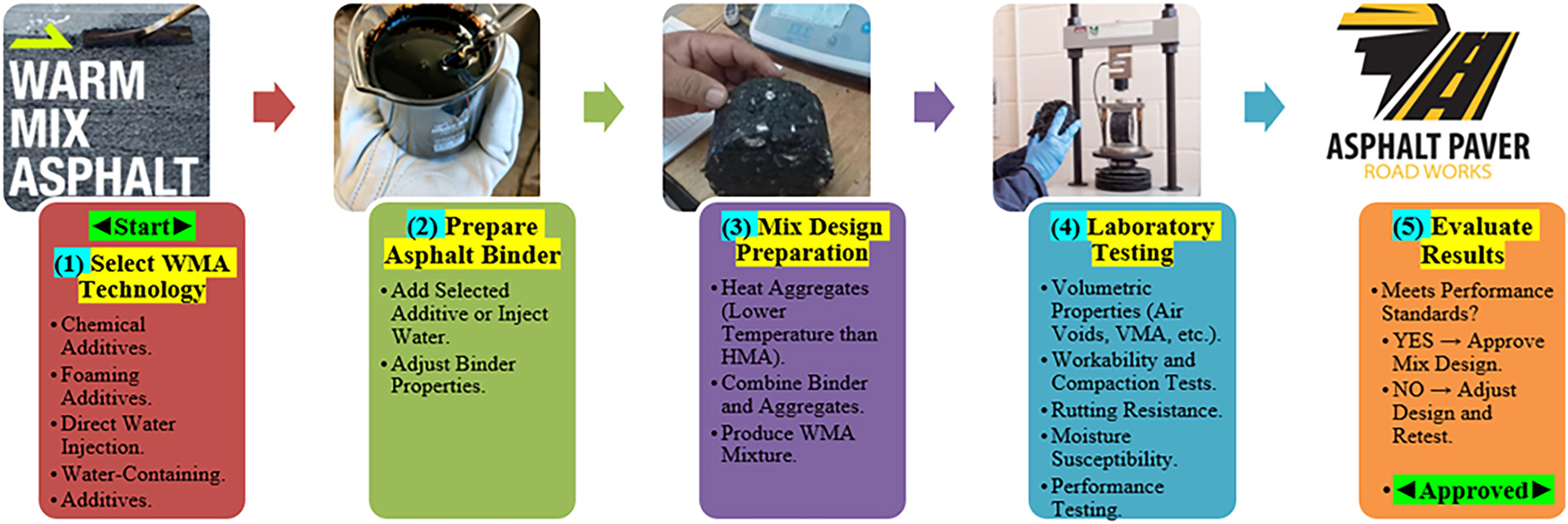
WMA design technical processes.
Moreover, the additives of organic agents, chemical modifiers, and synthetic zeolites have been demonstrated to increase the environmental benefits of WMA by further lowering the energy requirements for asphalt production. However, findings from LCAs suggest that certain additives may counteract these benefits because of their own environmental footprint, underscoring the importance of selecting additives with sustainability in mind [80]. In addition, the incorporation of recycled materials, such as RAP and industrial byproducts such as zeolite derived from petroleum refining, has proven highly effective in reducing the reliance on virgin aggregates, thereby minimizing the environmental impact of WMA. The synergy between WMA additives and recycled materials not only promotes sustainable resource utilization but also ensures that the mechanical performance and durability of asphalt mixtures remain comparable to or surpass those of conventional HMA [81]. In some instances, the use of WMA with up to 50 % reclaimed asphalt has been found to significantly reduce GHG emissions and overall energy consumption while maintaining superior pavement performance characteristics [82]. Figure 8 shows the influence of the volume of binder used on the rutting temperature of different WMA mixtures, as reported in previous studies [34], 39], [83], [84], [85], [86], [87], [88], [89], [90], [91]. Previous studies related binder volume (left axis, blue) with rutting test temperature (right axis, red) across multiple standard methods (e.g., AASHTO TP 63/T324, EN 12697–22, BS 598–110). The rutting temperatures generally cluster between ∼50 and 65 °C, whereas the average binder volumes span ∼35–65 %, with modest variability indicated by small error bars. Methods reporting higher binder contents (notably EN 12697–22 and AASHTO T324/TP63 in several datasets) also tend to report the upper range of rutting temperatures, implying a positive association between binder content and the temperature regime used to assess rutting susceptibility. Conversely, protocols with lower binder contents (e.g., some AASHTO T63 instances) align with lower rutting temperatures, highlighting that both the mixture composition and the chosen test standard systematically influence the reported rutting behavior of WMA mixtures. Despite the evident advantages of WMA, challenges remain in achieving an optimal balance between the use of additives and their environmental impact. Some additives, while effective at reducing production temperatures, may introduce sustainability concerns that offset their benefits. Furthermore, advancements in WMA technology have led to the development of recycled synthetic fibers and foamed bitumen, which continue to enhance road performance and environmental sustainability at reduced temperatures [92].
![Figure 8:
Influence of the volume of binder used on the rutting temperature of different WMA mixtures, as reported in previous studies (data obtained from [34], 39], [83], [84], [85], [86], [87], [88], [89], [90], [91]).](/document/doi/10.1515/rams-2025-0187/asset/graphic/j_rams-2025-0187_fig_008.jpg)
A significant body of research has been devoted to assessing the low-temperature performance of WMA containing RAP. One study, which utilized bending beam rheometer tests and asphalt binder cracking devices, explored the effects of Sasobit-modified WMA combined with RAP. The findings indicated that an excessive amount of WMA could compromise the mixture’s resistance to low-temperature cracking [93]. In addition, increasing the RAP content was found to negatively impact the ability of a mixture to resist cracking at low temperatures [94]. However, the use of rejuvenating agents has been identified as an effective method to mitigate the brittleness observed in WMA-RAP blends, significantly enhancing their low-temperature performance [95]. Given the natural stiffness of WMA-RAP mixtures, concerns have arisen about the potential for early cracking in colder climates, with several studies noting a decline in low-temperature performance compared with that of control mixtures [96]. On the other hand, some research suggests that, under specific conditions, WMA-RAP mixtures can perform just as well or even outperform traditional mixtures at cold temperatures [97]. Further investigations into foam WMA with varying levels of RAP binder have confirmed that the binder content in RAP plays a crucial role in determining the low-temperature behavior of recycled asphalt [5]. While WMA mixtures without RAP typically exhibit better flexibility at lower temperatures, the inclusion of RAP increases the mixture’s stiffness and reduces the m value, which could negatively affect its performance in colder environments [36]. Continuous advancements in material science and engineering remain essential for optimizing WMA formulations, ensuring that their environmental advantages align with long-term durability and resilience under diverse climatic conditions.
6 Advanced techniques in WMA compaction
WMA technology, which was originally developed in Europe, has revolutionized asphalt production by addressing key industry challenges. Compared with conventional HMA, this innovation significantly reduces production and compaction temperatures, leading to substantial decreases in energy consumption and emissions [27]. The ability to produce asphalt at lower temperatures not only reduces GHG emissions but also enhances the mixture’s workability, minimizes binder aging [28], facilitates paving in colder climates, and extends the feasible transport distance between mixing facilities and construction sites [21]. The cooling behavior of asphalt mixtures is largely dictated by the temperature differential between the mixture and the surrounding environment, with smaller differentials leading to slower cooling rates. This allows for extended compaction time and improved placement quality [1], 30], 98]. The integration of RAP into new asphalt mixtures offers significant economic and environmental advantages by reducing the reliance on virgin materials and increasing sustainability [99]. However, both the RAP and WMA individually pose certain limitations. Their combined application has proven to be an effective approach for mitigating these challenges, thereby improving the overall performance of the asphalt mixture and increasing pavement longevity [32].
The widespread adoption of WMA technologies in the asphalt industry is largely attributed to their capacity to increase mixture workability while lowering production and compaction temperatures. Among the most effective and commonly utilized WMA methods are (1) organic additives, such as Sasobit, which function by reducing the viscosity of the asphalt binder upon reaching its melting point. This ensures sufficient fluidity throughout production and construction, even at reduced temperatures [18]. (2) Chemical additives, such as evotherms, improve binder‒aggregate adhesion at lower temperatures by modifying interfacial properties, reducing slip forces at the binder‒aggregate interface, and consequently enhancing particle mobility during compaction. This results in improved uniformity and overall compaction performance [100]; and (3) foaming techniques, such as water-based foaming, in which controlled amounts of water are introduced into the asphalt binder during production [101]. The injected water generates steam and forms microbubbles within the binder, leading to expansion and viscosity reduction, thereby enhancing the binder’s ability to coat aggregates effectively at lower temperatures [102]. The integration of WMA technologies has significantly reshaped the asphalt industry, offering a wide range of benefits. One of the primary advantages is the reduction in mixing and compaction temperatures, which prevents premature aging of the asphalt binder. This, in turn, prolongs the material’s service life and improves its resistance to fatigue and thermal cracking during the early service stages [13]. Figure 9 depicts the influence of the volume of binder used on the air voids of different WMA mixtures, as reported in previous studies [34], 39], [83], [84], [85], [86], [87], [88], [89], [90], [91]. Moreover, as WMA mixtures do not require high-temperature storage, transportation, or placement conditions, they provide greater flexibility in field applications, increasing their practicality and sustainability. Prior studies related the binder volume (blue; left axis) to the measured air-void content (red; right axis) in WMA mixtures across several rutting test standards (e.g., BS 598–110, AASHTO TP 63/T324, EN 12697–22). Air voids mostly fall within a narrow 4–7% band, whereas the corresponding average binder volumes span approximately 40–65 %, with modest dispersion indicated by small error bars. A weak inverse tendency is observable: cases employing higher binder contents (60–65 %) often report air voids toward the lower end of the range, whereas lower binder contents (0–50 %) coincide with greater voids. These patterns suggest that increasing the binder volume can marginally improve compactability and mixture densification, although standard-specific procedures also contribute to the observed variability.
![Figure 9:
Influence of the volume of binder used on the air voids of different WMA mixtures, as reported in previous studies. (Data obtained from [34], 39], [83], [84], [85], [86], [87], [88], [89], [90], [91]).](/document/doi/10.1515/rams-2025-0187/asset/graphic/j_rams-2025-0187_fig_009.jpg)
The extended paving window facilitated by WMA technologies enables longer paving seasons, granting contractors logistical advantages [42]. Furthermore, WMA mixtures have exhibited improved workability and reduced compaction efforts, even when up to 90 % RAP is incorporated, reinforcing their viability for sustainable asphalt production [103]. Moreover, Figure 10 illustrates the impact of the binder volume on the air void content in various WMA mixtures [34], 39], [83], [84], [85], [86], [87], [88], [89], [90], [91]. It has also been reported that WMA formulations pair different additives with RAP, showing the RAP content (blue; left axis) alongside the dosage of other materials/additives (red; right axis). Across additives such as zeolites/Advera, Sasobit, Kaowax, PAWMA, Zycotherm, and Evotherm, RAP incorporation spans approximately 20–70 %, with zeolitic and wax-based systems (e.g., Sasobit) frequently enabling higher RAP fractions. Additive dosages are comparatively small (generally a few percent by mass), with zeolites typically used at the upper end of this range and amine/surfactant-type agents (e.g., Zycotherm, Evotherm) at the lower end. Collectively, the chart indicates that substantial RAP contents are feasible in WMA, but the achievable level is additive-dependent and reflects trade-offs among workability, foaming efficacy, and mixture performance.
![Figure 10:
WMA mixtures with varying RAP contents (data obtained from [1], 23], 39], 57], [76], [77], [78]).](/document/doi/10.1515/rams-2025-0187/asset/graphic/j_rams-2025-0187_fig_010.jpg)
The evaluation of asphalt mixture workability is typically conducted via three primary techniques, each offering unique benefits and limitations. The first method involves measuring the viscosity of the asphalt binder [63], which has traditionally been used for conventional asphalt binders and viscosity-dependent technologies [14]. However, this approach may not accurately reflect the improvements in workability achieved by certain WMA technologies, such as foaming processes and chemical additives, which have minimal effects on binder viscosity. Consequently, this technique may lead to inaccurate estimations of the required mixing and compaction temperatures, potentially overestimating the actual improvements in workability [13]. A second approach uses specialized instruments, such as a workability meter, to measure torque and resistance during the mixing process [63]. This method is effective in quantifying the resistance encountered while mixing and is highly sensitive to factors such as the binder content, binder stiffness, and aggregate composition, such as RAPs. However, it does not fully account for the impact of chemical additives on binder‒aggregate adhesion. In addition, the results obtained during mixing may not always correlate with the mixture’s performance in terms of ease of placement and compaction during field operations. The third technique assesses mechanical responses during compaction via the Superpave gyratory compactor (SGC) [104]. The SGC provides valuable insights by monitoring volumetric properties under controlled compaction energy and measuring shear resistance during the compaction process. This method is particularly useful for evaluating the workability by simulating real-world compaction conditions.
Advancements in sensing technology have provided deeper insights into the influence of mixture particle kinematics on asphalt compaction [105], 106]. The application of microelectromechanical system devices, such as the SmartRock sensor, has enabled researchers to examine particle-level responses under both laboratory and field conditions [107]. The findings consistently demonstrated a correlation between particle rotation, density development, and compaction behavior during SGC testing. When comparing kinematic parameters, such as particle rotation and acceleration, between the laboratory and field compaction processes, it is evident that the kneading action of the SGC, along with rolling wheel compaction, effectively mimics the actions of pneumatic-tire rollers used in the field. In a similar vein, the vibratory effects generated by the Marshall hammer were found to be comparable to those of field vibratory rollers [108]. Further laboratory experiments utilizing SmartRock sensors have shown that the particle contact stress is a reliable indicator of compaction conditions. Furthermore, variations in stress rates serve as a quantitative measure for evaluating the workability of asphalt mixtures [109]. The combined application of experimental and numerical approaches in assessing asphalt mixture compaction has demonstrated a significant relationship between the particle contact stress and the mixture’s locking point. This relationship underscores the viability of the particle contact stress as a practical measure of compactability [110]. These insights emphasize the significant role of particle kinematics and the mechanical properties of the mixture in influencing both the compactability and overall workability of asphalt mixtures [104]. Investigating the relationship between particle behavior during compaction and mixture workability provides essential knowledge for optimizing WMA technologies. Figure 11 shows the performance of the RAP, WMA and RAP + WMA mixtures [5]. Understanding these interactions enables the selection of materials with improved workability characteristics tailored to specific construction requirements.
![Figure 11:
Performance of WMA, RAP and WMA + RAP mixes (adapted with permission from [5]).](/document/doi/10.1515/rams-2025-0187/asset/graphic/j_rams-2025-0187_fig_011.jpg)
Performance of WMA, RAP and WMA + RAP mixes (adapted with permission from [5]).
7 Rheological properties
WMA can be produced through various techniques that utilize chemical and organic additives, including water-based agents and water-containing processes [30]. Extensive research worldwide has focused on refining WMA applications in pavement engineering to improve performance and sustainability [111]. Selecting the appropriate WMA technology and determining its optimal dosage are crucial for enhancing the rheological properties of asphalt binders, as well as improving the mechanical strength and longevity of asphalt mixtures. To compare the efficiency of different WMA additives, researchers have developed three dimensionless parameters that quantify variations in viscosity, resistance to rutting, and fatigue performance [39]. These parameters were normalized with respect to the base (unmodified) binder to allow direct comparison across additive types and dosages. The parameters are defined in Eqns. (1)–(3) as follows:
Rheological Enhancement Index (REI)
Viscosity Reduction Index (VRI)
Fatigue Performance Ratio (FPR)
where G * is the complex modulus from the DSR test, η is the dynamic viscosity, and G f is the fracture energy from SCB or LAS testing. All values were averaged across replicate measurements and scaled to the interval [0–1] via min–max normalization. Positive REI and FPR values indicate improvements in stiffness and fracture resistance, whereas a positive VRI denotes viscosity reduction and better workability.
As summarized in Table 3, representative WMA additives demonstrate distinct rheological and fracture behaviors when normalized to a control HMA binder. This normalized approach provides a structured way to compare additive performance. Chemical additives such as Evotherm and Rediset show greater viscosity-reduction potential (VRI > 0.35), whereas organic modifiers such as Sasobit achieve greater improvement in stiffness (REI ≈ 0.22). These indices should be interpreted as relative indicators because factors such as binder grade, temperature, and aging can influence the absolute values.
Dimensionless rheological and fracture parameters for representative WMA additives (values normalized to control HMA binder).
| Additive | Type | Dosage (% binder) | REI | VRI | FPR | Reference sources |
|---|---|---|---|---|---|---|
| Sasobit | Organic (wax) | 1.5 | 0.22 | 0.31 | 0.94 | [112] |
| Evotherm | Chemical (amine surfactant) | 0.4 | 0.18 | 0.42 | 0.98 | [113] |
| Rediset WMX | Chemical | 0.5 | 0.15 | 0.37 | 0.91 | [114] |
| Cecabase RT | Chemical (surfactant–ester blend) | 0.3 | 0.20 | 0.33 | 0.95 | [115]v” |
The impact of WMA additives largely depends on their chemical structure and functional mechanisms. Organic additives, such as wax-based compounds, decrease the binder viscosity once the temperature exceeds the melting point. On the other hand, chemical additives improve binder workability by reducing surface tension without significantly altering rheological characteristics [116]. However, the influence of WMA additives on moisture resistance varies depending on the type of technology used. Water-containing additives, including Aspha-min and Advera, as well as organic additives such as Asphaltan-B and Sasobit, have been reported to lower the moisture resistance of WMA mixtures, increasing their susceptibility to moisture-induced damage [50]. Conversely, chemical additives such as Rediset promote better adhesion between the binder and aggregates, enhancing moisture resistance while minimizing changes in the rheological behavior of the binder [117]. Therefore, the selection of WMA additives must be carefully considered to maintain a balance between workability and moisture resistance.
Owing to their unique molecular properties, surfactants enhance binder‒aggregate adhesion by attracting aggregates with opposite charges [117]. The influence of WMA additives on asphalt binder properties has also been examined via spectroscopic techniques. For example, as shown in Figure 12a, the incorporation of the warm-mix additive RAP-R affects the functional groups in warm-mix recycled asphalt. A newly identified transmittance peak at 3,295 cm−1, corresponding to the stretching vibration of free hydrogen bonds (–OH), was detected in the RAP-R binder but not in the RAP-C binder [118]. Furthermore, as illustrated in Figure 12b, this peak persisted even after both short-term and long-term aging, indicating that the rheological behavior of RAP-R mastics differs from that of other asphalt mastics under various aging conditions. While initial transmittance peaks between 1,000 cm−1 and 1,200 cm−1 were noticeable in the unaged RAP-R binder, these variations diminished with aging. In contrast, Figure 12c shows that the FTIR spectra of the RAP-M and RAP-C binders remained almost identical, indicating that the warm-mix additive M did not significantly alter the bond structure or cause recombination within the asphalt binder [118].
![Figure 12:
FTIR spectra of different WMA additives; a) warm-mix additive R, b) rheological behavior of RAP-R and c) the FTIR spectra of the RAP-M and RAP-C binders (adapted with permission from [118]).](/document/doi/10.1515/rams-2025-0187/asset/graphic/j_rams-2025-0187_fig_012.jpg)
FTIR spectra of different WMA additives; a) warm-mix additive R, b) rheological behavior of RAP-R and c) the FTIR spectra of the RAP-M and RAP-C binders (adapted with permission from [118]).
The FTIR peak identified at 3,295 cm−1 corresponds to the stretching vibration of free hydroxyl (–OH) groups, confirming that hydrogen bonding is induced by the warm-mix additive RAP-R (Xu et al., 2021). The persistence of this peak after both short- and long-term aging indicates a stable chemical modification of the binder that influences its macroscopic rheological behavior. Quantitatively, this modification led to an increase of approximately 11–14 % in the complex shear modulus (G*) at 60 °C and a reduction of approximately 8–10 % in viscosity at 135 °C relative to the control RAP-C binder. The performance-grade (PG) high-temperature limit improved from PG 64–22 to PG 70–22, reflecting enhanced rutting resistance without compromising workability. These changes suggest that the formation and stability of (–OH) bonds strengthen molecular interactions within the binder matrix, resulting in increased stiffness and improved temperature susceptibility, which is consistent with the observed rheological enhancement. Foaming technology in WMA production involves the controlled introduction of small quantities of water to the liquid asphalt binder throughout the mixture. This process leads to a temporary expansion in the binder volume, forming a foam structure at elevated temperatures, which facilitates the coating of aggregates at decreased mixing and compaction temperatures [119], 120]. The ability to increase the workability at lower temperatures makes foaming an efficient and widely adopted technique in asphalt pavement engineering. In addition to foaming technology, polyphosphoric acid (PPA) has gained attention as an economical substitute for polymer modifiers for asphalt modification. Its affordability and capacity to significantly increase binder stiffness in a controlled manner make it a preferred choice for pavement applications [121]. Asphalt binders modified with PPA demonstrate improved resistance to rutting in the early service life of pavements because of increased initial stiffness. Furthermore, PPA modifications contribute to enhanced low-temperature flow properties, potentially reducing susceptibility to fatigue and thermal cracking over time [122].
Furthermore, studies have shown that incorporating PPA, particularly in nonwaxy bitumen, significantly enhances the rheological behavior of asphalt binders at medium and high temperatures while exerting minimal influence on low-temperature performance [123]. Several studies have indicated that incorporating 1 % PPA by binder weight can lead to an increase in high-temperature performance of approximately 10 °C while also improving low-temperature performance by nearly 2 °C. This modification has been recognized as an effective approach for enhancing the thermal stability of asphalt binders [124]. Despite extensive research on WMA binders and PPA-modified binders as separate entities, few studies have explored the combined effects of PPA within WMA systems [117]. Understanding the rheological properties of WMA is crucial for optimizing its performance, as these properties directly influence workability, durability, and resistance to deformation. Technological advancements in WMA formulations have significantly improved viscosity and flexibility, positioning WMA as a viable and sustainable alternative to conventional asphalt. However, further research focusing on the interaction of additives and optimization of binder compositions remains essential to enhance long-term performance and ensure greater reliability in road construction applications.
8 Fracture properties
WMA represents a modern advancement in asphalt technology; reducing production and application temperatures offers several advantages, including lower energy consumption, reduced GHG, and improved working conditions by minimizing exposure to excessive heat and asphalt fumes [125]. While these environmental and occupational health benefits are well established, a comprehensive understanding of WMA’s fracture properties is essential to ensure its long-term durability and structural performance under diverse loading and environmental conditions [126]. Fracture characteristics, including fracture toughness, resistance to thermal and fatigue cracking, and vulnerability to moisture-induced damage, are determined by a range of factors, including binder type, choice of additives, production temperature, and aggregate gradation [127], 128]. The development of asphalt additives and mixture designs has significantly improved the mechanical properties of WMA, enabling it to achieve fracture resistance on par with conventional HMA. As a result, WMA has become a viable, sustainable, and structurally reliable alternative for modern road construction. Recent research underscores the advantages of combining RAP with WMA technologies, showing that this integration enhances both the compatibility and overall performance of asphalt mixtures [129]. Numerous studies have investigated the combined effects of high RAP content and WMA technologies, particularly focusing on sustainability benefits, such as energy reduction and increased recycling rates [130]. Research indicates that incorporating RAP into WMA mixtures helps mitigate additional aging of the reclaimed binder during production, thereby preserving its functional properties and extending the pavement lifespan [39]. The ability of WMA to reduce production temperatures plays a vital role in limiting the secondary aging of the RAP binder throughout the mixing and manufacturing processes. Additionally, the lower viscosity of WMA facilitates the incorporation of more RAP without compromising workability, improving the ease of placement and compaction [131]. This interaction between RAP and WMA presents a promising solution for developing environmentally sustainable pavements with performance characteristics comparable to those of conventional HMAs [5].
Many studies have explored the performance of RAP combined with various WMA additives via both laboratory tests and field assessments [21]. These investigations analyze the mechanical behavior of asphalt mixtures containing different RAP proportions and WMA technologies, focusing on key performance metrics such as cracking resistance, rutting susceptibility, and moisture durability. The findings suggest that combining RAP with WMA results in a synergistic effect, compensating for individual material limitations when used separately [126]. Further research has examined the impact of incorporating high RAP contents with different WMA additives, particularly with respect to the workability of asphalt mixtures. The results indicate that WMA technology significantly reduces the mixing and compaction temperatures, thereby increasing the workability. This improvement not only streamlines construction processes but also aligns with sustainability goals by reducing energy consumption and GHG emissions [85]. The combined application of RAP and WMA offers a strategic approach for optimizing material performance, minimizing environmental impact, and improving the durability and cost-effectiveness of asphalt pavements.
A study was conducted to evaluate the effects of varying RAP proportions (10 %, 30 %, and 50 %) in combination with WMA additives on the cracking resistance of asphalt mixtures under applied loads [121]. The results demonstrated that WMA additives enhanced the cracking resistance of modified mixtures compared with that of conventional HMA, as shown in Figure 13a [133]. However, an inverse correlation was observed between the RAP content and fatigue resistance, with reductions of 44 %, 74 %, and 89 % as the RAP content increased to 10 %, 30 %, and 50 %, respectively. Another study investigated the moisture susceptibility of asphalt mixtures containing RAP at concentrations ranging from 10 % to 50 % in conjunction with WMA additives and revealed that a higher RAP content improved moisture resistance (Figure 13b) [132]. Moreover, the combined effects of RAP and WMA on freeze‒thaw durability were assessed [134]. The results indicated that WMA-modified mixtures presented lower freeze‒thaw resistance than HMA did, indicating potential durability concerns in cold climates. Furthermore, an analysis of the high RAP content in WMA mixtures revealed its impact on rutting resistance [135]. The findings showed that increasing the RAP content in WMA mixtures enhanced the resistance to permanent deformation, with improvements ranging from 15 % to 40 %. However, while WMA mixtures benefit from higher RAP content in terms of load-associated cracking resistance, HMA mixtures exhibited the opposite trend, with increased RAP content reducing cracking resistance [135]. Recent research has increasingly focused on the fracture properties of asphalt mixtures incorporating both RAP and WMA additives [128], 136]. One study specifically examined the combined influence of RAP content and WMA technology on fracture resistance at intermediate temperatures. The findings suggested that higher RAP proportions led to a decline in fracture resistance, raising concerns about potential crack propagation in these mixtures [136]. Conversely, another study reported that incorporating 25 % RAP into WMA mixtures resulted in a fracture strength comparable to or exceeding that of HMA, indicating that optimizing the RAP and WMA compositions can help maintain the structural integrity of asphalt mixtures [125].
![Figure 13:
a) Force versus displacement curve and b) critical strain energy release rate (adapted with permission from [132]).](/document/doi/10.1515/rams-2025-0187/asset/graphic/j_rams-2025-0187_fig_013.jpg)
a) Force versus displacement curve and b) critical strain energy release rate (adapted with permission from [132]).
Studies have also demonstrated that, compared with HMA, incorporating 50 % RAP into WMA leads to a decrease in fracture strength [125]. This reduction is attributed primarily to increased brittleness, which negatively impacts both fracture resistance and fatigue resistance [137]. Another investigation analyzed the effects of different RAP contents in WMA mixtures produced with water-based foaming additives on fracture performance [30]. Using the semicircular bend (SCB) test, key fracture parameters, such as the cracking resistance index, fracture energy, and flexibility index, were evaluated. The results indicated that incorporating up to 50 % RAP improved the fracture strength; however, exceeding this limit negatively affected the fracture performance of the foam-based WMA mixtures. The integration of RAP, WMA additives, rejuvenators, and antistipping agents has become a widely adopted practice in asphalt pavement engineering. This comprehensive approach has led to extensive research on the interactions between WMA additives and RAP, particularly their effects on crucial performance indicators [138]. For example, one study examined the impact of different WMA additives on the workability of asphalt mixtures with varying RAP contents and revealed that WMA additives significantly improved the workability, facilitating better compaction and handling. Another study investigated the combined effects of recycling agents, WMA additives, and RAP on the cracking resistance of flexible pavements, highlighting the potential of these components to enhance overall pavement performance [129].
Experimental studies indicate that incorporating recycling agents and WMA additives can significantly improve the fracture toughness and energy absorption capacity of asphalt mixtures when subjected to various loading conditions at low temperatures. However, the inclusion of RAP has been observed to reduce these properties, highlighting a potential trade-off between the environmental benefits of RAP usage and the cracking resistance of asphalt mixtures [136]. Additional research on the mechanical behavior of WMA mixtures containing RAP underscores the pivotal role of the specific WMA additive in determining the overall performance of the mixture [104]. Furthermore, studies have demonstrated that incorporating 50 % RAP into asphalt mixtures leads to substantial improvements in key mechanical properties, such as the flow number, resilient modulus, and resistance to moisture-related damage [129]. The results shown in Figure 14 provide a detailed summary of the direct and indirect tensile strengths of WMA mixtures, as documented by various researchers [34], 72], 83], 87], 91], 116], [139], [140], [141], [142], [143], [144], [145].
![Figure 14:
Key findings of WMA works for direct and indirect tensile strength as reported by preceding researchers (data obtained from [34], 72], 83], 87], 91], 116], [139], [140], [141], [142], [143], [144], [145]).](/document/doi/10.1515/rams-2025-0187/asset/graphic/j_rams-2025-0187_fig_014.jpg)
The deterioration of asphalt due to aging has a meaningful contribution to pavement durability and service life, making it a critical factor in pavement engineering [129]. To ensure long-lasting performance, it is essential to account for aging effects in the design phase. Research has shown that as asphalt mixtures age, their stiffness increases, but the extent of this change depends on the composition of the mixture [146]. Although higher stiffness may enhance the load-bearing capacity, excessive stiffening leads to brittleness, increasing susceptibility to fatigue, thermal, and block cracking. Experts suggest that integrating aging-related adjustments into the design phase can improve resistance to traffic loads and environmental stressors, thereby enhancing pavement performance [147]. Asphalt aging also weakens the durability of pavements, increasing their vulnerability to moisture infiltration and subsequent deterioration [129]. Over time, aged asphalt mixtures exhibit reduced resistance to abrasion and moisture-induced damage, which accelerates structural degradation [148]. While aging strengthens asphalt concrete by increasing its stiffness, it simultaneously reduces flexibility, compromising the integrity of the mixture and increasing the likelihood of fatigue and thermal cracking [129]. Addressing these aging-related challenges at the design stage is crucial for improving the lifespan and performance of flexible pavements. To assess the long-term behavior of asphalt mixtures, investigators often employ accelerated aging methods in laboratory settings, replicating in-service conditions and monitoring changes in mechanical properties over time [146]. These controlled assessments provide valuable insights into durability and aid in optimizing material formulations for enhanced pavement resilience. Although incorporating RAP and WMA supports sustainability in pavement construction, the mechanical behavior of these materials, particularly their fracture resistance at intermediate temperatures, requires careful examination. The combined use of WMA additives, RAP, and rejuvenators must be carefully balanced to maintain structural strength and ensure that pavement longevity is not compromised. The ability of WMA to resist cracking plays a crucial role in determining its structural reliability under diverse traffic loads and environmental conditions. Advances in material engineering and the development of innovative additives have strengthened WMA resistance to crack initiation and propagation. These improvements contribute to the construction of more durable and environmentally responsible pavements. However, further investigations are necessary to deepen the understanding of fracture mechanisms and refine performance-based mix design approaches. Enhancing these aspects will support the broader adoption of WMA in modern infrastructure while maintaining high standards of sustainability and long-term performance.
9 Sustainability and environmental benefits
WMA has emerged as a transformative advancement in asphalt production, offering a sustainable alternative to conventional HMA. In response to increasing environmental concerns and the need for energy-efficient infrastructure, WMA technology addresses key challenges associated with traditional asphalt production. The underlying mechanism of WMA relies on specialized additives or water-based foaming techniques that enhance asphalt workability at reduced temperatures. This innovation not only improves energy efficiency but also assists the combination of higher proportions of RAP and other reused materials, supporting circular economy principles in construction. Furthermore, lower production temperatures mitigate the effects of thermal aging, which helps preserve the integrity of asphalt binders, extends the pavement lifespan and reduces the frequency of maintenance interventions. Since its introduction, WMA has gained widespread adoption in sustainable road construction due to its multiple environmental and practical benefits. These include a lower carbon footprint, improved air quality, reduced consumption of natural resources, and increased safety for construction workers due to decreased exposure to high temperatures and emissions. The integration of WMA into modern infrastructure projects aligns with global sustainability goals and reflects a commitment to environmentally responsible construction practices. As industry continues to prioritize sustainability, WMA represents a crucial step toward more efficient and eco-friendly road development strategies.
It is reported that WMA can consistently reduce greenhouse-gas and particulate emissions relative to HMA; however, the magnitude and reliability of these gains depend less on nominal temperature reduction and more on two contingencies [149]: long-term field performance and the material system chosen to achieve WMA conditions. Cradle-to-grave assessments that include traffic and end-of-life effects indicate that the embedded burdens of certain WMA technologies (e.g., synthetic zeolites) can erode plant-energy savings, whereas integrating RAP emerges as a robust lever for impact reduction, with even modest RAP shares (15 %) lowering climate and endpoint damages on the order of 13–14 % [150]. Mechanical-environmental studies further show that when WMA is paired with RAP and appropriate recycling agents, mixtures can match or exceed the rutting, cracking, and moisture resistance of virgin counterparts while simultaneously curbing cost and CO2, though performance is highly sensitive to the chemistry of the recycling agent and the contribution of virgin binder, which dominates both cost and emissions [151]. Comparative LCAs focused on midpoint indicators also suggest that WMA’s environmental advantage collapses if durability penalties increase maintenance demands [152]. Taken together, the literature supports WMA as environmentally preferable when (i) durability is preserved or improved, (ii) RAP substitution is maximized within performance limits, and (iii) additives are selected for low upstream burden and compatibilization efficacy; aligning mix-design decisions with cradle-to-grave, uncertainty-aware LCA therefore remains essential to realize dependable sustainability gains [10].
The combination of a higher percentage of RAP in WMA is increasingly recognized as a promising advancement toward sustainability in the paving industry. However, several industry professionals argue that the absence of standardized guidelines for the processing, handling, and characterization of RAP presents a significant challenge. In addition, the Superpave mix design methodology has been criticized for its limited capacity to effectively accommodate high-RAP-content mixtures, thereby constraining the adoption of greater RAP proportions in WMA applications [153]. Another critical aspect to consider when evaluating the sustainability of WMA is the carbon footprint associated with its production and transportation. Some researchers contend that the overall environmental benefits of WMA may be offset by emissions generated during the transportation of additives, particularly when sourced from distant locations rather than local suppliers. This logistical factor could inadvertently increase CO2 emissions and diminish the anticipated positive environmental impact of WMA [4],154]. From an environmental standpoint, extensive research has been conducted on the LCA of WMA. These studies overwhelmingly highlight the significant reduction in environmental burdens associated with WMA compared with HMA. Specifically, WMA technology (Figure 15) [155] has been shown to lower emissions of air pollutants, decrease energy consumption, reduce reliance on fossil fuels, and mitigate global warming potential (GWP) and GHG emissions [4], 155]. The most notable environmental advantage of WMA production is its capacity to curb GHG emissions, which is directly proportional to the energy savings achieved. Research estimates indicate that WMA production can lead to energy savings ranging from 25 % to 50 %, which subsequently results in a decrease of approximately 4.1 kg–5.5 kg of CO2 equivalent emissions per ton of WMA produced [156]. In a broader context, if Germany’s entire asphalt production, amounting to 63 million tons annually, were converted to lower-temperature WMA, the resulting CO2 emissions would decrease by approximately 0.4 million tons per year, reflecting a potential 25 % reduction [157]. Similarly, studies conducted in Australia indicate that WMA contributes to lower plant emissions, although the extent of this reduction varies on the basis of factors such as plant conditions, fuel types, prevailing weather conditions, and the specific WMA technology employed [14]. Furthermore, research suggests that decreasing HMA production temperatures by 20 °C could lead to an approximately 44 % reduction in total CO2 emissions generated from both the fuel and asphalt used in the manufacturing process. Moreover, studies indicate that lowering the production temperature of HMA by 20 °C has the potential to reduce overall CO2 emissions by approximately 44 %. This reduction encompasses emissions originating from both fuel consumption and asphalt materials utilized in the manufacturing process [158].
![Figure 15:
Techniques for reducing fumes and enhancing energy efficiency in the asphalt paving process (adapted with permission from [155]).](/document/doi/10.1515/rams-2025-0187/asset/graphic/j_rams-2025-0187_fig_015.jpg)
Techniques for reducing fumes and enhancing energy efficiency in the asphalt paving process (adapted with permission from [155]).
The environmental benefits of WMA technology are substantial, particularly in terms of pollutant emissions, which are considerably lower than those associated with conventional HMA production [159]. A 2021 report by the NAPA highlighted that switching from HMA to WMA resulted in a reduction of approximately 0.16 million metric tons (MMT) of CO2 equivalent emissions annually [160]. Furthermore, this shift led to a 24 % decrease in air pollutants, a 10 % reduction in smog formation, and a 3 % lower GWP, demonstrating the positive impact of WMA on environmental sustainability [64]. From an environmental standpoint, WMA technology effectively reduces CO2 emissions by lowering production and application temperatures. This reduction in temperature directly enhances the compaction of asphalt mixtures and the workability, which in turn improves the paving efficiency. WMA functions as a compaction aid by reducing the mechanical effort required to achieve optimal density, leading to enhanced pavement performance [14]. Despite its environmental advantages, certain operational challenges may arise when WMA is used. Factors such as the screed angle of attack on the paver, the movement of material between paving equipment [80], and the potential for thermal segregation can be affected by temperature variations during placement. In some cases, inconsistent temperature differentials within the surface mix may lead to undesirable outcomes, potentially impacting the long-term performance of the pavement [34].
WMA presents several advantages over conventional HMA, particularly in its ability to achieve the desired density with less effort, even at significantly lower temperatures [16]. This increased ease of compaction is due primarily to the use of innovative technologies and specialized additives in WMA production, which effectively reduce the viscosity of the asphalt binder. This reduction allows for better workability and compaction of the mixture under cooler conditions. However, the operation and maintenance of asphalt plants specifically designed for WMA production require careful attention to mitigate potential operations [56]. A notable benefit of WMA is its capacity to incorporate high percentages of RAP without negatively impacting workability, offering an environmentally friendly and cost-effective alternative for paving applications [161]. Furthermore, WMA offers significant advantages in colder climates by minimizing the temperature disparity between the asphalt mixture and the ambient environment. This reduction in temperature differential enhances the efficiency of paving operations under low-temperature conditions, ensuring improved workability and compaction. Moreover, the moderate temperature contrast in WMA allows for more consistent paving performance in colder climates, reducing potential issues associated with rapid cooling during placement.
This characteristic extends the paving season by allowing more time for placement and compaction while also increasing the feasible hauling distance between asphalt plants and construction sites [64]. The lower emissions, fumes, and noise levels associated with WMA production enable plants to operate closer to urban areas, making it possible to pave in regions where air quality regulations are stringent [56]. Furthermore, the smaller temperature differential in WMA mixtures accelerates the cooling process after construction, allowing traffic lanes to reopen sooner, a crucial advantage for high-traffic roads and airport rehabilitation projects [162]. Extensive research has been conducted to evaluate the potential of WMA in terms of pavement performance, operational efficiency, and environmental sustainability. The findings suggest that WMA provides sustainability advantages comparable to, and in some instances exceeding, those of HMA. These advantages include lower energy consumption, reduced emissions, and an enhanced capacity for incorporating RAP. The increasing global adoption of WMA indicates its potential to become the prevailing standard in asphalt paving. However, concerns regarding its long-term durability persist, particularly in relation to fatigue cracking, rutting, and susceptibility to moisture-induced damage. These challenges are more pronounced in mixtures produced via water-based foaming technologies, highlighting the need for further research to refine WMA formulations and address performance limitations for broader industry implementation [73].
10 Healing and LCA analysis of WMA mixtures
As global awareness of climate change increases, the transportation infrastructure sector continues to explore sustainable innovations to reduce energy consumption, emissions, and reliance on natural resources [163]. WMA has increasingly been recognized in pavement engineering for its ability to improve workability, lower production temperatures, and reduce GHG [164]. Numerous studies have shown that WMA provides several advantages over HMA, particularly in its ability to reduce pollutant emissions, lower fuel consumption, and minimize the formation of photooxidants [165]. An important feature of asphalt sustainability is the self-recovering capability of bitumen, which contributes to extending the lifespan of pavement. This process, illustrated in Figure 16, begins with rapid crack repair through binder flow, followed by a gradual increase in the material’s modulus and strength over time [1], 39], 54]. Furthermore, the wetting behavior of bitumen is closely linked to its surface free energy, with higher surface energy enhancing its wetting properties [1], 39], 54]. Beyond emission reductions, the environmental advantages of WMA are considerable. For example, replacing HMA with WMA results in a 6.23 % reduction in GWP and a 1.92 % decrease in fossil fuel depletion [165]. A comprehensive environmental assessment evaluating four key indicators, fossil fuel depletion, GWP, acidification, and photooxidant formation, revealed that WMA contributes to a 25 % reduction in both fossil fuel consumption and photooxidant formation. Additionally, it was found to lower the GWP by 26 % and acidification by 29 % [166]. Furthermore, a life cycle impact analysis comparing HMA and WMA demonstrated that implementing WMA results in a 7.3 % decrease in ozone depletion, a 4.72 % reduction in GWP, and a 1.5 % decline in smog formation [167].
![Figure 16:
Three-step healing process of bitumen (adapted with permission from [1], 39], 54]).](/document/doi/10.1515/rams-2025-0187/asset/graphic/j_rams-2025-0187_fig_016.jpg)
WMA has demonstrated substantial environmental advantages over HMA, positioning it as a more sustainable alternative for pavement construction. Studies reveal that WMA technology leads to an 18 % reduction in fossil fuel consumption and a 24 % decrease in air pollution levels compared with HMA [168]. In addition, WMA results in a 10 % reduction in smog formation, further emphasizing its environmental benefits. An LCA comparing WMA and HMA pavements, which is based on crucial sustainability metrics such as GWP, respirable inorganic emissions, and acidification potential (AP), underscore WMA’s eco-friendliness [168]. Research also shows that WMA leads to a 23.6 % decrease in energy usage and a significant reduction in pollutant emissions, including a 60 % reduction in CO2, a 72.6 % decrease in NOx, a 75.2 % reduction in SO2, and a 47.9 % decline in particulate matter (PM2.5) emissions (Figure 17a and b) [152]. These findings suggest that if WMA pavements maintain comparable performance levels to HMA pavements, they offer a far more environmentally sustainable alternative because of their reduced emissions. Sensitivity analyses have further highlighted that improvements in the production technologies of raw materials represent the most effective strategy for minimizing environmental impacts in both WMA and HMA systems [152]. In addition to the reduction in emissions and energy consumption, WMA has other environmental advantages, such as lower smog formation, reduced air pollution, and a decline in fossil fuel depletion [51]. Comparative studies consistently show that WMA leads to a 2.75 % decrease in AP, a 4 % reduction in respirable inorganic emissions, and a 2.72 % reduction in GWP relative to HMA. These results reinforce the position of WMA as a more environmentally responsible choice for asphalt pavement construction [1].
![Figure 17:
GWP effects of WMA and HMA pavements for (a) case 1 (WMA pavements present more than 20 % lower CADP values than HMA pavements do); (b) case 2 (WMA pavements present less than 20 % lower CADP values than pavements do) (adapted with permission from [152]).](/document/doi/10.1515/rams-2025-0187/asset/graphic/j_rams-2025-0187_fig_017.jpg)
GWP effects of WMA and HMA pavements for (a) case 1 (WMA pavements present more than 20 % lower CADP values than HMA pavements do); (b) case 2 (WMA pavements present less than 20 % lower CADP values than pavements do) (adapted with permission from [152]).
To assess the economic and environmental impacts of WMA-RAP technology comprehensively, life cycle cost analysis (LCCA) and LCA are invaluable methodologies for policymakers. These assessments provide a comprehensive evaluation of the entire life cycle of pavements, encompassing construction, raw material extraction, maintenance, and eventual disposal [13]. Ongoing research is essential to accurately quantify the long-term sustainability advantages of WMA-RAP mixtures and refine their application in pavement construction, maximizing both their environmental and economic benefits. Recent research has further advanced the understanding of WMA’s environmental implications through comprehensive life cycle and technoeconomic assessments. For example, a systematic LCA of carbon-mitigation strategies in asphalt pavements was conducted, which demonstrated that combining temperature-reduction technologies such as WMA with recycled material integration and optimized binder selection can collectively lower CO2 emissions by up to 40 % [169]. Their work also emphasized the significance of raw material production phases in total life cycle impacts, reinforcing the need for cradle-to-grave evaluations. Similarly, a balanced-mix-design framework coupled with a technoeconomic and environmental assessment is applied to WMA mixtures, showing that the integration of mechanical performance optimization with environmental metrics yields more durable and cost-efficient pavements than conventional HMA [151]. The incorporation of insights from these recent studies enhances the robustness of sustainability analyses in the present review, linking energy reduction and emission control with long-term performance and economic feasibility.
The self-recovery properties of WMA mixtures, particularly those including RAP, have yet to be fully explored within the existing body of research. Specifically, studies focusing on the self-recovery performance of asphalt mixtures via semicircular bending (SCB) tests in conjunction with microwave heating remain scarce [170]. In a specific study, WMA mixtures were produced via a Sasobit-modified binder that incorporates various additives, such as recycled tire steel fibers, copper slag, and steel shavings. The initial testing phase was performed at −20 °C, followed by a conditioning period at 20 °C for 3 h to facilitate the evaporation of moisture accumulated during freezing [170]. The cracked samples subsequently underwent microwave heating at a frequency of 2.45 GHz and a power output of 800 W for durations of 20, 30, and 40 s. The self-recovery efficiency of the mixtures was assessed by comparing the highest load of the restored samples to that of the original, unhealed samples [1]. The findings indicated that WMA mixtures incorporating copper slag and copper fillers presented superior heat distributions, resulting in enhanced self-healing performance across all heating durations [171]. Additionally, further research has investigated the damage recovery behavior of WMA mixtures containing two distinct additives, designated additive L and additive D, which were tested under three different air void conditions (4 %, 8 %, and 12 %) [172]. These studies provide critical insights into optimizing the self-healing properties of WMA mixtures, offering potential strategies for enhancing the durability and service life of asphalt pavements. Damaged samples underwent a three-hour induction heating process using a 35 kHz, 50 kW induction coil, with healing effectiveness assessed after the first, third, and sixth cycles. The healing index, estimated as the ratio of the cracking resistance of healed samples to that of unhealed samples, provides a quantitative measure of healing performance. The results indicated a 30 % decline in healing efficiency by the sixth cycle, primarily due to binder aging and a reduction in binder‒aggregate adhesion caused by repeated damage‒healing cycles [172]. Figure 18a illustrates the increase in crack areas within the asphalt mixtures as the number of damage‒healing cycles progresses. A higher air void content is correlated with more extensive cracking, likely due to weaker particle connectivity [172]. For example, the control mixture (C0) with 4 % air voids exhibited an initial crack area of 323 mm2, which expanded to 352 mm2 after one damage-healing cycle. Notably, the D2 mixture resulted in the smallest crack areas, suggesting improved resistance to damage. In addition, Figures 18b and 18c reveal an 18 % expansion in the crack area after a single damage‒healing cycle, confirming that, compared with the original state, the healed asphalt has a lower resistance to cracking.
![Figure 18:
a) Crack area of the asphalt mixtures at the 0th cycle of the first damage healing cycle, with (b) crack expansion of the virgin asphalt sample and (c) crack expansion after the healing process in the treated sample (adapted with permission from [172]).](/document/doi/10.1515/rams-2025-0187/asset/graphic/j_rams-2025-0187_fig_018.jpg)
a) Crack area of the asphalt mixtures at the 0th cycle of the first damage healing cycle, with (b) crack expansion of the virgin asphalt sample and (c) crack expansion after the healing process in the treated sample (adapted with permission from [172]).
Among the asphalt mixtures with different air void contents, those with 4 % air voids presented the highest self-healing potential. However, an increase in the number of air voids by 4 % led to a decrease in the healing efficiency of approximately 10 %, primarily due to reduced heat transfer within the mixture [172]. Studies exploring the application of microwave induction heating in WMA incorporating zinc slag as a limited or full substitute for mineral filler have demonstrated enhanced heat distribution and strength recovery, particularly when subjected to heating durations of 40–60 s [171]. Further research has investigated the self-recover potential of bitumen modified with chemical WMA additives. This analysis employed the simplified linear amplitude sweep (LAS) test to evaluate the extent of damage recovery in binders subjected to aging under both HMA and WMA production conditions. The healing index, derived from variations in damage between consecutive loading cycles, indicated that chemical WMA additives enhanced healing performance in short-term aged binders at 163 °C compared with those at 130 °C [173].
However, long-term aging simulations in which pressure aging vessels were applied demonstrated that virgin binders retained superior healing properties over WMA binders [173]. Mixtures with higher air void contents presented lower healing ratios, which was attributed to the presence of discontinuities that limited heat distribution within the WMA structure. The ability to incorporate larger quantities of RAP represents a major advantage of WMA technology, offering both environmental and economic benefits. The integration of RAP into WMA mixtures reduces material consumption, minimizes energy requirements, and decreases emissions during asphalt production, reinforcing its role as a sustainable alternative to HMA. In summary, the self-healing potential and LCA of WMA have become essential for enhancing pavement sustainability and durability. The inherent healing ability of WMA, along with its lower energy demands and reduced environmental impact, makes it a promising solution for contemporary road construction challenges. Future research should aim to refine healing mechanisms and develop more comprehensive LCA methodologies to optimize the balance between performance, cost efficiency, and environmental sustainability. Advancing these areas will facilitate the broader adoption of WMA, supporting the transition toward more sustainable and resilient infrastructure.
11 Economic considerations and energy efficiency
WMA technologies offer notable advantages in energy efficiency by enabling the production of asphalt mixtures at reduced temperatures. This lower production temperature directly translates into reduced fuel consumption, with cost savings estimated between 11 % and 35 %, or approximately 1.5–2.0 L of fuel per ton of WMA mixture produced [156]. Depending on the degree of temperature reduction, energy savings can range from 20 % to 75 % compared with conventional HMA production [174]. These economic benefits are particularly influenced by regional energy prices and the volume of energy needed. In areas where energy costs are relatively high, the economic appeal of WMA is especially significant [64]. For example, research has shown that a 10 °C reduction in production temperature can lead to energy savings of approximately 3 %–4 %, equating to a reduction of approximately 0.25 kg of fuel per ton of asphalt [27]. Moreover, WMA has been reported to decrease fuel usage during production by around 20 %, which contributes to a 5 % reduction in overall life cycle GHG emissions. This is equivalent to eliminating the carbon footprint of producing one million tons of asphalt annually [63]. Beyond energy efficiency, WMA can also offer cost advantages when combined with RAP. While the estimated cost of asphalt binder for conventional HMA is $26.24 per ton [155], the production costs for WMA using chemical additives and organic waxes are lower, at $24.36 and $23.13 per ton, respectively. These costs decrease even further with the incorporation of RAP, dropping to $20.05 per ton for mixtures using chemical additives and $16.19 per ton for those using organic waxes. This substantial cost reduction underscores the financial benefits of integrating RAP into both WMA and HMA production [34].
Some researchers have argued that the initial investment required for WMA technologies may not be fully offset by fuel savings alone [42]. However, additional economic advantages enhance its viability. These include extended paving seasons and increased production capacity, which provide long-term financial incentives [157]. Furthermore, reduced energy consumption supports sustainable development goals by minimizing resource use and lowering overall environmental impact. The statistical data further supports the cost efficiency of WMA. For example, one study reported that using WMA in place of HMA led to a 12 %–14 % reduction in energy consumption during production, resulting in notable energy cost savings [155]. The economic implications of lower energy demand also offer broader social benefits. Increased profitability for asphalt producers can lead to job retention, enhanced project competitiveness, and more cost-effective public infrastructure investments [4]. In many cases, WMA is not only financially comparable to HMA but also more cost-effective over time [15]. Figure 19 illustrates the different reduction mechanisms facilitated by various warm mix additives [155]. According to the statistical data presented in [155], the implementation of WMA instead of conventional HMA significantly lowers energy consumption during the production process, leading to an estimated energy cost reduction of approximately 12 %–14 %. Beyond energy savings, the financial viability of combining warm HMA and WMA with the RAP is another key consideration. According to recent studies, the price of asphalt binder for conventional HMA production is estimated at $26.24 per ton [155].
![Figure 19:
Illustration of the reduction mechanisms used in various WMA technologies (adapted with permission from [155]).](/document/doi/10.1515/rams-2025-0187/asset/graphic/j_rams-2025-0187_fig_019.jpg)
Illustration of the reduction mechanisms used in various WMA technologies (adapted with permission from [155]).
A major area of focus in WMA development is the incorporation of recycled materials such as RAP [57], crumb rubber (CR) [175], and recycled concrete aggregate (RCA) [176], which improve the sustainability of asphalt mixtures. Among these, RCA is particularly noteworthy due to its widespread availability as a major component of construction and demolition waste [177]. Approximately 10 billion tons of RCA are generated annually, sourced from rigid pavements and demolished concrete structures [52], 178]. The reduced energy demand of WMA continues to present considerable economic benefits, especially in regions with elevated energy prices [179]. Low production temperatures consistently correspond to decreased energy consumption [180]. Comparative studies evaluating different WMA production techniques, factoring in recycled materials, additive types, and fuel sources, have revealed that energy usage can be reduced by as much as 20 %–75 % [53], 181]. These energy savings are not uniform globally, as regional variations in energy consumption for asphalt production remain significant [182]. For example, in Louisiana, USA, WMA adoption over HMA resulted in a 12 %–14 % reduction in fuel consumption, translating into cost savings of approximately $1.61 per ton of asphalt produced [2].
Remarkably, the greatest variations in environmental impact across different asphalt pavement systems were attributed to material selection, asphalt production processes, and end-of-life considerations. A detailed breakdown of these life-cycle stages revealed the key subcomponents responsible for the observed differences, as illustrated in Figure 20, which delineates the contributions to CC and FD across these stages [150]. Compared with conventional HMA methods, the combination of 0.3 % natural zeolite with 30 % RAP has resulted in a significant cost reduction, with savings reaching approximately 25 % [15]. Almeida-Costa and Benta [61] reported that the energy consumption associated with asphalt manufacturing is affected by the specific type of asphalt mixture employed.
![Figure 20:
Effects of materials, asphalt production, and end-of-life conditions on climate change and fossil resource depletion (adapted with permission from [150]).](/document/doi/10.1515/rams-2025-0187/asset/graphic/j_rams-2025-0187_fig_020.jpg)
Effects of materials, asphalt production, and end-of-life conditions on climate change and fossil resource depletion (adapted with permission from [150]).
In particular, the energy differential between the production of HMA and WMA ranges from 8.6 % to 18.4 %. The asphalt manufacturing process predominantly consists of aggregate heating, asphalt binder heating, and mixing, with aggregate heating accounting for the highest proportion of both energy consumption and carboenn emissions. In addition to providing financial and environmental benefits, WMA also provides operational advantages, as its lower production temperature, which is closer to ambient conditions, yields several practical improvements. These include extended hauling distances, faster reopening of traffic lanes, reduced exposure to asphalt fumes, and improved workplace conditions. The latter is particularly important for worker health and safety, as lower exposure to harmful emissions minimizes the risk of occupational health issues associated with asphalt paving activities.
In addition, recent research conducted in the Kingdom of Saudi Arabia has reinforced these global trends in energy efficiency and cost-effectiveness. A 2024 study published in Science of the Total Environment presented a life cycle analysis (LCA) of asphalt production under local conditions [183]. The findings demonstrated that the adoption of WMA in Saudi Arabia led to significant reductions in both energy demand and GHG emissions, aligning directly with the Kingdom’s national sustainability targets. Furthermore, the study reported that integrating RAP into WMA mixtures could lower production costs by up to 25 %. Specifically, WMA incorporating RAP was found to cost as little as $20.05 per ton, compared with $26.24 per ton for conventional HMA [155]. These cost and energy savings are particularly relevant in the Saudi context, where high ambient temperatures already reduce the thermal input required for asphalt production. The analysis also emphasized that widespread implementation of WMA would contribute to the goals of Saudi Vision 2030 by promoting resource efficiency, reducing carbon intensity in infrastructure development, and enhancing long-term economic sustainability [183].
12 Safety and performance
The adoption of WMA technology has led to significant improvements in the safety and welfare of workers involved in asphalt paving operations [1]. By enabling a reduction in the production and compaction temperatures of bituminous mixtures, WMA offers a range of advantages across various sectors, including cost-effectiveness, environmental sustainability, worker safety, and overall paving efficiency [35]. In recent years, extensive studies have highlighted the economic and environmental benefits of WMA, with consistent findings underscoring its role in reducing emissions and conserving energy throughout asphalt production [36]. In addition, WMA has been associated with improved working conditions and enhanced occupational safety, fostering a healthier environment for workers at construction sites [37]. A key approach to mitigating carbon dioxide emissions during asphalt production and pavement construction is lowering the manufacturing and compaction temperatures of asphalt mixtures [34]. A reduction in temperature not only leads to a decrease in harmful emissions but also results in a more comfortable and safer working environment, potentially improving workforce retention by reducing exposure to hazardous fumes and extreme heat [70]. Concurrently, research into the integration of WMA technologies with RAP has been extensively explored. Given that RAP contains aged binder, excessive exposure to elevated temperatures can exacerbate its degradation. WMA has begun as an optimal approach for incorporating RAP while maintaining the structural integrity of the binder [184]. In addition, studies on the performance properties of WMA mixtures with RAP have evaluated their durability, mechanical properties, and long-term sustainability as paving solutions [103].
The integration of various supplementary materials into WMA mixtures has prompted researchers to explore innovative applications of this technology. One such approach involves the potential replacement of natural limestone aggregates with electric arc furnace slag, offering a more sustainable alternative for asphalt production [185]. Moreover, studies have investigated the influence of hydrated lime particle size on the moisture vulnerability of WMA mixtures containing specific additives, providing a significant understanding of enhancing their durability under variable ecological conditions [186]. A comprehensive review of WMA technology has also been conducted, outlining critical aspects such as constituent materials, mix design principles, mechanical performance considerations, and technological advancements that shape its practical applications [56]. Moreover, research has demonstrated that WMA effectively reduces susceptibility to thermal cracking, irrespective of the specific additive or production method employed [127]. Despite these benefits, the impact of WMA on permanent deformation due to repeated loading remains a subject of debate [159]. Some studies report inconsistencies in rutting behavior, suggesting that laboratory findings alone may not fully capture the complex real-world performance of WMA pavements [187]. The influence of aging on permanent deformation is a crucial factor that must be considered. While certain research findings indicate that aged WMA pavements exhibit increased rutting, others report reduced rut depths in WMA mixtures over time. In contrast, aged WMA mixtures have shown notable improvements in fatigue resistance and stiffness compared with their unaged counterparts. These apparent discrepancies arise primarily from variations in additive chemistry, binder modification mechanisms, and the laboratory aging procedures employed in different studies. For example, wax-based WMA additives such as Sasobit temporarily reduce binder viscosity at elevated temperatures but crystallize upon cooling, producing stiffer binders that resist rutting after aging. Conversely, chemical additives (e.g., surfactants and amine-based agents) mainly enhance adhesion and moisture resistance; their effect on postaging stiffness is less pronounced, which can lead to higher rut depths under severe thermal cycles. Differences in the air-void structure and oxidative exposure also influence the results; mixtures with greater air voids experience more binder hardening and aggregate interlocking, whereas denser mixtures age more slowly. Furthermore, testing protocols (Hamburg wheel tracking, repeated-load axial, or wheel-tracking tests) and aging durations differ across studies, affecting measured deformation behavior. Thus, the seemingly contradictory findings in the literature reflect differences in additive type, mixture design, and test conditions rather than an inherent inconsistency in the performance of WMA pavements. Efforts to address these performance variations have led to investigations into potential mitigation strategies. One effective approach involves the amalgamation of specific additives that can improve the rutting resistance of WMA mixtures or facilitate a decrease in production temperatures while maintaining overall performance standards [188].
Compared with conventional HMA, WMA mixtures have exhibited enhanced performance [14]. Figure 21 illustrates the percentage improvement in various performance parameters achieved through the incorporation of WMA technologies [4], 14], 16], 55], 150]. The adoption of WMA over HMA is supported by substantial evidence, particularly in relation to its environmental benefits and contributions to sustainable development [4], 16], 55], 150]. Moreover, asphalt mixtures encompassing both WMA and RAP have exhibited enhanced performance relative to their HMA-RAP counterparts. This improvement is largely associated with the minimized binder aging facilitated by WMA production methods, which operate at lower temperatures and mitigate excessive oxidative hardening [32]. Moreover, WMA technology enables a higher incorporation rate of CR into asphalt mixtures because of its reduced manufacturing temperature and ability to mitigate the effects of aging. Consequently, rubberized asphalt mixtures produced via WMA techniques can be manufactured and compacted at reduced temperatures while achieving superior long-term durability compared with that of conventional HMA mixtures [161].
![Figure 21:
Percent improvement in different environmental exposures (data obtained from [4], 14], 16], 55], 150]).](/document/doi/10.1515/rams-2025-0187/asset/graphic/j_rams-2025-0187_fig_021.jpg)
Reportedly, studies have shown that WMA can offer performance that is equal to or even superior to HMA, underscoring its adaptability across various pavement applications [156]. WMA has been successfully integrated into a wide variety of mix designs, including stone matrices, dense-graded open-graded friction courses, and mastic mixtures [4]. It has also proven effective when combined with polymer-modified binders and is frequently used on high-traffic pavements designed to withstand over 30 million 18-kip single-axle load equivalents. This technology has found applications in a range of infrastructure projects, such as port facilities, demonstrating its versatility across different layer thicknesses and traffic conditions [189]. In these settings, WMA has shown performance on par with, or exceeding, that of HMA, particularly in compaction efficiency, structural stiffness, and rutting resistance. In addition, it has displayed enhanced durability, increased resilience to thermal and fatigue cracking, and a comparable or reduced tendency for moisture-induced damage [42]. Experimental tests have further confirmed its ability to retain strength over time, showing high tensile strength and minimal degradation after aging simulations, which suggests its capacity to maintain structural integrity under extended service conditions [158]. Real-world evaluations, including vehicle load tests and falling weight deflectometer assessments, have confirmed that WMA performs similarly to HMA in practical applications [190].
Field studies of WMA mixtures, assessing their rutting potential, volumetric properties, dynamic modulus, and moisture resistance, have consistently demonstrated that WMA either matches or outperforms HMA [191]. For example, wheel tracking tests revealed that rut depths in WMA samples were comparable to those in HMA samples, further validating their structural dependability [192]. The improved compaction, enhanced resistance to rutting and thermal cracking, reduced binder aging, and superior joint quality all contribute to the potential of WMA to lower pavement life-cycle costs in comparison to HMA [192]. Given its advantages in terms of safety and performance, WMA presents a promising solution for modern road construction. Its ability to reduce emissions, improve workability, and extend the pavement lifespan aligns with global sustainability objectives. As the development of WMA technology progresses, future research should focus on refining performance assessment methodologies and creating innovative mixtures that further bolster the reliability, safety, and durability of WMA for long-term use in transportation infrastructure.
13 Applications for WMA in roadway construction
The adoption of WMA has driven notable advancements in road construction, particularly in enhancing sustainability, extending pavement durability, and improving performance across varying environmental conditions (Figure 22) [7]. This reduction in temperature offers substantial environmental and economic benefits, including decreased fuel consumption, reduced GHG emissions, and a lower overall carbon footprint, making WMA an increasingly viable solution for environmentally conscious infrastructure development (Yazirlioğlu, 2021). Furthermore, LCA studies have underscored the environmental advantages of WMA, demonstrating its alignment with global sustainability objectives. By curbing emissions generated during asphalt production and minimizing energy consumption, WMA contributes to mitigating the environmental impacts associated with traditional pavement construction methods [193].
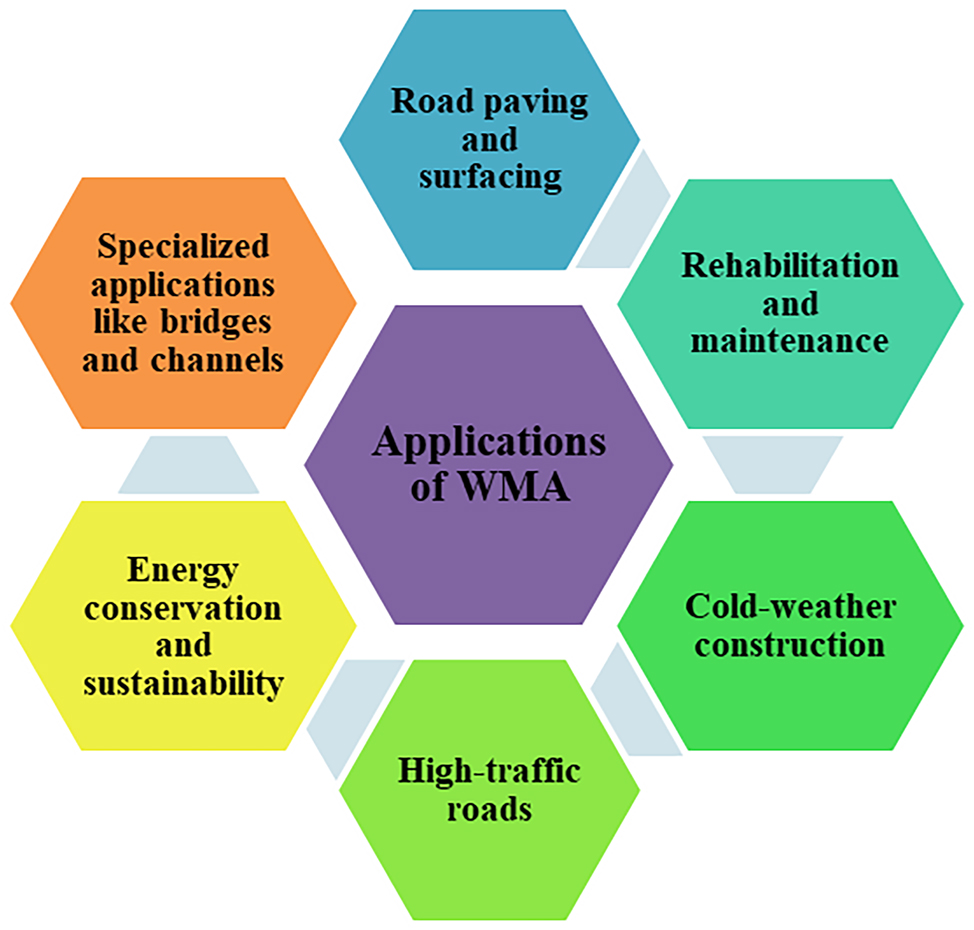
Applications of WMA in the road construction industry.
The mechanical performance of WMA has been the focus of extensive studies, with particular attention given to its structural behavior under various conditions. One notable study investigated the incorporation of ZYF-1 additives in WMA and revealed that these additives greatly enhance the performance of the material under low-temperature conditions while preserving its stability at high temperatures [194]. This enhancement makes WMA an ideal choice for regions with colder climates, where conventional HMA is more susceptible to cracking and brittleness due to extreme temperature fluctuations. Another critical aspect of WMA performance is its resistance to moisture-induced damage, which has historically been a concern in asphalt pavement durability. Research examining half-WMAs incorporating foamed bitumen and hydrated lime has demonstrated that WMA mixtures exhibit superior moisture resistance, particularly in areas prone to heavy rainfall and freeze‒thaw cycles [195]. This characteristic is essential for preventing common pavement failures such as potholes and rutting, which are often exacerbated by water infiltration. In addition to its technical advantages, WMA also offers considerable economic benefits. The reduction in production temperatures leads to lower fuel consumption during asphalt mixing, contributing to overall cost savings [196]. A study on polymer-modified bitumen and WMA production confirmed that lowering manufacturing temperatures directly decreases electricity and natural gas usage, further increasing cost efficiency. In addition, the transition to WMA technology helps alleviate the financial impact of carbon taxes by significantly reducing CO2 emissions associated with asphalt production [196].
One of the most promising advancements in WMA technology is its integration with rubberized asphalt, a modification aimed at enhancing its mechanical performance [39]. The incorporation of rubberized materials into WMA significantly improves fatigue resistance and self-healing capabilities, enabling pavements to recover from minor surface cracks and prolong their service life under intense traffic conditions. This innovation holds particular relevance in environments with high traffic volumes, where frequent roadway maintenance poses substantial financial and logistical challenges [197]. Further advancements in WMA technology include the introduction of antistipping agents in pelletized form, which are designed to improve the resistance of pavement to moisture damage and pothole formation. The addition of these materials improves stripping resistance, particularly in regions that experience extreme weather fluctuations, ensuring the long-term durability and safety of asphalt surfaces [198]. Moreover, the development of innovative binders and additives, such as Evotherm and Sasobit, has further optimized the performance of WMA by improving viscosity control and lowering compaction and mixing temperatures. A study examining the rheological characteristics of high-viscosity WMA mixtures revealed that the inclusion of additives like Evotherm M1 not only facilitates reduced production temperatures but also enhances pavement longevity. The findings indicated a remarkable 30 % increase in fatigue resilience to moderate temperatures, highlighting the toughness of the material under repeated loading without premature degradation [199]. These technological innovations reinforce WMA’s ability to rival and, in many cases, surpass the conventional HMA in terms of long-term resilience, performance, and sustainability.
Briefly, the implementation of WMA in the road construction sector represents a significant advancement in promoting both enhanced pavement performance and environmental sustainability. The ability of WMA to operate at lower production temperatures while simultaneously reducing energy consumption and improving mechanical properties underscores its potential as a transformative solution for modern infrastructure development. Ongoing innovations in asphalt additives, modified binders, and production methodologies continue to refine WMA’s performance, reinforcing its viability as a sustainable substitute for conventional HMA. The substantial body of studies dedicated to WMA underscores the increasing interest in its long-term benefits, positioning it as a critical material in the future of global road construction and sustainable transportation systems.
14 Challenges, limitations, future directions and emerging trends in WMA adoption
WMA innovation has attracted considerable attention for its environmental and economic advantages, particularly in lowering production temperatures and reducing emissions compared to HMA. Despite these benefits, several challenges, limitations, and areas requiring further improvement have hindered its widespread adoption [5]. Extensive research has highlighted the technical, economic, and environmental complexities associated with WMA, emphasizing the need for more consistent performance data and advancements in production methodologies to improve its reliability. One of the primary challenges related to WMA is its inconsistent performance under different climatic conditions and traffic loads [27], 39]. In colder climates or areas with high moisture levels, these compaction challenges may result in insufficient pavement density and reduced structural integrity, ultimately affecting long-term durability. Achieving uniform field performance remains a significant concern, particularly for heavily trafficked roads where consistent compaction is critical for pavement longevity [64]. Moreover, the limited availability of long-term performance data compared with HMA presents another obstacle, making it difficult for transportation agencies to fully endorse WMA as a reliable alternative in all contexts. Another major issue affecting the adoption of WMA is the variability in production technologies. Different methods, such as foaming techniques, chemical additives, and organic modifiers, introduce inconsistencies in asphalt quality, impacting both workability and long-term durability [23]. Studies have shown that variations in additive systems lead to significant differences in performance, raising concerns over the standardization of WMA production processes. Without uniform production guidelines, asphalt mixtures may exhibit inconsistencies in field applications, as different regions and contractors utilize various materials and techniques [200]. The absence of standardized protocols for temperature reduction and compaction methods further complicates the widespread implementation of WMA, making it challenging to establish consistent performance expectations across infrastructure projects [201].
The advancement of WMA depends on overcoming existing challenges related to performance consistency and standardization through extensive research and large-scale field trials. A key area of development involves refining LCA frameworks to better evaluate the long-term environmental and economic impacts of WMA [39]. While conventional assessments focus primarily on immediate reductions in emissions and energy consumption due to lower production temperatures, a more comprehensive approach is required. A holistic LCA should encompass the entire lifespan of pavements, including maintenance requirements, repair cycles, and end-of-life disposal, to provide a complete sustainability evaluation of WMA [92]. Recent studies suggest that hybrid LCA models, which integrate both process-based and input-output methodologies, offer a more accurate representation of the environmental advantages and economic implications of WMA [201]. In addition to environmental assessments, future improvements in WMA technology may stem from innovations in mix design, particularly through the incorporation of recycled materials. Research has demonstrated that the inclusion of CR and other reclaimed materials in WMA formulations enhances pavement durability while simultaneously addressing environmental concerns associated with waste management [200]. Despite these benefits, integrating recycled materials into WMA introduces new complexities in mix design. One of the primary challenges lies in balancing the advantages of incorporating recycled components to maintain the mechanical strength and performance of the final asphalt mixture. For instance, while incorporating recycled rubber significantly improves resistance to cracking, it also poses challenges in terms of workability at reduced production temperatures, as observed in multiple studies [202].
The increasing adoption of WMA is becoming closely connected to the principles of the circular economy, with a strong emphasis on resource efficiency and sustainable practices in road construction. Recent investigations have highlighted efforts by national road authorities across Europe to incorporate more environmentally responsible approaches, particularly by adding the proportion of recycled materials in asphalt mixtures [203]. While many NRAs recognize the potential environmental and financial benefits of WMA, widespread implementation has been slow, revealing a disconnect between awareness and actual application. This gap emphasizes the need for clear policy structures and stronger motivations to drive the implementation of WMA and other sustainable technologies in infrastructure development [64]. A major focus of research is focused on maximizing the use of recycled content in WMA to enhance the sustainability of roadway construction. The introduction of high-recycled-content WMA mixtures has demonstrated promising results, with studies showing that asphalt mixtures containing 45 %–60 % RAP can still meet vital performance criteria. However, achieving an ideal balance between rutting resistance and long-term durability remains a complex challenge [202]. This movement toward higher RAP usage aligns with broader trends in asphalt recycling, as transportation agencies and construction firms aim to reduce their environmental impact and carbon footprint [202]. The primary barrier to widespread WMA adoption is perceived and actual long-term durability concerns, which can be mitigated by implementing robust quality control, optimizing mix designs, conducting long-term performance monitoring, and improving knowledge sharing through education and industry-wide best practice guidance. Strategies include developing national guidelines, investing in research on additive compatibility and performance, and fostering collaborative efforts to standardize WMA production and implementation, ensuring that its long-term performance matches or exceeds HMA standards. To accelerate evidence accumulation, we also add concrete strategies: i) harmonized long-term monitoring plans for WMA control/companion sections using common distress, density, and binder-aging indices; ii) pooled analysis of agency PMS datasets with survival/ME calibration focused on WMA aging; and iii) standardized laboratory aging for WMA (two-step protocols) to better align laboratory–field durability inferences. Despite its environmental advantages, the increased use of RAP introduces certain challenges, particularly regarding material consistency. The aging of recycled asphalt binder can undermine pavement performance, especially under heavy traffic conditions [34]. As a result, more advanced testing methodologies are being explored to further explore the microstructural behavior of WMA. State-of-the-art techniques, such as atomic force microscopy, have been employed in recent studies to investigate the aging and modification characteristics of asphalt at the microscopic level. These studies have explored how asphalt behaves at reduced production temperatures, providing a better understanding of the molecular interactions among additives and asphalt binders [204].
Although WMA technology presents significant environmental advantages, including lower production temperatures, reduced emissions, and decreased energy consumption, its widespread implementation remains constrained by technical challenges and the absence of standardized practices. Addressing these limitations requires advancements in material composition, particularly through the integration of recycled materials and the application of cutting-edge analytical techniques such as AFM, which provides valuable insights into asphalt behavior at the microstructural level. Despite these promising developments, ensuring the long-term reliability of WMA necessitates a more comprehensive approach, including robust LCA and extensive field performance evaluations. The wealth of research dedicated to WMA, with over 1,140 studies exploring various aspects of its formulation and application, underscores the growing interest in optimizing its performance. However, the successful transition of WMA into mainstream road construction depends on collaborative efforts among researchers, industry professionals, and policymakers. Strengthening interdisciplinary cooperation will be essential in refining WMA technologies, developing uniform production standards, and facilitating their integration into sustainable infrastructure systems.
15 Conclusions
WMA represents a significant innovation in road construction, combining environmental responsibility with advanced engineering performance. This review systematically explores the materials, properties, and applications of WMA, highlighting its development, technical complexities, and diverse advantages. Through the integration of advanced materials and modern production techniques, WMA achieves efficient compaction at lower temperatures, leading to decreased GHG emissions, reduced energy consumption, and improved safety conditions for workers. These attributes position WMA as a key component in the advancement of sustainable infrastructure.
The mechanical and fractured characteristics of WMA mixtures highlight their ability to comply with strict performance criteria. Progress in self-healing mechanisms and LCA techniques has further reinforced WMA as a durable and economically sustainable alternative to conventional HMAs. Its environmental advantages, including a lower carbon footprint and the ability to integrate reclaimed materials, support international initiatives aimed at fostering environmentally responsible construction practices. Although WMA presents significant advantages, its widespread implementation faces several challenges. Differences in material behavior, high initial investment costs, and the necessity for extensive long-term performance evaluations remain critical areas requiring further investigation and technological advancement. In addition, variations in climate conditions and traffic loads demand tailored approaches to enhance the effectiveness of WMA in specific regions. Recent developments, such as the integration of biobased additives, advancements in nanotechnology, and the application of artificial intelligence in performance modeling, provide promising directions for future research and optimization.
As contemporary infrastructure evolves, WMA has emerged as a key solution for promoting sustainability while maintaining economic viability and environmental responsibility. Advancing its implementation requires coordinated efforts among researchers, industry professionals, and policymakers to overcome existing challenges, facilitate large-scale adoption, and propel advancements in road construction technologies. This analysis highlights the essential role of WMA in developing durable and sustainable transportation systems, contributing to a future that prioritizes connectivity and ecological responsibility.
To enhance the development and implementation of WMAs, scientists, researchers, and industry professionals have identified key areas for future investigations. These recommendations aim to address existing research gaps while promoting innovation, sustainability, and resilience in road construction:
The influence of WMA on pavement surface characteristics – particularly skid resistance (friction) and tire–pavement noise – should be investigated since our present scope focused on structural performance (e.g., rutting, cracking, and fatigue). This addition clarifies the boundaries of the current study and prioritizes these safety and acoustic aspects for subsequent research.
To investigate the formulation and effectiveness of next-generation additives, including biobased and nanotechnology-enhanced solutions, to enhance the durability, workability, and environmental compatibility of WMA mixtures.
Comprehensive field studies are needed to evaluate the structural integrity and durability of WMA under diverse climatic conditions, traffic volumes, and maintenance practices to ensure long-term reliability.
To examine the influence of locally sourced materials and environmental variables on WMA properties, region-specific forms/ulations that optimize performance and sustainability should be developed.
To assess the feasibility of incorporating higher percentages of RAP and other waste-derived materials in WMA mixtures to support circular economy initiatives in pavement engineering.
To investigate innovative compaction techniques to improve the mechanical properties, density, and uniformity of WMA layers, enhancing construction efficiency and pavement longevity.
To investigate the potential of self-healing mechanisms, such as encapsulated rejuvenators and polymer-based healing agents, to increase the pavement service life and decrease maintenance costs.
To conduct extensive evaluations to quantify the environmental gains of WMA, including reductions in carbon emissions, energy consumption, and resource usage across different production and application scenarios.
The synergistic effects of various WMA additives and modifiers were analyzed to refine formulations, improve stability, and ensure consistent performance across various operational conditions.
AI-driven predictive models are used to optimize WMA mix designs, simulate long-term pavement performance, and support data-driven decision-making in road construction.
To engage with industry professionals and regulatory bodies to establish uniform standards for WMA production, quality control, and application methodologies, broader global adoption should be ensured.
By addressing these critical areas, WMA technology can continue to evolve as a high-performance and sustainable solution for modern road construction, contributing to long-term efficiency and resilience in transportation infrastructure.
-
Funding information: The authors extend their appreciation to Prince Sattam bin Abdulaziz University for funding this research work through the project number (PSAU/2024/01/31329).
-
Author contribution: The author has accepted full responsibility for the entire content of this manuscript and approved its submission.
-
Conflict of interest: The authors state no conflict of interest.
-
Data availability statement: All data generated or analyzed during this study are included in this published article.
References
1. Nithinchary, J, Dhandapani, BP, Mullapudi, RS. Application of warm mix technology - design and performance characteristics: review and way forward. Constr Build Mater 2024;414:134915. https://doi.org/10.1016/j.conbuildmat.2024.134915.Suche in Google Scholar
2. Duarte, GM, Faxina, AL. Asphalt concrete mixtures modified with polymeric waste by the wet and dry processes: a literature review. Constr Build Mater 2021;312:125408. https://doi.org/10.1016/j.conbuildmat.2021.125408.Suche in Google Scholar
3. Xiong, R, Chu, C, Qiao, N, Wang, L, Yang, F, Sheng, Y, et al.. Performance evaluation of asphalt mixture exposed to dynamic water and chlorine salt erosion. Constr Build Mater 2019;201:121–6. https://doi.org/10.1016/j.conbuildmat.2018.12.190.Suche in Google Scholar
4. Tutu, KA, Tuffour, YA. Warm-mix asphalt and pavement sustainability: a review. Open J Civ Eng 2016;6:84–93. https://doi.org/10.4236/ojce.2016.62008.Suche in Google Scholar
5. Hettiarachchi, C, Hou, X, Wang, J, Xiao, F. A comprehensive review on the utilization of reclaimed asphalt material with warm mix asphalt technology. Constr Build Mater 2019;227:117096. https://doi.org/10.1016/j.conbuildmat.2019.117096.Suche in Google Scholar
6. Chan, S, Falkner, R, van Asselt, H, Goldberg, M. Strengthening non-state climate action: a progress assessment of commitments launched at the 2014 UN climate summit. Grantham Res Inst Clim Chang Environ Work Pap 2015;216.Suche in Google Scholar
7. Sukhija, M, Saboo, N, Pani, A. Economic and environmental aspects of warm mix asphalt mixtures: a comparative analysis. Transp Res Part D Transp Environ 2022;109:103355. https://doi.org/10.1016/j.trd.2022.103355.Suche in Google Scholar
8. Yaofei, L, Ke, Z. Review of environmental emissions and conventional performance of warm mix asphalt technology with evotherm additive. Int J Pavement Res Technol 2025;1–21. https://doi.org/10.1007/s42947-025-00578-5.Suche in Google Scholar
9. Arun Sagar, KM, Venudharan, V, Saha, G. Prospects of warm mix asphalt in maximizing reclaimed asphalt pavement utilization: review on mix design and performance, clean. Waste Syst 2025;10:100229. https://doi.org/10.1016/j.clwas.2025.100229.Suche in Google Scholar
10. Liu, N, Liu, L, Li, M, Sun, L. A comprehensive review of warm-mix asphalt mixtures: mix design, construction temperatures determination, performance and life-cycle assessment. Road Mater Pavement Des 2024;25:1381–425. https://doi.org/10.1080/14680629.2023.2268194.Suche in Google Scholar
11. Sandeep, K, Singh, B, Kathuria, A. A systematic review of foam mix asphalt. Innov Infrastruct Solut 2025;10:1–23. https://doi.org/10.1007/s41062-025-01866-6.Suche in Google Scholar
12. Jattak, ZA, Hassan, NA, Mohd Satar, MKI. Moisture susceptibility and environmental impact of warm mix asphalt containing bottom ash. Case Stud Constr Mater 2021;15:e00636. https://doi.org/10.1016/j.cscm.2021.e00636.Suche in Google Scholar
13. Caputo, P, Abe, AA, Loise, V, Porto, M, Calandra, P, Angelico, R, et al.. The role of additives in warm mix asphalt technology: an insight into their mechanisms of improving an emerging technology. Nanomaterials 2020;10:1–17. https://doi.org/10.3390/nano10061202.Suche in Google Scholar PubMed PubMed Central
14. Sukhija, M, Saboo, N. A comprehensive review of warm mix asphalt mixtures-laboratory to field. Constr Build Mater 2021;274:121781. https://doi.org/10.1016/j.conbuildmat.2020.121781.Suche in Google Scholar
15. Calabi-Floody, AT, Valdés-Vidal, GA, Sanchez-Alonso, E, Mardones-Parra, LA. Evaluation of gas emissions, energy consumption and production costs of warm mix asphalt (WMA) involving natural zeolite and reclaimed asphalt pavement (RAP). Sustain Times 2020;12:6410. https://doi.org/10.3390/SU12166410.Suche in Google Scholar
16. Wang, H, Liu, X, Apostolidis, P, Scarpas, T. Review of warm mix rubberized asphalt concrete: towards a sustainable paving technology. J Clean Prod 2018;177:302–14. https://doi.org/10.1016/j.jclepro.2017.12.245.Suche in Google Scholar
17. EAPA. The use of warm mix asphalt. Eur Asph Pavement Assoc 2014;23:3.Suche in Google Scholar
18. Dinis-Almeida, M, Afonso, ML. Warm mix recycled asphalt - a sustainable solution. J Clean Prod 2015;107:310–16. https://doi.org/10.1016/j.jclepro.2015.04.065.Suche in Google Scholar
19. Wu, S, Wen, H, Zhang, W, Shen, S, Mohammad, LN, Faheem, A, et al.. Field performance of top-down fatigue cracking for warm mix asphalt pavements. Int J Pavement Eng 2019;20:33–43. https://doi.org/10.1080/10298436.2016.1248204.Suche in Google Scholar
20. Vasconcelos, KL, Little, DN, Bhasin, A. Influence of reduced production temperatures on the adhesive properties of aggregates and laboratory performance of fine aggregate-asphalt mixtures. Road Mater Pavement Des 2010;11:47–64. https://doi.org/10.1080/14680629.2010.9690259.Suche in Google Scholar
21. Guo, M, Liu, H, Jiao, Y, Mo, L, Tan, Y, Wang, D, et al.. Effect of WMA-RAP technology on pavement performance of asphalt mixture: a state-of-the-art review. J Clean Prod 2020;266:121704. https://doi.org/10.1016/j.jclepro.2020.121704.Suche in Google Scholar
22. Liu, S, Zhou, S, Peng, A. Analysis of moisture susceptibility of foamed warm mix asphalt based on cohesion, adhesion, bond strength, and morphology. J Clean Prod 2020;277:123334. https://doi.org/10.1016/j.jclepro.2020.123334.Suche in Google Scholar
23. Yousefi, A, Behnood, A, Nowruzi, A, Haghshenas, H. Performance evaluation of asphalt mixtures containing warm mix asphalt (WMA) additives and reclaimed asphalt pavement (RAP). Constr Build Mater 2021;268:121200. https://doi.org/10.1016/j.conbuildmat.2020.121200.Suche in Google Scholar
24. Sol-Sánchez, M, Fiume, A, Moreno-Navarro, F, Rubio-Gámez, MC. Analysis of fatigue cracking of warm mix asphalt. Influence of the manufacturing technology. Int J Fatigue 2018;110:197–203. https://doi.org/10.1016/j.ijfatigue.2018.01.029.Suche in Google Scholar
25. Firmansyah, T. Effect of field aging on adhesive properties of warm-mix asphalt. In: AIP Conf. Proc. Kuantan, Malaysia: AIP Publishing; 2019.10.1063/1.5085974Suche in Google Scholar
26. Kassem, E, Garcia Cucalon, L, Masad, E, Little, D. Effect of warm mix additives on the interfacial bonding characteristics of asphalt binders. Int J Pavement Eng 2018;19:1111–24. https://doi.org/10.1080/10298436.2016.1240563.Suche in Google Scholar
27. Jamshidi, A, Hamzah, MO, You, Z. Performance of warm mix asphalt containing sasobit®: state-Of-the-art. Constr Build Mater 2013;38:530–53. https://doi.org/10.1016/j.conbuildmat.2012.08.015.Suche in Google Scholar
28. Vishal, U, Chowdary, V, Padmarekha, A, Murali Krishnan, J. Influence of moisture damage on fatigue of warm mix and hot mix asphalt mixture. J Mater Civ Eng 2020;32:04020247. https://doi.org/10.1061/(asce)mt.1943-5533.0003321.Suche in Google Scholar
29. Song, W, Huang, B, Shu, X. Influence of warm-mix asphalt technology and rejuvenator on performance of asphalt mixtures containing 50% reclaimed asphalt pavement. J Clean Prod 2018;192:191–8. https://doi.org/10.1016/j.jclepro.2018.04.269.Suche in Google Scholar
30. Shiva Kumar, G, Suresha, SN. State of the art review on mix design and mechanical properties of warm mix asphalt. Road Mater Pavement Des 2019;20:1501–24. https://doi.org/10.1080/14680629.2018.1473284.Suche in Google Scholar
31. Izaks, R, Gebauere, L, Sparans, R, Kornisovs, R, Haritonovs, V. Use of recycled asphalt and waste materials in production of high-performance asphalt mixtures. Baltic J Road Bridge Eng 2022;17:120–45. https://doi.org/10.7250/bjrbe.2022-17.582.Suche in Google Scholar
32. Monu, K, Ransinchung, GD, Singh, S. Effect of long-term ageing on properties of RAP inclusive WMA mixes. Constr Build Mater 2019;206:483–93. https://doi.org/10.1016/j.conbuildmat.2019.02.087.Suche in Google Scholar
33. Jattak, ZA, Hassan, NA, Satar, MKIM. Moisture susceptibility and environmental impact of warm mix asphalt containing bottom ash. Case Stud Constr Mater 2021;15:e00636.10.1016/j.cscm.2021.e00636Suche in Google Scholar
34. Cheraghian, G, Cannone Falchetto, A, You, Z, Chen, S, Kim, YS, Westerhoff, J, et al.. Warm mix asphalt technology: an up to date review. J Clean Prod 2020;268:122128. https://doi.org/10.1016/j.jclepro.2020.122128.Suche in Google Scholar
35. Valentová, T, Altman, J, Valentin, J. Impact of asphalt ageing on the activity of adhesion promoters and the moisture susceptibility. Transp Res Procedia 2016;14:768–77. https://doi.org/10.1016/j.trpro.2016.05.066.Suche in Google Scholar
36. Omari, I, Aggarwal, V, Hesp, S. Investigation of two warm mix asphalt additives. Int J Pavement Res Technol 2016;9:83–8. https://doi.org/10.1016/j.ijprt.2016.02.001.Suche in Google Scholar
37. Khedmati, M, Khodaii, A, Haghshenas, HF. A study on moisture susceptibility of stone matrix warm mix asphalt. Constr Build Mater 2017;144:42–9. https://doi.org/10.1016/j.conbuildmat.2017.03.121.Suche in Google Scholar
38. Kushwaha, P, Chauhan, AS. Pavement design and construction using warm mix asphalt: a bibliometric overview. Mater Today Proc 2023. https://doi.org/10.1016/j.matpr.2023.03.040.Suche in Google Scholar
39. L Yazi̇rlioğlu, Sustainable design considerations for emotional durability and product longevity through product care activities by repair enthusiasts, 2021.Suche in Google Scholar
40. Jennings, B, Wirtjes, R. Hot mix asphalt vs warm mix asphalt, south. Edwardsville, Illinois: Illinois Univ. Edwardsv; 2019.Suche in Google Scholar
41. Renken, P, Büchler, S, Falchetto, AC, Wang, D, Wistuba, MP. Warm mix asphalt-a German case study. Asph Paving Technol; 2018;87:685–714.Suche in Google Scholar
42. D’Angelo, J, Harm, E, Bartoszek, J, Baumgardner, G, Corrigan, M, Cowsert, J, et al.. FHWA-PL-08-007: warm-mix asphalt - european practice. Fed Highw Adm 2008;28.Suche in Google Scholar
43. Jamshidi, A, Hamzah, MO, Shahadan, Z. Selection of reclaimed asphalt pavement sources and contents for asphalt mix production based on asphalt binder rheological properties, fuel requirements and greenhouse gas emissions. J Clean Prod 2012;23:20–7. https://doi.org/10.1016/j.jclepro.2011.10.008.Suche in Google Scholar
44. Zhang, S, Wang, D, Guo, F, Deng, Y, Feng, F, Wu, Q, et al.. Properties investigation of the SBS modified asphalt with a compound warm mix asphalt (WMA) fashion using the chemical additive and foaming procedure. J Clean Prod 2021;319:128789. https://doi.org/10.1016/j.jclepro.2021.128789.Suche in Google Scholar
45. Aziz, MK, Mohd Hasan, MR, Poovaneshvaran, S, Tai, G, Wang, H. Application of diluted methanol to allow the production of latex modified asphalt mixture with lower energy consumption. Constr Build Mater 2020;262:120028. https://doi.org/10.1016/j.conbuildmat.2020.120028.Suche in Google Scholar
46. Arega, ZA, Bhasin, A, Li, W, Newcomb, DE, Arambula, E. Characteristics of asphalt binders foamed in the laboratory to produce warm mix asphalt. J Mater Civ Eng 2014;26:04014078. https://doi.org/10.1061/(asce)mt.1943-5533.0000981.Suche in Google Scholar
47. Maciejewski, K, Chomicz-Kowalska, A, Remisova, E. Effects of water-foaming and liquid warm mix additive on the properties and chemical composition of asphalt binders in terms of short term ageing process. Constr Build Mater 2022;341:127756. https://doi.org/10.1016/j.conbuildmat.2022.127756.Suche in Google Scholar
48. Yu, X, Dong, F, Ding, G, Liu, S, Shen, S. Rheological and microstructural properties of foamed epoxy asphalt. Constr Build Mater 2016;114:215–22. https://doi.org/10.1016/j.conbuildmat.2016.03.179.Suche in Google Scholar
49. Iwański, M, Chomicz-Kowalska, A, Mazurek, G, Buczyński, P, Cholewińska, M, Iwański, MM, et al.. Effects of the water-based foaming process on the basic and rheological properties of bitumen 70/100. Materials 2021;14:2803. https://doi.org/10.3390/ma14112803.Suche in Google Scholar PubMed PubMed Central
50. Xu, S, Xiao, F, Amirkhanian, S, Singh, D. Moisture characteristics of mixtures with warm mix asphalt technologies – a review. Constr Build Mater 2017;142:148–61. https://doi.org/10.1016/j.conbuildmat.2017.03.069.Suche in Google Scholar
51. Hassan, M. Evaluation of the environmental and economic impacts of warm-mix asphalt using life-cycle assessment. Int J Constr Educ Res 2010;6:238–50. https://doi.org/10.1080/15578771.2010.507619.Suche in Google Scholar
52. Aslam, MS, Huang, B, Cui, L. Review of construction and demolition waste management in China and USA. J Environ Manag 2020;264:110445. https://doi.org/10.1016/j.jenvman.2020.110445.Suche in Google Scholar PubMed
53. Kheradmand, B, Muniandy, R, Hua, LT, Yunus, RB, Solouki, A. An overview of the emerging warm mix asphalt technology. Int J Pavement Eng 2014;15:79–94. https://doi.org/10.1080/10298436.2013.839791.Suche in Google Scholar
54. Varma, R, Balieu, R, Kringos, N. A state-of-the-art review on self-healing in asphalt materials: mechanical testing and analysis approaches. Constr Build Mater 2021;310:125197. https://doi.org/10.1016/j.conbuildmat.2021.125197.Suche in Google Scholar
55. Woszuk, A, Franus, W. A review of the application of zeolite materials in warm mix asphalt technologies. Appl Sci 2017;7:293. https://doi.org/10.3390/APP7030293.Suche in Google Scholar
56. Capitão, SD, Picado-Santos, LG, Martinho, F. Pavement engineering materials: review on the use of warm-mix asphalt. Constr Build Mater 2012;36:1016–24. https://doi.org/10.1016/j.conbuildmat.2012.06.038.Suche in Google Scholar
57. Goli, H, Latifi, M. Evaluation of the effect of moisture on behavior of warm mix asphalt (WMA) mixtures containing recycled asphalt pavement (RAP). Constr Build Mater 2020;247:118526. https://doi.org/10.1016/j.conbuildmat.2020.118526.Suche in Google Scholar
58. Thives, LP, Ghisi, E. Asphalt mixtures emission and energy consumption: a review. Renew Sustain Energy Rev 2017;72:473–84. https://doi.org/10.1016/j.rser.2017.01.087.Suche in Google Scholar
59. Sun, L. Distribution of the temperature field in a pavement structure. Struct Behav Asph Pavements; 2016:61–177.10.1016/B978-0-12-849908-5.00002-XSuche in Google Scholar
60. Almuhmdi, A, Abdulbasit Muhmood, Salih, A. Effects of crushed glass waste as a fine aggregate on properties of hot asphalt mixture. Tikrit J Eng Sci 2021;28:129–45. https://doi.org/10.25130/tjes.28.3.10.Suche in Google Scholar
61. Almeida-Costa, A, Benta, A. Economic and environmental impact study of warm mix asphalt compared to hot mix asphalt. J Clean Prod 2016;112:2308–17. https://doi.org/10.1016/j.jclepro.2015.10.077.Suche in Google Scholar
62. Rahman, T, Dawson, A, Thom, N. Warm mix asphalt (WMA) for rapid construction in airfield pavement. Constr Build Mater 2020;246:118411. https://doi.org/10.1016/j.conbuildmat.2020.118411.Suche in Google Scholar
63. Behnood, A. A review of the warm mix asphalt (WMA) technologies: effects on thermo-mechanical and rheological properties. J Clean Prod 2020;259:120817. https://doi.org/10.1016/j.jclepro.2020.120817.Suche in Google Scholar
64. Milad, A, Babalghaith, AM, Al-Sabaeei, AM, Dulaimi, A, Ali, A, Reddy, SS, et al.. A comparative review of hot and warm mix asphalt technologies from environmental and economic perspectives: towards a sustainable asphalt pavement. Int J Environ Res Publ Health 2022;19:14863. https://doi.org/10.3390/ijerph192214863.Suche in Google Scholar PubMed PubMed Central
65. Stienss, M, Szydlowski, C. Influence of selected warm mix asphalt additives on cracking susceptibility of asphalt mixtures. Materials 2020;13:202. https://doi.org/10.3390/ma13010202.Suche in Google Scholar PubMed PubMed Central
66. Sukhija, M, Wagh, VP, Saboo, N. Development of workability based approach for assessment of production temperatures of warm mix asphalt mixtures. Constr Build Mater 2021;305:124808. https://doi.org/10.1016/j.conbuildmat.2021.124808.Suche in Google Scholar
67. Rodríguez-Alloza, AM, Gallego, J, Pérez, I. Study of the effect of four warm mix asphalt additives on bitumen modified with 15% crumb rubber. Constr Build Mater 2013;43:300–8. https://doi.org/10.1016/j.conbuildmat.2013.02.025.Suche in Google Scholar
68. Abed, A, Thom, N, Lo Presti, D, Airey, G. Thermo-rheological analysis of WMA-additive modified binders. Mater Struct Constr 2020;53:52. https://doi.org/10.1617/s11527-020-01480-1.Suche in Google Scholar
69. Silva, HMRD, Oliveira, JRM, Ferreira, CIG, Pereira, PAA. Assessment of the performance of warm mix asphalts in road pavements. Int J Pavement Res Tech 2010;3:119–27.Suche in Google Scholar
70. Rubio, MC, Martínez, G, Baena, L, Moreno, F. Warm mix asphalt: an overview. J Clean Prod 2012;24:76–84. https://doi.org/10.1016/j.jclepro.2011.11.053.Suche in Google Scholar
71. Ezemenike, CS, Aderinlewo, OO, Oladele, IO, Oyedepo, OJ. Evaluation of marshal stability and flow of hybrid modified asphalt concrete. FUTA J Eng Eng Technol 2022;16:51–7. https://doi.org/10.51459/futajeet.2022.16.1.376.Suche in Google Scholar
72. Ali, A, Abbas, A, Nazzal, M, Alhasan, A, Roy, A, Powers, D. Effect of temperature reduction, foaming water content, and aggregate moisture content on performance of foamed warm mix asphalt. Constr Build Mater 2013;48:1058–66. https://doi.org/10.1016/j.conbuildmat.2013.07.081.Suche in Google Scholar
73. Mohammed Babalghaith, A, Koting, S, Ramli Sulong, NH, Karim, MR, Mohammed AlMashjary, B. Performance evaluation of stone mastic asphalt (SMA) mixtures with palm oil clinker (POC) as fine aggregate replacement. Constr Build Mater 2020;262:120546. https://doi.org/10.1016/j.conbuildmat.2020.120546.Suche in Google Scholar
74. Cheraghian, G, Wistuba, MP. Effect of fumed silica nanoparticles on ultraviolet aging resistance of bitumen. Nanomaterials 2021;11:1–18. https://doi.org/10.3390/nano11020454.Suche in Google Scholar PubMed PubMed Central
75. Watson, DE, West, RC, Turner, PA, Casola, JR. Mixing and compaction temperatures of asphalt binders in hot-mix asphalt; 2010. https://doi.org/10.17226/14367.Suche in Google Scholar
76. Saarinen, EM-J, Belfast, QU, Aumasson, J-P. Kudelski security, the BLAKE2 cryptographic hash and message authentication code (MAC). Constr Build Mater 2015;4:1–8.Suche in Google Scholar
77. Zaremotekhases, F, Sadek, H, Hassan, M, Berryman, C. Impact of warm-mix asphalt technologies and high reclaimed asphalt pavement content on the performance of alternative asphalt mixtures. Constr Build Mater 2022;319:126035. https://doi.org/10.1016/j.conbuildmat.2021.126035.Suche in Google Scholar
78. Fakhri, M, Ahmadi, A. Recycling of RAP and steel slag aggregates into the warm mix asphalt: a performance evaluation. Constr Build Mater 2017;147:630–8. https://doi.org/10.1016/j.conbuildmat.2017.04.117.Suche in Google Scholar
79. Alnadish, AM, Aman, MY, Katman, HYB, Ibrahim, MR. Characteristics of warm mix asphalt incorporating coarse steel slag aggregates. Appl Sci 2021;11:3708. https://doi.org/10.3390/app11083708.Suche in Google Scholar
80. Belc, AL, Ciutina, A, Buzatu, R, Belc, F, Costescu, C. Environmental impact assessment of different warm mix asphalts. Sustain Times 2021;13:11869. https://doi.org/10.3390/su132111869.Suche in Google Scholar
81. Sol-Sánchez, M, Moreno-Navarro, F, Rubio-Gámez, MC, Pérez-Mena, V, Cabanillas, P, Norambuena-Contreras, J. Reuse of zeolite By-Products derived from petroleum refining for sustainable roads. Adv Mater Sci Eng 2019;2019:1–10. https://doi.org/10.1155/2019/4256989.Suche in Google Scholar
82. Georgiou, P, Loizos, A. Environmental assessment of warm mix asphalt incorporating steel slag and high reclaimed asphalt for wearing courses: a case study, road mater. Pavement Des 2021;22:S662–71. https://doi.org/10.1080/14680629.2021.1906305.Suche in Google Scholar
83. Mansourkhaki, A, Aghasi, A. Performance of rubberized asphalt containing liquid nanomaterial anti-strip agent. Constr Build Mater 2019;214:468–74. https://doi.org/10.1016/j.conbuildmat.2019.03.071.Suche in Google Scholar
84. Zhao, S, Huang, B, Shu, X, Woods, M. Comparative evaluation of warm mix asphalt containing high percentages of reclaimed asphalt pavement. Constr Build Mater 2013;44:92–100. https://doi.org/10.1016/j.conbuildmat.2013.03.010.Suche in Google Scholar
85. Kusam, A, Malladi, H, Tayebali, AA, Khosla, NP. Laboratory evaluation of workability and moisture susceptibility of warm-mix asphalt mixtures containing recycled asphalt pavements. J Mater Civ Eng 2017;29:04016276. https://doi.org/10.1061/(asce)mt.1943-5533.0001825.Suche in Google Scholar
86. Oliveira, JRM, Silva, HMRD, Abreu, LPF, Gonzalez-Leon, JA. The role of a surfactant based additive on the production of recycled warm mix asphalts - less is more. Constr Build Mater 2012;35:693–700. https://doi.org/10.1016/j.conbuildmat.2012.04.141.Suche in Google Scholar
87. Baek, J, Lee, SY, Lee, HJ. Comparative evaluation of WMA additives effects on conventional and polymer modified asphalt pavements. KSCE J Civ Eng 2018;22:2099–108. https://doi.org/10.1007/s12205-018-1785-9.Suche in Google Scholar
88. Ahmed, TA, Hajj, EY, Sebaaly, PE, Majerus, N. Influence of aggregate source and warm-mix technologies on the mechanical properties of asphalt mixtures. Adv Civ Eng Mater 2013;2:400–17. https://doi.org/10.1520/ACEM20130072.Suche in Google Scholar
89. Topal, A, Oner, J, Sengoz, B, Dokandari, PA, Kaya, D. Evaluation of rutting performance of warm mix asphalt. Int J Civ Eng 2017;15:705–14. https://doi.org/10.1007/s40999-017-0188-5.Suche in Google Scholar
90. Tuah, SNA. Mechanical and thermal properties of polypropylene/clay roof tiles waste (PP/CRTW) composites. Constr Build Mater 2015;4:1–8.Suche in Google Scholar
91. Ziari, H, Naghavi, M, Imaninasab, R. Performance evaluation of rubberised asphalt mixes containing WMA additives. Int J Pavement Eng 2018;19:623–9. https://doi.org/10.1080/10298436.2016.1199874.Suche in Google Scholar
92. Chomicz-Kowalska, A. Laboratory testing of low temperature asphalt concrete produced in foamed bitumen technology with fiber reinforcement, bull. Polish acad. Sci Tech Sci 2017;65:779–90. https://doi.org/10.1515/bpasts-2017-0086.Suche in Google Scholar
93. You, Z, Mills-Beale, J, Fini, E, Goh, SW, Colbert, B. Evaluation of low-temperature binder properties of warm-mix asphalt, extracted and recovered RAP and RAS, and bioasphalt. J Mater Civ Eng 2011;23:1569–74. https://doi.org/10.1061/(asce)mt.1943-5533.0000295.Suche in Google Scholar
94. Guo, N, You, Z, Tan, Y, Zhao, Y. Performance evaluation of warm mix asphalt containing reclaimed asphalt mixtures. Int J Pavement Eng 2017;18:981–9. https://doi.org/10.1080/10298436.2016.1138114.Suche in Google Scholar
95. Foroutan Mirhosseini, A, Tahami, A, Hoff, I, Dessouky, S, Kavussi, A, Fuentes, L, et al.. Performance characterization of warm-mix asphalt containing high reclaimed-asphalt pavement with bio-oil rejuvenator. J Mater Civ Eng 2020;32:04020382. https://doi.org/10.1061/(asce)mt.1943-5533.0003481.Suche in Google Scholar
96. Yu, X, Dong, F, Xu, B, Ding, G, Ding, P. RAP binder influences on the rheological characteristics of foamed warm-mix recycled asphalt. J Mater Civ Eng 2017;29:04017145. https://doi.org/10.1061/(asce)mt.1943-5533.0001993.Suche in Google Scholar
97. Xiao, F, Hou, X, Amirkhanian, S, Kim, KW. Superpave evaluation of higher RAP contents using WMA technologies. Constr Build Mater 2016;112:1080–7. https://doi.org/10.1016/j.conbuildmat.2016.03.024.Suche in Google Scholar
98. Yang, E, Xu, J, Luo, H, Huang, B, Wang, KCP, Li, JQ, et al.. Performance comparison of warm mix asphalt for Plateau area. Road Mater Pavement Des 2022;23:211–21. https://doi.org/10.1080/14680629.2020.1820889.Suche in Google Scholar
99. Al Dughaishi, H, Al Lawati, J, Bilema, M, Babalghaith, AM, Mashaan, NS, Yusoff, NIM, et al.. Encouraging sustainable use of RAP materials for pavement construction in Oman: a review. Recycling 2022;7:35. https://doi.org/10.3390/recycling7030035.Suche in Google Scholar
100. Hurley, GC, Prowell, BD. Evaluation of evotherm for use in warm mix asphalt - report 2. Auburn: National Center for Asphalt Technology; 2006.Suche in Google Scholar
101. Oliviero Rossi, C, Caputo, P, Baldino, N, Lupi, FR, Miriello, D, Angelico, R. Effects of adhesion promoters on the contact angle of bitumen-aggregate interface. Int J Adhesion Adhes 2016;70:297–303. https://doi.org/10.1016/j.ijadhadh.2016.07.013.Suche in Google Scholar
102. Leng, Z, Al-Qadi, IL, Cao, R. Life-cycle economic and environmental assessment of warm stone mastic asphalt. Transp A Transp Sci 2018;14:562–75. https://doi.org/10.1080/23249935.2017.1390707.Suche in Google Scholar
103. Guo, N, You, Z, Zhao, Y, Tan, Y, Diab, A. Laboratory performance of warm mix asphalt containing recycled asphalt mixtures. Constr Build Mater 2014;64:141–9. https://doi.org/10.1016/j.conbuildmat.2014.04.002.Suche in Google Scholar
104. Yu, S, Shen, S, Steger, R, Wang, X. Effect of warm mix asphalt additive on the workability of asphalt mixture: from particle perspective. Constr Build Mater 2022;360:129548. https://doi.org/10.1016/j.conbuildmat.2022.129548.Suche in Google Scholar
105. Cheng, Z, Zhang, D, Xie, S, Polaczyk, PA, Wang, T. SmartRock-Based research on gyratory locking point for stone mastic asphalt mixture. Buildings 2022;12:97. https://doi.org/10.3390/buildings12020097.Suche in Google Scholar
106. Wang, X, Shen, S, Huang, H, Zhang, Z. Towards smart compaction: particle movement characteristics from laboratory to the field. Constr Build Mater 2019;218:323–32. https://doi.org/10.1016/j.conbuildmat.2019.05.122.Suche in Google Scholar
107. Wang, X, Shen, S, Huang, H, Almeida, LC. Characterization of particle movement in superpave gyratory compactor at meso-scale using SmartRock sensors. Constr Build Mater 2018;175:206–14. https://doi.org/10.1016/j.conbuildmat.2018.04.146.Suche in Google Scholar
108. Wang, X, Shen, S, Huang, H. Meso-scale kinematic responses of asphalt mixture in both field and laboratory compaction. Transp Res Rec 2021;2675:1631–42. https://doi.org/10.1177/03611981211009222.Suche in Google Scholar
109. Dan, HC, Yang, D, Zhao, LH, Wang, SP, Zhang, Z. Meso-scale study on compaction characteristics of asphalt mixtures in superpave gyratory compaction using SmartRock sensors. Constr Build Mater 2020;262:120874. https://doi.org/10.1016/j.conbuildmat.2020.120874.Suche in Google Scholar
110. Zhang, D, Cheng, Z, Geng, D, Xie, S, Wang, T. Experimental and numerical analysis on mesoscale mechanical behavior of coarse aggregates in the asphalt mixture during gyratory compaction. Processes 2022;10:47. https://doi.org/10.3390/pr10010047.Suche in Google Scholar
111. Xiao, F, Amirkhanian, SN, Karakouzian, M, Khalili, M. Rheology evaluations of WMA binders using ultraviolet and PAV aging procedures. Constr Build Mater 2015;79:56–64. https://doi.org/10.1016/j.conbuildmat.2015.01.046.Suche in Google Scholar
112. de la Rosa, RH, Aenlle, AA, Muñoz, NV. Evaluation of natural additives for warm asphalt mix. Rev. La Constr. 2018;17:330–6. https://doi.org/10.7764/RDLC.17.2.330.Suche in Google Scholar
113. Zhang, R, Moshfeghi, AR, Zhou, F, Deb) Mishra, D. Effect of chemical warm-mix additives on asphalt binder rheological and chemical properties in the context of aging. Constr Build Mater 2023;393:132061. https://doi.org/10.1016/j.conbuildmat.2023.132061.Suche in Google Scholar
114. Abd, DM. Characterisation of warm asphalt mixtures with addition of reclaimed asphalt pavement materials [Ph.D. thesis]. Liverpool: University of Liverpool; 2017.Suche in Google Scholar
115. Mohd Hasan, MR, Goh, SW, You, Z. Comparative study on the properties of WMA mixture using foamed admixture and free water system. Constr Build Mater 2013;48:45–50. https://doi.org/10.1016/j.conbuildmat.2013.06.028.Suche in Google Scholar
116. Sengoz, B, Topal, A, Gorkem, C. Evaluation of natural zeolite as warm mix asphalt additive and its comparison with other warm mix additives. Constr Build Mater 2013;43:242–52. https://doi.org/10.1016/j.conbuildmat.2013.02.026.Suche in Google Scholar
117. Liu, J, Yan, K, Liu, J. Rheological properties of warm mix asphalt binders and warm mix asphalt binders containing polyphosphoric acid. Int J Pavement Res Technol. 2018;11:481–7. https://doi.org/10.1016/j.ijprt.2018.03.005.Suche in Google Scholar
118. Xu, H, Chen, J, Sun, Y, Zhu, X, Wang, W, Liu, J. Rheological and physico-chemical properties of warm-mix recycled asphalt mastic containing high percentage of RAP binder. J Clean Prod 2021;289:125134. https://doi.org/10.1016/j.jclepro.2020.125134.Suche in Google Scholar
119. Lyu, L, Pei, J, Burnham, NA, Fini, EH, Poulikakos, LD. Nanoscale evolution of rubber-oil modified asphalt binder after thermal and UV aging. J Clean Prod 2023;426:139098. https://doi.org/10.1016/j.jclepro.2023.139098.Suche in Google Scholar
120. Xiao, F, Punith, VS, Amirkhanian, SN. Effects of non-foaming WMA additives on asphalt binders at high performance temperatures. Fuel 2012;94:144–55. https://doi.org/10.1016/j.fuel.2011.09.017.Suche in Google Scholar
121. Liu, J, Yan, K, You, L, Ge, D, Wang, Z. Laboratory performance of warm mix asphalt binder containing polyphosphoric acid. Constr Build Mater 2016;106:218–27. https://doi.org/10.1016/j.conbuildmat.2015.12.126.Suche in Google Scholar
122. Yan, K, Zhang, H, Xu, H. Effect of polyphosphoric acid on physical properties, chemical composition and morphology of bitumen. Constr Build Mater 2013;47:92–8. https://doi.org/10.1016/j.conbuildmat.2013.05.004.Suche in Google Scholar
123. Edwards, Y, Tasdemir, Y, Isacsson, U. Influence of commercial waxes and polyphosphoric acid on bitumen and asphalt concrete performance at low and medium temperatures. Mater Struct Constr 2006;39:725–37. https://doi.org/10.1617/s11527-006-9134-8.Suche in Google Scholar
124. Martin, JV, Baumgardner, G, Hanrahan, J. Polyphosphoric acid use in asphalt more than 40 years experience. Asphalt 2006;21:14–16.Suche in Google Scholar
125. Stimilli, A, Virgili, A, Canestrari, F. Warm recycling of flexible pavements: effectiveness of warm mix asphalt additives on modified bitumen and mixture performance. J Clean Prod 2017;156:911–22. https://doi.org/10.1016/j.jclepro.2017.03.235.Suche in Google Scholar
126. Singh, D, Ashish, PK, Chitragar, SF. Laboratory performance of recycled asphalt mixes containing wax and chemical based warm mix additives using semi circular bending and tensile strength ratio tests. Constr Build Mater 2018;158:1003–14. https://doi.org/10.1016/j.conbuildmat.2017.10.080.Suche in Google Scholar
127. Hill, B, Behnia, B, Hakimzadeh, S, Buttlar, W, Reis, H. Evaluation of low-temperature cracking performance of warm-mix asphalt mixtures. Transp Res Rec 2012;2294:81–8. https://doi.org/10.3141/2294-09.Suche in Google Scholar
128. Kavussi, A, Motevalizadeh, SM. Fracture and mechanical properties of water-based foam warm mix asphalt containing reclaimed asphalt pavement. Constr Build Mater 2021;269:121332. https://doi.org/10.1016/j.conbuildmat.2020.121332.Suche in Google Scholar
129. Keymanesh, MR, Amani, S, Omran, AT, Karimi, MM. Evaluation of the impact of long-term aging on fracture properties of warm mix asphalt (WMA) with high RAP contents. Constr Build Mater 2023;400:132671. https://doi.org/10.1016/j.conbuildmat.2023.132671.Suche in Google Scholar
130. Rahman, MA, Zaman, M, Ali, SA, Ghabchi, R, Ghos, S. Evaluation of mix design volumetrics and cracking potential of foamed warm mix asphalt (WMA) containing reclaimed asphalt pavement (RAP). Int J Pavement Eng 2022;23:3454–66. https://doi.org/10.1080/10298436.2021.1902522.Suche in Google Scholar
131. Amrani, M, Taha, Y, El Haloui, Y, Benzaazoua, M, Hakkou, R. Sustainable reuse of coal mine waste: experimental and economic assessments for embankments and pavement layer applications in Morocco. Minerals 2020;10:851. https://doi.org/10.3390/min10100851.Suche in Google Scholar
132. Tayyab, S, Hussain, A, Haq, F, Khattak, A. Performance evaluation of fatigue and fracture resistance of wma containing high percentages of rap. Civ Eng J 2021;7:1529–45. https://doi.org/10.28991/cej-2021-03091741.Suche in Google Scholar
133. Mogawer, W, Austerman, A, Kluttz, R, Roussel, M. High-performance thin-lift overlays with high reclaimed asphalt pavement content and warm-mix asphalt technology. Transp Res Rec 2012;2293:18–28. https://doi.org/10.3141/2293-03.Suche in Google Scholar
134. Sharma, A, Mir, MS, Farooq, MA. Performance of WMA additives under freeze–thaw action. Road Mater Pavement Des 2019;20:1468–80. https://doi.org/10.1080/14680629.2018.1444668.Suche in Google Scholar
135. Zhu, X, Sun, Y, Du, C, Wang, W, Liu, J, Chen, J. Rutting and fatigue performance evaluation of warm mix asphalt mastic containing high percentage of artificial RAP binder. Constr Build Mater 2020;240:117860. https://doi.org/10.1016/j.conbuildmat.2019.117860.Suche in Google Scholar
136. Yousefi, AA, Sobhi, S, Aliha, MRM, Pirmohammad, S, Haghshenas, HF. Cracking properties of warm mix asphalts containing reclaimed asphalt pavement and recycling agents under different loading modes. Constr Build Mater 2021;300:124130. https://doi.org/10.1016/j.conbuildmat.2021.124130.Suche in Google Scholar
137. Jahanbakhsh, H, Karimi, MM, Naseri, H, Nejad, FM. Sustainable asphalt concrete containing high reclaimed asphalt pavements and recycling agents: performance assessment, cost analysis, and environmental impact. J Clean Prod 2020;244:118837. https://doi.org/10.1016/j.jclepro.2019.118837.Suche in Google Scholar
138. Tao, M, Mallick, RB. Effects of warm-mix asphalt additives on workability and mechanical properties of reclaimed asphalt pavement material. Transp Res Rec 2009;2126:151–60. https://doi.org/10.3141/2126-18.Suche in Google Scholar
139. Lu, DX, Saleh, M, Nguyen, NHT. Effect of rejuvenator and mixing methods on behaviour of warm mix asphalt containing high RAP content. Constr Build Mater 2019;197:792–802. https://doi.org/10.1016/j.conbuildmat.2018.11.205.Suche in Google Scholar
140. Hasan, MRM, Hamzah, MO, Yee, TS. Performance characterizations of asphalt binders and mixtures incorporating silane additive ZycoTherm. In: AIP Conf. Proc. Kuantan, Malaysia; 2017.10.1063/1.5005731Suche in Google Scholar
141. Goh, SW, Hasan, MRM, You, Z. Performances evaluation of cecabase® RT in warm mix asphalt technology. Proced - Soc Behav Sci. 2013;96:2782–90. https://doi.org/10.1016/j.sbspro.2013.08.311.Suche in Google Scholar
142. Moghadas Nejad, F, Azarhoosh, A, Hamedi, GH, Roshani, H. Rutting performance prediction of warm mix asphalt containing reclaimed asphalt pavements. Road Mater Pavement Des 2014;15:207–19. https://doi.org/10.1080/14680629.2013.868820.Suche in Google Scholar
143. Shafabakhsh, GH, Faramarzi, M, Sadeghnejad, M. Use of surface free energy method to evaluate the moisture susceptibility of sulfur extended asphalts modified with antistripping agents. Constr Build Mater 2015;98:456–64. https://doi.org/10.1016/j.conbuildmat.2015.08.123.Suche in Google Scholar
144. Hossain, Z, Zaman, M, O’Rear, EA, Chen, DH. Effectiveness of water-bearing and anti-stripping additives in warm mix asphalt technology. Int J Pavement Eng 2012;13:424–32. https://doi.org/10.1080/10298436.2011.616588.Suche in Google Scholar
145. Shivaprasad, PV, Xiao, F, Amirkhanian, SN. Evaluation of moisture sensitivity of stone matrix asphalt mixtures using polymerised warm mix asphalt technologies. Int J Pavement Eng 2012;13:152–65. https://doi.org/10.1080/10298436.2011.643792.Suche in Google Scholar
146. Amani, S, Jahangiri, B, Karimi, MM. Performance characterization of asphalt mixtures under different aging levels: a fracture-based method. Constr Build Mater 2023;383:131126. https://doi.org/10.1016/j.conbuildmat.2023.131126.Suche in Google Scholar
147. Karimi, MM, Amani, S, Jahanbakhsh, H, Jahangiri, B, Alavi, AH. Induced heating-healing of conductive asphalt concrete as a sustainable repairing technique: a review. Clean Eng Technol 2021;4:100188. https://doi.org/10.1016/j.clet.2021.100188.Suche in Google Scholar
148. Amani, S, Kavussi, A, Karimi, MM. Effects of aging level on induced heating-healing properties of asphalt mixes. Constr Build Mater 2020;263:120105. https://doi.org/10.1016/j.conbuildmat.2020.120105.Suche in Google Scholar
149. Kavussi, A, Motevalizadeh, SM. Exploring the role of extreme thermal conditions and freeze–thaw cycling on crack growth resistance of WMA mixes: an analytical and statistical analysis. Int J Pavement Eng 2023;24:2011871. https://doi.org/10.1080/10298436.2021.2011871.Suche in Google Scholar
150. Vidal, R, Moliner, E, Martínez, G, Rubio, MC. Life cycle assessment of hot mix asphalt and zeolite-based warm mix asphalt with reclaimed asphalt pavement. Resour Conserv Recycl 2013;74:101–14. https://doi.org/10.1016/j.resconrec.2013.02.018.Suche in Google Scholar
151. Yousefi, AA, Underwood, BS, Ghodrati, A, Behnood, A, Vahidi, E, Nowrouzi, A, et al.. Towards a durable and sustainable warm mix asphalt: techno-Economic and environmental evaluation considering balanced mix design approach. J Clean Prod 2025;486:144311. https://doi.org/10.1016/j.jclepro.2024.144311.Suche in Google Scholar
152. Ma, H, Zhang, Z, Zhao, X, Wu, S. A comparative life cycle assessment (LCA) of warm mix asphalt (WMA) and hot mix asphalt (HMA) pavement: a case study in China. Adv Civ Eng 2019;2019:9391857. https://doi.org/10.1155/2019/9391857.Suche in Google Scholar
153. Willis, JR, Marasteanu, M. Improved mix design, evaluation, and materials management practices for hot mix asphalt with high reclaimed asphalt pavement content. NCHRP Project 2013;9–46. https://doi.org/10.17226/22554.Suche in Google Scholar
154. Huang, W, Liu, M, Cao, M, Feng, X, Ding, H, Qiu, Y. Rheological properties and thermoreversible aging in SEAM modified asphalt binder. Mater Today Commun 2024;38:108218. https://doi.org/10.1016/j.mtcomm.2024.108218.Suche in Google Scholar
155. Sun, G, Ning, W, Jiang, X, Qiu, K, Cao, Z, Ding, Y. A comprehensive review on asphalt fume suppression and energy saving technologies in asphalt pavement industry. Sci Total Environ 2024;913:169726. https://doi.org/10.1016/j.scitotenv.2023.169726.Suche in Google Scholar PubMed
156. Croteau, JM, Tessier, B. Warm mix asphalt paving technologies: a road builder’s perspective. In: TAC/ATC 2008 - 2008 Annu. Conf. Exhib. Transp. Assoc. Canada Transp. - A Key to a Sustain. Futur. Ottawa, Ontario Canada: Transportation Association of Canada (TAC); 2008.Suche in Google Scholar
157. Nicholls, JC, James, D. Literature review of lower temperature asphalt systems. Proc Inst Civ Eng Constr Mater 2013;166:276–85. https://doi.org/10.1680/coma.11.00051.Suche in Google Scholar
158. Wang, T, Xiao, F, Zhu, X, Huang, B, Wang, J, Amirkhanian, S. Energy consumption and environmental impact of rubberized asphalt pavement. J Clean Prod 2018;180:139–58. https://doi.org/10.1016/j.jclepro.2018.01.086.Suche in Google Scholar
159. Rondón-Quintana, HA, Hernández-Noguera, JA, Reyes-Lizcano, FA. A review of warm mix asphalt technology: technical, economical and environmental aspects. Ing Invest 2015;35:5–18. https://doi.org/10.15446/ing.investig.v35n3.50463.Suche in Google Scholar
160. Williams, BA, Copeland, A, Ross, CT. Asphalt pavement industry survey on recycled materials and warm-mix asphalt usage 2017. Inf Ser 138 8th Annu Surv Natl. Asph. Pavement Assoc 2018:131.Suche in Google Scholar
161. Vaitkus, A, Čygas, D, Laurinavičius, A, Vorobjovas, V, Perveneckas, Z. Influence of warm mix asphalt technology on asphalt physical and mechanical properties. Constr Build Mater 2016;112:800–6. https://doi.org/10.1016/j.conbuildmat.2016.02.212.Suche in Google Scholar
162. Behl, A, Kumar, G, Sharma, G, Jain, PK. Evaluation of field performance of warm-mix asphalt pavements in India. Proced Soc Behav Sci 2013;104:158–67. https://doi.org/10.1016/j.sbspro.2013.11.108.Suche in Google Scholar
163. Kovinich, J, Kuhn, A, Wong, A, Ding, H, Hesp, SAM. Wax in asphalt: a comprehensive literature review. Constr Build Mater 2022;342:128011. https://doi.org/10.1016/j.conbuildmat.2022.128011.Suche in Google Scholar
164. Sukhija, M, Saboo, N, Pani, A. Effect of warm mix asphalt (WMA) technologies on the moisture resistance of asphalt mixtures. Constr Build Mater 2023;369:130589. https://doi.org/10.1016/j.conbuildmat.2023.130589.Suche in Google Scholar
165. Hasan, U, Whyte, A, Al Jassmi, H. Life cycle assessment of roadworks in United Arab Emirates: recycled construction waste, reclaimed asphalt pavement, warm-mix asphalt and blast furnace slag use against traditional approach. J Clean Prod 2020;257:120531. https://doi.org/10.1016/j.jclepro.2020.120531.Suche in Google Scholar
166. Mazumder, M, Sriraman, V, Kim, HH, Lee, SJ. Quantifying the environmental burdens of the hot mix asphalt (HMA) pavements and the production of warm mix asphalt (WMA). Int. J. Pavement Res. Technol. 2016;9:190–201. https://doi.org/10.1016/j.ijprt.2016.06.001.Suche in Google Scholar
167. Vega-Araujo, D, Martinez-Arguelles, G, Santos, J. Comparative life cycle assessment of warm mix asphalt with recycled concrete aggregates: a Colombian case study. Proced CIRP 2020;90:285–90. https://doi.org/10.1016/j.procir.2020.02.126.Suche in Google Scholar
168. Wu, S, Qian, S. Comparative study of warm mix asphalt and hot mix asphalt pavement based on LCA. In: Life-Cycle Struct. Syst. United Kingdom: Taylor & Francis; 2015:1719–24 pp.10.1201/b17618-258Suche in Google Scholar
169. Flores-Ruiz, D, Montoya-Alcaraz, M, García, L, Gutiérrez, M, Calderón-Ramírez, J. Mitigation strategies based on life cycle assessment for carbon dioxide reduction in asphalt pavements: systematic review. Sustain Times 2025;17:695. https://doi.org/10.3390/su17020695.Suche in Google Scholar
170. Fakhri, M, Bahmai, BB, Javadi, S, Sharafi, M. An evaluation of the mechanical and self-healing properties of warm mix asphalt containing scrap metal additives. J Clean Prod 2020;253:119963. https://doi.org/10.1016/j.jclepro.2020.119963.Suche in Google Scholar
171. Fakhri, M, Javadi, S, Sassani, A, Torabi-Dizaji, M. Zinc slag as a partial or total replacement for mineral filler in warm mix asphalt and its effects on self-healing capacity and performance characteristics. Materials 2022;15:736. https://doi.org/10.3390/ma15030736.Suche in Google Scholar PubMed PubMed Central
172. Phan, TM, Le, THM, Park, DW. Evaluation of cracking resistance of healed warm mix asphalt based on air-void and binder content. Road Mater Pavement Des 2022;23:47–61. https://doi.org/10.1080/14680629.2020.1829010.Suche in Google Scholar
173. Aurilio, RM, Aurilio, M, Baaj, H. The effect of a chemical warm mix additive on the self-healing capability of bitumen. J Test Eval 2022;50:984–98. https://doi.org/10.1520/JTE20210207.Suche in Google Scholar
174. Buss, A, Williams, RC, Schram, S. Evaluation of moisture susceptibility tests for warm mix asphalts. Constr Build Mater 2016;102:358–66. https://doi.org/10.1016/j.conbuildmat.2015.11.010.Suche in Google Scholar
175. Leng, Z, Yu, H, Zhang, Z, Tan, Z. Optimizing the mixing procedure of warm asphalt rubber with wax-based additives through mechanism investigation and performance characterization. Constr Build Mater 2017;144:291–9. https://doi.org/10.1016/j.conbuildmat.2017.03.208.Suche in Google Scholar
176. Martinho, FCG, Picado-Santos, LG, Capitão, SD. Influence of recycled concrete and steel slag aggregates on warm-mix asphalt properties. Constr Build Mater 2018;185:684–96. https://doi.org/10.1016/j.conbuildmat.2018.07.041.Suche in Google Scholar
177. Zhang, C, Hu, M, Yang, X, Miranda-Xicotencatl, B, Sprecher, B, Di Maio, F, et al.. Upgrading construction and demolition waste management from downcycling to recycling in the Netherlands. J Clean Prod 2020;266:121718. https://doi.org/10.1016/j.jclepro.2020.121718.Suche in Google Scholar
178. Sanchez-Cotte, EH, Fuentes, L, Martinez-Arguelles, G, Rondón Quintana, HA, Walubita, LF, Cantero-Durango, JM. Influence of recycled concrete aggregates from different sources in hot mix asphalt design. Constr Build Mater 2020;259:120427. https://doi.org/10.1016/j.conbuildmat.2020.120427.Suche in Google Scholar
179. Kristjánsdottir, Ó, Muench, ST, Michael, L, Burke, G. Assessing potential for warm-mix asphalt technology adoption. Transp Res Rec 2007;2040:91–9. https://doi.org/10.3141/2040-10.Suche in Google Scholar
180. Merusi, F, Polacco, G, Filippi, S, Giuliani, F. Structural transitions and physical networks in wax-modified bitumens. Road Mater Pavement Des 2013;14:289–309. https://doi.org/10.1080/14680629.2013.792292.Suche in Google Scholar
181. Bilema, MA, Aman, MY, Hassan, NA, Ahmad, KA, Elghatas, HM, Radwan, AA, et al.. Moisture sensitivity of crumb rubber modified modifier warm mix asphalt additive for two different compaction temperatures. IOP Conf Ser Earth Environ Sci 2018;140:012072. https://doi.org/10.1088/1755-1315/140/1/012072.Suche in Google Scholar
182. Gillespie, I. Quantifying the energy used in an asphalt coating plant. Glasgow, Scotland: Univ. Strachclyde Glas. Scotl.; 2012:164 p.Suche in Google Scholar
183. Shatnawi, I, Ali, A, Almutairi, S. Life cycle analysis of decarbonization strategies for asphalt mixtures in Saudi Arabia. J Clean Prod 2025;498:145171. https://doi.org/10.1016/j.jclepro.2025.145171.Suche in Google Scholar
184. Mallick, RB, Kandhal, PS, Bradbury, RL. Using warm-mix asphalt technology to incorporate high percentage of reclaimed asphalt pavement material in asphalt mixtures. Transp Res Rec 2008;2051:71–9. https://doi.org/10.3141/2051-09.Suche in Google Scholar
185. Marcobal, J, Lizárraga, J, Gallego, J. Laboratory compaction study and mechanical performance assessment of half-warm mix recycled asphalt mixtures containing 100% RAP. Materials 2019;12:1992. https://doi.org/10.3390/ma12121992.Suche in Google Scholar PubMed PubMed Central
186. Cheng, J, Shen, J, Xiao, F. Moisture susceptibility of warm-mix asphalt mixtures containing nanosized hydrated lime. J Mater Civ Eng 2011;23:1552–9. https://doi.org/10.1061/(asce)mt.1943-5533.0000308.Suche in Google Scholar
187. Raab, C, Camargo, I, Partl, MN. Ageing and performance of warm mix asphalt pavements. J. Traffic Transp. Eng. (English Ed. 2017;4:388–94. https://doi.org/10.1016/j.jtte.2017.07.002.Suche in Google Scholar
188. Almeida, A, Sergio, M. Evaluation of the potential of sasobit REDUX additive to lowerwarm-mix asphalt production temperature. Materials 2019;12:1285. https://doi.org/10.3390/ma12081285.Suche in Google Scholar PubMed PubMed Central
189. D’Angelo, J, Harm, E, Bartoszek, J, Baumgardner, G, Corrigan, M, Cowsert, J, et al.. International technology scanning program. In: Warm-mix asphalt: European practice. United States: Federal Highway Administration. Office of International Programs; 2008:72 p.Suche in Google Scholar
190. Al-Rawashdeh, AS. Performance assessment of warm mix asphalt (WMA) pavements. Thesis (Master Sci Russ Coll Engneering Technol 2008;144:104.Suche in Google Scholar
191. Hurley, GC, Prowell, BD, Kvasnak, AN. Ohio field trial of warm mix asphalt technologies: construction summary, fed. Highw. Adm. 2009:33.Suche in Google Scholar
192. Politano, L. Warm mix asphalt - a greener alternative to hot mix asphalt. In: 2012 TAC Conf. Exhib. - Transp. Innov. Oppor. TAC/ATC. Downsview, ON: Transportation Association of Canada; 2012:12 p.Suche in Google Scholar
193. Anthonissen, J, Van den bergh, W, Braet, J. Review and environmental impact assessment of green technologies for base courses in bituminous pavements. Environ Impact Assess Rev 2016;60:139–47. https://doi.org/10.1016/j.eiar.2016.04.005.Suche in Google Scholar
194. Zhang, K, Luo, Y, Chen, F, Han, F. Performance evaluation of new warm mix asphalt and water stability of its mixture based on laboratory tests. Constr Build Mater 2020;241:118017. https://doi.org/10.1016/j.conbuildmat.2020.118017.Suche in Google Scholar
195. Iwanski, MM, Chomicz-Kowalska, A, Maciejewski, K. Resistance to moisture-induced damage of half-warm-mix asphalt concrete with foamed bitumen. Materials 2020;13:654. https://doi.org/10.3390/ma13030654.Suche in Google Scholar PubMed PubMed Central
196. Almusawi, A, Sengoz, B, Ozdemir, DK, Topal, A. Economic and environmental impacts of utilizing lower production temperatures for different bitumen samples in a batch plant. Case Stud Constr Mater 2022;16:e00987. https://doi.org/10.1016/j.cscm.2022.e00987.Suche in Google Scholar
197. Li, P, Li, X, Yu, S, Sun, L, Yue, J, Li, R. Fatigue-healing performance analysis of warm-mix rubber asphalt mastic using the simplified viscoelastic continuum damage theory. Coatings 2024;14:914. https://doi.org/10.3390/coatings14070914.Suche in Google Scholar
198. Kim, KN, Le, THM. Feasibility of pellet material incorporating anti-stripping emulsifier and slaked lime for pothole restoration. Buildings 2023;13:1305. https://doi.org/10.3390/buildings13051305.Suche in Google Scholar
199. Lei, J, Zheng, N, Wang, Y, Su, H, Ren, X, Zhao, F. Rheological properties of warm mixed high viscosity asphalt at high and low temperatures. PLoS One 2024;19:1–18. https://doi.org/10.1371/journal.pone.0301138.Suche in Google Scholar PubMed PubMed Central
200. Zakerzadeh, M, Shahbodagh, B, Ng, J, Khalili, N. The use of waste tyre rubber in stone mastic asphalt mixtures: a critical review. Constr Build Mater 2024;418:135420. https://doi.org/10.1016/j.conbuildmat.2024.135420.Suche in Google Scholar
201. Jiang, R, Wu, P. Estimation of environmental impacts of roads through life cycle assessment: a critical review and future directions. Transp Res Part D Transp. Environ. 2019;77:148–63. https://doi.org/10.1016/j.trd.2019.10.010.Suche in Google Scholar
202. Tong, B, Habbouche, J, Flintsch, GW, Diefenderfer, BK. Rutting performance evaluation of BMD surface mixtures with conventional and high RAP contents under full-scale accelerated testing. Materials 2023;16:7611. https://doi.org/10.3390/ma16247611.Suche in Google Scholar PubMed PubMed Central
203. Mantalovas, K, Di Mino, G, Del Barco Carrion, AJ, Keijzer, E, Kalman, B, Parry, T, et al.. European national road authorities and circular economy: an insight into their approaches. Sustain Times 2020;12:7160. https://doi.org/10.3390/su12177160.Suche in Google Scholar
204. Ouyang, Q, Xie, Z, Liu, J, Gong, M, Yu, H. Application of atomic force microscopy as advanced asphalt testing technology: a comprehensive review. Polymers 2022;14:2851. https://doi.org/10.3390/polym14142851.Suche in Google Scholar PubMed PubMed Central
© 2026 the author(s), published by De Gruyter, Berlin/Boston
This work is licensed under the Creative Commons Attribution 4.0 International License.
Artikel in diesem Heft
- Research Articles
- A green and sustainable biocomposite materials: environmentally robust, high performance, low-cost materials for helicopter lighter structures
- Microstructural and UCS behavior of clay soils stabilized with hybrid nano-enhanced additives
- Optimization of microstructure and mechanical properties of microwave-sintered V/Ta/Re-doped tungsten heavy alloys
- Experimental and numerical study on the axial compression behavior of circular concrete columns confined by BFRP spirals and ties
- Effect of A-site calcium substitution on the energy storage and dielectric properties of ferroelectric barium titanate system
- Comparative analysis of aggregate gradation variation in porous asphalt mixtures under different compaction methods1
- Thermal and mechanical properties of bricks with integrated phase change and thermal insulation materials
- Nonlinear molecular weight dependency in polystyrene and its nanocomposites: deciphering anomalous gas permeation selectivity in water vapor-oxygen-hydrogen barrier systems
- ZnO nanophotocatalytic solution with antimicrobial potential toward drug-resistant microorganisms and effective decomposition of natural organic matter under UV light
- Review Articles
- Granite powder in concrete: a review on durability and microstructural properties
- Properties and applications of warm mix asphalt in the road construction industry: a comprehensive review and insights toward facilitating large-scale adoption
- Artificial Intelligence in the synthesis and application of advanced dental biomaterials: a narrative review of probabilities and challenges
- Recycled tire rubber as a fine aggregate replacement in sustainable concrete: a comprehensive review
Artikel in diesem Heft
- Research Articles
- A green and sustainable biocomposite materials: environmentally robust, high performance, low-cost materials for helicopter lighter structures
- Microstructural and UCS behavior of clay soils stabilized with hybrid nano-enhanced additives
- Optimization of microstructure and mechanical properties of microwave-sintered V/Ta/Re-doped tungsten heavy alloys
- Experimental and numerical study on the axial compression behavior of circular concrete columns confined by BFRP spirals and ties
- Effect of A-site calcium substitution on the energy storage and dielectric properties of ferroelectric barium titanate system
- Comparative analysis of aggregate gradation variation in porous asphalt mixtures under different compaction methods1
- Thermal and mechanical properties of bricks with integrated phase change and thermal insulation materials
- Nonlinear molecular weight dependency in polystyrene and its nanocomposites: deciphering anomalous gas permeation selectivity in water vapor-oxygen-hydrogen barrier systems
- ZnO nanophotocatalytic solution with antimicrobial potential toward drug-resistant microorganisms and effective decomposition of natural organic matter under UV light
- Review Articles
- Granite powder in concrete: a review on durability and microstructural properties
- Properties and applications of warm mix asphalt in the road construction industry: a comprehensive review and insights toward facilitating large-scale adoption
- Artificial Intelligence in the synthesis and application of advanced dental biomaterials: a narrative review of probabilities and challenges
- Recycled tire rubber as a fine aggregate replacement in sustainable concrete: a comprehensive review
