Cockney moved East: the dialect of the first generation of East Londoners raised in Essex
-
Amanda Cole

Abstract
This paper provides a dialectological account of the variety spoken by the first generation to grow up in a community in Essex populated by East Londoners after World War II. The dialect spoken by 15 speakers (female = 9; male =6) born between 1944 and 1969 is detailed in terms of vowels, consonants, morpho-syntactic features, and a brief discussion of Cockney Rhyming Slang. Comparisons are made with previous accounts of the working-class, East London dialect, Cockney, as well as the dialects of Essex (East London’s neighbouring county), East Anglia, South East England and Multicultural London English, the dialect now prevalent in the speech of young East Londoners. There are remarkable similarities between the English spoken in this Essex community and previous accounts of Cockney, including its most defining features. This Essex dialect is certainly encapsulated within the natural range of variation within Cockney and far surpasses the Cockney influences observed in other areas of the South East. Conclusively it can be determined that Cockney did move to Essex along with the communities who relocated.
1 Introduction
The Cockney dialect may have been transplanted to Essex, along with those who relocated in the so-called “Cockney diaspora” – the relatively accelerated dispersion of East Londoners after World War II. The county of Essex, which borders East London, was the primary outpost of the Cockney diaspora. There were several inter-related factors which resulted in the push and pull out of East London (see Fox 2015 for an overview). These include, firstly, deindustrialisation and the consequential reduction in factory and manual work, secondly, high rates of poverty, thirdly, overcrowding prompting elective relocation, and finally, government-led programmes which moved Londoners to overspill towns or estates in the post-war period.
In the latter half of the 20th century, East London became increasingly culturally and linguistically diverse (see Fox 2015). The meeting of many different languages and dialects of English led to the emergence of Multicultural London English (MLE) amongst young people (Cheshire et al. 2008). MLE shares some features with Cockney, but it also has some notably innovative features that are not found in any other local varieties. Correspondingly, Cockney may have “moved East” (as tentatively suggested by Fox 2015: 13) to Essex along with those who relocated.
The site of interest for this paper, Debden, was a council estate built in the town of Loughton in south-western Essex by the London County Council in the late 1940s. As well as dwellings, factories were constructed in Debden which provided work for residents who were almost exclusively working-class East Londoners. By 1953 Debden comprised 4,321 homes and had an estimated population of around 15,000 people, constituting over 14% of Loughton’s population at that time (Powell 1956). A majority of those who relocated from East London to Debden were young families or couples. This paper details the English spoken by the children of those who relocated from East London to Debden. This group are the first generation to grow up in Debden after its construction. They were raised in a community almost entirely formed of East Londoners relocated into what was then rural Essex.
2 Tracing the Cockney dialect
“Cockney” is a term often used to refer to the traditional working-class dialect of London as well as its speakers (Wells 1982: 301–302). Despite being a stigmatised variety, Cockney has had almost unprecedented geographic (and upward social) diffusion. It has influenced varieties spoken across South East England and beyond (see work on Estuary English: Przedlacka 2002). This process has long been documented in the county of Essex where Debden is situated. Trudgill (2008) has suggested that, as a result of the influence of London Englishes, southern Essex can no longer be classified as an East Anglian variety.
In Debden, as in any area of South East England, we would expect some Cockney-like features. However, in order to conclude that Cockney has been transplanted to Debden, the similarities between Debden English and Cockney must surpass the London influences observed in regional south-eastern varieties. In order to determine that Cockney has “moved East” (or North East in this case), there must be substantial linguistic overlap between the first generation to grow up in Debden and previous accounts of Cockney. This paper does not evaluate linguistic variation or change in a single or select handful of linguistic features (for work on variation and apparent-time change in Debden see Cole 2021; Cole & Evans 2020; Cole & Strycharczuk 2019, 2022). Instead, this paper tests whether Cockney, as a whole variety, was transplanted to Essex, regardless of whether ongoing change later occurred in subsequent generations. The dialect spoken by the first generation to grow up in Debden is detailed and compared to traditional accounts of Cockney and varieties spoken in Essex, modern-day East London, East Anglia and the South East more broadly.
3 Methods
3.1 Procedure
Fifteen participants completed a sociolinguistic interview to elicit speech in a range of different speech styles: a wordlist, a phonetically balanced passage and then an open interview about topics such as their experiences living in Debden. The recordings were conducted one-on-one, with the exception of a female participant who was interviewed with her partner (not a participant in this study).
3.2 Participants
The 15 participants (female = 9; male =6) were born between 1944 and 1969 (mean = 1956; SD = 6.7 years). A very specific group of speakers have been selected. All speakers were part of the first generation to grow up in Debden and were the children of those who were relocated from East London by the London County Council. In this way, the participants represent an important speaker group. We know that the first generation of children who grow up in a new town/estate are likely to speak a levelled variety, even if there is variability in the accents of the adults in the community (as in Milton Keynes: Kerswill and Williams 2000). Beyond this, all participants lived in Debden for the remainder of their lives. Participants were either born in Debden (n= 10) or moved there with their families before the age of five (n=5). All participants born after 1957 were raised in Debden from birth. For instance, a participant born in 1944 moved to Debden at age five when the estate was first built, but a participant born in 1951 was raised in Debden since birth. Participants’ families all relocated in the first decade of the estate.
All participants came from working-class families. Eight of the participants had no formal qualifications, five had technical or occupational qualifications, one had completed GCSEs (qualification achieved at age 16), and one participant had higher education qualifications. This participant worked in a clerical role, whilst all other participants worked in manual, or skilled trade roles, such as in the construction industry or secretarial work.
3.3 Analysis
Using ELAN (Version 5.4; Max Planck Institute for Psycholinguistics 2019), the casual speech, wordlist and passage data were transcribed. The casual speech data averaged 35 minutes in length (SD = 11.7) and ranged from 17 to 56 minutes. In this paper, observations about consonantal and morpho-syntactic features are made from the casual speech data. As I transcribed the data, I noted and thematically grouped linguistic phenomena as they occurred. In order to control for surrounding phonetic environment, and to reduce the effects of background noise, vowel productions are analysed from the wordlist and passage productions. The wordlist consisted mostly of /b/-V-/t/ and /b/-V-/d/ words as well as /h/-V-/d/ words covering the majority of the English vowel space. I also included some high frequency words which did not fit the /h/-V-/d/ or /b/-V-/d/ format, for example, mouth, toad, boy. The reading passage was an adaptation of the children’s story Chicken Little.
For the wordlist and passage data, time-aligned text-grids were produced for each audio file and F1 and F2 measurements were extracted at 20%, 35%, 50%, 65%, and 80% using FAVE (Rosenfelder et al. 2014). A selection of the textgrids were manually checked which revealed very limited tracking errors. Outliers, defined as 1.5x the interquartile range above the upper quartile and below the lower quartile for each vowel (at 50% for monophthongs and both 20% and 80% for diphthongs), were removed as likely tracking errors. Formant values were normalised using the Lobanov method to account for differences between speakers. High frequency and function words such as prepositions and pronouns were not included as they are more likely to be reduced. Only vowels with primary stress were included. A total of 316 different words were analysed from the passage and the wordlist combined. The formant values were then plotted in R (R Core Team 2018) using the phonR package (McCloy 2016).
4 Vowels
4.1 Cockney vowel shift
A systematic shifted vowel system incorporating both the diphthong and monophthong systems is a defining feature of Cockney. The shifted vowel system is also present to a lesser extent in East Anglia, southern England and the West Midlands, as well southern Hemisphere Englishes where the shift is more advanced, particularly, Australian and New Zealand English (Trudgill et al. 2000).
Research spanning decades has found a shifted monophthong system in Cockney speakers (Labov 1994; Mott 2012; Sivertsen 1960; Tollfree 1999; Wright, 1981). These accounts of Cockney describe the monophthong system as follows: STRUT is fronted to [ɐ̟ ~ a], TRAP is fronted and raised to [ɛ ~ æ], DRESS is raised to [e], KIT is centralised towards [ɪ ~ ɪ̈]; THOUGHT/NORTH/FORCE is substantially raised, and GOOSE and FOOT are substantially fronted. In addition, both FLEECE and GOOSE are somewhat diphthongal with centralised onsets (Wells 1982: 306; Wright 1981: 130).
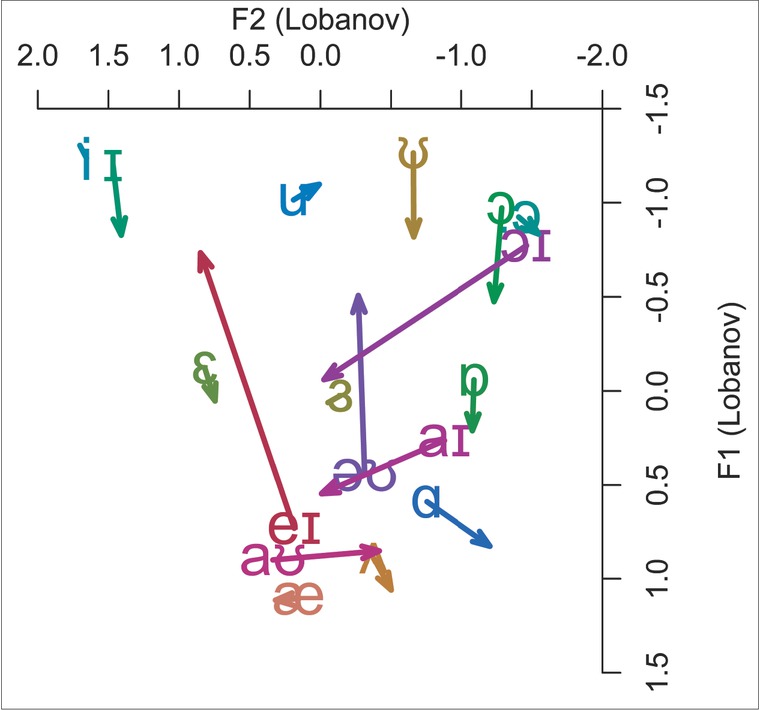
Fig. 1 is a vowel chart of the Debden monophthong system. In Debden, the Cockney vowel shift for monophthongs is more substantial in the back vowels compared to the front vowels (Fig. 1). The front vowels are not as shifted as previous accounts of Cockney. STRUT is not notably fronted, and TRAP and DRESS are not notably raised. In South East London, Tollfree (1999: 165-166) also found that these vowels were relatively lowered/backed compared to traditional accounts of Cockney. In contrast, there is greater evidence of Cockney vowel shift in the back vowels in Debden: BATH/START/PALM, LOT and THOUGHT/NORTH/ FORCE are raised. THOUGHT/NORTH/FORCE is a high back vowel that has a twoway distinction dependent on morpheme boundary and syllable structure (see Section 4.2). BATH/START/PALM is as high as STRUT, and unlike previous observations in Cockney is a backing diphthong (Fig. 2). LOT is as high as DRESS, and THOUGHT/NORTH/FORCE is as high as FOOT.
![Fig. 1 Vowels are labelled as they would be pronounced in RP. [ɔ] in purple represents THOUGHT/NORTH/FORCE preceding a coda-position consonant in a single morpheme. The vowel in all other positions is plotted in green. In bold are the average vowel productions across all speakers which are plotted at 50% for each vowel. Cockney vowel shift is present for the back vowels but not the front vowels. GOOSE and FOOT are fronted, THOUGHT and LOT are raised, but STRUT is not fronted, and TRAP and DRESS are not notably raised.](/document/doi/10.1515/dialect-2022-0005/asset/graphic/j_dialect-2022-0005_fig_001.jpg)
Vowels are labelled as they would be pronounced in RP. [ɔ] in purple represents THOUGHT/NORTH/FORCE preceding a coda-position consonant in a single morpheme. The vowel in all other positions is plotted in green. In bold are the average vowel productions across all speakers which are plotted at 50% for each vowel. Cockney vowel shift is present for the back vowels but not the front vowels. GOOSE and FOOT are fronted, THOUGHT and LOT are raised, but STRUT is not fronted, and TRAP and DRESS are not notably raised.
Vowel productions in Debden.
In addition, GOOSE and FOOT are substantially fronted; for instance, GOOSE is almost as front as TRAP and certainly cannot be feasibly described as a back vowel. Nonetheless, the presence of fronted GOOSE and FOOT in Debden is complex to interpret and is not necessarily indicative of the replication of a Cockney vowel system. In recent decades, GOOSE and FOOT fronting is widespread in much of South East England and beyond. However, the fronting apparent amongst this generation of speakers in Debden seems to predate more widespread regional fronting in the vowels.
In addition to a shifted monophthong system, these prementioned studies have evidenced a shifted diphthong system in Cockney. Cockney speakers have a fronted MOUTH vowel, PRICE has a backed and raised onset, GOAT has a lowered onset, FACE has a very open onset and CHOICE has a raised onset (though considered to be low by Wright [1981: 133] such that point may rhyme with pint). The fronted and somewhat raised onset of MOUTH and the backed and raised onset of PRICE can lead to a crossing of their trajectories which has been termed the “Cockney PRICE-MOUTH crossover” (Wells 1982: 310).
Fig. 2 is a vowel chart of speakers’ averaged monophthongs and diphthongs including their trajectories. In Debden, in line with most descriptions of Cockney, CHOICE has an onset which is substantially raised. In addition, FACE has a low onset which is almost as low as the MOUTH onset. GOOSE and FLEECE are not obviously diphthongised in this Figure 2, but this may be because values are averaged across speakers. In individual vowel systems (e.g., Figure 3) many speakers produce these vowels as diphthongs with centralised onsets. Nonetheless, much like FOOT and GOOSE fronting, FLEECE and GOOSE diphthongisation is widespread in the South East, but, once again, the existence and extent of this feature in Debden seems to predate the change observed across the region. Perhaps as a result of London’s consistent influence on south-eastern accents, these features have become widespread including in the pan-regional standard (see also Cole & Strycharczuk 2022).
formant plots of a female speaker from Debden with Cockney heritage who was born in the early 1950s.
However, much like the monophthong system, the diphthong system is not an exact replication of previous accounts of Cockney. Firstly, FACE is considerably fronter in this data than is reported in some but not all accounts of Cockney (cf. Wright 1981: 171 in which it has a fully fronted onset). In Debden, it is as front as both TRAP and MOUTH and is closer. In contrast, Labov’s (1994: 169) description of East Londoner Marie Colville’s vowel system in 1968 considers FACE backer than TRAP and overlapping with BATH/START/PALM. Secondly, though GOAT has a low onset in both Debden and traditional accounts of Cockney, there are discrepancies in its backness. GOAT does not have a backed onset in Debden, unlike in Labov’s (1994: 169) account of Cockney. However, Wright (1981: 128) and Hughes, Trudgill and Watt (2012: 76) present Cockney GOAT with a fronted onset. Similarly, Tollfree observed that amongst some young speakers in South East London, the onset for GOAT was not as backed or low as older speakers or alternate accounts of Cockney (Tollfree 1999: 167). In addition, Cockney MOUTH has been depicted with a higher and fronter nucleus than observed in this Debden data (e.g., Labov 1994: 169).
A final potential discrepancy between the Debden and Cockney diphthong systems is the trajectories of the MOUTH and PRICE vowels. Cockney MOUTH and PRICE are described as either monophthongal or with very short trajectories (Wells 1982: 306) whilst in Debden the glides appear comparatively longer. There was however a lexicalised monophthongal MOUTH vowel observed in our (and its derivations such as ours, ourselves), MOUTH was invariably produced as a fronted and fully open monophthong [aː] by all speakers. This variant was also particularly common in the word house and its inflections, particularly in the compound council house.
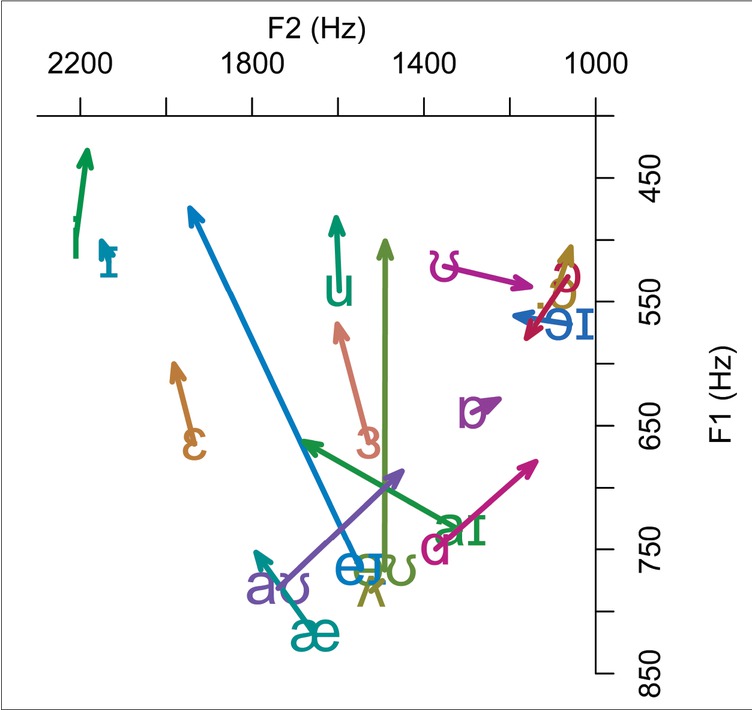
Interpreting the discrepancies in degree of monophthongisation for MOUTH and PRICE between Cockney and Debden is not straightforward. Firstly, PRICE and MOUTH in Debden do certainly have short trajectories relative to CHOICE and FACE, though they cannot be described as fully or even approaching monophthongal. It may be that in casual speech and not wordlist/passage readings, shorter trajectories would indeed be observed for these vowels. Secondly, there are inconsistencies and contradictions in previous accounts of these vowels in Cockney. Traditional accounts of Cockney describe MOUTH and PRICE as monophthongal, but also as having respectively fronted and backed onsets with crossing trajectories (PRICE-MOUTH crossover: Wells 1982: 310; c.f. Labov 1994: 169 who does not depict a cross in these vowels’ trajectories in Cockney). It is hard to align how monophthongs produced at opposite sides of the vocal tract can also have crossing trajectories. It may be worth noting that much previous data on Cockney has been based on auditory and not acoustic analysis. In terms of the PRICE-MOUTH crossover, the averaged trajectories do not cross in Debden. However, the cross in trajectories is found in several, but by no means a majority, of the individual vowel systems (see also Cole & Strycharczuk 2019). Figure 3 plots the vowel system of a female speaker in the sample who exhibits a traditional Cockney vowel system, including the PRICE-MOUTH crossover. The vowel system produced by this speaker, as well as many others in the sample, is an almost perfect replication of previous accounts of the Cockney vowel system.
This speaker has a traditional Cockney vowel system: GOAT and FACE are lowered, MOUTH is fronted, PRICE is backed (and crosses the trajectory of MOUTH), CHOICE is raised, GOOSE and FLEECE are diphthongal.
Fig. 2. Trajectories are plotted between 20% (onset) and 80% (offset) and are averaged across all speakers and all productions. Vowels are labelled as they would be pronounced in RP. [ɔ] in blue represents THOUGHT/NORTH/FORCE preceding a coda-position consonant in a single morpheme. The vowel in all other positions is plotted in green and is in a slightly fronter position. Cockney vowel shift is present in Debden: GOAT and FACE are lowered, MOUTH is fronted, PRICE is backed, CHOICE is raised.
Fig. 3. Trajectories are plotted between 20% (onset) and 80% (offset). Vowels are labelled as they would be pronounced in RP. [ɔ] in yellow represents THOUGHT/ NORTH/FORCE preceding a coda-position consonant in a single morpheme. The vowel in all other positions is plotted in red. This speaker has a traditional Cockney vowel system: GOAT and FACE are lowered, MOUTH is fronted, PRICE is backed (and crosses the trajectory of MOUTH), CHOICE is raised, GOOSE and FLEECE are diphthongal.
4.2 Thought/North/Force
In Debden, as reported in Cockney (Hughes, Trudgill & Watt 2012: 76; Wells 1982:310–311) and in South East London (Tollfree 1999: 167) THOUGHT/NORTH /FORCE has a distinction conditioned by morpheme boundary and syllable structure. For instance, when THOUGHT/NORTH/FORCE precedes a coda-position consonant in a single morpheme (board, port, form, lord) it is pronounced distinctly to when it occurs in all other positions (for, more, bored). Wells (1982: 311) reported the vowel as a raised monophthong in the former condition, and a diphthong with a lower onset in the latter condition. Tollfree (1999: 167) finds [oː] in the former condition and [ɔː] in the latter.
The THOUGHT/NORTH/FORCE split, henceforth here called the “board-bored rule”, is maintained in Debden and is also conditioned by both morpheme boundary and syllable structure. Nonetheless, though very similar, the productions are not identical to those reported in London by Wells or Tollfree (Table 1). Amongst these Debden speakers, when THOUGHT/NORTH/ FORCE precedes a coda-position consonant in a single morpheme it is [oː] as found in previous studies (Figure 2). In all other positions, the production is more variable, but tends to have a similar onset to the former condition but is often a lowering diphthong. The averaged trajectories of each of these vowels are plotted in Figure 2 and the productions of an individual speaker can be seen in Figure 3.
The board-bored rule split in London (Wells 1982: 311), specifically in South East London (from Tollfree, 1999: 167) and in Debden. In all locations, productions are conditioned by syllable structure and morpheme boundaries, but they are not identical.
| London | South East London | Debden | ||
|---|---|---|---|---|
| THOUGHT/NORTH/FORCE pre- ceding coda-position consonant in single morpheme. | Board, force, port, | oː | oː | oː |
| THOUGHT/NORTH/FORCE all other positions | Bored, four, pours, | ɔə | ɔː | oɔ |
4.3 GOAT
Much like in Cockney (Mott 2012: 78), in Debden, the unstressed GOAT vowel in words such as pillow, barrow, fellow, burrowed, narrow, tomato is produced as a schwa or an open vowel [ɐ]. This was variable within the community with the exception of some compound phrases such as window cleaner where the [ɐ] realisation was almost categorical.
4.4 LETTER/COMMA
In Debden, when schwa was in final position such as in lover, motor, brother it was produced with schwa or an open [ɐ] as has previously been reported in London (Fox 2015: 219; Tollfree 1999: 167; Wells 1982: 305; Wright 1981: 133). As a result, words such as pillar and pillow become homophonous (see Section 4.3 for the GOAT vowel in this positions).
4.5 CLOTH
Cockney previously had a distinction between CLOTH and LOT. CLOTH but not LOT could be produced as a raised vowel [oː]. Sivertsen (1960: 78–79) finds this realisation only in older generations in East London), and Wright (1981: 130) considers it to be a “great antiquity”. Beaken finds that older children may acquire [o:] forms but only in certain words, most notably off and gone (Beaken 1971). By 1982, Wells reports that the Cockney CLOTH vowel is almost invariably [ɒ] for most speakers.
Debden does not differ from this trend. CLOTH and LOT were merged. There were extremely limited instances of the traditional Cockney CLOTH vowel. The [o:] variant was found on rare occasion in occasional stylistic productions in words such as off and gone e.g., you’ll never guess what he’s gone [go:n] and done. One speaker told me that she did not believe she spoke “proper” Cockney like her parents or grandparents did. She rationalised this by explaining that she produced hospital as [ɒspɪto] (see Section 5.2.for L-vocalisation) and not [o:spɪto] like her older relatives. However, there was a lexicalised production of [o:] in god but only when it occurred in phrases such as oh my gawd, gawd blimey or gawd knows. This production is highly salient and can be considered a linguistic stereotype of Cockney that is often written orthographically as gawd. In Debden, people frequently refer to a “gawd blimey” accent which seems to be synonymous with a traditional Cockney accent. For instance, an older Debden speaker asked me if I would like to hear her “posh voice” or her “gawd blimey voice” (I requested the latter).
4.6 Schwa epenthesis
Schwa epenthesis is a feature which has previously been documented in Cockney (Wells 1982: 320). According to Wells, schwa epenthesis occurs between noninitial consonants and liquids such as lovely, Henry, umbrella. For instance, schwa epenthesis is evident in the Cockney song I’m Henery the eighth I am. As observed by Wells, the conditions of schwa epenthesis are not clear as there are many examples of words that apparently meet the conditions for epenthesis but are never subject to it such as sunrise and April (Wells 1982: 320). As a result, Wells suggests that schwa epenthesis may be a recessive historical relic.
In Debden, schwa epenthesis was not found. This was with the exception of the word Cockney which on very rare occasion could be stylistically produced Cockeney. In the word Cockney, schwa epenthesis occurs despite not meeting the conditions outlined by Wells. As schwa epenthesis is, in Labovian terms, a linguistic stereotype, it is perhaps not surprising that the last relic of Cockney schwa epenthesis is in the word Cockney itself.
5 Consonants
5.1 (ING)
The non-standard alveolar variant [n] of the variable (ING) is widespread in varieties of English including in Cockney (Hughes, Trudgill and Watt 2012:77; Mott 2012: 84; Wright 1981: 135). In Debden it has previous been demonstrated that (ING) operates differently for -thing words (something, nothing, anything, everything) compared to non-thing words e.g., morning, running (Cole 2021). For non-thing words the alveolar variant is strongly favoured by all ages and the variable is stable. For -thing words the standard velar is the favoured variant but there is apparent-time change towards the non-standard alveolar amongst young speakers. For participants in this present study, the velar variant is favoured for -thing words. There was additionally a third variant present: [-ɪŋk] as previously found in London (Schleef, Meyerhoff and Clark 2011; Wright 1981). This variant was heard frequently in Debden but was not the majority variant. The word something could be reduced to [sʌmɪŋk], [sʌɪŋk] or [sʌʔɪŋk].
5.2 L-vocalisation
When /l/ occurs in coda-position it is vocalised in Cockney (Mott 2012: 85–86; Wells 1982: 313–317; Wright 1981: 134). Though to a much lesser extent, L-vocalisation has long been observed in several other southern counties where it has diffused from London such as Essex, Surrey and Kent according to the Survey of English Dialects (Orton and Wakelin 1967). In Debden, as in Cockney, vocalisation is blocked in onset position (e.g., love, calling, believe). In Debden, vocalisation is approaching categorical when /l/ is in coda position, including complex codas, and precedes a consonant or a pause (milk, goal kick, wall#, bottle#). L-vocalisation was also possible, though to a much lesser extent, when in coda-position preceding a vowel. For instance, a speaker vocalised /l/ in the phrase all in a fight. Tollfree (1999: 174) also found instances of vocalisation in South East London when /l/ preceded a vowel but only amongst young speakers. In contrast, Wells stated that vocalisation is blocked in all intervocalic positions in Cockney.
In Debden, the quality of the vowel produced in place of /l/ depended on the preceding vowel and followed a similar distribution to that observed in Cockney (Mott 2012: 79; Wells 1982: 313–317). As a result of L-vocalisation, the following words could be homophonous:
now, nail and ‘nal’ as [næ:] or [næɤ]
heel and hill as [hɪɤ]
pool, paul, pull, ‘poil’ [po:]
doll and dole [daɤ]
Alternatively, when the FACE (nail, rail, sale), FLEECE (heel, peel, real) and CHOICE vowels (oil, boil, coil) preceded coda /l/, the production could be disyllabic. In these instances, productions could be FACE/FLEECE/CHOICE + [o]. For instance, nail, heel and coil could be [nʌɪ.o], [hɪi.o], and [koɪ.o] respectively. Compared to the productions outlined in (1), (2) and (3), these productions were more prevalent in less vernacular speakers. This process is, to my knowledge, previously undocumented in Cockney.
5.2.1 The GOAT split
Characteristic of Cockney is a split in the GOAT vowel when it is followed by /l/ (Roland-roller rule: Wells 1982: 312-313; as also found in South East London: Tollfree 1999: 167). The GOAT split is conditioned by L-vocalisation and morpheme boundaries. [ɒʊ] occurs when GOAT precedes coda-position /l/ (in the environment _lC and _l#) (roll, role, rolled). In all other environments the /l/ is not vocalised and resultingly the vowel is [ʌʊ] (rolling, roland). In Debden this contrast is maintained. However, whilst role/roll/rolled could never be [ʌʊ], it was very possible and frequent for rolling but not roland to be [ɒʊ]. These findings suggest that the pattern may be shifting: [ɒʊ] can indeed occur before clear /l/, but only when the /l/ precedes a morpheme boundary.
5.3 TH-fronting
TH-fronting refers to the production of /θ/ as [f] and /ð/ as [v]. TH-fronting is a feature of Cockney (Hughes, Trudgill and Watt 2012: 76; Tollfree 1999: 172; Wright 1981: 137) which has spread extensively throughout southern England and East Anglia. For instance, whilst the feature was previously completely absent in the East Anglian city of Norwich, it was present by 1983 (Trudgill 1999: 132).
Unsurprisingly, though not categorical, TH-fronting was very frequent in Debden. For the voiceless counterpart, fronting occurred in all positions (e.g., thing, authority, cloth). However, for the voiced counterpart, unlike Well’s (1982: 328) findings for Cockney, fronting cannot occur in onset position of stressed syllables such as that, although. In these positions, [ð] was the majority variant, but on occasion [d] was produced particularly in the words them, that, those (as in Cockney: Wright 1981: 137). On some instances, elision occurred in this position. This phenomenon has been previously reported in Cockney (Hughes, Trudgill & Watt 2012: 76) and is most likely a connected speech process.
5.4 H-dropping
H-dropping (or at least variability) is present in most urban centres across England and Wales (Hughes, Trudgill and Watt 2012: 66-7). These areas include East London (Wells 1982: 322; Wright 1981: 134), and towns in South East England (Reading and Milton Keynes: Williams and Kerswill 1999) but exclude much of East Anglia (Trudgill 1999: 133). H-dropping was frequently produced in Debden but, as noted in previous work (Cole 2021), rates are substantially higher in men than women. Hypercorrection of H-dropping (inserting /h/ where it would not be found in standard English) has previously been reported as a feature of Cockney (Wright 1981: 134). However, no instances of hypercorrection were observed in Debden, which may be as a result of increased rates of literacy and awareness of spelling conventions.
In Debden, H-dropping could lead to the presence of either intrusive-R or linking-R. For instance, intrusive-R refers to the process which occurs in many varieties of English including standard varieties, in which /r/ is inserted between a back or central non-high vowel /ɑ: ɔ: ə/ and a following vowel. In (1), as a result of L-vocalisation and H-dropping, schwa precedes a vowel and subsequently [ʋ] is inserted (see Section 5.7 and 5.2 respectively for [ɹ] productions and L-vocalisation).
I dunno what'll happen [wɒʔəʋæpən].
In this way, [ʋ] operates as an epenthetic consonant in Debden as a form of hiatus resolution. These findings chime with Wright’s work on Cockney. He suggests that /r/ is frequently inserted between vowels (Gerrahravit! ‘Get out of it!’) or even instances where T-glottalling would be expected (Itsgorralorravoles ‘It has got a lot of holes’) (Wright 1981: 139).
5.5 Yod deletion
Yod deletion refers to when /j/ is elided after a consonant. Yod deletion occurs in linguistically constrained environments in many parts of England such as after the alveolar sounds [t, d, n, s, z, l] in Cockney (Mott 2012: 86–87; Wells 1982: 330–331), but only in East Anglian can it occur in all linguistic environments such as in beautiful, few and human (Beal 2010: 18). Yod deletion was limited in Debden and was heard infrequently. This was with the exception of new (and its derivations) which seemed to represent a lexicalised pronunciation where yod deletion was almost categorical. As is widely found in many varieties of English, palatalization could occur in Debden, such that words like Tuesday were produced with [tʃ].
5.6 Glottal replacement
T-glottalling encompasses a range of different productions such as pre-glottalisation [ʔt] and glottal replacement [ʔ]. Glottal replacement (i.e. better becomes [bɛʔə] and bet becomes [bɛʔ]), is ubiquitous in many varieties of British English including in East London (Mott 2012; Sivertsen 1960: 199; Tollfree 1999; Wells 1982) where it originated independently of several other locations. Glottal replacement was abundant in Debden but did occur more frequently in some phonological contexts than others. Glottal replacement was most common when preceding another consonant such as that way, and least common in pre-vocalic position when preceding an unstressed syllable such as butter, water (see also Hughes, Trudgill and Watt 2012: 67).
Variable glottal reinforcement was also found for /p/ and /k/ as previously reported in London (Tollfree 1999: 170). Wright (1981: 136) suggests that in “broad-spoken Cockney” a glottal stop can be found in place of /p/ in words such as Clapham (Wright, 1981: 136). There was no evidence of glottal replacement for /p/ or /k/ in this phonological position in Debden. However, it could occur for /k/ but not /p/ in complex codas preceding unstressed syllables e.g., pack the bag. Resultingly, picture which could become homophonous or near-homophonous with pitcher.
5.7 [ɹ]
Like all of South East England and indeed, much beyond, the variety of English spoken in Debden is not rhotic. That is, /ɹ/ is not produced in its historical contexts such as car, farm with the exception of intrusive-R (i.e., when preceding a vowel: the car is). The loss of rhoticity in English can be traced back to eighteenth-century London English (Beal 2010: 15) before diffusing both geographically and socially. By 1550, rhoticity was hardly found amongst London speakers (Wright 1981: 135). Although some rare traces of rhoticity have been observed in southern England (e.g., older speakers in Milton Keynes and Reading: Williams & Kerswill 1999: 147), non-rhoticity is the wide-spread norm in the region. No instances of rhoticity were heard in Debden.
For prevocalic /ɹ/, the labio-dental approximant [ʋ] was widespread if not categorical in the speech of Debden speakers across all ages. This variant has previously been reported in London and is diffusing across England (see Foulkes & Docherty 2002). The labio-dental variant is increasingly used by young speakers in South East London (Tollfree 1999: 174), Milton Keynes and Reading (Williams & Kerswill 1999: 147), and Norwich where previously it was almost absent (Trudgill 1988).
6 Morpho-synctactic
6.1 Verbal {-s}
Siemund (2020) considers verbal {-s} as prone to more regional and social variation than perhaps any other feature in English. Non-standard verbal {-s} is often thought to have spread from northern varieties to the Midlands in the Middle English period (Wakelin 1977: 119) before progressing to southern England. In Debden, on some limited instances as in (1) and (2), verbal {-s} suffix occurred in non-standard contexts (i.e., contexts other than 3rd person singular) as previously found across South East England and London (Anderwald 2008: 450; Cheshire 1982: 31; Edwards 1993: 223; Wright 118).
They starts talking a bit carrot cruncher.
I got two mates comes in here.
6.2 Past tense of irregular verbs
As in many non-standard varieties of English (see Hughes, Trudgill & Watt 2012: 27–28 for an overview) including Cockney (Wright 1981: 119), for irregular verbs, the original past tense form (e.g., ran, lay, spoke and took) can be used for the past participle in Debden.
6.2.1 Come
The reverse phenomenon is found for come. As previously found in Cockney (Hughes, Trudgill and Watt 2012: 79) as well as many non-standard varieties of English, the past participle is used for the past tense form. As a result, come was the form used for the past, the present perfect and the present in Debden. The same process occurred with become.
(1) He went home lunchtime and come back.
6.2.2 Be
According to Britain (2002: 17), “virtually every vernacular variety of English appears to be variable with respect to past tense be”. The three main patterns are: (1) levelling to was; (2) levelling to were; (3) levelling to was in positive contexts but weren’t in negative contexts (see Beal 2010: 33; Siemund 2020. Though there have not previously been thorough accounts of past tense be in Cockney, the third pattern is found in the speech of adolescents in East London (Cheshire and Fox 2009) as well as other areas of southern (Cheshire 1982: 44). This pattern was also the norm in Debden.
Thought they was just a little bit better than you.
You was posh.
There was cafes everywhere.
[my school] weren't so bad.
That weren't just being a Cockney.
In addition, in Debden, as found in outer- but not inner-East London (Cheshire and Fox 2009) negative weren’t occurred frequently in the tag weren’t it/she/he/ they/you/I to refer to something in the past. In these contexts, there was often a reduction of weren’t to [wən] (see also wonn it? in Cockney [Wright 1981: 120]).
That was the mods and rockers thing, weren’t it?
I was a bit of a devil really, weren’t I?
6.2.3 Do
As found in many non-standard varieties of English, including in London (Hughes, Trudgill & Watt 2012: 79; Wright, 1981: 119) and South East England (Anderwald 2008: 445), the standard past participle done is used as the past tense form (did in the standard). This process occurs for the full verb but not the auxiliary.
We done that for years. For as long as I can remember
In addition, in the present tense, as found in many non-standard English varieties (Siemund 2020), and as almost categorical in the southern town of Reading (Cheshire 1982: 36), don’t was used as the third person singular replacing standard doesn’t.
Everyone don't really care if they pull out on you or slow you up.
6.2.4 Bring/buy levelling
The past participles and past tense verb forms of bring and buy are all neutralised to bought in Debden. There is no reference to this feature in previous accounts of Cockney as far as I am aware, but of course, this does not necessarily imply that it did not previously exist.
(1) Depends where you was bought up really like.
6.3 Negation
6.3.1 Negative concord
Negative concord (or multiple negation) refers to when more than one element in a phrase is negated. Negative concord is widespread in most urban varieties of English but Beal (2010: 34) considers it most characteristic of southern and not northern dialects. Negative concord has been previously documented in nonstandard varieties in South East England (Anderwald 2008: 453–454), Cockney (Wright 1981: 122) and MLE speakers in East London (Fox 2015: 224). The feature was frequently heard in Debden.
(1) You wouldn’t talk to no-one cos they’re all at it.
(2) Bit of training but no nothing.
However, as observed in Reading (Cheshire 1982: 64) negative concord was restricted in post-verbal indeterminates such as the following phrase:
(3) Nobody couldn’t come down here.
6.3.2 Ain’t
Ain’t is extremely widespread in English including in Cockney (Hughes, Trudgill and Watt 2012: 79; Wright, 1981: 120) and in Debden. Ain’t functions as a present tense negative form of copula and auxiliary be and auxiliary have (but not the full verb).
(1) You ain't got to move far out.
6.3.3 Init
Kortmann (2008: 491) lists the invariant tag init as a predominantly southern feature. Palacios Martínez (2015) found that amongst East London adolescents, init is an invariant tag. “Invariant” here means that init can follow subjects other than it (i.e., you/he/she/we/they) and can occur when the standard tag would be composed of have, do or a modal verb. The invariant tag init is often considered a recent linguistic feature in British Englishes which has emerged in adolescent speech in London as the influence of Caribbean English (see Andersen 2001: 168–179). Indeed, init as an invariant tag is well established in MLE (Fox 2015: 225–226).
Nonetheless, the existence of init in this sample of Debden speakers somewhat undermines these claims about the feature’s origins. Instead, init may be a feature of Cockney which has spread into other varieties. Wright (1981: 120) also reports innit and ennit as features of Cockney, but he does not comment on whether the tag is invariant with regards to subject agreement and corresponding verbs. In Debden, init is pronounced variably as [ɪnɪt] or [ɛnɪt] and can be invariant (i.e., can it occur in positions other than when the standard form would be isn’t it?).
It’s getting messed up a bit now, init.
Ridiculous amount of kids, init.
So, like, you know what it's like, init.
The existence of init among those born to Cockney families in Essex between 1944 and 1969 suggests that the feature predates the emergence of MLE. Init as an invariant tag may be a feature of Cockney. Nonetheless, it is worth noting that init could also be inflected such that was formed of [ɪnt]/[ɛnt] + you/he/she/it/we/ they/we (with h-deletion for he) (as also found to some extent in Reading: Cheshire 1982: 58). The /t/ could also variably be released, elided or produced as a glottal stop.
(1) Ai’t my game. I’m too old, in-I, like.
(2) We’ve moved on int-we.
(3) Got to live somewhere, int-ya.
6.3.4 Never
In Debden, as in Cockney (Wright 1981: 122), MLE (Fox 2015: 224), and across South East England (Anderwald 2008: 454455; Cheshire 1982: 67; Edwards 1993: 227), never can operate as a non-standard, past-tense sentential negator. In Debden, it can negate both “not on any occasion” and “not on a specific occasion”.
(1) Even though my dad was born in [area of East London] he never spoke like – sort of like he was from London.
6.4 Pronouns
6.4.1 Subject pronouns
In Debden, as in Cockney (Wright 1981: 116) and many other non-standard varieties, the object pronouns of standard English (me, her, him, it, us, them) can be used in place of the standard subject pronouns (I, she, he, it, we, they). In Debden, the standard subject pronouns are used in clauses where there is only one subject e.g., (1) and (2). If a clause has more than one subject, the object pronouns are used for all subjects e.g. (3) and (4).
I went there.
She went there.
Me and her went there.
Me, her and John went there.
6.4.2 Relative pronouns
Kortmann (2008: 491) lists the relative pronoun what as a distinctively southern feature. The feature is characteristic of Cockney (Wright, 1981: 116–117), but its usage is now negligible amongst adolescents in East London (Fox, 2015: 225). The feature was common in Debden along with the standard relative pronouns, and additionally, the relative pronoun could be omitted (as seen in in example (2) of 6.1.).
6.4.3 Reflexive pronouns
In line with previous findings in south-eastern varieties (Anderwald 2008: 443; Cheshire 1982: 79; Edwards 1993: 230) and Cockney (Wright 1981: 117), the reflexive pronouns system is regularised in Debden. The third-person masculine hisself and particularly the plural theirself/theirselves were common, but not categorical.
(1) They would consider theirself as that.
6.4.4 Possessive pronouns
-n could be used to form the absolute genetitive forms of the possessive pronouns ours, yours, hers and theirs which could become ourn, yourn, hern and theirn. This was extremely rare in the data but was heard on occasion. There was no single instance of hisn produced in place of standard his. This is unlike Wright’s (1981: 117) account of Cockney where -n could form all possessive pronouns. As highlighted by Wright (1981: 117), the feature was criticised as early as 1817 as an “error of pronunciation” amongst London speakers.
6.4.5 My
Previous research has documented in southern dialects the “use of me for my” (Edwards 1993: 230, see also Anderwald, 2008: 442; Siemund 2020). However, I suggest an alternative: me is not used as a possessive pronoun, instead my can be pronounced as either [miː] or [mɪ]. This is not equitable with the object pronoun being used as a possessive pronoun, instead, it seems to be a matter of pronunciation. Indeed, there were no instances of the object pronoun me being pronounced as [mɪ].
For my, [miː] seemed to occur exclusively before a vowel and [mɪ] occurred before a consonant. This result is based on observations and notes made while transcribing the data, and more detailed quantitative analysis is required to confirm this. This process is likely a form of hiatus resolution, such that the epenthetic consonant [j] can occur between vowels as in my Aunt [miːj ɑːnʔ].
(1) My [mɪ] cousin [name redacted], my [miː] Aunt [name redacted], my [mɪ] mum’s sister lived there.
6.5 Adverbs
As is widespread in many varieties of English (Hughes, Trudgill & Watt 2012: 33) including non-standard south-eastern varieties (Edwards 1993: 231) and Cockney (Wright 1981: 121), adjectives can be used as adverbial forms such that the {-ly} morpheme is not present.
6.6 Demonstratives
As found in many non-standard varieties including in much of South East England (Anderwald 2008: 444; Cheshire 1982: 78), and Cockney (see Edwards 1993: 232; Wright, 1981: 117), them is used as a determiner before a plural noun in place of standard those.
Where them big black gates are.
Because back in them days it was a lot safer as well for children.
6.7 Absense of preposition to
The preposition to could on some instances be absent after both go and come in their various verb forms (as also found in MLE: Fox 2015: 226).
You went [school name], didn’t you?
6.8 Comparatives and superlatives
Double marking comparatives (e.g., more quicker) and superlatives (e.g., most quickest) is so widespread in English it is best considered non-standard than regional (Beal 2010: 49). A simultaneous use of these two forms for marking comparatives was variably present in the Debden speakers. There was no evidence of the same phenomenon for superlatives.
7 Conclusion
This paper has detailed the English spoken by the first generation to grow up in Debden, a community in Essex populated by East Londoners after World War II. There are overwhelming similarities between previous accounts of Cockney and the dialect spoken in Debden. However, it is worth noting that there are also some minor discrepancies. For instance, though the Roland-roller rule and the boardbored rule are attested in both Cockney and Debden, productions are similar but not identical. In addition, yod deletion is not as extensive as expected in Debden, and glottal replacement is not observed for /p/. Moreover, although a shifted vowel system is observed in Debden, the short front vowels are lower than anticipated, FACE and GOAT are fronter, MOUTH is lower and along with PRICE, has a longer trajectory.
Nonetheless, there are also inconsistencies between different accounts of East London/Cockney dialects. For instance, Wells (1982), Tollfree (1999) and Mott (2012) do not entirely align on their descriptions of East London/Cockney vowel systems or THOUGHT/NORTH/FORCE productions. The vowel productions observed in Debden differ to several accounts of Cockney but are very similar to previous observations in South East London amongst those who did not relocate to Essex (Tollfree 1999). Comparisons between Debden and Cockney are complicated because there is not one single, intransient yardstick in the sand that we can considered “Cockney”. “Cockney” likely represents several subtly different dialects spoken in East London which have been in a perpetual state of change. Resultingly, it is unsurprising that there is not complete unanimity in linguistic descriptions of Cockney. Therefore, subtle differences between the dialect spoken in Debden and any single account of Cockney is not sufficient to refute the claim that Cockney has moved to Essex. Similarly, the absence or rarity of several “Cockney” dialect features – schwa epenthesis, CLOTH/LOT split, -n possessive pronouns – in Debden is also not in opposition to the claim that Cockney is spoken in Debden. As we have seen, these features have been considered by dialectologists or sociolinguists to be dying out or to be historical relics of Cockney for several decades. The discrepancies between some previous accounts of Cockney and the dialect spoken in Debden, including the vowel system, is certainly encapsulated within the natural range of linguistic variation and change within Cockney. In fact, these discrepancies are less substantial than the linguistic variation between some previous accounts of “Cockney” in East London.
On the whole, there are remarkable consistencies between the dialect spoken in Debden and previous accounts of Cockney. These similarities far surpass the Cockney influences observed in other areas of the South East (e.g., Przedlacka, 2002). The most notable similarities between Cockney and Debden are: a shifted vowel system, [ɐ] for LETTER/COMMA and GOAT vowel in some positions; boardbored rule; L-vocalisation and its effect on preceding vowel quality; GOAT split; [n] variant of (ING); TH-fronting/stopping; H-dropping; glottal replacement/reinforcement; labiodental /ɹ/; verbal {-s} over-generalisation; past tense form for past participle (including done for did); come as past tense form; levelling to was in positive contexts but weren’t in negatives; negative concord; prevalence of ain’t, never and init; object pronouns in standard subject pronoun positions; what or zero relative pronouns; reflexive pronouns hisself and theirselves; -n occasionally forming possessive pronouns; nonstandard production of my; adjectives in adverbial positions; and them for those. In addition, some Cockney features have been extended such as L-vocalisation which is possible in intervocalic position in Debden unlike in many accounts of Cockney.
This paper has also highlighted several non-standard linguistic features that have not previously been documented in Cockney: the variable pronunciations of my as [mi] or [mɪ] dependent on the following linguistic environment; bring/buy levelling in past tense and the past participle forms; init as an invariant tag as well as its secondary contractions (e.g. int-she; int-I). Given the widescale similarities between Debden and accounts of Cockney, it is most likely that these features are indeed features of Cockney but have not been previously investigated or observed.
In sum, there are remarkable similarities at several linguistic levels between the dialect spoken by the first generation to grow up in Debden and accounts of Cockney. Conclusively it can be determined that Cockney did move to Essex along with the communities who relocated.
References
Andersen, Gisle. 2001. Pragmatic markers and sociolinguistic variation: A relevance - theoretic approach to the language of adolescents. Amsterdam and Philadelphia: John Benjamins.10.1075/pbns.84Suche in Google Scholar
Anderwald, Lieselotte. 2008. The varieties of English spoken in the Southeast of England: Morphology and syntax. In: Varieties of English: The British Isles, 175–195, eds. Bernd Kortmann & Clive Upton. Berlin: De Gruyter Mouton.10.1515/9783110208399.2.440Suche in Google Scholar
Beaken, Michael A. 1971. A study of phonological development in a primary school population of East London. Ph.D. Dissertation. University of London.Suche in Google Scholar
Beal, Joan C. 2010. Introduction to Regional Englishes. Edinburgh University Press.10.1515/9780748629374Suche in Google Scholar
Cheshire, Jenny. 1982. Variation in an English dialect: A sociolinguistic study. Cambridge: Cambridge University Press.Suche in Google Scholar
Cheshire, Jenny & Sue Fox. 2009. Was/were variation: A perspective from London. Language Variation and Change 21: 1–38.10.1017/S0954394509000015Suche in Google Scholar
Cheshire, Jenny, Sue Fox, Paul Kerswill & Eivind Torgersen. 2008. Ethnicity, friendship network and social practices as the motor of dialect change: Linguistic innovation in London. Sociolinguistica 22: 1–23.10.1515/9783484605299.1Suche in Google Scholar
Cole, Amanda 2021. Co-variation, style and social meaning: the implicational relationship between (H) and (ING) in Debden, Essex. Language Variation and Change 32: 349–371.10.1017/S0954394520000162Suche in Google Scholar
Cole, Amanda & Bronwen Evans. 2020. Phonetic variation and change in the Cockney Diaspora: the role of gender and identity. Language in Society 50: 641–665.10.1017/S0047404520000640Suche in Google Scholar
Cole, Amanda & Patrycja Strycharczuk. 2019. The PRICE-MOUTH crossover in the “Cockney diaspora”. In Proceedings of the 19th International Congress of Phonetic Sciences (ICPhS2019). Dynamics of Vowels in Varieties of English Workshop, 602–606. Melbourne: International Phonetic Association.Suche in Google Scholar
Cole, Amanda & Patrycja Strycharczuk. 2022. Dialect levelling and Cockney diphthong shift reversal in South East England: the case of the Debden Estate. English Language and Linguistics. FirstView article.10.1017/S1360674321000290Suche in Google Scholar
Edwards, Viv. 1993. The grammar of southern British English. In Real English: the grammar of English dialects in the British Isles, 214–238, eds James Milroy & Lesley Milroy. Routledge. Abingdon & New York: Routledge.Suche in Google Scholar
Foulkes, Paul & Gerard J. Docherty. 2000. Another chapter in the story of /r/: ʻLabiodental’ variants in British English. Journal of Sociolinguistics 4: 30–59.10.1111/1467-9481.00102Suche in Google Scholar
Fox, Susan. 2015. The New Cockney: New Ethnicities and Adolescent Speech in the Traditional East End of London. London: Palgrave Macmillan.Suche in Google Scholar
Hughes, Arthur, Peter Trudgill & Dominic Watt. 2012. English accents and dialects: An introduction to social and regional varieties of English in the British Isles (5th ed.). London: Routledge.10.4324/9780203784440Suche in Google Scholar
Kerswill, Paul & Ann Williams. 2000. Creating a new town koine: children and language change in Milton Keynes. Language in Society 29: 65–115.10.1017/S0047404500001020Suche in Google Scholar
Kortmann, Bernd. 2008. Synopsis: morphological and syntactic variation in the British Isles. In Varieties of English 1: The British Isles, 478–495, eds. Bernd Kortmann & Clive Upton. Berlin: Mouton de Gruyter.10.1515/9783110208399.2.478Suche in Google Scholar
Labov, William. 1994. Principles of linguistic change 1: Internal factors. Malden: Blackwell.Suche in Google Scholar
Max Planck Institute for Psycholinguistics. 2019. ELAN (Version 5.4). Nijmegen: Max Planck Institute for Psycholinguistics.Suche in Google Scholar
McCloy, Daniel. 2016. phonR: Tools for phoneticians and phonologists (R package version 1.0-7). https://cran.r-project.org/web/packages/phonR/phonR.pdf (acc. May 13, 2022).Suche in Google Scholar
Mott, Brian. 2012. Traditional Cockney and popular London speech. Dialectologia 9: 69–94.10.18485/philologia.2011.9.9.1Suche in Google Scholar
Orton, Harold & Martyn F. Wakelin. 1967. The Survey of English dialects 4: The Southern Counties. Leeds: Arnold.Suche in Google Scholar
Palacios Martínez, Ignacio M. 2015. Variation, development and pragmatic uses of innit in the language of British adults and teenagers. English Language and Linguistics 19: 383–405.10.1017/S1360674314000288Suche in Google Scholar
Powell, William R. 1956. Loughton. In A history of the County of Essex 4: Ongar Hundred, 110–128. British History Online. http://www.british-history.ac.uk/vch/essex/vol4/pp110-114 (acc. August 19, 2021) . http://www.british-history.ac.uk/vch/essex/vol4/pp110-114 [acc. 19/8/2021]Suche in Google Scholar
Przedlacka, Joanna. 2002. Estuary English? A sociophonetic study of teenage speech in the Home Counties. Frankfurt am Main: Peter Lang.Suche in Google Scholar
R Core Team. 2018. R: A language and environment for statistical computing. R Foundation for Statistical Computing. Vienna. URL: https://www.R-project.org/Suche in Google Scholar
Rosenfelder, Ingrid, Josef Fruehwald, Keelan Evanini, Scott Seyfarth, Kyle Gorman, Hilary Prichard, & Jiahong Yuan. 2014. FAVE (Forced Alignment and Vowel Extraction) https://github.com/JoFrhwld/FAVE (acc. May 13, 2022).Suche in Google Scholar
Schleef, Erik, Miriam Meyerhoff & Lynn Clark. 2011. Teenagers’ acquisition of variation: A comparison of locally-born and migrant teens’ realisation of English (ING) in Edinburgh and London. English World-Wide 32: 206–236.10.1075/eww.32.2.04schSuche in Google Scholar
Siemund, Peter. 2019. Regional varieties of English: non-standard grammatical features. In: Oxford Handbook of English Grammar, 605–629, eds. Bas Aarts, Jill Bowie & Gergana Popova. Oxford: Oxford University Press.10.1093/oxfordhb/9780198755104.013.29Suche in Google Scholar
Sivertsen, Eva. 1960. Cockney Phonology. Oslo: Oslo University Press.Suche in Google Scholar
Tollfree, Laura. 1999. South East London English: discrete versus continuous modelling. In Urban voices. Accent studies in the British Isles, 163–184, eds. Paul Foulkes & Gerard Docherty. London: Arnold.Suche in Google Scholar
Trudgill, Peter. 1988. Norwich revisited: recent linguistic changes in an English urban dialect. English World- Wide 9: 34-49.10.1075/eww.9.1.03truSuche in Google Scholar
Trudgill, Peter. 1999. Norwich: endogenous and exogenous linguistic change. In Urban voices, Accent studies in the British Isles, 124–140, eds. Paul Foulkes & Gerard Docherty. London: Arnold.Suche in Google Scholar
Trudgill, Peter. 2008. The dialect of East Anglia: phonology. In: Varieties of English 1: The British Isles, 278–193, eds. Bernd Kortmann & Clive Upton. Berlin: Mouton de Gruyter.10.1515/9783110208399.1.178Suche in Google Scholar
Trudgill, Peter. Elizabeth Gordon, Gillian Lewis & Margaret Maclagan. 2000. The role of drift in the formation of native-speaker southern hemisphere Englishes: Some New Zealand evidence. Diachronica 17: 111–138.10.1075/dia.17.1.06truSuche in Google Scholar
Wakelin, Martyn F. 1977 (Rev. ed.). English dialects: An introduction. Burns & Oates. London: The Athlone Press, University of London.Suche in Google Scholar
Wells, John C. 1982. Accents of English 2. The British Isles. Cambridge: Cambridge University Press.10.1017/CBO9780511611759Suche in Google Scholar
Williams, Ann & Paul Kerswill. 1999. Dialect levelling: Change and continuity in Milton Keynes, Reading and Hull. In Urban voices, Accent studies in the British Isles, 141–162, eds. Paul Foulkes & Gerard Docherty. London: Arnold.Suche in Google Scholar
Wright, Peter. 1981. Cockney Dialect & Slang. Great Britain: BT Batsford Limited.Suche in Google Scholar
© 2022 Walter de Gruyter GmbH, Berlin/Boston
This work is licensed under the Creative Commons Attribution 4.0 International License.
Artikel in diesem Heft
- Frontmatter
- Artikel – Articles – Articulos
- Deutschsprachige Regionalpresse im Ausland. Fallstudie am Beispiel der „Batschkaer Spuren“
- The North Ukrainian dialect of Vyšneve in the East Slavic context: towards a final description
- Strategies for establishing discourse coherence. The case of Slovene dialectal discourse
- Real time and memory time of “father”. Social and linguistic motivation observed in Glottograms
- Cockney moved East: the dialect of the first generation of East Londoners raised in Essex
- Hispanic-American dialectology in the 16th century. Penetration of Americanisms in Nicolas Monardes’ Historia Medicinal
- Postposed topic specification across the Sahara. An areal phenomenon
- Luxemburger Wirtshausnamen
- Besprechungen – Comptes rendus – Reseñas – Reviews
- Besprechungen – Comptes rendus – Reseñas – Reviews
Artikel in diesem Heft
- Frontmatter
- Artikel – Articles – Articulos
- Deutschsprachige Regionalpresse im Ausland. Fallstudie am Beispiel der „Batschkaer Spuren“
- The North Ukrainian dialect of Vyšneve in the East Slavic context: towards a final description
- Strategies for establishing discourse coherence. The case of Slovene dialectal discourse
- Real time and memory time of “father”. Social and linguistic motivation observed in Glottograms
- Cockney moved East: the dialect of the first generation of East Londoners raised in Essex
- Hispanic-American dialectology in the 16th century. Penetration of Americanisms in Nicolas Monardes’ Historia Medicinal
- Postposed topic specification across the Sahara. An areal phenomenon
- Luxemburger Wirtshausnamen
- Besprechungen – Comptes rendus – Reseñas – Reviews
- Besprechungen – Comptes rendus – Reseñas – Reviews
