Conceptualizing Russian Food in Emigration: Foodways in Culture Maintenance and Adaptation
-
Ekaterina Protassova
 and
Maria Yelenevskaya
and
Maria Yelenevskaya

Abstract
Food preparation and consumption is an essential part of culture. Leaving their homeland and finding themselves in a society with eating habits different from theirs, migrants face a dilemma of adapting their diets to those customary in their new place of residence or trying to maintain their food habits. Relying on the ethnographic method and applying thematic and critical discourse analyses, this article explores how Russian-speaking migrants discuss changes in their foodways and what role Russian food stores play in the life of immigrant communities. Material for analyses was drawn from fieldwork conducted in Finland, Germany, Israel, and Switzerland. It includes in-depth interviews, immigrants’ essays, and group discussions. We also studied culinary discussion groups on Facebook and documented linguistic landscape related to food consumption in the diaspora. Among the salient themes in the discourse dealing with eating habits abroad are food nostalgia, trying out familiar recipes with new products, evaluating traditional dishes of the host society, and re-evaluating Russian cuisine, searching for the right food in the new country and trying to showcase the best of one’s own cooking to other people. Immigrants’ discourse about food and the labels on the food products available in “Russian” stores outside Russia reveal frequent use of paroemias and quotations and allusions to Soviet and post-Soviet popular culture. Russian-speaking immigrants’ reflections about their old and new foodways reveal that they are an integral part of search for a new hybrid self-identity.
Introduction
This article is devoted to eating habits and food talk in the Russian-language diaspora. Our goal is twofold: to show that attachment to the foodways of the home country is an essential part of migrants’ culture maintenance; the other one is to demonstrate that food discourse in the diaspora reflects adaptation processes and gradual hybridization of cultural practices of the newcomers. We chose this topic because of its pervasiveness in different modalities: oral talk, multimedia, and written documents. Another reason is that people’s perception of food and their eating habits change under stress (Steptoe; Popovic-Lipovac and Strasser). Migration is a stressful situation, in particular, if it is motivated by push rather than pull factors, which is the case for all waves of Russian emigration. Finally, food talk is a good source for analyzing how language use changes in the diaspora. We are particularly interested in the interconnection of everyday practices with language, culture, and the sense of belonging (Erikson).
One can hardly name a topic which is more cross-cultural, transnational, and intrinsic to human behavior than food. It has a high communication value and is suitable as a gambit to break the ice when strangers meet. Around the globe, we find that names of foods and their forms are among the first words learned by toddlers. Food discourse is related to cultivating plants and breeding animals; it covers buying, preserving, preparing, consuming, and enjoying food. Food vocabulary is vital for a variety of genres, such as menus, advertising, recipes, and restaurant reviews. Numerous food metaphors tell us about the nature of life in different societies and testify to numerous socio-economic changes that have occurred over time thanks to technological developments (Rogova). While in poor societies people are preoccupied with obtaining amounts of food sufficient for survival, in affluent ones, the quality of food, menus suitable for children, seniors, weight watchers, and people suffering from health problems are more frequent.
In rich countries, different styles of food consumption are subject to fashions and are often discussed in the media, including Russian-speaking media outside Russia. Despite being omnivorous, some people turn into vegetarians or vegans, while others try to model their nutrition following celebrities’ diets and rituals (Huynh and Olsen; Peterson). Culinary TV programs are popular in many countries, enabling viewers to learn from famous chefs. In Russia, a popular culinary show Smuck [savor] was run for many years by the rock musician Andrey Makarevich who shared his own recipes and invited other stars of the show business to show off theirs. When the program was canceled on TV, Makarevich licensed and moved it to YouTube. When he immigrated to Israel, it came to be shown on the Russian-language TV channel “Nine Plus,” expanding the repertoire of dishes to the cuisine of European Jews.
Today, many cities offer culinary tours introducing participants to local specialties. Guidebooks include chapters on local foods and describe gastronomic experiences awaiting tourists. All these sources provide rich material for linguo-anthropological analysis (e.g., Stöckl). Moreover, symbolic functions of food names and discussions about their role in the history of mankind have evolved into a critical foodway analysis in literary studies (Ceisel). In their turn, linguists often investigate the functions of food metaphors and paroemias in narratives and everyday speech.
Traditional systems of nutrition tend to change in the aftermath of mass migrations, both for immigrants and for members of host societies. Other factors affecting popular interest in food are the increasing internationalization of food consumption, and our contemporaries’ wish to have new impressions on an everyday basis (cf. Panayi). Due to the pervasiveness and diversity of food-related topics, the number of conversational analysis studies focusing on talk about healthy and ecologically safe foods, dietary principles, stories about exotic meals, table talk, and other related subjects is growing (Dürrschmid; Rozin and Rozin; Szatrowski).
Food is related to senses and also to social norms, emotions, and, in effect, to the identity formation (Parasecoli; Ward and Simner). The first home of a person is often associated with emotional comfort and one’s favorite dishes. Connotations and collocations of dishes’ nomenclature display social variables. In popular parlance of the Russian-speaking people, some of the ethnicities are associated with their favorite foods: the Uzbeks are known for their attachment to pilaf which is derided in ethnic jokes; a prototypical Belorussian cannot live without potatoes, and Italians are sometimes referred to as makaronniki [spaghetti eaters], a jocular and slightly pejorative epithet. A similar case is the naming of different immigrant groups by using food names. Thus, in the 1990s, the Russian-speaking immigrants to Israel were sometimes referred to as kolbasnaya alia [a sausage immigration wave], implying that ex-Soviets were not motivated by Zionism but escaped the economy of shortages in their home country. After the Russian annexation of the Crimea in 2014, when the West imposed sanctions against Russia, immigrants from Russia came to be dubbed syrnaya alia [cheese immigration wave] since imported cheeses became expensive and difficult to get in Russia. The war in Ukraine made many Ukrainians, as well as Russians, emigrate to Israel. It was enough for just one newcomer to ask in a Facebook group where one could get pumpkin latte in Israel, when this exotic drink came to become a metonymy for the entire group.
Food discourse reveals a wide spectrum of human pleasure and disgust connected to smells, appearance, and taste of different foods. This is the sphere of cognition and recognition elaborated in the course of multiple experiences. If the structure of cuisines is a cross-linguistic argument for the specificity of the culinary meta-language (Jurafsky; Vainio et al.), then migrating foodways of our contemporaries provide important information about the nature of our adaptation to new surroundings. Moreover, conversations about foods and eating habits add to our understanding of how migrants integrate into their host societies both physically and spiritually. At the same time, they reveal the salience of childhood memories about food for diasporic culture maintenance.
Culture maintenance in migration is closely related to the preservation of festive traditions, and their essential part is cooking specific dishes for different holidays. Even among the secular, cooking and eating these dishes is akin to rituals (Fialkova and Yelenevskaya, 161–165). Foods for festivities and also for funerals differ from everyday menus. In many countries, food is also season-dependent (Von Bremzen). Culture is omnipresent in the linguistic descriptions of food preparation and consumption (Kittler et al.). Nutritional habits reflect the interplay between identities and duties, traditions and trendiness, as well as inter- and out-group assessment. Moreover, historical origins of dishes together with their fluctuating names tell us about migrations of peoples and their linguistic and cultural contacts.
In the process of resettling, those who have moved to a distant country with a different climate often have to get used to nutritional habits markedly different from those in their home countries. Opening up to new ingredients and recipes, as well as adopting popular dishes of host societies, is an essential part of integration. Picking up ingredients for culinary purposes, utilizing leftovers, preparing food at home using precisely ordered ingredients, and other new habits are often discussed in societies on the move (Laakso; Mäkelä and Niva). Notably, if immigrants want to present their culture and traditions to members of the majority, they usually cook and play their ethnic music.
In this article, we consider some typical themes of the Russian-speaking immigrant foodways, like familiar recipes under new circumstances, nostalgic feelings connected with food and festivities, understanding of the variability of foodways, and using culinary to connect with people.
Material and Method
Material for this study was drawn from a variety of sources. We used fragments devoted to food and eating habits from over 50 biographic in-depth interviews which we conducted in Finland, Germany, Israel, the USA, and Switzerland. We organized 13 group discussions and asked 12 immigrants to Finland to write essays. We monitored Facebook groups in which participants exchanged recipes and shared their culinary experiences in their host countries and during trips. As immigrants ourselves, we analyzed changes that have occurred in the nutrition of our families, cooking styles, and attitudes to food since we left Russia. We also kept ethnographic diaries, making notes of table talk, our friends’ conversations about their changing eating habits, and chats overhead in “Russian” food stores in Finland, Germany, Israel, and the USA. We also collected over 200 photos of signs in “Russian” food stores and restaurants in the countries in which we conducted fieldwork. All the material for analysis is in Russian and translating the unedited excerpts quoted in the article we tried to preserve the style and mannerisms of the original.
So, our data are multimodal and may seem to be eclectic, but the ethnographic approach which we chose as our methodology welcomes the collection of different types of data and application of different research strategies in order to discover salient patterns and themes, but also locating absences and irregularities (Brewer, Dutta, 72). We were guided by the objective to understand the social meanings of food and food talk of the diasporans which involved participation in discussions, informal conversations, and joint preparation of food with our participants. The participatory style of our fieldwork assured us that the data we collected were grounded in the participants’ experiences. We do not intend to speak on behalf of our participants, but it is important for us to make their voices audible. We also used our interviews, and face-to-face and Facebook discussions to create and fine-tune our analytical approach and framework (Okely).
In our analytical work, we relied on thematic analysis, viewing themes as patterns of shared meaning supported or united by a core concept or statement. The key themes chosen for analysis are a result of repeated work with the data involving comparisons, inclusion, and exclusion of motifs. Thematic analysis helps us understand how individuals make meaning of their experience; it also shows how the broader social context impacts these meanings (Braun and Clarke). We also relied on critical discourse studies, perceiving discourse as social practice, which implies a dialectical relationship between a particular discursive event and the situations, institutions, and social structures which frame it. The social context is vital for the ethnographic approach, thematic analysis, and critical discourse studies. According to the pioneers of critical discourse analysis, Fairclough and Wodak, “Discourse is socially constitutive as well as socially conditioned – it constitutes situations, objects of knowledge and the social identities of and relationships between people and groups of people.” What is important for us in this project is that discourse helps sustain and reproduce the social status quo between groups and it can also contribute to transforming it. Diasporans discussing their foodway may be unwittingly participating in the juxtaposing their ingroup to host societies, their old eating habits to the new ones influenced by the habits of the majority, and in effect the culture of their homeland to the culture of the host society.
What is Russian in the Russian Cuisine?
When Russian speakers find themselves abroad, whether thanks to tourism or due to migration, they are surprised to see that many dishes they thought to be Russian are similar to the traditional cuisine of other peoples. This discovery perplexes people who are used to the Soviet and post-Soviet propaganda persuading the Russian public that their motherland is unique in all domains. So, reflections on typical Russian dishes and the difference between the food of the host country and the food familiar from childhood are frequent topics of the diasporic discourse.
In the interviews we conducted in Finland and Germany, we asked about the most important component of the Russian culture, and a typical response was “food”: P.N. “Food always comes to mind when I answer this question, and it is important to say what is different abroad.” Reflecting on their foodways, immigrants discuss related concepts trying to make sense of what ethnic cuisine is[1]:
GS: Russian cuisine. But what is it? We have bliny, but they are everywhere. Only if they are eaten with caviar or salted fish…
VK: Pelmeni, manty [Russian and Turkic words for “ravioli”], plov [pilaf] – but they are all Soviet, one may even say, Asian.
MK: What is purely Russian? Pirozhki [small pies] and bliny.
Bliny was one of the most frequently mentioned dishes (after borshch, which was mentioned as both Russian and Ukrainian), although there is no real specificity in their preparation, and the recipes are varied. Other opinions given were “Schchi da kasha pishcha nasha” [an old saying: cabbage soup and cooked cereals are our staples], “Salad Olivier [a dish known to the international consumer as the “Russian salad”].” “Cooked cereals are important!” Some participants believe semolina is the most hated food in the Russian culture, but it happens to be a favorite in Finland. Buckwheat is uncommon as a garnish in Finland, although it is known as flour. In most Western countries, buckwheat was seldom included in the diet; only today when healthy grains are all the rage, it is gradually becoming accepted; but in Russia, it is viewed as an indispensable part of a good menu. This is what one of our interviewees living in Switzerland said:
OT: In terms of everyday life, our home is still Russian. It is not that I make Olivier salad all the time or something of the kind, but we buy buckwheat all the time.
Interviewer: Sure. How would we live without buckwheat! (Both laugh).
OT: Yes. We have buckwheat, and borshch, too. Sometimes. Once a month.
Interviewer: The trouble is that buckwheat is not roasted.
OT: Oh, no. We have Turkish buckwheat. It’s very good.
Interviewer: In the supermarkets it’s not what we are used to.
OT: Sure, it’s green there. I only buy it from the Turks. But then it turns out that it is brought from somewhere else, from as far away as Kazakhstan.
Note that foods were among the first things that determined the Russian lifestyle for our interviewee, although later she says that she is not into culinary. The popularity of buckwheat may have increased in the late Soviet decades when it was in short supply after Nikita Khruschev’s ill-advised decision to replace staple grains with corn.
The following excerpt from a Facebook post of a Russian-speaking émigré in Britain tells us how difficult it is to create a common ground for a discussion about favorite foods with members of the host society, and what kind of effort it takes to do this:
YK: The other day I had to explain about the Russian cuisine. Mostly about kefir and cooked cereals. Even in our god-forsaken corner they now sell Polish kefir not only in specialized supermarkets, but also in Sainsbury’s. <…> The situation with grains is like this: they sell buckwheat even in Midlands at many stores, and exotic food lovers and other vegans buy it. The British find it hard to believe me when I tell them about the role of buckwheat in the life of Russian people, because [for them] it is like burgers made of tofu and quinoa! Sort of, this is not for everybody. That is, they make a face: “Really?! How very interesting!”, which, if you translate it from British, means: “Come on, stop lying!” Things with semolina and rice are better: they sell them everywhere and they are widely used in puddings and baking. So, you explain that you can make semolina porridge and put lots of jam on top. And in response the British will say: “Sounds like something little kids might enjoy”. This is what I explain about cooked rice: So, you have rice pudding. It’s similar, but without raisins and you don’t bake it. The only thing that is totally alien for the British is cooked millet. Do you eat this budgie food because you lack normal products?” [reproduced with permission]
Descriptions of how members of host societies respond to Russian favorite foods are frequent and are often full of humor, but also suggest the motif of superiority in the attitude to different “others.” Wives in mixed families tell stories of how their foreign husbands were first shocked by unusual combinations of foods, but gradually came to like their wives’ additions to their family menus. There is hardly a description in which buckwheat and dairies are not mentioned.
Fermented milk products often puzzle Russian-speaking newcomers and are a never-ending source of discussions in immigrants’ chat groups. Indeed, they differ from country to country. Smetana (thick sour cream) rules Russian cuisine as it is an indispensable ingredient for a variety of dishes. Russian-speaking immigrants write on the Internet-forums that they try to replace smetana with different other products, such as Finnish kermaviili, German Schmand, Armenian matzoon, French crème fraîche, Greek yogurt, Israeli shamenet, and English curd. Rarely anything can match rjazhenka or varenec, i.e., baked milk that underwent lactic acid fermentation – a unique and much-loved drink in the Russian-speaking world. Here is what a Finnish participant reported, which was confirmed by several others:
AX: We use Estonian smetana, we buy it in an Estonian store, and there, it is cheaper: in Kalinka [a popular store with ‘Russian’ products] it costs 1 euro 70 cents per half a kilo. There are two Estonian stores nearby, we also buy there. If we cannot buy there, we buy Estonian Deliciest, we can do it in ‘Ko’ and in “Es” [abbreviations of Finnish commercial chains]. We eat smetana with tvorog and with borshch. Not with Finnish tvorog maitorahka [quark, cottage cheese in Finnish], they sell German tvorog in the S-market, it should be 1 euro 19. Of course, my grandmother made it herself or bought it at the market, and it was different.
Many émigrés complain that among the foods they miss most is tvorog, a Russian version of quark, but which is drier and firmer than a quark. One can find it in Israel, both in the stores owned by Russian-speaking émigrés and in supermarkets. Immigrants report that recently, a product under the original name written in Cyrillic came to be produced in France and is quite similar to the original version. A Facebook blogger from Sweden proudly announced that she had managed to find a way to get the “right” product: tvorog is easy to make if you put 1 kg of Greek yogurt into a microwave oven for 15 min, and then, let it rest in a sieve until it becomes dense. This was followed by dozens of various other suggestions of how to make the much-loved dairy product at home and numerous recipes of syrniki (crêpes made of tvorog).
All participants admitted that their everyday culture and eating habits had changed after emigration. The problem of hybridization of culinary habits in the Russian cuisine was known to American Russians from the beginning of their settlement in the USA (e.g., Smith, 824). According to Caldwell (143), the Korean–Russian immigrants in South Korea complain about the food they encounter in their regained country of ethnic origin. They started growing vegetables for themselves, and when traveling back to Russia, they bring suitcases full of their favorite foods to satisfy their needs. Culinary habits are an essential part of migrants’ adaptation to a new country and a search for a new identity (cf. Agyeman and Giacalone; DuPuis et al.; Gabaccia; Wallach).
Some of the participants remarked that the Russian culinary culture is not just the things you swallow, but how food is served, how people sit around the table, how they communicate during a meal, and the way and the order in which they eat specific dishes (e.g., Bernstein: 7, 16–17). Many families have brought with them dinner and tea services, silverware, tablecloths, and objects of Russian crafts like gzhel’ and khokhloma. These are sometimes put on display and are used to serve festive meals in order to create a nostalgic “Russian atmosphere.”
In the post-Soviet period, internationally popular foods entered the Russian food market and led to borrowings and new word coinages, but also triggered errors and misspellings in the culinary linguistic repertoire (Perotto; Protassova, “Russkoe Pole”). Another post-Soviet trend was inventing literary loaded names of dishes alluding to old folkloric Russia, nineteenth-century Russia, or to the Soviet times (Rozanova et al.). While in the Soviet times talk about food was often devoted to the triumphs of getting hold of foods that had disappeared from grocery stores and inventing new recipes that could ingeniously replace ingredients that were v defitsite [in short supply] by simpler ones, in the new millennium an improved situation on the food market contributed to the emergence of a new manner of speaking about gastronomic delights.
The notion of “Russian food” differs from generation to generation. Descendants of the White émigrés still partly preserve the practice based on the pre-revolutionary cuisine, although adapted to modern ingredients (Protassova, “Kulinarnye Predpochtenija…”). In Finland, they cook beef tongue with horseradish and make vinegret (a salad consisting of boiled beets and potatoes mixed with peas, raw onions, and pickled cucumbers), which also entered the Finnish Christmas cuisine, although without potatoes. Another loanword in Finnish is the name of the Easter dish paskha (creamy and spiced cottage cheese with candied fruit). The Finnish version, pasha, pronounced as “pasa” deviates from the Russian normative paskha and dialectal paska. The latter would be hardly acceptable, as it is an interlingual homonym with the Finnish “shit.” White-émigré descendants eat herring (salted is preferred, while the default Finnish version is sweetish). Borshch, in which pickled beets are used, is eaten with pieces of sausages, and rassol’nik (soup with kidneys, pearl barley, and pickled cucumbers) is not as thick as in Russian recipes. In Russia, the cabbage pie has dough on top while in Finland the cabbage filling is left exposed and is decorated with mayonnaise. Vatrushka, a sweet pie with tvorog filling, is usually round and small while in Finland it is big and rectangular.
Different generations favor dishes, which were ranked as delicacies in their childhood and youth (Protassova, “Russian-Speaking Women Abroad…”). Some like deep-fried meat pies widely considered unhealthy in the West; others prefer honey pies deemed too sweet by weight watchers. Memories of tasty meals are connected to places, people, and circumstances. Therefore, immigrants’ nutrition styles vary, depending on the number of years lived abroad, but also on the year of emigration. Other factors influencing their menus are contacts with the local cuisine, which is considerably stronger in mixed than in all-immigrant households. Other factors are the degree of acquaintance with the fine versus everyday cuisine and the extent of exposure to the customs of the host society, including festive mores, seasonal dishes, and others. The overall influence of other food impressions (e.g., visits abroad) is also crucial.
In their famous book “Russian Cuisine in Exile,” Vail and Genis write:
“The threads that tie a man to his homeland are many and varied: a rich culture, a mighty people, a glorious history. But the strongest threads stretch from the homeland to the soul. These are not mere threads but more like ropes, Manila ropes. You can argue about culture, ethnicity, and history until morning, but can there really be a controversy about dried fish?” (Vail and Genis: xi)
Enumerating foods and drinks most popular among the Russian-speaking émigrés of the 1970s and 1980s, they come to the conclusion that menus composed of these products helped overcome difficulties in a foreign country and make life more joyful (ibid.: xii). Russian food was also among the markers of the Russian culture for representatives of the “White emigration” who left their home country in the upheaval of the October revolution and the Civil War. Morozoff and Goncharoff chocolates in Japan (Figure 1), merengue-based dessert Pavlova with its country-specific variants, the tea brands Wissotzky (since 1849) in Israel, Kusmi (since 1867, from Kousmichoff) in France, and Sergejeff (since 1873) in Finland are such examples. A case in point is the poet Larissa Andersen who was born in Khabarovsk and lived in China, Korea, Japan, India, Vietnam, and other countries. She died in France aged over 100. She wrote “I thought Russia was books. Everything we learned by heart. As well as borshch, pancakes, pie, and gingerbread. And quiet songs, and gentle sadness” (Alexander-Garrett). Russian cuisine was dear to many hearts in exile.

There were Russian food businesses created by Russian immigrants after 1918, like chocolate production in Japan (picture courtesy of Maria Kirichenko).
Transformative Food Habits in the Immigrant Homes
Buying, processing, and consuming food produced and sold in the host countries facilitates immigrants’ integration, but when newcomers do not speak the language of the host country, choosing the needed products may be not at all simple. Is the price indicated on a tag per kilogram or per packet? What is the distinction between dozens of jars with dairies? Why do vegetables and fruit that look glossy cost much less than those that are ill-shapen and blemished? How can one distinguish between chicken schnitzels and their imitation made of corn? Years after migration, some of our participants remember the confusion and shame they experienced in the supermarkets. Used to being literate and able to read any sign, they initially felt helpless and wasted too much time shopping. But these difficulties encouraged immigrants to learn new words. Bright pictures on the packages intended to attract customers often serve as picture dictionaries for new immigrants and facilitate acquisition of vocabulary of the language of the majority. No wonder that food names are among the first ones learned by immigrants in local languages. Veterans of the Russian-speaking communities share their knowledge of the local foods and their names with the greenhorns. Thus, a popular Israeli Facebook group “Tasty Cuisine (Israel)” (108,035 members) features a glossary of Israeli food products (facebook.com/groups/1293611817410389/permalink/2698752500229640, retrieved 14 November 2022). Posted in 2020, it received 515 likes, 449 comments, and was shared 81 times, although it is far from being comprehensive. The author formulates her goal as follows:
YM: Let’s compile a glossary which will be useful for those who live in Israel, but also for those who live in the CIS countries. It is for those who have come here only recently and also for those who came a long time ago. It is for those who are planning to come here and for those who are not but like to eat well. I remember how 30 years ago when we repatriated I felt lost in the supermarket because there were so many unknown names, and there was nobody to ask. That’s why for some time I would buy gvina levana [white cheese] instead of sour cream.
Besides the names of different foods, the glossary gives their description, potential use in cooking, and their names in the Hebrew script. The commentators take the task further by adding many items which do not appear in the featured text, posting photographs of the labels, and comparing some products with their closest “relatives” in the Russian/Soviet cuisine. Some users argue with the author of the glossary, but the majority are grateful:
NL: What a great job, what a post!!! Great respect and huge thanks to you! I have just arrived here, and I have so many questions!))) And I couldn’t understand first, why cottage)))
PO: Thanks for such great tips. It helps a lot. I remember that when I arrived here it took me a long time to figure out things about fermented-milk products. I was looking for lactose-free milk and couldn’t find it, but then it turned out there were even two different brands available.[2]
In the era of globalization, the knowledge of how to translate food vocabulary is important and is becoming a subject of research itself. In Finland, e.g., teaching Russian is often accompanied by lessons on the Russian cuisine. Moreover, a dictionary of food terms was compiled (Räsänen); however, translations are not always congruent with the views of an average Russian speaker living in Finland, as it often happens when individual oral verbalizations are confronted by rules of normalization. Older generations of Russian speakers in the diaspora, those who grew up and matured in the USSR, remember the ice cream prices of their youth, as well as wine and vodka prices. In fact, competing in who remembers the price of every single food product in specific periods of Soviet history turns into an amusing game at parties or during group interviews.
Facebook discussions about foods eaten away from the home country attract dozens of participants. Some admit that only thanks to an opportunity to taste other peoples’ cuisines they started thinking about differences in tastes and interconnections between food traditions and cultural specificity of tastes. Here are excerpts of a discussion that reveal immigrants’ reflective attitudes to new foods and their appreciation of acquiring new culinary experiences and tastes (retrieved 27 May 2023):
SL: Before moving to Spain, I didn’t like cheese. I didn’t see it as food but as an insult. Among the regional foods I like Galician best. Everything there reminds me of my childhood in my granny’s home in Ukraine. <…> I like fried eggs with potatoes and onions (tortilla con patata). It is served as an appetizer (tapa) almost in any bar. <…> And also rice with saffran mixed with sausage, meat and sea food. It’s very tasty. There are things I got used to and I like them: Spanish cheese, sausages, lentils, Spanish toasts with tomatoes, fried squids, etc. But there are also things I haven’t got used to. And it’s normal. I don’t have to mimic everything. After all, I am not Spanish. My tastes have changed in Spain, or Spain has changed my tastes. I like how they use spices here. I like hamon [Spanish “ham”] with melon and pâté with jam.
MG: Well, I don’t really like the combination of meat, etc. with “sweet” spices in the Arabic, Persian and Indian cuisine.
OZ: In Slovenia, they always serve fish with ground garlic… This seems weird to me)))
LK: I love saffron, I never cook rice without saffron, and of course I also put it into soups. Meat with cinnamon, that’s a bit weird))) And curry is great.
DB: In the past 12 years I have lived in different countries, including Europe, Asia and the Middle East. And I borrowed tastes and spices from each of the new countries. Now I cannot even determine the style of the dishes I cook—a Tartar pilaf with Arabic spices, a Thai salad with Chinese ingredients, Indian dhal together with rabbit Maltese style… My latest discovery was Palermo cuisine with its Moroccan influence: peanuts, pepper, cinnamon. Coriander and mint (in a meat dish!) is a very unusual combination.
YA: And I like everything to be very simple, without refinements.
DB: It’s wonderful that we are all so different.
Chats in Facebook food lovers’ groups are often triggered by provocative posts which go far beyond recipes, but raise questions of why people emigrate, how they perceive host societies and their culture, how to cope with nostalgia, what the attitude of the local population to Russians is and others. A case in point is a post in the group “What shall we cook for dinner” https://www.facebook.com/groups/gotovim.uzhin. The group is public with over 1.3 million members living in Russia and in the diaspora. One of the active members living in Guinea published a text accompanied by pictures (retrieved 20 May 2023):
AP: The most popular breakfast here is americano and half a baguette with mayonnaise or margarine (0.1€). But if you have 0.6€, you can afford bread with an omelet. The recipe is complicated, and it is important not to miss any details. Whisk ONE egg with 1/3 of a middle-size onion. In the picture you can see that the client paid as much as 0.7€ because he asked to have a tomato added and they generously threw into his omelet ¼ of a tiny little tomato. Now let’s take butter and separate it from the remaining pieces of previously cooked omelets. The butter has to be brown—this is important. If the color is not intense enough, simply use it to fry fish. Now that our butter is ready, let’s pour it into a frying pan. Not much, no more than half a pan, but no less than one third. When the butter starts smoking, pour the egg with the onion into the pan. It will immediately start rising and swelling. Keep frying until it gets gold-colored. An important detail—gold-color has to be brown. Now cut half of your baguette lengthwise and spread mayonnaise lavishly. Put a lot of mayonnaise, otherwise your sandwich won’t be tender enough, since you put so little butter. <…> There is no reason to economize on yourself, is there? Voila, our tasty and healthy breakfast is ready. Enjoy your meal!
Within 5 h, the post accumulated 246 “likes” and 114 comments and was shared twice. Some commentators discerned the author’s irony and responded in a matching style:
KF: I hope all the protagonists of this story have survived [I hope] their livers haven’t crashed and they haven’t fallen victim to salmonella and all sorts of dysenteria.
OD: Hmm. Tomorrow morning I’ll saturate my body with cholesterol. I feel I really want such an exotic breakfast. No joking, I might even cook it right now.
Some others were shocked and even scolded the author for her lack of compassion and derision of other people’s eating habits:
MPP: How terrible!
LR: I feel sorry for everyone; for the local inhabitants and for you, since for some reason you have to live in an atmosphere so unpleasant for you and amongst alien culinary habits. It is all very sad.
IN: One can feel your sarcasm and displeasure with the local cuisine in your recipe. Just like in your previous posts. Yes, people don’t eat like this when their life is jolly. This is sad. But after all, no one dragged and forced you to move to that country. I live in France now. Some of the dishes cooked here are rather strange, and not everyone eats well. But it wouldn’t occur to me to write about it… It’s not very nice you know […]
The author of the post assured her audience that there was no need to worry about her because nobody forced her to stay in Africa, and she likes the people surrounding her. In fact, some of the participants residing in various parts of Africa revealed that to their own surprise they had become attached to the continent, and food is also a factor.
Commentators ask each other where they live and work, and exchange remarks about the benefits and risks of living away from the homeland. Those who work in Africa, India, and Indonesia admit that they are afraid of eating street food and in local eateries because they do not trust their hygiene. There seems to be a consensus among the commentators that tasting new dishes is safer when you cook them yourself. In general, in this and similar threads, you can see two conflicting attitudes to the food of “the other” – openness and curiosity:
DT: A., please keep posting your photo reports. It is so interesting to learn how people live in different countries. Good luck to you!
AG: It’s very interesting to have a glimpse of different corners of the world!
or caution and suspicion:
SO: Doesn’t your subconscious alarm you, “don’t eat it, otherwise you’ll turn into a little goat”? After all you are throwing God-knows-what into your own dear stomach.
In the last remark, SO alludes to a Russian folk tale in which an elder sister is imploring her little brother not to drink water from a puddle. The brother did not obey and, indeed, turned into a kid. Popular reading for little children; this tale may still cultivate mistrust of unknown foods and drinks among our contemporaries. As Kabakova remarks, in the East-Slavic cultures, some foods and some ways of preparing dishes are forbidden (e.g., meat of some animals). These taboos are not related to the fear to violate Christian beliefs but to some other principles and prejudices rooted in folk traditions. An example of such customs is a habit of taking an emptied bottle off the table, saying that the dead body, called mertviak in Moscow and zhmurik in St. Petersburg, should be removed.
The language of the posts and comments in these discussion threads is worthy of attention. We often come across foreign names of foods and kitchen equipment (e.g., baguette, americano, tapa, and tortilla). Some of these insertions are given in English, French, Spanish, or German (Zwiebelschnitzel, “Well done нe пoлyчитcя” [Well done won’t work], “видeлa peцeпт в slowcooker” [I saw a recipe in a slow cooker]; others appear in Cyrillic (фyaгpa [foie gras], кpeм шapлoтт [charlotte cream]) and with Russian affixes, which testifies to the integration of these words into the Russian language ( za kheit it [they will hate], za kholesterin’ us’ [I’ll saturate my body with cholesterol], iz slais a svezhego ogurtsa [from a slice of a fresh cucumber]).
Since participants live in different countries, one can find discussions about regional names of foods. Although the language of communication is Russian, some comments are in Ukrainian (e.g., dobre scho vchasno pochitali! [good that you have read it on time]), or with elements of the South Russian and Ukrainian pronunciation imitated in writing, e.g., sho instead of chto. Notably, these insertions do not trigger hostile responses, which, unfortunately, often occurs today when Russian and Ukrainian chat-group participants interact. On some occasions, participants appeal to the folk wisdom, quoting proverbs, e.g., na vkus i tsvet tovarischei net [everyone to his own taste], vidit oko, da zub neimet [there’s many a slip twixt cup and lip].
Historically, in many cultures, including Russian, cooks at home were women, and cooks in restaurants were men. The theme of who has the skills and authoritative knowledge of how to cook is closely connected to family life and changing roles of the household members. Mothers and grandmothers are usually associated with the warmth of the kitchen, relaxed atmosphere, and sensory pleasure, as are their specialties. Holm et al. insist that in Scandinavia and Finland, women cook less, and men cook more. The division is more evident between ethnic traditions in mixed families. When husbands belong to the majority culture, they are more knowledgeable as to what foods are suitable on what occasions and for what purpose. At the same time, many respondents mention that in their families of origin, men had their specialties, primarily dishes for festive occasions. The less Russian cuisine is part of the family repertoire, the more men are involved in the process.
New culinary practices mark the beginning of a second, post-migration life, which is represented in experience narratives side by side with memories of pre-emigration experiences. People associate their previous eating experiences with family meals and important events in their families. Homemade food from their childhood is part of nostalgia for the past, and narratives about it revitalize migrants’ previous identities. Like other types of nostalgia, food nostalgia is deeply social. It increases interconnectedness and self-positivity and facilitates coping with the present and hoping for a better future (Sedikides et al.). No wonder then that talk about dishes familiar from childhood is so frequent in immigrant groups. Migrants may be more likely than others to seek out nostalgic experiences via food in order to oppose feelings of threat, loneliness, and discomfort (cf. Green et al.).
Interrelations between culture, bilingualism, and cognition are common (De Groot; Grosjean), yet food practices are seldom discussed in this respect. Today, mixing cultures, including food cultures, is becoming a habit in many families (West et al.). Sometimes, openness to new tastes is deliberate and is seen as trendy. At the same time, globalization has made fusion cooking so pervasive that we are not even aware of where some of our favorite dishes come from. The fusion of different traditions is studied in diverse domains and proves that multilingual persons perceive and name the world differently than monolinguals.
Reflections Around Food
The following excerpt from an essay of an immigrant of the 1990s shows that even those who left Russia as teenagers are familiar with the “Soviet culinary classics”:
AS: I came to Finland as a teenager, aged 12, and the school canteen formed my views of the Finnish cuisine, and culinary lessons in particular. We lived in a small, yet wealthy town, where school food was generously sponsored, children ate tasty things, and menus were diverse. In my everyday life, I cook predominantly Finnish dishes; nevertheless, if I think more deeply, their analogies can be found in the menus of the people in Russia, like meatballs and burgers. During feasts, we serve Soviet classics (Olivier and herring under the fur coat [a layered herring salad with finely chopped potatoes, beets, carrots, onions and hard-boiled eggs richly seasoned with mayonnaise]) adapted to local products. I also draw [recipes] from the Internet, and then, it’s international cuisine. I like Finnish food: it is not too sophisticated, and it does not take too much time to cook. I also think that Finnish dishes are less fat than traditional Russian ones, but, frankly, I actually never make traditional dishes.
For many Russian-speakers, homemade food symbolizes quality. In Soviet times, restaurants and cafeterias were rather few and could not accommodate everyone who wished to eat out. Moreover, in the absence of competition and due to frequent food shortages restaurants could not boast high quality or sophistication. No wonder then that these institutions were often ridiculed in movies and satire. Today, Russia’s food market abounds in eateries of different styles, offering various ethnic cuisines and cooking styles, so new immigrants sometimes miss the diversity of foods they could enjoy back in Russia. The following quotations are excerpts from the essays:
OK: If I need any ingredients that are not available in an ordinary store here, I buy them in an Estonian store. I don’t buy ready-made Finnish meals, because I am not accustomed to their taste, and I don’t like them. Especially mayonnaise and salads made with it. I don’t buy Finnish cakes either. I try to bake myself or, in case of emergency, I can buy something in the Estonian store.
KM: I cook the same things as in Russia. Food products taste a bit different. In the course of time, I learned to trust the quality of Finnish food and became satisfied. I can cook everything. I added some items of the Finnish cuisine [to my repertoire]: Karelian pies, salmon soup, sausage soup, puree soups, shchi [cabbage soup] with cream, potatoes baked with salmon and cream ([Fin.] laatikko), Finnish herring (marinated differently). As a rule, we do not buy ready-made meals, sometimes sandwiches if we are suddenly hungry when we are in town, ([Fin.] kolmioleipä), smoked or baked and cut beef, grilled chicken, this may happen. We usually cook at home or go to restaurants.
BA: Still today I buy Estonian smetana [sour cream]; in the first period after arrival, I missed it tremendously, because I didn’t know that “Estonian” stores existed. I also buy mayonnaise, unsalted butter, and sometimes sgushchjonka [Rus., condensed milk]. I borrowed pancakes with spinach from the Finnish cuisine:) I do not buy ready-made meals! Only baked buns from Lidl:)
ES: I miss tvorog and fish. White fish is not accessible here; one can buy it only as frozen blocks or it is very, very expensive. Among Finnish culinary recipes, I make siskonmakkarakeito, lohikeito [Fin. sausage soup, salmon soup; in the original essay written with spelling mistakes], different cream dressings. Sometimes I only buy different lattiko [Fin. casserole; written with spelling mistakes] and Karelian pies.
LP: We borrowed peruna latiko, makaroni latiko [Fin. potato/macaroni casserole; written with spelling mistakes].
MO: It [my cooking], is sort of half and half [Russian and Finnish]. The Russian culinary practice has changed. However, we always experimented back in Russia, we did it with soups and salads. Now, we try to do something new with stews.
After migration, traditional dishes undergo various changes, because some of the ingredients are either nowhere to find or taste different. That is why some participants complain that bread does not taste like bread, fish is not the same as at home, and even water taste is not the same, so your tea does not taste like the tea you are used to. That is why immigrants often discuss ways to replace foods they miss or where to buy products that taste like those left in their country of origin.
Food inspires imagination and creativity. Very few people remain neutral in evaluating it. The materiality of food does not concern only its physical characteristics (whether appealing to human senses or disturbing them), but also packaging and inscriptions. Seeing a familiar picture or a word in one’s mother tongue on a jar or can in an otherwise alien world may be a reminder of partially forgotten events of one’s childhood and may trigger a synesthetic reaction in the body and soul. Language contributes to conceptualizing and formulating what is a living tradition. It helps us understand why and what sort of people are searching to nourish their wholeness.
Food is perhaps one of the most stimulating thematic fields in which individuals feel themselves without usual restrictions when they talk to interviewers belonging to their in-group. When speaking to members of the host society the strategy may change and acceptance of the local cuisine is perceived as proof of loyalty to the dominant culture of the welcoming societies. Talking to members of the in-group immigrants often resort to exaggeration of the differences between “our” and “their” foods appearing to be more demanding than the average consumer.
YU: No riazhenka, no tasty tvorog, bread is not always tasty either (it has also deteriorated in Russia), no ice cream of the right taste (too sweet, and in Russia as well); generally speaking, the taste of all food products is different (no tasty tomatoes, cucumbers are rarely tasty, the apples are different). Maybe only beetroot, swede, carrots, potatoes, pumpkins and onions are good.
KF: First, I was against all Finnish sausages, both small and big [Rus. sardel’ki, sosiski], now, I have changed my mind. I am afraid that Finns eat too many sweets, always, everybody, everywhere. Before coming to Finland, I never ate that many sweet things, everything changed here:). Altogether, I like Finnish food, especially bread and cheeses.
EG: The salted butter is not always right!!! You absolutely cannot make custard for cakes with it!!!
PL: White bread remains fresh for too long, so I prefer Estonian white bread. Mayonnaise, salads, etc., are all wrong, so is salami. Dairy and meat products fit my taste.
As mentioned earlier, different generations have different attitudes toward foodways, and their narratives reveal diverse habits of preparing and eating food. For the younger participants, food remains the strongest cultural bond within the family. Conceptualization of the self goes through what a person consumes and how the food is prepared. Critique of the welcoming society is most evident in the descriptions of the “strange” food that one has to eat outside the home. The Estonian food stores and Estonian culinary culture combine many traditions and serve all needs of the diverse Russian-speaking community. Parents and grandparents are associated with specific dishes that form the family culinary repertoire. The culinary practices have symbolic meaning, intensifying in the situation of migration: it is the memory of food and food of memory. School and friends have certain influence on the habits. Traditions of feasts differ on different occasions (some are Russian or ours, some are Finnish or hybrid). Indeed, the cultural mixture is already a fact. In most cases, rationalism and tolerance prevail.
Food becomes a strong component of identity when the wholeness of the self is disturbed and endangered by contact with other groups, in particular when these groups are more numerous and powerful. And this is why in immigration the tendency of human beings to mark their membership in a culture or a group by asserting the specificity of what they eat and defining the difference of others (Fischler, 278) comes out stronger than in other contexts.
“Russian” Food Stores in the Diaspora: Their Economic and Symbolic Value
Food nostalgia (Reid et al.) is a sentiment that arises when we reminisce about or long for certain foods from our past. It is a powerful emotional connection to the flavors, smells, and experiences associated with specific dishes or meals that we enjoyed during our childhood or significant periods of our lives. Food nostalgia is often triggered by familiar tastes and aromas that evoke memories and emotions. It can be influenced by cultural and regional cuisines, family recipes, favorite snacks, holiday meals, or even specific restaurants or food establishments. For immigrants, it is a way to connect with their personal history and find comfort in the familiar. The nostalgic food experiences often have the power to transport humans back in time and evoke a sense of warmth, happiness, and a longing for “simpler” and happier times. Food companies and restaurants often tap into food nostalgia by reintroducing or reimagining classic recipes and flavors from the past. This approach allows them to capitalize on the emotional connection people have with certain foods, sparking interest and a desire to relive those cherished culinary moments. Although food nostalgia is a deeply personal and universal experience, it also helps to indulge in the past and find comfort in the familiar flavors of yesteryear.
Food nostalgia is often mentioned in immigrants’ narratives, and this explains the popularity of “Russian food stores” selling goods imported from places as diverse as Baltic States and Moldova, Georgia, and Kazakhstan, Ukraine and Siberia, Poland, and Czech Republic. While political relations between Russia and some FSU countries are complicated and marked by conflict, “Russian” food stores continue flourishing. Moreover, despite the ongoing war in Ukraine and anti-Russian sanctions, one can still see goods imported from Russia in them. It is not common, but our ethnographic diaries give examples of people avoiding goods of “the enemy.” Thus, one of us witnessed a customer refusing to buy chocolate bars despite a discount, because they were made in the factory of a “chocolate hair,” a derisive nickname of the former president of Ukraine, Petr Poroshenko. The war in Ukraine has created a rift between émigrés from Russia and Ukraine in many diasporic communities, which is manifested in different ways, including consumption patterns (Figure 2).

Antiwar sentiments in the diaspora are expressed in a multitude of ways. An Israeli company producing pel’meni paraphrased the pacifist slogan of the American counterculture of the 1960s: “Make love not war” turning it into “Make pelmeni not war” (photo courtesy of Varvara Preter).
“Russian” food stores, such as the European chain Mix Markt launched in Germany, have become an integral part of the economic market throughout Europe. Émigrés nourish their feelings and nostalgias with their favorite products such as birch-tree juice, sparkling wine, still called “Soviet Champagne,” chocolate Alionka, Baltika beer, sushki (small dry bagels), and canned food (cf. Gronow). According to Richter (“Baltika statt Beck’s.”), the five top-sold products in these stores are sunflower seeds, chocolates imported from Moscow, black tea, buckwheat, and vodka. This list almost coincides with the results of our fieldwork. Talking about their favorite foods, Russian speakers often repeat the slogan used by food producers in different countries: The taste we’ve known since our childhood. In fact, food nostalgia is an integral part of missing the homeland and idealizing one’s childhood and youth. This is how an émigré living in Italy describes the opening of a Russian–Ukrainian store in Bologna:
MM: My soul suffering from nostalgia waited for this event. I missed eggplant mousse. I tasted kvass [fermented beverage made from rye bread], which I hadn’t drunk for five years. I drank it from a bottle in the car, and I am not ashamed of this. Italians reacted in an interesting way. How can you explain the difference between kefir and rjazhenka? My Italian boyfriend liked tvorog and pickled cucumbers made our style. And tortellini russi, which means pelmeni.
Development of IT contributed to the transnational nature of Russian-language economies. Relying primarily on informal contacts, businesspeople launch projects that involve people residing in Russia and CIS countries and diasporans in different corners of the world. Among these projects are the delivery of familiar foods and objects of ethnic crafts to the “Russian stores” and conducting festivals and “weeks of Russian cuisine” which were held in Paris, Luxemburg, Ankara, and other cities. There are also numerous culinary master classes. Some of them are held in restaurants and culinary studios, but since the beginning of the pandemic, many of these events have been carried out online, involving ever bigger audiences. Culinary master classes target professionals and amateurs and teach Russian cuisine, as well as French, Italian, Japanese, Indian, and other Asian cuisines (e.g., tamaki.ru/master-classes, courseburg.ru/onlayn_master_klass_klassika_francuzskoy_kuhni-c6072-l0.html, relax.com.ua/master-class/italian-cuisine,[3] retrieved 15 November 2022). After the Russian war in Ukraine started, culinary classes of Ukrainian and Russian borshch received new followers (svoboda.org/a/31936500.html).
Besides the diversity of geographic origin of goods, Russian stores display a diversity of languages. While price tags are usually in Russian and in the local language, labels demonstrate a much bigger variety, covering the whole territory of the former Soviet Union, as well as countries of Eastern Europe. Chiaro and Rossato point out that descriptions of food form the core of our identity travel across languages and cultures. The body of translations regarding culinary practices is growing, and phenomena related to eating are omnipresent. Notably, in many countries, almost all labels on edible goods are multilingual. However, Lemivaara-Khoudoikulova showed that in Tajikistan, only local food is exempt from inscriptions, whereas some languages (e.g., Russian) designating the producer and/or the client are more prestigious than others. It means that pictures and letters stand in ambiguous interrelation and may provide visual allusions for the targeted consumer. Another example is Latvian exported foods: e.g., the label on canned salmon sold in Israeli non-kosher stores names the product in Russian but also has an English inscription “The best of Riga” to make the brand more prestigious. Geographic names on the packaging, e.g., salat po-tashkentski (Tashkent-style salad), baklazhany po-gruzinski (egg-plants Georgian style), and the use of diminutive and endearing suffixes sukhariki [little rusks], as well as allusions to childhood vkusno kak u babushki [as tasty as granny’s cooking], contribute to the feelings of belonging.
Many Russian dishes, appetizers, in particular, use mayonnaise, which often surprises and even shocks Westerners. On the other hand, mayonnaise available in Western grocery stores seldom satisfies Russian tastes, so diasporans prefer buying it in Russian stores. Prices in Russian stores are not lower than in local grocery stores; just the opposite, many émigrés complain that they are quite high, but this does not stop émigrés from shopping there.
Let us now compare four packages of fermented dairy products from Estonia, a country with a significant minority of Russian speakers (Figure 3). The first one contains rjazhenka, and the name is written in the Roman script in Estonian and highlighted by bold font. Then, comes the name in the Russian Cyrillic without highlighting. The backside explains in both languages that the product is fermented baked milk. The second package presents the product as originally Kyrgyz. Both inscriptions, the Roman script transliteration and the Cyrillic version (Kyrgyz uses Cyrillic script) are of the same size, but the Kyrgyz word is written wrongly (it should be кымыз), which indicates that this is a stylized Russian word. The proverb beneath is declared to be a Kyrgyz one, but is written in Estonian and Russian, and so is the description on the backside. The explanation reports that this is fermented baked cow milk, whereas kumys is a dairy product usually produced from mare’s milk. The third package, hapupiim in Estonian, is sour milk, prostokvasha in Russian, and the Russian word appears on the backside only. The fourth package (hapukoor is translated as smetana) comes from a different milk factory and has an Estonian inscription only. It remains unclear whether the producers using different languages on packaging address the Russian-speaking minority in their own country, potential buyers abroad, or just want to be multilingual.
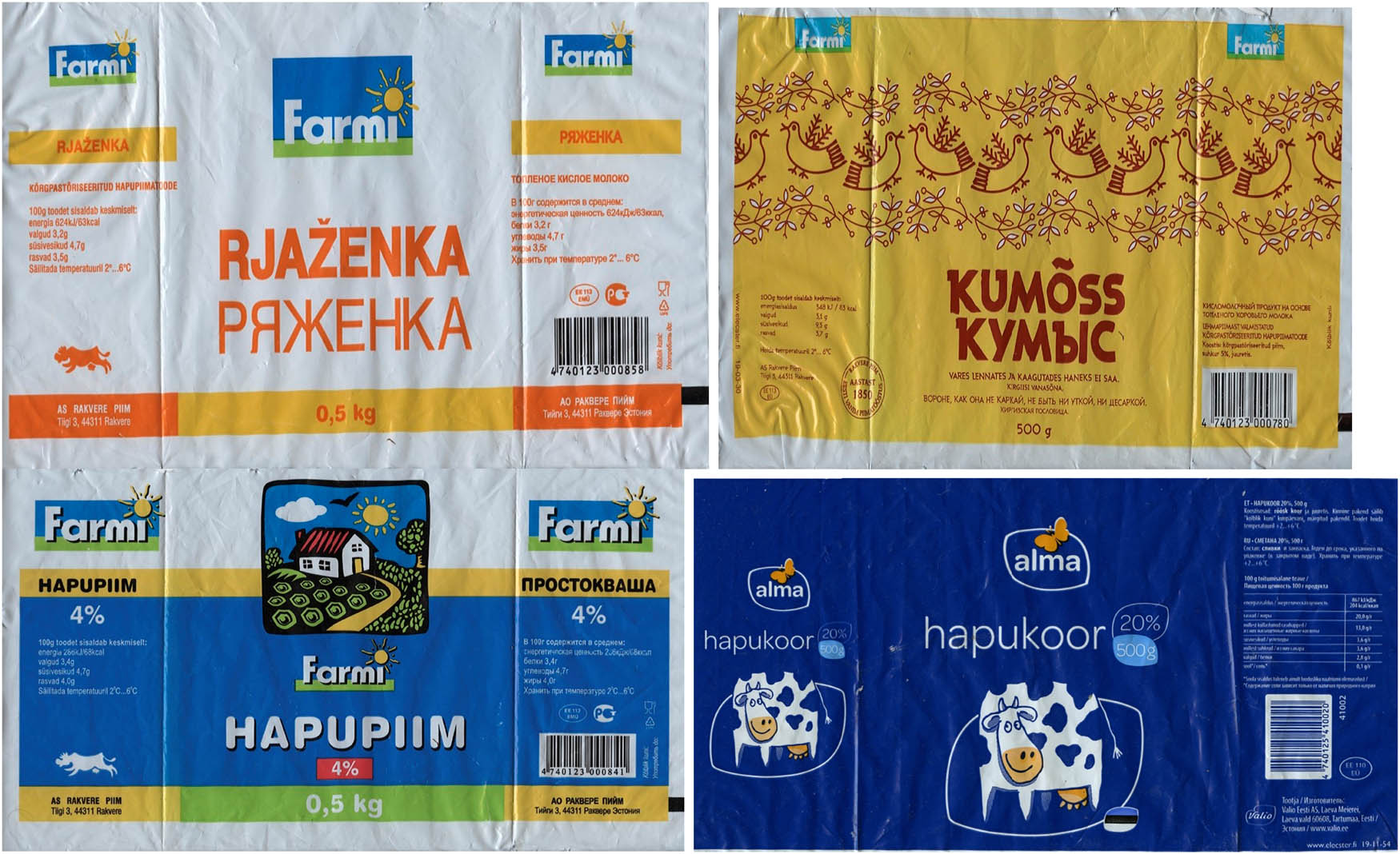
Fermented milk products from Estonia.
The interplay of the Soviet heritage and today’s design is present in the look of pelmeni packages. The German producer “Monolith” offers Pelmeni/Teigtaschen Avangardnije and Hinkali/Chinkali/Xinkaлi – Russian and Georgian varieties of dumplings. The names presumably target speakers of different languages, and the brand name reads “Cuisine of the peoples of the USSR” (Figure 4). This reminds consumers of the glorious international past of the big country. The product is sold outside Russia. Dumplings made of turkey meat and produced by “Germes” (Bavaria) have an appealing modern-looking design. A Russian company “Dyadya Vanya” selling processed and pickled vegetables exports it to different countries and is popular among co-ethnics. The name of the brand alludes to A. Chechov’s play. This is how the choice of the brand’s name is explained on the company’s website: “Dyadya Vania has an image of a good and decent person. Just imagine Dyadya Vanya and it brings to memory your home which you left a long time ago but where sometimes you want to return so much,” dyadya-vanya.ru/brand.
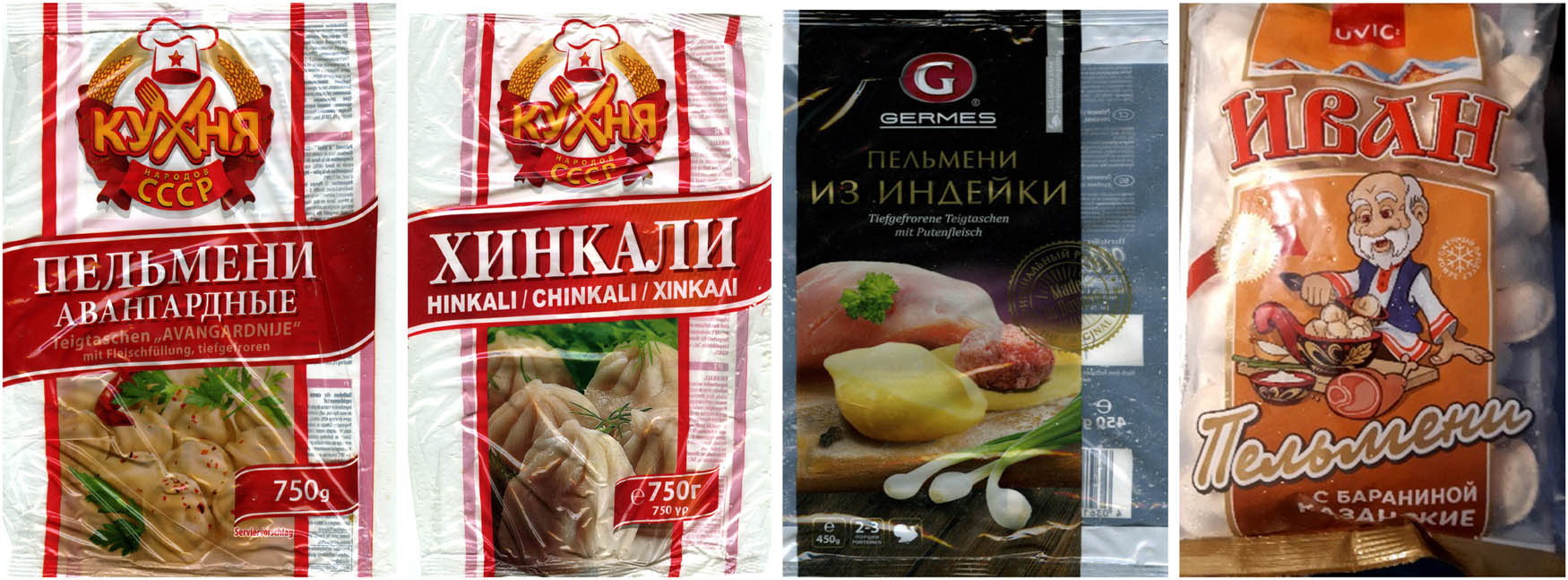
Pel’meni and khinkali from a store in Finland.
The multicultural Russian state binds various cultures together, and some dishes are still linked to their historical origin, although they are widely used (Figure 5). So, eating khinkali and lobio people remember that they come from Georgia, dolma is from Armenia, and manty are from Central Asia. Preparation of these special dishes, in particular on festive occasions, supports self-affirmation. Cooking is an integral part of a community life (cf. von Poser).
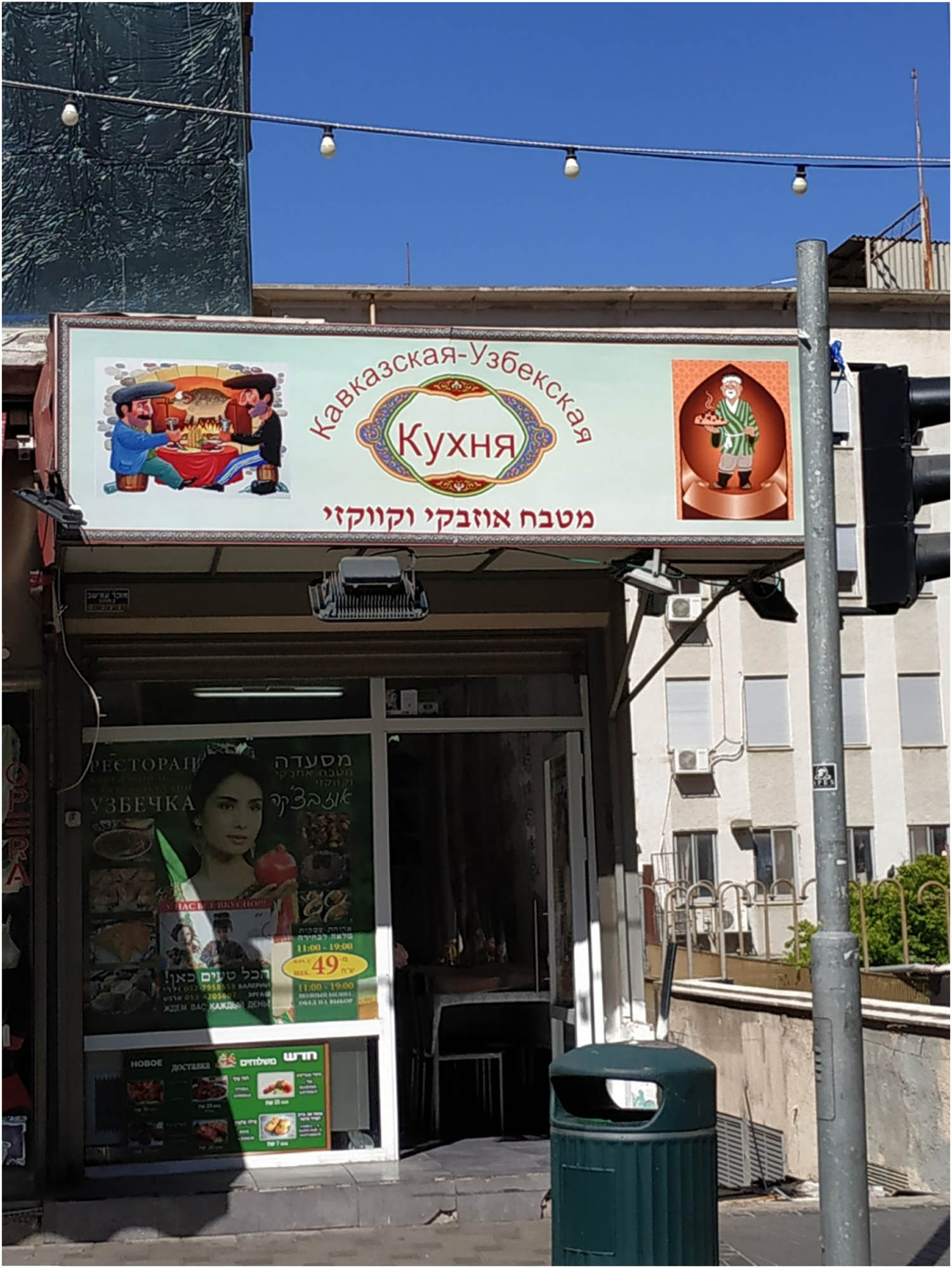
Caucasian and Central-Asia cuisines are popular outside their homes. As a heritage of the Soviet times, restaurants, and takeaways with it can be found in every country of the FSU and in various countries where Russian speakers have settled.
In countries where “Russian” food stores have numerous clients, such as Germany and Israel, not only goods imported from the former Soviet Union have nostalgic names, but also the locally produced ones, for example, doktorskaya kolbasa [doctor’s sausage], kabachkovaya ikra [zucchini caviar], Ukrainskii khleb [Ukrainian bread], zephyr v shokolade [chocolate coated marshmallow], Kievskii tort [Kyiv cake], and many others. Even if the taste of these foods differs from what immigrants remember from their childhood, the names serve to stir good memories. These names appeal both to individual experiences and also to cultural experience, which triggers a similar response in members of the immigrant group that helps to maintain a shared cultural identity (Holak; Holak et al.).
Conclusion
One of the most accessible cross-cultural communication topics in which one can steer away from politics and ideologies is talking about food; yet it can also provoke sensitive discussions. Food is a universal language that transcends borders and brings people together. This type of communication occurs while cooking, eating, recalling the past, and attempting to connect the various eras of existence. People learn new vocabulary and ways of expressing nutrient components through eating. Migrants need to acquire new words and internalize new concepts when talking about food. Emotions triggered by cooking and consuming foods call for social sharing (Riley and Paugh). Moreover, the visual side of serving dishes contributes to the mutual understanding of cultures (Mortezaei).
Representing different combinations of cultures, Russian-speaking immigrants live through intercultural communication while buying, preparing, serving, and eating food. All these stages of reflection, acceptance or rejection of the alien, and maintaining one’s own habits are essential for self-perception and new conceptualization of the world where migrants came to live. Food nostalgia is widespread among immigrants, and as many participants in this project conclude, it does not pass with time completely (cf. Protassova and Yelenevskaya). In many cases, it is mixed with nostalgia for childhood and youth, and family members left behind or long gone. These feelings familiar to most people may be particularly intense in immigration. Memories of “our” and “native” foods are charged with emotions, and maintenance of the old eating habits is part of immigrants’ attempts to reconstruct past experiences and the environment in which they feel comfortable. Internet discussions about Russian food outside the nation provide numerous examples of reflections about the self in the in-group and the self in an out-group. They suggest that food preferences are an integral part of individual and group identity.
The Internet has become an essential tool of transnational ties for dispersed immigrant communities, and Russian speakers are no exception. Russian-language culinary portals and blogs are frequented by people residing in different corners of the world, discussing healthy nutrition, exchanging recipes, and sharing culinary experiences. People in the metropolis display curiosity about the foodways of their compatriots abroad and are eager to learn about success and failures of the Russian cuisine in the world. Although flaming on these sites is relatively rare, they frequently reveal the division between us and them. The division lines differ; sometimes, we are all Russian speakers, irrespective of citizenship or the country of residence; but sometimes we implies those who stayed at home and they are all those who left their home country. Yet, more often than not, the atmosphere on the culinary sites is amicable, uniting participants by common interests in gastronomy, and common language and cultural background.
The fact that immigrants place their beloved foods and dishes on top of the list when they enumerate constituent parts of the Russian culture, before the Russian literature, nature landscapes, language, and history, speaks a lot about their “soul.” Even though the former nutritional habits were unhealthy, and following the current trend immigrants try to eat differently, they are not always ready to give up their favorite dishes. Tasty food makes us feel comfortable wherever we live.
-
Funding information: Open access funded by Helsinki University Library.
-
Conflict of interest: Authors state no conflict of interest.
Works Cited
Agyeman, Julian and Sidney Giacalone. editors. The Immigrant-Food Nexus: Borders, Labor, and Identity in North America. The MIT Press, 2020.10.7551/mitpress/11862.001.0001Search in Google Scholar
Alexander-Garrett, Leila. “Dal’nevostochnaja Londonskaja Dostoprimechatel’nost’ – Shura Shivarg.” Chayka, 7 September 2022. https://www.chayka.org/node/13448.Search in Google Scholar
Bernstein, Julia. “Sometimes I Feel that this is the Russia we had Always Dreamed of.” Transnationalism and Capitalism: Migrants from the former Soviet Union and their Experiences in Germany. Research Group Transnationalism Working Paper Number 7, Institute of Cultural Anthropology and European Ethnology Johann Wolfgang Goethe University Frankfurt am Main, 2006. https://d-nb.info/1055915745/34, accessed 8 January 2023.Search in Google Scholar
Braun, Virginia and Victoria Clarke. “Using Thematic Analysis in Psychology.” Qualitative Research in Psychology, vol. 3, no. 2, 2006, pp. 77–101. doi: 10.1191/1478088706qp063oa.Search in Google Scholar
Brewer, John D. Ethnography. Open University, 2000.Search in Google Scholar
Caldwell, Melissa L. “The Visible and the Invisible: Intimate Engagements with Russia’s Culinary East.” Re-Orienting Cuisine: East-Asian Foodways in the Twenty-First Century, edited by Kwang Ok Kim, Berghahn, 2015, pp. 129–149.10.1515/9781782385639-010Search in Google Scholar
Ceisel, Christina M. “Food Studies.” In Oxford Research Encyclopedia of Communication, edited by Jon F. Nussbaum, Oxford University Press, 2018, pp. 1–22. doi: 10.1093/acrefore/9780190228613.013.580.Search in Google Scholar
Chiaro, Delia and Linda Rossato. “Food and Translation, Translation and Food.” The Translator, vol. 21, no. 3, 2015, pp. 237–243. doi: 10.1080/13556509.2015.1110934.Search in Google Scholar
De Groot, Annette. “Bilingualism and Cognition.” The Encyclopedia of Applied Linguistics, edited by Carol A. Chapelle, Blackwell, Wiley, 2013, pp. 1–8. doi: 10.1002/9781405198431.wbeal0099.Search in Google Scholar
DuPuis, Matt, et al. Food Across Borders. Rutgers UP, 2017.Search in Google Scholar
Dürrschmid, Klaus. “Lebensmittel als Kommunikationsmittel – Die semiotische Lebensmittelqualität.” Ernährung, vol. 29, no. 3, 2005, pp. 126–128.Search in Google Scholar
Dutta, Urmitapa. “Ethnographic Approaches.” In Handbook of Methodological Approaches to Community-Based Research: Qualitative, Quantitative, and Mixed Methods, edited by Leonard Jason and David Glenwick, Oxford University Press, 2016, pp. 69–79.10.1093/med:psych/9780190243654.003.0008Search in Google Scholar
Erikson, Erik H. Identity and the Life Cycle. Norton, 1994.Search in Google Scholar
Fairclough, Norman and Ruth Wodak. “Critical Discourse Analysis.” In Discourse as Social Interaction, edited by T. A. van Dijk, 1997, Sage, pp. 258–284.Search in Google Scholar
Fialkova, Larisa and Maria Yelenevskaya. In Search of the Self: Reconciling the Past and the Present in Immigrants’ Experience. ELM Scholarly Press, 2013.10.7592/Sator.2013.12Search in Google Scholar
Fischler, Claude. “Food, Self and Identity.” Social Science Information, vol. 27, no. 2, 1988, pp. 275–292.10.1177/053901888027002005Search in Google Scholar
Gabaccia, Donna R. We are What We Eat: Ethnic Food and the Making of Americans, Harvard University Press, 1998.Search in Google Scholar
Green, Jeoffrey D., Chelsea A. Reid, Margaret A. Kneuer, and Mattie V. Hedgebeth. “The Proust Effect: Scents, Food and Nostalgia.” Current Opinion in Psychology, vol. 50, 2023, pp. 101–562.10.1016/j.copsyc.2023.101562Search in Google Scholar
Gronow, Jukka. Caviar with Champagne: Common Luxury and the Ideals of the Good Life in Stalin’s Russia. Berg, 2003.10.5040/9781350050747Search in Google Scholar
Grosjean, François. “Bicultural Bilinguals.” International Journal of Bilingualism, vol. 19, no. 5, 2015, pp. 572–586.10.1177/1367006914526297Search in Google Scholar
Holak, Susan L. “From Brighton Beach to Blogs: Exploring Food-Related Nostalgia in the Russian Diaspora,” Consumption Markets & Culture, vol. 17, no. 2, 2014, pp. 185–207.10.1080/10253866.2013.776308Search in Google Scholar
Holak, Susan L., Alexei V. Matveev, and William J. Halvena. “Nostalgia in Post-Socialist Russia: Exploring Applications to Advertising Strategy.” Journal of Business Research, vol. 60, 2007, pp. 649–655.10.1016/j.jbusres.2006.06.016Search in Google Scholar
Holm, Lotte, et al. “Who is Cooking Dinner?” Food, Culture & Society, vol. 18, no. 4, 2015, pp. 589–610.10.1080/15528014.2015.1088191Search in Google Scholar
Huynh, Mai T. X. and Svein O. Olsen. “Personality, Personal Values, and Consumer Participation in Self‐Production: The Case of Home Meal Preparation.” Psychology & Marketing, vol. 32, no. 7, 2015, pp. 709–724.10.1002/mar.20812Search in Google Scholar
Jurafsky, Dan. The Language of Food: A Linguist Reads the Menu. Norton, 2014.Search in Google Scholar
Kabakova, Galina. “Aliments interdits, aliments sacrés chez les Slaves de l’Est.” Religions et Alimentation, edited by Remi Gounelle et al., Brepols, 2019, pp. 119–134.10.1484/M.HR-EB.5.117411Search in Google Scholar
Kittler, Pamela G., et al. Food and Culture. 7th ed., Cengage Learning, 2017.Search in Google Scholar
Laakso, Senja. “Creating New Food Practices: A Case Study on Leftover Lunch Service.” Food, Culture & Society, vol. 20, no. 4, 2017, pp. 631–650.10.1080/15528014.2017.1324655Search in Google Scholar
Lemivaara-Khoudoikulova, Noora. Sociolingvisticheskij analiz roli russkogo jazyka v Tadzhikistane: jazykovaja povsednevnost’ odnoj tadzhikskoj sem’i (na osnove bytovyh pis’mennyh tekstov). University of Helsinki, 2011.Search in Google Scholar
Mäkelä, Johanna and Mari Niva. “Citizens and Sustainable Culinary Cultures.” Climate Change Adaptation and Food Supply Chain Management, edited by Ari Paloviita and Marja Järvelä. Routledge, 2016, pp. 172–182.Search in Google Scholar
Mortezaei, Vahid. Is Food a (Cross-cultural/Interpersonal) Communication Medium? MA Thesis. Aalto University, 2020. doi: 10.13140/RG.2.2.17545.67687.Search in Google Scholar
Ni, Maksim L. “Praktiki Pitanija Studentov-Migrantov v Obshhezhitii: Mezhdu Tradiciej i Racional’nost’ju.” Young Scientist, no. 4, 2016, pp. 623–627.Search in Google Scholar
Okely, Judith. Anthropological Practice: Fieldwork and Ethnographic Method. Routledge, 2020.10.4324/9781003084563Search in Google Scholar
Panayi, Panikos. “The Impact of Immigrant Food upon England.” Migrationsforschung und Interkulturelle Studien, edited by Jochen Oltmer, Rasch, 2002, pp. 179–202.Search in Google Scholar
Parasecoli, Fabio. “Savoring Semiotics: Food in Intercultural Communication.” Social Semiotics, vol. 21, no. 5, 2011, pp. 645–663.10.1080/10350330.2011.578803Search in Google Scholar
Perotto, Monica. “The Presence of the Italian Language in the Linguistic Landscapes of Moscow.” Dimensions of Sociolinguistic Landscapes in Europe. Materials and Methodological Solutions, edited by Mikko Laitinen and Anastassia Zabrodskaja, Lang, 2015, pp. 263–282.Search in Google Scholar
Peterson, Elizabeth. “Coffee and Danish in Sanpete County, Utah: An Exploration of Food Rituals and Language Shift.” Selected Proceedings of the 8th Workshop on Immigrant Languages in the Americas (WILA 8), edited by Jan H. Petersen and Karoline Kühl, Cascadilla, 2018, pp. 80–87.Search in Google Scholar
Popovic-Lipovac, Ana and Barbara Strasser. “A Review on Changes in Food Habits Among Immigrant Women and Implications for Health.” Journal of Minority Health, vol. 17, 2015, pp. 582–590. doi: 10.1007/s10903-013-9877-6.Search in Google Scholar
Protassova, Ekaterina. “Russian-Speaking Women Abroad: Prejudices and Achievements.” Innovative Methods in Multicultural Education, edited by Niina Raud, Studia Humaniora at Paedagogica Collegii Naroviensis IV, 2012, pp. 79–100.Search in Google Scholar
Protassova, Ekaterina. ““Russkoe Pole”: Issledovanie Nestandartnyh Variantov Jazyka.” Jazyk. Konstanty. Peremennye. Pamjati Aleksandra Evgen’evicha Kibrika, edited by Vladimir A. Plungyuan, Aleteiia, 2014, pp. 364–376.Search in Google Scholar
Protassova, Ekaterina. “Kulinarnye Predpochtenija Russkojazychnyh Emigrantov.” Chelovek i Jazyk v Kommunikativnom Prostranstve, vol. 10, 2019, pp. 60–66.Search in Google Scholar
Protassova, Ekaterina and Maria Yelenevskaya. “Speaking of Food in Immigration.” Communication Studies, vol. 9, no. 3, 2022, pp. 598–613. doi: 10.24147/2413-6182.2022.9(3).Search in Google Scholar
Räsänen, Kirsi. Suomalais-Venäläinen Ruokasanasto. SVK, 1992.Search in Google Scholar
Reid, Chelsea A., Jeffrey D. Green, Sophie Buchmaier, Devin K. McSween, Tim Wildschut, and Constantine Sedikides. “Food-Evoked Nostalgia,” Cognition and Emotion, vol. 37, no. 1, 2023, pp. 34–48. doi: 10.1080/02699931.2022.2142525.Search in Google Scholar
Richter, Philipp. “Baltika statt Beck’s.” Schwäbische Zeitung, vol. 8, Mai 2017. S. 8.Search in Google Scholar
Riley, Kathleen C. and Amy L. Paugh. Food and Language: Discourses and Foodways across Cultures, Routledge, 2018.10.4324/9781315695235Search in Google Scholar
Rogova, A.V. “Kontsept “eda” v Metaforicheskom Prelomlenii.” Yaroslavskii Pedagogicheskii Vestnik. Gumanitarnye Nauki, vol. 3, 2012, pp. 149–152.Search in Google Scholar
Rozanova, Nina N., et al. Eda Po-Russki v Zerkale Jazyka, RGGU, 2013.Search in Google Scholar
Rozin, Elizabeth and Paul Rozin. “Culinary Themes and Variations.” Natural History, vol. 90, no. 2, 1981, pp. 6–14.Search in Google Scholar
Sedikides, Constantine, Tim Wildschut, Clay Routledge, Jamie Arendt, Erica G. Hepper, and Xinyue Zhou. “Chapter Five – To Nostalgize: Mixing Memory with Affect and Desire.” Advances in Experimental Social Psychology, vol. 51, 2015, pp. 189–273.10.1016/bs.aesp.2014.10.001Search in Google Scholar
Smith, Andrew F. Food and Drink in American History. A “Full Course” Encyclopedia. V. 1. ABC-Clio, 2013.10.5040/9798216184751Search in Google Scholar
Steptoe, Andrew. “Invited Review: The Links between Stress and Illness.” Journal of Psychosomatic Research, vol. 35, no. 6, pp. 633–644.10.1016/0022-3999(91)90113-3Search in Google Scholar
Stöckl, Albert F. (ed.). Kostbares Österreich. Fachhochschule Krems, 2015.Search in Google Scholar
Szatrowski, Polly E. (ed.). Language and Food. Verbal and Nonverbal Experiences. Benjamins, 2014.10.1075/pbns.238Search in Google Scholar
Vail, Pyotr and Alexander Genis. Russian Cuisine in Exile. Academic Studies Press, 2018.10.2307/j.ctv1zjg7dpSearch in Google Scholar
Vainio, Annukka, et al. “From Beef to Beans: Eating Motives and the Replacement of Animal Proteins with Plant Proteins among Finnish Consumers.” Appetite, vol. 106, 2016, pp. 92–100.10.1016/j.appet.2016.03.002Search in Google Scholar
Von Bremzen, Anya. National Dish: Around the World in Search of Food, History, and the Meaning of Home, Penguin, 2023.Search in Google Scholar
von Poser, Anita. Foodways & Empathy. Berghahn, 2016.Search in Google Scholar
Wallach, Jennifer J. How America Eats: A Social History of U.S. Food and Culture. Rowman & Littlefield, 2013.10.5771/9781442208759Search in Google Scholar
Ward, Jamie and Julia Simner. “Lexical-Gustatory Synaesthesia: Linguistic and Conceptual Factors.” Cognition, vol. 89, 2003, pp. 237–261.10.1016/S0010-0277(03)00122-7Search in Google Scholar
West, Alexandria L., et al. “More than the Sum of its Parts: A Transformative Theory of Biculturalism.” Journal of Cross-Cultural Psychology, vol. 48, no. 7, 2017, pp. 963–990.10.1177/0022022117709533Search in Google Scholar
© 2023 the author(s), published by De Gruyter
This work is licensed under the Creative Commons Attribution 4.0 International License.
Articles in the same Issue
- Special Issue: Writing the Image, Showing the Word: Agency and Knowledge in Texts and Images, edited by Jørgen Bakke, Jens Eike Schnall, Rasmus T. Slaattelid, Synne Ytre Arne - Part II
- Cultural Syncretism and Interpicturality: The Iconography of Throne Benches in Medieval Icelandic Book Painting
- Rousseau’s Herbarium, or The Art of Living Together
- Special Issue: Russian Speakers After Migration, edited by Ekaterina Protassova and Maria Yelenevskaya
- Introduction: Everyday Verbal and Cultural Practices of the Russian Speakers Abroad
- Failing or Prevailing? Russian Educational Discourse in the Israeli Academic Classroom
- Cultural and Linguistic Capital of Second-Generation Migrants in Cyprus and Sweden
- Russian-Speaking Families and Public Preschools in Luxembourg: Cultural Encounters, Challenges, and Possibilities
- “I’m Home”: “Russian” Houses in Germany and Their Objects
- Conceptualizing Russian Food in Emigration: Foodways in Culture Maintenance and Adaptation
- From Odessa to “Little Odessa”: Migration of Food and Myth
- Domestication of Russian Cuisine in the United States: Wanda L Frolov’s Katish: Our Russian Cook (1947)
- A Russian Aristocrat in the Principality of Liechtenstein: Life Trajectories, Material Culture, and Language
- A Russian Story in the USA: On the Identity of Post-Socialist Immigration
- Special Issue: Plague as Metaphor, edited by Nahum Welang
- Introduction: How Metaphors Remember and Culturalise Pandemics
- The Humanities of Contagion: How Literary and Visual Representations of the “Spanish” Flu Pandemic Complement, Complicate and Calibrate COVID-19 Narratives
- “We’ve Forgotten Our Roots”: Bioweapons and Forms of Life in Mass Effect’s Speculative Future
- The Holobiontic Figure: Narrative Complexities of Holobiont Characters in Joan Slonczewski’s Brain Plague
- “And the House Burned Down”: HIV, Intimacy, and Memory in Danez Smith’s Poetry
- Regular Articles
- Social Connection when Physically Isolated: Family Experiences in Using Video Calls
- “I’ll see you again in twenty five years”: Life Course Fandom, Nostalgia and Cult Television Revivals
- How I Met Your Fans: A Comparative Textual Analysis of How I Met Your Mother and Its Reboots
- Transnational Business Services, Cultural Transformation/Identity, and Employee Performance: With Special Focus on Migration Experience and Emigration Plan
- Rethinking Agency in the European Debate about Virginity Certificates: Gender, Biopolitics, and the Construction of the Other
- The Mirror Image of Sino-Western in America’s First Work on Travel to China
- Strategies of Localizing Video Games into Arabic: A Case Study of PUBG and Free Fire
- Aspects of Visual Content Covered in the Audio Description of Arabic Series: A Corpus-assisted Study
- Translator Trainees’ Performance on Arabic–English Promotional Materials
- Youth and Intergenerational Transmission of Cultural Intelligence in Latvia, Spain and Turkey
- On the Happening of “Frank’s Place”: A Neo-Heideggerian Psychogeographic Appreciation of an Enchanted Locale
- Rebuilding Authority in “Lumpen” Communities: The Need for Basic Income to Foster Entitlement
- The Case of John and Juliet: TV Reboots, Gender Swaps, and the Denial of Queer Identity
Articles in the same Issue
- Special Issue: Writing the Image, Showing the Word: Agency and Knowledge in Texts and Images, edited by Jørgen Bakke, Jens Eike Schnall, Rasmus T. Slaattelid, Synne Ytre Arne - Part II
- Cultural Syncretism and Interpicturality: The Iconography of Throne Benches in Medieval Icelandic Book Painting
- Rousseau’s Herbarium, or The Art of Living Together
- Special Issue: Russian Speakers After Migration, edited by Ekaterina Protassova and Maria Yelenevskaya
- Introduction: Everyday Verbal and Cultural Practices of the Russian Speakers Abroad
- Failing or Prevailing? Russian Educational Discourse in the Israeli Academic Classroom
- Cultural and Linguistic Capital of Second-Generation Migrants in Cyprus and Sweden
- Russian-Speaking Families and Public Preschools in Luxembourg: Cultural Encounters, Challenges, and Possibilities
- “I’m Home”: “Russian” Houses in Germany and Their Objects
- Conceptualizing Russian Food in Emigration: Foodways in Culture Maintenance and Adaptation
- From Odessa to “Little Odessa”: Migration of Food and Myth
- Domestication of Russian Cuisine in the United States: Wanda L Frolov’s Katish: Our Russian Cook (1947)
- A Russian Aristocrat in the Principality of Liechtenstein: Life Trajectories, Material Culture, and Language
- A Russian Story in the USA: On the Identity of Post-Socialist Immigration
- Special Issue: Plague as Metaphor, edited by Nahum Welang
- Introduction: How Metaphors Remember and Culturalise Pandemics
- The Humanities of Contagion: How Literary and Visual Representations of the “Spanish” Flu Pandemic Complement, Complicate and Calibrate COVID-19 Narratives
- “We’ve Forgotten Our Roots”: Bioweapons and Forms of Life in Mass Effect’s Speculative Future
- The Holobiontic Figure: Narrative Complexities of Holobiont Characters in Joan Slonczewski’s Brain Plague
- “And the House Burned Down”: HIV, Intimacy, and Memory in Danez Smith’s Poetry
- Regular Articles
- Social Connection when Physically Isolated: Family Experiences in Using Video Calls
- “I’ll see you again in twenty five years”: Life Course Fandom, Nostalgia and Cult Television Revivals
- How I Met Your Fans: A Comparative Textual Analysis of How I Met Your Mother and Its Reboots
- Transnational Business Services, Cultural Transformation/Identity, and Employee Performance: With Special Focus on Migration Experience and Emigration Plan
- Rethinking Agency in the European Debate about Virginity Certificates: Gender, Biopolitics, and the Construction of the Other
- The Mirror Image of Sino-Western in America’s First Work on Travel to China
- Strategies of Localizing Video Games into Arabic: A Case Study of PUBG and Free Fire
- Aspects of Visual Content Covered in the Audio Description of Arabic Series: A Corpus-assisted Study
- Translator Trainees’ Performance on Arabic–English Promotional Materials
- Youth and Intergenerational Transmission of Cultural Intelligence in Latvia, Spain and Turkey
- On the Happening of “Frank’s Place”: A Neo-Heideggerian Psychogeographic Appreciation of an Enchanted Locale
- Rebuilding Authority in “Lumpen” Communities: The Need for Basic Income to Foster Entitlement
- The Case of John and Juliet: TV Reboots, Gender Swaps, and the Denial of Queer Identity
