Corrosion behaviour of stainless steel reinforcement in concrete
-
Federica Lollini
Federica Lollini is assistant professor in the field of materials science and technology at Politecnico di Milano (Italy). She received her MS and PhD from Politecnico di Milano. Her research interests include durability of reinforced concrete structures both in urban and marine environments. The design of concrete composition, the type of steel bar and constructions details in relation with the design service life, with regard to corrosion of steel reinforcement, are her main research topics.
 ,
Maddalena Carsana
,
Maddalena Carsana
Maddalena Carsana has a PhD in materials engineering. She is a researcher and assistant professor of construction materials at Politecnico of Milan. She works in the field of durability of construction materials. Her research interests are the durability and conservations of reinforced concrete structures and the development of new cementitious based on recycled materials and mineral additions.
Matteo Gastaldi is assistant professor in the field of material science and technology at Politecnico di Milano. His research activity is focused on the durability of construction materials. In particular, his main interests concern the prevention and protection techniques, mainly related to the use of stainless steel reinforcement, and the design for durability of reinforced concrete structures.
Elena Redaelli is assistant professor in the field of materials science and technology at Politecnico di Milano. Her main research interests are related to the corrosion of steel in concrete, its characterization and the methods to prevent and control it. In particular, her activity has focused on electrochemical techniques in concrete and methods for durability design of concrete structures.

Abstract
In Europe, stainless steel rebars have been used since the mid-80s, whilst in North America, their use has been progressively growing only since the mid-90s. Due to their higher resistance to corrosion in comparison to ordinary black steel bars, they have been employed in a wide number of applications worldwide to achieve the durability performance of reinforced concrete structures, especially in extremely corrosive marine environments or when long service lives are required. In this paper, a state of the art on the corrosion resistance of stainless steel bars is reported. In particular, the contribution of Professor Luca Bertolini in this research field is considered. Initially, different testing methods are presented to point out their advantages and limitations and then the results on corrosion behaviour of different grades of stainless steel bars (i.e. austenitic, ferritic and duplex), obtained especially with tests in concrete, are analysed. Afterwards, some of the recent applications of stainless steel bars are illustrated.
1 Introduction
Stainless steel (SS) rebars can be a suitable design option to fulfil durability requirements in chloride-bearing environments or when long service lives (SLs) are required. The most suitable SS grade has to be selected considering the characteristic of the structure, the concrete and the exposure conditions (Lollini et al., 2015).
According to Tuutti’s model (Tuutti, 1982), the SL of a reinforced concrete (RC) structure exposed to marine environment or de-icing salts can be divided into an initiation period, during which chloride ions penetrate the concrete cover and initiate pitting corrosion, and a subsequent propagation period, during which corrosion leads to a limit state affecting the serviceability or safety of the structure (Bertolini et al., 2013).
During the initiation period, chloride ions penetrate the concrete cover until they reach a specific concentration, i.e. the chloride threshold (Clth), at the surface of the embedded steel, leading to a local breakdown of the protective oxide film present on the reinforcement surface (passive film). A subsequent localised corrosion attack (pitting) takes place. Areas in the pit act as anodes (active zones) with respect to the surrounding still passive areas where the cathodic reaction of oxygen reduction takes place. Once corrosion has initiated, a very aggressive environment is produced inside localised attacks, due to the autocatalytic mechanism of pitting corrosion. Consequently, corrosion can reach very high rates of penetration (up to 1 mm/year), which can quickly lead to a remarkable reduction of the cross-section of the rebars. For this reason, the propagation stage of pitting corrosion is generally neglected in the design of concrete structures exposed to environments with chlorides and the SL of the structure is defined only on the basis of the initiation period.
In order to calculate the initiation period, the chloride threshold, i.e. the minimum amount of chloride ions that is required to breakdown the passive film and initiate pitting corrosion (i.e. to cause depassivation), should be defined. Although this is an apparently simple approach, the complex nature of pitting corrosion initiation should not be neglected. Thus, the assessment of Clth under real exposure conditions is indeed rather difficult because it is affected by numerous interrelated parameters, such as pore solution chemistry, electrochemical potential of the steel, steel/concrete interface, environmental temperature, type of steel and surface condition of the reinforcement (Page, 2009; Bertolini et al., 2013).
It is well known that SS rebars have higher corrosion resistance compared to traditionally used black steel bars, and they have been used in a large number of structures worldwide to achieve the durability performance of RC structures. Figure 1 depicts, for comparison, the typical evolution of the SL of an RC structure subject to chloride contamination for carbon steel (1) and SS rebars (2).
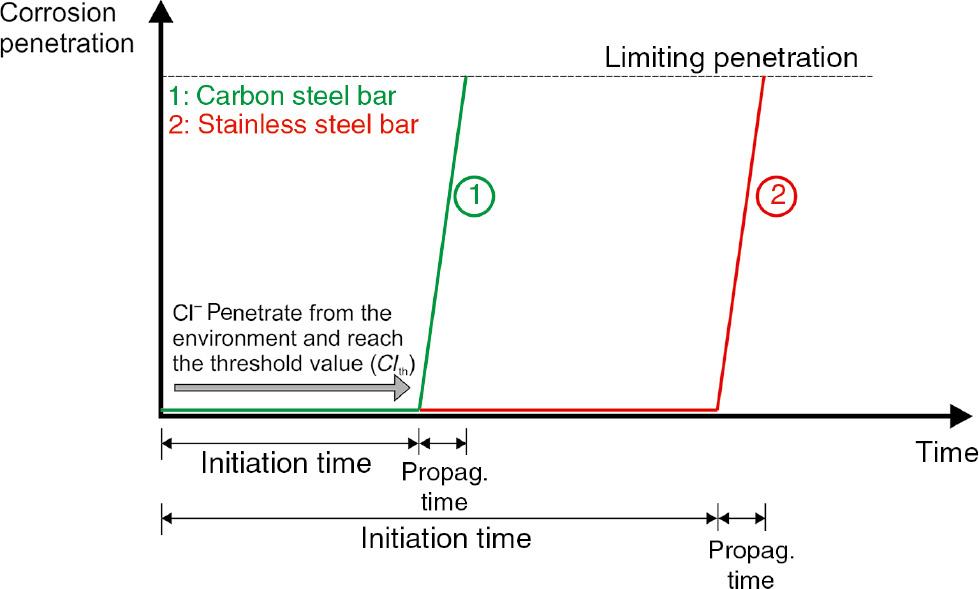
Schematic time evolution of steel corrosion in RC exposed to chlorides (Tuutti’s diagram) for carbon steel and SS bars.
Several grades of SS have been proposed as reinforcement, which are characterized by notably different chemical composition, cost and corrosion resistance performances.
This paper reports a state of the art on the corrosion resistance of SS bars. Initially, the different testing methods used to characterize corrosion behaviour are presented, and their advantages as well as limitations are discussed; afterwards, the results on corrosion behaviour of different grades of SS bars (i.e. austenitic, ferritic and duplex), obtained especially with tests in concrete, are analysed, attempting to rank them in relation with corrosion resistance. Finally, examples of use of SS rebars in real structures are described, and a promising and innovative use in combination with chloride-contaminated raw materials to increase the sustainability of construction industries is illustrated.
2 Testing methods
Although the main factors affecting Clth have been widely investigated and some of them are well known, a quantification of Clth values for steel in concrete is still rather difficult. First of all, pitting corrosion initiation is a stochastic phenomenon that is influenced by a great number of parameters (Alonso & Sanchez, 2009). Clth should be properly defined only through probability distributions, which take into account the effects of those parameters. However, such an approach requires a huge amount of experimental data, which are not available in the scientific literature. A second reason is the absence of a standardised or a generally accepted method, even for black steel bars, for the evaluation of Clth both on real structures and in laboratory specimens (Glass & Buenfeld, 1997; Alonso & Sanchez, 2009; Bertolini & Redaelli, 2009; Frederiksen, 2009; Page, 2009; Lollini et al., 2016b). Few data are available on real structures (as the detection of Clth implies the difficult task of measuring chloride content at the depth of the steel bars at the time of corrosion initiation), and these deal only with conventional black steel bars. For other steels that are not commonly used, such as SSs, only results of laboratory tests are generally available.
As there are no standardised methods for the evaluation of Clth, as well as for the detection of depassivation, a large variety of techniques has been used by different researchers.
Often electrochemical tests in solutions simulating the concrete pore solution, such as potentiodynamic tests at different Cl− content in solution or potentiostatic polarisation tests made after progressive chloride additions, are used to compare the corrosion resistance of steel bars of different composition. The current exchanged at the steel surface is monitored, and when it increases sharply, steel depassivation is detected, allowing the determination either of a pitting potential value or of a chloride threshold concentration. Tests in solutions permit a rapid evaluation of the resistance to pitting corrosion, allowing a preliminary evaluation of the role of the type of steel and of environmental parameters. However, they do not allow an evaluation of the chloride threshold in concrete, as chlorides concentration in solution cannot be directly converted in chloride contents in concrete (as a matter of fact, the chloride content in concrete is generally referred to the mass of cement, whilst in solution, it is referred to the mass of solution), and they may not be representative of the real conditions of a reinforcing bar in concrete. Furthermore, these tests may also be misleading even for the simple ranking of the corrosion resistance of different types of SSs (Bertolini & Gastaldi, 2011).
Tests in concrete or mortar have also been proposed; they vary for the way chlorides are introduced in the concrete (e.g. added to the mixing water or penetrated by diffusion or migration), the means of measuring the chloride content (e.g. total acid soluble chlorides or free chlorides) or the surface preparation of the rebar sample (e.g. pickled, sandblasted). These variations of the experimental procedures may have a large influence on the resulting value of the chloride threshold (Nurnberger et al., 1993). In tests in concrete, steel depassivation is usually detected with electrochemical (non-destructive) methods, such as monitoring corrosion potential and corrosion rate. The determination of the chloride threshold is carried out either by measuring the chloride content when steel depassivation is detected by corrosion rate and/or potential monitoring in initially chloride free specimens subjected to chloride penetration or by comparing corrosion behaviour in terms of corrosion rates and corrosion potential of specimens with different amounts of mixed-in chlorides. However, even the definition of the initiation of pitting corrosion, and thus of the chloride threshold, is not simple. In fact, an initial phase where breakdown of the passive film alternates to repassivation at incipient anodic sites is followed by a permanent active corrosion stage, where sustained pit propagation takes place. Potentiostatic polarisation tests, both in concrete with mixed-in chlorides and with chlorides that penetrate from an external source, have also been suggested to measure the chloride threshold as a function of steel potential and thus to correlate Clth to changes in the moisture content of concrete (Lollini et al., 2018). In tests in concrete with mixed-in chlorides, rebars are directly placed in contact with chloride-contaminated concrete and could not benefit from the initial passivation, which occurs in free-chloride concrete, and this might affect the test results. Conversely, tests with chlorides that penetrate from an external source have been usually carried out only in samples of porous mortar with low concrete cover thickness, as otherwise, they would require a very long time.
Compared to tests in solution, tests in concrete are more time consuming, as they require casting and curing of specimens and, if chlorides penetrate from an external source, the involved phenomena require longer durations to take place (penetration of chlorides in concrete and changes at the steel/concrete interface) also considering the high corrosion resistance of SS. However, tests in concrete are indeed more representative of real conditions, in particular, in considering the role of the steel-concrete interface (Page, 2009).
3 Corrosion behaviour of SS bars
SSs are alloyed steel with chromium content of at least 10.5% (EN 10088–1, EN 2005), which allows the formation of a chromium-rich passive film at the steel surface in many environmental conditions. Usually, Cr content higher than 13% is used and other alloying elements are added (typically Ni, Mo, N) in order to improve strength, corrosion resistance or other properties. Thermo-mechanical treatments are also applied to SS rebars in order to fulfill mechanical requirements for reinforcing bars.
SSs are generally divided in four types (based on the steel microstructure): martensitic, ferritic, austenitic and duplex (austenitic-ferritic). For use as reinforcement, however, only specific grades of austenitic and duplex SS are typically used in concrete (Table 1). Traditionally, austenitic type 304L (i.e. with about 18%Cr-10%Ni) and 316L (i.e. with about 17%Cr-11%Ni-2%Mo) and duplex type 22-05 (i.e. with about 22%Cr-5%Ni-3%Mo) are generally used. Due to the fluctuations of the cost of some alloy elements, above all nickel, in the last years, the use of rebars of duplex and austenitic SS with low nickel and molybdenum content (in which manganese is often added in place of nickel to obtain the austenitic structure), e.g. XM-28 (i.e. with about 17%Cr-1/2%Ni-12%Mn), 23-04 (i.e. with 23%Cr-4%Ni) and 21-01 (with a composition of approximately 21%Cr, 1% Ni associated with the presence of Mn), has been proposed (Table 1) (Bertolini & Gastaldi, 2011; Hansson, 2016).
Grades of SS most commonly used as reinforcement: main alloy elements (% by mass), designation and microstructures.
| Steel name | Designation |
Microstructure | Main alloy elements (% by mass) |
|||||
|---|---|---|---|---|---|---|---|---|
| EN 10088-1 | AISI | UNS | Cr | Ni | Mo | Other elements | ||
| 304L | 1.4307 | 304L | S30403 | Austenitic | 17.5–19.5 | 8–10 | – | – |
| 316L | 1.4404 | 316L | S31603 | Austenitic | 16.5–18.5 | 10–13 | 2–2.5 | – |
| 22-05 | 1.4462 | 318L | S31803 | Duplex | 21–23 | 4.5–6.5 | 2.5–3.5 | 0.1–0.22 N |
| 23-04 | 1.4362 | – | S32304 | Duplex | 22–24 | 3.5–5.5 | 0.1–0.6 | 0.05–0.2 N |
| 21-01 | 1.4162 | – | S32101 | Duplex | 21–22 | 1.4–1.7 | 0.1–0.8 | 4–6 Mn, 0.2–0.25 N |
| XM-28 | – | – | S24100 | Austenitic | 16.5–19 | 0.5–2.5 | – | 11–14 Mn, 0.2–0.45 N |
Several studies have been carried out in the last 40 years in order to evaluate the corrosion resistance of different types of SSs used as reinforcing bars, and the main findings will be reported in the next sections. Tables 2 and 3 summarise all the publications considered in the present evaluation, whilst Figure 2 shows the critical chloride threshold obtained in different publications for austenitic and duplex SS.
Published Clth values obtained on austenitic SS bars (test in: C, concrete; M, mortar; S, solution; method: F, free corrosion conditions; PS, potentiostatic polarisation tests; PD, potentiodynamic polarisation tests).
| Type of SS | Type of bar | Test in | Cl− (%) | Method | Exposure |
Duration (years) | Cl th | Note | References | |
|---|---|---|---|---|---|---|---|---|---|---|
| Location | T/R.H | |||||||||
| 302 | Plain | C | Up to 3.2 | F | Industrial environment (Beckton, UK) | 22 | >3 | Small pitting attacks after 22 years | Brown et al., 1978; Flint & Cox, 1988; Treadaway et al., 1989; Cox & Oldfield, 1996 | |
| 302 | Plain | C | – | F | Marine environment (Langstone Harbour, UK) | 22 | >3 | No corrosion even after 22 years in cracked specimens | Brown et al., 1978; Flint & Cox, 1988; Treadaway et al., 1989; Cox & Oldfield, 1996 | |
| 304 | Ribbed | M | 8 | F | Outside environment (Denmark) | 0.4 | >8 | In presence of welding oxide scale, Clth decreased to 5%–8% | Sorensen et al., 1990 | |
| 304 | Ribbed | M | 3.5–5 | PS | 3.5÷5 | Test at +200 mV/SCE. In presence of welding oxide scale, Clth decreased to 1%–2% | Sorensen et al., 1990 | |||
| 304 | Plain | C | Up to 3 | F | Outside environment (Milan) | 1.5 | >3 | Pastore & Pedeferri, 1991 | ||
| 304L | Plain | C | Up to 6 | F | Exposure cycles | 40°C/95%–98% | 0.67 | >6 | In carbonated concrete up to 4% | Bertolini et al., 2000 |
| 304L | Plain | C | Up to 4 | F | Exposure cycles | 40°C/95%–98% | 0.67 | >4 | In presence of simulated welding oxide scale | Bertolini et al., 2000 |
| 304L | Ribbed | C | – | F | Ponding with NaCl | >6 | Bertolini et al., 2001 | |||
| 304L | Ribbed | C | 5 | PS | Test up to +600 mV/SCE. In alkaline concrete, no corrosion up to a potential of +400 mV/SCE; in carbonated concrete, corrosion occurred at +50 mV/SCE | Bertolini et al., 2002 | ||||
| 304L | Ribbed | S | Up to 10 | PD | 20°C | 9–10 | pH 12.6 and pH 7.5 | Bertolini et al., 2002 | ||
| 304 | Ribbed | C | Up to 4 | F | Constantly wetted | 2 | >4 | García-Alonso et al., 2007a | ||
| 304 | S | 1.3 | PD | 50°C | >1.3 | pH 12 | Bourgin et al., 2005 | |||
| 304 | Ribbed | M | Up to 5 | F | Exposure cycles | 40÷95% | 3 | >5 | García-Alonso et al., 2007a | |
| 304 | Ribbed | C | – | F | Ponding | >6 | Hartt et al., 2009 | |||
| 304L | Ribbed | C | Up to 8 | F | Climatic chamber | 20°C/90% | >8 | Bertolini & Gastaldi, 2009 | ||
| 304L | Ribbed | C | Up to 8 | F | Exposure cycles | 20°C/40% | >8 | Gastaldi & Bertolini, 2014 | ||
| 316 | Plain | C | Up to 3.2 | F | Industrial environment (Beckton, UK) | 22 | >3 | No corrosion even after 22 years in cracked specimens | Brown et al., 1978; Flint & Cox, 1988; Treadaway et al., 1989; Cox & Oldfield, 1996 | |
| 316 | Plain | C | – | F | Marine environment (Langstone Harbour, UK) | 22 | >3 | No corrosion even after 22 years in cracked specimens | Brown et al., 1978; Flint & Cox, 1988; Treadaway et al., 1989; Cox & Oldfield, 1996 | |
| 316 | Ribbed | M | 8 | F | Outside environment (Denmark) | 0.4 | >8 | In presence of welding oxide scale, Clth decreased to 5%–8% | Sorensen et al., 1990 | |
| 316 | Ribbed | M | 3.5–5 | PS | 3.5÷5 | Test at +200 mV/SCE. In presence of welding oxide scale, Clth decreased to 1%–2% | Sorensen et al., 1990 | |||
| 316 | Plain | C | Up to 3 | F | Outside environment (Milan) | 1.5 | >3 | Pastore & Pedeferri, 1991 | ||
| 316Ti | Ribbed | C | Up to 2.5 | F | >2.5 | In alkaline and carbonated concrete | Nurnberger et al., 1993; Nurnberger & Beul, 1999 | |||
| 316Ti | Ribbed | C | – | F | Spraying with Cl− solution | 2.5 | >4.5 | Also in cracked concrete | Nurnberger et al., 1993; Nurnberger & Beul, 1999 | |
| 316Ti | Ribbed | C | – | F | Spraying with Cl− solution | 2.5 | <4.5 | In presence of welding oxide scale | Nurnberger et al., 1993; Nurnberger & Beul, 1999 | |
| 316L | Ribbed | C | – | F | Ponding with NaCl | >6 | Bertolini et al., 2001 | |||
| 316L | Plain | C | Up to 6 | F | Exposure cycles | 40°C/95%–98% | 0.67 | >6 | In carbonated concrete up to 4% | Bertolini et al., 2000 |
| 316L | Plain | C | Up to 4 | F | Exposure cycles | 40°C/95%–98% | 0.67 | 4 | In presence of simulated welding oxide scale | Bertolini et al., 2000 |
| 316L | S | 1.3 | PD | 50°C | >1.3 | pH 12 | Bourgin et al., 2005 | |||
| 316L | Ribbed | C | 5 | PS | Test at +600 mV/SCE. In alkaline concrete, no corrosion up to a potential of +400 mV/SCE; in carbonated concrete, corrosion occurred at +150 mV/SCE | Bertolini et al., 2002 | ||||
| 316L | Ribbed | S | Up to 10 | PD | 20°C | 9–10 | pH 12.6 and pH 7.5 | Bertolini et al., 2002 | ||
| 316LN | S | Up to 7 | PD | 20°C | >7 | Hurley & Scully, 2005 | ||||
| 316LN | S | PS | 20°C | 3 | Test at +200 mV/SCE | Hurley & Scully, 2005 | ||||
| 316 | Ribbed | C | Up to 4 | F | Constantly wetted | 2 | >4 | García-Alonso et al., 2007a | ||
| 316 | Ribbed | M | Up to 5 | F | Exposure cycles | 40÷95% | 3 | >5 | García-Alonso et al., 2007a | |
| 316L | Ribbed | C | – | F | Ponding | >6 | Hartt et al., 2009 | |||
| 316L | Ribbed | C | Up to 8 | F | Climatic chamber | 20°C/90% | >8 | Bertolini & Gastaldi, 2009 | ||
| 316L | Ribbed | C | Up to 8 | F | Exposure cycles | 20°C–40°C | >8 | Gastaldi & Bertolini, 2014 | ||
| XM-28 | Ribbed | C | Up to 5 | PS | 2.3÷5.5 | Test at +200 mV/SCE for 24 h | Gastaldi et al., 2013 | |||
| XM-28 | Ribbed | C | 5 | PS | <5 | Test at +200 mV/SCE for 4 days | Van Niejenhuis et al., 2016a | |||
| XM-28 | Ribbed | C | 3 | PS | >3 | Test at +100 mV/SCE for 4 days | Van Niejenhuis et al., 2016a | |||
| XM-28 | Ribbed | C | – | F | Exposure to salt brine with 21% Cl− | 2.3 | Van Niejenhuis et al., 2016b | |||
Published Clth values obtained on duplex SS bars (test in: C, concrete; M, mortar; S, solution; method: F, free corrosion conditions; PS, potentiostatic polarisation tests; PD, potentiodynamic polarisation tests).
| Type of SS | Type of bar | Test in | Cl− (%) | Method | Exposure |
Duration (years) | Cl th | Note | References | |
|---|---|---|---|---|---|---|---|---|---|---|
| Location | T/R.H | |||||||||
| 22-05 | Ribbed | C | Up to 2.5 | F | >2.5 | In alkaline and carbonated concrete | Nurnberger et al., 1993; Nurnberger & Beul, 1999 | |||
| 22-05 | Ribbed | C | – | F | Spaying with Cl− solution | 2.5 | >4.5 | Also in cracked concrete | Nurnberger et al., 1993; Nurnberger & Beul, 1999 | |
| 22-05 | Ribbed | C | 5 | PS | >5 | Test up to +600 mV/SCE. In alkaline and carbonated concrete, no corrosion up to a potential of +600 mV/SCE | Bertolini et al., 2002 | |||
| 22-05 | Ribbed | C | – | F | Ponding with NaCl | >6 | Bertolini et al., 2001 | |||
| 22-05 | Ribbed | S | Up to 10 | PD | 20°C | >10 | pH 12.6 and pH 7.5 | Bertolini et al., 2002 | ||
| 22-05 | S | 1.3 | PD | 50°C | >1.3 | pH 12 | Bourgin et al., 2005 | |||
| 22-05 | Ribbed | C | – | F | Ponding with NaCl | 2.3 | No corrosion even in cracked specimens | Van Niejenhuis et al., 2016b | ||
| 23-04 | Plain | C | Up to 3 | F | Outside environment (Milan) | 1.5 | >3 | Pastore et al., 1991 | ||
| 23-04 | Ribbed | S | Up to 10 | PS | 20°C | 7.5–8 | pH 12.6 | Bertolini & Gastaldi, 2009 | ||
| 23-04 | S | 1.3 | PD | 50°C | >1.3 | pH 12 | Bourgin et al., 2005 | |||
| 23-04 | S | PS | 20°C | 7.5 | Test at +100 mV/SCE. pH 13–13.5 | Lysogorski & Hartt, 2006 | ||||
| 23-04 | Ribbed | C | Up to 8 | F | Inside exposure | 20°C/90% | 3 | Bertolini & Gastaldi, 2009 | ||
| 23-04 | Ribbed | C | F | Ponding with NaCl | 2.3 | No corrosion at the end of exposure | Van Niejenhuis et al., 2016b | |||
| 21-01 | S | Up to 7 | PD | 20°C | >7 | Hurley & Scully, 2005 | ||||
| 21-01 | S | PS | 20°C | 1 | Test at +200 mV/SCE | Hurley & Scully, 2005 | ||||
| 21-01 | Ribbed | S | Up to 10 | PS | 20°C | 3.5–6 | pH 12.6 | Bertolini & Gastaldi, 2009 | ||
| 21-01 | C | Up to 6 | F | Ponding | 1.33 | Hartt et al., 2009 | ||||
| 21-01 | Ribbed | C | Up to 3 | F | Inside exposure | 20°C/90% | <3 | Bertolini & Gastaldi, 2009 | ||
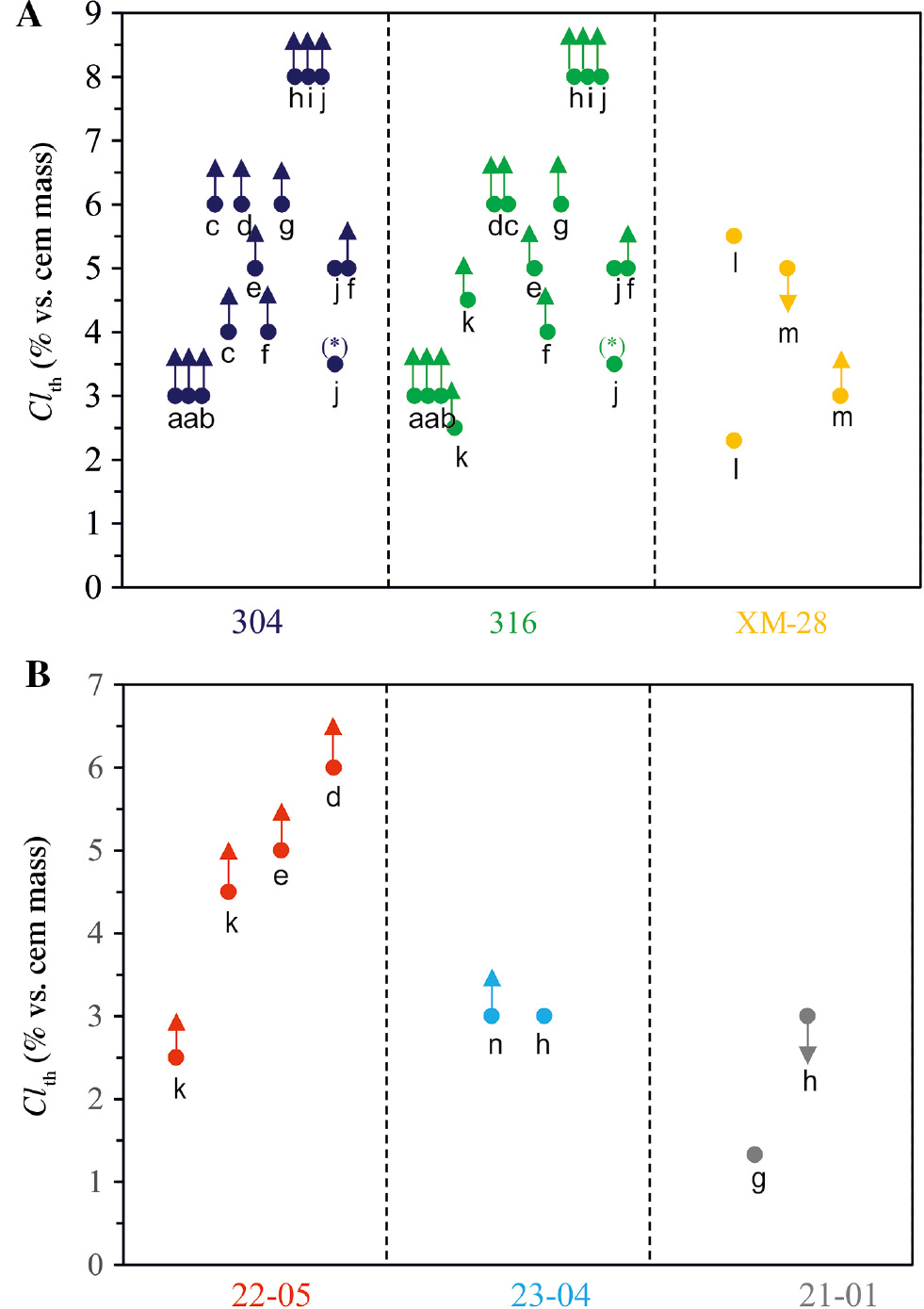
Cl th values obtained in concrete and mortar tests in the literature on austenitic (A) duplex, (B) SS bars (↑= value higher than; ↓= value lower than; *=value detected under anodic polarisation). (a: Brown et al., 1978; Flint & Cox, 1988; Treadaway et al., 1989; Cox & Oldfield, 1996; b: Pastore & Pedeferri, 1991; c: Bertolini et al., 2000; d: Bertolini et al., 2001; e: Bertolini et al., 2002; f: García-Alonso et al., 2007a; g: Hartt et al., 2009; h: Bertolini & Gastaldi, 2009; i: Gastaldi & Bertolini, 2014; j: Sorensen et al., 1990; k: Nurnberger et al., 1993; Nurnberger & Beul, 1999; l: Gastaldi et al., 2013; m: Van Niejenhuis et al., 2016a; n: Pastore et al., 1991).
3.1 Austenitic and ferritic SSs
Earlier studies were carried out on austenitic and ferritic grades of SS. From the late 1970s, the results of an extensive study on the behaviour of SS reinforcement in chloride-contaminated concrete were published (Brown et al., 1978; Flint & Cox, 1988; Treadaway et al., 1989; Cox & Oldfield, 1996). Tests in the above mentioned papers were performed on plain bars embedded in concrete prisms and beams made with 3.2% of mixed-in chlorides by mass of cement. Concrete beams, with a chloride content added in the mix up to 0.96% by mass of cement, were cracked before exposure to the aggressive environment. Concrete specimens were exposed to an industrial environment (Beckton, UK); furthermore, some cracked concrete beams, initially free of chlorides, were exposed to the splash zone of a marine environment (Langstone Harbour, UK). After 10 years of exposure, no corrosion was observed on austenitic SSs 302 (comparable to 304 but with a higher carbon content) and 316. Conversely, ferritic SSs 405 and 430 was shown to suffer pitting corrosion in high permeability concrete (w/c=0.75) with up to 1% chloride by mass of cement. Austenitic SSs did not show any sign of serious corrosion even after 22 years of exposure. Indeed, only slight pitting attacks occurred on 302 SS in concrete with 3.2% chloride by mass of cement (exposed to industrial atmosphere) (Cox & Oldfield, 1996).
Afterwards, several studies were carried out on 304 and 316 grades. The good corrosion resistance of austenitic SS was confirmed by a study on commercial ribbed bars of 304 and 316 austenitic SS bars in mortar (a sulphate-resistant portland cement was used) with up to 8% of mixed-in chlorides (Sorensen et al., 1990); no corrosion was observed in these specimens exposed outdoors for 5 months (Denmark). Further potentiostatic polarisation tests on the same SS at +200 mV/SCE (which can be considered representative of the maximum potential values reached in atmospheric exposure conditions) showed that corrosion could initiate at chloride contents of 3.5–5% by mass of cement and that the corrosion resistance of 316 was only marginally higher than that of 304.
A further study showed that fully passive conditions were maintained by plain bars of 304 and 316 austenitic SS embedded in concrete with mixed-in chlorides up to 3% by mass of portland cement and exposed in urban atmosphere (Milan, Italy) for 18 months (Pastore & Pedeferri, 1991).
Corrosion resistance of austenitic 316 Ti and ferritic 410 ribbed bars was also studied in alkaline and carbonated portland cement concrete contaminated with up to 2.5% chlorides by mass of cement (Nurnberger et al., 1993). Tests in cracked concrete, reinforced with austenitic and ferritic SS, initially free of chlorides and sprayed with chloride solution for 2.5 years, were also carried out (Nurnberger & Beul, 1999). Austenitic SS did not suffer pitting corrosion whether in alkaline or in carbonated concrete with up to 2.5% Cl− and in cracked concrete specimens when a chlorides content of about 4.5% by mass of cement was reached at the steel surface. Conversely, ferritic SSs did not show pitting corrosion in alkaline concrete containing up to 2.5% Cl− but were susceptible to pitting attack in carbonated concrete with 1% Cl−.
Tests in limestone-portland cement concrete contaminated with chlorides showed that bars of austenitic SS 304L and 316L did not undergo corrosion in alkaline and carbonated concrete with a chloride content up to 6% by cement mass, even after 8 months of exposure in very aggressive conditions simulating tropical climates (at 40°C and 95%–98% R.H.) (Bertolini et al., 2000). Also ferritic 430 steels were tested showing a lower corrosion resistance at 40°C compared to austenitic steels.
A further study showed that no corrosion occurred even at potential values up to +400 mV/SCE (potential values that can be reached only in the presence of external polarisation, as in the case of stray currents) on 304L and 316L in concrete with 5% of mixed-in chlorides. In carbonated concrete with 5% chlorides, a rather small increase in potential of 50 mV versus the free corrosion potential was enough to initiate pitting corrosion on 304L, showing that under this very aggressive condition (5% Cl− + carbonation), 304L may be susceptible to pitting corrosion; for 316L, a higher anodic polarisation of 150 mV was required to initiate corrosion (Bertolini et al., 2002) (Figure 3).
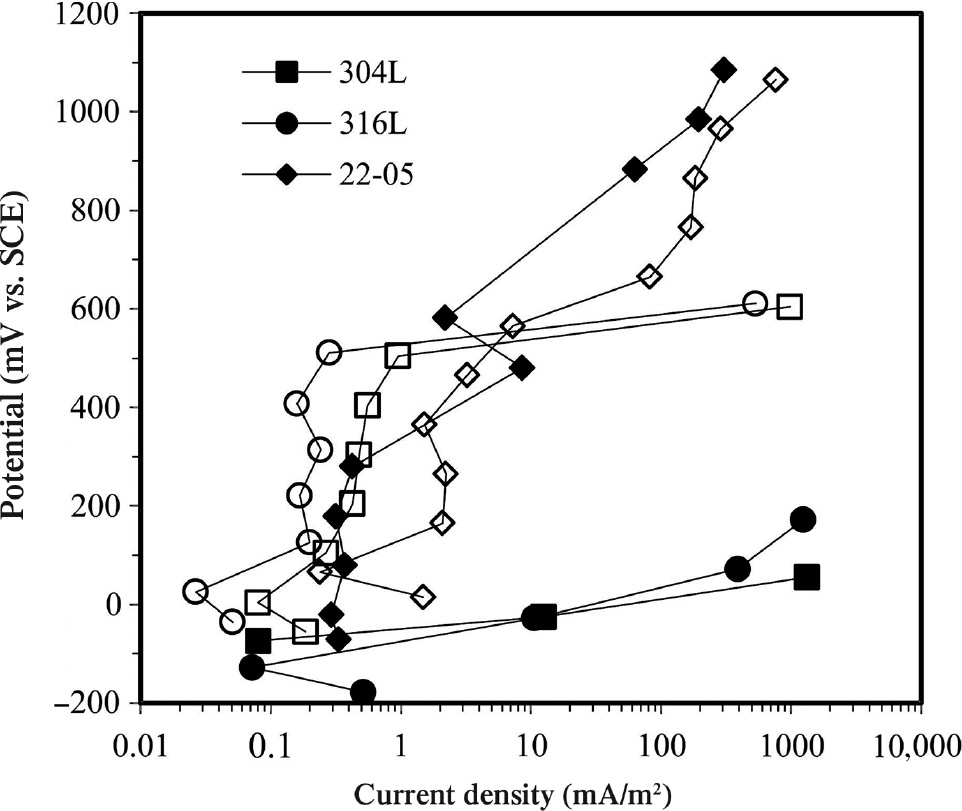
Results of potentiostatic polarisation tests on steel bars (φ 8 mm) embedded in alkaline (empty symbols) and carbonated (black symbols) concrete with 5% chloride by mass of cement (Bertolini et al., 2002).
In concrete with 2% and 4% mixed-in chlorides, 304 and 316, which were kept constantly wet using pads soaked in water, did not show initiation of pitting corrosion after approximately 2 years of exposure (García-Alonso et al., 2007a). Even in mortar with 2% and 5% mixed-in chlorides, the same rebars did not experience initiation of pitting corrosion after exposure to humidity cycles for about 3 years (García-Alonso et al., 2007b). No corrosion initiation was observed on 304L and 316L SSs during ponding tests, even with a chloride content at the steel surface of higher than 6% (Hartt et al., 2009).
Another study (Bertolini & Gastaldi, 2009) showed that corrosion initiation did not take place on ribbed bars of austenitic SS 304L and 316L, embedded in alkaline concrete with a content of chloride by mass of cement up to 8% and exposed at 20°C and 90% R.H. The passive condition was preserved also at temperatures higher than 40°C (Gastaldi & Bertolini, 2014).
In recent years, austenitic SS XM-28, with manganese added in place of nickel, has been proposed. Few works investigated its corrosion resistance, and it has been observed that it can be significantly affected by the differences in chemical composition (different producers vary the C, Ni and Mo content) and/or processing details (Hansson, 2016). According to Gastaldi et al. (2013), with potentiostatic polarisation tests at +200 mV/SCE for 24 h carried out on a set of 10 bars embedded in concrete with mixed-in chlorides in contents varying from 2% to 5%, Clth of XM-28 ranged between 2.3% and 5.5% by cement mass. According to Van Niejenhuis et al. (2016a), with potentiostatic polarisation tests at +200 mV/SCE for 4 days, corrosion occurred on three out of three bars embedded in concrete with 5% mixed-in chlorides and in two out of three bars embedded in concrete with 3% mixed-in chlorides. With potentiostatic polarisation tests at +100 mV/SCE for 4 days, corrosion did not occur on the three rebars in concrete with 3% mixed-in chlorides. In another study (Van Niejenhuis et al., 2016b), the XM-28 in sound concrete exhibited passive behaviour throughout more than 850 days’ exposure to salt brine containing 21% Cl−; however, no indication of chloride content at the bar depth at the end of exposure was reported, and hence, a minimum value for the critical chloride content cannot be discerned. Conversely, in concrete with cracks longitudinal to the bar, corrosion initiated after about 50 days.
The abovementioned studies show that traditional austenitic SS, i.e. of 316 and 304 grades, with and without molybdenum, have a high corrosion resistance in concrete. No corrosion was observed in alkaline concrete with chloride contents higher than 6% by mass of cement and even in carbonated concrete containing more than 4% chlorides by mass of cement. Even under aggressive exposure conditions simulating tropical climates, i.e. at 40°C and 95%–98% R.H., they remained passive. SS of 316 grade showed a better corrosion resistance than 304 only if anodic polarisation was applied. The more recent austenitic SS of grade XM-28 seems characterised by lower corrosion resistance in comparison with 304 and 316. Conversely, ferritic SSs showed poor corrosion resistance; pitting corrosion initiation was observed even with 1% chloride by cement mass.
3.2 Duplex SS
Austenitic-ferritic duplex SSs have also been proposed for use in concrete structures. The first study on this steel was performed in 1993 (Nurnberger et al., 1993); corrosion occurred neither in carbonated concrete with up to 2.5% Cl− by cement mass nor in cracked alkaline concrete with a chloride content higher than 4.5% Cl− by mass of cement.
The corrosion resistance of commercial ribbed bars of 22-05 SS embedded in concrete with 5% chlorides by mass of cement added in the mix was also analysed and compared to austenitic SS (Bertolini et al., 2002). Results showed that the corrosion rate of duplex SS was negligible in alkaline concrete in which either limestone-portland cement (CEM II/A-L) or ground granulated blast furnace slag cement (CEM III/B) was used, even during exposure at 40°C and 90%–95% R.H. Furthermore, corrosion initiated neither on bars in specimens in carbonated concrete with 5% chlorides by cement mass nor in alkaline concrete subjected to ponding with sodium chloride solution, although a chloride content higher than 6% by mass of cement was reached at the steel surface (Bertolini et al., 2001). Potentiostatic polarisation tests performed on these concrete specimens confirmed the outstanding corrosion resistance of 22-05 steel, showing that passivity was maintained even at potential values up to +400 mV/SCE both in alkaline and in carbonated concrete (Figure 3) (Bertolini et al., 2002). Conversely, as previously observed, austenitic SSs showed a decrease in corrosion resistance in carbonated concrete with 5% chloride when they were anodically polarised. A higher corrosion resistance of this SS, compared to 304L and 316L, in carbonated concrete and also in the presence of cracks was also observed by Islam et al. (2013), Bautista et al. (2015), and Van Niejenhuis et al. (2016b). This behaviour can be correlated to the high PREN of this SS grade.
The higher corrosion resistance of duplex SS 22-05 with respect to austenitic SSs was also confirmed by tests in alkaline (pH 12.6) and neutral (pH 7.5) solutions (Bertolini et al., 2002). Nevertheless, it was shown that the presence of welding oxide has a negative effect also on 22-05 SS, since it decreases the passivity range (Figure 4).
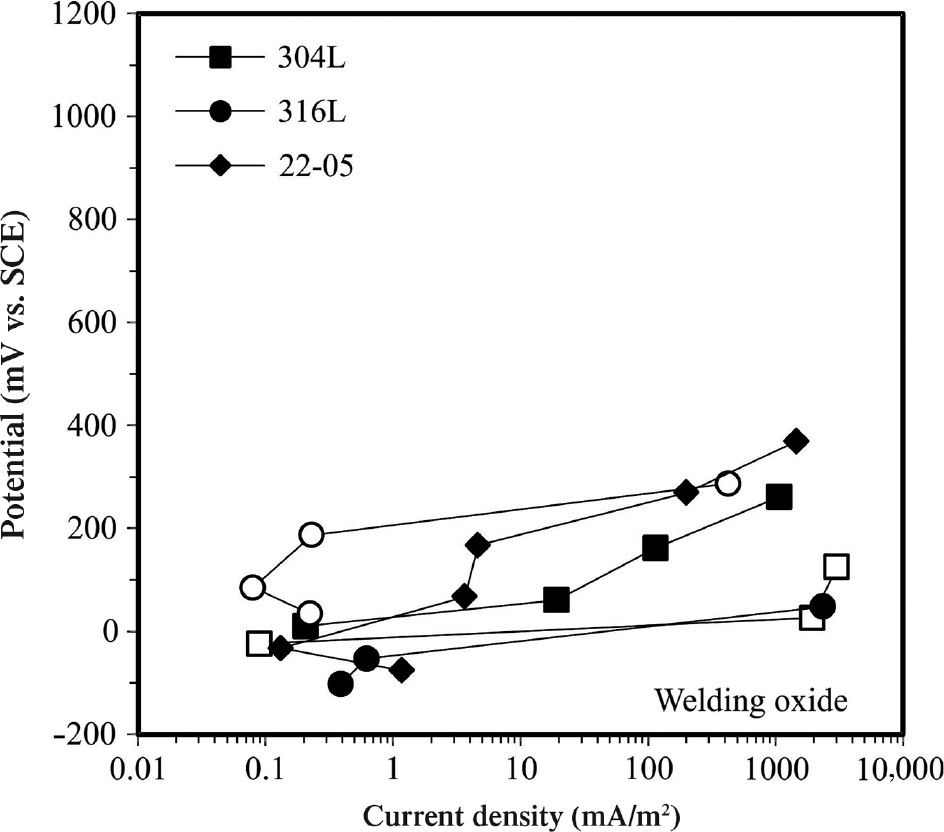
Results of potentiostatic polarisation tests on SS bars (φ 8 mm) with simulated welding oxide in concrete with 5% Cl− . White symbols show tests on annealed bars (Bertolini et al., 2002).
In recent years, the increase in the cost of the nickel has led manufacturers of SS reinforcing bars to develop low-nickel duplex SS rebars. Attention was initially focused on duplex SS of type 23-04 and, later on, on SS of type 21-01. Only few data are available in the literature regarding the corrosion resistance of these steels in concrete. Most of the published studies have been merely aimed at the evaluation of the pitting potential in alkaline solutions.
At the beginning of the 1990s, a study was carried out on 23-04 plain bars embedded in concrete with mixed-in chlorides up to 3% versus mass of cement and no corrosion was experienced during the 18 months of exposure in urban atmosphere (Pastore et al., 1991). Later on, tests were performed on the cross-section of bars of duplex austenitic-ferritic 23-04 and, for comparison, on austenitic 304, 304L, 316 and 316L in a solution simulating the concrete pore solution and in a solution with a pH of 12.6 at 20°C (Bertolini et al., 1996, 1998c). In potentiostatic polarisation tests, at +200 mV/SCE, a critical chloride content of 3.5% by mass in solution was found during tests at 40°C for 23-04 duplex SS, whilst for austenitic SS, corrosion took place at 4.5% by mass in solution.
Other authors (Bourgin et al., 2005) showed that in tests in alkaline solutions at pH 12 with 21 g/l of NaCl (about 1.3% Cl− by mass of solution) and at a temperature of 50°C, neither duplex 23-04 nor 22-05 nor austenitic 304L and 316L SS bars suffered pitting corrosion during potentiodynamic polarisation tests.
In potentiostatic polarisation tests at +100 mV/SCE in alkaline solution (pH 13–13.5) at room temperature, 23-04 SS (in pickled condition) showed an average content of chlorides for corrosion initiation of 7.5% by mass of solution (Lysogorski & Hartt, 2006).
With potentiodynamic and potentiostatic polarisation tests at +200 mV/SCE in an alkaline solution (pH 12.6), at 20°C, the ribbed 23-04 rebars showed a pitting potential of +500/+600 mV/SCE with 5% chlorides versus mass of solution (in potentiodynamic tests) and the initiation of corrosion with chlorides content of 7.5%–8% versus mass of solutions (in potentiostatic tests) (Bertolini & Gastaldi, 2009, 2011).
In more recent years, few studies were carried out in concrete contaminated by chlorides, which, however, gave a different indication about the corrosion resistance of 23-04 duplex SS in comparison to tests in solution (Bertolini & Gastaldi, 2011). As a matter of fact, duplex 23-04 SSs showed pitting corrosion initiation even in concrete with 3% chlorides by cement mass (Bertolini & Gastaldi, 2009). Therefore, even though tests in solution suggested a corrosion resistance of 23-04 SS similar to that of 304L SS, tests in concrete showed a lower corrosion threshold for the former. This suggests that the behaviour of 23-04 SS in concrete needs to be further investigated.
According to Van Niejenhuis et al. (2016b), in sound concrete, 23-04 SS exhibited passive behaviour throughout the more than 850 days’ exposure to salt brine containing 21% Cl− (no indication of the chloride content at the bar depth at the end of exposure is reported in the paper).
Even a cheaper duplex SS, i.e. 21-01, has been very recently proposed for reinforcing bars. Although the number of studies dealing with the corrosion resistance of this type of steel is rather modest, the available literature clearly shows that they have a chloride threshold even lower than that of 23-04 duplex SS. In potentiostatic polarisation tests at +200 mV/SCE in an alkaline solution (pH 12.6), the chloride content for corrosion initiation for 21-01 was lower than Cl−/OH− ratio of 8 (corresponding to about 1% Cl− versus mass of solution), whilst in the austenitic 316L, the Cl−/OH− ratio was always higher than 20 (about 3% Cl− versus mass of solution) (Hurley & Scully, 2005, 2006). Another study with potentiostatic polarisation tests in saturated calcium solutions showed that corrosion initiation on duplex 21-01 steel occurred with 3.5–6% chloride by mass of solution (Bertolini & Gastaldi, 2009) and showed that the corrosion resistance of this steel is lower than those of 23-04, 304LN and 316LN steels (Figure 5A).
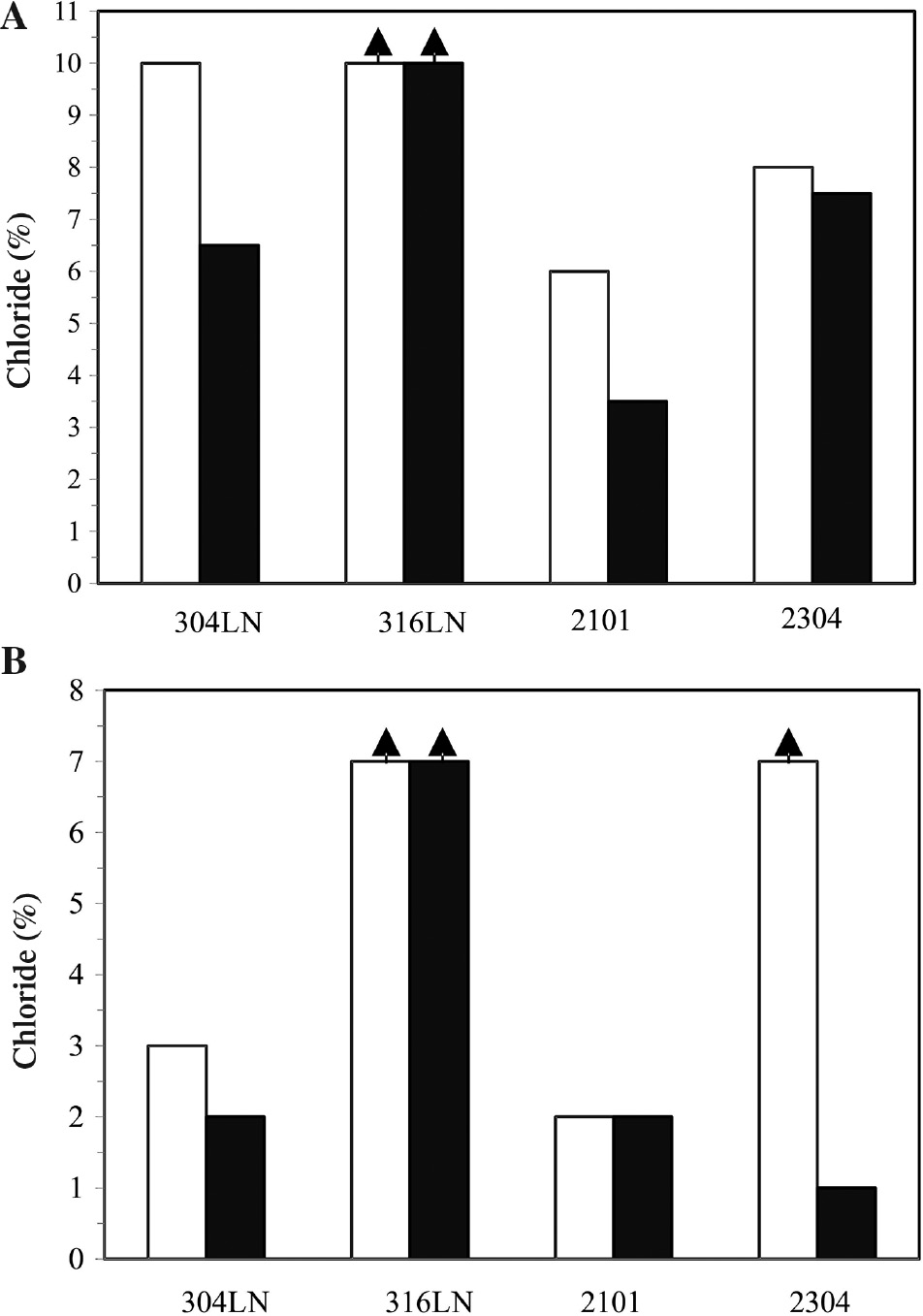
Chloride content for pitting corrosion initiation in potentiostatic polarisation tests at +200 mV/SCE in saturated Ca(OH)2 solution at 20°C (A) and 40°C (B) carried out on two replicate specimens for each grade of SS (Bertolini & Gastaldi, 2009).
Others authors (Hartt et al., 2009) showed that in tests on concrete specimens (exposed in laboratory at room temperature) subjected to ponding, 21-01 steel bars showed a corrosion resistance lower than that of ferritic 410. The chloride threshold was estimated as the chloride level that led to the initiation of corrosion in 2% of the tested bars; a value of 1.33% chlorides by mass of cement was evaluated for 21-01 steel, which was even lower than the level of 1.63% chloride by cement mass that was obtained for ferritic 410.
In another study in chloride-bearing concrete exposed at 20°C and 90% R.H., pitting corrosion took place on 21-01 in concrete specimens with 3% chloride by cement mass (Bertolini & Gastaldi, 2009).
The previous results seem to be in contrast with the conclusions of some published works that claim that 21-01 SS has a corrosion resistance similar to that of 304L, 316L and 23-04 SS (Bergquist et al., 2005; Sederholm et al., 2009). The conclusion of these papers is unsubstantiated, as it is not based on the evaluation of the chloride threshold, but it is simply argued from the observation of a similar behaviour of the two grades of steel in mild exposure conditions (T=20°C).
In order to assess the effect of temperature on the corrosion resistance of 21-01 steel, potentiostatic polarisation tests at +200 mV/SCE were carried out in chloride-contaminated alkaline solutions (pH 12.6) at 40°C. Figure 5B shows that the chloride content for corrosion initiation on 21-01 SS decreases to about 2%, showing a reduction of about 60% compared to the values at 20°C (Figure 5A). Tests at a higher temperature were also carried out on SS bars embedded in concrete. Duplex 21-01 SS suffered pitting corrosion in concrete with 2.5% chloride by cement mass exposed to 40°C.
3.3 Final consideration
The previous analysis in the literature shows that the pitting resistance equivalent number (PREN=%Cr+3.3%Mo+16%–30%N), which is normally related to the ability of SS to resist pitting attack in neutral environments, may not be reliable in alkaline environments such as concrete. In particular, the presence of molybdenum seems to have a lower effect on corrosion resistance, as confirmed by the small differences observed between 304LN (without molybdenum) and 316LN; furthermore, nickel has been shown to give a positive effect on corrosion resistance especially in simulated tropical environment (Bertolini et al., 1996; Bertolini & Gastaldi, 2011; Elsener et al., 2011a,b). In carbonated concrete [or in the presence of cracks, as SSs are directly exposed to the atmosphere, as discussed by Van Niejenhuis et al. (2016b)], conversely, PREN index might still be a useful ranking index.
Furthermore, these results suggest that, depending also on the experimental techniques adopted by different researchers, a wide range of values of chloride threshold is reported. Nevertheless, the studies are in agreement to show that different grades of SSs have different chloride threshold for corrosion initiation. In general, a very good behaviour is reported for duplex 22-05 and austenitic 316L SSs, even in concrete with high chloride contamination (e.g. 5% chlorides by mass at the steel surface) and exposed to hot environments (e.g. 40°C or higher). These types of SSs therefore may be appropriate for use in harsh environments where high chloride contamination is associated to wet and hot exposure conditions. Austenitic 304L showed, in concrete, a slightly lower corrosion resistance than did 316L and 22-05. All other types of SS bars considered in this review were shown to have a lower corrosion resistance and therefore are likely to be appropriate only in milder environments. Anyway, the dissimilar testing procedures used in the different works make the definition of design values of the chloride threshold for the different grades of SS exposed to different environmental conditions difficult. In fact, only general information about the corrosion resistance of the austenitic and duplex SS are reported on technical reports available to the designer (The Concrete Society, 1998; The Concrete Society, 2008). In Figure 6, an attempt has been made to depict approximate values of the range of Clth for the different grades of SS rebars, based on previously reported data. Values reported in this figure should be assumed only as indicative values. In the figure, it can be observed that, although indicative, the range of Clth for 21-01 SS is between 1.33% and 3% by mass of cement and, for XM-28 SS, it is between 2.3% and 5% by mass of cement. For the other SSs, only a minimum value can be detected, considering that, in real cases, chloride contents higher than 5% by mass of cement are unlikely reached at the concrete cover depth of the steel surface and, hence, Figure 6 has been limited to this value (values suggested in literature exceeding 5% have been identified by a rightward arrow). The minimum values of Clth for austenitic 304 and 316 SS were around 3.5% by mass versus cement, detected under anodic polarisation (Sorensen et al., 1990), whilst the Clth minimum value for duplex 23-04 SS was 2.7% by mass of cement. For duplex 22-05 SS, values higher than 5% by mass of cement were detected in all the studies, and hence, it can be considered that Clth for this SS is higher than 5% by mass of cement.
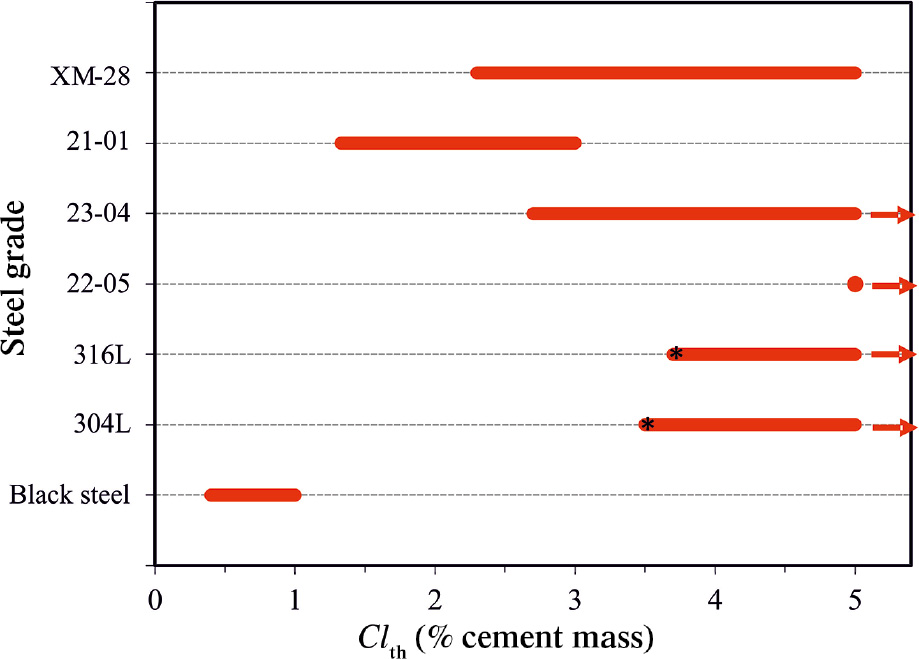
Approximate values of Clth for different grades of SS rebars obtained from the different studies (*=min. value detected under anodic polarisation by Sorensen et al., 1990).
3.4 Practical aspects
As far as practice at the construction site is concerned, it should be observed that compared with other types of corrosion-resistant rebars (such as epoxy coated or galvanised steel), corrosion resistance is a bulk property of SS. Therefore, the integrity of SS is unaffected if its surface is cut or damaged during handling. Obviously, this does not apply to clad bars (i.e. usual carbon steel bars clad with a thin layer of SS), which, in some cases, have been proposed as a cheaper alternative to solid SS bars (which have not been considered in this paper).
The chemical composition of the SS reinforcement guarantees weldability (mainly obtained by decreasing the carbon content). Nevertheless, welding is not recommended under site conditions unless adequate control is maintained; in fact, welding may have some negative consequences with regard to mechanical properties and corrosion resistance. Welding oxides and the mill scale, which negatively affect corrosion resistance, should be removed. As a matter of fact, the good corrosion resistance of austenitic grades may be affected by the presence of oxide produced at high temperature (i.e. mill scale or welding oxides). The influence of welding oxide scale on the surface of the austenitic SS was analysed by several authors. All of the published studies show that high-temperature oxides have a deleterious effect on the corrosion behaviour of the SS bars. For instance, it was shown that, in the presence of a welding oxide scale on the surface of austenitic 304 and 316 SS embedded in mortar, the chloride threshold decreased from up to 8% by cement mass to 5%–8% in the specimens in free corrosion condition (exposed outdoor) and from 3.5%–5% to 1%–2% in potentiostatic tests at +200 mV/SCE (Sorensen et al., 1990). In the study by Nurnberger et al. (1993), it was demonstrated that ferritic SS, which did not show pitting corrosion in alkaline concrete containing up to 2.5% Cl−, was susceptible to pitting attack in the presence of welding oxide in specimen with 1% Cl−. Pits were also observed on the welded bars of 316Ti SS bars embedded in cracked concrete specimens where a chloride content of about 4.5% by mass of cement was reached at the steel surface. These results show that the corrosion resistance of the SS bars is remarkably affected by the presence of high-temperature oxide scale. Therefore, it is good practice to fully remove both the mill scale and welding oxides from the surface of the steel.
The coefficient of thermal expansion of austenitic steels is higher (about 1.8×10⁻⁵°C−1) than that of concrete and of the traditional carbon steel bars (about 10−5°C−1); austenitic-ferritic steels are in an intermediate position. Although this may raise concern about differential expansion especially during fire, no cases of damage have been reported. Furthermore, the thermal conductivity of austenitic SS is much lower than that of carbon steel, and thus, the increase in temperature throughout the steel is delayed. Finally, SSs generally retain more of their room-temperature strength than carbon steel above temperatures of about 550°C and more of their stiffness than carbon steel across the whole temperature range (Gardner & Ng, 2006). Austenitic SSs are generally considered non-magnetic (although cold drawing can increase their magnetic permeability) (Bertolini et al., 2013).
In the past, concern has been expressed about the risk of galvanic corrosion of black steel induced by coupling with SS bars, in order to use the more expensive SS bars only where it is necessary to fulfil durability requirements. In principle, interaction of metals with different electrochemical behaviour could both promote corrosion initiation (e.g. due to anodic polarisation) and increase the corrosion rate (due to macrocell effects) in one of the coupled metals. Experimental tests (Bertolini et al., 1998a,b,c) showed that when both carbon steel and SS rebars are passive and embedded in aerated concrete, the macrocell does not produce appreciable effects, as both steels have almost the same free corrosion potential. Only when black steel undergoes corrosion (i.e. due to bad design or execution that does not prevent chloride penetration for the expected SL) that the macrocell current becomes significant. However, as shown in Figure 7, the increase in corrosion rate on carbon steel embedded in chloride-contaminated concrete due to galvanic coupling with austenitic SS (316L) is significantly lower than the increase brought about by coupling with passive black steel (Bertolini et al., 1998a,c; The Concrete Society, 1998). As corroding black steel is always coupled with passive areas of black steel, further coupling with SS minimises the increase of corrosion rate. By means of cathodic polarisation curves, it was shown that this behaviour is explained by higher overvoltage for the cathodic reaction of oxygen reduction on austenitic SS with respect to carbon steel (Figure 8).
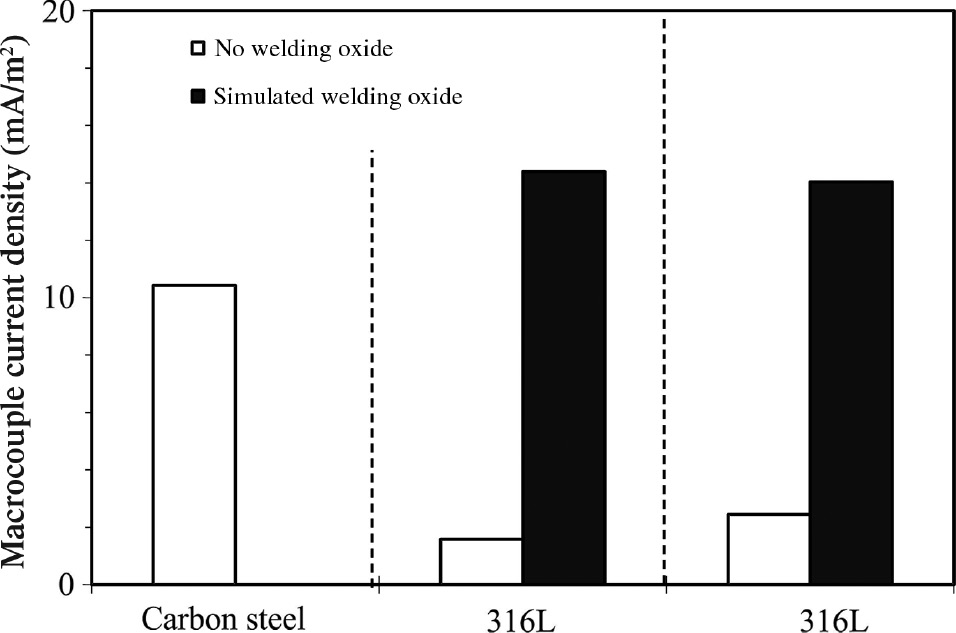
Macrocell current density exchanged between a corroding bar of carbon steel in 3% chloride contaminated concrete connected with a (parallel) passive bar of carbon steel in chloride-free concrete, 316L SS in chloride-free concrete and in 3% chloride-contaminated concrete (20°C, 95% R.H.). Results on SS bars with simulated welding scale are also reported (The Concrete Society, 1998).
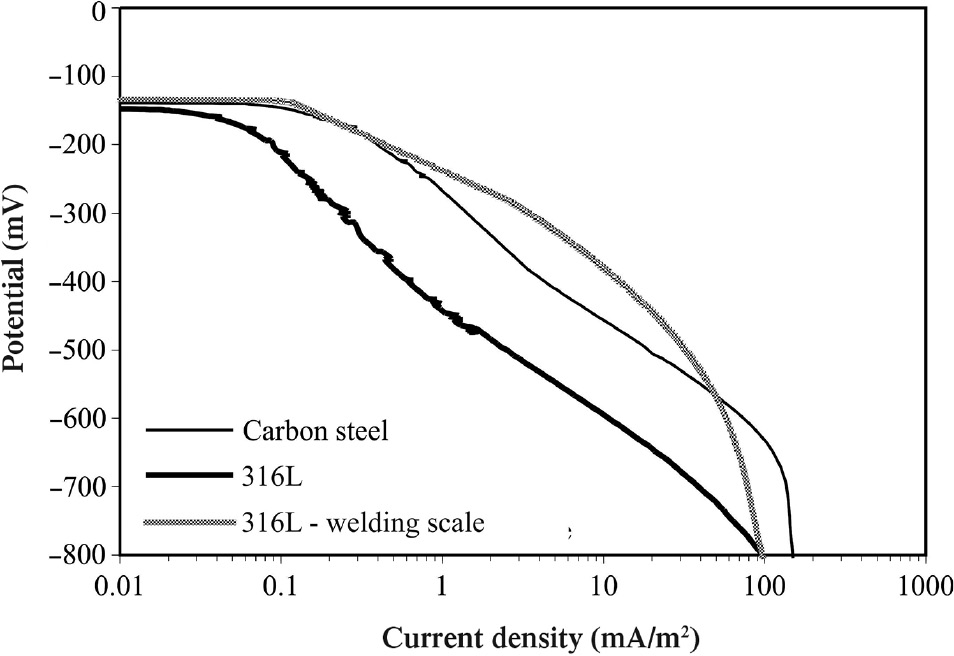
Cathodic polarisation curves in saturated Ca(OH)2 solution (pH 12.6) of 316L SS compared with the curve of carbon steel. Tests on SSs with simulated welding scale are also shown (Bertolini et al., 1998b).
As a consequence of these findings, even in technical reports, it is stated that SS bars will minimise problems that could occur in neighbouring corroding and passive areas (The Concrete Society, 1998).
Furthermore, increased galvanic current can occur in the presence of welding scale on SS. Oxide scale produced at high temperatures increases the macrocell current density generated by SSs, to the same order of magnitude or even greater than that produced by coupling with carbon steel (Figure 7) (Bertolini et al., 1998a). This risk can be avoided by removing the welding scale, either mechanically or by pickling.
Further studies have confirmed that macrocell formed when duplex 22-05 SS was electrically connected with corroding carbon steel is lower with respect to those due to coupling with passive carbon steel. Nevertheless, a higher macrocell current density was generated with respect to those produced with an austenitic SS cathode. This behaviour can be explained with the different kinetics of oxygen reduction on duplex SS; in fact, duplex SS has shown a lower overvoltage for cathodic reaction with respect to that of austenitic SS (Gojkovic et al., 1998; Sagües et al., 2005). This suggests that cathodic reaction is less inhibited in steels with the presence of the ferritic phase together with the austenitic one. No data are available for duplex SS with lower nickel content (i.e. 23-04 and 21-01).
4 Applications
SS rebars have been used in a wide range of applications, such as bridges, tunnels and underpasses, retaining walls, foundations, marine structures, historic buildings and other structures with long SLs. In several structures, the required amount of SS rebars and, hence, the entire cost of a structure were limited through the use of SS in the outermost horizontal and vertical reinforcing layer of the most exposed parts of the structures, whilst the remaining reinforcement was ordinary carbon steel reinforcement.
The first reported application of SS bars dates back to 1941 for the construction of the Progreso de Castro Pier in Yucatán (Mexico), in which plain bars of 304 were used (Castro-Borges et al., 2002). Later in Europe, SS rebars have been widely used since the mid-80s, whilst in North America, their use has been progressively growing only since the mid-90s. Table 4 shows some examples of structures built or restored in recent years where SS rebars of different grades were employed (https://www.nickelinstitute.org/∼/media/Files/TechnicalLiterature/Ni_StainlessSteel-Rebar-LD.ashx. June 2016; http://www.stainlesssteelrebar.org/applications/. June 2016; http://www.reval-stainless-steel.com/applications.html. June 2016; Gupta, 2016). For instance, grade 304 was employed for the construction of Schaffhausen Bridge on the Rhine River in Switzerland, for which an SL of 80 years was required, whilst steel grade 22-05 was used for the tower of the Stonecutters Bridge, which connects Nam Wan Kok, Tsing Yi Island and Stonecutters Island, to provide the required combination of strength and corrosion resistance through the entire SL of 120 years (Hui & Wong, 2009).
Examples of applications of different grades of SS rebars (un, unknown).
| Type of SS | Structure | Location | Date | SL (years) | Reference |
|---|---|---|---|---|---|
| 304 | Bridge on I-696 | Detroit, MI, USA | 1984 | un | www.nickelinstitute.org |
| 304L | Schaffhausen bridge | River Rhine, Switzerland | 1995 | 80 | www.stainlesssteelrebar.org |
| 304LN | Guildhall | East London | 2000 | 750 | Bertolini et al., 2013 |
| 316 | Underpass | Newcastle, Tyneside, UK | 1995 | un | www.nickelinstitute.org |
| 316L | Broadmeadow Bridge | Dublin, Ireland | 2003 | un | www.stainlesssteelrebar.org |
| 316LN | Gladstone Bridge | Queensland, Australia | un | www.reval-stainless-steel.com | |
| Bridge | Ajax, Ontario, Canada | 1998 | un | www.nickelinstitute.org | |
| Thorold Tunnel | Ontario, Canada | 2004 | un | www.nickelinstitute.org | |
| 21-01 | Gateway Bridge | South-east Queensland, Australia | 2011 | 300 | www.stainlesssteelrebar.org |
| Buddhist Temple | Thailand | 2013 | 300 | www.stainlesssteelrebar.org | |
| Junction Värtan | Stockholm, Sweden | 2015 | un | www.stainlesssteelrebar.org | |
| 22-05 | Ramp for Garden State Parkway | NJ, USA | 1998 | un | www.nickelinstitute.org |
| Haynes Inlet Slough Bridge | OR, USA | 2004 | 120 | www.stainlesssteelrebar.org | |
| Belt Parkway Bridge | Brooklyn, USA | 2004 | 100 | www.nickelinstitute.org | |
| Driscoll Bridge | NJ, USA | 2004 | un | www.nickelinstitute.org | |
| Siena Footbridge | Siena, Italy | 2006 | 120 | www.nickelinstitute.org | |
| Stonecutters Bridge | Hong Kong, China | 2009 | 120 | www.stainlesssteelrebar.org | |
| Sea wall construction | Arabian Gulf | 2009 | un | www.nickelinstitute.org | |
| Little Bay Bridge | Newington, NH, USA | 2011 | un | Gupta, 2016 | |
| Sakonnet River Bridge | RI, USA | 2012 | un | www.nickelinstitute.org | |
| Hurdman Bridge | Ontario, Canada | 2014 | un | www.stainlesssteelrebar.org | |
| Bayonne Breakwater | Bayonne, France | 2014 | un | www.stainlesssteelrebar.org | |
| Burgoyne Bridge | St. Catharine’s, Ontario, Canada | 2016 | un | Gupta, 2016 | |
| 23-04 | Cameron Heights Dr. Bridge | Edmonton, Alberta, Canada | 2010 | un | www.nickelinstitute.org |
| S. Saskatchewan River Bridge, Medicine Hat | Alberta, Canada | 2011 | un | www.nickelinstitute.org | |
| Caminada Bay Bridge | LA, USA | 2011 | un | Gupta, 2016 | |
| Hastings Bridge | MN, USA | 2012 | 100+ | www.stainlesssteelrebar.org | |
| Riverwalk | Brisbane, Australia | 2013 | 100 | www.stainlesssteelrebar.org | |
| Allt Chonoglias Bridge | Scotland, UK | 2013 | 120 | www.stainlesssteelrebar.org | |
| Coastal Protection | Cromer, UK | 2014 | 50 | www.stainlesssteelrebar.org | |
| Kenaston Overpas | Winnipeg, Manitoba, Canada | 2014 | un | www.nickelinstitute.org | |
| Daniel Hoan Bridge | Milwaukee, WI, USA | 2014 | un | Gupta, 2016 | |
| Macau Bridge | Hong Kong – Zhuhai – China | 2016 | 120 | www.stainlesssteelrebar.org | |
| New Champlain Bridge | Montreal, Canada | 2016 | un | www.stainlesssteelrebar.org | |
| XM-28 | Light rail transit | Edmonton, Alberta, Canada | 2012 | un | Gupta, 2016 |
| Osborne Bridge | Winnipeg, Manitoba, Canada | 2012 | un | Gupta, 2016 | |
| Pulasky skyway | Newark, Jersey City, USA | 2014 | un | Gupta, 2016 | |
| Kosciuszko Bridge | New York City, USA | 2019 | un | Gupta, 2016 |
From Table 4, it can be observed that SS rebars are usually utilised in extremely corrosive marine environments, for instance, in the Coastal Protection at Cromer, UK, or in the presence of massive chloride contamination from deicing salts, for instance, in the Värtan Junction, in Sweden. However, SS rebars are also employed to prevent carbonation-induced corrosion, as in the GuildHall Yard East in London, which is a building hosting a Roman amphitheatre, built in 2000 with a design SL of 750 years, where SS rebars were used for the new RC walls. SS rebars are both employed for the construction of new structures or for the repair and renovation of existing structures where very long design lives are required. As a matter of fact, SS rebars can be beneficial in those repair cases where carbon steel bars are corroded to such an extent that local replacement or additional reinforcement is needed as part of a repair or to control cracking where concrete cover is low in the repaired zones. In the latter case, fine welded mesh reinforcement is often used. In this regard, some examples are the rehabilitation of walls of the Thorold Tunnel, Canada, in 2004 or the maintenance of the Gladstone Bridge, Australia, which, although built in 1960, showed in recent years corrosion of the reinforcing carbon steel on the deck. In the repair work of this bridge, SS ribbed bars type 316L joined with original carbon steel was used.
Finally, in Table 4, it can be observed that SS rebars are commonly used to guarantee long SLs, also longer than 100 years; often the indications on the required SL are lacking or SLs also of the order of 300 years, in marine environments, are prescribed. In the latter case, some doubts could arise that the SS grade employed for those structures could really guarantee such a long design life.
In the framework not only of durability but also of sustainability of RC structures, a promising and innovative application of SS rebars can be considered when chloride-contaminated raw materials are used for concrete. As a matter of fact, the construction industry could greatly benefit from the use of chloride-contaminated raw materials for the production of concrete, as great amounts of natural resources such as fresh water or mined rocks for aggregates could be saved. Within the framework of ERA-NET Plus Infravation 2014, the SEACON project “Sustainable concrete using seawater, salt-contaminated aggregates, and non-corrosive reinforcement” was started, with the aim of demonstrating the safe utilisation of seawater and salt-contaminated aggregates for a sustainable concrete production when combined with non-corrosive reinforcement (GFRP and SS bars) (Lollini et al., 2016a, 2017a; Redaelli et al., 2017).
5 Concluding remarks
SS rebars have been widely used worldwide both for the construction of new structures and infrastructures and the repair of existing structures. Laboratory and field experience has shown that SS bars can prevent corrosion even in RC structures exposed to the most severe environments and that they are able to significantly increase the chloride threshold by a factor of even 4–10, compared to conventional carbon steel bars.
Furthermore, they can be coupled with ordinary black steel bars, as the effect of the galvanic coupling is negligible. Hence, they can be used only in selected parts of the structures, exposed to the most aggressive exposure conditions, employing ordinary black steel bars in the other parts.
Today, a range of SS grades is commercially available, which provide different corrosion resistances and costs. Nevertheless, in order to evaluate the grade of SS to be used to guarantee the target durability requirements for the construction of RC structures, the designers need to know their corrosion resistance and, in particular, the critical chloride threshold for corrosion initiation.
About the authors

Federica Lollini is assistant professor in the field of materials science and technology at Politecnico di Milano (Italy). She received her MS and PhD from Politecnico di Milano. Her research interests include durability of reinforced concrete structures both in urban and marine environments. The design of concrete composition, the type of steel bar and constructions details in relation with the design service life, with regard to corrosion of steel reinforcement, are her main research topics.

Maddalena Carsana has a PhD in materials engineering. She is a researcher and assistant professor of construction materials at Politecnico of Milan. She works in the field of durability of construction materials. Her research interests are the durability and conservations of reinforced concrete structures and the development of new cementitious based on recycled materials and mineral additions.

Matteo Gastaldi is assistant professor in the field of material science and technology at Politecnico di Milano. His research activity is focused on the durability of construction materials. In particular, his main interests concern the prevention and protection techniques, mainly related to the use of stainless steel reinforcement, and the design for durability of reinforced concrete structures.

Elena Redaelli is assistant professor in the field of materials science and technology at Politecnico di Milano. Her main research interests are related to the corrosion of steel in concrete, its characterization and the methods to prevent and control it. In particular, her activity has focused on electrochemical techniques in concrete and methods for durability design of concrete structures.
References
Alonso MC, Sanchez M. Analysis of the variability of chloride threshold values in the literature. Mater Corros 2009; 60: 631–637.10.1002/maco.200905296Search in Google Scholar
Bautista A, Alvarez SM, Paredes EC, Velasco F, Guzman S. Corrugated stainless steels embedded in carbonated mortars with and without chlorides: 9-year corrosion results. Constr Build Mater 2015; 95: 186–196.10.1016/j.conbuildmat.2015.07.099Search in Google Scholar
Bergquist A, Iversen A, Qvafort R. Corrosion properties of UNS S32101 – a new duplex stainless steel with low nickel content tested for use as reinforcement in concrete. Corrosion/2005, NACE, Houston, Paper No. 05260 (2005).10.5006/C2005-05260Search in Google Scholar
Bertolini L, Gastaldi M. Corrosion resistance of austenitic and low-nickel duplex stainless steel bars. Int Conf Eurocorr09, Nice, 6–10 September 2009.Search in Google Scholar
Bertolini L, Redaelli E. Depassivation of steel reinforement in case of pitting corrosion: detection techniques for laboratory studies. Mater Corros 2009; 60: 608–616.10.1002/maco.200905276Search in Google Scholar
Bertolini L, Gastaldi M. Corrosion resistance of low-nickel duplex stainless steel rebars. Mater Corros 2011; 62: 120–129.10.1002/maco.201005774Search in Google Scholar
Bertolini L, Bolzoni F, Pastore T, Pedeferri P. Behaviour of stainless steel in simulated concrete pore solution. Br Corros J 1996; 31: 218–222.10.1179/bcj.1996.31.3.218Search in Google Scholar
Bertolini L, Gastaldi M, Pastore T, Pedeferri MP, Pedeferri P. Experiences on stainless steel behaviour in reinforced concrete. Int Conf Eurocorr ’98, “Solutions of Corrosion Problems”, European Federation of Corrosion, Event No. 221, Utrecht, 28th September–1st October 1998a.Search in Google Scholar
Bertolini L, Gastaldi M, Pastore T, Pedeferri MP, Pedeferri P. Effects of galvanic coupling between carbon steel and stainless steel reinforcement in concrete. Int Conf on “Corrosion and Rehabilitation of Reinforced Concrete Structures”, Federal Highway Administration, Orlando, 7–11 December 1998b.Search in Google Scholar
Bertolini L, Pedeferri P, Pastore T. Stainless steel in reinforced concrete structures. In: Gjørv OE, Sakai K, Bathia N. editors. Concrete under severe conditions 2 – environment and loading, New York: E & FN Spon, 1998c; Vol. 1: 94–103.10.5006/C1997-97244Search in Google Scholar
Bertolini L, Gastaldi M, Pastore T, Pedeferri MP. Corrosion behaviour of stainless steels in chloride contaminated and carbonated concrete. Internationale Zeitschrift für Bauinstandsetzen und Baudenkmalpfledge 2000; 6: 273–292.10.1515/rbm-2000-5476Search in Google Scholar
Bertolini L, Gastaldi M, Pedeferri P. Stainless Steel in concrete. Annual Progress Report, European Community, COST 521 Workshop, References 269, Tampere, 17–20 June, 2001.Search in Google Scholar
Bertolini L, Gastaldi M, Pedeferri P, Redaelli E. Factors influencing the corrosion resistance of austenitic and duplex stainless steel bars in chloride bearing concrete. 15th International Corrosion Congress – ICC, Granada, 2002.Search in Google Scholar
Bertolini L, Elsener B, Pedeferri P, Redaelli E, Polder R. Corrosion of steel in concrete: prevention, diagnosis, repair, 2nd ed., Weinheim: Wiley-VCH, 2013.10.1002/9783527651696Search in Google Scholar
Bourgin C, Chauveau E, Demelin B. Stainless steel rebar: the choice of service life, 5th European Stainless Steel Science and Market Congress, Sevilla, 2005.10.1051/metal:2006159Search in Google Scholar
Brown BL, Harrop D, Treadaway KWJ. Corrosion testing of steels for reinforced concrete. Building Research Establishment, Garston, 1978: 45–78.Search in Google Scholar
Castro-Borges P, Troconis De Rincón O, Moreno EI, Torres-Acosta AA, Martínez-Madrid M, Knudsen A. Performance of a 60-year-old concrete pier with stainless steel reinforcement. Mater Perform 2002; 41: 50–55.Search in Google Scholar
Cox RN, Oldfield JW. The long term performance of austenitic stainless steel in chloride-contaminated concrete. In: Page CL, Bamforth PB, Figg JW editors. Corrosion of reinforcement in concrete construction. Soc Chem Ind 1996: 662–669.Search in Google Scholar
Elsener B, Addari D, Coray S, Rossi A. Nickel-free manganese bearing stainless steel in alkaline media-electrochemistry and surface chemistry. Electrochim Acta 2011a; 56: 4489–4497.10.1016/j.electacta.2011.02.049Search in Google Scholar
Elsener B, Addari D, Coray S, Rossi A. Stainless steel reinforcing bars – reason for their high pittingcorrosion resistance. Mater Corros 2011b; 62: 111–119.10.1002/maco.201005826Search in Google Scholar
EN 10088-1: Stainless steels – part 1: list of stainless steels, 2005.Search in Google Scholar
Flint GN, Cox RN. The resistance of stainless steel partly embedded in concrete to corrosion by seawater. Mag Concr Res 1998; 40: 13–27.10.1680/macr.1988.40.142.13Search in Google Scholar
Frederiksen JM. On the need for more precise threshold values for chloride initiated corrosion. Mater Corros 2009; 60: 597–601.10.1002/maco.200905273Search in Google Scholar
García-Alonso MC, Escudero ML, Miranda JM, Vega MI, Capilla F, Correia MJ, Salta M, Bennani A. González JA. Corrosion behaviour of new stainless steels reinforcing bars embedded in concrete. Cem Concr Res 2007a; 37: 1463–1471.10.1016/j.cemconres.2007.06.003Search in Google Scholar
García-Alonso MC, González JA, Miranda J, Escudero ML, Correia MJ, Salta M, Bennani A. Corrosion behaviour of innovative stainless steels in mortar. Cem Concr Res 2007b; 37: 1562–1569.10.1016/j.cemconres.2007.08.010Search in Google Scholar
Gardner L, Ng KT. Temperature development in structural stainless steel sections exposed to fire. Fire Safe J 2006; 41: 185–203.10.1016/j.firesaf.2005.11.009Search in Google Scholar
Gastaldi M, Bertolini L. Effect of temperature on the corrosion behaviour of low-nickel duplex stainless steel bars in concrete. Cem Concr Res 2014; 56: 52–60.10.1016/j.cemconres.2013.11.004Search in Google Scholar
Gastaldi M, Lollini F, Bertolini L. Performance-based durability design of concrete structures reinforced with stainless steel bars, 3rd Workshop on The new boundaries of Structural Concrete, Bergamo 3–4 October 2013.Search in Google Scholar
Glass GK, Buenfeld NR. Chloride threshold level for corrosion of steel in concrete. Corros Sci 1997; 39: 1001–1013.10.1016/S0010-938X(97)00009-7Search in Google Scholar
Gojkovic SL, Zecevic SK, Obradovic MD, Drazic DM. Oxygen reduction on a duplex stainless steel. Corros Sci 1998; 40: 849–860.10.1016/S0010-938X(98)00004-3Search in Google Scholar
Gupta S. Use of stainless steel reinforcement bars for extending bridge life. Presentation at FHWA Corrosion Resistance Reinforcing Bar Seminar, 4/7/16, Stillwater, OK.Search in Google Scholar
Hansson CM. Corrosion of stainless steel in concrete. In: Poursaee A, editor. Corrosion of steel in concrete structures. Duxford, UK: Woodhead Publishing, Elsevier Ltd., 2016.10.1016/B978-1-78242-381-2.00004-3Search in Google Scholar
Hartt WH, Powers RG, Kessler RJ. Performance of corrosion resistant reinforcements in concrete and application of results to service life projection. Corrosion 2009, NACE, Houston, 2009, Paper No. 09206.10.5006/C2009-09206Search in Google Scholar
Hui MCH, Wong CKP. Stonecutters Bridge – durability, maintenance and safety considerations. Struct Infrastruct Eng 2009; 5: 229–243.10.1080/15732470601130337Search in Google Scholar
Hurley MF, Scully JR. Threshold chloride concentration of selected corrosion resistant rebar materials compared to carbon steel. Corrosion/2005, NACE, Houston, Paper No. 05259 (2005).10.5006/C2005-05259Search in Google Scholar
Hurley MF, Scully JR. Threshold chloride concentrations of selected corrosion-resistant rebar materials compared to carbon steel. Corrosion 2006; 62: 892–904.10.5006/1.3279899Search in Google Scholar
https://www.nickelinstitute.org/∼/media/Files/TechnicalLiterature/Ni_StainlessSteel-Rebar-LD.ashx. June 2016.Search in Google Scholar
http://www.stainlesssteelrebar.org/applications/. June 2016.Search in Google Scholar
http://www.reval-stainless-steel.com/applications.html. June 2016.Search in Google Scholar
Islam MA, Bergsma BP, Hansson CM. Chloride-induced corrosion behavior of stainless steel and carbon steel reinforcing bars in sound and cracked concrete. Corrosion 2013; 69: 303–312.10.5006/0706ESearch in Google Scholar
Lollini F, Carsana M, Gastaldi M, Redaelli E, Bertolini L. The challenge of the performance-based approach for the design of reinforced concrete structures in chloride bearing environment. Constr Build Mater 2015; 79: 245–254.10.1016/j.conbuildmat.2014.12.044Search in Google Scholar
Lollini F, Carsana M, Gastaldi M, Redaelli E, Bertolini L, Nanni A. Preliminary assessment of durability of sustainable RC structures with mixed-in seawater and stainless steel reinforcement. Key Eng Mater 2016a; 711: 52–59.10.4028/www.scientific.net/KEM.711.52Search in Google Scholar
Lollini F, Redaelli E, Bertolini L. Investigation on the effect of supplementary cementitious materials on the critical chloride threshold of steel in concrete. Mater Struct 2016b; 49: 4147–4165.10.1617/s11527-015-0778-0Search in Google Scholar
Lollini F, Carsana M, Gastaldi M, Redaelli E, Torabian Isfahani F, Bertolini L. Corrosion behaviour of reinforcement in concrete with chloride-contaminated raw materials – part I: laboratory tests. Metallurgia Italiana 2017a; 7–8: 39–42.Search in Google Scholar
Lollini F, Gastaldi M, Bertolini L, Performance parameters for the durability design of reinforced concrete structures with stainless steel reinforcement. Struct Infrastruct Eng 2018; doi: 10.1080/15732479.2018.1436573.10.1080/15732479.2018.1436573Search in Google Scholar
Lysogorski D, Hartt WH. Performance of corrosion resistant reinforcement in short-term laboratory experiments, Corrosion/2006, NACE, Houston, Paper No. 06339, 2006.Search in Google Scholar
Nurnberger U, Beul W, Onuseit G. Corrosion behaviour of welded stainless reinforcing steel in concrete. Otto Graf J 1993; 4: 225–259.Search in Google Scholar
Nurnberger U, Beul W. Corrosion of stainless steel reinforcement in cracked concrete. Otto Graf J 1999; 10: 23–37.Search in Google Scholar
Page CL. Initiation of chloride-induced corrosion of steel in concrete: role of the interfacial zone. Mater Corros 2009; 60: 586–592.10.1002/maco.200905278Search in Google Scholar
Pastore T, Pedeferri P. Corrosion behaviour of a duplex stainless steel in chloride contaminated concrete. Proc Int Conf Stainless Steel’ 91 ISIJ, Japan: Chiba, 1991; 1: 351–358.Search in Google Scholar
Pastore T, Pedeferri P, Bertolini L, Bolzoni F, Cigada A. Electrochemical study on the use of duplex stainless steel in concrete. In: Charles J, Bernhardsson S. editors. Duplex Stainless Steels’ 91. Les Editions Physique 1991; 2: 905–913.Search in Google Scholar
Redaelli E, Carsana M, Gastaldi M, Lollini F, Torabian Isfahani F, Bertolini L. Corrosion behaviour of reinforcement in concrete with chloride-contaminated raw materials – part II: on site preliminary results. Metallurgia Italiana 2017; 7–8: 43–46.Search in Google Scholar
Sagües A, Virtanen S, Schmuki P. Oxygen reduction on passive steel and Cr rich alloys for concrete reinforcement. Proceedings of the 9th International Symposium on the Passivation of Metals and Semiconductors and the Properties of Thin Oxide Layers, Paris, 2005.10.1016/B978-044452224-5/50049-4Search in Google Scholar
Sederholm B, Almqvist J, Randstrom S. Corrosion properties of stainless steels as reinfocement in concrete in Swedish outdoor environment. Corrosion/2009, NACE, Houston, Paper No. 09203, 2009.10.5006/C2009-09203Search in Google Scholar
Sorensen B, Jensen PB, Maahn E. The corrosion properties of stainless steel reinforcement. In: Page CL, Treadaway KWJ, Bamforth PB, editors. Corrosion of Reinforcement in Concrete. England: Elsevier Appl Sci 1990: 601–610.Search in Google Scholar
The Concrete Society. Guidance on the use of stainless steel reinforcement. Technical Report No. 51, 1998.Search in Google Scholar
The Concrete Society. Guide to the design of concrete structures in the Arabian Peninsula. Report CS 163, 2008.Search in Google Scholar
Treadaway KWJ, Cox RN, Brown BL. Durability of corrosion resisting steels in concrete. Proc Instn Civil Eng 1989; Part 1, 86: 305–331.10.1680/iicep.1989.1628Search in Google Scholar
Tuutti K. Corrosion of steel in concrete. Swedish foundation for concrete research, Stockholm, 1982.Search in Google Scholar
Van Niejenhuis CB, Bandura TW, Hansson CM. Evaluation of the proposed European test procedure for ranking stainless steel rebar. Corrosion 2016a; 72: 834–842.10.5006/2000Search in Google Scholar
Van Niejenhuis CB, Walbridge S, Hansson CM. The performance of austenitic and duplex stainless steels in cracked concrete exposed to concentrated chloride brine. J Mater Sci 2016b; 51: 362–374.10.1007/s10853-015-9387-0Search in Google Scholar
Article note:
The article is a tribute to Professor Bertolini for his outstanding work in the field of stainless steel rebars.
©2019 Walter de Gruyter GmbH, Berlin/Boston
Articles in the same Issue
- Frontmatter
- Editorial
- Environmental degradation of reinforced concrete structures
- Review
- Corrosion behaviour of stainless steel reinforcement in concrete
- Original articles
- New service limit state criteria for reinforced concrete in chloride environments
- The performance of corroded lap splices in reinforced concrete beams
- Corrosion effects on seismic capacity of reinforced concrete structures
- Assessment of reinforced concrete structures in marine environment: a case study
Articles in the same Issue
- Frontmatter
- Editorial
- Environmental degradation of reinforced concrete structures
- Review
- Corrosion behaviour of stainless steel reinforcement in concrete
- Original articles
- New service limit state criteria for reinforced concrete in chloride environments
- The performance of corroded lap splices in reinforced concrete beams
- Corrosion effects on seismic capacity of reinforced concrete structures
- Assessment of reinforced concrete structures in marine environment: a case study
