High-temperature corrosion resistance of SiO2-forming materials
-
Kazuya Kurokawa
Kazuya Kurokawa received his MEng and DEng in metallurgical engineering in 1980 and 1983, respectively, from Hokkaido University, Japan. He has worked in CAREM of Hokkaido University as a professor since 2003 and now in the National Institute of Technology, Tomakomai College, Japan, as the President. His research interests are the high-temperature oxidation of metals and alloys and the development of advanced high-temperature materials.
 ,
Toto Sudiro
,
Toto Sudiro
Toto Sudiro received his MEng and DEng in materials science and engineering in 2010 and 2013, respectively, from Hokkaido University. He has worked in the Research Center for Physics of the Indonesian Institute of Sciences as a researcher since 2011. His research interests are the high-temperature oxidation and corrosion of alloys and the microstructure of coatings prepared by using mechanical alloying and thermal spray techniques.
Tomonori Sano received his MEng in materials science and engineering in 2011 from Hokkaido University. He has worked as an engineer at Mitsubishi Heavy Industry Ltd., Japan, since 2011.
Shoji Kyo received his DEng in materials science and engineering in 2014 from Hokkaido University. He works in the Power Engineering R&D Center, Kansai Electric Co., Inc., Japan. His research interests are the evaluation of high-temperature corrosion of boiler tubes and the development and practical use of thermal spray materials with resistance to high-temperature sulfidation and abrasion.
Osamu Ishibashi works at Osaka Fuji Corporation, Japan. His research field is in the plasma spraying of various materials on metallic substrates.
Masaharu Nakamori received his DEng in materials science and engineering in 1993 from Hokkaido University. He worked in the corrosion protection of power systems at Takasago Technical Institute Chemical Research Laboratory, Mitsubishi Heavy Industry from 1970 to 2000. He was a guest professor in Hokkaido University from 2009 to 2011. Presently, he works at High Temperature Corrosion & Protection Technosearch Co., Ltd., Japan.

Abstract
An increasing demand for electricity and preserving the environment has become a great driving force for the development of advanced boilers for coal-fired plants to improve their plant efficiency by raising the operating temperature. To achieve this purpose, the development of materials that possess a high mechanical strength and excellent resistance against corrosion at high temperatures is required. Considering such situation, the high-temperature corrosion behavior of SiO2-forming materials such as CrSi2-Ni and CoNiCrAlY-Si alloys in atmospheres containing NaCl and Na2SO4 is introduced. The SiO2 scale plays a significant role in suppressing the inward diffusion of sulfur and chlorine, resulting in the remarkable suppression of the formation of sulfide and chloride at the scale/substrate interface and inside of the substrate. Based on such results, it is emphasized that SiO2-forming materials show outstanding corrosion resistance against atmospheres containing NaCl and Na2SO4.
1 Introduction
STBA and similar steels are widely used as alloy steel boilers and heat exchanger tubes in the superheater tubes of boilers in coal-fired plants. However, to satisfy future demands for high efficiency and reduced CO2 emissions, their use in environments with even higher temperatures and pressures is required (Viswanathan & Bakker, 2001a,b; Hashimoto et al., 2008). Furthermore, the use of coal-rich reserves is increasingly important for power generation (International Energy Outlook, 2010). In such harsh environments, material degradation can increase in severity due to the high-temperature corrosion from corrosive gases and molten salts as well as the erosion from the impact of combustion ash. Given these circumstances, it has become necessary to develop a base or coating material with excellent high-temperature corrosion and erosion resistances.
Research related to the high-temperature corrosion of boiler or coating materials has been conducted over the past several decades (Goebel et al., 1973; Hendry & Lees, 1980; Lee & Lin, 1999; Peng et al., 2003; Uusitalo et al., 2004; Mayoral et al., 2006; Li et al., 2007; Singh et al., 2007). Moreover, many papers have been published concerning the mechanism of high-temperature corrosion in the presence of various corrosive gas species and substances (Goebel & Pettit, 1970; Stringer, 1977; Grabke, 1984; Stroosnijder & Quadakkers, 1986a,b; Rapp, 1987, 2002; Kofstad, 1988; Bender & Schütze, 2003; Young, 2008; Pettit, 2011). In complex atmospheres containing molten salts and similar corrosive substances, products (sulfides, chlorides, and others) often form at the interface of scale and alloy substrate or in the alloy, which are difficult to anticipate based on the thermodynamics of the metal and atmosphere. In particular, considering the high efficiency (high temperature) of plants in the future, the corresponding production of sulfides and chlorides will be extremely harmful from the viewpoint of high-temperature corrosion resistance. As such, it is necessary to suppress the production of these substances. However, a solution to this problem is difficult to determine for conventional Fe- or Ni-based materials.
With this background, we have conducted research for several years to study the high-temperature corrosion resistance of silicide-based SiO2-forming materials (Sudiro et al., 2009, 2011a,b, 2012a,b,c,d; Sano et al., 2011), which have been found to be effective in suppressing the formation of sulfides and chlorides. In this paper, we describe the effectiveness of these SiO2-forming materials.
2 SiO2-forming materials
As metal disilicides (MSi2) have a high Si concentration, in principle, they should readily form an SiO2 film. However, not all metal disilicides do so, and few are able to form an SiO2 film. The following conditions are required for an SiO2 film formation:
The affinity of the metal for oxygen should be considerably lower than that for Si.
The diffusion coefficient of Si in the silicide should be larger than that of the oxygen (ions) in the SiO2 film.
FeSi2 and CoSi2 are known metal disilicides that satisfy these conditions, in which an SiO2 film is formed by the selective oxidation of Si.
Furthermore, in the case of MoSi2 or WSi2, although a metal oxide is formed along with SiO2 in the initial stage of oxidation, the vapor pressure of the metal oxide is high and it volatilizes rapidly. As a result, the substrate is covered with SiO2 during the initial stage of oxidation. As the oxygen partial pressure of the SiO2/substrate interface is close to the dissociation pressure of SiO2, the metal is not subsequently oxidized and only SiO2 grows. However, this oxidation behavior strongly depends on temperature, with a higher temperature being more advantageous for forming an SiO2 film.
CrSi2 forms a slightly different oxide film than the above-mentioned metal disilicides. Basically, as with the cases of FeSi2 and CoSi2, we may expect that an SiO2 single film will be formed by the selective oxidation of Si; in fact, a double-layer structure film is formed comprising SiO2 and Cr2O3 layers from the side of the substrate (Yamauchi et al., 2010). However, the thickness of the Cr2O3 layer is negligibly small compared to the SiO2 layer.
In this paper, in addition to CrSi2-based materials forming an SiO2 film in a wide temperature range, the high-temperature corrosion resistance of other SiO2-film-forming materials such as CoNiCrAlY-Si alloy is also described. We obtained our results in one of the following two ways: (1) by embedding into NaSO4-25.7 mass% NaCl close to the eutectic composition (melting point 901 K) in an alumina crucible with a lid (hereafter referred to as the embedding method) or (2) by setting it above the liquid surface of the molten salt (hereafter referred to as the composite gas method). The corrosive environment of the latter is the air-NaSO4-NaCl composite gas environment. Table 1 shows the vapor pressures of NaSO4 and NaCl measured at that time.
Vapor pressures of NaCl and Na2SO4 at each temperature.
| Vapor pressure of NaCl (Pa) | Vapor pressure of Na2SO4 (Pa) | |
|---|---|---|
| 923 K | 7.101×10⁻¹ | 2.121×10⁻⁶ |
| 1073 K | 3.631×101 | 5.988×10⁻⁴ |
| 1273 K | 9.090×10² | 9.194×10⁻² |
3 Characteristics of the high-temperature corrosion resistance of p-type and n-type oxide films
First, we consider the high-temperature corrosion of a metal forming a p-type oxide film, wherein the diffusion of metal ions is dominant compared to that of oxide ions such as oxides of Fe and Ni. For the high-temperature corrosion related to molten salts, Figure 1 (Sano et al., 2011) shows examples for STBA 21 (Cr 1, Mn 0.3–0.6, Mo 0.3, Si<0.5, C 0.1–0.2, P<0.035, S<0.035, Fe bal, in mass%) subjected to high-temperature corrosion at 923 K by the composite gas method. Accordingly, an oxide scale as an external scale is formed but at the interface between the oxide scale and the substrate, sulfides and chlorides are frequently produced. Depending on the atmosphere, carburizing may also occur inside the metal or alloy. The fact that oxides are formed on the outermost surface of the scale indicates that the thermodynamic equilibrium phase between the atmosphere and the metal is an oxide, and if the oxide scale is dense, we can also expect that oxides will form on the metal side from the outermost surface. In this case, as the oxygen partial pressure at the oxide scale and substrate interface corresponds to the dissociation pressure of the oxide (assuming that the equilibrium constant of O2=2O is 1, the dissociation pressure is pO2′=aO2), as shown in Figure 2, large oxygen and metal potential gradients are formed in the oxide scale. The fact that the inward diffusion of oxide ions is negligible in the oxide scale exhibiting p-type semiconductivity indicates that the oxygen partial pressure at the interface of the oxide scale and the substrate is maintained at the dissociation pressure of the oxide. In cases involving the diffusion or penetration of other components, such as sulfur, into such a low oxygen potential interface via defects such as microcracks, the potential of the component exhibits a relative increase at the interface.
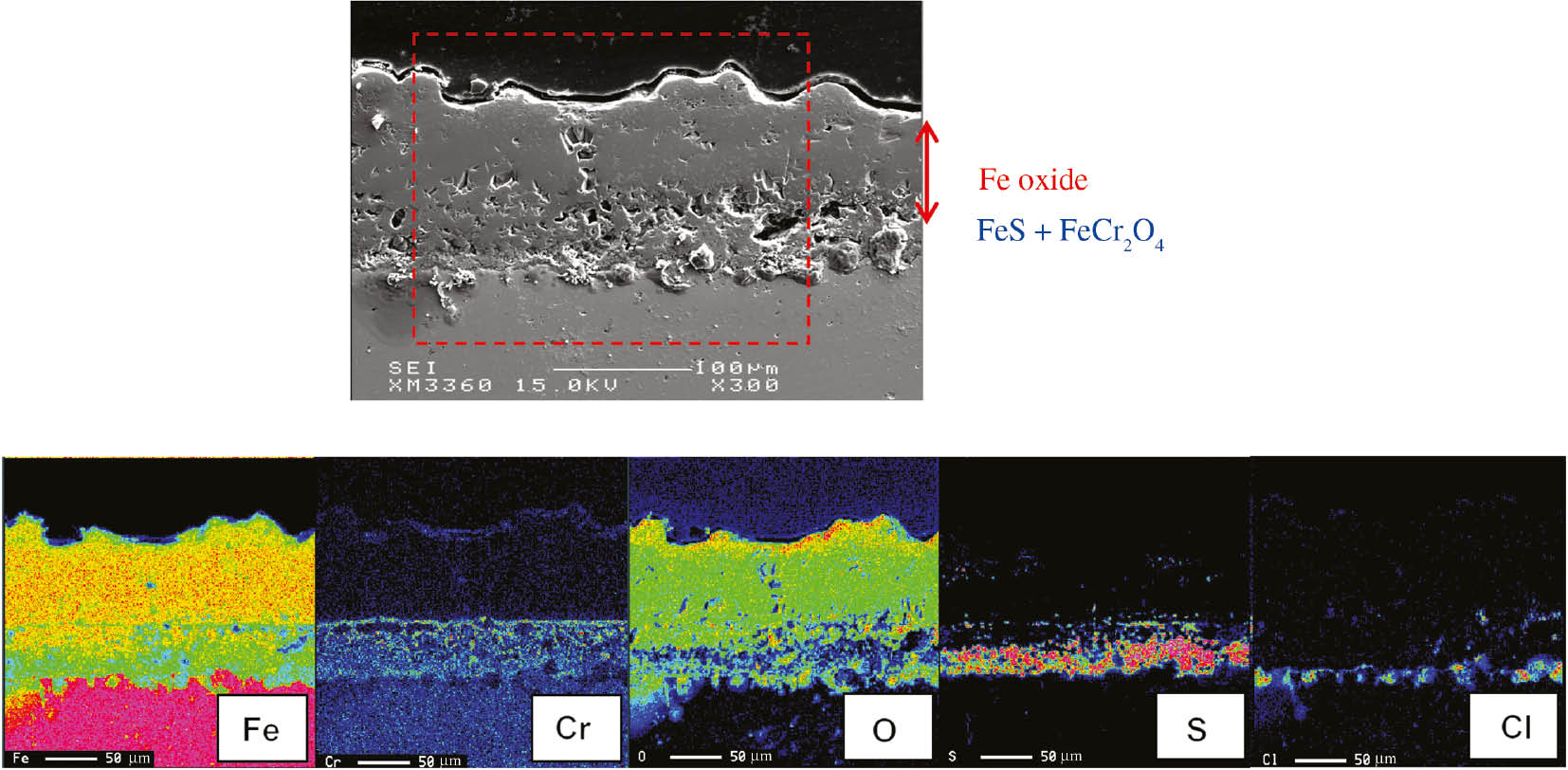
Cross-sectional scanning electron microscopy (SEM) image and element map in the scale formed on STBA 21 corroded for 72 ks at 923 K in an air-NaCl-Na2SO4 gas atmosphere (Sano et al., 2011). Reproduced with permisison from the 123rd Committee on Heat-Resisting Materials and Alloys, Japan Society for the Promotion of Science.
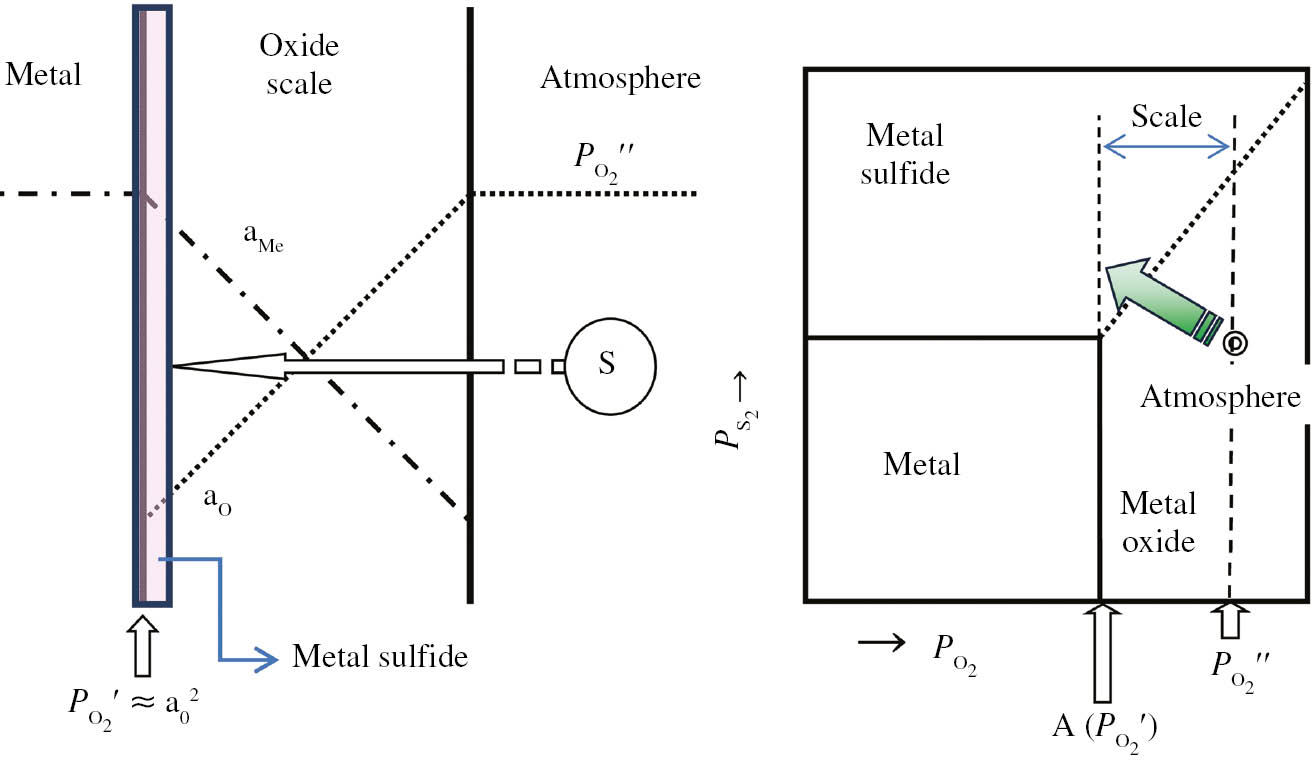
Schematic of oxygen and metal potentials in an oxide scale and the Me-O-S phase diagram.
For example, we consider a case in which metal corrodes in an O2-S2 gas atmosphere. The corrosive environment in this system is indicated by ◎ in the diagram on the right-hand side of Figure 2. Considering the gas atmosphere, the metal oxide is thermodynamically stable, and only this oxide is formed on the metal surface. However, this condition is only valid at the oxide scale/atmosphere interface unlike the thermodynamic state at the oxide scale/substrate interface; therefore, the local equilibrium must be considered when taking into account the decrease in the oxygen potential at the oxide scale/substrate interface. In other words, as the oxygen potential decreases to the value of A (the dissociation pressure of the metal oxide) at the oxide scale/substrate interface, in the case of sulfur diffusion or penetration into this interface, there is a possibility of reaching the sulfide stable region. For example, it is assumed that SO2 gas penetrates into the interface of the oxide scale (FeO)/substrate (Fe) and its SO2 partial pressure is 102 Pa (1073 K). We determined the partial pressures of oxygen and sulfur equilibrated at the situation to be 6×10⁻⁷ and 3×10⁻⁷ Pa, respectively. When this oxygen is consumed by the oxidation of Fe and its partial pressure drops to the dissociation pressure of FeO (about 10−14 Pa), the partial pressure of sulfur at this interface may increase to the calculated maximum in the order of 107 Pa to satisfy the equilibrium of SO2=O2+1/2 S2. The diagram on the right-hand side of Figure 2 shows this case, but the arrow from the ◎ mark of the atmospheric composition does not mean that the sulfur potential continuously increases in scale. Thus, even if the sulfur partial pressure of the atmosphere is below the equilibrium dissociation pressure of the metal sulfide, sulfide formation may occur at the oxide scale/substrate interface. This also applies to chloride formation and carbide formation or carburization. It is difficult to establish these conditions, as the oxygen potential at the oxide scale/substrate interface is not very different from that of the atmosphere as long as the oxide scale formed is quite porous. However, these conditions can be easily established with a metal or alloy forming an oxide scale with a particularly strong protective ability.
Moreover, it is well known that the diffusion of oxygen molecules (when SiO2 is in the amorphous phase) or oxygen ions (in the case of a crystalline matter) is dominant in an n-type oxide SiO2 film (Wirkus & Wilder, 1966; Glushko et al., 1977; Cawley & Boyce, 1988; Kalen et al., 1991). Therefore, when the flux of the other components such as sulfur or chlorine is much smaller in the SiO2 film than that of oxygen, as illustrated in Figure 3, a relative potential increase in the other components hardly occurs at the oxide scale/substrate interface. Incidentally, although it is a rough estimate, when considering the interatomic spacing (O2 1.207 Å, S2 1.887 Å, Cl2 1.988 Å) and the ionic radius (O2− 1.40 Å, S2− 1.85 Å, Cl− 1.81 Å) of gas molecules, we infer that oxygen is more susceptible to inward diffusion than other oxidizing agents. In other words, when a dense SiO2 scale is formed, a relative potential increase of sulfur and chlorine at the oxide scale/substrate interface hardly occurs; consequently, we can anticipate that the formation of sulfides and chlorides is inhibited.
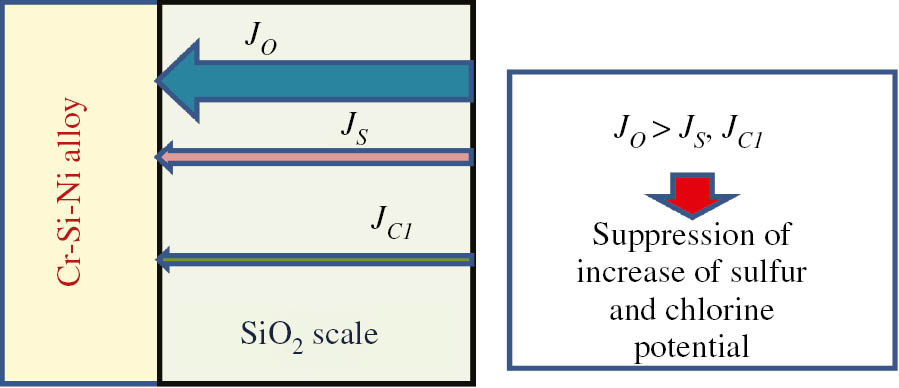
Comparison of flux of oxygen, sulfur, and chlorine in the SiO2 scale.
4 High-temperature corrosion of SiO2-forming materials
Below, we describe the results obtained with respect to the high-temperature corrosion behavior of some SiO2-forming materials, particularly the inhibition of the formation of sulfides and chlorides at the oxide scale/substrate interface. Although all the figures in this section show high-temperature corrosion cases by the composite gas method, we observed the following tendencies regarding the difference between the embedding and composite gas methods and the effect of the temperature:
Basically, there is only a small difference in the structure of the corroded layer due to the corrosion methods (embedding and composite gas methods). However, in the composite gas method, the occurrence of internal corrosion (internal oxide and internal sulfide) is somewhat suppressed. We consider this to be due to the fact that, in the composite gas method, the oxygen potential is higher in the atmosphere, so that a more stable and dense oxide scale is formed.
In the experimental temperature range (923–1273 K), both test methods are likely to form a denser SiO2 film at higher temperatures. This is probably because the diffusion coefficient of Si in the substrate alloy increases as the temperature increases, and SiO2 is prone to amorphization.
4.1 CrSi2-Ni alloys
Figure 4 (Sudiro et al., 2011b) and Figure 5 (Sano et al., 2011) show examples of the cross-sectional structure of a corroded layer formed in the high-temperature corrosion test by the composite gas method of CrSi2 and CrSi2-10 mass% Ni in which a small amount of (Cr, Ni) Si phase is included, respectively. In CrSi2, an SiO2 outer layer with some irregularities is formed, and a high Cr-rich layer (Si-depleted zone) is formed on the substrate just beneath it. Due to this increase in Cr content, sulfide and chloride are also produced. On the contrary, in the alloy with the addition of Ni, a very dense SiO2 film is formed and the formation of a high Cr-rich layer is prevented. This may be attributed to the formation of a (Cr, Ni) Si phase as a second phase with a large Si diffusion coefficient. We found trace amounts of Na, S, and Cl distributed in the SiO2 film, but the formation of sulfides and chlorides near the oxide scale/substrate interface is completely suppressed. This confirms our expectations mentioned in Section 3, namely, that an SiO2-forming material has excellent ability to suppress the formation of sulfide and chloride. Note that this sulfide/chloride formation-inhibiting effect is similar not only for the composite gas method as described above but also for the embedding method.
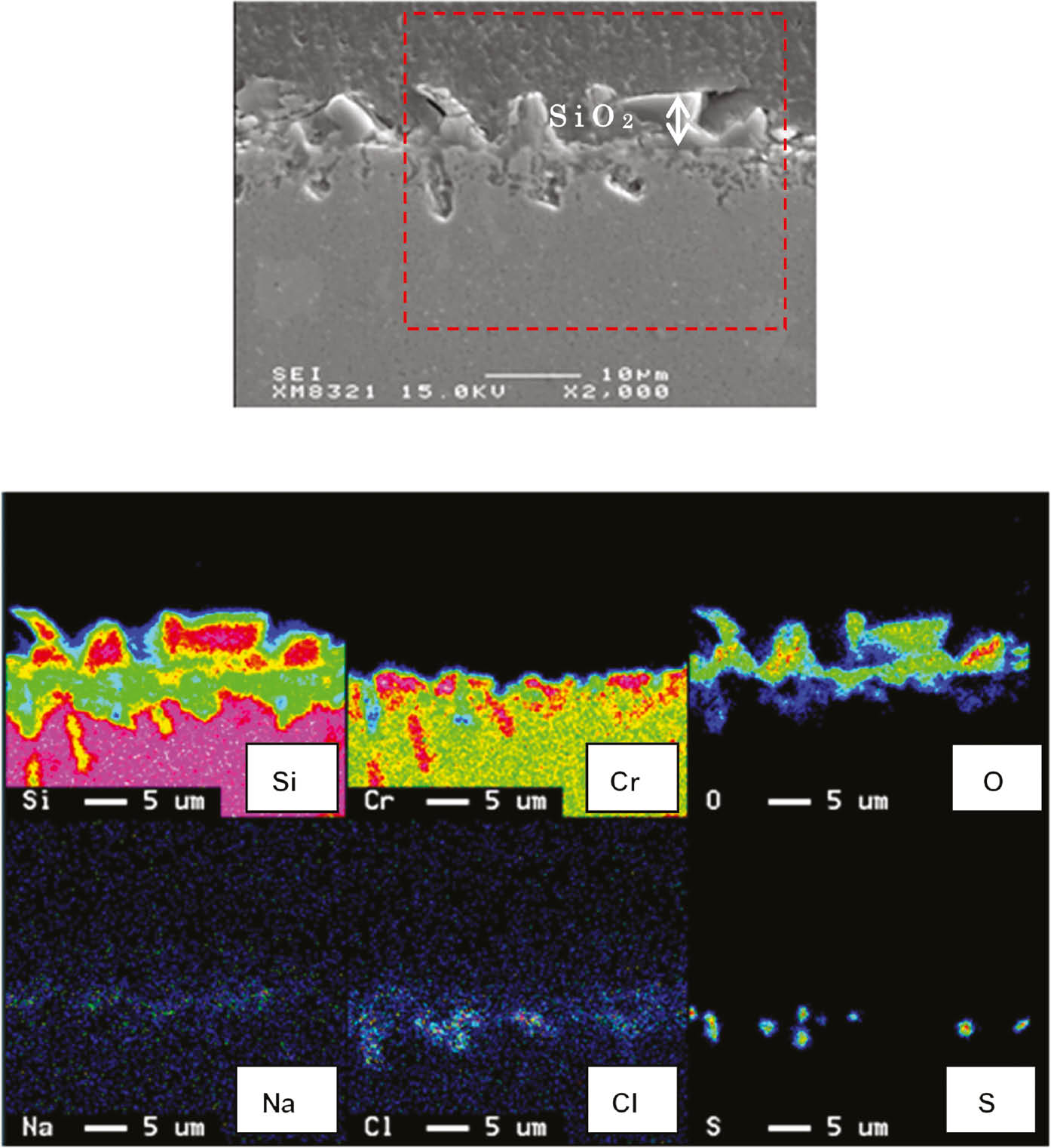
Cross-sectional SEM image and element map in the scale formed on CrSi2 corroded for 720 ks at 1073 K in an air-NaCl-Na2SO4 gas atmosphere (Sano et al., 2011; Sudiro et al., 2011b). Reproduced with permission from the 123rd Committee on Heat-Resisting Materials and Alloys, Japan Society for the Promotion of Science and Trans Tech Publications.
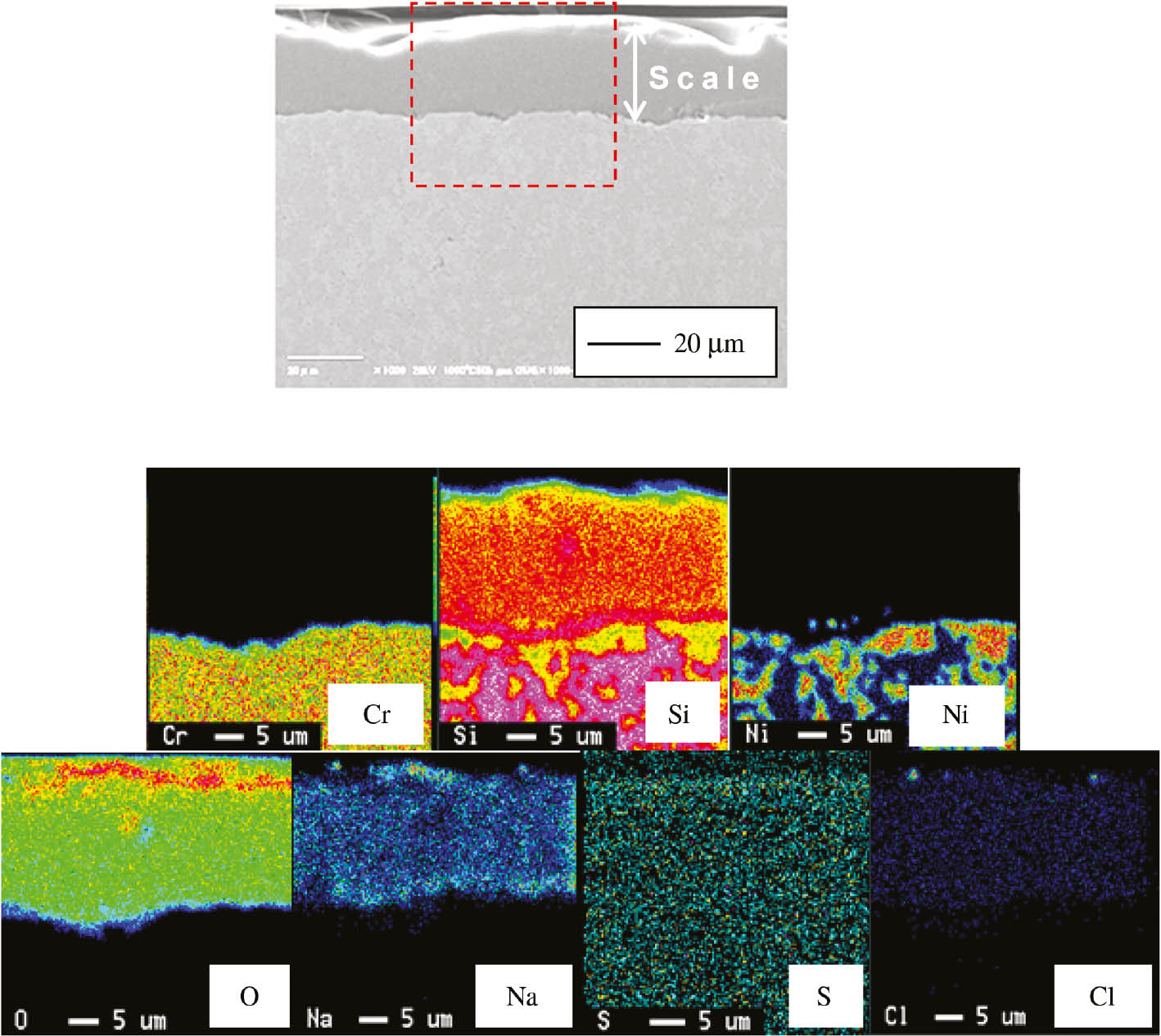
Cross-sectional SEM image and element map in the scale formed on CrSi2-10 mass% Ni corroded for 180 ks at 1273 K in an air-NaCl-Na2SO4 gas atmosphere (Sano et al., 2011). Reproduced with permisison from the 123rd Committee on Heat-Resisting Materials and Alloys, Japan Society for the Promotion of Science.
From the above-mentioned test results, we can summarize the high-temperature corrosion behavior of the Cr-Si-Ni alloys as follows:
When Ni is added to CrSi2, a (Cr, Ni) Si phase is formed, and this phase contributes to the formation of a dense SiO2 film because it is (supposed to be) a supply source of Si for the growth of the SiO2 film.
If a high-temperature corrosion atmosphere contains elements, such as Na, which promote the amorphization of SiO2, a very dense SiO2 film is formed.
When a dense amorphous SiO2 film is formed, the inward diffusion of sulfur and chlorine or the penetration of molten salt to alloy substrate is suppressed, and the formation of sulfides and chlorides can be significantly suppressed. As a result, as shown in Figure 6
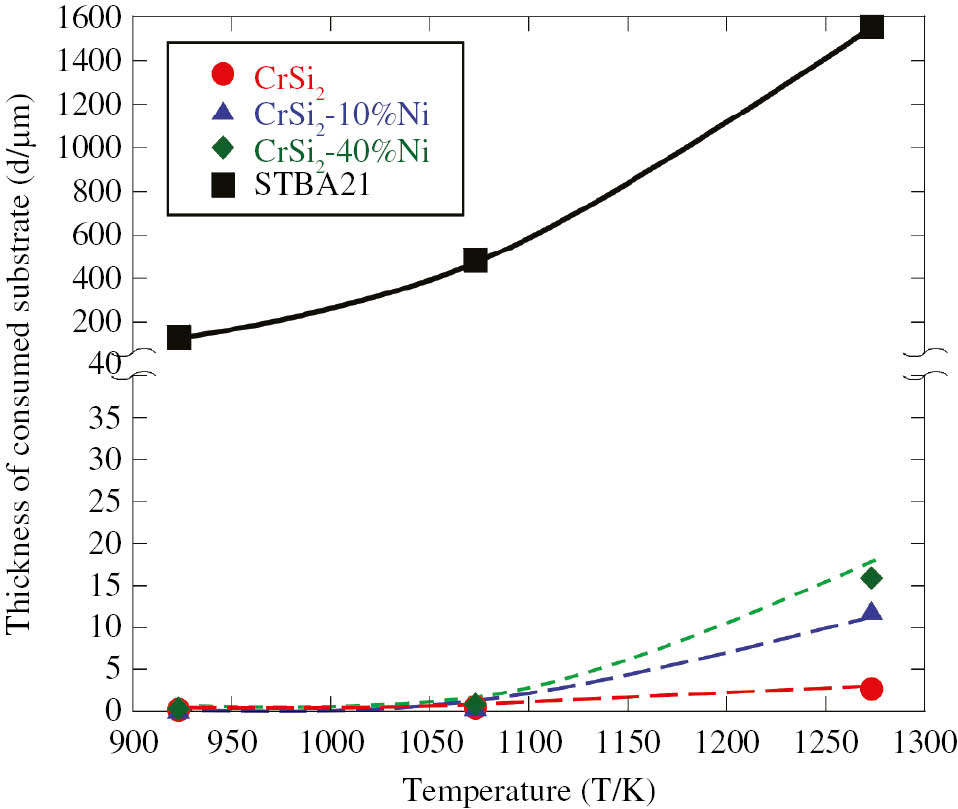 Figure 6:
Temperature dependence of the thickness of consumed substrate after high-temperature corrosion for 72 ks in an air-NaCl-Na2SO4 gas atmosphere (Sano et al., 2011). Reproduced with permisison from the 123rd Committee on Heat-Resisting Materials and Alloys, Japan Society for the Promotion of Science.
(Sano et al., 2011), a decrease in the thickness of consumed substrate due to high-temperature corrosion of the material is drastically reduced compared to that in iron-based alloys.
4.2 CoNiCrAlY-Si alloys
CoNiCrAlY, an Al2O3-forming material, is widely used as a coating material for gas turbine blades and other related items. Using CoNiCrAlY with the addition of 30 mass% Si [phases comprising Cr3Si, AlNi2Si, (Co, Cr) Si, NiSi2, CrSi2, and Si], we conducted high-temperature corrosion tests using the composite gas and embedding methods in the same way as described in the previous section. Figure 7 (Sudiro et al., 2011a) shows the cross-sectional structure of the corroded layer formed at 1073 K by the composite gas method. For comparison, this figure also shows the state of the corroded layer formed in the CoNiCrAlY alloy. In CoNiCrAlY, an oxide scale mainly composed of Al2O3 is formed, but significant amounts of Al2O3 and Cr sulfide (the exact composition is unknown) are also produced inside the alloy. Furthermore, at 923 K, Cr sulfide is produced near the substrate surface in the corroded layer. Such sulfidation is probably due to the poor compactness of the Al2O3 layer. On the contrary, in CoNiCrAlY containing 30 mass% Si, an extremely thin and compact oxide scale is formed, which is mainly composed of SiO2 (a thin Al2O3 layer is also formed by the substitution reaction of Al and Si at the SiO2/substrate interface), and we observed no formation of internal oxide or internal sulfide. The structure of this oxide scale remained the same in the temperature range of 923–1273 K. Moreover, especially for the material forming a relatively dense oxide scale with uniform thickness, we observed no significant difference in the structure of the formed corroded layer by the composite gas and embedding methods. However, at lower Si content alloys, the embedding method tended to form an oxide scale with a slightly uneven thickness and local internal oxide (Al2O3) and internal sulfide (Y sulfide) readily formed. One plausible reason for this is that the embedding method is more likely to form a slightly incomplete (not compact) oxide scale due to the atmosphere of low oxygen potential.
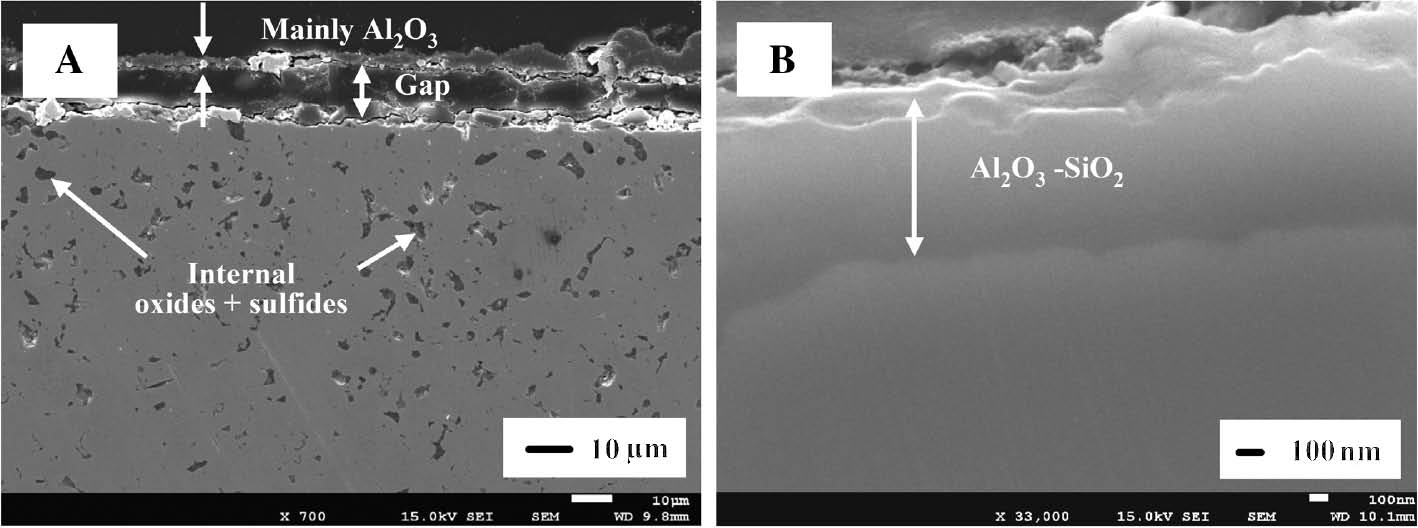
Cross-sectional SEM images of scales formed on (A) CoNiCrAlY and (B) CoNiCrAlY-30 mass% Si alloys for 720 ks at 1073 K in an air-(Na2SO4+25.7 mass% NaCl) gas atmosphere (Sudiro et al., 2011a). Reproduced with permission from the Japan Institute of Metals and Materials.
4.3 Summary of Ni-Al-Si alloys
As apparent from the above-mentioned corrosion examples, SiO2-forming materials show excellent high-temperature corrosion resistance. In addition to these, we performed high-temperature corrosion tests (Sudiro et al., 2009, 2011a,b, 2012a,b,c,d) on numerous metal materials, and our results are summarized in Figure 8. Here, as we detected no other substantial elements such as Co and Cr in the outer oxide layer and found Si and Al to mainly contribute to the oxidation reaction, for the sake of convenience, we use an Ni-Al-Si system phase diagram to present various alloy compositions (very roughly, we assumed the concentrations of elements other than Ni, Al, and Si to be 0). Figure 9 compares the consumed thickness (including the thickness of internal sulfide and internal oxide layers) of materials (dense SiO2-forming materials) with particularly outstanding corrosion resistance to that of CoNiCrAlY. We found the high-temperature corrosion resistance of the SiO2-forming materials to be excellent. Moreover, the difference between the embedding and composite gas methods is small.
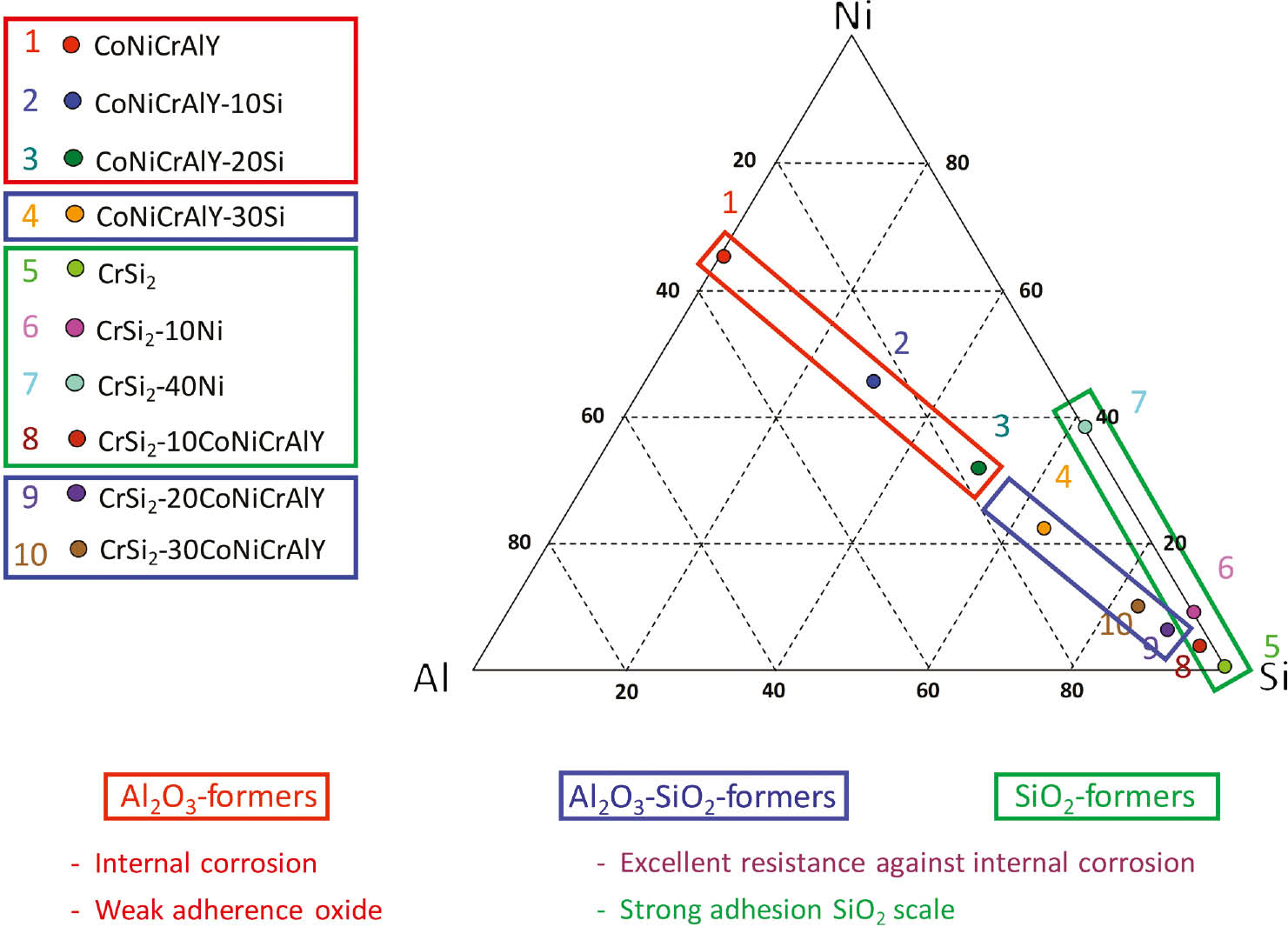
Relationship between composition of alloy and oxide scale formed in atmospheres containing NaCl and Na2SO4.
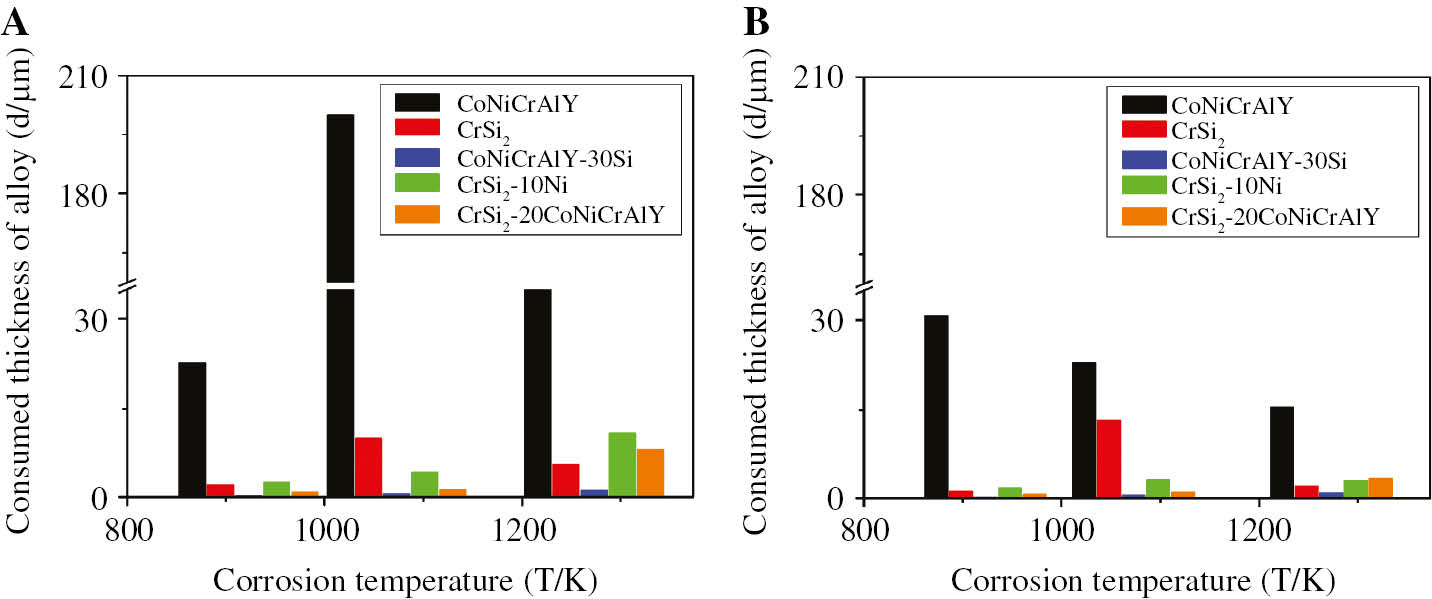
Temperature dependence of consumed thickness of CoNiCrAlY, CrSi2, CoNiCrAlY-30 mass% Si, CrSi2-10 mass% Ni, and CrSi2-20 mass% CoNiCrAlY alloys corroded at 923 and 1073 K for 720 ks and 1273 K for 72 ks in (A) an air-Na2SO4-NaCl gas atmosphere and (B) a mixture of Na2SO4-NaCl melts.
Below, we summarize the high-temperature corrosion behavior of each material forming an SiO2 scale, an SiO2 scale/alumina scale, and an alumina scale:
As in Al2O3-forming materials the adhesion between the oxide scale and the substrate is weak and damage may easily occur in the scale, hardly any dense oxide scale is formed. As a result, internal sulfidation and internal oxidation are likely to occur.
SiO2- and SiO2/Al2O3-forming materials completely suppress the formation of internal sulfide and chloride at the oxide scale/substrate interface and in the alloy. However, if the alumina film underlying the SiO2 scale layer is thick, the scale damaging or descaling may be induced.
5 Conclusions
In this paper, we presented the examples of the high-temperature corrosion of SiO2-forming materials such as CrSi2-Ni and CoNiCrAlY-Si alloys that we have recently studied. The results showed that the SiO2 scale plays a significant role in suppressing inward diffusion of sulfur and chlorine, resulting in the remarkable suppression of the formation of sulfide and chloride at the scale/substrate interface and inside of the substrate. We believe that the formation of sulfide and chloride at the corroded layer/substrate interface is due to the decrease in oxygen potential at the interface and the relative increase in the potential of other oxidants. A summary of the results obtained in our study reveals that an SiO2 scale formation is remarkably efficient in suppressing the formation of sulfides and chlorides. Accordingly, to overcome the need of materials for advanced high-temperature energy applications, the development of a new base and coating material becomes particularly important. This can allow the power plants to increase its efficiency, reduce CO2 emission, and extend their service life.
About the authors

Kazuya Kurokawa received his MEng and DEng in metallurgical engineering in 1980 and 1983, respectively, from Hokkaido University, Japan. He has worked in CAREM of Hokkaido University as a professor since 2003 and now in the National Institute of Technology, Tomakomai College, Japan, as the President. His research interests are the high-temperature oxidation of metals and alloys and the development of advanced high-temperature materials.

Toto Sudiro received his MEng and DEng in materials science and engineering in 2010 and 2013, respectively, from Hokkaido University. He has worked in the Research Center for Physics of the Indonesian Institute of Sciences as a researcher since 2011. His research interests are the high-temperature oxidation and corrosion of alloys and the microstructure of coatings prepared by using mechanical alloying and thermal spray techniques.
Tomonori Sano received his MEng in materials science and engineering in 2011 from Hokkaido University. He has worked as an engineer at Mitsubishi Heavy Industry Ltd., Japan, since 2011.
Shoji Kyo received his DEng in materials science and engineering in 2014 from Hokkaido University. He works in the Power Engineering R&D Center, Kansai Electric Co., Inc., Japan. His research interests are the evaluation of high-temperature corrosion of boiler tubes and the development and practical use of thermal spray materials with resistance to high-temperature sulfidation and abrasion.

Osamu Ishibashi works at Osaka Fuji Corporation, Japan. His research field is in the plasma spraying of various materials on metallic substrates.

Masaharu Nakamori received his DEng in materials science and engineering in 1993 from Hokkaido University. He worked in the corrosion protection of power systems at Takasago Technical Institute Chemical Research Laboratory, Mitsubishi Heavy Industry from 1970 to 2000. He was a guest professor in Hokkaido University from 2009 to 2011. Presently, he works at High Temperature Corrosion & Protection Technosearch Co., Ltd., Japan.
References
Bender R, Schütze M. The role of alloying elements in commercial alloys for corrosion resistance in oxidizing-chloridizing atmospheres. Part I: Literature evaluation and thermodynamic calculations on phase stabilities. Mater Corros 2003; 54: 567–586.10.1002/maco.200390129Search in Google Scholar
Cawley JD, Boyce RS. A solution of the diffusion equation for double oxidation in dry oxygen including lazy exchange between network and interstitial oxygen. Philos Mag A 1988; 58: 589–601.10.1080/01418618808209939Search in Google Scholar
Glushko PI, Postogvard GI, Pugachev NS, Dudnik SF, Podtykan VP. Structure of scale on molybdenum disilicide. Zashchita Metallov (Engl Trans) 1977; 13: 222–224.Search in Google Scholar
Goebel JA, Pettit FS. Na2SO4-induced accelerated oxidation (hot corrosion) of nickel. Metall Trans 1970; 1: 1943–1954.10.1007/BF02642794Search in Google Scholar
Goebel JA, Pettit FS, Goward GW. Mechanisms for the hot corrosion of nickel-base alloys. Metall Trans 1973; 4: 261–278.10.1007/BF02649626Search in Google Scholar
Grabke HJ. High temperature corrosion in complex, multi-reactant gaseous environments. In: Norton JF, editor. High temperature materials corrosion in coal gasification atmospheres. London: Elsevier Applied Science Publishers Ltd., 1984: 59–82.Search in Google Scholar
Hashimoto T, Tanaka Y, Hokano M, Hirasaki D. Latest technology of highly efficient coal-fired thermal power plants and future prospects. Tech Rev (Mitsubishi Heavy Ind Ltd) 2008; 45: 11–14.Search in Google Scholar
Hendry A, Lees DJ. Corrosion of austenitic steels in molten sulphate deposits. Corros Sci 1980; 20: 383–404.10.1016/0010-938X(80)90007-4Search in Google Scholar
International Energy Outlook 2010: DEO/EIA-0484(2010), US Energy Information Administration (EIA), 2010.Search in Google Scholar
Kalen JD, Boyce RS, Cawley JD. Oxygen tracer diffusion in vitreous silica. J Am Ceram Soc 1991; 74: 203–209.10.1111/j.1151-2916.1991.tb07318.xSearch in Google Scholar
Kofstad P. High temperature corrosion. London: Elsevier Applied Science Publishers Ltd., 1988.Search in Google Scholar
Lee WH, Lin RY. Oxidation, sulfidation and hot corrosion of intermetallic compound Fe3Al at 605°C and 800°C. Mater Chem Phys 1999; 58: 231–242.10.1016/S0254-0584(98)00280-6Search in Google Scholar
Li YS, Niu Y, Spiegel M. High temperature interaction of Al/Si-modified Fe-Cr alloys with KCl. Corros Sci 2007; 49: 1799–1815.10.1016/j.corsci.2006.10.019Search in Google Scholar
Mayoral MC, Andrés JM, Belzunce J, Higuera V. Study of sulphidation and chlorination on oxidized SS310 and plasma-sprayed Ni-Cr coatings as simulation of hot corrosion in fouling and slagging in combustion. Corros Sci 2006; 48: 1319–1336.10.1016/j.corsci.2005.06.004Search in Google Scholar
Peng X, Liu K, Pan W-P, Riley JT. High-temperature corrosion of A210-C carbon steel in simulated coal-combustion atmospheres. Oxid Met 2003; 60:117–135.10.1023/A:1024621514635Search in Google Scholar
Pettit F. Hot corrosion of metals and alloys. Oxid Met 2011; 76: 1–21.10.1007/s11085-011-9254-6Search in Google Scholar
Rapp RA. Chemistry and electrochemistry of hot corrosion of metals. Mater Sci Eng 1987; 87: 319–327.10.1016/0025-5416(87)90394-6Search in Google Scholar
Rapp RA. Hot corrosion of materials: a fluxing mechanism? Corros Sci 2002; 44: 209–221.10.1016/S0010-938X(01)00057-9Search in Google Scholar
Sano T, Sudiro T, Kyo S, Ishibashi O, Nakamori M, Kurokawa K. High-temperature corrosion of Cr-Si-Ni alloys in atmospheres containing salt gases (in Japanese), Report of the 123rd Committee on Heat-Resisting Materials and Alloys, Japan Society for the Promotion of Science 2011; 52: 105–111.Search in Google Scholar
Singh H, Puri D, Prakash S. An overview of Na2SO4 and or V2O5 induced hot corrosion of Fe- and Ni based superalloys. Rev Adv Mater Sci 2007; 16: 27–50.Search in Google Scholar
Stringer J. Hot corrosion of high-temperature alloys. Annu Rev Mater Sci 1977; 7: 477–509.10.1146/annurev.ms.07.080177.002401Search in Google Scholar
Stroosnijder MF, Quadakkers WJ. Review of high temperature corrosion of metals and alloys in sulphidizing/oxidizing environments I. Corrosion of metals. High Temp Tech 1986a; 4: 83–96.10.1080/02619180.1986.11753321Search in Google Scholar
Stroosnijder MF, Quadakkers WJ. Review of high temperature corrosion of metals and alloys in sulphidizing/oxidizing environments II. Corrosion of alloys. High Temp Tech 1986b; 4: 141–151.10.1080/02619180.1986.11753329Search in Google Scholar
Sudiro T, Sano T, Kyo S, Ishibashi O, Nakamori M, Kurokawa K. The influence of Cr addition on the high temperature corrosion of CoNiCrAlY alloys. Adv Appl Plasma Sci 2009; 7: 295–298.Search in Google Scholar
Sudiro T, Sano T, Kyo S, Ishibashi O, Nakamori M, Kurokawa K: High temperature corrosion of CoNiCrAlY-Si alloys in an air-Na2SO4-NaCl gas atmosphere. Mater Trans 2011a; 52: 433–438.10.2320/matertrans.MBW201026Search in Google Scholar
Sudiro T, Sano T, Yamauchi A, Kyo S, Ishibashi O, Nakamori M, Kurokawa K. High temperature corrosion behavior of Si-containing alloys in the gas phase of air-(Na2SO4 + 25.7 mass% NaCl). Mater Sci Forum 2011b; 696: 272–277.10.4028/www.scientific.net/MSF.696.272Search in Google Scholar
Sudiro T, SanoT, Kyo S, Ishibashi O, Nakamori M, Kurokawa K. High temperature corrosion of CoNiCrAlY-Si alloys in the liquid phase of Na2SO4-NaCl. Maters Trans 2012a; 53: 920–925.10.2320/matertrans.MBW201105Search in Google Scholar
Sudiro T, Sano T, Kyo S, Ishibashi O, Nakamori M, Kurokawa K. The influence of CoNiCrAlY addition on the high temperature corrosion behavior of CrSi2 alloy in an air-Na2SO4-NaCl gas atmosphere. Maters Trans 2012b; 53: 1627–1632.10.2320/matertrans.MAW201210Search in Google Scholar
Sudiro T, Sano T, Kyo S, Ishibashi O, Nakamori M, Kurokawa K. High temperature corrosion behavior of Si-containing alloys in the liquid phase of Na2SO4 + 25.7 mass% NaCl. Defect Diffus Forum 2012c; 323–325: 353–358.10.4028/www.scientific.net/DDF.323-325.353Search in Google Scholar
Sudiro T, Sano T, Kyo S, Ishibashi O, Nakamori M, Kurokawa K. A comparative study of high temperature corrosion of Al2O3, SiO2 and Al2O3-SiO2 forming alloys in a Na2SO4-NaCl atmosphere. In: Proc. 8th International Symposium on High-Temperature Corrosion and Protection on Materials; Paper No. 71 in CD-ROM, 2012d: 1–8.10.1007/s11085-013-9398-7Search in Google Scholar
Uusitalo MA, Vuoristo PMJ, Mäntylä TA. High temperature corrosion of coatings and boiler steels below chlorine-containing salt deposits. Corros Sci 2004; 46: 1311–1331.10.1016/j.corsci.2003.09.026Search in Google Scholar
Viswanathan R, Bakker W. Materials for ultra supercritical coal power plants—boiler materials: Part 1. J Mater Eng Perform 2001a; 10: 81–95.10.1361/105994901770345394Search in Google Scholar
Viswanathan R, Bakker W. Materials for ultra supercritical coal power plants—turbine materials: Part II. J Mater Eng Perform 2001b; 10: 96–101.10.1361/105994901770345402Search in Google Scholar
Wirkus CD, Wilder DR. High-temperature oxidation of molybdenum disilicide. J Am Ceram Soc 1966; 49: 173–177.10.1111/j.1151-2916.1966.tb13227.xSearch in Google Scholar
Yamauchi A, Suzuki Y, Sakaguchi N, Watanabe S, Kurokawa K. Microstructure and analysis of oxide scales formed on Cr-Si-Ni compacts in air and H2O-containing atmosphere. Corros Sci 2010; 52: 2098–2103.10.1016/j.corsci.2010.02.007Search in Google Scholar
Young DJ. High temperature oxidation and corrosion of metals. Amsterdam: Elsevier Corrosion Series, 2008.Search in Google Scholar
©2018 Walter de Gruyter GmbH, Berlin/Boston
Articles in the same Issue
- Frontmatter
- In this issue
- Editorial
- Special issue on Recent advances in corrosion science: celebrating the 90th birthday of Professor Norio Sato
- Reviews
- Some microelectrochemical methods for the investigation of passivity and corrosion
- Inhibition effect of underpotential deposition of metallic cations on aqueous corrosion of metals
- Role of anodic oxide films in the corrosion of aluminum and its alloys
- Development of novel surface treatments for corrosion protection of aluminum: self-repairing coatings
- Mini review
- High-temperature corrosion resistance of SiO2-forming materials
- Original articles
- Cyclic carburization-oxidation behavior of Hastelloy-X at 1000°C
- Growth of passive oxide films on iron and titanium under non-stationary state
- Influence of metal cations on inhibitor performance of gluconates in the corrosion of mild steel in fresh water
Articles in the same Issue
- Frontmatter
- In this issue
- Editorial
- Special issue on Recent advances in corrosion science: celebrating the 90th birthday of Professor Norio Sato
- Reviews
- Some microelectrochemical methods for the investigation of passivity and corrosion
- Inhibition effect of underpotential deposition of metallic cations on aqueous corrosion of metals
- Role of anodic oxide films in the corrosion of aluminum and its alloys
- Development of novel surface treatments for corrosion protection of aluminum: self-repairing coatings
- Mini review
- High-temperature corrosion resistance of SiO2-forming materials
- Original articles
- Cyclic carburization-oxidation behavior of Hastelloy-X at 1000°C
- Growth of passive oxide films on iron and titanium under non-stationary state
- Influence of metal cations on inhibitor performance of gluconates in the corrosion of mild steel in fresh water
