Investigation of differential shrinkage stresses in a revolution shell structure due to the evolving parameters of concrete
-
Bodol Momha Merlin
 ,
Djopkop Kouanang Landry
,
Djopkop Kouanang Landry

Abstract
The article focuses on the influence of differential shrinkage linked by drying at the early-age displacements and strain distribution of a concrete ring specimen. Depending on the gradient of dimension changes through the thickness, tensile stress occurs near the exposed surface where drying is greater and thus results in strain gradients development. An experimental design was carried out on a concrete ring cast in laboratory conditions in order to monitor strains and displacements. Subsequently, a finite element method was used to simulate the ring’s behaviour in drying conditions. The gradient development linked by a non-uniform moisture distribution in the thickness is established by solving the non-linear partial differential drying equation with Mensi’s diffusion law. The stress and displacement analysis was modeled by three nodes curved shell FEM (CSFE-sh) based on strain approximation with the shell theory. Finally, the ring’s behaviour includes both differential shrinkage resulting in the mechanical and physical properties of gradients development in the thickness and the influence of prestressing, in which the tensile creep effects have a great influence. The comparison of experimental results with numerical simulation shows that drying and tensile creep phenomena have the most important influence on the early-age stress development in the walled ring.
Nomenclature
-
-
contravariant tensor
-
-
local vector basis at the midsurface S
-
-
contravariant basis of surface
-
-
cement gauge (kg/m3)
-
-
water diffusion coefficient
-
-
covariant component of the linearized membrane strain tensor of the midsurface S
-
-
young modulus
-
-
covariant and contravariant component of the metric tensor of the shell
-
-
contravariant basis of space
-
-
3D shell’s thickness
-
-
covariant linearized change of curvature tensor at the midsurface S
-
-
flexional energy
-
-
membrane energy
-
-
drying shrinkage coefficient
-
-
covariant linearized change of the third fundamental form tensor of S
-
-
component of the global displacements in
-
-
component of the global displacements in
-
-
component of a displacement in
-
-
component of a displacement in
-
-
water over cement ratio
-
-
lame’s coefficients
-
-
autogenous shrinkage coefficient
-
-
free water content (l/m3)
-
-
bounded water (l/m3)
-
-
initial water content and the moisture content in equilibrium with external hygrometry
-
-
hydration degree
-
-
thickness ratio
1 Introduction
Concrete shells are more and more used nowadays in civil engineering. These structures are sensitive to internal strains which occur at an early state due to the combined effects of applied load, shrinkage, creep, and relaxation. Also, these volume changes cannot occur freely and stresses arising from these changes can modify the mechanical operating mode of the concrete wall and influence their design. Generally, many designers just address the deformation induced by the mechanical load, ignoring the delayed strains which can become significant over time. Also, for concrete structure design, shrinkage is taken into account in the calculation of prestressed structure with the estimation of tension losses, but seems neglected or underestimated for other structures like non-reinforced concrete shells.
Several studies have been carried out on creep and shrinkage phenomena as well as their applications on structures [1,2,3,4]. Domes and curved roofs have also been the subject of particular attention, and much attention has been paid to buckling and the distribution of forces linked to second-order effects [5,6,7]. Nevertheless, very few works have looked into the nonlinear behaviour of concrete integrating creep and shrinkage. The effect of creep on axisymmetric elements has been studied [8,9,10]. Chepurnenko et al. [8] have shown that the impact of creep deformation on the distribution of internal forces was low and can be estimated in the order of 1.29%, and this effect decreases with the increase of curvature. We can however name Hamed et al. [11] who simulated the interaction at long-term of shrinkage and creep on a dome and found that the magnitude of long-term deflection is critical for the design and stability of the structure. However, for concrete shell structures, the distribution of stress in the core of the material prior to any external loading at an early age has not been sufficiently investigated. It is all the more so important for the property gradients (hydration, moisture, porosity, and strain gradients), which increases as soon as the material is cast.
It has been established that hydration degree and moisture generate property gradients through the thickness of the material [12], which can lead to differential shrinkage. Also, Zhang et al. [13] have experimentally shown that the drying shrinkage of cement paste increases with an evaporation rate. These research studies suggest that for concrete, the hydration degree in the case of a large drying gradient is a function of considered point position, and consequently, Young’s modulus may be defined by field points depending on the position and moisture content. It is well known from the ring test that concrete has a particular loading model in the case of any external force due to shrinkage [14]. The behaviour of the concrete is therefore found to be strongly non-linear and accentuated by the property gradients as a result of the combination of shrinkage, creep, and strain release effects [15]. Most of the time, the theory of homogenization is applied for the consideration of Young’s modulus. To simplify our study, we assume that Young’s modulus is time-dependent.
In this study, the nonlinear short-term behaviour is prospected to characterize the level of stresses in the material before their service life. Water distribution in the thickness of the material is obtained by solving nonlinear partial differential equation. Non-linearity is due to the formulation of diffusion and exchange terms. The diffusion coefficient being proportional to the water content, it cannot have the same value for all elements at the same time. In many moisture transfer finite element codes, the state’s functions
In this work, the chemohydromechanical approach is used to model displacements. In computational mechanics, many numerical formulations are used to solve governing equations of shells. We can identify for this purpose the disturbed stress field model [16], smoothed particle hydrodynamics [17], the generalized differential quadrature finite elements [18], and the equivalent single layer approach for complexes geometries [19,20] derived from generalized Layer-Wise theory [21]. Most of the work carried out on shell structure modeling links either Kirchhoff–Love or Reissner–Mindlin hypothesis [22,23]. The Nzengwa and Tagne (N–T) [24] two-dimensional model for linear elastic thick shells will be used in this study. The numerical convergence and validation of this model can be found in the literature [25,26].
2 Shell theoretical model
A large number of shells kinematics were developed from the Taylor series development of the displacements field:
Eqs. (1) and (2) present five variational unknowns which are two membranes displacements
2.1 Thick shell theory
All existing formulations differ in the definition of the function
The N–T shell model gives the following displacement results
In the basis
(3)In the basis
The strain tensor deduced from shells’ kinematics with respect to the plane strain state reads
We express the strain components using the parameters of the cylindrical shell’s midsurface. In detail, we have:
2.2 Hygral–mechanical finite element modeling
The approach used here is based on strain interpolation using curved shell finite elements (CSFE-sh) with shifted-Lagrange triangular element (Figure 1) with three degrees of freedom per node rather than five [26].
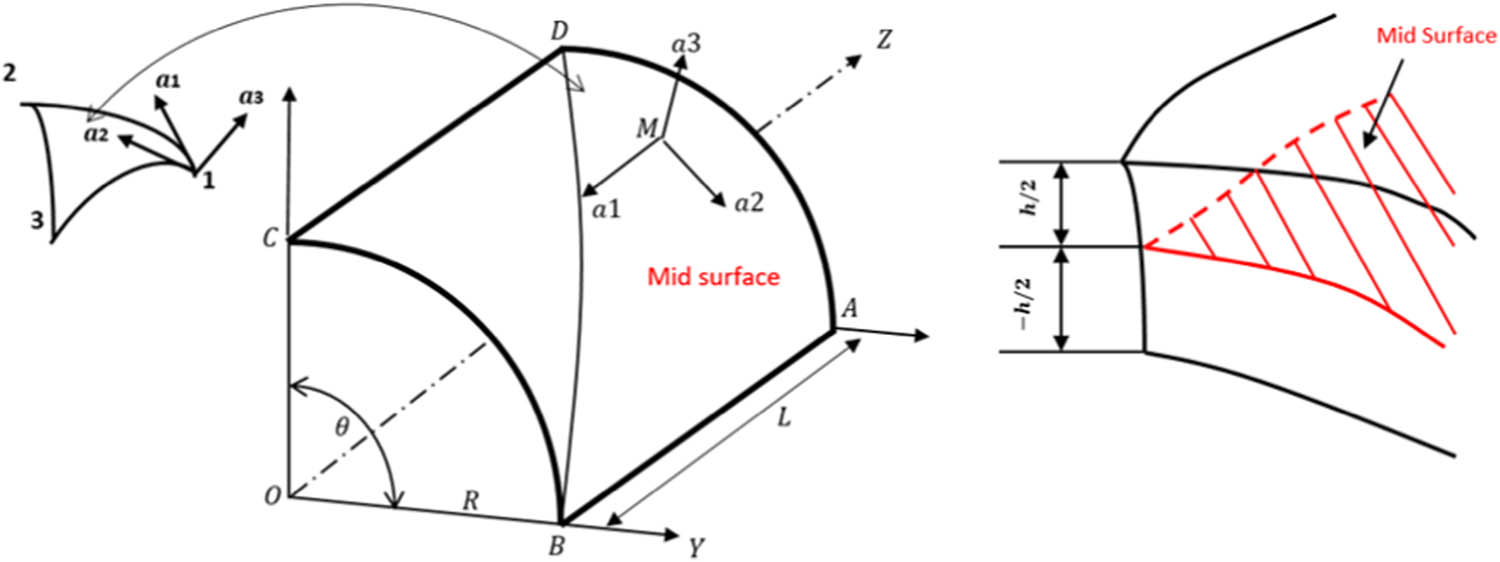
Triangular shell element.
The law of linearized hygral elastic behaviour written in the absence of internal bonds takes the same form as thermal formulation. Most stresses are mainly generated in circumferential (hoop) and radial directions because shrinkage in vertical directions is much less significant as compared to those in circumferential and radial directions [27]. For a shell
with
Eq. (11) is equivalent to
where the functions of the bilinear form are expressed by
3 Moisture transport problem at an early age
Structures based on cementitious materials see their initial water content decrease regardless of the environment in which they are placed. The anhydrous cement grains try to capture the water molecules to hydrate themselves, and during this time, a thermodynamic balance tries to be established with the external environment.
3.1 Bound water formulation
Onsite conditions, the cement-based materials are generally exposed to climatic conditions after casting at least upon one face. At the early age, Powers and Brownyard quoted by Brouwers [28] distinguish in the core of concrete free water, bound water, and water that cannot be evaporated which is neglected here. At time t, water contained in the material is the sum of free and bound water. Hydration law depends on the quantity of free water available in the mixture. We assume that just after casting (time
Eq. (14) is completely determined if bound water can be evaluated independently. It is known that the bound water is proportional to the quantity of cement in the mixture and the hydration degree. So, the bound water can be well approximated by the following relation:
The explicit expression of free water is deduced from this
Hydration degree is expressed in the following rate form, where its dependence on temperature is described by the Arrhenius-type law
where
with a to suppress the parameter taken equal to 3.5. We consider the chemical affinity
where
3.2 Drying of concrete
Water contained in the core of the material can be in a liquid or gaseous phase. According to Daian [30], the water liquid flow and vapor water flow can be expressed with the same potential such that the free water takes the form
Its variation is significant in the change of moisture transport due to drying [31,32]. Consequently, to model the diffusion phenomenon, the approach of Mensi et al. is considered [33]:
The parameter B can be taken as a constant, B = 0.05. The drying parameter A needs to be determined. We assume that water content variation in the medium is due to hydric transfer and hydration process. The boundaries conditions used are in the convective form
where
Using the finite element technic, the domain
The variational equation leads to
The relation (25) is reorganized as follows:
Eq. (26) is nonlinear. For
The Crank–Nicholson algorithm can also be used as done in ref. [34]. Eq. (27) can be easily resolved, and we obtain the first approximation of the solution denoted
4 Consideration of strains
It is important to state that the dimension variations recorded at each side are the total strain, which expresses the global response of the material to the various stresses induced by several phenomena such as shrinkage, creep and relaxation, and thermal effects which is neglected here depending to the position parameter (
where
The phenomenon of shrinkage is principally linked to the variation of water content in the material in laboratory conditions. In practice, it is sufficient to consider autogenous and drying shrinkage for concrete studies. As autogenous shrinkage is directly related to hydration, many models propose a relationship between shrinkage and hydration degree as indicated in Eq. (30) below
I is the identity matrix and
The quantity
Young’s modulus is expressed here as a function of hydration degree according to De Schutter and Taerwe [35]
The constant b and the modulus at the ultimate hydration degree have to be known.
where
With
To determine the tensile creep coefficient, recent work has described an approach based on the use of strain measured from the shrinkage test, as specified in the standard NF P 15-433, with those measured from the restrained ring test following ASTM C1581 [38].
Therefore, the creep coefficient can be calculated as follows:
where
The strain linked to the loss of water by evaporation increases with time and the self-stresses generated will undergo a reduction due to the relaxation.
Based on the deformation continuity principle between the two rings [39], the elastic strains of the concrete ring can be determined from steel strains development as follows:
where
We assume that the visco-elastic parameter

Variations in time of strains measured from ring specimens and 7 cm × 7 cm × 28 cm prismatic samples.
The variations in the time of creep coefficient calculated are given in Table 1.
Creep coefficient variations
| 1 Day | 3 Days | 7 Days | 28 Days | |
|---|---|---|---|---|
| Creep coefficient ϕ(t0, t) | 0.18 | 0.91 | 1.02 | 1.2 |
5 Main data of tested shell
In this work, two thick cylindrical specimens (Figures 3 and 4) of unreinforced concrete were cast, instrumented, and subjected to drying in laboratory conditions (temperature, 22°C ± 1; relative humidity, 70 ± 5%). The shell is cylindrical, with an internal radius of R
1 = 37.5 cm and an external radius of R
2 = 47.5 cm. The ratio thickness over the smallest radius in absolute value is equal to

Geometry details of the test specimen.

Sample preparation and instrumentation.
5.1 Concrete mix
The cement used in this study is an ordinary Portland cement CEM I 42.5 N. The uniaxial compressive strength of concrete was determined on the cubic specimen of 10 cm side at 28 days. The mix proportions and the average compressive strength (
Composition of concrete
| Composition of concrete | |||||
|---|---|---|---|---|---|
| Water (W) | Cement (c) | Sand (s) | Gravel 0/15 | W/c | fc |
| 216 l | 400 kg | 800 l | 965 l | 0.54 | 20 MPa |
5.2 Mass loss and free shrinkage measurement
For shrinkage and mass loss measurement, concrete specimens of the size of
5.3 Rings specimens preparation and instrumentation
The ring specimens were demoulded 24 hours after pouring. After that period, the waterproof paint is applied to the inner and top faces of the ring, and then, the whole is covered with the polyan sheet for 22 hours.
The instrumented ring specimens, data acquisition system and steel molds used are shown in Figure 4. We considered:
The micrometer-sensitive digital comparators for displacement measurement. To monitor the displacements, the comparators are placed at different points of its thickness along the x-axis from the centre of the ring, respectively, at 39 cm (C3), 42.5 cm (C2), and 46 cm (C1);
The strain gauges are bonded in the both inner face and outer face of the rings 22 hours after steel form removal. The adhesive used consists of a two-component “M-Bond AE-15 Kit for strain gages” proposed by MICRO MEASUREMENTS. This adhesive is highly resistant to moisture. For strains recovering, the strain gauges are fixed along the hoop direction of the rings;
A data acquisition system in a quarter-bridge configuration for strain recording;
A plastic film was placed below to prevent any suction of water from the test piece through the substrate and allow a free displacement at the base of the specimen.
After preparation and instrumentation, the rings were exposed to drying after the removal of the plastic film. This corresponds to a cured period of 48 hours after casting.
6 Results and discussion
Experimental campaign was carried out for several days then, and the collected data were stripped and analyzed. The water contraction coefficients and the percentage of mass loss recorded on the samples were therefore be calculated.

Exchange coefficient.

Diffusion coefficient.
6.1 Fitting drying parameters
Based on the results of mass loss measurements, the diffusion coefficient is defined by parameter

Mass loss.

Free water evolution at different points.
6.2 Evolution of water content in time and the thickness
The trend of water moisture evolution (Figure 9) according to time shows that free water variation tends asymptomatically towards the water content of the environment. The evolution of the free water content in the thickness is shown in Figure 10. Globally, the non-uniform moisture distribution is observed. The internal moisture differs significantly according to the depth from the exposed surface where the free water content is small as compared to the rest of the thickness. It appears that the drying kinetics is much accentuated for the outer sheet while the inner sheets are substantially slow.

Mean water variation in the mixture.

Water variation in the cross section.
The internal moisture differs significantly according to the depth from the exposed surface where the gradients of free water content are greater compared to the rest of the thickness.
Young’s modulus of the material is linked to the degree of hydration and varies according to the position considered as a function of the water content. We note a low variability of the modulus in the thickness (Figure 11) with a maximum coefficient of variation estimated at 0.4% at 4 days (Figure 12).

Young modulus variation in the thickness at different age.

Young modulus coefficient of variation.
The result of radial displacement simulated at the midsurface is presented in Figure 13. We can observe that both measured displacement and those simulated evolve in the same way with the sample amplitude and similar kinetic evolution. The displacement model result is compared to the displacement measured on the midsurface, and the observed value difference may be due to the complex behaviour of the concrete ring at a young age. The shell theoretical model used in this study is unable to compute transverse strains through thickness.

Midsurface displacement.
6.3 Displacements and strains evolution
The mechanisms allowing the development of the shrinkage generate deformations which also result in a measurable displacement using the sensors placed on the thickness of the benchmark. We are interested here in the displacements in the hoop direction, and we neglect the displacement along the generatrix.
6.3.1 Displacement’s measurement in time and the thickness
The results of radial displacements are given in Figure 14. The results show that the radial displacement near the exposed surface is greater as compared to those measured near the inner face and midsurface. At the same time, the radial displacement measured near the inner surface is lower than the two others and can be considered practically constant. Also, the increase of displacements is globally observed at the half outer layer of the ring. This confirms the fact that the shell is the seat of the stress field induced by the restrained shrinkage phenomenon occurring in drying conditions. The gradients of displacements are also observed from the outer surface to the inner surface.

Measured radial displacements (μm).
6.3.2 Strains measurement in time and the thickness
Because the shell is the seat of a stress field-induced par shrinkage phenomenon, strains then develop in the core of the material. The total strains measured express the global response of the material to the various stresses induced by shrinkage, creep and relaxation effects. The evolution of strains measured on benchmark 1 at the outer and inner surfaces is presented in Figure 15. It should also be noted that the external deformation measurement gauge (DataR2ext) on ring 2 ceased to operate after approximately five days. The problem is believed to be related to the connection of said gauge.

435 Measured strains (μm/m).
We can observe that in the first days of drying, both sides of the specimen deform in the same way with the same amplitude of deformations and the same kinetic evolution. Then, a second time, the strains measured at the outer face begin to decrease and end by changing the sign while at the same time the increase of the strains measured at the inner face is observed. This evolution of strain development in the thickness can be attributed to the tensile creep phenomenon and its relaxation effects which are responsible for the release of stress observed on the thickness. Afterwards, we assume that, the drying kinetics being different from one side to the other, the movements of the exposed layers are restricted by the interior layers. This situation leads to the development of tensile creep the stress being kept constant by step period in time. These tensile stresses can lead to damage in severe conditions.
6.4 Simulation of strains evolution
In order to simulate the deformations of the structure linked to shrinkage, it is essential to determine the water contraction coefficients from the shrinkage measurements recorded on the prismatic specimens.
6.4.1 Fitting shrinkage parameters
For the determination of hydric contraction coefficients, the autogenous and drying shrinkage was recorded to the loss of mass measured on
6.4.2 Modeling strains evolution in time and depth
The results of the total strains simulated are the superposition of shrinkage and creep effects. We can observe that in the first days after demolding, both measured strains and simulated strains evolve in the same way with the same amplitude and same kinetic evolution (Figure 16). These strains can be considered as being generated mainly by the shrinkage linked to the change of internal moisture in the material, including hydration. Then, a second time, the strains measured decrease greatly with the change in the kinetic. In this case, shrinkage is greater at the outer surface exposed to drying compared to the rest of the thickness. The displacement of the outer layers due to differential shrinkage compresses the inner layer, and as the displacement of the inner layer is restrained by the geometrical shape of the specimen, this last one will bring the outer layer in tension. This tendency can be explained by the fact that the change in measured strain kinetics can be related to rapid development of creep and stress relaxation the material undergoes.

Total strains versus time without relaxation effect.
Looking carefully at the displacements and strains recorded, everything happens as if the inner layers of the specimen behaved like successive rings with differences in mechanical properties. The strains gradually increase with time as the inner layer cannot deform freely; this leads to the adaptation of material, and there is therefore a relaxation of the stresses. This can probably explain the change in the kinetics of the strains observed for the inner layer.
It can be observed that the tensile creep consideration would just decrease the amplitude of strains. Strain is caused by the departure of the water, and the shape of the strains is similar to the evolution of free water along the thickness.
Figure 17 represents hoop strain distribution along thickness at 14 days. Gradients of strains along the thickness follow the same evolution as the free water gradient in the material thickness.

Hoop strain distribution along the thickness.
The hoop stress that develops in the material is not harmful to compression loading but reaches about 2 MPa at 14 days (Figure 18).

Hoop stress along the thickness.
7 Conclusion
In this framework, stress analysis is performed on a simple thick-walled cylinder subjected only to the effect of natural drying. An experimental campaign on cylindrical specimen and numerical simulation was conducted. A hydro-mechanical formulation has been employed to obtain the midsurface displacement using water gradient by analogy with thermal expansion. An attempt has been made to determine strain evolution in the core of material using two-dimensional (2D) thick shell theory. The simulation done showed that the hydration degree is a function of the considered location on the thickness and thus, the related Young’s modulus. However, when the thickness tested is low, the variation in modulus is negligible. With regard to strains, strain law variation along the thickness is led by the water gradient which depends on drying boundary conditions. Consequently, the gradients of strains related to the water content can develop. The strains gradually increase with time as the inner layer cannot deform freely; this leads to the adaptation of material and therefore relaxation of the stresses.
For ring specimens, the outer layers located near the drying face are rapidly subjected to the tension resulting from the interaction with the internal layers; consequently, the specificities of the ring’s test are globally reproduced without the use of the brass ring. The curve of the strain evolution recorded on the outer sheet is similar to that of a part subjected to tensile creep as reported by Ranaivomanana et al. [40]. At the same time, the inner members are globally compressed, assuming that the specimen undergoes prestressed.
At last, as the fluctuations of the strain's kinetics would result from the adjustment of the material due to the stress relaxation, this phenomenon can be taken in the simulation to attenuate evolution and changes of kinetic strains on the concrete ring. Therefore, the effects of creep deserve to be studied more because existing models do not approach enough the deformations of the ring.
Acknowledgement
The authors would like to thank the research team of the Civil Engineering laboratory of SJP- Polytechnic Institute of Douala as well as that of the L2MGC laboratory of CY-Cergy Paris University for providing necessary equipment for data acquisition during the course of this research. Our special thanks go to the following people: Prof. Albert Noumowé; Prof. Anne-Lise Beaucour; Prof. Javad Elsami; Msc Steve M. Nkomom; Msc. Hugues S. Taowe
-
Funding information: The authors state no funding involved.
-
Conflict of interest: Authors state no conflict of interest.
-
Data availability statement: Measurement data is available to anyone who wants it.
References
[1] Radnić J, Matešan D. Testing of prestressed concrete shell under long-term load and unload. Exp Mech. 2009;50:575–88.10.1007/s11340-009-9242-9Search in Google Scholar
[2] Torrenti JM, Benboudjema F, Chauvel D, Barré F. Retrait de dessiccation des bétons: résultats du PN CEOS.fr, 31emes rencontres de l'AUGC. ENS Cachan; 2013.Search in Google Scholar
[3] Duprat F, Sellier A. Fiabilité des ponts en béton précontraint soumis au fluage, 19ème Congrès Français de Mécanique; 2009 Aug 24–28; Marseille, France.Search in Google Scholar
[4] Bažant ZP, Jirásek M. Creep and hygrothermal effects in concrete structures. Solid Mech its Appl. 2018;225:960.10.1007/978-94-024-1138-6Search in Google Scholar
[5] Halicka A, Podgórski J. Designing of cylindrical concrete tanks with regard to buckling and second order effects. Procedia Eng. 2017;193:50–7.10.1016/j.proeng.2017.06.185Search in Google Scholar
[6] Miyazaki N, Hagihara S. Creep buckling of shell structures. Mech Eng Rev. 2015;2(2):14-00522.10.1299/mer.14-00522Search in Google Scholar
[7] Duissenbekov B, Tokmuratov A, Zhangabay N, Orazbayev Z, Yerimbetov B, Aldirayov Z. Finite-difference equations of quasistatic motion of the shallow concrete shells in nonlinear setting. Curved Layer Struct. 2020;7:48–55.10.1515/cls-2020-0005Search in Google Scholar
[8] Chepurnenko A, Mailyan L, Yazyev B, Ivanov A. Calculation of the rotation shells on axisymmetric load taking the creep into account. MATEC Web Conf. 2017;106:04011.10.1051/matecconf/201710604011Search in Google Scholar
[9] Andreev V, Cherpurnenko A, Yazyev B. Calculation of creep of circular cylindrical shell by bending theory. Procedia Eng. 2016;165:1141–6.10.1016/j.proeng.2016.11.831Search in Google Scholar
[10] Karpov V, Semenov A. Computer modeling of the creep process in stiffened shells. International Scientific Conference Energy Management of Municipal facilities and Substaiable Energy Technologies EMMFT. vol. 1, 2018. p. 48–58.10.1007/978-3-030-19756-8_5Search in Google Scholar
[11] Hamed E, Bradford MA, Gilbert RI. Nonlinear long-term behaviour of spherical shallow thin-walled concrete shells of revolution. Int J Solids Struct. 2010;47:204–15.10.1016/j.ijsolstr.2009.09.027Search in Google Scholar
[12] Wang X, Sun B, Li S, Wang Z, Li H, Gao Y, et al. Numerical modeling of hydration performance for well cement exposed to a wide range of temperature and pressure. Constr Build Mater. 2020;261:119929.10.1016/j.conbuildmat.2020.119929Search in Google Scholar
[13] Zhang L, Qian X, Lai J, Qian K, Fang M. Effect of different wind speeds and sealed curing time on early-age shrinkage of cement paste. Constr Build Mater. 2020;255:119366.10.1016/j.conbuildmat.2020.119366Search in Google Scholar
[14] Khan I, Castel A, Xu T, Ian Gilbert R. Early-age tensile creep and shrinkage induced cracking in internally restrained concrete members. Mag Concr Res. 2018;71(22):1167–79.10.1680/jmacr.18.00038Search in Google Scholar
[15] Amba JC, Balayssac JP, Détriché CH. Characterization of differential shrinkage of bonded mortar overlays subjected to drying. Mater Struct. 2010;43:297–308.10.1617/s11527-009-9489-8Search in Google Scholar
[16] Goh CY, Hrynyk TD. Nonlinear finite element analysis of reinforced concrete flat plate punching using a thick-shell modelling approach. Eng Struct. 2020;224:111250.10.1016/j.engstruct.2020.111250Search in Google Scholar
[17] Lin J, Naceur H, Laksimi A, Coutellier D. Modélisation de structures minces de type coques en comportement non linéaire géométrique par la méthode SPH, 21e Congrès français de mécanique; 2013 Aug 26–30; Bordeaux, France.Search in Google Scholar
[18] Fantuzzi N, Tornabene F, Viola E. Generalized differential quadrature finite element method for vibration analysis of arbitrarily shaped membranes. Int J Mech Sci. 2014;79:216–51.10.1016/j.ijmecsci.2013.12.008Search in Google Scholar
[19] Tornabene F, Viscoti M, Dimitri R. Equivalent single layer higher order theory based on a week formulation for the dynamic analysis of anisotropic doubly-curved shells with an arbitrary geometry and variable thickness. Thin-Walled Struct. 2022;174:109119.10.1016/j.tws.2022.109119Search in Google Scholar
[20] Tornabene F, Viscoti M, Dimitri R, Aiello MA. Higher order formulations for doubly-curved shell structures with a honeycomb core. Thin-Walled Struct. 2021;164:1107789.10.1016/j.tws.2021.107789Search in Google Scholar
[21] Tornabene F, Viscoti M, Dimitri R. Generalized higher order layerwise theory for the dynamic study of anisotropic doubly-curved shells with a mapped geometry. Eng Anal Bound Elem. 2022;134:147–83.10.1016/j.enganabound.2021.09.017Search in Google Scholar
[22] Gallegos-Cazares S, Schnobrich W. Effect of creep and shrinkage on the behavior of reinforced concrete gable roof hyperbolic-paraboloids. Civil Engineering Studies: Structural Research Series No. 543. University of Illinois; 1988.Search in Google Scholar
[23] Luu CH, Mo YL, Hsu TTC. Development of CSMM-based shell element for reinforced concrete structures. Enginering Struct. 2017;132:778–90.10.1016/j.engstruct.2016.11.064Search in Google Scholar
[24] Nzengwa R, Tagne Simo BH. A two-dimensional model for linear elastic thick shells. Int J Solids Struct. 1999;36:5141–76.10.1016/S0020-7683(98)00165-6Search in Google Scholar
[25] Anyi JN, Nzengwa R, Amba JC, Ngayihi Abbe CV. Approximation of linear elastic shells by curved triangular finite elements based on elastic thick shells theory. Math Probl Eng. 2016;2016:8936075.10.1155/2016/8936075Search in Google Scholar
[26] Anyi JN, Amba JC, Essola D, Ngahiyi Abbe CV, Bodol Momha M, Nzengwa R. Generalised assumed strain curved shell finite elements (CSFE-sh) with shifted-Lagrange and applications on N-T's shells theory. Curved Layer Struct. 2020;7:125–38.10.1515/cls-2020-0010Search in Google Scholar
[27] Wang S. Thermal analysis of cylindrical concrete shell at transition boundary between regions with different reinforcement configurations. Eng Struct. 2015;84:279–86.10.1016/j.engstruct.2014.11.038Search in Google Scholar
[28] Brouwers HJH. The work of powers and brownyard revisited: Part 1. Cem Concr Res. 2004;34(9):1697–716.10.1016/j.cemconres.2004.05.031Search in Google Scholar
[29] Zheng Z, Wei X. Mesoscopic models and numerical simulations of the temperature field and hydration degree in early-age concrete. Constr Build Mater. 2021;266:121001.10.1016/j.conbuildmat.2020.121001Search in Google Scholar
[30] Daian J-F. Condensation and isothermal water transfert in cement mortar: Part I. Transp Porous Media. 1988;13:563–89.10.1007/BF00959103Search in Google Scholar
[31] Zhang J, Hou D, Gao Y, Wei S. Determination of moisture diffusion coefficient of concrete at early age from interior humidity measurements. Dry Technology: An Int J. 2011;29(6):689–96.10.1080/07373937.2010.528106Search in Google Scholar
[32] Suwito A, Ababneh A, Xi Y, William K. The coupling effect of drying shrinkage and moisture diffusion in concrete. Comput Concr. 2006;3(2):103–22.10.12989/cac.2006.3.2_3.103Search in Google Scholar
[33] Mensi R, Acker P, Attoulou A. Séchage du béton: analyse et modélisation. Mater Struct. 1988;21:3–12.10.1007/BF02472523Search in Google Scholar
[34] Babaei M, Kiarasi F, Asemi K, Dimitri R, Tornabene F. , Transient thermal stresses in FG porous rotating truncated cones reinforced by graphene platelets. Appl Sci. 2022;12:13932.10.3390/app12083932Search in Google Scholar
[35] De Schutter G, Taerwe L. Degree of hydration-based description of mechanical properties of early age concrete. Mater Struct. 1996;29:335–44.10.1007/BF02486341Search in Google Scholar
[36] Zreiki J, Lamour V, Moranville M, Chaouche M. Détermination des contraintes mécaniques dans les pièces massives en béton au jeune âge: instrumentation in-situ et modélisation, 8eme édition des journées scientifiques du regroupement francophone pour la recherche et la formation sur le béton (RF) B; 2007. p. 2.Search in Google Scholar
[37] Pedro Alex Sanchez Hernandez, Prediction of Creep, Shrinkage, and Temperature Effects in concrete structures. Farmington Hills (MI): ACI Committee; 1997. p. 209.Search in Google Scholar
[38] Nguyen T-H. Durabilité des réparations à base cimentaire: analyse compare de l’influence des propriétés mécaniques du matériau de réparation [dissertation]. Toulouse: Université Tolouse-III- Paul Sabatier; 2010.Search in Google Scholar
[39] Weiss WJ. Prediction of early age shrinkage cracking in concrete [dissertation]. Evanston (IL): Northwestern University; 1999.Search in Google Scholar
[40] Ranaivomanana N, Multon S, Turatsinze A. Basic creep of concrete under compression, tension and bending. Constr Build Mater. 2013;38:173–80.10.1016/j.conbuildmat.2012.08.024Search in Google Scholar
© 2023 the author(s), published by De Gruyter
This work is licensed under the Creative Commons Attribution 4.0 International License.
Articles in the same Issue
- Research Articles
- Investigation of differential shrinkage stresses in a revolution shell structure due to the evolving parameters of concrete
- Multiphysics analysis for fluid–structure interaction of blood biological flow inside three-dimensional artery
- MD-based study on the deformation process of engineered Ni–Al core–shell nanowires: Toward an understanding underlying deformation mechanisms
- Experimental measurement and numerical predictions of thickness variation and transverse stresses in a concrete ring
- Studying the effect of embedded length strength of concrete and diameter of anchor on shear performance between old and new concrete
- Evaluation of static responses for layered composite arches
- Nonlocal state-space strain gradient wave propagation of magneto thermo piezoelectric functionally graded nanobeam
- Numerical study of the FRP-concrete bond behavior under thermal variations
- Parametric study of retrofitted reinforced concrete columns with steel cages and predicting load distribution and compressive stress in columns using machine learning algorithms
- Application of soft computing in estimating primary crack spacing of reinforced concrete structures
- Identification of crack location in metallic biomaterial cantilever beam subjected to moving load base on central difference approximation
- Numerical investigations of two vibrating cylinders in uniform flow using overset mesh
- Performance analysis on the structure of the bracket mounting for hybrid converter kit: Finite-element approach
- A new finite-element procedure for vibration analysis of FGP sandwich plates resting on Kerr foundation
- Strength analysis of marine biaxial warp-knitted glass fabrics as composite laminations for ship material
- Analysis of a thick cylindrical FGM pressure vessel with variable parameters using thermoelasticity
- Structural function analysis of shear walls in sustainable assembled buildings under finite element model
- In-plane nonlinear postbuckling and buckling analysis of Lee’s frame using absolute nodal coordinate formulation
- Optimization of structural parameters and numerical simulation of stress field of composite crucible based on the indirect coupling method
- Numerical study on crushing damage and energy absorption of multi-cell glass fibre-reinforced composite panel: Application to the crash absorber design of tsunami lifeboat
- Stripped and layered fabrication of minimal surface tectonics using parametric algorithms
- A methodological approach for detecting multiple faults in wind turbine blades based on vibration signals and machine learning
- Influence of the selection of different construction materials on the stress–strain state of the track
- A coupled hygro-elastic 3D model for steady-state analysis of functionally graded plates and shells
- Comparative study of shell element formulations as NLFE parameters to forecast structural crashworthiness
- A size-dependent 3D solution of functionally graded shallow nanoshells
- Special Issue: The 2nd Thematic Symposium - Integrity of Mechanical Structure and Material - Part I
- Correlation between lamina directions and the mechanical characteristics of laminated bamboo composite for ship structure
- Reliability-based assessment of ship hull girder ultimate strength
- Finite element method on topology optimization applied to laminate composite of fuselage structure
- Dynamic response of high-speed craft bottom panels subjected to slamming loadings
- Effect of pitting corrosion position to the strength of ship bottom plate in grounding incident
- Antiballistic material, testing, and procedures of curved-layered objects: A systematic review and current milestone
- Thin-walled cylindrical shells in engineering designs and critical infrastructures: A systematic review based on the loading response
- Laminar Rayleigh–Benard convection in a closed square field with meshless radial basis function method
- Determination of cryogenic temperature loads for finite-element model of LNG bunkering ship under LNG release accident
- Roundness and slenderness effects on the dynamic characteristics of spar-type floating offshore wind turbine
Articles in the same Issue
- Research Articles
- Investigation of differential shrinkage stresses in a revolution shell structure due to the evolving parameters of concrete
- Multiphysics analysis for fluid–structure interaction of blood biological flow inside three-dimensional artery
- MD-based study on the deformation process of engineered Ni–Al core–shell nanowires: Toward an understanding underlying deformation mechanisms
- Experimental measurement and numerical predictions of thickness variation and transverse stresses in a concrete ring
- Studying the effect of embedded length strength of concrete and diameter of anchor on shear performance between old and new concrete
- Evaluation of static responses for layered composite arches
- Nonlocal state-space strain gradient wave propagation of magneto thermo piezoelectric functionally graded nanobeam
- Numerical study of the FRP-concrete bond behavior under thermal variations
- Parametric study of retrofitted reinforced concrete columns with steel cages and predicting load distribution and compressive stress in columns using machine learning algorithms
- Application of soft computing in estimating primary crack spacing of reinforced concrete structures
- Identification of crack location in metallic biomaterial cantilever beam subjected to moving load base on central difference approximation
- Numerical investigations of two vibrating cylinders in uniform flow using overset mesh
- Performance analysis on the structure of the bracket mounting for hybrid converter kit: Finite-element approach
- A new finite-element procedure for vibration analysis of FGP sandwich plates resting on Kerr foundation
- Strength analysis of marine biaxial warp-knitted glass fabrics as composite laminations for ship material
- Analysis of a thick cylindrical FGM pressure vessel with variable parameters using thermoelasticity
- Structural function analysis of shear walls in sustainable assembled buildings under finite element model
- In-plane nonlinear postbuckling and buckling analysis of Lee’s frame using absolute nodal coordinate formulation
- Optimization of structural parameters and numerical simulation of stress field of composite crucible based on the indirect coupling method
- Numerical study on crushing damage and energy absorption of multi-cell glass fibre-reinforced composite panel: Application to the crash absorber design of tsunami lifeboat
- Stripped and layered fabrication of minimal surface tectonics using parametric algorithms
- A methodological approach for detecting multiple faults in wind turbine blades based on vibration signals and machine learning
- Influence of the selection of different construction materials on the stress–strain state of the track
- A coupled hygro-elastic 3D model for steady-state analysis of functionally graded plates and shells
- Comparative study of shell element formulations as NLFE parameters to forecast structural crashworthiness
- A size-dependent 3D solution of functionally graded shallow nanoshells
- Special Issue: The 2nd Thematic Symposium - Integrity of Mechanical Structure and Material - Part I
- Correlation between lamina directions and the mechanical characteristics of laminated bamboo composite for ship structure
- Reliability-based assessment of ship hull girder ultimate strength
- Finite element method on topology optimization applied to laminate composite of fuselage structure
- Dynamic response of high-speed craft bottom panels subjected to slamming loadings
- Effect of pitting corrosion position to the strength of ship bottom plate in grounding incident
- Antiballistic material, testing, and procedures of curved-layered objects: A systematic review and current milestone
- Thin-walled cylindrical shells in engineering designs and critical infrastructures: A systematic review based on the loading response
- Laminar Rayleigh–Benard convection in a closed square field with meshless radial basis function method
- Determination of cryogenic temperature loads for finite-element model of LNG bunkering ship under LNG release accident
- Roundness and slenderness effects on the dynamic characteristics of spar-type floating offshore wind turbine
