Multilingual Encyclopedia Polymer Science—Improving Communication in Science and Education
-
Jan Merna
Jan Merna <
Jan.Merna@vscht.cz > is at the Department of Polymers, University of Chemistry and Technology in Prague, Czech Republic and
Michael Hess
and
Michael Hess
Michael Hess is at the Department of Physics, University of North Texas, Denton, TX, USA. Both are members of the Subcommittee on Polymer Education.

One of the benchmark documents of the IUPAC Polymer Division (Division IV) is the Glossary of Basic Terms in Polymer Science (IUPAC recommendations) [1]. The original document was published in English—the official language of IUPAC—however, there are numerous authorized translations existing, written in Roman characters (Portuguese, Spanish, French, Italian, German, Czech, Polish) and also in special characters, e.g. Chinese, Japanese, or Korean. This gave rise to the idea to put together a multilingual encyclopedia giving not only a collection of the most important terms in polymer science translated in as many languages as possible but also provide in the same text the corresponding definitions in a free, on-line available web version. Such Multilingual Encyclopedia project is supported by the Polymer Division as project 2007-008-1-400.
Today, after several years of intense work, a version in the languages simplified and traditional Chinese, Czech, French, German, Hebrew, Italian, Japanese, Malay, Polish, Portuguese, Russian and Spanish is available at https://iupac.org/polymer-edu/multilingual-polymer-glossary/ or https://multilingual.iupac.org.
The database was originally created by the IUPAC working group lead by Claudio dos Santos and hosted on web of Federal University of Ouro Preto. In 2021 the database was redesigned by Petr Čech (University of Chemistry and Technology Prague) and migrated to IUPAC server. Since then, inclusion of languages with special characters has been enabled like Chinese, Hebrew, Russian, and Japanese. It contains 135 basic terms in polymer science in 14 languages (Fig. 1).
The database can be searched by language or terms which can be filtered to the following classes:
Structure (66 terms)
Substances (44 terms)
Reactions (25 terms)
Selecting a term (e.g. atactic macromolecule) and a click shows the translation of the term in the languages presently available, and a click on a language displays the complete IUPAC definition as published in Pure and Applied Chemistry [1] and the IUPAC Compendium of Polymer Terminology and Nomenclature (The Purple Book) [2].
For another example, choose the term “irregular macromolecule.”
Some translations of this example are listed below; additional presented online include Hebrew, Polish, Chinese, Italian, Japanese, Malay.
irregular macromolecule (English)
Macromolecule, the structure of which essentially comprises the repetition of more than one type of constitutional unit, or a macromolecule the structure of which comprises constitutional units not all connected identically with respect to directional sense.
macromolécula irregular (Portugese)
Macromolécula cuja estrutura compreende essencialmente a repetição de mais de uma tipo de unidade constitucional ou uma macromolécula cuja estrutura compreende unidades constitucionais, sendo que nem todas estão conectadas identicamente com relação a um sentido direcional.
macromolécula irregular (Spanish)
Una macromolécula cuya estructura comprende esencialmentela repetición de más de un tipo de unidad constitucional, o una macromolécula cuya estructura comprende unidades constitucionales que no están identicamente unidas con respecto al sentido direccional.
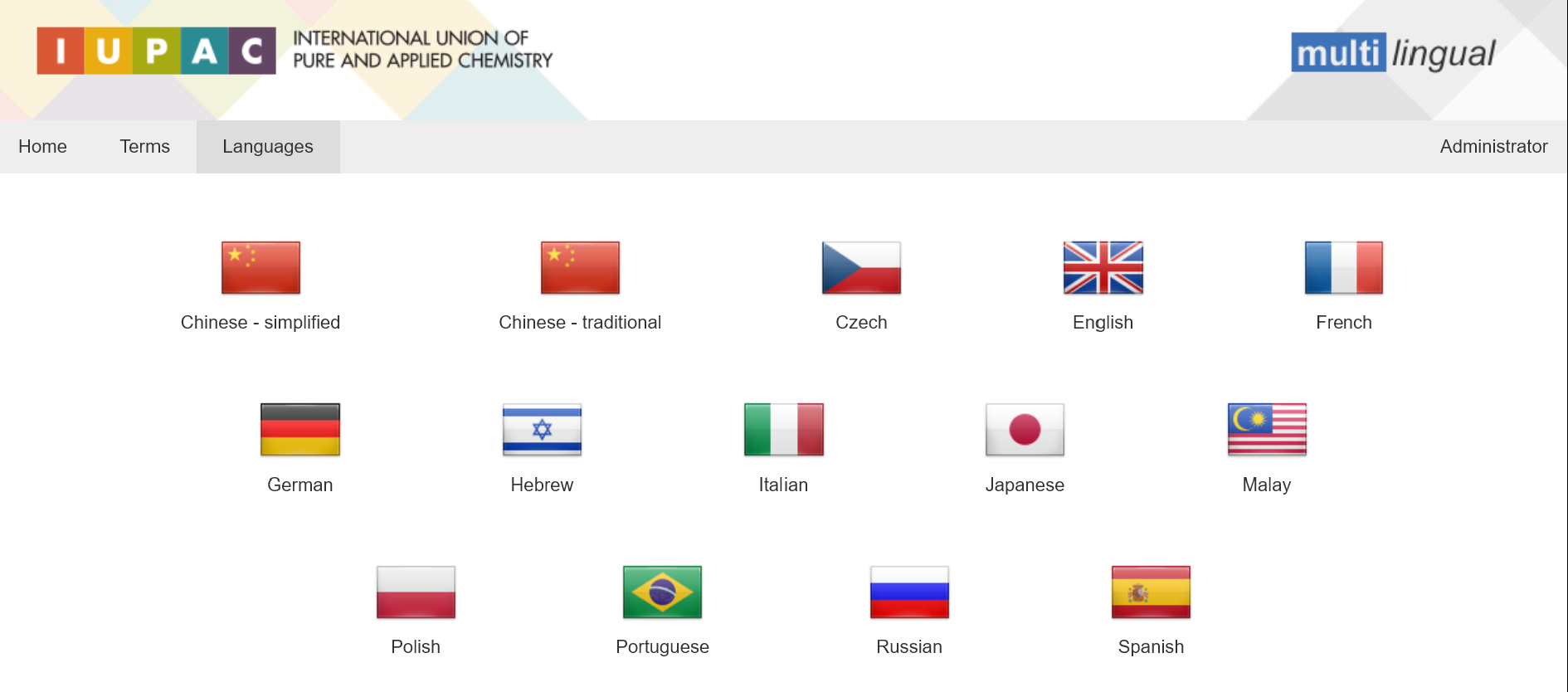
Languages currently available in the encyclopedia https://multilingual.iupac.org
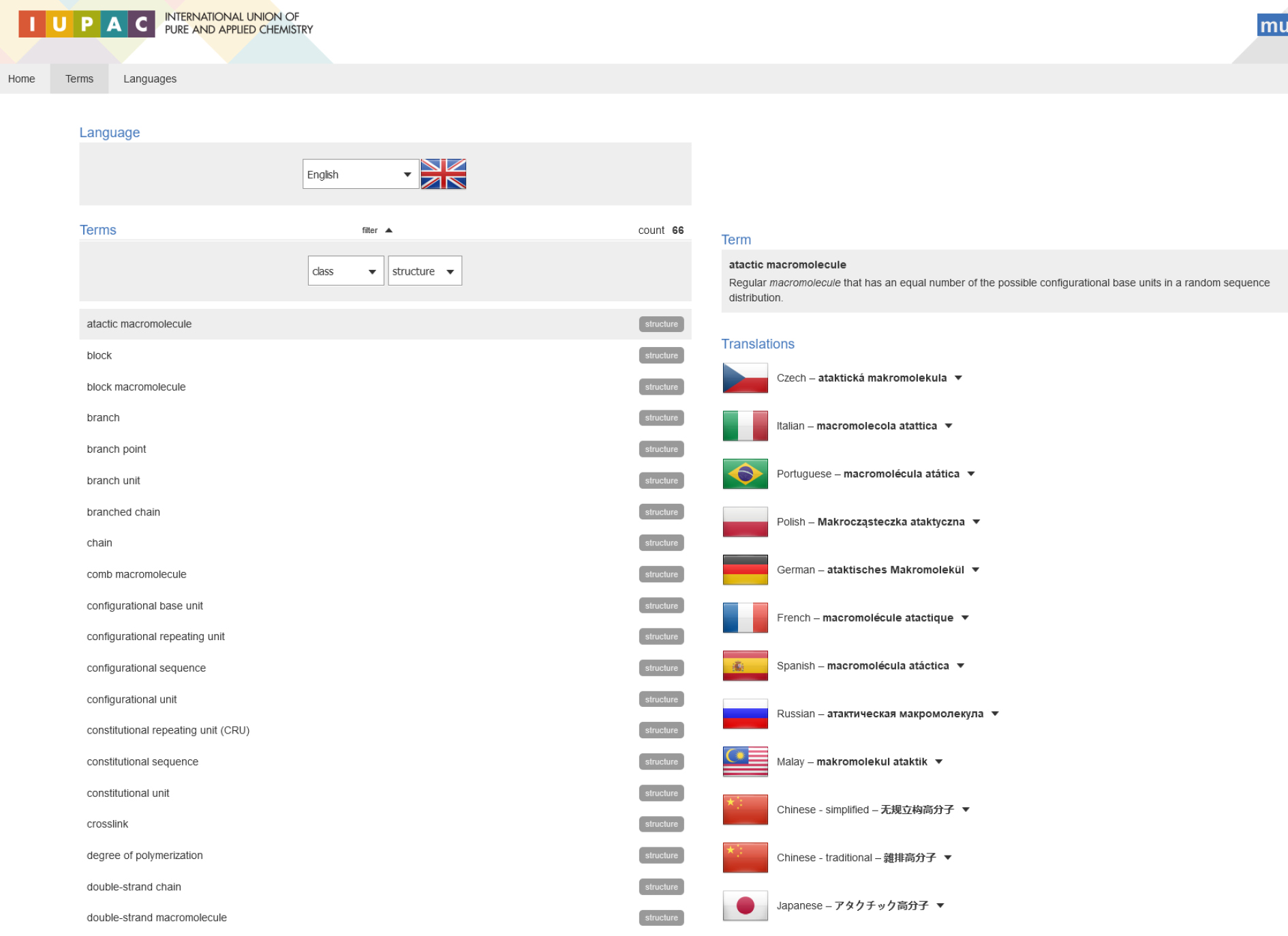
From the homepage, click on ‘terms’ shows the (present) list of terms that are covered by the glossary of basic terms.
macromolécule irrégulière (French)
Macromolécule dont la structure est principalement constituée de la répétition de plus d’une unité constitutive ou macromolécule dont la structure est principalement constituée de la répétition d’une seule unité constitutive mais dont toutes les unités ne sont pas connectées entre elles dans un seul sens directionnel.
нерегулярная макромолекула (Russian)
Макромолекула, в структуре которой присутствует более одного типа составных звеньев, или макромолекула, не все составные звенья которой связаны друг с другом одинаковым образом.
unregelmäßiges Makromolekül (German)
Makromolekül, bei dem ein wesentlicher Teil der Struktur durch Wiederholung von mehr als einem Typ konstitutioneller Einheiten gebildet wird, oder dessen Struktur im wesentlichen aus konstitutionellen Einheiten besteht, die nicht alle in gleicher Weise orientiert miteinander verbunden sind.
iregulární (nepravidelná) makromolekula (Czech)
Makromolekula, jejíž struktura je tvořena opakováním dvou a více druhů konstitučních jednotek, nebo makromolekula, jejží konstituční jednotky nejsou z hlediska vzájemné orientace spojeny shodným způsobem.
It is our aim to add the translations of other languages, in particular of those that use special characters, like Arabic, Korean, or any other language that can provide an authorized translation. Also, we should like to add more terms from available IUPAC Recommendations, however, this requires a significant budget and more manpower than is presently available. This also depends on the acceptance and general request by the scientific community.
We do hope that this first approach to a multilingual encyclopedia on polymer science based on IUPAC documents and authorized translations will be accepted as a useful tool in scientific work and education, and hopefully the project will be extended and its content increased.
In times where the use of Artificial Intelligence becomes more and more popular, one might think that a project like this is superfluous. However, results obtained from AI are not scientifically approved and do not necessarily come with a reliable reference. This, however, is granted by the present project. For the success of this project, it is important that its existence has to become known and its use popular in the scientific and the educational community.
See online at https://iupac.org/polymer-edu/multilingual-polymer-glossary/
About the authors
Jan Merna <Jan.Merna@vscht.cz> is at the Department of Polymers, University of Chemistry and Technology in Prague, Czech Republic
Michael Hess is at the Department of Physics, University of North Texas, Denton, TX, USA. Both are members of the Subcommittee on Polymer Education.
References
1. A.D. Jenkins, P. Kratochvíl, R. F. T. Stepto and, U. W. Suter. “Glossary of basic terms in polymer science (IUPAC Recommendations 1996)” Pure and Applied Chemistry, vol. 68, no. 12, 1996, pp. 2287-2311. https://doi.org/10.1351/pac19966812228710.1351/pac199668122287Search in Google Scholar
2. Richard G. Jones, Jaroslav Kahovec, Robert Stepto, Edward S. Wilks, Michael Hess, Tatsuki Kitayama, W. Val Metanomski, Compendium of Polymer Terminology and Nomenclature, IUPAC Recommendations 2008, RCS Cambridge UK (2009)10.1039/9781847559425Search in Google Scholar
©2025 by IUPAC & De Gruyter
This work is licensed under the Creative Commons Attribution-NonCommercial-NoDerivatives 4.0 International License.
Articles in the same Issue
- Masthead - Full issue pdf
- President’s Column
- The IUPAC-Soong Prize for Sustainable Chemistry—the first IUPAC presidential prize
- Features
- Hazard Information Profiles
- Global Conversation on Sustainability
- Scientists Reviewed 7,000 Studies on Microplastics.
- IUPAC Wire
- Standard atomic weights of three technology critical elements revised
- IUPAC-Soong Prize for Sustainable Chemistry
- Green Chemistry for Life grants presented to Top Young Scientists
- Election of IUPAC Officers, Members of the Executive Board and Science Board
- 2025 IUPAC International Award for Advances in Harmonized Approaches to Crop Protection Chemistry—Call for Nominations
- 2025 IUPAC-Solvay International Award for Young Chemists—Call for applicants
- Navigating New Horizons
- In memoriam: Morton Z. Hoffman
- Project Place
- Advanced methods for assessment of risks of false decisions in analytical chemistry (testing) laboratories—basic concepts and associated terms
- IUPAC HELM Glycans Extension
- Molecular Machine Terminology
- Terminology and Classification of Per- and Poly-Fluoroalkyl Substances (PFAS)
- Chemistry Entrepreneurship
- Multilingual Encyclopedia Polymer Science—Improving Communication in Science and Education
- Making an imPACt
- Terms of Latin origin relating to sample characterization (IUPAC Technical Report)
- Glossary of terms used in biochar research (IUPAC Technical Report)
- Properties and units in the clinical laboratory sciences. Part XXVIII. NPU codes for characterizing subpopulations of the hematopoietic lineage, described from their clusters of differentiation molecules (IUPAC Technical Report)
- Definition of materials chemistry (IUPAC Recommendations 2024)
- IUPAC Recommendations: (Un)equivocal Understanding of Hydrogen and Halogen Bonds and Their (Un)equivocal Naming!
- Conference Call
- Chemistry Education
- Building Chemical Bridges in Latin America: Reflections from the 36th Congreso Latinoamericano de Química
- African Training School on Green Chemistry and Environmental Sustainability
- New Perspectives on the Fight against Chemical Weapons
- Where 2B & Y
- Global Gathering of Chemistry Experts: IUPAC 2025 Comes to Kuala Lumpur, Malaysia!
- Mark Your Calendar
Articles in the same Issue
- Masthead - Full issue pdf
- President’s Column
- The IUPAC-Soong Prize for Sustainable Chemistry—the first IUPAC presidential prize
- Features
- Hazard Information Profiles
- Global Conversation on Sustainability
- Scientists Reviewed 7,000 Studies on Microplastics.
- IUPAC Wire
- Standard atomic weights of three technology critical elements revised
- IUPAC-Soong Prize for Sustainable Chemistry
- Green Chemistry for Life grants presented to Top Young Scientists
- Election of IUPAC Officers, Members of the Executive Board and Science Board
- 2025 IUPAC International Award for Advances in Harmonized Approaches to Crop Protection Chemistry—Call for Nominations
- 2025 IUPAC-Solvay International Award for Young Chemists—Call for applicants
- Navigating New Horizons
- In memoriam: Morton Z. Hoffman
- Project Place
- Advanced methods for assessment of risks of false decisions in analytical chemistry (testing) laboratories—basic concepts and associated terms
- IUPAC HELM Glycans Extension
- Molecular Machine Terminology
- Terminology and Classification of Per- and Poly-Fluoroalkyl Substances (PFAS)
- Chemistry Entrepreneurship
- Multilingual Encyclopedia Polymer Science—Improving Communication in Science and Education
- Making an imPACt
- Terms of Latin origin relating to sample characterization (IUPAC Technical Report)
- Glossary of terms used in biochar research (IUPAC Technical Report)
- Properties and units in the clinical laboratory sciences. Part XXVIII. NPU codes for characterizing subpopulations of the hematopoietic lineage, described from their clusters of differentiation molecules (IUPAC Technical Report)
- Definition of materials chemistry (IUPAC Recommendations 2024)
- IUPAC Recommendations: (Un)equivocal Understanding of Hydrogen and Halogen Bonds and Their (Un)equivocal Naming!
- Conference Call
- Chemistry Education
- Building Chemical Bridges in Latin America: Reflections from the 36th Congreso Latinoamericano de Química
- African Training School on Green Chemistry and Environmental Sustainability
- New Perspectives on the Fight against Chemical Weapons
- Where 2B & Y
- Global Gathering of Chemistry Experts: IUPAC 2025 Comes to Kuala Lumpur, Malaysia!
- Mark Your Calendar
