IUPAC HELM Glycans Extension

HELM (Hierarchical Editing Language for Macromolecules) is a machine-readable linear notation for representing biopolymers, including peptides, antibodies, other oligonucleotides and therapeutic proteins. HELM has been developed and supported by the Pistoia Alliance since 2013 through an active user community and member organizations. As of 2021, HELM is a mature digital motif with demonstrated efficacy and applicability in informatics and structure representation. The HELM notation is now jointly stewarded by IUPAC and the Pistoia Alliance.
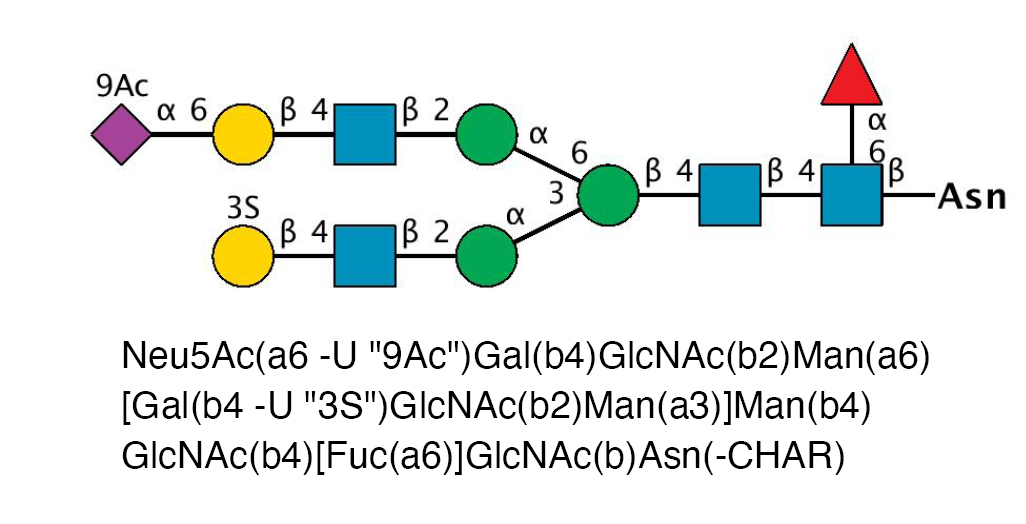
Example of structure generated using DrawGlycan-SNFG shown with the IUPAC string used to generate it; from <http://www.virtualglycome.org/DrawGlycan/>
The scope of HELM monomers presently includes only amino acids and nucleic acids. However, carbohydrates are branching biopolymers and are difficult to represent using a linear notation. Thus, rules are needed to ensure that they are represented uniquely.
The introduction of monosaccharides as monomers to HELM notation would provide a standardized representation of glycoconjugates, including glycoproteins and glycolipids in addition to glycosides. Such molecules can be used to represent substrates for glycosyltransferase enzymes, for example, as can be seen in the Gene Ontology, Reactome, and other pathway databases.
The initial set of monomers identified by the Pistoia Alliance is based on the well-established convention for the pictorial display of structures: Symbol Nomenclature For Glycans (SNFG), recommended for submission to major journal and other publications. The SNFG system was originally released in 2015, building on earlier symbolic notation in coordination with the IUPAC-IUBMB Joint Commission on Biochemical Nomenclature (JCBN) and other community resources [1]. The approach to represent glycans in HELM outlined by the Pistoia Alliance describes the use of SNFG for nomenclature and display.
The project will work through several objectives, including:
Update HELM notation to include appropriate methodology to properly represent glycan moieties
Establish a set of commonly used glycan monomers (e.g., found in public databases)
Establish a validation data set to ensure appropriate implementation of the IUPAC HELM glycan extensions
Represent glycan-containing structures using the newly established HELM glycan extensions
Work with the stakeholder communities to adopt HELM glycan extensions
Addition of glycan monomers by HELM would provide critical support for machine readable large molecule representation and extend the utility of the HELM line notation. Furthermore, this effort would be able to better inform the IUPAC InChI large molecule initiative.
For more information and comment, contact Task Group Chairs Kiyoko Aoki-Kinoshita or Evan Bolton <bolton@ncbi.nlm.nih.gov> | https://iupac.org/project/2024-011-1-024/
References
1. Symbol Nomenclature for Graphical Representation of Glycans, Glycobiology 25: 1323-1324, 2015. https://doi.org/10.1093/glycob/cwv09110.1093/glycob/cwv091Search in Google Scholar PubMed PubMed Central
©2025 by IUPAC & De Gruyter
This work is licensed under the Creative Commons Attribution-NonCommercial-NoDerivatives 4.0 International License.
Articles in the same Issue
- Masthead - Full issue pdf
- President’s Column
- The IUPAC-Soong Prize for Sustainable Chemistry—the first IUPAC presidential prize
- Features
- Hazard Information Profiles
- Global Conversation on Sustainability
- Scientists Reviewed 7,000 Studies on Microplastics.
- IUPAC Wire
- Standard atomic weights of three technology critical elements revised
- IUPAC-Soong Prize for Sustainable Chemistry
- Green Chemistry for Life grants presented to Top Young Scientists
- Election of IUPAC Officers, Members of the Executive Board and Science Board
- 2025 IUPAC International Award for Advances in Harmonized Approaches to Crop Protection Chemistry—Call for Nominations
- 2025 IUPAC-Solvay International Award for Young Chemists—Call for applicants
- Navigating New Horizons
- In memoriam: Morton Z. Hoffman
- Project Place
- Advanced methods for assessment of risks of false decisions in analytical chemistry (testing) laboratories—basic concepts and associated terms
- IUPAC HELM Glycans Extension
- Molecular Machine Terminology
- Terminology and Classification of Per- and Poly-Fluoroalkyl Substances (PFAS)
- Chemistry Entrepreneurship
- Multilingual Encyclopedia Polymer Science—Improving Communication in Science and Education
- Making an imPACt
- Terms of Latin origin relating to sample characterization (IUPAC Technical Report)
- Glossary of terms used in biochar research (IUPAC Technical Report)
- Properties and units in the clinical laboratory sciences. Part XXVIII. NPU codes for characterizing subpopulations of the hematopoietic lineage, described from their clusters of differentiation molecules (IUPAC Technical Report)
- Definition of materials chemistry (IUPAC Recommendations 2024)
- IUPAC Recommendations: (Un)equivocal Understanding of Hydrogen and Halogen Bonds and Their (Un)equivocal Naming!
- Conference Call
- Chemistry Education
- Building Chemical Bridges in Latin America: Reflections from the 36th Congreso Latinoamericano de Química
- African Training School on Green Chemistry and Environmental Sustainability
- New Perspectives on the Fight against Chemical Weapons
- Where 2B & Y
- Global Gathering of Chemistry Experts: IUPAC 2025 Comes to Kuala Lumpur, Malaysia!
- Mark Your Calendar
Articles in the same Issue
- Masthead - Full issue pdf
- President’s Column
- The IUPAC-Soong Prize for Sustainable Chemistry—the first IUPAC presidential prize
- Features
- Hazard Information Profiles
- Global Conversation on Sustainability
- Scientists Reviewed 7,000 Studies on Microplastics.
- IUPAC Wire
- Standard atomic weights of three technology critical elements revised
- IUPAC-Soong Prize for Sustainable Chemistry
- Green Chemistry for Life grants presented to Top Young Scientists
- Election of IUPAC Officers, Members of the Executive Board and Science Board
- 2025 IUPAC International Award for Advances in Harmonized Approaches to Crop Protection Chemistry—Call for Nominations
- 2025 IUPAC-Solvay International Award for Young Chemists—Call for applicants
- Navigating New Horizons
- In memoriam: Morton Z. Hoffman
- Project Place
- Advanced methods for assessment of risks of false decisions in analytical chemistry (testing) laboratories—basic concepts and associated terms
- IUPAC HELM Glycans Extension
- Molecular Machine Terminology
- Terminology and Classification of Per- and Poly-Fluoroalkyl Substances (PFAS)
- Chemistry Entrepreneurship
- Multilingual Encyclopedia Polymer Science—Improving Communication in Science and Education
- Making an imPACt
- Terms of Latin origin relating to sample characterization (IUPAC Technical Report)
- Glossary of terms used in biochar research (IUPAC Technical Report)
- Properties and units in the clinical laboratory sciences. Part XXVIII. NPU codes for characterizing subpopulations of the hematopoietic lineage, described from their clusters of differentiation molecules (IUPAC Technical Report)
- Definition of materials chemistry (IUPAC Recommendations 2024)
- IUPAC Recommendations: (Un)equivocal Understanding of Hydrogen and Halogen Bonds and Their (Un)equivocal Naming!
- Conference Call
- Chemistry Education
- Building Chemical Bridges in Latin America: Reflections from the 36th Congreso Latinoamericano de Química
- African Training School on Green Chemistry and Environmental Sustainability
- New Perspectives on the Fight against Chemical Weapons
- Where 2B & Y
- Global Gathering of Chemistry Experts: IUPAC 2025 Comes to Kuala Lumpur, Malaysia!
- Mark Your Calendar
