Navigating New Horizons

Abstract
As environmental, technological and societal change join forces to disrupt human and planetary health, the world must get better at tracking and responding to a host of emerging challenges, according to a new report from the United Nations Environment Programme (UNEP) and the International Science Council (ISC), released last July.
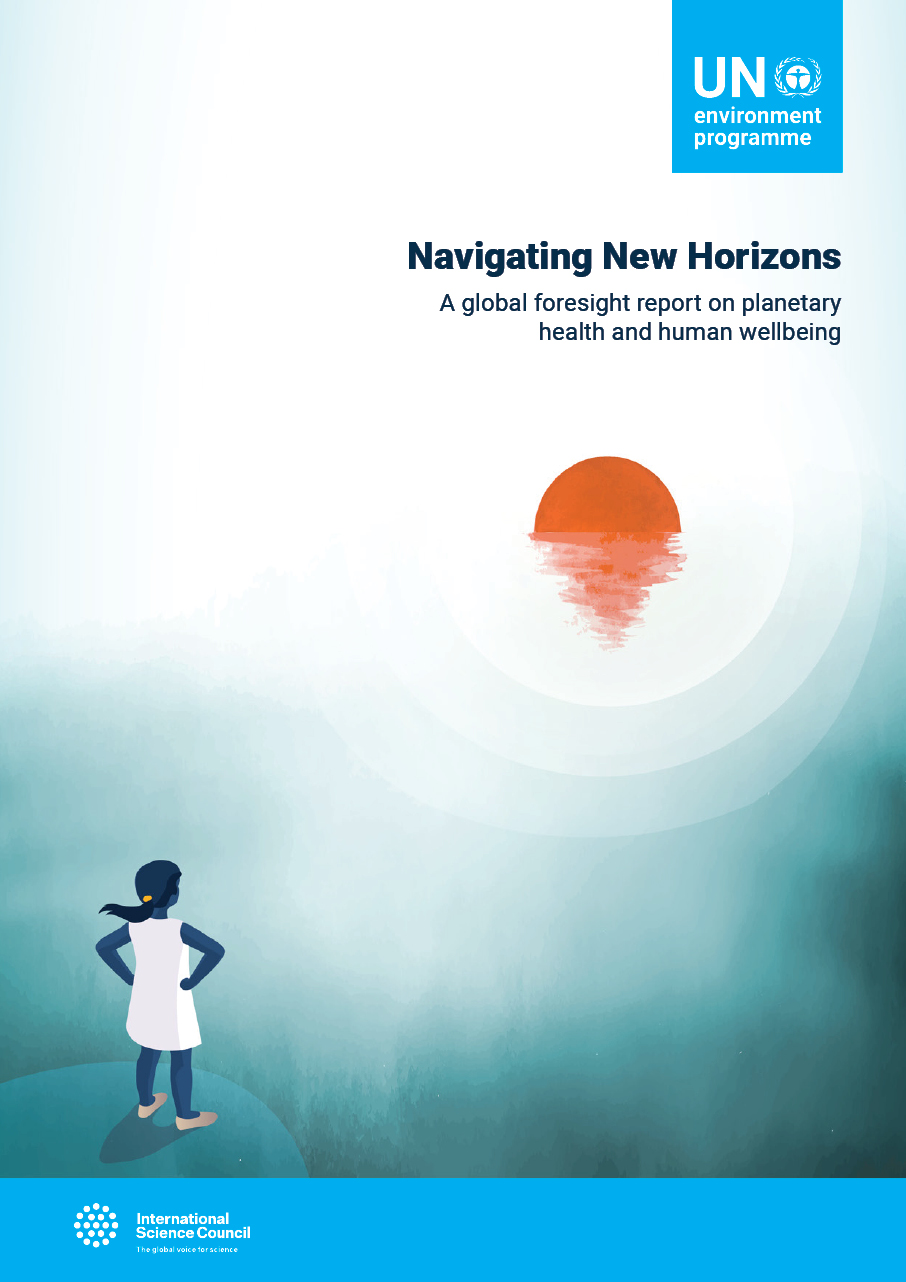
Navigating New Horizons—A Global Foresight Report on Planetary Health and Human Wellbeing identifies eight critical global shifts that are accelerating the triple planetary crisis of climate change, nature and biodiversity loss, and pollution and waste. The shifts include humanity’s degradation of the natural world, the rapid development of technologies such as AI, competition for natural resources, widening inequalities and declining trust in institutions. These shifts are creating a polycrisis, in which global crises are amplifying, accelerating, and synchronizing—with huge implications for human and planetary wellbeing.
Eighteen accompanying signals of change—identified by hundreds of global experts through regional and stakeholder consultations that included youth—offer a deeper glimpse into potential disruptions, both positive and negative, that the world must prepare for.
Signals of change
Key shifts and signals of change outlined in the report include:
The demand for critical rare earth elements, minerals, and metals to fuel the transition to net-zero is expected to increase fourfold by 2040, increasing calls for deep sea mining and even space mining. This poses potential threats to nature and biodiversity, could increase pollution and waste, and spark more conflicts.
As permafrost thaws on a warming planet, ancient organisms that may be pathogenic could be released, resulting in major environmental, animal and human impacts. This phenomenon has already led to an outbreak of anthrax in Siberia.
While AI and digital transformation can bring benefits, there are environmental implications—such as increased demand for critical minerals and rare earth elements and water resources to meet data center demands. The use of AI in weapons systems and military applications, and the development of synthetic biology, need careful review through an environmental lens.
Armed conflict and violence are rising and evolving. These conflicts result in ecosystem degradation and pollution, leading to repercussions for vulnerable populations.
Forced displacement is increasing human health and environmental impacts. One in every 69 people is now forcibly displaced—nearly double the figures from a decade ago. Conflict and climate change are key drivers.
Adopting foresight
However, the report finds that using foresight tools can help the world to anticipate and prepare for the next emerging challenges and future disruptions.
Peter Gluckman, President of the ISC, said, “Foresight provides a useful set of tools to step outside of short-termism to help identify future opportunities and risks provided that it is done in a truly pluralistic manner, transcending narrow institutional mandates, sectors and other artificial divides that constrain our framing of the problems and the solutions.”
The report recommends adopting a new social contract that engages a diverse range of stakeholders, including indigenous people; giving young people a stronger voice; and rethinking measures of progress to go beyond GDP.
Governments and societies can also introduce shorter term targets and indicators that allow them to be more agile in governance. Ushering in tools and actions to reconfigure financial systems and reroute capital flows—a positive signal of change in the report—could help to reduce inequalities, eradicate extreme poverty and address environmental crises.
Supporting agile and adaptive governance would require better monitoring and assessment of interventions. This includes integrating and improving monitoring on environmental change, and making data and knowledge more accessible.
Just as the impacts of multiple crises are amplifying harm to environmental and human health, the solutions are in sight and actions are underway that would address the global shifts and signals of change identified in the report. Foresight can help to accelerate these actions and spark many more.
Reproduced from https://council.science/news/global-foresight-report
©2025 by IUPAC & De Gruyter
This work is licensed under the Creative Commons Attribution-NonCommercial-NoDerivatives 4.0 International License.
Articles in the same Issue
- Masthead - Full issue pdf
- President’s Column
- The IUPAC-Soong Prize for Sustainable Chemistry—the first IUPAC presidential prize
- Features
- Hazard Information Profiles
- Global Conversation on Sustainability
- Scientists Reviewed 7,000 Studies on Microplastics.
- IUPAC Wire
- Standard atomic weights of three technology critical elements revised
- IUPAC-Soong Prize for Sustainable Chemistry
- Green Chemistry for Life grants presented to Top Young Scientists
- Election of IUPAC Officers, Members of the Executive Board and Science Board
- 2025 IUPAC International Award for Advances in Harmonized Approaches to Crop Protection Chemistry—Call for Nominations
- 2025 IUPAC-Solvay International Award for Young Chemists—Call for applicants
- Navigating New Horizons
- In memoriam: Morton Z. Hoffman
- Project Place
- Advanced methods for assessment of risks of false decisions in analytical chemistry (testing) laboratories—basic concepts and associated terms
- IUPAC HELM Glycans Extension
- Molecular Machine Terminology
- Terminology and Classification of Per- and Poly-Fluoroalkyl Substances (PFAS)
- Chemistry Entrepreneurship
- Multilingual Encyclopedia Polymer Science—Improving Communication in Science and Education
- Making an imPACt
- Terms of Latin origin relating to sample characterization (IUPAC Technical Report)
- Glossary of terms used in biochar research (IUPAC Technical Report)
- Properties and units in the clinical laboratory sciences. Part XXVIII. NPU codes for characterizing subpopulations of the hematopoietic lineage, described from their clusters of differentiation molecules (IUPAC Technical Report)
- Definition of materials chemistry (IUPAC Recommendations 2024)
- IUPAC Recommendations: (Un)equivocal Understanding of Hydrogen and Halogen Bonds and Their (Un)equivocal Naming!
- Conference Call
- Chemistry Education
- Building Chemical Bridges in Latin America: Reflections from the 36th Congreso Latinoamericano de Química
- African Training School on Green Chemistry and Environmental Sustainability
- New Perspectives on the Fight against Chemical Weapons
- Where 2B & Y
- Global Gathering of Chemistry Experts: IUPAC 2025 Comes to Kuala Lumpur, Malaysia!
- Mark Your Calendar
Articles in the same Issue
- Masthead - Full issue pdf
- President’s Column
- The IUPAC-Soong Prize for Sustainable Chemistry—the first IUPAC presidential prize
- Features
- Hazard Information Profiles
- Global Conversation on Sustainability
- Scientists Reviewed 7,000 Studies on Microplastics.
- IUPAC Wire
- Standard atomic weights of three technology critical elements revised
- IUPAC-Soong Prize for Sustainable Chemistry
- Green Chemistry for Life grants presented to Top Young Scientists
- Election of IUPAC Officers, Members of the Executive Board and Science Board
- 2025 IUPAC International Award for Advances in Harmonized Approaches to Crop Protection Chemistry—Call for Nominations
- 2025 IUPAC-Solvay International Award for Young Chemists—Call for applicants
- Navigating New Horizons
- In memoriam: Morton Z. Hoffman
- Project Place
- Advanced methods for assessment of risks of false decisions in analytical chemistry (testing) laboratories—basic concepts and associated terms
- IUPAC HELM Glycans Extension
- Molecular Machine Terminology
- Terminology and Classification of Per- and Poly-Fluoroalkyl Substances (PFAS)
- Chemistry Entrepreneurship
- Multilingual Encyclopedia Polymer Science—Improving Communication in Science and Education
- Making an imPACt
- Terms of Latin origin relating to sample characterization (IUPAC Technical Report)
- Glossary of terms used in biochar research (IUPAC Technical Report)
- Properties and units in the clinical laboratory sciences. Part XXVIII. NPU codes for characterizing subpopulations of the hematopoietic lineage, described from their clusters of differentiation molecules (IUPAC Technical Report)
- Definition of materials chemistry (IUPAC Recommendations 2024)
- IUPAC Recommendations: (Un)equivocal Understanding of Hydrogen and Halogen Bonds and Their (Un)equivocal Naming!
- Conference Call
- Chemistry Education
- Building Chemical Bridges in Latin America: Reflections from the 36th Congreso Latinoamericano de Química
- African Training School on Green Chemistry and Environmental Sustainability
- New Perspectives on the Fight against Chemical Weapons
- Where 2B & Y
- Global Gathering of Chemistry Experts: IUPAC 2025 Comes to Kuala Lumpur, Malaysia!
- Mark Your Calendar
