Advanced methods for assessment of risks of false decisions in analytical chemistry (testing) laboratories—basic concepts and associated terms

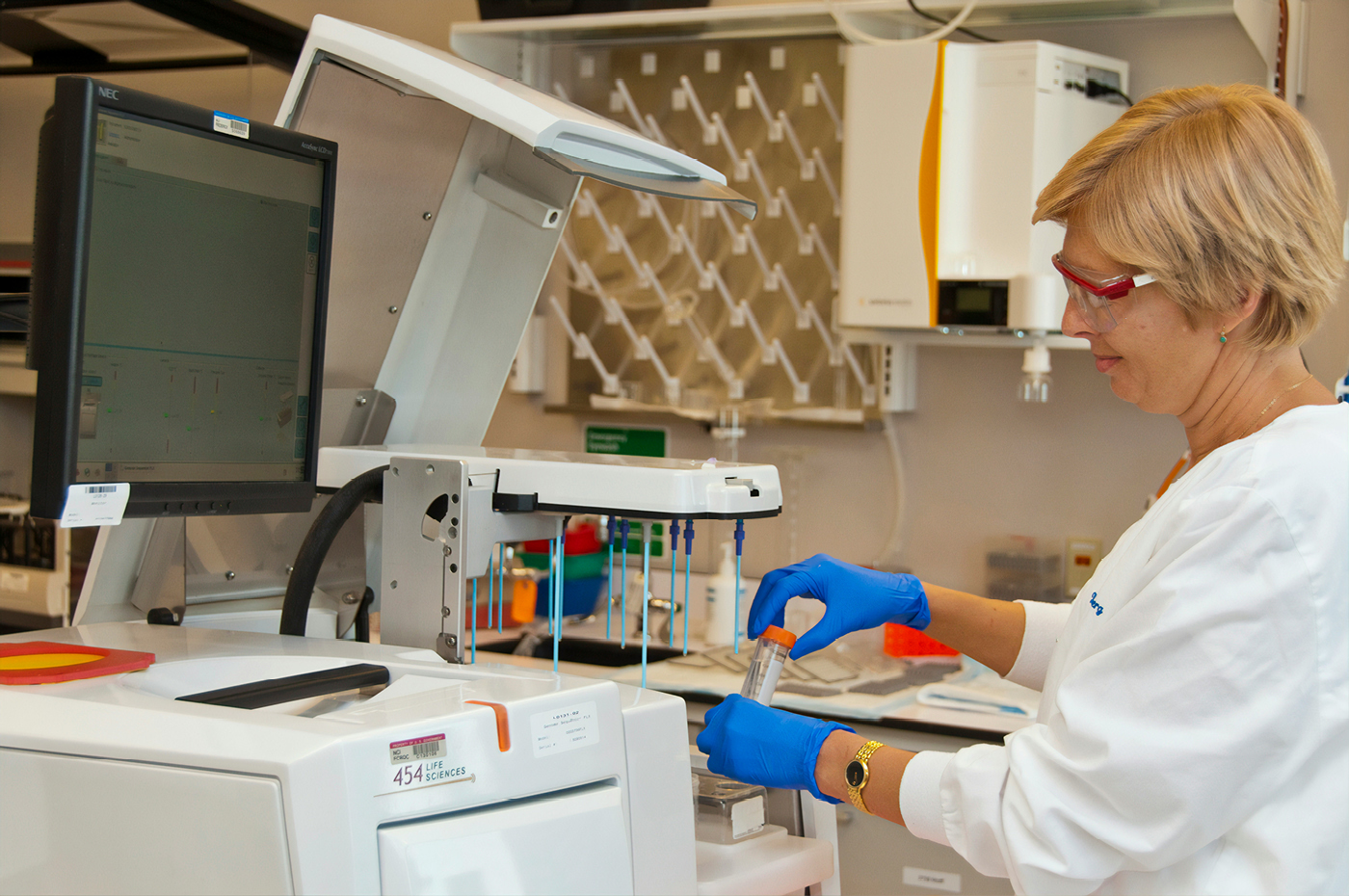
A technician preparing to run microbial genomes on the Roche 454 sequencing platform at the Advanced Technology Research Facility (ATRF), Frederick National Laboratory for Cancer Research, National Cancer Institute.
There are three main documents by ISO and IEC for risk management: ISO 31000:2018 “Risk management—Guidelines”, IEC 31010:2019 “Risk management—Risk assessment techniques”, and ISO 31073:2022 “Risk management—Vocabulary”. These documents provide a common approach (based on the risk assessment) for the management of any type of risk and are not industry- or sector- specific. They can be customized to any organization, and are applicable to any activity, including decision-making. However, the authors of the documents (ISO/TC 262) emphasize that in practice the concepts and terminology need to be adapted to the field or discipline of application, to avoid misinterpretation, misrepresentation, or misuse.
During the past decade several IUPAC projects have been dedicated to risk assessment in an analytical laboratory:
1. A position paper of the IUPAC project team (project 2014-027-1-500) on the risks of false decisions originated by human errors (2013), https://doi.org/10.1007/s00769-012-0934-y, has reached about 16000 readers (ResearchGate, 25 July 2024). The IUPAC/CITAC Guide on assessment of the risks caused by human errors (2016), https://doi.org/10.1515/ci-2016-0520, was implemented recently even in such unexpected fields as medicine (2023), https://doi.org/10.21037/jlpm-23-7, and military equipment testing (2024), https://doi.org/10.37701/dndivsovt.20.2024.15.
2. The topic of risks of false decisions in conformity assessment due to measurement uncertainty was initially addressed in the IUPAC/CITAC Guide on assessment of the risks of out-of-specification test results of a single component content (2012), https://doi.org/10.1351/PAC-REP-11-10-04. It was further developed in the IUPAC/CITAC Guide for multicomponent objects, when test results may be correlated (2020), https://doi.org/10.1515/pac-2019-0906; and in the IUPAC/CITAC Guide for multicomponent objects under a mass balance constraint (2023), https://doi.org/10.1515/pac-2022-0801.
In the current project a harmonization of basic concepts and associated terms applied in advanced methods for assessment of the risks is offered. This harmonization will contribute to quality assurance wherever measurements and tests are made in analytical chemistry (testing) laboratories, in industry, trade, environmental analysis, or another field. The project will also contribute to the IUPAC Mission “providing a common language for chemistry”.
For more information and comment, contact Task Group Chair Ilya Kuselman <ilya.kuselman@gmail.com> | https://iupac.org/project/2024-012-2-500/
©2025 by IUPAC & De Gruyter
This work is licensed under the Creative Commons Attribution-NonCommercial-NoDerivatives 4.0 International License.
Articles in the same Issue
- Masthead - Full issue pdf
- President’s Column
- The IUPAC-Soong Prize for Sustainable Chemistry—the first IUPAC presidential prize
- Features
- Hazard Information Profiles
- Global Conversation on Sustainability
- Scientists Reviewed 7,000 Studies on Microplastics.
- IUPAC Wire
- Standard atomic weights of three technology critical elements revised
- IUPAC-Soong Prize for Sustainable Chemistry
- Green Chemistry for Life grants presented to Top Young Scientists
- Election of IUPAC Officers, Members of the Executive Board and Science Board
- 2025 IUPAC International Award for Advances in Harmonized Approaches to Crop Protection Chemistry—Call for Nominations
- 2025 IUPAC-Solvay International Award for Young Chemists—Call for applicants
- Navigating New Horizons
- In memoriam: Morton Z. Hoffman
- Project Place
- Advanced methods for assessment of risks of false decisions in analytical chemistry (testing) laboratories—basic concepts and associated terms
- IUPAC HELM Glycans Extension
- Molecular Machine Terminology
- Terminology and Classification of Per- and Poly-Fluoroalkyl Substances (PFAS)
- Chemistry Entrepreneurship
- Multilingual Encyclopedia Polymer Science—Improving Communication in Science and Education
- Making an imPACt
- Terms of Latin origin relating to sample characterization (IUPAC Technical Report)
- Glossary of terms used in biochar research (IUPAC Technical Report)
- Properties and units in the clinical laboratory sciences. Part XXVIII. NPU codes for characterizing subpopulations of the hematopoietic lineage, described from their clusters of differentiation molecules (IUPAC Technical Report)
- Definition of materials chemistry (IUPAC Recommendations 2024)
- IUPAC Recommendations: (Un)equivocal Understanding of Hydrogen and Halogen Bonds and Their (Un)equivocal Naming!
- Conference Call
- Chemistry Education
- Building Chemical Bridges in Latin America: Reflections from the 36th Congreso Latinoamericano de Química
- African Training School on Green Chemistry and Environmental Sustainability
- New Perspectives on the Fight against Chemical Weapons
- Where 2B & Y
- Global Gathering of Chemistry Experts: IUPAC 2025 Comes to Kuala Lumpur, Malaysia!
- Mark Your Calendar
Articles in the same Issue
- Masthead - Full issue pdf
- President’s Column
- The IUPAC-Soong Prize for Sustainable Chemistry—the first IUPAC presidential prize
- Features
- Hazard Information Profiles
- Global Conversation on Sustainability
- Scientists Reviewed 7,000 Studies on Microplastics.
- IUPAC Wire
- Standard atomic weights of three technology critical elements revised
- IUPAC-Soong Prize for Sustainable Chemistry
- Green Chemistry for Life grants presented to Top Young Scientists
- Election of IUPAC Officers, Members of the Executive Board and Science Board
- 2025 IUPAC International Award for Advances in Harmonized Approaches to Crop Protection Chemistry—Call for Nominations
- 2025 IUPAC-Solvay International Award for Young Chemists—Call for applicants
- Navigating New Horizons
- In memoriam: Morton Z. Hoffman
- Project Place
- Advanced methods for assessment of risks of false decisions in analytical chemistry (testing) laboratories—basic concepts and associated terms
- IUPAC HELM Glycans Extension
- Molecular Machine Terminology
- Terminology and Classification of Per- and Poly-Fluoroalkyl Substances (PFAS)
- Chemistry Entrepreneurship
- Multilingual Encyclopedia Polymer Science—Improving Communication in Science and Education
- Making an imPACt
- Terms of Latin origin relating to sample characterization (IUPAC Technical Report)
- Glossary of terms used in biochar research (IUPAC Technical Report)
- Properties and units in the clinical laboratory sciences. Part XXVIII. NPU codes for characterizing subpopulations of the hematopoietic lineage, described from their clusters of differentiation molecules (IUPAC Technical Report)
- Definition of materials chemistry (IUPAC Recommendations 2024)
- IUPAC Recommendations: (Un)equivocal Understanding of Hydrogen and Halogen Bonds and Their (Un)equivocal Naming!
- Conference Call
- Chemistry Education
- Building Chemical Bridges in Latin America: Reflections from the 36th Congreso Latinoamericano de Química
- African Training School on Green Chemistry and Environmental Sustainability
- New Perspectives on the Fight against Chemical Weapons
- Where 2B & Y
- Global Gathering of Chemistry Experts: IUPAC 2025 Comes to Kuala Lumpur, Malaysia!
- Mark Your Calendar
