Building Chemical Bridges in Latin America: Reflections from the 36th Congreso Latinoamericano de Química
-
Javier García-Martínez
Javier García-Martínez <
j.garcia@ua.es > is a Professor of Inorganic Chemistry and Director of the Molecular Nanotechnology Laboratory of the University of Alicante where he leads an international team working on the synthesis and application of nanostructured materials for the production of chemicals and energy. Javier is since January 2024 IUPAC Past President. Previously, he served as President (2022-2023), Vice President and member of the Executive Committee, and as Titular Member and Vice-President of the Inorganic Chemistry Division.

Late September last year, I had the pleasure of attending the 36th Congreso Latinoamericano de Química (CLAQ, Latin American Chemistry Congress), held in Panama from 25 September to 9 October. This 2024 event was particularly significant as it coincided with the 50th anniversary of the Colegio Panameño de Químicos (Copaqui), marking an important milestone in the chemical sciences community in Panama. The congress theme, Construyendo Puentes Químicos en América Latina (Building Chemical Bridges in Latin America), emphasised the importance of regional cooperation and the common challenges and opportunities facing Latin American chemists in the 21st century.
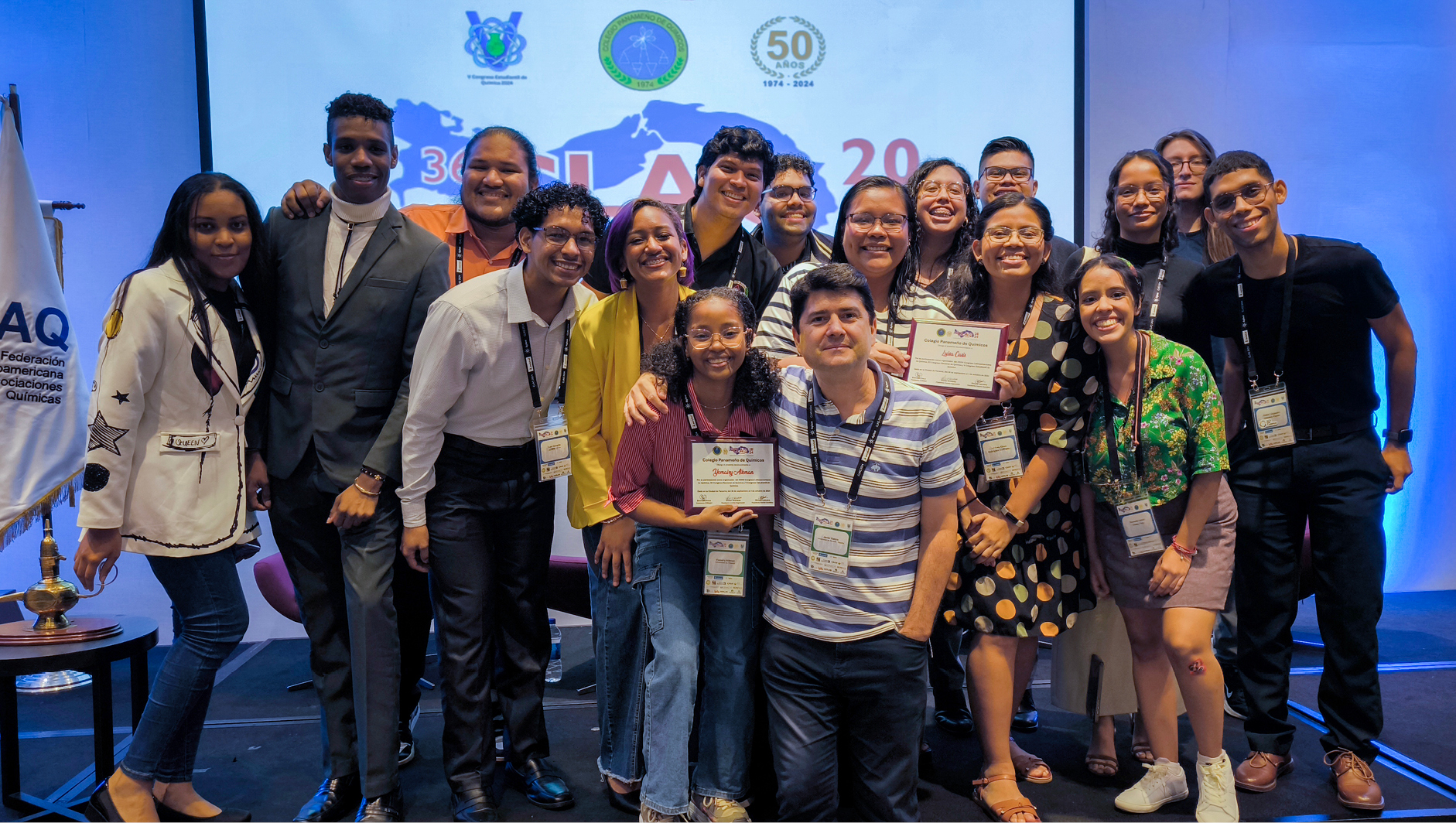
Javier García-Martínez pictured with some of the early career chemists who attended the 36th Latin American Chemistry Congress in Panama, coinciding with the 5th Student Chemistry Congress.
Held in conjunction with the XII Congreso Nacional de Química (National Chemistry Congress) and the V Congreso Estudiantil de Química (Student Chemistry Congress), the CLAQ 2024 programme was diverse and included a number of key events, such as three roundtables on topics such as chemical entrepreneurship, frontiers in chemical research and the role of chemistry in driving innovation in the region. The congress brought together leading researchers, professionals, and students to discuss the latest advances in chemical research in areas ranging from materials science to biotechnology. During the congress, the Latin American Women in Chemistry Awards were presented to Grissel Trujillo de Santiago (Emerging Leader in Chemistry), Priscila Castelani (Leadership in Industry) and Coralia Osorio Roa (Leadership in Academia).
During the congress, I had the privilege of delivering a plenary lecture on Catalysing Circular Chemistry. This was a wonderful opportunity to share recent advances catalysis for a more sustainable future with an audience eager to explore the role of chemistry in addressing climate change and sustainability. I also presented some of IUPAC’s key activities and invited participants to attend the Global Women’s Breakfast on 11 February 2025, to nominate more candidates for our awards and prizes, and to attend our 53rd IUPAC General Assembly and the 50th World Chemistry Congress, which will be held in Kuala Lumpur, Malaysia, in July 2025.
Particularly useful was my participation in the General Assembly of the Federation of Chemical Societies of Latin America (FLAQ), where I described the main initiatives and programmes organised by IUPAC and invited the participants to benefit from the various efforts made with the Spanish-speaking community in mind, such as the translation into Spanish of the Brief Guides to Inorganic, Organic and Polymer Nomenclature and the OPCW-IUPAC e-Learning Safety Training Programme in Spanish. I also introduced the Presidents’ Forum to the representatives of the various Chemical Societies present in the room. This meeting provided an excellent platform to address common goals, including the promotion of chemistry education, the advancement of scientific research, and the implementation of sustainable practices.
I took advantage of my time in Panama to meet with the President and other academic authorities of the University of Panama, the country’s largest and oldest university with over 100 000 students. We discussed ways to further strengthen the relationship between IUPAC and Panama’s academic institutions. Discussions focused on creating more opportunities for Panamanian students and researchers to engage with IUPAC’s global initiatives, particularly in the areas of sustainability and educational outreach. This meeting was an important step in expanding IUPAC’s presence in the region and ensuring that Panama continues to play a vital role in Latin American and global chemistry.
Taking advantage of my visit to the University of Panama, I gave a talk to their chemistry students entitled “Reimagining Our Relationship with the Planet at a Molecular Scale.” In this talk, I challenged students to reimagine chemistry at the molecular level to shape global sustainability efforts and urged them to take an active role in rethinking chemical processes to better meet environmental needs. This dialogue with the new generation of Panamanian chemists was particularly rewarding, as their passion and innovative ideas demonstrated the future potential of the region’s scientific community.
I am delighted to say that the 36th CLAQ in Panama was a resounding success, both in terms of scientific exchange and in strengthening regional ties. The Congress truly embodied its theme of “Building Chemical Bridges” and facilitated meaningful connections across Latin America. From the lively discussions during the congress to the strategic conversations with academic and industry leaders, it is clear that Latin American chemists are committed to driving the future of the field with an eye towards sustainability, innovation and international collaboration. I am deeply grateful to have been part of this historic event and look forward to continuing to work with my colleagues across the region as we build a stronger, more connected scientific community.
As we look forward to CLAQ 2026 in Lima, Peru, the groundwork laid at the Panama Congress will serve as a foundation for future meetings. The conversations started in Panama will undoubtedly continue in Lima as we strive to further integrate the scientific capabilities of the region. The next Congress promises to build on this year’s momentum, with even more ambitious goals to foster chemical innovation and address the global challenges that unite us all.
The 36th Congreso Latinoamericano de Química was a testament to the power of regional cooperation and the critical role of chemistry in shaping a sustainable future. I would like to express my sincere gratitude to Copaqui and the entire Organizing Committee for their extraordinary work in bringing this event to life, and for allowing me to share with chemists from the region how IUPAC is contributing to the advancement of the chemical sciences worldwide, and to invite them to be part of this effort. The discussions, connections and ideas shared in Panama will undoubtedly have a profound impact in the region, helping to further strengthen the links between the various Latin American chemical societies and between them and the rest of the world.
About the author
Javier García-Martínez <j.garcia@ua.es> is a Professor of Inorganic Chemistry and Director of the Molecular Nanotechnology Laboratory of the University of Alicante where he leads an international team working on the synthesis and application of nanostructured materials for the production of chemicals and energy. Javier is since January 2024 IUPAC Past President. Previously, he served as President (2022-2023), Vice President and member of the Executive Committee, and as Titular Member and Vice-President of the Inorganic Chemistry Division.
©2025 by IUPAC & De Gruyter
This work is licensed under the Creative Commons Attribution-NonCommercial-NoDerivatives 4.0 International License.
Articles in the same Issue
- Masthead - Full issue pdf
- President’s Column
- The IUPAC-Soong Prize for Sustainable Chemistry—the first IUPAC presidential prize
- Features
- Hazard Information Profiles
- Global Conversation on Sustainability
- Scientists Reviewed 7,000 Studies on Microplastics.
- IUPAC Wire
- Standard atomic weights of three technology critical elements revised
- IUPAC-Soong Prize for Sustainable Chemistry
- Green Chemistry for Life grants presented to Top Young Scientists
- Election of IUPAC Officers, Members of the Executive Board and Science Board
- 2025 IUPAC International Award for Advances in Harmonized Approaches to Crop Protection Chemistry—Call for Nominations
- 2025 IUPAC-Solvay International Award for Young Chemists—Call for applicants
- Navigating New Horizons
- In memoriam: Morton Z. Hoffman
- Project Place
- Advanced methods for assessment of risks of false decisions in analytical chemistry (testing) laboratories—basic concepts and associated terms
- IUPAC HELM Glycans Extension
- Molecular Machine Terminology
- Terminology and Classification of Per- and Poly-Fluoroalkyl Substances (PFAS)
- Chemistry Entrepreneurship
- Multilingual Encyclopedia Polymer Science—Improving Communication in Science and Education
- Making an imPACt
- Terms of Latin origin relating to sample characterization (IUPAC Technical Report)
- Glossary of terms used in biochar research (IUPAC Technical Report)
- Properties and units in the clinical laboratory sciences. Part XXVIII. NPU codes for characterizing subpopulations of the hematopoietic lineage, described from their clusters of differentiation molecules (IUPAC Technical Report)
- Definition of materials chemistry (IUPAC Recommendations 2024)
- IUPAC Recommendations: (Un)equivocal Understanding of Hydrogen and Halogen Bonds and Their (Un)equivocal Naming!
- Conference Call
- Chemistry Education
- Building Chemical Bridges in Latin America: Reflections from the 36th Congreso Latinoamericano de Química
- African Training School on Green Chemistry and Environmental Sustainability
- New Perspectives on the Fight against Chemical Weapons
- Where 2B & Y
- Global Gathering of Chemistry Experts: IUPAC 2025 Comes to Kuala Lumpur, Malaysia!
- Mark Your Calendar
Articles in the same Issue
- Masthead - Full issue pdf
- President’s Column
- The IUPAC-Soong Prize for Sustainable Chemistry—the first IUPAC presidential prize
- Features
- Hazard Information Profiles
- Global Conversation on Sustainability
- Scientists Reviewed 7,000 Studies on Microplastics.
- IUPAC Wire
- Standard atomic weights of three technology critical elements revised
- IUPAC-Soong Prize for Sustainable Chemistry
- Green Chemistry for Life grants presented to Top Young Scientists
- Election of IUPAC Officers, Members of the Executive Board and Science Board
- 2025 IUPAC International Award for Advances in Harmonized Approaches to Crop Protection Chemistry—Call for Nominations
- 2025 IUPAC-Solvay International Award for Young Chemists—Call for applicants
- Navigating New Horizons
- In memoriam: Morton Z. Hoffman
- Project Place
- Advanced methods for assessment of risks of false decisions in analytical chemistry (testing) laboratories—basic concepts and associated terms
- IUPAC HELM Glycans Extension
- Molecular Machine Terminology
- Terminology and Classification of Per- and Poly-Fluoroalkyl Substances (PFAS)
- Chemistry Entrepreneurship
- Multilingual Encyclopedia Polymer Science—Improving Communication in Science and Education
- Making an imPACt
- Terms of Latin origin relating to sample characterization (IUPAC Technical Report)
- Glossary of terms used in biochar research (IUPAC Technical Report)
- Properties and units in the clinical laboratory sciences. Part XXVIII. NPU codes for characterizing subpopulations of the hematopoietic lineage, described from their clusters of differentiation molecules (IUPAC Technical Report)
- Definition of materials chemistry (IUPAC Recommendations 2024)
- IUPAC Recommendations: (Un)equivocal Understanding of Hydrogen and Halogen Bonds and Their (Un)equivocal Naming!
- Conference Call
- Chemistry Education
- Building Chemical Bridges in Latin America: Reflections from the 36th Congreso Latinoamericano de Química
- African Training School on Green Chemistry and Environmental Sustainability
- New Perspectives on the Fight against Chemical Weapons
- Where 2B & Y
- Global Gathering of Chemistry Experts: IUPAC 2025 Comes to Kuala Lumpur, Malaysia!
- Mark Your Calendar
