Impact of COVID-19 pandemic control measures on infection of other respiratory pathogens: A real-world data research in Guangzhou, China
-
Haisheng Hu


The spread of the coronavirus disease 2019 (COVID-19) caused by a highly contagious severe acute respiratory syndrome coronavirus 2 (SARS-CoV-2) in 2020 put a heavy burden on the medical system worldwide and has consequently changed our lifestyle.[1,2] The COVID-19 infection was unprecedented, which caused people to be easily infected at the onset of the outbreak. Then, through pandemic prevention policy and heightened social distancing, the spread of the disease was gradually prevented.[3,4] However, do the pandemic prevention actions toward SARS-CoV-2 have implications on the infection rate of other respiratory pathogens such as adenovirus (ADV), respiratory syncytial virus (RSV), and parainfluenza virus (PIV)?
Common respiratory viruses such as RSV and PIV were prevalent among children before the COVID-19 pandemic, with the infection rates being 38.6% in winter and 4.8% in spring, respectively.[5] RSV is an RNA virus that commonly causes infections in newborns, while PIV mainly causes lower respiratory tract infections in infants and adults.[6]
Monitoring the prevalence of various respiratory viruses during the COVID-19 pandemic can help evaluate the role of COVID-19 pandemic prevention and control strategies in preventing infections of other respiratory pathogens.
Here, we retrospectively analyzed 6758 patients from The First Affiliated Hospital of Guangzhou Medical University, who had been detected with major respiratory pathogens including ADV, Rickettsia Q fever (COX), Chlamydia pneumoniae (CP), influenza A (IFA), influenza B (IFB), Legionella pneumophila (LP), Mycoplasma pneumoniae (MP), PIV, and RSV from January to December 2020. All patients were diagnosed with suspected respiratory infection primarily due to clinical symptoms, including cough, fever, and dyspnea, by a respiratory specialist. The epidemic prevention measures in China are described in an additional file.
An indirect immunofluorescence assay (IFA; Vircell, S.L, Spain) was used to detect immunoglobulin M (IgM) antibodies against the main pathogens of respiratory tract infections including ADV, COX, CP, IFA, IFB, LP, MP, PIV, and RSV in human serum. The positive results were observed using an immunofluorescence microscope according to the antigen–antibody reaction.
Data management and statistical analysis were performed using Statistical Package for the Social Sciences (SPSS) statistical software version 20.0 (IBM Corp, Armonk, NY, USA). Abnormal distribution data are expressed as median (first quartile, third quartile), and categorical variables are presented as frequencies and percentages. Intergroup differences were compared using the chi-square test (χ2) or Fisher’s exact test. The Bonferroni method was used to perform pairwise comparisons of the positivity rates between groups in different time phases. Statistical significance was set at P < 0.05.
A total of 6758 patients were included in the analysis, of whom 4092 were male and 2666 were female. Their median age was 56 years (33–68).
In total, 16.4% of patients were positive for at least one respiratory pathogen, with MP being the infection with the highest positivity rate (11.1%) in the study population. The overall study period was divided into three phases, January to May as the early time phase, June to September as the middle time phase, and October to December as the late phase, based on the changing trend (Figure 1). The total positive rate for at least one pathogen remained low and plateaued until May and showed an upward trend until October. Compared with the early time phase (9.6%), the positive rate during the late phase (17.6%) was higher.
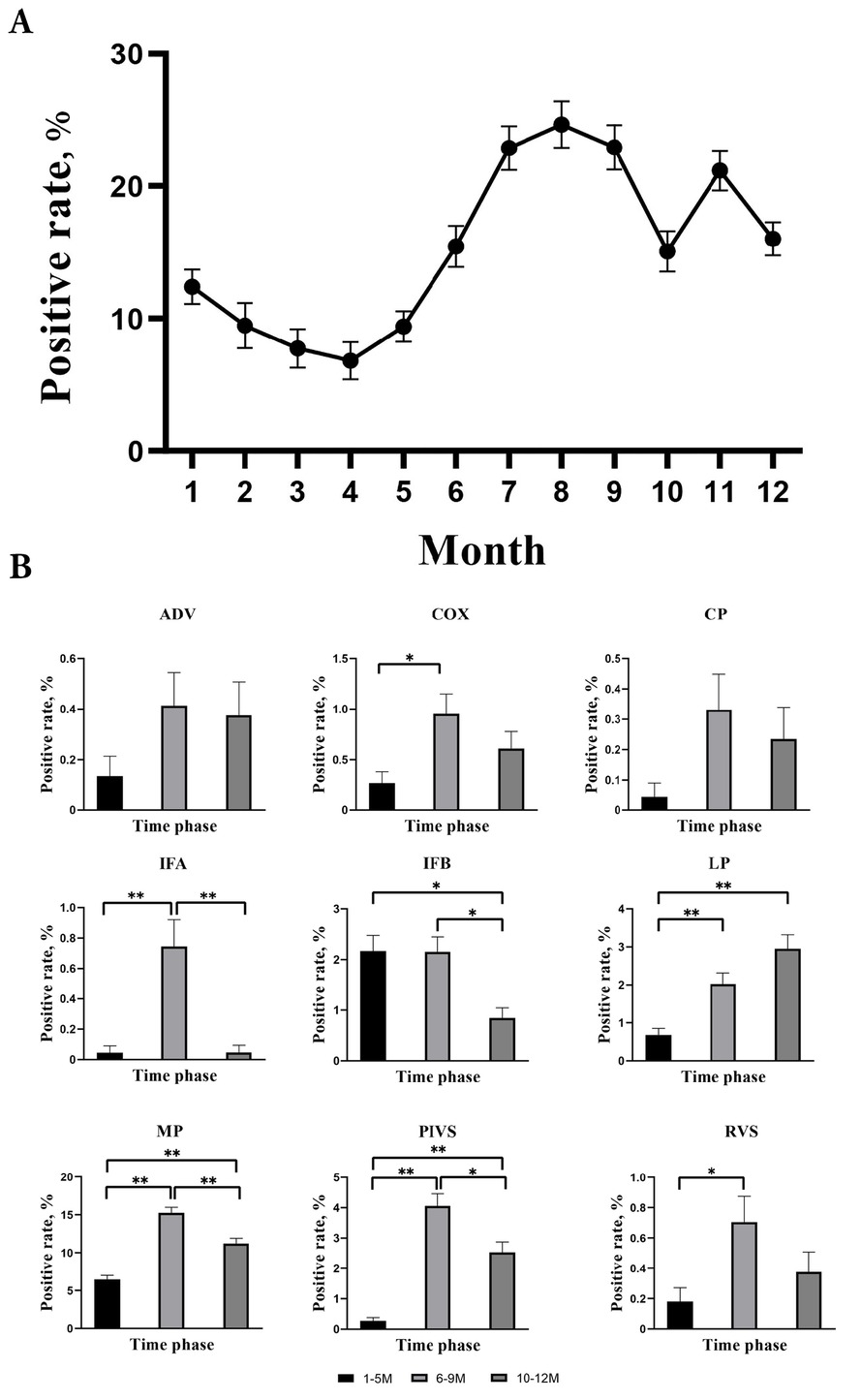
The distribution characteristics of overall and individual positive rates of respiratory pathogens with change of time. (A) The figure shows the monthly distribution of positive rates, which had a positive response to at least one of the nine respiratory viruses. The trend of virus infection with time was drawn using positive rates in various months, and the error bars of the curve indicate 95% confidence intervals. (B) The figure shows the individual positive rates of the nine respiratory viruses based on three time phases. The Bonferroni method was utilized to perform pairwise comparisons for the positive rates between every two groups in different time phases. *P < 0.05; **P < 0.001. ADV: adenovirus; COX: Rickettsia Q fever; CP: Chlamydia pneumoniae; IFA: influenza A; IFB: influenza B; LP: Legionella pneumophila; M: month; MP: Mycoplasma pneumoniae; PIVS: parainfluenza viruses; RVS: respiratory syncytial virus.
Further, COX (0.95%), IFA (0.75%), MP (15.24%), and PIV (4.06%) had a high positive rate during the middle time phase relative to the other time phases (P < 0.05). Interestingly, the population of detected pathogens in February, March, and April was less than 300, and it was more than 550 for the rest of the months.
The positivity rate of children (0–5 years), juveniles (6–17 years), adults (18–49 years), and older adults (≥ 50 years) were 32.1%, 24.0%, 17.9%, and 12.1%, respectively, which showed a significantly decreasing trend (P < 0.001). The corresponding detection populations were 784, 396, 1490, and 4088 from children to elders, respectively (Figure S1). Moreover, there was no significant difference in the number of tests between sexes in the early time phase.
This study analyzed the relationship between the prevalence of respiratory pathogen infection and pandemic prevention strategies. We found that the total positive rate of respiratory pathogens decreased gradually until May. With the fear of contracting the virus, and with an increasing number of confirmed cases and deaths, people spontaneously reduced going to public places, started wearing surgical masks, and observed frequent disinfection.[7,8] In addition, the Chinese government also strictly implemented policy interventions such as banning of outdoor activities and crowd entertainment, increasing the frequency of environmental cleaning, suspending work and school, and controlling city traffic, which effectively attenuated the source of infection and cut off the route of pathogen transmission.[9] Further, traditional Chinese medicines such as “Yuekang NO.1”, Radix Isatidis, and so on were also popular, as they are known to promote antiviral immunity. The above mode not only lessened the spread of COVID-19 infection, but also played a preventive role in the infection of other respiratory pathogens.
However, the total positive rate of respiratory pathogens increased rapidly starting May and reached its peak in August. As we know, due to the rapid advancement in molecular technology in detecting SARS-CoV-2, the application of pandemic control measures such as “shelter hospitals” and “health codes,” as well as the unremitting efforts of the medical practitioners, the COVID-19 pandemic was controlled from April in China.[10] Although the resumption of work and production was in progress, the intervention of the government’s pandemic prevention policy was not relaxed and border restrictions and isolation policies continued.[11] But with the ease of the pandemic, the public began to relax their vigilance, increased outdoor activities, and ignored frequent disinfection, which consequently increased the rate of other respiratory pathogens.
Interestingly, the total positive rate of respiratory pathogens was low in October. In China, cases that acquired the COVID-19 infection from traveling abroad increased from September. Concurrently, the SARS-CoV-2 mutated, which made molecular testing prone to sensitivity bias, and thus, the extension of virus latency was not detected among travelers undergoing isolation. This greatly increased the difficulty of preventing the pandemic.[12,13] With the spread of the mutated strains of the SARS-CoV-2, the public started wearing surgical masks when communicating and when doing outdoor activities and are paying attention to pandemic prevention again. These behaviors have a direct positive impact on preventing the spread of other respiratory pathogens such as CP, ADV, RSV, and MP.
Compared with the data published in previous similar studies, this study suggested that of the 6,758 patients tested, 16.4% were positive for at least one respiratory pathogen, which is far less than the corresponding prevalence (36.3%) reported by a long-term and large-scale epidemiology survey performed from 2011 to 2016 in southern China.[14] Therefore, the pandemic prevention strategy against COVID-19 infection interfered with other pathogens that cause respiratory infectious diseases. Besides, we also found that MP had the highest positivity rate during the COVID-19 pandemic. MP is transmitted through droplets and has an incubation period of 2–3 weeks. It is also the main respiratory pathogen causing airway infection in South China.[15, 16, 17]
This study was the first to report on the epidemiology of major respiratory pathogens during the COVID-19 pandemic based on real-world medical data, and it evaluated the impact of pandemic prevention strategies in China on other respiratory pathogen infections. The sudden respiratory infection prevention strategy involves the strategy of using previous pandemic control measures and the medical resource reserve to prevent disease transmission in the face of unknown and sudden respiratory infectious diseases, which requires the intervention of the government and the cooperation of the public.
In addition, the spread of respiratory pathogens depends on people’s habits and the environment. Thus, regional restriction was the main limitation of our study. Further, children and older adults may be more vulnerable to respiratory pathogens because of high detection populations in these two age groups, but it was not excluded that was disturbed by the age proportion of the urban population, which needs to be further analyzed. Due to technical limitations, we have only detected nine common respiratory pathogens in China, which need to be extended to other pathogens after technical improvement in the future.
Overall, the prevalence of all respiratory pathogens declined during the COVID-19 pandemic. The pandemic prevention strategy against COVID-19 infection is not only directed toward SARS-CoV-2, but also interferes with other pathogens that cause respiratory infectious diseases. According to the results of this study, a similar pandemic prevention strategy may effectively prevent the global spread of yet another respiratory infectious disease.
Funding statement: This study was supported by Guangzhou Laboratory Emergency Research Project (No. EKPG21-302). The funders had no role in study design, data analysis, preparation of the manuscript, or decision to publish.
Acknowledgments
We thank everyone involved in the collection, storage, transportation, and management of the serum samples from BRD-NCRCRD. We would like to thank Editage (www.editage.cn) for English language editing.
-
Supplementary Materials
Supplementary materials mentioned in this article are online available at the journal's official site only.
-
Author’s Contributions
Sun B conceived and designed the experiments. Wu J, Li L, Huang H, Cheng ZJ, and Zheng P performed the experiments. Hou X analyzed the data. Hu H wrote the paper. All authors read and approved the final manuscript.
-
Ethics Approval and Consent to Participate
Approval was obtained from the ethics committee of The First Affiliated Hospital of Guangzhou Medical University (GYFYY-2016-73). The informed consent of patients was obtained by the Biobank for Respiratory Diseases in the National Clinical Research Center for Respiratory Disease (BRD-NCRCRD; Guangzhou, southern China), which informed each patient that their clinical examination data would be used for possible future studies.
-
Conflict of Interest
The authors declare that they have no competing interests.
Reference
1 Cheng ZJ, Zhan Z, Xue M, Zheng P, Lyu J, Ma J, et al. Public Health Measures and the Control of COVID-19 in China. Clin Rev Allergy Immunol 2021;18:1-16.10.1007/s12016-021-08900-2Search in Google Scholar PubMed PubMed Central
2 Liao B, Chen Z, Zheng P, Li L, Zhuo J, Li F, et al. Detection of Anti-SARS-CoV-2-S2 IgG Is More Sensitive Than Anti-RBD IgG in Identifying Asymptomatic COVID-19 Patients. Front Immunol 2021;12:724763.10.3389/fimmu.2021.724763Search in Google Scholar PubMed PubMed Central
3 Liu M, Huang H, Bian X, Zheng Z, Li N, Sun B, et al. A prospective cohort study of the presence of SARS-CoV-2 in clinical samples from multiple bodily sites. J Bio-X Res 2021. (Epub ahead of print)10.1097/JBR.0000000000000114Search in Google Scholar
4 Chen H, Zhang X, Liu W, Xue M, Liao C, Huang Z, et al. The role of serum specific- SARS-CoV-2 antibody in COVID-19 patients. Int Immunopharmacol 2021;91:107325.10.1016/j.intimp.2020.107325Search in Google Scholar PubMed PubMed Central
5 Beeton ML, Zhang XS, Uldum SA, Bébéar C, Dumke R, Gullsby K, et al. Mycoplasma pneumoniae infections, 11 countries in Europe and Israel, 2011 to 2016. Euro Surveill 2020;25:1900112.10.2807/1560-7917.ES.2020.25.2.1900112Search in Google Scholar PubMed PubMed Central
6 Ellis J, Erickson N, Gow S, West K, Lacoste S, Godson D. Infection of calves with in-vivo passaged bovine parainfluenza-3 virus, alone or in combination with bovine respiratory syncytial virus and bovine coronavirus. Can J Vet Res 2020;84:163-71.Search in Google Scholar
7 Li Y, Hu H, Zhang T, Wang G, Huang H, Zheng P, et al. Increase in Indoor Inhalant Allergen Sensitivity During the COVID-19 Pandemic in South China: A Cross-Sectional Study from 2017 to 2020. Journal of Asthma and Allergy 2021;14:1185-95.10.2147/JAA.S322034Search in Google Scholar PubMed PubMed Central
8 Pottegård A, Kristensen KB, Reilev M, Lund LC, Ernst MT, Hallas J, et al. Existing Data Sources in Clinical Epidemiology: The Danish COVID-19 Cohort. Clin Epidemiol 2020;12:875-81.10.2147/CLEP.S257519Search in Google Scholar PubMed PubMed Central
9 Fang ZF, Sun BQ, Zhu AR, Lin LC, Zhao JC, He S, et al. Multiplexed analysis of circulating IgA antibodies for SARS-CoV-2 and common respiratory pathogens in COVID-19 patients. J Med Virol 2021;93:325760.10.1002/jmv.26829Search in Google Scholar PubMed
10 Cheng ZJ, Xue M, Zheng P, Lyu J, Zhan Z, Hu H, et al. Factors Affecting the Antibody Immunogenicity of Vaccines against SARS-CoV-2: A Focused Review. Vaccines (Basel) 2021;9:869.10.3390/vaccines9080869Search in Google Scholar PubMed PubMed Central
11 Huang Z, Chen H, Xue M, Huang H, Zheng P, Luo W, et al. Characteristics and roles of severe acute respiratory syndrome coronavirus 2-specific antibodies in patients with different severities of coronavirus 19. Clin Exp Immunol 2020;202:210-9.10.1111/cei.13500Search in Google Scholar PubMed PubMed Central
12 Ma P, Meng Q, Sun B, Zhao B, Dang L, Zhong M, et al. MeCas12a, a Highly Sensitive and Specific System for COVID-19 Detection. Adv Sci (Weinh) 2020;7:2001300.10.1002/advs.202001300Search in Google Scholar PubMed PubMed Central
13 Yu HQ, Sun BQ, Fang ZF, Zhao JC, Liu XY, Li YM, et al. Distinct features of SARS-CoV-2-specific IgA response in COVID-19 patients. Eur Respir J 2020;56:2001526.10.1183/13993003.01526-2020Search in Google Scholar PubMed PubMed Central
14 Luo HJ, Huang XB, Zhong HL, Ye CX, Tan X, Zhou K, et al. Epidemiological characteristics and phylogenic analysis of human respiratory syncytial virus in patients with respiratory infections during 2011-2016 in southern China. Int J Infect Dis 2020;90:5-17.10.1016/j.ijid.2019.10.009Search in Google Scholar PubMed PubMed Central
15 Chen Y, Liu F, Wang C, Zhao M, Deng L, Zhong J, et al. Molecular Identification and Epidemiological Features of Human Adenoviruses Associated with Acute Respiratory Infections in Hospitalized Children in Southern China, 2012-2013. PLoS One 2016;11:e0155412.10.1371/journal.pone.0155412Search in Google Scholar PubMed PubMed Central
16 Qu J, Yang C, Bao F, Chen S, Gu L, Cao B. Epidemiological characterization of respiratory tract infections caused by Mycoplasma pneumoniae during epidemic and post-epidemic periods in North China, from 2011 to 2016. BMC Infect Dis 2018;18:335.10.1186/s12879-018-3250-2Search in Google Scholar PubMed PubMed Central
17 Krafft C, Christy C. Mycoplasma Pneumonia in Children and Adolescents. Pediatr Rev 2020;41:12-9.10.1542/pir.2018-0016Search in Google Scholar PubMed
© 2022 Haisheng Hu, Xiangqing Hou, Jiajia Wu, Lixian Li, Huimin Huang, Zhangkai Jason Cheng, Peiyan Zheng, Baoqing Sun, published by Sciendo
This work is licensed under the Creative Commons Attribution-NonCommercial-NoDerivatives 3.0 License.
Articles in the same Issue
- Editorial
- Inhaled antibiotics and airway bacterial decolonization for patients with chronic obstructive pulmonary disease: The rationale and future
- Perspective
- Retinal examination modalities in the early detection of Alzheimer's disease: Seeing brain through the eye
- Commentary
- Hydrogel: A promising new technique for treating Alzheimer’s disease
- Metabolic adaptation in lactation: Insulin-dependent and -independent glycemic control
- Review Article
- Aberrant energy metabolism in Alzheimer’s disease
- Obesity and coronavirus disease 2019
- Crosstalk between adipose tissue and the heart: An update
- Delta variant: Partially sensitive to vaccination, but still worth global attention
- Benefits of physical activity on cardiometabolic diseases in obese children and adolescents
- Original Article
- TCDD-inducible poly (ADP-ribose) polymerase promotes adipogenesis of both brown and white preadipocytes
- Functional evaluation of intermediate coronary lesions with integrated computed tomography angiography and invasive angiography in patients with stable coronary artery disease
- A novel wide-band dielectric imaging system for electro-anatomic mapping and monitoring in radiofrequency ablation and cryoablation
- Brief Report
- Impact of COVID-19 pandemic control measures on infection of other respiratory pathogens: A real-world data research in Guangzhou, China
Articles in the same Issue
- Editorial
- Inhaled antibiotics and airway bacterial decolonization for patients with chronic obstructive pulmonary disease: The rationale and future
- Perspective
- Retinal examination modalities in the early detection of Alzheimer's disease: Seeing brain through the eye
- Commentary
- Hydrogel: A promising new technique for treating Alzheimer’s disease
- Metabolic adaptation in lactation: Insulin-dependent and -independent glycemic control
- Review Article
- Aberrant energy metabolism in Alzheimer’s disease
- Obesity and coronavirus disease 2019
- Crosstalk between adipose tissue and the heart: An update
- Delta variant: Partially sensitive to vaccination, but still worth global attention
- Benefits of physical activity on cardiometabolic diseases in obese children and adolescents
- Original Article
- TCDD-inducible poly (ADP-ribose) polymerase promotes adipogenesis of both brown and white preadipocytes
- Functional evaluation of intermediate coronary lesions with integrated computed tomography angiography and invasive angiography in patients with stable coronary artery disease
- A novel wide-band dielectric imaging system for electro-anatomic mapping and monitoring in radiofrequency ablation and cryoablation
- Brief Report
- Impact of COVID-19 pandemic control measures on infection of other respiratory pathogens: A real-world data research in Guangzhou, China
