
Obituary for Hartmut Bärnighausen
-
Michael Ruck


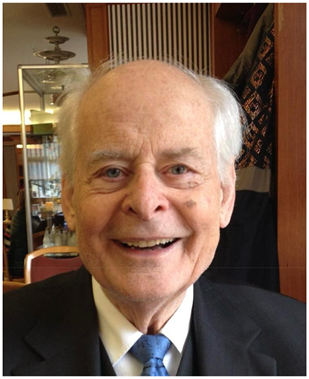
Hartmut Bärnighausen, 16.02.1933–30.03.2025
Friends and colleagues are mourning the loss of Professor Dr. Hartmut Bärnighausen, who passed away on March 30, 2025. His loss is deeply felt by the solid-state chemistry and crystallography communities, as he was an exceptional scientist and a remarkable person.
Hartmut Bärnighausen was born on February 16, 1933, in Chemnitz, Germany. His early years were shaped by the upheaval and the deprivations of the Second World War and the subsequent post-war period. He developed a passion for music early in his life. As a high school graduate, he was selected to lead the school orchestra, and later, displayed his talent as a violinist in a chamber music ensemble, in addition to being an enthusiastic visitor to classical concerts. When it came to choosing a career, however, he decided against music in favor of chemistry. He completed his diploma studies in 1955 under the supervision of Leopold Wolf at the University of Leipzig. His promising scientific career in Leipzig came to an abrupt end on May 10, 1958, when Hartmut Bärnighausen found himself compelled to leave the GDR immediately for political reasons, just as he was about to complete his dissertation. With nothing but his beloved violin in his hands, he found refuge and was accepted as a doctoral student under Georg Brauer, the grandson of Nobel Prize winner Wilhelm Ostwald, at the University of Freiburg. Fortunately, his fiancée and later wife was able to follow him a year later. Already in 1959, he obtained his doctorate in Freiburg. Subsequently, he engaged in a post-doctoral sojourn with Franz Jellinek at the University of Groningen (Netherlands), culminating in his habilitation in 1967 back in Freiburg. Shortly thereafter, at the age of 34, he was appointed to the Chair of Inorganic Chemistry at the University of Karlsruhe (now KIT), a position he held until his retirement in 1998. He was among the final cohort of German professors to retain full emeritus privileges, a status that enabled him to continue his work at the institute for an extended period. His expertise in crystallographic problems made him a highly sought-after advisor for doctoral students, guiding them through complex crystallographic problems.
Hartmut Bärnighausen’s research articles and scientific presentations were defined by an exceptional level of scientific and linguistic precision. He made significant contributions to the chemistry of (mixed-valence) rare-earth compounds, 1 , 2 to the chemical understanding of structural phase transitions 3 and to complex crystal chemistry topics. 4 , 5 He elaborated and programmed the refinement of twin crystal structures and developed a reliable method for absorption correction of X-ray diffraction data. His most important scientific legacy is the application of mathematical group-subgroup relationships to crystal chemistry. 6 , 7 The formalism allows a stringent ordering and representation of structural relationships between crystal structures. The method has now established itself internationally. In the literature, the graphical representation of such structural relationships, which resembles a genealogical family tree, is often referred to as a “Bärnighausen tree”. In 1997, the German Crystallographic Society honored Hartmut Bärnighausen’s life’s work by awarding him the Carl Hermann Medal.
Hartmut Bärnighausen was not only a passionate researcher, but also a gifted and highly respected university lecturer. In his typical manner, he combined the highest demands on himself with those on his students. His carefully prepared lectures and seminars, particularly those on solid-state chemistry and on structure determination using diffraction methods, were characterized by his verbal precision and content sovereignty. As a diploma or doctoral student, long afternoons in his office offered a unique chance to absorb his expertise and passion. Many of his students were shaped by him and the example he set for their lives. Resilience, discipline, commitment, professional excellence, order, and precision on the demanding side, and humanity, friendliness, modesty, patience and devotion on the giving side. Part of his legacy are his former co-workers, several of whom have become professors themselves, including Joachim Strähle, Ulrich Müller, Michael Veith, Horst Philipp Beck, Johannes Beck and Michael Ruck.
Hartmut Bärnighausen lived his final days with full mental capacity and inner peace, having achieved a fulfilled and self-determined life. We will miss the indomitable and honorable person, as well as the great scientist and teacher.
References
1. Bärnighausen, H.; Schiller, G. The Crystal-Structure of A-Ce2O3. J. Less-Common Met. 1985, 110, 385–390. https://doi.org/10.1016/0022-5088(85)90347-9.Search in Google Scholar
2. Lange, F. T.; Bärnighausen, H. Investigations on the Chemical-Transport of the Anhydrous Europium Chlorides EuCl2, Eu5Cl11, Eu4Cl9, Eu14Cl33 and EuCl3 with AlCl3. Z. Anorg. Allg. Chem. 1993, 619, 1747–1754.10.1002/chin.199401013Search in Google Scholar
3. Jochum, M.; Unruh, H. G.; Bärnighausen, H. A Study of the Mechanism of the Ferroelectric Transition in Monoclinic K2ZnBr4. J. Phys.: Condens. Matter 1994, 6, 5751–5760.10.1088/0953-8984/6/29/017Search in Google Scholar
4. Ruck, M.; Bärnighausen, H. On the Polymorphism of In5Br7. Z. Anorg. Allg. Chem. 1999, 625, 577–585.10.1002/(SICI)1521-3749(199904)625:4<577::AID-ZAAC577>3.0.CO;2-BSearch in Google Scholar
5. Woike, T.; Himmelreich, U.; Henke, H.; Bärnighausen, H. Crystal Structure Analysis, Pseudosymmetry and Spectroscopic Data of K4[Fe(CN)5NO2]·KNO2·H2O. Z. Kristallogr. 2002, 217, 119–126. https://doi.org/10.1524/zkri.217.3.119.20648.Search in Google Scholar
6. Bärnighausen, H. Group-Subgroup Relations Between Space Groups: A Useful Tool in Crystal Chemistry. MATCH 1980, 9, 139–175.Search in Google Scholar
7. Müller, U. Symmetriebeziehungen zwischen verwandten Kristallstrukturen, 2nd ed.; Springer: Berlin, Germany, 2023.10.1007/978-3-662-67166-5_12Search in Google Scholar
© 2025 the author(s), published by De Gruyter, Berlin/Boston
This work is licensed under the Creative Commons Attribution 4.0 International License.
Articles in the same Issue
- Frontmatter
- In this issue
- Obituary
- Obituary for Hartmut Bärnighausen
- Micro Review
- Bismuth as reactive and non-reactive flux medium for the synthesis and crystal growth of intermetallics
- Organic and Metalorganic Crystal Structures (Original Paper)
- Racemic and unusual enantiomeric crystal forms of N-cycloalkyl-4-methyl-2,2-dioxo-1H-2λ6,1-benzothiazine-3-carboxamides and their biological activity
- Inorganic Crystal Structures (Original Paper)
- Lead phosphate oxyapatite, Pb10(PO4)6O, with c-double superstructure
- A novel microporous uranyl silicate prepared by high temperature flux technique
- The Grubbs catalyst – dichlorido(1-(2,6-diethylphenyl)-3,5,5-trimethyl-3-phenylpyrrolidin-2-ylidene)-({5-nitro-2-[(propan-2-yl)oxy]phenyl}methylidene)ruthenium(II) – some observations on the crystallography and stereochemistry of a racemic mimic pair
- Thermal decomposition of copper(II) hydroxide and hydroxocarbonates according to X-ray photoelectron spectroscopy in operando
- New calcium perrhenates: synthesis and crystal structures of Ca(ReO4)2 and K2Ca3(ReO4)8·4H2O
Articles in the same Issue
- Frontmatter
- In this issue
- Obituary
- Obituary for Hartmut Bärnighausen
- Micro Review
- Bismuth as reactive and non-reactive flux medium for the synthesis and crystal growth of intermetallics
- Organic and Metalorganic Crystal Structures (Original Paper)
- Racemic and unusual enantiomeric crystal forms of N-cycloalkyl-4-methyl-2,2-dioxo-1H-2λ6,1-benzothiazine-3-carboxamides and their biological activity
- Inorganic Crystal Structures (Original Paper)
- Lead phosphate oxyapatite, Pb10(PO4)6O, with c-double superstructure
- A novel microporous uranyl silicate prepared by high temperature flux technique
- The Grubbs catalyst – dichlorido(1-(2,6-diethylphenyl)-3,5,5-trimethyl-3-phenylpyrrolidin-2-ylidene)-({5-nitro-2-[(propan-2-yl)oxy]phenyl}methylidene)ruthenium(II) – some observations on the crystallography and stereochemistry of a racemic mimic pair
- Thermal decomposition of copper(II) hydroxide and hydroxocarbonates according to X-ray photoelectron spectroscopy in operando
- New calcium perrhenates: synthesis and crystal structures of Ca(ReO4)2 and K2Ca3(ReO4)8·4H2O
