Turf Building in Iceland – Past, Present, and Future
-
Guðný Zoëga
 ,
Sigríður Sigurðardóttir
,
Sigríður Sigurðardóttir

Abstract
For a millennium, turf was the primary building material in Iceland. It was used for dwellings, outhouses, boundary walls, raised roads, and other man-made structures. Turf is known as an earthen building material in many countries, especially in northern latitudes, but the knowledge of how to build using it has mostly disappeared. As turf was used well into the twentieth century in Iceland, the skilled craft of locating, harvesting, and building with this material has been retained. This is also facilitated by still standing historical buildings and the need for continual maintenance. Archaeologists also benefit from learning about turf as they frequently interpret the remains of turf walls in the archaeological record. This means that Iceland is in a unique position to disseminate knowledge on this important intangible heritage. However, because of a lack of adequate funding and strategies for maintaining the craft, these skills are in danger of disappearing in Iceland as well. In this article, we discuss the state of knowledge on turf, what turf is, the preservation of the intangible building heritage, the revival of interest in turf, and how the various strands of evidence serve as background for the interpretation of turf as heritage and as an archaeological material.
1 Introduction
Settlement in Iceland started in the ninth century, primarily by people of Norwegian and Northern British descent (Ebenesersdóttir et al., 2018; Karlsson, 2000). These people brought with them the knowledge of building with turf, a material that was readily available in Iceland and well suited to Iceland’s precarious climatic conditions. Archaeology has established that from the onset, turf was the main building material (Karlsson, 2022). The knowledge of turf building was carried from one generation to the next, adapted and developed according to differences in local and regional availability and environmental conditions (Stefánsson, 2019). Turf was used for buildings in Iceland until the mid-twentieth century, and turf buildings were in use as late as the 1990s. The prolonged use of turf meant that the knowledge of how to build with it has been retained in Iceland when it has disappeared in other countries. This knowledge is not only important for the upkeep of remaining historical turf architecture but also for the archaeological interpretation of turf structures.
Most research regarding turf has focused on turf buildings and building techniques, of which there are several useful overviews. A common theme has also been the relationship between people and turf buildings, domestic life, culture, and social complexities. However, turf as a material, the intangible knowledge of working with turf, and the interpretation of turf in the archaeological record have received less focus. In this article, we look at the complexities of turf as a building material, its uses, its social and ideological importance, and the state of research. These diverse threads of information provide an interpretative background for the assessment of turf in the archaeological record as well as the preservation of existing historical turf architecture.
2 Turf – The Background
For the interpretation of turf in the historical record, the first points of contact are the Icelandic vernacular and normative sources. As is the case with many mundane everyday practices, turf is rarely mentioned in Icelandic medieval literature. There are a few mentions of turf harvesting and storing, but they are not detailed. One example is from Fljótsdæla saga, which offers a description of a turf bog and how turf is being transferred and restacked. Another example comes from Reykdæla saga, which tells about turf cutting in a dry field to repair an old booth (Halldórsson & Kristjánsdóttir, 1987). However, these sagas were written centuries after the events they purport to describe and might therefore reflect turf cutting during the time they were written. The more contemporary saga of the Sturlungs, written in the thirteenth century, is also mostly silent on turf and turf use. However, there is a mention of a turf bog and the cutting of turf strips with a scythe as well as a description of the stacking of turf (Jóhannesson, Finnbogason, & Eldjárn, 1946). The Icelandic medieval law book Grágás (Grey goose) is also rather silent when it comes to turf and its procurement. It does mention the different values placed on buildings and the duty of tenants to maintain their rental properties. It also decrees that it was the responsibility of farmers to ensure the building of boundary walls and communal fences. These communal fences were used for dividing up homefields and outfields and should be constructed of turf and/or stone (Karlsson, Árnason, & Sveinsson, 2001).
More data on turf and its use exist from the modern era. The Danish army officer and archaeologist Daniel Bruun travelled extensively in Iceland around 1900. This was a time of significant changes in Icelandic society, and his publications paved the way for ethnographic studies in the country. His description of housing is detailed and encompasses both buildings that were in use and those in archaeological contexts. He noted that turf was a good-quality building material, which he attributed to an unusually dense root mat caused by the cold climate (Bruun, 1987). His work has laid the foundation for a lot of overviews on turf buildings, including the writings of Guðmundur Hannesson. Hannesson was a physician who wrote extensively about turf housing and advocated for increased quality in building techniques. In volume one of Iðnsaga Íslands (The Industrial History of Iceland) published in 1943, he wrote an overview chapter on turf and its uses.
Turf houses are more frequently mentioned in written sources than turf working. However, prior to the late eighteenth century, few sources describe Icelandic architecture in any detail. Sigurðardóttir wrote a useful overview of medieval housing based on saga materials, but due to the lack of data in the sources, there is little mention of the nature of turf (Sigurðardóttir, 1966). The sixteenth- and seventeenth-century scholars Arngrímur Jónsson and Oddur Einarsson noted that residential buildings were mostly built of turf and that the number of buildings was roughly the same on smaller farms as on the more affluent ones (Einarsson, 1971; Jónsson, 1985). In the eighteenth century, authorities made a concerted effort to improve the quality of life for Icelanders, which included guidance on better building techniques (Stefánsson, 2019). For instance, Reverends Björn Halldórsson and Guðlaugur Sveinsson published essays on good building practices in 1777 and 1790, respectively (Halldórsson, Kristjánsson, Sigfússon, & Þorsteinsson, 1983; Sveinsson, 1790). Surgeon General Sveinn Pálsson travelled the country at the end of the eighteenth century. He observed a new development in turf dwellings, a two-story dwelling where people lived on the upper floors while cows were kept on the lower floors. He states that this was a reaction to increasingly cold weather and a lack of kindling for heating (Pálsson, 1945). These structures were common from the nineteenth to the twentieth century. It was a convenient method for heating buildings, and it was also used at wealthier farms (Sigurðardóttir, 2017). Konrad Maurer, who visited Iceland in 1858, stated that most turf houses were small due to the fact that imported timber was expensive (Maurer, Schier, & Björnsson, 1997).
In the late nineteenth century, turf and the dwellings made from it were believed to be unsanitary and the main cause of many ailments that afflicted the Icelandic nation. Guðmundur Hannesson wrote an influential essay in 1899 describing poor quality housing and its impact on the health and living conditions of the nation (Hannesson, 1899). As a result, the authorities sent out a countrywide questionnaire regarding the types of buildings and living conditions. The answers reveal both positive and negative views on turf buildings, but government officials advocated for the replacement of turf with more modern building materials, preferably concrete (Bárðarson, 1904; Stefánsson, 2020; Þorláksson, 1903). Despite this, people chose to live in turf dwellings well into the twentieth century. An important factor was that turf was readily available, cheap, and provided good insulation (Sigurðardóttir, 2021). Today, this negative view is being revised with some scholars describing it as “state-sponsored” propaganda (Hafsteinsson & Jóhannesdóttir, 2015).
Considerable work has been published on turf and turf architecture in recent decades. The architects Hörður Ágústsson and Hjörleifur Stefánsson have provided invaluable overviews of vernacular building traditions and architecture (Ágústsson, 1987, 1989, 1998, 2004; Stefánsson, 2019, 2020). They viewed turf buildings primarily in relation to building methods and their developments. Historian Sigríður Sigurðardóttir has conducted extensive research on turf and has published reports on her findings. She has also written booklets on turf harvesting and construction that have been published in Icelandic, English, French, and German (Sigurðardóttir, 2008, 2011, 2018, 2021).
Recent research has started to explore the social and theoretical dimensions of turf as a material as well as the realities of living and engaging with turf buildings. The social and physical environment has been discussed in several works, dealing with themes such as living in a turf home, cleanliness, health, and general well-being (Rúnarsdóttir, 2007; Sigurðardóttir, 2017; van Hoof & van Dijken, 2007; Zoëga & Murphy, 2019). Other projects have examined turf buildings and storytelling (Coullenot, 2022) and turf buildings as super-organisms with the potential to inspire a re-evaluation of modern architecture (Turfiction, website).
3 Turf as a Building Material
Turf offers many avenues for interpretation, but a fundamental understanding of how the material is formed, harvested, and used is essential. In Iceland, the material defined as turf is the root system of plants, whether they grow on dry land or in bogs. The density of the turf varies depending on the soil’s characteristics. The roots are embedded in layers of natural soil deposits, which can impact the cohesion of the turf and, consequently, its building properties. Long, dense, and solidly entangled roots of bog turf are a more superior construction material compared to short, loose roots from dry fields. Turf was more readily available than timber in Iceland, and it also had good insulation properties, providing windtight walls and roofs. This was an important attribute in a country that lacked fuel for heating. The best turf is harvested from so-called turf bogs (torfmýri), which have optimal conditions for root density and soil composition (Figure 1). Such bogs were highly priced and one of the attributes used to determine the value of a farm. A highly valued farm usually had good access to quality turf. These turf bogs were renewable, taking on average 5–7 years to regenerate for further harvesting (Sigurðardóttir, 2021).
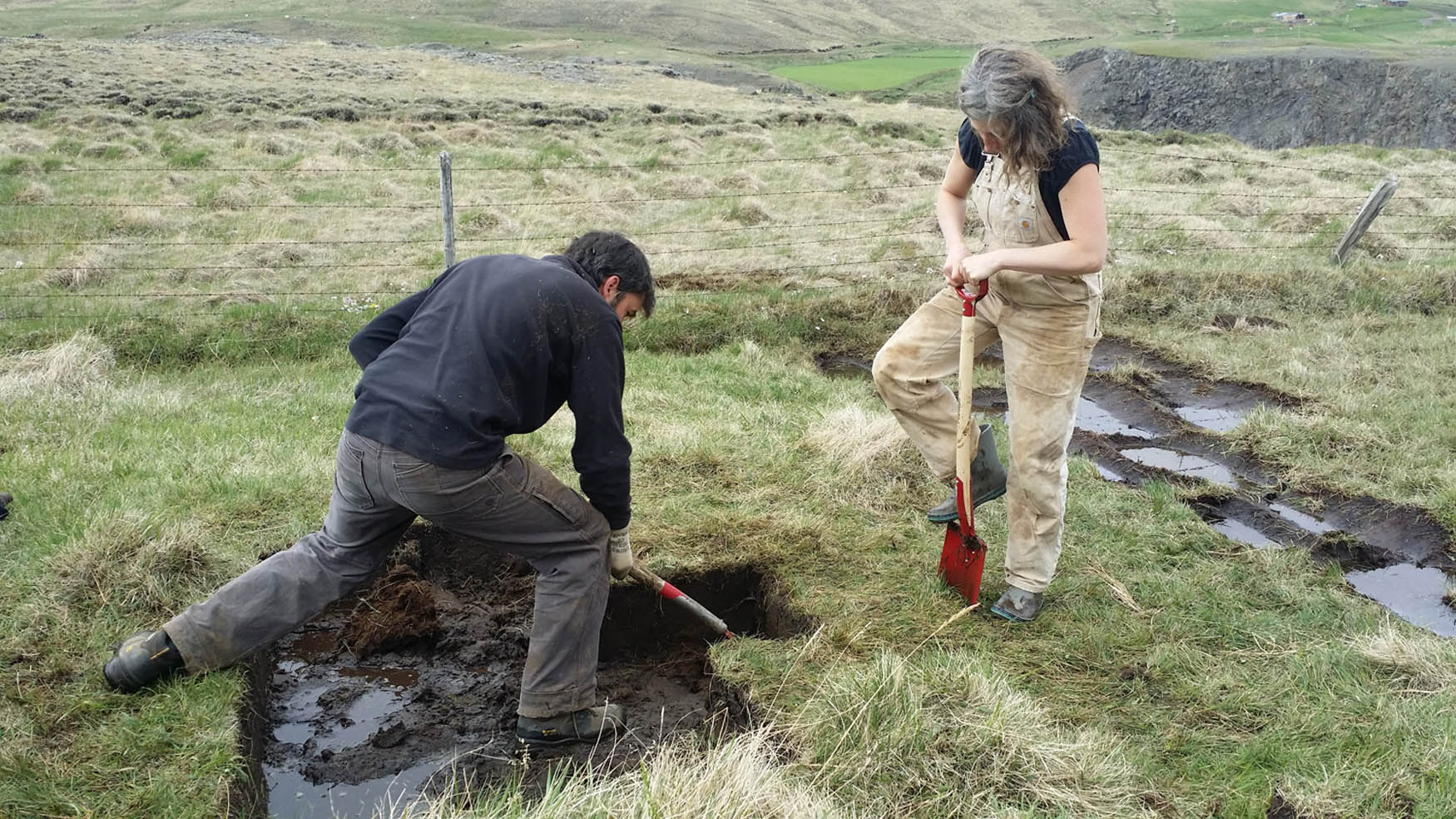
Turf being extracted from a turf bog at Tyrfingsstaðir by participants at a turf building course offered by the Heritage Craft School. The tools used are an undercut spade and a regular spade. Photo: Bryndís Zoëga.
3.1 Types of Turf
Harvesting turf was one of the seasonal chores on a farm, typically taking place in the spring or fall. Turf harvested in the spring was used for building in the summer, while turf harvested in the fall was used for winter repairs. The methods for harvesting turf varied depending on the location, the type of turf being cut, and its intended use (Sigurðardóttir, 2021). Historically, turf was cut with either a spade or a scythe. Nowadays craftsmen typically employ undercut spades, spades, and modern turf cutters. However, the traditional methods of turf cutting are still employed when necessary (Sigurðardóttir, 2021; Stefánsson, 2019).
Turf can be divided into two types, strips and blocks. Turf scythes were used to create so-called “strips” (e.g. strengur/reiðingur) and “turf” (torfa). Strips and turfs were used for binding turf walls made of turf blocks and stones (Figure 2). Strips could also be used solely for wall construction. Strips and turfs were also used as roofing materials, as a bedding layer for cows, in benches for sitting, as a protective layer under saddles, and even as mattresses on beds (Gestsson, 1980). In recent times, turf was used as insulation in timber houses and later in concrete buildings that replaced the turf houses.
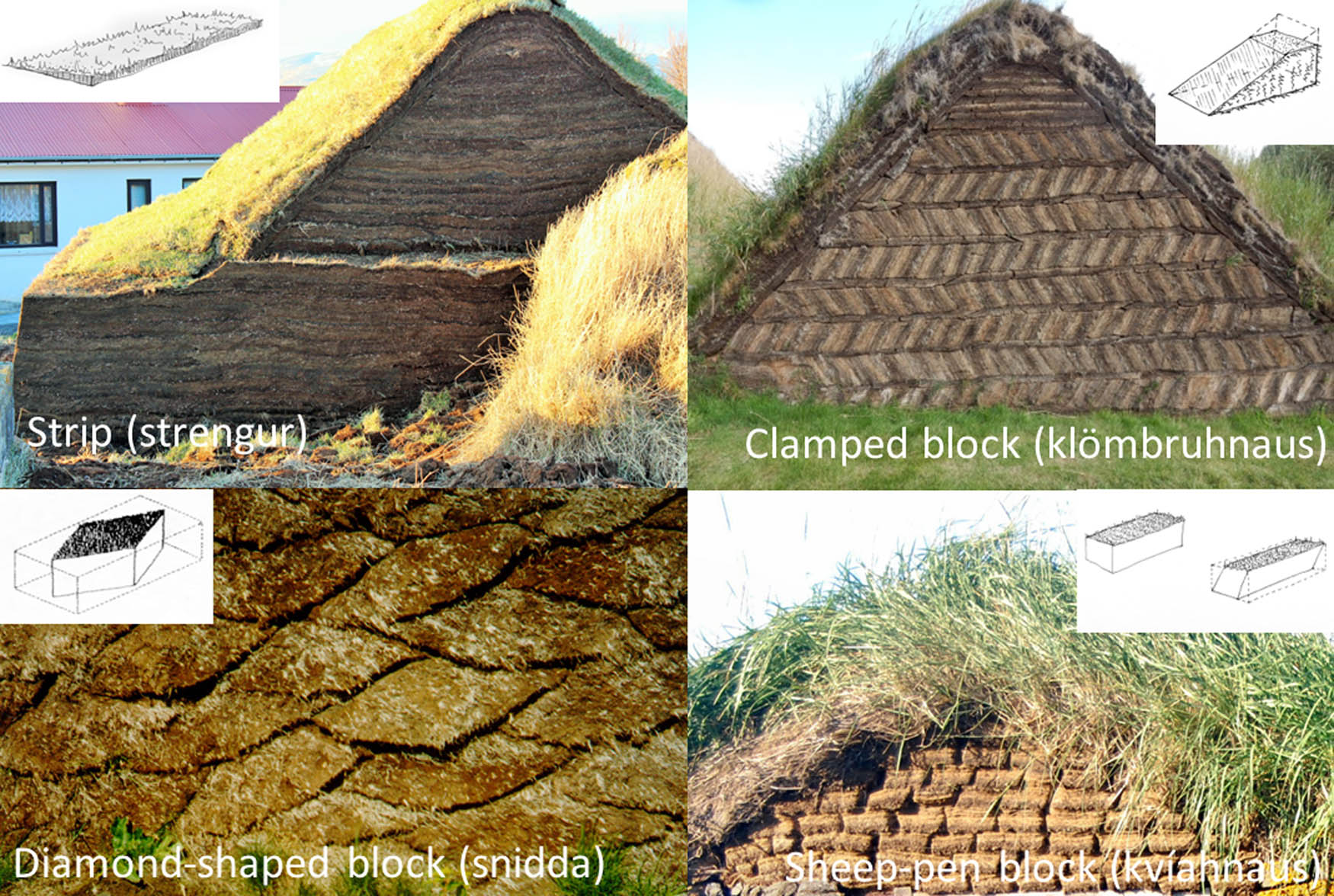
A composite figure showing the four main types of turf walls. In the upper left corner, there is a gable made entirely of turf strips. In the upper right corner is a wall made from clamped blocks. In the lower left corner, there is a wall made of diamond-shaped blocks and in the lower right corner is a gable wall built of sheep-pen blocks. Photo: Sigríður Sigurðardóttir.
Spades were used to cut blocks (hnaus). Their forms and sizes depended on their intended use and the available materials. There are also significant geographical variations in their usage. Blocks were commonly used for double-faced walls. The “clamped” block (klömbruhnaus/hnakkahnaus) was the most notable, forming the eye-catching herring-bone pattern seen in many turf walls. “Sheep-pen” blocks (kvíahnaus/kökkur) were simpler in form. In the northern parts of the country, they were primarily used for animal barns and other outbuildings. However, in the southern parts, they were utilised in all building types. A “diamond-” or oblong-shaped block (snidda) was mostly used for fences, roofs, roads, and embankments in the north (Sigurðardóttir, 2021). In the south, however, snidda was also used for house walls (Stefánsson, 2019).
3.2 Building with Turf
The availability, quality, and accessibility of turf determined how it was used and how well structures have been preserved. Turf was extensively used for construction in Iceland from the settlement of the island in the ninth century up to the twentieth century. Hence, there are still active, albeit few, craftsmen working with the material. Although little is known about the use of turf in ancient times, ethnographic accounts of more recent turf use exist. The discussion here is partially based on the results of Sigurðardóttir’s (2021) master´s thesis on turf and turf building. In her thesis, she analysed questionnaires from the ethnographic department of the National Museum of Iceland and conducted interviews with practicing craftsmen.
Dense, clay-rich soils in bogs were considered excellent building materials. However, layers of sand and volcanic ash weaken the cohesiveness of the turf, making it more prone to tearing. According to the turf craftsman Helgi Sigurðsson, the best material for cutting turf is a clay rich soil with a thick layer of entangled roots. This layer often extends to a depth of about 50–80 cm, where it is replaced by peat (Sigurðardóttir, 2021).
Stones were the second most important building material for walls, sometimes used exclusively but frequently as a part of a turf wall (Figure 3). For house building, stones were most commonly used with turf. Only natural stones were used for construction, and for convenience, they were collected as close to the building site as possible. When old walls were rebuilt or repaired, their stones were re-used. The third notable building material was timber. Although turf and stones were the primary building materials, most buildings were based on a timber frame that supported the roof. This was done because turf walls are typically not weight-bearing. Some buildings, notably churches and living quarters, had walls that were fully clad with timber (Sigurðardóttir, 2021, Stefánsson, 2019).
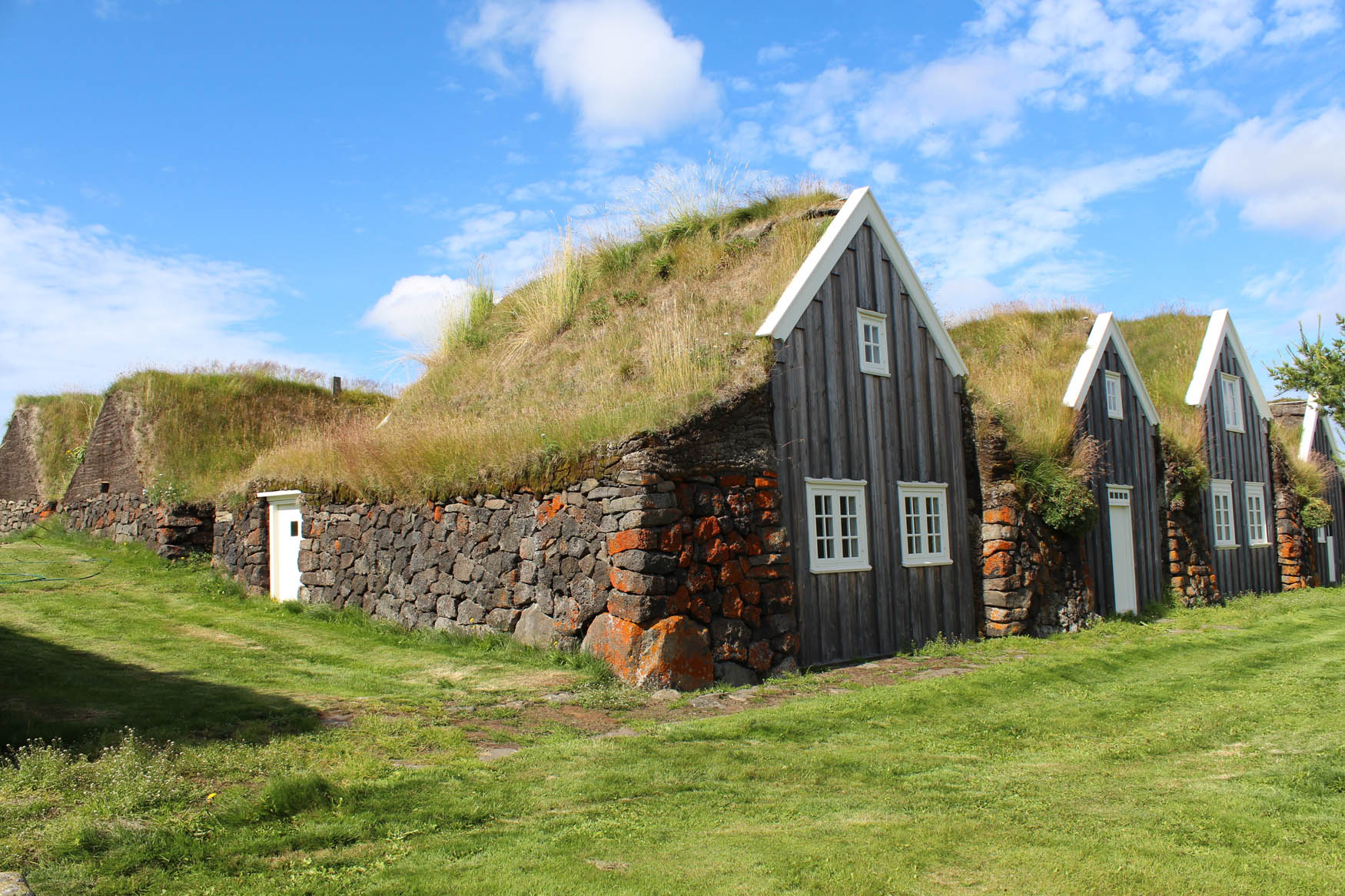
The front of the farm building at Þverá in Laxárdalur, a classic gable farmhouse which became a common architectural style in the nineteenth century. The walls are double-faced walls built with stones, mostly lava stones, and capped with turf. Photo: Sigríður Sigurðardóttir.
Walls could be either single- or double-faced. A single-faced wall was constructed by building a turf wall up against earthen banks or cliffs. A double-faced wall was more common and consisted of two parallel walls made of turf blocks or strips, usually with stones. The gap between them was then filled with compacted loose material. The walls were strengthened by laying strips of turf perpendicular to the direction of the wall every two or three rows of turf blocks. The material used to fill the gap between the outer and inner faces of a double-faced wall was continuously added and compacted during the construction of the wall. The fill (or core) consisted of earth and turf remains, often from an old wall or roof (Hannesson, 1943; Sigurðardóttir, 2021; Stefánsson, 2019). When constructing a building in a new location, the fill material typically consisted of earth from either the excavation of the house’s foundation or the grounds next to the building (Sigurðardóttir, 2021). Walls tended to be wider at the base and tapered towards the top (Hannesson, 1943; Stefánsson, 2019). All the walls were not of same thickness or height. Internal walls, for instance, tended to be thinner and sometimes taller than the outer walls, and the walls of dwellings tended to be thicker than those in buildings for storage and livestock. In general, buildings on the same farm were built using the same materials harvested from the same area (Sigurðardóttir, 2008).
The foundation for a building had to be solid and dry (Hannesson, 1943; Sigurðardóttir, 2021). When walls were built solely of turf, the foundation was usually levelled but not dug down, as was considered best practice. To allow for proper drainage and prevent groundwater from seeping up into the walls, it was common practice to place a single layer of stones or gravel beneath the first layer of turf. Sometimes, stone-lined channels were used for drainage (Sigurðardóttir, 2021).
Turf was also used for roofing, with an underlying wooden beam structure. An effective roof had to be steep to facilitate runoff. If the uppermost layer of turf cracked, water had an easy access into the roofing structure, leading to leaks (Hannesson, 1943; Sigurðardóttir, 2021). The construction methods and materials used for roofing depended on the timber structure and the type of house. A good roof was made up of at least three layers of turf strips, sometimes interspersed with earth. In areas where naturally forming stone slates were available, they would be used for roofs. A good roof had a resilient, durable root mat which produced a lush, green grass covering year after year (Sigurðardóttir, 2021).
Building with turf and stone required craftsmanship and experience. The key was knowledge of the material and how it can be utilised. How long a turf wall lasted depended on the craftmanship, building materials, and geographical location. The foundation the house was built on was also fundamental for the preservation of the walls (Hannesson, 1943; Þorsteinsson, 1990). Good turf wall can last a long time. In the drier climate of northern Iceland, walls could last for over 100 years. For instance, one of the turf walls at Glaumbær farm is estimated to be over 130 years old. A more common age for a turf wall, however, has been estimated to be between 20 and 50 years (Hannesson, 1943; Sigurðardóttir, 2021; Stefánsson, 2020). The endurance of walls also depended on their location within the house and previous repairs. Turf walls require continual repair work and, as they age and weather, they start to split open or warp. If the walls are not repaired right away and wind, rain, or snow get to infiltrate them, the walls get damp and become prone to damage from frost heaving. Parts of walls can be repaired as thoroughly as possible, either by removing a section of the wall and patching it up or by dismantling and rebuilding larger segments, even entire walls (Sigurðardóttir, 2021) (Figure 4). Without adequate repairs, the buildings may collapse and eventually become a part of the natural landscape and, finally, an archaeological record.

A recently repaired turf wall made of clamped blocks at Tyrfingsstaðir. To the left is freshly cut turf, and to the right is the old wall. Successful wall repairs require craftmanship as a repaired wall tends to be weaker and therefore more prone to further damage. The wall is repaired with good turf, but the old wall is clay-rich and is made up of even better turf. Photo: Bryndís Zoëga.
4 The Archaeology of Turf
Knowledge of the nature of turf, the different building components, and their uses in various turf constructions is important when attempting to interpret turf from an archaeological perspective. From the time of settlement, turf was the main building material used in Iceland. It was used not only for residences but also for all the buildings on the farm as well as outfield structures such as booths, shielings, corrals, fences, roads, and bridges. Turf structures may remain visible on the surface for centuries, particularly in a sparsely forested country such as Iceland. The visibility of turf structures facilitates archaeological surface surveying, provided that the remains have not been damaged by trees, modern farming practices, or construction. In areas that have not been subjected to modern agricultural practices and/or were abandoned early, the landscape may offer a wealth of well-preserved and visible archaeological remains dating from the settlement times up to the twentieth century (Sigurðarson, Zoëga, & Sigurðardóttir, 2017) (Figure 5).

A drone photo from the valley Holtsdalur in northern Skagafjörður shows turf structures dated from the tenth century until the middle of the twentieth century. The interpretation of turf structures in the landscape may, for instance, be affected by factors such as soil deposition, their shape and what types of plants are growing on them. Where preservation is good, it is possible to read the landscape from modern times back to the time of settlement. Photo: Guðný Zoëga.
For archaeologists, Icelandic turf offers a unique opportunity for interpretation. Iceland experiences occasional volcanic eruptions, which sometimes leave layers of volcanic ash or tephra. Many of these tephra layers have known historic dates. When turf is formed, these tephra layers become embedded within the turf matrix, forming a distinct layer visible in the turf strips and blocks. With the inclusion of datable tephra layers, walls can provide an additional level of interpretation. The presence or absence of specific tephra layers may indicate when walls were built and help date episodes of rebuilds and repairs. The walls may be situated above and below the dated tephra layers, establishing more accurate pre- or post-dates for the structure (Schmid, Dugmore, Vésteinsson, & Newton, 2017). The tephra layers often have distinct colours, which makes the blocks stand out when buried in the ground. Turf made of more uniform soils or turf that has decomposed tend to be less visible in the ground and therefore more difficult to distinguish archaeologically if no stones remain in the walls (Romankiewicz, 2019).
Contrary to what might be expected, turf and turf walls are often preserved very well in the ground, even when no evidence of a structure is visible on the surface. Careful excavation of turf structures often reveals well-preserved sections of walls and, in some cases, complete walls and structures. Interpretation of buried turf requires some knowledge on the nature and the construction of turf walls. Interpreting turf correctly in archaeological contexts is important not only for the documentation of building techniques but also for the interpretation of regional architectural differences. Unfortunately, the nature of turf in wall constructions has often not been recorded, which makes it difficult to compare the building methods and forms of turf used for excavated structures with the ethnographic data. Buildings may have collapsed or been completely levelled when they were abandoned, and timber and stones may have been removed and repurposed. Such structures rarely allow for accurate interpretation of the turf construction. Where turf has been recorded, however, it seems clear that similar types of turf and turf constructions have been used through the ages. As an example, a section of the side wall of a tenth-century longhouse at Keldudalur in Skagafjörður shows a well-known double-faced wall construction made of clamped turf with mixed earth compressed between the two wall faces (Zoëga & Traustadóttir, 2007) (Figure 6).
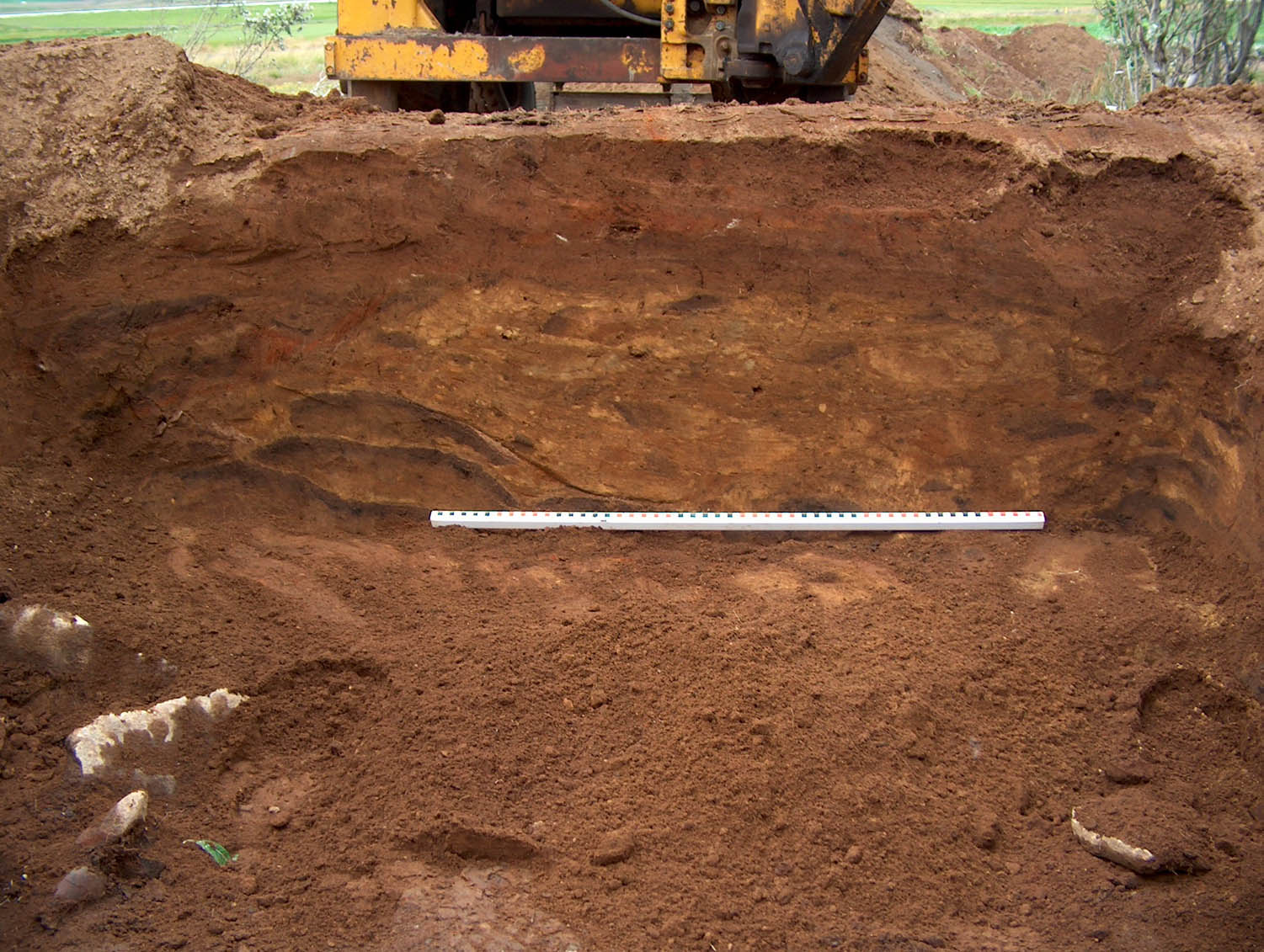
A section of the wall of a tenth-century longhouse in Keldudalur, Skagafjörður. The wall was double-faced with clamped blocks. The blocks are made visible by thick, dark tephra layers which can be seen stacked on either side of the scale bar. In between the two walls is a mixture of earth and turf. The yellow flecks are prehistoric tephra from Mt. Hekla. The earliest turf often had thick layers of this tephra which would have made the turf unstable. Photo: Guðný Zoëga.
The special qualities of turf and the presence of tephra layers allow the dating of remains using minimally invasive coring and targeted test trenching. Excavation, however, is not the sole method of interpreting turf in the archaeological context. Over the last two decades, research in Skagafjörður has shown that turf walls may also be successfully interpreted through geophysical means, given the right conditions and interpretation. This also applies to walls that do not contain any stones. In 2005, a Viking age longhouse was discovered using geophysics in the fields below the Glaumbær turf farm museum. The structure is large, over 40 m in length, but no evidence of it is visible on the surface (Steinberg, Bolender, & Damiata, 2016). Test trenches in the structure revealed that the walls of the longhouse, similar to the walls of its nineteenth-century counterpart on the hill above, were also constructed entirely of turf. This discovery extends the known history of turf use in Glaumbær by 900 years (Steinberg, Zoëga, Bolender, & Damiata, 2022). As part of this research, a pilot project was conducted on the retention of organic materials in buried turf. Although small in scale, this research showed that the preservation of turf is directly correlated with the size and organic content of turf walls (Steinberg, 2004).
5 Turf in a Wider Context
Turf buildings belong to the category of earthen architecture. Earthen materials have been used in the construction of vernacular architecture around the world for thousands of years. Although the knowledge of how turf was used may, to a large extent, be lost, it is present in archaeological and ethnographical records (Jakhelln, 2017; Piesik, 2017; Walker, 2006; Yu Mainicheva, 2017). Indigenous turf architecture is also known in North America, where turf was still being used for buildings well into the twentieth century (Jonaitis, 2017). In Norway, turf was used in the Viking age chieftain’s hall at Borg in Lofoten (Solli, 2006). The building has been reconstructed with external turf walls and Icelandic craftsmen were recruited for both the initial reconstruction and subsequent repair work. In medieval northern Norway, churches were also frequently built, at least partially, with turf (Trædal, 2008). Turf churches and other turf structures are also known from early medieval Ireland (O’Sullivan, McCormick, Kerr, & Lorcan, 2014) and even into the twentieth century (Mullane, 2019). Scotland has a notably rich turf heritage, with many buildings, especially in rural areas, constructed from turf (Wilkinson, 2009). The turf tradition has been established on early medieval and even Iron Age archaeological sites in Britain (Romankiewicz, 2019). Recent archaeological research has also shown that turf was widely used for defensive structures in Roman Britain, a notable example of this is the famous Antonine wall (Romankiewicz et al., 2022).
The widespread use of turf emphasises the importance of understanding the material and what it looks like in the archaeological record. One notable thing that affects researching and comparing materials between countries or areas, however, is the variation in terminology. This can be due to regional differences or the lack of knowledge of the correct terms. For instance, turf may be called sod, and turf is also another word for fuel in some languages. In Iceland, turf is for building whereas peat is the fuel. Turf blocks may be referred to as bricks, turf strips, divets, etc. (see for instance Walker, 2006). A more formalised terminology would be helpful and facilitate international collaboration and utilisation of research materials.
6 The Preservation and Promotion of Traditional Turf Building Skills: The Heritage Craft School Project
For understanding turf, turf use, and construction in an archaeological or historical context, knowledge of how the material was procured and used is of vital importance. As stated above, certain skills, knowledge, and experience are needed to build with turf. There are no formal training programs available for people wanting to learn how to build with turf. Turf building is not a formal and recognised craft and the craftsmen that have employment from working with turf have learnt their trade from previous generations of turf builders.[1]
These skills are an important part of Iceland’s intangible cultural heritage and are essential for preserving Iceland’s historical turf buildings. The Heritage Craft School Project evolved from the need to preserve those skills (Figure 7). The project was initiated in 2006 by Sigríður Sigurðardóttir, then museum director at Skagafjörður Heritage Museum. The project is a partnership of the Heritage Museum, the Carpentry Department of The Comprehensive Secondary School of Northwest Iceland, and the Tourism Department at Hólar University (Byggðasafn Skagfirðinga, 2006).
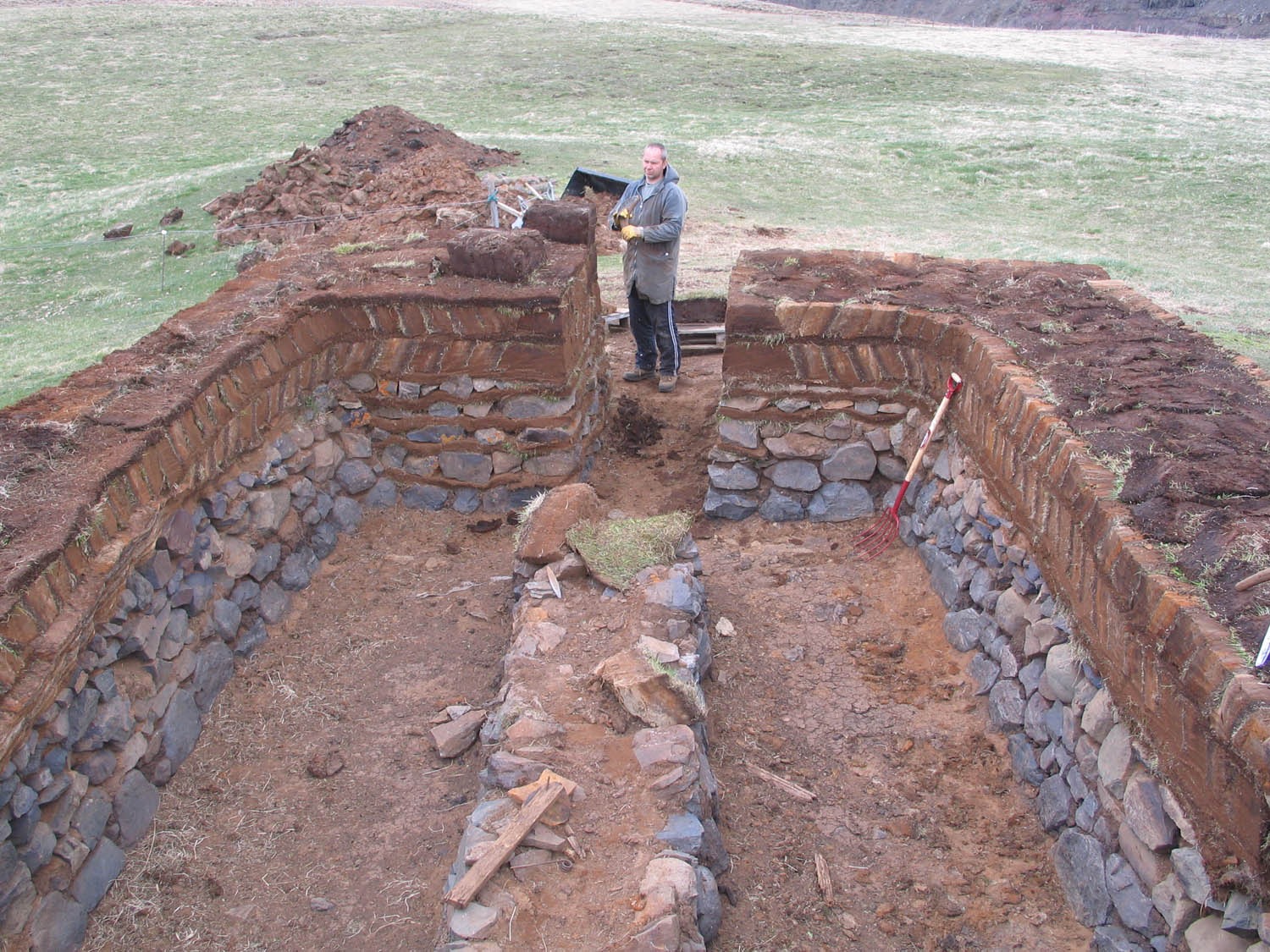
Helgi Sigurðsson, a master craftsman at the entrance of a sheep shed reconstructed by the Heritage Craft School Project at Tyrfingsstaðir, North Iceland. The walls have a classic construction commonly found in animal housing. Alternating turf and stone halfway up the walls protect them from being damaged by animals. The upper part of the wall is a classic double-faced wall made of clamped blocks. Photo: Bryndís Zoëga.
The aim of the project is to preserve and promote traditional building skills, as well as document the vernacular terminology associated with traditional Icelandic building methods. In the project’s initial stages, the Norwegian Crafts Institute in Maihaugen, Norway, was consulted about methods of collecting and preserving information on traditional building skills. The original plan was to graduate students, who would be able to pass on the intangible cultural heritage of traditional building methods (Byggðasafn Skagfirðinga, 2006, 2007). In the end, the courses evolved into being of more general nature and open to all.
The Heritage Craft School Project has been offering courses in traditional building techniques since 2007. The courses are designed to offer a hands-on experience of traditional building crafts. Emphasis is placed on conserving the historic integrity and authenticity of old buildings. The courses were initially aimed at professionals (builders, people from the heritage sector, tourism sector, etc.), landowners, homeowners, or people who wanted to learn to maintain their own buildings (Byggðasafn Skagfirðinga, 2007). In fact, most of the Icelandic participants have not been professionals, but rather people with diverse backgrounds who were interested in turf and turf building traditions. Non-Icelandic participants came from all over the world, but the majority came from Scotland through a collaboration with the ArchNetwork- and Erasmus + Adult Education-funded programs run by the Firm of Arch (Fornverkaskólinn, 2012).
As well as teaching about traditional building skills, the Skagafjörður Heritage Museum, through the Heritage Craft School Project, has been renovating and restoring a turf farm and associated outhouses in Tyrfingsstaðir, in the region of Skagafjörður in northern Iceland (Figure 8). The houses at Tyrfingsstaðir are built in the vernacular tradition, and most remained in use until 1969 when the farmers moved to the nearest town. Subsequently, the buildings gradually fell into decay. In 2006, the Skagafjörður Heritage Museum signed a contract with the landowners about restoring the old farm buildings through courses in turf building (Byggðasafn Skagfirðinga, 2006). By that time, the landowners were again living at the farm, but the old turf buildings had collapsed either fully or partially. Today, all but one house has been restored and most have been taken into use.
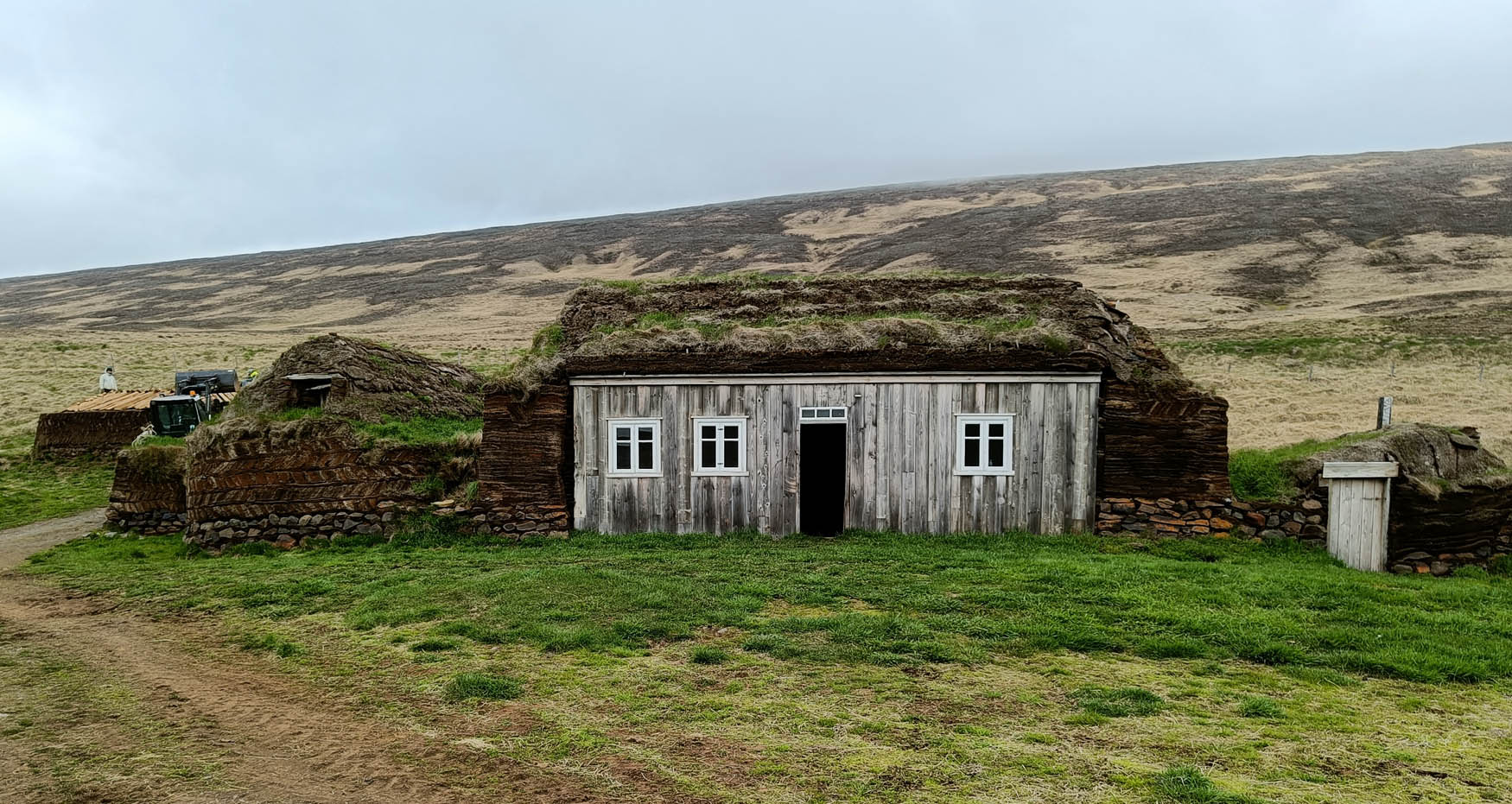
The front of the reconstructed farmhouse at Tyrfingsstaðir in the spring of 2022. Photo: Bryndís Zoëga.
Other projects related to the promotion of turf building and heritage can, for instance, be found in the Dutch town of Firdgum. Archaeologist Daniël Postma and associates built a reconstruction of an early medieval turf house as a part of their PhD research at the University of Groningen (Postma, 2016). Postma participated in a turf building course hosted by the Heritage Craft School Project, and in his master’s thesis he states that even though the construction methods between Iceland and the terp region in the Netherlands differ considerably, the knowledge from the course “helped to identify some universal preconditions for working with turf” and that this “background knowledge has been of key importance for the interpretation of archaeological and historical turf buildings” (Postma, 2010, p. 19). Another success story is the reconstruction of a seventeenth-century turf house at the Glencoe Visitor Centre in the Glencoe National Nature reserve. The house was re-constructed by archaeologists, architects, and craftspeople that had participated in a course at the Heritage Craft School Project (Glencoe Turf House Keeps Heritage Building Skills Alive, 2022). These projects underline the importance of transnational cooperation in sustaining and reviving fragile knowledge of traditional building methods.
7 The Changing Image of Turf
The overall perception of traditional vernacular heritage directly influences how people perceive its meaning and importance. In the nineteenth and early twentieth centuries, Icelanders were actively working towards gaining independence from Danish rule. Society was changing rapidly, and people were eager to embrace modernity as they migrated in large numbers from the countryside into towns and began earning wages. During this period, the Icelandic turf house began to be unfavourably perceived, and turf came to be associated with poverty, diseases, and an outdated way of life (Magnússon, 2019). The preceding centuries had been fraught with natural calamities, poverty, and deteriorating living conditions, which had a negative impact on the quality of housing as well as most other aspects of society (Hafsteinsson & Jóhannesdóttir, 2015). In a recent article, Hafsteinsson (2019) also discusses how “colonial thought” may have influenced the negative outcome for Icelandic vernacular architecture at the turn of the twentieth century.
Badly built dwellings made of low-quality materials were unsightly and unhygienic. However, similar to any other place in the world, these buildings were indicative of poverty and limited resources rather than a reflection of the quality of turf as a building material. Timber and, in the first decades of the twentieth century, concrete became the norm for construction (Stefánsson, 2020). Moving from turf buildings to timber or concrete houses was a shock for some, who expressed their disappointment with their new homes as they were cold and expensive to heat. Some even mentioned noisiness as a negative factor, as turf provides excellent acoustic properties (Kuhn & Prinz, 2003). Imported building materials were costly, while turf was widely available, and turf buildings continued to be used, particularly in rural areas.
The sixteenth-century scholar Arngrímur the Learned states in his writings that Icelanders need not feel ashamed of building with turf, as Spartans themselves had used turf for construction (Jónsson, 1985). Perhaps the comments made by foreign visitors had already had a negative impact on how Icelanders perceived their national architecture at that time. Negative views of the Icelandic turf house have been long-standing. Even today, they may be referred to as turf-huts in a derogatory manner, especially by older generations (Figure 9). Things are, however, changing for the better.
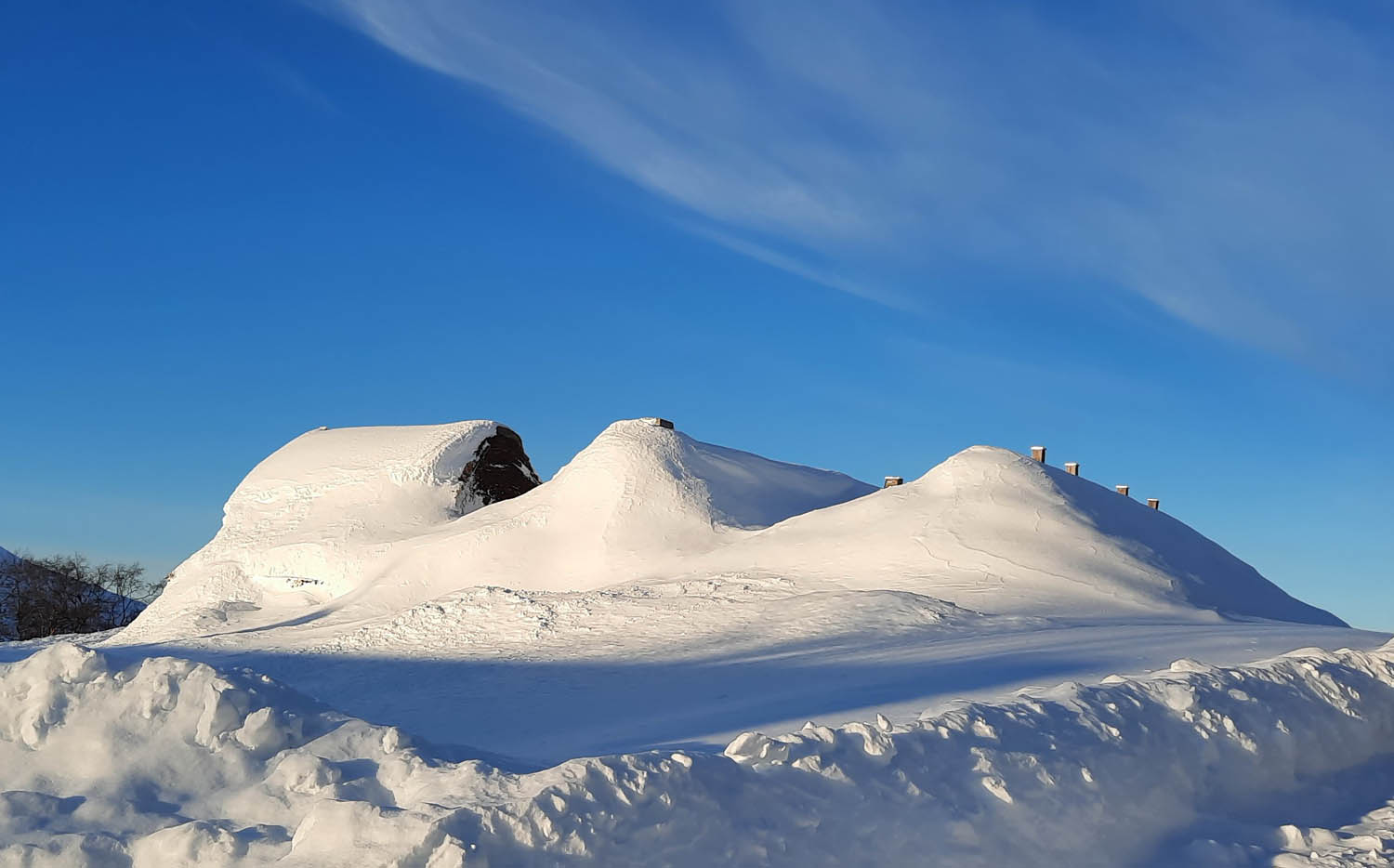
The historic turf building of Nýibær in Hólar in Hjaltadalur, North Iceland, in the winter of 2021. The picture shows how the buildings almost blend into the snowy landscape. Foreign visitors often described how the buildings almost seemed to disappear into the landscape, further fuelling the negative perception of Iceland’s vernacular architecture. The thick turf walls, however, provided good insulation against the snow, and the huddled form of the buildings helped to retain heat within them. Photo: Sigríður Sigurðardóttir.
In 2020, the Tourism Department of Hólar University conducted country-wide research on people’s attitudes towards turf and turf buildings. This research included the opinions of local residents as well as tourists. When tourists were asked to rate turf houses on a scale of 1–10, very few gave a rating below 6. However, up to 85% of tourists graded them 8–10 for attractiveness and up to 100% rated them highly for educational value (Sigurðardóttir, 2020b). The consensus was that turf buildings are an important national heritage, and people’s views on them were overwhelmingly positive. When tourists were asked to describe their experiences, the most common words were as follows: historic, heritage, interesting, remarkable, amazing, nice, hard, surprising (Sigurðardóttir, 2020b). Furthermore, the majority of Icelanders said that turf buildings were a national symbol that should be protected (Sigurðardóttir, 2020a).
Today, the methods and materials of traditional turf building are primarily used for repairing historic turf houses and for building and maintaining historical reconstructions. Occasionally, however, individuals request the construction of traditional outhouses or other turf structures. In many ways, turf aligns well with modern ideas of the ideal building material: it is sustainable, renewable, and has a low carbon footprint. It also has excellent insulation and acoustic qualities. However, despite its past usefulness, turf is not a material that lends itself to modern building regulations or conveniences. Formerly the cheapest and most convenient option for house building, turf is now expensive and exclusive. Additionally, the need for continual repairs means costly maintenance. It is difficult to imagine turf being used again as the primary material for domestic architecture.
Having said that, turf as a tradition has been experiencing a revival in recent years. This revival has mostly been driven by the tourism industry, eager to utilise Icelandic heritage in their attractions. For the reasons mentioned above, these attractions tend to be more of a nod to the turf tradition rather than actual turf structures. The buildings may have a perceived “traditional” appearance or incorporate, to some extent, turf and/or stones into the building design. Two such attractions are the Old Farm in north Iceland and Turfhouse Retreat in the south (Íslandsbærinn Old Farm, website; Torfhús Retreat, website). A solid facade of klambra, “clamped blocks,” greets those visiting the recently constructed geothermal attraction, Sky Lagoon. These are traditionally cut and constructed klambra blocks but employed with a modern supportive backing (Sky Lagoon website) (Figure 10). These new ways of utilising the turf heritage may not be traditional, but they do demonstrate respect for the history and tradition of the material and the architecture it helped form.
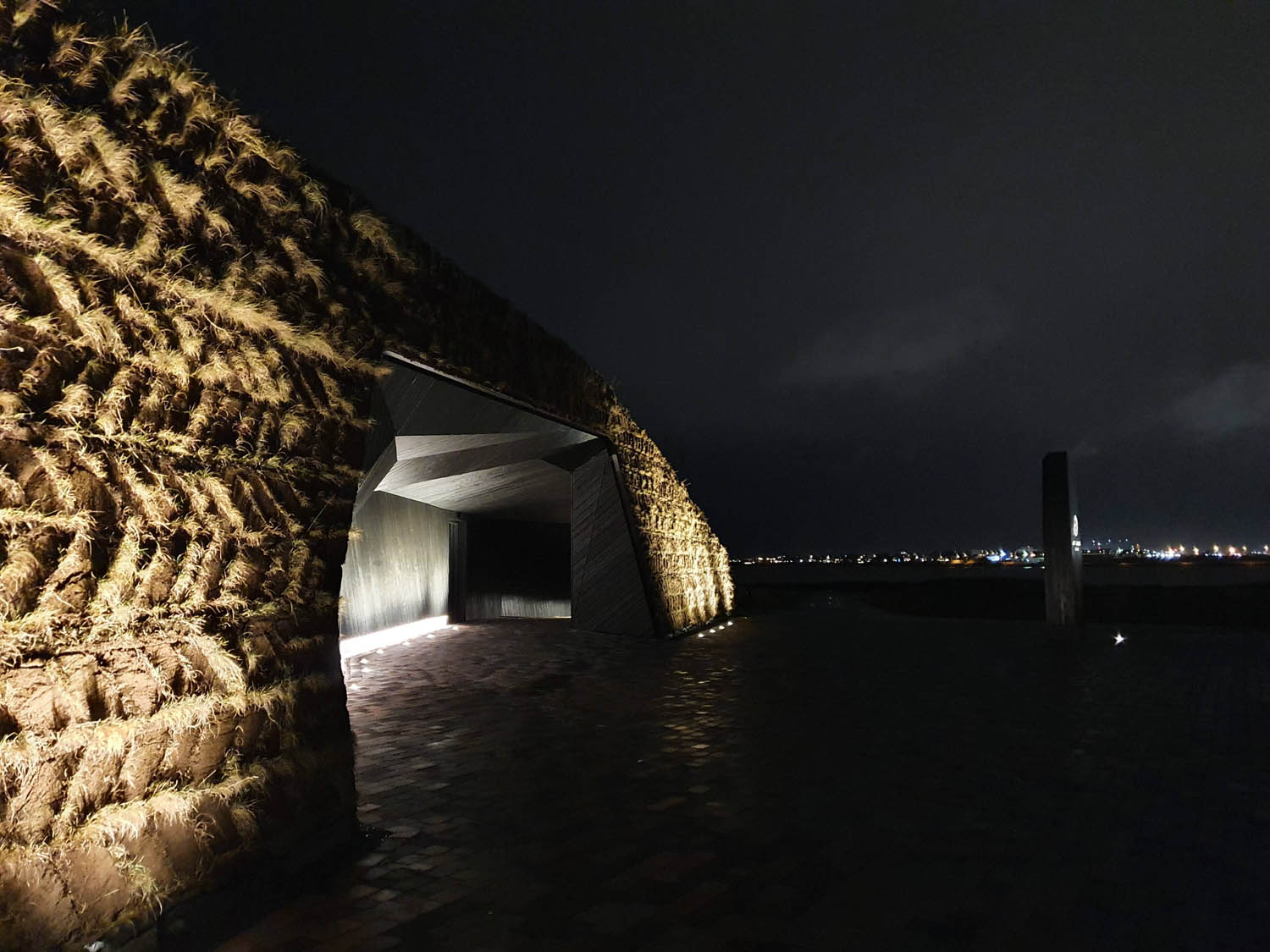
The facade of the Sky-Lagoon spa at night. The turf blocks are a throwback to times past, while encapsulating a very modern and luxurious experience. Photo: Guðný Zoëga.
8 Discussion
To accurately identify and interpret turf and turf structures in the archaeological record, it is crucial to have knowledge of the material and its usage. Ethnographic and written sources are also crucial for contextualising this heritage, but without the knowledge of the material itself, a vital source of information is missing. Ensuring the maintenance of knowledge is paramount. The biggest threat to the Icelandic turf tradition is the loss of knowledge on how to locate, harvest, and build with turf. The Heritage Craft School Project aims to preserve and promote the important intangible heritage of building with turf. Skilled craftspeople, architects, and archaeologists, primarily from Scotland have taken turf courses at the Heritage Craft School. They do so because the knowledge of traditional turf building has been lost in their respective countries. Learning how to work with turf as a material helps with interpreting and maintaining historical architecture. Additionally, knowledge of turf construction aids archaeologists in identifying buried turf structures. The knowledge and experience of turf building traditions which have survived in Iceland have for instance, been important for reviving turf building traditions in both the Netherlands and to a greater extent in Scotland. In the words of Brian Wilkinson (Wilkinson, 2009, p. 29): “While the social history and environmental conditions are quite different, an understanding of the long use of turf in Iceland can inform research here about our own buildings made of this simple material and enable a richer understanding of the types of vernacular buildings so common throughout Scotland’s rural past.”
In Iceland, a large body of knowledge has been amassed on turf and turf buildings. However, academic research is still limited, and there is a lack of publications available to an international audience. A lot of research and publications on turf have been based on macroscopic and ethnographic descriptions. However, limited controlled research has been conducted on turf and its material or chemical properties, as well as the factors that affect its preservation and suitability as a construction material. Here the study of turf can draw upon the methodologies of building archaeology (see for instance Lorenzon, Nitschke, Littman, & Silverstein, 2020; Russell et al., 2022). In addition, more in-depth comparative studies of turf, turf harvesting, and turf construction are needed, both ethnographically and archaeologically.
More funding is needed for the maintenance of historic buildings, resulting in a lack of paid positions and repair work for craftsmen. As a result, there is limited renewal in the profession. Unless a concerted effort is put into place to ensure that the tradition is kept alive, it is difficult to envisage a good outcome for the Icelandic turf heritage. Maintaining turf buildings is expensive, and the limited official funding is directed to the upkeep of protected buildings in the Historic Buildings Collection at the National Museum of Iceland.
There are signs, though, that the tide may be turning. The results of the 2020 research on people’s attitudes towards turf houses, as well as the experience of the Heritage Craft School Project, have shown that there is ample positive interest in traditional buildings and building skills. Turf buildings are no longer seen as a sign of backward times, but rather as a heritage that is socially significant, and needs to be protected and maintained.
9 Conclusion
In this contribution, we have examined turf in Iceland in terms of its, material, history, uses, and local and international significance. Turf and turf working seem to have been remarkably consistent throughout the millennium when turf was the primary building material. Regional nuances in building methods and architecture may become more apparent with further research. By employing a holistic approach to researching turf structures, whether they are still standing, collapsed, or preserved sub-surface, the interpretive potential is greatly enhanced. As Iceland still retains the knowledge of working and building with turf, it must be hoped that efforts will be made to ensure its preservation, for the benefit of historical architecture in Iceland and further afield.
Acknowledgments
We would like to express our gratitude for the invitation to participate in the NOS-HS funded workshop Earthen Architecture in Nordic Research: Historic Knowledge, Social Impact, and Sustainability. Many thanks go to Martha Lorenzon for her inspiration and enthusiasm, as well as to the other PI´s and participants in the workshops for their valuable contributions to the discussions and knowledge sharing. We would also like to thank the Skagafjörður Heritage Museum and the Heritage Craft School Project for their support and for making data available. We also thank the anonymous reviewers for their constructive criticisms, which helped improve the paper.
-
Conflict of interest: Authors state no conflict of interest.
References
Ágústsson, H. (1987). Íslenski torfbærinn. In F. F. Jóhannsson, H. Ólafsson, J. H. Aðalsteinsson, & Þ. Magnússon (Eds.), Íslensk þjóðmenning. Uppruni og umhverfi (Vol. 1, pp. 227–344). Reykjavík: Þjóðsaga.Search in Google Scholar
Ágústsson, H. (1989). Húsagerð á síðmiðöldum. In S. Líndal. (Ed.), Saga Íslands (Vol. IV, pp. 261–300). Reykjavík: Hið íslenzka bókmenntafélag.Search in Google Scholar
Ágústsson, H. (1998). Íslensk byggingararfleifð: Ágrip af húsagerðasögu 1750–1940 (Vol. 1). Reykjavík: Húsafriðunarnefnd ríkisins.Search in Google Scholar
Ágústsson, H. (2004). Laufás við Eyjafjörð: Staðurinn. Reykjavík: Hið íslenzka bókmenntafélag.Search in Google Scholar
Bárðarson, G. G. (1904). Hugleiðingar um húsagerð. Búnaðarrit, 18(1), 237–252. Reykjavík: Búnaðarfélag Íslands.Search in Google Scholar
Bruun, D. (1987). Íslenskt þjóðlíf í þúsund ár (Vol. 1). In S. Steindórsson (trans.). Reykjavík: Örn og Örlygur.Search in Google Scholar
Byggðasafn Skagfirðinga. (2006). Ársskýrsla Byggðasafns Skagfirðinga fyrir 2006.Search in Google Scholar
Byggðasafn Skagfirðinga. (2007). Ársskýrsla Byggðasafns Skagfirðinga fyrir 2007.Search in Google Scholar
Coullenot, S. (2022). La ferme islandaise. Une archéologie des narrations de l’architecture en tourbe. (PhD thesis), Unpublished doctoral dissertation, Jean Monnet University, Saint Etienne.Search in Google Scholar
Ebenesersdóttir, S. S., Sandoval-Velasco, M., Gunnarsdóttir, E. D., Jagadeesan, A., Guðmundsdóttir, V. B., Thordardóttir, E. L., … Helgason, A. (2018). Ancient genomes from Iceland reveal the making of a human population. Science, 360(6392), 1028–1032. doi: 10.1126/science.aar2625.Search in Google Scholar
Fornverkaskólinn. (2012). Ársskýrsla Fornverkaskólans 2012. https://www.glaumbaer.is/static/files/fornverkaskolinn/gagnabanki/arsskyrsla2012.pdf.Search in Google Scholar
Einarsson, O. (1971). Íslandslýsing = Qualiscunque descriptio Islandiae. In S. Pálsson (trans.). Reykjavík: Bókaútgáfa Menningarsjóðs.Search in Google Scholar
Gestsson, M. (1980). Settorfur. In K. Eldjárn (Ed.), Árbók Hins íslenzka fornleifafélags 1980 (pp. 111–112). Reykjavík: Hið íslenzka fornleifafélag.Search in Google Scholar
Glencoe Turf House Keeps Heritage Building Skills Alive. (2022, July 1). National Trust for Scotland. https://www.nts.org.uk/stories/glencoe-turfhouse-keeps-heritage-building-skills-alive-1.Search in Google Scholar
Hafsteinsson, S. B., & Jóhannesdóttir, M. G. (2015). Moldargreni og menningararfur. Útrýming og arfleifð torfhúsa. In Ó. Rastrick & V. Tr Hafstein (Eds.), Menningararfur á Íslandi. Greining og gagnrýni (pp. 9–19). Reykjavík: Háskólaútgáfan.Search in Google Scholar
Hafsteinsson, S. B. (2019). “Icelandic Putridity”: Colonial Thought and Icelandic Architectural Heritage. Scandinavian Studies: Publication of the Society for the Advancement of Scandinavian Study, 91(1–2), 53–73. doi: 10.5406/scanstud.91.1-2.0053.Search in Google Scholar
Halldórsson, B., Kristjánsson G., Sigfússon, B., & Þorsteinsson, Þ. (1983). Rit Björns Halldórssonar í Sauðlauksdal. Reykjavík: Búnaðarfélag Íslands.Search in Google Scholar
Halldórsson, B., & Kristjánsdóttir, B. S. (1987). Íslendinga sögur og þættir (Vol. 1 & 3, new ed.). Reykjavík: Svart á Hvítu.Search in Google Scholar
Hannesson, G. (1899). Maður horfðu þér nær – liggur í götunni steinn. Bjarki, IV(22), 85. Seyðisfjörður.Search in Google Scholar
Hannesson, G. (1943). Húsagerð á Íslandi. In G. Finnbogason (Ed.), Iðnsaga Íslands (Vol. 1, pp. 1–317). Reykjavík: Iðnaðarmannafélagið í Reykjavík.Search in Google Scholar
Jakhelln, G. (2017). Turf, Timber and Skjelter construction in Norway. In S. Piesik (Ed.), Habitat: Vernacular Architecture for a Changing Planet (pp. 374–378). London: Thames & Hudson.Search in Google Scholar
Jóhannesson, J., Finnbogason, M., & Eldjárn, K. (1946). Sturlunga saga. Reykjavík: Sturlunguútgáfan.Search in Google Scholar
Jonaitis, A. (2017). Indigenous Dwellings of America’s Subarctic and Northwest Coast. In S. Piesik (Ed.), Habitat: Vernacular Architecture for a Changing Planet (pp. 366–374). London: Thames & Hudson.Search in Google Scholar
Jónsson, A. (1985). In H. Þorláksson (Ed.), Crymogæa. Þættir úr sögu Íslands. In J. Benediktsson (trans.). Reykjavík: Sögufélag.Search in Google Scholar
Karlsson, G. (2000). Iceland´s 1100 years: History of a marginal society. London: C. Hurst.Search in Google Scholar
Karlsson, G., Árnason, M., & Sveinsson, K. (2001). Grágás: Lagasafn íslenska þjóðveldisins (3rd ed.). Reykjavík: Mál og Menning.Search in Google Scholar
Karlsson, G. (2022). Fornir hættir: Húsakostur og verkmenning. Reykjavík: Háskólaútgáfan.Search in Google Scholar
Kuhn, H., & Prinz, R. (2003). In M. Kristinsson (Ed.), Úr torfbæjum inn í tækniöld (Vol. 2). Reykjavík: Örn og Örlygur.Search in Google Scholar
Lorenzon, M., Nitschke, J. L., Littman, R. J., & Silverstein, J. E. (2020). Mudbricks. Construction Methods, and Stratigraphic Analysis: A Case Study at Tell Timai (Ancient Thmuis) in the Egyptian Delta. American Journal of Archaeology, 124(1), 105–131. doi: 10.3764/aja.124.1.0105.Search in Google Scholar
Magnússon, S. G. (2019). Hús og híbýli alþýðumanna. Fátækt á Íslandi á síðari hluta 19. aldar og fram á þá 20. í máli og myndum. In D. Ólafsson, M. Jónsson, & S. G. Magnússon (Eds.), Híbýli fátæktar. Húsnæði og veraldleg gæði fátæks fólks á 19. öld og fram á 20. öld (pp. 15–51). Reykjavík: Háskólaútgáfan.Search in Google Scholar
Maurer, K., Schier, K., & Björnsson, Á. (1997). Íslandsferð 1858. In B. Hafstað (trans.). Reykjavík: Ferðafélag Íslands.Search in Google Scholar
Mullane, F. (2019). Croiceann cruaidh féarmhar an talaimh: a material culture of the skin of the earth – the example of roofing with sod parings in Ireland. Journal of Ethnological Studies, 57(1), 1–26. doi: 10.1080/04308778.2019.1592936.Search in Google Scholar
O’Sullivan, A., McCormick, F., Kerr, T., & Lorcan, H. (2014). Early Medieval Ireland, AD 400–1100. Dublin: Royal Irish Academy.Search in Google Scholar
Pálsson, S. (1945). Ferðabók: Dagbækur og ritgerðir 1791–1897. In J. Eyþórsson, P. Hannesson & S. Steindórsson (trans.). Reykjavík: Snælandsútgáfan.Search in Google Scholar
Piesik, S. (2017). Introduction. In S. Piesik (Ed.), Habitat: Vernacular Architecture for a Changing Planet (pp. 16–24). London: Thames & Hudson.Search in Google Scholar
Postma, D. (2010). Salt Marsh Architecture: Catalogue, technology and typological development of early medieval turf buildings in the northern coastal area of the Netherlands. University of Groningen, Groningen. https://www.waddenacademie.nl/fileadmin/inhoud/pdf/06-wadweten/Scripties/D._Postma_-_scriptieverkl.pdf.Search in Google Scholar
Postma, D. (2016). Het Zodenhuis Van Firdgum: Middeleeuwse boerderijbouw in het Friese kustgebied tussen 400 en 1300. Eelde: Barkhuis.Search in Google Scholar
Romankiewicz, T. (2019). Turf worlds: Towards understanding an understudied building material in rural Iron Age architecture – some thoughts in a Scottish context. In D. C. Cowley, M. Fernández-Götz, T. Romankiewicz & H. Wendling (Eds.), Rural Settlement: Relating Buildings, Landscape, and People in the European Iron Age (pp. 135–142). https://www.sidestone.com/openaccess/9789088908187.pdf.Search in Google Scholar
Romankiewicz, T., Russell, B., Bailey, G., Gardner, T., Snyder, J., & Beckett, C. (2022). Another wall of turf. Proceedings of the Society of Antiquaries of Scotland, 151, 103–141. 10.9750/PSAS.151.1353.Search in Google Scholar
Rúnarsdóttir, A. L. (2007). Á tímum torfbæja: Híbýlahættir og efnismenning í íslenska torfbænum frá 1850. Skýrslur Þjóðminjasafns Íslands 2007/1. https://www.thjodminjasafn.is/media/rannsoknir/Torfbaejarskyrsla-PDF.pdf.Search in Google Scholar
Russell, B., Romankiewicz, T., Gardner, T., Birley, A., Snyder, J. R., & Beckett, C. T. S. (2022). Building with turf at Roman Vindolanda: multi-scalar analysis of earthen materials, construction techniques, and landscape context. Archaeological Journal 179(1), 169–210. doi: 10.1080/00665983.2021.1949148.Search in Google Scholar
Schmid, M. M. E., Dugmore, A. J., Vésteinsson, O., & Newton, A. J. (2017). Tephra isochrons and chronologies of colonisation. Quaternary Geochronology, 40, 56–66.10.1016/j.quageo.2016.08.002Search in Google Scholar
Sigurðardóttir, A. (1966). Híbýlahættir á miðöldum. Reykjavík: Menningarsjóður og Þjóðvinafélagið.Search in Google Scholar
Sigurðardóttir, S. (2008). Building with turf. In N. M. Brown (trans.), Smárit Byggðasafns Skagfirðinga IX. https://www.glaumbaer.is/static/files/Skjol/ix-turf.pdf.Search in Google Scholar
Sigurðardóttir, S. (2011). Gamlir byggingahættir. Smárit Byggðasafns Skagfirðinga VIII (2nd ed.). https://www.glaumbaer.is/static/files/Skjol/xiv-gamlar-byggingar.pdf.Search in Google Scholar
Sigurðardóttir, S. (2017). Þrif og þvottar í torfbæjum. Rit Byggðasafns Skagfirðinga 2. Akureyri: Byggðasafn Skagfirðinga. https://www.glaumbaer.is/static/files/pdf/rrit-bsk2-thrif_og_thvottar_i_torfbaejum-2017.pdf.Search in Google Scholar
Sigurðardóttir, S. (2018). Gamlar torf- og grjóthleðsluleifar í Skagafirði 1987–2017. Vettvangs- og heimildakannanir (nr. 2018/212). Byggðasafn Skagfirðinga. https://www.glaumbaer.is/static/files/pdf/Rannsoknarskyrslur_200-249/bsk-2018-212_gamlar-torf-og-grjothledslur-i-skagafirdi-1987-2017-ss.pdf.Search in Google Scholar
Sigurðardóttir, S. (2020a). Gestir meta torfbæi. Rannsóknir um minjaarf III – torfbyggingar. Hólar University. https://www.holar.is/static/files/Rannsoknir/Ferdamaladeild/Utgefidefni/skyrsla-iii_lok-2-.pdf.Search in Google Scholar
Sigurðardóttir, S. (2020b). Viðhorf til nytja og minjagildis torfbygginga. Rannsóknir um minjaarf I – torfbyggingar. Hólar University. https://www.holar.is/static/files/Rannsoknir/Ferdamaladeild/Utgefidefni/vidhorf_til_nytja-_og_minjagildis_torfbygginga_loka.pdf.Search in Google Scholar
Sigurðardóttir, S. (2021). Byggingarefnið torf: Meira en þúsund ára umgjörð íslenskrar mannvistar (Master thesis). (University of Iceland, Reykjavík) https://skemman.is/handle/1946/37431.Search in Google Scholar
Sigurðarson, G. S., Zoëga, G., & Sigurðardóttir, S. (2017). Reading the landscape. Sauðárkrókur: Byggðasafn Skagfirðinga. https://rafhladan.is/handle/10802/20085.Search in Google Scholar
Solli, B. (2006). Borg in Lofoten: From early Iron Age “cooking-mates” via Viking Age chieftains to medieval farmers. In Dynamics of Northern societies: Proceedings of the SILA/NABO Conference on Arctic and North Atlantic Archaeology, Copenhagen, May 10–14th, 2004 (pp. 259–271).Search in Google Scholar
Stefánsson, H. (2019). From Earth – Icelandic Turf Houses. In A. Yates (trans.). Reykjavík: Gullinsnið.Search in Google Scholar
Stefánsson, H. (2020). Hvílíkt torf – tóm steypa!: úr torfbæjum í steypuhús. Reykjavík: Háskólaútgáfan.Search in Google Scholar
Steinberg, J. M. (2004). Note on organic content of turf walls in Skagafjörður, Iceland. Archaeologia Islandica, 3, 61–70.Search in Google Scholar
Steinberg, J. M., Bolender, D. J., & Damiata, B. N. (2016). Viking Age Settlement Patterns in Northern Iceland: Initial Results of The Skagafjörður Archaeological Settlement Survey. Journal of Field Archaeology 41(4), 389–412. doi: 10.1080/00934690.2016.1203210.Search in Google Scholar
Steinberg, J. M., Zoëga, G., Bolender, D. J., & Damiata, B. N. (2022). Glaumbær: Overview and assessment of the results of the 2001–2014 investigations (nr. 2002/241). Skagafjörður Heritage Museum & Fiske Center for Archaeological Research, UMass Boston. https://www.glaumbaer.is/static/files/bsk-2022-241_glaumbaer-compressed.pdf.Search in Google Scholar
Sveinsson, G. (1790). Húsa eður bæjabyggingar á Íslandi: Sérdeilis smá eður kotbæja. Rit þess konunglega íslenzka Lærdómslistafélags 11. Retrieved from Rit þess (konunglega) íslenzka Lærdómslistafélags - Megintexti (01.01.1790) - Tímarit.is (timarit.is).Search in Google Scholar
Þorláksson, J. (1903). Nýtt byggingarlag. Steyptir steinar, tvöfaldir veggir. Búnaðarrit, 17(1), 277–302. Reykjavík: Búnaðarfélag Íslands.Search in Google Scholar
Þorsteinsson, G. (1990). Horfnir starfshættir og leiftur frá liðnum öldum (2nd ed.). Reykjavík: Örn og Örlygur.Search in Google Scholar
Trædal, V. (2008). Kirkesteder og kirkebygninger i Troms og Finnmark før 1800. Tromsø: Universitetet i Tromsø.Search in Google Scholar
van Hoof, J., & van Dijken, F. (2007). The historical turf farms of Iceland: Architecture, building technology and the indoor environment. Building and Environment, 43(6), 1023–1030. doi: 10.1016/j.buildenv.2007.03.004.Search in Google Scholar
Walker, B. (2006). Scottish Turf Construction. Edinburgh: Historic Scotland.Search in Google Scholar
Wilkinson, B. (2009). A study of Turf: Historic rural settlements in Scotland and Iceland. Architectural Heritage, 20(1), 15–31. doi: 10.3366/E135075240900017X.Search in Google Scholar
Yu Mainicheva, A. (2017). Homesteads of Northern and Central Russia. In S. Piesik (Ed.), Habitat: Vernacular architecture for a changing planet (pp. 386–391). London: Thames & Hudson.Search in Google Scholar
Zoëga, G., & Murphy. K. (2019). Life on the northern frontier; Bioarchaeological reconstructions of 11th century households in North Iceland. In C. Tica & D. Martin (Eds.), Bioarchaelogoy of Frontiers and Borderlands (pp. 160–184). Gainesville: University Press of Florida. doi: 10.2307/j.ctvx0720b.Search in Google Scholar
Zoëga, G., & Traustadóttir, R. (2007). Keldudalur: A sacred place in Pagan and Christian times in Iceland. In U. Fransson, M. Svedin, S. Bergerbrant & F. Androshchuk (Eds.), Cultural Interaction Between East and West. Archaeology, Artefacts and Human Contacts in Northern- Europe (pp. 225–230). Stockholm: University of Stockholm.Search in Google Scholar
© 2023 the author(s), published by De Gruyter
This work is licensed under the Creative Commons Attribution 4.0 International License.
Articles in the same Issue
- Regular Articles
- A 2D Geometric Morphometric Assessment of Chrono-Cultural Trends in Osseous Barbed Points of the European Final Palaeolithic and Early Mesolithic
- Wealth Consumption, Sociopolitical Organization, and Change: A Perspective from Burial Analysis on the Middle Bronze Age in the Carpathian Basin
- Everything Has a Role to Play: Reconstruction of Vessel Function From Early Copper Age Graves in the Upper Tisza Region (Eastern Hungary)
- Urban Success and Urban Adaptation Over the Long Run
- Exploring Hypotheses on Early Holocene Caspian Seafaring Through Personal Ornaments: A Study of Changing Styles and Symbols in Western Central Asia
- Victims of Heritage Crimes: Aspects of Legal and Socio-Economic Justice
- On the (Non-)Scalability of Target Media for Evaluating the Performance of Ancient Projectile Weapons
- Small Houses of the Dead: A Model of Collective Funerary Activity in the Chalcolithic Tombs of Southwestern Iberia. La Orden-Seminario Site (Huelva, Spain)
- Bigger Fish to Fry: Evidence (or Lack of) for Fish Consumption in Ancient Syracuse (Sicily)
- Terminal Ballistics of Stone-Tipped Atlatl Darts and Arrows: Results From Exploratory Naturalistic Experiments
- First Archaeological Record of the Torture and Mutilation of Indigenous Mapuche During the “War of Arauco,” Sixteenth Century
- The Story of the Architectural Documentation of Hagia Sophia’s Hypogeum
- Iconographic Trends in Roman Imperial Coinage in the Context of Societal Changes in the Second and Third Centuries CE: A Small-Scale Test of the Affluence Hypothesis
- Circular Economy in the Roman Period and the Early Middle Ages – Methods of Analysis for a Future Agenda
- New Insights Into the Water Management System at Tetzcotzinco, Mexico
- How Linguistic Data Can Inform Archaeological Investigations: An Australian Pilot Study Around Combustion Features
- Leadership in the Emergent Baekje State: State Formation in Central-Western Korea (ca. 200–400 CE)
- Middle Bronze Age Settlement in Czeladź Wielka – The Next Step Toward Determining the Habitation Model, Chronology, and Pottery of the Silesian-Greater Poland Tumulus Culture
- On Class and Elitism in Archaeology
- Archaeology of the Late Local Landscapes of the Hualfín Valley (Catamarca, Argentina): A Political Perspective from Cerro Colorado of La Ciénaga de Abajo
- Review Article
- The State of the Debate: Nuragic Metal Trade in the Bronze Age and Early Iron Age
- A Review of Malta’s Pre-Temple Neolithic Pottery Wares
- Commentary Article
- Paradise Found or Common Sense Lost? Göbekli Tepe’s Last Decade as a Pre-Farming Cult Centre
- Special Issue Published in Cooperation with Meso’2020 – Tenth International Conference on the Mesolithic in Europe, edited by Thomas Perrin, Benjamin Marquebielle, Sylvie Philibert, and Nicolas Valdeyron - Part II
- The Time of the Last Hunters: Chronocultural Aspects of Early Holocene Societies in the Western Mediterranean
- Fishing Nets and String at the Final Mesolithic and Early Neolithic Site of Zamostje 2, Sergiev Posad (Russia)
- Investigating the Early-to-Late Mesolithic Transition in Northeastern Italy: A Multifaceted Regional Perspective
- Socioeconomic, Technological, and Cultural Adaptation of the Mesolithic Population in Central-Eastern Cantabria (Spain) in the Early and Middle Holocene
- From Coastal Sites to Elevated Hinterland Locations in the Mesolithic – Discussing Human–Woodland Interaction in the Oslo Fjord Region, Southeast Norway
- Exploitation of Osseous Materials During the Mesolithic in the Iron Gates
- Motorways of Prehistory? Boats, Rivers and Moving in Mesolithic Ireland
- Environment and Plant Use at La Tourasse (South-West France) at the Late Glacial–Holocene Transition
- Stylistic Study of the Late Mesolithic Industries in Western France: Combined Principal Coordinate Analysis and Use-Wear Analysis
- Mesolithic Occupations During the Boreal Climatic Fluctuations at La Baume de Monthiver (Var, France)
- Pressure Flakers of Late Neolithic Forest Hunter-Gatherer-Fishers of Eastern Europe and Their Remote Counterparts
- The Site Groß Fredenwalde, NE-Germany, and the Early Cemeteries of Northern Europe
- Special Issue on Archaeology of Migration: Moving Beyond Historical Paradigms, edited by Catharine Judson & Hagit Nol
- The Blurry Third Millennium. “Neolithisation” in a Norwegian Context
- Movement or Diaspora? Understanding a Multigenerational Puebloan and Ndee Community on the Central Great Plains
- Human Mobility and the Spread of Innovations – Case Studies from Neolithic Central and Southeast Europe
- The Thule Migration: A Culture in a Hurry?
- The Transformation of Domes in Medieval Chinese Mosques: From Immigrant Muslims to Local Followers
- Landscapes of Movement Along the (Pre)Historical Libyan Sea: Keys for a Socio-Ecological History
- Arab Migration During Early Islam: The Seventh to Eighth Century AD from an Archaeological Perspective
- Special Issue on Ancient Cultural Routes: Past Transportations Infrastructures as a Two-Way Interaction Between Society and Environment, edited by Francesca Fulminante, Francesca Mazzilli & Franziska Engelbogen
- The Impact of Transportation on Pottery Industries in Roman Britain
- The Role of the Road in Settling a Mountainous Region
- An Example of Geographic Network Analysis: The Case Study of the Fortore Valley (Molise and Apulia, Italy)
- Water, Communication, Sight, and the Location of Fortifications on the Strata Diocletiana (Syria) in Late Antiquity
- Transport, Interaction, and Connectivity
- Special Issue on Scales of Interaction in the Bronze and Iron Age Central Mediterranean, edited by Emily Holt & Davide Schirru
- Tracing Mobility Patterns of Buried Species of the Late Iron Age Funerary Staggered Turriform of Son Ferrer (Calvià, Spain)
- Approaching Interaction in Iron Age Sardinia: Multi-Scalar Survey Evidence from the Sinis Archaeological Project and the Progetto S’Urachi
- From the Atlantic to the Mediterranean and Back: Sardinia, Iberia, and the Transfer of Knowledge in Late Bronze Age Networks
- Special Issue on Bricks Under the Scope: Microscopic and Macroscopic Approaches to the Study of Earthen Architecture, edited by Marta Lorenzon, Moritz Kinzel, & Benjamín Cutillas-Victoria
- Earthen Architecture in Nordic Countries: Future Directions
- Earthen Architecture and Craft Practices of Early Iron Age Ramparts: Geoarchaeological Analysis of Villares de la Encarnación, South-Eastern Iberia
- Earthen Architecture in Southern Algeria: An Assessment of Social Values and the Impact of Industrial Building Practices
- Studying the Use of Earth in Early Architecture of Southwest and Central Asia
- Roof Tiles and Bricks of the Etruscan Domus dei Dolia (Vetulonia, Italy): An Archaeological and Archaeometric Study of Construction Materials
- The Building Blocks of Circular Economies: Rethinking Prehistoric Turf Architecture Through Archaeological and Architectural Analysis
- Undecorated Roman-Period Roof Tiles – An Old Material Providing New Results
- Turf Building in Iceland – Past, Present, and Future
- Special Issue on Past Sounds: New Perspectives in the Field of Archaeoacoustics, edited by Margarita Díaz-Andreu & Neemias Santos da Rosa
- Employing Psychoacoustics in Sensory Archaeology: Developments at the Ancient Sanctuary of Zeus on Mount Lykaion
- One, Two, Three! Can Everybody Hear Me? Acoustics of Roman Contiones. Case Studies of the Capitoline Hill and the Temple of Bellona in Rome
- Ringing Tone and Drumming Sages in the Crevice Cave of Pirunkirkko, Koli, Finland
- Music and Storytelling at Rock Art Sites? The Archaeoacoustics of the Urkosh Area (Russian Altai)
- Listening in Sacred Spaces: The Sanctuary of Poseidonia and Selinunte’s Main Urban Sanctuary
- Presenting Archaeoacoustics Results Using Multimedia and VR Technologies
- Special Issue on Reconsidering the Chaîne Opératoire: Towards a Multifaceted Approach to the Archaeology of Techniques, edited by Marie-Elise Porqueddu, Claudia Sciuto & Anaïs Lamesa
- Reconsidering the Chaîne Opératoire: At the Crossroad Between People and Materials
- Materiality of Plaster Vessels: The Problem of Southwest Asian Neolithic White Ware
- The Chaîne Opératoire Approach for Interpreting Personal Ornament Production: Marble Beads in Copper Age Tuscany (Italy)
- Seriality and Individualization: Carving the Fluted Sarcophagi from Hierapolis of Phrygia
- Making Vessels for the Dead: Pottery-Making Practices, Chaîne Opératoire and the Use of Grog (Crushed Sherds) as a Technological and Cultural Choice during Late and Inca Periods in the Northwestern Argentine Region (Southern Andes)
- An Invention Shading Light to the Socio-History of Bonneuil Quarry Basin: The Roadheaders with Rotating Drill Bits
- The Ugly Duckling: Understanding the Making of an Early Copper Age Atypical Ceramic Vessel from the Great Hungarian Plain
- Synopsis of a Treasure. A Transdisciplinary Study of Medieval Gold Workings Biographies
- Identification of Ceramic Traditions on the Prehistoric Mines of Gavà (Barcelona, Spain)
Articles in the same Issue
- Regular Articles
- A 2D Geometric Morphometric Assessment of Chrono-Cultural Trends in Osseous Barbed Points of the European Final Palaeolithic and Early Mesolithic
- Wealth Consumption, Sociopolitical Organization, and Change: A Perspective from Burial Analysis on the Middle Bronze Age in the Carpathian Basin
- Everything Has a Role to Play: Reconstruction of Vessel Function From Early Copper Age Graves in the Upper Tisza Region (Eastern Hungary)
- Urban Success and Urban Adaptation Over the Long Run
- Exploring Hypotheses on Early Holocene Caspian Seafaring Through Personal Ornaments: A Study of Changing Styles and Symbols in Western Central Asia
- Victims of Heritage Crimes: Aspects of Legal and Socio-Economic Justice
- On the (Non-)Scalability of Target Media for Evaluating the Performance of Ancient Projectile Weapons
- Small Houses of the Dead: A Model of Collective Funerary Activity in the Chalcolithic Tombs of Southwestern Iberia. La Orden-Seminario Site (Huelva, Spain)
- Bigger Fish to Fry: Evidence (or Lack of) for Fish Consumption in Ancient Syracuse (Sicily)
- Terminal Ballistics of Stone-Tipped Atlatl Darts and Arrows: Results From Exploratory Naturalistic Experiments
- First Archaeological Record of the Torture and Mutilation of Indigenous Mapuche During the “War of Arauco,” Sixteenth Century
- The Story of the Architectural Documentation of Hagia Sophia’s Hypogeum
- Iconographic Trends in Roman Imperial Coinage in the Context of Societal Changes in the Second and Third Centuries CE: A Small-Scale Test of the Affluence Hypothesis
- Circular Economy in the Roman Period and the Early Middle Ages – Methods of Analysis for a Future Agenda
- New Insights Into the Water Management System at Tetzcotzinco, Mexico
- How Linguistic Data Can Inform Archaeological Investigations: An Australian Pilot Study Around Combustion Features
- Leadership in the Emergent Baekje State: State Formation in Central-Western Korea (ca. 200–400 CE)
- Middle Bronze Age Settlement in Czeladź Wielka – The Next Step Toward Determining the Habitation Model, Chronology, and Pottery of the Silesian-Greater Poland Tumulus Culture
- On Class and Elitism in Archaeology
- Archaeology of the Late Local Landscapes of the Hualfín Valley (Catamarca, Argentina): A Political Perspective from Cerro Colorado of La Ciénaga de Abajo
- Review Article
- The State of the Debate: Nuragic Metal Trade in the Bronze Age and Early Iron Age
- A Review of Malta’s Pre-Temple Neolithic Pottery Wares
- Commentary Article
- Paradise Found or Common Sense Lost? Göbekli Tepe’s Last Decade as a Pre-Farming Cult Centre
- Special Issue Published in Cooperation with Meso’2020 – Tenth International Conference on the Mesolithic in Europe, edited by Thomas Perrin, Benjamin Marquebielle, Sylvie Philibert, and Nicolas Valdeyron - Part II
- The Time of the Last Hunters: Chronocultural Aspects of Early Holocene Societies in the Western Mediterranean
- Fishing Nets and String at the Final Mesolithic and Early Neolithic Site of Zamostje 2, Sergiev Posad (Russia)
- Investigating the Early-to-Late Mesolithic Transition in Northeastern Italy: A Multifaceted Regional Perspective
- Socioeconomic, Technological, and Cultural Adaptation of the Mesolithic Population in Central-Eastern Cantabria (Spain) in the Early and Middle Holocene
- From Coastal Sites to Elevated Hinterland Locations in the Mesolithic – Discussing Human–Woodland Interaction in the Oslo Fjord Region, Southeast Norway
- Exploitation of Osseous Materials During the Mesolithic in the Iron Gates
- Motorways of Prehistory? Boats, Rivers and Moving in Mesolithic Ireland
- Environment and Plant Use at La Tourasse (South-West France) at the Late Glacial–Holocene Transition
- Stylistic Study of the Late Mesolithic Industries in Western France: Combined Principal Coordinate Analysis and Use-Wear Analysis
- Mesolithic Occupations During the Boreal Climatic Fluctuations at La Baume de Monthiver (Var, France)
- Pressure Flakers of Late Neolithic Forest Hunter-Gatherer-Fishers of Eastern Europe and Their Remote Counterparts
- The Site Groß Fredenwalde, NE-Germany, and the Early Cemeteries of Northern Europe
- Special Issue on Archaeology of Migration: Moving Beyond Historical Paradigms, edited by Catharine Judson & Hagit Nol
- The Blurry Third Millennium. “Neolithisation” in a Norwegian Context
- Movement or Diaspora? Understanding a Multigenerational Puebloan and Ndee Community on the Central Great Plains
- Human Mobility and the Spread of Innovations – Case Studies from Neolithic Central and Southeast Europe
- The Thule Migration: A Culture in a Hurry?
- The Transformation of Domes in Medieval Chinese Mosques: From Immigrant Muslims to Local Followers
- Landscapes of Movement Along the (Pre)Historical Libyan Sea: Keys for a Socio-Ecological History
- Arab Migration During Early Islam: The Seventh to Eighth Century AD from an Archaeological Perspective
- Special Issue on Ancient Cultural Routes: Past Transportations Infrastructures as a Two-Way Interaction Between Society and Environment, edited by Francesca Fulminante, Francesca Mazzilli & Franziska Engelbogen
- The Impact of Transportation on Pottery Industries in Roman Britain
- The Role of the Road in Settling a Mountainous Region
- An Example of Geographic Network Analysis: The Case Study of the Fortore Valley (Molise and Apulia, Italy)
- Water, Communication, Sight, and the Location of Fortifications on the Strata Diocletiana (Syria) in Late Antiquity
- Transport, Interaction, and Connectivity
- Special Issue on Scales of Interaction in the Bronze and Iron Age Central Mediterranean, edited by Emily Holt & Davide Schirru
- Tracing Mobility Patterns of Buried Species of the Late Iron Age Funerary Staggered Turriform of Son Ferrer (Calvià, Spain)
- Approaching Interaction in Iron Age Sardinia: Multi-Scalar Survey Evidence from the Sinis Archaeological Project and the Progetto S’Urachi
- From the Atlantic to the Mediterranean and Back: Sardinia, Iberia, and the Transfer of Knowledge in Late Bronze Age Networks
- Special Issue on Bricks Under the Scope: Microscopic and Macroscopic Approaches to the Study of Earthen Architecture, edited by Marta Lorenzon, Moritz Kinzel, & Benjamín Cutillas-Victoria
- Earthen Architecture in Nordic Countries: Future Directions
- Earthen Architecture and Craft Practices of Early Iron Age Ramparts: Geoarchaeological Analysis of Villares de la Encarnación, South-Eastern Iberia
- Earthen Architecture in Southern Algeria: An Assessment of Social Values and the Impact of Industrial Building Practices
- Studying the Use of Earth in Early Architecture of Southwest and Central Asia
- Roof Tiles and Bricks of the Etruscan Domus dei Dolia (Vetulonia, Italy): An Archaeological and Archaeometric Study of Construction Materials
- The Building Blocks of Circular Economies: Rethinking Prehistoric Turf Architecture Through Archaeological and Architectural Analysis
- Undecorated Roman-Period Roof Tiles – An Old Material Providing New Results
- Turf Building in Iceland – Past, Present, and Future
- Special Issue on Past Sounds: New Perspectives in the Field of Archaeoacoustics, edited by Margarita Díaz-Andreu & Neemias Santos da Rosa
- Employing Psychoacoustics in Sensory Archaeology: Developments at the Ancient Sanctuary of Zeus on Mount Lykaion
- One, Two, Three! Can Everybody Hear Me? Acoustics of Roman Contiones. Case Studies of the Capitoline Hill and the Temple of Bellona in Rome
- Ringing Tone and Drumming Sages in the Crevice Cave of Pirunkirkko, Koli, Finland
- Music and Storytelling at Rock Art Sites? The Archaeoacoustics of the Urkosh Area (Russian Altai)
- Listening in Sacred Spaces: The Sanctuary of Poseidonia and Selinunte’s Main Urban Sanctuary
- Presenting Archaeoacoustics Results Using Multimedia and VR Technologies
- Special Issue on Reconsidering the Chaîne Opératoire: Towards a Multifaceted Approach to the Archaeology of Techniques, edited by Marie-Elise Porqueddu, Claudia Sciuto & Anaïs Lamesa
- Reconsidering the Chaîne Opératoire: At the Crossroad Between People and Materials
- Materiality of Plaster Vessels: The Problem of Southwest Asian Neolithic White Ware
- The Chaîne Opératoire Approach for Interpreting Personal Ornament Production: Marble Beads in Copper Age Tuscany (Italy)
- Seriality and Individualization: Carving the Fluted Sarcophagi from Hierapolis of Phrygia
- Making Vessels for the Dead: Pottery-Making Practices, Chaîne Opératoire and the Use of Grog (Crushed Sherds) as a Technological and Cultural Choice during Late and Inca Periods in the Northwestern Argentine Region (Southern Andes)
- An Invention Shading Light to the Socio-History of Bonneuil Quarry Basin: The Roadheaders with Rotating Drill Bits
- The Ugly Duckling: Understanding the Making of an Early Copper Age Atypical Ceramic Vessel from the Great Hungarian Plain
- Synopsis of a Treasure. A Transdisciplinary Study of Medieval Gold Workings Biographies
- Identification of Ceramic Traditions on the Prehistoric Mines of Gavà (Barcelona, Spain)
