From the Atlantic to the Mediterranean and Back: Sardinia, Iberia, and the Transfer of Knowledge in Late Bronze Age Networks
-
Ralph Araque Gonzalez


Abstract
Sardinia was a hub of sea routes in the Final Bronze Age, c. 1200–850 BC, connecting the Aegean and the Levant in the East with the Iberian Atlantic façade in the West at its latitudinal extremes. Although situated some 1,200 nautical miles apart, bronze working techniques on the island, specific decorations, and implement typologies were clearly related to those in western Iberia, which was a pivotal node connecting the Atlantic and Mediterranean worlds. Without doubt, individuals have travelled between and beyond both regions, and transported objects alongside technological as well as theoretical information. Although serious challenges accompanied the multi-directional intensification of interactions, the local communities had innovative responses to them, managing to integrate new people and knowledge. The general aim of this contribution is to provide a theoretical framework with which to analyse the motivations and social mechanisms for cooperation and communication that facilitated technology transfer in an environment of dispersed, socially heterogeneous communities. The exchanges and interactions within this decentralised network must have been self-organised by individuals and communities, and encompassed all forms of entanglement. Consequently, practises of self-governance, hospitality, conflict management, and inter-group communication as well as shared symbols are of central interest.
1 Introduction
This article focuses on interactions and social dynamics between individuals and communities from the Mediterranean island of Sardinia and those of the Iberian Atlantic façade from the Final Bronze Age (FBA) until the Early Iron Age (EIA) transition (Table 1). Sardinia and western Iberia are ore-bearing regions, situated at intersections of the greater Atlantic and Mediterranean networks. The material record of Portugal, Extremadura, and Andalusia includes notable evidence for Mediterranean contacts, ostensibly via Sardinia, which had already been interacting with Greece and Cyprus at least since the precedent Recent Bronze Age (RBA).
Comparative chronological chart for the Mediterranean regions mentioned in the text (after Brandherm, 2007; Lo Schiavo, 2007; Lo Schiavo & Perra, 2018; Peche-Quilichini, 2010; Vilaça, 2020)
| BC | Sardinia | Iberia | Corsica | Italy | Cyprus | Greece |
|---|---|---|---|---|---|---|
| 1350–1200 | RBA | Late Bronze Age/Isla de Cheta (from c. 1260 BC) | RBA | Apennine-Subappennine | LC II B–C | LH III A–B |
| 1200–1150 | FBA 1 | Huerta de Arriba | FBA 1 | FBA 1 Protovillanova | LC III A | LH III C |
| 1150–1050 | FBA 2 | Hío | FBA 1 | FBA 2 Protovillanova | LC III B | Submycenaean |
| 1050–950 | FBA 3 | Huelva | FBA 2 | FBA 3 Protovillanova | Cypro-Geometric I | Proto-Geometric |
| 950–850 | FBA 3/EIA 1A | Sa Idda | FBA 3 | EIA 1 Villanova | Cypro-Geometric II–III | Late Proto-Early Geometric |
| 850–730 | EIA 1 B | Sa Idda | EIA 1 | EIA 1 B Villanova | Cypro-Geometric III | Geometric |
Perhaps the most significant cultural innovation of the FBA was the firm establishment of direct and indirect long-distance contacts, the intensification of exchanges, and the transport of scarce commodities. Amongst the latter, we find above all metals (mainly tin and copper or finished bronze artefacts), amber, and the valued perishable contents of pottery containers that are now only represented by their sherds (Celestino, Rafel, & Armada, 2008; Chevillot, 1991; Earle, Ling, Uhnér, Stos-Gale, & Melheim, 2015; Iacono, 2019; Ling et al., 2014; Lo Schiavo, Muhly, Maddin, & Giumlia-Mair, 2009). There are abundant archaeological evidence for technological transfer and shared symbols between the Atlantic and the Mediterranean coastal regions within intertwined, decentralised networks that linked face-to-face communities and complex polities (Araque, 2018; Aubet & Sureda, 2013; Babbi, Bubenheimer-Erhart, Marín-Aguilera, & Mühl, 2015; Ialongo, Hermann, & Rahmstorf, 2021; Knapp, Russell, & Van Dommelen, 2022; Maeir et al., 2019; Molloy, 2016; Moore & Armada, 2012; Ruiz-Gálvez Priego, 2015).
The material records of western Iberia and Sardinia show that even though they are situated more than 1,000 nautical miles (almost 2,000 km) apart, with regards to Bronze Age seafaring technology and estimated travel times (Table 2), they both shared unambiguously related bronze working techniques and typological as well as artistic preferences. Furthermore, we can observe that some implements were made in surprisingly similar shapes in an even larger area, between Ireland and Sardinia (Coffyn, 1985; Eogan, 1983; Lo Schiavo, 1991). Symbolic figures like the horned warrior image emerged in the figural art of the eastern and western Mediterranean, in Iberia, and as far North as Scandinavia (Figure 1). Iconic representations on the western Iberian stelae and Sardinian bronze figurines transmitted symbolic information as well as notions of local identity (Araque, 2018; Brandherm, 2013; Celestino, 2001; Celestino & Paniego, 2021; Celestino & Rodríguez, 2017; Díaz-Guardamino, 2010; Lilliu, 1966; Lo Schiavo, 2020; Rodriguez-Corral, 2017; Vandkilde, Matta, Ahlqvist, & Nørgaard, 2021; Vilaça, 2011a, 2020). This ubiquitous resemblance of complex techniques and aesthetics is of particular interest, because it implies close, repeated, and predominantly peaceful interpersonal contacts, i.e. the forming of a community of practice (Dobres, 2000; Lechtman, 1977; Wenger, 1999).
Distances and travel time between anchorages in the Mediterranean and Atlantic Europe
| Origin | Destination | Approx. distance in nautical miles (nm) | Approx. duration in days |
|---|---|---|---|
| Alghero (Sardinia) | Tagus Bay (Portugal) | 1,257 (2,328 km) | 15 |
| Alghero (Sardinia) | West Cyprus | 1,460 (2,703 km) | 21 |
| Tagus Bay (Portugal) | West Cyprus, Via Alghero | 2,817 (5,013 km) | 36 |
| Tagus Bay (Portugal) | West Cyprus | 2,376 (4,400 km) | 33 |
| Tagus Bay (Portugal) | Cork (Ireland) | 8,77 (1,624 km) | 10 |
Note: The distances and travel time were calculated with information from ports.com and sea-distances.org as approximations dependant on weather and season. The hypothetical maximum average sailing speed in best weather conditions for Bronze Age boats has been considered to be 3 knots (cf. Safadi & Sturt, 2019).
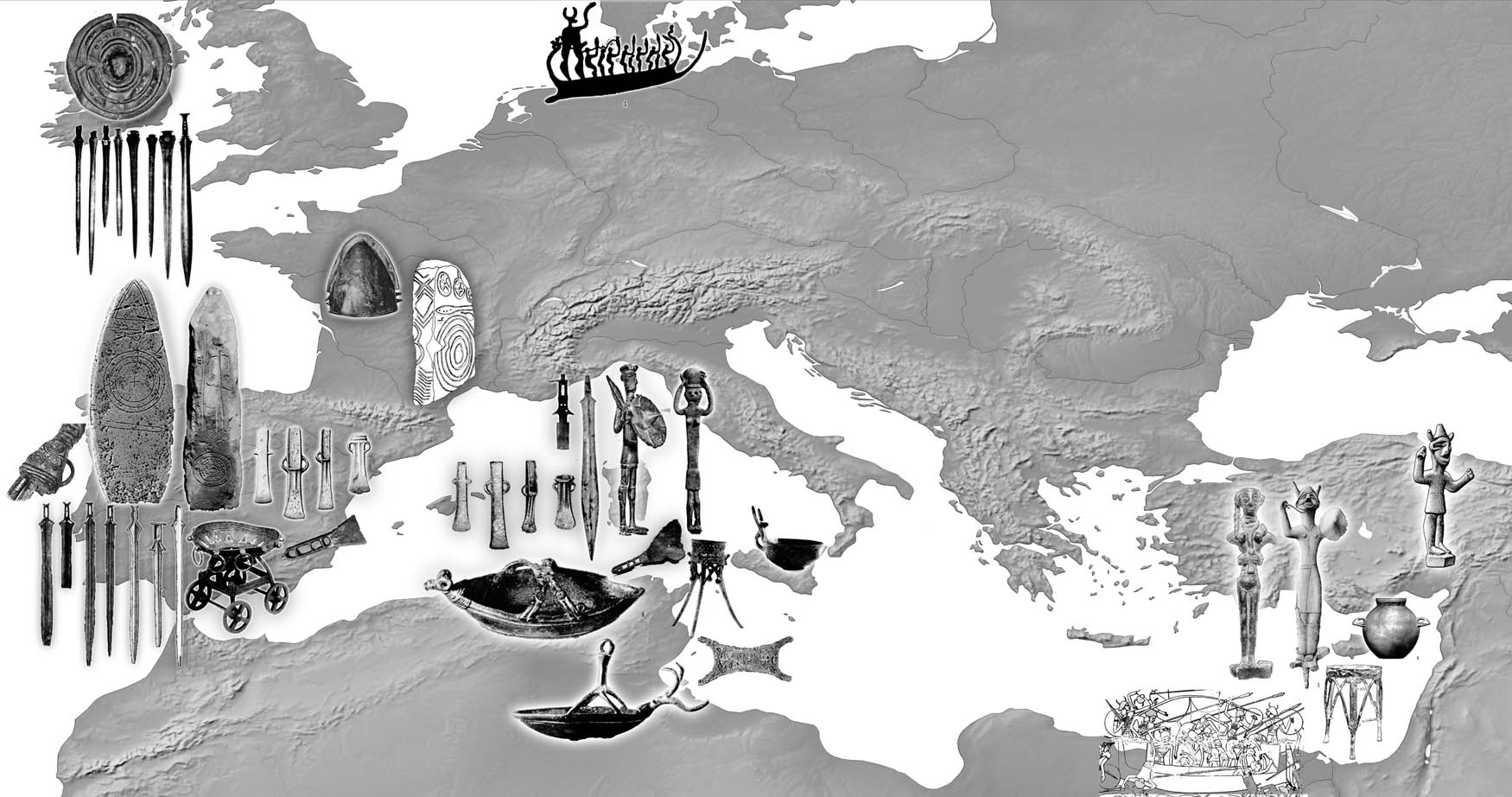
Mediterranean and Atlantic FBA material culture (after Armbruster, 2003; Bernardini, 2010; Brandherm, 2013; Coffyn, 1985; Eogan, 1983; Fundoni, 2020; Harrison, 2004; Hencken, 1971; Meyer & Knapp, 2021; Lilliu, 1966; Ling et al., 2014; Lo Schiavo, 2013a; Molloy, 2017; Seeden, 1980; Uckelmann, 2012; Vilaça, 2021; Vilaça & Bottaini, 2019; artefacts not to scale).
Seagoing vessels were a most important prerequisite for long-distance travelling and networking, and they must have been operated with profound geographical and navigational knowledge. Some shipwrecks have been found, and ships or boats were frequently represented in Sardinian, Balearic, eastern Mediterranean, and even in Scandinavian Bronze Age iconography (Ardu & Garau, 2018; Depalmas, 2005; Guerrero Ayuso, 2006; Knapp, 2018; Ling et al., 2014; Monroe, 2009; Safadi & Sturt, 2019). However, cooperation for logistics, a shared concept of hospitality and methods for communication were just as important to keep things going in the network as the vessels and the technological hardware were.
The archaeology of the FBA confronts us with a world that was fundamentally different from ours, and it should certainly not be mistaken for a predecessor of the globalised economic system (cf. Brück & Fontijn, 2013). In the looming of paradigms like competitive chiefs and prestige goods exchange, it has long been neglected that the Bronze Age as a cultural-chronological construct is entirely contingent on inter-group cooperation, which must have ensured technological transfer and all resulting cultural and social changes.
Atlantic and Mediterranean networks were maintained by decentralised communities, with small groups of agents moving between distant shores. There was no principal organisational force to arrange the flow of goods and people, no doctrine to regulate the exchange of ideas and knowledge, no central authority to call upon when dispute and conflict arose, or when raiding took the place of trading (Araque, in press; Ialongo et al., 2021). Thus, networking communities must have resolved recurrent conflict to a degree where it was no limitation for continued exchanges. Therefore, the present study aims to detect the mechanisms and signals that diminished social distance, for example symbols, fashions, and customs, within the archaeological record. Particular incentives for exchanges, for example the scarcity or abundance of material resources, will be brought into focus.
First, a theoretical framework will be developed in order to approach this complex situation. I will introduce rational choice theory to this study (Leeson, 2010, 2014), alongside concepts of anarchist theory (Angelbeck & Grier, 2012; Araque, 2020; Kropotkin, 1914). Due to the substantial material evidence for contacts, the resulting approach will be applied to FBA-EIA Sardinia and Iberia in a comparative study that sheds new light on the archaeological record and scientific data.
2 Approaches Towards the Understanding of Decentralised Networks
The archaeological evidence from the FBA in the central and western Mediterranean clearly shows that multi-scalar exchange networks and intercultural communications on regional as well as long-distance levels must have existed (Araque, 2018; Ialongo et al., 2021; Knapp et al., 2022; Kouremenos & Gordon, 2020; Lo Schiavo, 2013a,b; Molloy, 2016; Maran & Stockhammer, 2012). However, the underlying dynamics and organisation are difficult to reconstruct on the basis of artefacts alone. The first question that must be asked is as follows: who interacted and how was continuous interaction achieved? Interaction will be defined (after the Cambridge Dictionary[1]) as an occasion when two or more people or things communicate with or react to each other. Communications are, according to the same source, the various methods of sending information between people and places, including spoken words as well as graphic symbols. Other relevant concepts have recently been well defined: connectivity is “the material or ideational bridging of disparate communities via several interaction processes,” contact “refers more specifically to the direct, physical interaction,” and mobility is “a behaviour well suited to consider various forms of movement, from migration to diffusion, transhumance, trading and raiding” (Knapp et al., 2022, pp. 83–84). Further principal concepts for the understanding of interactions will be addressed below.
2.1 Technology Transfer
The conceptual definition that “(T)echnologies … combine technique and activities with implements and artefacts, within a social context of organization in which the technologies are developed, employed, and administered” (Maeir et al., 2019, p. 76) will be accepted here. Technologies reflect the knowledge and instruments that people use to cope with their environment and thereby shape their social lives. Furthermore, technology refers to any physical manifestation of materials produced by humans and is directly related to culture. It has a significant social impact on economic and subsistence strategies as well as on intercultural connections and transmissions (Dobres, 2000; Lechtman, 1977; Maeir et al., 2019; Robb, 1998). Hyman and Renn (2012, p. 89) urged that “a narrow approach that ignores knowledge in the archaeological study of metallurgy or ceramics may fail to recognize that apparently different products were created with the same technology, and thus the same knowledge.”
Consequently, Van Valkenburgh, Kelloway, Privat, Sillar, and Quilter (2017, p. 18) stated that to understand technological transfer in archaeology “focus should be trained not on objects, per se, but on what they have to tell us about the processes of their production, circulation and reception.” Kiriatzi and Knappett (2016) approached the archaeological record from technological perspectives to reveal the complexities of material practices in relation to human mobility. Stockhammer and Maran (2019, p. 2) emphasised the crucial aspect that “the transfer and translation of innovations requires different forms of intercultural contact than the transfer of objects: objects can be exchanged without any instructions for use […].” The same authors revealed that technology transfer “requires personal contact and exchange of ideas and knowledge,” and that this may involve the possibility to communicate in a common language (ibid.). The social component of technological transfer has been stressed, as it involves a range of different ways in which individuals and groups acquire skills, share them, or retain them over generations (Bevan & Bloxam, 2016; Dobres, 2000). Furthermore, it is an expression of interactions that had substantial influence on societies, as technologies are fundamental to the constitution of social order (Maeir et al., 2019).
This process encompasses networking between the actors, the translation of technological and non-technological knowledge, as well as the acceptance and appropriation of foreign practices and concepts. Friendly or unfriendly interactions of societies that are determined by assessing, challenging, and defending learned norms against others are generally not critical for technology transfer. Although the latter might have a significant cultural impact, this results from the reception of innovations within a society rather than from its direct confrontation with another. Moreover, people might have pragmatically integrated perceived advancements, based on functionality and quality, in their material culture from other groups (cf. Sackett, 1977). On the other hand, innovations could also be rejected on the basis of specific cultural preconceptions (Rogers, 1962). This paradox explains why central and western Mediterranean communities adopted innovations from state-like polities in the Aegean and Levant but had no interest in administrative or political centralisation, bureaucracy, and writing systems.
2.2 Community, Society, and Social Distance
It is important to explain what we mean by the terms culture, community, and society. This distinction matters, because we find shared material culture in geographically dispersed communities, where continuous interactions involving individuals from diverse social groups must have existed, but still cannot be defined as a uniform society. Culture beyond the materials will be considered as learned or acquired knowledge, plans for action, beliefs, rules, and understandings that are available to people in their social group and can be challenged as a result of individual decisions or experiences. Hence, individuals who form a social group can decide to scrutinise, adapt, or protect their shared culture (after Barclay, 1997, pp. 14–25). Various situations that occurred in the FBA would have brought people from different cultural backgrounds into contact, for example as hosts and guests, or joining the same travelling crew, as it had been the case with the Uluburun ship (Knapp, 2018, pp. 157–161).
One problem existing within the study of prehistoric archaeology is that “(N)ormally, we define and distinguish societies by individual’s citizenship of, residence in, and allegiance to particular nations and governments. None of these traditional demarcators of society make sense in the context of pirates [and most prehistoric communities], however” (Leeson, 2010, p. 26). Hakonen (2021) criticised the haphazard use of the term “society” by archaeologists who construct homogeneous prehistoric populations that seem to mirror modern nation states. Alternatively, he proposed to examine the divergence of social identities between prehistoric communities in geographical proximity, who were all unique and largely independent, with shared as well as exclusive practices (Hakonen, 2021, p. 225).
Within a community, people live and work together for their subsistence, often welded together through family bonds. Although it might be a matter of choice, the membership in a community can also be involuntary by birth; nevertheless, there is usually the option to exit and “vote with one’s feet” (Angelbeck & Grier, 2012; Leeson, 2014, pp. 25–27). Between Iberia and Sardinia, dispersed and socially diverse communities interacted with each other, which means that in addition to the physical distance between them, they also overcame their social distance.
“Social distance is the extent to which individuals share beliefs, customs, practices, appearances, and other characteristics that define their identity,” hence socially heterogeneous individuals share few or none of these categories, while socially homogenous individuals share many or all (Leeson, 2014, p. 18). Social distance is multidimensional and some dimensions, like rules and customs, might be more significant than others, for example appearance. Within each shared dimension, there are degrees of social homogeneity, which might sometimes only be marginal. While some of the dimensions can be predefined by natural conditions, most are not, i.e. worldviews, religion, language, customs, and fashion. They are subject to the choice of individuals and affect their attitude towards others in a social space. Thus, individuals can decide to reduce social distance between each other by altering these variables, for example by learning a language or adapting beliefs (Leeson, 2014, p. 19). Accordingly, the degree of social homogeneity in communities is quite high, while significant degrees of heterogeneity can exist between individuals within a society.
We may still refer to prehistoric societies as long as we are aware that they were not defined by the conceptions of a nation state, but instead by shared culture, practices, cosmologies, and environmental factors, as well as any sense of belonging together. Following this definition, there was arguably a Sardinian FBA-EIA society with widely shared cultural norms and ideals, and perhaps there were tribal societies in Iberia to whom this might apply.
A ship’s crew could be defined as a temporary community and there might also have been the notion of a transcultural Bronze Age “seafarer society” with shared practices and rituals (Artzy, 1997; Sherratt, 1998). This would not have been dissimilar to historically documented and often multicultural seventeenth century Caribbean or first century BC Cilician pirate societies (Hitchcock & Maeir, 2016; Leeson, 2010; Rauh, 1997). Nevertheless, such groups, who had diminished social distance across diverse cultural norms, did not interact in terms of consolidated societies.
In summary, an approach towards technological transfer should rather be concerned with interactions between individuals and networking between communities than concentrating on largely political interactions between societies. Technology transfer is contingent upon interpersonal communication between craftspeople and specialists (Kiriatzi & Knappett, 2016; Rogers, 1962), while intercultural communications between communities and societies might encompass friendly entanglements and organised goods exchange as well as violent encounters, such as warfare and colonialism.
2.3 Decentralised Communities: Governance vs Government
How did the abovementioned, unique, and autonomous communities organise and maintain their networking and exchanges? To understand the social dynamics of decentralised groups, it is important to consider the location of power within them as well as acknowledging the crucial difference between government and governance. Clastres’ (1989) concept of “societies against the state” explains the difference between monopolised coercive power, which is located in the hands of an individual or small group, and collective political power, which remains shared within the whole community. Societies who prefer the communalisation of power have manifold, sometimes violent mechanisms, to eschew centralisation and government (Angelbeck & Grier, 2012; Araque, 2020; Braudel, 1972, pp. 38–42; Paynter, 1989).
Government is, after Max Weber’s (1919) classic definition, a territorial monopoly on violence, social rule creation, and enforcement. This authority does not rely on the unanimous and voluntary agreement of the governed people and coercion must reinforce its approval (Leeson, 2014, pp. 5–9). According to Thomas Hobbes, government is the contrary of the “state of nature,” which is anarchy. He referred to the Greek meaning and simple definition of anarchy, which is “the absence of government” (Barclay, 1997; Leeson, 2014, pp. 3–7). Consequently, prehistoric archaeology deals with anarchic social settings, but of course not with political anarchist ones.
Prehistoric communities apparently cooperated in the western and central Mediterranean in the absence of anything like government, which led to complex cultural as well as technological achievements. These social groups must have organised themselves in a way that prevented havoc and overcame the paradox of power, which refers to “(T)he combination of the need for an authority and the fact that the very introduction of such an authority generates strong incentives for him [the chief] to abuse his power” (Leeson, 2010, p. 27).
Governance, on the contrary, exclusively refers to the existence of efficient social mechanisms and formal or informal institutions that provide and enforce social rules and create social order. Government is just one form of governance, but the latter can perfectly exist within anarchy and it is more often than not based on the common agreement of the participants. When people create governance in a community that is unanimously agreed upon by its members and offers deviants the option to exit, this can be defined as self-governance (Leeson, 2014, p. 6).
2.4 Cooperation and Reputation
The FBA Atlantic and Mediterranean constituted an environment encompassing geographically dispersed, scarce resources (tin and copper ores) that were essential for the daily life of socially heterogeneous communities along their shores. Subsequently, individuals seemingly managed to secure cooperation for the exchange of metals over vast areas along chronically unsafe travel routes (Araque, 2018; Gordon & Kouremenos, 2020; Ialongo et al., 2021; Ling et al., 2014; Sherratt, 1998). The networking must have been based on practices of mutual aid, for example reciprocal hospitality, sharing of information, and assistance of local guides in difficult territory (Araque, 2020, 2021; Kropotkin, 1914).
The interacting individuals and communities probably had strong incentives to cooperate because they were interested in material, technological, and intellectual innovations. The basic hypothesis of rational choice theory is that people respond to incentives and that their behaviour is often motivated by rational cost–benefit calculations (Leeson, 2010, 2014, 2017). This concept also works well when it is separated from notions of profit maximisation and is useful in understanding the sometimes-astonishing rationality of exchange systems where people cooperated for a common benefit without centralised organisational authorities. Nevertheless, there are limitations to this paradigm because not all behaviour is rational and practices of mutual aid typically include non-self-interested and altruistic behaviour (cf. Bourdieu, 2005; Foley, 2003).
The prehistory of the research area was characterised by face-to-face communities with close-knit internal networks, where people knew each other in multiple capacities, as neighbours, relatives, workmates, friends, and where gossip and public opinion are the prevalent mechanisms of social control (Bintliff, 1999; Bott, 1971; Brandes, 1987). Anarchist Kropotkin (1914, p. 102) made reference to “societies knowing no kind of authority besides the authority of public opinion” where people would be “freely submitting to rules which continually clash with … personal desires […].” One hundred years later, economist Leeson (2014, pp. 2–11) put emphasis on the “discipline of continuous dealings,” where individuals induce cooperation by penalising uncooperative behaviour with negative reputations and as a consequence deny interaction in the future.
Reputations are instructive to society as to with whom can be cooperated and who is not to be trusted (Brandes, 1987; Gilmore, 1987; Leeson, 2014). It is hard to underestimate how important such mechanisms would have been for prehistoric communities and for their interactions in a wider network. For anthropologists, it is a “cross-cultural truism” (Brandes, 1987, p. 131) that all face-to-face communities, where public opinion determines reputation as a key organising principle, know some form of honour and shame. As reciprocal moral values, they represent the integration of an individual into the group (Gilmore, 1987, p. 3): honour reflects a good reputation and respected community standing, while shame reflects a bad reputation and deeds worthy of sanctioning. These concepts are based on a “radical sense of equality” (Brandes, 1987, p. 127) and are therefore applied to all community members as well as to outsiders with whom the group interacts. Reputations are a highly efficient mechanism of social control and maintain social order within small to large-scale social and political networks (Gilmore, 1987; Leeson, 2014, p. 9). Reputations are volatile, since they are subject to permanent challenging and re-negotiation within the community, and they affect individual as well as intercommunal relations, thereby enforcing or obstructing cooperation.
Reputations are based on attributes and expectations that are ascribed to a person, object, or symbol. Thus, artefacts and raw materials can, like people, obtain reputations – good and bad. The reputations of objects are essential for technological transfer: good reputations of technologies create incentives to integrate them into local material culture; artefact types can have a reputation for high workmanship when they stem from a master craftsperson, a particular workshop, or from a specific region; raw materials with good reputations for their quality are sought after in exchange networks.
2.5 Communication and Signals
Communication is necessary to reveal rules and reputations, and to establish cooperative relations, or to warn against looming conflict, and does not necessarily have to rely on language, but also on symbolic codes that are understood within a social network (Hodder, 1982, 1989; Robb, 1998). The information that was transported along prehistoric networks must have incorporated instructive, technological, and metaphysical (philosophical, theoretical, religious) contents (Sackett, 1977). Consequently, an important factor to initiate technology transfer is signalling, or ex ante sorting of potential cooperators (Leeson, 2014).
A signal does not require social homogeneity; the signal has to be publicly observable and sufficiently specific, and it must have a symbolic value to enable interaction, which makes it costlier for a cheater than for a co-operator to use. Since the precondition for interaction is to overcome social distance, interactors from socially heterogeneous backgrounds must adopt cultural attributes that they share to establish social closeness. This can be for example language, customs, rituals, or dress. Social-distance-reducing signals are “costly” in the way that they require repeated, cooperative interactions over time (Leeson, 2014, pp. 22–23).
Adopting degrees of homogeneity with an outsider is thus a signal that is especially suited to intergroup interaction: when an individual or group successfully establishes trusted relations through social-distance-reducing signals, this ideally enables interaction with other members of the approached group as well (Leeson, 2014, pp. 23–24). Essentially, the active decision to reduce social distance is the precondition for any exchange between different groups.
When people decide to interact continuously, they need to establish a degree of social homogeneity, for example by acknowledging common measures, developing similar styles of decoration, adornment, and beliefs, learn common languages or participate in shared religious practices (cf. Dobres, 2000; Hodder, 1989). Emblematic symbols can signal shared beliefs and trustworthiness, and thus can conjure positive or negative reputations. Conversely, they can also induce fear, signal antagonism, or convey threats. This form of communication still prevails today in settings where language is ineffective, for example through the use of naval ensigns. The open display of identifiable artefacts or symbols can be a signal to interact or to deter outsiders. Graphic symbols, for example figurines or rock art, are always visual signals and they were widespread in the research areas during the FBA (cf. Robb, 1998). Finally, whenever individuals travelled to faraway lands with peaceful intentions and met other groups, they must have relied on signalling to initiate interactions and request comfort from potential hosts.
2.6 Hospitality
Hospitality is the most important precondition for technological transfer as well as the basis for intergroup cooperation. Nonetheless, it has been relentlessly eschewed as a concept in archaeological debates. Much has been written on its opposites – conflict and violence – while the evident prevalence of peaceful interactions has not attracted half as much concern (cf. Fry, 2013). The practice of hospitality is one of the most distinguishable ways to initiate cooperative relations: the rendering of comfort (food, shelter, and safety) to a stranger in one’s own territory (Herzfeld, 1987, p. 77). Hospitality can be considered as a form of interaction between two people or groups (host and hosted) that intersects gift-giving and social duty (cf. Mauss, 1966), hegemony and subalternity, membership and inclusion, ownership, and reception (Messana, 2021, p. 111). It is important to recognise that hospitality is generally not by itself to be viewed as a matter of philanthropy, but of right (Grotti & Brightman, 2021, p. 10, following Immanuel Kant and Jacques Derrida).
Although hospitality includes the subordination of the guest to the host, it offers the best opportunities for an imminent integration of strangers, and hence of their knowledge, into a community. Initially, the guests depend on the hosts in their territory, but reciprocal claims can create peaceful interdependences when all of the involved parties accept the necessity of cooperation for a common benefit (Fry & Souillac, 2016).
There are, simply speaking, two ways in which people can primarily react to strangers: the first would be to refuse their recognition and to chase or kill them, in the absence of any knowledge of the stranger, as they might represent a threat to established norms. The other possibility is to offer them hospitality, which remains the only way to guarantee the free circulation of individuals. Hospitality therefore represents a system of undifferentiated reciprocity in most cultures (Pitt-Rivers, 1977, pp. 501–517; Grotti & Brightman, 2021). For completeness, a third way to approach strangers might be their violent capture and involuntary integration into the community, usually by creating, at least initially, an asymmetric relationship. However, this method does not fully contribute to technology transfer and it requires elaborate structures for repression, unless the subjects are small children. It is not based on communicative interaction, but on force. It undoubtedly does not enable networking practices.
Hospitality has been an unswerving Mediterranean theme: J. Pitt-Rivers wrote his ground-breaking analysis with the background of his fieldwork in western Iberia, Arabian accounts, and Homeric texts (Pitt-Rivers, 1977). Indeed, Homer’s writings are full of detailed references to the practice and conventions of hospitality, which can be considered the central theme of the Odyssey (Reece, 1993). Herzfeld (1987) contributed with fundamental research from Greece. Sardinian communities are still known for their celebrated, albeit strictly ritualised hospitality, including the treatment of strangers with “religious respect” as it has already been prescribed by the “Codice della vendetta barbaricina” (Messana, 2021, p. 104 after Pigliaru, 2010[1975]).
Moreover, the presence and importance of hospitality appears to be an anthropological constant, from the tribe to the community to the household. The Amazonian Achuar people most frequently chose to kill strangers, due to centuries of bad experiences with the Inca and European empires, but nevertheless they know hospitality (Descola, 1988). The latter is fundamental for West African Wolof communities (Messana, 2021) and F. Boas found it to be prevailing amongst Arctic Inuit communities (Pitt-Rivers, 1977). Kropotkin (1914) described practices of hospitality in diverse societies through the ages as manifestations of mutual aid. Tonkinson explained that in the Australian desert, “everyone is mindful also of how much their survival rests on mutual hospitality and unfettered access to their neighbors’ natural resources in both lean and bountiful times” (Tonkinson, 2004, p. 101; see also Fry & Souillac, 2016). This list could be continued indefinitely and gives the impression that there is hardly a human society where hospitality has not been a conventional cultural norm.
Reciprocity is a basic component of the original concept of hospitality: it could be expected to be returned to the hosts when they would visit their former guest’s territory, although this might often be improbable when the guest travelled from afar. This reciprocity may also inverse political superiority by placing a guest at the mercy of the host, who in turn has to respect the laws of hospitality (Grotti & Brightman, 2021; Herzfeld, 1987). Continuous reciprocal hospitality can significantly diminish social distance and facilitate the integration of guests. Now, as in prehistory, the practice of hospitality can differ from one community to the next, and each can have a reputation for welcoming openness, or for the contrary (Herzfeld, 1987). As a consequence, some groups would participate in networks, while others would isolate themselves, which is accordingly reflected in the material records of particular places.
In Sardinia, the frequent exchanges based on hospitality between villages as a consequence of the need for shepherds and farmers to move regularly, with seasonal returns, have led to the establishment of friendships and familiarities beyond the guest–host relationship. Here it is clear again that hospitality guaranteed the exchange relationships between communities and mutual aid, including a specific gift-exchange system (Messana, 2021). Furthermore, this model is consistent with other populations that recognised that their survival rested on reciprocal hospitality and the sharing of resources in frugal lands (Fry & Souillac, 2016; Kropotkin, 1914).
Beyond the definition of providing comfort for strangers, another connecting element of hospitality is the creation of an ambivalent status between that of a stranger and a member of the community. Different attitudes may distinguish between strangers from the same “wider” society or from the outside, for example in Arctic communities or in modern Greece (Herzfeld, 1987; Pitt-Rivers, 1977). Guests from distant lands were sometimes higher appreciated and treated with more effort, although this would at the same time imply an even more asymmetric relation between host and guests, with less initial prospect for integration.
Finally, the integration of strangers, equivalent to the entry of an outsider into any group, is usually an occasion for “rites of incorporation” after a period of ordeal: the status of stranger and the intermediate role as a guest are lost and that of community member is gained, when the aspirant agrees to subscribe to the rules of their social culture (Pitt-Rivers, 1977, p. 503). This ritual significantly diminishes social distance and might bond two distant communities together through the irreversible passage of one or several members.
2.7 Conflict and Prestige
“The law of hospitality is founded upon ambivalence. It imposes order through an appeal to the sacred, makes the unknown knowable, and replaces conflict by reciprocal honour. It does not eliminate conflict altogether” (Pitt-Rivers, 1977, p. 513). Knowing that the stranger is not to be trusted is a recurring aspect of hospitality, and situations may turn sour as soon as the guest is leaving the host’s premises. In addition to this danger, there may still be individuals who are not interested in hospitable relationships, react with hostility to strangers, or prefer to take their benefits from raiding instead from cooperating.
The predominant archaeological narratives after Keeley’s influential “War before Civilization” (1996) still paint a Hobbesian picture of a Bronze Age where people would have lived nasty, brutish, and short lives in bizarre warrior societies, led by mercilessly competing chiefs. However, following Kropotkin’s (1914) thesis that cooperation is a factor in evolution, it can be stated that “Hobbes was wrong …. Individuals have [always] secured property protection and social cooperation without government […]” (Leeson, 2014, p. 1).
Particular subsistence strategies, for example transhumance, or geographical restraints like water shortage, oblige people to collaborate for survival (Carballo, 2013; Fry & Souillac, 2016; Messana, 2021). Tonkinson’s comment on the inhabitants of the Great Western Desert could easily be transferred to any arid Mediterranean setting, where “to permit inter-group conflict or feuding to harden social and territorial boundaries would be literally suicidal, since no group can expect the existing water and food resources of its territory to tide it over until the next rains; peaceful inter-group relations are imperative for long-term survival” (2004, p. 92). In recent Mediterranean societies, hospitality, honesty, and other desirable qualities have been interpreted as “a compensatory response to competitive pressures, as mechanisms through which aggressive tendencies might be ameliorated” (Brandes, 1987, p. 132).
The Sardinian “Codice della vendetta barbaricina” (Pigliaru, 2010[1975]) is a good example for self-governance within a pastoral population in a harsh environment that had no trust in what were often dysfunctional external governments (cf. Braudel, 1972, pp. 38–39). It delivers rules to enforce cooperation without central authorities and dispels the prejudice that inconsiderately equates vendetta with blood feuding. Nonetheless, it prescribes physical violence, usually inflicted by the insulted parties themselves, for the sanctioning uncooperative (ergo dishonourable) behaviour.
Strategies for conflict management were crucial to establish reciprocal bonds with the incentive to cooperate for a common gain and to assure the maintenance of the fragile exchange system. Bronze Age metallurgy was contingent on geographically dispersed raw materials, where a guaranteed supply required cooperation over sometimes significant distances. Conflict resolution includes arrangements for safe conduct and cross-cultural mechanisms to pacify feuds that might originate in individual misbehaviour or intergroup tensions. Evidence of intergroup violence show that these objectives could not always be met (Araque, in press; Peche-Quilichini et al., in press).
Warriors could gain prestige in tribal societies when they had a reputation to be brave and reliable (i.e. cooperating) in battle. Conversely, they would not have gained it if community members were afraid of their violent conduct. Threatening the neighbours would have been dishonourable, punishable behaviour in face-to-face communities. A trustworthy warrior could be chosen as a leader in violent adventures, with coercive power during the campaigns, but without power in peace and no influence in the daily affairs of the community (Angelbeck & Grier, 2012; Clastres, 1989; Otto, Thrane, & Vandkilde, 2006; Kim & Kissel, 2018).
Prestige is synonymous with a reputation based on honourable behaviour, which means that an individual complies with tradition and cherished norms, or performed reputable actions for the community and is therefore deemed trustworthy (Gilmore, 1987). Prestige does not equal power by any definition. Guests who behave respectfully (i.e. honourably), or bring benefits to the community, will enjoy prestige and will be welcomed when they return. On the contrary, offenders or deviants who have disrespected the community’s norms will not regain their reputation by showing off with material goods. Prestige could not be obtained without honourable actions or with simple valuables. The assumption that representative possessions signal a powerful status and consequently cause submission is based on modern capitalistic individualism in a society that is built on largely anonymous associations of people. There is a notable fetish character to the commodity as a prestige object that symbolises social status and class, and hence becomes a factor in the structuring of social thinking (cf. Marx, 1996[1867]).
With reference to predominant theories, Stockhammer and Maran criticise the fact that archaeologists have attributed technology transfer mainly to “male individuals of high status” who are the supposed “guiding factors of historical developments” (2019, p. 2). The capitalist concept of “elite exchange networks” has been dispelled by Science and Technology Studies, which have demonstrated that males of high status have the least interest in innovation and often consider it as a threat. On the contrary, individuals with low or flexible status due to migration, mobility, or gender have much greater incentives to change and innovate (Stockhammer & Maran, 2019, following De Laet & Mol, 2000).
In the archaic states of the East Mediterranean, oligarchic rulers gained prestige in their group of peers by sending their colleagues most valuable presents in the form of exotic goods and artefacts. However, this has often resulted in the awkward use of the term “prestige goods” in the study of prehistory: in face-to-face communities, valuable possessions alone do not convey prestige to a person. Social roles with justified authority based on competence are transferred by consensus and can be indicated by dress, ornaments, or equipment. Equally, individuals who gain prestige and possess extraordinary objects, which they possibly share with others, might be highly esteemed. Such objects can be self-made, where the attached know-how will enhance the prestige, or brought back from journeys, with the same effect, or received as gifts, or gained through barter, which might sometimes trigger envy. Whatever its source, prestige is clearly an aspect where interpersonal competition comes into play.
2.8 Competition and Innovation
Reputations naturally have strong influences on competition as well as cooperation. At the same time, cooperation and competition are not mutually exclusive social categories and they can typically both occur as complementary in face-to-face communities (Gilmore, 1987, p. 101). The major incentives for competitive behaviour amongst community members are gains in prestige, partners, and privileged access to provisions or material goods. The eagerness to gain the most honourable reputation (i.e. prestige) and privileged access to particular provisions, as long as they are redistributed, will not affect social life in a negative way, while the competition for partners frequently leads to violent conflicts (Brandes, 1987; Gilmore, 1987; Kropotkin, 1914; Pitt-Rivers, 1977). Cooperation is always the basis for the survival of communities or societies, while competition can develop dangerous, destructive sides i.e. blood feuding, the murder of rivals, the exclusive control of resources by one group, warfare, arms races, etc.
However, competition can facilitate innovation for positive purposes (Leeson, 2014; Rogers, 1962). The prestigious achievements of manufacturing extraordinary commodities, or to help a community to improve its standing against nature or enemies, are incentives for the invention and refining of implements as well as technologies. Consequently, craft specialists who compete for such reasons almost automatically start experimenting and improving their products. Normally, competitive behaviour of craft specialists is not done with the destruction of their competitors in mind. This might still be intended in times of conflict, but for the most purposes, competition or friendly strife means continued input and promising challenges.
Eventually, technology transfer can take place in the nexus of cooperative and competitive settings, especially if there are no marked status differences, and when there is no central organisation of subsistence and production. First and foremost, this enables the exchange of knowledge between cooperating individuals and can prompt innovations that result from the interaction between craftspeople or other specialists (cf. Rogers, 1962; Wenger, 1999). Thus, the anarchic setting of the FBA-EIA Mediterranean allowed for intensified, unrestrained, and un-channelled flows of knowledge within the established decentralised networks.
2.9 Understanding Interactions
At the end of the Bronze Age, socially heterogeneous communities and individuals interacted directly and indirectly over great spatial distances by overcoming the social distance between them. They thus established exchange networks in which technological knowledge and ideas were transported alongside material goods and artefacts. The actors, individuals, communities as well as voluntary associations like ship crews used visual as well as cultural methods of communication to reduce social distance between them. These networks paved the way for technology transfer, which was based on close, continued interactions. This could only be maintained by the means of efficient self-governance with methods for conflict resolution and cross-cultural cooperation, including hospitality. Within this nexus of cooperation and competition between specialists, innovations resulted from multidirectional technology transfer. Prestige might have been a driving force for travellers and craftspeople to constantly work on techniques in order to cope with the challenges of the environment as well as the often-diverse cultures they knew.
Throughout the Bronze Age, many communities as well as archaic states had to cope with limited access to raw materials, particularly metals, with which to maintain their lifestyles. The numerous interconnected networks of the FBA-EIA, stretching between the Atlantic façade into central Europe and the Mediterranean, left a bewildering archaeological record that testifies these continuous interactions. Therefore, the aim is to understand the motivations and social dynamics that enabled technology transfer, cooperation, organisation, and communications that resulted in innovations and continuous contacts across cultural limitations in a setting without central institutions or governments.
Anthropological research on cooperation, social interaction, and conflict resolution in face-to-face communities can provide important insights (Araque, in press; Fry, 2006, 2013). However, the social mechanisms for interaction and organisation, for example hospitality, reputation, and prestige, are only indirectly detectable within the material record. Sometimes, the writings of Homer provide a relevant EIA source for customs such as hospitality (Reece, 1993).
People moving within self-organised networks could adapt to diverse identities and local customs. In one African example, it was observed that “far from being a single ‘tribal’ identity, most Africans moved in and out of multiple identities, defining themselves at one moment as subject to this chief, at another moment as a member of a cult, … as part of this clan, … as an initiate in that professional guild. These overlapping networks of association and exchange extended over wide areas” (Ranger, 1985, p. 248). Social-distance-reducing signalling, such as respecting local authorities, customs, and religious practices, is a recognised anthropological constant that permits the foundation of networking. Within a cycle of repeated interactions over time, social closeness could be established through the adaption of language and customs; standardised weights and measures or media of exchange would be further indicators (Leeson, 2014, p. 30; cf. Rahmstorf et al., 2021).
The indirect transmission of knowledge through intertwined networks might be assumed when similar types of objects or decorations, and symbols were locally produced and used in distant areas. Nevertheless, it would be possible for individuals to move at least haphazardly through the connected areas with the same knowledge, signals, and social-distance-reducing mechanisms. Similar techniques for the use, maintenance, and manufacture of implements or the use of the same raw materials might spark interest in innovations and reduce social distance between specialists from different backgrounds concerning cultural practices or social organisation, as it is, for example shown by a widespread use of standardised weight units (Ialongo et al., 2021; Kiriatzi & Knappett, 2016; Rogers, 1962).
3 From the Mediterranean to the Atlantic and Back
Archaeologist Taramelli was the first to recognise the parallels of artefacts from the Sardinian Monte Sa Idda hoard with contemporary Iberian bronzes and to subsequently postulate the existence of prehistoric contacts (Fundoni, 2020; Taramelli, 1921). Although he mainly referred to various types of tools and weapons shared between the two regions, some decorative techniques in both regions during this period have been the focus of renewed interest and numerous publications, primarily by Lo Schiavo (1991, 2005, 2013a). After the number of finds of related bronzes had increased dramatically and Sardinian pottery was discovered in Iberia, the nature and scale of these connections have been approached in recent analyses and accordingly, continuous direct interactions are now generally considered to be plausible (Araque, 2018; Aubet & Sureda, 2013, Bernardini, 2010; Celestino et al., 2008; Gómez & Fundoni, 2011; Rodriguez-Corral, 2017; Usai & Lo Schiavo, 2009).
The archaeological record indicates continued exchanges between Sardinia and Atlantic western Iberian, while the evidence in the Peninsula’s Mediterranean East is less obvious. This either suggests that the interest in the technologies and materials appears to have been smaller in other regions along these possible routes, or that interpersonal contacts were more superficial. Hence, it is possible that interaction was less intense in places that were merely considered as stopovers, where materials only occasionally found their ways into local networks. Upon arrival at the intended anchorages, when further inland sites had to be reached and scheduled activities (barter, procurement of ores, and ship repairs) took place over a prolonged period of time, it would have been difficult to return during the unnavigable months of the winter. Subsequently, interactions in the course of these extended stays might have included collaboration between craftspeople and other specialists.
3.1 Communities in Iberia and Sardinia
Western Iberia, encompassing parts of the Meseta, the Portuguese Beiras, the Alentejo, and Spanish Extremadura, the Tagus, Guadiana as well as Guadalquivir valleys, was socially speaking an extremely heterogeneous area during the FBA. Nevertheless, local networks with shared material culture seem to have existed (Araque, 2018, pp. 168–173; Díaz-Guardamino, 2010, pp. 373–388; Lull, Micó, Rihuete Herrada, & Risch, 2014). Transhumance, which was probably one of the oldest ways of life for pastoral Mediterranean populations (Braudel, 1972, pp. 87–95), might have been common, although it is extremely difficult to detect with archaeological methods. Within this culturally scattered and naturally rough landscape, one of the most advanced metallurgies of the European FBA flourished, fired by the abundance of accessible raw materials, above all tin and copper.
Throughout this period, the Guadiana valley and Extremadura were populated by communities living in dispersed small villages or hamlets, sometimes at height (Jiménez Ávila, 2012; Pavón Soldevilla, 1998). The Portuguese lower Tagus valley shows a similar pattern of small settlements at height, while the upper Tagus valley did not produce much evidence for FBA occupation as of yet (Vilaça & Cardoso, 2017). In the Alentejo, mostly small with a few slightly larger settlements have been discovered (Calado, Mataloto, & Rocha, 2007; Soares et al., 2021). In the Beira Interior, most settlements were dispersed and simple hamlets, preferably at height, and often with just a few houses (Vilaça, 1995). At the same time, the archaeological record indicates high mobility of inhabitants in all the abovementioned regions and “meeting points” that were not controlled by a single community, but instead provided space for group interaction (Baptista, 2019; Ruiz-Gálvez Priego, 1995; Vilaça, 2013c). Furthermore, the Iberian stelae were recurrently decorated with motifs that relate to connectivity, such as shields with equivalents in Ireland, helmets typical for central Europe, Mediterranean ornaments, and horned human figures (Celestino, 2001; Díaz-Guardamino, 2010; Mederos Martín, 2019; Vilaça, 2011a).
Mobility, connectivity, and short and long-distance contacts and exchanges were amongst the hallmarks of western Iberian FBA groups. The reasons for this are almost certainly related to Iberia’s situation at the intersection of the Atlantic and the Mediterranean spheres, and on the rich metal ores that were sought after throughout the corresponding networks. It has been postulated that communities in central Portugal and south-western Spain had continuous exchange relationships with Sardinia from the FBA onwards (Lo Schiavo, 2013a,b; Vilaça, 2013b, 2020), as well as the possible import of Iberian tin to Sardinia (Berger, Matta, Nørgaard, Salis, & Vandkilde, 2023). According to recent lead isotope analyses, metal exchanges involving Iberia and Sardinia might have, through intertwined networks, ranged as far as Scandinavia, Cyprus, and North Africa (Ling et al., 2014, 2019; Matta & Vandkilde, 2023; Perra & Lo Schiavo, 2023, pp. 207–304).
The archaeological record of this island paints a different picture: Sardinian settlements show a high degree of homogeneity, stability, and shared material culture from the Middle Bronze Age (MBA) into the EIA (c. 1800–730 BC). Typical villages were composed of seemingly chaotic arrangements of round drystone huts, all of relatively equal size; some villages were located around a nuraghe (Sant’Imbenia) or next to a sanctuary (Serra Orrios) but there were no recurring patterns. Strategic considerations were apparently insignificant for the choice of sites, while proximity to fertile land was preferential (Perra, 2013; Usai, 2006). The overall stability and disinterest in defensive measures suggest that raiding was uncommon, and intergroup violence was infrequent or inconsequent (Araque, 2021, in press). Despite the high settlement stability and apparent security over several centuries, no villages grew into central hubs, nor were the largest settlements inhabited by more than 150–200 people (Usai, 2006, pp. 557–559). This might be due to a widespread culture of fission (Braudel, 1972, p. 41), when a considerable demographic increase in the RBA led to the foundation of new villages instead of the expansion of existing sites (Perra, 2013; Usai, 2006).
The island was further characterised by monumental architecture with massive stone towers called nuraghi, sometimes expanded into huge complexes, that shaped the landscape from the MBA (c. 1800–1350 BC) onwards (Lilliu, 2005; Vanzetti et al., 2013). This architectural tradition had been abandoned in the FBA when complex water sanctuaries emerged, shortly after the established maritime interactions had intensified (Perra, 2013). Sanctuary complexes were composed of wells and fountains, water ductworks, multifarious structures as well as social spaces for feasting that were often capable of hosting hundreds of people. The sanctuaries indicate a new polycentric structuring of the landscape and their specific locations suggest that they served as nodes of interaction for the larger territorial federations of independent villages (Araque, 2018, 2021; Ialongo, 2018; Usai, 2011).
Most of the information on connectivity and the influence of intercultural communication and cultural innovation can be gleaned from the remains found at these sanctuaries: bronze figurines, votive swords, ornaments, tools, and weapons with Atlantic, Aegean, and Italic references. Sardinia’s geostrategic situation in the central Mediterranean and its rich copper ores seem to have facilitated the development of local metallurgy. Craftspeople with abundant supplies seemingly were in contact with their contemporaries from the West and from the East. This convergence of knowledge from diverse cultural backgrounds led to one of the most thriving and innovative metallurgies of the FBA. Usai stated that the monumental constructions of both the nuraghi and sanctuaries (where the metalwork was exhibited and sometimes produced) expose inter-community cooperation as well as competition (2011, pp. 11–12), where the combination of both is a precondition for innovation.
The settlements in both FBA Sardinia and Iberia did not exceed the size of a typical face-to-face community, which has been defined as around 200 inhabitants by Bintliff (1999); in actuality, most were significantly smaller. It can be hypothesised that within face-to-face communities, social control mechanisms based upon public opinion and reputations prevailed. This implies that most likely their self-governance encompassed informal, justified authorities, religious rituals, and internal conflict resolution. However, heterogeneous or decentralised these communities were, they managed to organise efficient networks for the exchange of goods, knowledge, and technologies.
4 Travelling with Materials and Sharing Technologies
Western Iberia and Sardinia were both favoured for their natural resources, including copper and lead ores and – in Portugal and Northwest Spain – an abundance of tin and gold (Figure 2a; Bartelheim, 2007; Lo Schiavo, Giumlia-Mair, Sanna, & Valera, 2005). It is often argued that these ores were the motor of the Bronze Age long distance exchange networks. In this context, it is important to consider the recent analyses which suggest that Iberian (Portuguese) tin might have been used for Sardinian bronze figurines, while the island’s own limited tin resources were most probably not known or exploited in the FBA (Berger et al., 2023). This would reveal a strong incentive on the Sardinian side to maintain continued interactions involving prolonged stopovers at the destination. Consequently, the use of the same raw materials and their elaboration must have been a further incentive for technological transfer. It is noteworthy that iron technology was introduced in both Sardinia and western Iberia around 1000 BC, perhaps locally even earlier (Figure 2d; Álvarez Sanchís, Lorrio Alvarado, & Ruiz Zapatero, 2016; Araque Gonzalez et al., 2023; Lo Schiavo & Milletti, 2020; Renzi, Rovira, Carme Rovira-Hortalà, & Montero Ruiz, 2013; Vilaça, 2013a).

(a) Map of metal ores in Iberia (after Bartelheim, 2007, p. 34, Figure II.7), (b) locations of tin deposits in Europe (grey areas) with the average of tin in regional bronze compositions. A decrease in tin and increase in lead is notable when moving from Iberia towards Atlantic and Eastern Mediterranean regions (Figuereido et al., 2010, p. 1625, Figure 1), (c) map of stelae in south-western Iberia (courtesy of P. Paniego Díaz), and (d) map of FBA iron finds in Iberia (Vilaça, 2013a, Figure 2).
Further similarities in both archaeological records are a noticeable scarcity of detectable tombs and the near nonexistence of richly furnished graves throughout the FBA until the advanced EIA. Sardinian collective, megalithic tombs from the MBA–RBA were still used infrequently in the FBA (Perra, 2013), and the occasional finds of humble urns or burials in western Iberia are at least as scattered as the contemporary settlements (Araque, 2018, p. 176; Vilaça, 2020). This indicates that social status was predominantly not reflected in the funeral rites of both regions until the EIA, when large-scale commercial trade had changed the social structures of many Mediterranean communities. Throughout the FBA, there were pronounced similarities in the material culture of Sardinia and Iberia.
4.1 Functional Implements: Tools and Weapons
Axes, palstaves, fire tongs, chisels, and daggers were manufactured in almost identical shapes in Iberia and Sardinia (Figure 3). Binary alloy bronzes with an average of ca. 10–12% tin content prevailed for such implements in both regions (Figure 2b; Bottaini, 2013; Lo Schiavo & Giumlia-Mair, 2018). F. Lo Schiavo was the first to emphasise the integration of Iberian types of weapons as well as tools for wood and stone working in Sardinia, where older local shapes were discontinued (Lo Schiavo, 1991, 2005). Together with the implements, knowledge relating to usage techniques, their reproduction, and optimisation, would almost certainly have been exchanged between interacting individuals.

Bronze palstaves and tools from the Monte Sa Idda Hoard and tongs from Sardara in Sardinia compared to objects from the Freixianda hoard in Portugal (after Fundoni, 2020, p. 66, Figures 2 and 3; Lo Schiavo & Giumlia-Mair, 2018, p. 417, Figure 1.3; Taramelli 1921; Vilaça, Bottaini, & Montero Ruíz, 2012; upper row not to scale).
The use of fire tongs came with shared practices in metallurgical activities and their manufacture required profound technological understanding. A chisel is part of a whole package of stone-working techniques that includes tools for indirect strokes (hammers, mallets), an awareness of the workability and properties of different rock types, as well as interest in stone working for architectural or artisanal purposes (Araque Gonzalez et al., 2023). The same knowledge could be transferred to firmer chisels for woodworking and to specialised axes that could be designed for cleaving, logging, or carpentry (Dolfini, Scholes, Collins, Hardy, & Joyce, 2023). Through the ages, the incentive for personal exchange with individuals who work with a shared repertoire of tools and hence forming a community of practice was often exceptionally strong (Wenger, 1999; cf. Dobres, 2000). Journeymen still take to the road with exactly the same objective in mind, like their medieval guild fellows, and, most likely, their less formally organised prehistoric ancestors did.
The typological evolution of swords followed the same trajectory from Ireland to Sardinia until Sa Idda phase (Figure 4; Brandherm, 2007; Eogan, 1983; Lo Schiavo, 1991; Molloy, 2017). The islanders apparently preferred to rely on the Iberian-Atlantic style for their weapons instead of Italic, central European, or Aegean types, considering the closer proximity to the Apennine Peninsula, and despite their existing Aegean contacts. At the same time, Mycenaean sword types were represented on statue-menhirs in neighbouring Corsica and thus must have been well known (Leandri, Peche-Quilichini, & Cesari, 2015). This could be one case where the good reputation of these swords resulted in their adoption in the central Mediterranean. Since the effectiveness of these implements was so widely recognised, craftspeople must have had a common, cross-cultural interest in their further development.

Moreover, the use of swords in combat required corresponding techniques, and while the leaf-shaped swords were designed for hacking and slashing, the slightly later carp’s tongue and Huelva-types were more versatile and suitable for stabbing, and the Sa Idda/Ronda swords had notches above the handle, possibly to swing and flip the blade faster (pers. comm., Rafael Herrmann, 2015). Spearheads were also exceptionally similar in both regions, and thus it seems that fighting techniques were passed down along the Atlantic-Mediterranean networks.
4.2 Ceremonial Implements: Handles, Feasting Gear, and Decoration
The characteristic “fishbone” or “a trecchia” decoration in the FBA is so far only known from three regions: Cyprus, Iberia, and Sardinia. It appears on handles with unidentified function, which have mainly been found in central Portugal (Figure 5a and b), from where they might originate. There is one odd example in the Sa Idda hoard, which might have been an import to Sardinia (Figure 5c; Taramelli, 1921; Vilaça, 2008, 2013b, 2020).

Fishbone- and a trecchia-decorations: a. Portugal: São Martinho – b. Portugal. Pé do Castelo – c. Sardinia: Monte Sa Idda (after Vilaça, 2008, p. 392, Fig. 6 and 2013b, p. 24, Fig. 8) – d. Sardinia: Abini-Teti (Lilliu, 1966, Nr. 355). Openwork bronze handles: e. Portugal: Monte do Frade – f. Portugal: Baiões (after Vilaca, 2013b, p. 21, Fig. 6) – g. Sardinia: Nuraghe San Pietro – h. Sardinia: Abini-Teti – i. Sardinia: Costa Nighedda (after Harrison, 2004, p. 154, Fig. 7.19).
Furthermore, the handle of a Sardinian jar is decorated in a similar way and has an additional bull figurine applique (Figure 5d). The unique combination of the lost-wax technique, openwork, and appliques with “a trecchia” decoration on handles of the so-called tranchets with unclear functions from Portugal (Figure 5e and f) and from mirrors in Sardinia (Figure 5g–i) also commands attention. This combined artwork always pertains to particular artefacts that can most probably be associated with ceremonial or ritual activities. The adaption of such specific decorations clearly advocates technological transfer and shared aesthetic perceptions.
A combination of openwork, “a trecchia” decoration, appliques, and lost-wax casting was also used for a group of objects that includes a wheeled stand from Portugal (Figure 6a) and tripods that are thought to have been incense burners in Sardinia (Figure 6b and c) and Cyprus (Figure 6d). The complexity of these objects reveals the passing on of techniques between the Aegean and Iberia, most probably via Sardinia. The mould from Campo Redondo in Portugal was designed for objects with spirals and “a trecchia” decoration (Alarcão, 1993), and there are several other pieces of evidence for the local production of corresponding artwork (Armbruster, 2003; Lo Schiavo, 2005; Vilaça, 2013b, 2020). It is highly unlikely that the combinations of aesthetics, artwork, and technologies were developed independently or in imitation of an odd import, because they are the result of complicated casting and working procedures that would best be passed on within the frame of personal interactions (pers. comm. Bastian Asmus, 2021).

Tripods and wheeled stands (all bronze) with openwork and fishbone-decorations, (a) Portugal: Baiões (Senna Martinez & Pedro, 2000, p. 63, Figure 2), (b) Sardinia: Santa Maria in Paulis (Russell & Knapp, 2017, p. 12, Figure 3), (c) Pirosu, Grotta Su Benatzu (Pusole, 2018, Figure 4), and (d) Cyprus: possibly Kourion (after Meyer & Knapp, 2021, p. 457, Figure 5). Not to scale.
Articulated roasting spits and meat hooks from France, Iberia, Ireland, and Great Britain that were cast in the lost-wax technique and often decorated with emblematic animal figurines show the understanding of identical specialised techniques in the Atlantic realm as well as in Sardinia (Figure 7; Armada & Vilaça, 2016; Needham & Bowman, 2005). However, the spit-holder from Monte Sa Idda (Figure 7c) is so far the only reference for roasting spits on the island, and it seems that, contrary to many other innovations, it was not integrated into local culture.

Roasting spits from Portugal: (a) Cachouça (Idanha-a-Nova), (b) Marzugueira, Alvaiázere (Vilaça, 2013b, p. 23, Figure 7), (c) Sardinia: spit-holder, Monte Sa Idda (Taramelli, 1921, Figure 85), and (d) France: Roasting spit with bird-applique from the Dordogne River, Périgord (Chevillot, 1991, p. 157, Pl. 8, Nr. 14). Not to scale.
Spirals were used as decorative details on representative or ceremonial bronze work, i.e. on a meat hook from Portugal and on a situla-handle from Sardinia, both associated with feasting, as well as on Sardinian figurines and boat models (Figure 8). The similarity of the technique used for the making of these miniature spirals is striking. Although the spiral might be a global motif that has a millennia-long tradition, the technical execution and purposeful application on a certain range of artefacts can hardly be accidental.

Spiral applique decorations from Portugal: (a and b) Meat-hook from Baiões (after Armbruster, 2003, Est. 4), (c) Sardinia: Situla from Sardara (Bernardini & Botto, 2011, p. 80, Figure 35.2), (d) Bronze boat from Tula (Lilliu, 1966, Nr. 316), and (e) Horned warrior figurine from Pádria (Lilliu, 1966, Nr. 104). Not to scale.
In summary, the recurring pattern that connects all of these decorative elements and techniques is that they were used on a small range of objects that appear to be designed for ritual/ceremonial uses, for example feasting or body care, and incense burning (tripods and wheeled stands). They often appear in combination and they can have integrated animal or anthropomorphic figurines. These similar designs and symbols on decorated bronze vessels associated with drinking and adorned feasting implements, for example spits and meat hooks, imply conventions despite regional differences in the ceremonial use of such artefacts. Thus, shared aesthetics might have been signalling specific information associated with rituals, and they would certainly have reduced social distance if the same combination was encountered in distant settings.
After establishing continuous interactions, the major prerequisites for cross-cultural cooperation between decentralised communities and individuals would have been a common language as well as a shared system of measurement and spatial thinking. Numerous weights have been found in Iberia as well as in Sardinia. They used the standardised shekel-measure of ca. 9.5 g that was known from Iberia into the Middle East, where this weighing system is best recorded and weights have been found in cities as well as in shipwrecks, while their use is well documented in written sources (Figure 9; Ialongo, 2019; Ialongo et al. 2021; Rahmstorf, Barjamovic, & Ialongo, 2021; Ruiz-Gálvez Priego, 2008; Vilaça, 2011b, 2020). This could be regarded as another clear sign for continuous dealings and goods exchange over a vast geographical area.

5 Graphic Symbols and Horned Warriors: From the Mediterranean to the Atlantic
The graphic representations of objects, animals, and human figures played an important role in the material cultures of the FBA–EIA in Sardinia and western Iberia. The preserved image media for these depictions were different in both regions: bronze figurines and miniatures were the characteristic form of representation on the island, while stelae (decorated stone slabs) were most commonly used in western Iberia. The shared motifs were often related to the warrior image and a set of weapons that was a combination of sword, bow and arrow, and round shield in Sardinia, while it was the spear, sword, and round shield in Iberia. Warriors represent ca. 50% of Sardinian figurines, and most of them are depicted wearing horned headgear. In Iberia, most anthropomorphic representations in the Guadalquivir valley, as well as a significant number further North, have horned headdresses.
Generally, the horned warrior motif was widespread in the FBA from Iberia, the Baleares, Sardinia, Corsica, Greece, Cyprus, the Levant, Anatolia, throughout the Middle East, up to Scandinavia. The similarity of the images in many regions is striking despite the use of different materials and image media: bronze or wood were used to make figurines, stone for stelae and statue-menhirs, and ceramic for seals (Figure 10). The appearance of this symbolic figure along the Mediterranean shores and beyond hence seems to reflect the established routes.

Horned warriors from the FBA Mediterranean and Scandinavia, on stelae, as statue-menhirs, wooden, and bronze figurines and on seals. (1) Andalusia, Ecija 5, (2) Menorca, Cueva Es Mussol, (3) Corsica, Filitosa, (4) Sardinia, Uta, (5) Sardinia, Senorbí, (6) Denmark, Grevensvænge, (7 and 8) Cyprus, Enkomi, (9) Anatolia, Merj Khamis, (10) Anatolia, Dövlek, (11 and 12) Byblos, and (13) Ras Shamra. (from Araque, 2018, p. 340, Figure 2, after Borchhardt, 1972; Harrison, 2004; Lilliu, 1966; Lull, Micó, & Rihuente, 2006; Seeden, 1980). Not to scale.
The best-known horned warrior-deity in the written records from the eastern Mediterranean was the so-called “storm god.” In Anatolia, he was believed to have been the ruler of a subterranean ocean and was venerated at holy wells, fountains, and sanctuaries. This might be due to geological conditions in parts of Anatolia, where water is mostly present in the subterranean streams of the karst regions (Green, 2003, p. 283). The same karstic features are present in Sardinia. In the Levant, the “storm god” was associated with the rainstorms, which constituted the most important source of water in the region. Thus, it seems that each region adapted the archetype to its own situation, but the essence remained the same: The “storm god” was a deity of water, fertility, weather, war, and hunting (Green, 2003, pp. 283–290). The sacred animal of the eastern “storm god” as an archetypical divinity was the bull, whose horns often adorn its headdress. All these associations could be reasonably applied to its central and western Mediterranean representations (Araque Gonzalez, 2012; Araque, 2018). Moreover, all boat-models from Sardinia are fitted with figure-heads depicting a bull or other horned animals (Figure 11(13–18)). It is possible that the myths associated with this image might have been an example and a link to self-identification for worshippers who undertook dangerous journeys.

Sardinian bronzetti: (1) from unknown provenance, (2 and 9) Santa Vittoria-Serri, (3, 5, and 11) Teti-Abini, (4) Nule, (6–8) Monte Arcosu-Uta, (10) Aidomaggiore, (12) Ittiri (from Lilliu, 1966, Nr. 75, 123, 104, 267, 259, 7, 11, 12, 48, 58, 154 & 183). Boat models: (13) Vetulonia, (14) Bultei, (15) Chiaramonti, (16) unknown provenance, (17) Baunei, and (18) Pipizu-Oroli (Photographs: (13): courtesy of M. Rendeli and (14–18): courtesy of the Soprintendenza per i beni culturali di Cagliari). Not to scale.
Horned warrior images are also known from Scandinavia, where they frequently appear in rock-art and they are recurrently associated with ships, like in Sardinia, and with chariots, like in Iberia (Figures 1 and 10; Ling et al., 2014; Vandkilde et al., 2021). Therefore, this combination of motifs, centred around the horned warriors, might point towards the shared archetypical image of an adventurous traveller. In the Odyssey, Zeus Xenios was a deity associated with the bull, is presented as the protector of travellers, suppliants, and guests (Reece, 1993). It could be hypothesised that if the horned warriors in pre-literate societies were indeed related to travel, their image might accordingly have transmitted similar notions of hospitality.
A particular connection of the horned warrior image with travel is represented with the “ingot god” from Enkomi (Figure 10(7)), who stands upon an ox-hide ingot and thus on the symbol of Cyprus’ most important exported commodity. This particular combination might have personified the deity as the protector of the local copper industry and of the sailors who brought these ingots to their ports of destination (Papasavvas, 2011). The horned warrior’s weapons symbolised aggressive as well as protective aspects, making him a compelling patron of travellers who had to face the stormy sea as well as the implicit dangers of raiders. This could hypothetically also apply to the horned warriors in Sardinia, Iberia, and Scandinavia.
In summary, the horned as well as other warrior representations in the research areas could be interpreted as symbols that were understood over a vast geographic area and signalled shared ideas. It is suggested that these essential concepts might have helped to overcome social distance, including religious or spiritual ideas, protection for travellers, social roles, respect for local customs and informal authorities. At the same time, it could have signalled the willingness for self-defence or contrariwise, the threat of violent enforcement of objectives.
5.1 Sardinian Bronzetti
The Sardinian bronzetti (small bronzes) represent a unique iconographic body, thus far consisting of more than 630 detailed representations of anthropomorphic and zoomorphic figures, boats, nuraghi, diverse tools, weapons, vessels, and other objects (Araque, 2018; Depalmas, 2005; Foddai, 2008; Lilliu, 1966; Lo Schiavo, 2020). They were produced from the FBA onwards, when contacts with the eastern Mediterranean and Iberia had intensified and representative art became a distinctive cultural element in several regions.
The anthropomorphic figurines include cloaked women (Figure 11(1)), mothers with their babies (Figure 11(2)), persons offering food (Figure 11(9)), shepherds (Figure 11(10)), sexually ambivalent figures, musicians (Figure 11(11) and (12)), and the abovementioned prominent warriors. A hybrid mix between man and bull (Figure 11(4)) as well as four-armed, four-eyed warriors support the impression that supernatural, possibly mythical creatures were represented (Figure 11(3)).
The often-detailed depictions of dress, various hairstyles, and distinctive weapons most probably signalled local identity and social coherence. The bronzetti were publicly exposed at the sanctuaries and often fixed on stone slabs, where they might possibly have been arranged in scenes or meaningful combinations. The statues from Mont’e Prama from the tenth century BC (Lai, Fonzo, Pacciani, & O’Connell, 2014), which thus far represent the oldest stone statuary in the Mediterranean regions beyond Egypt and Anatolia, shared the warrior theme as well as many decorative details with the bronze figurines (Minoja & Usai, 2014).
Furthermore, there were more than 150 miniatures of boats and ships, which often have a mast and thus symbolise sailing vessels (Figure 11(13–18); Depalmas, 2005). These bronzes are one of the clearest indicators that seafaring played a crucial role in FBA-EIA Sardinia. The symbolic complex associated with the boats incorporated horned land animals as figureheads (bull, deer, ram), other land animals aboard (pigs, boar, dogs), birds, nuraghe towers, and ploughing oxen moving contrary to the bow. There were also a number of clay boat-miniatures, some with zoomorphic figureheads, which have been used as lamps or incense-burners. Contemporary clay models of boats are known from Crete, Cyprus (with animal figureheads), Lípari, and Levant (Depalmas, 2005, pp. 188–200). The Byblos hoard (c. 1500–1200 BC) contained several bronze boats, one of which is steered by a monkey, similar to one Sardinian boat (Figure 11(17); Seeden, 1980, Plate 123–125).
These miniatures from the FBA demonstrate that sea-going vessels were well-known and played an important role in the everyday life as well as in the cosmology of Sardinia and other Mediterranean regions. This indicates a process of internalisation of travel and subsequent contact into the local cultures. It is thus not unreasonable to consider that in Sardinia, a seafaring culture similar to the one prevailing in the eastern Mediterranean was known and practiced (Maeir et al., 2019; Sherratt, 1998). Common rituals would have greatly facilitated the interactions and exchanges with other ship’s crews in regional and long-distance networks. The figurines and boat models can thus be interpreted as a complex of symbolic representations that signalled shared social practices and rituals that were frequently related to travel and seafaring.
5.2 Monuments and Iconography as Strategies of Integration
With the FBA, the traditional ancestor worship at collective megalithic tombs was on the decrease, and instead new funerary rites that did not leave tangible traces must have prevailed (Perra, 2013). The Sardinian megalithic tombs, nuraghi, and sanctuaries were monumental signals that considerably reduced social distance all over the island and reveal a conflict management strategy by creating points of continuous interaction that bonded the communities who built and used them. The same function can also be attributed to the figurines and statues, and other uniquely Sardinian artefacts that helped to create a collective identity.
However, strangers from different cultural backgrounds would probably have recognised familiar figures like the horned warrior as well as archetypical female representations, popular with eastern Mediterranean seafarers (Artzy, 1997; Lo Schiavo, 2020; Sherratt, 1998). The emerging iconography could have considerably reduced social distance between people who had no ancestral roots on the island, but could have related to shared cosmologies, beliefs, and the practice of inclusive ritual activities that emerged in the FBA in order to unite locals and guests. The innovations in religious practices were probably closely linked to the integration of visitors and immigrants as well as to the widening horizon of Sardinian communities.
Therefore, at the sanctuaries, interactions and rituals like feasting, gift-giving, and sacrifice, might have taken place in order to establish social coherence between local communities as well as to reduce social distance with strangers who stayed on the island. This would have guaranteed continuous exchange relationships and mutual assistance between local groups and with strangers alike. Within this environment, technological transfer was to flourish.
5.3 Iberian Stelae
The Iberian stelae are decorated stone slabs averaging c. 1.60 m in height, with representations of anthropomorphic figures, animals (dogs, horses, and deer), and selected objects (weapons, mirrors, ornaments, chariots, and lyres). They have been found in three core areas: Portugal, the Spanish Extremadura, and western Andalusia (Figure 2c). Three recurring main formats have been recognised: stelae with a basic composition of sword, spear, and shield (B), with additional objects (B + O), and with anthropomorphic representations (A), including figures with headdresses or “diademadas” (Celestino, 2001; Harrison, 2004). However, the typology of the group with anthropomorphic figures has recently been refined, since some show a single figure, others pairs or groups, and some even proper scenes (Celestino & Salgado Carmona, 2011).
The stelae represent a continuation of a longstanding tradition of anthropomorphic rock art in Iberia: Chalcolithic and Early Bronze Age statue-menhirs, later Bronze Age weapon-stelae in Portugal, and finally the stelae of the FBA–EIA transition. All of them were found along the routes of communication through the territory, near water sources, and at landmarks (Baptista, 2019; Díaz-Guardamino, 2010; Vilaça, 2011a). The depicted artefacts insinuate a sophisticated metallurgy, and images of characteristic objects from Atlantic, central European as well as Mediterranean traditions expose a wide-ranging connectivity as well as confirming an FBA-EIA origin of the monuments (Figure 12). The Iberian stelae hence provide critical arguments for long-distance networks with direct and indirect interactions (Araque, 2018, pp. 182–250; Brandherm, 2013; Rodriguez-Corral, 2017; Ruiz-Gálvez Priego & Galán, 2017).

Chronology and graphic elements on the Iberian stelae: FBA chronology scheme following the represented artefacts, as proposed by D. Brandherm; schematic representations of horned human figures, chariots, and lyres. Crested bronze helmets from France: (a) Le Theil, (b) River Seine in Paris, (c) Berniéres d’Ailly, (d) from Spain: Ría de Huelva, and (e) Leather shield, with concentric v-notched decoration, from Clonbrin, Ireland (after Brandherm, 2013, T. 11; Ruiz-Gálvez Priego & Galán, 2017, Pl. XX; Uckelmann, 2012, T. 136–137). Not to scale.
The majority of stelae have been carved into hard rocks such as granitic aplite, silicate quartz-sandstone, or even quartzite (Araque, 2018, pp. 187–191; Araque Gonzalez et al., 2023; Merino Martínez, Andonaegui, Chapa, & Pereira Sieso, 2020). The making of stelae from sometimes extremely hard materials is by no means comparable to their counterparts made out of softer rocks; as in modern stonemasonry, it must have required fundamentally different tools and techniques. Recent analyses and experiments have not only shown that a group of stelae from Extremadura could not have been carved with bronze or lithic tools, but that proper steel was in use at least since ca. 900–770 BC, as is proven by the analyses of the chisel of Rocha do Vigio in Portugal (Araque Gonzalez et al., 2023). Iberia has revealed some of Europe’s oldest iron artefacts (Álvarez Sanchís et al., 2016; Vilaça, 2013a). All of them have been found in the regions with stelae, and the discovery of the steel chisel that was capable of carving the hardest rocks only when it was hardened, i.e. quenched and tempered (Araque Gonzalez et al., 2023; Figure 19), suggests that techniques of stone working and innovative metallurgical knowledge had spread along the same routes in Iberia.
Stelae in the northern area of distribution were made from fine-grained granitic aplite and hard sedimentary rocks, and the formats (B) and (B + O) prevailed (Figure 13). They are occasionally found together with presumably older statue-menhirs displaying elaborate headdresses and sometimes with female sexual attributes; only one stelae from this group (Figure 13e) is decorated with two (unarmed) horned anthropomorphic beings (Araque, 2018; Celestino, 2001; Díaz-Guardamino, 2010; Vilaça, 2011a). This region between Galicia, Central Portugal, and the upper Extremadura is exceptionally rich in tin, copper, and gold ores (Bartelheim, 2007).

Iberian FBA stelae from Portugal: (a) Baraçal 1 (granitic aplite), (b) Baraçal 2 (granitic aplite), (c) Aldeia Velha (granitic aplite), (d) Fóios (quarzitic siltstone) (Photos: M. Kaiser), (e), Sao Martinho 1 (granitic aplite, currently under analysis) (Photo: MATPJ), and (f) Telhado (granitic aplite) (model: H. Pires). Overview of Portuguese FBA stelae, with their dimensions compared to a life-size person (after Vilaça, 2021, p. 329, Figure 3, p. 331, Figure 6).
The stelae from the southern area of distribution, between the Guadiana and Guadalquivir valleys, are characterised by the omnipresence of anthropomorphic representations (Figure 14). This region was extraordinarily rich in iron, copper, and silver, with smaller deposits of tin or gold (Bartelheim, 2007). The emblematic symbols on the format (A) stelae were integrated into vivid scenes or seemingly chaotic combinations of nevertheless standardised symbols and abstract anthropomorphic beings (Figure 14b). There is a significant concentration of monuments in the Zújar valley that were predominantly made from silicate quartz-sandstone and quartzite, which are amongst the hardest rocks for sculpting (Araque Gonzalez et al., 2023). On the other hand, there was apparently a preference for softer rocks in Andalusia, where so far neither quarzitic nor granitic stelae have been found. The characteristic figures with headdresses and female attributes known from the North were frequently depicted on the FBA-EIA stelae (Figure 14a and c), even though only a few statue-menhirs have so far been found in the southern regions. In the north of the Tagus and in the Guadiana valley, horned figures composed less than one-fifth of the anthropomorphic representations, but they make up more than half of the representations in the Guadalquivir valley (Figure 14b, d, and f; Araque, 2018, pp. 240–241).

Iberian FBA stelae from south-western Spain: (a) Capilla 1, La Moraleja (silicate quartz-sandstone), (b) Cabeza del Buey 4, Majada Honda (hard sedimentary rock), (c) Torrejon el Rubio 2, El Oreganal (sedimentary rock, currently under analysis), (d) Magacela (quartzite), (e) Capilla 3, Las Yuntas (quartzite), (f) Las Puercas, Esparragosa de Lares (quartzite). (Illustration: V. Rammelkammer, after Concha, González Bornay, & de Hoz Bravo, 2005, Nr. 17, 27, 29 & 53; González Bornay, 2021, Nr. 21; Ruiz-Gálvez Priego, 2019, p. 465, Figure 1). Not to scale.
Emerging contacts between Iberia and the Mediterranean coincide with the making of stelae in all formats in their whole area of distribution. Symbolic depictions reflecting the cultural and technological exchange were incorporated. Many of the represented objects were alien to the Atlantic sphere before the FBA, while they had been commonplace in the Mediterranean or in central Europe (Figure 12; Brandherm, 2013; Mederos Martín, 2019; Ruiz-Gálvez Priego & Galán, 2017). Therefore, the stelae embodied the essence of travel with all its connotations, including the transportation of assorted knowledge and technologies (metallurgy, stone-working, combat, aesthetics, vehicles, music, and myths). They became signals which communicated multifarious concepts and technologies related to intercultural communications along the Atlantic and Mediterranean networks, while the rock as an image medium relied on old Iberian traditions. The use of some particularly hard rocks did also signal the knowledge of correspondingly advanced iron tools. In this context, the stelae appear to have explicitly promoted technological and cultural innovations.
The stelae show representations of artefacts otherwise unknown in the archaeological record of Iberia, revealing the technical possibilities of stone working as well as widespread symbolic/spiritual perceptions. In order to understand the stelae as manifestations of technology transfer in FBA-EIA Iberia and the Atlantic-Mediterranean networks, their material and technological aspects are being studied within this ongoing project[2] and within other international projects with diverse approaches (for an overview, see Celestino & Paniego, 2021).
6 Application of the Resulting Theoretical Framework to the Archaeological Record
Sardinia and Iberia were pivotal nodes that connected the wider Atlantic and Mediterranean networks, and hence enabled the flow of goods, ideas, and technologies from the Northwest of Europe to the shores of the Levant and into Asia Minor, and back. Connectivity between communities and individuals is indicated by the archaeological remains of multifarious exchanges and the existence of sea-going vessels. Nautical knowledge, a common language, and a shared system of measurement and spatial thinking, an interest in sharing innovations, and the recognition of conveniences upon dealing with strangers were the preconditions for networking.
Clearly related and almost identical shapes of tools and weapons in Sardinia and Iberia indicate shared technologies for their manufacture and practical use, as well as for conceptual agreements on their forms. Shared decorative techniques, ornaments, and symbolic codes indicate that systems for signalling abstract information had been developed and social distance must have been significantly reduced. This degree of shared material culture could only be reached through continued personal interactions between individuals, and this was contingent on the cooperation of all participating groups.
Two hallmarks of cooperative societies could be identified within the local and long-distance networks that connected Iberia with Sardinia in the FBA: first, the practice of mutual aid, and second, efficient methods of conflict management in order to restrain perpetual raiding and feuding. Self-governance could have worked perfectly within decentralised communities whenever the prevention of uncooperative or destructive behaviour, and a provision with sufficient public goods, could be achieved by collective decision making with the prospect of mutual benefits (Kropotkin, 1914; Leeson, 2010, 2014).
The small villages and hamlets in both Sardinia and western Iberia were home to only a handful up to hardly more than 200 inhabitants. Therefore, they would have formed face-to-face communities (Bintliff, 1999), where public opinion was a social control mechanism and reputations orientated cooperation between individuals. Concepts of honour and shame must have existed and influenced social order, where individuals as well as interacting communities were categorised according to their reputations within their social and exchange networks. The same categorisation applied to materials and artefacts for practical or aesthetic purposes. Public opinions structured the interactions in the networks, where good reputations facilitated continuous dealings and cooperation, while bad ones obstructed them.
Reputations must have been essential in recognising opportunities and dangers when dealing with strangers, and they also must have facilitated technology transfer within prehistoric networks. The reputations of finished objects and materials were essential for technology transfer. Hospitality is a universal anthropological constant and is the cooperative practice that ensures the mobility of individuals on extended journeys with relevance to interactions between dispersed communities.
7 Discussion and Conclusion
The interactions between Sardinia and Iberia appear to have been direct and continued over an extended period of time, with growing interpersonal as well as inter-communitarian bonds. Objects, technologies, and raw materials were constantly shared, exchanged, and continuously developed. The chicken-and-egg-problem is surely difficult to solve with the material record of these multidirectional exchange networks alone. The Monte Sa Idda hoard is representative, since it contained predominantly Iberian bronzes whose shapes had been adopted in Sardinia (Taramelli, 1921). Nonetheless, some Iberian FBA prototypes, for example handles (Figure 5c) and the roasting spits, were not integrated into the Sardinian repertoire. Equally, a great number of locally produced FBA gold jewellery, merging Atlantic and Mediterranean techniques, were found in Iberia (Armbruster, 2003; Perea & Armbruster, 2008). However, there appears to have been absolutely no interest in gold in Sardinia (Lo Schiavo et al., 2005).
The shipment of tin could have been a decisive incentive of Bronze Age Sardinians for continuous dealings with Iberia, where the greatest European resources were to be found. However, this aspect requires further research and there is a growing amount of new isotope data that points towards this direction (Berger et al., 2023; Matta & Vandkilde, 2023; Perra & Lo Schiavo, 2023, pp. 207–304).
Generally, the impact of emerging contacts on the local communities was diverse: In Sardinia, there were observable changes in demography, metallurgy, shipbuilding, ritual activities, and monumental architecture. This was not the case in Iberia: the patterns of settlement show no demographic rise, no monumental architecture emerged, and except for the introduction of new iconography on the stelae, there are no hints on changes in ritual activities. Conversely, centralisation processes neither occurred in Iberia nor on the island before the EIA. In Sardinia, the old settlement structures were maintained in spite of the demographic rise, i.e. villages did not grow bigger, but new ones were founded (Perra, 2013; Usai, 2006). The occasional contact with state societies did not create incentives to adapt centralising mechanisms, which is probably due to the functional self-organisation that permitted the maintenance of the autonomy of local as well as mobile communities. It is thus unlikely that travellers would return home and use their knowledge to manipulate power relations within their communities, for example by trying to introduce foreign political roles (cf. Brück & Fontijn, 2013; Kienlin, 2015).
Individuals travelling between Iberia and Sardinia in the FBA almost certainly knew how to behave and interact in a Sardinian sanctuary as well as in a village in Extremadura: they became trustworthy because they recognised the local customs and adapted their behaviour to suit their hosts. Shared symbols and fashions must have reduced social distance, and although it is impossible to find archaeological proof for it, a common lingua franca must have been established. Similar mechanisms had enabled a huge network in precolonial Africa with “intensive social interaction between various ethnic groups” and “extensive credit arrangements, often between total strangers from different tribes” (Cohen, 1969, p. 6).
Naturally, travelling and bartering material goods bore plenty of potential for conflict to arise, starting with feeling cheated in exchanges, delivering goods that did not meet expectations, distrust in strangers concerning sexual relationships in the community, and, of course, incentives for raiding and piracy. Still, the Atlantic-Mediterranean FBA networks could be maintained and consolidated over time. In conclusion, a functional network maintained by geographically and socially distant groups that facilitated technological transfer had been established. Within this construct, individuals and communities managed to combine their experiences and agree upon common practices, superregional customs, and methods for communication that signalled cooperative intentions as well as antagonisms. This further implies shared means of communication, rituals, acceptance of local rules, including respect for religious practices and informal authorities, and strategies for conflict resolution.
The efficiency of cooperative self-governance in the central Mediterranean, Iberia, and beyond paved the way for the emergence of novel economic and political constellations in the EIA. It led to intensified commerce, including the organised large scale silver exploitation in Iberia (Murillo-Barroso, Montero Ruiz, Rafel, Hunt Ortiz, & Armada, 2016). However, this also led to the installation of coercive governments in early city states like Carthage or Rome, and to violent Greek colonisation (Babbi et al., 2015; Schön & Töpfer, 2016); this was the end of Mediterranean prehistory.
Abbreviations
- EIA
-
Early Iron Age
- FBA
-
Final Bronze Age
- MBA
-
Middle Bronze Age
- RBA
-
Recent Bronze Age
Acknowledgments
Thanks to Ian Lynch for the English language editing and Bastian Asmus, Xose-Lois Armada, Pedro Baptista, Sebastian Celestino, Vítor Clamote, Rafael Ferreiro Mählmann, Michael Kinsky, Rui Mataloto, Jasmine Ntoutoume-Obame, Marcos Osório, Pablo Paniego, Vera Rammelkammer, Raquel Vilaça, Giuseppe Vintrici, and the three anonymous peer reviewers for their insightful comments that helped to complete this article.
-
Funding information: The study was funded by the Deutsche Forschungsgesellschaft (DFG) within the project “The Iberian stelae of the Final Bronze Age: Iconography, Technology and the Transfer of Knowledge between the Atlantic and the Mediterranean,” DFG-No. AR 1305/2-1, which is accessible at https://www.experimentalarchaeology.uni-freiburg.de/projekt.
-
Conflict of interest: Author states no conflict of interest.
References
Alarcão, J. (1993). Arqueologia da Serra da Estrela. Manteigas: Parque Natural da Serra da Estrela.Search in Google Scholar
Álvarez Sanchís, J. R., Lorrio Alvarado, A. J., & Ruiz Zapatero, G. (2016). Los primeros elementos de hierro en Iberia. Anejos a Cuadernos de Prehistoria y Arqueología de la Universidad Autónoma de Madrid 2. Homenaje a la profesora Concepción Blasco Bosqued (pp. 149–165). Madrid: Universidad Autónoma. doi: 10.15366/ane2.blasco2016.012.Search in Google Scholar
Angelbeck, B., & Grier, C. (2012). Anarchism and the archaeology of anarchic societies: Resistance to centralization in the Coast Salish region of the Pacific Northwest Coast. Current Anthropology, 53, 547–87.10.1086/667621Search in Google Scholar
Araque, R. (2018). Inter-cultural communications and iconography in the Western Mediterranean during the Late Bronze Age and Early Iron Age. Freiburger Archäologische Studien 9. Rahden: Leidorf.Search in Google Scholar
Araque, R. (2020). Anarchy in the Bronze Age? Social organization and complexity in Sardinia. In B. Currás & I. Sastre (Eds.), Alternative Iron Ages: Social theory from archaeological analysis (pp. 74–93). London and New York: Routledge.10.4324/9781351012119-5Search in Google Scholar
Araque, R. (2021). Monuments of cooperating communities: Sardinian nuraghi and sanctuaries. In G. Albertazzi, G. Muti, & A. Saggio (Eds.), Islands in Dialogue (ISLANDIA), proceedings of the First International Postgraduate Conference in the Prehistory and Protohistory of the Mediterranean Islands (pp. 187–207). Rome: Artemide.Search in Google Scholar
Araque, R. (in press). Raiders and Travellers: Bronze Age Warriors in the Mediterranean and Beyond/Brigands et Voyageurs: Guerriers de l’Age du Bronze en Méditerranée et Au-Delà. In K. Peche-Quilichini, H. Paolini-Saez, H. Blitte, T. Lachenal, F. Leandri, A. Lehoerff, & B. Quilliec (Eds.). (in press, planned 2023), «Âge du Bronze, Âge de Guerre». Violence organisée et expressions de la force au IIe millénaire avant J.-C, Actes du congrès de l’APRAB (Ajaccio-Porticcio, octobre 2020). Ajaccio: Piazzola.Search in Google Scholar
Araque Gonzalez, R. (2012). Sardinian bronze figurines in their Mediterranean setting. Praehistorische Zeitschrift, 87(1), 83–109.10.1515/pz-2012-0005Search in Google Scholar
Araque Gonzalez, R., Asmus, B., Baptista, P., Mataloto, R., Paniego Díaz, P., Rammelkammer, V., … Ferreiro Mählmann, R. (2023). Stone-working and the earliest steel in Iberia: Scientific analyses and experimental replications of final Bronze Age stelae and tools. Journal of Archaeological Science, 152, doi: 10.1016/j.jas.2023.105742.Search in Google Scholar
Ardu, A., & Garau, L. (2018). Il relitto di Domu ‘e S’Orku: un’antichissima imbarcazione naufragata nella costa di Arbus (Sardegna centro-occidentale). In M. Capulli (Ed.), Il patrimonio culturale sommerso. Ricerche e proposte per il futuro dell’archeologia subacquea in Italia. Udine: Forum.Search in Google Scholar
Armada, X. L., & Vilaça, R. (2016). Rituales de comensalidad en el Bronze Final de la Iberia Atlántica: Artefactos metálicos, contextos e interpretación. In R. Vilaça & M. Serra (Eds.), Matar a fome, alimentar a alma, criar soci- abilidades: Alimentação e comensalidade nas sociedades pré e proto-históricas/To feed the body, to nourish the soul, to create sociability: Food and commensality in pre- and protohistoric societies (pp. 127–157). Coimbra: Instituto de Arqueologia – FLUC – CEPBA.Search in Google Scholar
Armbruster, B. (2003). A Metalurgia da Idade do Bronze Final Atlântico do Castro de Nossa Senhora da Guia de Baiões (S. Pedro do Sul, Viseu). Estudos Pré-Históricos, X-XI, 2002–2003, 145–155.Search in Google Scholar
Artzy, M. (1997). Nomads of the Sea. In S. Swiny, R. L. Hohlfelder, & H. Wylde Swiny (Eds.), Res Maritimae–Cyprus and the Eastern Mediterranean from Prehistory to Late Antiquity. Proceedings of the Second International Symposion “Cities on the Sea”, Nicosia, Cyprus, October 18–22, 1994 (pp. 1–16). Atlanta (Georgia): Scholars Press.Search in Google Scholar
Aubet, M. E., & Sureda, P. (Eds). (2013). Interacción Social y Comercio en la Antesala del Colonialismo. Cuadernos de Arqueología Mediterranea 21. Barcelona: Universidad Pompeu Fabra.Search in Google Scholar
Babbi, A., Bubenheimer-Erhart, B., Marín-Aguilera, B., & Mühl, S. (Eds.). (2015). The Mediterranean Mirror: Cultural Contacts in the Mediterranean Sea between 1200 and 750 BC. Mainz: RGZM.Search in Google Scholar
Baptista, P. (2019). Mobilidade Humana nos Territórios da Beira Interior Durante o Bronze Final. Estudos Pré-históricos, XIX. Viseu: Centro de Estudos Pré-históricos da Beira Alta. http://estudospre-historicos.weebly.com/uploads/9/7/6/5/97656080/2019_estudosprehistoricos_volxix.pdf.Search in Google Scholar
Barclay, H. (1997). Culture and anarchism. London: Freedom Press.Search in Google Scholar
Bartelheim, M. (2007). Die Rolle der Metallurgie in vorgeschichtlichen Gesellschaften/The Role of Metallurgy in Prehistoric Societies. Forschungen zur Archäometrie und Altertumswissenschaft 2. Rahden: Leidorf.Search in Google Scholar
Berger, M., Matta, V., Nørgaard, H. W., Salis, G., & Vandkilde, H. (2023). 3. Origin and mixing of metals for Nuragic bronzetti studied with isotopes and trace elements. In M. Perra & F. Lo Schiavo (Eds.), Contatti e Scambi fra la Sardegna, l’Italia continentale e l’Europa Nord-Occidentale nell’Età del Bronzo (XVIII-XI Sec. A.C.): La “Via del Rame”, la “Via dell’Ambra”, la “Via del Stagno”, Atti del V Festival della Civiltà Nuragica (Orroli, Cagliari) (pp. 241–259). Cagliari: Arkadia.Search in Google Scholar
Bernardini, P. (2010). Le Torri, i Metalli, il Mare: Storie Antiche di un’Isola Mediterranea. Sassari: Delfino.Search in Google Scholar
Bernardini, P., & Botto, M. (2011). I Bronzi “Fenici” della Peninsola Italiana e della Sardegna. Rivista di Studi Fenici XXXVIII, 1, 17–117.Search in Google Scholar
Bevan, A., & Bloxam, E. (2016). Stonemasons and craft mobility in the Bronze Age Eastern Mediterranean. In: E. Kiriatzi & C. Knappett (Eds.), Human mobility and technology transfer in the prehistoric Mediterranean (pp. 68–93). Cambridge: Cambridge University Press.10.1017/9781316536063.006Search in Google Scholar
Bintliff, J. (1999). Settlement and territory. In G. Barker (Ed.), Companion encyclopedia of archaeology (Vol. 1, pp. 505–545). London & New York: Routledge.Search in Google Scholar
Borchhardt, J. (1972). Homerische Helme. Mainz: Zabern.Search in Google Scholar
Bott, E. (1971). Family and social network: Roles, norms, and external relationships in ordinary urban families (2nd ed.). New York: Tavistock.Search in Google Scholar
Bottaini, C. (2013). Depósitos metálicos no Bronze Final (sécs. XIII–VII A.C.) do Centro e Norte de Portugal. Aspetos sociais e arqueometalúrgicos/Final Bronze Age (13th–7th cent. BC) Hoards in the Center and North of Portugal. Social and archaeometallurgy aspects. (Doctoral dissertation). University of Coimbra, Coimbra. https://estudogeral.sib.uc.pt/handle/10316/23582?locale=pt.Search in Google Scholar
Bourdieu, P. (2005). The social structures of the economy. Cambridge: Polity.Search in Google Scholar
Brandes, S. (1987). Reflections on honor and shame in the Mediterranean. In D. D. Gilmore (Ed.), Honor and shame and the unity of the Mediterranean (pp. 75–89). Washington: American Anthropological Association.Search in Google Scholar
Brandherm, D. (2007). Las espadas del Bronce Final en la península Ibérica y Baleares. PBF IV, 16. Stuttgart: Franz Steiner.Search in Google Scholar
Brandherm, D. (2013). Mediterranes, Atlantisches und Kontinentales in der bronze- und ältereisenzeitlichen Stelenkunst der Iberischen Halbinsel. In G. Kalaitzoglou & G. Lündorf (Eds.), Petasos – Festschrift für Hans Lohmann (pp. 132–48, Tafel 9–11). Paderborn: Wilhelm Fink & Ferdinand Schöningh.10.30965/9783657777396_015Search in Google Scholar
Braudel, F. (1972). The Mediterranean and the Mediterranean Sea in the Age of Philip II (Vol. 1). London and New York: Fontana, Collins/Harper & Row.Search in Google Scholar
Brück, J. & Fontijn, D. (2013). The myth of the chief: Prestige goods, power, and personhood in the European Bronze Age. In H. Fokkens & A. Harding (Eds.), The Oxford handbook of the European Bronze Age (pp. 197–215). Oxford: Oxford University Press.10.1093/oxfordhb/9780199572861.013.0011Search in Google Scholar
Calado, M., Mataloto, R., & Rocha, A. (2007). Povoamento prot-histórico na margen direita do regolfo de Alqueva (Alentejo, Portugal). In A. Rodrígues Díaz & I. Pávon Soldevilla (Eds.), Arqueología de la tierra. Paisajes rurales de la protohistoria peninsular (pp. 129–179). Cáceres: Universidad de Extremadura.Search in Google Scholar
Carballo, D. M. (Ed.). (2013). Cooperation and collective action. Archaeological perspectives. Boulder: University Press of Colorado.Search in Google Scholar
Celestino, S. (2001). Estelas de guerrero y estelas diademadas. La Precolonización y formación del mundo tartésico. Barcelona: Bellaterra Arquéologia.Search in Google Scholar
Celestino, S., & Paniego, P. (2021). Últimas investigaciones sobre las estelas de guerrero y diademadas de la península ibérica/Latest research on the Iberian Peninsula warrior and diadem stelae. Paleohispanica, 21, 71–93.10.36707/palaeohispanica.v21i0.425Search in Google Scholar
Celestino, S., Rafel, N., & Armada, X.-L. (Eds.). (2008). Contacto cultural entre el Mediterráneo y el Atlántico (siglos XII - VIII ane): La precolonización a debate. Madrid: CSIC.Search in Google Scholar
Celestino, S., & Rodríguez, E. (Eds.). (2017). Territórios comparados: Los valles del Guadalquivir, el Guadiana y el Tajo en época tartésica. Anejos del Archivo Español de Arqueología 80, Mérida: CSIC.Search in Google Scholar
Celestino, S., & Salgado Carmona, J. A. (2011). Nuevas metodologías para la distribución especial de las estelas del Oeste peninsular. In R. Vilaça (Ed.), Estelas e estátuas-menires da Pré à Proto-história (pp. 417–48). Sabugal: Sersilito.Search in Google Scholar
Chevillot, C. (Ed.). (1991). L’âge du bronze atlantique: Ses faciès, de l'écosse à l’Andalousie et leurs relations avec le bronze continental et la Méditerranée. Beynac: Association des Musées du Sarladais.Search in Google Scholar
Clastres, P. (1989). Society against the state: Essays in political anthropology. New York: Zone Books.Search in Google Scholar
Coffyn, A. (1985). Le Bronze final atlantique dans la Péninsule Ibérique. Paris: de Boccard.Search in Google Scholar
Cohen, A. (1969). Custom and politics in urban Africa: A study of Hausa migrants in Yoruba towns. Berkeley: University of California Press.10.1525/9780520314153Search in Google Scholar
Concha, C. D. de la, González Bornay, J. M., & de Hoz Bravo, J. (2005). Catálogo de estelas decoradas del Museo Arqueológico Provincial de Badajoz, siglos VIII-V a. C. Badajoz: Junta de Extremadura.Search in Google Scholar
De Laet, M., & Mol, A. (2000). The Zimbabwe bush pump: Mechanics for a fluid technology. Social Studies of Science, 30(2), 225–263.10.1177/030631200030002002Search in Google Scholar
Depalmas, A. (2005). Le navicelle della Sardegna nuragica. Cagliari: GasperiniSearch in Google Scholar
Descola, P. (1988). La selva culta: Simbolismo y praxis en la ecología de los Achuar. Quito: Abya-Yala.10.4000/books.ifea.1600Search in Google Scholar
Díaz-Guardamino, M. (2010). Las estelas decoradas en la Prehistoria de la Península Ibérica. (PhD thesis). Universidad Complutense de Madrid, Madrid. https://eprints.ucm.es/id/eprint/11070/.Search in Google Scholar
Dobres, M.-A. (2000). Technology and social agency: Outlining a practice framework for archaeology. Oxford: Blackwell.Search in Google Scholar
Dolfini, A., Scholes, S. C., Collins, J., Hardy, S., & Joyce, T. J. (2023). Testing the efficiency of Bronze Age axes: An interdisciplinary experiment. Journal of Archaeological Science, 152. doi: 10.1016/j.jas.2023.105741.Search in Google Scholar
Earle, T., Ling, J., Uhnér, C., Stos-Gale, Z., & Melheim, L. (2015). The political economy and metal trade in Bronze Age Europe: Understanding regional variability in terms of comparative advantages and articulations. European Journal of Archaeology, 18(4), 633–657. doi: 10.1179/1461957115Y.0000000008.Search in Google Scholar
Eogan, G. (1983). Hoards of the Irish later Bronze Age. Dublin: University College.Search in Google Scholar
Figuereido, E., Silva, R. J. C., Senna-Martinez, J. C., Aráujo, M. F., Braz Fernandez, F. M., & Inêz Vaz, J. L. (2010). Smelting and recycling evidences from the Late Bronze Age habitat site of Baiões (Viseu, Portugal). Journal of Archaeological Science, 37, 1623–1634.10.1016/j.jas.2010.01.023Search in Google Scholar
Foddai, L. (2008). Sculture Zoomorfe: Studi sulla bronzistica figurata nuragica. Milano: Selecta.Search in Google Scholar
Foley, D. (2003). Rationality and ideology in economics. Social Research: An International Quarterly, 71. doi: 10.1353/sor.2004.0011.Search in Google Scholar
Fry, D. (2006). The human potential for peace: An anthropological challenge to assumptions about war and violence. New York: Oxford University Press.Search in Google Scholar
Fry, D. (Ed.). (2013). War, peace and human nature. The convergence of evolutionary and cultural views. New York: Oxford University Press.10.1093/acprof:oso/9780199858996.001.0001Search in Google Scholar
Fry, D., & Souillac, G. (2016). Introduction: Indigenous insights. Common Knowledge, 22(1), Issue Section: Peace by Other Means: Symposium on the Role of Ethnography and the Humanities in the Understanding, Prevention, and Resolution of Enmity Part 5 (pp. 8–24). doi: 10.1215/0961754X-3322846.Search in Google Scholar
Fundoni, G. (2020). Bronzi atlantici, traffici e contatti tra la Sardegna nuragica, il resto del Mediterraneo e l’Atlantico in Taramelli. In M. Casagrande, M. Picciau, & G. Salis (Eds.), Antonio Taramelli e l’Archeologia della Sardegna (pp. 59–67). Cagliari & Sassari: Soprintendenze Archeologia Belle Arti e Paesaggio.Search in Google Scholar
Gilmore, D. D. (Ed.). (1987). Honor and shame and the unity of the Mediterranean (pp. 75–89). Washington: American Anthropological Association.Search in Google Scholar
Gómez, F., & Fundoni, G. (2011). Relaciones del Suroeste con el Mediterráneo en el Bronce Final (siglos XI-X a.C.). Huelva y la Isla de Cerdeña. Anales de Arqueología Cordobesa, 21–22(2010–2011), 17–56.Search in Google Scholar
González Bornay, J. M. (2021). Catálogo de estelas decoradas del Museo de Cáceres. Cáceres: Junta de Extremadura, Museo de Cáceres.Search in Google Scholar
Gordon, J., & Kouremenos, A. (2020). Introduction. In A. Kouremenos & J. Gordon (Eds.), Mediterranean archaeologies of insularity in an age of globalization (pp. 1–27). Oxford: Oxbow.10.2307/j.ctv138wst6.6Search in Google Scholar
Green, A. R. W. (2003). The storm-god in the ancient near East. Winona Lake (Indiana): Eisenbrauns.10.1515/9781575065373Search in Google Scholar
Grotti, V., & Brightman, M. (2021). Migrant hospitalities in the Mediterranean. Encounters with Alterity in birth and Death. Cham: Palgrave Macmillan. doi: 10.1007/978-3-030-56585-5_2.Search in Google Scholar
Guerrero Ayuso, V. M. (2006). Nautas baleáricos durante la Prehistora (parte II) de la iconografia naval a las fuentes históricas. Pyrenae, 37(2), 7–45.Search in Google Scholar
Hakonen, A. (2021). Communities beyond society: Divergence of local prehistories on the Bothnian Arc, Northern Europe. Open Archaeology, 7(1), 211–230. doi: 10.1515/opar-2020-0132.Search in Google Scholar
Harrison, R. J. (2004). Symbols and warriors. Images of the European Bronze Age. Bristol: Western Academic & Specialist Press.Search in Google Scholar
Hencken, H. (1971). The earliest European Helmets, Bronze Age and early Iron Age. Cambridge (MA): Peabody Museum of Archaeology and Ethnology, Harvard University.Search in Google Scholar
Herzfeld, M. (1987). “As in your own house”: Hospitality, ethnography, and the stereotype of Mediterranean society. In D. D. Gilmore (Ed.), Honor and shame and the unity of the Mediterranean (pp. 75–89). Washington: American Anthropological Association.10.1525/aa.1987.89.4.02a00590Search in Google Scholar
Hitchcock, L. A., & Maeir, A. M. (2016). A Pirate’s Life for me: The Maritime Culture of the Sea Peoples. Palestine Exploration Quarterly, 148(4), 245–264. doi: 10.1080/00310328.2016.1250358.Search in Google Scholar
Hodder, I. (1982). Symbols in action: Ethnoarchaeological studies of material culture. Cambridge: Cambridge University Press.Search in Google Scholar
Hodder, I. (Ed.). (1989). The meaning of things: Material culture and symbolic expression. London: Unwin Hyman.Search in Google Scholar
Hyman, M. D., & Renn, J. (2012). Survey: From technology transfer to the origins of science. In J. Renn (Ed.), The globalization of knowledge in history (pp. 75–104). Berlin: Max-Planck-Gesellschaft zur Förderung der Wissenschaften. doi: 10.34663/9783945561232-00.Search in Google Scholar
Iacono, F. (2019). The archaeology of Late Bronze Age interaction and mobility at the gates of Europe: People, things, and networks around the Southern Adriatic Sea. London & New York: Bloomsbury.Search in Google Scholar
Ialongo, N. (2018). Crisis and recovery: The cost of sustainable development in Nuragic Sardinia. European Journal of Archaeology, 21(1), 18–38. doi: 10.1017/eaa.2017.20.Search in Google Scholar
Ialongo, N. (2019). The earliest balance weights in the West: Towards an independent metrology for Bronze Age Europe. Cambridge Archaeological Journal, 29(1), 103–124. doi: 10.1017/S0959774318000392.Search in Google Scholar
Ialongo, N., Hermann, R., & Rahmstorf, L. (2021). Bronze Age weight systems as a measure of market integration in Western Eurasia. Proceedings of the National Academy of Sciences, 118, e2105873118. doi: 10.1017/S0959774321000330.Search in Google Scholar
Jiménez Ávila, J. (Ed.). (2012). Sidereum Ana II. El río Guadiana en el Bronce Final. Anejos del Archivo Español de Arqueología LXII. Mérida: CSIC.Search in Google Scholar
Kienlin, T. (2015). All heroes in their armour bright and shining? Comments on the Bronze Age ‘Other’. In T. Kienlin (Ed.), Fremdheit, Perspektiven auf das Andere. Bonn: Habelt.Search in Google Scholar
Kim, N. C., & Kissel, M. (2018). Emergent warfare in our evolutionary past. New York and London: Routledge.10.4324/9781315151021Search in Google Scholar
Kiriatzi, E., & Knappett, C. (Eds.). (2016). Human mobility and technology transfer in the prehistoric Mediterranean. Cambridge: Cambridge University Press.10.1017/9781316536063Search in Google Scholar
Knapp, A. B. (2018). Seafaring and seafarers in the Bronze Age Eastern Mediterranean. Leiden: Sidestone Press.Search in Google Scholar
Knapp, A., Russell, A., & Van Dommelen, P. (2022). Cyprus, Sardinia and Sicily: A maritime perspective on interaction, connectivity and imagination in Mediterranean Prehistory. Cambridge Archaeological Journal, 32(1), 79–97. doi: 10.1017/S0959774321000330.Search in Google Scholar
Kouremenos, A., & Gordon, J. (2020). Mediterranean archaeologies of insularity in an age of globalization. Oxford: Oxbow.10.2307/j.ctv138wst6Search in Google Scholar
Kropotkin, P. (1914). Mutual aid: A factor in evolution. London: Heinemann.Search in Google Scholar
Lai, L., Fonzo, O., Pacciani, E., & O’Connell, T. (2014). Isotopi stabili e radioattivi: primi dati su dieta e cronologia assoluta delle sepolture di Mont’e Prama. In M. Minoja & A. Usai (Eds.), Le sculture di Mont’e Prama. Contesto, scavi e materiali (pp. 207–218). Rome: Gangemi.Search in Google Scholar
Leandri, F., Peche-Quilichini, K., & Cesari, J. (2015). Iconographie compare et contextualize des statues-menhirs corses et des bronzetti anthropomorphes sardes. In G. Rodriguez & H. Marchesi (Eds.), Statues-menhirs et pierres levees du Néolithique à aujourd’hui (pp. 299–311). Saint-Pons-de-Thomières: Maraval.Search in Google Scholar
Lechtman, H. (1977). Style in technology – Some early thoughts. In H. Lechtman & R. Merrill (Eds.), Material culture: Styles, organization, and dynamics of technology (pp. 3–18). St. Paul/New York/Boston/Los Angeles/Saan Francisco: West.Search in Google Scholar
Leeson, P. (2010). The invisible hook. The hidden economics of pirates. Princeton & Oxford: Princeton University Press.10.1515/9781400829866Search in Google Scholar
Leeson, P. (2014). Anarchy unbound. Why self-governance works better than you think. Cambridge: Cambridge University Press.10.1017/CBO9781139198813Search in Google Scholar
Leeson, P. (2017). WTF?! An economic tour of the weird. Stanford: Stanford University Press.10.1515/9781503604490Search in Google Scholar
Lilliu, G. (1966). Sculture della Sardegna Nuragica. Cagliari: La Zattera.Search in Google Scholar
Lilliu, G. (2005). I Nuraghi: Torri preistoriche di Sardegna. Nuoro: Ilisso.Search in Google Scholar
Ling, J., Hjärthner-Holdar, E., Grandin, L., Stos-Gale, Z., Kristiansen, K., Melheim, A. L., … Canovaro, C. (2019). Moving metals IV: Swords, metal sources and trade networks in Bronze Age Europe. Journal of Archaeological Science: Reports, 26. doi: 10.1016/j.jasrep.2019.05.002.Search in Google Scholar
Ling, J., Stos-Gale, Z., Grandin, L., Billström, K., Hjärthner-Holdar, E. & Persson, P.-O. (2014). Moving metals II: Provenancing Scandinavian Bronze Age artefacts by lead isotope and elemental analyses. Journal of Archaeological Science, 41, 106–132.10.1016/j.jas.2013.07.018Search in Google Scholar
Lo Schiavo, F. (1991). La Sardaigne et ses Relations avec le Bronze Final Atlantique. In C. Chevillot & A. Coffyn (Eds.), L’Age du Bronze Atlantique (pp. 213–224). Beynac-et-Cazenac: Association des Musées du Sarlandais.Search in Google Scholar
Lo Schiavo, F. (2005). Bronze weapons, tools, figurines from Nuragic Sardinia. In F. Lo Schiavo, A. Giumlia-Mair, U. Sanna, & R. Valera (Eds.), Archaeometallurgy in Sardinia from the origin to the Early Iron Age (pp. 343–358). Montagnac: Mergoil.Search in Google Scholar
Lo Schiavo, F. (2007). Votive swords in Gallura: An example of Nuragic weapon worship. In C. Burgess & C. Burgess (Eds.), Beyond Stonehenge: Essays on the Bronze Age in honour of Colin Burgess (pp. 225–36). Oxford: Oxbow.Search in Google Scholar
Lo Schiavo, F. (2013a). Interconnessioni fra Mediterraneo e Atlantico Nell’Etá del Bronzo: Il Punto di Vista della Sardegna. In M. E. Aubet & P. Sureda (Eds.), Interacción Social y Comercio en la Antesala del Colonialismo (pp. 107–134). Cuadernos de Arqueología Mediterranea 21. Barcelona: Universidad Pompeu Fabra.Search in Google Scholar
Lo Schiavo, F. (2013b). The Western Mediterranean before the Etruscans. In J. M. Turfa (Ed.), The Etruscan World (pp. 197–215). London: Routledge.Search in Google Scholar
Lo Schiavo, F. (2020). La Donna Nuragica: Fonti e confronti mediterranei. In E. Borgna & S. Cordazza (Eds.), Dall’Adriatico All’Egeo Scritti di Protostoria in Onore di Paola Càssola Guida (pp. 275–296). Udine: Forum.Search in Google Scholar
Lo Schiavo, F., Giumlia-Mair, A., Sanna, U., & Valera, R. (Eds.). (2005). Archaeometallurgy in Sardinia from the origin to the early Iron Age. Montagnac: Mergoil.Search in Google Scholar
Lo Schiavo, F., & Giumlia-Mair, G. (Eds.). (2018). Bronze age metallurgy on Mediterranean Islands, Volume in Honour of R. Maddin and V. Karageorgis. Drémil-Lafage: Mergoil.Search in Google Scholar
Lo Schiavo, F., & Milletti, M. (2020). The earliest Iron metallurgy in Sardinia. In M. C. Belarte, M. C. Rovira, & J. Sanmartí (Eds.), Iron metallurgy and the formation of complex societies in the Western Mediterranean (1st Millennium BC). Proceedings of the 8th International Archaeological Meeting of Calafell (Calafell, from 6th to 8th October 2016) (pp. 73–94). Barcelona/Tarragona: Àrea d’Arqueologia, Universitat de Barcelona/Institut Català d’Arqueologia Clàssica.Search in Google Scholar
Lo Schiavo, F., Muhly, J. D., Maddin, R., & Giumlia-Mair, A. (Eds.). (2009). Oxhide ingots in the Central Mediterranean. Rome: CNR, INSTAP.Search in Google Scholar
Lo Schiavo, F., & Perra, M. (2018). From the Aegean to Nuragic Sardinia. History and development of a misused instrument: The chronological table. In M. Betelli, M. Del Freo, & J. van Wijngaarden (Eds.), Mediterranea Itinera. Studies in Honour of Lucia Vagnetti (pp. 51–66). Rome: CNR.Search in Google Scholar
Lull, V., Micó, R., & Rihuente, C. (Eds.). (2006). Peinando la muerte. Rituales de vida y muerte en la prehistoria de menorca. Barcelona: MARQ.Search in Google Scholar
Lull, V., Micó, R., Rihuete Herrada, C., & Risch, R. (2014). The Bronze Age in Mediterranean Iberia. In M. Almagro Gorbea (Ed.), Iberia. Protohistory of the far West of Europe: From Neolithic to Roman conquest (pp. 127–146). Burgos: Fundación Atapuerca.10.1093/oxfordhb/9780199572861.013.0033Search in Google Scholar
Maeir, M. A., Ben-Shlomo, D., Cassuto, D., Chadwick, J. R., Davis, B., Behar, A. E., … Workman, V. (2019). Technological insights on Philistine culture: Perspectives from Tell es-Safi/Gath. Journal of Eastern Mediterranean Archaeology & Heritage Studies, 7(1), 76–118.10.5325/jeasmedarcherstu.7.1.0076Search in Google Scholar
Maran, J., & Stockhammer, P. (Eds.). (2012). Materiality and social practice. Transformative capacities of intercultural encounters. Oxford: Oxbow.Search in Google Scholar
Marx, K. (1996 [1867]). Capital, Volume 1. London, New York and Moscow: Lawrence & Wishardt, International Publishers and Progress Publishing Group Corporation. https://search.alexanderstreet.com/view/work/bibliographic_entity%7Cbibliographic_details%7C4706172#page/1/mode/1/chapter/bibliographic_entity%7Cdocument%7C4706174.Search in Google Scholar
Matta, V., & Vandkilde, H. (2023). The state of the debate: Nuragic metal trade in the Bronze Age and Early Iron Age. Open Archaeology, 9(1), 130–158. doi: 10.1515/opar-2022-0280.Search in Google Scholar
Mauss, M. (1966). The Gift. London: Cohen & West.Search in Google Scholar
Mederos Martín, A. (2019). Los cascos con cresta del Bronce Final de la Península Ibérica y la segunda fase de las estelas del Suroeste con espejo y casco (1275–1200 AC). Complutum, 30(2), 273–311.10.5209/cmpl.66335Search in Google Scholar
Merino Martínez, E., Andonaegui, P., Chapa, T., & Pereira Sieso, J. (2020). Petrographic and geochemical study of the stone warrior stelae from central Iberia: Linking the geological record and archaeological heritage. Geoarchaeology, 35(2), 177–197.10.1002/gea.21759Search in Google Scholar
Messana, G. (2021). Hospitality and exchange: Identity relationships between ‘natives’ and ‘foreigners’ in Sardinia. Island Studies Journal, 16(2), 97–116. doi: 10.24043/isj.176.Search in Google Scholar
Meyer, N., & Knapp, A. B. (2021). Resilient social actors in the transition from the Late Bronze to the early Iron Age on Cyprus. Journal of World Prehistory, 34, 433–487. doi: 10.1007/s10963-021-09163-7 Search in Google Scholar
Minoja, M., & Usai, A. (Eds.). (2014). Le sculture di Mont’e Prama. Contesto, scavi e materiali. Rome: Gangemi.Search in Google Scholar
Molloy, B. P. C. (Ed.). (2016). Of Odysseys and Oddities: Scales and modes of interaction between prehistoric Aegean societies and their neighbours. Sheffield Studies in Aegean Archaeology 10. Oxford: Oxbow.10.2307/j.ctvh1dgq5Search in Google Scholar
Molloy, B. P. C. (2017). Hunting Warriors: The transformation of weapons, combat practices and society during the Bronze Age in Ireland. European Journal of Archaeology, 20(2), 280–316. doi: 10.1017/eaa.2016.8 Search in Google Scholar
Monroe, C. M. (2009). Scales of fate. Trade, tradition, and transformation in the Eastern Mediterranean ca. 1350–1175 BC. Münster: Ugarit-Verlag.Search in Google Scholar
Moore, T., & Armada, X. L. (Eds.). (2012). Atlantic Europe in the First Millenium BC - crossing the divide. Oxford: Oxford University Press.10.1093/acprof:osobl/9780199567959.001.0001Search in Google Scholar
Murillo-Barroso, M., Montero Ruiz, I., Rafel, N., Hunt Ortiz, M. A., & Armada, X.-L. (2016). The macro-regional scale of silver production in Iberia during the first millennium BC in the context of Mediterranean contacts. Oxford Journal of Archaeology, 35(1), 75–100.10.1111/ojoa.12079Search in Google Scholar
Needham, S., & Bowman, S. (2005). Flesh-hooks, technological complexity and the Atlantic Bronze Age feasting complex. European Journal of Archaeology, 8(2), 93–136.10.1177/1461957105066936Search in Google Scholar
Otto, T., Thrane, H., Vandkilde, H. (Eds.). (2006). Warfare and society: Archaeological and social anthropological perspectives. Aarhus: Aarhus University Press.Search in Google Scholar
Papasavvas, G. (2011). From smiting to smithing: The transformation of a Cypriot god. In P. P. Betancourt & S. C. Ferrence (Eds.), Metallurgy: Understanding How, Learning Why. Studies in Honour of James D. Muhly (pp. 59–66). Philadelphia (Pennsylvania): INSTAP.10.2307/j.ctt3fgvzd.15Search in Google Scholar
Pavón Soldevilla, I. (1998). El Tránsito del II al I Milenio a. C. en las Cuencas medias de los rós Tajo y Guadiana: La Edad del Bronce. Cáceres: Universidad de Extremadura.Search in Google Scholar
Paynter, R. (1989). The archaeology of equality and inequality. Annual Reviews of Anthropology, 18, 369–399.10.1146/annurev.an.18.100189.002101Search in Google Scholar
Peche-Quilichini, K. (2010). La céramique du Bronze Final dans le Sud de la Corse (XIIe-IXe siècle av. J.-C.): Les assemblages récurrents de type “Apazzu-Castidetta-Cucuruzzu”. In N. Nuccia Catacchio (Ed.), L’alba dell’Etruria. Fenomeni di continuità e transformazione nei secoli XII-VIII a. C. (pp. 573–593). Milano: Centro Studi di Preistoria e Archeologia.Search in Google Scholar
Peche-Quilichini, K., Paolini-Saez, H., Blitte, H., Lachenal, T., Leandri, F., Lehoerff, A., & Quilliec, B. (Eds.). (in press). «Âge du Bronze, Âge de Guerre». Violence organisée et expressions de la force au IIe millénaire avant J.-C, Actes du congrès de l’APRAB (Ajaccio-Porticcio, octobre 2020). Ajaccio: Piazzola.Search in Google Scholar
Perea, A., & Armbruster, B. (2008). Tradicion, cambio y ruptura generacional. La producción orfebre de la fachada atlántica durantela transición Bronce-Hierro de la Península Ibérica. In S. Celestino, N. Rafel, & X. L. Armada (Eds.), Contacto cultural entre el Mediterráneo y el Atlántico (siglos XII–VIII ane): la precolonización a debate (pp. 497–508). Madrid: CSIC, Escuela Espanola de Historia y Arqueología en Roma.Search in Google Scholar
Perra, M. (2013). Une Société en Mouvemnent: la Transformation du Paysage et la Construction de la Société Nuragique (Sardaigne) du XVIIe siecle au VIIIe siecle avant J.-C. Toulouse: ANRT.Search in Google Scholar
Perra, M., & Lo Schiavo, F. (Eds.). (2023). Contatti e Scambi fra la Sardegna, l’Italia continentale e l’Europa Nord-Occidentale nell’Età del Bronzo (XVIII-XI Sec. A.C.): La “Via del Rame”, la “Via dell’Ambra”, la “Via del Stagno”, Atti del V Festival della Civiltà Nuragica (Orroli, Cagliari). Cagliari: Arkadia.Search in Google Scholar
Pigliaru, A. (2010[1975]). Il Codice della Vendetta Barbaricina. Nuoro: Maestrale.Search in Google Scholar
Pitt-Rivers, J. (1977[2012]). The law of hospitality [reprint]. HAU: Journal of Ethnographic Theory 2(1), 501–517.10.14318/hau2.1.022Search in Google Scholar
Pusole, A. (2018). I Tripodi Bronzei Nuragici: Un Contributo. Quaderni, Soprintendenza Archeologia, Belle Arti e Paesaggio per la città metropolitana di Cagliari e le province di Oristano e Sud Sardegna, 29, 53–80.Search in Google Scholar
Rahmstorf, L., Barjamovic, G., & Ialongo, N. (Eds.). (2021). Merchants, measures and money: Understanding technologies of early trade in a comparative perspective. Kiel/Hamburg: Wachholtz.10.23797/9783529035418Search in Google Scholar
Ranger, T. (1985). The invention of tradition in Colonial Africa. In E. Hobsbawm & T. Ranger (Eds.), The invention of tradition (pp. 211–262). Cambridge: Cambridge University Press.10.1017/CBO9781107295636.006Search in Google Scholar
Rauh, N. K. (1997). Who were the cilician pirates? In S. Swiny, R. L. Hohlfelder, & H. Wylde Swiny (Eds.), Res Maritimae – Cyprus and the Eastern Mediterranean from Prehistory to Late Antiquity. Proceedings of the Second International Symposion “Cities on the Sea”, Nicosia, Cyprus, October 18–22, 1994 (pp. 263–280). Atlanta (Georgia): Scholars Press.Search in Google Scholar
Reece, S. (1993). The stranger’s welcome. Oral theory and the aesthetics of the homeric hospitality scene. Ann Arbor: University of Michigan Press.10.3998/mpub.13509Search in Google Scholar
Renzi, M., Rovira, S., Carme Rovira-Hortalà, M. & Montero Ruiz, I. (2013). Questioning research on early iron in the Mediterranean. In J. Humphris & T. Rehren (Eds.), The world of iron (pp. 178–187). London: Archetype.Search in Google Scholar
Robb, J. (1998). The archaeology of symbols. Annual Review of Anthropology, 27, 329–346.10.1146/annurev.anthro.27.1.329Search in Google Scholar
Rodriguez-Corral, J. (2017). Entangled worlds: Materiality, Archaeometry and Mediterranean-Atlantic identities in Western Iberia. Mediterranean Archaeology and Archaeometry, 17(1), 159–178. doi: 10.5281/zenodo.290668.Search in Google Scholar
Rogers, E. M. (1962). Diffusion of innovations. New York/London: The Free Press.Search in Google Scholar
Ruiz-Gálvez Priego, M. (1995). Ritos de Paso y Puntos de Paso: La Ría de Huelva en el mundo del Bronce Final Europeo. Madrid: Universidad Complutense.Search in Google Scholar
Ruiz-Gálvez Priego, M. (2008). Writing, counting, self-awareness, experiencing distant worlds. Identity processes and free-lance trade in the Bronze Age/Iron Age transition. In S. Celestino, N. Rafel, & X.-L. Armada (Eds.), Contacto cultural entre el Mediterráneo y el Atlántico (siglos XII–VIII ane) La precolonización a debate (pp. 27–40). Madrid: CSIC.Search in Google Scholar
Ruiz-Gálvez Priego, M. (2015). Before ‘the Gates of Tartessos’: Indigenous knowledge and exchange networks in the Late Bronze Age Far West. In A. Knapp & P. Van Dommelen (Eds.), The Cambridge prehistory of the Bronze and Iron Age Mediterranean (pp. 196–214). Cambridge: Cambridge University Press. doi: 10.1017/CHO9781139028387.015.Search in Google Scholar
Ruiz-Gálvez Priego, M. (2019). De Hombres y Dioses: La Estela de Guerrero de Magacela y el RP’UM. In E. Chávez-Álvarez, D. Camalich Massieu, & D. Martín Soca (Eds.), Un PERIPLO docente e investigador: estudios en homenaje al profesor Antonio Tejera Gaspar (pp. 463–480). La Laguna: Universidad de La Laguna.Search in Google Scholar
Ruiz-Gálvez Priego, M., & Galán, E. (2017). From shepherds to heroes: Mediterranean iconography of power in the far West. In M. Fotiadis, R. Laffineur, Y. Lolos, & A. Vlachopoulos (Eds.), EΣΠEPOΣ/HESPEROS: The Aegean seen from the West (pp. 53–60, Pl. XX & XXI). Liège: Peeters.Search in Google Scholar
Russell, P., & Knapp, A. B. (2017). Sardinia and cyprus: An alternative view on Cypriotes in the Central Mediterranean. Papers of the British School at Rome, 85, 1–35. doi: 10.1017/S0068246216000441.Search in Google Scholar
Sackett, J. R. (1977). The meaning of style in archaeology: A general model. American Antiquity, 42(3), 369–380.10.2307/279062Search in Google Scholar
Safadi, C., & Sturt, F. (2019). The warped sea of sailing: Maritime topographies of space and time for the Bronze Age eastern Mediterranean. Journal of Archaeological Science, 103, 1–15.10.1016/j.jas.2019.01.001Search in Google Scholar
Schön, F., & Töpfer, H. (Eds.). (2016). Karthago Dialoge. Karthago und der punische Mittelmeerraum - Kulturkontakte und Kulturtransfers im 1. Jahrtausend vor Christus. Ressourcen Kulturen Band 2. Tübingen: Universität Tübingen. http://hdl.handle.net/10900/72648.Search in Google Scholar
Seeden, H. (1980). The standing armed figurines in the Levant. PBF I, 1. München: Beck.Search in Google Scholar
Senna Martinez, J. C., & Pedro, I. (2000). Between myth and reality: The Foundry of Senhora da Guia de Baioes and Baioes/Santa Luzia metallurgy. Trabalhos de Arqueologia da EAM, 6, 61–77. Lisboa, Colibri.Search in Google Scholar
Sherratt, S. (1998). “Sea Peoples” and the economic structure of the late second millennium in the Eastern Mediterranean. In S. Gitin, A. Mazar, & E. Stern (Eds.), Mediterranean peoples in transition, thirteenth to early tenth centuries BCE. Studies in Honour of Professor Trude Dothan (pp. 292–313). Jerusalem: Israel Exploration Society.Search in Google Scholar
Soares, A. M., Baptista, L., Mataloto, R., Melo, L., Silva, A. M., Monge Soares, R., & Valério, P. (2021). The Bronze Age of Southwestern Iberian Peninsula: Endogenous evolution versus migration stimuli. Revista Portuguesa de Arqueologia, 24, 59–82.Search in Google Scholar
Stockhammer, P., & Maran, J. (Eds.). (2019). Appropriating innovations. Entangled knowledge in Eurasia 5000–1500 BC. Oxbow: Oxford & Philadelphia.Search in Google Scholar
Taramelli, A. (1921). Il Ripostiglio dei Bronzi Nuragici di Monte Sa Idda di Decimoputzu (Cagliari). Monumenti Antichi dei Lincei, XXVII, 5–98. https://digi.ub.uni-heidelberg.de/diglit/monant1921/0007.Search in Google Scholar
Tonkinson, R. (2004). Resolving conflict within the law: The Mardu Aborigines of Australia. In G. Kemp & D. Fry (Eds.), Keeping the peace: Conflict resolution and peaceful societies around the world (pp. 89–104). London: Routledge.Search in Google Scholar
Uckelmann, M. (2012). Die Schilde der Bronzezeit in Nord- West und Zentraleuropa. PBF 4. Stuttgart: Steiner.Search in Google Scholar
Usai, A. (2006). Osservazioni sul popolamento e sulle forme di organizzazione comunitaria nella Sardegna Nuragica. In R. Peroni (Ed.), Studi di Protostoria in Onore die Renato Peroni (pp. 557–566). Firenze: All’Insegna del Giglio.Search in Google Scholar
Usai, A. (2011). La civiltà nuragica, dai nuraghi a Mont’e Prama. In M. Minoja & A. Usai (Eds.), La Pietra e gli Eroi. Le sculture restaurate di Mont’e Prama. Guida a l’esposizione (pp. 9–16). Sassari: h_demia.ss/press.Search in Google Scholar
Usai, A., & Lo Schiavo, F. (2009). Contatti e scambi. In Istituto Italiano di Preistoria e Protostoria (Ed.), Atti della XLIV Riunione Scientifica: La Preistoria e la Protostoria della Sardegna, Cagliari, Barumini, Sassari 23–28 novembre 2009, Volume I – Relazioni generali (pp. 271–286). Firenze: IIPP.Search in Google Scholar
Vandkilde, H., Matta, V., Ahlqvist, L., & Nørgaard, H. W. (2021). Anthropomorphised warlike beings with horned helmets: Bronze Age Scandinavia, Sardinia, and Iberia compared. Praehistorische Zeitschrift, 2021, 1–29. doi: 10.1515/pz-2021-2012.Search in Google Scholar
VanValkenburgh, P., Kelloway, S. J., Privat, K. L., Sillar, B., & Quilter, J. (2017). Rethinking cultural hybridity and technology transfer: SEM microstructural analysis of lead glazed ceramics from early colonial Peru. Journal of Archaeological Science, 82, 17–30. doi: 10.1016/j.jas.2017.04.007.Search in Google Scholar
Vanzetti, A., Castangia, G., Depalmas, A., Ialongo, N., Leonelli, V., Perra, M., & Usai, A. (2013). Complessi fortificati della Sardegna e delle isole del Mediterraneo Occidentale nella Protostoria. Scienze dell’Antichità, 19, 83–123.Search in Google Scholar
Vilaça, R. (1995). Aspectos do Povoamento da Beira Interior (Centro e Sul) nos finais da Idade do Bronze. Lisbon: IPPAR.Search in Google Scholar
Vilaça, R. (2008). Reflexoes em Torno da Presença Mediterrànea no Centro do Territorio Portuguès, na Charneira do Bronze para o Ferro. In S. Celestino, N. Rafel, & X.-L. Armada (Eds.), Contacto cultural entre el Mediterráneo y el Atlántico (siglos XII - VIII ane): La precolonización a debate (pp. 371–400). Madrid: CSIC.Search in Google Scholar
Vilaça, R. (Ed.). (2011a). Estelas e estátuas-menires da Pré à Proto-história. Sabugal: Sersilito.Search in Google Scholar
Vilaça, R. (2011b). Ponderais do Bronze Final-Ferro Inicial do Ocidente peninsular: Novos datos e questões em aberto. In M. P. García Bellido, L. Callegarin, & A. Jiméniez Díez (Eds.), Barter, money and coinage in the ancient Mediterranean (10th-1st centuries BC) (pp. 139–167). Anejos de AEspA LVIII, 139–67.Search in Google Scholar
Vilaça, R. (2013a). L’arrivée des premiers fers dans l’Occident atlantique. Mélanges de la Casa de Velázquez. Nouvelle Série, 43(1), 39–64.10.4000/mcv.4788Search in Google Scholar
Vilaça, R. (2013b). Late Bronze Age: Mediterranean impacts in the Western end of the Iberian Peninsula (Actions and Reactions). In M. E. Aubet & P. Sureda (Eds.), Interacción Social y Comercio en la Antesala del Colonialismo (pp. 13–41). Cuadernos de Arqueología Mediterranea 21. Barcelona: Universidad Pompeu Fabra.Search in Google Scholar
Vilaça, R. (2013c). O Povoamento da Beira Interior durante o Bronze Final: evidencias, interaccao e simbolismos. Estudos Arqueológicos de Oeiras, 20, 191–220.Search in Google Scholar
Vilaça, R. (2020). O Ocidente Peninsular de há 3000 Anos num Cruzamento de Escalas. Itinerários das Coisas e das Pessoas/Western Iberia 3000 Years Ago at a Crossing of Scales. Itineraries of Things and People. Estudos Arqueológicos de Oeiras, 27, 281–316.Search in Google Scholar
Vilaça, R. (2021). Em torno da estela do Telhado (Fundão): Um ensaio de arqueologia micro-regional. In V. S. Goncalves (Ed.), Terra e Sal. Das antigas sociedades camponesas ao fim dos tempos modernos. Estudos oferecidos a Carlos Tavares da Silva. Estudos & Memórias 16. Lisbon: UNIARQ/FL-UL. Workgroup on Ancient Peasant Societies (WAPS).Search in Google Scholar
Vilaça, R., & Bottaini, C. (2019). Breaking metals and handling ideas about Bronze Age hoards from Western Iberia. Material patterns, invisible behaviors and possible interpretations. In A. C. Valera (Ed.), Fragmentation and deposition in pre and proto-historic Portugal (pp. 127–139). Lisbon: NIA/ERA Arqueologia.Search in Google Scholar
Vilaça, R., Bottaini, C., & Montero Ruíz, I. (2012). O depósito do Cabeço de Maria Candal, Freixianda (Ourém, Portugal). O Arqueólogo Português, Série V, 2, 297–353.Search in Google Scholar
Vilaça, R., & Cardoso, J. (2017). O Tejo português durante o Bronze Final. In S. Celestino & E. Rodríguez (Eds.), Territórios comparados: los valles del Guadalquivir, el Guadiana y el Tajo en época tartésica (pp. 237–281). Anejos del Archivo Español de Arqueología 80, Mérida: CSIC.Search in Google Scholar
Weber, M. (1919[1958]). Politics as a Vocation. In H.H. Gerth & C. Wright Mills (Eds.), From Max Weber: Essays in Sociology (pp. 77–128). New York: Oxford University Press.Search in Google Scholar
Wenger, E. (1999). Communities of practice: Learning, meaning, and identity. Cambridge/New York: Cambridge University Press.10.1017/CBO9780511803932Search in Google Scholar
© 2023 the author(s), published by De Gruyter
This work is licensed under the Creative Commons Attribution 4.0 International License.
Articles in the same Issue
- Regular Articles
- A 2D Geometric Morphometric Assessment of Chrono-Cultural Trends in Osseous Barbed Points of the European Final Palaeolithic and Early Mesolithic
- Wealth Consumption, Sociopolitical Organization, and Change: A Perspective from Burial Analysis on the Middle Bronze Age in the Carpathian Basin
- Everything Has a Role to Play: Reconstruction of Vessel Function From Early Copper Age Graves in the Upper Tisza Region (Eastern Hungary)
- Urban Success and Urban Adaptation Over the Long Run
- Exploring Hypotheses on Early Holocene Caspian Seafaring Through Personal Ornaments: A Study of Changing Styles and Symbols in Western Central Asia
- Victims of Heritage Crimes: Aspects of Legal and Socio-Economic Justice
- On the (Non-)Scalability of Target Media for Evaluating the Performance of Ancient Projectile Weapons
- Small Houses of the Dead: A Model of Collective Funerary Activity in the Chalcolithic Tombs of Southwestern Iberia. La Orden-Seminario Site (Huelva, Spain)
- Bigger Fish to Fry: Evidence (or Lack of) for Fish Consumption in Ancient Syracuse (Sicily)
- Terminal Ballistics of Stone-Tipped Atlatl Darts and Arrows: Results From Exploratory Naturalistic Experiments
- First Archaeological Record of the Torture and Mutilation of Indigenous Mapuche During the “War of Arauco,” Sixteenth Century
- The Story of the Architectural Documentation of Hagia Sophia’s Hypogeum
- Iconographic Trends in Roman Imperial Coinage in the Context of Societal Changes in the Second and Third Centuries CE: A Small-Scale Test of the Affluence Hypothesis
- Circular Economy in the Roman Period and the Early Middle Ages – Methods of Analysis for a Future Agenda
- New Insights Into the Water Management System at Tetzcotzinco, Mexico
- How Linguistic Data Can Inform Archaeological Investigations: An Australian Pilot Study Around Combustion Features
- Leadership in the Emergent Baekje State: State Formation in Central-Western Korea (ca. 200–400 CE)
- Middle Bronze Age Settlement in Czeladź Wielka – The Next Step Toward Determining the Habitation Model, Chronology, and Pottery of the Silesian-Greater Poland Tumulus Culture
- On Class and Elitism in Archaeology
- Archaeology of the Late Local Landscapes of the Hualfín Valley (Catamarca, Argentina): A Political Perspective from Cerro Colorado of La Ciénaga de Abajo
- Review Article
- The State of the Debate: Nuragic Metal Trade in the Bronze Age and Early Iron Age
- A Review of Malta’s Pre-Temple Neolithic Pottery Wares
- Commentary Article
- Paradise Found or Common Sense Lost? Göbekli Tepe’s Last Decade as a Pre-Farming Cult Centre
- Special Issue Published in Cooperation with Meso’2020 – Tenth International Conference on the Mesolithic in Europe, edited by Thomas Perrin, Benjamin Marquebielle, Sylvie Philibert, and Nicolas Valdeyron - Part II
- The Time of the Last Hunters: Chronocultural Aspects of Early Holocene Societies in the Western Mediterranean
- Fishing Nets and String at the Final Mesolithic and Early Neolithic Site of Zamostje 2, Sergiev Posad (Russia)
- Investigating the Early-to-Late Mesolithic Transition in Northeastern Italy: A Multifaceted Regional Perspective
- Socioeconomic, Technological, and Cultural Adaptation of the Mesolithic Population in Central-Eastern Cantabria (Spain) in the Early and Middle Holocene
- From Coastal Sites to Elevated Hinterland Locations in the Mesolithic – Discussing Human–Woodland Interaction in the Oslo Fjord Region, Southeast Norway
- Exploitation of Osseous Materials During the Mesolithic in the Iron Gates
- Motorways of Prehistory? Boats, Rivers and Moving in Mesolithic Ireland
- Environment and Plant Use at La Tourasse (South-West France) at the Late Glacial–Holocene Transition
- Stylistic Study of the Late Mesolithic Industries in Western France: Combined Principal Coordinate Analysis and Use-Wear Analysis
- Mesolithic Occupations During the Boreal Climatic Fluctuations at La Baume de Monthiver (Var, France)
- Pressure Flakers of Late Neolithic Forest Hunter-Gatherer-Fishers of Eastern Europe and Their Remote Counterparts
- The Site Groß Fredenwalde, NE-Germany, and the Early Cemeteries of Northern Europe
- Special Issue on Archaeology of Migration: Moving Beyond Historical Paradigms, edited by Catharine Judson & Hagit Nol
- The Blurry Third Millennium. “Neolithisation” in a Norwegian Context
- Movement or Diaspora? Understanding a Multigenerational Puebloan and Ndee Community on the Central Great Plains
- Human Mobility and the Spread of Innovations – Case Studies from Neolithic Central and Southeast Europe
- The Thule Migration: A Culture in a Hurry?
- The Transformation of Domes in Medieval Chinese Mosques: From Immigrant Muslims to Local Followers
- Landscapes of Movement Along the (Pre)Historical Libyan Sea: Keys for a Socio-Ecological History
- Arab Migration During Early Islam: The Seventh to Eighth Century AD from an Archaeological Perspective
- Special Issue on Ancient Cultural Routes: Past Transportations Infrastructures as a Two-Way Interaction Between Society and Environment, edited by Francesca Fulminante, Francesca Mazzilli & Franziska Engelbogen
- The Impact of Transportation on Pottery Industries in Roman Britain
- The Role of the Road in Settling a Mountainous Region
- An Example of Geographic Network Analysis: The Case Study of the Fortore Valley (Molise and Apulia, Italy)
- Water, Communication, Sight, and the Location of Fortifications on the Strata Diocletiana (Syria) in Late Antiquity
- Transport, Interaction, and Connectivity
- Special Issue on Scales of Interaction in the Bronze and Iron Age Central Mediterranean, edited by Emily Holt & Davide Schirru
- Tracing Mobility Patterns of Buried Species of the Late Iron Age Funerary Staggered Turriform of Son Ferrer (Calvià, Spain)
- Approaching Interaction in Iron Age Sardinia: Multi-Scalar Survey Evidence from the Sinis Archaeological Project and the Progetto S’Urachi
- From the Atlantic to the Mediterranean and Back: Sardinia, Iberia, and the Transfer of Knowledge in Late Bronze Age Networks
- Special Issue on Bricks Under the Scope: Microscopic and Macroscopic Approaches to the Study of Earthen Architecture, edited by Marta Lorenzon, Moritz Kinzel, & Benjamín Cutillas-Victoria
- Earthen Architecture in Nordic Countries: Future Directions
- Earthen Architecture and Craft Practices of Early Iron Age Ramparts: Geoarchaeological Analysis of Villares de la Encarnación, South-Eastern Iberia
- Earthen Architecture in Southern Algeria: An Assessment of Social Values and the Impact of Industrial Building Practices
- Studying the Use of Earth in Early Architecture of Southwest and Central Asia
- Roof Tiles and Bricks of the Etruscan Domus dei Dolia (Vetulonia, Italy): An Archaeological and Archaeometric Study of Construction Materials
- The Building Blocks of Circular Economies: Rethinking Prehistoric Turf Architecture Through Archaeological and Architectural Analysis
- Undecorated Roman-Period Roof Tiles – An Old Material Providing New Results
- Turf Building in Iceland – Past, Present, and Future
- Special Issue on Past Sounds: New Perspectives in the Field of Archaeoacoustics, edited by Margarita Díaz-Andreu & Neemias Santos da Rosa
- Employing Psychoacoustics in Sensory Archaeology: Developments at the Ancient Sanctuary of Zeus on Mount Lykaion
- One, Two, Three! Can Everybody Hear Me? Acoustics of Roman Contiones. Case Studies of the Capitoline Hill and the Temple of Bellona in Rome
- Ringing Tone and Drumming Sages in the Crevice Cave of Pirunkirkko, Koli, Finland
- Music and Storytelling at Rock Art Sites? The Archaeoacoustics of the Urkosh Area (Russian Altai)
- Listening in Sacred Spaces: The Sanctuary of Poseidonia and Selinunte’s Main Urban Sanctuary
- Presenting Archaeoacoustics Results Using Multimedia and VR Technologies
- Special Issue on Reconsidering the Chaîne Opératoire: Towards a Multifaceted Approach to the Archaeology of Techniques, edited by Marie-Elise Porqueddu, Claudia Sciuto & Anaïs Lamesa
- Reconsidering the Chaîne Opératoire: At the Crossroad Between People and Materials
- Materiality of Plaster Vessels: The Problem of Southwest Asian Neolithic White Ware
- The Chaîne Opératoire Approach for Interpreting Personal Ornament Production: Marble Beads in Copper Age Tuscany (Italy)
- Seriality and Individualization: Carving the Fluted Sarcophagi from Hierapolis of Phrygia
- Making Vessels for the Dead: Pottery-Making Practices, Chaîne Opératoire and the Use of Grog (Crushed Sherds) as a Technological and Cultural Choice during Late and Inca Periods in the Northwestern Argentine Region (Southern Andes)
- An Invention Shading Light to the Socio-History of Bonneuil Quarry Basin: The Roadheaders with Rotating Drill Bits
- The Ugly Duckling: Understanding the Making of an Early Copper Age Atypical Ceramic Vessel from the Great Hungarian Plain
- Synopsis of a Treasure. A Transdisciplinary Study of Medieval Gold Workings Biographies
- Identification of Ceramic Traditions on the Prehistoric Mines of Gavà (Barcelona, Spain)
Articles in the same Issue
- Regular Articles
- A 2D Geometric Morphometric Assessment of Chrono-Cultural Trends in Osseous Barbed Points of the European Final Palaeolithic and Early Mesolithic
- Wealth Consumption, Sociopolitical Organization, and Change: A Perspective from Burial Analysis on the Middle Bronze Age in the Carpathian Basin
- Everything Has a Role to Play: Reconstruction of Vessel Function From Early Copper Age Graves in the Upper Tisza Region (Eastern Hungary)
- Urban Success and Urban Adaptation Over the Long Run
- Exploring Hypotheses on Early Holocene Caspian Seafaring Through Personal Ornaments: A Study of Changing Styles and Symbols in Western Central Asia
- Victims of Heritage Crimes: Aspects of Legal and Socio-Economic Justice
- On the (Non-)Scalability of Target Media for Evaluating the Performance of Ancient Projectile Weapons
- Small Houses of the Dead: A Model of Collective Funerary Activity in the Chalcolithic Tombs of Southwestern Iberia. La Orden-Seminario Site (Huelva, Spain)
- Bigger Fish to Fry: Evidence (or Lack of) for Fish Consumption in Ancient Syracuse (Sicily)
- Terminal Ballistics of Stone-Tipped Atlatl Darts and Arrows: Results From Exploratory Naturalistic Experiments
- First Archaeological Record of the Torture and Mutilation of Indigenous Mapuche During the “War of Arauco,” Sixteenth Century
- The Story of the Architectural Documentation of Hagia Sophia’s Hypogeum
- Iconographic Trends in Roman Imperial Coinage in the Context of Societal Changes in the Second and Third Centuries CE: A Small-Scale Test of the Affluence Hypothesis
- Circular Economy in the Roman Period and the Early Middle Ages – Methods of Analysis for a Future Agenda
- New Insights Into the Water Management System at Tetzcotzinco, Mexico
- How Linguistic Data Can Inform Archaeological Investigations: An Australian Pilot Study Around Combustion Features
- Leadership in the Emergent Baekje State: State Formation in Central-Western Korea (ca. 200–400 CE)
- Middle Bronze Age Settlement in Czeladź Wielka – The Next Step Toward Determining the Habitation Model, Chronology, and Pottery of the Silesian-Greater Poland Tumulus Culture
- On Class and Elitism in Archaeology
- Archaeology of the Late Local Landscapes of the Hualfín Valley (Catamarca, Argentina): A Political Perspective from Cerro Colorado of La Ciénaga de Abajo
- Review Article
- The State of the Debate: Nuragic Metal Trade in the Bronze Age and Early Iron Age
- A Review of Malta’s Pre-Temple Neolithic Pottery Wares
- Commentary Article
- Paradise Found or Common Sense Lost? Göbekli Tepe’s Last Decade as a Pre-Farming Cult Centre
- Special Issue Published in Cooperation with Meso’2020 – Tenth International Conference on the Mesolithic in Europe, edited by Thomas Perrin, Benjamin Marquebielle, Sylvie Philibert, and Nicolas Valdeyron - Part II
- The Time of the Last Hunters: Chronocultural Aspects of Early Holocene Societies in the Western Mediterranean
- Fishing Nets and String at the Final Mesolithic and Early Neolithic Site of Zamostje 2, Sergiev Posad (Russia)
- Investigating the Early-to-Late Mesolithic Transition in Northeastern Italy: A Multifaceted Regional Perspective
- Socioeconomic, Technological, and Cultural Adaptation of the Mesolithic Population in Central-Eastern Cantabria (Spain) in the Early and Middle Holocene
- From Coastal Sites to Elevated Hinterland Locations in the Mesolithic – Discussing Human–Woodland Interaction in the Oslo Fjord Region, Southeast Norway
- Exploitation of Osseous Materials During the Mesolithic in the Iron Gates
- Motorways of Prehistory? Boats, Rivers and Moving in Mesolithic Ireland
- Environment and Plant Use at La Tourasse (South-West France) at the Late Glacial–Holocene Transition
- Stylistic Study of the Late Mesolithic Industries in Western France: Combined Principal Coordinate Analysis and Use-Wear Analysis
- Mesolithic Occupations During the Boreal Climatic Fluctuations at La Baume de Monthiver (Var, France)
- Pressure Flakers of Late Neolithic Forest Hunter-Gatherer-Fishers of Eastern Europe and Their Remote Counterparts
- The Site Groß Fredenwalde, NE-Germany, and the Early Cemeteries of Northern Europe
- Special Issue on Archaeology of Migration: Moving Beyond Historical Paradigms, edited by Catharine Judson & Hagit Nol
- The Blurry Third Millennium. “Neolithisation” in a Norwegian Context
- Movement or Diaspora? Understanding a Multigenerational Puebloan and Ndee Community on the Central Great Plains
- Human Mobility and the Spread of Innovations – Case Studies from Neolithic Central and Southeast Europe
- The Thule Migration: A Culture in a Hurry?
- The Transformation of Domes in Medieval Chinese Mosques: From Immigrant Muslims to Local Followers
- Landscapes of Movement Along the (Pre)Historical Libyan Sea: Keys for a Socio-Ecological History
- Arab Migration During Early Islam: The Seventh to Eighth Century AD from an Archaeological Perspective
- Special Issue on Ancient Cultural Routes: Past Transportations Infrastructures as a Two-Way Interaction Between Society and Environment, edited by Francesca Fulminante, Francesca Mazzilli & Franziska Engelbogen
- The Impact of Transportation on Pottery Industries in Roman Britain
- The Role of the Road in Settling a Mountainous Region
- An Example of Geographic Network Analysis: The Case Study of the Fortore Valley (Molise and Apulia, Italy)
- Water, Communication, Sight, and the Location of Fortifications on the Strata Diocletiana (Syria) in Late Antiquity
- Transport, Interaction, and Connectivity
- Special Issue on Scales of Interaction in the Bronze and Iron Age Central Mediterranean, edited by Emily Holt & Davide Schirru
- Tracing Mobility Patterns of Buried Species of the Late Iron Age Funerary Staggered Turriform of Son Ferrer (Calvià, Spain)
- Approaching Interaction in Iron Age Sardinia: Multi-Scalar Survey Evidence from the Sinis Archaeological Project and the Progetto S’Urachi
- From the Atlantic to the Mediterranean and Back: Sardinia, Iberia, and the Transfer of Knowledge in Late Bronze Age Networks
- Special Issue on Bricks Under the Scope: Microscopic and Macroscopic Approaches to the Study of Earthen Architecture, edited by Marta Lorenzon, Moritz Kinzel, & Benjamín Cutillas-Victoria
- Earthen Architecture in Nordic Countries: Future Directions
- Earthen Architecture and Craft Practices of Early Iron Age Ramparts: Geoarchaeological Analysis of Villares de la Encarnación, South-Eastern Iberia
- Earthen Architecture in Southern Algeria: An Assessment of Social Values and the Impact of Industrial Building Practices
- Studying the Use of Earth in Early Architecture of Southwest and Central Asia
- Roof Tiles and Bricks of the Etruscan Domus dei Dolia (Vetulonia, Italy): An Archaeological and Archaeometric Study of Construction Materials
- The Building Blocks of Circular Economies: Rethinking Prehistoric Turf Architecture Through Archaeological and Architectural Analysis
- Undecorated Roman-Period Roof Tiles – An Old Material Providing New Results
- Turf Building in Iceland – Past, Present, and Future
- Special Issue on Past Sounds: New Perspectives in the Field of Archaeoacoustics, edited by Margarita Díaz-Andreu & Neemias Santos da Rosa
- Employing Psychoacoustics in Sensory Archaeology: Developments at the Ancient Sanctuary of Zeus on Mount Lykaion
- One, Two, Three! Can Everybody Hear Me? Acoustics of Roman Contiones. Case Studies of the Capitoline Hill and the Temple of Bellona in Rome
- Ringing Tone and Drumming Sages in the Crevice Cave of Pirunkirkko, Koli, Finland
- Music and Storytelling at Rock Art Sites? The Archaeoacoustics of the Urkosh Area (Russian Altai)
- Listening in Sacred Spaces: The Sanctuary of Poseidonia and Selinunte’s Main Urban Sanctuary
- Presenting Archaeoacoustics Results Using Multimedia and VR Technologies
- Special Issue on Reconsidering the Chaîne Opératoire: Towards a Multifaceted Approach to the Archaeology of Techniques, edited by Marie-Elise Porqueddu, Claudia Sciuto & Anaïs Lamesa
- Reconsidering the Chaîne Opératoire: At the Crossroad Between People and Materials
- Materiality of Plaster Vessels: The Problem of Southwest Asian Neolithic White Ware
- The Chaîne Opératoire Approach for Interpreting Personal Ornament Production: Marble Beads in Copper Age Tuscany (Italy)
- Seriality and Individualization: Carving the Fluted Sarcophagi from Hierapolis of Phrygia
- Making Vessels for the Dead: Pottery-Making Practices, Chaîne Opératoire and the Use of Grog (Crushed Sherds) as a Technological and Cultural Choice during Late and Inca Periods in the Northwestern Argentine Region (Southern Andes)
- An Invention Shading Light to the Socio-History of Bonneuil Quarry Basin: The Roadheaders with Rotating Drill Bits
- The Ugly Duckling: Understanding the Making of an Early Copper Age Atypical Ceramic Vessel from the Great Hungarian Plain
- Synopsis of a Treasure. A Transdisciplinary Study of Medieval Gold Workings Biographies
- Identification of Ceramic Traditions on the Prehistoric Mines of Gavà (Barcelona, Spain)
