Seriality and Individualization: Carving the Fluted Sarcophagi from Hierapolis of Phrygia


Abstract
Several marble sarcophagi, including both plain or fluted coffins and chests decorated with garlands, friezes, and elaborate compositions framed by columns and covered with roof-shaped or kline lids, are attested in the Roman burial grounds at Hierapolis in Phrygia (Turkey). Because of their repetitive, standardized pattern, fluted sarcophagi have been dismissed by scholars as the formulaic, more affordable output of local workshops. Contrary to the apparent simplicity, however, each item is highly individual with respect to the morphology of its mouldings and flutes, surface treatment, and decorative details. The majority of the pieces from the North Necropolis seem to have been carved in response to individual requirements. While rationalized modes of production likely dominated the economic landscape of the Roman sarcophagus industry, customers could exercise a significant degree of control over the pieces carved by local quarry-based workshops. Exploration of these processes, operational flows, and histories may yield new perspectives on the social and economic relationships that underpinned the production and trade of Roman sarcophagi.
1 Introduction
The site of Hierapolis, on the western brink of the Anatolian Plateau, encompasses an area of some 65 hectares (for maps of the site and the spatial organization of its burial grounds, see Scardozzi, 2015). Relative to its size, Hierapolis boasts one of the largest concentrations of graves known in the Roman world. Hundreds of funerary monuments with a date range spanning from the second century BCE to Late Antiquity line the roads that led to the north towards the Meander River and the city of Tripolis, and to the south towards the Lykos Valley and the sites of Laodikeia and Colossae, in addition to clusters on the slopes to the north, east, and south of the city. Scattered among the monuments are thousands of travertine sarcophagi and a significant quantity of marble pieces (Anguissola & Costa, 2020; Anguissola, Bochicchio, Calabrò, & Costa, 2016, examine the layout and history of the burial grounds of Hierapolis).[1] The large corpus of funerary inscriptions, most of which were written between the second and fourth centuries CE, reflects the social relevance of a well-appointed tomb and the intense competition for space and visibility that played out in Hierapolis’s burial grounds. The texts enumerate the tombs’ architectural elements and offer insights into the identities of their owners and of those entrusted with their maintenance. Occasionally, the inscriptions mention sarcophagi made of travertine (σορὸς πωρινός), pale travertine (λευκόπωρος), white marble (σορὸς λευκή or λευκόλιθος), marble from Dokimeion (σορὸς Δοκιμηνή), Thiounta (Θιουντηνή), or Tauriskon (Tαυρισκιανή).[2] In rare instances, a sarcophagus is described as κατάγλυφος, “carved” (Anguissola et al., 2016, pp. 510–513), or ξυστρωτή, “fluted” (Scardozzi, 2016b, pp. 242 and 243, Figure 7). The term κατάγλυφος is applicable to several types of figured chest attested at Hierapolis – that is, those with friezes, garlands, or human figures on the backdrop of an imposing architectural façade (the so-called Säulensarkophage). Meanwhile, an object characterized as σορὸς ξυστρωτή must be one of the many chests with vertical grooves that can be found in the burial grounds of Hierapolis (Figure 1). Based on the results of a survey undertaken in the North Necropolis, this article examines the morphology, technology, and contexts of the fluted sarcophagi of Hierapolis, a class of artefacts that has been largely neglected in the scholarly literature despite its potential to offer a privileged perspective from which to observe the broader social and economic dynamics at play at this site.
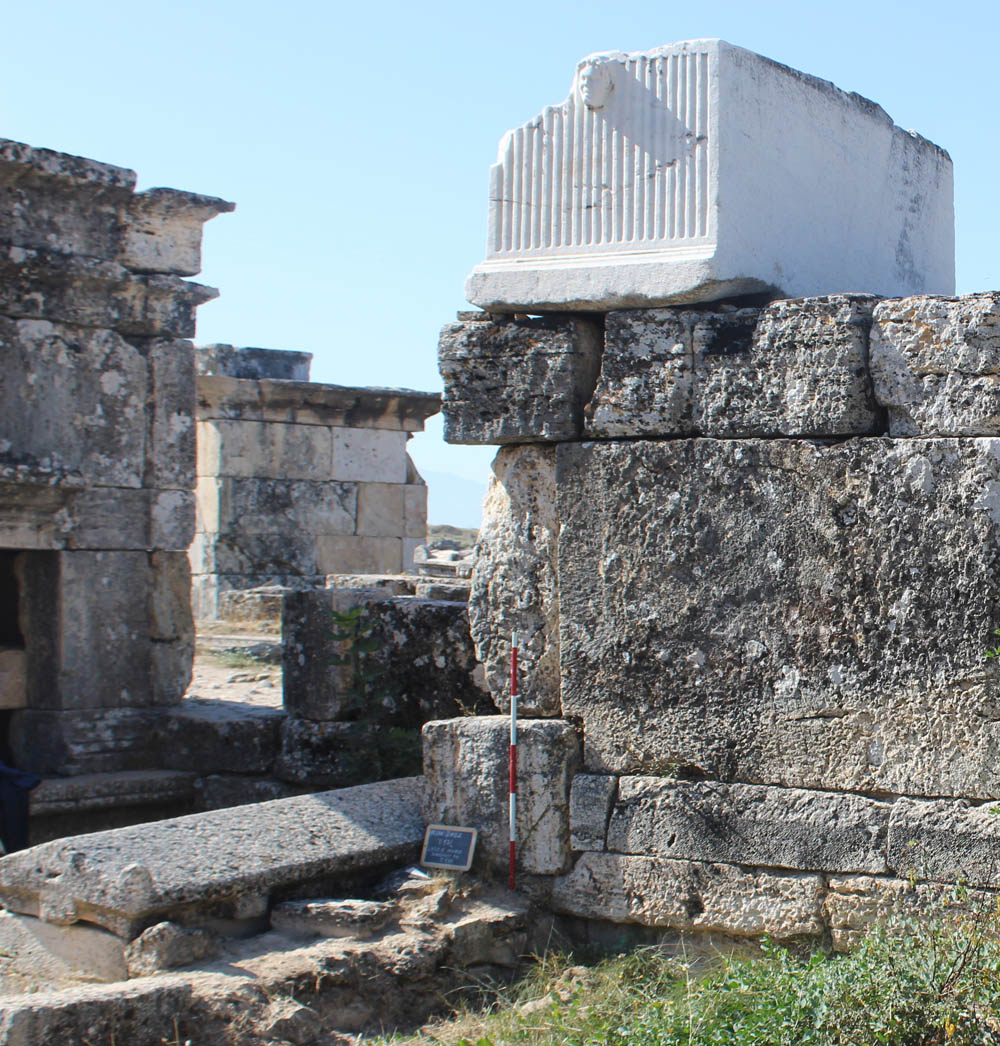
Hierapolis, North Necropolis. Fluted marble chest of a sarcophagus on the roof of a building attached to Tomb 174, view from East inside the funerary enclosure (photo: A. Anguissola, 2022).
2 Method
Curved, S-shaped grooves adorned the chests of many so-called strigillated sarcophagi produced in Rome and the western provinces; straight, vertical fluting occurs on a limited number of chests from that part of the empire from the third century onwards, often in combination with other patterns (Huskinson, 2015, p. 1, n. 2). Fluted sarcophagi (known in the overwhelmingly German scholarly literature as Riefelsarkophage or kannelierte Sarkophage) also appear to have been rare in the Eastern Mediterranean and in ancient Phrygia, where their production began in the late first or early second century CE (Koch & Sichtermann, 1982, pp. 477, 534); it is only at Hierapolis that they constitute a sizeable portion of the entire corpus (Vanhaverbeke & Waelkens, 2002, p. 119). Scholars have focused on high-quality chests adorned with garlands, columns, and friezes, as well as on the monumental kline lids that have been attributed to sculptors from Dokimeion and Aphrodisias or to models designed in those prominent artistic centres, dismissing formulaic products, such as the fluted sarcophagi, as the simpler, more affordable output of local workshops.[3] A holistic appreciation of these artefacts requires that we address them within the context of Hierapolis’s broader archaeological assemblage and as components in a cycle of production and consumption – from the sourcing of raw material to the vocabulary used in funerary inscriptions – against the social, economic, and artistic backdrop of Roman Hierapolis.
The reconstruction of tasks, processes, and individual histories presented in this article can not only help account for material that has few parallels at other sites but also suggest new avenues for exploring the relationships between the main agents involved in sarcophagus production (Russell, 2021, provides an excellent introduction to the chaîne opératoire of Roman stone carvers, esp. pp. 72–75 for the production of sarcophagi; see also Russell & Wootton, 2017). These agents included the quarry-based craftsmen who supplied the stone and prepared the piece for detailed work, the sculptors who carved the chest and lid, and the customer who purchased the final product and possibly exercised some degree of control over its appearance. In principle, sarcophagi decorated with simple, repetitive patterns could easily be manufactured in bulk by workshops near the quarries to be purchased as almost or wholly complete pieces. Rationalized modes of production aimed at marketing larger quantities of relatively affordable marble artworks occupied a significant position in the empire’s economic landscape (Russell, 2011; Ward-Perkins, 1980a,b; Wilson 2008, pp. 402–405; a recent overview of the extensive literature on this point is Koortbojian, 2019). However, the evidence from Hierapolis, characterized by the co-existence of works in stone both from major manufacturing centres (such as Dokimeion) and from local sources, defies simplified models, pointing to a more articulate system of supply and negotiation, which could respond to specific needs relating to a given piece’s intended location and its position within a larger assemblage. To explore these dimensions, the discussion addresses the shape of the fluted sarcophagi from Hierapolis, the material and processes used to produce them, the actions and rituals that centred on them in the burial grounds, eventual changes in their ownership, and their reuse.
3 Materials
3.1 Shapes
Surveys in the North Necropolis at Hierapolis in 2022–2023 resulted in the identification of 41 fragments of fluted chests, 38 of which were made of marble and 3 of travertine.[4] In addition to these, an inscribed fluted chest is today on display in the site’s museum. With few exceptions, the pieces’ fragmentary state impedes recognition of those that may have belonged to the same item.[5] In the case of 15 fragments, at least one of the edges has been identified, displaying the termination of the flutes and the mouldings (Figure 2). Both the lower and upper edges are preserved only in four cases: a travertine chest near Tomb 120, the slab belonging to a child’s sarcophagus in front of Tomb 53, the chest still in situ on a building south of Tomb 174,[6] and the sarcophagus in the site’s museum, which represents the sole instance of both the chest and a roof-shaped lid having been found together (Figure 3a–c). The chest bears an inscription that has been dated to the first half of the second century CE, mentioning the name of the deceased, a woman named Neratia Maximilla, and her husband Makrinos Philadelphos (Ritti, 2004, pp. 574–575, no. 9; 2006, pp. 152–154; Ronchetta, 2018, pp. 254–255).[7]

Drawings of fragmentary fluted marble chests from Tombs 54 (above), 30 (centre), and 61 (below) in the North Necropolis at Hierapolis (drawings by A. Anguissola, digitalized by A. Monticolo, 2022).

(a–c) Hierapolis, Archaeological Museum, inv. E.5311 (chest), E.5312 (lid). Marble sarcophagus of Neratia Maximilla, early second century CE, from the Tomb A28 of Flavius Zeuxis. Main long side and short sides (photos: A. Anguissola, 2022).
One isolated travertine chest and three marble items are equipped with lifting bosses on the short sides; in the case of a coffin on the roof of a tomb south of Tomb 174, the boss takes the shape of a satyr’s head.[8] In most cases, the chests present simple, obliquely cut socles that project significantly from the chest’s surface (Figure 4), with the exception of Neratia Maximilla’s sarcophagus. Occasionally, a socle has been shaped out only on one or two sides of the coffin, likely owing to the limited visibility of the sarcophagus in its architectural context.[9] Only on the socle of the chest in front of Tomb 61, a reversed-cyma frieze runs along its longer side facing the plateia and the short right-hand site (supra, Figure 2 and infra, Figure 6a, c, and d), presenting close stylistic analogies with the vegetal patterns on the lid of the sarcophagus of Neratia Maximilla and on a fragment of a chest from Tomb 30 (supra, Figure 2).[10] A fragment found in the valley east of Tomb 95 includes the upper corner of a fluted chest with different mouldings on either side (infra, Figure 5).

Hierapolis, North Necropolis. Fragmentary fluted marble chests between Tombs 81 and 82 (photo: A. Anguissola, 2022).
The flutes vary in width and depth as well as in the curves at their upper and lower extremities. Notwithstanding their similarity in size, the sarcophagus of Neratia Maximilla and the chest above Tomb 174 show striking disparities in the number of flutes on each. On the former, 29 flutes had been carved on the main long side with 12 on each short side; the angular flutes and fillets on the short sides are larger. Meanwhile, as many as 46 flutes run along the latter’s long side, while the short sides, which face the plateia and the space inside the funerary enclosure, respectively, are decorated with 21 flutes. In both cases, the flutes on the long side number slightly more than twice as many as those on the short sides. The fragmentary long side of the chest from a child’s sarcophagus in front of Tomb 54 is embellished with 14 flutes. In other instances wherein a chest’s shorter side is preserved, the number of flutes ranges from approximately 14 in the case of the piece on the roof of Tomb 177 to at least 18 on the chest in front of Tomb 61.[11] On most pieces (e.g., on the chest above Tomb 174 and on those near Tombs 30 and 61, see supra, Figures 1 and 2), a narrow, flat raised moulding runs between each pair of flutes; elsewhere, a double fillet with either flat or sharp edges encloses and separates the flutes (e.g., on the pieces in front of Tomb 54 and between Tombs 81 and 82, illustrated supra, Figures 2 and 4). The sculptor who carved the sarcophagus of Neratia Maximilla produced unique decorative effects by treating the parting fillet as a straight incised line with a dovetail-shaped lower end. The flutes at the extremes of each side appear to have received particular attention, sometimes substituted by an empty space or infilled with either a flat or a protruding curved surface.[12]
Only the sarcophagus of Neratia Maximilla was equipped with two tabulae ansatae, only one of which was used in the early second century CE for an epigram that described the coffin as the “ancestral monument” (τούτῳ τῷ πατρῴῳ μνήματι) in which a man named Makrinos Philadelphos had interred his deceased wife.[13] A tabula surrounded by raised edges may also have featured on the fluted travertine chest near Tomb 120, although the piece’s poor state of preservation prohibits any more detailed description of its features. It is possible that, on at least some of these coffins, polychromy may have been employed to create lively, brightly coloured surfaces (Huskinson, 2015, pp. 51–53), although the inscriptions point towards a close connection between the fluted sarcophagi and the whiteness of their marble.[14] The corpus overall gives an impression of striking variability, whereby despite the repetitive, standardized pattern, each item appears to have been highly individualized with respect to the morphology of its mouldings and flutes, surface treatment, and decorative details.
3.2 Sources
Scholars have identified workshops producing fluted sarcophagi in limited quantities in the region’s main high-quality sculptural production centres during the Roman imperial period – Dokimeion (Waelkens, 1982, pp. 39–41) and Aphrodisias (Koch & Sichtermann, 1982, p. 530; see also the pieces published in de Chaisemartin, 1993, pp. 239–245, no. 94, Pls. 22–23 and Öğüş, 2018, pp. 82–83, no. 228). In these cases, fluting is either limited to certain sections or extended to the entire chest. On a child’s sarcophagus found at Iconium (Konya) and dated to the second or third century CE, the fluted motif is developed on both the chest and the roof-shaped lid (Istanbul, Archaeological Museum, no. 509 T). The fluted sarcophagi from Hierapolis were formerly considered to have been either imported from Dokimeion (Waelkens, 1982, pp. 39–41) – and of limited value compared with the more elaborate columnar coffins – or the idiosyncratic expression of local workshops (Koch, 1993, p. 180). The disagreement reflects the challenges posed by materials that appear to be highly standardized but that have never been the object of extensive surveys. Recent petrographic and isotope analyses, conducted within a broader investigation of the use of marble in Hierapolis (Ismaelli & Scardozzi, 2016), paint a more nuanced picture. These analyses revealed that three fluted slabs reused in the Church of St. Philip are made of marble from Dokimeion (Ahrens et al., 2016, pp. 265–266, nos. 5, 11, 12, Figures 7–9). The examination of five pieces found in the North Necropolis indicated sources of stone that were significantly closer – the local quarries at Gök Dere and Marmar Tepe and, perhaps, in the case of fragments near Tomb 30 and 144, those of Thiounta, located some 20 km north of Hierapolis (Scardozzi, 2016b, p. 255).[15]
A simple flat band separates the flutes on one of the slabs of marble from Dokimeion that had been reused in the Church of St. Philip; on the other two, the flutes are encased into double fillets. All three items, however, share complex mouldings on the lower and upper edges. Unfortunately, none of the pieces from the North Necropolis with profiles similar to the slabs in the Church of St. Philip and to other chests attributed to craftsmen working in Dokimeion has been included in the sample for analysis (Scardozzi, 2016b, p. 255, Table 5). The more elaborate (i.e., with concave and convex projections) socles of the chests located north of Tomb 69 and between Tombs 81 and 82 are comparable to pieces produced in Dokimeion soon after the mid-second century CE (Waelkens, 1982, pp. 2–3). The poorly preserved chest on the roof of Tomb 177 exhibits the remnants of relatively elaborate mouldings, with a rounded profile on at least one short side.[16] A fragment found in the valley east of Tomb 95, which preserves the upper corner of a fluted chest (Figure 5), also presents close analogies to items from Dokimeion (Waelkens, 1982, p. 4).

Drawing of the fragment of the upper edge of a fluted marble chest found east of Tomb 95 in the North Necropolis at Hierapolis (drawing by A. Tortorella, digitalized by A. Monticolo, 2022).
The evidence indicates that although workshops based in Dokimeion and Hierapolis were able to supply similar fluted chests, the former exhibited a characteristic penchant for imposing architectural frames and elaborate mouldings. Based on the results of archaeometric analyses of a small sample and stylistic comparison with other fragments scattered throughout the burial grounds at Hierapolis, it appears that only a minority of the fluted chests had been supplied from Dokimeion.
4 Processes
The identification of marks resulting from stone removal provides a valuable insight into the production process and carving technique employed in the creation of stone objects. After extracting the blocks of marble intended for sarcophagi, quarrymen likely hollowed and roughed them out in the quarries using a pickaxe and the chisel point to form the regular shape of a hollow box and prepare it for transportation and more detailed carving (Frate, 2006, Figure 2). Unfinished pieces recovered from shipwrecks or left behind at the quarries, most likely due to flaws in the stone, suggest that blocks were hollowed out near the site of extraction to reduce their weight. Sometimes, these blocks were also equipped with partially carved socles and profiles (Russell, 2021, pp. 73, 75).
The chest in which Neratia Maximilla was interred and the chest still located above Tomb 174 (the only two pieces to preserve all three dimensions) suggest that a length of approximately 235 cm, a width of 120–125 cm, and a height of circa 90–100 cm (i.e., around 8 × 4 × 3 feet) may have been standard for these sarcophagi.[17] However, narrower chests are also attested, as well as the isolated larger piece in front of Tomb 61, which has a 257 cm long side facing the main street.[18] Significantly, the three more imposing chests coincide with the rare instances in which decorative motifs (e.g., a floral or kyma frieze, a figural head) are paired with a fluted pattern. All three chests were placed in highly prominent locations: within the enclosure of a tomb close to the Frontinus Gate (the sarcophagus of Neratia Maximilla, found in Tomb A28 of Flavius Zeuxis), along the plateia (the chest in front of Tomb 61), and on the roof of the first large complex (Tomb 174) at the opposite end of the burial ground. Large, elegantly decorated sarcophagi with fluted chests would have been among the first and last valuable objects visible to those arriving at and leaving the city. The chests from the North Necropolis also differ with respect to the thickness of their sides, which ranges from 10 to 18 cm (in the case of the sarcophagus of Neratia Maximilla), with most items being around 14 cm thick.[19]
The chest along the plateia before Tomb 61 has a socle (composed of a flat line and a kyma frieze, which is 17 cm high overall) that is considerably lower than the actual base of the sarcophagus, which is around 30 cm thick (Figure 6a and b). As the traces on the inner surface indicate, the piece was shaped using a pickaxe and a chisel point held at an angle of between 70 and 90 degrees to the surface – the most effective position from which to cut into the stone rapidly, allowing the removal of large lumps of marble with each stroke. The craftsman appears to have worked at a shallower angle on the walls, without lifting the chisel between the strokes and leaving diagonal, parallel marks on the surface.

(a–d) Hierapolis, North Necropolis. Fragment of a fluted marble chest along the plateia in front of Tomb 61. Views of the main long side, the interior, and both short sides (photos: A. Anguissola, 2022).
The subsequent stages of the process were likely entrusted to a proficient sculptor who finished the sarcophagus at its final destination or worked in accordance with precise instructions from the client. The rear of the chest, positioned against the podium of Tomb 61, was left rough. The fluting and the kyma frieze, carefully finished with precision tools and abrasives, cover the main long side that faces the street and the right-hand short side, which remained in full view of those who walked along the plateia from the city (Figure 6c). The left-hand short side was mostly hidden by a large travertine sarcophagus, the lower part of which remains in situ north of the marble chest. Owing to the piece’s limited visibility, the flutes interrupt soon after the angle and the space of the frieze is left flat (Figure 6d). The entire surface on the left-hand short side was treated with a fine-pointed tooth chisel, producing a coarse texture of shallow parallel cuts.
In other instances, such as that of the chest near Tomb 144, the carver did not smooth out the flutes and fillets but rather treated the former only with the point and tooth chisels, while rendering the surface of the latter more regular using a coarse rasp (Figure 7). The significant variation in the width of both the flutes (between 2.5 and 3.5 cm) and the fillets (between 2.5 and 3 cm), which is characteristic of most pieces from the North Necropolis, suggests that these are the result of a freehand approach and that the carver did not use a strict template to plot the pattern before executing it (Huskinson, 2015, pp. 47–49).[20] This must have been the case for the sarcophagus of Neratia Maximilla, equipped with two tabulae ansatae of different sizes, placed at a regular distance from either edge of the fluting and between one another and aligned with the dividing cuts in the fillets (Figure 8 and supra, Figure 3a). The final touches made to the sarcophagus of Neratia Maximilla included the careful definition of all profiles – the lines and curved edges of the flutes, the dividing line in the fillets, and the opposite ends of the chest (Figure 9).

Hierapolis, North Necropolis. Fragments of a fluted marble chest on Tomb 144 (photo: A. Anguissola, 2022).

Marble sarcophagus of Neratia Maximilla (Figure 3a–c), detail of the chest with the funerary inscription (photo: A. Anguissola, 2022).

Marble sarcophagus of Neratia Maximilla (Figure 3a–c), detail of the left-hand short side of the chest and lid (photo: A. Anguissola, 2022).
Several unfinished strigillated coffins from Rome indicate that craftsmen completed the fluted panels before carving any figural decoration and, in general, allowed the possibility of later personalization according to the needs and wishes of their customers (Russell, 2011, pp. 138–139; 2013, pp. 296–297; 2021, p. 97). The final stages in the carving of a fluted sarcophagus are depicted on a late third- or fourth-century CE funerary panel found on the Via Labicana in Rome, now in Urbino (Huskinson, 2015, pp. 46–47; Jockey, 1998, pp. 638–639; Russell, 2020, pp. 243–244). The relief represents two men (whom scholars have variously identified as the individuals mentioned in the inscription – the deceased Eutropos and his son – or either of them and an assistant) carving the final details of a strigillated lenos (or tub-shaped) chest, a widespread sarcophagus type at Rome during that period. Using a drill, the craftsmen create the grooves in the mane of a lion whose head emerges from the finished flutes. It is likely that the lifting boss in the shape of a satyr’s head on the sarcophagus placed above Tomb 174 (supra, Figure 1), paired with a pendant on the now-lost opposite side, was executed after the fluted pattern by shaping a rough mass of stone into a protome (19 cm high, 15.5 cm wide, and projecting ca. 9 cm from the panel).[21] Certainly, any texts providing information on the owner of the sarcophagus, the deceased for whom it was destined, and the tomb to which it belonged, as well as the terms for its maintenance, were inscribed immediately before or after the burial had taken place. However, only the larger upper tabula ansata on the sarcophagus of Neratia Maximilla presents a smooth surface and was inscribed with elegant Greek letters. The fact that the surface of the lower tablet appears to have been significantly lowered and encased in a frame suggests the possibility that an earlier inscription had been erased and the entire layer of marble carefully removed when the sarcophagus was used for Neratia Maximilla.
The evidence from the fluted chests at Hierapolis provides valuable insights into the actions and tools employed by their carvers. However, it is crucial to avoid overemphasizing its significance within the context of broader models. While it is possible to observe the stages of work on a sarcophagus chest and imagine the sequence in which they were carried out, it is important to note that there is no distinct boundary marking the completion of each step and the beginning of the next. The manufacturing process of a sarcophagus is far from a linear sequence of discrete activities. The duration of each stage and the level of attention dedicated to it can vary, as well as the work location and the individual carrying out the task. These variations depend on factors such as the size of the workshop, its proximity to quarries and customers, and the specific project requirements. Furthermore, carvers may utilize identical tools in different ways or employ different tools for the same purpose. Taking into account this variability and fluidity, Tim Ingold describes the work of a craftsman as “something more like an unbroken, contrapuntal coupling of a gestural dance with a modulation of the material” (Ingold, 2013, p. 26).
5 Uses
5.1 Display
Thanks to their geographical proximity to the city, the craftsmen who produced most of the fluted sarcophagi found at Hierapolis were able to incorporate specific requests from their customers and adapt each piece to its intended architectural setting. Sarcophagi were arranged along the street as isolated items or placed atop cube-shaped tombs or underground chambers, on a podium, or within a funerary enclosure, sometimes on a paved platform (ὁ πλάτος, τὸ βαθρικόν). The area between the plateia and Tomb 61 had been paved with large travertine slabs, and an incised line marked the precise location in which the sarcophagus was to be placed in line with the façade (supra, Figure 6b–d).[22]
The burial itself represented the final moment in the sarcophagus’ arrangement. As the deceased’s remains were placed inside the coffin, the relationship between the chest and the lid became definitive – at least according to most owners’ intentions. A raised margin on the upper edge of the chest was often left in place to secure the lid and ensure that it would not shift over the course of time, particularly at sites of high seismic activity such as Hierapolis (Figure 10).[23] The owners of the sarcophagus of Neratia Maximilla appear to have gone a step further, fastening the two pieces of stone with a large lead pin on each side. To facilitate this, two pairs of essentially square holes were made in the chest and lid with gouges carved between them (Figure 11).[24] Funerary inscriptions from the second and third centuries CE mention the practice of using pins to close the coffin (the relevant verb is κορακόω) after all the persons destined to be buried in it had died (Ritti, 2016, pp. 454–456, no. 7, Figure 9). This device was likely also intended to prevent the unlawful occupation of tombs (τυμβωρυχία), which appears to have occurred in various modes in Roman Hierapolis: unauthorized burials, selling other people’s buildings, dividing their plots, moving sarcophagi, blocking their tombs’ visibility from the street, or impeding access to those tombs. Breaking the pins that fastened a sarcophagus (ἀποκορακόω) was strictly forbidden, and fines could be imposed on transgressors (Ritti, 2016, pp. 502–506, no. 25, Figures 26–27).

Hierapolis, North Necropolis. Fragments of a fluted marble chest found near Tomb 30, view of the upper edge (photo: A. Anguissola, 2022).

Marble sarcophagus of Neratia Maximilla (Figure 3a–c), detail of the right-hand short side of the chest and lid (photo: A. Anguissola, 2022).
After a burial, the sarcophagus remained in use as an essential component in the funerary assemblage. At Hierapolis, affluent individuals and families made provisions for rituals such as the stephanoticon, which involved adorning the monument or the sarcophagus with wreaths, having set aside the financial resources thanks to a funerary foundation or as a bequest to surviving relatives or professional associations (Ritti, 1992–1993, 2004, 2016). A large fragment of a roof-shaped lid has been found near the fluted chest in front of Tomb 61, the frieze on which is stylistically similar to the kyma motif that runs along the bottom of the chest, indicating that the two pieces may have belonged to the same sarcophagus.[25] The shallow, squarish holes cut into the lid, which have yielded no traces of lead or cement, may have served a function related to these rituals – perhaps to fix the wooden stakes from which the garlands were hung.
5.2 Changes
The life of a sarcophagus extended far beyond the moment it transitioned from the hands of the carver to those of the customer. Marble and travertine sarcophagi were inherited, sold, and usurped multiple times over the course of the centuries. Funerary inscriptions bear witness to the need to discourage the usurpation of other people’s sarcophagi and to regulate their hereditary transmission in Hierapolis between the second and fourth centuries CE (Ritti, 2004, 2016). A roughed-out garland sarcophagus inside Tomb 162 offers a conspicuous example of multiple occupations. The sarcophagus is of a type that is widely attested in Hierapolis and appears to respond to a taste for standardized products that relied on the prestige of the material rather than stylistic quality (Scardozzi, 2016b, pp. 245–251). An earlier inscription on the lid names the late second-century CE owner of the sarcophagus and the funerary chamber as Marcus Aurelius Ammianos Menandrianos. A later text from the fourth century CE was carved in large and irregular letters across the entire chest, apparently undeterred by the presence of the relief. The inscription indicates that a man named Acholios Ammianos Molybas claimed ownership of the sarcophagus, highlighting its material value: ἡ σορὸς ἡ μαρμάρεινος, “the marble sarcophagus” (Ritti, 2004, pp. 562–564; 2016, pp. 465–467, no. 11, Figure 13). Other inscriptions run across the travertine sarcophagi inside and outside the tomb, indicating the presence of multiple owners and families, some of which coexisted at around the same time. In an inscription on the façade, possibly carved at some point between the two burials in the garland sarcophagus, the archigrammateus Artemidoros and his wife claimed ownership of the βωμός, an “altar-like structure” (likely part of the building on which sarcophagi could be placed) and a “white fluted sarcophagus” (ἡ σορὸς ἡ λευκὴ ἡ ξυστρωτή), now lost (Scardozzi, 2016b, p. 242).
During the Byzantine era, when the Roman burial grounds had long fallen out of use, several marble sarcophagi were singled out for reuse in the Church of St. Philip. The original location of these pieces is unknown. Most were likely found in the North-East Necropolis, close to the new building; however, some of the slabs may have been sourced in the North Necropolis and transported from there (Ahrens et al., 2016, pp. 259, 276). As the result of archaeometric analyses indicate, fluted chests from Dokimeion prevail among those reused in the Church of St. Philip. Their sophisticated profiles and the elegant repetition of the vertical pattern likely made these pieces particularly well suited for reuse in enclosures and as a water basin.[26] Significantly, the only analysed fragment of a fluted chest made of local marble (probably from Thiounta) was incorporated into a wall between two pillars, with the fluted face downturned and virtually invisible (Ahrens et al., 2016, pp. 266–267, no. 13, Figure 10).
6 Conclusions
Close observation of the fluted sarcophagi from the North Necropolis, their technical and stylistic features, and their contexts and functions offers a fresh perspective from which to address the social, economic, and artistic history of Hierapolis. Notwithstanding these pieces’ relative simplicity, the work involved in shaping and carving a fluted chest was complex and time-consuming and was the preserve of skilled craftsmen. Purchasing a suitable plot of land; building a tomb, enclosure, or platform; buying a sarcophagus; establishing a foundation; making a will; and planning for continued maintenance and rituals were all part of a lengthy process of preparation that reveals the crucial role of funerary self-presentation and commemoration in the lives of the inhabitants of the Roman Empire. Each step in this process required some degree of negotiation between the individuals and their families (including the freedmen who were sometimes responsible for the tomb’s maintenance), the city’s administration (e.g., the archive in which the will would be deposited and the holy fiscus to which fines would be paid), professional associations, other fellow citizens who may have previously owned the plot, tomb, or coffin, and the stonemasons and craftsmen who would build the monument or carve the sarcophagus.
The fluted sarcophagi found in the North Necropolis occupy an intermediate position between the notions of “small-scale” and “large-scale” production (or, put otherwise, “production-to-order” and “production-to-stock”) that are thought to respond to radically different criteria in the management of supply and demand. As recent and more nuanced interpretations of the manufacture and trade of Roman sarcophagi have demonstrated, morphological standardization is not necessarily the result of mass production or distance. In long-distance trade, the sculptors’ workshops in which the sarcophagi were finished may have played a key connecting role between the quarry-based craftsmen and the consumer. Specialization and the distribution of tasks allowed large integrated systems to maintain a high productivity rate while accommodating a certain degree of individuality. It appears that quarrymen and carvers adopted a flexible approach when it came to dividing tasks and determining the location of each stage of the work, rather than following a consistent operational model across the industry. Based on stylistic comparisons with pieces that have been subjected to archaeometric analyses, most fluted sarcophagi found in Hierapolis appear to have been produced using marble extracted on the city’s outskirts. The quarrymen, the carvers, and the sculptors entrusted with executing the finishing touches formed a network that could easily respond to individual clients’ requirements. Recent research has demonstrated that workshops based in or around Hierapolis could produce a vast array of marble sarcophagi, ranging from plain coffins to chests and lids with elaborate figural decoration. Imports from Aphrodisias are virtually absent, whereas those from Dokimeion represent only a small portion of the analysed sample, limited to a few high-quality pieces – particularly columnar chests and kline-shaped lids (Scardozzi, 2016b). Standardized items, such as roughed-out garland chests and fluted pieces, were mostly supplied by local workshops that developed a stylistic language based on abstract motifs and repetition. Within the boundaries of typologies, traditions, and profit, these workshops created unique pieces that exhibited different morphologies and surface treatments. The sarcophagi produced at Dokimeion were primarily intended to appeal to the wide audience of the empire’s elite. In contrast, locally crafted pieces offer a more direct insight into the specific demands, preferences, and expectations of individual customers and communities. Local workshops at Hierapolis may have opted for vegetal friezes, as observed on the lid of the sarcophagus of Neratia Maximilla and the fragment from Tomb 30, and kyma motifs, as seen on the piece in front of Tomb 61, to distinguish their output from the products imported from Dokimeion. These imports were characterized by elaborate mouldings, and the use of distinct decorative motifs can be viewed as part of a competitive strategy, which has also been documented in the case of columnar sarcophagi at Aphrodisias (Öğüş, 2014).
The same sculptors may occasionally have worked with both marble and other locally sourced stones, as suggested by an isolated fluted chest made of travertine near Tomb 120 (Vanhaverbeke & Waelkens, 2002, p. 120, Figure 1, 122, type IV). The chest, of which two large pieces and a smaller fragment have been identified (Figure 12a and b), was bulkier than most marble items and, unlike most of them, was decorated on all four sides.[27] It shares with its marble counterparts the shape of its flutes, which terminate with an upper curved profile. The presence of a central tabula encased by a frame is also in line with the arrangement of funerary inscriptions on marble items.

(a and b) Hierapolis, Nort Necropolis. Two of the three pieces of a fluted travertine chest found near Tomb 120 (photo: A. Anguissola, 2022).
In the corpus of the fluted sarcophagi from Hierapolis, however, exploration of trans-material designs appears to have operated in both directions. Fluted marble chests are occasionally equipped with large lifting bosses that had been left rough, thus appropriating a feature characteristic of the travertine sarcophagi of Hierapolis (Vanhaverbeke & Waelkens, 2002, p. 120, Figure 1). Clearly, workshops familiar with both types of stone followed the same criteria with respect to the pieces’ static infrastructure, layout, and design. It is likely that carvers were most comfortable working with stones they were familiar with. However, as it has been evidenced by the idiosyncratic use of Thasian marble in other regions of the empire (Russell, 2013, pp. 330–332 with bibliography), they may have been open to experimenting with different materials. In the context of Hierapolis, it is possible that most carvers initiated their apprenticeship by working on less complex and demanding objects crafted from travertine before progressing to marble blocks.
Although the extent and features of a shared repertoire of shapes and motifs between the marble and travertine sarcophagi at Hierapolis remain to be addressed by future research, it appears that local workshops’ versatility extended to the use of available materials, the selection of which may have depended on various factors relating to each individual project.
Acknowledgements
The research team from the University of Pisa has been a member of the Italian Archaeological Mission at Hierapolis (MAIER) since 2008. I am grateful to the Director of MAIER, Professor Grazia Semeraro, for her generous support and the permission to work in the site’s burial grounds. Antonio Monticolo and Angelica Tortorella took part in the 2022–2023 surveys that focused on the fluted and travertine sarcophagi in the North Necropolis.
-
Funding information: Support for fieldwork in the burial grounds of Hierapolis came from a Research Project of National Interest awarded by the Italian Ministry of University and Research (PRIN 2015). Additional funding was provided by the University of Pisa within the framework of the Excellence program “Accelerations and Resilience: Expansion and Growth in the Early States and Empires of the Ancient World” (2018-2022) and the cooperative project “New approaches to the study of ancient funerary landscapes” (PRA 2019-2021).
-
Conflict of interest: The authors report no conflict of interest.
References
Ahrens, S., Brilli, M., Caggia, M. P., Cox, J., Maniatis, Y., Quarta, G., … Van Keuren, F. (2016). Marble sarcophagi from the St. Philip Church of Hierapolis and the North-East Necropolis. In T. Ismaelli & G. Scardozzi (Eds.), Ancient quarries and building sites in Asia Minor (pp. 259–276). Bari: Edipuglia.Search in Google Scholar
Anguissola, A., & Costa, S. (2020). I sarcofagi nella necropoli nord di Hierapolis in contesto: Due casi di studio. Studi Classici e Orientali, 56, 301–328.10.12871/978883339362920Search in Google Scholar
Anguissola, A., Bochicchio, L., Calabrò, A., & Costa, S. (2016). La necropoli sud-ovest a Hierapolis di Frigia: Lo scavo della tomba di Tiberius Claudius Thalamos. In F. D’Andria, M. P. Caggia, & T. Ismaelli (Eds.), Hierapolis di Frigia VIII, 2. Le attività delle campagne di scavo e restauro 2007-2011 (pp. 503–507). Istanbul Ege Yayınları.Search in Google Scholar
Anguissola, A., Monticolo, A., & Tortorella, A. (2022). La campagna 2022 dell’Università di Pisa nella Necropoli Nord a Hierapolis di Frigia. AΓΩΓH/Agogé, 19, 73–79.10.12871/978883339841911Search in Google Scholar
Caggia, M. P. (2014). La collina di San Filippo a Hierapolis di Frigia: Osservazioni sulle fasi di occupazione bizantina e selgiuchide (IX-XIV sec.). Scienze dell’Antichità, 20(2), 143–161.Search in Google Scholar
de Chaisemartin, N. (1993). Appendix IV. Agonistic images on Aphrodisian sarcophagi. In C. Roueché (Ed.), Performers and partisans at Aphrodisias in the Roman and Late Roman periods (pp. 239–248). London: Society for the Promotion of Roman Studies.Search in Google Scholar
Ditaranto, I. (2016). Ancient marble quarries in the territory of Hierapolis. In T. Ismaelli & G. Scardozzi (Eds.), Ancient quarries and building sites in Asia Minor (pp. 87–100). Bari: Edipuglia.Search in Google Scholar
Frate, O. (2006). Il materiale lapideo come indicatore sociale, culturale ed economico. Il caso dei sarcofagi di marmo della necropoli nord di Hierapolis di Frigia. In V. Badino & G. Baldassarre (Eds.), Le risorse lapidee dall’antichità ad oggi in area mediterranea (pp. 423–430). Turin: GEAM.Search in Google Scholar
Frate, O. (2007). I sarcofagi in marmo della Necropoli Nord. Metodo della ricerca e resultati preliminari. In F. D’Andria & M. P. Caggia (Eds.), Hierapolis di Frigia I. Le attività delle campagne di scavo e restauro 2000–2003 (pp. 457–472). Istanbul: Ege Yayınları.Search in Google Scholar
Huskinson, J. (2015). Roman strigillated sarcophagi. Oxford: Oxford University Press.10.1093/acprof:oso/9780199203246.001.0001Search in Google Scholar
Ingold, T. (2013). Making. Anthropology, archaeology, art and architecture. London: Routledge.10.4324/9780203559055Search in Google Scholar
Ismaelli T., & Scardozzi, G. (Eds.). (2016). Ancient quarries and building sites in Asia Minor. Bari: Edipuglia.Search in Google Scholar
Jockey, P. (1998). Le représentations d’artisans de la pierre dans le monde grécoromain et leur éventuelle exploitation par l’historien. Topoi, 8(2), 625–652.10.3406/topoi.1998.1776Search in Google Scholar
Judeich, W. (1898). Inschriften. In C. Humann, C. Cichorius, W. Judeich, & F. Winter (Eds.). Altertümer von Hierapolis (pp. 67–180). Berlin: G. Reimer (Jahrbuch des Deutschen Archäologischen Instituts. ErgänzungsHeft).Search in Google Scholar
Koch, G., & Sichtermann, H. (1982). Handbuch der Archäologie. Römische Sarkophage. München: C.H. Beck.Search in Google Scholar
Koch, G. (1993). Sarkophage der römischen Kaiserzeit. Darmstadt: Wissenschaftliche Buchgesellschaft.Search in Google Scholar
Koortbojian, M. (2019). Standardization and transformation. Some observations on the sarcophagus trade and sarcophagus production. In C. H. Hallett (Ed.), Flesheaters. An international symposium on roman sarcophagi (pp. 125–143). Wiesbaden: Reichert.Search in Google Scholar
Öğüş, E. (2014). Columnar sarcophagi from Aphrodisias: Elite emulation in the Greek East. American Journal of Archaeology, 118, 113–136.10.3764/aja.118.1.0113Search in Google Scholar
Öğüş, E. (2018). Columnar sarcophagi from Aphrodisias. Wiesbaden: Reichert.10.29091/9783954907434Search in Google Scholar
Ritti, T. (1992–1993). Nuovi dati su una nota epigrafe sepolcrale con stefanotico da Hierapolis di Frigia. Scienze dell’Antichità, 6–7, 41–68.Search in Google Scholar
Ritti, T. (2004). Iura sepulcrorum a Hierapolis di Frigia. In S. Panciera (Ed.), Libitina e dintorni. “Libitina” e i “luci” sepolcrali. Le “leges libitinariae” campane. “Iura sepulcrorum”: vecchie e nuove iscrizioni (pp. 455–634). Rome: Quasar.Search in Google Scholar
Ritti, T. (2006). Guida epigrafica a Hierapolis di Frigia. Istanbul: Ege Yayinlari.Search in Google Scholar
Ritti, T. (2016). Per la storia sociale ed economica di Hierapolis di Frigia: Le fondazioni sociali e funerarie. Rome: Bardi (Accademia Nazionale dei Lincei. Classe di Scienze Morali, Storiche e Filologiche. Memorie, s. 9. 37, 3).Search in Google Scholar
Ronchetta, D. (2018). L’architettura funeraria di Hierapolis di Frigia: Le tombe A della Necropoli Nord. Turin: Politecnico di Torino.Search in Google Scholar
Russell, B. (2011). The Roman sarcophagus ‘industry’: A reconsideration. In J. Elsner & J. Huskinson (Eds.), Life, death and representation: Some new work on Roman sarcophagi (pp. 119–148). Berlin & New York: De Gruyter.10.1515/9783110216783.119Search in Google Scholar
Russell, B. (2013). The economics of the Roman stone trade. Oxford: Oxford University Press.10.1093/acprof:oso/9780199656394.001.0001Search in Google Scholar
Russell, B. (2020). Roman sculptors at work: Professional practitioners? In E. Stewart, E. Harris, & D. Lewis (Eds.), Skilled Labour and Professionalism in Ancient Greece and Rome (pp. 243–266). Cambridge: Cambridge University Press.10.1017/9781108878135.009Search in Google Scholar
Russell, B. (2021). Roman stone carvers and their chaîne opératoire. In H. Hochscheid & B. Russell (Eds.), The value of making. Theory and practice in ancient craft production (pp. 71–88). Turnhout: Brepols.Search in Google Scholar
Russell, B., & Wootton, W. (2017). Makers and making: Classical art in action. In A. Lichtenberger & R. Raja (Eds.), The diversity of classical archaeology (pp. 253–270). Turnhout: Brepols.Search in Google Scholar
Scardozzi, G. (Ed.). (2015). Nuovo atlante di Hierapolis di Frigia. Istanbul: Ege Yayınları.Search in Google Scholar
Scardozzi, G. (2016a). General considerations on the ancient marble quarries in the territory of hierapolis and in the southern sector of the Denizli Basin: Between topography and archaeometry. In T. Ismaelli & G. Scardozzi (Eds.), Ancient quarries and building sites in Asia Minor (pp. 131–140). Bari: Edipuglia.Search in Google Scholar
Scardozzi, G. (2016b). The marble sarcophagi of the necropolises of Hierapolis. In T. Ismaelli & G. Scardozzi (Eds.), Ancient quarries and building sites in Asia Minor (pp. 231–257). Bari: Edipuglia.Search in Google Scholar
Vanhaverbeke, H., & Waelkens, M. (2002). The northwestern necropolis of Hierapolis (Phrygia). The chronological and topographical distribution of the travertine sarcophagi and their way of production. In D. De Bernardi Ferrero (Ed.), Saggi in onore di Paolo Verzone (pp. 119–145). Rome: G. Bretschneider.Search in Google Scholar
Vanhaverbeke, H., Waelkens, M., & Ritti, T. (1999). Is plump later? The possibilities of dating sarcophagi by means of their proportions checked by PCA-analysis on the North-Western Necropolis sarcophagi of Hierapolis (Phrygia, Turkey). In J. A. Barceló, I. Briz, & A. Vila (Eds.), New techniques for old times. CAA98. Computer applications and quantitative methods in archaeology (pp. 201–208). Oxford: Archaeopress (BAR International Series 757).Search in Google Scholar
Waelkens, M. (1982). Dokimeion. Die Werkstatt der repräsentativen kleinasiatischen Sarkophage. Chronologie und Typologie ihrer Produktion. Berlin: Gebr. Mann.Search in Google Scholar
Ward-Perkins, J. (1980a). Nicomedia and the marble trade. Papers of the British School at Rome, 48, 23–69.10.1017/S0068246200008357Search in Google Scholar
Ward-Perkins, J. (1980b). The marble trade and its organization: Evidence from Nicomedia. In J. D’Arms & E. C. Kopff (Eds.), The seaborne commerce of ancient Rome: Studies in archaeology and history (pp. 325–336). Rome: American Academy in Rome (Memoirs of the American Academy in Rome).10.2307/4238714Search in Google Scholar
Wilson, A. (2008). Large-scale manufacturing, standardization, and trade. In J. Oleson (Ed.), The Oxford handbook of engineering and technology in the classical world (pp. 393–417). Oxford: Oxford University Press.10.1093/oxfordhb/9780199734856.013.0016Search in Google Scholar
© 2023 the author(s), published by De Gruyter
This work is licensed under the Creative Commons Attribution 4.0 International License.
Articles in the same Issue
- Regular Articles
- A 2D Geometric Morphometric Assessment of Chrono-Cultural Trends in Osseous Barbed Points of the European Final Palaeolithic and Early Mesolithic
- Wealth Consumption, Sociopolitical Organization, and Change: A Perspective from Burial Analysis on the Middle Bronze Age in the Carpathian Basin
- Everything Has a Role to Play: Reconstruction of Vessel Function From Early Copper Age Graves in the Upper Tisza Region (Eastern Hungary)
- Urban Success and Urban Adaptation Over the Long Run
- Exploring Hypotheses on Early Holocene Caspian Seafaring Through Personal Ornaments: A Study of Changing Styles and Symbols in Western Central Asia
- Victims of Heritage Crimes: Aspects of Legal and Socio-Economic Justice
- On the (Non-)Scalability of Target Media for Evaluating the Performance of Ancient Projectile Weapons
- Small Houses of the Dead: A Model of Collective Funerary Activity in the Chalcolithic Tombs of Southwestern Iberia. La Orden-Seminario Site (Huelva, Spain)
- Bigger Fish to Fry: Evidence (or Lack of) for Fish Consumption in Ancient Syracuse (Sicily)
- Terminal Ballistics of Stone-Tipped Atlatl Darts and Arrows: Results From Exploratory Naturalistic Experiments
- First Archaeological Record of the Torture and Mutilation of Indigenous Mapuche During the “War of Arauco,” Sixteenth Century
- The Story of the Architectural Documentation of Hagia Sophia’s Hypogeum
- Iconographic Trends in Roman Imperial Coinage in the Context of Societal Changes in the Second and Third Centuries CE: A Small-Scale Test of the Affluence Hypothesis
- Circular Economy in the Roman Period and the Early Middle Ages – Methods of Analysis for a Future Agenda
- New Insights Into the Water Management System at Tetzcotzinco, Mexico
- How Linguistic Data Can Inform Archaeological Investigations: An Australian Pilot Study Around Combustion Features
- Leadership in the Emergent Baekje State: State Formation in Central-Western Korea (ca. 200–400 CE)
- Middle Bronze Age Settlement in Czeladź Wielka – The Next Step Toward Determining the Habitation Model, Chronology, and Pottery of the Silesian-Greater Poland Tumulus Culture
- On Class and Elitism in Archaeology
- Archaeology of the Late Local Landscapes of the Hualfín Valley (Catamarca, Argentina): A Political Perspective from Cerro Colorado of La Ciénaga de Abajo
- Review Article
- The State of the Debate: Nuragic Metal Trade in the Bronze Age and Early Iron Age
- A Review of Malta’s Pre-Temple Neolithic Pottery Wares
- Commentary Article
- Paradise Found or Common Sense Lost? Göbekli Tepe’s Last Decade as a Pre-Farming Cult Centre
- Special Issue Published in Cooperation with Meso’2020 – Tenth International Conference on the Mesolithic in Europe, edited by Thomas Perrin, Benjamin Marquebielle, Sylvie Philibert, and Nicolas Valdeyron - Part II
- The Time of the Last Hunters: Chronocultural Aspects of Early Holocene Societies in the Western Mediterranean
- Fishing Nets and String at the Final Mesolithic and Early Neolithic Site of Zamostje 2, Sergiev Posad (Russia)
- Investigating the Early-to-Late Mesolithic Transition in Northeastern Italy: A Multifaceted Regional Perspective
- Socioeconomic, Technological, and Cultural Adaptation of the Mesolithic Population in Central-Eastern Cantabria (Spain) in the Early and Middle Holocene
- From Coastal Sites to Elevated Hinterland Locations in the Mesolithic – Discussing Human–Woodland Interaction in the Oslo Fjord Region, Southeast Norway
- Exploitation of Osseous Materials During the Mesolithic in the Iron Gates
- Motorways of Prehistory? Boats, Rivers and Moving in Mesolithic Ireland
- Environment and Plant Use at La Tourasse (South-West France) at the Late Glacial–Holocene Transition
- Stylistic Study of the Late Mesolithic Industries in Western France: Combined Principal Coordinate Analysis and Use-Wear Analysis
- Mesolithic Occupations During the Boreal Climatic Fluctuations at La Baume de Monthiver (Var, France)
- Pressure Flakers of Late Neolithic Forest Hunter-Gatherer-Fishers of Eastern Europe and Their Remote Counterparts
- The Site Groß Fredenwalde, NE-Germany, and the Early Cemeteries of Northern Europe
- Special Issue on Archaeology of Migration: Moving Beyond Historical Paradigms, edited by Catharine Judson & Hagit Nol
- The Blurry Third Millennium. “Neolithisation” in a Norwegian Context
- Movement or Diaspora? Understanding a Multigenerational Puebloan and Ndee Community on the Central Great Plains
- Human Mobility and the Spread of Innovations – Case Studies from Neolithic Central and Southeast Europe
- The Thule Migration: A Culture in a Hurry?
- The Transformation of Domes in Medieval Chinese Mosques: From Immigrant Muslims to Local Followers
- Landscapes of Movement Along the (Pre)Historical Libyan Sea: Keys for a Socio-Ecological History
- Arab Migration During Early Islam: The Seventh to Eighth Century AD from an Archaeological Perspective
- Special Issue on Ancient Cultural Routes: Past Transportations Infrastructures as a Two-Way Interaction Between Society and Environment, edited by Francesca Fulminante, Francesca Mazzilli & Franziska Engelbogen
- The Impact of Transportation on Pottery Industries in Roman Britain
- The Role of the Road in Settling a Mountainous Region
- An Example of Geographic Network Analysis: The Case Study of the Fortore Valley (Molise and Apulia, Italy)
- Water, Communication, Sight, and the Location of Fortifications on the Strata Diocletiana (Syria) in Late Antiquity
- Transport, Interaction, and Connectivity
- Special Issue on Scales of Interaction in the Bronze and Iron Age Central Mediterranean, edited by Emily Holt & Davide Schirru
- Tracing Mobility Patterns of Buried Species of the Late Iron Age Funerary Staggered Turriform of Son Ferrer (Calvià, Spain)
- Approaching Interaction in Iron Age Sardinia: Multi-Scalar Survey Evidence from the Sinis Archaeological Project and the Progetto S’Urachi
- From the Atlantic to the Mediterranean and Back: Sardinia, Iberia, and the Transfer of Knowledge in Late Bronze Age Networks
- Special Issue on Bricks Under the Scope: Microscopic and Macroscopic Approaches to the Study of Earthen Architecture, edited by Marta Lorenzon, Moritz Kinzel, & Benjamín Cutillas-Victoria
- Earthen Architecture in Nordic Countries: Future Directions
- Earthen Architecture and Craft Practices of Early Iron Age Ramparts: Geoarchaeological Analysis of Villares de la Encarnación, South-Eastern Iberia
- Earthen Architecture in Southern Algeria: An Assessment of Social Values and the Impact of Industrial Building Practices
- Studying the Use of Earth in Early Architecture of Southwest and Central Asia
- Roof Tiles and Bricks of the Etruscan Domus dei Dolia (Vetulonia, Italy): An Archaeological and Archaeometric Study of Construction Materials
- The Building Blocks of Circular Economies: Rethinking Prehistoric Turf Architecture Through Archaeological and Architectural Analysis
- Undecorated Roman-Period Roof Tiles – An Old Material Providing New Results
- Turf Building in Iceland – Past, Present, and Future
- Special Issue on Past Sounds: New Perspectives in the Field of Archaeoacoustics, edited by Margarita Díaz-Andreu & Neemias Santos da Rosa
- Employing Psychoacoustics in Sensory Archaeology: Developments at the Ancient Sanctuary of Zeus on Mount Lykaion
- One, Two, Three! Can Everybody Hear Me? Acoustics of Roman Contiones. Case Studies of the Capitoline Hill and the Temple of Bellona in Rome
- Ringing Tone and Drumming Sages in the Crevice Cave of Pirunkirkko, Koli, Finland
- Music and Storytelling at Rock Art Sites? The Archaeoacoustics of the Urkosh Area (Russian Altai)
- Listening in Sacred Spaces: The Sanctuary of Poseidonia and Selinunte’s Main Urban Sanctuary
- Presenting Archaeoacoustics Results Using Multimedia and VR Technologies
- Special Issue on Reconsidering the Chaîne Opératoire: Towards a Multifaceted Approach to the Archaeology of Techniques, edited by Marie-Elise Porqueddu, Claudia Sciuto & Anaïs Lamesa
- Reconsidering the Chaîne Opératoire: At the Crossroad Between People and Materials
- Materiality of Plaster Vessels: The Problem of Southwest Asian Neolithic White Ware
- The Chaîne Opératoire Approach for Interpreting Personal Ornament Production: Marble Beads in Copper Age Tuscany (Italy)
- Seriality and Individualization: Carving the Fluted Sarcophagi from Hierapolis of Phrygia
- Making Vessels for the Dead: Pottery-Making Practices, Chaîne Opératoire and the Use of Grog (Crushed Sherds) as a Technological and Cultural Choice during Late and Inca Periods in the Northwestern Argentine Region (Southern Andes)
- An Invention Shading Light to the Socio-History of Bonneuil Quarry Basin: The Roadheaders with Rotating Drill Bits
- The Ugly Duckling: Understanding the Making of an Early Copper Age Atypical Ceramic Vessel from the Great Hungarian Plain
- Synopsis of a Treasure. A Transdisciplinary Study of Medieval Gold Workings Biographies
- Identification of Ceramic Traditions on the Prehistoric Mines of Gavà (Barcelona, Spain)
Articles in the same Issue
- Regular Articles
- A 2D Geometric Morphometric Assessment of Chrono-Cultural Trends in Osseous Barbed Points of the European Final Palaeolithic and Early Mesolithic
- Wealth Consumption, Sociopolitical Organization, and Change: A Perspective from Burial Analysis on the Middle Bronze Age in the Carpathian Basin
- Everything Has a Role to Play: Reconstruction of Vessel Function From Early Copper Age Graves in the Upper Tisza Region (Eastern Hungary)
- Urban Success and Urban Adaptation Over the Long Run
- Exploring Hypotheses on Early Holocene Caspian Seafaring Through Personal Ornaments: A Study of Changing Styles and Symbols in Western Central Asia
- Victims of Heritage Crimes: Aspects of Legal and Socio-Economic Justice
- On the (Non-)Scalability of Target Media for Evaluating the Performance of Ancient Projectile Weapons
- Small Houses of the Dead: A Model of Collective Funerary Activity in the Chalcolithic Tombs of Southwestern Iberia. La Orden-Seminario Site (Huelva, Spain)
- Bigger Fish to Fry: Evidence (or Lack of) for Fish Consumption in Ancient Syracuse (Sicily)
- Terminal Ballistics of Stone-Tipped Atlatl Darts and Arrows: Results From Exploratory Naturalistic Experiments
- First Archaeological Record of the Torture and Mutilation of Indigenous Mapuche During the “War of Arauco,” Sixteenth Century
- The Story of the Architectural Documentation of Hagia Sophia’s Hypogeum
- Iconographic Trends in Roman Imperial Coinage in the Context of Societal Changes in the Second and Third Centuries CE: A Small-Scale Test of the Affluence Hypothesis
- Circular Economy in the Roman Period and the Early Middle Ages – Methods of Analysis for a Future Agenda
- New Insights Into the Water Management System at Tetzcotzinco, Mexico
- How Linguistic Data Can Inform Archaeological Investigations: An Australian Pilot Study Around Combustion Features
- Leadership in the Emergent Baekje State: State Formation in Central-Western Korea (ca. 200–400 CE)
- Middle Bronze Age Settlement in Czeladź Wielka – The Next Step Toward Determining the Habitation Model, Chronology, and Pottery of the Silesian-Greater Poland Tumulus Culture
- On Class and Elitism in Archaeology
- Archaeology of the Late Local Landscapes of the Hualfín Valley (Catamarca, Argentina): A Political Perspective from Cerro Colorado of La Ciénaga de Abajo
- Review Article
- The State of the Debate: Nuragic Metal Trade in the Bronze Age and Early Iron Age
- A Review of Malta’s Pre-Temple Neolithic Pottery Wares
- Commentary Article
- Paradise Found or Common Sense Lost? Göbekli Tepe’s Last Decade as a Pre-Farming Cult Centre
- Special Issue Published in Cooperation with Meso’2020 – Tenth International Conference on the Mesolithic in Europe, edited by Thomas Perrin, Benjamin Marquebielle, Sylvie Philibert, and Nicolas Valdeyron - Part II
- The Time of the Last Hunters: Chronocultural Aspects of Early Holocene Societies in the Western Mediterranean
- Fishing Nets and String at the Final Mesolithic and Early Neolithic Site of Zamostje 2, Sergiev Posad (Russia)
- Investigating the Early-to-Late Mesolithic Transition in Northeastern Italy: A Multifaceted Regional Perspective
- Socioeconomic, Technological, and Cultural Adaptation of the Mesolithic Population in Central-Eastern Cantabria (Spain) in the Early and Middle Holocene
- From Coastal Sites to Elevated Hinterland Locations in the Mesolithic – Discussing Human–Woodland Interaction in the Oslo Fjord Region, Southeast Norway
- Exploitation of Osseous Materials During the Mesolithic in the Iron Gates
- Motorways of Prehistory? Boats, Rivers and Moving in Mesolithic Ireland
- Environment and Plant Use at La Tourasse (South-West France) at the Late Glacial–Holocene Transition
- Stylistic Study of the Late Mesolithic Industries in Western France: Combined Principal Coordinate Analysis and Use-Wear Analysis
- Mesolithic Occupations During the Boreal Climatic Fluctuations at La Baume de Monthiver (Var, France)
- Pressure Flakers of Late Neolithic Forest Hunter-Gatherer-Fishers of Eastern Europe and Their Remote Counterparts
- The Site Groß Fredenwalde, NE-Germany, and the Early Cemeteries of Northern Europe
- Special Issue on Archaeology of Migration: Moving Beyond Historical Paradigms, edited by Catharine Judson & Hagit Nol
- The Blurry Third Millennium. “Neolithisation” in a Norwegian Context
- Movement or Diaspora? Understanding a Multigenerational Puebloan and Ndee Community on the Central Great Plains
- Human Mobility and the Spread of Innovations – Case Studies from Neolithic Central and Southeast Europe
- The Thule Migration: A Culture in a Hurry?
- The Transformation of Domes in Medieval Chinese Mosques: From Immigrant Muslims to Local Followers
- Landscapes of Movement Along the (Pre)Historical Libyan Sea: Keys for a Socio-Ecological History
- Arab Migration During Early Islam: The Seventh to Eighth Century AD from an Archaeological Perspective
- Special Issue on Ancient Cultural Routes: Past Transportations Infrastructures as a Two-Way Interaction Between Society and Environment, edited by Francesca Fulminante, Francesca Mazzilli & Franziska Engelbogen
- The Impact of Transportation on Pottery Industries in Roman Britain
- The Role of the Road in Settling a Mountainous Region
- An Example of Geographic Network Analysis: The Case Study of the Fortore Valley (Molise and Apulia, Italy)
- Water, Communication, Sight, and the Location of Fortifications on the Strata Diocletiana (Syria) in Late Antiquity
- Transport, Interaction, and Connectivity
- Special Issue on Scales of Interaction in the Bronze and Iron Age Central Mediterranean, edited by Emily Holt & Davide Schirru
- Tracing Mobility Patterns of Buried Species of the Late Iron Age Funerary Staggered Turriform of Son Ferrer (Calvià, Spain)
- Approaching Interaction in Iron Age Sardinia: Multi-Scalar Survey Evidence from the Sinis Archaeological Project and the Progetto S’Urachi
- From the Atlantic to the Mediterranean and Back: Sardinia, Iberia, and the Transfer of Knowledge in Late Bronze Age Networks
- Special Issue on Bricks Under the Scope: Microscopic and Macroscopic Approaches to the Study of Earthen Architecture, edited by Marta Lorenzon, Moritz Kinzel, & Benjamín Cutillas-Victoria
- Earthen Architecture in Nordic Countries: Future Directions
- Earthen Architecture and Craft Practices of Early Iron Age Ramparts: Geoarchaeological Analysis of Villares de la Encarnación, South-Eastern Iberia
- Earthen Architecture in Southern Algeria: An Assessment of Social Values and the Impact of Industrial Building Practices
- Studying the Use of Earth in Early Architecture of Southwest and Central Asia
- Roof Tiles and Bricks of the Etruscan Domus dei Dolia (Vetulonia, Italy): An Archaeological and Archaeometric Study of Construction Materials
- The Building Blocks of Circular Economies: Rethinking Prehistoric Turf Architecture Through Archaeological and Architectural Analysis
- Undecorated Roman-Period Roof Tiles – An Old Material Providing New Results
- Turf Building in Iceland – Past, Present, and Future
- Special Issue on Past Sounds: New Perspectives in the Field of Archaeoacoustics, edited by Margarita Díaz-Andreu & Neemias Santos da Rosa
- Employing Psychoacoustics in Sensory Archaeology: Developments at the Ancient Sanctuary of Zeus on Mount Lykaion
- One, Two, Three! Can Everybody Hear Me? Acoustics of Roman Contiones. Case Studies of the Capitoline Hill and the Temple of Bellona in Rome
- Ringing Tone and Drumming Sages in the Crevice Cave of Pirunkirkko, Koli, Finland
- Music and Storytelling at Rock Art Sites? The Archaeoacoustics of the Urkosh Area (Russian Altai)
- Listening in Sacred Spaces: The Sanctuary of Poseidonia and Selinunte’s Main Urban Sanctuary
- Presenting Archaeoacoustics Results Using Multimedia and VR Technologies
- Special Issue on Reconsidering the Chaîne Opératoire: Towards a Multifaceted Approach to the Archaeology of Techniques, edited by Marie-Elise Porqueddu, Claudia Sciuto & Anaïs Lamesa
- Reconsidering the Chaîne Opératoire: At the Crossroad Between People and Materials
- Materiality of Plaster Vessels: The Problem of Southwest Asian Neolithic White Ware
- The Chaîne Opératoire Approach for Interpreting Personal Ornament Production: Marble Beads in Copper Age Tuscany (Italy)
- Seriality and Individualization: Carving the Fluted Sarcophagi from Hierapolis of Phrygia
- Making Vessels for the Dead: Pottery-Making Practices, Chaîne Opératoire and the Use of Grog (Crushed Sherds) as a Technological and Cultural Choice during Late and Inca Periods in the Northwestern Argentine Region (Southern Andes)
- An Invention Shading Light to the Socio-History of Bonneuil Quarry Basin: The Roadheaders with Rotating Drill Bits
- The Ugly Duckling: Understanding the Making of an Early Copper Age Atypical Ceramic Vessel from the Great Hungarian Plain
- Synopsis of a Treasure. A Transdisciplinary Study of Medieval Gold Workings Biographies
- Identification of Ceramic Traditions on the Prehistoric Mines of Gavà (Barcelona, Spain)
