A Schema for Artorius: History, John Heath-Stubbs, and the Last Modernist Epic
-
Dennis Wilson Wise
Dennis Wilson Wise is a professor of practice at the University of Arizona. His research focuses mainly on epic fantasy, Tolkien in particular, and encompasses over two dozen peer-reviewed articles. He has earned awards for teaching, for research, and for service, and he was the reviews editor for Fafnir: Nordic Journal of SFF Research when it became the first academic journal to win a World Fantasy Award. In addition, Wise published his first book, Speculative Poetry and the Modern Alliterative Revival: A Critical Anthology, in 2024.


Abstract
Although John Heath-Stubbs’s long modernist epic Artorius is largely unknown, this ambitious text combines a cyclical vision of history with a linear one on its way to understanding Great Britain’s loss of imperial status. If this point has generally been missed, the complexity of Heath-Stubbs’s multiple symbolic superstructures partly accounts for the text’s unfortunate reception. Accordingly, I present an explanatory schema for Artorius in line with what other modernist texts – most famously Joyce’s Ulysses – have benefitted from. Besides unpacking the symbolic superstructures used by Heath-Stubbs, I also address how the poet, who lived in Egypt during the 1956 Suez crisis, uses them to answer a British nation that can no longer identify as a global power.
Zusammenfassung
Obwohl John Heath-Stubbs’ langes modernistisches Epos Artorius weitgehend unbekannt ist, verbindet dieser ehrgeizige Text eine zyklische Vision der Geschichte mit einer linearen auf dem Weg zum Verständnis von Großbritanniens Verlust des imperialen Status. Wenn dieser Punkt im Allgemeinen übersehen wurde, so ist die Komplexität von Heath-Stubbs’ mehrfachem symbolischen Überbau teilweise für die unglückliche Rezeption des Textes verantwortlich. Dementsprechend wird hier ein Erklärungsschema für Artorius vorgelegt, wie es auch für andere modernistische Texte –am bekanntesten ist Joyces Ulysses– angewandt worden ist. Diskutiert werden nicht nur die von Heath-Stubbs verwendeten symbolischen Überstrukturen, sondern es wird auch darauf eingangen, wie der Dichter, der während der Suezkrise 1956 in Ägypten lebte, sie nutzt, um einer britischen Nation zu antworten, die sich nicht länger als Weltmacht identifizieren kann.
Résumé
Bien que la longue épopée moderniste de John Heath-Stubbs, Artorius, soit largement méconnue, ce texte ambitieux combine une vision cyclique de l’histoire avec une vision linéaire pour comprendre la perte du statut impérial de la Grande-Bretagne. Si ce point n’a généralement pas été remarqué par la critique, c’est la complexité des multiples superstructures symboliques de Heath-Stubbs qui explique en partie la réception manquée du texte. En conséquence, je présente un schéma explicatif pour Artorius, comme ceux dont ont bénéficié d’autres textes modernistes, dont le plus célèbre est l’Ulysse de Joyce. En plus de décortiquer les superstructures symboliques utilisées par Heath-Stubbs, j’examine également comment le poète, qui a vécu en Égypte pendant la crise de Suez en 1956, les utilise pour répondre à une nation britannique qui parvient plus à s’identifier à une puissance mondiale.
In ‘Epitaph’, John Heath-Stubbs’s most anthologized poem, he jokingly laments – still merely thirty years old – that he has ‘outlived his friends and most of his reputation’.[1] Despite the self-deprecation, this statement describes his later literary fate well. As with many British poets who first came to prominence in the 1940s, Heath-Stubbs’s postwar reputation dwindled steadily, and his long poem Artorius (1973) – despite earning him a Queen’s Gold Medal in Poetry – is now virtually unknown. This is a shame. After all, not only is Artorius a powerful, semiotically rich text that weaves seamlessly between pathos, comedy, and horror, but Heath-Stubbs joins T. S. Eliot (The Waste Land, 1922) and Charles Williams (Taliessin Through Logres, 1938) in a dazzling trifecta of modernist Arthurian poets who combine an aesthetics of difficulty with non-linear narratives in order to meditate, as W. David Soud argues for a slightly different group of authors, on the ‘relationship between history and eternity’.[2] Yet whereas the early Eliot sings of culture despair and Williams invokes an elaborate spiritualism, Heath-Stubbs repurposes the Matter of Britain for a nation suffering the aftereffects of two devastating world wars and an empire in rapid collapse. Rather than reactionary nostalgia, however, Artorius represents a critical, late modernist attempt to acclimatize Great Britain to the end of its imperium, connecting that end (via symbols) with the downfall of King Arthur. To help alleviate the starkness of this vision, Heath-Stubbs hints that just social orders can be constructed through poesis – even if, otherwise, he acknowledges that all such orders are ephemeral and imperfect: mere temporary stays against history’s anguished chaos and the endless churning of its cycles.
My final section will tackle Artorius’s anti-imperial dimension, but getting there requires unpacking the ‘symbolic superstructures’ that make Artorius the modernist epic it is. There are several concrete reasons, I suspect, for why this text has languished so long in obscurity, unstudied by anyone except the poet’s friends or colleagues.[3] Although Heath-Stubbs blamed his own unpopularity on being wrongly associated with the New Apocalypse, a ‘short-lived and never very influential school [that …] more or less disintegrated before any poems of mine appeared in book form’,[4] Artorius is also, simply, a challenging poem to read – a very challenging poem. Nor did Heath-Stubbs ever provide the ‘companion’ one of his friends once implored him to provide.[5] As a result, Artorius has gone without any of the paratextual aids that have, historically, rendered other modernist texts more accessible. Famously, Eliot appended footnotes to The Waste Land, and David Jones did likewise for his two major poems. Even C. S. Lewis wrote a book, Arthurian Torso (1969), that explicates his friend Charles Williams. Yet the honor of best-known paratextual supplement goes to Stuart Gilbert, whose schema for Ulysses is especially relevant given that Heath-Stubbs borrows so much directly from Joyce. With that in mind, in the absence of any author-supplied map or companion to Artorius, I propose to supply one for him. Accordingly, my article’s first half decodes the ‘symbolic superstructures’ that guide Artorius’s shape and meaning. This schema appears as Figure 1.
To summarize briefly, these symbolic superstructures – borrowed by Heath-Stubbs from the Western literary canon, traditionally understood – convey themes of historical cyclicity and the interchangeability of universal myth. Classical literature inspires two structures, medieval literature three more. A minor sixth structure, medical astrology, rounds out the schema. Modern anachronisms suffuse them all. Yet whereas Heath-Stubbs names the major structures explicitly in his text (the minor one he names in a later interview), my division into ‘classical’ and ‘medieval’ is editorial. This I consider justified because Heath-Stubbs draws widely upon his vast erudition to help establish the core equivalency of all myths across time and geographical origin. In other words, Artorius practices a mythic cosmopolitanism, and it is Heath-Stubbs’s denial of any true historical progress in time that, for him, validates this procedure. Of course, other modernists subscribed to non-progressive (or cyclical) philosophies of history too. Joyce leaned on Vico; Yeats’s gyres hail from esotericism; and Pound supported Imagism through his theories on cyclicity. Unlike these others, though, Heath-Stubbs never translated his instinctive distrust of secular-liberal ideologies into a contempt for modernity. Artorius practices a more temperate politics. Despite a muted Christian teleology wherein Heath-Stubbs hints at an ultimate freedom of the will beyond historical time, he instead hopes (as I shall argue) to establish a new, just social order, at least in verse, that acknowledges and accepts Great Britain and his native England as a former global power: a postimperial country.
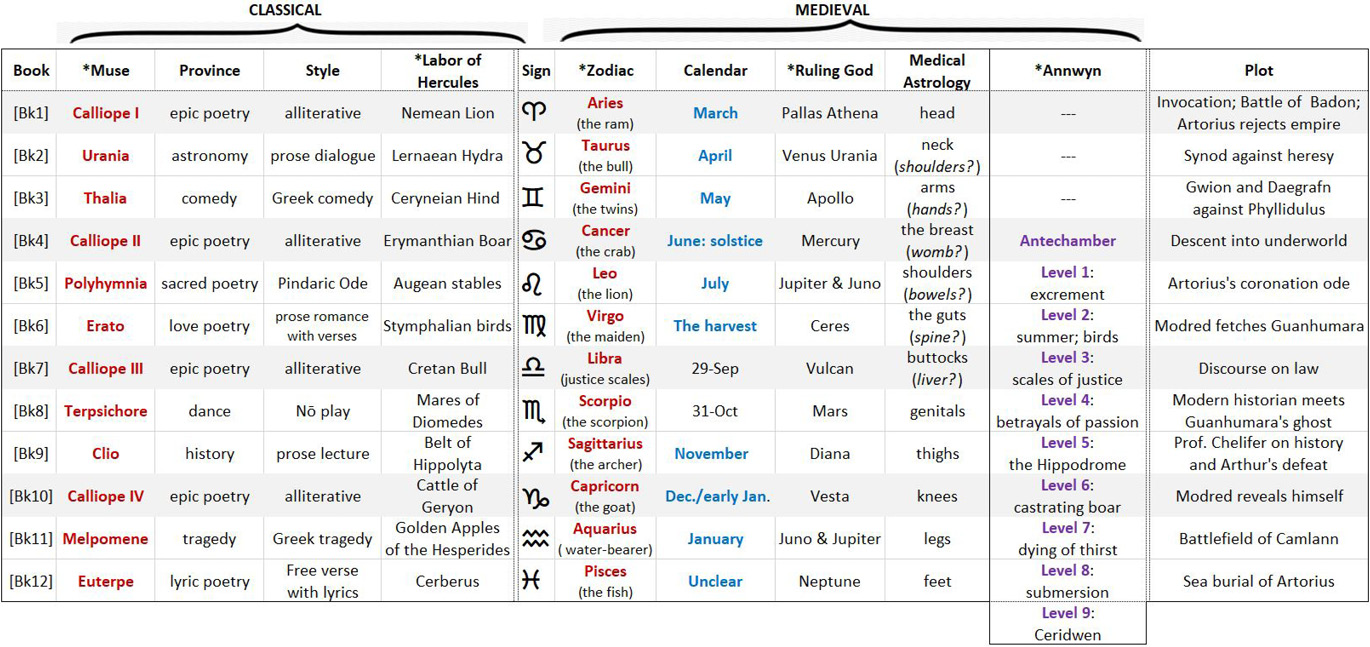
Major structures are denoted by an asterisk (*). Medical astrology is a minor structure.
My argument appears in two stages. In ‘Reading the Schema’, I briefly describe Artorius’s classical and medieval structures before outlining how these structures interact through a close reading of Artorius’s ninth book. Altogether, I show that Heath-Stubbs’s mythic method encourages a kind of semiotic overload that is more creatively suggestive than is rationally dissectible. Afterwards, I examine Artorius as anti-imperial text, defending my conception of the poem as a late modernist epic before, finally, linking Heath-Stubbs’s critique of empire to a view of history that is nine parts cyclical, one part teleological.
Reading the Schema
The Classical Structures
The most obvious structuring device in Artorius are the Twelve Muses. By tradition every epic should invoke a muse, but Heath-Stubbs – not wishing to offend any one goddess – prudently chooses to invoke them all. Calliope, however, takes pride of place. As the muse of epic poetry, she guides all four ‘books’ in Artorius; her sisters govern but a single section each. From his first lines, though, Heath-Stubbs quickly signals the irony with which he will employ traditional epic machinery. The invocation begins:
Take down, Calliope, your trumpet from its tack:
Rested has it long, and rusted? Give us a rouse, girl.[6]
Needlessly to say, Homer never pled the goddess’s favour via trumpet, and in fact these instruments only saw widespread usage during the late medieval period. Today they’re mostly associated with jazz ensembles and marching bands, not the music of the spheres or Dante wending his way through Hell’s nine circles. Perhaps Heath-Stubbs is crossing his fingers and hoping that Calliope will be grateful for having been roused at all, a new age’s divine Dizzy Gillespie. In any event, Heath-Stubbs frequently pairs irony with his own sincere classicism, lending his poem a touch of playfulness wholly absent from Eliot or Williams. By stratagems such as this, Heath-Stubbs hopes to enlist the reader’s sympathy for a poetic form – the epic – that, to modern ears, now seems almost unbearably archaic.
In Artorius, each Muse dictates the poetic form used within her section or book. The ‘Clio’ section appears as a lecture since the Muse of History speaks ‘in prose, though she plod’.[7] Likewise, ‘Polyhymnia’ is a Pindaric ode, ‘Melpomene’ a Greek tragedy, and so on. Nonetheless, every section demonstrates Heath-Stubbs’s experimental touch, his willingness to modify a classical form. The ‘Clio’ section is laced with surrealism, and ‘Terpsichore’ is marked by a form Heath-Stubbs probably learned from Yeats or Pound: the Japanese Noh. According to one critic, Yeats and Pound both considered Noh an Imagiste form of drama that, like Artorius as a whole, forsakes linear narrativity in favour of presenting one Image of increasing intensity; this Image should ideally hint at metaphysical permanence, a moment of transhistorical stability amidst the endless flux of things in time.[8] The same principle holds as true for ‘Terpsichore’ as for Yeats’s Noh plays: each abandons a ‘sense of progress and [instead presents] various ages in the past contemporaneously with the present’.[9] Heath-Stubbs accomplishes this feat by literally having his contemporary professor of history, C. Chelifer, encounter the ghost of Guanhumara (Guinevere) on an archaeological site on a desolate heath somewhere in northern England.
The four Calliope books deserve special mention for their metrical style. Rather than Miltonian blank verse or Greek hexameters, epic poetry’s two most traditional meters, Heath-Stubbs selects a greatly loosened form of Middle English alliterative meter.[10] During his Oxford days in the early 1940s, medieval languages and literature dominated the university’s English Syllabus, and several Oxford faculty members saw the alliterative meter as indigenous to the English nation. Indeed, one scholar whom Heath-Stubbs greatly admired, the Inkling C. S. Lewis, once praised ‘our native prosody’ over and against imported French-and-Italian meters from the continent.[11] Despite Heath-Stubbs’s core cosmopolitanism, then, his clear willingness to explore myths and literatures from across the western tradition, in his heart he held a special place for England and its ‘native’ prosody. In Artorius he even grants England a special tenth muse of his own invention, Chrysophone, whom he has preside over all English verse. No less than Calliope, this tenth muse inspires Artorius’s four narrative books in the alliterative meter. Heath-Stubbs thereby joins himself to a company as diverse in metrical form as Cædmon, William Langland, Shakespeare, Chaucer, Wordsworth, and Dylan Thomas.[12]
The second classical structure governing Artorius are the Twelve Labors of Hercules. These labours are, generally speaking, far less architectonic than the Twelve Muses, playing a comparatively small role in the overall text, but Heath-Stubbs cites them prominently near the end of his invocation. The life of Artorius, he implies, thus requires deeds as monumental as anything undertaken by ancient Greece’s greatest hero.
The Medieval Structures
As previously mentioned, my division of structures into classical and medieval is editorial, not authorial, yet it helps us better realise the sheer historical range of Heath-Stubbs’s erudition. No other modernist – certainly not Eliot or Williams – does anything quite comparable. In Artorius, Heath-Stubbs’s strongest medieval structure is the Zodiac, second only to the Nine Muses in terms of architectonic importance. The poet presents his astrological framework in the ‘Urania’ section. This section draws inspiration from a first-century Latin epic in five books, M. Manilius’s Astronomica, and although Heath-Stubbs did not himself take astrology seriously, he considered the subject essential for understanding ‘almost any poetry from the Middle Ages to the seventeenth century’.[13] He was probably heavily influenced in this view by C. S. Lewis, whose lectures on medieval cosmology and worldview (later published as The Discarded Image in 1964) Heath-Stubbs considered a ‘revelation’ for viewing the cosmos in ways ‘beside that of modern scientific humanism’.[14] Perhaps a more immediate influence than Lewis, however, was Spenser and the Numbers of Time by Alastair Fowler.[15] In a review, Heath-Stubbs admires Fowler’s argument that astrological symbolism pervades The Faerie Queene, and he later applies this insight in an essay of his own on The Shepearde’s Calender.[16]
Accompanying the Zodiac are two supplementary medieval structures: the ruling gods and medical astrology. Both derive from M. Manilius as well. A few interesting discrepancies, though, distinguish Artorius’s presentation from its source text – more than likely, Heath-Stubbs was relying on memory alone given his full blindness at that time. Notably, his source text for Manilius probably was not A. E. Housman’s Latin edition of Astronomica – Heath-Stubbs could not read Latin fluently – but, instead, Thomas Creech’s flawed 1697 English translation. Despite the inaccuracies of this latter version, only two minor errors creep into Heath-Stubbs’s ruling-gods structure. In ‘Urania’, St. Illtud observes that the sign of Leo is ruled by Jupiter and Juno,[17] but the actual deities according to Creech are Jupiter and Rhea, his mother.[18] Indeed, Creech’s pairing makes better sense for Leo: Rhea’s iconography often includes lions. Creech furthermore has the goddess Juno rule alone over Aquarius, but Heath-Stubbs once more pairs Juno with Jupiter, evidently misremembering a symmetry that did not exist.
In the medical-astrology structure, more severe discrepancies appear. Since Heath-Stubbs never describes this minor structure in Artorius, my main information comes from his Camelot Project interview given two decades after the fact, which I then compared against Creech’s original text (see Astronomica, Bk II, para. 27). Heath-Stubbs’s deviations are marked by italics:
the head is Aries, the shoulders Taurus, the hands Gemini, the spine and back Virgo, the stomach and womb Cancer, the bowels Leo, the kidneys Libra, the genitals Scorpio – that’s quite important in my scheme – the thighs Sagittarius, the knees Capricorn, the legs Aquarius, and the feet Pisces. It would be difficult to make this work exactly, but it does work roughly.[19]
In other words, Heath-Stubbs differs from Creech in exactly half his twelve Zodiac signs. Once again, a faulty memory can explain things, but, notably, neither his Camelot Project interview nor Creech wholly align with the text of Artorius, although the poem generally tends to confirm the interview. In ‘Gemini’, Heath-Stubbs mentions Lalage’s hand, and in ‘Cancer’ he compares Annwyn to a womb. Both sections therefore align perfectly with Heath-Stubbs’s interview. He does not mention bowels specifically in ‘Leo’, but this organ clearly pairs well with the Herculean labour of cleaning the Augean stables; likewise, although ‘Virgo’ lacks any specific reference to guts, spine, or back, Heath-Stubbs’s conversation between the Stymphalian Birds could well be hinting at corpses’ exposed intestines after a battle. Nonetheless, the Camelot Project interview is wrong in two respects. In ‘Urania’, Bishop Bedwini refers to the ‘nine necks’ of the hydra of heresy, which confirms Creech rather than the interview.[20] Both Heath-Stubbs and Creech, however, are wrong in ‘Libra’. Whereas Creech mentions buttocks and Heath-Stubbs kidneys, the text only names Julian the Apostate’s pierced liver.[21] Perhaps Heath-Stubbs conflated two similar organs in his recollection – like kidneys, livers help eliminate toxins from the body.
In any event, medical astrology holds the least architectonic sway of any structuring device in Artorius; hence, I call it a minor structure. Things are much different with our last medieval structure, perhaps the boldest one deployed by Heath-Stubbs overall: the traditional katabasis or descent into the underworld. Notably, before Milton settled on the Fall as his great theme, he once considered writing an epic on King Arthur – an ambition he expresses in Mansus:
Si quando indigenas revocabo in carmina reges,
Arturumque etiam sub terries bella moventum.
[If ever I shall summon back our native kings into our songs,
And Arthur, waging his wars beneath the earth.][22]
This quotation occurs as one of Artorius’s two epigraphs, so Heath-Stubbs thus takes Milton’s ‘wars beneath the earth’ quite literally. As Merddyn tells Artorius, there is precedent for such dangerous descents – they have been previously made by Aeneus and Scipio Aemilianus, and one will be made by Dante.[23] And like those other wayfarers, Artorius must have a guide – not Merddyn himself, but Anubis, Egyptian mythology’s dog-headed conductor of souls. This represents a clever choice by Heath-Stubbs. Historically, the deity who rules under Cancer – Hermes/Mercury – was so frequently linked with Anubis in Roman Egypt that they were eventually syncretised into a single deity: Hermanubis.
Yet Artorius’s specific trek through the underworld owes its greatest debt, not to The Aeneid or Somnium Scipionis, but to Inferno. Like the Hell imagined by Dante, Annwyn subdivides into nine levels and an antechamber. Each foretells a future situation in Artorius’s kingship. What makes this structuring device so unusual, however, is its relative lateness in the text. Although it shapes Books V–X11 in Artorius strongly, it touches nothing beforehand. In my final section, I’ll suggest that Heath-Stubbs uses this lateness as a way to signal the advent of Christ’s Nativity into history, a divinely mandated ‘correction’ to endlessly repeated cyclicity, but for now, let me emphasise one particular structural oddity about Artorius’s underworld sojourn. Annwyn has nine levels … but the poem only has eight books remaining. There is thus nothing in Artorius that corresponds with its hero’s culminating encounter with Ceridwen. This event seems to happen outside History, perhaps in mythical time or even absolute time. Accordingly, my schema in Figure 1 formally excludes this ninth level. From this uniquely ahistorical vantage point, however, King Artorius receives – no less than does Virgil’s Aeneus and Milton’s Adam – a vision of futurity: the next fifteen centuries in the history of Great Britain.
How the Structures Interact: ‘Clio’
By this point, readers have surely noticed that no specifically modern symbolic superstructure graces the formal architecture of Artorius. Instead, modernity suffuses the text as a whole. Far from a straight – yet stylistically experimental – historical poem, Artorius continuously affirms the unity of symbols across historical time. The mythic method does for Heath-Stubbs as it does for Joyce: it grants order and significance to the ‘immense panorama of futility and anarchy which is contemporary history’.[24] The anachronisms brought by Artorius into 6th-century Britain, though, are intellectual rather than material. As already mentioned, Merddyn proleptically invokes Dante’s Inferno, but Heath-Stubbs also has Cerdic of the Saxons extol the proletariat and rail against tax-gatherers; parodies F. R. Leavis in ‘Thalia’; and surveys Western political thought in ‘Calliope III’. This latter includes a state sanctioned by religious myth (Bishop Bedwini); Shelley’s notion of poets as legislators (Gwion); Thomas Hobbes (Gerontius); Sir Robert Filmer (Urbigena); John Locke (Gaius); royalism (Gwalchmai); socialism (Flaccus); and imperialism (Modred). The poet Gwion even critiques utopianism via references to Plato, Thomas More, and Francis Bacon.[25]
With these symbolic superstructures in mind, readers now have everything required to analyse how they operate within a single section of Artorius. Here I’ll consider the structures in ‘Clio’, which according to Figure 1 are:
Muse: Clio, the muse of history
Style: prose lecture
Herculean labour: Belt of Hippolyta
Zodiac: Sagittarius, the archer
Ruling God: Diana
Body part: thighs
Annwyn: the Hippodrome (level 5)
The prose-lecture format makes easy sense. Ever since Herodotus and Thucydides, historians have traditionally written in prose, so it’s a good method for discussing Arthurian historiography. Among the authorities cited by Professor C. Chelifer are E. K. Chambers (1866–1954), R. G. Collingwood (1889–1943), Geoffrey Ashe (1923–2022), and Beram Saklatvala (1911–1976). Yet the professor’s first initial, C., stands for ‘Cheiron’, which aligns this section with its Zodiac sign. Cheiron was the wise centaur who tutored Achilles, and the traditional association of centaurs with archery brings them under Sagittarius.
At the same time, a touch of surrealism continually disrupts Chelifer’s lecture. In the prior section, he had encountered Guanhumara’s grief-stricken ghost, and her laments disorder his thinking. Surrealism is a thoroughly modernist technique, of course, but it enables Heath-Stubbs to fulfil his remaining structures. Otherwise, the professor’s random utterance – ‘Onward, Christian solders, Amazons of the spirit, votaries of Diana’ – would make little sense, but it connects the medieval legend of St. Ursula’s eleven thousand virgins to a Herculean labour (Queen Hippolyta of the Amazons) and the Ruling God (Diana, a virgin goddess and hunter who, like centaurs, is skilled at archery).[26] Through this schema, moreover, readers can unlock other obscure references. Although the professor admits that the Huns have no bearing on his subject, as ‘nomad archers of the steppes … so entirely dependent on their horses as to be almost permanently united to them’, they are explicitly linked to centaurs. Indeed, toward the end of Chelifer’s lecture, his stream of surreal associations come so rapidly that Heath-Stubbs clearly is appealing to intuition, not reason.[27] The ultimate effect is one of rapid-fire equivalencies, x = y = z, and the medical astrology structure enters via this method as well. When the professor concludes by mentioning the ‘waste land and the dolorous blow’, Heath-Stubbs invites his audience to remember that, in Arthurian tradition, the dolorous blow had been struck to the king’s thigh.[28]
Yet the Annwyn superstructure constitutes Heath-Stubbs’s deftest use of structuring device. Thematically, Artorius’s ninth book signals the point of no return in Artorius’s imperialism – the moment he makes his fatal decision to invade Byzantium. There’s no historical or even medieval literary precedent for Artorius (or Arthur) attacking the Emperor Justinian. Nevertheless, two factors tell us that this decision occurs ‘in’ this section. Our first clue hails from Professor Chelifer himself. His lecture concludes with naming himself, ‘Taliesin-Tiresias, churchwarden in Gloucester Road or proof-reader for the Press’, a statement which thereby creates a triune poetic identity between Heath-Stubbs, Eliot, and Williams.[29] At various points in Artorius, Heath-Stubbs variously adopts the alter egos of Chelifer, Taliesin, and Tiresias. Likewise, it was Eliot who, after divorcing Vivienne Haigh-Wood, briefly served as churchwarden at St Stephen’s Church on Gloucester Road, and Williams who worked for Oxford University Press. (This latter poet, moreover, was the first author to link King Arthur with Byzantium.) Even if readers miss this exceedingly obscure triune identity, Heath-Stubbs’s Annwyn structure provides a second, better hint. When Artorius reaches the Welsh underworld’s fifth level, he meets a ‘harlot for the whoremasters of the Hippodrome’ – i. e., the Empress Theodora, Justinian’s wife.[30] Yet this Annwyn-empress, another huntress like Diana, transforms suddenly and nightmarishly into a cat, and she snaps Artorius’s spine as if he were a mouse. By this action readers know that Byzantium will eventually throw back Artorius’s armies, specifically in the ‘Clio’ section that aligns with it, and thus break the Ymheradwr’s power.
As Artorius lays paralyzed by the Annwyn-Theodora on Annwyn’s fifth level, though, the following words appear as if out of nowhere:
A prim and pedantic and prosy voice,
In a lengthy discourse growing louder and louder,
For futurity defined his defeat and his failure.[31]
Within the context of ‘Calliope II’, this passage makes no sense … but the ‘prosy’ voice, of course, belongs to none other than Professor C. Chelifer, the historian. His unusual surname, moreover, invokes the family Cheliferidae, the genus name for pseudoscorpions. The professor even calls himself a ‘harmless book-scorpion’, essentially stingless, but Artorius’s treacherous nephew Modred, whose coup takes place under the sign of Scorpio, will bear a deadlier sting by far.[32] Nonetheless, this distant, subtle link between Modred and the professor suggests that some historians are less harmless, or less ineffectual, than they might suppose. Centuries after Artorius’s downfall, in ‘long futurity’, it is historians – not traitors like Modred – who will muster meaning out of the king’s grievous fate. Perhaps their careful weighing of evidence will garner nothing more than a ‘matter for lays, and for lyrical laments’, as indeed happens in much Arthurian literature.[33] Still, their judgements will last until history’s end.
Artorius and the Philosophy of History
Artorius as Late Modernist Epic
To this point, I’ve argued that the symbolic superstructures shown by Figure 1 create a kind of semiotic overload within Artorius, nudging readers toward accepting that all mythic symbols and archetypes are basically equivalent: x = y = z. To this interchangeability Heath-Stubbs adds fervent stylistic anachronisms that help merge the modern with the medieval and the classical. Yet to what end? I shall now argue that Heath-Stubbs welds a muted Christian teleology into his overall theory of cyclical history, yet he directs this unique synthesis to a British nation struggling to understand its own postimperial position. Before getting to that argument, though, let me briefly address my designation of Artorius as a modernist epic. Nowadays, although questions about whether a text counts as modernist or not have grown rather tired, I can still imagine some obvious objections to either term in my phrase ‘modernist epic’. For one thing, Heath-Stubbs himself avoided calling Artorius an epic. It was the sequence, he believes, that is the ‘characteristic twentieth-century poetic form’. Examples include The Waste Land, Taliessin Upon Logres, and Tennyson’s Maud.[34] Second, since many critics still typically associate literary modernism with avant-garde work produced between the world wars, calling any text published in 1973 ‘modernist’ seems like a stretch at best.
The overall epic character of Artorius, though, seems relatively straightforward. Epic machinery pervades the text: an invocation, a katabasis, a foretelling of future history, a council with speeches, a great theme, a hero-centred narrative. Even when Heath-Stubbs wryly subverts epic machinery, he advertises his awareness of it. Battles are a major part of most epics, for example, but Artorius’s speaker loudly calls attention to his complete disinterest in describing the Battle of Badon. As he archly tells the goddess Calliope, ‘Murder in the mass is no matter fitting / For a maiden lady, like you, to muse upon’.[35] The speaker does something similar, more discreetly, in the ‘Melpomene’ section. As in genuine Greek tragedy, the main action – in this case, the Battle of Camlann – occurs off-stage. Yet, rather than in simply possessing epic machinery, Heath-Stubbs believes that an epic’s essence lies in having central events that conform
to a basic mythic pattern or archetype, such as is reflected in religious ritual and symbolism. The event is one in which the whole community feels itself to have participated, and which is the type and source of its present and future destiny.[36]
In contrast to Milton, who abandoned King Arthur as an epic subject after beginning to doubt Arthur’s historicity, such dubious historicity becomes a virtue for Heath-Stubbs.[37] It allows him to seek out the mythic, to bypass the particular for the universal. Thus Heath-Stubbs can present his hero’s life as a ‘paradigm, his passage, / Like the sun, through symbols’ without regard to verifiable individual details.[38] His Artorius does not have a genuine personality. Neither is he just one king, his empire just one empire – instead, Artorius is all kings, and his realm all realms. Historical ‘facts’ thereby become epiphenomenal under this archetypal perspective, and Artorius guides its readers on a phantasmagoric journey through symbols. Even symbols derived from Heath-Stubbs’s own Christian faith are not exempt. When Bishop Bedwini recounts his parable about the angel and the king in ‘Calliope III’, Gwion immediately recalls its similarity to the tale of Pwyll from the Mabinogion: both stories partake of the mythic archetype of sacrificial kings.[39] Likewise, Heath-Stubbs equates Pallas Athena with ‘another Parthenos’, i. e. the Virgin Mary,[40] and both women to the virgin Sinora, a woman from Cornish legend who is equally ‘Christian votaress’ and ‘Druid lady of the standing stones’.[41] All three figures are incarnations of divine femininity, suggests Heath-Stubbs, and thus participate in the White Goddess archetype identified by Robert Graves.[42]
So categorizing Artorius as an epic seems easily justifiable, but my further description of modernist requires more defence. If we see modernity and postmodernity as periodizing concepts only, then Artorius’s 1973 publication puts it firmly in the latter “postmodern” category – a product of late capitalism, as Fredric Jameson would say. Or we could view Artorius as postmodern in terms of its literary poetics. According to Amy J. Elias in Sublime Desire, a ‘metahistorical romance’ seeks the impossible: the ‘past itself as a situating, grounding foundation for knowledge and truth’.[43] If historical writing is nothing but a type of fiction, an active construct by historians rather than a means by which one can articulate history-in-itself, then metahistorical romances yearn to bypass this situation and do the impossible: capture the historical sublime. In many ways, this seems to describe Artorius’s treatment of history. Heath-Stubbs even deploys several techniques commonly associated with postmodern poetics, including blatant self-referentiality and highlighting the fictiveness of his text.[44] Moreover, Heath-Stubbs utterly abandons the interiority often associated with literary modernism. Instead, he focuses on the fragmentation of history itself, particularly in ‘Clio’ when Professor Chelifer deconstructs Arthurian historiography. Given all these factors, Artorius seems postmodern through and through.
Nonetheless, we cannot ignore Heath-Stubbs’s mythic method or his structural debt to Joyce. In this regard, Anthony Mellors’s concept of ‘late modernism’ is a useful one; it provides a mediating aesthetic between postmodernism and high modernism. In Mellors’s view, modernists usually affirm that a mythic consciousness can allow humanity to ‘recover and participate in natural processes rather than symbolizing the division between human significance and a chaotic universe’. Modernists therefore upheld ‘mythic values against perceived threats to selfhood and community’.[45] In contrast, postmodernists usually try to see myth as ideology.[46] Given how sincerely Heath-Stubbs employs mythic archetypes (despite his customary, semi-self-mocking irony), Artorius clearly demonstrates a greater affinity with the modernist perspective. Indeed, his metafictionality notwithstanding, Heath-Stubbs consistently sees symbols as viable pathways to a numinous core reality that transcends historical or cultural particularity – a viewpoint he owes partly to Williams and Joyce. At one point he even paraphrases one of Joyce’s most famous lines from Ulysses. In that novel, Stephen Dedalus proclaims history ‘a nightmare from which I am trying to awake’.[47] A similar dismay is expressed by Gwion when he contemplates two dialectical dragons, Gwyrthyr ap Greidawl and Gwynn ap Nudd, from whom
… all our myths
And the horrors of our history, howsoever it is told,
Are images of their dream, the dialectic of those dragons.[48]
If history is a form of traumatic nightmare, as Gwion and Stephen claim, then Artorius affirms that poets – whether Stephen Dedalus, Gwion, or Heath-Stubbs himself – can alleviate that nightmare through poesis or art. Poetic orders are castles made of sand, perhaps, but at least they are castles for a time.
For Mellors, what ultimately distinguishes late modernists (i. e., those authors writing between 1945 and 1975, roughly) from earlier modernists is politics. The Second World War had forced newer poets to reconsider the illiberal and reactionary views of interwar modernism.[49] By Heath-Stubbs’s time, the fascism of Pound had grown thoroughly discredited. Of course, Heath-Stubbs leans conservative himself. In one obituary, his friend Michael Meyer calls him a ‘self-confessed – and at times self-parodying – reactionary and arch-royalist’.[50] Nonetheless, modernists such as Yeats and Pound championed cyclical theories of history because they yearned for some sort of return to an ancient organic unity. Nothing like that appears in Artorius. Although Heath-Stubbs certainly distrusts liberal-secular progressivism (his character Flaccus, for instance, a socialist, plots with Modred), Heath-Stubbs buttresses his cyclicity philosophy of history with a view that all political orders are ultimately imperfect and ephemeral. Let the cycles of history turn as they may, placing one’s hope in an ancient order is just as problematic as placing one’s hope in a future one. Thus does Artorius proffer a grand narrative of history that, through symbol and myth, incorporates and explains the collapse of Great Britain as an imperial power, a historical fall from grace where nothing remains to them now except a ‘tedious decline, / With two rival crews of contending rats’, i. e., the Labour and Tory parties.[51] In order to motivate this reading of Artorius, I’ll now turn from the text’s symbolic superstructures to the vision of history which Heath-Stubbs presents in his late modernist epic.
Empire and Its Discontents
When the Suez Crisis broke out in Egypt in 1956, Heath-Stubbs was there teaching at the University of Alexandria; he thus witnessed the event that many historians claim signified the end of Great Britain’s tenure as a world power. In fact, Heath-Stubbs was one of the few foreign nationals not to be expelled during the crisis.[52] Besides his university affiliation, which was a significant factor, what helped him were his close ties with the local Muslim and Coptic communities. As one former Egyptian student recalls, unlike
other British lecturers before him, who preferred to live on the city’s margin, he led an active life, enriched with interesting contacts with different social groupings […] those who lived in villas […] and with modest villagers, his students’ families.[53]
With this background in mind, it is perhaps easier to grasp the anti-imperial dimension of Artorius. Heath-Stubbs does not celebrate empire. When Artorius styles himself a Comes (or count) after the Battle of Badon, the realm flourishes. It even survives his crowning in ‘Polyhymnia’. After Modred, however, urges a ‘civilising mission’ upon his uncle to expand Artorius’s kingdom into an empire, the Ymheradwr’s fall happens quickly.[54] Heath-Stubbs foreshadows this fate in an earlier tale about King Minos of legend. According to Merddyn, the Cretan king currently serves as a righteous lawgiver in Hades, but during life Minos had been cursed with the Minotaur as divine punishment for his ‘lust and covetousness’.[55] Merddyn thus hints at two separate analogies. In the first analogy, he links Modred to the Minotaur through their monstrous, unnatural births – incest for one, bestiality for the other. In the second analogy, he links Artorius with King Minos. Although Artorius will eventually gain legendary fame – like Minos – as a lawgiver, his final mortal years will be cursed by an unholy sin. In Artorius, that sin is empire.
This anti-imperial stance is reflected in Heath-Stubbs’s cyclical vision of history. Generally, cyclical theories reject at least three key propositions:
that historical change is cumulative;
that chronologically later periods are superior to earlier periods; and
that significant change or progress occurs over time.[56]
These propositions distinguish cyclical theories of history from linear ones, which nonetheless come in various shapes and sizes: eschatological, teleological, Whiggish, Marxist, Providential, etc. What such theories share, though, is a belief that the future will be demonstrably different from the past – usually, though not always, for the better. In contrast, cyclical theories deny any such irrevocable difference, and they reject any fundamental incommensurability between past and present. Although Heath-Stubbs does hint at a kind of muted Christian teleology, this hint is extremely muted, and it impinges only on Artorius’s outermost edges. Otherwise, Heath-Stubbs’s epic overwhelming emphasises a cyclical historical vision.
As per his usual method, Heath-Stubbs presents historical cyclicity in multiple ways. The first and most obvious is structural: the Zodiac, i. e. the Celestial Wheel. Wheels, of course, rotate, and their revolutions can go on forever. Since the stars govern all fate, the paradigmatic life of Artorius will be repeated again at some future time. Ancient authors assumed such cyclicity as a matter of course, but among modern philosophers, the major proponent has been Vico. Joyce borrows heavily from Vico, notably, and Heath-Stubbs from Joyce. As with Finnegans Wake, Artorius is a text that comes full circle. It both begins and ends with the same phrase: ‘Take down, Calliope, your trumpet’.[57] Yet Heath-Stubbs also presents cyclicity through reference to Ovid’s Four Ages of Man, creating a direct parallel between Artorius’s imperial ambitions and the twilight of the modern British Empire. In Metamorphoses, Ovid had recounted the four ages – gold, silver, bronze, and iron – as a tale of steady decline unto his present day. Heath-Stubbs modifies this conception by envisioning his current century as a latter-day ‘Iron Age’, a time when war – he means the two world wars – had become ‘less human, more horrible and more hideous’.[58] Lest this be too subtle, the poet adds that the ‘wheel is in motion, willy-nilly we march on / To the uses of artillery, and atomic overkill’.[59] Progress is a myth; ‘mutability masters us’.[60]
The third marker of cyclicality in Artorius comes via Heath-Stubbs’s conceit of ‘Three Dark Ages’. The notion of a dark age, of course, which Petrarch first coined, does not imply cyclicity on its own, yet for Heath-Stubbs it connects three separate historical collapses of civilization: Minoan-Mycenæan Greece (11th century BC); the Western Roman Empire (5th century AD); and modernity, a period whose decline, according to Professor C. Chelifer, began in either 1945, 1914, or 1789.[61] In any event, Artorius treats its three alleged Dark Ages as thematically equivalent. The Second Dark Age mirrors the First when Myrddin draws a parallel between King Arthur and King Minos, and Heath-Stubbs draws a further parallel between Arthur’s fallen kingdom and the disintegration of the British Empire. Nevertheless, from the First Dark Age arose an epic poet afflicted with blindness, Homer, and from the Third Dark Age arises its own blind epic poet: Heath-Stubbs himself. In the text’s boldest and most self-referential passage, Gwion muses on the necessary conditions for epic poetry in the future:
We evoke an order: an interim is assigned –
As a poet, perhaps, in the future predicament
Of the doubtfulness and dullness of a Third Dark Age
Might undertake the unfashionable inditing of an epic,
Though his colleagues and his confrères confined themselves merely
To little linguistic and logical constructs,
Or deployed their egos in the Dionysiac delirium
Of surreal illumination, or psychedelic self-indulgence –
He might establish an order, by the example of his experiment,
Driving his through-road across the thickets of thoughtlessness,
And he also if temporarily, might turn the tide –
But they come back, they come back again, those currents of meaninglessness;
Language lags, and languishes away –
The Daughter of Chaos reconsolidates her reign,
Universal Darkness, and delivers it to the dunces. (emphasis added)[62]
Despite the writing of epics being unfashionable today, Heath-Stubbs sees little choice given the allegedly dismal state of modern verse. He hold the Beats (‘psychedelic self-indulgence’), automatic writing (‘surreal illumination’), and the New York School (‘linguistic and logical constructs’) in little regard.[63] Yet this passage also articulates a vision of poets coming together to evoke order through art. Against the ravages of Chaos’s daughter, Chance or Tyche, an interim order can be forged. Of course, such orders cannot last forever. Inevitably, meaning gives way to meaninglessness; the cycle must continue. But poeisis provides temporary hope.
Still, one bare means exists by which humanity can escape history’s mutability. Soon after Heath-Stubbs describes Ovid’s cyclical Four Ages in ‘Calliope III’, his passage turns to the Roman festival of Saturnalia. The pagan Romans celebrated this holiday at winter solstice, and Christians later absorbed these rituals into Christmas. From this exemplary syncretism, though, comes Artorius’s sole hope of historical teleology:
The stable, for once, was the centre of the world;
Not the dialectical dragons, but the dumb ox
And the ass in humility, hung their heads
By a manger of straw, where Mary the Mother
Looked at her Love and hushed Him with a lullaby.
From the Solstice of Capricorn the Cross stems up,
The ends of the transom transfixing the equinoxes,
The summit at Cancer – Christ in the circle
Of the stars of fatality, to ensure our freedom,
Slain for our salvation, in the celestial wheel,
From the foundation of the world; He was found worthy. […]
Not the mirth of Saturn’s mythical magisterium,
But the felt prescience of a possible freedom
Eschatologically offered at the end of the ages,
Whose shoots are burgeoning, and begin now to show.[64]
With that opening pun on stable, Christ’s Nativity introduces a new directionality into history. Against the perpetual and purposeless succession of events in time, the endless cycle, the ox and the ass provide a potential alternative to Gwyrthyr ap Greidawl and Gwynn ap Nudd, the dialectal dragons whose dreams, says Gwion, are the ‘horrors of our history’. I emphasise ‘potential’. Traditionally, Christian historians have seen the Nativity as the moment when eternity enters history, but Hearth-Stubbs suggests something different. In Artorius, the Nativity does not change human history – it only promises (‘guarantees’) freedom at the ‘end of the ages’.[65] Only someday, in other words, can humanity choose other than what the Celestial Wheel ordains … but that time certainly is not now. Nor can we imagine when that time might be. There is no ‘Christian historicism’ in Artorius – only a vague promise of eschatological freedom of the will at history’s end.
Yet such vague hopes offer little consolation for anyone still trapped by history, ruled by fate, and governed the Celestial Wheel. This is where Heath-Stubbs finds amor fati – Nietzsche’s Eternal Recurrence of the Same – a useful concept. Freedom consists in actively choosing our fates despite those fates’ predetermination. In Hindsights, Heath-Stubbs admits to having read ‘quite a lot of [Nietzsche] when a boy’, and he comes closest to articulating this love of fate in Artorius during Artorius’s death scene.[66] Wishing to aid and comfort his king’s departed spirit, the loyal Bedwyr says
[…]. But I must not:
We stand as sentries, and the order
For knock-off is not yet given.
And I have his orders too. I go
To throw the bitter sword [Caliburn] into the bitter lake.
By that gesture, I affirm, on his behalf,
My own and his existence – not bound
By myth, the starry returning wheels.[67]
Through this affirmation, Bedwyr chooses voluntarily to fulfil his remaining duties because of the uncritical love he bears for Artorius, his lord. I do not read Heath-Stubbs as saying that Bedwyr literally unbinds himself from the ‘starry returning wheels’, since that would contravene the entirely of Artorius, yet, despite the intransigence of the Celestial Wheel, Bedwyr actively chooses the role that necessity has allotted him: the orders that bind and obligate him.
A muted double vision of freedom thus appears within Artorius. One is an eschatological but complete freedom at the end of time, and the other is a lesser freedom obtaining within concrete historical time. Both, though, are compatible with historical cyclicity. By way of analogy, let us imagine a coin set spinning on a tabletop. Several simultaneous motions apply to this coin. One motion, of course, involves the coin rotating rapidly along its own axis. Another motion is the coin as it circles the tabletop. (Technically, as friction from the tabletop slows down the coin, these circles will grow wider, but for now let’s ignore the impact of friction.) In this analogy, the spinning coin represents the Celestial Wheel, which rotates along its own axis in perpetuity. The Celestial Wheel, though, like the coin on the tabletop, follows a secondary circular path through the cosmos. With the Nativity, however, a third motion is introduced into this complex system. Now imagine that the table in our analogy suddenly starts moving forward in linear fashion. For the Celestial Wheel, its primary and secondary motions – its circular rotations – remain in force, but this third linear motion is goal-directed: it seeks the freedom promised by the Nativity. In this way, Artorius maintains the cyclical vision of history conveyed by its symbolic superstructures, but a light appears at the end of history’s tunnel.[68]
The outstanding virtue of Heath-Stubbs’s system is how well he reconciles pagan ways of thought with Christian ones. Whereas Milton had condemned all pagan deities as devils, Heath-Stubbs supports a wider tolerance. Although the Nativity enjoys a special status in Artorius, the poet sees all religions – including Christianity – as partaking in universal mythic archetypes … and Heath-Stubbs’s Annwyn structure, which significantly does not take effect until Artorius’s fourth book, structurally parallels the late arrival of the Nativity on the world-historical stage. With this observation, then, I wish to conclude. As suggested, most readers have probably overlooked Artorius because of its great difficulty, and this rich, fascinating late modernist epic has, sadly, never enjoyed the paratextual aids that have eased critics or other readers into the text. In the first half of my article, I therefore supplied one such paratextual aid with Figure 1. Nonetheless, Heath-Stubbs’s classical and medieval superstructures are more than just late modernist window-dressing for a poetics of difficulty. They actively contribute to a remarkable synthesis of the ancient, the medieval, and the modern. Artorius then applies this synthesis toward a stoic endurance of postimperial Great Britain – a moment witnessed personally by Heath-Stubbs during the Suez Crisis – by rejecting imperialist nostalgia and coming, finally, to terms with the sinfulness of human empire.
About the author
Dennis Wilson Wise is a professor of practice at the University of Arizona. His research focuses mainly on epic fantasy, Tolkien in particular, and encompasses over two dozen peer-reviewed articles. He has earned awards for teaching, for research, and for service, and he was the reviews editor for Fafnir: Nordic Journal of SFF Research when it became the first academic journal to win a World Fantasy Award. In addition, Wise published his first book, Speculative Poetry and the Modern Alliterative Revival: A Critical Anthology, in 2024.
Bibliography
Christopher, Joe R., ‘John Heath-Stubbs’ Artorius and the Influence of Charles Williams: Part I’, Mythlore, 13.2 (1986), pp. 56–62Search in Google Scholar
–, ‘John Heath-Stubbs’ Artorius and the Influence of Charles Williams: Part II’, Mythlore, 13.2 (1987), pp. 51–57Search in Google Scholar
–, ‘John Heath-Stubbs’ Artorius and the Influence of Charles Williams: Part III’, Mythlore, 13.4 (1987), pp. 51–56Search in Google Scholar
Elias, Amy J, Sublime Desire: History and Post-1960s Fiction (Baltimore: Johns Hopkins University Press, 2001)Search in Google Scholar
Eliot, T. S, ‘Ulysses, Order, and Myth’, in Selected Prose of T. S. Eliot, ed. by Frank Kermode (New York: Harcourt, 1975), pp. 175–178Search in Google Scholar
Every, George, ‘History in Artorius’, Aquarius, 10 (1978), pp. 66–7110.1080/0022062780100208Search in Google Scholar
Heath-Stubbs, John. ‘The Cauldron of Ceridwen’. Rev. of The White Goddess, by Robert Graves, The New English Weekly, vol. 33, no. 13, 8 Jul. 1948, pp. 139–40.Search in Google Scholar
–, Collected Poems: 1943–1987 (Manchester: Carcanet, 1988)Search in Google Scholar
–, ‘The Folklore I Grew Up With’, Folklore, 107 (1996), pp. 1–310.1080/0015587X.1996.9715909Search in Google Scholar
–, Hindsights: An Autobiography (London: Hodder & Stoughton, 1993)Search in Google Scholar
–, The Literary Essays of John Heath-Stubbs, ed. by A. T. Tolley (Manchester: Carcanet, 1998)Search in Google Scholar
–, ‘Preface’, in Collected Poems: 1943–1987 (Manchester: Carcanet, 1988), pp. 21–26Search in Google Scholar
Joseph, Jenny, ‘Artorius’, Aquarius, 23/24 (1998), pp. 80–84Search in Google Scholar
Joyce, James, Ulysses (New York: Vintage International, 1990)Search in Google Scholar
Lewalski, Barbara K., The Life of John Milton: A Critical Biography, rev. edn. (Oxford: Blackwell, 2000)Search in Google Scholar
Lewis, C. S., ‘The Idea of an “English School”’, in Rehabilitations and Other Essays (Oxford: Oxford University Press, 1939), pp. 59–77Search in Google Scholar
–, The Discarded Image: An Introduction to Medieval and Renaissance Literature (Cambridge: Cambridge University Press, 1964)Search in Google Scholar
Lindop, Grevel, Charles Williams: The Third Inkling (Oxford: Oxford University Press, 2015)Search in Google Scholar
M. Manilus, Jacob Tonson, The Five Books of M. Manilius Containing a System of the Ancient Astronomy and Astrology, trans. by Thomas Creech in Early English Books Online <https://proquest.libguides.com/eebopqp> [accessed 28 May 2023]Search in Google Scholar
Megally, Shafik, ‘A Poetic Vision of Alexandria’, Aquarius, 23/24 (1998), pp. 31–35Search in Google Scholar
Mellors, Anthony, Late Modernist Poetics from Pound to Prynne (Manchester: Manchester University Press, 2005)Search in Google Scholar
Meyer, Michael, ‘John Heath-Stubbs [Obituary]’, The Guardian, 28 December 2006, <www.theguardian.com/news/2006/dec/29/guardianobituaries.booksobituaries> [accessed 30 January 2024]Search in Google Scholar
Soud, W. David, Divine Cartographies: God, History, and Poiesis in W. B. Yeats, David Jones, and T. S. Eliot (Oxford: Oxford University Press, 2016)10.1093/acprof:oso/9780198777779.001.0001Search in Google Scholar
Thompson, Raymond H., ‘Interview with John Heath-Stubbs’, in The Camelot Project, (Rochester: Robbins Library, 1989) <https://d.lib.rochester.edu/camelot-project> [accessed 7 April 2023]Search in Google Scholar
Van Domelen, John E., The Haunted Heart: Nine Essays on the Poetry of John Heath-Stubbs (Salzburg: University of Salzburg, 1993)Search in Google Scholar
Williams, Louise Blakeney, Modernism and the Ideology of History: Literature, Politics, and the Past (Cambridge: Cambridge University Press, 2002)10.1017/CBO9780511485350Search in Google Scholar
© 2024 the author(s), published by Walter de Gruyter GmbH, Berlin/Boston
This work is licensed under the Creative Commons Attribution 4.0 International License.
Articles in the same Issue
- Titelseiten
- L’exception saxonne: le curieux cas d’Ariohan dans le Cycle de Guiron le Courtois
- Hither and Yawn: Malory’s Drowsy Lancelot in the Morte Darthur – ‘shew me somthynge of that I seke’ (MD 773.23–26).
- The Linguistic Provenance of the Hebrew King Arthur (1279) Reassessed
- L’annominatio en question dans quelques textes arthuriens en vers (xiie-xiiie siècles): généralités et applications à l’étude des rimes
- The Onomasticon Arthurianum (et similia). State of the art of a chimera
- A Schema for Artorius: History, John Heath-Stubbs, and the Last Modernist Epic
- Notice
- The Japanese Branch of The International Arthurian Society. Part One. General Issues and English
- ‘And I am more than this man can comprehend’: Contemporary Arthurian Texts & Resistance to White Supremacy
Articles in the same Issue
- Titelseiten
- L’exception saxonne: le curieux cas d’Ariohan dans le Cycle de Guiron le Courtois
- Hither and Yawn: Malory’s Drowsy Lancelot in the Morte Darthur – ‘shew me somthynge of that I seke’ (MD 773.23–26).
- The Linguistic Provenance of the Hebrew King Arthur (1279) Reassessed
- L’annominatio en question dans quelques textes arthuriens en vers (xiie-xiiie siècles): généralités et applications à l’étude des rimes
- The Onomasticon Arthurianum (et similia). State of the art of a chimera
- A Schema for Artorius: History, John Heath-Stubbs, and the Last Modernist Epic
- Notice
- The Japanese Branch of The International Arthurian Society. Part One. General Issues and English
- ‘And I am more than this man can comprehend’: Contemporary Arthurian Texts & Resistance to White Supremacy
