Of saints and ancestors: The ethnopragmatics and cultural semantics of religious terms
-
Felix K. Ameka, PhD (ANU, Canberra). He is CIPL/CIPSH Chair Professor Emeritus, Ethnolinguistic Vitality and Diversity, Leiden University. He is a socio-cultural-cognitive linguist. His research focuses on the meaning (semantics and pragmatics) of linguistic signs. He has published on the lexicon, grammar, (ethno-)semantics, (ethno-)pragmatics, and language contact of West African languages. He is a Fellow of the Ghana Academy of Arts and Sciences, Australian Academy of Humanities, and Academia Europaea.


Abstract
The encounter between Christianity and the Gbe people of the Gulf of Guinea dates back to the middle of the 17th century, with the translation of Doctrina Christina into Aladagbe (Benin). In the encounters of Christian missionaries in their evangelization with the Ewe (Gbe group), both interlocutors have sought to make meaning through language and practices. However, there was a systematic attempt to separate Christian concepts and understandings from the local cultural concepts and treat the latter as demonic. In the process of inculturation of Christianity (in Africa), many such distinctions are contested. One such contested issue is the parallel between “ancestors” and “saints” in Christian thought. In this paper I undertake an ethnopragamtic and conceptual analysis of the Ewe term for ancestors, and compare it to the concept of saints. I conclude by advocating that conceptual analysis of the religious terms across cultures should be done as a prerequisite to inculturation.
1 Introduction
In missionization it is typically assumed that the Christian conceptual world is alien to the missionized. It is also assumed that the religious concepts and values are alien to the cultures. No attempt is made to understand the existing world in order to see if there are any similarities or overlap in content that would facilitate the introduction or transfer of knowledge from one system to the other. The existing system is demonized. As the Ghanaian social anthropologist and theologian Emeritus Archbishop Sarpong (1975: 33) notes,
Belief in the spirits of the dead and in their influence over the living is found among all peoples, and in every conceivable religion and culture. … Belief in ancestors and their veneration are therefore not peculiar to any age, religion or society. … When Christians call their dead saints and refer to those of pagans [sic] ancestors, they are not expressing different ideas. Both words express ideas about people who once belonged to their religious group, are now dead, and are supposed to be in a position of influence over the living.
Grosso modo, Emeritus Archbishop Sarpong is right that the ideas embodied in words like ‘saints’ and ‘ancestors’ are not too different. However, as he points out himself, the fact that they do not have the same value in the different worldviews and cultures in contact suggests that they are different. Moreover, even though the belief in these ‘dead’ beings and their influence on the living may be universal, they are still understood in linguacultural specific ways cross linguistically. The similarities and differences between the concepts can be revealed through a cultural semantic analysis. The culture-specific ways of thinking and relating to these entities can also be accounted for in ethnopragmatic scripts as developed in the Natural Semantic Metalanguage (NSM), Minimal languages and ethnopragmatics framework (see e.g. Goddard 2018, 2021; Goddard and Wierzbicka 2014, 2018; Goddard and Ye 2015).[1] The goal of this paper is to argue for the need for conceptual analysis as a prerequisite for the transfer or adoption of terms and terminology in language and cultural contact situations. I do this through an exploration of the understandings of the Christian concept of ‘saints’ on the one hand, and the understandings of the Ewe[2] concept of tɔ́gbéwó, literally ‘grandfathers’, on the other in the context of the contact between the two cultures. In the next section, I first provide a context for the themes of ancestors and saints as current and relevant topics of discourse. In Section 3, I review some of the ideas that have been debated over the years about ancestors by anthropologists and linguists that motivate the need for careful cultural semantic analysis. Section 4 explores the comparative semantics of the Ewe terms for ancestors and for elders. Section 5 delves briefly into the understanding of saints in Christian and Catholic faith. Section 6 compares the Ewe linguistic worldview about ancestors with the Christian view of the saints. The concluding section provides an outlook for the study of the semantics of various religious concepts as an aid to the inculturation of the Christian faith in African cultures.
2 Context
The encounters between Christianity and the linguacultures of the Gulf of Guinea, the Gbe speaking peoples, dates back to the middle of the 17th century with the translation of Doctrina Christina into Aladagbe of Benin. In the encounters of Christian missionaries in their evangelization both interlocutors have sought to make meaning through linguistic and cultural practices. Like missionaries everywhere, various strategies were, and are used in the transfer of meanings from Christian worldviews to the missionized linguacultures. A pivotal strategy is that of translation of texts leading to borrowings of matter, that is actual forms, or of patterns (Matras 2020). In the case of Ewe, some terms and concepts were borrowed and adapted to suit the phonology. Thus Jesus Christ (adopted via Portuguese probably) is Yésu Krísto, sacrament is sakraménto, communion is kɔmínio. Other terms are translated in paraphrase, for instance, ‘saint’ is ame kɔkɔe lit. ‘person holy, clean’. For the translation of some concepts into Ewe, the Bremen missionaries also borrowed and adapted terms from Akwapim Twi, a neighbouring linguacultural group where the Presbyterian Basel missionaries were engaged in evangelization and translation work. For example, the term for ‘church’ in Ewe is sɔleme, which is adapted from the Twi term asɔre ‘public worship, church’. Similarly, the term for ‘devil’ is adapted from the Twi term abonsám ‘wizard, witch; devil, demon’ with another synonym based on the English term ‘Satan’ as Sátana (see Meyer 1999 on the translation process of the devil into Ewe). These introduced terms do not pay attention to local understandings of concepts leading to a syncretic conceptual universe. This situation would be ameliorated, I contend, if just as with the introduction of concepts in development practice, there was first a conceptual analysis conducted of possible terms before introducing alien terms.[3] To minimize the adverse effects of translation and conceptual transfer in the process I suggest that people bringing the message should collaborate with the receiving community members to first undertake a rigorous conceptual analysis of existing concepts, draw out the parallels and see whether to imbue the existing terms with new content or introduce a new term. It is important not to demonize or think of existing terms as inferior or derogatory to the new concept being introduced (see Ameka and Hill 2021, 2022).
If this strategy had been employed in the first entanglements, the challenge of ancestors to Western Christian ideas would have been minimized. To contextualise the rest of the discussion I want to draw attention to the continued contestation of the themes of ancestors and saints in contemporary media reports. The first is a homily by an Ewe Catholic priest from Togo, Rev. Fr Alade, which went viral on social media. Note the titling of it by the person who initiated the share: ‘educative, listen to the end’, see Figure 1. The second is an explanation offered by another Catholic priest of Vietnamese heritage with respect to why Catholics pray mentioning the Virgin Mary and the saints on X, formerly Twitter.
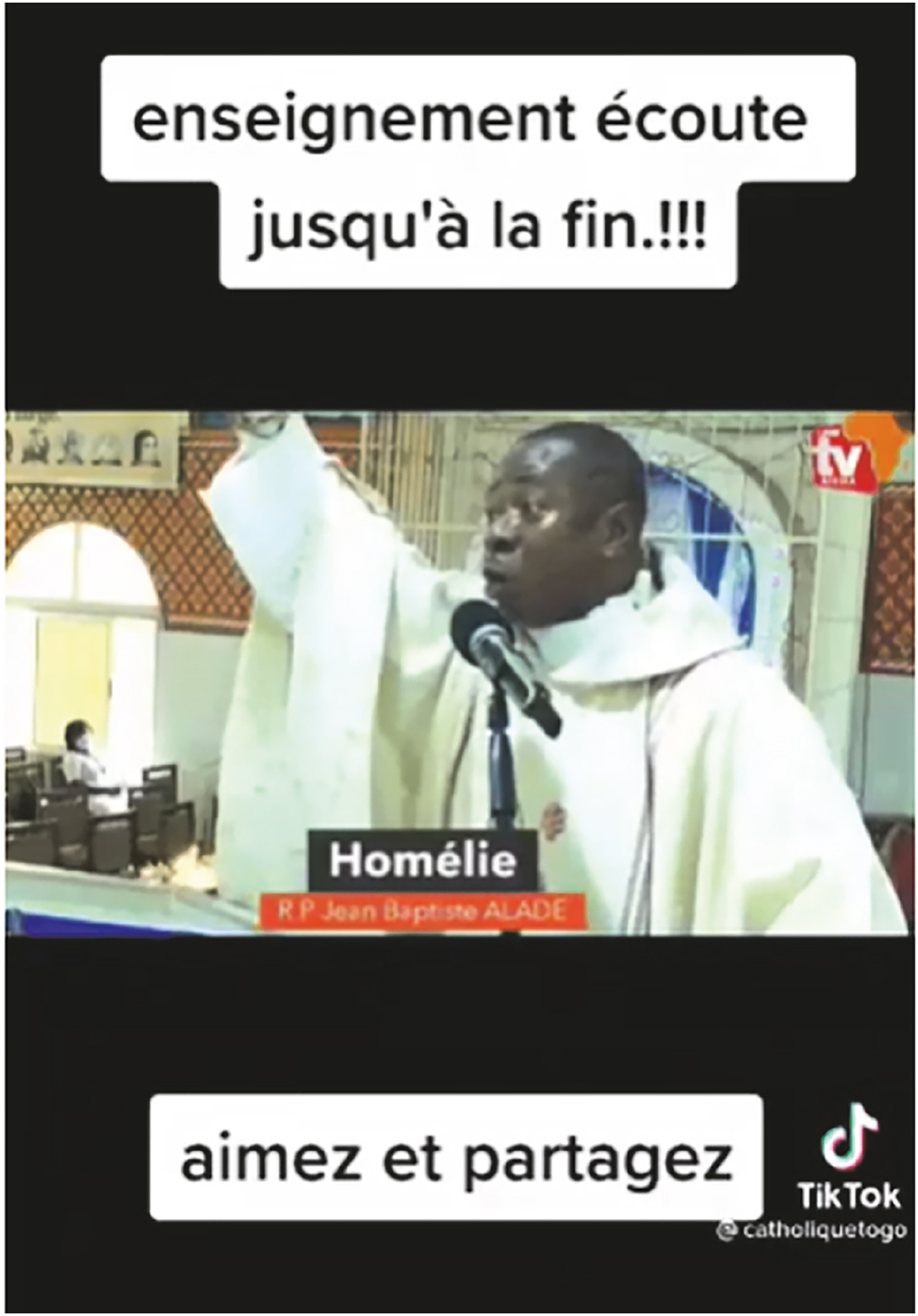
Homily Fr Jean Baptiste Alade on ancestors and traditions.
One of the messages of Fr. Alade is that unless the members of his congregation (Togolese) understand and have knowledge of their home practices and customs, they cannot be true Christians. In his words:
| né | mè-nyá | aƒé.me | ƒé | kɔnú=wó | o=a |
| cond | 2sg:neg-know | home | poss | custom=pl | neg=tp |
| ma-tè.ŋú | á-nyé | Krísto-tɔ́ | adódóé | o | |
| neg:2sg:pot-can | 2sg:sbjv-cop | Christ-posspro | important | neg | |
| ‘If you do not know your home customs, you cannot be a true Christian’. | |||||
He goes on to admonish Christians that if they deny knowledge of their home practices then they are being hypocritical. He asserts that it is only when you know and understand the home practices that you can distinguish and discern which is good practice commensurate with Christian practices and which is not. It is only when one has such knowledge that one can be (come) a staunch Christian. One aspect of home knowledge and custom he uses to illustrate the point is how to say a family home prayer according to Ewe norms. He outlines the structure of the beginning part of the cultural activity type of libation prayer (Archer et al. 2021; Levinson 1979) as follows. First, the omnipotent God is invoked, then one calls what he terms the divinities of the family and the next is the tɔ́gbéwó, ‘the dead grandfathers of the family’ i.e. revered ancestors, of the family. However, it is not all the dead grandfathers that are called upon in prayer. It is only those who lived a good life and who did good things for people while in this world who are called upon. Those who did very bad things to people before they died, e.g. causing bad things to happen to other people through their powers are not invoked in prayer. He adds that previously mamáwó ‘grandmothers’ were not called upon in family prayer. Today, by contrast, the grandmothers who lived a good life and did valiant things while in this world of the living (kodzogbe, see Ameka 2024) are called upon. Those that do very bad things to other people through their spiritual powers such as adze ‘witchcraft’ are not called upon. The libation prayer is a pragmatic act or pragmeme (Capone and Graci 2024).
We infer from these statements that, firstly, it is not every grandfather or grandmother who dies who becomes an ancestor to be venerated or is invoked as an ancestor. A critical quality that dead grandfathers and grandmothers must have to be accorded ancestor status is that they should have lived a good life while in kodzogbe ‘the world of the living’. Secondly, veneration is no longer exclusive to grandfathers; grandmothers also belong to the group of ancestors. We will discuss other conditions that have to be met before one qualifies as an ancestor below. Before that, I report on a news item that implies a parallelism between saints and ancestors (see also Ajakor and Nwochoko 2024 for a comparison of ancestor veneration in Igbo culture of Nigeria and the veneration of saints in Christianity).
Rev Douglas Vu, pastor of Our Lady of La Vang Catholic Church, Birmingham, in a post on X (formerly Twitter) on August 23, 2023, reported that when he asked his social media followers to pray to the Virgin Mary, someone responded: “Is this not idol worshipping.[4] I thought our Lord Jesus Christ says no one cometh to the father except through me.” Rev. Vu responded first with a question: “Do you ever ask family or friends to say a prayer for you when you are sick or have problems?” He further explained: “To ask the Mother of Jesus to intercede for us is not idolatry. In the Catholic Church – we believe like all Christians do – in salvation through Jesus alone! But we also believe in the communion of saints…”. In his further elaboration he connects the relationship between Catholics and the saints and the Virgin Mary in the Catholic tradition to the relationship between the living and their ancestors. I cite the media report:
To whom this may concern: Catholics do not worship the saints!” he wrote. “All Catholics are born again and Jesus is our Lord and Savior. We ‘honor’ His Mother, the saints…. as you and I would honor our own ancestors. We don’t worship our ancestors but we keep their memories alive in our hearts and our lives. Thank you! God bless you all! Peace!
What I find particularly pertinent is this comparison between the honour and reverence Catholics accord the saints and the Virgin Mary and the honour and reverence accorded to ancestors. It is not surprising that Rev. Vu hails from Vietnam where, as in Africa, ancestor veneration is practiced.
3 Ancestor worship or non-worship
Just as Catholics do not worship saints or the Virgin Mary so do Africans, and in this particular case, the Ewe, not worship ancestors. This issue has been contested a lot in the literature. In a much-discussed article by Kopytoff (1971), he charges that “the selection by anthropologists of the phrases ‘ancestor cult’ and ‘ancestor worship’, in dealing with African cultures, is semantically inappropriate, analytically misleading, and theoretically unproductive” (Kopytoff 1971: 140, emphasis added). Based on his ethnographic study of the Suku, a Bantu group of Tanzania, and on linguistic evidence, he suggests that the Suku do not have separate linguistic expressions for elders and for ancestors. He argues that from an emic point of view there is an “elder complex” which is a continuum from the living elders to the dead elders. Others have noted that in other Bantu linguacultures there are expressions for ancestral spirits, so there is recognition of ancestors different from elders (Brian 1973; Mendonsa 1976). I will show in Section 4 that in Ewe and related languages there are two social categories, one of the living elderly people and the other of ancestors. I hope to also show that we interact with the ancestors with respect, honouring and revering them.
Naden (1996: 74) makes a similar point when he suggests that in discussing terms related to what he calls “traditional attitudes of an African group towards ancestors,… a careful lexicological study of the vocabulary used by members of the society under consideration can help”. He invites students of cross-cultural meaning, especially bilingual lexicographers, who are aware of various techniques of analysis and presentation which may help to avoid the worst distortions, to take up the challenge. In this study I use a technique of analysis that has been tried, and tested in the study of cross-cultural meaning to reveal the conceptual content and the attitudes of the Ewe towards ancestors. Naden, like many others before him, was questioning the appropriateness of the term ancestor “worship”. As he pointed out, the English word “worship” has very specific senses and connotations and for which French, for example, has no real equivalent, as culte and veneration and their equivalents in Germanic languages like the Dutch godsdienst and eredienst rather refer to “religion” in English. Naden, like Kopytoff, draws attention to the biases introduced in this discussion by reliance on the English language and Western social categories which do not match African realities (cf. Wierzbicka 2014; Levisen 2019). For example, ancestors do not belong to a religion. As Sarpong points out, ancestors are not part of an Ewe religion, nor Ga religion. This is one respect in which they differ from saints, as saints belong to the Christian religion. Like many other researchers, Naden suggests the term “ancestor veneration”, which he notes is also used by McCall (1995: 257). And “veneration” can apply to the living,[5] but also has “religious” overtones (and moreover has a corresponding French term which is no faux ami). In the next section we turn to the Ewe linguistic world view about elders and ancestors and the respectful attitudes towards them.
4 Tsitsiawo – elders, and Tɔ́gbéwó – ancestors
4.1 ametsitsi, tsitsiawó
In her exploration of cultural scripts for asymmetrical interactions in Ghanaian communities, Thompson (2021) identifies ametsitsi ‘elder person’ in Ewe as an age-related category of people who people think of as above other people and should be accorded respect. The term ametsitsi is a noun-adjective compound which can be parsed as in (2).
| [ame]N-[tsi-tsi]ADJ |
| person-RED-become.grown |
| ‘elderly person’ |
The adjective tsi-tsi ‘old, grown’ can also be nominalized by the cliticization of the definiteness marker to form tsitsi=a ‘elder’. This nominalized form can be pluralized to form a collective of elders as in the section heading, tsitsiawó ‘elders’.
I will first discuss the singular form ametsitsi drawing on Thompson’s analysis. She notes that the term is defined in terms of age; someone who has seen many more years than many others. The implication of this is that the ametsitsi has more experience than most. This is also linked to the common adage in many African linguacultures: old age is wisdom. Thompson points out an obligation that an ametsitsi has in terms of the expectation that they should “transmit their knowledge to the younger members of the family and/or community”. This idea is captured in components (c) and (d) of her explication (SE1) below. An ametsitsi is also expected to live a morally upright life. This is one of the features that would qualify one also to be an ancestor after they die (Thompson 2021).[6]
| [SE1} Semantic explication for ametsitsi ‘elderly person’ | |||
| (a) | someone of one kind | ||
| (b) | this someone was born [m] a long time ago before many other people were born [m] | ||
| (c) | many people don’t know how people can live well, this someone can know it | ||
| (d) | these other people can know it if this person says some things to them at some time | ||
| often if these other people want to know what is good for them to do at some time | |||
| they can know it if this someone says something to them | |||
| (e) | because of this, people can think about someone of this kind like this: | ||
| “this someone is someone above many people” | |||
The collective elders are assumed to be the storehouse of wisdom. They are usually attributed authorial responsibility for proverbs and wise sayings. Thus, the opening frame for citing proverbs in discourse is:
| Tsitsi=a=wó | dó-á | ló | bé |
| elder=def=pl | say-hab | proverb | qt |
| ametsitsi | mé-yɔ-a | mo | o |
| elder | neg-squeeze-hab | face | neg |
| ‘Elders say an elder does not frown their face’. | |||
This is one way in which tsitsiawó ‘elders’ are different from tɔ́gbéwó “grandfathers, ancestors”. The latter are not given that authorial role. Another difference between tsitsiawó and tɔ́gbéwó is that tsitsiawó do not have a structural position in the framework of libation prayer. tɔ́gbéwó do, as Rev. Fr. Alade pointed out. They are called upon as third in the rung of entities. What the two categories have in common is that people think of them as being above other people and that they are respected accordingly. As we shall see below, the term for ancestors is kin-based while tsitsiawo is based on life stage, thus contra Kopytoff’s argument, Ewe makes a distinction between elders and ancestors. A similar distinction is made in Akan, a neighbouring Kwa group, where ancestors are designated Nananom ‘grandfathers’ while an elder person is called an ɔpanyin (see Thompson 2021; van der Geest 1998 for its use and significance).
4.2 tɔ́gbéwó
The lexeme tɔ́gbé ‘grandfather, ancestor, chief’ has several dialect variant forms such as tɔ́gbó, tɔ́gbóé, and tɔ́gbúí (Aŋlɔ). Thompson (2021), being a speaker of Aŋlɔ, uses the Aŋlɔ form tɔ́gbúí in her discussion of one aspect of the term, the one pertaining to a chief. I use in this discussion the form tɔ́gbé, the Inland dialect variant. Apart from variation in form, the lexeme is also polysemous, as the glosses provided suggest: tɔ́gbé is used in both reference and address to talk to and about one’s grandfather; it is used to designate and address a chief; it is used to address dead elders and also to refer especially in the plural to ancestors. I think the semantic invariant of all these is the idea that these are entities and/or beings that people think of as above all other people and that they are to be respected. But each of the uses has specific features. Parallel to tɔ́gbé ’grandfather’ is the opposite mamá ‘grandmother’. Recall that Fr. Alade noted that grandmothers used not to be invoked in home prayers but now they are, reflecting a change of including women in the ancestor category and eliminating sex bias. Mamá has, roughly speaking, the same three uses: as kin term, as designation for a female leader, and as a title.
The primary sense of the two terms tɔ́gbé and mamá is the kin relational usage, i.e. as grandfather, and grandmother, as exemplified in (4a, b) below:
| tɔ́gbé-nye | wó | lã.me | gble͂ |
| grandfather-1sg | poss | body | spoil |
| ‘My grandfather is sick’ lit: My grandfather’s body is spoilt, it is not in good condition. [A response to a question about How is your grandfather?] | |||
| mamá-nye | yi | boƒo |
| grandmother | go | farm |
| ‘My grandmother has gone to the farm’. | ||
| [said in answer to a question, where is your grandmother?] | ||
Taking inspiration from Wierzbicka’s (2017) explication of the English terms, ‘grandfather’ and ‘grandmother’, I propose semantic explications for the Ewe terms tɔ́gbé and mamá in construction with nye ‘1SG’ in [SE2] and [SE3] respectively.
| [SE2] Semantic explication of tɔ́gbé-nye ‘my grandfather’ |
| tɔ́gbé-nye ‘my grandfather’ |
| a man, I can say about this man: ‘this is my grandfather’ |
| someone can say this about a man if this man is the father of this person’s father |
| someone can say this about a man if this man is the father of this person’s mother |
| [SE3] Semantic explication of mamá–nye ‘my grandmother’ |
| mamá-nye ‘my grandmother’ |
| a woman, I can say about this woman: ‘this is my grandmother’ |
| someone can say this about a woman if this woman is the mother of this person’s mother |
| someone can say this about a woman if this woman is the mother of this person’s father |
The terms tɔ́gbé and mamá as noted above are used also with respect to people who are not the father or mother of one’s parents, but are more like age mates or above of one’s grandfather or grandmother. Because of their age they are interacted with in the same way and they are respected as people above other people. This extended usage of the terms can be paraphrased as in [SE4].
| [SE4] semantic explication of address usage of tɔ́gbé and mamá |
| man /woman |
| I think about you like this: |
| You are someone like my grandfather/grandmother |
| Because of this, I think about you like this: |
| “this someone is someone above me”. |
| I want to do things with you like I do with my grandmother/grandfather |
| Because of this I can say to you tɔ́gbé/mamá |
Before turning to the use of these terms in relation to ancestorship, we discuss their use to designate people in leadership roles as chiefs or queens. Thompson (2021) gives an insightful analysis of this usage of tɔ́gbúí (tɔ́gbé). The details more or less apply to mamá also. She notes that the Chief of a locality is thought of as the father of all the people in that area. In fact, in my view, from an Ewe linguistic worldview perspective, such a leader is more like a grandfather or grandmother for all. They must do things for the people. In this function, they wield social, political, and cultural powers (Dzobo 2001: 21). For instance, in the Ghanaian context the chiefs are constitutionally recognized and can codify local customary laws. In turn, the people are expected to revere, obey and honour them. [SE5] is a modified version of Thompson’s (2021: 11) explication of the prototype semantics of this usage.
| SE5 Semantic explication for tɔgbui/tɔgbe ‘chief’ |
| (a) someone of one kind |
| (b) people in a place can think about someone of this kind like this: |
| “this someone is someone above other people in this place |
| this someone can do many good things for many people in this place if this |
| someone wants |
| at the same time, this someone can do many bad things to many people in |
| this place if this someone wants |
| (c) when someone of this kind says to people in this place about something: |
| “I want you to do this”, they can’t not do it |
| if at some time some of these people don’t do it as this someone wants, |
| bad things can happen to them because of it |
| (d) there is one someone of this kind in a place, not more” |
Thompson further explains that components (a) and (b) capture the idea that tɔgbui (tɔ́gbé) is the main figurehead of the local area they govern. Furthermore, he can perform various functions that promote the welfare of the people, “including codifying customary laws, settling disputes and reconciling people, organising ceremonies and festivals, assisting individuals to secure their basic social needs, and promoting socio-economic development in the area”, as captured in component (b). Moreover, component (c) points to the reverence that people have towards this figurehead as well as their obligation towards them in terms of doing what this person says. The last component indicates that there is only one such person in a local area. This has to be interpreted in terms of the scale at which the local area is defined. It could be at a clan level, a village level, or a paramountcy level.
In interactions involving a tɔ́gbé/tɔ́gbúí or mamá in their leadership roles as chief/queen certain socio-cultural norms are expected to be followed. If these are violated one could be considered as not having had proper upbringing. Such a person could be characterised in Ewe as a dzimakplá [dzi ‘bear a child’-ma ‘PRIV’- kplá ‘bring.up’] ‘a person not well-bred’, or a kplámase [kplá ‘bring.up’-ma ‘PRIV’-se ‘hear’] ‘a disobedient person’. As these terms indicate, people have to be conscious of group and individual public image. If the person is seen as a dzimakplá that goes directly to the group as the questions usually asked in such circumstances are: Who is the father or the mother of this person? What house or family do they belong to? When people go against the socio-cultural norms they are seen as not showing respect and can be sanctioned. Consider the following cultural script [CS1] based on one proposed by Thompson (2021: 17 [CS4]) specifically to account for interactions with a tɔ́gbúí/tɔ́gbé.I draws out the attitudes, feelings and cultural expectations and patterned behaviours involved.
| [CS1] Ghanaian cultural script for interacting with tɔgbui/tɔgbe (in English) |
| When people think like this about someone, they think like this at the same time: |
| (a) “this someone is someone above me |
| at the same time, this someone is someone above many people” |
| (b) I can’t say things to this someone like I can say things to many other people |
| (c) If I say things to this someone like I say things to many other people, it can be like this: |
| this someone can feel something bad, this someone can think something bad about me |
| other people can say something bad about me because of this |
| at the same time, they can say something bad about my family |
| (d) I don’t want this |
Component (a) relates to the superior status that the tɔ́gbúí/tɔ́gbé and mamá have. Component (b) captures the idea that there are specific modes of communicating with them, namely, one has to say things to people of this status through someone else (see Ameka 2004 and references therein on triadic communication and royal distance). Components (c) and (d) relate to how people would not want to be negatively evaluated as it might reflect on their family and themselves.
The explications of the terms tɔ́gbé and mamá pertain to the social category of elders but elders with connections to kinship. Importantly, the usages discussed so far pertain to the living elders. In the next section we return to the use of the terms in reference and address to the dead elders or ancestors.
4.3 tɔ́gbéwó as ancestral spirits
The third sense of tɔ́gbé which is related to the other senses pertains to its use to designate and address kin that have died and do not have a visible bodily presence in this physical world referred to in Ewe as kodzogbe. [7] As mentioned already, even though tɔ́gbéwó can be and are called upon individually, they are always interacted with as a group, and this usage includes male and female dead elders. In Ewe worldview, tɔ́gbéwó are one of the invisible elements – an ethnopsychological relational construct in the Ewe conception of a person. I claim in an earlier study (see Ameka 2024: 154; see also Spieth 2011) that tɔ́gbéwó are a subcategory of the emic category and component ŋú-nú-wó [lit skin/body-thing-PL] ‘beings (things) around people’. These ‘beings around you’ are responsible for things that happen to people in the physical world. tɔ́gbéwó as invisible beings are thought of as spirits who manifest themselves in the lives of their relatives, influencing them. The living relatives in turn revere and honour them. The “insider” anthropologist Nukunya (1973: 121–122) argues that “by far the most important supernatural forces among the Anlo [Ewe] are the ancestral spirits tͻgbeŋͻliwó [i.e grandfather/ancestor-ghost-PL]”, the beings that hover around the living. They can do good things for people. However, if they are not revered/respected they can cause bad things to happen to people.
The everyday reality of tɔ́gbéwó in the lives of the Ewe people is evidenced by the fact that in daily discourse they are constantly mentioned and their existence acknowledged in situations to be reassured that the ancestors are present. The expression in (5) is often heard being used to affirm their existence with the implication that they will influence and do good things for the living in whatever situation they find themselves.
| tɔ́gbéwó | le-e | (Inland Ewe) |
| ancestors | be.at-3SG | |
| ‘Ancestors exist!’ | ||
Another set of common conversational routines used in daily life is in (6):
| tɔ́gbéwó | wa | dɔ́ | ‘ | (Inland Ewe) |
| ancestors | do | work | ||
| lit. ‘Ancestors have worked!’ | ||||
| tɔ́gbéwó | se͂́ | ŋú |
| ancestors | become.strong | skin/body |
| lit. ‘Ancestors are strong!’ | ||
The conversational routines or situation bound utterances (e.g., Kecskes 2010) in (6) are used in contexts where something good has happened to a living member of the community, for example, they had a baby, got married, passed an exam, landed a new job. In short, in situations in English where one would say “Congratulations” or similar expressions to another (see e.g. Ameka 1987 for more details). The significance of the routine responses, the second part of the adjacency pair of the expressions in (6), given in (7) are instructive.
| Yoo, | mia-wó-é | dó | gbe | ɖá |
| OK | 2PL-PL-FOC | put | voice | in.the.distance |
| ‘OK! You (pl) have prayed’. | ||||
| Yoo, | mìa-tɔ-wó | tsyɛ́ / hã |
| OK | 2PL-POSSPRO-PL | also |
| ‘OK! Yours too!’ (i.e. your ancestors too are strong/have worked). | ||
The response in (7a) points to the belief that good things happen to people through the intervention of the ancestors through whom the living channel their prayers sometimes through libation and other practices asking for good things to happen to people in kodzogbe ‘the world of the living’. And (7b) shows that while ancestors may be linked to lineages, ancestors as a group work for good things to happen to the living, whether they are their direct relatives or not. Furthermore, (7a) shows that one of the ways in which the living are expected to interact with the ancestors is through invoking them in libation prayer to intercede in the things that happen to them in kodzogbe ‘the world of the living’.
As noted in Ameka (2024), there are things that one can do to honour and show reverence to the ancestors, principally through libation prayer and by not defiling them in one’s daily life. It is believed that ancestors are around and accompany the living. People are therefore expected to observe certain practices in their daily encounters in order to show respect to them. Some of the things one should not do include sitting on the steps of a house at night, sweeping rooms at night and calling out names of other people out loud at night. When these taboos are violated, the ancestral spirits can do bad things to people, the living. At the same time, to court their favour, and as an indication of the ancestors being co-present with the living, when someone is about to ingest something such as a fluid, they are expected to share it with them through a gesture of pouring a little bit on the ground before taking a sip. This is reminiscent of the way during libation, the one saying the prayer pours some fluid on the ground as they call upon the ancestors.
I think that it is the misunderstanding of these respect behaviours, (including their invocation in libation prayer) which led to earlier studies of anthropologists and missionaries to think of ancestors in the wrong light. I believe these are the things, especially their being called in prayer, which led people to think of the respect practices as “worship” from an Anglocentric Western point of view. As pointed out above, this is patently misguided. In the case of the Ewe, I think it is also a failure to recognise the two emic categories of libation that is performed. Linguistically and conceptually, the Ewe distinguish two kinds of libation: one involving the invocation of tɔ́gbéwó performed usually by an ametsitsi ‘elder’ and the other involving prayer to gods typically performed by a priest(ess). The linguistic label for the former is given in (8a) and for the latter in (8b).
| tsi-ƒo-ɖé-anyí8 |
| fluid-hit-ALL-ground |
| ‘pouring fluid on the ground, = libation’ |
- 8
In Aŋlɔ and in Standard written Ewe, this form is realized as tsi-ƒo-ɖí where the noun anyí is pronominalized as the 3SG object form =i and this gets assimilated to the e vowel of the allative preposition to get ɖí.
| aɖe-gbe-dó-dó |
| tongue-voice-RED-send |
| lit. sending the voice of the tongue; i.e. ‘tongue-greeting’ |
Kovey (1998: 109–122) discusses and exemplifies the difference between the two. Roughly speaking, the practice of aɖe-gbe-dó-dó involves prayer to a god or gods that have come to be translated in the postcolonial and post-missionization era as ‘fetish’, or ‘cult’ and designated in Ewe as trɔ͂́ or vudú. For this genre, it is a priest(ess) of the god who transmits the message/prayer and various gifts brought by the one seeking to pray to the god. Sometimes in the process, the priest(ess) might use unintelligible language, hence the aɖe ‘tongue’ part of the name. This is very different from what happens in tsi-ƒo-ɖé-anyí, the ubiquitous every day practice of praying and paying respect to God and the ancestors. This is performed not by a priest but by a family elder (ametsitsi) or a tɔ́gbé ‘grandfather’ and it uses plain and intelligible language understood by all present. The only material substance used is fluids of different kinds, typically palm wine, hard liquor, or flour mixed in water called dzatsi. Apart from the question of whether ancestors are worshipped, another highly contested issue is whether libation prayer is a Christian practice. Exploring this issue will take us too far away from our immediate concerns. I contend that if the two “insider-recognized” categories of libation were understood, there would not have been any question of whether ancestors were worshipped or not in the family libation prayer.
Be that as it may, as observed earlier, not everyone who dies who is revered as an ancestor. There are certain qualities that must be exhibited. One can see some parallels to saints where it is not every person who dies who is elevated to sainthood (see below). The dead elders who are considered tɔ́gbéwó ‘ancestors’ are people who have lived well. They lived morally upright lives in kodzogbe ‘the world of the living’. They must have lived to a ripe old age. They died a natural death. There is a distinction made between a natural death (kú nyóe ‘good death’) and an unnatural death (kú vɔ͂́e ‘bad death’). Unnatural deaths involve tragic circumstances such as traffic accidents, drowning, dying by being consumed by fire, dying from some diseases such as leprosy (perceived to be the retribution for bad behaviour) or dying by suicide. So only dead elders who died a good death are tɔ́gbéwó. Part of living a good life or living well is that the person must have married and have had children to continue the lineage, as it were. There are special funeral and burial rights for people who die unnatural deaths and for people who did not have children. These people are not part of good tɔ́gbéwó. The spirits of such people are thought of as bad, and during libation prayer are not invited to the party; they are asked to not come near and are “served” away from the centre. Thus, becoming an ancestor and being considered as such depends on one’s conduct in life and on the manner of death.
As will become evident in the next section there are overlaps between ancestors and saints. There are however some significant differences. One of these is that for ancestor-hood the manner in which a person died is significant, as explained above. For saints, someone who died a “bad death” as defined in many African cultures is not disqualified. In fact, one group of saints, the martyrs, would be construed as having died in a bad manner as a martyr is someone who loses their life because of their belief or faith, for example, the Martyrs of Uganda.[9] To anticipate the discussion of saints in the next section and by way of summary of the discussion on ancestors, in Table 1, I summarise the main features that qualify a person for ancestor-hood and indicate their relevance or otherwise for sainthood.
Attributes of ancestors and saints compared.
| Features | Ancestors | Saints | Comment |
|---|---|---|---|
| Dead/alive | Dead | Dead | In the sense of the communion of saints some of the saints are alive (see below) |
| Lived well | Yes | Yes | Do good things for people while alive |
| Lived morally upright lives | Yes | Yes | |
| Age | Should die as an adult | Not relevant | Children cannot be ancestors, but they can be saints, e.g. The Holy Innocents |
| Die a natural death | Yes | Not relevant | |
| Die in tragic circumstances | No | Not relevant | The Martyrs and the Holy Innocents died in tragic circumstances |
| Can do bad things to people who do not venerate them | Yes | No | |
| Married and have children | Yes | Not relevant | Many saints are Virgins |
With these considerations in mind, I propose a semantic explication in Minimal English [SX1] to account for the conceptual content of tɔ́gbéwó using the semantic template for ethnopsychological person constructs as proposed by Wierzbicka (2016) and used in Ameka (2024) (see Peeters 2019 for elaboration).
| [SX1] Semantic explication of Mia tɔ́gbéwó/ Mía mamáwó ‘Our ancestors’ |
| [WHAT IS IT} |
| Some beings of one kind |
| [HOW WE CAN THINK ABOUT THEM] |
| We can think about them like this: |
| They died. |
| Before they died, they were people like us. |
| Now, they are not people like us anymore. |
| They are like beings of another kind. |
| They are near us. |
| Sometimes, people can see them. |
| Sometimes, people can hear them. |
| Sometimes, some people can speak to them. |
| When we think of someone /one of us in kodzogbe |
| We cannot not think of some beings of this kind |
| At the same time, we can think about these beings like this: |
| They want good things to happen to us. |
| If we do something bad, they can do something bad to us. |
| [WHAT WE CAN KNOW ABOUT THESE BEINGS] |
| We can know this about these beings: |
| Before they died, they lived in this place for some time, not a short time. |
| They lived well |
| They did many good things for people in this place |
| When they died, they died as it is good for people to die. |
| Because of all this, they are above us, |
| At the same time, they are above many other people |
| [HOW WE FEEL TOWARDS THESE BEINGS] |
| We feel something good towards these beings. |
| We know that when we are in a place where they are, we cannot do some things. |
| We don’t want to do these things. |
| We know that when we do these things, something bad can happen to us. |
5 Saints
We turn in this section to the uses and understandings of saints, and along the way we offer some comparisons with ancestors. It would not be an overstatement to assert that all Christians, as professed in the Apostles’ or Nicene Creed, believe in the “communion of saints”. However, the term “saints” has multiple interpretations depending partly on context and partly on denomination. McBrien (1994: 1109–110) suggests that there are at least four meanings of the term saints. The first pertains to “all those who have been justified by the grace of Christ, whether they be living or dead”. It would appear that this is the sense in which one talks of the “communion of saints”, as it encompasses the living and the dead. Tentatively, I suggest the following description of the understanding of the “communion of saints” in Minimal English (SX2):
| [SX2] Explicitation of the understanding of “communion of saints’ |
| [WHAT IS IT] |
| Many people of one kind |
| They are like one thing |
| We can think about it like this: |
| They were all baptised. |
| Because of this, they are now like one thing |
| [WHAT WE CAN KNOW ABOUT THESE PEOPLE |
| Some of these people are living now |
| Some of these people died before now |
| Before they died, they lived in this place for some time. |
| They now live with God. |
| All these people are like one thing. |
| They think about things in the same way |
| They do some things in the same way |
In this sense of encompassing both the living and the dead, the term would appear to share features with the “elder complex” proposed as a framework to deal with the issue of ancestors in Africa (Kopytoff 1971). As pointed out above, for the majority of African cultures (including Ewe), there is a distinction between the living elders and the dead elders, i.e., ancestors. Thus, the sense of saints here would appear to be different from that of ancestors who are principally thought of as dead.
The second sense proposed by McBrien is that the term saints refers to “those who, having been justified by Christ on earth, have entered into eternal life”. This applies to people who have died, that is their life on earth ended, but they are believed to be living with God forever (see Wierzbicka 2025 on eternal life). The aspect of ancestors that probably relates to this sense is their being with people all the time, being near them, influencing and interacting with them. They are thought of as being in the spirit world, not necessarily with God.
A third sense in which saints is used is to refer to “particular figures, especially biblical personages who are examples of holiness”. Perhaps the comparative point here is in terms of ancestors being individuated and linked to particular lineages as well as working as a collective. As noted above, they lived good lives, they did very many good things for many people while living in kodzogbe ‘the world of the living’, and they died a good death. In The Children’s Book of the Saints, Louis Savary (SVD) (1986) draws on the etymology of the word in Hebrew, Greek and Latin to explain that a saint is a “holy one”. In the Ewe and for that matter many African linguacultures, ancestors are said to have lived exemplary lives worthy of emulation. However, this is not evaluated in terms of holiness like in the Christian tradition. The emic designation is that they are good people. This is why those who do bad things to people and are judged to be bad people do not qualify to be ancestors. Should the goodness and exemplary lives be interpreted as holy? One meaning component of ‘holy’ in several dictionaries is good. Dictionaries typically add pure and perfect, and worthy of veneration. If we accept the everyday uses of the term holy then it can be argued that ancestors and saints share a feature of holiness as good people.
McBrien points out that while the three interpretations discussed so far are applicable to the Catholic understanding of saints, it is the fourth sense of the word saints which is characteristically Catholic. This is the use of the term to refer to “those whom the Church, either through custom or formal canonization, has singled out as members of the Church triumphant so that they may be commemorated in public worship”. McBrien cites Avery Dulles (1985: 85) as writing that the “cult of the saints” is the most distinctively Catholic practice among all practices. While in the phrasing of the fourth sense the word worship is used, we should recall Fr. Vu’s explanation discussed in Section 2 of the distinction between worship and veneration. Catholics affirm that they do not worship saints, they venerate them and ask for their intercession. Indeed, the first step of recognizing someone as a saint in the Catholic Church is that they are declared Venerable. As Savary (1986) explains in The Children’s Book of the Saints, this means that the person is a deceased person whose life on earth was filled with heroic virtues. I think this is where the comparison is very apt. Ancestors are not institutionally declared, but by virtue of their being invoked in prayer means that they are seen as having lived good lives. And this is where the veneration also comes from.
The Catholic Church has two other steps linked to requirements for sainthood, one, that the Venerable should have performed witnessed miracles. Two, when a miracle is attributed to a Venerable, they may be declared Blessed, i.e. be beatified. When they perform two miracles they can be “canonized”, i.e. declared a Saint. There is nothing comparable to these stages in a person attaining ancestor status. In addition to this difference, there is also the fact that saints can be children while it is adults who qualify to be ancestors.
From the foregoing it should be clear that it is Venerables who are comparable to ancestors. They are dead and before they died they lived virtuous lives on earth. The Venerables have other features endowed upon them by the institution of the Church. These include their ability to intercede for members of the pilgrim church (i.e., Christians living on earth) and the suffering church (i.e., the souls in purgatory), as they themselves are part of the triumphant church (i.e., those living in glory with God).
With these considerations in mind, I propose tentatively, the semantic explicitation in the second column of Table 2. I have juxtaposed the representations for ancestors in Ewe and for Venerables to facilitate comparison.
Semantic explications of ancestors and Venerables compared.
| Ancestors | Venerable(s) |
|---|---|
| [WHAT IS IT} Some beings of one kind |
[WHAT IS IT} Someone/people of one kind |
| [HOW WE CAN THINK ABOUT THEM] We can think about them like this: They died. Before they died, they were people like us. Now, they are not people like us anymore. They are like beings of another kind. They are near us. Sometimes, people can see them. Sometimes, people can hear them. Sometimes, some people can speak to them. When one thinks of someone /one of us in kodzogbe One cannot not think of some beings of this kind At the same time, we can think about these beings like this: They want good things to happen to us. If we do something bad, they can do something bad to us. |
[HOW WE CAN THINK ABOUT THEM] We can think about them like this: They died. Before they died, they were people like us. Now, they are not people like us anymore. They are like beings of another kind They live with God One of them can be near someone else every time At the same time, we can think about these beings like this: They want good things to happen to us. |
| [WHAT WE CAN KNOW ABOUT THESE BEINGS] We can know this about these beings: Before they died, they lived for some time in this place, not a short time They lived well They did many good things for people in this place When they died, they died as it is good for people to die. Because of all this, they are above us, At the same time, they are above many other people. |
[WHAT WE CAN KNOW ABOUT THEM] We can know this about these beings: Before they died, they lived for some time in this place They lived well They did many good things for people in this place Because of all this, the Church wants us to think of them like this: they are above us, At the same time, they are above many other people. |
| [HOW WE FEEL TOWARDS THESE BEINGS] We feel something good towards these beings. We know that when we are in a place where they are, we cannot do some things. We don’t want to do these things. We know that when we do these things, something bad can happen to us. |
[HOW WE FEEL TOWARDS THESE BEINGS] We feel something good towards these beings. We know that they are always with us They want to do good things for us. We can say things like this to them: I know that you live with God. I know that you can speak to God. I can’t speak to God as you can speak to God. Because of this, I want you to say some things to God about me. |
The parallels and differences are evident when one compares the tentative explications. The shared components are in bold face. The Venerables serve as patron saints where they intercede for people with God. This is the idea that is captured in the fourth block of the explication.
6 Some concluding remarks
In the foregoing I have undertaken a conceptual analysis of the concepts of ancestors in an Ewe linguistic worldview, and of saints as used in Christian discourses. I have demonstrated how semantic analysis of terms can illuminate the belief-related terms. My main argument is that because the first missionaries did not undertake such an analysis any terms that pertained to the beliefs and worldviews of the missionized were demonized and discarded. Had such analysis been carried out, the view expressed by Sarpong (1975), cited in the Introduction to the present paper, would have been upheld that people everywhere venerate their dead whom they consider to have lived exemplary and morally upright lives before they died. The details vary but the kernel is the same and could be thought of as a cultural universal.
Thus, we have noted that the dead who live good lives and do good things for people are venerated as ancestors or as saints. It is also the case that ancestors are dead kin-related persons. Saints in one understanding can be living or dead (see the communion of saints) but in the Catholic understanding of Saints, they are deceased persons who lived good lives and are declared Venerable. On this point the two concepts coincide. There are some points on which the concepts differ. First, saints as we mentioned earlier belong to a religion. And in the case of the Catholic Church, they have to be formally recognized and canonized. Ancestors do not belong to a religion as such, they are part of the linguacultural belief system. Second, saints are not age-bound. Children can also be declared saints, for instance the Holy Innocents. Ancestors have to have lived for some time, not a short time in kodzogbe ‘the world of the living’. Third, ancestors are believed to be able to do bad things to those who do not venerate them, while saints are not believed to do bad things to people.
If such knowledge informed missionary work, there would not be the need to declare certain concepts “pagan”, or to demonize certain practices in veneration of ancestors. There would also be less of loan translation and coinages in order to introduce the Christian concepts into other cultures (see footnote 3). Such shift in thinking and approach is necessary in the context of understanding Southern Christianities and of the inculturation of Christianity in the Global South.
About the author
Felix K. Ameka, PhD (ANU, Canberra). He is CIPL/CIPSH Chair Professor Emeritus, Ethnolinguistic Vitality and Diversity, Leiden University. He is a socio-cultural-cognitive linguist. His research focuses on the meaning (semantics and pragmatics) of linguistic signs. He has published on the lexicon, grammar, (ethno-)semantics, (ethno-)pragmatics, and language contact of West African languages. He is a Fellow of the Ghana Academy of Arts and Sciences, Australian Academy of Humanities, and Academia Europaea.
Acknowledgments
I am very grateful to Deborah Hill, Cliff Goddard and Anna Wierzbicka for their constructive comments on the paper. I am also grateful to Alesandro Capone and his Editorial Team for their patience.
Abbreviations
- 1
-
first person
- 2
-
second person
- 3
-
third person
- COND
-
Conditional
- COP
-
Copula
- FOC
-
Focus
- HAB
-
Habitual
- NEG
-
Negative
- PL
-
plural
- POSS
-
possessive marker
- POSSPRO
-
possessor pronoun
- POT
-
potential
- QT
-
quotative
- RED
-
reduplicative
- SBJV
-
subjunctive
- SG
-
singular
- TP
-
terminal particle
References
Ajakor, Emmanuel & Benjamin Nwokocha. 2024. Cult of Igbo ancestors and veneration of saints in the Orthodox Christian world: A comparative analysis of Igbo traditional religion and christianity. OHAZURUME-Unizik Journal of Culture and Civilization 3(1).Search in Google Scholar
Ameka, Felix K. 1987. A comparative analysis of linguistic routines in two languages: English and Ewe. Journal of Pragmatics 11(3). 299–326. https://doi.org/10.1016/0378-2166(87)90135-4.Search in Google Scholar
Ameka, Felix K. 2004. Grammar and cultural practices: The grammaticalisation of triadic communication in West African languages. The Journal of West African Languages [Special Issue: Areal Typology of West African Languages] 30(2). 5–28.Search in Google Scholar
Ameka, Felix K. 2024. Conceptions of the make-up of a human person in Ewe. In Andrea Hollington, Alice Mitchel & Nico Nassenstein (eds.), Anthropological linguistics in Africa, 136–176. Amsterdam: John Benjamins.10.1075/clu.23.06ameSearch in Google Scholar
Ameka, Felix K. & Deborah Hill. 2021. Linguistic tools and practices for inclusive communication in indigenous communities. Paper presented at IPrA Conference.Search in Google Scholar
Ameka, Felix K. & Deborah Hill. 2022. Introduction: What can linguistics and language(s) contribute to development practices? In Deborah Hill & Felix K. Ameka (eds.), Languages, linguistics and development practices, 1–22. Cham: Palgrave Macmillan.10.1007/978-3-030-93522-1_1Search in Google Scholar
Archer, Dawn, Piotr Jagodziński & Rebecca Jagodziński. 2021. Activity types and genres. In Michael Haugh, Dániel Z. Kádár & Marina Terkourafi (eds.), The Cambridge handbook of sociopragmatics, 206–226. Cambridge: Cambridge University Press.10.1017/9781108954105.012Search in Google Scholar
Brain, James L. 1973. Ancestors as elders in Africa – Further thoughts. Africa 43(2). 122–33. https://doi.org/10.2307/1159324.Search in Google Scholar
Capone, Alesandro & Roberto Graci. 2024. Pragmemes revisited. A theoretical framework. Frontiers in Psychology 15. 1329291. https://doi.org/10.3389/fpsyg.2024.1329291.Search in Google Scholar
De Busser, Rik. 2013. The influence of Christianity on the Bunun language: A preliminary overview. In Proceedings of the international workshop on “Special Genres” in and around Indonesia, 59–76. Tokyo, Research Institute for Languages and Cultures of Asia and Africa, Tokyo University of Foreign Studies, 17-19 February 2013.Search in Google Scholar
Dulles, Avery. 1985. The catholicity of the church. Oxford: Clarendon Press.Search in Google Scholar
Dzobo, Noah K. 2001. The chief and his elders among the Ewe of Ghana and Togo. Ho, Ghana: The Institute for the Study of African Christianity.Search in Google Scholar
Goddard, Cliff. 2018. Ten lectures on natural semantic metalanguage: Exploring language, thought and culture using simple translatable words. Leiden: Brill.10.1163/9789004357723Search in Google Scholar
Goddard, Cliff (ed.). 2021. Minimal languages in action. Cham: MacMillan Palgrave.10.1007/978-3-030-64077-4Search in Google Scholar
Goddard, Cliff & Anna Wierzbicka. 2014. Words and meanings: Lexical semantics across domains, languages, and cultures. New York: Oxford University Press.10.1093/acprof:oso/9780199668434.001.0001Search in Google Scholar
Goddard, Cliff & Anna Wierzbicka. 2018. Minimal English and how it can add to global English. In C. Goddard (ed.), Minimal English for a global world improved communication using fewer words, 5–27. Cham: MacMillan Palgrave.10.1007/978-3-319-62512-6_2Search in Google Scholar
Goddard, Cliff & Zhengdao Ye. 2015. Ethnopragmatics. In The Routledge handbook of language and culture, 66–83. London and New York: Routledge.Search in Google Scholar
Kecskes, Istvan. 2010. Situation-bound utterances as pragmatic acts. Journal of Pragmatics 42(11). 2889–2897.10.1016/j.pragma.2010.06.008Search in Google Scholar
Kopytoff, Igor. 1971. Ancestors as elders in Africa. Africa 41(2). 129–142. https://doi.org/10.2307/1159423.Search in Google Scholar
Kovey, J. A. S. Yaovi. 1998. Tɔgbui Eʋemegã Akpa Gbãtɔ: Eʋegbe Numenyadu [Ewe Traditional Literature]. Accra: Bureau of Ghana Languages.Search in Google Scholar
Levinson, Stephen C. 1979. Activity types and language. Linguistics 17. 365–399. https://doi.org/10.1515/ling.1979.17.5-6.365.Search in Google Scholar
Levisen, Carsten. 2019. Biases we live by: Anglocentrism in linguistics and cognitive sciences. Language Sciences 76. 101173. https://doi.org/10.1016/j.langsci.2018.05.010.Search in Google Scholar
Matras, Yaron. 2020. Language contact, 2nd edn. Cambridge: Cambridge University Press.Search in Google Scholar
McBrien, Richard P. 1994. Catholicism (Completely Revised and Updated). New York: Collins Dove.Search in Google Scholar
McCall, John C. 1995. Rethinking ancestors in Africa. Africa 165(2). 256–270.10.2307/1161193Search in Google Scholar
Mendonsa, Eugene L. 1976. Elders, office holders and ancestors among the Sisala of Northern Ghana. Africa 46. 57–65. https://doi.org/10.2307/1159093.Search in Google Scholar
Meyer, Birgit. 1999. Translating the devil: Religion and modernity among the Ewe in Ghana. Edinburgh: Edinburgh University Press.Search in Google Scholar
Naden, Anthony. 1996. Ancestor non-worship in Mampruli. Lexikos 6: 71–103.10.5788/6-1-1026Search in Google Scholar
Nukunya, G. K. 1973. Some underlying beliefs in ancestor worship and mortuary rites among the Ewe. In G. Dieterlen (ed.), La notion de personne en Afrique Noire, Paris 11–17 Octobre 1971, 119–130. Paris: Edition de Centre de la Recherche Scientifique.Search in Google Scholar
Peeters, Bert. 2019. Delving into heart- and soul-like constructs: Describing EPCs in NSM. In Bert Peeters (ed.), Heart- and soul-like constructs across languages, cultures, and epochs, 1–29. London and New York: Routledge.10.4324/9781315180670-1Search in Google Scholar
Sarpong, Peter Akwasi. 1975. Ghana in retrospect: Some aspects of Ghanaian culture. Tema: Ghana Publishing Corporation.Search in Google Scholar
Savary, Louis M. 1986 (2004). The children’s book of saints. New York: Regina Press.Search in Google Scholar
Spieth, Jakob. 2011. In M. Edorh, E. Tsaku, R. Avornyo, M. E. Kropp Dakubu, Trans. & Komla Amoaku (eds.), The Ewe people: A study of the Ewe people in German Togo. Accra: Sub-Saharan Publishers (Original work published 1906, Die Ewe Stammen: Material zur Kunde des Ewe-Volken in Deutsch-Togo).Search in Google Scholar
Thompson, Rachel GA. 2021. Cultural scripts for asymmetrical interactions in Ghana. Nordic Journal of African Studies 30(1). 24.Search in Google Scholar
van der Geest, 1998 van der Geest, Sjaak. 1998. Ɔpanyin: The Ideal of Elder in the Akan Culture of Ghana. Canadian Journal of African Studies 32(3). 449–493.10.1080/00083968.1998.10751147Search in Google Scholar
Wierzbicka, Anna. 2014. Imprisoned in English. New York: Oxford University Press.10.1093/acprof:oso/9780199321490.001.0001Search in Google Scholar
Wierzbicka, Anna. 2016. Two levels of verbal communication, universal and culture-specific. In A. Rocci & L. de Saussure (eds.), Verbal communication, 447–481. Berlin: De Gruyter Mouton.10.1515/9783110255478-024Search in Google Scholar
Wierzbicka, Anna. 2017. The meaning of kinship terms: A developmental and cross-linguistic perspective. In Zhengdao Ye (ed.), The semantics of nouns, 19–62. Oxford: Oxford University Press.10.1093/oso/9780198736721.003.0002Search in Google Scholar
Wierzbicka, Anna. 2025. “Eternal Life”, “Eternal punishment”: What did Jesus really mean? Cognitive Semantics 10(3). 297–326. https://doi.org/10.1163/23526416-bja10065.Search in Google Scholar
© 2025 the author(s), published by De Gruyter, Berlin/Boston
This work is licensed under the Creative Commons Attribution 4.0 International License.
Articles in the same Issue
- Frontmatter
- Introductory Notes
- Introductory notes
- Research Articles
- Ecopragmatic roles of insect lexicons: A case of Indonesian Javanese Penginyongan parikan
- Of saints and ancestors: The ethnopragmatics and cultural semantics of religious terms
- “We are in African society, women normally soft-pedal”: Cultural orientations in the construction of justice in Nigerian adjudicative discourses
- A socio-cognitive approach to mistranslation: A case study of Chinese classical poetry
- Quasi-proper names, linguistic use, and contextuality
- Book Reviews
- Gila A. Schauer: Intercultural Competence and Pragmatics
- Teun A. van Dijk: Social movement discourse: An introduction
- Istvan Kecskes: The Cambridge Handbook of Intercultural Pragmatics
- Stella Bullo & Derek Bousfield: Talking in Clichés: The Use of Stock Phrases in Discourse and Communication
- Cornelia Ilie: Questioning and answering practices across contexts and culture
- Louise, Cummings: Introducing Pragmatics: A Clinical Approach
- Jeannette Littlemore, Marianna Bolognesi, Nina Julich Warpakowski, Chung-hong Danny Leung & Paula Perez Sobrino: Metaphor, metonymy, the body and the environment: an exploration of the factors that shape emotion-colour associations and their variation across cultures
- Schröder, Ulrike, Adami, Elisabetta, and Dailey-O’Cain, Jennifer: Multimodal Communication in Intercultural Interaction
- Nicola Halenko and Jiayi Wang: Pragmatics in English Language Learning
- Kasia M. Jaszczolt: Semantics, Pragmatics, Philosophy: A Journey through Meaning
- Piotr Stalmaszczyk: The Cambridge Handbook of the Philosophy of Language
- Corrigendum
- Exploring emoji usage in intercultural CMC: Insights from Colombian and Argentinian learners of German
Articles in the same Issue
- Frontmatter
- Introductory Notes
- Introductory notes
- Research Articles
- Ecopragmatic roles of insect lexicons: A case of Indonesian Javanese Penginyongan parikan
- Of saints and ancestors: The ethnopragmatics and cultural semantics of religious terms
- “We are in African society, women normally soft-pedal”: Cultural orientations in the construction of justice in Nigerian adjudicative discourses
- A socio-cognitive approach to mistranslation: A case study of Chinese classical poetry
- Quasi-proper names, linguistic use, and contextuality
- Book Reviews
- Gila A. Schauer: Intercultural Competence and Pragmatics
- Teun A. van Dijk: Social movement discourse: An introduction
- Istvan Kecskes: The Cambridge Handbook of Intercultural Pragmatics
- Stella Bullo & Derek Bousfield: Talking in Clichés: The Use of Stock Phrases in Discourse and Communication
- Cornelia Ilie: Questioning and answering practices across contexts and culture
- Louise, Cummings: Introducing Pragmatics: A Clinical Approach
- Jeannette Littlemore, Marianna Bolognesi, Nina Julich Warpakowski, Chung-hong Danny Leung & Paula Perez Sobrino: Metaphor, metonymy, the body and the environment: an exploration of the factors that shape emotion-colour associations and their variation across cultures
- Schröder, Ulrike, Adami, Elisabetta, and Dailey-O’Cain, Jennifer: Multimodal Communication in Intercultural Interaction
- Nicola Halenko and Jiayi Wang: Pragmatics in English Language Learning
- Kasia M. Jaszczolt: Semantics, Pragmatics, Philosophy: A Journey through Meaning
- Piotr Stalmaszczyk: The Cambridge Handbook of the Philosophy of Language
- Corrigendum
- Exploring emoji usage in intercultural CMC: Insights from Colombian and Argentinian learners of German
