Alkaline leaching of zinc from low-grade oxide zinc ore using ammonium citrate as complexing agent
-
Shiwei Li
Shiwei Li obtained his doctorate from Northeastern University in 2013. Currently, he works at Kunming University of Science and Technology. His primary research interests include microwave metallurgy, hydrometallurgy and comprehensive recovery of the wastes in metallurgy fields.
Aiyuan Ma is pursuing his doctorate at Kunming University of Science and Technology, China. Currently, he is carrying out research on hydrometallurgy and unconventional metallurgy under the supervision of Professor Jinhui Peng. His main research subject is extracting zinc from the blast furnace with an ammonia system.
Kun Yang is pursuing her doctorate at Kunming University of Science and Technology, China, where she is currently carrying out research on microwave energy application, metallurgy and chemical engineering under the supervision of Professor Jinhui Peng. Her main research subject is coupling various outfields to strengthen the leaching of nontraditional zinc resources.
Shaohua Yin obtained her doctorate from Northeastern University in 2013. Currently, she is working at Kunming University of Science and Technology. Her primary research interests include microwave metallurgy, solvent extraction of rare earth and the efficient use of rare earth resources.
Libo Zhang is a PhD supervisor in Kunming University of Science and Technology, and is mainly engaged in the microwave heating in the application of metallurgy, chemical engineering, material, etc.
 ,
Jinhui Peng
,
Jinhui Peng
Jinhui Peng is a PhD supervisor in Kunming University of Science and Technology, and is mainly engaged in microwave heating in the application of metallurgy, chemical engineering and materials science. He has received many awards, among which are the State Technological Invention Award and the Natural Science Award of Kunming province.
,
Weiheng Chen
Weiheng Chen has started his MSc at the Kunming University of Science and Technology, China, where he is currently carrying out research on metallurgy and chemical engineering under the supervision of Professor Libo Zhang. His primary research interests include hydrometallurgy and comprehensive recovery of the wastes in metallurgy fields.
Feng Xie has started his MSc at the Kunming University of Science and Technology, China, where he is currently carrying out research on microwave energy application, metallurgy and chemical engineering under the supervision of Professor Libo Zhang. His main research subject is the extraction and separation of rare earths by the microfluidics technique.

Abstract
In this study, the effect of ammonium citrate (AC) on the leaching of low grade zinc oxide ore in the 5 m ammonia solution was studied. AC served as a leaching agent and complexing agent, respectively. The results of the leaching experiments showed that AC increased the leaching rate of zinc, which increased with the rise of the concentration of AC. Under conditions of temperature of 30°C, reaction time of 60 min, citric acid concentration of 1 mol/l and solid to liquid ratio of 1:5, 88.83% of zinc was leached. The enhancement mechanism of AC to the leaching rate of zinc was studied by Fourier transform infrared (FT-IR) spectra.
1 Introduction
Zinc is an important base metal used in the production of alloys and chemical additives, and is a common metal used in the galvanizing and the battery manufacturing industries [1, 2]. Zinc is mainly produced by the roasting-leaching-electrolysis route which combines pyro- and hydrometallurgical operations [3]. As zinc consumption rises and the high grade zinc ore storage decrease year by year, the low grade zinc oxide ore has been paid more and more attention [1, 4, 5].
Leaching low grade zinc oxide ore consumes a great deal of acid because of the existence of large amounts of alkali gangue such as CaO and MgO in it [5]. Moreover, the zinc oxide ores have a large quantity of silica, which dissolves during acid leaching, forming silicic acid and transforming to a gel [5–7]. As a result, the formation of silica gel will bring a problem of poor solid-liquid separation characteristic of residues [3, 7, 8].
The increasing demand for zinc has required intensive studies on new hydrometallurgical processes for extracting zinc from low grade oxide ores [6]. In the past 20 years, leaching zinc from low grade oxide ores with the ammonia metallurgical process has been successfully developed. Yang et al. [9] studied the leaching behavior of zinc oxide ore in the NH3-NH4Cl system. Ding et al. [10] studied the dissolution kinetics of zinc silicate (hemimorphite) in the ammoniacal solution, and they found that the dissolution of the hemimorphite is a chemically controlled process. Wang et al. [6] studied the leaching kinetics of the low grade zinc oxide ore in the NH3-NH4Cl-H2O system, and they found that the leaching kinetics in this system follows the kinetic law of the shrinking-core model.
As a chelating agent, citric acid was usually used for enhancing the leaching efficiency of heavy metals from various ores [11–13], industrial waste [14–16], soil [17, 18], etc. Literature about the effect of citric acid on the leaching efficiency of zinc from low grade oxide ore was very limited. In this study, the effects of ammonium citrate (AC) concentrations on the leaching of low grade zinc oxide ores in ammonia solution (5 mol/l) were studied. Ammonium ions and citrate ions ionized from AC served as a leaching agent and complexing agent, respectively. The enhancement mechanism of AC to the leaching rate of zinc was discussed. The aim of this work was to develop a new hydrometallurgical technology that uses the environmentally friendly AC for enhancing the leaching efficiency of zinc from the low grade zinc oxide ores.
2 Materials and methods
The ores used in this study were from the Lanping County in Yunnan Province of China. After crushing, the sample was ground, and its chemical analysis was carried out. The chemical composition of the ores is given in Table 1, which showed that the samples used in this work are high silica and high alkali gangue low grade zinc oxide ores, and the zinc content in the ores was as low as 6.01%. The X-ray diffraction of the ores is displayed in Figure 1, which showed the samples used in this work mainly composed of SiO2, CaCO3, PbCO3 and Zn4Si2O7(OH)2·H2O.
The chemical composition of low grade oxide zinc ore (mass fraction, %).
| ZnT | Fe | Pb | S | SiO2 | Al2O3 | MgO | CaO |
|---|---|---|---|---|---|---|---|
| 6.01 | 8.11 | 6.41 | 0.45 | 31.75 | 5.98 | 0.14 | 12.05 |
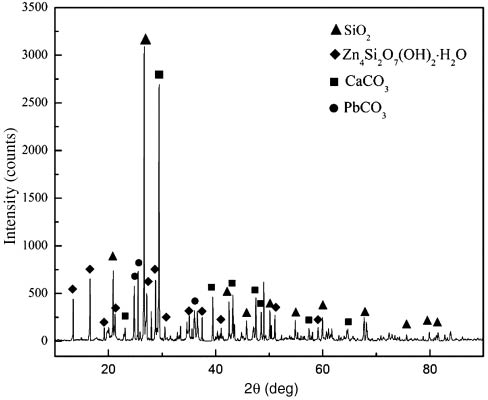
X-ray diffraction (XRD) pattern of low-grade oxide zinc ore.
The AC and ammonia were analytically pure, and obtained from Sinopharm Chemical Reagent Co. Ltd. Two steps leaching experiments are conducted in a 300 ml closed glass reactor equipped with a magnetic stirrer (HJ-6A, JIntan, China), and its flow diagram is shown in Figure 2. The leaching liquid used in the first leaching step was the filtrate from the second leaching step of the other leaching experiment, and an operation like this could save leaching agents and could improve zinc recovery. The parameters of the leaching experiments were as follows: temperature of 30°C, reaction time of 60 min, stirring speed of 300 rpm, solid to liquid ratio of 1:5 and ammonia concentration of 5 mol/l. The detailed compositions of the leaching liquids are displayed in Table 2.
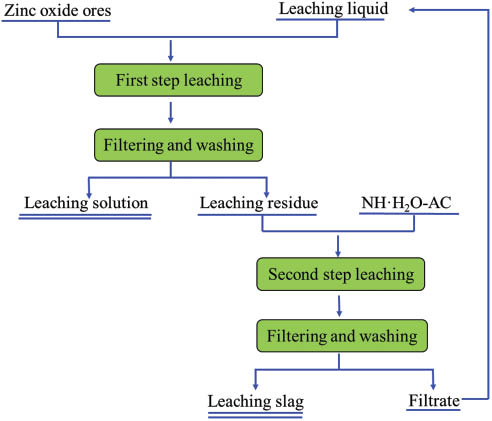
Flow diagram of the leaching process.
The leaching reagent concentrations of different leaching solutions (mol/l).
| Solution no. | AC | NH3·H2O | Solution no. | AC | NH3·H2O |
|---|---|---|---|---|---|
| 1 | 0.00 | 5 | 6 | 0.55 | 5 |
| 2 | 0.15 | 5 | 7 | 0.65 | 5 |
| 3 | 0.25 | 5 | 8 | 0.75 | 5 |
| 4 | 0.35 | 5 | 9 | 0.85 | 5 |
| 5 | 0.45 | 5 | 10 | 1.00 | 5 |
After leaching experiments, the leaching recovery of zinc (ηZn, %) was calculated according to the following equation:
where, CZn, V, m and WZn represented the Zn concentration of leaching solution (g/l), the leaching volume (l), the mass of the zinc oxide ore (g) and the Zn content of the zinc oxide ore (%), respectively.
Fourier transform infrared (FT-IR) spectra with an Affinity-1 FT-IR spectrometer of the leaching solutions were obtained to study the reason for the enhanced leaching rate, using an America Nicolet IS 10 spectrometer. Spectra over the 4000 cm-1 to 400 cm-1 range were obtained at room temperature.
3 Results and discussion
3.1 Phase analysis of leaching slag
Figure 3 shows X-ray diffraction patterns of the leaching slags. The results of this analysis revealed that the peaks of hemimorphite [Zn4Si2O7(OH)2·H2O] gradually weakened with the rise of the AC concentrations. When the AC concentration was 0.35 mol/l, the peaks of hemimorphite almost disappeared, which meant that the zinc-containing phase was almost completely leached. The SiO2, CaCO3 and PbCO3 phases were the main compositions of the leaching slags, and they were not leached in leaching experiments.
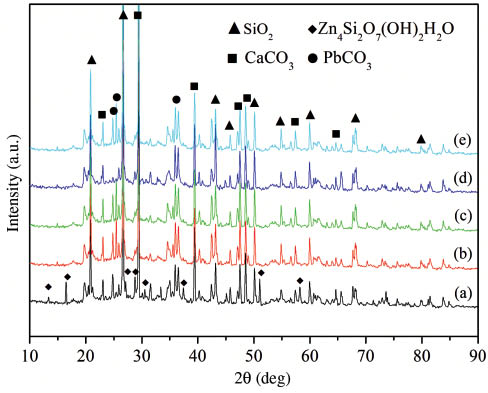
X-ray diffraction (XRD) patterns of two steps leaching slags formed in different solutions: (A) No. 2 solution; (B) No. 4 solution; (C) No. 6 solution; (D) No. 8 solution; (E) No. 10 solution.
3.2 Leaching rate
The effects of AC concentrations on the zinc recovery (average value) from the low grade zinc oxide ores are displayed in Figure 4, which showed that the zinc recovery increased with the rise of the concentration of AC. Obviously, when the concentration of AC was 0 mol/l, the total zinc recovery of two step leaching was only 4.72%. When the concentration of AC was 1 mol/l, the total zinc recovery of two step leaching was as high as 88.84%. AC showed a strong enhanced effect on the zinc recovery from the low grade zinc oxide ores.
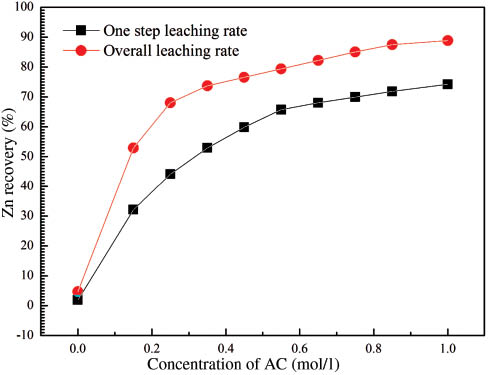
Effect of ammonium citrate (AC) concentration on zinc recovery (average value). Overall leaching rate represents the total leaching rate in the two steps, and first step leaching rate represents the leaching rate in the first step as shown in Figure 2.
The dissolution of hemimorphite in the alkaline system can be represented by Eq. (1):
From Eq. (1), we can clearly find out that NH4+ ions and NH3 molecules were the necessary reactants that can dissolve hemimorphite. With the rise of the AC concentration, the concentration of NH4+ ion in the leaching solution increased, and the chemical reaction in Eq. (1) was promoted. As a result, the zinc recovery was promoted.
3.3 FT-IR of leachate solution
Figure 5 shows the X-ray diffraction patterns of the solid and the leaching solution with the AC concentration of 1 mol/l (No. 10 solution in Table 2). From the spectrum of the AC solid, two peaks at 1400 cm-1 and 1600 cm-1 can clearly be found. There are asymmetric stretching vibrations between 1600 cm-1 and 1642 cm-1 and symmetric vibrations between 1517 cm-1 and 1326 cm-1, which belong to COO- group [19, 20]. Asymmetric stretching vibrations and symmetric vibrations revealed the COO- groups ionized from the AC chelated with metal cations [21]. In the ammonia solution, the leaching rates of Fe, Pb, Al, Ca and Mg were very limited, so the metal cations can be thought of as zinc cations. The citrate ionized from AC could form stable complexes with the free zinc ions, and the concentration of the free zinc ions decreased. From Eq. (1), we can deduce that the concentration of the free NH3 increased, and the leaching process will be promoted. This was another reason for the improvement of the leaching ratio of zinc.

Fourier transform infrared (FT-IR) spectra of ammonium citrate (AC) solid and leaching liquids with the AC concentration of 1 mol/l.
4 Conclusions
The effects of AC concentration on the zinc recovery of low grade zinc oxide ores were investigated. The major conclusions drawn from the work are summarized below:
Zinc in the low grade zinc oxide ore can be leached in the NH3-AC-H2O system. Zinc recovery increased with the rise of the concentration of AC. Under conditions of temperature of 30°C, reaction time of 60 min, citric acid concentration of 1 m and solid to liquid ratio of 1:5, 88.83% of zinc was recovered.
The peaks of hemimorphite in the leaching slags gradually weakened with the rise of the AC concentrations. When the AC concentration was 0.3 mol/l, the peaks of hemimorphite almost disappeared, which meant that the zinc-containing phases were almost completely leached.
Asymmetric stretching vibrations (between 1600 cm-1 and 1642 cm-1) and symmetric vibrations (between 1517 cm-1 and 1326 cm-1) revealed the COO- groups in the citrate ionized from AC chelated with zinc cations. The citrate ionized from AC formed stable complexes with the free zinc ions, and this was another reason for the improvement of the leaching ratio of zinc.
About the authors

Shiwei Li obtained his doctorate from Northeastern University in 2013. Currently, he works at Kunming University of Science and Technology. His primary research interests include microwave metallurgy, hydrometallurgy and comprehensive recovery of the wastes in metallurgy fields.

Aiyuan Ma is pursuing his doctorate at Kunming University of Science and Technology, China. Currently, he is carrying out research on hydrometallurgy and unconventional metallurgy under the supervision of Professor Jinhui Peng. His main research subject is extracting zinc from the blast furnace with an ammonia system.

Kun Yang is pursuing her doctorate at Kunming University of Science and Technology, China, where she is currently carrying out research on microwave energy application, metallurgy and chemical engineering under the supervision of Professor Jinhui Peng. Her main research subject is coupling various outfields to strengthen the leaching of nontraditional zinc resources.

Shaohua Yin obtained her doctorate from Northeastern University in 2013. Currently, she is working at Kunming University of Science and Technology. Her primary research interests include microwave metallurgy, solvent extraction of rare earth and the efficient use of rare earth resources.

Libo Zhang is a PhD supervisor in Kunming University of Science and Technology, and is mainly engaged in the microwave heating in the application of metallurgy, chemical engineering, material, etc.

Jinhui Peng is a PhD supervisor in Kunming University of Science and Technology, and is mainly engaged in microwave heating in the application of metallurgy, chemical engineering and materials science. He has received many awards, among which are the State Technological Invention Award and the Natural Science Award of Kunming province.

Weiheng Chen has started his MSc at the Kunming University of Science and Technology, China, where he is currently carrying out research on metallurgy and chemical engineering under the supervision of Professor Libo Zhang. His primary research interests include hydrometallurgy and comprehensive recovery of the wastes in metallurgy fields.

Feng Xie has started his MSc at the Kunming University of Science and Technology, China, where he is currently carrying out research on microwave energy application, metallurgy and chemical engineering under the supervision of Professor Libo Zhang. His main research subject is the extraction and separation of rare earths by the microfluidics technique.
Acknowledgments
This work was supported by the National Program on Key Basic Research Project of China (973 Program, 2014CB643404), Kunming University of Science and Technology Personnel Training Fond (KKSY201452089), and National Natural Science Foundation of China (51404118).
References
[1] Liu ZY, Liu ZH, Li QH, Yang TZ, Zhang X. Hydrometallurgy 2012, 125–126, 137–143.10.1016/j.hydromet.2012.06.004Search in Google Scholar
[2] Li SW, Gao B, Tu GF. Hu L, Sun SC, Zhu GL, Yin SH. Constr. Build. Mater. 2014, 71, 121–131.Search in Google Scholar
[3] Xu HS, Wei C, Li CX, Fan G, Deng ZG, Li MT, Li XB. Hydrometallurgy 2010, 105, 186–190.10.1016/j.hydromet.2010.07.014Search in Google Scholar
[4] He SM, Wang JK, Yan JF. Hydrometallurgy 2010, 104, 235–240.10.1016/j.hydromet.2010.06.011Search in Google Scholar
[5] Li CX, Xu HS, Deng ZG, Li XB, Li MT, Wei C. Trans. Nonferrous Met. Soc. China 2010, 20, 918–923.10.1016/S1003-6326(09)60236-3Search in Google Scholar
[6] Wang RX, Tang MT, Yang SH, Zhang WH, Tang CB, He J, Yang JG. J. Cent. South Univ. Technol. 2008, 15, 679–683.Search in Google Scholar
[7] He SM, Wang JK, Yan JF. Hydrometallurgy 2011, 108, 171–176.10.1016/j.hydromet.2011.04.004Search in Google Scholar
[8] Chen AL, Zhao ZW, Jia XJ, Long S, Huo GS, Chen XY. Hydrometallurgy 2009, 97, 228–232.10.1016/j.hydromet.2009.01.005Search in Google Scholar
[9] Yang SH, Tang MT, Chen YF, Tang CB, He J. Trans. Nonferrous Met. Soc. China 2004, 14, 626–630.Search in Google Scholar
[10] Ding ZY, Yin ZL, Hu HP, Chen QY. Hydrometallurgy 2010, 104, 201–206.10.1016/j.hydromet.2010.06.004Search in Google Scholar
[11] Mehta KD, Das C, Pandey BD. Hydrometallurgy 2010, 105, 89–95.10.1016/j.hydromet.2010.08.002Search in Google Scholar
[12] Shabani MA, Irannajad M, Azadmehr AR. Int. J. Miner. Metall. Mater. 2012, 19, 782–786.Search in Google Scholar
[13] Tang JA, Valix M. Miner. Eng. 2006, 19, 1274–1279.Search in Google Scholar
[14] Ma LW, Nie ZR, Xi XL, Han XG. Hydrometallurgy 2013, 136, 1–7.10.1016/j.hydromet.2013.01.016Search in Google Scholar
[15] Ettler V, Vrtišková R, Mihaljevič M, Šebek O, Grygar T, Drahota P. J. Hazard. Mater. 2009, 170, 1264–1268.Search in Google Scholar
[16] Kinoshita T, Yamaguchi K, Akita S, Nii S, Kawaizumi F, Takahashi K. Chemosphere 2005, 59, 1105–1111.10.1016/j.chemosphere.2004.12.015Search in Google Scholar PubMed
[17] Schwab AP, He YH, Banks MK. Chemosphere 2005, 61, 856–866.10.1016/j.chemosphere.2005.04.098Search in Google Scholar PubMed
[18] Schwab AP, Zhu DS, Banks MK. Chemosphere 2008, 72, 986–994.10.1016/j.chemosphere.2008.02.047Search in Google Scholar PubMed
[19] Sonmez MS, Kumar RV. Hydrometallurgy 2009, 95, 53–60.10.1016/j.hydromet.2008.04.012Search in Google Scholar
[20] Kaliva M, Kyriakakis E, Gabriel C, Raptopoulou CP, Terzis A, Tuchagues JP, Salifoglou A. Inorg. Chim. Acta. 2006, 359, 4535–4548.Search in Google Scholar
[21] Tsaramyrsi M, Kavousanaki D, Raptopoulou CP, Terzis A, Salifoglou A. Inorg. Chim. Acta. 2001, 320, 47–59.Search in Google Scholar
©2015 by De Gruyter
This article is distributed under the terms of the Creative Commons Attribution Non-Commercial License, which permits unrestricted non-commercial use, distribution, and reproduction in any medium, provided the original work is properly cited.
Articles in the same Issue
- Frontmatter
- In this issue
- Editorial
- Has GPS landed with precision?
- Original articles
- Solar production of WO3: a green approach
- Sesbania sesban L. biomass as a novel adsorbent for removal of Pb(II) ions from aqueous solution: non-linear and error analysis
- Green methacrylated lignin model compounds as reactive monomers with low VOC emission for thermosetting resins
- Deposition behavior of TiB2 by microwave heating chemical vapor deposition (CVD)
- Interaction and thermodynamics of methylene blue adsorption on oxidized multi-walled carbon nanotubes
- Alkaline leaching of zinc from low-grade oxide zinc ore using ammonium citrate as complexing agent
- Heat shock and titanium dioxide nanoparticles decrease superoxide dismutase and glutathione enzymes activities in Saccharomyces cerevisiae
- Momordica charantia fruit mediated green synthesis of silver nanoparticles
- The continuous synthesis and application of graphene supported palladium nanoparticles: a highly effective catalyst for Suzuki-Miyaura cross-coupling reactions
- Conference announcements
- 5th Flow Chemistry Congress (San Diego, CA, USA, September 15–16, 2015)
- Conferences 2015–2017
- Book reviews
- Flow chemistry
- Biomass as a sustainable energy source for the future: fundamentals of conversion processes
Articles in the same Issue
- Frontmatter
- In this issue
- Editorial
- Has GPS landed with precision?
- Original articles
- Solar production of WO3: a green approach
- Sesbania sesban L. biomass as a novel adsorbent for removal of Pb(II) ions from aqueous solution: non-linear and error analysis
- Green methacrylated lignin model compounds as reactive monomers with low VOC emission for thermosetting resins
- Deposition behavior of TiB2 by microwave heating chemical vapor deposition (CVD)
- Interaction and thermodynamics of methylene blue adsorption on oxidized multi-walled carbon nanotubes
- Alkaline leaching of zinc from low-grade oxide zinc ore using ammonium citrate as complexing agent
- Heat shock and titanium dioxide nanoparticles decrease superoxide dismutase and glutathione enzymes activities in Saccharomyces cerevisiae
- Momordica charantia fruit mediated green synthesis of silver nanoparticles
- The continuous synthesis and application of graphene supported palladium nanoparticles: a highly effective catalyst for Suzuki-Miyaura cross-coupling reactions
- Conference announcements
- 5th Flow Chemistry Congress (San Diego, CA, USA, September 15–16, 2015)
- Conferences 2015–2017
- Book reviews
- Flow chemistry
- Biomass as a sustainable energy source for the future: fundamentals of conversion processes
