A solvent free approach for Knoevenagel condensation: facile synthesis of 3-cyano and 3-carbethoxycoumarins
-
Suresh Kumar
Suresh Kumar is currently working as an Assistant Professor of Organic Chemistry at Kurukshetra University, India. He received his PhD degree in Organic Chemistry from Maharshi Dayanand University, India in 2009. His area of research is focused on the development of greener and more efficient protocols for the synthesis of heterocyclic compounds.


Abstract
A simple, efficient and solvent free approach for the Knoevenagel condensation has been developed which involves grinding of active methylene compounds with aromatic aldehydes over basic alumina. Using this solvent free Knoevenagel approach, a facile and efficient synthesis of 3-cyano and 3-carbethoxycoumarins has also been developed, which involves the grinding of 2-hydroxybenzaldehydes with malononitrile or ethylcyanoacetate respectively over basic alumina followed by grinding with p-toluenesulphonic acid (PTSA) in the same mortar.
1 Introduction
Coumarin constitutes an important class of oxygen heterocyclic compounds and occupies a special place in the field of natural and synthetic organic chemistry, owing to their potent and diverse biological activities [1]. A large number of natural products and synthetic analogues bearing the coumarin structural unit, display diverse and important biological activities [2–4]. 3-Cyano and 3-carbethoxycoumarins are the well-known starting materials for the synthesis of coumarin-3-carboxylic acid and coumarin-3-carboxamide, which have been used to synthesise modified cephalosporins [5], penicillins [6], and oxygen bridged tetrahydropyridones [7]. Cyano and carbethoxy functional groups are also useful for introducing units of biological interest such as triazole, thiadiazine and thiadiazole to coumarin nucleus for increasing biological activity of the compounds [8]. Beside synthetic applications, 3-cyanocoumarins have also been evaluated for their biological activities such as antimicrobial properties [9].
3-Cyanocoumarins are generally obtained by the reaction of 2-hydroxybenzaldehydes with malononitrile or ethylcyanoacetate. This reaction, first involves the condensation of the previously mentioned two reactants to give benzylidene derivatives, which undergo further cyclisation to give 3-cyanocoumarin. Various reagents have been used for this reaction, which includes aqueous alkali [10], aqueous K2 CO3 using phase transfer catalyst [11], pyridine [12], piperidine [13], etc. The toxic nature of piperidine or pyridine, longer reaction time, poor yields and use of hazardous organic solvents during the reaction, are the important limitations of this method. Moreover in some cases, a mixture of products is formed, as cyano groups normally undergo hydrolysis if an aqueous or alcoholic medium is used, thus giving a mixture of products which includes 3-carboxycoumarins.
Carbon-carbon bond formation is an important requirement for many organic syntheses [14] and Knoevenagel condensation is a key route for affecting this [15, 16]. This reaction is reported to be catalysed by various organic bases such as piperidine [17], pyridine [18], inorganic Lewis acids and bases such as ZnCl2 [19], CaO [20] and ZnO [21], using either conventional heating or microwave irradiations [22]. The use of ultrasound [23] and ionic liquid [24] has also been made for this reaction.
Because of the public concern over environment degradation, many efforts are being made to carry out the reaction, under eco-friendly conditions by eliminating the use of hazardous chemicals, particularly solvents [25]. Nowadays the grinding technique has evolved as an important and cheap method to carry out the reactions under solvent free conditions with greater selectivity and higher yields [26–29].
In continuation of our work to develop solvent free routes for organic synthesis [30–32], using grinding technique, herein we report a facile synthesis of 3-cyano and 3-carbethoxycoumarins by making use of solvent free Knoevenagel condensation (Scheme 1).
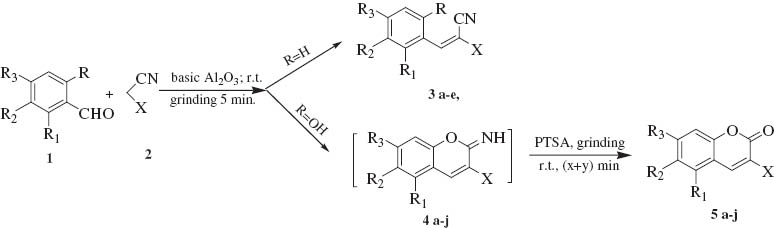
Synthesis of 3-cyano and 3-carbethoxycoumarin via solvent free Knoevenagel condensation.
2 Materials and methods
Grinding in all the reactions was carried out in a porcelain mortar with a pestle. Basic alumina of Brockmann activity-I and 150 mesh size from Aldrich was used. Melting points were taken in an open capillary, on an electrically heated metal block and are uncorrected. All the compounds were characterised from their spectral data (IR and 1H-NMR) and compared with an authentic sample (CO-TLC and CO-IR). The 1H NMR spectra were recorded on a Bruker Avance II 400 spectrometer at 400 MHz in CDCl3 using TMS as an internal standard. Chemical shifts (δ) are reported in ppm and coupling constant in Hz. The IR spectra were recorded using a Perkin Elmer spectrometer.
2.1 General procedure
2.1.1 Synthesis of arylidenemalononitrile (3a–e)
A mixture of benzaldehyde (4.7 mmol), malononitrile (Merck, Mumbai, India) (4.8 mmol) and basic alumina (5 g) was ground in a mortar with a pestle for 5 min, when the initial aldehydes were found to have reacted completely, as checked by thin layer chromatography (TLC). Diethyl ether (20 ml) was added to the reaction mixture, stirred well and the mixture was filtered to remove alumina. The residue was washed with diethyl ether (2×5 ml) and the solvent removed from combined ether extract by distillation. The solid residue obtained was recrystallised from ethanol to give benzylidenemalononitrile (3a–e). All other chemicals except substituted 2-hydroxybenzaldehydes were purchased from Sigma-Aldrich Chemicals, New Delhi, India.
2.1.2 Synthesis of 3-cyanocoumarin/ 3-carbethoxycoumarin (5a–j)
A mixture of 2-hydroxybenzaldehyde (4.7 mmol), malononitrile/ethylcyanoacetate (4.8 mmol) and basic alumina (5 g) was ground in a mortar with a pestle for 5 min, when the initial aldehydes were found to have reacted completely, as checked by TLC. p-Toluenesulphonic acid (PTSA) (1.0 g) was added to the reaction mixture and it was again ground for 5 min in the same mortar. The reaction mixture was left at room temperature for 10–15 min until the completion of the reaction, which was checked by TLC. Diethyl ether (20 ml) was added to the reaction mixture, stirred well and the mixture was filtered to remove the alumina. The residue was washed with diethyl ether (2×5 ml) and the combined ether extract was washed with 10% aq. NaHCO3 solution (2×15 ml), followed by water, to remove any unused PTSA. The ether layer was dried over anhydrous sodium sulphate and the solvent was removed by distillation to obtain the solid residue which recrystallised from methanol to give coumarin (5a–j).
2.1.3 Synthesis of 3-cyano-2-imino-2H-1-benzopyran (4a)
IR (nujol): 3300 cm-1 (N-H), 2220 cm-1(C≡N), 1640 cm-1(C=N).
2.1.4 Synthesis of 6-bromo-3-cyanocoumarin (5c)
IR (nujol): 2234 cm-1 (C≡N), 1735 cm-1 (C=O).
1H-NMR (CDCl3): δ 7.33 (d, J=8.0 Hz, 1H, H-8), 7.82 (dd, J=8.92 Hz & 2.30 Hz, 1H, H-7), 7.91(d, J=2.3 Hz, 1H, H-5), 8.56 (s, 1H, H-4).
3 Results and discussion
In an attempt to devise a solvent free approach for Knoevenagel condensation, a mixture of benzaldehyde and malononitrile was ground well for 5 min, in a porcelain mortar with a pestle using basic alumina as the support and catalyst. Reactants were found to have reacted completely after 5 min of grinding as confirmed by TLC. The yellow solid mass obtained after grinding was worked up to give a compound which was identified as benzylidenemalononitrile, based on its melting point (compared to a reference compound) and spectral data. Using this procedure, differently substituted benzylidenemalononitriles (3a–e) were obtained with 88 to 92% yield (Scheme 1). Encouraged by the results of this reaction, the reaction of 2-hydroxybenzaldehyde and malononitrile was taken up next, with a view to obtaining 3-cyanocoumarin. The reaction was performed in the presence of basic alumina as described earlier and the product obtained was identified as 3-cyano-2-imino-2H-1-benzopyran (4a). So instead of 3-cyanocoumarin, we obtained 3-cyano-2-imino-2H-1-benzopyran. The imino compound obtained was then hydrolysed with methanolic HCl to give 3-cyanocoumarin. In the next experiment, an attempt was made to prepare 3-cyanocoumarin from 2-hydroxybenzaldehyde and malononitrile in a single pot. Thus after grinding the mixture of 2-hydroxybenzaldehyde and malononitrile over basic alumina for 5 min, p-toluenesulphonicacid was added to the reaction mixture and was again ground for 5 min, and left at room temperature for another 10 min, when the initially formed 3-cyano-2-imino-2H-1-benzopyran was found to have disappeared from the reaction mixture as was confirmed by TLC. The reaction mixture finally gave 3-cyanocoumarin. It appears that the water molecule of crystallisation, present in the monohydrate of PTSA or the moisture absorbed by PTSA during the reaction was sufficient for the hydrolysis of 3-cyano-2-imino-2H-1-benzopyran into 3-cyanocoumarin. A reaction between 2-hydroxybenzaldehyde and ethylcyanoacetate, using basic alumina as support, under similar conditions, produced 3-carbethoxycoumarin. It is clear that it is the –CN functional group not –COOC2 H5 functional group of ethylcyanoacetate which participates in cyclisation. So it may be the case of trans-selectivity of the Knoevenagel reaction which leads to (E)-ethylbenzylidenecyanoacetate as the major product. In the case of ethylcyanoacetate, if after grinding the reaction mixture with PTSA, it was kept at room temperature for 1 h, the 3-carboethoxycoumarin began converting to 3-carboxycoumarin. However, complete conversion could not take place even after keeping the reaction mixture for 1 day. Reaction conditions were then optimised with respect to the amount of basic alumina used in step one and PTSA in step two, by taking the model reaction of 2-hydroxybenzaldehyde with malononitrile (Table 1). 3-Cyano-2-imino-2H-1-benzopyran was obtained with a maximum yield in step one, when 5 g of basic alumina was used and, in step two, the use of 1 g–1.5 g of PTSA gave a maximum yield of 3-cyanocoumarin. Thus by making use of these optimised conditions, using this procedure, various substituted 3-cyano and 3-carbethoxycoumarins (5a–j) were successfully synthesised (82–90% yield) under solvent free conditions, directly reacting 2-hydroxybenzaldehyde with malononitrile or ethylcyanoacetate in one pot without isolating the imino compounds (Table 2).
Optimisation of the reaction conditions for the model reaction* at room temperature.
| Amount of basic Al2 O3 used (g) | Grinding time (min) | Yield (%) |
| Step-1 (synthesis of 3-cyano-2-imino-2H-1-benzopyran) | ||
| 2 | 5 | 81 |
| 3 | 5 | 85 |
| 4 | 5 | 90 |
| 5 | 5 | 91 |
| 6 | 5 | 90 |
| 7 | 5 | 87 |
| Amount of PTSA used (g) | Grinding time (x+y min) | Yield (%) |
| Step-2 (synthesis of 3-cyanocoumarin) | ||
| 0.5 | 5+10 | 88 |
| 1.0 | 5+10 | 90 |
| 1.5 | 5+10 | 90 |
| 2.0 | 5+10 | 87 |
*Grinding of 2-hydroxybenzaldehyde and malononitrile over basic alumina in porcelain mortar.
Solvent free synthesis of benzylidenemalononitriles and 3-cyano/3-carbethoxycoumarins.
| Comp. | X | R | R1 | R2 | R3 | Time (x+y min) | mp (°C) | lit. mp (°C) | Yield (%) |
|---|---|---|---|---|---|---|---|---|---|
| 3a | CN | H | H | H | H | NA | 83–84 | 82–84 [16] | 92 |
| 3b | CN | H | H | H | CH3 | NA | 132–33 | 133–35 [33] | 91 |
| 3c | CN | H | H | H | OCH3 | NA | 116–117 | 118 [34] | 88 |
| 3d | CN | H | H | H | NO2 | NA | 159–60 | 159–60[35] | 90 |
| 3e | CN | H | H | H | Cl | NA | 164–65 | 163[34] | 92 |
| 4a | CN | OH | H | H | H | NA | 138–39 | 140–41 [36] | 91 |
| 5a | CN | OH | H | H | H | 5+10 | 180–81 | 182 [13] | 90 |
| 5b | CN | OH | H | Cl | H | 5+10 | 191–92 | 191–92 [37] | 89 |
| 5c | CN | OH | H | Br | H | 5+10 | 195–96 | 195 [38] | 90 |
| 5d | CN | OH | H | H | OCH3 | 5+15 | 227–28 | 225–26 [39] | 82 |
| 5e | CN | OH | OCH3 | H | OCH3 | 5+15 | 229–30 | 228–29 [11] | 80 |
| 5f | COOC2 H5 | OH | H | H | H | 5+15 | 92–93 | 95 [40] | 86 |
| 5g | COOC2 H5 | OH | H | Cl | H | 5+15 | 143–44 | 145 [41] | 85 |
| 5h | COOC2 H5 | OH | H | Br | H | 5+15 | 167–68 | 168 [40] | 89 |
| 5i | COOC2 H5 | OH | H | H | OCH3 | 5+15 | 122–23 | 125 [41] | 82 |
| 5j | COOC2 H5 | OH | OCH3 | H | OCH3 | 5+20 | 148–50 | 149 [41] | 82 |
x, grinding time; y, time for which reaction mixture was kept at room temperature.
4 Conclusion
In conclusion it can be stated that the present approach for Knoevenagel condensation provides a very simple, solvent free and convenient synthesis of benzylidenemalononitriles in high yields by making use of grinding technique at room temperature. This approach can also be used for the synthesis of 3-cyano and 3-carbethoxycoumarins in a single pot under solid phase conditions.
About the author

Suresh Kumar is currently working as an Assistant Professor of Organic Chemistry at Kurukshetra University, India. He received his PhD degree in Organic Chemistry from Maharshi Dayanand University, India in 2009. His area of research is focused on the development of greener and more efficient protocols for the synthesis of heterocyclic compounds.
Acknowledgement
The author is thankful to Prof. J. K. Makrandi for his valuable suggestions on this work.
References
[1] Soine TO. J. Pharm. Sci. 1964, 53, 231–264.Suche in Google Scholar
[2] Yacobi A. J. Pharm. Sci. 1975, 64, 1995–1998.Suche in Google Scholar
[3] Borges F, Roleira F, Mihazes N, Santana L, Uriarte E. Current Med. Chem. 2005, 12, 887–916.Suche in Google Scholar
[4] Neyt J, De-Clercq E, Singha R, Chang YH, Das AR, Chakraborty SK, Hong SC, Tsay SC, Hsu MH, Hwu JR. J. Med. Chem. 2009, 52, 1486–1490.Suche in Google Scholar
[5] Bonsignore L, Cottiglia F, Elkhaili H, Jehl F, Lavagna SM, Loy G, Manna F, Monteil H, Pompei D, Secci D. II Farmaco 1998, 53, 425–430.10.1016/S0014-827X(98)00047-0Suche in Google Scholar
[6] Bonsignore L, Delogu A, Loy G, Lavagna SM, Secci D. Eur. J. Med. Chem. 1994, 29, 479–485.Suche in Google Scholar
[7] Jonsson D, Erlandsson M, Unden A. Tetrahedron Lett. 2001, 42, 6953–6956.Suche in Google Scholar
[8] Bhalla M, Hitkari A, Gujrati VR, Bhalla TN, Shanker K. Eur. J. Med. Chem. 1994, 29, 713–717.Suche in Google Scholar
[9] Zaha AA, Hazem A. New Microbiol. 2002, 25, 213–222.Suche in Google Scholar
[10] Fringuelli F, Piermatti O, Pizzo F. Synthesis, 2003, 15, 2331–2334.10.1055/s-2003-41061Suche in Google Scholar
[11] Seema, Kumar S, Makrandi JK. Indian J. Chem. 2005, 44B, 1307–1308.Suche in Google Scholar
[12] Cingolani E. Gazz. Chim. Ital. 1954, 84, 843–852.Suche in Google Scholar
[13] Baker W, Howes CS. J. Chem. Soc. 1953, 119–124.10.1039/jr9530000119Suche in Google Scholar
[14] Jones, G. In Organic Reactions, Adams, R, Ed., John Wiley & Sons: New York, 1967, vol. 15, pp. 204–599.Suche in Google Scholar
[15] Texier-Boullet F, Foucaud A. Tetrahedron Lett. 1982, 23, 4927–4928.Suche in Google Scholar
[16] Phadtare SB, Shankarling GS. Environ Chem. Lett. 2012, 10, 363–368.Suche in Google Scholar
[17] Fioravanti S, Pellacani L, Tardella PA, Vergari MC. Org. Lett. 2008, 10, 1449–1451.Suche in Google Scholar
[18] Augustine JK, Naik YA, Mandal AB, Chowdappa NV, Praveen B. J. Org. Chem. 2007, 72, 9854–9856.Suche in Google Scholar
[19] Shanthan Rao P. Venkatraman RV. Tetrahedron Lett. 1991, 32, 5821–5822.10.1016/S0040-4039(00)93564-0Suche in Google Scholar
[20] Lu Y, Ren G, Cao W, Tong W, Gao M. Synth. Commun. 2004, 34, 2047–2051.Suche in Google Scholar
[21] Moison H, Texier-Boullet F, Faucaud A. Tetrahedron 1987, 43, 537–542.10.1016/S0040-4020(01)89986-5Suche in Google Scholar
[22] Mogilaiah K. Sharath Babu H, Vidya K, Shiv Kumar K. Indian J. Chem. 2010, 49B, 390–393.Suche in Google Scholar
[23] Zhao S, Wang X, Zhang L. RSC Adv. 2013, 3, 11691–11696.Suche in Google Scholar
[24] Su C, Chen ZC, Zhen QG. Synthesis 2003, 555–559.10.1055/s-2003-37643Suche in Google Scholar
[25] Tanaka K, Toda F. Chem. Rev. 2000,100, 1025–1074.Suche in Google Scholar
[26] Cave GWV, Raston CL, Scott JL. Chem. Commun. 2001, 2159–2169.10.1039/b106677nSuche in Google Scholar
[27] Kumar A, Sharma S. Green Chem. 2011, 13, 2017–2020.Suche in Google Scholar
[28] Sato K, Ozu T, Takenaga N. Tetrahedron Lett. 2013, 54, 661–664.Suche in Google Scholar
[29] Sachdeva H, Saroj R, Khaturia S, Dwivedi D. Green Process. Synth. 2012, 1, 469–477.Suche in Google Scholar
[30] Kumar S, Lamba MS, Makrandi JK. Green Chem. Lett. & Rev. 2008, 1, 123–125.Suche in Google Scholar
[31] Kumar S, Makrandi JK. E J Chem. 2012, 9, 1251–1256.Suche in Google Scholar
[32] Sharma D, Kumar S, Makrandi JK. Green Chem. Lett.Rev. 2011, 4, 127–129.Suche in Google Scholar
[33] Jin TS, Zhang JS, Wang AQ, Li TS. Synth. Commun. 2004, 34, 2611–2616.Suche in Google Scholar
[34] Deshmukh MB, Patil SS, Jadhav SD, Pawar PB. Synth. Commun. 2012, 42, 1177–1183.Suche in Google Scholar
[35] Ren YM, Cai C. Synth. Commun. 2007, 37, 2209–2213.Suche in Google Scholar
[36] Valizadeh H, Mahmoodian M, Gholipour H. J. Heterocyclic Chem. 2011, 48, 799–802.Suche in Google Scholar
[37] Bruce JM, Creed D, Daves K. J. Chem. Soc.C, 1971, 3749–3756.10.1039/j39710003749Suche in Google Scholar
[38] Sharma D, Makrandi JK. J. Serb. Chem. Soc. 2013, doi: 10.2298/JSC130127140S.10.2298/JSC130127140SSuche in Google Scholar
[39] Lele SS, Patel MG, Sethna S. J. Org. Chem. 1962, 27, 637–639.Suche in Google Scholar
[40] Clinton RO, Laskowski SC, J. Am. Chem. Soc. 1949, 71, 3602–3606.Suche in Google Scholar
[41] Bonsignore L, Cottiglia F, Maccioni AM, Secci D, Lavagna SM. J. Heterocyclic Chem.1995, 32, 573–577.Suche in Google Scholar
©2014 by Walter de Gruyter Berlin/Boston
This article is distributed under the terms of the Creative Commons Attribution Non-Commercial License, which permits unrestricted non-commercial use, distribution, and reproduction in any medium, provided the original work is properly cited.
Artikel in diesem Heft
- Frontmatter
- In this issue
- Editorial
- Megatrends – megascience? Part 2
- Feature
- Novel sustainable industrial processes: from idea to commercial scale implementation
- Original articles
- Application of environmental and economic metrics to guide the development of biocatalytic processes
- Synthesis of nanostructured MgO powders with photoluminescence by plasma-intensified pyrohydrolysis process of bischofite from brine
- A solvent free approach for Knoevenagel condensation: facile synthesis of 3-cyano and 3-carbethoxycoumarins
- Green synthesis and characterisations of antibacterial silver-polyvinyl alcohol nanocomposite films for wound dressing
- Company profiles
- AVA Biochem: commercialising renewable platform chemical 5-HMF
- Invenios: micro process technology – chemical process technology of tomorrow
- Conference announcements
- International Conference on Green Chemistry and Sustainable Engineering International (Barcelona, Spain, July 29–31, 2014)
- 7th Annual European Forum for Industrial Biotechnology and the Biobased Economy (Reims, France, September 30–October 2, 2014)
- 19th International Symposium on Homogeneous Catalysis (ISHC-XIX; Ottawa, ON, Canada, July 6–11, 2014)
- 248th American Chemical Society National Meeting and Exposition: Chemistry and Global Stewardship (San Francisco, CA, USA, August 10–14, 2014)
- Conferences 2014–2017
- Book reviews
- Green materials for sustainable water remediation and treatment
- Engineering catalysis
Artikel in diesem Heft
- Frontmatter
- In this issue
- Editorial
- Megatrends – megascience? Part 2
- Feature
- Novel sustainable industrial processes: from idea to commercial scale implementation
- Original articles
- Application of environmental and economic metrics to guide the development of biocatalytic processes
- Synthesis of nanostructured MgO powders with photoluminescence by plasma-intensified pyrohydrolysis process of bischofite from brine
- A solvent free approach for Knoevenagel condensation: facile synthesis of 3-cyano and 3-carbethoxycoumarins
- Green synthesis and characterisations of antibacterial silver-polyvinyl alcohol nanocomposite films for wound dressing
- Company profiles
- AVA Biochem: commercialising renewable platform chemical 5-HMF
- Invenios: micro process technology – chemical process technology of tomorrow
- Conference announcements
- International Conference on Green Chemistry and Sustainable Engineering International (Barcelona, Spain, July 29–31, 2014)
- 7th Annual European Forum for Industrial Biotechnology and the Biobased Economy (Reims, France, September 30–October 2, 2014)
- 19th International Symposium on Homogeneous Catalysis (ISHC-XIX; Ottawa, ON, Canada, July 6–11, 2014)
- 248th American Chemical Society National Meeting and Exposition: Chemistry and Global Stewardship (San Francisco, CA, USA, August 10–14, 2014)
- Conferences 2014–2017
- Book reviews
- Green materials for sustainable water remediation and treatment
- Engineering catalysis
