Microfluidics Group – Department of Chemistry, Sultan Qaboos University
-
Haider A.J. Al Lawati


Sultan Qaboos University (SQU) was established in 1986. The University started with five colleges; Medicine, Engineering, Agriculture, Education and Science. Several other colleges were later established, including the College of Arts, the College of Commerce and Economics, the College of Law and the College of Nursing.
The Chemistry Department is a part of the College of Science, established in 1986. This department offers a 5-year BSc, a 2-year MSc, and a 3-year PhD program.
After obtaining his PhD in 2007, Dr. Al Lawati established a new research group in the microfluidics area at the Department of Chemistry. The microfluidics group includes: Dr. Haider Al Lawati, Dr. FakhrEldin O. Suliman and Prof. Salma Al Kindy, and Mrs. Gouri B. Varma (Assistant Researcher).
In May 2009, the group successfully obtained His Majesty (HM) Grant for a project entitled “Developing Microfluidic Systems for Routine Analysis of Pharmaceutical Samples" with a budget of $200,000. We were able to establish the first research laboratory in the field of microfluidics at SQU and perhaps in the Arabian Gulf region. Additionally, the grant helped a great deal in creating an excellent research environment and a strong research group. The microfluidics group presented a number of scientific papers at international conferences and published several papers in international journals (Talanta [1, 2], Analytical Methods [3] and Luminescence [4, 5]). Additionally, we participated in the Oman innovation fair in 2011 and received an award for the best innovation at the exhibition. These intensive research activities requested further investment and an extension for a year was granted with a budget of $25,000.
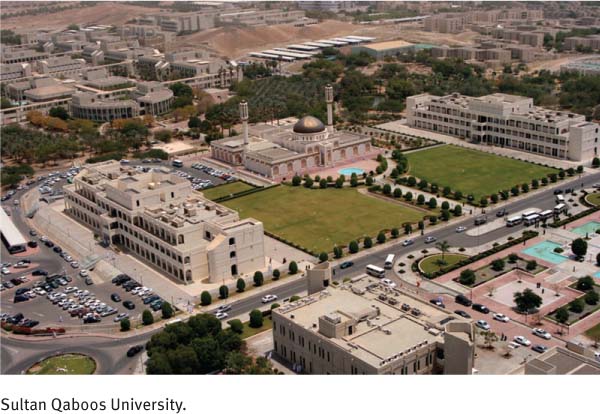
Sultan Qaboos University.
In June 2011, we submitted a new research proposal to The Research Council (TRC) -Sultanate of Oman. The research utilizes microfluidics as an efficient mixing device in a chemiluminescence detection system for a capillary-HPLC. The mixing device was developed successfully early in the HM funded project. The project was highly appreciated by the referees and based on their comments the TRC accepted to fund the project with a budget of $370,000 for a period of 3 years. (2012–2015). The future plan is to explore the possibility of utilizing a paper based lab on a chip for pharmaceutical and biological analysis using optical detection techniques.
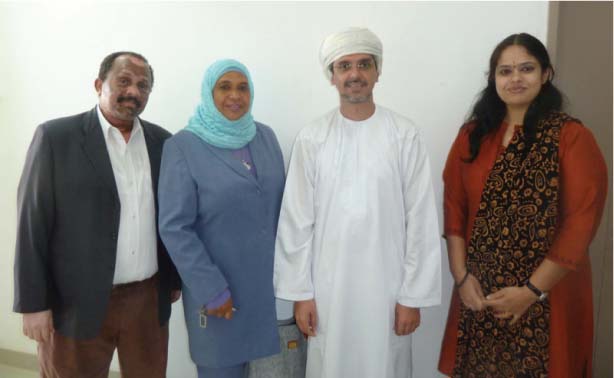
From left to right Dr. Fakhr Eldin, Prof. Salma Al Kindy, Dr. Haider Al Lawati, Mrs. Gouri B. Varma.

References
1 Al Lawati HAJ, Gharibi EA, Al Kindy SMZ, Suliman FEO, Al-Lawati AM. Talanta 2011, 85, 906–912.10.1016/j.talanta.2011.04.072Search in Google Scholar PubMed
2 Al Lawati HAJ, Suliman FO, Al Kindy SMZ, Al Lawati AM, varma GB, Nour IM. Talanta 2010, 82, 1999–2002.10.1016/j.talanta.2010.08.018Search in Google Scholar PubMed
3 Al Lawati HAJ, Al-Azwani M, Varma GB, Suliman FEO, Shalabi KA. Anal. Methods 2011, 3, 2585–2592.10.1039/c1ay05346aSearch in Google Scholar
4 Al Lawati HAJ, Al Dahmani ZM, Suliman FEO, Al Kindy SMZ, Al-Lawati AM. Luminescence 2011, 26, 762–767.10.1002/bio.1310Search in Google Scholar PubMed
5 Al Lawati HAJ, Varma GB, Suliman FEO. Luminescence 2013, 28, 44–49.10.1002/bio.2334Search in Google Scholar PubMed
©2013 by Walter de Gruyter Berlin Boston
Articles in the same Issue
- Masthead
- Masthead
- Graphical abstracts
- In this Issue
- Editorial
- Scientific spring metamorphosis
- Original articles
- Development highlights of micro-nano technologies in the MENA region and pathways for initiatives to support and network
- Integrated processing for the separation of biobutanol. Part A: experimental investigation and process modelling
- Integrated processing for the separation of biobutanol. Part B: model-based process analysis
- Direct saccharification of lignocellulosic biomass by hydrolysis with formic acid solution
- A facile synthesis of 2H-chromen-2-ones via Pechmann condensation under solvent free conditions using grinding technique
- Counter-current arrangement of microfluidic liquid-liquid droplet flow contactors
- Organization profiles
- The Centre for Green Process Engineering (CGPE) opens with launch event at London South Bank University (LSBU)
- King Saud University: nanoscience and nanotechnology research highlights
- Kuwait Institute for Scientific Research
- University profile
- Nanoscience and nanotechnology research highlights at Kuwait University
- Laboratory profiles
- Microfluidics Group – Department of Chemistry, Sultan Qaboos University
- Assiut Microfluidics Laboratory
- Company profiles
- Hikma Pharmaceuticals
- SÜSS MicroTec and iX-factory: qualified process and equipment support for development, research and production – made in Germany
- LionX: our chips enable your products
- Conference announcements
- 17th Annual Green Chemistry and Engineering Conference (GC&E; North Bethesda, MD, USA, June 18–20, 2013)
- 17th IUPAC Conference on Organometallic Chemistry Directed Towards Organic Synthesis (OMCOS 17), Fort Collins, CO, USA, July 28–August 1, 2013
- Conferences 2013/2014
- Book review
- Chemicals from biomass: integrating bioprocesses into chemical production complexes for sustainable development
Articles in the same Issue
- Masthead
- Masthead
- Graphical abstracts
- In this Issue
- Editorial
- Scientific spring metamorphosis
- Original articles
- Development highlights of micro-nano technologies in the MENA region and pathways for initiatives to support and network
- Integrated processing for the separation of biobutanol. Part A: experimental investigation and process modelling
- Integrated processing for the separation of biobutanol. Part B: model-based process analysis
- Direct saccharification of lignocellulosic biomass by hydrolysis with formic acid solution
- A facile synthesis of 2H-chromen-2-ones via Pechmann condensation under solvent free conditions using grinding technique
- Counter-current arrangement of microfluidic liquid-liquid droplet flow contactors
- Organization profiles
- The Centre for Green Process Engineering (CGPE) opens with launch event at London South Bank University (LSBU)
- King Saud University: nanoscience and nanotechnology research highlights
- Kuwait Institute for Scientific Research
- University profile
- Nanoscience and nanotechnology research highlights at Kuwait University
- Laboratory profiles
- Microfluidics Group – Department of Chemistry, Sultan Qaboos University
- Assiut Microfluidics Laboratory
- Company profiles
- Hikma Pharmaceuticals
- SÜSS MicroTec and iX-factory: qualified process and equipment support for development, research and production – made in Germany
- LionX: our chips enable your products
- Conference announcements
- 17th Annual Green Chemistry and Engineering Conference (GC&E; North Bethesda, MD, USA, June 18–20, 2013)
- 17th IUPAC Conference on Organometallic Chemistry Directed Towards Organic Synthesis (OMCOS 17), Fort Collins, CO, USA, July 28–August 1, 2013
- Conferences 2013/2014
- Book review
- Chemicals from biomass: integrating bioprocesses into chemical production complexes for sustainable development
