IUPAC Postgraduate Summer School on Green Chemistry


Postgraduate Summer School on Green Chemistry, 13 July 2018, Palazzo Ducale, Venice
The IUPAC Postgraduate Summer School on Green Chemistry took place from 7-13 July 2018 in Venice, Italy, one of the most beautiful cities in the world and seat of history and culture. It was hosted in the prestigious Palazzo Ducale in St. Mark’s Square and the historic Cultural Centre Don Orione Artigianelli.
The present edition of the Summer School was managed by IUPAC Interdivisional Committee on Green Chemistry for Sustainable Development (ICGCSD) (https://iupac.org/body/041/) and it was the first one organized under IUPAC umbrella (https://iupac.org/project/2017-006-2-041), following 10 previous Summer Schools on Green Chemistry held in Venice from 1998 to 2008 that were managed by the Interuniversity Consortium Chemistry for the Environment (INCA).
Three Alumni of the previous Summer Schools participated in this new edition as teachers:Prof. Egid Mubofu, Vice Chancellor, University of Dodoma (UDOM), Tanzania
Prof. Rafael Luque, Associate Professor, Universidad de Cordoba, Spain
Prof. Peter Licence, Associate Professor, Nottingham University, UK
As Chair I proposed the event and managed organization together with the Organizing Committee in Venice, composed of Prof. Fabio Aricó, Prof. Andrea Vavasori, from Ca’ Foscari University of Venice and the Secretary of the Conference, Ms Elena Griguol.
The Organizing Committee was supported by the Database Manager, Mr Roberto Dallocchio from CNR Istituto di Chimica Biomolecolare, Sassari, Italy and the Web Manager Mr Stefano Bonetta from Ca’ Foscari University of Venice.
The event was endorsed by the Italian National Commission for UNESCO, the Superintendence of Archaeology, Fine Arts and Landscape for the City of Venice and Lagoon, the City of Venice, and the GREENOMIcS UNESCO/UNITWIN Network. The school was supported by several Cà Foscari University Departments: DAIS Department of Environmental Sciences, Informatics and Statistics, and DSMN Department of Molecular Sciences and Nanosystems. It was sponsored by platinum sponsors Eni, L’Oréal, PhosAgro, and GreeNovator and sponsors The Organization for the Prohibition of the Chemical Weapons (OPCW), and the Smart City project SCN 00520 (HeMaIn).
Main topics of the Summer School were:
Renewables & Green Energy
New Reaction Pathways
Green Materials
Reaction Media
Analytical Chemistry & Green Chemistry for Restoration
The summer school also received the endorsement of the European Year of Cultural Heritage 2018 and was listed in the calendar of the events taking place during the year for these celebrations (http://annoeuropeo2018.beniculturali.it/en/eventi/3025/). The choice of Venice as host city for the summer school has offered the opportunity to highlight the emerging connection of green chemistry with the cultural heritage restoration and conservation field. In fact, Monday, 9 July, at Palazzo Ducale was especially dedicated to restoration of cultural heritage goods through green chemistry, with the participation of important experts in the field in collaboration with Venice Superintendence.
The school provided the participants with an understanding of the latest developments of the concepts and management of green and sustainable chemistry. Lectures offered state-of-the-art research contributions in the field of green chemistry, and also covered background material. Existing clean chemical processes, case histories, and topics related to current research in green chemistry were explained in order to familiarize students with the strategies behind designing “greener” synthetic routes. A research policy session addressed the issues which steer the Green Chemistry at the industrial, academic, and governmental levels and the need to anticipate the evolution of environmental regulations, for the chemical industry.
68 Selected post-graduate attendees and 30 teachers coming from 38 different countries participated in the Summer School in Venice. In total, 248 applications were received, and 35 paying students were considered eligible to attend the school after a thorough selection by the Organizing Committee based on their CVs and list of publications. 205 Scholarship applications were received by January 2018 from students coming from less-advantageous countries. A Scientific Committee composed of 8 IUPAC members selected an initial list of 59 applications based on merit out of the 205 submitted. The first 33 students on the list were awarded with a scholarship to attend the school, each receiving €610 from IUPAC, platinum sponsors Eni and L’Oréal, and sponsor OPCW.

Prof. Pietro Tundo and Prof. Michael Graetzel, Palazzo Ducale Loggia, Venice
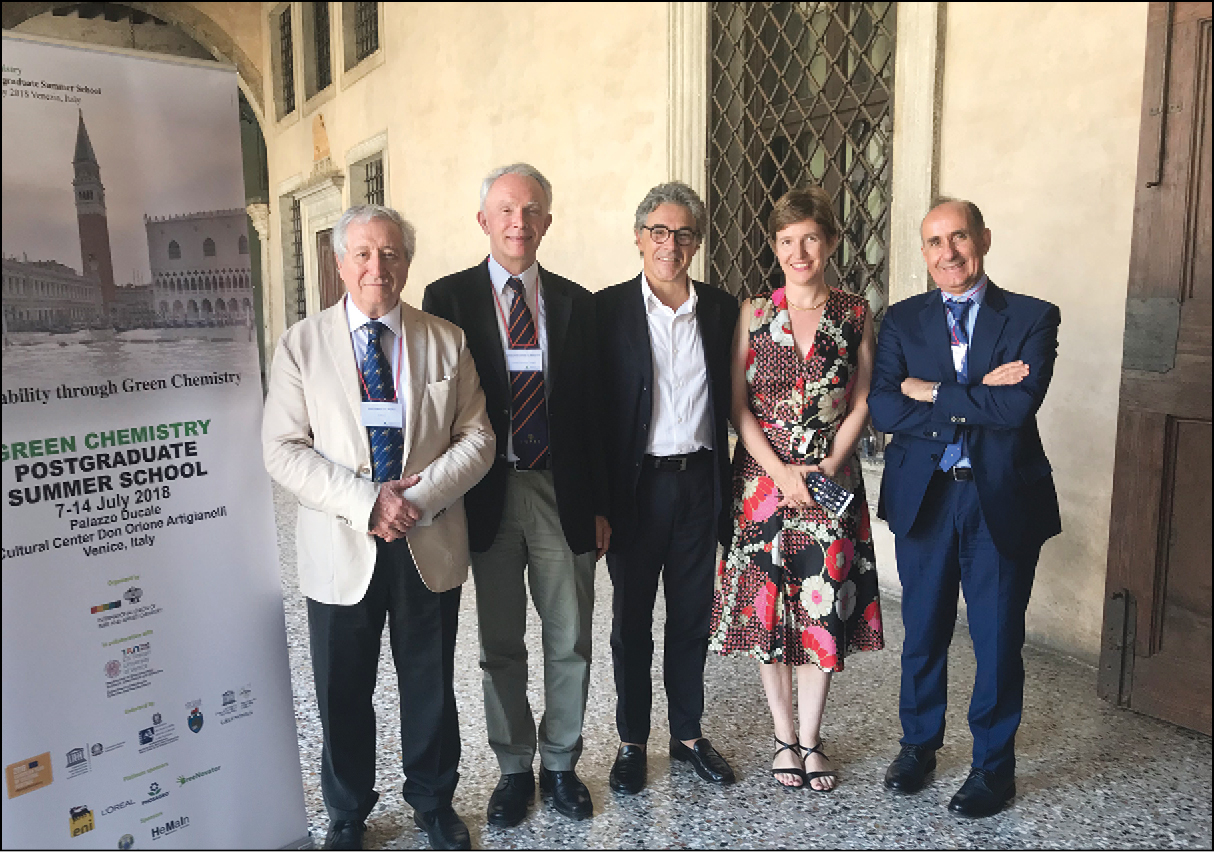
Prof. Pietro Tundo, Prof. Christopher Brett, Dr. Luca Battistella (City of Venice), Venice Superintendent Arch. Manuela Carpani and Ing. Giacomo Rispoli (Eni)
The Organizing Committee expectations were completely met for the quality of teachers and students, and for the diversity of participants both in terms of their geographical origin and their professional affiliations. During the event all the young academicians could contribute their thoughts and ideas on relevant issues of green chemistry and sustainability, restoration and cultural values conservation, chemical weapons prohibition, innovative pharmaceutical production processes, environmental protection, renewables and many other topics. The school was an effective platform for discussing the practical implementation of scientific ideas in the field of green chemistry. It is very important not just to theoretically discuss something, but also to work together to develop and promote real, practical solutions that will later help achieve the final global goal of preserving the planet for future generations.
The rigorous selection of participants contributed to form a class of highly-educated, talented students who find themselves at a point of their life where they are ready to invest their talents and scientific know-how for their future professional careers in a mature and responsible way. The top-level and diverse range of topics offered for discussion at the summer school provided them the chance to look around, exchange their scientific knowledge and establish important links with other participants and professors for fruitful joint projects and research activities. This was a real success for this summer school, since this opportunity will speed up the participants’ careers going forward. In fact three alumni who now occupy important positions in their respective countries: Prof. Egid Mubofu, Prof. Rafael Luque, and Prof. Peter Licence, came back to the school this summer as teachers.
Detailed Programme
Teachers of international scientific and academic repute participated in the event, such as Prof. Michael Graetzel, a well-known scientist in the field of photovoltaic panels, as well as Director of Photonics and Interfaces (LPI) at the Institute of Chemical Science and Engineering Faculty of Basic Science Ecole Polytechnique Fédérale de Lausanne in Switzerland. Prof. Eugene Rozanov, a scientist who knows the causes and can propose scientific remedies to the problem of the ozone hole, came from the Swiss Davos Physical-Meteorological Observatory. Many interventions were explained, starting from a rigorous scientific basis, on how to use what nature makes available for our daily use through a new chemistry that respects the environment and man according to the sustainable development approach and the UN 17 Sustainable Development Goals (SDGs).
Poster session and Awards
All students had the opportunity to expose their posters at the poster sessions on Sunday, 8 July and Tuesday, 10 July at Don Orione Artigianelli. The sessions were a highlight of the summer school due to the originality and the high scientific value of the 52 poster contributions, the significant number of young people that shared their researches with the other attendees, and the interest demonstrated by the participants. On Friday, 13 July, five participants were awarded for their posters and gave an oral presentation on their work.
The winners were:
Francesca Russo, Institute on Membrane Technology (ITM-CNR), Rende, Italy; Innovative materials for membrane-based Green Chemistry development
Manuele Musolino, Cà Foscari University of Venice; Silica Sol-Gel Chemistry & Dimethylcarbonate: A Sustainable Approach to Graffiti Removal
Elena Álvarez González, University of Murcia, Spain; A green bioprocess for the synthesis of flavour esters in Sponge-Like Ionic Liquids
Susana Nieto Céron, University of Murcia, Spain; Sponge-like ionic liquids as an efficient tool for green chemical processes
Alexandra Grekova, Boreskov Institute of Catalysis, Novosibirsk State University, Russia; The Working Pair “Licl/Multi-Wall Carbon Nano-Tubes/Pva”—Water for Thermal Energy
During the closing ceremony two students were awarded with a parchment by the platinum sponsors Eni and L’Oréal in recognition of their contributions to Green Chemistry correlated to their fields of interest:
Eni’s winner: Susana Nieto Céron, University of Murcia, Spain, Sponge-like ionic liquids as an efficient tool for green chemical processes
L’Oréal’s winner: Nejib Kasmi, University of Monastir, Tunisia, Synthesis of New Eco-Friendly Copolyesters From Fully Renewable Resources: Poly(ε-Caprolactone-Co-Pentylene 2,5-Furandicarboxylate)
UNESCO-UNITWIN
The Summer School being one of the activities foreseen in the UNESCO-UNITWIN “Green Chemistry Excellence from Baltic Sea to Mediterranean Sea and Beyond GREENOMIcS Programme (https://www.eventi.polimi.it/events/unesco-unitwin-network/) a meeting took place among the UNITWIN’s members present at the School: Prof. Pietro Tundo, Prof. Nicholas Gathergood, Prof. Klaus Kuemmerer, and Prof. Mehmet Mehmet Mahramanlioglu. They discussed the Summer School outcomes and other on-going and future activities of the GREENOMIcS Network to be reported to UNESCO Paris.
Dr Jinze Dou from Aalto University, Finland, Dr. Andrea Bernardi and Dr Jiemeng Li from Politecnico of Milano, Italy, both participants of the Summer School, were invited to attend the meeting. Also Prof. Alexey Zanin was present as representative of UNESCO Chair in Green Chemistry for Sustainable Development from Dmitry Mendeleev University of Chemical Technology of Russia.
Social event
The Summer School was not just great scientific event, and some space and time were dedicated to socializing and networking as well. A social event took place on Wednesday, 11 July when all the participants were invited to take a boat trip around the Venice Lagoon. Starting from Zattere, on board a big motor ship, the attendees had the opportunity of seeing the city of Venice from the Giudecca Canal, visiting Burano and Torcello Islands. The tour ended at Saint Mark’s Square.
Next year, in May 2019, the Summer School will be organized at the University of Dar es Salaam in Tanzania, and chaired Prof. Egid Mubofu; see https://iupac.org/project/2018-017-1-041 for details.
©2018 IUPAC & De Gruyter. This work is licensed under a Creative Commons Attribution-NonCommercial-NoDerivatives 4.0 International License. For more information, please visit: http://creativecommons.org/licenses/by-nc-nd/4.0/
Articles in the same Issue
- Masthead - Full issue pdf
- Vice President’s Column
- Towards 2019 and the Future
- Features
- Chemistry of Small Spaces
- Chemistry for the Future Solvay Prize
- IUPAC in the (real) clouds
- Chemistry: The Driving Force for Emerging Technologies
- Preprints and Scholarly Communication in Chemistry: A look at ChemRxiv
- IUPAC Wire
- IUPAC Elections for the 2020–2021 Term
- Mirabbos Hojamberdiev is awarded the 2018 IUPAC Chemrawn VII Prize for Green Chemistry
- Standard Atomic Weights of 14 Chemical Elements Revised
- 2019 IUPAC-Solvay International Award for Young Chemists—call for applicants
- Periodic Table of Younger Chemists Revealed
- 2018 Hall of Fame Inductees Announced— ACS Division of Medicinal Chemistry
- IUPAC seeks Expressions of Intent to host 2025 General Assembly and World Chemistry Congress
- Stamps International
- Oganesson, Where Art Thou?
- Project Place
- Safety of Engineered Nanomaterials
- Realisation of a Unified pH Scale
- Successful Drug Discovery
- ILLIAS: An epic journey towards the database on liquid-liquid equilibria in systems containing ionic liquids
- InChI Open Education Resource
- Microwave induced combustion—critical evaluation and new applications
- Multiple Uses of Chemicals—Website updates and translations into OPCW official languages
- IUPAC COCI Safety Training Program—Latin America, STP Associates Training
- Making an imPACt
- Nomenclature for boranes and related species
- Making an imPACt
- Engineered nanomaterials and human health: Part 1. Preparation, functionalization and charact-erization (IUPAC Technical Report)
- Engineered nanomaterials and human health: Part 2. Applications and nanotoxicology (IUPAC Technical Report)
- The ongoing challenge of novel psychoactive drugs of abuse. Part I. Synthetic cannabinoids (IUPAC Technical Report)
- Nomenclature of flavonoids (IUPAC Recommendations 2017)
- Standard reporting of Electrical Energy per Order (EEO) for UV/H2O2 Reactors (IUPAC Technical Report)
- Innovative Technologies for Chemical Security
- Conference Call
- IUPAC Postgraduate Summer School on Green Chemistry
- Polymers: Design, Function, and Application
- Polymers and Organic Materials for Electronics and Photonics: Science for Applications
- Chemistry for Beauty and Health
- From Thailand to Spain
- Where 2B & Y
- Science as a Human Right: International Science Center and Science Museum Day (ISCSMD)
- Mendeleev 150
- Solution Chemistry of Technology Critical Elements
- Mark Your Calendar
- Footnotes
- Index 2018
Articles in the same Issue
- Masthead - Full issue pdf
- Vice President’s Column
- Towards 2019 and the Future
- Features
- Chemistry of Small Spaces
- Chemistry for the Future Solvay Prize
- IUPAC in the (real) clouds
- Chemistry: The Driving Force for Emerging Technologies
- Preprints and Scholarly Communication in Chemistry: A look at ChemRxiv
- IUPAC Wire
- IUPAC Elections for the 2020–2021 Term
- Mirabbos Hojamberdiev is awarded the 2018 IUPAC Chemrawn VII Prize for Green Chemistry
- Standard Atomic Weights of 14 Chemical Elements Revised
- 2019 IUPAC-Solvay International Award for Young Chemists—call for applicants
- Periodic Table of Younger Chemists Revealed
- 2018 Hall of Fame Inductees Announced— ACS Division of Medicinal Chemistry
- IUPAC seeks Expressions of Intent to host 2025 General Assembly and World Chemistry Congress
- Stamps International
- Oganesson, Where Art Thou?
- Project Place
- Safety of Engineered Nanomaterials
- Realisation of a Unified pH Scale
- Successful Drug Discovery
- ILLIAS: An epic journey towards the database on liquid-liquid equilibria in systems containing ionic liquids
- InChI Open Education Resource
- Microwave induced combustion—critical evaluation and new applications
- Multiple Uses of Chemicals—Website updates and translations into OPCW official languages
- IUPAC COCI Safety Training Program—Latin America, STP Associates Training
- Making an imPACt
- Nomenclature for boranes and related species
- Making an imPACt
- Engineered nanomaterials and human health: Part 1. Preparation, functionalization and charact-erization (IUPAC Technical Report)
- Engineered nanomaterials and human health: Part 2. Applications and nanotoxicology (IUPAC Technical Report)
- The ongoing challenge of novel psychoactive drugs of abuse. Part I. Synthetic cannabinoids (IUPAC Technical Report)
- Nomenclature of flavonoids (IUPAC Recommendations 2017)
- Standard reporting of Electrical Energy per Order (EEO) for UV/H2O2 Reactors (IUPAC Technical Report)
- Innovative Technologies for Chemical Security
- Conference Call
- IUPAC Postgraduate Summer School on Green Chemistry
- Polymers: Design, Function, and Application
- Polymers and Organic Materials for Electronics and Photonics: Science for Applications
- Chemistry for Beauty and Health
- From Thailand to Spain
- Where 2B & Y
- Science as a Human Right: International Science Center and Science Museum Day (ISCSMD)
- Mendeleev 150
- Solution Chemistry of Technology Critical Elements
- Mark Your Calendar
- Footnotes
- Index 2018
