Reaching Out for the Sun
-
Daniel Rabinovich


According to a report released in 2011 by the International Energy Agency, enough sunlight hits the earth every 90 minutes to fulfill the world’s energy needs for an entire year. Only a small portion of the global energy supply for electricity generation, heating, and transportation is derived from solar energy, an unfortunate situation since the Sun is a virtually inexhaustible source of energy. This is essentially a technological problem that deals with the cost and conversion efficiency of solar cells and the development of new materials for batteries, both of which are areas of intense research today for chemists, physicists, and other scientists and engineers.
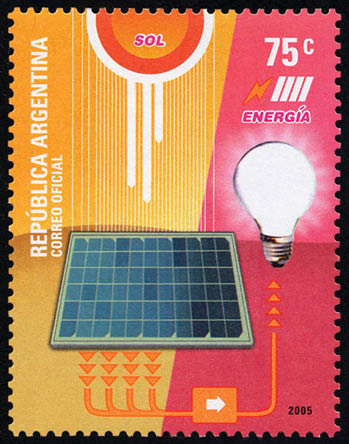
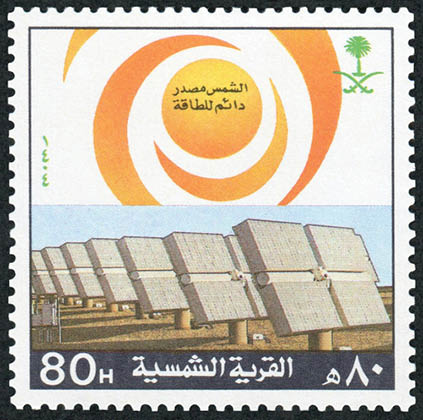
Dozens of postage stamps, including the two illustrated in this note, have been issued worldwide to underscore the importance and value of renewable energy resources, including sunlight, wind, waves, biomass, and geothermal heat. It is interesting to note that even oil-rich countries like Iraq and Saudi Arabia have released stamps dedicated to solar energy, perhaps tacitly acknowledging that the future energy needs of the planet will not be primarily satisfied with fossil fuels.
The Solar Army, a multilayered outreach project led by Professor Harry Gray, a beloved inorganic chemist at CalTech, aims to promote the understanding of key aspects of solar energy conversion and storage. Relatively inexpensive kits that can be used to screen metal oxides capable of water oxidation activity or to build dye-sensitized solar cells and explain photosynthetic processes have been widely demonstrated to the general public and distributed to secondary school and undergraduate students and their teachers. The hope is that training a new generation of scientists and engineers will help make solar energy utilization one of the cornerstones of a sustainable, efficient, and safe world for many generations to come.
Written by Daniel Rabinovich <drabinov@uncc.edu>.
©2016 by Walter de Gruyter Berlin/Boston
Artikel in diesem Heft
- Masthead - Full issue pdf
- Contents
- Vice-President’s Column
- IUPAC— Holding the International Chemistry Family Together
- Stamps International
- Reaching Out for the Sun
- Features
- IChO-48—An Extraordinary Olympiad of Chemistry
- SAICM Science Sector and IUPAC Activities
- The Solar Army
- IUPAC Wire
- Chemistry International Goes Seasonal
- Future of the Chemical Sciences
- IUPAC 2017 Distinguished Women in Chemistry or Chemical Engineering—Call for Nominations
- 2017 IUPAC-Solvay International Award For Young Chemists
- IUPAC100 Logo Competition
- UNESCO/PhosAgro/IUPAC Green Chemistry for Life Program
- Hanwha Total IUPAC Young Scientist Award 2016
- DSM Materials Sciences Award 2016 Goes to Professor Steven P. Armes
- WANTED: A Home for an Orphaned Chemical Database
- Project Place
- Identifying International Chemical Identifier (InChI) Enhancements—QR Codes and Industry Applications
- Categorizing Chalcogen, Pnictogen, and Tetrel Bonds, and Other Interactions Involving Groups 14-16 Elements
- Standardization of Electrical Energy Per Order (EEO) Reporting for UV/H2O2 Reactors
- Isotopes Matter
- Materials on the Nanoscale—Uniform Description System Version 2.0
- Making an imPACt
- How to Name New Chemical Elements (IUPAC Recommendations 2016)
- Vocabulary of Concepts and Terms in Chemometrics (IUPAC Recommendations 2016)
- Glossary of Terms Used in Extraction (IUPAC Recommendations 2016)
- Extraction for Analytical Scale Sample Preparation (IUPAC Technical Report)
- Review of Footnotes and Annotations to the 1949–2013 Tables of Standard Atomic Weights and Tables of Isotopic Compositions of the Elements (IUPAC Technical Report)
- Guidelines for Measurement of Luminescence Spectra and Quantum Yields of Inorganic and Organometallic Compounds in Solution and Solid State (IUPAC Technical Report)
- Bookworm
- Storing Energy, with Special Reference to Renewable Energy Sources
- Chemistry Beyond Chlorine
- POLYCHAR 23—World Forum on Advanced Materials
- Macromolecular Complexes Part I and II
- Polymer-Solvent Complexes and Intercalates POLYSOLVAT-10
- A Draft Framework for Understanding SDG Interactions
- Up for Discussion
- Is it possible to extend the Cahn-Ingold-Prelog priority rules to supramolecular structures and coordination compounds using lone pairs?
- Preliminary Property Design for Ionic Solids and Liquids
- Conference Call
- New Chemistries for Phytomedicines and Crop Protection Chemicals
- Science: How Close to Open?
- Chemical Safety and Security in a Rapidly Changing World
- POLYCHAR 24 World Forum Advanced Materials
- Polymers and Organic Chemistry (POC-16)
- Phosphorus Chemistry
- Where 2B & Y
- Solutions for Drug-Resistant Infections
- Macro- and Supramolecular Architectures and Materials
- Colloquium Spectroscopicum Internationale
- Introduction to the World of Chemical Data—an OnLine College Course (OLCC) on Cheminformatics
- Chemical Identifier
- Digital Cultural Heritage
- 16th International Meeting on Boron Chemistry (IMEBORON16)
- Mark Your Calendar
- Index 2016
Artikel in diesem Heft
- Masthead - Full issue pdf
- Contents
- Vice-President’s Column
- IUPAC— Holding the International Chemistry Family Together
- Stamps International
- Reaching Out for the Sun
- Features
- IChO-48—An Extraordinary Olympiad of Chemistry
- SAICM Science Sector and IUPAC Activities
- The Solar Army
- IUPAC Wire
- Chemistry International Goes Seasonal
- Future of the Chemical Sciences
- IUPAC 2017 Distinguished Women in Chemistry or Chemical Engineering—Call for Nominations
- 2017 IUPAC-Solvay International Award For Young Chemists
- IUPAC100 Logo Competition
- UNESCO/PhosAgro/IUPAC Green Chemistry for Life Program
- Hanwha Total IUPAC Young Scientist Award 2016
- DSM Materials Sciences Award 2016 Goes to Professor Steven P. Armes
- WANTED: A Home for an Orphaned Chemical Database
- Project Place
- Identifying International Chemical Identifier (InChI) Enhancements—QR Codes and Industry Applications
- Categorizing Chalcogen, Pnictogen, and Tetrel Bonds, and Other Interactions Involving Groups 14-16 Elements
- Standardization of Electrical Energy Per Order (EEO) Reporting for UV/H2O2 Reactors
- Isotopes Matter
- Materials on the Nanoscale—Uniform Description System Version 2.0
- Making an imPACt
- How to Name New Chemical Elements (IUPAC Recommendations 2016)
- Vocabulary of Concepts and Terms in Chemometrics (IUPAC Recommendations 2016)
- Glossary of Terms Used in Extraction (IUPAC Recommendations 2016)
- Extraction for Analytical Scale Sample Preparation (IUPAC Technical Report)
- Review of Footnotes and Annotations to the 1949–2013 Tables of Standard Atomic Weights and Tables of Isotopic Compositions of the Elements (IUPAC Technical Report)
- Guidelines for Measurement of Luminescence Spectra and Quantum Yields of Inorganic and Organometallic Compounds in Solution and Solid State (IUPAC Technical Report)
- Bookworm
- Storing Energy, with Special Reference to Renewable Energy Sources
- Chemistry Beyond Chlorine
- POLYCHAR 23—World Forum on Advanced Materials
- Macromolecular Complexes Part I and II
- Polymer-Solvent Complexes and Intercalates POLYSOLVAT-10
- A Draft Framework for Understanding SDG Interactions
- Up for Discussion
- Is it possible to extend the Cahn-Ingold-Prelog priority rules to supramolecular structures and coordination compounds using lone pairs?
- Preliminary Property Design for Ionic Solids and Liquids
- Conference Call
- New Chemistries for Phytomedicines and Crop Protection Chemicals
- Science: How Close to Open?
- Chemical Safety and Security in a Rapidly Changing World
- POLYCHAR 24 World Forum Advanced Materials
- Polymers and Organic Chemistry (POC-16)
- Phosphorus Chemistry
- Where 2B & Y
- Solutions for Drug-Resistant Infections
- Macro- and Supramolecular Architectures and Materials
- Colloquium Spectroscopicum Internationale
- Introduction to the World of Chemical Data—an OnLine College Course (OLCC) on Cheminformatics
- Chemical Identifier
- Digital Cultural Heritage
- 16th International Meeting on Boron Chemistry (IMEBORON16)
- Mark Your Calendar
- Index 2016
