Determining the gas accumulation period using fluid inclusion observations: Xiang Zhong Basin, China
-
 and
and

Abstract
There are a large number of natural gas shows in the Upper Paleozoic of the central Hunan Basin. However, the hydrocarbon accumulation process was complicated due to the strong tectonic reformation in this area. A study of the natural gas accumulation period is of significance for determining gas accumulation models. In this research, the fluid inclusion samples were tested, the fluid inclusion occurrence characteristics, uniform temperature data, and reservoir evolution were analyzed, and four diagenetic periods and four diagenetic periods and three hydrocarbon accumulation periods were identified. (i) For the syntaxial stage, the filling is dark and nonluminous, and the fluid captured by the overgrowing cement around the particles is mainly seawater; (ii) for the (Early) Mesogenetic burial stage, the calcite cement grows around the particles or micritic calcite matrix, and the fluid captured is mainly brine; (iii) for (Late) Mesogenetic burial stage, two sets of decomposed fissures developed in massive calcite colloids with non-luminous gas-rich hydrocarbon inclusions within the crystals; and (iv) for Telogenetic burial stage, weakly fluorescent pure gaseous hydrocarbon inclusions are developed in luminescent calcite veins. The result indicates that the organic inclusions in the Lower Carboniferous of the central Hunan Basin are dominated by weakly fluorescent and nonfluorescent rich gas inclusions and pure gas-phase inclusions, with three stages of hydrocarbon filling. By integrating the average homogenization temperatures on burial curves, the three charging orders correspond to 260–250 Ma during the Late Permian, 249–245 Ma during the Early Triassic, and 208–170 Ma during the Late Triassic. Dense reservoir characteristics reveal deep basin gas reservoir in deep basin.
1 Introduction
Fluid inclusions represent the original mineralization solution that formed the rock [1]. Some visionary petrologists and petroleum geologists began to bring the study of fluid inclusions in the realm of petroleum geological exploration in the late 1870s and early 1980s, with amazing results [2]. Fluid inclusion analysis, which has been widely used since the 1980s, has played an essential role in the research of hydrocarbon migration, gas accumulation period, reservoir chronology, and reservoir formation history [3,4,5,6,7].
In recent years, many experts and scholars have made a comprehensive study on the filling and accumulation periods of the Upper Paleozoic natural gas reservoirs in some basins by using the method of inclusion combined with basin simulation. However, there are still differences in the study of the accumulation periods of the Upper Paleozoic. The main viewpoints include one-stage accumulation [8,9], two-stage accumulation [10], three-stage accumulation, and more than three-stage accumulation [11,12,13]. In previous studies, fluid inclusions in the Xiangzhong Basin have not been studied alone, and there is a lack of detailed analysis of natural gas accumulation periods. In recent 10 years, micro-laser Raman spectroscopy (MLRM) has been widely used in mineralogy and petrology, which is also a rapid and efficient method for the determination of composition and molar concentration of single inclusion. Geologists have obtained a lot of information about the structure and material composition of minerals and rocks through MLRM. The integrated use of fluid inclusion petrological characteristics, homogenization temperature analysis technology and Raman spectroscopy testing technology can well describe the accumulation process, filling sequence, filling composition, and filling time of gas reservoirs and solve the problem that the natural gas accumulation process cannot be reproduced [14].
In the process of basin evolution, with the burial depth and the paleotemperature increases continuously,the homogenization temperature of the inclusions after being captured rarely changes, so the inclusions can be used as paleotemperature indicators. Ren et al. [15] reported the burial history of single well was simulated by the paleotemperature standard method such as the uniform temperature of fluid inclusions, and then, the hydrocarbon accumulation period was analyzed. Combined with the tectonic movement, the thermal evolution history of the basin was finally restored. This method has gradually become the mainstream method for the world’s major oil and gas companies to analyze oil and gas accumulation periods. Liu et al. [16] determined the oil and gas filling time of the Upper Paleozoic Permian formation by simulating the burial and thermal history of a single well and using the variability of fluid inclusions in the reservoir. Wang et al. [17] used IES-PetroMod basin simulation software to simulate and analyze the thermal history and hydrocarbon generation history based on the simulation of single well burial history in Caohu Sag, Tarim Basin. Ou et al. [18] determined the relative time of fluid activity and reservoir formation through the relationship between fluid inclusions and diagenetic mineral generations and their symbiotic series in sedimentary basins and comprehensive analysis of microscopic Fourier infrared information. Wu [19] reported that the technique of MICRO FT-IR is applied to study the hydrocarbon inclusions in quartz sandstone samples collected from the Xiamaling formation in Jibei-Liaoxi depression. Combining with the basin simulation results, Mohamed Ragab Shalaby [20] evaluated the organic matter content, type and maturity of Jurassic source rocks in Shoushan Basin, which further improved the understanding of burial history and hydrocarbon generation time. Earlier geochemical studies on the characterization and origin of oil were done by Brenneman, Bond, Barker et al. [21,22,23]. Bockmeulen et al., Stauffer and Betoret, Core Lab, and Blaser and White [24,25,26,27] made partial studies on the generation, migration, and accumulation of hydrocarbons in the basin. In central Hunan, Carboniferous and Permian transitional facies are well developed and reservoirs are widely distributed laterally [28]. Accurate analysis of reservoir evolution and hydrocarbon accumulation period has become a key issue in oil and gas exploration in the study area [29,30,31,32,33,34,35]. For simply developed basins, the formation process of oil and gas reservoirs is simple and the reservoir formation period is easy to determine. For hydrocarbon-bearing basins with complex tectonics and long deposition periods, the formation period is relatively complicated because they are characterized by multi-phase reservoir formation [34,36,37]. In Fu study, integrated petrological, mineralogical, and fluid inclusion tests are employed to evaluate reservoir characteristics and reconstruct the history of hydrocarbon migration and accumulation during oil and gas reservoir formation [38]. Liu found out the period and time of deep hydrocarbon accumulation in Wangfu fault depression, combined with the burial history and thermal history simulation of strata in Wangfu fault depression [39]. The predecessors have conducted deep research on the characteristics of hydrocarbon accumulation and hydrocarbon migration in the depression area of the central Hunan Basin, but there is a lack of clear research on the accumulation time and accumulation period of the depression area of the central Hunan Basin, which is not conducive to the fine exploration and development process of oil and gas in the study area. To ascertain the laws regarding the formation and distribution of the Upper Paleozoic natural gas reservoirs in the central Hunan Basin, there is an urgent need to restore and finely describe the reservoir pore evolution and oil and gas filling process. We conduct various microscopic experiments, such as cathodoluminescence of fluid inclusions from the Upper Carboniferous reservoirs (the reservoir is represented by D3x-C2 in the following text) in the Xiang Zhong Lian Yuan depression. The experimental results are integrated with the burial (thermal) history to determine the reservoir charging period and stages. Then, based on the hydrocarbon generation (expulsion) history of source rocks and the structural evolution history of the strata, the forming process of hydrocarbon is restored (Figure 1). Therefore, to provide a basis for understanding and improving the hydrocarbon accumulation law of the Upper Paleozoic system, 67 fluid inclusions samples were collected from the interior, edge, and adjacent areas of the Xiangzhong Sag on the basis of field geological survey. The type, shape, size, fluorescence observation, uniform temperature, and density of fluid inclusions were tested, and the hydrocarbon accumulation periods in the study area were further studied.

(a) Outline map of China showing position of the central Hunan Basin and study area; (b) regional geological map of the study area and sampling locations; and (c) generalized stratigraphic column of Carboniferous Permian strata of the study area with stars marking position of the target horizon.
2 General geology
The central Hunan Basin has been a negative tectonic unit of the South China Land Surface Basin in Xiang Zhong since the Late Paleozoic. The central Hunan Basin is located in the southern part of the Xue Feng Paleolith and the north of the South China Fold. The strata of the Protozoic–Mesozoic boundary are exposed in the area. The Upper Paleozoic–Mesozoic strata are mainly located in three depressions, including Lian Yuan, Shao Yang, and Ling Ling. The Upper Paleozoic Devonian–Lower Mesozoic Triassic is a marine carbonate rock with clastic sediments, and its strata thickness ranges from 5,000 to 6,000 m.
According to the historical development and actual situation as well as the characteristics of structure features and stratigraphic distribution, the central Hunan Basin can be further divided into five secondary tectonic units, such as the Lian Yuan depression, Long Shan bulge, Shao yang depression, Guan Dimiao bulge, and Ling Ling depression (Figure 1), with a total area of 22,500 km2 [40].
This area has excellent congenital hydrocarbon geological conditions and is an important area for marine natural gas exploration in southern China. Strong tectonic deformation has extensively reformed the strata, and many folds and faults are easily developed in the area [41]. Up to now, 53 drilled wells and 40 wells with oil and gas shows have been constructed in central Hunan, which contains 18 wells with gas injection and 6 wells with gas injection height exceeding 10 m. The highest height of gas injection reached 18.5 m, and the longest time of gas injection is 4 months, with the highest initial daily production of 6,880 m3. The hydrocarbon layers mainly accumulate in the C series strata, followed by the P and T series strata; the depth of the oil and gas layers is 1,000–250 m in the appropriate section. The oil and gas layers are distributed in the anticline and inclined. The sedimentary environment and geological structure of the marine strata in the area are similar to those of the Si Chuan Basin. The gas-bearing layer properties of the sandstone of the Shi Dengzi Formation of the Lower Carboniferous Da Tang Order in central Hunan are comparable to those of the deep basin gas of the Jian Nan gas field (Jian shen1well) in the western Hubei-eastern Chongqing area, western middle Yangtze. Therefore, the deep basin gas trap (well preserved and large reserves) has great potential for the gas accumulation period. The reservoir type in this area is mainly porous, fractured type and pore fracture type, in which the main reservoir space is the secondary dissolution pores produced by diagenesis and fractures produced by plate tectonics. Reservoir thickness is controlled by sedimentary environment and paleogeography [42]. The rock types are mainly clastic rock reservoirs dominated by very fine-grained quartz sandstone, lithic sandstone and mud-crystal limestone and carbonate reservoirs dominated by mud-crystal limestone.
The porosity and permeability of the reservoir are very low. Among them, carbonate rocks are characterized by low porosity and low permeability. The porosity is 0.57–2.1% and the permeability is 0.019–0.045 × 10⁻³ μm2; the porosity of a clastic rock is 8.8–10.8% and the permeability is 0.386–1.13 × 10⁻³ μm2. Cracks and fractures are widespread in under-salt reservoirs, which play an important role in improving transport channels and reservoir space.
3 Materials and methods
Sixty-seven samples from the interior margin and adjacent areas of the Xiang Zhong Basin were collected from the field geological survey (specific locations are shown in Figure 1), mainly 36 from the sedimentary basin, followed by 26 from the Devonian and 5 from the Permian. The Carboniferous samples are mainly distributed in the central part of the depression, of which 14 are from the western tectonic zone, 12 from the southern tectonic zone, and 10 from the eastern tectonic zone and are distributed in Lian Qiao Town, Huo Changping, Shao Dong County, etc. The rock types are mainly limestone, limy dolomite and quartz sandstone. Calcite-filled samples with developed sutures and obvious multiphase phenomena were selected for the study.
LinKam UK’s new THMS600G hot and cold stage, coupled with a Japanese Olympus microscope and equipped with a 100 × 8 mm telephoto lens, were used for the research tests. The vacuum of the cathodoluminescence instrument is 0.3 Pa. The voltage and current of the electron beam are 7.5 kV and 0.63–0.76 mA, respectively. Polarized light observation and fluorescence observation of fluid inclusions and homogenization temperature determinations were carried out at the Microscopic Hydrocarbon Assay Laboratory of China University of Geosciences (Wuhan). The temperature resolution of the hot and cold table is 0.1°C, the accuracy of the homogenization method of temperature measurement is ±1°C, and the main frequency distribution range of the homogeneous temperature is derived from the homogeneous temperature histogram. We analyzed the production characteristics of the Lower Carboniferous and Devonian inclusions in the central Hunan Basin. In this article, the microscopic fluorescence characteristics, homogeneous temperature, and the burial history and regional tectonic activity history are used to reasonably infer the gas-filling period of the central Hunan Basin.
4 Results and discussion
4.1 Study on reservoir cathodoluminescence characteristics
The cathode luminescence of the filling particles in different periods has obvious different characteristics. The order of luminescence of D3x-C1d is non-luminescent, dark orange, yellow, and brightly yellow, which represents four different periods. The diagenetic minerals of the D3x-C1d carbonate reservoir in the central Hunan Basin are mainly calcite, common salt, and dolomite. According to the diagenetic structure, the cementation sequence and the output relationship of cavity filling minerals under cathodoluminescence the diagenesis sequence can be divided into four stages [43]. (a) Syntaxial stage: the first stage of pore filling is developed. Syntaxial overgrowth cements maintain optical continuity with their substrate; they are dark and non-luminescent under the condition of cathodoluminescence (Figure 2a). Small filled calcite particles are shown under polarized light, while bioclasts are non-luminescent (Figure 2b). The syntaxial cements are serrated (Figure 2a and b). There are few filling mineral inclusions in the pores, and the individual is small and the distribution is very uneven. (b) (Early) Mesogenetic burial stage: generally, they grow around particles or micritic calcite matrix (Figure 2c and d). The crystal shape is mostly blocky and granular. They are brightly yellow luminescent. (c) (Late) Mesogenetic burial stage: in general, they will grow around the early calcite matrix, showing a massive structure. The clearance fissures of some massive calcite are well developed (Figures 2e and 2f). The calcite cement is brightly yellow luminescent. (d) Telogenetic burial stage: because of the widespread development of structural fractures, the reservoir properties have been greatly improved. There are two intersecting oblique calcite veins in the rock samples, and the calcite particles are brighter than other three-stage cements in plane-polarized light. At least two groups of cleavage fissures can be clearly identified. They are dully luminescent under cathodoluminescence (Figure 2g and h). According to the contact relationship, we can infer that the thicker cracks cut the thinner cracks, and the thinner cracks formed earlier than the thicker cracks. The calcite crystals filled with fine cracks are small, glossy, and dark, and the local cleavage development can be seen. The calcite crystals in the coarse cracks are coarse and bright, and two groups of cleavage fissures can be clearly identified.

Cathodoluminescence characteristics of the D3x-C1d reservoirs in the central Hunan Basin.
4.2 Occurrence of organic inclusions
Oil and gas and brine inclusions are captured during the diagenetic stage as indicated by transmitted light and fluorescence thin-section microscopy, and it is mainly distributed in quartz intragrain fractures (Figure 3b), through quartz grain fractures (Figure 3a) and calcite vein cementation (Figure 3c). The gas–liquid ratio is 3–5%, and a few can reach 18%. The fluid inclusions of reservoirs are in different shapes, most of which are round and elliptical as well as irregular, and the size is generally between 5 and 12 μm, individually up to 20 μm.

Micrograph of inclusions under transmitted light. (a) Inclusions detected in cracks penetrating quartz grains; (b) fluid inclusions in cracks in quartz particles; (c) fluid inclusions in calcite filled with limestone fractures; and (d) calcite veins cut each other in limestone.
The inclusions are mainly distributed along the late healed crack in the quartz particle cracks and internal cracks in quartz particles that are characterized by obvious secondary genesis.
Inclusions in limestone are randomly distributed in clusters, without obvious directionality and they are characterized by showing primaries. In addition, the common calcite veins cut each other as shown in Figure 3d, TR1 is cut by TR2, TR1 is earlier than TR2, the calcite filled in TR1 has a clear solution, but the whole is dark, while the calcite filled in TR2 has thicker and brighter crystals, and the two sets of clear solutions are partially visible.
4.3 Microfluorescence observation of organic inclusions
The differences in the composition of hydrocarbon inclusions and their degree of thermal evolution are reflected by the different fluorescence colors [44]. With the development of organic matter, the fluorescence color usually shows different color changes, such as fire red, orange, yellow, green, and blue-white, while the fluorescence spectrum is blue-shifted, and the opposite fluorescence spectrum is red-shifted [45]. Therefore, the fluorescence color and fluorescence spectral parameters of organic inclusions are often used as the basis for classifying the oil- and gas-filling period [46–49].
No oil inclusions were found in the majority of the collected samples, but a large number of nonfluorescent or weakly fluorescent pure and gas-phase rich inclusions and a small amount of non-fluorescent black-brown bitumen were observed in cracks or intergranular cavities in most samples as shown in Figure 4. The presence of asphalt indicates that the paleo-oil reservoir existed in the area or experienced early oil and gas filling, which was destroyed by tectonic movement or thermal degradation at a later time. The gas-rich inclusions indicated that the area has undergone hydrocarbon evolution and a high degree of hydrocarbon evolution and that natural gas pools may exist.

Dark brown asphalt without fluorescence of electron microscopes. (a and b) Gray brown asphalt with limestone cracks observed under transmission light and (c and d) asphalt with limestone cracks observed under ultraviolet light.
In the article, the fluorescence analysis of inclusions plays a significant role in the existence of oil and gas filling or reservoir formation and possibly natural gas reservoirs in central Hunan. However, we also need to combine inclusions, with homogeneous temperature tests, stratigraphic burial history, and tectonic activity history to make a specific classification of the reservoir formation period.
4.4 Microcalorimetry of fluid inclusions
Inclusion homogeneous temperature represents the formation temperature at the time of fluid capture, and different homogeneous temperature ranges represent different periods [50–53]. The homogenization temperature distribution of brine inclusions with hydrocarbon inclusions can be used not only as an approximation of paleotemperature and a marker of thermal events but also as an effective basis for the classification of hydrocarbon formation episodes. It is now widely used to determine the formation time and period of oil and gas reservoirs by the homogeneous temperature of organic inclusions in oil and gas reservoirs [54–57]. The capture temperature of the inclusions represents the temperature at which the inclusions are formed. Significant discrepancies exist between the homogeneous temperatures of inclusions formed at different times. The homogeneous temperature of organic inclusions is low because their organic bubbles shrink faster than water vapor bubbles, so their homogeneous temperature is low. The temperature of the fluid medium at the time of inclusions capture is reflected by the homogeneous temperature of the brine inclusions at the same time, which becomes the basis for analyzing the period of gas transportation and determining the period of gas transportation.
The results of the homogeneous temperature of the envelope are shown in Figure 5 and Table 1. In general, there are three phases of inclusion in the mudpan-carboniferous system in the central Hunan Basin, and the homogeneous temperature range of the package was 93.3–120.5°C. The homogeneous temperature of the three stages is 93.3–99.5, 115.7–120.5, and 141.9–153.8°C. Therefore, there are at least two phases of gas injection in this area, namely 93.3–99.5°C for the first phase, 115.7–120.5°C for the second phase, and 141.9–153.8°C for the possible third phase of gas injection. According to the paleogeothermal history, it is inferred that the gas injection period may be Late Permian (260–250 Ma) and Early Triassic (249–245 Ma), and the time of Late Triassic (208–170 Ma) existed for the Phase I fluid injection.

Histogram of inclusions homogenization temperature.
Measures of inclusion homogenization temperature
| Lithology | Host mineral | Homogenization temperature (°C) | Average homogenization temperature (°C) | Fluid injection time (Ma) |
|---|---|---|---|---|
| Bioclastic limestone | Fracture-filling calcite | 93.3–99.5 | 93.3 | 260–250 |
| 115.7–120.5 | 118.8 | 249–245 | ||
| 141.9–153.8 | 147.6 | 208–170 |
4.5 Diagenesis and porosity evolution
Hydrocarbon charging and reservoir diagenesis are simultaneous geological processes in the petroleum system, and whether the reservoir has enough space to accommodate oil and gas is determined by the constructive and destructive effect of diagenesis on the reservoir. Competition among these roles is the cause of porosity generation, preservation, and reduction, and the present porosity and permeability characteristics represent the net result of all past processes. Hence, to study the formation period of oil and gas reservoirs, it is necessary first to divide the diagenetic process of reservoirs in a certain area in detail.
Constructive diagenesis includes compaction, cementation, dissolution, tectonic faulting, and recrystallization. The compaction effect is that coarse particles insert into the pores and pierce the soft particles, and the plastic material deforms, which will squeeze and reduce pore space. The cement formed by cementation will fill the pores and reduce the porosity. In the dissolution process, organic matter and clay minerals release CO2 in the diagenetic evolution process to form an acidic water environment, and the dissolution of limestone will produce the pores and help to increase pores. Both fracture and pressure solutions have a beneficial effect on the increase of porosity.
Compaction refers to the effect of water drainage, porosity reduction, and volume reduction of sediment after deposition under the heavy load of sedimentary layer or under the action of tectonic deformation stress. The compaction effect in the clastic reservoir is mainly manifested as the tight arrangement of rock particles, linear and concave–convex contact, and close mosaic. In some samples, the plastic minerals, such as mica, are bent and deformed, and the rock is partially broken, indicating that the loss of porosity and the deterioration of reservoir physical properties in the study area are affected by strong compaction (Figure 6a and b).
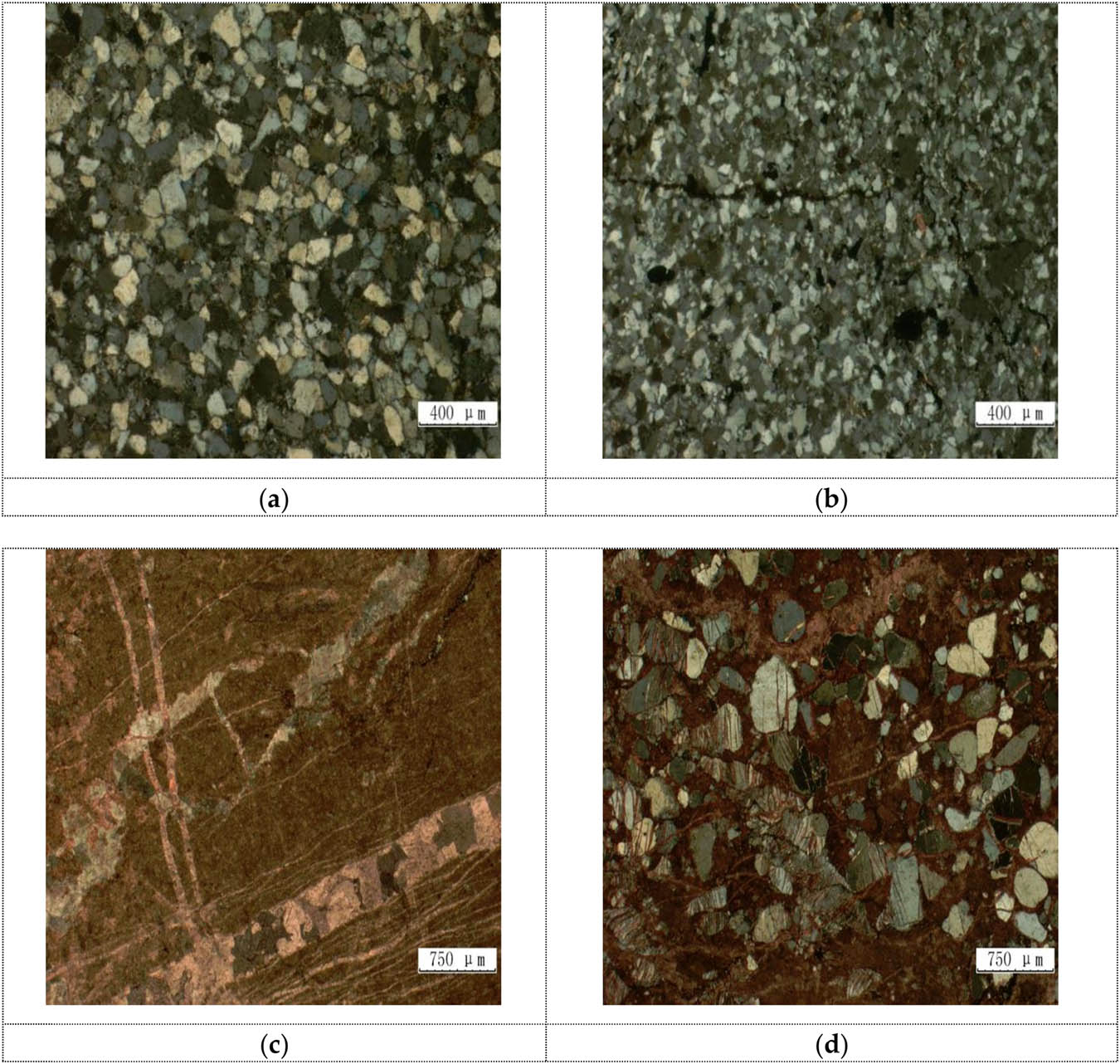
Compaction observed by microscopic thin sections of samples under reflected light. (a) Orthogonal light (X5), authigenic clay is mainly composed of quartz grains wrapped in thin films; (b) orthogonal light (X5), rock is compacted and the particles are mostly concave–convex–linear contact. It can be seen that many sutures are fully filled with iron oxide, carbon, and mud. A small amount of carbon filled between grains; (c) orthogonal light (X2.5), wrist foot and debris are seen in thin sections, mostly heavy crystallization, with unclear structure. Dolomite is the product of metasomatic calcite, mostly fine crystal structure; several dissolution and structural fractures are visible, mostly filled by calcite and dolomite; (d) orthogonal light (X2.5), the debris is mainly quartz, and local micro-cracks are very developed and filled with calcite. Several structures and dissolution fractures are completely filled by calcite.
Pressure dissolution is very common in carbonate rocks. Carbonate particles or crystal planes form or bend and are mosaic. The most important product is the suture, which is also a place for the enrichment of organic matter. Core and field outcrop observations show that the suture line is parallel or close to parallel to the lithostratigraphy, and the fracture column is perpendicular to the level. The fracture width is about 2 mm, and it is multi-branched and serrated mosaic. The peak column fluctuates greatly, up to 2 cm, and is mostly filled by iron mud and asphaltene with rich mechanism in brown or black (Figure 6c and d). In the whole area of central Hunan, the suture is very developed, and from the field and core observation, the larger part of the suture is cut through microfractures and biological debris.
In the process of fracture, the tectonic stress and the compaction of overlying sediments often cause rock fracture to produce cracks. The contribution of cracks to the reservoir is mainly manifested in porosity and permeability, which can not only be used as an important seepage channel but also be regarded as a favorable reservoir space. Fractures are well developed in central Hunan, which are mainly characterized by tectonic fractures and diagenetic fractures. In this study area, there are at most four-stage cracks, and the distribution direction of cracks is relatively disordered, which is the result of multi-stage secondary stress. However, it is also found that the trend of the second stage fracture is consistent with that of the fourth stage fracture, which may have been subjected to the same geological stress (Figure 7a).

(a) The fracturing of samples under observing; (b) calcite filled with cementation in two mutually cut fractures under transmission light (×40); (c) two-phase calcite cementation of cracks under transmission light (×100); (d) clay mineral cementation in clastic rock pores under scanning electron microscope (×2,000); (e) micropores formed by dissolution in micritic limestone under scanning electron microscope (×2,500); and (f) secondary porosity formed by dissolution of a few particles under scanning electron microscope (×800).
Early cementation is very well developed in the granular limestone of the Lower Carboniferous Shidengzi Member in Lianyuan Sag. The early cements are mainly composed of mud crystal matrix and clay, and the content of organic matter and clay is high, which greatly reflects the characteristics of early diagenesis. Most of the cements are recrystallized in the later stage, which is bright crystal cement, and calcite is of generation, which greatly reduces the porosity of the reservoir and reduces the porosity (Figure 7b–d).
With the development of diagenesis, organic acids formed by early source rocks entered the reservoir. Later hydrocarbon cracking explained the acidic environment formed by CO2 release, which caused the dissolution of unstable mineral components and soluble cements.
The dissolution in central Hunan mainly occurs in dolomite, dolomitic limestone, suture, and pore-developed rocks. The intragranular and intergranular dissolution pores are well developed in dolomite and dolomitic limestone. The dissolution pores and fractures in the suture line are the main spaces and channels for oil and gas accumulation and migration in this area (Figure 7e and f).
In summary, the effects of diagenesis on porosity evolution are listed in Table 2.
Table of relationship between diagenesis and porosity
| Diagenesis | Microscopic characteristics | Influence on reservoir |
|---|---|---|
| Compaction action | Point-line contact and concave–convex contact between particles, coarse particles inserted into pores and pierced soft particles; deformation or delamination of plastic material | Reduce porosity |
| Adhesion action | Mud crystal (a small amount of bright crystal) calcite cement, the formation time is early, the crystallization speed is fast, the crystal particles are fine | |
| Silica cements are mainly secondary enlargement of quartz | ||
| Clay minerals include kaolinite, illite, etc. | ||
| Dissolution | Organic matter and clay minerals release CO2 in the diagenetic evolution process, forming acidic water environment, dissolving limestone and generating pores | Increase porosity |
| Disruption | The cracks are divided into two types: cracks and cracks. The cracks include conjugate shear suture cracks | |
| Pressure solution | The concave–convex contact between quartz and soft particles can be seen, and the suture line can be seen |
4.6 Natural gas accumulation period
4.6.1 History of hydrocarbon generation and exclusion from hydrocarbon source rocks
According to the analysis of the tectonic evolution history, after the Garridon movement, the region was in a relatively stable and continuously subsiding quasi-terrestrial stage of development during the Hai xi Early Indo-Chinese period, accompanied by oscillatory movements that rise and fall at times. The region has formed a cycle of sedimentation, which is characterized by sea-in and sea-out. When the Middle Triassic Indo-China movement occurred, the evolutionary history of the Late Paleozoic to Middle Triassic trap in this region was ended and the tectonic pattern of wide and gentle folding and fracturing was formed.
According to the analysis of hydrocarbon evolution history, the hydrocarbon source rocks from D2 to C1 in this area have entered the peak of petroleum generation and expulsion before the Middle Triassic Indo-China movement. The arrival of the Indo-China movement at this time prepared a timely tectonic trap for the oil and gas formed in this area in the early stage as shown in Figure 8.

Matching diagram of tectonic movement and petroleum generation.
After the Indo-China movement, from the Late Triassic to the Middle Jurassic, more than 2,000 m thick (extrapolated from the maximum residual thickness) of the marine–land interaction clastic strata was accepted and deposited in this area, which led to the burial depth of D2–C1 hydrocarbon source rocks in this area to reach or exceed the previous burial depth, and caused the thermal cracking of the liquid hydrocarbons formed in the early stage to gaseous hydrocarbons and then caused the remaining organic matter to produce secondary hydrocarbon production.
By the outbreak of the Yan Shan Movement in the Middle Jurassic, the structure formed by the Indo-China Movement was massively modified by strong horizontal extrusion, and the wide and gentle folds were tightened by the strong horizontal extrusion stress and caused a lot of stripping, which destroyed and modified the early formed hydrocarbons and thus led to the basic end of hydrocarbon generation.
However, the strong Yan Shan movement plays an important role in the formation of oil and gas in this area. Some of the drawbacks and sub-back slopes are the products of the high back slopes in the Indo-Chinese period, being modified by the strong Yan Shan movement. Early-formed hydrocarbons can be formed twice in the process of diffusion and redistribution. In particular, some cryptic structures (such as the Win Tang back slope) were formed under the larger-scale slip and pushover structures in the negative tectonic zone, which provided a place for the accumulation of hydrocarbons generated secondarily before the current tectonic movement. The organic matter of the Devonian and Carboniferous systems in this region has evolved from top to bottom stratigraphically and from east to west regionally. Moreover, from the Qi Ziqiao Formation to the Da tang Order, the organic matter evolution showed a general pattern of successive changes in the region, and from the Qi Ziqiao Formation to the Da tang Order, the organic matter evolution showed a general pattern of successive changes in the region.
4.6.2 History of trap formation and evolution
The central Hunan Basin was in a relatively quiet stage during the Hai Xi Period and received an overall decline in deposition. D2–C1 has a large sediment thickness and relatively high organic matter abundance. Moreover, it has a variety of oil-forming or oil-bearing assemblages and has a timely regional agglomeration zone, so it has superior congenital conditions for oil and gas generation. A relative humid climate is prevalent in southern China, with annual precipitation ranging from 1.2 to 2.0 m [58–62]. The sedimentary environment affects the lithofacies of the surrounding rock, thereby affecting the conditions of reservoir formation [63]. However, due to the long time and deep burial experienced by D2–C1, as well as the frequent and strong tectonic movements in Indochina and beyond, the hydrocarbon evolution of D2–C1 is deeper and has been subjected to more complex and intense modification effects. The most important traps in this area are tectonic traps and lithologic traps, which are controlled by regional tectonics in the planar spreading. Good trap closure conditions, good oil and gas storage performance, and effective oil source communication in the fracture system are conducive to the formation of rocky oil and gas reservoirs [64,65]. The traps are mainly concentrated in the secondary anticline belt in the folded zone within the depression, followed by the fault-fold belt, block belt, and fold belts on both sides of the depression, and a few are located in the hidden anticline among the oblique.
4.6.3 Determination of reservoir forming period according to the homogenization temperature of fluid inclusion
The homogeneous temperature of brine inclusions formed in the reservoir at the same time as the hydrocarbon inclusions represent the temperature at which oil and gas enter the reservoir. According to this temperature as well as the paleothermal pattern of the basin and reservoir burial history, the stratigraphic depth of burial and the corresponding geological age at the time of the formation of the inclusions can be determined. By applying this method, the formation time and period of reservoirs can be determined [66,67]. According to the research results of the previous reservoir evolutionary history and the current fluid inclusions homogeneous temperature and burial history projection method, the hydrocarbon formation period can be determined [68], as shown in Figure 8.
The thermal evolution history of the former hydrocarbon source rocks reveals that the hydrocarbon source rocks of the Liu jia Tang and Shi Dengzi formations of the Lower Carboniferous in this area entered the hydrocarbon generation threshold in the Middle Permian, reached the oil generation peak at the end of the Late Permian, and probably entered the main hydrocarbon discharge period in the Late Triassic, and the maturity was high with gas filling. Based on the inclusion homogeneous temperature test, there are at least two periods of hydrocarbon charging inclusions with reservoir formation temperatures of 93.3–99.5 and 115.7–120.5°C, respectively. In addition, 141.9–153.8°C indicates that there is at least one phase of natural gas filling.
In the Late Permian, the source rocks in this period have entered the oil generation threshold, and some hydrocarbons have been discharged, but they have not reached the peak of oil generation. The number of formations is small, and the continuous filling time is short (7 Ma). Therefore, the source rocks in this period have little contribution to reservoir formation. From the Early Triassic to Middle Triassic, the source rocks in this area entered the peak period of oil generation before the Indo-China movement. Although the large-scale hydrocarbon generation and expulsion of source rocks lasted for a short time (3 Ma), the natural gas-filling time was shorter than the earlier period due to the influence of the Indo-China movement.
In the Late Triassic, the hydrocarbon source rocks of this phase have reached the end of the main hydrocarbon discharge period. Affected by the Indo-China movement, this area has a very high degree of organic matter evolution and a long filling time (11 Ma), mainly dominated by gas. The Late Triassic is a large gas-filling period. However, since hydrocarbon shows were not found at this stage in this study, we can only make an inference here.
It is tentatively inferred that the filling of most of the lithologic reservoirs began in the Late Permian. The large-scale filling of lithologic reservoirs may have started in the Late Triassic according to previous data. The confinement was formed in the Middle Triassic and it had done provide favorable conditions for gas infill in the Late Triassic.
5 Discussion
According to the burial history data (Figure 9), it can be seen that the study area was subjected to long-term burial deposition during the Early Carboniferous–Early Permian period. The rock formation in this stage was dominated by compaction and pressure solution, and the porosity of the rocks was greatly reduced and the reservoir was severely densified. Based on the results of the homogeneous temperature and burial history of inclusions, the reservoir formation stage can be divided into three formation stages. The first oil gas accumulation period has occurred in the Late Permian (about 260–250 Ma). Some hydrocarbon source rocks of the Lower Carboniferous Liu jia Tang Formation in the central area of the depression have entered the oil production threshold and started to discharge hydrocarbons, and then hydrocarbons started to be transported to the Shi Deng Zi Formation. The second oil gas accumulation period occurred at 93.6–92.0 Ma, when the hydrocarbon source rocks had reached the peak of hydrocarbon production and thus the hydrocarbons continued to be transported. However, because of the Indo-China movement, the region was forced to undergo violent uplift and hydrocarbon transport was interrupted. Finally, period III mainly occurred in the Late Triassic-Middle Jurassic period (about 208–170 Ma). With the overall subsidence of the Xiang Zhong Basin, the Ce Shui Group, and Zi Men Qiao Formation with dense lithology formed a good cover, which made the hydrocarbon source rocks of the Lower Carboniferous Liu jia Tang and Shi Deng Zi Formations of the Xiang Zhong Basin to be buried rapidly and the maturation range expanded continuously. The hydrocarbon source rocks entered the peak of venting in the Late Triassic, and a large amount of natural gas was transported to the reservoir for reservoir formation.

Burial historical diagram showing the determination of hydrocarbon gas charging time and reservoir evolution for the central Hu Nan.
According to Law [69], gas filling in basin-centered gas reservoirs occurred in conditions near or at a peak burial temperature and depth. The increase in pressure in tight reservoirs within deep basin gas reservoirs is synchronized with the opening of natural fractures. Both the Early Triassic gas charge and the Late Triassic gas charge were near the peak of the burial depth at that time. Therefore, the high pressure generated due to hydrocarbon removal causes the fractures to open twice synchronously, which bridges the internal channels of the reservoir and leads to a large amount of gas transport into the trap to form deep basin gas reservoirs under the condition of the dense reservoir with low porosity and permeability.
In summary, the dense reservoir of the Lower Carboniferous in the Xiang Zhong Basin was formed at 290 Ma, Period I oil charging time mainly occurred at 260–250 Ma, and the reservoir completed the densification process when the oil and gas were filled; Period II oil charging time was 249–245 Ma and was terminated by the influence of the Indo-China movement; and Period III oil charging time occurred at 208–170 Ma after the Indo-China movement, when the reservoir is characterized by dense. Therefore, the Lower Carboniferous of the Xiang Zhong Basin is characterized by a deep basin gas formation, which is consistent with the formation pattern of low-permeability reservoirs that are first densified and later filled into reservoirs, and a large number of deep basin gas reservoirs can be developed in the deep part of the basin.
6 Conclusion
It is shown that the organic inclusions in the Lower Carboniferous of the central Hunan Basin are dominated by weakly fluorescent and nonfluorescent rich gas inclusions and pure gas-phase inclusions. Gray-black bitumen and black-brown bitumen are found in the fractures of the limestone, which suggests the existence of ancient oil and gas reservoirs or that they have experienced oil and gas infill and have evolved to a high degree.
According to the tectonic evolution history of the central Hunan Basin, the hydrocarbon source rocks in this area have entered the peak of hydrocarbon discharge before the occurrence of the Indo-China movement, and the arrival of the Indo-China movement is highly significant for the filling of oil and gas.
This article infers four rock-forming stages in this area are derived by combining the tectonic development history, and so on. (i) For the syntaxial stage, the filling is dark and nonluminous, and the fluid captured by the overgrowing cement around the particles is mainly seawater; (ii) for the (Early) Mesogenetic burial stage, the calcite cement grows around the particles or micritic calcite matrix, and the fluid captured is mainly brine; (iii) for the (Late) Mesogenetic burial stage, two sets of decomposed fissures developed in massive calcite colloids with non-luminous gas-rich hydrocarbon inclusions within the crystals; (iv) for the Telogenetic burial stage, weakly fluorescent pure gaseous hydrocarbon inclusions are developed in luminescent calcite veins. The result indicates that the organic inclusions in the Lower Carboniferous of the central Hunan Basin are dominated by weakly fluorescent and nonfluorescent rich gas inclusions and pure gas-phase inclusions, with three stages of hydrocarbon filling.
According to the collected inclusion temperature measurement data, a total of three phases of oil and gas infill were found in the Xiang Zhong Basin. These three phases were filled at 260–250, 249–245, and 208–170 Ma. And their temperatures at the time of reservoir formation were about 93.3–99.5, 115.7–120.5, and 141.9–153.8°C. The reservoir is characterized by density at this time, which is consistent with the formation pattern of low-permeability reservoirs that are first densified and later filled into reservoirs, and a large number of deep basin gas reservoirs can be developed in the deep part of the basin.
Acknowledgments
The authors thank the help and guidance from the teachers of School of Energy, China University of Geosciences (Wuhan).
-
Funding information: This research was jointly supported by the Open Foundation of Key Laboratory of Coal Exploration and Comprehensive Utilization of Ministry of Natural Resources, grant number KF2021-5; the National Key R&D Program of China, grant number 2018YFB0605503; and the National Key R&D Program of China, grant number 2018YFC0807801.
-
Author contributions: In this study, Zhu is mainly responsible for the comprehensive study of technical route and hydrocarbon accumulation theme, Qi is mainly responsible for literature research and thin section analysis, Dai is mainly responsible for field geological work, and Shen is mainly responsible for the development history of structure.
-
Conflicts of interest: The authors declare that there is no conflict of interest regarding the publication of this article.
-
Ethical approval: The conducted research is not related to either human or animal use.
-
Data availability statement: All data generated or analyzed during this study are included in this published article and its supplementary information files.
References
[1] Zhang W, Chen Z. Fluid inclusion geology. Wuhan: China University of Geosciences Press; 1993.Search in Google Scholar
[2] Wang R, Zhai J, Chen P, Ling H. Modern Testing Technology of Earth Science. Nanjing: Nanjing University Press; 1999.Search in Google Scholar
[3] Liu D. Fluid inclusion studles-an effective means for basin fluid investigation. Earth Sci Front. 1995;2(4):149–54.Search in Google Scholar
[4] Wang J, Chen W, Leng X, Yu Z, Shi Y, Luan F, et al. Organic inclusions and their relationship with oil and gas. Chin Sci Bull. 1987;3(3):318–25.10.1360/N972017-00815Search in Google Scholar
[5] Lu H, Li B, Shen K, Zhao X, Yu T, Wei J. Inclusion geochemistry. Beijing: Geological publishing house; 1990.Search in Google Scholar
[6] Karlsen DA, Nedkvitne T, Larter SR, Bjørlykke K. Hydrocarbon composition of authigenic inclusions: application to elucidution of petroleum reservoir filling history. Geochim Cosmochim Acta. 1993;57(15):3641–59.10.1016/0016-7037(93)90146-NSearch in Google Scholar
[7] Xiao X, Liu Z, Liu D, Mi J, Shen J, Song Z. Study on accumulation time of natural gas reservoir based on fluid inclusion information. Chin Sci Bull. 2002;47(12):957–60.Search in Google Scholar
[8] Cao Q, Gao J, Fan L, Pang C, Yu J. Characteristics and significance of fluid Iinclusions in Upper Paleozoic of Southwest Ordos Basin. Nat Gas Geosci. 2015;26(12):2245–53.Search in Google Scholar
[9] Zhang W, Guo Y, Tang D, Zhang J, Li M, Xu H, et al. Characteristics of fluid inclusions and determination of gas accumulation period in the Upper Paleozoic reservoirs of Sulige Gas Field. Acta Pet Sin. 2009;30(5):658–91.Search in Google Scholar
[10] Li Y, Zhao J, Li J. Fluid inclusions and gas accumulation of Permian in Eastern Ordos Basin. Xinjiang Pet Geol. 2011;32(5):451–6.Search in Google Scholar
[11] Liu X, Zhou L, Hou Y. Study of gas charging in the Upper Paleozoic of Ordos Basin using fluid inclusion. Acta Pet Sin. 2007;6:37–42.Search in Google Scholar
[12] Zhang W. Study on diagenesis and hydrocarbon filling stages in Yulin gas field. Spec Oil Gas Reserv. 2010;17(1):49–53.Search in Google Scholar
[13] Liu J, Chen H, Li J, Hu G, Shan X. Using fluid inclusion of reservoir to determine hydrocarbon charging order and times in the Upper Paleozoic of Ordos Basin. Geol Sci Technol Inf. 2005;4:60–6.Search in Google Scholar
[14] Li R, Zhang X, Zou Y. Study on the gas reservoir accumulation period for ying shan sag in shuang cheng fault depression of song liao basin. Pet Geol Oilfield Dev Daqin. 2014;33(2):27–30.Search in Google Scholar
[15] Ren ZL, Li WH, Liang Y, Wu XQ, Yu Q, Ren L, et al. Tight oil reservoir formation conditions and main controlling factors of Yanchang Formation in southeastern Ordos Basin. Oil Gas Geol. 2014;35(2):190–8.Search in Google Scholar
[16] Liu J, Liu K, Gui L. Fluid inclusion characteristics and hydrocarbon charge history in the Upper Paleozoic, central Ordos Basin [Edition of Natural Science]. Zhongguo Shiyou Daxue Xuebao Ziran Kexue Ban. 2019;43(2):13–24.Search in Google Scholar
[17] Wang B, Zhao Y, Luo Y, Ma H. Thermal evolution and hydrocarbon generation in the Caohu Sag of the Tarim Basin-based on IES basin simulation technology. Shiyou Shiyan Dizhi. 2010;32(6):605–9.Search in Google Scholar
[18] Ou O, Li L, Sun Y. Theory and application of the fluid inclusion research on the sedimentary basins. Bulletin of Mineralogy. Petrology Geochem. 2006;25(1):1–11.Search in Google Scholar
[19] Wu D. Application of Micro Fourier Transform Infrared in Hydrocarbon inclusions-Taking Hydrocarbon inclusions in the XiaoMaling Formation of the Upper Proterozoic in libei-Liaoxi Depression as Example. J East China Inst Technology(Natural Sci Ed). 2015;38(1):32–6.Search in Google Scholar
[20] Shalaby MR, Hakimi MH, Abdullah WH. Geochemical characteristics and hydrocarbon generation modeling of the Jurassic source rocks in the Shoushan Basin, North Western Desert. Egypt. Mar Pet Geol. 2011;1611–24.10.1016/j.marpetgeo.2011.07.003Search in Google Scholar
[21] Brenneman MC. Estudio geoquimico de crudos dela Cuenca de Maracaibo. Mere3rd Venezuelan Geol Cong; 1960. p. 1025–69.Search in Google Scholar
[22] Bond JG. Maracaibo Basin geochemical study. Internal Report. Caracas: Lagoven, S.A.; 1967. p. 40.Search in Google Scholar
[23] Barker C, Dickey PA, Bockmeulen HA. Chemical effects of bacterial degradation of Bolivar Coastal crude oils. Internal Report. Internal Report. Los Teques: Intevep. S.A.; 1979. p. 47.Search in Google Scholar
[24] Bockmeulen H, Barker C, Dickey PA. Geology and geochemistry of crude oils, Bolivar Coastal Fields, Venezuela. Bull Am Assoc Pet Geol. 1983;242–70.Search in Google Scholar
[25] Stauffer KW, Betoret C. Evaluaci6n delpotencial petrolifero dela Cuenca de Maracaibo. Internal Report. Caracas: Corpoven, S.A.; 1979. p. 84.Search in Google Scholar
[26] Core Lab. Regional geochemical study of the Lake Maracaibo Basin, Western Venezuela. Internal Report. Caracas: Lagoven, S.A.; 1982. p. 134.Search in Google Scholar
[27] Blaser R, White C. Source rock and carbonization study, Maracaibo Basin, Venezuela. Mem Am Assoc Pet Geol. 1984;35:229–52.10.1306/M35439C14Search in Google Scholar
[28] Xiao Z, Tan J, Ju Y, Hilton J, Yang R, Zhou P, et al. Natural gas potential of Carboniferous and Permian transitional shales in central Hunan, South China. J Nat Gas Sci Eng. 2018;55:520–33.10.1016/j.jngse.2018.05.024Search in Google Scholar
[29] Cao T, Xu H, Liu G, Deng M, Cao Q, Yu Y. Factors influencing microstructure and porosity in shales of the Wufeng-Longmaxi formations in northwestern Guizhou, China. J Pet Sci Eng. 2020;191:107181.10.1016/j.petrol.2020.107181Search in Google Scholar
[30] Cao T, Deng M, Song Z, Luo H, Hursthouse AS. Characteristics and controlling factors of pore structure of the Permian shale in southern Anhui province, East China. J Nat Gas Sci Eng. 2018;60(12):228–45.10.1016/j.jngse.2018.10.018Search in Google Scholar
[31] Cao T, Liu H, Pan A, Fu Y, Deng M, Cao Q, et al. Pore evolution in siliceous shales and its influence on shale gas-bearing capacity in eastern Sichuan-western Hubei. China J Pet Sci Eng. 2022;208(1):10959.10.1016/j.petrol.2021.109597Search in Google Scholar
[32] Zhao J. Geochronology of petroleum accumulation: new advances and the future trend. Advance Earth Sci. 2002;17(3):378–83.Search in Google Scholar
[33] Zhang J, Xu H, Zhao J, Ren P. Geological characteristics and exploratial of oil and gas in the northeast area of China. Geol China. 2018;45(2):260–73.Search in Google Scholar
[34] Xue N, Zhu G, Lv X, He T, Wu Z. Advances in geochronology of hydrocarbon accumulation. Nat Gas Geosci. 2020;31(12):1733–48.Search in Google Scholar
[35] Xiao Z, Liu J, Tan J, Yang R, Hilton J, Zhou P, et al. Geologic characterization of a lower Cambrian marine shale: implications for shale gas potential in northwestern Hunan, South China. Interpretation (Tulsa). 2018;2018(3):635–47.10.1190/INT-2017-0117.1Search in Google Scholar
[36] Schubert F, Diamond LW, Toth TM. Fluid-inclusion evidence of petroleum migration through a buried metamorphic dome in the Pannonian Basin, Hungary. Chem Geol. 2007;244(3–4):357–81.10.1016/j.chemgeo.2007.05.019Search in Google Scholar
[37] Fu S, Liao Z, Chen A, Chen H. Reservoir characteristics and multi-stage hydrocarbon accumulation of the Upper Triassic Yanchang Formation in the southwestern Ordos Basin, NW China. Energy Explor Exploit. 2020;38(2):348–71.10.1177/0144598719870257Search in Google Scholar
[38] Fu S, Liao Z, Chen A, Chen H. Reservoir characteristics and multi-stage hydrocarbon accumulation of the Upper Triassic Yanchang Formation in the southwestern Ordos Basin. NW China Energy Explor Exploit. 2020;38(2):348–71.10.1177/0144598719870257Search in Google Scholar
[39] Lou R, Wang L, Wang L, Yang G, Wang J, Liu C, et al. Characteristics of fluid inclusions and hydrocarbon accumulation period of Huoshiling -Yingcheng Formations in Wangfu fault depression, Songliao Basin, China. J Pet Sci Eng. 2022;208:109421.10.1016/j.petrol.2021.109421Search in Google Scholar
[40] Liu X. Oil gas reservoir forming and preserving conditions of Devonian-Carboniferous in Xiang Zhong Basin. Doctoral dissertation. Central South University; 2009. p. 3–5.Search in Google Scholar
[41] Huang Y, Dong L, Hursthouse A, Yu Y, Huang J. Characterization of pore microstructure and methane adsorption of organic-rich black shales in northwestern Hunan. South China Energy Explor Explor. 2019;38(2):473–93.10.1177/0144598719878021Search in Google Scholar
[42] Shao LY, Yang ZY, Shang XX, Xiao ZH, Wang S, Zhang WL, et al. Lithofacies palaeogeography of the Carboniferous and Permian in the Qinshui Basin, Shanxi Province, China. J Palaeogeograp-English. 2015;4(4):384–412.10.1016/j.jop.2015.06.001Search in Google Scholar
[43] Shan Y, Wang H, Zhang L, Su P, Cheng M, Bai Z. Study on hydrocarbon accumulation periods based on fluid inclusions and diagenetic sequence of the subsalt carbonate reservoirs in the Amu Darya right bank block. Geofluids. 2022;2022:1–19.10.1155/2022/2412615Search in Google Scholar
[44] Burruss RC. Hydrocarbon fluid inclusions in studies of sedimentary diagenesis. Fluid inclusions: applications to petrology. Mineralogical Association of Canada Short Course Notes; 1981. p. 138–56.Search in Google Scholar
[45] Burruss RC. Practical aspects of fluorescence microscopy of petroleum fluid inclusions. Luminescence microscopy and spectroscopy: qualitative and quantitative applications. SEPM Short Course. 1991;25:127.10.2110/scn.91.25.0001Search in Google Scholar
[46] Goldstein RH, Reynolds TJ. Systematics of f1uid inclusions in diagenetic; minerals. U S America SEPM Short Course. 1994;31:69–85.10.2110/scn.94.31.0069Search in Google Scholar
[47] Zhao Y, Chen H. The relationship between fluorescence colors of oil inclusions and their maturities. Earth Science-Journal China Univ Geosci. 2008;33(1):91–7.Search in Google Scholar
[48] Chen H. Advances in geochronology of hydrocarbon accumulation. Oil Gas Geol. 2007;28(2):143–50.Search in Google Scholar
[49] Liao J, Cheng X, Luo L. Charactoristic of Hydrocarbon inclusion and Its Geological Significance of Jurassic in Shinan Area. Xinjiang Pet Geol. 2006;27(6):717–21.Search in Google Scholar
[50] Shen W, Lu X. Fluid inclusion in the study of petroleum migration in Z1 area, Middle Junggar Basin, China. Geol Sci Technol Inf. 2007;26(3):62–8.Search in Google Scholar
[51] Li C, Chen H, Zhang X. Fluidinclusions analysis of the Ordovician reservoir in Tahe Oilfield. Acta Pet Sin. 2005;26(1):42–7.Search in Google Scholar
[52] Li Y, Shi Z. Study on fluid inclusion of tight sand reservoir of upper triassic XuJiahe formation in central Sichuan Basin. Lithologic Reserv. 2008;20(1):27–33.Search in Google Scholar
[53] Haszeldine RS, Samson IM, Cornfort C. Dating diagenesis in a petroleum basin, a new fluid inclusion method. Nature. 1984;307(5949):354–7.10.1038/307354a0Search in Google Scholar
[54] Mclimmans RK. The application of fluid inclusion tomigration of oil and diagenesis in petroleum reservoirs. Appl Geochem. 1987;2(5–6):585–603.10.1016/0883-2927(87)90011-4Search in Google Scholar
[55] Kuang L, Guo J, Huang T. Petroleum accumulation in Ordovician carbonate rocks of Yuqi region in Akekule uplift, Tarim Basin. Pet Explor Dev. 2007;34(2):299–303.Search in Google Scholar
[56] Sun Q, Xie H, Guo J. Fluid inclusions in sedimentary basins generating petroleum and their application. J Chancchun Univ Sci Technol. 2000;30(1):42–5.Search in Google Scholar
[57] Zhao Y, Zhang C, Wang Y, Lin H. Shear-related roughness classification and strength model of natural rock joint based on fuzzy comprehensive evaluation. Int J Rock Mech Min Sci. 2021;137:104550.10.1016/j.ijrmms.2020.104550Search in Google Scholar
[58] Zhao Y, Liu Q, Zhang C, Liao J, Lin H, Wang Y. Coupled seepage-damage effect in fractured rock masses: model development and a case study. Int J Rock Mech Min Sci. 2021;144:104822.10.1016/j.ijrmms.2021.104822Search in Google Scholar
[59] Liu J, Zhao Y, Tan T, Zhang L, Zhu S, Xu F. Evolution and modeling of mine water inflow and hazard characteristics in southern coalfields of China: A case of Meitanba mine. Int J Min Sci Technol. 2022;32:513–24.10.1016/j.ijmst.2022.04.001Search in Google Scholar
[60] Zhao Y, Lian Y, Wei J, Wang J, Lin W. Transient pulse test and morphological analysis of single rock fractures. Int J Rock Mech Min Sci. 2017;91:139–54.10.1016/j.ijrmms.2016.11.016Search in Google Scholar
[61] Liu Q, Zhao Y, Tang L, Liao J, Wang X, Tan T, et al. Mechanical characteristics of single cracked limestone in compression-shear fracture under hydro-mechanical coupling. Theor Appl Fract Mech. 2022;119:103371.10.1016/j.tafmec.2022.103371Search in Google Scholar
[62] Zhao Y, Wang Y, Wang W, Tang L, Liu Q, Cheng G. Modeling of rheological fracture behavior of rock cracks subjected to hydraulic pressure and far field stresses. Theor Appl Fract Mech. 2019;101:59–66.10.1016/j.tafmec.2019.01.026Search in Google Scholar
[63] Hou H, Shao L, Wang S, Xiao Z, Wang X, Li Z, et al. Influence of depositional environment on coalbed methane accumulation in the Carboniferous-Permian coal of the Qinshui basin, northern China. Front Earth Sci. 2019;13(3):535–50.10.1007/s11707-018-0742-8Search in Google Scholar
[64] Yu Y, Zhang C, Wang L, Li S, Hursthouse A, Huang Y, et al. Sedimentary characteristics and genetic mechanism of a deep-water channel system in the Zhujiang Formation of Baiyun Sag, Pearl River Mouth Basin. Deep Sea Res Part I Oceanogr Res Pap. 2021;168:103456.10.1016/j.dsr.2020.103456Search in Google Scholar
[65] Yu Y, Cai L, Zhang C, Wang L, Zhu R, Huang Y, et al. Sedimentary sequence, evolution model and petroleum geological significance of forced regression: a case study of the miocene zhujiang formation of the pearl river mouth basin in the northern South China sea. J Mar Sci Eng. 2021;9(11):1298.10.3390/jmse9111298Search in Google Scholar
[66] Xu L, Yang G, Xia S. Applitation of fluid inclusions in study of the limesand stages of hydrocarbon reservior filling a case study of heidimiao area in south songliao basin. Jilin Daxue Xuebao Diqiu Kexue Ban. 2006;36:29–32.Search in Google Scholar
[67] Zhu W, Cao Z, Li C. Diagenetic evolution of reservoirs and reservoir and reservoir-forming stages in the Xiangzhong depression. Chin J Ceol. 2015;50(3):943–54.Search in Google Scholar
[68] Shan Y, Wang H, Zhang L, Su P, Cheng M, Bai Z. Study on hydrocarbon accumulation periods based on fluid inclusions and diagenetic sequence of the subsalt carbonate reservoirs in the amu darya right bank block. Geofluids. 2022;2022:1–19.10.1155/2022/2412615Search in Google Scholar
[69] Law BE. Basin-centered gas systems. AAPG Bull. 2002;86(11):1891–919.10.1306/61EEDDB4-173E-11D7-8645000102C1865DSearch in Google Scholar
© 2022 Wei Zhu et al., published by De Gruyter
This work is licensed under the Creative Commons Attribution 4.0 International License.
Articles in the same Issue
- Research Articles
- Modeling thixotropic break-down behavior of dense anaerobically digested sludge
- Structure of pumpkin pectin and its effect on its technological properties
- Free volumes in mixed-tacticity poly(3-hydroxybutyrate) determined by viscosimetry and their correlations with structural features and mechanical properties
- In-line measurement and modeling of temperature, pressure, and blowing agent dependent viscosity of polymer melts
- Determining the gas accumulation period using fluid inclusion observations: Xiang Zhong Basin, China
- Rheological thixotropy and pasting properties of food thickening gums orienting at improving food holding rate
- Evaluation of four different cogeneration cycles by using some criteria
- Effect of phosphogypsum and water-retaining in the stabilization and durability of stabilized mortars
- Determination of gamma-ray transmission factors of WO3–TeO2–B2O3 glasses using MCNPX Monte Carlo code for shielding and protection purposes
- Assessment of the usability conditions of Sb2O3–PbO–B2O3 glasses for shielding purposes in some medical radioisotope and a wide gamma-ray energy spectrum
- Exergy analyses of two and three stage cryogenic cycles
- Special Issue on Rheological Behavior and Engineering Stability of Rock Mass - Part I
- Mechanical properties of sandstone under hydro-mechanical coupling
- GIS-based landslide susceptibility mapping using frequency ratio and index of entropy models for She County of Anhui Province, China
- Reinforcement placement on mechanics and deformation of stepped reinforced retaining wall experimental study of characteristics
Articles in the same Issue
- Research Articles
- Modeling thixotropic break-down behavior of dense anaerobically digested sludge
- Structure of pumpkin pectin and its effect on its technological properties
- Free volumes in mixed-tacticity poly(3-hydroxybutyrate) determined by viscosimetry and their correlations with structural features and mechanical properties
- In-line measurement and modeling of temperature, pressure, and blowing agent dependent viscosity of polymer melts
- Determining the gas accumulation period using fluid inclusion observations: Xiang Zhong Basin, China
- Rheological thixotropy and pasting properties of food thickening gums orienting at improving food holding rate
- Evaluation of four different cogeneration cycles by using some criteria
- Effect of phosphogypsum and water-retaining in the stabilization and durability of stabilized mortars
- Determination of gamma-ray transmission factors of WO3–TeO2–B2O3 glasses using MCNPX Monte Carlo code for shielding and protection purposes
- Assessment of the usability conditions of Sb2O3–PbO–B2O3 glasses for shielding purposes in some medical radioisotope and a wide gamma-ray energy spectrum
- Exergy analyses of two and three stage cryogenic cycles
- Special Issue on Rheological Behavior and Engineering Stability of Rock Mass - Part I
- Mechanical properties of sandstone under hydro-mechanical coupling
- GIS-based landslide susceptibility mapping using frequency ratio and index of entropy models for She County of Anhui Province, China
- Reinforcement placement on mechanics and deformation of stepped reinforced retaining wall experimental study of characteristics
