Conference Notes

Preview: 118th Annual meeting of the DGaO
Dresden, Germany, June 6–10, 2017
Founded in 1923 the German Society of Applied Optics (DGaO) is one of the oldest optical societies in the world. For its annual meeting it has established a tradition to convene in the week after Pentecost. The 118th Annual Meeting will take place in Dresden from 6 to 10 June 2017. It will be organized under the auspices of Jürgen Czarske, Chair of Measurement and Sensor System Techniques at the Institute of Principles of Electrical and Electronic Engineering at the Technical University Dresden.
The conference program will feature the following main topics:
Computational imaging
Computer vision
Optics for extreme requirements
New solutions in precision optics
Call for paper
Contributions are invited as short presentations (15 min) and posters for the main topics mentioned above or for all fields of applied optics. Submissions should be done via the online submission platform at http://www.dgao-proceedings.de/anmeldung/anmeldung_d.php). The General language of the conference is German, however, English contributions are welcome.
Program committee
S. Sinzinger, J. Czarske, C. Denz, C. Faber, A. Fischer, A. Heinrich, A. Heisterkamp, F. Höller, A. Jacobsen, N. Koukourakis, E. Langenbach, T. Thöniß
Contact
Cathleen John
TU Dresden
Fakultät Elektrotechnik und Informationstechnik
Professur für Mess- und Sensorsystemtechnik
01062 Dresden, Germany
Tel.: +49 (351) 463-37657
Fax: +49 (351) 463-37716
E-Mail: dgao2017@tu-dresden.de
Deadlines and registration fees
While abstracts are due on 15th January, the main program will be published in March 2017. Early bird registration for all visitors will end on 6th May 2014. After that day the full registration will go up from €250 (Non members €270) to €255 (€305). Prices are subject to 7% VAT.
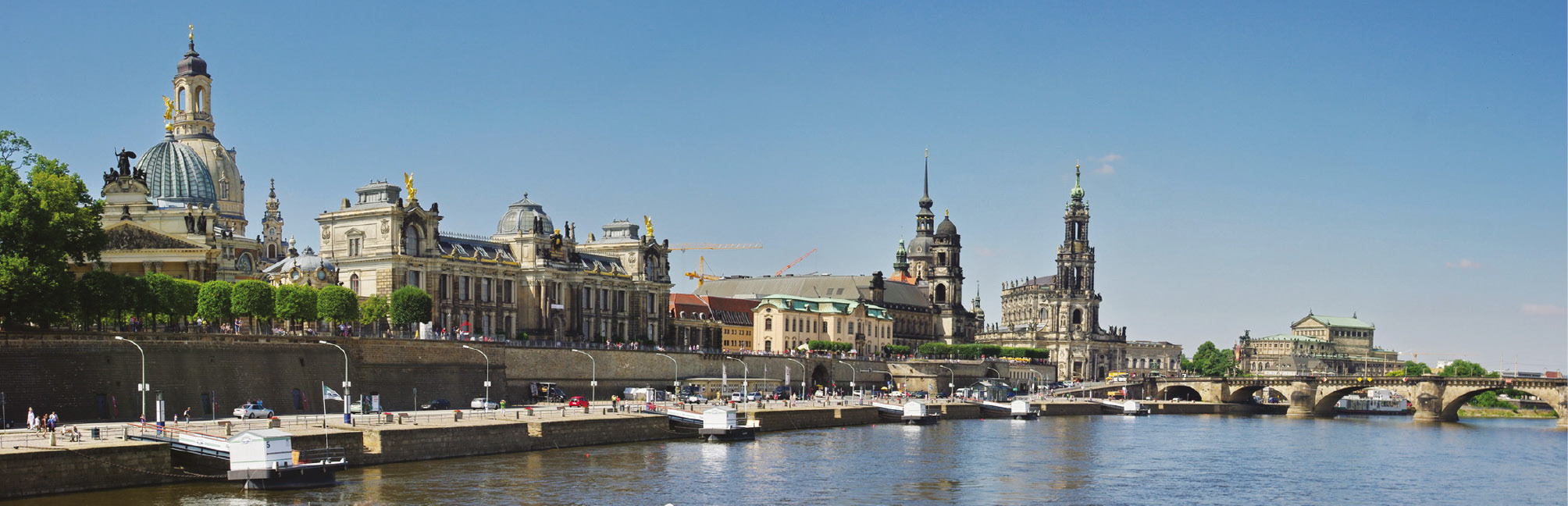
This view is called ‘Canaletto-view’ since it shows the old town silhouette similar to a painting from the famous Italian painter Canaletto from 1748. (Photo: Bgabel at wikivoyage.)
DGaO Young Scientist Award
For the fifth time, the DGaO will award the best dissertation and the best Master’s thesis from a German speaking country in the field of Applied Optics. The DGaO Young Scientist Award will be presented at the annual meeting in Dresden.
There will be separate cash awards for the best PhD dissertation and the best Master’s thesis of 2016, along with a 1-year full membership of the DGaO. The winners will also be invited to the Dresden meeting to give a presentation of their work.
In order for a student to be considered, supervisors will need to submit the original thesis as a PDF file to the DGaO secretary. The supervisor will also need to submit the following:
thesis summary (max. 2 pages)
appraisal statement
curriculum vitae of candidate
list of publications, patents related to thesis (if applicable).
Submission deadline for the prize is 16 March, 2017.
Dresden – City of Science
Dresden, the capitol of the federal state of Saxony is a pleasant town with a rich history and beautiful architecture. Today it is the seat of the Saxony State Government and the Saxony parliament. But there is much more than just representative administration buildings: Frauenkirche, Zwinger and Semperoper as well as many other world famous architectural monuments make up this wonderful city. Dresden hosts a number of museums such as the New Masters Gallery, the New Green Vault, the Museum of Transportation and the Hygiene Museum.
Today, Dresden is a leading location for industry, science and research in the fields of microelectronics, nano technology, material science applied optics and biomedical research. With about 40 000 employees the so-called Silicon Saxony is one of the most important sites for microelectronics in Europe.
Researchers from all around the world are attracted by research institutions like the TU Dresden, the Max-Planck-, Leibniz, Helmholtz and Fraunhofer institutes. In the recent fourth round of the German Excellence Initiative the Technical University was awarded two excellence clusters and one Graduate School. Applied optics is a main research focus in Dresden. Particularly successful are the researchers in the fields of biophotonics, organic LEDs, smart microscopes, high field lasers for cancer treatments and many more.
The 2016 Berthold Leibinger Laser Prizes
The ninth awards ceremony for the internationally noted honors for applied laser technology of the Berthold Leibinger Foundation in Ditzingen took place on Friday, September 9, 2016.
Together with 700 guests, the Berthold Leibinger Foundation celebrated the ninth presentation of its laser prizes on September 9, 2016. The jury awarded four innovation prizes and Professor Gérard Mourou received the Berthold Leibinger Zukunftspreis (Future Prize). The awards come with the following prize money: €30 000 for the Zukunftspreis and first prize, €20 000 for each of the two second prizes and €10 000 for the third prize.
The event was opened by the foundation founder and former managing partner of the TRUMPF Group, Professor Berthold Leibinger. He was very pleased to see that the auditorium was filled to the last seat. ‘The Berthold Leibinger Innovationspreis is the most important work of this foundation, and so I am grateful to see that the awards ceremony is receiving so much attention from the general public’. Following his speech, Elizabeth Rogan, Chief Executive Officer of OSA The Optical Society, gave a history of the innovations that have been made in optics and photonics over the last 100 years. Professor Friedemann Schrenk, Head of the Paleoanthropology Section of the Senckenberg Gesellschaft für Naturforschung (Senckenberg Society for Nature Research) in Frankfurt, held the ceremonial address. In his presentation ‘Origins, Breakthroughs, Expansions: 6 Million Years of Human History’, he talked about the latest findings on the evolutionary development of early humans. He had a surprising message for the audience: the differentiation of prehistoric humans from their ancestors did not only happen through a use of tools, it was based on the ability to work together socially. He also discussed the subject of migration. Since prehistoric times, a number of migration waves across the globe have shaped humanity and led to its further development. ‘According to an anthropological time scale, migration barriers do not exist, there is only a joint development of humanity’, Professor Schrenk said.

Four innovations and one future prize
As in the preceding years, the awards presentation itself began with film portraits of the prizewinners and their work, followed by a laudation held by a jury member. The prizewinners were chosen during a jury meeting last May. Four of the eight finalists were able to convince the jury, which is why the jurors awarded two second place prizes.
Since 2006, the Berthold Leibinger Foundation has been honoring one scientist for their outstanding contributions to applied laser technology. In 2016, this honor was awarded to French professor Gérard Mourou of the École Polytechnique. Due to his invention of ‘chirped pulse amplification’ (CPA) at the University of Rochester, NY, in collaboration with his student Donna Strickland, Mourou is considered the ‘father’ of electromagnetic fields of high and ultra-high intensity fields, as laudator Ursula Keller said while explaining the jury’s choice. This technology enables the amplification of short laser pulses to extremely high peak power. With CPA, Mourou pioneered the field of femtosecond ophthalmology with more than one million patients a year today, and revolutionized the field of high intensity lasers. Most recently, he initiated Europe’s Extreme Light Infrastructure ELI in the Czech Republic, Hungary and Romania.
The first prize of the innovation award was presented to Swiss physicist Dr. Balthasar Fischer by Professor Wolfgang Marquardt. Fischer developed a membrane-free microphone at Vienna University of Technology that can hear through light. Marketed through Fischer’s company Xarion Laser Acoustics, the microphone is now finding applications in non-destructive metrology and the process control of machine tools. The microphone is also ideal for use as a sensor for optoacoustic imaging in biomedical engineering.
One of the second prizes was awarded to the founder of the company Crystalline Mirror Solutions, Dr. Garrett Cole from Santa Barbara, CA and Dr. Markus Aspelmeyer, professor at the University of Vienna. They developed crystalline semiconductor coatings for mirrors, which for example, can improve the precision of optical atomic clocks by orders of magnitude. Their mirrors have revolutionized the world of optical high precision measurement. For this, they were awarded one of the two second prizes by Professor Theodor Hänsch, Physics Nobel Prize laureate from 2005.
A further second prize was awarded to a total of 12 scientists from Saarbrücken and Dresden led by Professor Frank Mücklich and Professor Andrés-Fabián Lasagni. Mücklich’s working groups at Saarland University as well as the Steinbeis Forschungszentrum Material Engineering Center Saarland and Lasagni’s working groups at the Fraunhofer Institute for Materials and Beam Technology and at the Dresden University of Technology researched and developed the processes and laser systems to quickly and economically generate tiny micropatterns and nanopatterns using the effect of laser interference. Surfaces functionalized in this manner can reduce friction to a large extent or they can kill bacteria and thus reduce the transmission of germs. This technology will also be used to increase the reliability of electrical plug-in connections, such as in automobiles.
AOT authors win Leibinger price
A total of 33 developers from the Laser Guide Star Alliance won the third prize, which was awarded by Professor H. Jeffrey Kimble. Their high-power laser system is one of the key elements used in the construction of contemporary large telescopes on Earth. Based on earlier patented work and prototypes by the ESO, the international industrial consortium of TOPTICA in Garching and MPB Communications in Montreal, Canada, jointly developed a novel laser system. This technology offers advantages for the tracking of satellites and the detection of space debris as well as further applications. The respective groups were headed by Dr. Wilhelm Kaenders from TOPTICA, Dr. Wallace Clements from MPB and Dr. Domenico Bonaccini Calia from the ESO. Design considerations and system implementation of the laser guide star facility were published in this journal in June 2014 (https://doi.org/10.1515/aot-2014-0025).
The social part of the event began after the awards ceremony. The colorful mix of guests from society and politics, science and business, laser companies and laser users celebrated with the prizewinners and made new contacts while catching up with old acquaintances.

The Laser guide star team receives the Berthold Leibinger Innovationspreis.
The next awards ceremony will take place in 2 years, in 2018, on the third Friday in September. Applications for the innovation award may be submitted up to December 31, 2017.
©2016 THOSS Media & De Gruyter
Articles in the same Issue
- Cover and Frontmatter
- Community
- Conference Notes
- Conference Calendar
- News from the European Optical Society EOS
- Topical Issue: Optical 3D Sensing
- Review Articles
- High-speed optical 3D sensing and its applications
- Infrared deflectometry for the inspection of diffusely specular surfaces
- Multi-scale referencing and coordinate unification of optical sensors in multi-axis machines
- Research Articles
- 3D shape measurement with thermal pattern projection
- A new form measurement system based on subaperture stitching with a line-scanning interferometer
- Evaluation of pixel-wise geometric constraint-based phase-unwrapping method for low signal-to-noise-ratio (SNR) phase
- Single-shot phase-measuring deflectometry for cornea measurement
- Modeling of imaging fiber bundles and adapted signal processing for fringe projection
- Noncontact three-dimensional quantitative profiling of fast aspheric lenses by optical coherence tomography
- Tutorial
- Aspherics in spectacle lenses
- Research Article
- Structural noise tolerance of photonic crystal optical properties
Articles in the same Issue
- Cover and Frontmatter
- Community
- Conference Notes
- Conference Calendar
- News from the European Optical Society EOS
- Topical Issue: Optical 3D Sensing
- Review Articles
- High-speed optical 3D sensing and its applications
- Infrared deflectometry for the inspection of diffusely specular surfaces
- Multi-scale referencing and coordinate unification of optical sensors in multi-axis machines
- Research Articles
- 3D shape measurement with thermal pattern projection
- A new form measurement system based on subaperture stitching with a line-scanning interferometer
- Evaluation of pixel-wise geometric constraint-based phase-unwrapping method for low signal-to-noise-ratio (SNR) phase
- Single-shot phase-measuring deflectometry for cornea measurement
- Modeling of imaging fiber bundles and adapted signal processing for fringe projection
- Noncontact three-dimensional quantitative profiling of fast aspheric lenses by optical coherence tomography
- Tutorial
- Aspherics in spectacle lenses
- Research Article
- Structural noise tolerance of photonic crystal optical properties
