Home Mathematics Cohomological properties of maximal pro-p Galois groups that are preserved under profinite completion
Article Open Access

Cohomological properties of maximal pro-p Galois groups that are preserved under profinite completion

  • Tamar Bar-On EMAIL logo
Published/Copyright: April 24, 2024

Abstract

Let p be a prime number. One of the most difficult and important questions in Galois theory these days is determining which pro-p groups can occur as maximal pro-p Galois groups. Some restrictions of the structure of maximal pro-p Galois groups are already known, and therefore, the families of all pro-p groups satisfying these restrictions are in the center of the research. In the current paper we deal with three of these families: The family of all pro-p groups which satisfy hereditarily the n-vanishing Massey product property, the family of 1-cyclotomic oriented pro-p groups, and the family of pro-p groups that are hereditarily of p-absolute Galois type. We show that all these families are closed under taking profinite completion of each order.

MSC 2020: 20E18; 12F12

Introduction

Profinite groups were first introduced in 1928 by Wolfgang Krull, who proved that regarded as a topological group with the Krull topology, every Galois group of a field extension is compact, Hausdorff and totally disconnected [14]. In the 1950s Horst Leptin proved that every profinite group can be realized as the Galois group of some field extension [16]. One of the main questions in Galois theory these days is computing the absolute Galois groups of fields, and of main importance, the field of rational numbers , which is known as the “inverse Galois problem” (see, for example, [12, 5, 4]). The opposite direction of this question asks to identify absolute Galois groups among all profinite groups. Several results are already known: for example, the only nontrivial finite group which can be realized as an absolute Galois group is C 2 (Artin–Schreier Theorem). In addition, for every infinite cardinal 𝐦 , the free profinite group of rank 𝐦 is isomorphic to the absolute Galois group of F ( t ) , where F is an algebraically closed field of cardinality 𝐦 (see [7]). However, the known cases are just a drop in the ocean, and decades after the inverse problem of Galois theory was presented, it is remarkable how few we know about absolute Galois groups. As pro-p groups are generally more reachable, it is just natural to start with learning the maximal pro-p Galois group of a field. Let F be a field. The maximal pro-p Galois group of F, denoted by G F ( p ) , is equal to Gal ( F ( p ) / F ) , where by F ( p ) we denote the maximal p-extension of F, which is the compositum of all finite p-extensions of F, inside a given algebraic closure. One easily observes that G F ( p ) is equal to the maximal pro-p quotient of the absolute Galois group G F of F. Notice that if G F is a pro-p group itself, then it is immediately a maximal pro-p Galois group. Such groups can be obtained, for example, by taking a p-Sylow subgroup of an absolute Galois group.

For the rest of the paper we fix a prime p once and for all.

Recently, a lot of effort is devoted to finding restrictions on the possible structure and properties of an absolute, or a maximal pro-p Galois group. One of the main research directions is due to Galois representations. Recall that the absolute Galois group of a field F naturally acts on the separable closure of F, making it into a G F module with special submodules, such as μ p n ( F ) , the set of all p n th routes of unity, which are tightly connected to the cohomological groups of G F = Gal ( F ¯ / F ) . Hence, most of these restrictions regard the structure of modules over G and the properties of cohomology groups of G over specific modules. In order to make things a bit simpler, we often assume that the base field F contains all roots of unity of order p. Thus, the natural action of G F on μ p ( F ) 𝔽 p is trivial. In fact, since for an arbitrary field F, [ F ( μ p ) : F ] is either 1 or p - 1 , if G F ( p ) does not appear as a maximal pro-p group of some field containing a primitive root of unity of order p, then it does not appear as an absolute Galois group of any field. Thus, this assumption does not lose too much information. One should notice also that if G F = Gal ( F ¯ / F ) is the absolute Galois group of F, and H c G is a closed subgroup of G, then H = Gal ( F ¯ / K ) , where K = F ¯ H denotes the field of fixed points of H. Thus, H is isomorphic to an absolute Galois group as well. Moreover, if F contains all roots of unity of order p then so does K. The same holds for maximal pro-p Galois groups, i.e., every closed subgroup of a maximal pro-p Galois group of a field (containing a primitive root of unity of order p) is a maximal pro-p Galois group of some field (containing a primitive root of unity of order p). See, for example [6, Section 5.4]. As a result, if is a property that characterizes absolute maximal pro-p Galois groups (of fields containing a primitive root of unity of order p), then we will always be interested in the property which says that G satisfies hereditarily, i.e., that every closed subgroup of G satisfies .

In this paper, we want to investigate the connection between a pro-p group G and its profinite completion G ^ having some required properties of maximal pro-p Galois groups over fields which contain a primitive root of unity of order p, which leads to a possible connection between the ability of a profinite (pro-p) group G to be realized as an absolute (maximal pro-p) Galois group over a field which contain a primitive root of unity of order p, and that of its profinite completion G ^ .

Definition 1 ([25], Section 3.2).

Let G be an abstract group. The profinite completion of G, denoted by G ^ , is a profinite group equipped with a homomorphism i : G G ^ which satisfies the following universal property: for every homomorphism f : G H , where H is a profinite group, there exists a unique continuous homomorphism f ^ : G ^ H which makes the following diagram commutative:

Let G be a profinite group. Regarded as an abstract group, G also possesses a profinite completion. Despite looking a bit confusing in the first place, a profinite group does not necessarily equal its profinite completion. For a counterexample, one may look, for example, at [25, Example 4.2.12]. A profinite group which equals its profinite completion is called strongly complete. This is equivalent to the condition that every subgroup of finite index is open.

One of the main theorems in the whole area of profinite groups is the celebrated solution of Segal and Nikolov to Serre’s conjecture, which states that every finitely generated profinite group is strongly complete ([23]).

In fact, there are very “few” profinite groups which are strongly complete, and these are only the “small” profinite groups. This is due to the following proposition ([27]):

Proposition 2.

Let G be a profinite group. Then the following are equivalent:

  1. G is strongly complete.

  2. For every natural number n, G has only finite number of subgroups of index n.

Thus, many absolute Galois groups are not strongly complete, such as G and all free profinite groups of infinite rank. In the pro-p case, the situation is much simpler. A pro-p group is strongly complete if and only if it is finitely generated. The first direction follows immediately from the fact that Φ ( G ) = [ G : U ] = p U is the intersection of finitely many subgroups, and d ( G ) = d ( G / Φ ( G ) ) . The second direction is a consequence of the Nikolov–Segal Theorem, but in fact it was proved directly by Serre in the 1970s.

Our work is motivated by the following question:

Question.

Assuming a nonfinitely generated profinite (or pro-p) group G can be realized as an absolute (maximal pro-p) Galois group, does the same hold for G ^ ?

In [3] the author proved the following:

Theorem 3.

Let G be a non-necessarily strongly complete profinite projective group. Then G ^ is profinitely projective.

By [11, Corollary 23.1.3], a profinite group is projective if and only if it can be realized as the absolute Galois group of a pseudo-algebraically closed field. So, this gives a family of examples of absolute Galois groups whose profinite completion can be realized as an absolute Galois group as well. Notice that this also implies a cohomological connection between a profinite group and its profinite completion, due to the fact that being projective is equivalent to cohomological dimension 1 . Such cohomological connections for the first two cohomoligical groups of G and G ^ with coefficients in certain modules M, will be in the core of the proofs of Theorems 20 and 24. The reader should not be confused with the cohomological goodness presented by Serre in [26, Section 2.6], as Serre talked about the ability of the natural homomorphisms of the form i n ( M ) : H cont n ( G ^ , M ) H abs n ( G , M ) into the abstract cohomology groups of G to being isomorphisms, while in this paper we are going to deal with the possible connections between H cont n ( G , M ) and H cont n ( G ^ , M ) , or more precisely, with the question what properties of the continuous cohomology groups H cont n ( G , M ) are also satisfied by H cont n ( G ^ , M ) . In fact, there is a significant difference between these two questions, as it can be shown for example by taking n = 1 and M = 𝔽 p with a trivial module structure: By [26, Section 2.6, Exercise 1 (b)], every group belongs to A 1 . That is, for every abstract group G and a finite continuous module M over G ^ , the natural homomorphisms i n ( M ) : H cont n ( G ^ , M ) H abs n ( G , M ) are bijective for n = 1 and injective for n = 2 . However, if we take G to be a nonfinitely generated pro-p group, then the natural homomorphism H cont 1 ( G , 𝔽 p ) H abs 1 ( G , 𝔽 p ) is never an isomorphism, see [10, top of p. 2].

One last observation we need to make, is that, although not a trivial fact, using [25, Proposition 4.2.3] one can prove that the profinite completion of a pro-p group is again a pro-p group.

The paper is organized as follows: In Section 1, we prove that for some known cohomological properties of maximal pro-p Galois groups over fields that contain a primitive root of unity of order p, the family of pro-p groups which satisfy this property is closed under taking a profinite completion. In Section 2 we extend this result to a profinite completion of every order.

1 Main results

In this section we review some of the known properties of maximal pro-p Galois groups, and show that they are preserved under profinite completion. First we need a few lemmas that will be used repetitively in the proofs.

Lemma 4.

Let H be a finite index subgroup of a profinite group G. Then H is locally closed, i.e., for every x 1 , , x n H , if we denote by K = x 1 , , x n ¯ the closed subgroup in G that is generated by these elements, then K H .

Proof.

Let x 1 , , x n H . Consider K = x 1 , , x n ¯ , the closed subgroup in G that is generated by x 1 , , x n . Since H is a finite index subgroup of G, it follows that K H is a finite index subgroup of K. Since K is a finitely generated profinite group, by the Nikolov–Segal Theorem, K is strongly complete, so K H is open in K, and thus closed in G. But K H contains the generators x 1 , , x n of K, so K K H implies K H . ∎

Remark 5.

Recall that, for every abstract residually finite group G, there is a one-to-one correspondence between the open subgroups of G ^ and the finite index subgroups of G, obtained by U U ¯ , where U denotes a finite-index subgroup of G, and U ¯ denotes its topological closure in G ^ (see[25, Proposition 3.2.2]), and conversely U ¯ U ¯ G . Moreover, since every finite-index subgroup of U is also finite index in G, U ¯ U ^ (see [25, Propositions 3.2.5 and 3.2.6]). Here we identify G with its image i ( G ) under the natural homomorphism i : G G ^ . That can be done by Lemma 9.

Later on, we will use the above correspondence in order to identify open subgroups in the profinite completion of a given residually finite group G with the profinite completions U ^ of the finite-index subgroups of G.

We also need the following lemma:

Lemma 6.

Let G be a profinite group, H a closed subgroup of G, and φ : H A a continuous homomorphism to a finite group. Then φ can be lifted to some open subgroup U of G.

Proof.

This is precisely [11, Lemma 1.2.5 (c)] ∎

During this paper, we are going to use intensively the celebrated solution to Serre’s conjecture, which is also known as the Nikolov–Segal Theorem.

Theorem 7 ([23]).

Every finitely generated profinite group is strongly complete.

Remark 8.

Notice that this immediately implies that every abstract homomorphism from a finitely generated profinite group to an arbitrary profinite group is continuous.

In addition, we are going to use the following properties of profinite completion several times:

Lemma 9 ([25, Chapter 3.1]).

Let G be an abstract group and G ^ its profinite completion. Then:

  1. i ( G ) is dense in G ^ .

  2. i : G G ^ is one-to-one if and only if G is residually finite.

Remark 10.

By [25, Theorem 2.1.3] the intersection of all open normal subgroups of a profinite group is trivial, which means that a profinite group is always residually finite. Thus, given a profinite group G, we can consider it as a dense subgroup of its profinite completion G ^ .

Eventually, the following proposition is a key tool in our toolbox:

Proposition 11.

Let C be a property of functions from a group to a given finite group A which is preserved under reduction and union. Let U be a finite index subgroup of some profinite group G. Assume that for every finitely generated closed subgroup H of G that is contained in U there is a continuous homomorphism H A satisfying C . Then there is an abstract homomorphism U A satisfying C .

Proof.

For all finitely generated closed subgroups H c G that are contained in U, denote by 𝒞 H the set of all continuous homomorphisms H A satisfying 𝒞 . Since H is finitely generated and A finite, Hom ( H , A ) is finite. Hence so is 𝒞 H . For all H K finitely generated closed subgroups of G that are contained in U we can define a map φ K H : 𝒞 K 𝒞 H by f f | H , since the property preserved under reduction of the domain. Notice that the set X of all finitely generated closed subgroups of G that are contained in U ordered by inclusion form a directed set. Thus, { 𝒞 H , φ K H : H , K X } is an inverse system of finite sets. Thus, by [25, Proposition 1.1.4] its inverse limit is nonempty. Notice that an element in the inverse limit is a homomorphism X A . By Lemma 4, X = U . Eventually, by the assumption that 𝒞 is closed under union, we get that there is a homomorphism U A satisfying 𝒞 as required. ∎

Remark 12.

The properties we are going to deal with are all connected to the trivial module 𝔽 p . Notice that since | Aut ( 𝔽 p ) | = p - 1 , for every pro-p group G, the only possible G-module structure of 𝔽 p is the trivial one.

Remark 13.

Throughout the paper, all functions between profinite groups are assumed to be continuous, and when we talk about the cohomology groups of profinite groups, we will always refer to the continuous cohomology groups, unless stated explicitly otherwise.

1.1 Massey products

The first property we deal with is the vanishing of the n-fold Massey products. Massey products were defined in a much wider context, and were first introduced by Massey in [17], where he proved that Borromean rings are not equivalent to three unlinked circles by showing that the singular cochain complex of the complement of the Borromean rings in 3 admits a nontrivial triple Massey product. In this paper we will only present Massey products in the context of Galois cohomology of profinite groups.

Let G be a profinite group and a 1 , , a n H 1 ( G , 𝔽 p ) . A defining system for a 1 , , a n is a set a i j C 1 ( G , 𝔽 p ) for 1 i j n , ( i , j ) ( 1 , n ) which satisfies:

  1. for all i,

    [ a i i ] = a i ,

  2. for all 1 i j n , ( i , j ) ( 1 , n ) ,

    a i j = r = i j - 1 a i r a r + 1 , j .

The Massey product a 1 , , a n is the subset of H 2 ( G , 𝔽 p ) of all cohomology classes [ r = 1 n - 1 a 1 r a r + 1 , n ] obtained from defining systems for a 1 , , a n . We say that the Massey product vanishes if it contains 0.

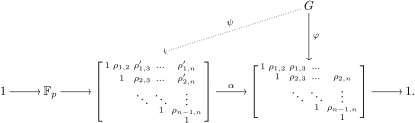
In case G acts trivially on 𝔽 p we have the following equivalence: Denote by U n + 1 ( 𝔽 p ) the group of n + 1 × n + 1 unitriangular matrices over the ring 𝔽 p , and by U n + 1 ( 𝔽 p ) ¯ the quotient of U n + 1 ( 𝔽 p ) by the ( 1 , n + 1 ) st entry, which is equivalent to the group of unitriangular matrices with the ( 1 , n + 1 ) st entry omitted. Let G be a profinite group acting trivially on 𝔽 p . Then G satisfies the vanishing n-Massey product property if and only if for every (continuous) homomorphism φ : G U n + 1 ( 𝔽 p ) ¯ there exists a (continuous) homomorphism ψ : G U n + 1 ( 𝔽 p ) such that for every element g G and 1 i n , [ ψ ( g ) ] i , i + 1 = [ φ ( g ) ] i , i + 1 . In summary,

For more convenience, we call such a homomorphism ψ : G U n + 1 ( 𝔽 p ) a “twisted solution” for the diagram. It has been conjectured by Mináč and Tân that for every n and every field F contains a primitive root of unity of order p, G F ( p ) satisfies the n-vanishing Massey product property (see [21]. In the paper [20] this conjecture was in fact extended to all fields). This conjecture is known to be true in the following cases:

  1. n = 3 , p = 2 and F is arbitrary ([20]),

  2. n = 3 , p is odd, and F is arbitrary ([18]. See also [9]),

  3. n = 4 , p = 2 and F is arbitrary ([19]),

  4. F is a number field and n and p are arbitrary ([13]).

Theorem 14.

Let G be a pro-p group acting trivially on F p such that G has hereditary the vanishing n-Massey product property. Then so does G ^ .

We prove the theorem in several steps.

Proposition 15.

Let G be an abstract group and consider F p as a trivial G ^ -module. Then G ^ satisfies the n-vanishing Massey product property if and only if for every abstract homomorphism φ : G U n + 1 ( F p ) ¯ there exists an abstract homomorphism ψ : G U n + 1 ( F p ) such that for every element g G and 1 i n , [ ψ ( g ) ] i , i + 1 = [ φ ( g ) ] i , i + 1 .

Proof.

( ) Let φ : G U n + 1 ( 𝔽 p ) ¯ be an abstract homomorphism. By definition of the profinite completion it can be lifted to a continuous homomorphism φ ¯ : G ^ U n + 1 ( 𝔽 p ) ¯ . By assumption, there exists a twisted (continuous) solution ψ : G ^ U n + 1 ( 𝔽 p ) . Let i : G G ^ denote the natural homomorphism associated to the profinite completion. Then ψ i : G U n + 1 ( 𝔽 p ) is an abstract twisted solution for G.

( ) Let φ : G ^ U n + 1 ( 𝔽 p ) ¯ be a continuous homomorphism. Then φ i is an abstract homomorphism G U n + 1 ( 𝔽 p ) ¯ . By assumption, G admits an abstract twisted solution ψ : G U n + 1 ( 𝔽 p ) . We claim that its continuous lifting ψ ¯ : G ^ U n + 1 ( 𝔽 p ) is a twisted solution. Indeed, for every 1 i < n , the maps [ ψ ¯ ] i , i + 1 and [ φ ] i , i + 1 which go to a Hausdorff space, identify on the dense subset i ( G ) , thus they are equal. ∎

Lemma 16.

A profinite group G satisfies hereditarily the n-vanishing Massey product property if and only if every open subgroup of G satisfies the n-vanishing Massey product property.

Proof.

Let H c G and let φ : H U n + 1 ( 𝔽 p ) ¯ be a continuous homomorphism. By Lemma 6 there exists an open normal subgroup O c G such that φ can be lifted to a continuous homomorphism φ ¯ : O U n + 1 ( 𝔽 p ) ¯ . Let ψ : O U n + 1 ( 𝔽 ) p be a “twisted” solution to the corresponding embedding problem. Then ψ | H is a twisted solution for H. ∎

Proof of Theorem 14.

Let U be a finite index subgroup of G and φ : U U n + 1 ( 𝔽 p ) ¯ an abstract homomorphism. By Proposition 15, in order to prove that U ^ satisfies the n-vanishing Massey product property it is enough to prove that φ admits an abstract twisted solution. For every finite subset D = { x 1 , , x n } of U, look at the restriction of φ to H D = D ¯ , the closed subgroup of G generated by D. Since H D is finitely generated, by the Nikolov–Segal Theorem, φ | H D is continuous. So, since H D is a closed subgroup of G, by assumption, it admits a twisted solution ψ D . It is easy to see that if D E , then any twisted solution from H E induces a twisted solution from H D by restriction of the domain, and that the union of twisted solutions is a twisted solution. Thus, by Proposition 11 there exists an abstract twisted solution from U. In conclusion, U ^ U ¯ satisfies the n-fold vanishing Massey product property. Since by Remark 5 these are all the open subgroups of G ^ , by Lemma 16 we are done. ∎

1.2 1-cyclotomic orientation

Let G be a pro-p group acting trivially on 𝔽 p . A p-orientation of G is a homomorphism θ : G p × . A pro-p group together with a p-orientation is called a p-oriented profinite group. Later on we will omit the p.

Notice that the orientation makes p into a p [ G ] -module, by defining g . x = θ ( g ) x . We denote this module by p ( 1 ) .

Let F be a field containing a primitive root of unity of order p. Denote by μ p ( F ) the subgroup of F ¯ × of all p-power roots of unity. Then Aut ( μ p ( F ) ) p × , and the natural action of G F ( p ) on F ¯ makes G F ( p ) as an oriented pro-p group. This induced orientation is called the “arithmetical orientation”. The arithmetical orientation of G F ( p ) admits a special property: By the exact sequence

1 μ p n ( F ) F ¯ × p n F ¯ × 1 ,

we get that

F × / ( F × ) p n H 1 ( G F ( p ) , μ p n ( F ) ) H 1 ( G F ( p ) , p ( 1 ) / p n ) .

Thus the natural epimorphism F × / ( F × ) p n F × / ( F × ) p implies that the natural map

H 1 ( G F ( p ) , p ( 1 ) / p n ) H 1 ( G F ( p ) , p ( 1 ) / p )

is in fact an epimorphism. That was the motivation for the following definition:

Definition 17 ([24]).

Let G be an oriented pro-p group. Then G is called a 1-cyclotomic oriented pro-p group if the induced module structure on p satisfies that the natural map

H 1 ( H , p ( 1 ) / p n p ( 1 ) ) H 1 ( H , p ( 1 ) / p p ( 1 ) ) H 1 ( H , 𝔽 p )

is surjective, for all closed subgroups H c G and for every natural number n.

Corollary 18.

Let F be a field containing a primitive root of unity of order p and let G F ( p ) be its maximal pro-p Galois group. Then equipped with the arithmetical orientation, G F ( p ) is a 1-cyclotomic oriented pro-p group.

Remark 19.

Since G acts trivially on 𝔽 p , we have H 1 ( H , p / p p ) = Hom ( H , p / p p ) .

Theorem 20.

Let G be a 1-cyclotomic oriented pro-p group. Then so is G ^ .

We prove it by several steps.

Observation 21.

By the universal property of profinite completion, the orientation of G can be lifted to an orientation of G ^ .

Lemma 22.

Let G be an oriented pro-p group. Then G is 1-cyclotomic if and only if the induced module structure on Z p satisfies that the natural map

H 1 ( U , p ( 1 ) / p n p ( 1 ) ) H 1 ( U , p ( 1 ) / p p ( 1 ) ) H 1 ( U , 𝔽 p )

is surjective, for all open subgroups U o G and for every natural number n.

Proof.

Let n be a natural number, H a closed subgroup of G and f H 1 ( H , p / p ) = Hom ( H , p / p ) . By Lemma 6, any homomorphism from H to p / p can be lifted to a homomorphism from some open subgroup U of G. By assumption, there exists a crossed homomorphism α H 1 ( U , p ( 1 ) / p n ) which projects on this homomorphism. So the restriction of α to H will do. ∎

Proof of Theorem 20.

First we lift the orientation of G to G ^ .

Let n be a natural element and α H 1 ( U ^ , 𝔽 p ) . We shall find an element f ^ H 1 ( U ^ , p ( 1 ) / p n ) such that the natural homomorphism H 1 ( U ^ , p ( 1 ) / p n p ( 1 ) ) H 1 ( H , 𝔽 p ) sends f ^ to α.

Let us look at α | U . This is an element in H abs 1 ( U , 𝔽 p ) Hom abs ( U , 𝔽 p ) . Now let H be a finitely generated closed subgroup of G that is contained in U and look at α | H . By the Nikolov–Segal Theorem, H is strongly complete and thus α | H H cont 1 ( H , 𝔽 p ) . Hence, since G is cyclotomic, there exists an element β H H cont 1 ( H , p ( 1 ) / p n ) which projects over α | H .

Recall that an element in H cont 1 ( H , p ( 1 ) / p n ) is in fact an equivalence class of continuous crossed homomorphisms H p ( 1 ) / p n . However, since H acts trivially on 𝔽 p , every element in H 1 ( H , 𝔽 p ) is a singleton. Thus, if f H is a primitive of β H in C 1 ( H , 𝔽 p ) , then the π f H = α | H , where π : p ( 1 ) / p n p ( 1 ) / p 𝔽 p is the natural projection.

The number of continuous crossed homomorphisms from a finitely generated profinite group to a finite module is finite since it depends only on the values of the generators. In addition, if f H is a crossed homomorphism H p ( 1 ) / p n satisfying π f H = α | H and K H , then f H | K is a crossed homomorphism H p ( 1 ) / p n satisfying π f H | K = α | K . Hence, we have a projective system of finite sets, so its inverse limit is nonempty. Observe that the inverse limit is a crossed homomorphism f : X : p ( 1 ) / p n satisfying π f = H X α | H , where X is the set of all closed subgroups of G which are contained in U. By Lemma 4 f is in fact a crossed homomorphism U p ( 1 ) / p n satisfying π f = α | U . Now using the cohomological goodness for n = 1 , there is a continuous crossed homomorphism f ^ C 1 ( U ^ , p ( 1 ) / p n ) whose restriction to U is equivalent to f. Thus ( π f ^ ) | U π f = α | U . Again, since every element in H abs 1 ( U , 𝔽 p ) is a singleton, we have ( π f ^ ) | U = α | U . We conclude that π f ^ and α, being two continuous functions to an Hausdorff space which identify on a dense subset, are equal. ∎

1.3 Pro-p groups of p-absolute Galois type

Let G = G F ( p ) be the maximal pro-p Galois group of a field F containing a primitive root of unity of order p. For every χ H 1 ( G , 𝔽 p ) = Hom ( G , 𝔽 p ) one has the following identities:

H 1 ( G , 𝔽 p ) F × / ( F × ) p , H 1 ( ker ( χ ) , 𝔽 p ) L × / ( L × ) p ,
H 2 ( G , 𝔽 p ) Br p ( F ) , H 2 ( ker ( χ ) , 𝔽 p ) Br ( L ) ,

where L = F ¯ ker ( χ ) and Br p stands for the subgroup of all elements annihilated by p in the Brauer group of a given field. Thus, the known isomorphism F × / N L / F ( L × ) Br ( L / F ) gives rise to the following exact sequence (for the proof, see [8, p. 73, Theorem 1]):

(1) H 1 ( ker ( χ ) , 𝔽 p ) Cor G ker ( χ ) H 1 ( G , 𝔽 p ) χ H 2 ( G , 𝔽 p ) Res ker ( χ ) G H 2 ( ker ( χ ) , 𝔽 p ) .

This exactness is of significant importance, as can be shown for example by its contribution to the proof of the Norm Residue Isomorphism Theorem (see [28]). The condition of satisfying this exact sequence has been studied in [15] with connections to other pro-p-maximal Galois groups properties, and stand in the focus of [6]. In the last paper, they call pro-p groups which satisfy this property group of p-absolute Galois type. They also presented the definition of groups hereditarily of p-absolute Galois type.

In the current paper we focus on pro-p groups G which are hereditarily of p-absolute Galois type, i.e., for every closed subgroup H c G and every χ H 1 ( H , 𝔽 p ) the above sequence is exact. Observe that every maximal pro-p Galois group is hereditarily of p-absolute Galois type.

Remark 23.

Notice that sequence (1) is always a complex.

Theorem 24.

Let G be a pro-p group, hereditarily of p-absolute Galois type. Then so is G ^ .

Lemma 25.

Let G be a pro-p group. Then G is hereditarily of p-absolute Galois type if and only if every open subgroup of G is of p-absolute Galois type.

Proof.

Let H be a closed subgroup of G and χ H 1 ( H , 𝔽 p ) . Recall that since G acts trivially on 𝔽 p , it follows that H 1 ( H , 𝔽 p ) Hom ( H , 𝔽 p ) . Thus, by Lemma 6, χ can be lifted to some open subgroup U o G . Let ρ H 1 ( H , 𝔽 p ) be an element such that χ ρ = 0 . By Lemma 6 again there is an open subgroup U such that ρ can be lifted to U . Note that χ ρ = 0 means that there is some f C 1 ( H , 𝔽 p ) such that ( f ) = χ ρ . Since f is a continuous function from a profinite space to a finite space, it projects through some finite quotient of H (see [25, Proposition 1.1.16 (a)]). That is, there exist a finite group A, a continuous homomorphism f : H A and a continuous function f ′′ : A 𝔽 p such that f = f ′′ f . So again, there exists a lifting of f , and thus of f, to an open subgroup U ′′ of G. By defining O = U U U ′′ , we get that O is an open subgroup of G to which both χ and ρ can be lifted. Denote these lifting by χ ¯ and ρ ¯ , and notice that χ ¯ ρ ¯ is trivial. By assumption,

ρ ¯ = Cor O O ker ( χ ) ρ

for some ρ H 1 ( O ker ( χ ) , 𝔽 p ) . Taking

ρ ′′ = Res H ker ( χ ) O ker ( χ ) ( ρ )

will do.

For the second exactness, let α H 2 ( H , 𝔽 p ) such that Res ker ( χ ) H ( α ) = 0 . By the same arguments, there exists some open subgroup O o G containing H such that α and χ can be lifted to it, and α ¯ , the lifting of α, is trivial. By assumption, α ¯ = χ ¯ ρ for some ρ H 1 ( O , 𝔽 p ) , when χ ¯ denotes the lifting of χ to O. Then Res H O ( ρ ) = α proving the exactness in H 2 ( H , 𝔽 p ) . ∎

Remark 26.

Lemma 25 has also been proven in [6, Proposition 5.10].

We also need the following lemma:

Lemma 27.

Let K be a group and let L , H be subgroups such that L has finite index in K. Assume further that [ H : H L ] = [ K : L ] . Then for every K-module M the following diagram is commutative:
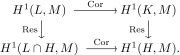
Proof.

Choose a right transversal h 1 , , h n of L H in H. Then h 1 , , h n is a right transversal for H in K too. Recall that given a primitive f C 1 ( L , M ) of an element α H 1 ( L , M ) , Cor K L ( α ) is represented by the function

Cor K L ( f ) ( k ) = h i h i - 1 f ( h i k h i k ~ - 1 )

(see [22, p. 46]). By substituting an element h H , the commutativity follows. ∎

Proof of Theorem 24.

Using Remark 5, let U ^ be an open subgroup of G ^ , for some finite-index subgroup U of G, and χ H 1 ( U ^ , 𝔽 p ) a continuous homomorphism. We will prove the exactness of the following series:

H 1 ( ker ( χ ) , 𝔽 p ) Cor U ^ ker ( χ ) H 1 ( U ^ , 𝔽 p ) χ H 2 ( U ^ , 𝔽 p ) Res ker ( χ ) U ^ H 2 ( ker ( χ ) , 𝔽 p ) .

Exactness at H 1 ( U ^ , F p ) . Let ρ H 1 ( U ^ , 𝔽 p ) be such that χ ρ = 0 . Let us look at the restrictions of ρ and χ to U, these are not-necessarily-continuous homomorphisms U 𝔽 p .

First assume that χ | U = 0 . Since χ is continuous and U is dense in U ^ , we conclude that χ = 0 . Hence ker ( χ ) = U ^ and for every ρ H 1 ( U ^ , 𝔽 p ) , ρ = Cor U ^ ( ρ ) .

Now assume that χ | U 0 and let x U be such that χ ( x ) 0 . By the Nikolov–Segal Theorem, for every finitely generated closed subgroup H of G that is contained in U, Res H U ( χ ) and Res H U ( ρ ) are continuous homomorphisms. Moreover, taking the restriction of f to H, for f C 1 ( U ^ , 𝔽 p ) such that ( f ) = χ ρ implies that Res H U ( χ ) Res H U ( ρ ) = 0 . So by assumption,

Res H U ( ρ ) = Cor H ker ( Res H ( χ ) ) ( ρ )

for some ρ H 1 ( ker ( Res H ( χ ) ) , 𝔽 p ) . Since H is finitely generated and H ker ( χ ) is of finite index in H, it follows that H ker ( χ ) is open in H. Thus, by [25, Corollary 2.5.5] H ker ( χ ) is finitely generated too. Moreover, if H K are finitely generated closed subgroups of G that are contained in U and that contain x, then using Lemma 27 and the fact that [ H : H ker ( χ ) ] = p = [ K : K ker ( χ ) ] , for all ρ K such that Res K U ( ρ ) = Cor K ker ( χ ) K ( ρ K ) one has

Res H U ( ρ ) = Cor H ker ( χ ) H ( Res ker ( χ ) H ker ( χ ) K ( ρ K ) ) .

Since the set of continuous homomorphisms from a finitely generated profinite group to a finite group is finite, there is an element ρ H abs 1 ( ker ( χ | U ) , 𝔽 p ) which is an inverse limit of all these homomorphisms. This follows from the fact that U equals the union of all finitely generated closed subgroups H that are contained in it and contain x and thus ker ( χ | U ) = ker ( Res H U ( χ ) ) . Moreover, it is easy to see that ρ = Cor U ker ( χ ) U ( ρ ) . Since H abs 1 ( U , 𝔽 p ) = Hom abs ( U , 𝔽 p ) , it follows that ρ can be lifted to a continuous homomorphism ρ ^ : ker ( χ ) 𝔽 p . The only thing left to show is that

ρ = Cor U ^ ker ( χ ) ( ρ ^ ) .

For that choose a transversal { u 1 , , u n } of ker ( χ | U ) in U. By [25, Proposition 3.2.2] this is also a transversal of ker ( χ ) in U ^ . Recall that for each x U ^ ,

Cor U ^ ker ( χ ) ( ρ ^ ) ( x ) = u i ρ ^ ( u i x x u i ~ - 1 ) ,

where u i x ~ denotes the representative of the coset of u i x from the chosen set of transversal. An analog of this interpretation holds for Cor U ker ( χ ) U ( ρ ) . So ρ and Cor U ^ ker ( χ ) ( ρ ^ ) identify on the dense subset U, and hence they are equal.

Exactness at H 2 ( U ^ , F p ) . Let α H 2 ( U ^ , 𝔽 p ) be such that

Res ker ( χ ) U ^ ( α ) = 0 .

Its restriction to U is an element in the second abstract cohomology of U whose restriction to ker ( χ | U ) is trivial. Since α is continuous, there is some finite continuous homomorphic image A of U ^ such that α splits through the natural projection U ^ A (recall that for the continuous cohomology groups, H n ( U ^ , 𝔽 p ) ) lim H n ( A , 𝔽 p ) when A runs over the set of finite continuous homomorphic images of U ^ (see [25, Proposition 6.5.5]). That is, α = Inf U ^ ( α A ) , where α A H 2 ( A , 𝔽 p ) . Thus Res U U ^ ( α ) is also inflated from A, and hence so is Res H ( α ) for every finitely generated closed subgroup H of G that is contained in U. By the Nikolov–Segal Theorem we get that the reduced homomorphism H A is continuous, so Res H ( α ) is a continuous cocycle. The same holds for Res H U ( χ ) . So by assumption there is some ρ H H cont 1 ( H , 𝔽 p ) such that Res H U ( χ ) ρ H = Res H U ( α ) . Observe that this is an equation of equivalence classes. That is, if we identify α with some primitive of α in C 2 ( U ^ , 𝔽 p ) , then there exists some f H C cont 1 ( H , 𝔽 p ) such that Res H U ( χ ) ρ H + δ ( f H ) = Res H U ( α ) . Obviously, if K H , then Res K H ( χ ) ρ H | K + δ ( f H | K ) = Res K U ( α ) . Moreover, the number of continuous homomorphisms from a finitely generated profinite group to a finite group is finite. In addition, for every continuous homomorphism ρ H from H to 𝔽 p , the number of f H C cont 1 ( H , 𝔽 p ) satisfying Res H U ( χ ) ρ H + δ ( f H ) = Res H U ( α ) is finite as is can be determined by the values of finite set of generators. Taking the inverse limit of the finite sets of such pairs ( ρ H , f H ) , we obtain a cocycle ρ H abs 1 ( U , 𝔽 p ) such that Res U U ^ ( χ ) ρ = Res U U ^ α . Since ρ is in fact a homomorphism, it can be lifted to a continuous homomorphism ρ ^ Hom ( U , 𝔽 p ) = H 1 ( U , 𝔽 p ) . So the only thing left to show is that χ ρ ^ = α . But this follows from the injectivity of the second cohomological map H cont 2 ( U ^ , 𝔽 p ) H abs 2 ( U , 𝔽 p ) described in [26, Section 2.6]. ∎

2 Completions of higher order

In [1] the author presented the infinite tower of profinite completions which is defined as follows: Let G be a nonstrongly complete profinite group and α an ordinal. Set G 0 = G .

If α = β + 1 is a successor ordinal, then

G α = G β ^

and if α is limit, then

G α = H α ^

when

H α = lim β < α G β ^ .

The chain is equipped with natural compatible homomorphisms φ β α : G β G α . It has been proven that all the groups in this chain are nonstrongly complete and the maps are injective, and thus this chain grows indefinitely. In [2] the local weights of all the groups in the chain have been computed and discovered to strictly increase. In this paper we treat G α as the α’th completion of G and we want to prove that if G possess some property of absolute Galois groups that was stated above, then so does G α for every ordinal α. First we need the following lemma:

Lemma 28.

Let α be a limit ordinal and let U be a finite index subgroup of

H α = lim β < α G β ^ .

Then U is locally profinite and more precisely every finitely generated abstract subgroup of U is contained in a closed subgroup of some G β for β < α which in turn is contained in U.

Proof.

Let x 1 , , x n U . There is some β < α such that x 1 , , x n G β . Thus x 1 , , x n U G β which is a finite index subgroup of G β . So, by Lemma 4, the closed subgroup generated by x 1 , , x n in G β is contained in U G β . Since φ β α is injective it is also included in U. ∎

Proposition 29.

Let C be a property of profinite groups which satisfies the following conditions:

  1. Every closed subgroup of a profinite group G satisfies property 𝒞 if and only if every open subgroup of G does so.

  2. If U is an abstract group for which every finitely generated abstract subgroup is contained in a finitely generated profinite group which satisfies 𝒞 , then U ^ satisfies 𝒞 .

Then if G is a nonstrongly complete profinite group which satisfies C hereditarily, the same holds for G α , the αth completion of G, for every ordinal α.

Proof.

We prove it by transfinite induction. Let α be an ordinal.

The case α = 0 is true by assumption.

Let α = β + 1 be a successor. By induction, every closed subgroup of G β satisfies 𝒞 . By Lemma 4, every finite index subgroup U of G is locally closed and thus satisfies the conditions of (2), so U ^ satisfies 𝒞 . Thus, by condition (1), every closed subgroup of G α = G β ^ satisfies 𝒞 .

Let α be a limit ordinal. Let U be a finite index subgroup of H α . By Lemma 28, every finitely generated subgroup of U is contained in a closed subgroup of some G β for β < α . By induction assumption, these closed subgroup satisfy property 𝒞 . Thus U satisfies the conditions of condition (2) so U ^ satisfies 𝒞 . By condition (1), every closed subgroup of G α = H α ^ satisfies 𝒞 . ∎

Theorem 30.

Let G be a nonstrongly complete pro-p group which satisfies one of the following options:

  1. G is projective.

  2. G satisfies the n - vanishing Massey product hereditary.

  3. G has an orientation and every closed subgroup of G is 1 - cyclotomic with respect to this orientation.

  4. G is hereditary of p - absolute Galois type.

Then the same holds for G α , correspondingly, for every ordinal α.

Proof.

This is an immediate consequence of Proposition 29 and the proofs of Theorems 14, 20, 24 and the main theorem of [3]. The only thing left to show is that the orientation of G can be lifted to an orientation for every G α in the chain, but this is also immediate since by the definition of profinite completion every homomorphism to a profinite group can be lifted to a compatible homomorphism from the completion, and compatible homomorphism induces a homomorphism from the direct limit, by the universal property of direct limit. ∎


Communicated by Freydoon Shahidi


References

[1] T. Bar-On, The tower of profinite completions, J. Group Theory 21 (2018), no. 6, 1065–1072. 10.1515/jgth-2018-0024Search in Google Scholar

[2] T. Bar-On, The weight of nonstrongly complete profinite groups, J. Group Theory 24 (2021), no. 5, 987–1004. 10.1515/jgth-2021-0001Search in Google Scholar

[3] T. Bar-On, The profinite completion of a profinite projective group, Glasg. Math. J. 64 (2022), no. 2, 499–503. 10.1017/S0017089521000240Search in Google Scholar

[4] L. Bary-Soroker, M. Jarden and D. Neftin, The Sylow subgroups of the absolute Galois group Gal ( ) , Adv. Math. 284 (2015), 186–212. 10.1016/j.aim.2015.05.017Search in Google Scholar

[5] I. Bauer, F. Catanese and F. Grunewald, Faithful actions of the absolute Galois group on connected components of moduli spaces, Invent. Math. 199 (2015), no. 3, 859–888. 10.1007/s00222-014-0531-2Search in Google Scholar

[6] S. Blumer, A. Cassella and C. Quadrelli, Groups of p-absolute Galois type that are not absolute Galois groups, J. Pure Appl. Algebra 227 (2023), no. 4, Article ID 107262. 10.1016/j.jpaa.2022.107262Search in Google Scholar

[7] A. Douady, Détermination d’un groupe de Galois, C. R. Acad. Sci. Paris 258 (1964), 5305–5308. Search in Google Scholar

[8] P. K. Draxl, Skew Fields, London Math. Soc. Lecture Note Ser. 81, Cambridge University, Cambridge, 1983. 10.1017/CBO9780511661907Search in Google Scholar

[9] I. Efrat and E. Matzri, Triple Massey products and absolute Galois groups, J. Eur. Math. Soc. (JEMS) 19 (2017), no. 12, 3629–3640. 10.4171/jems/748Search in Google Scholar

[10] G. A. Fernández-Alcober, I. V. Kazachkov, V. N. Remeslennikov and P. Symonds, Comparison of the discrete and continuous cohomology groups of a pro-p group, Algebra i Analiz 19 (2007), no. 6, 126–142. 10.1090/S1061-0022-08-01030-3Search in Google Scholar

[11] M. D. Fried and M. Jarden, Field Arithmetic, Ergeb. Math. Grenzgeb. (3) 11, Springer, Cham, 2006. 10.1007/b138352Search in Google Scholar

[12] E. Girondo and G. González-Diez, A note on the action of the absolute Galois group on dessins, Bull. Lond. Math. Soc. 39 (2007), no. 5, 721–723. 10.1112/blms/bdm035Search in Google Scholar

[13] Y. Harpaz and O. Wittenberg, The Massey vanishing conjecture for number fields, Duke Math. J. 172 (2023), no. 1, 1–41. 10.1215/00127094-2022-0004Search in Google Scholar

[14] W. Krull, Galoissche Theorie der unendlichen algebraischen Erweiterungen, Math. Ann. 100 (1928), no. 1, 687–698. 10.1007/BF01448872Search in Google Scholar

[15] Y. H. J. Lam, Y. Liu, R. Sharifi, P. Wake and J. Wang, Generalized Bockstein maps and Massey products, Forum Math. Sigma 11 (2023), Paper No. e5. 10.1017/fms.2022.103Search in Google Scholar

[16] H. Leptin, Ein Darstellungssatz für kompakte, total unzusammenhängende Gruppen, Arch. Math. (Basel) 6 (1955), 371–373. 10.1007/BF01900508Search in Google Scholar

[17] W. S. Massey, Some higher order cohomology operations, International Symposium on Algebraic Topology, Universidad Nacional Autónoma de México and UNESCO, México (1958), 145–154. Search in Google Scholar

[18] E. Matzri, Triple Massey products in Galois cohomology, preprint (2014), https://arxiv.org/abs/1411.4146. Search in Google Scholar

[19] A. Merkurjev and F. Scavia, The Massey vanishing conjecture for fourfold Massey products modulo 2, preprint (2023), https://arxiv.org/abs/2301.09290. Search in Google Scholar

[20] J. Mináč and N. D. Tân, Triple Massey products vanish over all fields, J. Lond. Math. Soc. (2) 94 (2016), no. 3, 909–932. 10.1112/jlms/jdw064Search in Google Scholar

[21] J. Mináč and N. D. Tân, Triple Massey products and Galois theory, J. Eur. Math. Soc. (JEMS) 19 (2017), no. 1, 255–284. 10.4171/jems/665Search in Google Scholar

[22] J. Neukirch, A. Schmidt and K. Wingberg, Cohomology of Number Fields, Springer, Berlin, 2013. Search in Google Scholar

[23] N. Nikolov and D. Segal, On finitely generated profinite groups. I. Strong completeness and uniform bounds, Ann. of Math. (2) 165 (2007), no. 1, 171–238. 10.4007/annals.2007.165.171Search in Google Scholar

[24] C. Quadrelli, Chasing maximal pro-p Galois groups via 1-cyclotomicity, Mediterr. J. Math. 21 (2024), no. 2, Paper No. 56. 10.1007/s00009-024-02598-0Search in Google Scholar

[25] L. Ribes and P. Zalesskii, Profinite Groups, Ergeb. Math. Grenzgeb. (3) 40, Springer, Berlin, 2000. 10.1007/978-3-662-04097-3Search in Google Scholar

[26] J.-P. Serre, Cohomologie Galoisienne, Lecture Notes in Math. 5, Springer, Berlin, 1979. Search in Google Scholar

[27] M. G. Smith and J. S. Wilson, On subgroups of finite index in compact Hausdorff groups, Arch. Math. (Basel) 80 (2003), no. 2, 123–129. 10.1007/s00013-003-0786-0Search in Google Scholar

[28] V. Voevodsky, On motivic cohomology with 𝐙 / l -coefficients, Ann. of Math. (2) 174 (2011), no. 1, 401–438. 10.4007/annals.2011.174.1.11Search in Google Scholar

Received: 2023-06-15
Revised: 2024-03-10
Published Online: 2024-04-24
Published in Print: 2025-02-01

© 2024 Walter de Gruyter GmbH, Berlin/Boston

This work is licensed under the Creative Commons Attribution 4.0 International License.

Downloaded on 19.12.2025 from https://www.degruyterbrill.com/document/doi/10.1515/forum-2023-0227/html
Scroll to top button