The Impact of Artificial Intelligence on the Production and Editing of Audiovisual Content
-
Iryna Gavran
 ,
Serhii Honcharuk
,
Serhii Honcharuk

Abstract
The relevance of this study is driven by the rapid development of artificial intelligence (AI) in the creative industries, particularly in the creation and editing of audiovisual content, necessitating a reassessment of its impact on the technological and ethical aspects of this field. The objective of the study was to analyze the key opportunities and challenges of using AI in audiovisual content production, as well as to outline recommendations for mitigating associated risks. The research was based on a review and comparative analysis of contemporary scientific studies. The findings demonstrated that AI enables significant reductions in production time and costs through the automation of routine tasks such as editing, video correction, and animation creation. Generative models, particularly generative adversarial networks (GANs), open new possibilities for creating realistic visual effects and three-dimensional objects that previously required considerable effort and resources. Deep learning algorithms improve the quality of sound and image, restore old materials, and adapt content for different target audiences through personalisation. However, certain risks have been identified, including content standardisation, threats of disinformation due to the spread of deepfake technologies, and copyright infringements. Thus, the study confirmed that the integration of AI into the audiovisual sector has a substantial impact and future potential for optimising production processes, yet it requires consideration of socio-ethical aspects.
1 Introduction
Artificial intelligence (AI) has become an integral part of the modern technological era, influencing various fields, including the production and editing of audiovisual content. The use of AI in this context enables the creation of new artistic and entertainment products while simplifying routine and labour-intensive processes (Kolisnyk et al. 2023, 107; Lazarte et al. 2025). For instance, AI algorithms can generate music or animation based on provided data, significantly expanding the capabilities of modern content and offering new prospects for the creative industry. The study by Han et al. (2024) in the field of music generation for dance projects demonstrates AI’s ability to create complex multimedia projects by automatically selecting music for different instruments based on dance movements. This opens new horizons for multimedia art, particularly in cinema and music.
AI also contributes to the development of multimodal emotion recognition, which can process audiovisual information and detect emotional states based on dynamic reactions (Salas-Cáceres et al. 2024). This enhances user experience, especially in audiovisual content, where viewer or listener reactions play a crucial role in creating deeper emotional impact. Additionally, studies indicate that AI influences content development processes and intellectual property protection. For example, Gutierrez et al. (2021) explore the implications of AI technologies on marketing strategies and digital platforms, focusing on how AI-driven content creation challenges traditional intellectual property frameworks. While their study acknowledges the importance of AI in the creative sector, it emphasizes that AI’s capabilities in content production and distribution require a reconsideration of intellectual property laws to accommodate new forms of digital media. The study highlights the growing need for comprehensive regulation in areas such as copyright and licensing in the context of AI-driven content distribution.
The study by Reddy et al. (2024) discusses how AI is employed to simplify specific areas of cinematography, such as creating realistic visual effects and animations. This approach minimizes the need for time-consuming manual editing in these areas, enabling more efficient production workflows in the animation sector. According to Anantrasirichai and Bull (2022), AI is widely adopted across the creative industries, particularly in media content creation and editing. Moreover, Bashynska et al. (2021) examine the integration of AI in education, focusing on how AI supports adaptability and enhances remote learning platforms. The study highlights the evolution of “smart education” and the creation of interactive virtual environments, fostering new ways of student engagement in academic research. Notably, virtual spaces are also evolving due to AI, fostering interactive research and learning practices, as indicated by Tserklevych et al. (2021, 226). This allows educational institutions to create virtual museums and interactive spaces, enhancing student engagement in academic research.
Another important application of AI is facilitating the translation of audiovisual content, adapting it to new cultural contexts through machine translation (Shevchuk and Hunaza 2025). This significantly eases media content distribution across different language audiences, particularly in global media corporations. According to French et al. (2023), AI is contributing to the development of innovative educational technologies, particularly by enabling more personalized learning experiences that can be adapted to individual needs, with a focus on creative disciplines.
Given AI’s rapid advancement and its impact on creative content production, a range of ethical and legal challenges arise. Carceller (2024) explores the changes generative AI brings to artistic education, advocating for new teaching methods and the integration of AI into curricula to prepare students for evolving artistic practices in the age of AI. Meanwhile, Cádiz (2020) investigates the use of fuzzy logic algorithms in music creation, focusing on how AI technologies enable the generation of new musical compositions through algorithmic processes. Peterson and Broersen (2024) explore the limitations of explicable AI models, focusing on the ethical challenges posed by AI’s lack of transparency in decision-making processes and the difficulty of understanding the rationale behind machine-generated outcomes.
Therefore, this study aims to examine how AI is transforming the processes of creating and editing audiovisual content and to identify key trends, challenges, and ethical considerations facing the industry amid its rapid development. The analysis covers various AI applications in the creative fields, including music generation, animation, and content translation, to outline the main prospects, limitations, and ethical concerns associated with this technology.
2 Materials and Methods
This study utilized a thorough methodology to examine the influence of AI on audiovisual media, concentrating on essential criteria for the comparative evaluation of current scientific research. This research involved a comparative review of current scientific investigations, employing a well-defined set of criteria to guarantee a systematic and significant assessment of AI’s function in audiovisual creation. The primary criterion was the technological scope of each research, emphasizing the use of AI methods such as generative adversarial networks (GANs), deep learning, and machine learning in practical tasks like editing, animation, restoration, personalization, and translation. The second criterion pertained to evaluating the extent of integration – determining if AI was utilized in discrete functions or included across various stages of the production process. The third component was assessing results, wherein research was juxtaposed based on actual or theoretical data about AI’s influence on production efficiency, cost savings, content quality, and user engagement. The ethical and legal aspects explored in the literature formed a fourth criterion, scrutinizing discourse on transparency, authorship, intellectual property, and privacy. Finally, the methodological rigour of each source was evaluated, prioritizing peer-reviewed papers that offered either empirical evidence or critical analytical frameworks.
Considering the rapid technological development, sources published between 2019 and 2024 were selected, allowing an exploration of recent scientific works and technological advancements in this field. The selection of these sources enabled not only the tracking of the latest trends but also the assessment of the evolution of AI applications. Research was contrasted based on geographical variety, emphasizing studies from North America and Europe, where AI technologies in audiovisual creation are most developed. Incorporating studies from Asia and Latin America would offer a more comprehensive view on AI implementation, legal obstacles, and cultural influences affecting AI in audiovisual production.
This study largely adopts a qualitative approach, but the literature examined indicates many quantitative frameworks for assessing AI tools in audiovisual production. This encompasses production efficiency measurements, like decreases in editing time and expenses, as well as content quality indicators, such as the precision of AI in restoring and producing audiovisual content. Although these measures are not explicitly utilized in this study, they are crucial for assessing the efficacy of AI tools and should be incorporated into future research to achieve a more thorough comprehension of AI’s function in audiovisual production.
Data collection was conducted using several academic databases, including ScienceDirect, Scopus, IEEE Xplore, Google Scholar, and specialized journals dedicated to media technologies and AI. This provided access to a diverse range of materials, encompassing both theoretical research and practical developments. Sources were selected based on keywords such as “generative content,” “audiovisual processing,” “creative industries,” and “AI content copyright.” The initial selection included 112 publications within the chosen timeframe. After analysis, only sources directly related to AI’s impact on audiovisual media and containing empirical data or in-depth analytical reviews of modern technologies were retained. Studies with insufficient contribution or those only partially addressing the research topic were excluded. As a result, 52 sources were selected as the foundation for examining key aspects of AI’s influence on audiovisual media.
The literature review focused on identifying key trends in AI applications in audiovisual media, particularly in generative content and ethical issues. The research involved a thorough analysis of selected sources to determine the main directions of AI’s influence on audiovisual media. One of the primary objectives was to study generative models, which allow the creation of text, images, audio, and video based on input data. The quality and accuracy of the generated content, as well as the potential integration of these models into creative processes, were assessed. The analysis considered technical aspects such as model adaptation to new tasks and resource efficiency. Additionally, particular attention was given to the socio-ethical aspects of AI usage. Issues related to algorithm transparency, accountability for AI-generated content, and the potential impact on creative professions were significant topics of investigation.
At the final stage, the results were summarized, providing a comprehensive examination of the technological and socio-ethical aspects of AI’s impact on media. This ensured a holistic understanding of contemporary trends and challenges arising from AI’s integration into the audiovisual sector and creative industries.
3 Results
3.1 The Positive Impact of AI on Content Creation and Editing
The use of AI in the creation and editing of audiovisual content is becoming increasingly popular due to its vast potential for optimizing workflows and reducing production costs. AI-powered tools offer innovative approaches to automation and the enhancement of all stages of content production – from planning to editing. In this context, AI serves as a versatile tool that enhances efficiency and simplifies the execution of projects of varying complexity (Somvanshi 2019, 67).
One of AI’s key achievements is its ability to optimize the video editing process. Traditionally, video editing involves lengthy manual work, including analyzing recorded footage, selecting the best moments, adjusting color correction, and synchronizing audio with visuals. Modern AI algorithms not only perform these tasks faster but also with greater precision, offering automatic identification of key moments in a video (Derda 2023, 273). For instance, AI-powered software such as Adobe Premiere Pro with its Sensei feature can automatically recognize important scenes and stabilize images. This not only reduces the time spent on technical operations but also allows creators to focus on artistic decisions. A comparison of traditional video editing approaches and AI-assisted methods is provided in Table 1.
Comparative analysis of AI-assisted and traditional video production.
| Feature | Traditional video production | AI video production |
|---|---|---|
| Time | Weeks to months | Hours to days |
| Cost | High | Low |
| Creative control | Inconsistent | Retains context |
| Scalability | Limited | Effortless |
| Customization | Manual | Automated |
-
Source: compiled by the authors based on Kowalski (2024).
The data presented illustrates the significant advantages AI offers in video production. While traditional video editing requires substantial time and resources, AI enables similar tasks to be completed in significantly shorter periods, sometimes reducing weeks of work to just a few hours (Shen and Yu 2021). For example, video processing algorithms such as DaVinci Resolve with an integrated AI module allow for automatic color correction, analyzing scenes, and adjusting frame tonality to a unified standard. Compared to manual adjustments, which require meticulous fine-tuning for each frame, such automation reduces an editor’s workload by 50–70 % (Al Adwan et al. 2023, 730).
These aspects highlight the importance of intelligent algorithms not only for technical improvements but also for implementing innovations that simplify complex tasks such as creating realistic visual effects or animations. This is particularly evident in technologies related to GANs, which make it possible to generate highly realistic effects without the need for complex equipment or lengthy computations (Hales 2021, 79). For example, GANs can automatically generate complex 3D objects, textures, or even natural phenomena such as rain, smoke, or explosions with a high degree of detail (Samson 2024, 343). This has a significant impact on the development of cinema and television production, making it easier to work on scenes involving intricate visual effects. Additionally, AI-based tools enable the modelling of faces, adding animations or altering characters’ emotions in real time (Reddy et al. 2024, 752). Virtual actors created using such technologies appear entirely realistic, maintaining natural facial expressions, movements, and even voices. In cinema, for instance, these technologies allow for the recreation of historical figures or the development of entirely new characters for science fiction films, reducing costs associated with elaborate makeup or special effects. Modern animation studios utilize these tools to create lifelike characters or even fully computer-generated scenes that are almost indistinguishable from real-life footage.
Deep learning algorithms also play a crucial role in the restoration and enhancement of audiovisual materials. In particular, super-resolution technology enables the conversion of low-resolution video into HD or even 4K formats (Sun 2024a, 123444). AI automatically adjusts colors, fills in missing details, reduces digital noise, and improves overall image clarity. These capabilities are widely used both in restoring old films and in preparing modern content filmed in challenging conditions. For instance, technologies developed by NVIDIA can not only restore lost video fragments but also generate new, realistic versions based on archival materials, which could revolutionize cinematic heritage preservation. These algorithms can also automatically remove unwanted noise, adjust volume levels, or synchronize audio with video footage (Amiriparian et al. 2022). This is particularly important when working with materials that contain multilayered audio tracks, such as films or advertisements. Thanks to these tools, the need for lengthy manual sound editing is reduced, and the results often surpass those achieved through manual processing (Magro-Vela et al. 2024, 95). For example, modern sound-processing algorithms can automatically eliminate echo effects or background wind noise, which previously required the involvement of a specialist (Tjhin 2022, 41).
For creating trailers or promotional videos, AI can quickly analyze footage to identify the most dynamic scenes or moments that best convey the essence of a film (Bigioi et al. 2024). Algorithms can automatically highlight key elements such as motion dynamics, character interactions, and important plot lines (Curien 2021, 25). This results in highly effective content that retains all essential information for the audience without unnecessary elements.
Another significant AI achievement is the integration of computer vision technologies, which facilitate tasks such as framing, facial recognition, and object detection (Anantrasirichai and Bull 2022, 603–629). During the editing process, for instance, effects such as background blurring or highlighting a central object can be applied automatically. These tools enable rapid achievement of cinematic quality even without specialized video editing skills. Moreover, automating routine tasks frees up more opportunities for creativity. Editors and directors can focus on conceptual and artistic decisions while entrusting technical aspects to AI-driven algorithms. For example, AI-assisted generation of preliminary versions of films or clips with the ability to quickly modify them allows creators to experiment with different script variations, frame compositions, or color palettes (Basole and Major 2024, 59).
Beyond technical applications, AI offers new creative possibilities. For instance, AI-driven text-to-image technologies enable the creation of storyboards or scripts based on initial ideas from clients (Zhao and Zhao 2024, 17). This simplifies the early stages of project development, allowing for quicker experimentation with different concepts. Additionally, AI-integrated trend prediction algorithms analyze audience preferences and recommend stylistic or narrative adjustments to enhance content popularity. With these technologies, audiovisual content can not only meet current demands but also adapt to future expectations, making AI an indispensable tool in this field.
Furthermore, AI is capable of independently generating scripts based on gathered data. Using tools that process large volumes of information, AI can analyze audience interests through social media, search queries, and other sources (Momot 2022). This allows for the identification of trending topics and genres while also predicting future trends. For example, platforms incorporating AI technologies can automatically generate scripts that reflect themes most resonant with contemporary audiences.
Another area where AI demonstrates its effectiveness is in adapting content for different platforms (Butenko et al. 2023). Its algorithms can automatically adjust video formats to meet platform-specific requirements, such as the 9:16 vertical format for TikTok or square format for Instagram. Moreover, AI can automatically trim video length while preserving its core message and optimize video for different devices by lowering resolution for low-powered hardware. AI-integrated editors, such as Magisto or Vimeo Create, also enable the automatic addition of subtitles in multiple languages, enhancing content accessibility for international audiences – a particularly valuable feature (Liu 2024, 3–15).
Adobe Premiere Pro’s Sensei AI streamlines video editing by detecting pivotal points in unedited film, markedly decreasing editing duration and enabling editors to concentrate on creative choices. Research by Orak and Turan (2024) substantiates AI’s function in automating repetitive operations, such as scene identification and audio synchronisation, hence optimizing workflows and diminishing production expenses. DaVinci Resolve employs AI to optimize color grading by autonomously analyzing film and modifying color tones, hence enhancing visual quality and expediting post-production. Research, such as that conducted by Sun (2024b), underscores the efficacy of AI-driven color correction in enhancing visual consistency, facilitating superior outcomes with less manual effort.
GANs have revolutionized visual effects by producing lifelike 3D models, atmospheric phenomena, and intricate simulations such as explosions. NVIDIA’s deep learning algorithms employ super-resolution approaches to enhance and upscale antiquated audiovisual sources to high-definition formats. These technologies allow smaller companies to produce high-quality animations and effects at reduced prices. Tang et al. (2025) illustrate that GANs facilitate the creation of more complex scenarios and innovative creative opportunities with fewer resources, hence expanding doors for experimentation. Artificial intelligence is progressively employed to customize audiovisual material with natural language processing and machine learning (Iskandarov et al. 2020). Artificial intelligence automates screenplay creation, adaptive narrative development, and content suggestions based on audience analytics, enhancing viewer engagement. Du et al. (2023) emphasize the role of AI in generating interactive, personalized narratives, hence enhancing content relevancy. Furthermore, predictive analytics enables authors to adapt material according to audience behavior, hence improving retention and satisfaction.
Du et al. (2023) demonstrate that AI automates scriptwriting and visual effects, facilitating interactive narratives that reduce production time. In marketing, AI-generated movies are customized for particular demographics, hence improving campaign efficacy. Tang et al. (2025) assert that AI is augmenting narrative by automating production and expanding audience engagement via personalized suggestions, while also aiding instructional content providers by tailoring films to student requirements and improving accessibility.
These capabilities illustrate how AI is transforming traditional audiovisual content creation processes, merging automation with creativity and unlocking new opportunities for the industry. By integrating intelligent algorithms, content creation, editing, and optimization become not only more efficient but also more adaptable, allowing producers to tailor their work to the demands of the modern market. AI does not merely accelerate routine tasks – it also fosters innovation, expanding the boundaries of creative possibilities.
3.2 The Negative Impact of AI on the Content Industry
Despite numerous advantages, such as the automation of routine tasks, increased efficiency, and cost reduction, there are also significant challenges related to the creative process of working with content. Although AI can significantly ease production processes, it can also lead to a decrease in the level of uniqueness.
One important aspect is the shift in approaches to quality control of audiovisual content. AI is capable of quickly analyzing large volumes of material and identifying which elements need correction, however, automated systems do not always account for all contextual nuances (Nauryzbayev and Kaliyeva 2016; Rehman et al. 2018). This is particularly true for the emotional component of content, the depth of communication with the audience, and social significance. Instead of creating content that meets the individual needs of various target audiences, AI may produce more standardized, impersonal material, which fails to address the deeper aspects of perception and emotional interaction with the viewer. This could lead to the standardization of content, which would lose the uniqueness and individuality that were inherent in traditional creation methods.
AI algorithms, despite their efficiency, frequently depend on pre-established templates or patterns, which may constrain the creativity and originality of the generated material. In the context of AI-generated music, algorithms often create tracks utilizing predefined formulae or datasets, yielding works devoid of the emotional depth and personal touch that a human composer may impart. In video production, AI can standardize procedures like color grading and video editing, resulting in a consistent aesthetic across many projects. This improves efficiency but also jeopardizes the uniqueness of each work, complicating the audience’s ability to differentiate between many authors’ approaches.
Furthermore, AI-generated material may undermine cultural variety. Algorithms may inadequately consider regional cultural differences, which are crucial for engaging various audiences. For example, in international media organizations, AI techniques employed for content translation or subtitling may neglect cultural idioms or emotional nuances that a human translator would usually convey. Consequently, information may become increasingly homogenized, resulting in fewer chances for local expressions or distinct cultural viewpoints to emerge. Consequently, whereas AI offers novel prospects for content personalization, it also engenders apprehensions regarding creativity becoming increasingly restricted by algorithmic limitations, resulting in material that is less unique and more universally standardised.
Furthermore, the use of AI technologies can lead to a decline in the quality of the content being produced, especially when automated editing systems are employed. For example, algorithms may struggle to recognize cultural contexts or subtle nuances, leading to a loss of accuracy and reliability. AI algorithms can generate content that appears convincing but does not always correspond to actual facts or authoritative sources, casting doubt on the trustworthiness of such materials. Since automated systems can be based on large data sets but may not always interpret their content correctly, this can result in misinterpretations or false claims. This poses a threat when AI is actively used to create news, documentaries, or other important forms of content, where the accuracy and truthfulness of information are critical.
When working with AI, one often encounters challenges in achieving the desired level of realism, particularly in complex scenes where physical characteristics of objects need to be considered, such as their interaction with the environment, movement, or gravity. AI-based programs can generate very good results in simple situations, but when working with complex compositions, unpredictable results may arise, degrading the quality of the content and making it less natural or realistic. In this context, the findings of Crump’s (2024) research demonstrate experts’ opinions on content that has been generated using generative algorithms (Figure 1).
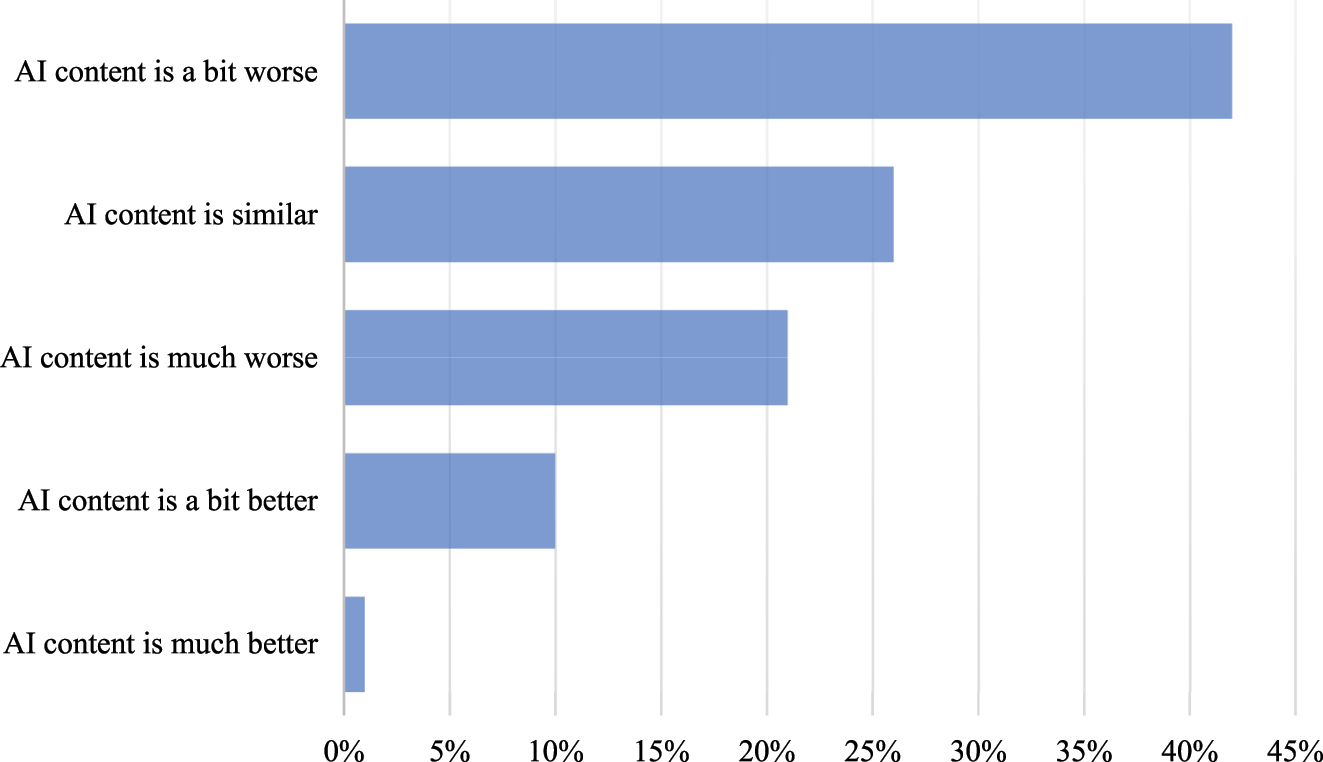
The quality of AI-generated content compared to human-created content. Source: compiled by the authors based on Crump (2024).
Although AI can significantly accelerate the content creation process, the quality of this content still cannot compete with human-generated material (Li 2021). Automated systems often produce content that is more standardized and less personalized, reducing its appeal to the target audience. However, due to the speed and efficiency of processing large volumes of data, AI can be a useful tool in assisting with content creation and routine tasks, such as editing or automatically generating template texts (Iklassova et al. 2024). At the same time, when AI is used in more complex, creative areas of content, such as scriptwriting or developing original videos, its role remains limited.
In this regard, the use of AI can create limitations for creativity by imposing templates and algorithmic constraints (Wan and Ren 2021). Algorithms often impose certain standards for content creation, making it difficult to apply original, ideal approaches. This leads to a reduction in flexibility and uniqueness of the created content, making it less adapted to the unique needs of the audience (Psallidas et al. 2021). As a result, the content may lose its appeal and individuality.
It is also worth noting that AI can affect the quality of the sound accompanying audiovisual content. Algorithms that automatically generate music tracks or sound effects often fail to consider the complexity of the composition and the cultural significance of sound elements (Pietsch 2024, 7). This can result in monotony and standardization of sound design, which does not reflect the aesthetic or emotional aspects required for high-quality content. Instead of creating unique soundscapes, automated systems often reproduce typical templates that may appear overly mechanical and lacking in originality (Astistova and Sedliar 2024, 31; Sun 2024a, 123438).
Another consequence of AI development in the content industry is the spread of deepfake technologies, which allow the creation of realistic fake materials. These technologies, using AI algorithms, can alter video and audio by adding or changing facial expressions, voices, and the behavior of individuals on screen (Tokarieva et al. 2024). The result can be the creation of entirely convincing materials that deceive the viewer and can have a devastating impact on the reputation of individuals, organizations, or even entire countries (Eugeni and Pisters 2020, 94). For example, in 2020, there were well-known cases of deepfake use to create fake political statements, which could influence public opinion and political processes in countries, even without their knowledge or consent. Deepfake technologies not only manipulate information but also open up opportunities for the creation of fake news. They can be used for political manipulation, spreading misinformation, or even fraud (Alshehri et al. 2024). These technologies not only create fake images or videos but can also generate human voices, enabling the simulation of phone conversations. Such actions can have serious consequences for trust in information sources and journalistic practices, as it becomes more difficult to separate truthful materials from fake ones.
Thus, as AI is actively used for editing and creating audiovisual materials, problems arise related to the loss of individuality and the creative approach to content. Automated systems cannot always account for the nuances that make content unique and appealing to viewers. It should be specifically noted that deepfake technologies open up new opportunities for creating fake materials, casting doubt on the authenticity of the presented information and threatening trust in the use of AI in content creation.
3.3 Ethical and Social Implications of AI Use
Nevertheless, the use of AI in modern society presents a series of challenges that go beyond technical issues and require broad interdisciplinary discussion. The ability of AI to influence various aspects of life opens up new perspectives but also raises concerns related to violations of ethical standards, the exacerbation of social inequality, and threats to privacy (Ruane et al. 2019).
One of the fundamental challenges of using AI in creating audiovisual content is determining authorship. In the traditional sense, authorship is based on the unique contribution of a human, but in the context of AI, this concept becomes more complex. Algorithms that generate content based on large datasets do not act autonomously in a creative sense, but their results often raise questions about the distribution of intellectual property rights. Specifically, it is unclear whether the author should be the programmer who developed the algorithm, the company that employs it, or the end user who defined the parameters for content generation (Tallala 2024). At the same time, the training process of AI, which is based on analyzing existing works, creates the risk of reproducing content that is similar to the originals, which may lead to legal conflicts and accusations of copyright infringement. The dependence of creative processes on the technical capabilities of algorithms causes the blurring of boundaries between human creativity and automated production. AI generates content that has no direct connection to the cultural context or subjective experiences characteristic of human creativity, raising doubts about the authenticity of such results (Nesterov 2023). This situation highlights the need for the adaptation of legal norms and the creation of new legal mechanisms that take into account the specifics of AI’s creative work. In particular, it is important to ensure a fair distribution of rights and responsibilities between all participants in the content creation process, including developers, companies, and users, to promote regulatory consistency and minimize conflicts (Yanyshivskyi 2024).
An even more serious challenge is the violation of privacy. AI is often used to create pornographic materials featuring well-known individuals without their consent, which is a serious infringement of their rights (Apakhayev et al. 2017). Deepfake technologies allow video or audio to be altered in ways that make them appear entirely realistic, undermining the reputation of individuals and institutions. In addition to reputational risks, such materials pose a threat to the psychological well-being of the affected individuals, causing stress, public condemnation, or discrimination. This requires the implementation of strict legal and technical mechanisms to prevent abuse of such tools. Preventive measures should include both criminal liability for creating such materials and technical solutions for their identification (Paris 2021).
Automation of creative processes also has a significant social impact, particularly on employment. While AI helps optimize routine tasks, such as editing or creating subtitles, it also displaces people from these areas, contributing to a reduction in job opportunities. Workers in the audiovisual industry are forced to adapt to new conditions, often changing qualifications or transitioning to roles related to AI control and administration. This leads to a transformation of the labor market, where competencies in technology are increasingly valued but traditional creative skills are given less attention. Such changes lead to structural inequality in society: workers who lack access to technical education or resources for retraining may find themselves at risk of unemployment, while well-paid positions in the technology sector become available only to a limited pool of specialists (Cooke et al. 2024).
Existing intellectual property laws are inadequate in addressing the complications posed by AI in content development. The primary concern is establishing authorship in AI-assisted creations, as existing legislation, including that of the EU and the U.S., presumes human authorship. Nonetheless, whether AI is utilized in the creation of music, screenplays, or visual effects, the ownership of copyright remains ambiguous, whether it resides with the AI developer, the user providing input, or the AI itself. Hugenholtz and Quintais (2021) underscore this deficiency in the legal framework, proposing that current legislation may require modification to encompass AI-generated works.
Moreover, deepfake technologies, employing AI to generate very persuasive counterfeit movies or sounds, present significant risks to media integrity. These technologies facilitate the generation of altered material that may readily disseminate disinformation. Sun (2024b) observes that existing legislation inadequately governs the use or dissemination of deepfakes, rendering people and organizations susceptible to reputational harm or political exploitation. A distinct regulatory deficiency exists in mitigating the risks associated with these AI-driven technologies.
Moreover, data privacy regulations, like GDPR, frequently fail to mitigate the hazards associated with AI technology, especially when AI systems handle personal data to produce customized content. Carceller (2024) highlights that AI’s dependence on extensive datasets for content generation poses substantial issues with accountability and transparency, particularly when personal data is included. The absence of openness in AI decision-making processes becomes a significant ethical issue. Peterson and Broersen (2024) assert that the elucidation of AI models is essential for guaranteeing that the output generated by AI is morally robust and impartial. In the absence of explicit legal frameworks for AI transparency, there exists a danger that AI-generated material may mislead the public or reinforce prejudices, especially in sensitive media like news reporting or political discourse.
Moreover, automation exacerbates the problem of decreasing the social status of traditional professions in the creative sector. The use of AI can lead to the stigmatization of human labor as less efficient or outdated, which negatively impacts the motivation and professional self-fulfillment of artists and workers in the creative industry. This also creates new challenges for the social perception of creativity, as automated systems reduce the importance of individual contribution, replacing it with standardized approaches (Zyhrii et al. 2023). The expansion of automation promotes the deepening of the digital divide, with countries or social groups that have less access to cutting-edge technologies losing their competitiveness in the global economy.
The extensive integration of AI in audiovisual creation is expected to impact jobs within the creative industry. AI technologies that automate operations such as video editing, color grading, and animation may result in job displacement for human creatives, including editors and animators. Although new occupations in AI administration and control may arise, conventional creative roles might see diminishment (Carceller 2024, 87). Furthermore, AI-driven content development poses a threat to the standardization of creativity, thereby diminishing the diversity of artistic expression (Psallidas et al. 2021). Cultural homogenization may arise if AI systems primarily mirror Western media trends, hence limiting the expression of non-Western perspectives in global media.
The deficiency of transparency in AI models, notably GANs and deep learning, raises concerns, particularly when these tools produce or modify media material. GANs sometimes operate as opaque systems, complicating the ability to elucidate the decision-making processes behind the produced material (Peterson and Broersen 2024). This opacity may result in biases or misrepresentations, particularly in sensitive materials such as political films or news broadcasts (Hugenholtz and Quintais 2021, 1197). In the absence of explicit restrictions for AI transparency, the generation and dissemination of damaging or deceptive material may occur without accountability, undermining public trust in AI-generated media (Rama et al. 2023).
After reviewing existing literature, some critical factors must be addressed while formulating new legal frameworks for AI in the audiovisual sector:
Regulations should require explainable AI, guaranteeing that content development procedures are traceable and transparent (Carceller 2024, 89). This will enable stakeholders to comprehend the rationale behind AI-generated content.
AI-generated content must comply with ethical norms, ensuring that algorithms do not reinforce prejudices or discrimination (Psallidas et al. 2021). Explicit criteria must be established to avert the production of deepfakes and other deceptive material (Sun 2024b).
Explicit norms must delineate culpability for makers and distributors of AI-generated material, assuring responsibility for the production of damaging content (Peterson and Broersen 2024).
Regulatory frameworks must guarantee adherence to data privacy legislation, especially when AI technologies utilize personal data for content generation (Hugenholtz and Quintais 2021, 1201).
Concrete procedures must be implemented to govern the production and dissemination of deepfakes, encompassing AI detection technologies and content labelling (Alshehri et al. 2024).
By addressing these factors, legislation can alleviate the dangers linked to AI and guarantee its responsible application in the creative sectors. The use of AI in the audiovisual sector requires a balance between technological progress, ethical standards, and social challenges. It is crucial to develop mechanisms that ensure the transparency of content creation processes, protect privacy rights, and prevent manipulation. Only by adhering to ethical standards can AI become not only a technological advance but also a tool that benefits society as a whole, supporting social justice and security.
4 Discussion
The development of AI creates new opportunities and challenges across various industries, particularly in the media, where these technologies are contributing to changes in how content is created and consumed. Comparing the results of this study with the works of other authors allows for an evaluation of the significance of applying AI in the context of contemporary scientific developments. The assessment of the impact of AI technologies on media production, as well as the consideration of ethical and security aspects of such changes, is an important part of the academic discussion, as it deepens the understanding of both the positive and negative effects of their implementation.
The research by Magro-Vela et al. (2024) underscores the emerging yet significant influence of generative AI on audiovisual content production. This corresponds with the results of the present study, which similarly recognizes the swift incorporation of AI technology in creative processes. Both studies underscore that, although the application of AI in content creation remains in its infancy, it has already made a substantial impact by improving production efficiency and transforming the creative process. Magro-Vela et al. (2024) emphasize the necessity for more investigations into the enduring effects of AI integration, especially for creative workflows and production processes. This corresponds with the current study’s findings, indicating that while AI provides evident short-term advantages in efficiency, its long-term effects on the autonomy of creative workers and the overall quality of material remain ambiguous. This necessitates a balanced strategy for AI integration in media, ensuring the preservation of both innovation and artistic integrity.
Hugenholtz and Quintais (2021) analyze the issues that AI-generated work presents to copyright law, especially regarding authorship. Their research suggests that existing EU copyright regulations are predominantly adequate and sufficiently adaptable to address the issues presented by AI-assisted production. Rather than advocating for new laws, they suggest implementing the current regulations in a nuanced manner to include AI-generated works. Their research highlights that, while certain aspects may necessitate additional clarification, especially concerning authorship and the rights of creators utilizing AI technologies, current legal frameworks are predominantly equipped to manage AI-generated content under existing copyright laws.
Peterson and Broersen (2024) highlight significant ethical concerns about AI decision-making, including the challenges of openness and accountability in algorithmic procedures. The current study’s findings reflect concerns over the integration of AI into content production, which presents substantial ethical problems, especially in guaranteeing that AI-generated material is devoid of biases and that decision-making processes are comprehensible and defensible. Our findings suggest that although AI is revolutionizing content creation, insufficient openness in AI decision-making is a significant obstacle, especially when AI generates material that influences public opinion or depicts real-world occurrences. The focus of Peterson and Broersen on formulating explicit algorithms aligns with this research’s demand for transparency and enhanced control mechanisms in AI tools.
Samuel-Okon et al. (2024) examine the security threats posed by AI-generated material, particularly deepfakes, which have elicited concerns about their capacity to erode faith in media legitimacy. The findings of the current study corroborate this issue, recognizing deepfakes as a substantial danger to the trustworthiness of audiovisual material. The findings indicate that although AI can improve content generation, its negative aspects, represented by technologies such as deepfakes, present significant threats to media trustworthiness. Samuel-Okon et al. underscore the pressing necessity for AI-driven tools to identify deepfakes, a sentiment reflected in the present article’s findings that stress the imperative for swift technical progress in deepfake detection and media authentication instruments. In this regard, important tools for the automatic detection of deepfakes must be integrated into media platforms to prevent their spread. The development of such tools must be constantly updated to ensure their effectiveness in combating new methods of content falsification.
Bontridder and Poullet (2021) analyze the ethical ramifications of AI in producing misinformation and suggest comprehensive legislative structures to mitigate these concerns. The current study’s findings support this perspective, as AI’s dual function is recognized in augmenting content customization and enabling the dissemination of disinformation. This study underscores the necessity of explicit policies controlling AI utilization in media creation to avert its misuse in generating deceptive or detrimental material. Bontridder and Poullet’s appeal for examination of platform business models is especially pertinent given the increasing frequency of AI-generated misinformation, which can be exacerbated by social media algorithms.
Personalization of content is one of the key areas of AI application in the media sector, as it significantly improves audience interaction and enhances the quality of audiovisual content. Derda (2023) underscores the capacity of AI to facilitate customized media content generation, tailoring material according to user preferences. The notion of AI-driven personalisation is a central issue in contemporary research, highlighting that AI can enable the automation of content production, resulting in more customized and engaging audiovisual goods. The present study substantiates the notion that AI’s capacity to customize information might enhance audience engagement and happiness, particularly in domains such as news and entertainment. The issue, however, resides in reconciling customization with the necessity for diverse and impartial information that addresses a broad audience rather than only catering to individual tastes.
Sun (2024a) examines the function of deep learning in the automation of information classification and administration, particularly with extensive digital archives. This facet of deep learning’s use is particularly pertinent to the obtained results above, wherein AI’s capacity to efficiently handle extensive data was recognized as a pivotal element in media production. The study’s findings underscore the significance of AI in post-production phases, facilitating the organization, storage, and retrieval of media assets. Both studies concur on the enhancements in efficiency that AI may provide for media management, particularly in contexts requiring the administration of extensive audiovisual archives. Deep learning allows the creation of more accurate and faster search systems, capable of analyzing and structuring vast amounts of diverse media resources such as video, audio, images, and text based on their content, as well as highlighting and storing the most valuable information fragments (Kerimkhulle et al. 2021). Furthermore, it is important to note that these technologies not only improve post-production stages, where content needs to be organized and stored, but can also be used at all stages of media production. For example, deep learning methods allow for the automation of content monitoring and moderation processes in real-time, which is critically important in situations where processing large amounts of material requires significant time and human resources. Thus, these technologies significantly increase production efficiency and speed, as well as ensure a higher quality of the final product.
Cooke et al. (2024) emphasize the difficulties the audience has in identifying AI-generated material. Their research underscores the necessity for improved detection techniques, as the majority of AI-generated material goes unnoticed by the public. The current study confirms this, highlighting the increasing challenge of differentiating AI-generated media from human-produced content. This poses a considerable challenge to media legitimacy and elicits worries over the possibility of manipulation. With the advancement of detection technologies, there is a necessity for enhanced public awareness and education on the possibilities of AI in media production to alleviate the hazards of misinformation. This development has serious consequences for trust in the media. In situations where the public may be uninformed or unable to distinguish artificially generated content from real sources, there is a risk of spreading disinformation and manipulation, which can affect public opinion and political processes (Apakhayev et al. 2024). Solutions to this problem include creating labels or watermarks for content indicating its artificial origin, as well as developing methods that allow the audience to independently verify the authenticity of sources through specialized platforms or applications.
Thus, the development of AI technologies in the media sector not only provides new opportunities for creating and editing content but also presents significant ethical, legal, and security issues for society. A comparison with other studies shows the importance of a multifaceted approach to AI usage, which involves not only technological innovations but also the development of standards to prevent potential risks.
Future investigations into AI’s impact on audiovisual content must prioritize the development of transparent algorithms to ensure accountability and mitigate manipulation, particularly with deepfake technology, which requires prompt regulatory frameworks and detection mechanisms to combat misinformation. Ethical guidelines for AI-generated content are crucial to avert the perpetuation of biases and to foster equity, diversity, and cultural awareness. Moreover, assessing the impact of AI on employment in the creative sector is crucial since AI automation may replace traditional creative roles, raising the issue of adaptation and skill enhancement. In addition, future research must explore the environmental consequences of training large AI models that need significant computational resources and identify strategies to improve AI energy efficiency. Furthermore, ensuring data privacy and security in AI-generated material, especially regarding personal information, will be a paramount responsibility. Ultimately, research should examine AI’s impact on promoting cultural diversity to prevent content homogenization, ensuring that AI systems respect local cultures and enrich the global media landscape.
5 Conclusions
This study analyzed various aspects of AI usage in the creation and editing of audiovisual content, focusing on its advantages, challenges, and socio-ethical implications. The impact of AI in this field was reflected in a significant reduction in production time, resource optimization, and the implementation of innovative technologies.
The results of the study demonstrated that, through the automation of routine tasks, AI simplifies processes such as editing, video correction, and the creation of complex visual effects. Generative models like GAN enable the creation of realistic objects and scenes with minimal costs. Additionally, deep learning algorithms are successfully applied in the restoration of old audiovisual materials, improving sound and video quality, automating trailer creation, and personalizing content. These advancements open up new prospects for the industry, allowing products to adapt more quickly to market demands.
However, the study also revealed a number of issues, including content standardization, risks associated with the spread of fake materials (deepfakes), copyright infringement, and inadequate regulatory oversight. Ethical challenges related to the lack of transparency in algorithms and privacy threats require the development of new regulatory mechanisms and oversight of AI technology usage. Nonetheless, the study has certain limitations. It primarily focused on a qualitative analysis of contemporary AI technologies and their impact, leaving quantitative assessments of the effectiveness of implemented solutions outside its scope. Moreover, due to the rapid development of AI, some of the technologies presented may become outdated, requiring constant updates to the research base. Therefore, further research could focus on the development of transparent and context-adapted algorithms, the creation of systems to prevent information manipulation, and the evaluation of the long-term social consequences of automating creative processes.
References
Al Adwan, M. N., M. A. A. Mahmoud, R. Abdallah, R. Abokhoza, and S. Taha. 2023. “The Impact of Artificial Intelligence Applications on Media Industries: A Prospective Study.” Journal of Namibian Studies: History Politics Culture 33: 721–34. https://doi.org/10.59670/jns.v33i.534.Suche in Google Scholar
Alshehri, A., D. Almalki, E. Alharbi, and S. Albaradei. 2024. “Audio Deep Fake Detection with Sonic Sleuth Model.” Computers 13 (10): 256. https://doi.org/10.3390/computers13100256.Suche in Google Scholar
Amiriparian, S., T. Hübner, V. Karas, M. Gerczuk, S. Ottl, and B. W. Schuller. 2022. “Deepspectrumlite: A Power-Efficient Transfer Learning Framework for Embedded Speech and Audio Processing from Decentralized Data.” Frontiers in Artificial Intelligence 5: 856232. https://doi.org/10.3389/frai.2022.856232.Suche in Google Scholar
Anantrasirichai, N., and D. Bull. 2022. “Artificial Intelligence in the Creative Industries: A Review.” Artificial Intelligence Review 55 (1): 589–656. https://doi.org/10.1007/s10462-021-10039-7.Suche in Google Scholar
Apakhayev, N., K. Adilova, D. Bugybay, G. Mukaldyeva, G. N. Mukhamadiyeva, and B. M. Koshpenbetov. 2017. “Childhood Legal Protection in Kazakhstan.” Journal of Advanced Research in Law and Economics 8 (3): 714–21. https://doi.org/10.14505/jarle.v8.3(25).03.Suche in Google Scholar
Apakhayev, N., K. Adilova, D. Bugybay, A. Toktybaev, and D. Kopbayev. 2024. “The Problem of Protecting the Rights and Legitimate Interests of the Child in the Family and Outside it.” Danube 15 (3): 221–36. https://doi.org/10.2478/danb-2024-0013.Suche in Google Scholar
Astistova, T., and A. Sedliar. 2024. “Development of Software for Evaluation of Text Originality.” Technologies and Engineering 25 (5): 25–36. https://doi.org/10.30857/2786-5371.2024.5.3.Suche in Google Scholar
Bashynska, I., O. Garachkovska, Y. Kichuk, T. Podashevska, and O. Bigus. 2021. “Smart Education 4.0: Balancing Dual-Distance and Reskilling Revolution.” Studies of Applied Economics 39 (6): 1–11. https://doi.org/10.25115/eea.v39i6.5262.Suche in Google Scholar
Basole, R. C., and T. Major. 2024. “Generative AI for Visualization: Opportunities and Challenges.” IEEE Computer Graphics and Applications 44 (2): 55–64. https://doi.org/10.1109/mcg.2024.3362168.Suche in Google Scholar
Bigioi, D., S. Basak, M. Stypułkowski, M. Zieba, H. Jordan, R. McDonnell, et al.. 2024. “Speech Driven Video Editing Via an Audio-Conditioned Diffusion Model.” Image and Vision Computing 142: 104911. https://doi.org/10.1016/j.imavis.2024.104911.Suche in Google Scholar
Bontridder, N., and Y. Poullet. 2021. “The Role of Artificial Intelligence in Disinformation.” Data & Policy 3: e32. https://doi.org/10.1017/dap.2021.20.Suche in Google Scholar
Butenko, N., O. Mykhaylovych, P. Bincheva, A. Lyndyuk, and T. Luchnikova. 2023. “The Role of Internet Marketing in the Strategy of Forming Entrepreneurial Activity.” Economic Affairs (New Delhi) 68 (1): 73–82. https://doi.org/10.46852/0424-2513.1s.2023.9.Suche in Google Scholar
Cádiz, R. F. 2020. “Creating Music with Fuzzy Logic.” Frontiers in Artificial Intelligence 3: 59. https://doi.org/10.3389/frai.2020.00059.Suche in Google Scholar
Carceller, A. T. 2024. “The Artificial Revolution: Challenges for Redefining Art Education in the Paradigm of Generative Artificial Intelligence.” Digital Education Review 45: 84–90. https://doi.org/10.1344/der.2024.45.84-90.Suche in Google Scholar
Cooke, D., A. Edwards, S. Barkoff, and K. Kelly. 2024. “As Good as a Coin Toss Human Detection of AI-Generated Images, Videos, Audio, and Audiovisual Stimuli.” AarXiv 1: 1–19, https://doi.org/10.48550/arXiv.2403.16760.Suche in Google Scholar
Crump, E. 2024. AI in Marketing: Research Study, Stats, Industry Trends & Data. Foundation Marketing. https://foundationinc.co/lab/ai-marketing-results/ (accessed July 3, 2025).Suche in Google Scholar
Curien, N. 2021. “The Audiovisual Industry Facing the Digital Revolution: Plunging the Predigital Fishbowl into the Digital Ocean.” In Digital and Social Media Regulation: A Comparative Perspective of the US and Europe, edited by S.A. Matei, F. Rebillard, and F. Rochelandet, 17–43. Cham: Springer.10.1007/978-3-030-66759-7_2Suche in Google Scholar
Derda, I. 2023. ““Did You Know that David Beckham Speaks Nine Languages?”: AI-Supported Production Process for Enhanced Personalization of Audio-Visual Content.” Creative Industries Journal 16 (3): 265–80. https://doi.org/10.1080/17510694.2021.2025001.Suche in Google Scholar
Du, H., J. Wang, D. Niyato, J. Kang, Z. Xiong, and D. I. Kim. 2023. AI-generated Incentive Mechanism and Full-Duplex Semantic Communications for Information Sharing. arXiv: 2303.01896. https://doi.org/10.48550/arXiv.2303.01896.Suche in Google Scholar
Eugeni, R., and P. Pisters. 2020. “The Artificial Intelligence of a Machine: Moving Images in the Age of Algorithms.” NECSUS_European Journal of Media Studies 9 (1): 91–100.Suche in Google Scholar
French, F., D. Levi, C. Maczo, A. Simonaityte, S. Triantafyllidis, and G. Varda. 2023. “Creative Use of OpenAI in Education: Case Studies from Game Development.” Multimodal Technologies and Interaction 7 (8): 81. https://doi.org/10.3390/mti7080081.Suche in Google Scholar
Gutierrez, E., C. Puente, C. Velasco, and J. A. O. Varela. 2021. “Smart Marketing on Audiovisual Content Platforms: Intellectual Property Implications.” In Advances in Artificial Intelligence and Applied Cognitive Computing, edited by H. R. Arabnia, K. Ferens, D. de la Fuente, E. B. Kozerenko, J. A. Olivas Varela, and F. G. Tinetti, 913–21. Cham: Springer.10.1007/978-3-030-70296-0_73Suche in Google Scholar
Hales, C. 2021. “Artificial Intelligence: The Latent Revolution in Filmmaking.” Adam Arts 2: 72–87.Suche in Google Scholar
Han, B., Y. Li, Y. Shen, Y. Ren, and F. Han. 2024. “Dance2MIDI: Dance-Driven Multi-Instrument Music Generation.” Computational Visual Media 10 (4): 791–802. https://doi.org/10.1007/s41095-024-0417-1.Suche in Google Scholar
Hugenholtz, P. B., and J. P. Quintais. 2021. “Copyright and Artificial Creation: Does EU Copyright Law Protect AI-Assisted Output?” IIC-International Review of Intellectual Property and Competition Law 52 (9): 1190–216. https://doi.org/10.1007/s40319-021-01115-0.Suche in Google Scholar
Iklassova, K., A. Aitymova, O. Kopnova, A. Shaporeva, G. Abildinova, Z. Nurbekova, et al.. 2024. “Ontology Modeling for Automation of Questionnaire Data Processing.” Eastern-European Journal of Enterprise Technologies 5 (131): 36–52. https://doi.org/10.15587/1729-4061.2024.314129.Suche in Google Scholar
Iskandarov, E. K., G. G. Ismayilov, and F. B. Ismayilova. 2020. “Diagnostic Operation of Gas Pipelines Based on Artificial Neuron Technologies.” Advances in Intelligent Systems and Computing 1095 AISC: 787–91. https://doi.org/10.1007/978-3-030-35249-3_103.Suche in Google Scholar
Kerimkhulle, S., Z. Kerimkulov, D. Bakhtiyarov, N. Turtayeva, and J. Kim. 2021. “In-Field Crop-Weed Classification Using Remote Sensing and Neural Network.” In SIST 2021 – 2021 IEEE International Conference on Smart Information Systems and Technologies, Vol. 1, 9465970.10.1109/SIST50301.2021.9465970Suche in Google Scholar
Kolisnyk, O., R. Mykhailova, O. Berehovyi, V. Vlasiuk, and D. Kurovska. 2023. “Midjorney Neural Network as a Tool for Generating Design Graphics.” Art and Design 6 (1): 106–15. https://doi.org/10.30857/2617-0272.2023.1.10.Suche in Google Scholar
Kowalski, D. 2024. AI vs Traditional Video Production: Which Approach Suits Your Brand? Unscript. https://www.unscript.ai/blog/ai-vs-traditional-video-production (accessed July 3, 2025).Suche in Google Scholar
Lazarte, E. G. F., M. T. J. Paccotaipe, R. C. R. Heredia, and T. M. V. Loyola. 2025. “Audiovisual Narrative in the Age of Artificial Intelligence: Advances, Trends and Challenges: A Systematic Review.” Journal of Educational and Social Research 15 (1): 1. https://doi.org/10.36941/jesr-2025-0001.Suche in Google Scholar
Li, Y. 2021. “Film and TV Animation Production Based on Artificial Intelligence AlphaGd.” Mobile Information Systems 2021 (1): 1104248. https://doi.org/10.1155/2021/1104248.Suche in Google Scholar
Liu, J. 2024. “Analysis of the Impact of AI Editing on Film and Television Post-production in Digital Transformation.” Applied Mathematics and Nonlinear Sciences 9 (1): 1–17. https://doi.org/10.2478/amns-2024-2424.Suche in Google Scholar
Magro-Vela, S., P. Sánchez-López, and N. Navarro-Sierra. 2024. “The Revolution Will Be Artificial. An Analysis of AI-Generated Audio-Visual Creation.” Tripodos 55: 75–98. https://doi.org/10.51698/tripodos.2024.55.05.Suche in Google Scholar
Momot, I. 2022. Artificial Intelligence in Filmmaking Process: Future Scenarios. JAMK University of Applied Sciences. https://urn.fi/URN:NBN:fi:amk-2022052712497 (accessed July 3, 2025).Suche in Google Scholar
Nauryzbayev, G., and S. Kaliyeva. 2016. “A Non-iterative Solution to Implement Interference Alignment and Cancellation Scheme for the Three-User MIMO X-Channel Model.” In 2016 International Conference on Information and Communication Technology Convergence, ICTC 2016, 538–43. Institute of Electrical and Electronics Engineers.10.1109/ICTC.2016.7763529Suche in Google Scholar
Nesterov, V. 2023. “Integration of Artificial Intelligence Technologies in Data Engineering: Challenges and Prospects in the Modern Information Environment.” Bulletin of Cherkasy State Technological University 28 (4): 82–92. https://doi.org/10.62660/2306-4412.4.2023.82-90.Suche in Google Scholar
Orak, C., and Z. Turan. 2024. “Using Artificial Intelligence in Digital Video Production: A Systematic Review Study.” Journal of Educational Technology and Online Learning 7 (3): 286–307. https://doi.org/10.31681/jetol.1459434.Suche in Google Scholar
Paris, B. 2021. “Configuring Fakes: Digitized Bodies, the Politics of Evidence, and Agency.” Social Media + Society 7 (4). https://doi.org/10.1177/20563051211062919.Suche in Google Scholar
Peterson, C., and J. Broersen. 2024. “Understanding the Limits of Explainable Ethical AI.” International Journal on Artificial Intelligence Tools 33 (3): 2460001. https://doi.org/10.1142/S0218213024600017.Suche in Google Scholar
Pietsch, J. 2024. “The Audiovisual Archive in an Era of Disinformation and Misinformation.” IEW Journal of European Television History and Culture 25: 1–13. https://doi.org/10.25969/mediarep/23183.Suche in Google Scholar
Psallidas, T., P. Koromilas, T. Giannakopoulos, and E. Spyrou. 2021. “Multimodal Summarization of User-Generated Videos.” Applied Sciences 11 (11): 5260. https://doi.org/10.3390/app11115260.Suche in Google Scholar
Rama, H. H., V. H. Rama, and B. R. Rexhepi. 2023. “The Impact of Marketing and Technological Factors on the Quality, Safety and Sales of Wine.” Quality – Access to Success 24 (196): 49–53. https://doi.org/10.47750/QAS/24.196.06.Suche in Google Scholar
Reddy, V. S., M. Kathiravan, and V. L. Reddy. 2024. “Revolutionizing Animation: Unleashing the Power of Artificial Intelligence for Cutting-Edge Visual Effects in Films.” Soft Computing 28: 749–63. https://doi.org/10.1007/s00500-023-09448-3.Suche in Google Scholar
Rehman, H. U., M. Darus, and J. Salah. 2018. “Graphing Examples of Starlike and Convex Functions of Order β.” Applied Mathematics and Information Sciences 12 (3): 509–15. https://doi.org/10.18576/amis/120305.Suche in Google Scholar
Ruane, E., A. Birhane, and A. Ventresque. 2019. “Conversational AI: Social and Ethical Considerations.” In Conference: AICS – 27th AIAI Irish Conference on Artificial Intelligence and Cognitive Science. Institute for Lifecourse and Society (ILAS). https://www.researchgate.net/publication/337925917_Conversational_AI_Social_and_Ethical_Considerations (accessed July 3, 2025).Suche in Google Scholar
Salas-Cáceres, J., J. Lorenzo-Navarro, D. Freire-Obregón, and M. Castrillón-Santana. 2024. “Multimodal Emotion Recognition Based on a Fusion of Audiovisual Information with Temporal Dynamics.” Multimedia Tools and Applications 1–17. https://doi.org/10.1007/s11042-024-20227-6.Suche in Google Scholar
Samson, G. 2024. “Procedurally Generated AI Compound Media for Expanding Audial Creations, Broadening Immersion and Perception Experience.” International Journal of Electronics and Telecommunication 70 (2): 341–8. https://doi.org/10.24425/ijet.2024.149550.Suche in Google Scholar
Samuel-Okon, A. D., O. I. Akinola, O. O. Olaniyi, O. O. Olateju, and S. A. Ajayi. 2024. “Assessing the Effectiveness of Network Security Tools in Mitigating the Impact of Deepfakes AI on Public Trust in Media.” Archives of Current Research International 24 (6): 355–75. https://doi.org/10.9734/acri/2024/v24i6794.Suche in Google Scholar
Shen, Y., and F. Yu. 2021. “The Influence of Artificial Intelligence on Art Design in the Digital Age.” Scientific Programming 2021 (1): 4838957. https://doi.org/10.1155/2021/4838957.Suche in Google Scholar
Shevchuk, L., and L. Hunaza. 2025. “Analysis of International Experience in Implementing Artificial Intelligence in the Educational Process.” Scientia et Societus 4 (1): 76–85. https://doi.org/10.69587/ss/1.2025.76.Suche in Google Scholar
Somvanshi, D. 2019. “The Future of Audiovisual Story Telling.” Journal of Emerging Technologies and Innovative Research 6 (6): 64–71.Suche in Google Scholar
Sun, M. 2024a. “An Intelligent Retrieval Method for Audio and Video Content: Deep Learning Technology Based on Artificial Intelligence.” IEEE Access 12: 123430–46. https://doi.org/10.1109/ACCESS.2024.3450920.Suche in Google Scholar
Sun, P. 2024b. “A Study of Artificial Intelligence in the Production of Film.” SHS Web of Conferences 183: 03004. https://doi.org/10.1051/shsconf/202418303004/.Suche in Google Scholar
Tallala, T. 2024. Generative Artificial Intelligence, Content Creation and Intellectual Property Rights in Commercial Use: Сrediting the Audiovisual Output. Turku University of Applied Sciences. https://urn.fi/URN:NBN:fi:amk-2024062623863 (accessed July 3, 2025).Suche in Google Scholar
Tang, Y., H. Li, M. Lan, X. Ma, and H. Qu. 2025. “Understanding Screenwriters’ Practices, Attitudes, and Future Expectations in Human-AI Co-creation.” In CHI Conference on Human Factors in Computing Systems, 1–18. Association for Computing Machinery.10.1145/3706598.3714120Suche in Google Scholar
Tjhin, S. 2022. “Optimizing Development through Media Technology of Creativity in the New Normal Era.” Journal of Community Services: Sustainability and Empowerment 2 (1): 37–53. https://doi.org/10.35806/jcsse.v2i1.279.Suche in Google Scholar
Tokarieva, K. S., O. Y. Kovalchuk, A. P. Kolesnikov, A. D. Dzyurbel, O. B. Bodnar-Petrovska, and O. G. Predmestnikov. 2024. “The Use of AI-Language Models in Judicial Proceedings: Information and Legal Aspects.” Revista Juridica 2 (78): 520–38. https://doi.org/10.26668/revistajur.2316-753X.v2i78.6928.Suche in Google Scholar
Tserklevych, V., O. Prokopenko, O. Goncharova, I. Horbenko, O. Fedorenko, and Y. Romanyuk. 2021. “Virtual Museum Space as the Innovative Tool for the Student Research Practice.” International Journal of Emerging Technologies in Learning (iJET) 16 (14): 213–31. https://doi.org/10.3991/ijet.v16i14.22975.Suche in Google Scholar
Wan, Y., and M. Ren. 2021. “New Visual Expression of Anime Film Based on Artificial Intelligence and Machine Learning Technology.” Journal of Sensors 2021 (1): 9945187. https://doi.org/10.1155/2021/9945187.Suche in Google Scholar
Yanyshivskyi, M. 2024. “Regulation of Artificial Intelligence in Ukraine in the Framework of Harmonisation of Legislation with EU Legal Norms.” Democratic Governance 17 (1): 53–62. https://doi.org/10.23939/dg2024.53.Suche in Google Scholar
Zhao, X., and X. Zhao. 2024. “Application of Generative Artificial Intelligence in Film Image Production.” Computer-Aided Design & Applications 21 (S27): 15–28. https://doi.org/10.14733/cadaps.2024.S27.15-28.Suche in Google Scholar
Zyhrii, O., Y. Trufanova, L. Parashchuk, N. Sampara, and I. Tsvigun. 2023. “Law and Technology: The Impact of Innovations on the Legal System and its Regulation.” Social and Legal Studios 6 (4): 267–75. https://doi.org/10.32518/sals4.2023.267.Suche in Google Scholar
© 2025 the author(s), published by De Gruyter, Berlin/Boston
This work is licensed under the Creative Commons Attribution 4.0 International License.
Artikel in diesem Heft
- Frontmatter
- Editorial
- Technology, Preservation, and Resilience in an Era of Change: Editor’s Note
- Articles
- Newly Discovered Archival Logic: Functions Emerging from the Records in Contexts Standard
- Traversing Rock Climbers’ Oral Histories to Podcast Platforms: Processes, Analytics, and Digital Library Impact
- VGG-Based Feature Extraction for Classifying Traditional Batik Motifs Using Machine Learning Models
- The Impact of Artificial Intelligence on the Production and Editing of Audiovisual Content
- Navigation of Cultural Heritage in the Digital Age: The Role of Social Media Platforms in the Preservation of Selected Folk Performances of Odisha
- Review
- Saving Ukrainian Cultural Heritage Online (SUCHO)
- News and Comments
- PDT&C Editorial Board Position Paper on the Emerging Crisis in the Cultural Heritage and Preservation Sectors
Artikel in diesem Heft
- Frontmatter
- Editorial
- Technology, Preservation, and Resilience in an Era of Change: Editor’s Note
- Articles
- Newly Discovered Archival Logic: Functions Emerging from the Records in Contexts Standard
- Traversing Rock Climbers’ Oral Histories to Podcast Platforms: Processes, Analytics, and Digital Library Impact
- VGG-Based Feature Extraction for Classifying Traditional Batik Motifs Using Machine Learning Models
- The Impact of Artificial Intelligence on the Production and Editing of Audiovisual Content
- Navigation of Cultural Heritage in the Digital Age: The Role of Social Media Platforms in the Preservation of Selected Folk Performances of Odisha
- Review
- Saving Ukrainian Cultural Heritage Online (SUCHO)
- News and Comments
- PDT&C Editorial Board Position Paper on the Emerging Crisis in the Cultural Heritage and Preservation Sectors
