Poisson Structures on moduli spaces of Higgs bundles over stacky curves
-
Georgios Kydonakis
 ,
Hao Sun
,
Hao Sun

Abstract
We demonstrate the construction of Poisson structures via Lie algebroids on moduli spaces of twisted stable Higgs bundles over stacky curves. The construction provides new examples of Poisson structures on such moduli spaces. Special attention is paid to moduli spaces of parabolic Higgs bundles over a root stack.
1 Introduction
Symplectic or Poisson structures on moduli spaces over a complex algebraic curve X have been obtained in a variety of cases. A basic paradigm involves the G-character varieties, as moduli spaces of fundamental group representations into a connected complex reductive group G. These are finite-dimensional complex symplectic manifolds when X is compact, and the symplectic structure in this case was first conceived analytically using the method of symplectic reduction from infinite-dimensional spaces in the seminal work of Atiyah and Bott [2]. At the same time, a more topological approach to the natural symplectic structure on such spaces of fundamental group representations was proposed by Goldman [20] interpreting these structures in terms of the intersection pairing on the underlying topological surface. The method of symplectic reduction was next further developed by Hitchin in [22] to produce Kähler and hyperkähler structures on the moduli space of stable Higgs bundles via the non-abelian Hodge correspondence and their counterparts to moduli spaces of solutions to the self-duality equations.
In the case when the curve is noncompact, the symplectic structure generalizes to a Poisson structure. The noncompact case is actually equivalent to equipping X with a reduced effective divisor D. The symplectic leaves consist of equivalence classes of connections with fixed conjugacy class of local holonomy around each point of a fixed reduced effective divisor on X. A primary description of this theory appeared in the book of Atiyah [1], while in the article of Audin [3] a review of several approaches is presented. In the particular situation of parabolic vector bundles on X with trivial flags in the parabolic structure, Poisson structures on moduli spaces of twisted Higgs bundles were obtained independently by Bottacin [15] and Markman [28].
Note that from the point of view of the tame nonabelian Hodge correspondence as described by Simpson [35], parabolic Higgs bundles correspond to filtered local systems which are regarded as representations of the fundamental group π1(X ∖ D). In the wild case, a nonabelian Hodge correspondence when the structure group is GL(n, ℂ) was obtained collectively from the works of Biquard–Boalch [5] and Sabbah [33]. For a general connected complex reductive group G, Boalch introduced wild character varieties to classify meromorphic G-connections with higher order poles, and constructed Poisson structures on them; see for instance [12; 13] and the survey article [11].
In this article, we exhibit a wider class of Poisson structures on moduli spaces of Higgs bundles over stacky curves, demonstrating an intrinsic property that justifies the existence of the Poisson structure. The principal method by which we shall obtain Poisson structures on the moduli spaces of interest is via the duals of Lie algebroids.
In [27], Logares and Martens considered moduli spaces 𝓟α of α-semistable parabolic Higgs bundles over an algebraic curve. In fact, the open subset
Let 𝓧 be a smooth projective Deligne–Mumford stack over ℂ and let X be the coarse moduli space of 𝓧. The moduli space of semistable G-Higgs bundles on 𝓧 was constructed by Simpson in [34], who showed that this is, in fact, a quasi-projective scheme. The moduli problem and also moduli spaces of Higgs bundles on Deligne–Mumford stacks have been more generally studied in [39] and [38] by the second author.
Suppose that 𝓧 is a stacky curve, which is a smooth projective Deligne–Mumford stack of dimension one. We are thus considering the moduli space 𝓜H(𝓧, α) of stable Higgs bundles over 𝓧 with a fixed parabolic structure α, as well as 𝓜H(𝓧, G) and 𝓜H(𝓧, G, α), the relative moduli spaces of pairs where the structure group of the underlying bundles is determined by a complex reductive algebraic group G. We show that the moduli space 𝓜H(𝓧, α) is a Lie algebroid over the tangent space of the moduli space of stable bundles over X, thus implying the main theorem of this article:
Theorem 1.1
(Theorem 4.3). Let 𝓧 be a stacky curve over ℂ. The moduli space 𝓜H(𝓧, α) of stable Higgs bundles over 𝓧 with fixed parabolic structure α admits a Poisson structure.
In the course of developing the proof of this result, we highlight the importance of certain short exact sequences (Atiyah sequences) that arise. This opens the way for generalizing the above theorem in several directions. We first show similarly that the moduli space 𝓜H(𝓧, G, α) for a fixed faithful representation G ↪ GL(V) is also equipped with a Poisson structure:
Theorem 1.2
(Theorem 4.4). The moduli space 𝓜H(𝓧, G, α) of stable G-Higgs bundles over a stacky curve 𝓧 with fixed parabolic structure α admits a Poisson structure.
The notion of stability we consider here does not depend on the choice of a faithful representation G ↪ GL(V). An alternative notion of (semi)stability for parabolic principal G-bundles and parabolic G-Higgs bundles is considered in the more recent work of Biquard, García-Prada and Mundet i Riera [6]. Furthermore, it is proven by the authors recently that the stability condition considered in this paper is equivalent to Ramanathan’s stability condition of the corresponding logahoric Higgs torsor; see [26].
Note that in the special case of a root stack and a parabolic structure when all parabolic weights are rational, there is an alternative description of parabolic bundles as orbifold bundles; see [7; 19; 25; 29]. Therefore, our theorems provide an orbifold version of the result of Bottacin [15] and Markman [28] in the case of simple pole divisors, as was first conjectured by Logares and Martens [27, § 5.2].
Let 𝓜͠ be a moduli stack, and suppose that 𝓜 is a fine moduli space of 𝓜͠. We have 𝓜͠ ≅ Hom(–, 𝓜), therefore a Poisson structure on 𝓜 will induce a Poisson structure on 𝓜͠. A theory of Poisson structures on stacks is needed here, and this was introduced in the dissertation of Waldron [40]. Based on the theory of Poisson structures on stacks, we show that the moduli stack 𝓜͠H(𝓧, α) has a Poisson structure as a stack (Corollary 4.5).
Next, we show that the moduli space 𝓜H(𝓧, 𝓛, α) of stable 𝓛-twisted Higgs bundles over 𝓧 with fixed parabolic structure α is Poisson, subject to the existence of a certain short exact sequence for any stable bundle 𝓕 ∈ 𝓜(𝓧, α); the precise statement is the following:
Theorem 1.3
(Theorem 5.1). Let 𝓧 be a stacky curve over ℂ and let X be the coarse moduli space of 𝓧. Let α be a parabolic structure on X and denote by D̅ = p1 + … + pk ∈ X the divisor with respect to α. Let 𝔻 = q1 +… + qk ∈ 𝓧 be the corresponding divisor on 𝓧, where qi is the point corresponding to pi. If there exists a short exact sequence
for any stable bundle 𝓕 ∈ 𝓜(𝓧, α) such that
the morphism 𝓗om(𝓕 ⊗ 𝓛, 𝓕 ⊗ ω𝓧) → 𝓔nd(𝓕) is not surjective,
𝔫 is a sheaf of Lie algebras supported on 𝔻,
then the moduli space 𝓜H(𝓧, 𝓛, α) admits a Poisson structure.
If X is a smooth projective curve, if D̅ = p1 + … + pk is a reduced effective divisor on X and r̅ = (r1, …, rk) is a k-tuple of positive integers, let XD̅, r̅} denote the corresponding root stack and consider the natural map π : 𝓧 → X from the root stack 𝓧 to its coarse moduli space X. Denote by 𝔻 the reduced divisor of π–1(D̅). The correspondence between parabolic bundles on (X, D̅) and bundles on 𝓧 := XD̅,r̅ implies the correspondence in the stability conditions as in [14, Remarque 10] and, more precisely, in moduli spaces 𝓜(𝓧, α) ≅ 𝓜par(X, α). It is natural to extend this correspondence to Higgs bundles [9; 8; 29], thus having 𝓜H(𝓧, α) ≅
Let now 𝓛 be a line bundle over 𝓧 and denote by L the parabolic line bundle over (X, D̅) corresponding to 𝓛, that is, a line bundle over X together with a collection of flags Lpi ⊃ {0} with a real weight 0 ≤ αpi < 1 for each point pi ∈ D̅ where i = 1, …, k. There is a one-to-one correspondence between 𝓛-twisted Higgs bundles on 𝓧 and L-twisted parabolic bundles on (X, D̅); see [24, § 5]. We have the following proposition:
Proposition 1.4
(Proposition 6.2). Let 𝓧 = XD̅,r̅ be a root stack. Denote by X the coarse moduli space of 𝓧. The following statements hold:
There is an isomorphism 𝓜H(𝓧, α) ≅
There is an isomorphism 𝓜H(𝓧, ω𝓧(𝔻), α) ≅
Let 𝓛 be an invertible sheaf on 𝓧 and let π : 𝓧 → X be the map from the root stack to its coarse moduli space. Denote by L the corresponding parabolic line bundle of 𝓛 on (X, D̅). Then there is an isomorphism 𝓜H(𝓧, 𝓛, α) ≅
Under these considerations, we find that the short exact sequence
in Theorem 1.3 can be translated in the language of parabolic bundles by taking 𝓛 = ω𝓧(𝔻) to
where F is the corresponding parabolic bundle of 𝓕. With respect to the above observation, Theorem 1.3 gives an alternative proof to [27] on the existence of a Poisson structure on
The method via Lie algebroids used in this article provides the construction of Poisson structures on a wide class of Higgs bundle moduli spaces over stacky curves. In order to further investigate completely integrable systems embedded as symplectic leaves of these Poisson moduli spaces, an explicit construction of a canonical moment map would be required giving a Hamiltonian G-stack, so that the symplectic leaves are well-defined via an appropriate Marsden–Weinstein symplectic reduction theorem for symplectic stacks. We hope to explicitly demonstrate this more direct approach in a future article.
2 Preliminaries
In this preliminary section, we collect the necessary background on stacks that we shall need for our purposes, and we also consider parabolic bundles and compare them to bundles on root stacks. In this paper, all stacks and schemes are defined over ℂ. The interested reader may refer to [8; 31] for further background on the material covered in § 2.1–2.3. A good reference for § 2.4 is [34, § 4, § 5]. In § 2.5, we give the definition of parabolic structures of G-bundles, which depends on a fixed faithful representation G ↪ GL(V).
2.1 Deligne–Mumford stacks
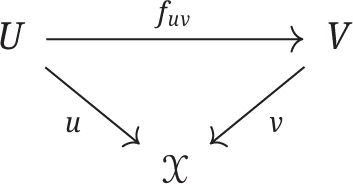
A Deligne–Mumford stack 𝓧 is an algebraic stack such that there exists a surjective étale morphism U → 𝓧, where U is a ℂ-scheme. The data (U, u) is called a chart of 𝓧, where u is surjective. If u : U → 𝓧 is an étale morphism (not necessarily surjective), the pair (U, u) is called a local chart of 𝓧. Let (U, u) and (V, v) be two charts of 𝓧. A morphism of charts (U, u) and (V, v) is a morphism fuv : (U, u) → (V, v) of schemes such that the following diagram commutes:
If 𝓧 is locally of finite type and with finite diagonal, then there exists a coarse moduli space X (as an algebraic space) of 𝓧; see [31, Theorem 11.1.2]. Denote by π : 𝓧 → X the natural morphism.
Definition 2.1
A Deligne–Mumford stack 𝓧 is smooth and projective if it satisfies the following conditions:
there exists a surjective étale morphism Y → 𝓧 such that Y is a smooth projective variety;
𝓧 can be written as a global quotient [Y∖Γ], where Γ is a finite group;
𝓧 has a coarse moduli space X, which is a smooth projective variety,
and we say that 𝓧 is a smooth projective Deligne–Mumford stack. Furthermore, if 𝓧 is connected and of dimension one, we say that 𝓧 is a stacky curve.
The idea of smooth projective Deligne–Mumford stacks is introduced by Simpson to establish a stacky version of the nonabelian Hodge correspondence [34, Theorem 5.4]. Compared to Simpson’s definition, we also require that the coarse moduli space X is smooth and projective for the purposes of this paper.
Definition 2.2
Let 𝓧 be a smooth projective Deligne–Mumford stack. A Cartier divisor D on 𝓧 is defined on each chart (U, u) as follows: there is a Cartier divisor Du on U such that if fuv : (U, u) → (V, v) is a morphism of charts, then
2.2 Sheaves
Sheaves on stacks
Let 𝓧 be a Deligne–Mumford stack and let (U, u) be a chart of 𝓧. Instead of giving the precise definition of coherent sheaves on 𝓧, we give a more workable definition. A coherent sheaf 𝓕 on 𝓧 is defined to be a pair (F, σ) such that F is a coherent sheaf on U and σ : s* F
are the source and target maps. In fact, this definition does not depend on the choice of the chart we take. We refer the reader to [31, Chapter 7] for more details. A coherent sheaf 𝓕 is locally free if the coherent sheaf F in the corresponding pair (F, σ) is locally free.
We next provide some examples of coherent sheaves on 𝓧, and we omit the isomorphism σ for simplicity. The structure sheaf 𝓞𝓧 is defined as 𝓞U on the chart (U, u). Let
Higgs Bundles over stacks
Let 𝓧 be a stacky curve. A Higgs bundle on 𝓧 is a pair (𝓕, Φ), where 𝓕 is a locally free sheaf on 𝓧 and Φ : 𝓕 → 𝓕 ⊗
Stability condition
Let 𝓧 be a stacky curve. Let π : 𝓧 → X be the natural map to its coarse moduli space. Denote by q : 𝓧 → ℂ the structure morphism. Let 𝓕 be a locally free sheaf over 𝓧. The degree of 𝓕 over 𝓧 is defined (see [14, § 4.1]) as
where c1(𝓕) is the first Chern class of 𝓕. A locally free sheaf 𝓕 is called semistable (respectively stable), if for any subsheaf 𝓕′ with rk(𝓕′) < rk(𝓕), it is
Similarly, a Higgs bundle (𝓕, Φ) is called semistable (respectively stable), if for any Φ-invariant subsheaf 𝓕′ with rk(𝓕′) < rk(𝓕), it is
Recall that Φ-invariant subsheaf 𝓕′ means that Φ(𝓕′) ⊆ 𝓕′ ⊗
2.3 Principal bundles
Principal bundles and G-Higgs bundles
Let 𝓧 be a Deligne–Mumford stack, and fix a chart (U, u) of 𝓧. Let G be a connected complex reductive algebraic group. Denote by 𝔤 the Lie algebra of G. A G-bundle 𝓔 on 𝓧 is defined as a pair (E, σ), where E is a G-bundle on U and σ : s* E
where BunG(𝓧) is the category of G-bundles fibered in groupoids on 𝓧 and BG is the classifying stack of G.
Now let 𝓧 be a stacky curve. A G-Higgs bundle on 𝓧 is a pair (𝓔, Φ) such that 𝓔 is a principal G-bundle on 𝓧 and Φ ∈ H0(𝓧, 𝓔(𝔤) ⊗
Stability condition
Let 𝓧 be a stacky curve, and write it as a global quotient 𝓧 = [Y/Γ]. By definition, a G-Higgs bundle 𝓔 on 𝓧 is equivalent to a Γ-equivariant G-Higgs bundle on Y; see [4, § 2]. We fix a faithful representation G ↪ GL(V). Denote by 𝓔(V) := 𝓔 ×G V the associated bundle. In this case, a Higgs field Φ ∈ H0(𝓧, 𝓔(𝔤) ⊗
Remark 2.3
Indeed, there are several ways to define the semistability of principal G-bundles. In this paper, we shall use the above definition for semistability, since it has been proved that the moduli space of G-Higgs bundles over a projective Deligne–Mumford stack exists in this case; see [34].
2.4 Root stacks
Root stacks are a highly significant case of Deligne–Mumford stacks. It is known that a smooth projective Deligne–Mumford stack is locally isomorphic to a root stack; see [34]. We review this result in this subsection.
Let X be a smooth projective variety, and let L be a line bundle on X. Note that the following categories are equivalent
Let s ∈ Γ(X, L) be a section of L. The pair (L, s) defines a morphism X → [𝔸1/𝔾m]. The category of pairs (L, s), where L is a line bundle on X and s ∈ Γ(X, L), and the category of morphisms X → [𝔸1/𝔾m] are equivalent. This equivalence can be generalized to n line bundles and n sections. More precisely, the category of morphisms X → [𝔸n/
Let θr : [𝔸1/𝔾m] → [𝔸1/𝔾m] be the morphism induced by r-th power maps on both 𝔸1 and 𝔾m. Let X(L,s,r) be the fiber product X ×[𝔸1/𝔾m],θr [𝔸1/𝔾m]. The stack X(L,s,r) is then called the r-th root stack. Let D̅ = (D1, …, Dk) be a k-tuple of effective Cartier divisors Di ⊆ X. Let r̅ = (r1, …, rk) be a k-tuple of positive integers. We define θr̅ : [𝔸k/
Let 𝓧 be a Deligne–Mumford stack locally of finite presentation with finite diagonal. Denote by X its coarse moduli space. Let x be a geometric point of 𝓧, that is, a morphism x : Specℂ → 𝓧. Denote by Gx the automorphism group of x. Since 𝓧 is a Deligne–Mumford stack, Γx is a finite group. Let x̅ be the corresponding point of x in the coarse moduli space. There exists (see [31, Theorem 11.3.1]) a neighborhood (U, u) of x̅ and a finite morphism V → U such that
This tells us that a Deligne–Mumford stack is locally a quotient stack. More precisely, let x ∈ 𝓧 be a geometric point, and let x̅ be its corresponding point in X. There is an étale neighborhood (U, u) of x̅ ∈ X such that
2.5 Parabolic bundles
Now we consider a special case of a root stack. Let X be a smooth projective curve and let D̅ = (D1, …, Dk) be a k-tuple of divisors Di ⊆ X such that Di = pi is a single point. Let r̅ = (r1, …, rk) be a k-tuple of positive integers. The notation r(p) shall refer to the integer in r̅ corresponding to the point p ∈ D̅.
Parabolic structures and parabolic bundles
We assume that XD̅,r̅ can be written as a global quotient [U/Γ] ≅ XD̅,r̅ where U is a smooth projective variety. There is a natural map π : U → X. A locally free sheaf 𝓕 of rank n over XD̅,r̅ is equivalent to a locally free sheaf F on U together with a local trivialization Θp : Fp → Up × ℂn for each point p ∈ D̅, where Up is a neighborhood of π–1(p) and Fp := F|Up, such that Θp is ℤr(p)-equivariant with respect to the following action around the point p ∈ D̅
where
where
Then, we define a weighted filtration of F on π–1(p),
where Fi(p)/Fi+1(p) corresponds to the subspace on which the action of t is given by tαi(p). The weighted filtration associated to each puncture determines a parabolic structure on F, and we prefer to use the notation α for it.
A parabolic bundle on (X, D̅) is a pair (F, α), where F is a locally free sheaf and α is a parabolic structure over each of the points in D̅. A locally free sheaf 𝓕 on XD̅,r̅ is equivalent to a parabolic bundle on (X, D̅). We refer the reader to [7; 19; 29] for more details on this correspondence. Furthermore, the parabolic structure itself is an important topological invariant of a locally free sheaf over XD̅,r̅, which can be used in describing the connected components of the moduli space of locally free sheaves on 𝓧; see [25]. With respect to this correspondence, we say that a locally free sheaf 𝓕 on XD̅,r̅ has parabolic structure α if the corresponding parabolic bundle on X is of parabolic type α.
A parabolic structure of a locally free sheaf over a point p corresponds to a parabolic group. A parabolic structure over a point is given by integers
The correspondence between parabolic structures and parabolic groups can be also understood from Higgs fields. Let now Φ be a Higgs field of 𝓕. With respect to the above setup, Φ can be written as follows around p ∈ D̅:
where
and the Φ̂ij are block matrices of holomorphic functions on F. Note that the morphism Φ can be regarded as an element in the parabolic subgroup. In fact, the calculation also works for any endomorphism of 𝓕; see [25; 29].
Parabolic degree and stability condition
The parabolic degree of a parabolic vector bundle F is given by
We call a parabolic vector bundle F semistable (respectively stable) if for all parabolic subbundles F′ we have
From the correspondence between parabolic bundles F over X and bundles 𝓕 over XD̅,r̅ we have
Note that this property also provides that F is semistable (respectively stable) if and only if 𝓕 is semistable (respectively stable).
Parabolic Higgs bundles
Let E be a parabolic bundle on (X, D̅). Let ωX be the canonical line bundle of X. A parabolic Higgs field Φ is a section H0(X, 𝓔nd(E) ⊗ ωX(D̅)) which preserves the filtration on each puncture p ∈ D̅, i.e. Φ|p (Fi(p)) ⊆ Fi(p) ⊗ ωX(D̅). If φ|p (Fi(p)) ⊆ Fi+1(p) ⊗ ωX(D̅), it is called a strongly parabolic Higgs field. Roughly speaking, on each puncture, parabolic Higgs fields can be regarded as elements in the parabolic subgroup, while strongly parabolic Higgs fields are regarded as elements in the unipotent subgroup of the parabolic subgroup. We refer the reader to [27; 42] for more details.
We denote the sheaf of parabolic homomorphisms between two parabolic vector bundles E and F by 𝓟ar𝓗om(E, F), the sheaf of strongly parabolic homomorphisms by 𝓢𝓟ar𝓗om(E, F). In addition, we denote 𝓟ar𝓔nd(E) = 𝓟ar𝓗om(E, E) and 𝓢𝓟ar𝓔nd(E) = 𝓢𝓟ar𝓗om(E, E). We now define:
A parabolic Higgs bundle over (X, D̅) is a pair (E, Φ), where E is a parabolic bundle and Φ belongs to H0(X, 𝓟ar𝓔nd(E) ⊗ ωX(D̅)). We call it stable (respectively semistable) if it is stable (respectively semistable) with respect to the Φ-invariant subbundles.
A strongly parabolic Higgs bundle (X, D̅) is a pair (E, Φ) where E is a parabolic bundle and Φ belongs to H0(X, 𝓢𝓟ar𝓔nd(E) ⊗ ωX(D̅)).
Let L be a parabolic line bundle on X. We call L-twisted parabolic Higgs bundle over (X, D̅) a pair (E, Φ), where E is a parabolic bundle and Φ ∈ H0(X, 𝓟ar𝓔nd(E) ⊗ L).
Parabolic structure of principal bundles
Closing this subsection, we give the definition of the parabolic structure of a G-bundle. We fix a faithful representation G ↪ GL(V). Let 𝓔 be a G-bundle on 𝓧 and denote by 𝓔(V) the associated bundle. We say that the parabolic structure of 𝓔 is α, if the parabolic structure of the corresponding associated bundle 𝓔(V) is α. Although the parabolic structure of a principal G-bundle depends on the choice of the faithful representation in this definition, the stability condition of the associated bundle is equivalent to Ramanathan’s stability condition for the corresponding parabolic G-Higgs bundle (or logahoric Higgs torsor). This property is recently studied and proven by the authors in [26].
3 Deformation theory on moduli spaces of Higgs bundles over Deligne–Mumford stacks
In this section, we review some results on the deformation theory of moduli spaces of Higgs bundles over Deligne–Mumford stacks, which will help us calculate the tangent space of the moduli spaces we are interested in. In § 3.1, we define all the moduli spaces we consider in this paper and in § 3.2 we review the deformation theory on those moduli spaces. In § 3.3, we review the Grothendieck duality of coherent sheaves over Deligne–Mumford stacks, while in § 3.4 we restrict to stacky curves and apply the results from § 3.2 and § 3.3 to construct a morphism T*(𝓜H(𝓧)) → T(𝓜H(𝓧)), which will be used in order to construct a Poisson structure on 𝓜H(𝓧) later on in § 4.
3.1 Moduli space of Higgs bundles on smooth projective Deligne–Mumford stacks
Let 𝓧 be a smooth projective Deligne–Mumford stack. We first review the process of constructing the moduli space 𝓜H(𝓧); see [34] for more details.
Let Y → 𝓧 be a surjective étale morphism such that Y is a smooth projective variety, and this admits a proper hyper-covering by smooth projective varieties; see [34, Theorem 5.8]. In other words, there is a simplicial resolution of 𝓧 by smooth projective varieties. We briefly review next the construction of a simplicial resolution of 𝓧. The first step of this construction is given by the existence of a surjective étale morphism Y0 → 𝓧, where Y0 := Y. Then we look at Y0 ×𝓧 Y0. By resolving singularities, we get a smooth projective variety Y1. This provides the starting point of a simplicial resolution Y1 ⇉ Y0 → 𝓧. Iterating the process, we get the simplicial resolution Y∙ of 𝓧. Since each Yk is a smooth projective variety over ℂ, the moduli space 𝓜H(Yk) of stable Higgs bundles over Yk exists [36, Theorem 4.7]. Thus, there is a natural way to construct the moduli space 𝓜H(Y∙) of semistable Higgs bundles over Y∙ [34, § 6]. Indeed, the moduli space of stable (respectively semistable) Higgs bundles over Y∙ is isomorphic to the moduli space of stable (respectively semistable) Higgs bundles over 𝓧, see [34, § 9]:
The moduli space of Higgs bundles over 𝓧 is proved to be a quasi-projective scheme in [34, § 6].
In this paper, we prefer to consider the stable locus of the moduli space, but some of our results can be extended to the semistable case. We use the following notation for the moduli spaces we consider:
𝓜(𝓧, ∙1, ∙3): the moduli space of stable bundles on 𝓧,
𝓜H(𝓧, ∙1, ∙2, ∙3): the moduli space of stable Higgs bundles on 𝓧,
𝓜par(X, ∙1, ∙3): the moduli space of stable parabolic bundles on X,
where ∙1 is the position for the structure group G, ∙2 is for the line bundle 𝓛 (as the twisting bundle) and ∙3 is for the parabolic structure α. For example, 𝓜H(𝓧, G, α) denotes the moduli space of stable G-Higgs bundles on 𝓧 with parabolic structure α. The moduli spaces over Deligne–Mumford stacks are constructed in [34], while their parabolic analogs were constructed in [41].
3.2 Deformation theory
The goal of this subsection is to calculate the tangent space of 𝓜H(𝓧), which is the moduli space of Higgs bundles on 𝓧. The moduli space 𝓜H(𝓧) represents the following moduli problem
such that for each ℂ-scheme T, 𝓜͠H(𝓧)(T) is the set of isomorphism classes of T-flat families of stable Higgs bundles (𝓕, Φ). In this section, we shall be using the notation 𝓜͠ for the moduli problem 𝓜͠H(𝓧) and 𝓜 for the moduli space of stable Higgs bundles.
Remark 3.1
A moduli problem is usually defined as a functor, which is taken as the first step to construct moduli spaces [21]. This functor can be improved to be a category fibered in groupoids, and therefore, a “moduli problem” can be equipped with a stack structure. In this paper, we use the same notation 𝓜͠ for moduli problems and the corresponding stacks. We refer the reader to [17] for more details.
Let Spec(A) be an affine scheme, and let M be an A-module. Let ξ = (𝓕, Φ) be an element in 𝓜͠(A), where 𝓜͠(A) := 𝓜͠(Spec(A)). There is a natural map
Denote by 𝓜͠ξ(A[M]) the pre-image of the element ξ ∈ 𝓜͠(A). In other words, 𝓜͠ξ(A[M]) is the set of elements whose restriction to 𝓧A is ξ. The set 𝓜͠ξ(A[M]) is known as the set of deformations of ξ with respect to the extension
Now let A = ℂ and let M be the free rank one A-module generated by ε. We consider the short exact sequence
where ℂ[ε] is the ring ℂ[ε]/(ε2) and we abuse the notation here.
Given an element ξ ∈ 𝓜͠(ℂ), an infinitesimal deformation of ξ is an element in 𝓜͠ξ(ℂ[ε]). It is well-known that the set of all infinitesimal deformations of ξ is the tangent space of the moduli space 𝓜 at the point ξ.
Let ξ = (𝓕, Φ) be an element in 𝓜͠(A). The deformation complex
where the map e(Φ) is given by
and p𝓧 : 𝓧 ×ℂ A → 𝓧 is the natural projection. If there is no ambiguity, we omit the symbols M, 𝓕, Φ and use the notation
for the deformation complex. Biswas and Ramanan in [10] first described the set of infinitesimal deformations of a Higgs bundle over a smooth projective variety and proved that the set of deformations is isomorphic to the first hypercohomology of a two-term complex. This approach was generalized to the case of Higgs bundles over a Deligne–Mumford stack in [39]. Therefore, we have the following proposition:
Proposition 3.2
(Proposition 3.3 in [39]). Let ξ = (𝓕, Φ) be a Higgs bundle in 𝓜͠(A). The set of deformations 𝓜͠ξ(A[M]) is isomorphic to the hypercohomology group ℍ1(C∙), where C∙ is the complex
where e(Φ)(s) = –ρ(s)(Φ) is defined as above.
The above proposition implies the following corollary:
Corollary 3.3
If a Higgs bundle (𝓕, Φ) is stable, then the tangent space of 𝓜H(𝓧) at the point ξ = (𝓕, Φ) is isomorphic to ℍ1(
Proposition 3.3 in [39] actually proves the statement for an 𝓛-twisted Higgs bundle, and therefore the result can be generalized to the 𝓛-twisted case:
Corollary 3.4
The tangent space of 𝓜H(𝓧, 𝓛) at a stable 𝓛-twisted Higgs bundle ξ = (𝓕, Φ) is isomorphic to ℍ1(
Let 𝓔 be a principal G-bundle. We fix a faithful representation G ↪ GL(V) and consider the associated bundle 𝓔(V). Then, we can use the same argument as in Proposition 3.2 to calculate the tangent space of 𝓜H(𝓧, G).
Corollary 3.5
The tangent space of 𝓜H(𝓧, G) at a stable G-Higgs bundle ξ = (𝓔, Φ) is isomorphic to ℍ1(
3.3 Grothendieck duality
Let 𝓧 and 𝓨 be separated and finite type Deligne–Mumford stacks. Denote by D#(𝓧) the derived category of complexes of coherent sheaves over 𝓧, where # represents here either of b, +, –.
Let f : 𝓧 → 𝓨 be a proper morphism of stacks. The morphism induces the following functors of categories of coherent sheaves
such that f* is right adjoint to f*. From these two functors, we can define the derived functors
Note that the functor Rf* is still right adjoint to Lf*:
In fact, we have another functor f! : Db(𝓨) → Db(𝓧), which is right adjoint to Rf*, satisfying
where 𝓔∙ ∈ Db(𝓧) and 𝓕∙ ∈ Db(𝓨).
Theorem 3.6
(Theorem 2.22 in [30]). Let σ : 𝓧 → Spec(ℂ) be a smooth proper Deligne–Mumford stack of dimension n over ℂ. Then σ! (ℂpt), where ℂpt is the constant sheaf on Spec(ℂ), is canonically isomorphic to the complex ω𝓧[n].
Considering the morphism f: 𝓧 → Spec(ℂ), we have
If 𝓔∙ is a coherent sheaf 𝓔 over 𝓧, then Exti(𝓔, ω𝓧) ≅ Hn–i(𝓧, 𝓔)*.
Let 𝓔∙ = 0 → 𝓔0 → … → 𝓔m → 0 be an element in Db(𝓧). By Grothendieck duality we have
where 𝓔∙,* is the dual complex
3.4 Application
For a stacky curve 𝓧, we then have
is a 2-term complex. Thus the cotangent space
and so
Similarly, we also have the morphism
4 Lie algebroids and Poisson structures
The principal method by which we shall obtain Poisson structures on our moduli spaces of interest is via the duals of Lie algebroids. Poisson structures are usually defined on smooth varieties. Nonetheless, Poisson structures on stacks were first conceived in the dissertation of Waldron [40]. Although the author only considers differential stacks in [40], the approach can be carried over to the algebraic setting naturally. In § 4.1, we shall review the definitions and some properties of Lie algebroids and Poisson structures on smooth varieties, as well as on stacks; we refer to [40, § 7.2] and [23, § 1] for a complete overview. In § 4.2 and § 4.3, we prove the main theorems of this section that the moduli spaces 𝓜H(𝓧, α) and 𝓜H(𝓧, G, α) admit a Poisson structure (Theorems 4.3 and 4.4). In § 4.4, we consider the stack 𝓜͠H(𝓧, α) of Higgs bundles on 𝓧 by abuse of notation. As an application of Theorem 4.3, we next show that 𝓜͠H(𝓧, α) also admits a Poisson structure.
4.1 Lie algebroids and Poisson structures
We start by recalling the basic notions for Lie algebroids and Poisson structures on smooth varieties over ℂ and then pass to a reasonable generalisation of these notions over stacks.
Smooth varieties
A Lie algebroid on a smooth variety X is a vector bundle F → X together with a Lie bracket [, ] on the space of global sections Γ(F) and a morphism a : F → TX, called the anchor map of F, which induces a Lie algebra morphism Γ(F) → Γ(TX) satisfying the Leibniz rule
for all ξ, ν ∈ Γ (F) and f ∈ C∞(X). A morphism of Lie algebroids on X is a morphism of vector bundles inducing a Lie algebra morphism between spaces of sections and commuting with the anchor maps. The category of Lie algebroids on X is denoted by 𝓛𝓐.
A Poisson bracket on X is a Lie bracket
satisfying the Leibniz rule {f, gh} = {f, g}h + g{f, h}, for f, g, h ∈ 𝓞X; cf. [23, Section 1]. Poisson brackets bijectively correspond to bi-vector fields
such that
The Poisson bracket {, }Π that corresponds to such a bi-vector field Π is given by {f, g}Π = Π(df, dg). Associated to a Poisson structure Π on X, there is a Lie algebroid structure
Theorem 4.1
If F is a Lie algebroid on X, then the total space of the dual vector bundle F* has a natural Poisson structure.
We now consider an important example of Lie algebroids, the Atiyah algebroid. Let X → X/H be an H-torsor. Denote by 𝔥 the corresponding Lie algebra of H. We have a natural projection π : X → X/H and, moreover, we obtain the following exact sequence
The group action H on X induces a natural action on TX and a natural surjective morphism TX/H → T(X/H), which is regarded as an anchor map. Therefore, we have the following exact sequence
where Ad(X) := X ×Ad 𝔥. This exact sequence is called the Atiyah sequence. It is easy to check that the Atiyah sequence gives a Lie algebroid structure on TX/H. By Theorem 4.1, the total space of (TX/H)* has a Poisson structure; note here that we are viewing TX/H as a vector bundle over X/H.
Stacks
We will extend the definition of Lie algebroids from schemes to stacks. Let 𝓜 be a smooth Deligne–Mumford stack. Take a surjective étale morphism M → 𝓜, where M is a smooth variety. We consider the simplicial resolution of 𝓜
Similar to the definition of sheaves on stacks (see § 2.2), we still use the local chart M → 𝓜 to give the definition of Lie algebroids on 𝓜. A Lie algebroid 𝓕 on 𝓜 is defined as a pair (F, σ), where F is a Lie algebroid on M and σ : s* F
Now we move to Poisson structures on 𝓜. A Poisson structure on 𝓜 is a pair (Π, σ), where Π is a Poisson structure on M and σ : s* Π
Proposition 4.2
(40, § 7.2.5] If 𝓕 be a Lie algebroid over 𝓜, then the total space of 𝓕* has a natural Poisson structure.
We will see in § 4.4 that the moduli problems we are studying in this article fall in the case described by the above proposition.
4.2 Poisson structure on 𝓜H(𝓧, α)
Let 𝓧 = [Y/Γ] be a stacky curve over ℂ and let X be the coarse moduli space of 𝓧. In this section, we will prove the main theorem of this paper.
Theorem 4.3
The moduli space 𝓜H(𝓧, α) of stable Higgs bundles over 𝓧 with fixed parabolic structure α admits a Poisson structure.
Proof
The strategy of the proof is to show that 𝓜H(𝓧, α) is a Lie algebroid over T𝓜(X), the tangent space of the moduli space of stable bundles over X, by constructing a map
which will play the role of an anchor map. Note that (3.7) gives precisely such a map. Following the approach as in [27, § 3], we first restrict to
By the discussion in § 2.4, let 𝓧 be a root stack XD̅,r̅. Denote by π : 𝓧 → X the natural morphism; note that the dimension of 𝓧 is one. The divisor D̅ = p1 + … + pn is a sum of distinct points and let qi be the corresponding point of pi in 𝓧. Note that π–1(pi) = r(pi)qi. Let us denote by 𝔻 = q1 + … + qn the divisor in 𝓧.
Let 𝓕 be a locally free sheaf on 𝓧 with parabolic structure α. Given q ∈ 𝔻, denote by α(q) the parabolic structure of π*𝓕 around p = π(q) ∈ D̅. Let Pq be the parabolic group of GLn(ℂ) corresponding to α(q) as we discussed in § 2.5. Let Pq = LqNq be the Levi decomposition of P, where Lq is the Levi factor and Nq is a unipotent group. Denote by 𝔩q, 𝔫q the Lie algebras of Lq and Nq respectively. Define 𝓕′ := π* π* 𝓕. Since the stacky curve 𝓧 is defined over ℂ, the functor π* is exact. Thus, 𝓕′ is a locally free sheaf on 𝓧. We have the following exact sequence
This induces a long exact sequence
Note that the last term H1(𝓧, ∏q∈𝔻 𝔫q ⊗ 𝓞q) is trivial, and thus we have a short exact sequence
where Ad is the kernel of the surjective map Ext1(𝓕, 𝓕) → Ext1(𝓕′, 𝓕′). Remember that 𝓕 is a stable bundle and that we are working over the field ℂ. Therefore, 𝓕 is simple and the functor
is exact. The exactness of the functor π* implies that π* 𝓕 is stable, and so is 𝓕′. Therefore, End(𝓕′) ≅ ℂ. Now we go back to the term Ad. If 𝓕 is stable, then
which is supported over q ∈ 𝔻. Over each point q ∈ 𝔻, Adq is isomorphic to the Lie algebra 𝔫q. Therefore, Adq is the adjoint representation of the unipotent group Nq.
In the short exact sequence (4.2), the third term Ext1(𝓕′, 𝓕′) is isomorphic to the tangent space of the moduli space of stable bundles over X at the point 𝓕′, thus
With respect to this isomorphism, we have a natural map
Now we consider the tangent bundles on 𝓜(𝓧, α) and 𝓜(X)

Let ℱ, ℱ′ be the universal bundles on 𝓜(𝓧, α) × 𝓧 and 𝓜(X) × X respectively. Therefore, we have
and
Clearly, the term
is the tangent bundle of 𝓜(𝓧, α), and
is the tangent bundle of 𝓜(X).
For the rest of the proof, we prove the following two statements
(R1(μ1)* 𝓔nd(ℱ))* is isomorphic to
R1 (μ1)* 𝓔nd(ℱ) is a Lie algebroid over 𝓜(X),
which shall imply that the moduli space
To prove the first statement, we work locally on a point 𝓕 ∈ 𝓜(𝓧, α). The space Ext1(𝓕, 𝓕) is the tangent space of 𝓜(𝓧, α) at the point 𝓕, and we have
By Grothendieck duality, see § 3.3, the following isomorphism holds:
This isomorphism tells us that
which finishes the proof of the first statement. For every Higgs field Φ ∈ H0(𝓧, 𝓔nd(𝓕) ⊗ ω𝓧) we have
For the second statement, note that in summary we have the following exact sequence
which is an Atiyah sequence as studied in § 4.1. Therefore, the second statement also holds and this finishes the proof of the theorem.□
4.3 Poisson structure on 𝓜H(𝓧, G, α)
Let G ↪ GL(V) be a fixed faithful representation. In this subsection, we will prove that there exists a Poisson structure on 𝓜H(𝓧, G, α).
Theorem 4.4
The moduli space 𝓜H(𝓧, G, α) of stable G-Higgs bundles over a stacky curve 𝓧 with fixed parabolic structure α admits a Poisson structure.
Proof
The proof is similar to the one for the moduli space 𝓜H(𝓧, α). We work on the open dense subset

Let ℰ and ℰ′ be the universal bundles on 𝓜(𝓧, G, α) × 𝓧 and 𝓜(X, G) × X, respectively. Denote by ℰ(V) and ℰ′(V) the associated bundles with respect to G ↪ GL(V). Around a point q ∈ 𝔻, let Pq be the corresponding parabolic group in GL(V) with respect to ℰ(V). Denote by Pq = LqNq the Levi factorization. With the same discussion as in the proof of Theorem 4.3, we have
Let
where
Clearly, we have
and
the tangent bundle of 𝓜(X, G). Therefore, R1(μ1)* 𝓔nd(ℰ) is a Lie algebroid over 𝓜(X, G). At the same time, the tangent space of (R1 (μ1)* 𝓔nd(ℰ))* is isomorphic to the tangent space of
Therefore, the moduli space of G-Higgs bundles 𝓜H(𝓧, G, α) has a Poisson structure.□
4.4 Stacks
In the last subsection, we proved that there exists a Poisson structure on the moduli space 𝓜H(𝓧, α). By abuse of notation, we consider the existence of a Poisson structure on the moduli stack 𝓜͠H(𝓧, α) of Higgs bundles on 𝓧. We show that the stack 𝓜͠H(𝓧, α) has a Poisson structure, which is induced by the Poisson structure on 𝓜H(𝓧, α). Below we sketch the extension of the construction of a Poisson structure on a general stack 𝓜͠.
Let 𝓧 be a stacky curve with coarse moduli space X. It is known that 𝓜͠H(𝓧, α) has a natural stack structure; see [17]. Since this moduli problem is defined for the stable Higgs bundles, 𝓜H(𝓧, α) is a fine moduli space of 𝓜͠H(𝓧, α) by [38, Theorem 1.3]. Thus
This isomorphism provides the following corollary:
Corollary 4.5
The stack 𝓜͠H(𝓧, α) admits a Poisson structure.
In general, a moduli problem may not have a fine moduli space, for example
In the rest of this subsection, we give a brief idea about the construction of a Poisson structure on a stack 𝓜͠. The idea is that we want to find an atlas {Mi}i∈ℐ of 𝓜͠ in the Lisse-étale site, see [31, Example 2.1.15], where Mi are schemes. We can try to construct a Poisson structure on each Mi and check whether they can be glued together. Furthermore, if 𝓜͠ is an algebraic stack, we can assume that there exists a smooth surjective morphism M → 𝓜͠, where M is a scheme, and construct a Poisson structure on M. We also have to check that the pull-backs s, t : M ×𝓜͠ M → M of the Poisson structure on M are isomorphic.
Now we take the stack
Conjecture 4.6
There is a Poisson structure on the stack
5 Poisson structure on the moduli space of stable 𝓛-twisted Higgs bundles over stacky curves
In this section, we work on 𝓜H(𝓧, 𝓛, α), the moduli space of stable 𝓛-twisted Higgs bundles on a stacky curve 𝓧 with fixed parabolic structure α. We prove that a Poisson structure exists over 𝓜H(𝓧, 𝓛, α) under certain conditions.
Let 𝓧 = [U/Γ] be a stacky curve. Denote by X the coarse moduli space of 𝓧. Let α be a parabolic structure on X, and denote by D̅ = p1 + … + pk ∈ X the divisor with respect to α. Let 𝔻 = q1 + … + qk ∈ 𝓧 be the corresponding divisor on 𝓧, where qi is the point corresponding to pi.
Theorem 5.1
If there exists a short exact sequence
for any stable bundle 𝓕 ∈ 𝓜(𝓧, α) such that
the morphism 𝓗om(𝓕 ⊗ 𝓛, 𝓕 ⊗ ω𝓧) → 𝓔nd(𝓕) is not surjective,
𝔫 is a sheaf of Lie algebras supported on 𝔻,
then the moduli space 𝓜H(𝓧, 𝓛, α) admits a Poisson structure.
Proof
Analogously to the proof of Theorem 4.3, we only have to work with
By our assumption that the support of 𝔫 is contained in 𝔻, the last term H1(𝓧, 𝔫) is trivial. This implies a short exact sequence
where Ad is the kernel of the map Ext1(𝓕 ⊗ 𝓛, 𝓕 ⊗ ω𝓧) → Ext1(𝓕, 𝓕). Let ℱ be the universal bundle on 𝓜(𝓧, α) × 𝓧 and consider
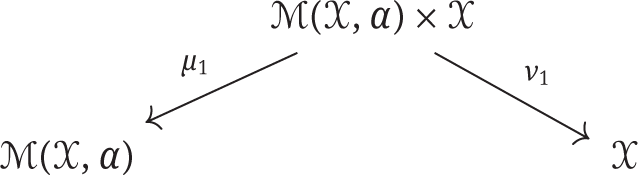
The short exact sequence (5.2) induces the following sequence for universal bundles:
With respect to our assumption about 𝔫, the short exact sequence (5.3) gives a Lie algebroid structure on
Therefore,
which would imply the result.
By Grothendieck duality, see § 3.3, we obtain
Equivalently,
Therefore,
Remark 5.2
Note that if the morphism 𝓗om(𝓕 ⊗ 𝓛, 𝓕 ⊗ ω𝓧) → 𝓔nd(𝓕) is surjective, and 𝔫 is zero, then the term 𝒜d in (5.3) is zero. This means that (5.3) is not an Atiyah sequence, and the approach of Theorem 5.1 fails in this case. Therefore, Theorem 5.1 does not apply to the case 𝓛 = ω𝓧. However, this special case is treated exactly in Theorem 4.3.
6 Relation with the work of Logares–Martens
In this section, we compare the results of Sections 4 and 5 to the main result of Logares and Martens [27]. In the special case of a root stack and a parabolic structure when all parabolic weights are rational, we show that the moduli space of stable orbifold G-Higgs bundles has a Poisson structure.
Let X be a smooth projective curve. Let D̅ = p1 + … + pk be a reduced effective divisor on X, and let r̅ = (r1, …, rk) be a k-tuple of positive integers. We denote by XD̅,r̅ the corresponding root stack. There is a natural map π : XD̅,r̅ → X; we write 𝔻 := π–1(D̅). By the discussion in § 2.5, we know that there is a correspondence between parabolic bundles on (X, D̅) and bundles on 𝓧 := XD̅,r̅. Moreover, we have the following equivalence in the language of tensor categories from [14]:
Proposition 6.1
([14, Théorème 4, 5] There is an equivalence of tensor categories between bundles 𝓕 with parabolic structure α on 𝓧 and parabolic bundles F with the same parabolic structure α on (X, D̅). In particular, this equivalence preserves the degree, that is, pardeg(F) = deg(𝓕).
As discussed in § 2.5, this equivalence implies the correspondence in stability as in [14, Remarque 10]. More precisely, we have 𝓜(𝓧, α) ≅ 𝓜par(X, α). It is natural to extend this correspondence to Higgs bundles as in [9; 8; 29], thus giving 𝓜H(𝓧, α) ≅
In conclusion, we have the following proposition.
Proposition 6.2
Let 𝓧 = XD̅,r̅ be a root stack and denote by X the coarse moduli space of 𝓧. The following statements hold:
There is an isomorphism 𝓜H(𝓧, α) ≅
There is an isomorphism 𝓜H(𝓧, ω𝓧(𝔻), α) ≅
Let 𝓛 be an invertible sheaf on 𝓧 and let π : 𝓧 → X be the map from the root stack to its coarse moduli space. Denote by L the corresponding parabolic line bundle to 𝓛 on (X, D̅). Then there is an isomorphism 𝓜H(𝓧, 𝓛, α) ≅
Note that an orbifold is always a root stack. Thus, we have the following corollary to Theorem 4.4:
Corollary 6.3
The moduli space of stable orbifold G-Higgs bundles has a Poisson structure.
In [27, § 3.2.2], the following short exact sequence is used to construct a Poisson structure on
where F is a parabolic bundle on (X, D̅), 𝓢𝓟ar𝓔nd(F) is the sheaf of strongly parabolic endomorphisms and 𝓟ar𝓔nd(F) is the sheaf of parabolic endomorphisms. Translating to the language of stacks, we have
where 𝓕 is the bundle on root stacks corresponding to F. Therefore the sequence (6.1) is equivalent to
Note that when 𝓛 = ω𝓧(𝔻), the short exact sequence (5.1) becomes
Clearly, the sequence (6.2) satisfies the conditions of Theorem 5.1. With respect to the above discussion, we can prove alternatively to [27] the following:
Corollary 6.4
The moduli space
Proof
Given the data (X, D̅, α), we can construct a root stack 𝓧 = XD̅,r̅ (see § 2.4 and § 2.5). Denote by 𝔻 the corresponding divisor on 𝓧. There is a one-to-one correspondence between parabolic Higgs bundles with parabolic structure α and Higgs bundles with parabolic structure α on 𝓧. Under this correspondence, the line bundle ωX(D̅) on X corresponds to ω𝓧(𝔻) on 𝓧. By Proposition 6.2, this induces an isomorphism between
Funding statement: G. K. and H. S. are very grateful to Athanase Papadopoulos, Weixu Su and the “Programme de Recherche conjoint (PRC) CNRS/NNSF of China 2018” for support for their visit to Fudan University, where part of this work was completed. L. Z. thanks the Institut de Recherche Mathématique Avancée of the Université de Strasbourg for its hospitality. G. K. is grateful to the Labex IRMIA of the Université de Strasbourg for support during the completion of this project. H. S. is supported by the National Key R&D Program of China No. 2022YFA1006600 and NSFC12101243.
Acknowledgements
The authors wish to warmly thank Philip Boalch and Florent Schaffhauser for helpful discussions and particularly useful comments. The authors also thank the anonymous referees for a careful reading of the manuscript and important remarks which led to various improvements.
Communicated by: I. Coskun
References
[1] M. Atiyah, The geometry and physics of knots. Cambridge Univ. Press 1990. MR1078014 Zbl 0729.5700210.1017/CBO9780511623868Suche in Google Scholar
[2] M. F. Atiyah, R. Bott, The Yang-Mills equations over Riemann surfaces. Philos. Trans. Roy. Soc. London Ser. A 308 (1983), 523–615. MR702806 Zbl 0509.1401410.1098/rsta.1983.0017Suche in Google Scholar
[3] M. Audin, Lectures on gauge theory and integrable systems. In: Gauge theory and symplectic geometry (Montreal, PQ, 1995), volume 488 of NATO Adv. Sci. Inst. Ser. C: Math. Phys. Sci., 1–48, Kluwer 1997. MR1461568 Zbl 0873.5801610.1007/978-94-017-1667-3_1Suche in Google Scholar
[4] V. Balaji, I. Biswas, D. S. Nagaraj, Principal bundles over projective manifolds with parabolic structure over a divisor. Tohoku Math. J. (2) 53 (2001), 337–367. MR1844373 Zbl 1070.1450610.2748/tmj/1178207416Suche in Google Scholar
[5] O. Biquard, P. Boalch, Wild non-abelian Hodge theory on curves. Compos. Math. 140 (2004), 179–204. MR2004129 Zbl 1051.5301910.1112/S0010437X03000010Suche in Google Scholar
[6] O. Biquard, O. García-Prada, I. Mundet i Riera, Parabolic Higgs bundles and representations of the fundamental group of a punctured surface into a real group. Adv. Math. 372 (2020), 107305, 70. MR4129012 Zbl 1451.1411110.1016/j.aim.2020.107305Suche in Google Scholar
[7] I. Biswas, Parabolic bundles as orbifold bundles. Duke Math. J. 88 (1997), 305–325. MR1455522 Zbl 0955.1401010.1215/S0012-7094-97-08812-8Suche in Google Scholar
[8] I. Biswas, S. Majumder, M. L. Wong, Root stacks, principal bundles and connections. Bull. Sci. Math. 136 (2012), 369–398. MR2923408 Zbl 1260.1401710.1016/j.bulsci.2012.03.006Suche in Google Scholar
[9] I. Biswas, S. Majumder, M. L. Wong, Parabolic Higgs bundles and Γ-Higgs bundles. J. Aust. Math. Soc. 95 (2013), 315–328. MR3164505 Zbl 1307.1401810.1017/S1446788713000335Suche in Google Scholar
[10] I. Biswas, S. Ramanan, An infinitesimal study of the moduli of Hitchin pairs. J. London Math. Soc. (2) 49 (1994), 219–231. MR1260109 Zbl 0819.5800710.1112/jlms/49.2.219Suche in Google Scholar
[11] P. Boalch, Poisson varieties from Riemann surfaces. Indag. Math. (N.S.) 25 (2014), 872–900. MR3264779 Zbl 1305.5300110.1016/j.indag.2014.07.004Suche in Google Scholar
[12] P. P. Boalch, Geometry and braiding of Stokes data; fission and wild character varieties. Ann. of Math. (2) 179 (2014), 301–365. MR3126570 Zbl 1283.5307510.4007/annals.2014.179.1.5Suche in Google Scholar
[13] P. P. Boalch, Topology of the Stokes phenomenon. In: Integrability, quantization, and geometry. I. Integrable systems, volume 103 of Proc. Sympos. Pure Math., 55–100, Amer. Math. Soc. 2021. MR4285677 Zbl 1471.3201610.1090/pspum/103.1/01832Suche in Google Scholar
[14] N. Borne, Fibrés paraboliques et champ des racines. Int. Math. Res. Not. IMRN no. 16 (2007), Art. ID rnm049, 38 pages. MR2353089 Zbl 1197.1403510.1093/imrn/rnm049Suche in Google Scholar
[15] F. Bottacin, Symplectic geometry on moduli spaces of stable pairs. Ann. Sci. École Norm. Sup. (4) 28 (1995), 391–433. MR1334607 Zbl 0864.1400410.24033/asens.1719Suche in Google Scholar
[16] C. Cadman, Using stacks to impose tangency conditions on curves. Amer. J. Math. 129 (2007), 405–427. MR2306040 Zbl 1127.1400210.1353/ajm.2007.0007Suche in Google Scholar
[17] S. Casalaina-Martin, J. Wise, An introduction to moduli stacks, with a view towards Higgs bundles on algebraic curves. In: The geometry, topology and physics of moduli spaces of Higgs bundles, volume 36 of Lect. Notes Ser. Inst. Math. Sci. Natl. Univ. Singap., 199–399, World Sci. Publ., Hackensack, NJ 2018. MR3837871 Zbl 1404.1400710.1142/9789813229099_0004Suche in Google Scholar
[18] T. J. Courant, Dirac manifolds. Trans. Amer. Math. Soc. 319 (1990), 631–661. MR998124 Zbl 0850.7021210.1090/S0002-9947-1990-0998124-1Suche in Google Scholar
[19] M. Furuta, B. Steer, Seifert fibred homology 3-spheres and the Yang–Mills equations on Riemann surfaces with marked points. Adv. Math. 96 (1992), 38–102. MR1185787 Zbl 0769.5800910.1016/0001-8708(92)90051-LSuche in Google Scholar
[20] W. M. Goldman, The symplectic nature of fundamental groups of surfaces. Adv. in Math. 54 (1984), 200–225. MR762512 Zbl 0574.3203210.1016/0001-8708(84)90040-9Suche in Google Scholar
[21] J. Harris, I. Morrison, Moduli of curves. Springer 1998. MR1631825 Zbl 0913.14005Suche in Google Scholar
[22] N. J. Hitchin, The self-duality equations on a Riemann surface. Proc. London Math. Soc. (3) 55 (1987), 59–126. MR887284 Zbl 0634.5304510.1112/plms/s3-55.1.59Suche in Google Scholar
[23] D. Kaledin, Symplectic singularities from the Poisson point of view. J. Reine Angew. Math. 600 (2006), 135–156. MR2283801 Zbl 1121.5305610.1515/CRELLE.2006.089Suche in Google Scholar
[24] G. Kydonakis, H. Sun, L. Zhao, The Beauville-Narasimhan-Ramanan correspondence for twisted Higgs V-bundles and components of parabolic Sp(2n, ℝ)-Higgs moduli spaces. Trans. Amer. Math. Soc. 374 (2021), 4023–4057. MR4251221 Zbl 1464.1401610.1090/tran/8284Suche in Google Scholar
[25] G. Kydonakis, H. Sun, L. Zhao, Topological invariants of parabolic G-Higgs bundles. Math. Z. 297 (2021), 585–632. MR4204707 Zbl 1457.1402610.1007/s00209-020-02526-4Suche in Google Scholar
[26] G. Kydonakis, H. Sun, L. Zhao, Logahoric Higgs torsors for a complex reductive group. Math. Ann. 388 (2024), 3183–3228. MR4705763 Zbl 780807910.1007/s00208-023-02605-xSuche in Google Scholar
[27] M. Logares, J. Martens, Moduli of parabolic Higgs bundles and Atiyah algebroids. J. Reine Angew. Math. 649 (2010), 89–116. MR2746468 Zbl 1223.1403810.1515/crelle.2010.090Suche in Google Scholar
[28] E. Markman, Spectral curves and integrable systems. Compositio Math. 93 (1994), 255–290. MR1300764 Zbl 0824.14013Suche in Google Scholar
[29] B. Nasatyr, B. Steer, Orbifold Riemann surfaces and the Yang–Mills–Higgs equations. Ann. Scuola Norm. Sup. Pisa Cl. Sci. (4) 22 (1995), 595–643. MR1375314 Zbl 0867.58009Suche in Google Scholar
[30] F. Nironi, Grothendieck Duality for Deligne–Mumford stacks. Preprint 2009, arXiv:0811.1955Suche in Google Scholar
[31] M. Olsson, Algebraic spaces and stacks, volume 62 of American Mathematical Society Colloquium Publications. Amer. Math. Soc. 2016. MR3495343 Zbl 1346.1400110.1090/coll/062Suche in Google Scholar
[32] M. Olsson, J. Starr, Quot functors for Deligne-Mumford stacks. Comm. Algebra 31 (2003), 4069–4096. MR2007396 Zbl 1071.1400210.1081/AGB-120022454Suche in Google Scholar
[33] C. Sabbah, Harmonic metrics and connections with irregular singularities. Ann. Inst. Fourier (Grenoble) 49 (1999), 1265–1291. MR1703088 Zbl 0947.3201910.5802/aif.1717Suche in Google Scholar
[34] C. Simpson, Local systems on proper algebraic V-manifolds. Pure Appl. Math. Q. 7 (2011), 1675–1759. MR2918179 Zbl 1316.1400810.4310/PAMQ.2011.v7.n4.a27Suche in Google Scholar
[35] C. T. Simpson, Harmonic bundles on noncompact curves. J. Amer. Math. Soc. 3 (1990), 713–770. MR1040197 Zbl 0713.5801210.1090/S0894-0347-1990-1040197-8Suche in Google Scholar
[36] C. T. Simpson, Moduli of representations of the fundamental group of a smooth projective variety. I. Inst. Hautes Études Sci. Publ. Math. no. 79 (1994), 47–129. MR1307297 Zbl 0891.1400510.1007/BF02698887Suche in Google Scholar
[37] C. T. Simpson, Moduli of representations of the fundamental group of a smooth projective variety. II. Inst. Hautes Études Sci. Publ. Math. no. 80 (1994), 5–79 (1995). MR1320603 Zbl 0891.1400610.1007/BF02698895Suche in Google Scholar
[38] H. Sun, Moduli Space of Λ-modules on Projective Deligne–Mumford Stacks. Preprint 2020, arXiv:2003.11674Suche in Google Scholar
[39] H. Sun, Moduli problem of Hitchin pairs over Deligne-Mumford stacks. Proc. Amer. Math. Soc. 150 (2022), 131–143. MR4335863 Zbl 1474.1400410.1090/proc/15663Suche in Google Scholar
[40] J. Waldron, Lie Algebroids over Differentiable Stacks. Ph.D. Thesis, University of York, 2014.Suche in Google Scholar
[41] K. Yokogawa, Compactification of moduli of parabolic sheaves and moduli of parabolic Higgs sheaves. J. Math. Kyoto Univ. 33 (1993), 451–504. MR1231753 Zbl 0798.1400610.1215/kjm/1250519269Suche in Google Scholar
[42] K. Yokogawa, Infinitesimal deformation of parabolic Higgs sheaves. Internat. J. Math. 6 (1995), 125–148. MR1307307 Zbl 0830.1400710.1142/S0129167X95000092Suche in Google Scholar
© 2024 Walter de Gruyter GmbH, Berlin/Boston
This work is licensed under the Creative Commons Attribution 4.0 International License.
Artikel in diesem Heft
- Frontmatter
- Inequalities for f*-vectors of lattice polytopes
- Lower bound on the translative covering density of octahedra
- Variations on the Weak Bounded Negativity Conjecture
- Poisson Structures on moduli spaces of Higgs bundles over stacky curves
- Generalized Shioda–Inose structures of order 3
- Deformation cones of Tesler polytopes
- Some observations on conformal symmetries of G2-structures
- Characterization of the sphere and of bodies of revolution by means of Larman points
- Fractional-linear integrals of geodesic flows on surfaces and Nakai’s geodesic 4-webs
- The feet of orthogonal Buekenhout–Metz unitals
Artikel in diesem Heft
- Frontmatter
- Inequalities for f*-vectors of lattice polytopes
- Lower bound on the translative covering density of octahedra
- Variations on the Weak Bounded Negativity Conjecture
- Poisson Structures on moduli spaces of Higgs bundles over stacky curves
- Generalized Shioda–Inose structures of order 3
- Deformation cones of Tesler polytopes
- Some observations on conformal symmetries of G2-structures
- Characterization of the sphere and of bodies of revolution by means of Larman points
- Fractional-linear integrals of geodesic flows on surfaces and Nakai’s geodesic 4-webs
- The feet of orthogonal Buekenhout–Metz unitals
