Development of Mask Design Knowledge Base Based on Sensory Evaluation and Fuzzy Logic
-
Yan Hong


Abstract
This article focuses on the development of the mask design knowledge base, which is expected to be applied in a personalized mask design system. To realize the proposed knowledge base, a perceptual descriptive space of the mask is first developed for the description of both functional and aesthetic perceptions of a mask. The mask ontology is also developed to form the mask element matrix. Mask design knowledge is expressed as the relationship between the perceptual descriptive space and the mask ontology, which is extracted by a group of experienced designers through a sensory evaluation procedure. This relationship is then simulated by fuzzy logic tools. The proposed knowledge base has been validated that it is reliable. The personalized mask design system can be further developed with the propose mask design knowledge base.
1 Introduction
Recently, masks have attracted more and more public attention due to the functional and aesthetic demands of consumers. From the functional aspect, masks can effectively filter the air to prevent toxic gases and dust from entering the lungs, especially during epidemics and smoggy days. From the aesthetic aspect, young people usually wear different masks to highlight their unique personality and fashion taste [1]. For these reasons, masks are becoming increasingly popular.
Although the demand for masks is increasing, the current mask design cannot meet the functional and aesthetic demands of consumers. There is a huge gap between the increasing demand and the mask products available in the market. This is because the traditional mask design is mainly based on the designers’ subjective understanding of fashion as well as their professional design knowledge [2]. Therefore, the personalized design for consumers has not been fully respected in the production of masks.
To solve the problems existing in traditional design methods, many researchers have tried to find solutions to the personalized design by adapting a knowledge-based design process. For example, Yan Hong developed a color recommendation system with the development of color design knowledge base [3]. Junjie Zhang developed an interactive jeans design system which is realized by a jeans design knowledge base [4]. Linzi Pu applied a similar idea to achieve a personalized design process for the development of children’s raincoats [5]. In conclusion, a knowledge-based design process can efficiently solve traditional design problems and has been widely used in personalized design.
Based on existing research, the main task in knowledge-based personalized design is the development of the related knowledge base. In this context, we propose to develop a general design knowledge base for masks, which can be further applied to develop a personalized mask design process and related system. The proposed design knowledge base is based on a sensory evaluation and fuzzy logic integrated method [6]. First, sensory evaluation is used to extract the relationship between demands (functional and aesthetic demands) and design elements of the mask. Then, fuzzy logic is used to model this relationship. Finally, the mask knowledge base for masks can be developed.
The rest of the article is structured as follows: Section 2 introduces the methodology of this article; Section 3 explains the overall experiment design and related concepts used in the experiment design; Section 4 discusses the results; Section 5 describes the validation of the proposed knowledge base; finally, a conclusion is provided in Section 6.
2 Methodology
2.1 General research approach
This article focuses on the development of a design knowledge base for the mask types. Based on the literature, design knowledge is tacit and subjective [7], and normally, it can be expressed as the relationship between mask perception words (modern, chic, elegant, etc.) and design elements (stand collar, X shape, O style, etc.). In this context, the research methodology of this work is a sensory evaluation and fuzzy logic integrated method. Sensory evaluation is used to extract the conceptual relationship between mask perception words and design elements. This relationship is subjective and qualitative; thus, fuzzy logic is used to quantify the involved conceptual relationship.
2.2 Related concept
2.2.1 Quantification of human perception using sensory evaluation
The sensory evaluation has been widely used in the food industry and the automobile manufacturing industry [8]. Compared with physical measurement, the sensory evaluation method is more suitable for processing with human non-quantitative sensory perception, and it can be used as a bridge between human sensory perception and specific data; thus, the complex and subtle sensory perception of humans can be quantified [9]. In this research, to develop a mask design knowledge, the relationship between mask perception words and mask design elements should be simulated. Sensory evaluation is suitable to extract this kind of relationship. The designer’s professional design knowledge can also be extracted in this process.
2.2.2 Using fuzzy logic to process data
The relationship between mask perception words and mask design elements, which is extracted based on sensory evaluation, is quantified. To process this kind of data, fuzzy logic is employed. Fuzzy logic can quantify qualitative data [10]. Using fuzzy logic, all relevant linguistic data can be quantified for further processing of the data obtained in the sensory evaluation process, so that these mask perception words are quantified as fuzzy numbers [11].
3 Experiment
As shown in Figure 1, there are three experiments in this research. Experiment I is designed to develop the perceptual descriptive space of mask design. Through Experiment II, an ontology of masks will be obtained. Then, based on Experiments I and II, the relationship between the proposed perceptual descriptive space and mask ontology will be extracted through a sensory evaluation procedure in Experiment III. In Experiments I, II, and III, 20 professional fashion designers are involved.
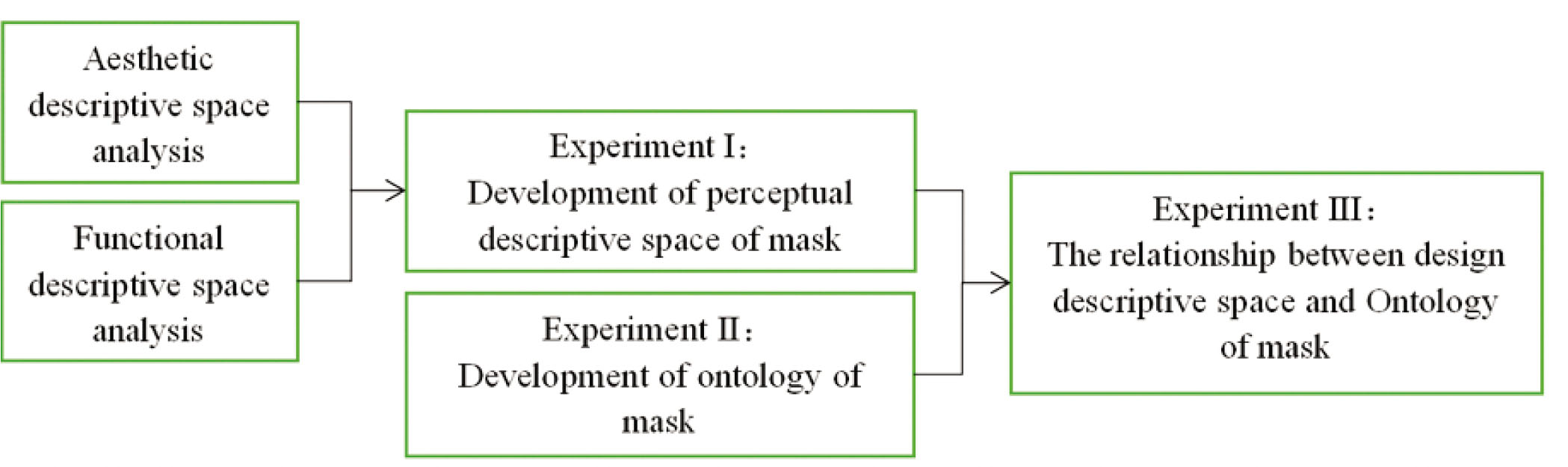
The flow of the experiments and the relationship between the experiments.
3.1 Experiment I: Development of the perceptual descriptive space of masks
The proposed perceptual descriptive space is developed to measure the aggregated perceptual data of designers about their perception of mask design elements. The proposed perceptual descriptive space has two subspaces: (1) aesthetic descriptive space and (2) functional descriptive space. The perceptual descriptive space of mask design will be able to describe people’s various demands for masks. To realize the proposed system, the following procedure has been carried out: (1) generation of human perception criteria and (2) selection and evaluation of human perception criteria.
First, a training session was performed. The purpose of this experiment about souring mask demands was announced to the evaluation team (20 professional designers). After that, a brainstorming process was performed. During the brainstorming process, each of the panelists was free to access open resources (books, internet, literature, etc.) to get information about demands for mask design. After the brainstorming process, each trained member of the panel generated an extensive list of consumer demands criteria, which are in the form of words/phrases. Then, the generated words/phrases were collected and screened for all the members of the panel. A “round table” discussion among all the participants was carried out to vote for all the words/phrases. There were five main principles in the election: (1) Select positive mask perception words which meet aesthetic standards (Paired adjectives generally express opposite perceptual evaluation, but it does not mean that one is commendatory and the other is derogatory); (2) The mask perception words are limited to the description of the masks rather than the description of the wearer; (3) Exclude the mask perception words of the overall preference for clothing; (4) Avoid repeating words/phrases; and (5) The selected words should cover all possible design schemes as far as possible. At the end of each step, we announced the results of that step to all the team members. Only the results agreed by all team members could be used in the next step.
3.2 Experiment II: Development of ontology of masks
Experiment II was designed to study the mask ontology, namely, the composition of mask-related design elements, which can be applied to establish the mask element matrix. There were three steps in Experiment II: (1) generation of mask elements; (2) selection and evaluation of the elements of masks; and (3) analysis of the different states of each element of masks.
We require each member of the evaluation team to consult relevant information and clarify the specific content of the aesthetic and functional categories of masks and their impacting mechanism. Then, combining with their own design experience, the members list the elements of masks and the different states of each element. Subsequently, as in Experiment I, we publish the results of each member and ask all participants to have a “round table” discussion and screen all words/phrases.
There are two principles in screening: (1) The essential elements of masks should be selected to be complete and not repeated; and (2) When determining the different states of the elements of masks, attention should be paid to exclude the over-professional and over-functional states. At the end of each step, we announce the results of that step to all the team members. Only the results agreed upon by all team members can be used in the next step.
3.3 Experiment III: The relationship between demands and form elements
Experiment III aims to establish the relationship between each of the mask design elements of the mask element matrix and every dimension of the perceptual descriptive space. First, we ask each member of the evaluation team to evaluate each dimension of mask design perceptual descriptive space subjectively for each element in the mask element matrix. According to their sensory experience of these elements, each member gives the most appropriate score for a certain state of the element in scores 1–7. When scoring aesthetic evaluation criteria, 1 and 7 represent the highest scores of a pair of mask perception words, respectively. For example, for “Simple-complicated,” 1 represents extremely simple and 7 represents extremely complicated. When scoring the evaluation criteria of image functions, 1 and 7 indicate that they have the least function and the most function, respectively.
4 Results and Discussion
4.1 The established mask design perceptual descriptive space
As shown in Table 1, there are four dimensions (pair of mask perception words) of the aesthetic descriptive space, which can describe consumer expectations of mask aesthetic demands. They are Simple-Complicated, Daily-Professional, Practical-Aesthetic, and Mature-Lovely. Detailed explanation for each pair of mask aesthetic perception words from the dictionary is given in Table 1.
The aesthetic sensory evaluation criteria and their explanation
| Aesthetic evaluation criteria | Explanation |
|---|---|
| Simple-Complicated | Simple: not ornate or luxurious |
| Complicated: consisting of many interconnecting parts or elements | |
| Daily-Professional | Daily: happening, done, or produced every day |
| Professional: connected with a job that needs special training or skill | |
| Practical-Aesthetic | Practical: connected with real situations |
| Aesthetic: made in an artistic way and beautiful to look at | |
| Mature-Lovely | Mature: complete in natural growth or development |
| Lovely: charmingly or exquisitely beautiful |
As shown in Table 2, there are seven dimensions of the functional descriptive space, which can describe consumer expectations of mask functional demands. They are dust prevention, anti-haze, warmth retention, prevent bask, breath ability, smog prevention, prevent lens from fogging, and assistance campaign. Detailed explanation for each pair of mask functional perception words from the dictionary is given in Table 2.
The perceptual function evaluation criteria and their explanation
| Perceptual function evaluation criteria | Explanation |
|---|---|
| Dust prevention | Prevent dust inhalation into the nasal cavity |
| Smog prevention | Prevent smog inhalation into the nasal cavity |
| Warmth retention | Keep out the cold and keep warm |
| Prevent bask | Prevent skin damage from the Sun |
| Breath ability | The ability of the body to breathe smoothly in some structure |
| Prevent lens from fogging | The frustration of fogged-up lenses |
| Assistance campaign | Make breathing and facial sensation more comfortable during exercise |
4.2 The established ontology of masks
As shown in Tables 3–5, there are 15 elements of the desired mask ontology. Among them, there are 12 elements about mask body, 3 elements about mask type, and the other 3 about wearing method. Based on this ontology, a mask element matrix can be defined. We named it as a mask element matrix.
Elements of the mask body and the various states of the elements
| 1 | 2 | 3 | 4 | 5 | |
|---|---|---|---|---|---|
| Stitches on the surface of the masks | a11 no stitches | a12 stitches in the center front | a13 stitches in the upper half of the center front | ||
| Binding tape | a21 no binding tape | a22 surrounded by binding tapes | a23 binding tapes around the top and bottom | a24 binding tapes around the left and right | |
| Folds on the left and right | a31 no fold | a32 has folded on the left and right | |||
| Front opening | a41 no front opening | a42 overlay front opening | a43 front opening that reveals the nose | ||
| Plastic strip on the nose bridge | a51 no plastic strip on the nose bridge | a52 has a plastic strip on the nose bridge | |||
| Chin cover | a61 no chin cover | a62 the chin covered by dart | a62 the chin covered by elastic drawstring | a64 the chin covered by stitching on the bottom edge | a65 the chin covered by stitching around the face |
| Neck cover | a71 no neck cover | a72 the neck covered for preventing bask by stitching on the bottom edge | a72 covers the neck and face together for preventing bask | a74 the neck covered for keeping warm by covering the entirety | |
| Ear cover | a81 no ear cover | a82 covers the ears and face together | a83 covers the ear separately | ||
| Special parts cover | a91 no special parts cover | a92 nose bridge cover | a93 canthi cover | a94 covers the nose bridge and canthi together |
The characteristics and number of the tape
| 1 | 2 | 3 | 4 | |
|---|---|---|---|---|
| Form shape | b11 narrow and flat | b12 slender and round | b13 wide and flat | b14 thick and round |
| Length deformable | b21 nonadjustable but elastic | b22 adjustable and elastic | b23 adjustable but inelastic | |
| The connection method | b31 continuous cut | b32 suture | b33 bonding | b34 tie-up |
Wearing method and number
| 1 | 2 | 3 | 4 | 5 | |
|---|---|---|---|---|---|
| Wearing parts | c11 ear hanging | c12 head-mounted | c13 neck-mounted with ear hanging | c14 neck-mounted with head-mounted | |
| The way of head-mounted | c21 not head-mounted | c22 tie-up | c23 elastic band | c24 pothook | c25 Velcro |
| The way of neck-mounted | c31 not neck-mounted | c32 Velcro | c33 zipper | c34 button |
Using the mask element matrix, a mask prototype can be defined. Figure 2 presents an example of a mask prototype using the obtained mask element matrix.
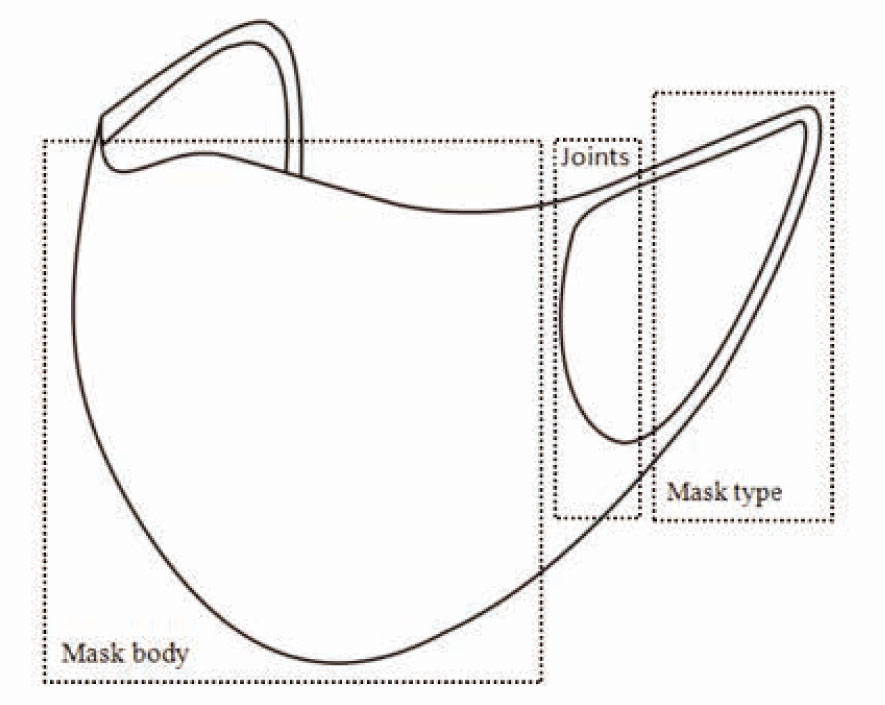
An example of a mask prototype.
4.3 The established knowledge base of masks
The conceptual relationship between aesthetic descriptive space and functional descriptive space, as shown in Figure 3, is based on the result of Experiments I, II, and III.
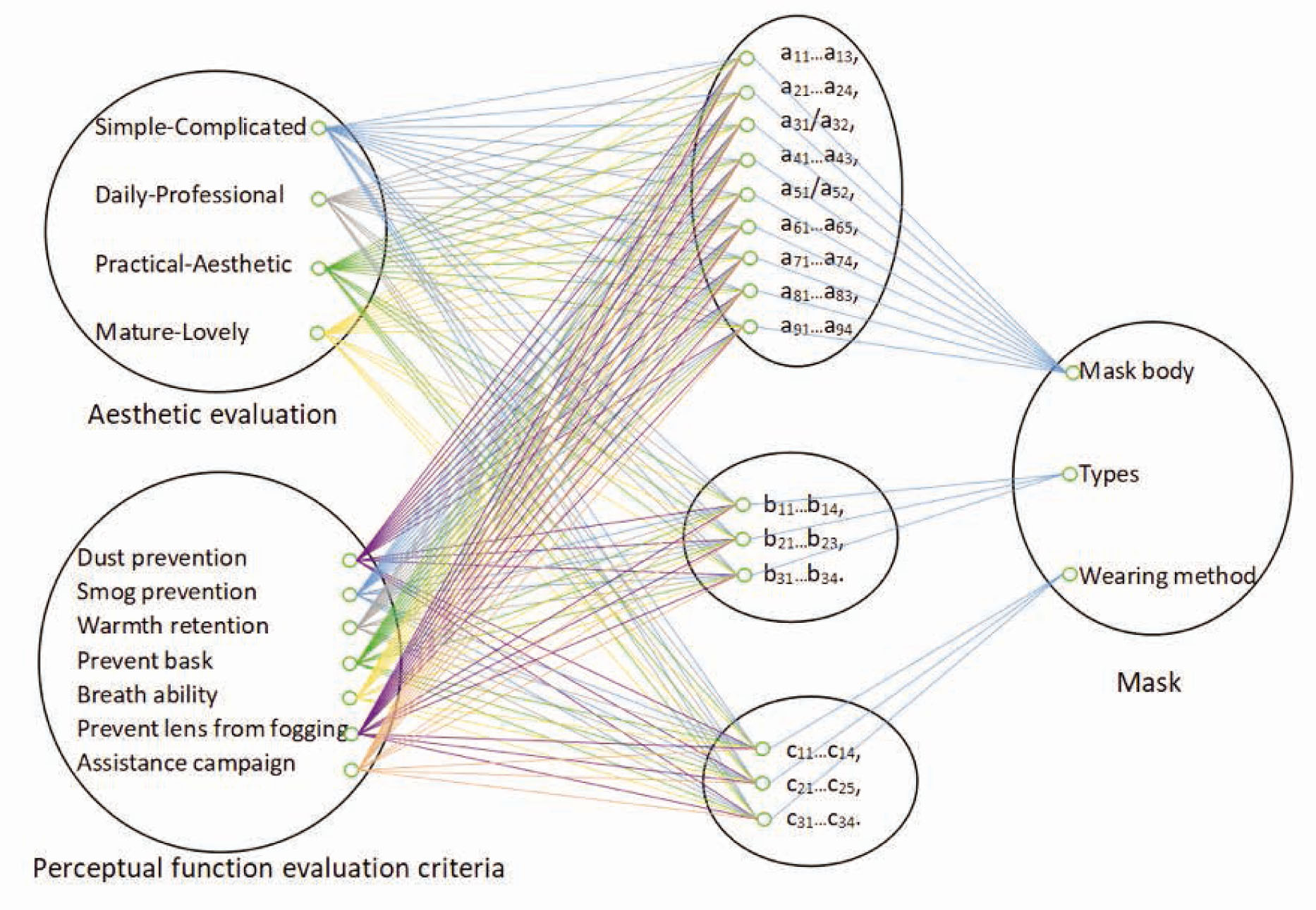
The corresponding relationship between different states of each element and demands’ evaluation criteria.
Because of the involved data is full of uncertainty and imprecision, we used the fuzzy tools to analyze and model the data. In this research, triangular fuzzy numbers (TFNs), as a classic fuzzy tool is employed. The involved evaluation criteria and their corresponding fuzzy numbers are shown in Table 6.
The evaluation results are represented by TFN Aij. We assume that N(Fc) (c = 1, 2, 3, ..., 7) is the number of participating experts of each evaluation result
where i denotes the form element, i = 1, 2, ..., b; j denotes the corresponding perceptual image, j = 1, 2, ..., l. For example, the states of “No front opening” which is one of the elements of masks suppose that 20 experts are invited. Among them, 15 of them think that the feeling is “Extremely Simple,” 4 of them think that it is “Very simple,” 1 of them thinks that it is “Extremely complicated,” and the perceptual image of “No front opening” in the dimension of “Simple-Complicated” can be expressed by TFN:
Its perceptual image is between “extremely simple” and “very simple.” Using this method, the different states of each element of the masks were scored under different criteria.
5 Validation
We also experimented the validation of the proposed knowledge base. Another group of 20 designers is invited and involved in the validation experiment. The purpose of the validation experiment is to verify the rationality of the knowledge base by comparing the similarity of the results of two different times. The three experiments are carried out again. Fuzzy similarity measurement tools are employed in the calculation of the results between two times.
If there are two TFNs
For making significant comparisons, we formalize the distance or dissimilarity between
Therefore, the similarity between
For example, as explained in Section 3, the perceptual image of “No front opening” in the dimension of “Simple-Complicated” defined in Group 1 is (0.25, 0.55, and 1.55), and the result offered by Group 2 is (0.24, 0.56, and 1.58), in this condition, the similarity degree is defined as:
Using this method, all the similarities between two times of results are defined, and the average similarity of the results of the two different times is 96.7%. The similarity results show that the knowledge base developed in this research is reliable.
6 Conclusion
In this article, a mask design knowledge base is developed based on a sensory evaluation and fuzzy logic integrated method. A perceptual descriptive space of mask is developed for the description of both functional and aesthetic perceptions of the mask. The mask ontology is also developed to form the mask element matrix. The relationship between the perceptual descriptive space and the mask ontology is extracted by a group of experienced designers through a sensory evaluation procedure. In this process, professional mask design knowledge is extracted. This relationship is then simulated by fuzzy logic tools. The proposed knowledge base has been validated, which can be further applied to an automatic mask design system.
References
[1] Hong, Y., Chen, Y., Cao, X., Zeng, X. (2018). Framework of consumer perceived value on fashion products for female college students in France. Industria Textila, 69, 495–501.10.35530/IT.069.06.1408Search in Google Scholar
[2] Hong, Y., Bruniaux, P., Curteza, A., Liu, K., Zeng, X., et al. (2018). Visual-simulation-based personalized garment block design method for physically disabled people with scoliosis (PDPS). Autex Research Journal,18, 35–45.10.1515/aut-2017-0001Search in Google Scholar
[3] Hong, Y., Zeng, X., Wang, Y., Bruniaux, P., Chen, Y. (2018). CBCRS: An open case-based color recommendation system. Knowledge-Based Systems, 141, 113–128.10.1016/j.knosys.2017.11.014Search in Google Scholar
[4] Zhang, J. J., Liu, K., Dong, M., Zeng, X., Hong, Y. (2018). Jeans knowledge base development based on sensory evaluation technology for customers’ personalized recommendation. Emerald Insight, 30, 101–111.10.1108/IJCST-03-2017-0036Search in Google Scholar
[5] Pu, L. Z., Wagner, M., Abteu, M., Hong, Y., Wang, P. (2018). Raincoat design for children for age group 7–8 years: A design development case study. Industria Textile, 69, 394–399.10.35530/IT.069.05.1471Search in Google Scholar
[6] Xue, Z., Zenga, X., Koehla, L., Chenb, Y. (2014). Measuring consistency of two datasets using fuzzy techniques and the concept of indiscernibility: Application to human perceptions on fabrics. Engineering Applications of Artificial Intelligence, 36, 54–63.10.1016/j.engappai.2014.07.010Search in Google Scholar
[7] Chen, X., Zeng, X., Boulenguez-Phippen, J., Tao, X., Koehi, L. (2015). Control and optimization of human perception on virtual garment products by learning from experimental data. Knowledge-Based Systems, 87, 92–101.10.1016/j.knosys.2015.05.031Search in Google Scholar
[8] Zhu, Y., Zeng, X., Koehl, L., Lageat, T., Charbonneau, A., et al. (2010). A general methodology for analyzing fashion oriented textile products using sensory evaluation. Food Quality and Preference, 21, 1068–1076.10.1016/j.foodqual.2010.07.014Search in Google Scholar
[9] Xue, Z., Zeng, X., Koehl, L., Shen, L. (2016). Interpretation of fabric tactile perceptions through visual features for textile products. Journal of Sensory Studies, 31, 143–162.10.1111/joss.12201Search in Google Scholar
[10] Hong, Y., Bruniaux, P., Zeng, X., Curteza, A., Liu, K. (2017). Design and evaluation of personalized garment block design method for atypical morphology using the knowledge supported virtual simulation method. Textile Research Journal, 88, 1721–1734.10.1177/0040517517708537Search in Google Scholar
[11] Hong, Y., Zeng, X., Bruniaux, P., Chen, Y., Zhang, X. (2017). Development of a new knowledge-based fabric recommendation system by integrating the collaborative design process and multi-criteria decision support. Textile Research Journal, 88, 2682–2698.10.1177/0040517517729383Search in Google Scholar
© 2021 Yan Hong et al., published by Sciendo
This work is licensed under the Creative Commons Attribution 4.0 International License.
Articles in the same Issue
- Defect Detection of Printed Fabric Based on RGBAAM and Image Pyramid
- Hydrophilization of Polyester Textiles by Nonthermal Plasma
- Prediction of Sewing Thread Consumption for Over-Edge Stitches Class 500 Using Geometrical and Multi-Linear Regression Models
- Experimental Investigation of the Properties of Laminated Nonwovens Used for Packaging of Powders in Mineral Warmers
- An Approach to Estimate Dye Concentration of Domestic Washing Machine Wastewater
- Moisture and Thermal Transport Properties of Different Polyester Warp-Knitted Spacer Fabric for Protective Application
- Quick Detection of Aldehydes and Ketones in Automotive Textiles
- Identification of Miao Embroidery in Southeast Guizhou Province of China Based on Convolution Neural Network
- Effect of Temperature on the Structure and Filtration Performance of Polypropylene Melt-Blown Nonwovens
- Analysis of Mechanical Properties of Unidirectional Flax Roving and Sateen Weave Woven Fabric-Reinforced Composites
- Development of Mask Design Knowledge Base Based on Sensory Evaluation and Fuzzy Logic
- Preparation of Polypyrrole/Silver Conductive Polyester Fabric by UV Exposure
- A New Approach for Thermal Resistance Prediction of Different Composition Plain Socks in Wet State (Part 2)
- Analyzing Thermophysiological Comfort and Moisture Management Behavior of Cotton Denim Fabrics
- Comparison of the Effects of the Cationization of Raw, Bio- and Alkali-Scoured Cotton Knitted Fabric with Different Surface Charge Density
Articles in the same Issue
- Defect Detection of Printed Fabric Based on RGBAAM and Image Pyramid
- Hydrophilization of Polyester Textiles by Nonthermal Plasma
- Prediction of Sewing Thread Consumption for Over-Edge Stitches Class 500 Using Geometrical and Multi-Linear Regression Models
- Experimental Investigation of the Properties of Laminated Nonwovens Used for Packaging of Powders in Mineral Warmers
- An Approach to Estimate Dye Concentration of Domestic Washing Machine Wastewater
- Moisture and Thermal Transport Properties of Different Polyester Warp-Knitted Spacer Fabric for Protective Application
- Quick Detection of Aldehydes and Ketones in Automotive Textiles
- Identification of Miao Embroidery in Southeast Guizhou Province of China Based on Convolution Neural Network
- Effect of Temperature on the Structure and Filtration Performance of Polypropylene Melt-Blown Nonwovens
- Analysis of Mechanical Properties of Unidirectional Flax Roving and Sateen Weave Woven Fabric-Reinforced Composites
- Development of Mask Design Knowledge Base Based on Sensory Evaluation and Fuzzy Logic
- Preparation of Polypyrrole/Silver Conductive Polyester Fabric by UV Exposure
- A New Approach for Thermal Resistance Prediction of Different Composition Plain Socks in Wet State (Part 2)
- Analyzing Thermophysiological Comfort and Moisture Management Behavior of Cotton Denim Fabrics
- Comparison of the Effects of the Cationization of Raw, Bio- and Alkali-Scoured Cotton Knitted Fabric with Different Surface Charge Density
