Book Review
-
Giuliani Gaston

Reviewed Publication:
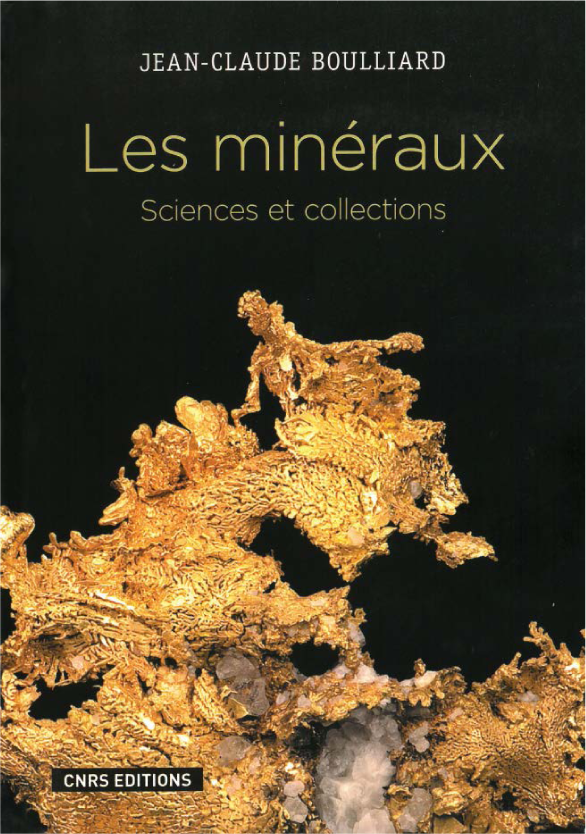
Book review: Les Minéraux: Sciences et collections. ( 2016 ) By Boulliard J.-Cl.. CNRS Editions. ISBN: 978-2-271-09059-1, 608 p. 49€ Hardback.
The book Les Minéraux: Sciences et collections written in French by Jean-Claude Boulliard, teacher-researcher and head of the collection of minerals at the Institute of Mineralogy, Material Physics and Cosmochemistry at the University Pierre-et-Marie-Curie-Sorbonne Universities, Paris, has as its purpose to fill the gap between the scientific world and that of collectors of minerals, either enthusiastic lay persons, connoisseurs, or professionals. In the introduction, the author provides an overview of the book with criticism and explanations about the choices used for the description of the main minerals species as well as for their classification and choice of geographic locations. Each mineral description is illustrated by high-quality and beautiful photos, and the minerals are almost exclusively from the Museum of the University Pierre-et-Marie-Curie-Sorbonne collection and curated by Alain Jeanne-Michaud.
The book includes two parts, which are very different in terms of contents and packaging.
The volume begins with a section entitled Mineralogical milestone: twenty questions and their answers with the purpose to allow different types of collector to master the culture of mineralogical collections with state-of-the-art mineral knowledge. Each chapter within the section contains answers to questions commonly asked by those from different groups, including the layman, novice, connoisseur, and collector. These include questions like: What is a mineral? How do minerals form? How are minerals classified? What is a crystal? How do we analyze a crystal? Are some minerals dangerous? What about the authenticity of minerals? What is a mineral collection? History of collections? Value of a collection?
The answers to these questions are covered in 156 pages in four chapters of different lengths and, as to be expected, there is some repetition from one chapter to another. Generally, additional references are proposed for getting more detailed information. The chapters dedicated to metallogenesis, crystallography, and classification of minerals are more advanced and may be unsuitable for novices. The photographs are of excellent quality, but sometimes there is no scale and some drawings would merit more explanation. The chapter dedicated to collectors is very interesting in terms of history, motivation for building a collection, choice of the minerals, values, and appreciation of the minerals. This chapter is a novel reference in the French mineralogical literature because it includes the cultural heritage and values of the objects connected to the mineralogical collections.
The second section of the book, simply entitled Les Minéraux, describes around 280 important mineral species and is devoted to collections. The minerals are organized following the IMA classification. The description starts with native elements, then halides followed by oxides-hydroxides, sulfides, sulfates, chromates-molybdates-tung-states, borates, carbonates, phosphates-vanadates-arsenates, silica and silicates, and finally organics.
For each class, different features of specific interest for collection minerals are described, and for this reason the book is a pioneering work for collectors from France and French-speaking countries. Included are the origin and type of deposit (geology, location, and history of discoveries), desirability and assessment in terms of market and quotation, rarity and esthetic, and technical considerations like determination, conservation, treatments, and forgery. The photographic illustrations of high-quality specimens are all from the Museum of the University Pierre-et-Marie-Curie-Sorbonne. Some questions arise about the style of French writing because the author has respected the IMA rules, which are very different from what is taught at French universities, especially for accents on the mineral names that may be somewhat unsettling for students and researchers. There are some typographic mistakes, and the small typesetting makes the reading of some technical passages unnecessarily difficult.
In summary, this is a good and well-illustrated encyclopedic book, i.e., referring to the second part of the volume, that represents a starting point for mineral classification and description intended for collectors including enthusiastic lay persons exchanging minerals, connoisseurs, and professionals. In that sense it is a pioneering work written in French for collectors and traders. It is also a textbook for upper class undergraduate and graduate student courses. Additionally, the two parts of the monograph would be useful for French research scientists with a confirmed knowledge in crystallography, mineralogy, and metallogeny.
© 2018 Walter de Gruyter GmbH, Berlin/Boston
Articles in the same Issue
- Highlights and Breakthroughs
- The tales of disequilibrium and equilibrium crystallization of rare metal minerals: Data from new experiments
- Pressure, temperature, water content, and oxygen fugacity dependence of the Mg grain-boundary diffusion coefficient in forsterite
- Questioning the biogenicity of Neoproterozoic superheavy pyrite by SIMS
- The effect of disequilibrium crystallization on Nb-Ta fractionation in pegmatites: Constraints from crystallization experiments of tantalite-tapiolite
- Titanite major and trace element compositions as petrogenetic and metallogenic indicators of Mo ore deposits: Examples from four granite plutons in the southern Yidun arc, SW China
- Kuliginite, a new hydroxychloride mineral from the Udachnaya kimberlite pipe, Yakutia: Implications for low-temperature hydrothermal alteration of the kimberlites
- Electron microprobe technique for the determination of iron oxidation state in silicate glasses
- Experimental investigation of F and Cl partitioning between apatite and Fe-rich basaltic melt at 0 GPa and 950–1050 °C: Evidence for steric controls on apatite-melt exchange equilibria in OH-poor apatite
- Carbonic acid monohydrate
- High spatial resolution analysis of the iron oxidation state in silicate glasses using the electron probe
- Disturbance of the Sm-Nd isotopic system by metasomatic alteration: A case study of fluorapatite from the Sin Quyen Cu-LREE-Au deposit, Vietnam
- Segerstromite, Ca3(As5+O4)2[As3+(OH)3]2, the first mineral containing As3+(OH)3, the arsenite molecule, from the Cobriza mine in the Atacama Region, Chile
-
Vestaite, (Ti4+Fe2+)
- Decomposition boundary from high-pressure clinoenstatite to wadsleyite + stishovite in MgSiO3
- Letter
- Making tissintite: Mimicking meteorites in the multi-anvil
- Book Review
Articles in the same Issue
- Highlights and Breakthroughs
- The tales of disequilibrium and equilibrium crystallization of rare metal minerals: Data from new experiments
- Pressure, temperature, water content, and oxygen fugacity dependence of the Mg grain-boundary diffusion coefficient in forsterite
- Questioning the biogenicity of Neoproterozoic superheavy pyrite by SIMS
- The effect of disequilibrium crystallization on Nb-Ta fractionation in pegmatites: Constraints from crystallization experiments of tantalite-tapiolite
- Titanite major and trace element compositions as petrogenetic and metallogenic indicators of Mo ore deposits: Examples from four granite plutons in the southern Yidun arc, SW China
- Kuliginite, a new hydroxychloride mineral from the Udachnaya kimberlite pipe, Yakutia: Implications for low-temperature hydrothermal alteration of the kimberlites
- Electron microprobe technique for the determination of iron oxidation state in silicate glasses
- Experimental investigation of F and Cl partitioning between apatite and Fe-rich basaltic melt at 0 GPa and 950–1050 °C: Evidence for steric controls on apatite-melt exchange equilibria in OH-poor apatite
- Carbonic acid monohydrate
- High spatial resolution analysis of the iron oxidation state in silicate glasses using the electron probe
- Disturbance of the Sm-Nd isotopic system by metasomatic alteration: A case study of fluorapatite from the Sin Quyen Cu-LREE-Au deposit, Vietnam
- Segerstromite, Ca3(As5+O4)2[As3+(OH)3]2, the first mineral containing As3+(OH)3, the arsenite molecule, from the Cobriza mine in the Atacama Region, Chile
-
Vestaite, (Ti4+Fe2+)
- Decomposition boundary from high-pressure clinoenstatite to wadsleyite + stishovite in MgSiO3
- Letter
- Making tissintite: Mimicking meteorites in the multi-anvil
- Book Review
