The interaction of delignification and fiber characteristics on the mechanical properties of old corrugated container fiber/polypropylene composite
-
Pouria Rezaee Niaraki
 ,
Ahmad Jahan Latibari
,
Ahmad Jahan Latibari

Abstract
The effect of fiber characteristics from old corrugated container (OCC) paper on the strength properties of OCC/polypropylene composites was evaluated. Fibers with different contents of lignin (2.8%, 3.8%, 5.3%, and 7%) were produced using soda pulping. Wettability, tear, and tensile strength of the fibers were measured as the indication factors to assess the strength of reinforcing component in the composites. The weight portions of the OCC fibers, polypropylene, and maleic anhydride-grafted polypropylene (MAPP) were selected at 20%, 77%, and 3% of the total weight of the composite, respectively. The composite compounds were formed using a counter-rotating twin screw extruder, and the specimens were made in an injection molding machine. The interaction of fiber characteristics and fiber lignin content on the mechanical properties of composite was investigated. The results revealed that with lower fiber lignin content, both flexural and tensile properties were increased. Consequently, by forming better fiber dispersion and by reducing stress regions in the composite, impact strength was also improved. Lower lignin content resulted in better mechanical properties than fiber characteristics.
1 Introduction
Composite materials, as a combination of two or more components in any form or application, have been used since ancient times. New and advanced composites, however, have been developed and used to utilize the advantages of the beneficial properties of each component and to eliminate the weakness and limitation of the components used. These new materials often exhibit more useful properties than its components alone. Natural fiber-reinforced composites resulting from the compounding of cellulosic material with thermoplastic polymer matrices have been developed to take advantage of the large quantity, annual renewability, low cost, light weight, excellent and competitive specific strength, and environmental friendliness of such material [1, 2].
In general, in the course of wood-plastic composite development and application, a wide range of lignocellulosic materials have been investigated by many research groups as fillers and/or reinforcing components for plastic matrices. These lignocellulosic materials include wood powder and fibers, hemp fibers, linens, corn stalks, coconut shells, peanuts shells, wheat, and rice straw [1, 3].
Wood fiber-reinforced composites are anisotropic and heterogeneous materials, which allow greater flexibility in engineering the composite properties to the requirements of the final use [4, 5]. The processing of such composite material is flexible, economical, and ecological, and it is possible to use the same equipment used with either wood or plastics [6, 7]. Unfortunately, the frequent incompatibility between polar fibers and nonpolar polymeric matrices affects the degree of dispersion of the fibers within the matrix and the overall homogeneity of the composite structure. It is believed that the hydrophobic characteristics of the polymers and the hydrophilic behavior of the natural fibers will interfere with the bonding between these compounds. Therefore, the use of compatibilizers in natural fiber-reinforced polymer composites is required to improve the poor interfacial attraction between the hydrophilic fiber and the hydrophobic polymer matrix [1, 8]. A vast quantity of research on wood fiber-reinforced composites has focused on the improvement of the interfacial interaction and the adhesion between the wood fibers and the plastic matrices by enhancing the dispersion of the fibers into the polymer matrix [5, 6, 9].
During the last decades, most of the experiments on natural fiber-reinforced composites have been on the use of wood and other lignocellulosic material flour, and even in cases in which natural fibers are used, those fibers have been virgin pulp fibers. These types of the fibers are expensive. Moreover, the supply is limited, and the consumer must compete with the paper industry. OCC fibers, as a source of recycled fibers, are abundant and available at low cost, which confirms with the needed low-cost raw material for natural fiber/polymer composites.
Among wood components, carbohydrates are hydrophilic, and lignin is considered to be hydrophobic. Therefore, the various aspects of lignin in strength development and the antioxidative effects of lignin in natural fiber-reinforced polymer composites have been investigated [10–12]. Alexy et al. [11] investigated the blend of lignin with polypropylene and determined that the addition of lignin increased the strength and thermal resistance and oxidative properties of the composite. However, Karimi et al. [13] used kraft pulp fibers with different degrees of delignification and noted that fibers with lower lignin content produced composites with higher mechanical properties. These authors concluded that the hydrophobic nature of lignin prevents either chemical or physical (molecular interaction) bonding between natural fibers and polypropylene [14]. Literature shows that the application of OCC fibers in composite production is not available.
The impact of lignin on the interfacial behavior of natural fiber-polymer composites and the global interest in material recycling, especially paper and wood products, necessitates the development of alternative procedures for using recycled material in the production of value-added products, including natural fiber-plastic composites. The objective of this study was therefore directed toward the modification of old corrugated container (OCC) fibers to obtain different contents of lignin, fiber wettability, and strengths and the effect of such modification on the strength of cellulosic fiber-polypropylene composites.
2 Materials and methods
2.1 Materials
OCCs were collected from a corrugated board production plant. Polypropylene was purchased from Maron Petrochemical Co. with a density of 0.87 g/cm3 and a melt flow index of 7–10 g/10 min. Maleic anhydride-grafted polypropylene (MAPP) manufactured by Sigma-Aldrich was used as a coupling agent. The coupling agent contained 1% (wt/wt) grafted maleic anhydride and had a melt flow index of 11 g/10 min, a density of 0.91 g/cm3, and a viscosity of 4.0 poise at 190°C. Mn and Mw were 3900 (GPC) and 9100 (GPC), respectively.
The respective weight portions of the OCC fibers, polypropylene, and MAPP were selected at 20%, 77%, and 3% of the total weight of the composite.
2.2 Pulping (delignification)
A sufficient quantity of OCC was first cut into small pieces (40×40 mm2) and stored in polyethylene bags until use. The OCC pieces were slushed in water using a laboratory mixer to reach uniform suspension and then thoroughly washed. The fiber slurry was dewatered using a 30-mesh screen followed by hand pressing to reach 25% dryness before soda cooking. Soda pulping was used to generate fibers with different contents of lignin. Fibers were cooked using 16% NaOH at a constant pulping temperature of 170°C. The various pulping times to reach different degrees of delignification were 10, 30, 70, and 120 min. The lignin content of the fibers was determined based on the kappa number measurement according to TAPPI T236 om-85 [15]. The cooked fiber suspension was screened, and the fiber retained on the 30-mesh screen was used as the reinforcing material in the composites. The collected fibers were air-dried and then fluffed, followed by drying in an air circulation oven at 103°C±2°C to reach the 2% moisture content required for compounding.
2.3 Compounding and sample preparation
A direct extrusion blending procedure was used in which all components of the composite were mixed simultaneously. The required amount of each component was weighed and mixed using Dr. Collin’s counter-rotating twin screw extruder (Collin-Zk50, Germany) with a mixing temperature profile of 155°C–190°C in different sections of the extruder at a rotational speed of 60 rpm. The extrudate produced was cooled to room temperature and then ground to produce granules for further processing. Grinding was conducted in a laboratory mill (Wieser, WG-LS 200/200, Germany), and the granulated material was cooled to 85°C before injection molding.
An injection molding machine (Imen-Machine Co., Iran) set at 150°C, 160°C, or 165°C was used to prepare the test samples. With each molding operation, a complete set of specimens for different tests were produced.
2.4 Strength and wetting evaluation
The specimens were conditioned at 65±5% relative humidity and 20°C±5°C for 2 weeks before testing. Standard test methods used were as follows: ASTM D 638 [16] for tensile strength and modulus, ASTM D 790 [17] for three-point flexural strength and modulus, and ASTM D 256 [18] for impact strength. Instron 4486 universal testing machine was used for strength determination.
The tensile and tear indices of the 50-g/m2 fiber hand sheets were used to indicate the fiber inherent strength and the bonding potential. The tensile strength index and the tear strength index of the hand sheets were determined according to TAPPI T410 om-88 and T411 om-89 [15], respectively.
The wetting behavior of the fibers was determined using water rise in a capillary glass tube with a diameter of 3 mm. The water rise after 90 min at room temperature was measured and recorded for the four different fibers with different lignin contents.
2.5 Statistical analysis
Analysis of variance (ANOVA) was used for statistical analysis of the results. When the ANOVA showed a statistically significant difference between the averages, Duncan’s multiple range test was used to group the averages.
3 Results and discussion
The results of the strength measurements on the composites produced incorporating OCC fibers with different contents of lignin and polypropylene are illustrated in Figures 1–4. Each value in the figures is the average of four measurements. The data are compared with the samples produced using OCC fibers without any chemical treatment to change the surface characteristics of the fibers (non-delignified samples). The presence of lignin either in or on the surface of the fibers generated different fiber wettabilities and varied strength properties. The zero-span tensile strength of the hand sheets is considered to be an indication of the strength of single fibers. However, because the apparatus to determine the zero-span strength was not available in this experiment, the tear and tensile strengths of the 50-g/m2 hand sheets were measured as indicators of fiber inherent strength and bonding potential. Depending on the type of lignin, it is usually hydrophobic as compared with cellulose [19, 20]. Therefore, as the lignin content of the fibers increases, the wetting potential of the fibers decreases. To eliminate the impact of fiber length on the strength properties of the composites, different fibers were screened using the 30-mesh screen to eliminate the fines and short fibers. In addition, because the surface morphology of the fibers also influences the bonding [21], different types of fibers with varying amount of lignin were kept at the same freeness level. In this condition, the fiber morphology will be identical for different samples having different contents of lignin.

Influence of OCC fiber characteristics on the tensile and flexural strengths of OCC fiber/polypropylene composites.

Influence of OCC fiber characteristics on the wetting potential, tensile strength index, and tear strength index.

Influence of OCC fiber characteristics on the tensile and flexural modulus of elasticity of OCC fiber/polypropylene composites.

Influence of OCC fiber characteristics on the impact strength of OCC fiber/polypropylene composites.
It is believed that the hydrophobic characteristics of the polymers and the hydrophilic behavior of the natural fibers interfere with bonding between these compounds [13, 19]. Therefore, if the surface of the natural fibers is hydrophobic, then the bonding potential between the natural fibers and the polypropylene may be enhanced [1, 22]. On the contrary, however, higher lignin content and consequently lower wetting potential did not improve the strength of the composite. In addition, at higher lignin content and lower wettability, lower composite strength values were reached. However, a positive correlation between fiber wettability and composite strength was observed.
As either the tensile strength or the tear strength of the fibers increases, as measured by tear and tensile strength of thin hand sheets of the paper, a marginal reduction in tensile and flexural strength of the composite was observed, and at the higher end of the strength of the fibers, again an improvement is observed (Figures 1 and 2). The results indicate that the strength and the bonding potential of the reinforcing component of the composite are more important than the surface characteristics of the fiber with respect to strength development [6, 13, 23]. However, the importance of fiber/matrix compatibility must be taken into consideration. In the case of higher lignin content, SEM micrograph shows the fiber pull out, and for lower lignin, we see fracture surface without fiber pull out (Figure 5).
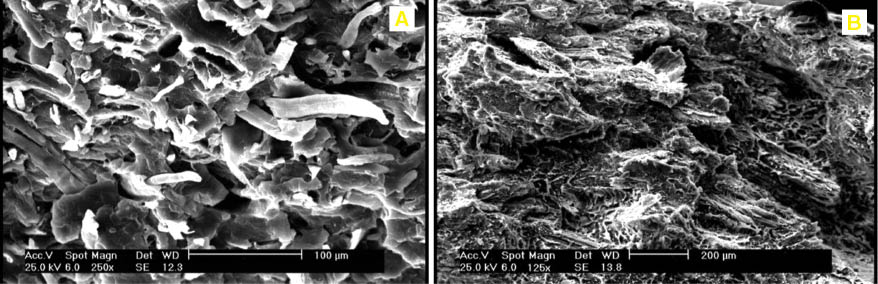
SEM micrograph of the fracture surfaces of the composite samples used for tensile strength measurements. (A) Non-delignified sample showing fibers pulled out of the matrix. (B) Sample with 2.8% lignin showing the fracture without any fiber pulled out.
As shown in Figure 1, the results revealed that by decreasing fiber lignin content, both flexural and tensile strengths were increased. Delignified fiber transferred the stress more efficiently than original fiber. This phenomenon resulted in higher flexural and tensile strengths because of the improvement of the adhesion and the nature of the fiber/matrix interface [24]. As lignin is also one of the three main components of wood structure, by highly more delignification, the lack of this element is getting tangible, and both tensile and tear strengths of fiber reach into their the minimum range (Figure 2) [13]. According to Alexy et al. [11], lignin acts mainly in polypropylene as a processing stabilizer. In this research, we have also concluded that highly delignification can be destructive and would have a negative effect on composite degradation. However, the influence of the fiber type on the tensile modulus of elasticity and especially on the flexural modulus of elasticity was more pronounced (Figure 3).
The impact strengths of composite are illustrated in Figure 4. By decreasing lignin content and enhancing wettability, impact strengths were increased. The impact strengths of the composites produced using fibers with the lowest lignin content and the highest wettability were higher than the composites produced with higher lignin content and lower wettability. The incompatibility of the fibers with the matrix deteriorated the bond formation between the matrix and the fibers. At lower bonding between the fibers and the matrix, the unbonded areas initiate the stress concentration upon loading and cause subsequent failure at lower loadings [25]. The presence of fillers in the function of composite decrease the impact strength of the composite because stiffer cellulose fibers will act as stress concentrators in the polymer matrix, thus reducing the crack initiation energy and consequently the impact strengths of the composite [26].
These findings are similar to those of Nygard et al. [27], who mentioned the presence of lignin as a retaining parameter to form interfacial bonds in composite and declared that the introduction of reinforcement will introduce weak interfacial regions and stress concentration at fiber ends in general and thereby decrease impact strength.
4 Conclusions
In a bonding process such as bonding between cellulosic fibers and polypropylene, various factors are influential. Fiber morphology, chemical characteristics, and wetting have been among the important variables. In this work, the effect of OCC fiber characteristics with different contents of lignin (2.8%, 3.8%, 5.3%, and 7%), different wetting behaviors, and different fiber strengths on the strength properties of OCC/polypropylene composites was evaluated. The results have been enumerated as follows:
In the presented study, wettability was also measured to evaluate interfacial bonding between natural fibers and polypropylene composite. It was found that fibers with lower lignin content and higher wettability produced higher composite strengths values. This finding implies that wettability can also be considered as an effective factor in adhesion properties of wood plastic composites. The interaction between fiber chemical and physical characteristics should also be considered as important factors.
The tear and tensile strength of delignified fibers are lower than the fibers before delignification, which is the consequence of chemicals affecting fiber integrity. The strength of delignified fibers reduces as the lignin content increases. Although the strength of delignified fibers is lower than that of non-delignified fibers, the strength of composites made of these fibers is higher. Of course, a linear trend was not observed. Because the equipment to measure single fiber strength is not available in different laboratories, tensile and tear strengths of 50-g/cm2 hand sheets are used as the indication of bonding between fibers and the inherent strength of the fibers making the sheets. Because the lignin content of the fibers also influences the bond strength between the fibers, the exact correlation between hand sheet strength properties and composite strength was not observed, which indicates the impact of other variables.
In contrast to carbon or glass fiber-reinforced composite, in cellulosic fiber plastic composites, it is believed that while compounding and mixing the components, polymer penetrates into the structure of the fibers, which not only reduces the influence of the fiber morphology but also limits the impact of other variables that have been investigated in this study.
Acknowledgments
The authors are grateful for the support of the Department of Wood and Paper Science and Technology, Karaj Branch, Islamic Azad University, Karaj, Iran.
References
[1] Yao F, Lei Wu Q. Ind. Crop. Prod. 2008, 28, 63–72.10.1016/j.indcrop.2008.01.007Search in Google Scholar
[2] Rashno A, Mohebi Damabi R, Ahmadi S. J. Reinf. Plast. Comp. 2014, 33, 1294–1304.10.1177/0731684414528596Search in Google Scholar
[3] Woohhams R, Shiang L, Balatinecz J. Wood Plastic Composites Conference, Madison, WI, USA, 1991.Search in Google Scholar
[4] Muszynski L. BioResources 2009, 4, 1210–1221.10.15376/biores.4.3.1210-1221Search in Google Scholar
[5] Zhang H, Rizvi GM, Park CB. Adv. Polym. Tech. 2004, 23, 263–276.10.1002/adv.20016Search in Google Scholar
[6] Martí-Ferrer F, Vilaplana F, Ribes-Greus A. J. Appl. Polym. Sci. 2006, 99, 1823–1831.10.1002/app.22717Search in Google Scholar
[7] Bledzki AK, Faruk O. Compos. Sci. Technol. 2004, 64, 693–700.10.1016/S0266-3538(03)00291-4Search in Google Scholar
[8] Cuia Y, Leeb S, Noruziaanc B. Compos. Part A-Appl. S. 2008, 39, 655–661.10.1016/j.compositesa.2007.10.017Search in Google Scholar
[9] Liu T, Lei Y, Wang Q. BioResources 2013, 8, 4619–4632.10.15376/biores.8.3.4619-4632Search in Google Scholar
[10] Gregorováa A, Cibulkováb Z, Košíkováa B. Polym. Degrad. Stabil. 2005, 89, 553–558.10.1016/j.polymdegradstab.2005.02.007Search in Google Scholar
[11] Alexy P, Košíková B, Podstránska G. Polymer 2000, 41, 4901–4908.10.1016/S0032-3861(99)00714-4Search in Google Scholar
[12] Canetti M, Bertini F, Chirico AD. Polym. Degrad. Stabil. 2006, 91, 494–498.10.1016/j.polymdegradstab.2005.01.052Search in Google Scholar
[13] Karimi A, Nazari S, Ghasemi I. J. Appl. Polym. Sci. 2006, 102, 4759–4763.10.1002/app.23967Search in Google Scholar
[14] Li X, Tabil LG, Panigrahi S. J. Polym. Environ. 2007, 15, 25–33.10.1007/s10924-006-0042-3Search in Google Scholar
[15] Industry TAoPaP. Standard Test Method to Measure Tensile and Tear Strength of the Paper, TAPPI Press: Atlanta, GA, USA, 2010.Search in Google Scholar
[16] Material ASoTa. Annual Book of ASTM Standards. ASTM D638 – Standard Test Method for the Determination of Tensile Properties of Plastics, Philadelphia, PA, USA, 2008.Search in Google Scholar
[17] Material ASoTa. Annual Book of ASTM Standards. ASTM D790 – Standard Test Method for the Determination of Flexural Properties of Plastics, Philadelphia, PA, USA, 2008.Search in Google Scholar
[18] Material ASoTa. Annual Book of ASTM Standards. ASTM D256 – Standard Test Method for the Determination of the Azod Pendulum Impact Resistance of Plastics, Philadelphia, PA, USA, 2008.Search in Google Scholar
[19] Kim HS, Lee BH, Choi SW, Kim S, Kim HJ. Compos. Part A-Appl. S. 2007, 38, 1473–1482.10.1016/j.compositesa.2007.01.004Search in Google Scholar
[20] Pouteau C, Dole P, Cathala B, Averous L, Boquillon N. Polym. Degrad. Stab. 2003, 81, 9–18.10.1016/S0141-3910(03)00057-0Search in Google Scholar
[21] Beg MDH, Pickering KL. Compos. Part A-Appl. S. 2008, 39, 1748–1755.10.1016/j.compositesa.2008.08.003Search in Google Scholar
[22] Gown J, Lee SY, Chun SJ, Doh GH, Kim JH. Korean J. Chem. Eng. 2010, 27, 651–657.10.1007/s11814-010-0058-1Search in Google Scholar
[23] Bledzki AK. J. Cell. Plast. 2006, 42, 77–88.10.1177/0021955X06060946Search in Google Scholar
[24] Stark NM, Rowlands RE. Wood Fiber Sci. 2003, 35, 167–174.10.1016/B978-012472531-7/50060-3Search in Google Scholar
[25] Yuan Q, Misra RDK. Polymer. 2006, 47, 4421–4433.10.1016/j.polymer.2006.03.105Search in Google Scholar
[26] Bengtsson M, Baillif ML, Oksman K. Compos. Part A-Appl. S. 2007, 38, 1922–1931.10.1016/j.compositesa.2007.03.004Search in Google Scholar
[27] Nygard P, Tanem BS, Karlsen T. Compos. Sci. Technol. 2008, 38, 3418–3424.10.1016/j.compscitech.2008.09.029Search in Google Scholar
©2017 Walter de Gruyter GmbH, Berlin/Boston
This article is distributed under the terms of the Creative Commons Attribution Non-Commercial License, which permits unrestricted non-commercial use, distribution, and reproduction in any medium, provided the original work is properly cited.
Articles in the same Issue
- Frontmatter
- Original articles
- Micro-XCT-based finite element method for predicting the elastic modulus of needle carbon-fiber-reinforced ceramic matrix composites
- A comparative analysis of evolutionary algorithms in the design of laminated composite structures
- Study on the impact of Fe2P phase on the electrochemical performance of LiFePO4
- Improved hydration resistance of magnesia by EDTA and ammonium phosphate as additives
- The interaction of delignification and fiber characteristics on the mechanical properties of old corrugated container fiber/polypropylene composite
- The effects of thermal residual stresses and interfacial properties on the transverse behaviors of fiber composites with different microstructures
- Impact response characterization of shear CFRP strengthened RC beams by Fourier and wavelet methods: tests and analyses
- Nanoscale investigation of polymer cement concretes by small angle neutron scattering
- Design of a compact UWB antenna with a partial ground plane on epoxy woven glass material
- Preparation of polyimide-graphite composite and evaluation of its friction behavior at elevated temperatures
- Finite element analysis of mechanical properties of woven composites through a micromechanics model
- Tensile strength of Z-pinned laminates in RTD and hot-wet environment
- Free vibration analysis of symmetrically laminated composite circular plates with curvilinear fibers
- Preparation and characterization of nano NC/HMX composite particles
- Effect of heat treatment on the mechanical and tribological properties of AA8090/6% SiCp composite
- Design and absorption analysis of a new multiband split-S-shaped metamaterial
- Effect of matrix temperature and powder size on the infiltration height of SiO2-reinforced Al 7075 matrix composites produced by vacuum infiltration
- Optimization of preparation conditions of epoxy-containing nanocapsules
Articles in the same Issue
- Frontmatter
- Original articles
- Micro-XCT-based finite element method for predicting the elastic modulus of needle carbon-fiber-reinforced ceramic matrix composites
- A comparative analysis of evolutionary algorithms in the design of laminated composite structures
- Study on the impact of Fe2P phase on the electrochemical performance of LiFePO4
- Improved hydration resistance of magnesia by EDTA and ammonium phosphate as additives
- The interaction of delignification and fiber characteristics on the mechanical properties of old corrugated container fiber/polypropylene composite
- The effects of thermal residual stresses and interfacial properties on the transverse behaviors of fiber composites with different microstructures
- Impact response characterization of shear CFRP strengthened RC beams by Fourier and wavelet methods: tests and analyses
- Nanoscale investigation of polymer cement concretes by small angle neutron scattering
- Design of a compact UWB antenna with a partial ground plane on epoxy woven glass material
- Preparation of polyimide-graphite composite and evaluation of its friction behavior at elevated temperatures
- Finite element analysis of mechanical properties of woven composites through a micromechanics model
- Tensile strength of Z-pinned laminates in RTD and hot-wet environment
- Free vibration analysis of symmetrically laminated composite circular plates with curvilinear fibers
- Preparation and characterization of nano NC/HMX composite particles
- Effect of heat treatment on the mechanical and tribological properties of AA8090/6% SiCp composite
- Design and absorption analysis of a new multiband split-S-shaped metamaterial
- Effect of matrix temperature and powder size on the infiltration height of SiO2-reinforced Al 7075 matrix composites produced by vacuum infiltration
- Optimization of preparation conditions of epoxy-containing nanocapsules
