Preparation and characterization of nano NC/HMX composite particles
-
Chongwei An
 ,
Hequn Li
,
Hequn Li

Abstract
Nano nitrocellulose/cyclotetramethylene tetranitramine (NC/HMX) composite particles were precipitated from their co-solutions by the spray drying method. The nano composite samples were characterized by scanning electron microscope, transmission electron microscope and X-ray diffraction. Impact sensitivity and thermal decomposition properties of nano composites were also measured and analyzed. Results show that the product particles are close to spherical in shape and range from 0.5 μm to 5 μm in size. In the product particles, β-HMX particles with size ranging from 50 nm to 100 nm are uniformly and discretely dispersed in NC binders. The drop height of nano NC/HMX composite particles (66.1 cm) is more than triple as high as that of raw HMX (21.6 cm), exhibiting considerably low impact sensitivity. Moreover, nano composite particles are easier to decompose and decomposed more rapidly than do raw HMX under the thermal stimulus due to the lower peak temperature and activation energy and higher reaction rate. Therefore, nano composites are expected to be candidates filled in high burning rate propellants.
1 Introduction
Due to its advantages such as high-energy performance, smokeless combustion and low price, cyclotetramethylene tetranitramine (HMX) has been widely used in many plastic-bonded explosives, propellants and powders [1]. To attain the high-energy performance goal, the mass fraction of HMX particles was raised to 80% or more in some composite modified double base and nitrate ester plasticized polyether propellants formulation [2]. High loading of HMX could greatly enhance the specific impulse of propellants but degrade the safety, mechanical properties and processing properties of the propellants at the same time. Recently, some methods, including surface coating, size reduction and morphology modification of solid fillers [3–5], were implemented to relieve these contradictions. Using surface coating technology, shell materials with outstanding properties could be coated on the solid fillers to improve the explosive properties. Thus, it had become an acutely popular method to improve the propellant properties. In 2010, we exploited a new method, i.e. slurry-emulsion-distillation, to coat nitrocellulose (NC) and centralite-1 onto the nitroamine particles. The safety, mechanical properties and processing technology of propellants made with the coated nitroamine sample were all improved [6].
Recently, a new coating technology, spray drying, was used in the energetic materials field to prepare nano composites [7–10]. By such process, nano energetic particles were embedded in polymer to form nano energetic composite granules, which presented different properties from the conventional molding powders. In this paper, NC, an important polymer in double based propellants, was selected as a binder to prepare nano NC/HMX composite particles using the spray drying technology. The morphology, crystal form, thermal decomposition and impact sensitivity of samples were tested and characterized.
2 Materials and methods
2.1 Materials
HMX (β crystal form) was purchased from Gansu Yin Guang Chemical Industry Co. Ltd., Baiyin, Gansu province, China. NC was provided by Shanxi Xing’an Chemical Industry Co. Ltd., Taiyuan, Shanxi province, China. Acetone (C.P.) was purchased from Tianjin Bodi Chemical Ltd., Tianjin, China.
2.2 Preparation of nano NC/HMX composite particles
Firstly, 9.7-g HMX and 0.3-g NC were dissolved in acetone to form a uniform co-solution at room temperature by sonication. Secondly, the co-solution was sprayed and dried to produce microparticles using a Mini Büchi 290 spray dryer made by BÜCHI Labortechnik AG (Meierseggstrasse, Switzerland). The flow rate of the feed solution and the cyclone was set to 4.5 ml/min and 30 ml/min, respectively. The temperature of inlet and outlet dry gas (N2) was set as 60°C and 40°C, respectively. Finally, the product granules were separated from the drying gas with a cyclone separator and collected in an electrically grounded glass collection vessel.
Compared with the common materials, HMX and NC were more sensitive under the unexpected stimulus, such as impact, friction and static electricity. Therefore, what we should note particularly are as follows. (1) The drying medium should be an inert gas such as nitrogen and argon. In the preparation process, oxygen concentration was continuously monitored and controlled to keep it low (≤3%) to ensure safe operation and eliminate explosion risk. (2) It would be best to choose a low boiling point solvent to solve the energetic materials. The temperature of drying medium was kept slightly higher than the boiling point of solvent to ensure safe operation. (3) The cyclone flow should be controlled as low as possible to decrease the impact and friction between particles and container wall, which could result in explosion risk. (4) The spray dryer was equipped with a point discharge device, which released the accumulative electric charge of powders to avoid explosion caused by static charge. (5) The spray dryer was housed in an explosion-proof enclosure to shield operators from injury.
2.3 Properties and characterization
The profiles and size of nitrocellulose/cyclotetramethylene tetranitramine (NC/HMX) were characterized by S4800 scanning electronic microscope (SEM) made by Japan Hitachi Ltd. and JEM-2010 Transmission Electron Microscope (TEM) made by Japan JEOL Ltd. The crystal structure of HMX in nano composites was distinguished by X-ray diffraction (XRD) analysis using a DX-2700 X-ray diffractometer made by Dandong Haoyuan Instrument Co., Ltd., Dandong, Liaoning province, China which was equipped with a graphite diffracted-beam monochromator (Cu Kα radiation at 40 kV and 30 mA). The samples were scanned from 5° to 55° in 2θ, with an increment of 0.02° and a scan speed of 0.5 s per step.
Impact sensitivity was surveyed by an ERL 12 type drop hammer apparatus developed by North University of China. A small sample (35 mg) of explosive was placed between the anvil and striker of the machine, and a weight (2.5 kg) was dropped on the striker. The results were expressed by the critical drop height of 50% explosion probability (H50). The differential scanning calorimeter (DSC) experiments were carried out with DSC131 instrument made by Setaram Instrumentation (Caluire, France). The conditions were followed: sample mass, 0.7 mg; heating rate, 5°C/min, 10°C/min, 20°C/min; N2 atmosphere, 30 ml/min.
3 Results and discussion
3.1 SEM characterization
The products are observed by S-4800 scanning electronic microscope. The SEM image is shown in Figure 1.

SEM images of nano NC/HMX composites at different magnification: (A) ×5000, (B) ×50,000.
From Figure 1A, it can be found that the product particles are close to spherical in shape and range from 0.5 μm to 5 μm in size with even distribution. Figure 1B indicates that the microsphere has a relatively coarse surface, which seems to be composed of many tiny particles sized in nano scale. The polymer (NC) can bond these nano HMX particles together to form an even whole microsphere.
3.2 TEM characterization
The TEM images in Figure 2A clearly demonstrate the viewpoint that the microspheres are aggregates of many tiny granules. The co-solutions of HMX and NC are sprayed by the nozzle to form many tiny droplets in the hot nitrogen. The co-solvent of droplets evaporates rapidly in the hot atmosphere, and then the binder and HMX particles are precipitated to form a continuous composite sphere. Nano HMX particles are easy to obtain in the co-precipitation process because NC can adsorb around the explosive crystal to prevent large crystal growth, which is affirmed in Figure 2B. Figure 2B shows that HMX particles of size ranging from 50 nm to 100 nm are uniformly and discretely dispersed in NC matrix and each HMX particle is coated and bonded together by NC.

TEM images of nano NC/HMX composites at different magnification.
3.3 XRD analysis
Raw HMX and NC/HMX Nano composite particles were tested by X-ray diffraction, and the patterns are shown in Figure 3. Figure 3 clearly shows that raw HMX has different diffraction peaks at 14.4°, 16.2°, 20.7°, 23.2°, 27.3°, 29.8°, 32.0° and 37.4° 2θ, which are in good agreement with the Joint Committee on Powder Diffraction Standards card of β-Octahydro-1,3,5,7-tetranitro-1,3,5,7,-tetrazocine (PDF#00-042-1768). The result shows that the crystal phase of raw HMX exists as β. For HMX in nano composites, there are the same characteristic peaks only at about 14.4°, 16.2°, 20.7° and 32.0° 2θ, which are much weaker and wider than those of raw HMX. This may occur because of the crystal size reduction of HMX and the addition of amorphous NC. These phenomena indicate that HMX particles in nano composites have the same crystal structure as raw HMX (β phase). MDI Jade 9 software and Scherrer equation (Equation 1) were used to estimate the crystal size of HMX in composites.

XRD patterns of raw HMX and nano NC/HMX composites.
where D is the particle size in nm; K is the Scherrer constant (0.89); λ is the wavelength of the X-ray (0.154 nm); B is the full width at half maximum (FWHM) of the diffraction pattern in °; Bs is standard of instrument peak width and its value is 0.05°; θ is the diffraction angle in °.
The highest characteristic peaks are at about 20.7° and 32.0° 2θ, and their FWHM values are 0.249° and 0.215°, respectively. Therefore, the crystal sizes of HMX in composites are calculated as 40.1 nm and 49.5 nm. The results also indicate that HMX particles in nano composites are sized in nanoscale.
3.4 Thermal decomposition
The DSC curves of raw HMX and nano NC/HMX composites at heating rates of 5°C/min, 10°C/min and 20°C/min are shown in Figure 4. The curves are presented from 200°C to 320°C for better visualization. It can be found that each curve has an exothermic peak at about 280°C, which shifts to high temperature as the heating rate increases. Figure 4A shows that HMX decomposition occurs in the solid state at lower heating rates (5°C/min). At 10°C/min and 20°C/min, a weak endothermic peak before the strong exothermic peak is found at about 275°C–280°C, implying that HMX decomposition occurs after melting. A similar process occurs for the curves of nano NC/HMX composites.
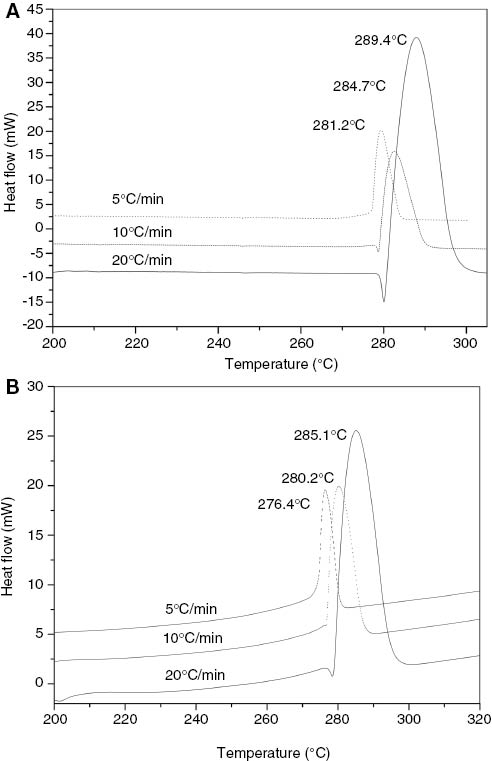
DSC curves of raw HMX (A) and nano NC/HMX composites (B) at heating rates of 5°C/min, 10°C/min, and 20°C/min.
The kinetic parameters of raw HMX and nano NC/HMX composite particles were calculated by Kissinger’s plot [11], shown in Figure 5, where β is the programmed heating rate in K/min and Tp is the absolute temperature of the peak. The activation energy (E) and frequency factors (A) of the samples are calculated from the slope -E/R and the intercept ln(AR/E).
Figure 5 shows that the Kissinger’s plots of raw HMX and nano NC/HMX composite particles have a high linear correlation coefficient. The activation energy of nano NC/HMX composites is calculated as 395.1 kJ/mol, which is ∼30 kJ/mol lower than that of raw HMX.

Kissinger’s plots of ln(β/Tp2) versus reciprocal peak temperature 1000/Tp for raw and nano NC/HMX composites particles. Symbol R is used to identify the linear correlation coefficient of ln(β/Tp2) to 1000/Tp.
The thermal decomposition reaction rate constant (k) of explosives can be determined according to the Arrhenius equation (logk=logA-E/2.3RT) [12]. It can be found that logk has the linear function with 1/T; the slope and intercept are equal to E/2.3R and logA, respectively. The plots of logk versus 1/T for HMX samples are shown in Figure 6. As can be seen in Figure 6, nano NC/HMX composites have a higher reaction rate constant than that of raw HMX at the same temperature. The result implies that the nano composites can decompose more rapidly than do raw HMX. Combined with the results of peak temperature, activation energy and reaction rate constants, it can be concluded that nano composites are expected to be a candidate filled in propellants to raise the burning rate.

Plots of logk versus 1/T for raw HMX and nano NC/HMX composites.
3.5 Impact sensitivity
Two parallel tests are carried out to measure the impact sensitivity of raw HMX and nano NC/HMX composites, with results given in Table 1. The two parallel results from each sample have very good repeatability. The average drop height of nano NC/HMX composites is 66.1 cm, which is more than triple as high as raw HMX (21.6 cm). This result suggests that nano NC/HMX composites are more difficult to explode under impact stimulus. Two reasons are attributed to the sensitivity reduction: one is the binder (NC) coated on HMX surface, which can prevent the friction among explosive particles and provide a shock absorber or diverter under the mechanical stimuli to reduce the formation probability of “hot spots” [13], and another is the size reduction of HMX particles in composites, which can reduce the mean void size to raise the threshold for critical hot-spot formation [14].
Drop height of raw HMX and nano NC/HMX composites.
| Samples | Raw HMX | Nano NC/HMX composites | ||||
|---|---|---|---|---|---|---|
| Experiment (no.) | Exp(1) | Exp(2) | Average | Exp(1) | Exp(2) | Average |
| Drop height (H50)/cm | 19.6 | 23.5 | 21.6 | 63.2 | 69.0 | 66.1 |
4 Conclusion
We have produced nano NC/HMX composite particles by an approach based on spray drying. Characterizations reveal that the product particles are close to spherical in shape and range from 0.5 μm to 5 μm in size with even distribution. The HMX particles with size ranging from 50 nm to 100 nm are uniformly and discretely dispersed in NC binders. Nano HMX crystal has the same crystal structure as β-HMX. The nano NC/HMX composite particles exhibited considerably low impact sensitivity. The drop height is more than triple as high as that of raw HMX (21.6 cm). Moreover, the nano composite particles are easier and rapider to decompose than do raw HMX under the thermal stimulus due to the lower required peak temperature and activation energy and higher reaction rate. Although HMX particles are sized in nanoscale, they are embedded in the micron composite granules, which can be dispersed in the propellant slurry with relative ease. For this very reason, the composites are expected to be a candidate filled in propellants to raise the burning rate.
References
[1] Pinheiro GFM, Lourenco VL, Iha K. J. Therm. Anal. Calorim. 2002, 67, 445–452.10.1023/A:1013984813195Search in Google Scholar
[2] Li FS, Guo XD, Liu GP. Design and Manufacture of Advanced Propellant, 1st ed., National Defense Industry Press: Beijing, 2008.Search in Google Scholar
[3] An CW, Guo XD, Song XL, Wang Y, Li FS. J. Energ. Mater. 2009, 27, 118–132.10.1080/07370650802405265Search in Google Scholar
[4] Muthiah R, Krishnamurthy VN, Gupta BR. J. Appl. Polym. Sci. 1992, 44, 2043–2052.10.1002/app.1992.070441120Search in Google Scholar
[5] Pillai AGS, Sanghavi RR, Dayanandan CR, Joshi MM, Velapure SP, Singh A. Propell. Explos. Pyrot. 2001, 26, 226–228.10.1002/1521-4087(200112)26:5<226::AID-PREP226>3.0.CO;2-9Search in Google Scholar
[6] An CW, Li FS, Wang JY, Guo XD. J. Propul. Power. 2012, 28, 444–448.10.2514/1.B34061Search in Google Scholar
[7] Qiu HW, Stepanov V. Di Stasio AR, Chou T, Lee WY. J. Hazard. Mater. 2011, 185, 489–493.10.1016/j.jhazmat.2010.09.058Search in Google Scholar
[8] Qiu HW, Stepanov V, Chou T, Surapaneni A, Di Stasio AR, Lee WY. Powder. Technol. 2012, 226, 235–238.10.1016/j.powtec.2012.04.053Search in Google Scholar
[9] An CW, Li HQ, Geng XH, Li JL, Wang JY. Propell. Explos. Pyrot. 2013, 38, 172–175.10.1002/prep.201200164Search in Google Scholar
[10] Joseph HK, Natali M, Tate J, Allcorn E. Int. J. Energ. Mater. Chem. Propul. 2013, 12, 119–162.10.1615/IntJEnergeticMaterialsChemProp.2013005383Search in Google Scholar
[11] Kissinger, HE. Anal. Chem. 1957, 29, 1702–1706.10.1021/ac60131a045Search in Google Scholar
[12] Tompa AS, Boswell RF. Thermochim. Acta. 2000, 357, 169–175.10.1016/S0040-6031(00)00386-5Search in Google Scholar
[13] Field JE. Acc. Chem. Res. 1992, 25, 489–496.10.1021/ar00023a002Search in Google Scholar
[14] Tarver CM, Chidester SK, Nichols AL. J. Phys. Chem. 1996, 100, 5794–5799.10.1021/jp953123sSearch in Google Scholar
©2017 Walter de Gruyter GmbH, Berlin/Boston
This article is distributed under the terms of the Creative Commons Attribution Non-Commercial License, which permits unrestricted non-commercial use, distribution, and reproduction in any medium, provided the original work is properly cited.
Articles in the same Issue
- Frontmatter
- Original articles
- Micro-XCT-based finite element method for predicting the elastic modulus of needle carbon-fiber-reinforced ceramic matrix composites
- A comparative analysis of evolutionary algorithms in the design of laminated composite structures
- Study on the impact of Fe2P phase on the electrochemical performance of LiFePO4
- Improved hydration resistance of magnesia by EDTA and ammonium phosphate as additives
- The interaction of delignification and fiber characteristics on the mechanical properties of old corrugated container fiber/polypropylene composite
- The effects of thermal residual stresses and interfacial properties on the transverse behaviors of fiber composites with different microstructures
- Impact response characterization of shear CFRP strengthened RC beams by Fourier and wavelet methods: tests and analyses
- Nanoscale investigation of polymer cement concretes by small angle neutron scattering
- Design of a compact UWB antenna with a partial ground plane on epoxy woven glass material
- Preparation of polyimide-graphite composite and evaluation of its friction behavior at elevated temperatures
- Finite element analysis of mechanical properties of woven composites through a micromechanics model
- Tensile strength of Z-pinned laminates in RTD and hot-wet environment
- Free vibration analysis of symmetrically laminated composite circular plates with curvilinear fibers
- Preparation and characterization of nano NC/HMX composite particles
- Effect of heat treatment on the mechanical and tribological properties of AA8090/6% SiCp composite
- Design and absorption analysis of a new multiband split-S-shaped metamaterial
- Effect of matrix temperature and powder size on the infiltration height of SiO2-reinforced Al 7075 matrix composites produced by vacuum infiltration
- Optimization of preparation conditions of epoxy-containing nanocapsules
Articles in the same Issue
- Frontmatter
- Original articles
- Micro-XCT-based finite element method for predicting the elastic modulus of needle carbon-fiber-reinforced ceramic matrix composites
- A comparative analysis of evolutionary algorithms in the design of laminated composite structures
- Study on the impact of Fe2P phase on the electrochemical performance of LiFePO4
- Improved hydration resistance of magnesia by EDTA and ammonium phosphate as additives
- The interaction of delignification and fiber characteristics on the mechanical properties of old corrugated container fiber/polypropylene composite
- The effects of thermal residual stresses and interfacial properties on the transverse behaviors of fiber composites with different microstructures
- Impact response characterization of shear CFRP strengthened RC beams by Fourier and wavelet methods: tests and analyses
- Nanoscale investigation of polymer cement concretes by small angle neutron scattering
- Design of a compact UWB antenna with a partial ground plane on epoxy woven glass material
- Preparation of polyimide-graphite composite and evaluation of its friction behavior at elevated temperatures
- Finite element analysis of mechanical properties of woven composites through a micromechanics model
- Tensile strength of Z-pinned laminates in RTD and hot-wet environment
- Free vibration analysis of symmetrically laminated composite circular plates with curvilinear fibers
- Preparation and characterization of nano NC/HMX composite particles
- Effect of heat treatment on the mechanical and tribological properties of AA8090/6% SiCp composite
- Design and absorption analysis of a new multiband split-S-shaped metamaterial
- Effect of matrix temperature and powder size on the infiltration height of SiO2-reinforced Al 7075 matrix composites produced by vacuum infiltration
- Optimization of preparation conditions of epoxy-containing nanocapsules
