The Coase Theorem, the Nonempty Core, and the Legal Neutrality Principle


Abstract
The Coase theorem states that where there are externalities and no transaction costs resource allocation is Pareto-optimal and independent of the stakeholders’ legal position. This result has been challenged many times. In the cooperative game approach to resource allocation, the refutation is made by constructing a three-person game which has an empty core under one set of liability rules—which implies that optimal allocations are coalitionally unstable–and a nonempty core under another set. In this example, however, the probability that the core is non-empty is rather high (5/6). Yet, even if coalitionally stable Pareto-optimal arrangements are likely, to establish the plain validity of the Coase theorem it must be shown that the legal neutrality statement also holds. We show that for the three-person cooperative game example mentioned above, the probability that the two assertions of the Coase theorem hold can be as low as 3/8.
Acknowledgements
I am grateful to Régis Deloche and Gabrielle Smart for very helpful comments on a previous version of this paper. I also thank a referee for stimulating comments and suggestions.
Appendix
A Proof of Proposition 2
Proof
To establish the result we shall first assume that θ1≡v(AB)/v(ABC) is first drawn from a uniform distribution. Let θ4 denote vl(C)/v(ABC). For each realization θ1 the probability that vl(C)/v(ABC) be lower than
Therefore, the probability that the legal neutrality property holds when θ1 is given and
We can check that:
Now the probability that the legal neutrality property holds, θ1 being given, is
Finally, the probability that the legal neutrality property holds is equal to
□
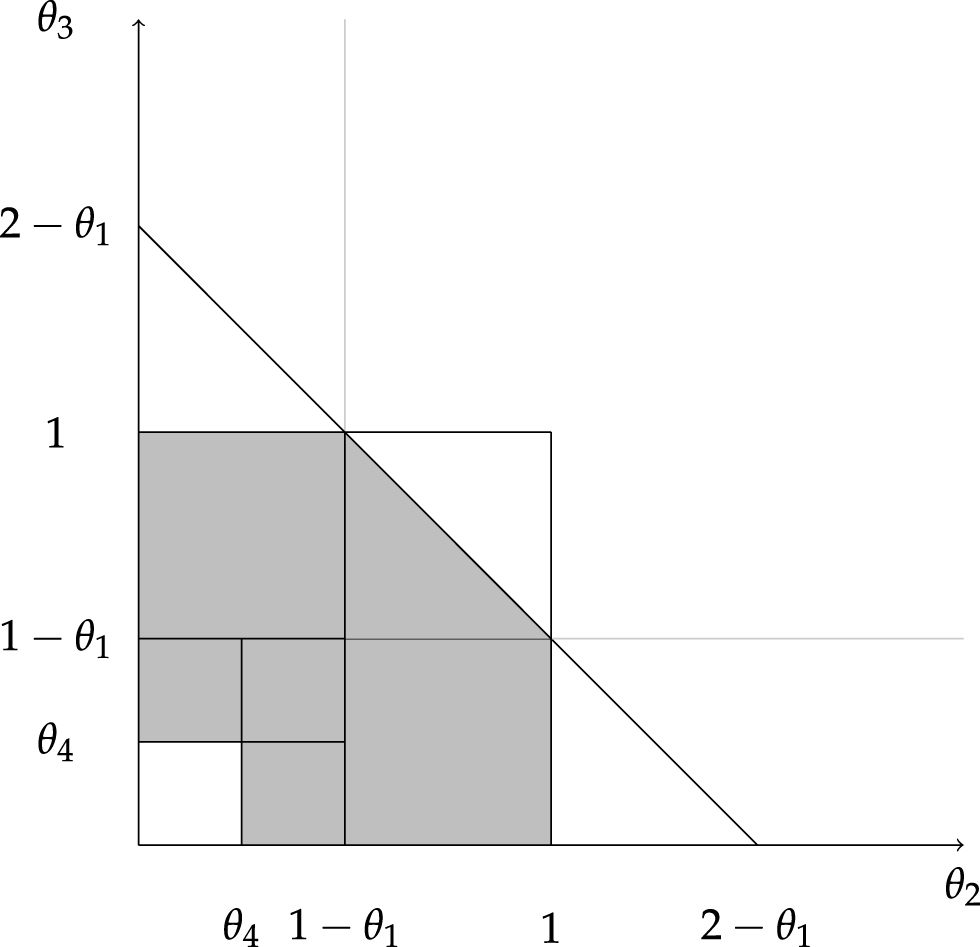
Probability that the legal neutrality property holds (θ1 and θ4 being given).
B Proof of Proposition 3
To compute the probability that the legal neutrality principle holds let us first assume that θ1, θ2 and θ3 are defined as in the preceding part of the appendix. Let us also define
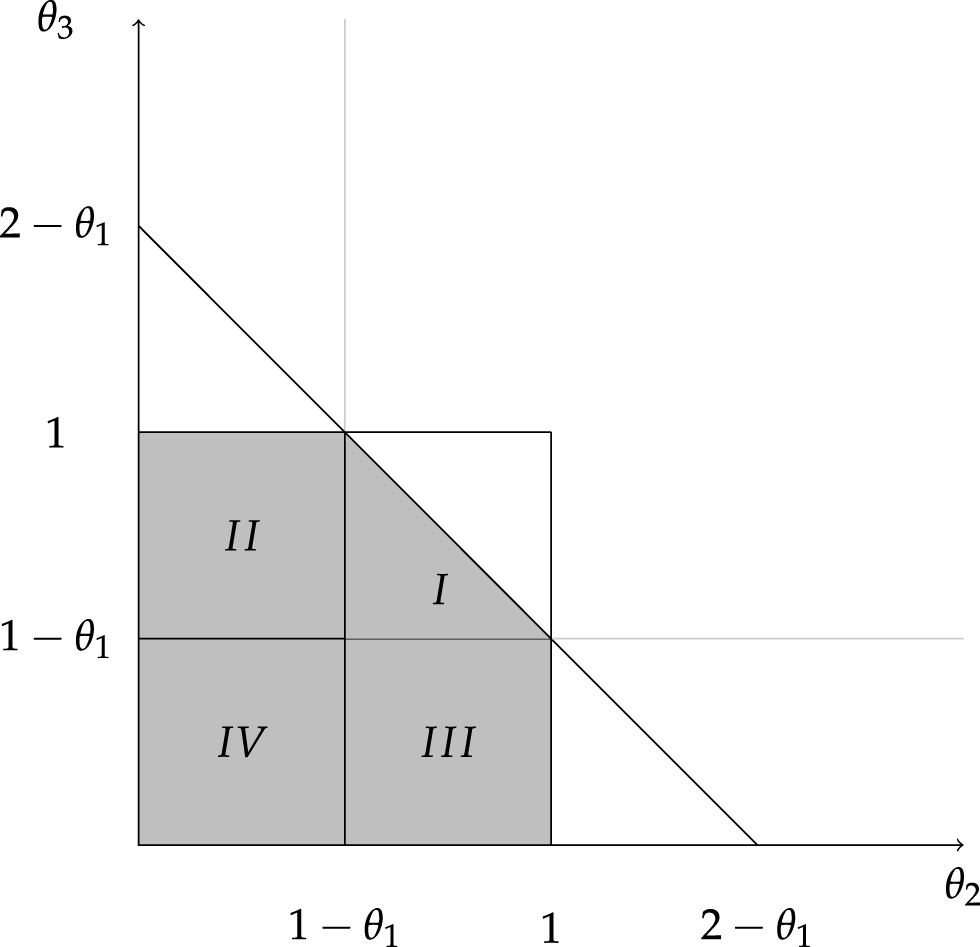
Probability that
Denote by
Zone I
We can check that
(32)(33)Zone II
(34)(35)Zone III
(36)(37)Zone IV
(38)(39)
Now we have
where
where we have stressed that the Pi are all functions of θ1, θ2 and θ3. We next compute each integral in the above sum.
To compute the first integral we first get after tedious computations
Then we obtain
We also have
and
Using these expressions, we finally get
Finally, the probability that the legal neutrality principle holds (and the Coase theorem) is:
References
Aivazian, Varouj A., and Jeffrey L. Callen. 1981. “The Coase Theorem and the Empty Core,” 24 (1)Journal of Law and Economics 175–181.10.1086/466979Search in Google Scholar
Aivazian, Varouj A., and Jeffrey L. Callen. 2003. “The Core, Transaction Costs, and the Coase Theorem,” 14 Constitutional Political Economy 287–299.10.1023/B:COPE.0000003859.10184.f3Search in Google Scholar
Allen, Douglas W. 2015. “The Coase Theorem: Coherent, Logical, and not Disproved,” 11 (2)Journal of Institutional Economics 379–390.10.1017/S1744137414000083Search in Google Scholar
Benoit, Jean-Pierre, and Lewis Kornhauser. 2002, “Game Theoretic Analysis of Legal Rules and Institutions, Chapter 60,” in Aumann Robert and Sergiu Hart, eds. Handbook of Game Theory with Economic Applications, vol. 3. London: North-Holland.10.1016/S1574-0005(02)03023-0Search in Google Scholar
Bernholz, Peter. 1997. “Property Rights, Contracts, Cyclical Social Preferences, and The Coase Theorem: A Synthesis,” 13 European Journal of Political Economy 419–442.10.1016/S0176-2680(97)00027-XSearch in Google Scholar
Bergstrom, Ted. 2017, “When was Coase Right?” Departemental Working paper, UC Santa Barbara.Search in Google Scholar
Chipman, John S., and Guoqiang Tian. 2012. “Detrimental Externalities, Pollution Rights, and the “Coase Theorem”,” 49 Economic Theory 309–327.10.1007/s00199-011-0602-1Search in Google Scholar
Coase, Ronald. 1960. “The Problem of Social Cost,” 3 The Journal of Law & Economics 1–44.10.1057/9780230523210_6Search in Google Scholar
Coase, Ronald. 1981. “The Coase Theorem and the Empty Core: Comment,” 24 (1)Journal of Law and Economics 183–187.10.1086/466980Search in Google Scholar
Chipman, John S. 1998, “A Close Look at the Coase Theorem,” in James M. Buchanan and Bettina Monissen, eds. The Economists’ Vision : Essays in Modern Economic Perspectives; for Hans G. Monissen on the Occasion of His 60th Birthday, 131–162. Frankfurt/Main: Campus Verlag.Search in Google Scholar
Ferey, Samuel, and Pierre Dehez. 2016a, “Multiple Causation, Apportionment and the Shapley Value,” 45 (1)Journal of Legal Studies 143–171.10.1086/685940Search in Google Scholar
Gonzales, Stéphane, and Alain Marciano. 2017, “De Nouveaux Éclairages sur le Théorème de Coase et la Vacuité du Coeur,” Revue D’économie Politique 579–600.10.3917/redp.274.0579Search in Google Scholar
Gonzales, Stéphane, Marciano Alain, and Philippe Solal. 2016, “The Social Cost Problem, Rights and the (Non)Empty Core” Working paper, Université de Saint-Etienne.10.2139/ssrn.2863952Search in Google Scholar
Hurwicz, Leonid. 1995, “What is the Coase Theorem?,” 7 Japan and the World Economy 49–74.10.1016/0922-1425(94)00038-USearch in Google Scholar
Medema, Steven. 2017, “The Coase Theorem at Sixty” Working paper, University of Colorado Denver.Search in Google Scholar
Maschler, M., Solan Eilon, and Shmuel Zamir. 2013, Game Theory. Cambridge, UK: Cambridge University Press.10.1017/CBO9780511794216Search in Google Scholar
Parisi, Francesco. 2008. “Coase Theorem,” in Steven Durlauf and Lawrence Blume, eds. The New Plagrave Dictionary of Economics. London: Plagrave Macmillan.10.1057/978-1-349-95121-5_517-2Search in Google Scholar
Robson, Alex. 2014, “Transaction Costs Can Encourage Coasean Bargaining,” 160 Public Choice 539–549.10.1007/s11127-013-0117-3Search in Google Scholar
Zaho, Jingang. 2017. “A Reexamination of the Coase Theorem,” Journal of Mechanism and Institution Design, forthcoming.Search in Google Scholar
Supplementary Material
The online version of this article offers supplementary material (DOI:https://doi.org/10.1515/rle-2018-0027).
© 2020 Walter de Gruyter GmbH, Berlin/Boston
Articles in the same Issue
- Articles
- Laudatio: Francesco Parisi
- Law and Economics as We Grow Younger
- The Coase Theorem, the Nonempty Core, and the Legal Neutrality Principle
- The Optimal Standard of Proof with Adjudication Avoidance
- Political Insulation, Technical Expertise and the Technocrat’s Paradox
- Thinking Like (Law-And-) Economists – Legal Rules, Economic Prescriptions and Public Perceptions of Fairness
Articles in the same Issue
- Articles
- Laudatio: Francesco Parisi
- Law and Economics as We Grow Younger
- The Coase Theorem, the Nonempty Core, and the Legal Neutrality Principle
- The Optimal Standard of Proof with Adjudication Avoidance
- Political Insulation, Technical Expertise and the Technocrat’s Paradox
- Thinking Like (Law-And-) Economists – Legal Rules, Economic Prescriptions and Public Perceptions of Fairness
