
Sixty years of Radiochimica Acta: a brief overview with emphasis on the last 10 years
-
Syed M. Qaim
 and
Birgit Zoglmeier
and
Birgit Zoglmeier

Abstract
On the occasion of the diamond jubilee of Radiochimica Acta (RCA), this article briefly describes the progress made by the journal during the last 10 years; a detailed account of the developments during the first 50 years having been given earlier ( Radiochimica Acta 2012, 100, 483–492). Publishing responsibility for the journal was taken over in 2014 by Walter De Gruyter, a traditional German publishing company founded in 1749. This allowed RCA also to maintain its established traditional standard of publishing. Being broad-based, the journal encompasses all chemical aspects of nuclear science and technology. It has kept pace with the changing trends in radiochemical research. Today, besides fundamental nuclear chemistry, applied topics, such as chemical behaviour and mobility of actinides and fission products, accelerator-based radiochemistry, development of novel radiochemical techniques, study of radiation chemical effects, etc., are well represented. The journal is supported by a group of international Editors and Advisors who are distinguished radiochemists themselves. It follows a strict peer-review system and is assisted by a network of about 500 referees. About 200 manuscripts are received per year, out of which 40–45% are rejected. The impact factor (IF) of RCA is comparable to those of other radiochemistry-related journals, but the cited half-life (CHL) of RCA is by far the highest of all related journals. A list of top highly cited 100 articles has been provided alongside this article. In the past, most of the articles originated from Europe and North America, but in recent years the number of contributions from China and several developing countries has been increasing. All articles are published in English, and the journal is presently available to read both online and in a printed format.
1 Introduction
The journal Radiochimica Acta (RCA) was founded in 1962, under the patronage of the Nobel Laureate Otto Hahn, to cater for the publishing needs of the then fast expanding field of radiochemistry. In those days radiochemists published their work in several different chemistry and physics journals and had no platform of their own for technical communications. With the introduction of RCA a new era dawned for radiochemistry. Although published in Germany, right from its inception the journal aimed to inculcate an international character and flavour. In its very first issue, contributions were published from München, Karlsruhe, Köln, Jülich (Germany), Orsay (France), Amsterdam (The Netherlands), Yale (USA), Buenos Aires (Argentina) and Tokai (Japan).
The journal’s international character has been maintained, continuously nurtured and further developed over its lifetime of 60 years. Manuscripts could be written, during the journal’s early years in any of three international languages, viz, English, French and German; however, over the years the trend has completely shifted, so that today they are all published in the English language. A detailed review of the development over the first 50 years was given in 2012 while celebrating the Golden Anniversary of the journal [1]. The names of all Editors and Advisors were listed and the excellent management of the production process by the staff of the Oldenbourg Verlag was eulogised. The present article written on the occasion of the diamond jubilee of the journal concentrates on a description of the progress made during the last 10 years.
2 Present status of publishing
Soon after the launch of RCA, competition also appeared, and a few other journals dealing with some specific aspects of radiochemistry and radioactivity came into existence. However, RCA maintained its broad-based character. The refereeing procedure became stricter and the publishing process started shifting to electronic systems. A big change came in 2014 when the publishing responsibility of the journal was taken over by Walter De Gruyter, Berlin/Boston. It became a great privilege to this journal because the new Publisher has had a strong tradition of publishing scientific material for the last 270 years. Radiochimica Acta thus continues to maintain its traditional high-quality publishing. Today, all manuscripts are handled completely electronically. After acceptance, the article first appears electronically as AOP (ahead of print) and then, within about four months, it is published in both electronic and printed formats. An issue appears every month and the whole volume per year covers about 1000 pages.
In recent years, traditional high-quality journals have encountered some difficulties due to the strong propagation of “open access” publishing. Although the idea to present all research results at the disposal of all interested persons is commendable, it risks preventing scientists from the Third World countries from disseminating their knowledge properly because of their inability to pay large APCs (article processing charges) to fully “open access” journals. Regarding this matter, a great concern has been recently expressed by the World Academy of Sciences for the advancement of science in developing countries (TWAS). The editors of RCA support “open access” publishing with some limitations and so do not reject manuscripts from developing countries on financial reasons. Walter De Gruyter also provides discounted or waived APC schemes for some countries. According to IAEA reports, in many of those countries, new nuclear reactors and, above all, accelerators are being built, and excellent radiochemical research is emerging. Consequently, RCA encourages new results from those countries. There is no compromise in the review process, but publication of results follows without any charges. As a result of this compassionate approach, the contributions to RCA from countries with weaker economies are increasing to some extent. Radiochimica Acta is currently a hybrid journal in that most of the content is paid for on a subscription basis, but it does also carry Open Access papers should the author require it to do so. Any paper – whether Open Access or not – is accepted for publication purely on the merits of the written research.
3 Editors and advisors
With change of Publisher of RCA, a restructuring of the Editorial Board occurred in the beginning of 2014; Syed M. Qaim was appointed as the Editor-in-Chief and five other expert radiochemists from various parts of the world (J. V. Kratz, E. Simoni, H. Nitsche, S. S. Jurisson and A. Shinohara) were appointed as co-editors. The journal suffered a setback due to the sad an untimely demise of H. Nitsche in 2014. The Editorial Board was then extended to include Z. Chai, P. K. Mohapatra and T. E. Albrecht-Schmitt. In recent years, three of the co-editors have retired (J. V. Kratz, E. Simoni, A. Shinohara). Their contributions are highly acknowledged. They have been replaced by younger colleagues from the respective regions. The names of present Editors are given in Table 1. Some replacements and additions were also made to the wider Editorial Advisory Board. The journal has presently 18 advisors, representing the international radiochemistry community. They are also listed in Table 1.
Editors and advisors of Radiochimica Acta (status: 1 April 2022).
| Editor-in-Chief |
| S. M. Qaim, Jülich, Germany |
| Editors |
| T. E. Albrecht-Schoenzart, Tallahassee, USA |
| Z. Chai, Beijing, China |
| Ch. E. Düllmann, Mainz, Germany |
| S. S. Jurisson, Columbia, USA |
| C. Le Naour, Orsay, France |
| P. K. Mohapatra, Mumbai, India |
| A. Yokoyama, Kanazawa, Japan |
| Advisory Board |
| W. Cha, Daejeon, Korea |
| N. Dacheux, Montpellier, France |
| R. Eichler, Villigen, Switzerland |
| C. Ekberg, Gothenburg, Sweden |
| N. D. M. Evans, Nottingham, UK |
| M. Fassbender, Los Alamos, USA |
| H. Geckeis, Karlsruhe, Germany |
| J. John, Prague, Czech Republic |
| S. N. Kalmykov, Moscow, Russia |
| S. Lahiri, Kolkata, India |
| V. K. Manchanda, Mumbai, India |
| G. Modolo, Jülich, Germany |
| Y. Nagame, Ibaraki, Japan |
| B. Neumaier, Jülich, Germany |
| F. Rösch, Mainz, Germany |
| Th. J. Ruth, Vancouver, Canada |
| X. Wang, Beijing, China |
| J. H. Zaidi, Islamabad, Pakistan |
Appreciation is expressed to all the editors and advisors for their painstaking continuous efforts to maintain the scientific standing of the journal that it enjoys today.
4 Scope of the journal and changing trends in radiochemical research
The scope of RCA encompasses all areas of fundamental and applied radiochemistry, including radiation chemistry. Of particular interest are topics like fundamental chemistry of actinides and transactinides, chemistry of nuclear energy production, nuclear waste treatment, nuclear data for applications, radiochemical separations, use of radionuclides in all fields, especially in medicine (i.e., radiopharmaceutical chemistry), radioactive nanoparticles, effects of radiation on materials properties, etc. Thus RCA maintains its broad-based character.
The journal has played a significant role in dissemination of new knowledge in all areas of radiochemistry. Furthermore, it has always endeavoured to summarize newer knowledge by publishing authoritative review articles on topics of timely interest [cf. 1]. Over the last 10 years it has brought forth a few special issues to apprise the general readership of newer developments, e.g.
Speciation (2013).
Radiochemistry in China (2014).
Radiochemistry in Northern Europe (2015).
Separation Science in Nuclear Technology in India (2015).
Nuclear Materials (2017).
Herrmann Memorial Issue (2019).
A very special issue of the journal entitled: “International Year of the Periodic Table of Chemical Elements 2019”, covering 354 pages, was published to celebrate the recognition of Chemistry by UNESCO. It contains authoritative reviews on almost all aspects of radiochemistry (RCA 107, 767–1120, 2019) and has been hailed as a high class publication.
The topics covered by the journal reflect to a great extent the developments in the field of radiochemistry. The changing trends in articles published during the first 50 years of its existence were described in detail [1]. Over the last 10 years, the emphasis on energy-related radiochemistry has remained while management of radioactive waste is still a big challenge. Investigations to understand the chemical behaviour and mobility of actinides and fission products under various natural conditions (i.e. speciation and migration) are of fundamental significance in developing safe deep geological repositories for nuclear waste. Those studies continue and are often reported in RCA. In recent years, however, stronger efforts are being devoted to accelerator-based radiochemistry, mainly in two directions. First, studies of superheavy elements. Though the work is carried out in only a few specialized laboratories, the number of associated scientists from other institutions is large. The results obtained are very exciting, with the Periodic Table extended up to Z = 118. The collaborative efforts were so impressive that UNESCO declared the year 2019 as “International Year of the Periodic Table of Elements”. Radiochimica Acta brought out a special issue on the occasion (see above). More new information is pouring in. The second direction is the development of accelerator-based medical radionuclides. The role of short-lived organic positron emitters, (e.g., 11C and 18F) is well established in Positron Emission Tomography (PET), a non-invasive organ imaging technique for in vivo study of metabolic processes. The emphasis is now growing on longer lived positron emitters and a few special therapeutic radionuclides of metallic nature. They are finding increasing applications in theranostics and radionuclide targeted therapy. Needless to say that those studies cannot be performed without radiochemistry. It is also worth pointing out that both the areas of accelerator-based radiochemistry, namely, superheavy element research and medical radionuclide development, are extremely interdisciplinary: the former overlaps heavily with physics, and the latter with pharmacy and medicine. The results are therefore dispersed in a large number of journals, but RCA receives a considerable share of contributions in both the fields.
5 Contributors, referees and review process
Over the last 10 years more than 3000 contributors from many parts of the world have contributed to RCA. About 900 articles, covering around 10,000 pages have been published. The Editors and the Publisher express their gratitude to all authors in general, and to our regular contributors in particular, for their life-time dedication to the journal and to the field of radiochemistry.
The standard of a primary journal is mainly dependent on the peer-review process which is followed after the submission of a manuscript. Radiochimica Acta has continually tried to maintain a hard but fair review system. To this endeavour it has built up a network of about 500 experts in various branches of radiochemistry who act as referees when requested. A very grateful acknowledgement is due to our referees who do excellent work on an honorary basis. The referees and the editors have generally a sympathetic approach to the authors and try to help them with regard to the improvement of their manuscripts, both technically and linguistically. The journal receives about 200 manuscripts per year. Most of them have to be revised, some of them several times. The rejection rate is 40–45%. Our endeavour is to complete the review process within about four months but it depends on several factors, such as delay with the referee, workload on the editor etc., but often the author does not respond to the criticism as fast as it is desired. The Publisher adheres to the policy that an accepted normal manuscript should be available online immediately after Proof correction. Thereafter it appears in printed form within about three months.
6 Impact of the journal
The importance of a scientific journal is judged today by various criteria. Needless to say that good editing, correct language, clean setting and printing, rapid appearance in print (first online, followed by the paper version) and regularity in time-schedules are still very important factors, and they are strictly observed in case of RCA. However, the citation of a paper in the literature is becoming a more important criterion. Here two aspects appear to be very relevant: firstly, the impact factor (IF), which shows how much interest an article has aroused within the considered two-year time-period, and secondly, the cited half-life (CHL) which depicts the importance of the article over a longer period. These two aspects are discussed below with respect to radiochemistry-related journals. The data were collected from the Web of Science [2].
6.1 Impact factor
The impact factors (IF) of the four radiochemistry-related journals, namely J. Radioanalytical and Nuclear Chemistry (JRNC), J. Labelled Compounds and Radiopharmaceuticals (JLCR), Applied Radiation and Isotopes (ARI), and Radiochimica Acta (RCA), are plotted in Figure 1 for the period 2005–2020. Evidently the values are not very high for all the periodicals. This reflects the size of the community which is not very large, but also to some extent the effect of not being fully “open access”. In general, the IF of RCA is comparable to those of other three journals, with fluctuations in the case of JLCR. Figure 1 also shows the IF of J. Environmental Radioactivity which has some features common to radiochemistry journals. Its IF was comparable to that of RCA till 2011. But then the Fukushima accident occurred. The size of the community interested in environmental radioactivity enhanced considerably; and with that the IF of the journal suddenly increased.
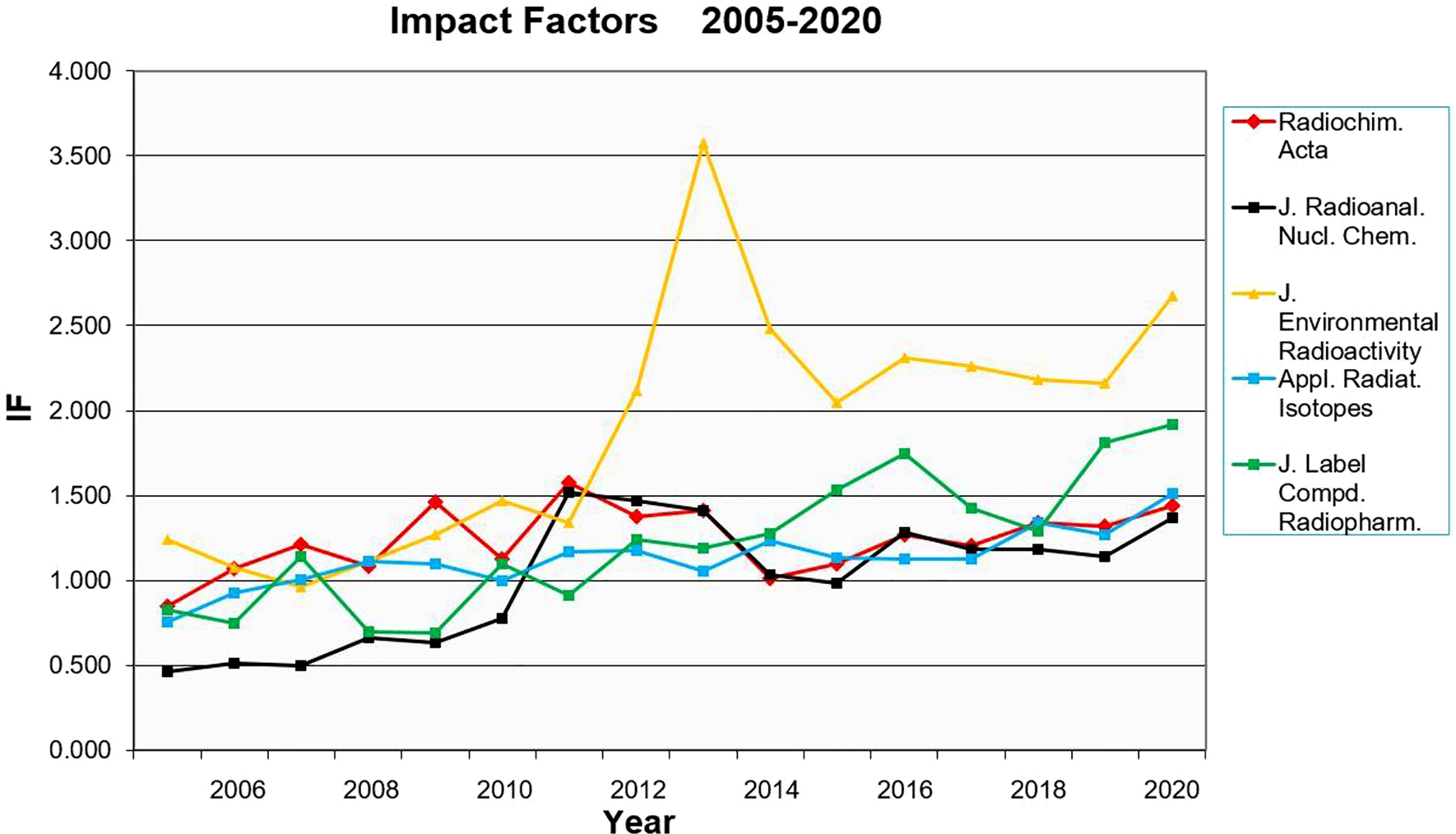
Impact factors of radiochemistry-related journals.
6.2 Cited half-life
The cited half-lives of the above mentioned five radiochemistry-related journals are given for the period 2005–2020 in Figure 2. Evidently the values for RCA are by far the highest of all related journals. These numbers depict that the papers published in RCA are of long-term value, with citations extending up to 30 years or even more.
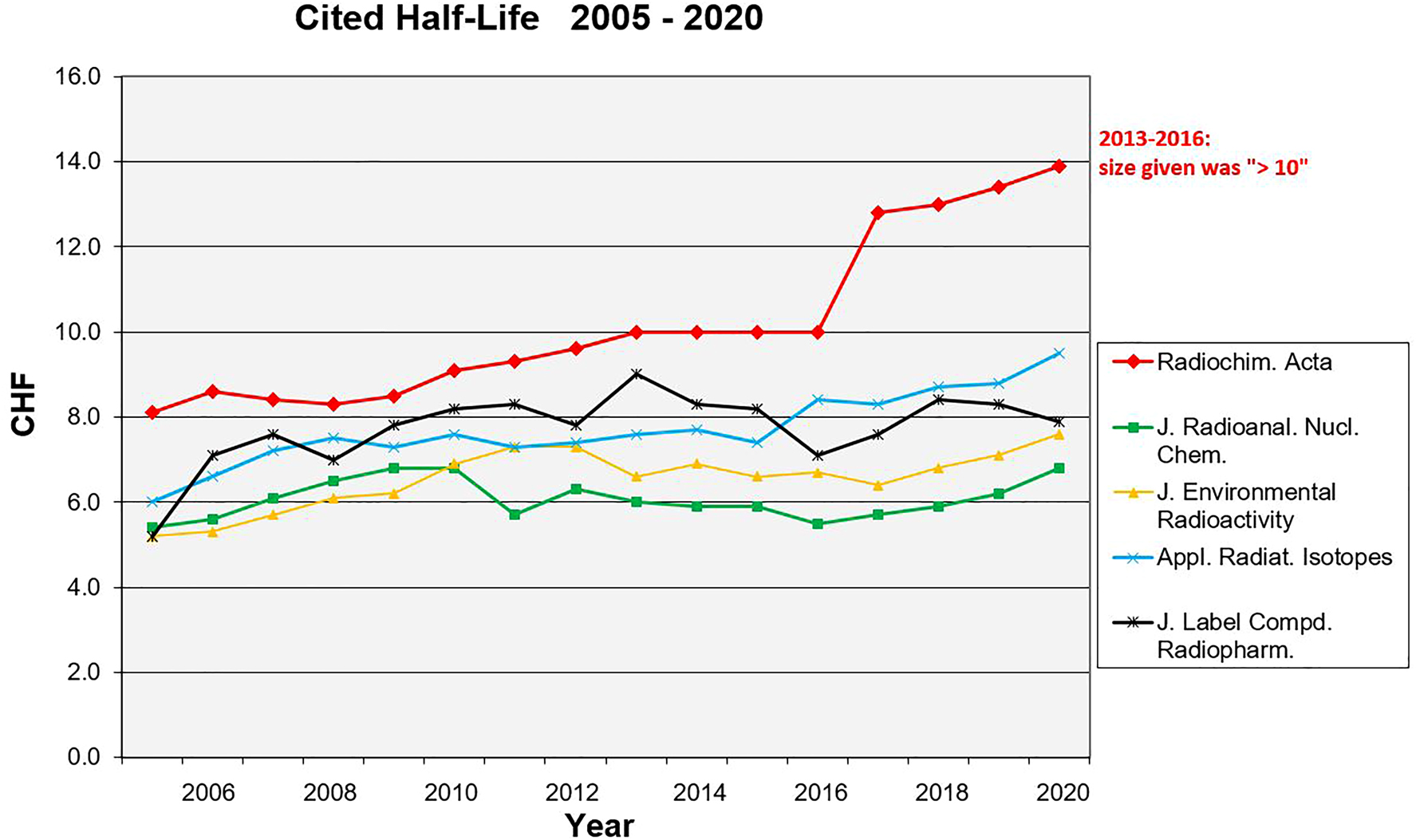
Cited half-lives of radiochemistry-related journals.
7 Highly cited publications
The importance of an individual article is often judged by the number of citations it has received, though it is not necessarily always a positive index. A paper with controversial results, for example, may be highly criticized (and so highly cited). Nonetheless, looking positively at the matter, a highly cited paper adds prestige to a journal. The information available in the Web of Science [2] showed that a large number of papers published in RCA received high citations. The top 100 publications are listed in Table 2. Analysis shows that they often deal with the actinides and transactinides, speciation, adsorption and migration of radionuclides in the geosphere, nuclear data and medical radionuclide production, radiochemical separations, etc. Some of the authors are very distinguished scientists, carrying all types of national and international honours and awards. The Editors and the Publisher congratulate all authors on achieving this manifested distinction and have pleasure in thanking them for publishing excellent work in this journal.
The 100 most cited papers of Radiochimica Acta.
| Rank | Authors, title of publication, and reference | Number of citations |
|---|---|---|
| 1 | Neck, V.; Kim, J. I. Solubility and hydrolysis of tetravalent actinides. Radiochim. Acta 2001, 89, 1–16. https://doi.org/10.1524/ract.2001.89.1.001 |
361 |
| 2 | Silva, R. J.; Nitsche, H. Actinide environmental chemistry. Radiochim. Acta 1995, 70–71, 377–396. https://doi.org/10.1524/ract.1995.7071.s1.377 |
329 |
| 3 | Bernhard, G.; Geipel, G.; Reich, T.; Brendler, V.; Amayri, S.; Nitsche, H. Uranyl(VI) carbonate complex formation: Validation of the Ca2UO2(CO3)(3)(aq.) species. Radiochim. Acta 2001, 89, 511–518. https://doi.org/10.1524/ract.2001.89.8.511 |
300 |
| 4 | Bernhard, G.; Geipel, G.; Brendler, V.; Nitsche, H. Speciation of uranium in seepage waters of a mine tailing pile studied by time-resolved laser-induced fluorescence spectroscopy (TRLFS). Radiochim. Acta 1996, 74, 87–91. https://doi.org/10.1524/ract.1996.74.special-issue.87 |
198 |
| 5 | Choppin, G. R. Solution chemistry of the actinides. Radiochim. Acta 1983, 32, 43–53. https://doi.org/10.1524/ract.1983.32.13.43 |
190 |
| 6 | Choppin, G. R. Humics and radionuclide migration. Radiochim. Acta 1988, 44–45, 23–28. https://doi.org/10.1524/ract.1988.4445.1.23 |
166 |
| 7 | Hummel, W.; Berner, U.; Curti, E.; Pearson, F. J.; Thoenen, T. Nagra/PSI chemical thermodynamic data base 01/01. Radiochim. Acta 2002, 90, 805–813. https://doi.org/10.1524/ract.2002.90.9-11_2002.805 |
161 |
| 8 | Ekberg, C.; Fermvik, A.; Retegan, T.; Skarnemark, G.; Foreman, M. R. S.; Hudson, M. J.; Englund, S.; Nilsson, M. An overview and historical look back at the solvent extraction using nitrogen donor ligands to extract and separate An(III) from Ln(III). Radiochim. Acta 2008, 96, 225–233. https://doi.org/10.1524/ract.2008.1483 |
158 |
| 9 | Lenhart, J. J.; Cabaniss, S. E.; MacCarthy, P.; Honeyman, B. D. Uranium(VI) complexation with citric, humic and fulvic acids. Radiochim. Acta 2000, 88, 345–353. https://doi.org/10.1524/ract.2000.88.6.345 |
151 |
| 10 | Ruth, T. J.; Wolf, A. P. Absolute cross sections for the production of 18F via the 18O(p, n)18F reaction. Radiochim. Acta 1979, 26, 21–24. https://doi.org/10.1524/ract.1979.26.1.21 |
150 |
| 11 | Rabung, T.; Stumpf, T.; Geckeis, H.; Klenze, R.; Kim, J. I. Sorption of Am(III) and Eu(III) onto gamma-alumina: experiment and modelling. Radiochim. Acta 2000, 88, 711–716. https://doi.org/10.1524/ract.2000.88.9-11.711 |
148 |
| 12 | Choppin, G. R.; Rao, L. F. Complexation of pentavalent and hexavalent actinides by fluoride. Radiochim. Acta 1984, 37, 143–146. https://doi.org/10.1524/ract.1984.37.3.143 |
143 |
| 13 | Kim, J. I.; Czerwinski, K. R. Complexation of metal ions with humic acid: Metal ion charge neutralization model. Radiochim. Acta 1996, 73, 5–10. https://doi.org/10.1524/ract.1996.73.1.5 |
142 |
| 14 | Merchel, S.; Herpers, U. An update on radiochemical separation techniques for the determination of long-lived radionuclides via accelerator mass spectrometry. Radiochim. Acta 1999, 84, 215–219. https://doi.org/10.1524/ract.1999.84.4.215 |
138 |
| 15 | Torres, R. A.; Choppin, G. R. Europium (III) and americium(III) stability constants with humic acid. Radiochim. Acta 1984, 35, 143–148. https://doi.org/10.1524/ract.1984.35.3.143 |
137 |
| 16 | Choppin, G. R. The role of natural organics in radionuclide migration in natural aquifer systems. Radiochim. Acta 1992, 58–59, 113–120. https://doi.org/10.1524/ract.1992.5859.1.113 |
135 |
| 17 | Sugo, Y.; Sasaki, Y.; Tachimori, S. Studies on hydrolysis and radiolysis of N,N,N′,N′-tetraoctyl-3-oxapentane-1,5-diamide. Radiochim. Acta 2002, 90, 161–165. https://doi.org/10.1524/ract.2002.90.3_2002.161 |
130 |
| 18 | Kim, J. I. Actinide colloid generation in groundwater. Radiochim. Acta 1991, 52–53, 71–81. https://doi.org/10.1524/ract.1991.5253.1.71 |
125 |
| 19 | Berner, U. R. Modeling the incongruent dissolution of hydrated minerals. Radiochim. Acta 1988, 44–45, 387–393. https://doi.org/10.1524/ract.1988.4445.2.387 |
121 |
| 20 | Coenen, H. H.; Moerlein, S. M.; Stöcklin, G. No-carrier-added radiohalogenation methods with heavy halogens. Radiochim. Acta 1983, 34, 47–68. https://doi.org/10.1524/ract.1983.34.12.47 |
121 |
| 21 | Antonio, M. R.; Soderholm, L.; Williams, C. W.; Blaudeau, J. P.; Bursten, B. E. Neptunium redox speciation. Radiochim. Acta 2001, 89, 17–25. https://doi.org/10.1524/ract.2001.89.1.017 |
119 |
| 22 | Kalmykov, S. N.; Choppin, G. R. Mixed Ca2+/UO2 2+/Co3 2− complex formation at different ionic strengths. Radiochim. Acta 2000, 88, 603–606. https://doi.org/10.1524/ract.2000.88.9-11.603 |
119 |
| 23 | Brachmann, A.; Geipel, G.; Bernhard, G.; Nitsche, H. Study of uranyl(VI) malonate complexation by time resolved laser-induced fluorescence spectroscopy (TRLFS). Radiochim. Acta 2002, 90, 147–153. https://doi.org/10.1524/ract.2002.90.3_2002.147 |
118 |
| 24 | Choppin, G. R.; Nash, K. L. Actinide separation science. Radiochim. Acta 1995, 70–71, 225–236. https://doi.org/10.1524/ract.1995.7071.special-issue.225 |
118 |
| 25 | Piel, H.; Qaim, S. M.; Stöcklin, G. Excitation functions of (p,xn)-reactions on Ni-nat and highly enriched Ni-62: possibility of production of medically important radioisotope Cu-62 at a small cyclotron. Radiochim. Acta 1992, 57, 1–5. https://doi.org/10.1524/ract.1992.57.1.1 |
118 |
| 26 | Lieser, K. H.; Bauscher, C. Technetium in the hydrosphere and in the geosphere.1. Chemistry of technetium and iron in natural-waters and influence of the redox potential of the sorption of technetium. Radiochim. Acta 1987, 42, 205–213. https://doi.org/10.1524/ract.1987.42.4.205 |
116 |
| 27 | Rai, D. Solubility product of Pu(IV) hydrous oxide and equilibrium-constants of Pu(IV)/Pu(V), Pu(IV)/Pu(VI), and Pu(V)/Pu(VI) couples. Radiochim. Acta 1984, 35, 97–106. https://doi.org/10.1524/ract.1984.35.2.97 |
116 |
| 28 | Hennig, C.; Reich, T.; Dahn, R.; Scheidegger, A. M. Structure of uranium sorption complexes at montmorillonite edge sites. Radiochim. Acta 2002, 90, 653–657. https://doi.org/10.1524/ract.2002.90.9-11_2002.653 |
115 |
| 29 | Payne, T. E.; Davis, J. A.; Waite, T. D. Uranium adsorption on ferrihydrite-Effects of phosphate and humic acid. Radiochim. Acta 1996, 74, 239–243. https://doi.org/10.1524/ract.1996.74.special-issue.239 |
115 |
| 30 | Seaborg, G. T. Overview of the actinide and lanthanide (The F) elements. Radiochim. Acta 1993, 61, 115–122. https://doi.org/10.1524/ract.1993.61.34.115 |
115 |
| 31 | Bros, R.; Carpena, J.; Sere, V.; Beltritti, A. Occurrence of Pu and fissiogenic REE in hydrothermal apatites from the fossil nuclear reactor 16 at Oklo (Gabon). Radiochim. Acta 1996, 74, 277–282. https://doi.org/10.1524/ract.1996.74.special-issue.277 |
113 |
| 32 | Czerwinski, K. R.; Buckau, G.; Scherbaum, F.; Kim, J. I. Complexation of the uranyl-ion with aquatic humic-acid. Radiochim. Acta 1994, 65, 111–119. https://doi.org/10.1524/ract.1994.65.2.111 |
113 |
| 33 | Kimura, T.; Choppin, G. R.; Kato, Y.; Yoshida, Z. Determination of the hydration number of Cm(III) in various aqueous solutions. Radiochim. Acta 1996, 72, 61–64. https://doi.org/10.1524/ract.1996.72.2.61 |
110 |
| 34 | Zvara, I. Simulation of thermochromatographic processes by the Monte Carlo method. Radiochim. Acta 1985, 38, 95–102. https://doi.org/10.1524/ract.1985.38.2.95 |
108 |
| 35 | Finn, P. A.; Hoh, J. C.; Wolf, S. F.; Slater, S. A.; Bates, J. K. The release of uranium, plutonium, cesium, strontium, technetium and iodine from spent fuel under unsaturated conditions. Radiochim. Acta 1996, 74, 65–71. https://doi.org/10.1524/ract.1996.74.special-issue.65 |
107 |
| 36 | Geipel, G.; Brachmann, A.; Brendler, V.; Bernhard, G.; Nitsche, H. Uranium(VI) sulfate complexation studied by time-resolved laser-induced fluorescence spectroscopy (TRLFS). Radiochim. Acta 1996, 75, 199–204. https://doi.org/10.1524/ract.1996.75.4.199 |
106 |
| 37 | Serrano-Purroy, D.; Baron, P.; Christiansen, B.; Malmbeck, R.; Sorel, C.; Glatz, J. P. Recovery of minor actinides from HLLW using the DIAMEX process. Radiochim. Acta 2005, 93, 351–355. https://doi.org/10.1524/ract.93.6.351.65642 |
102 |
| 38 | Wanner, H.; Albinsson, Y.; Karnland, O.; Wieland, E.; Wersin, P.; Charlet, L. The acid-base chemistry of Montmorillonite. Radiochim. Acta 1994, 66–67, 157–162. https://doi.org/10.1524/ract.1994.6667.special-issue.157 |
100 |
| 39 | Eichler, R.; Aksenov, N. V.; Albin, Yu. V.; Belozerov, A. V.; Bozhikov, G. A.; Chepigin, V. I.; Dmitriev, S. N.; Dressler, R.; Gaeggeler, H. W.; Gorshkov, V. A.; Henderson, R. A.; Johnsen, A. M.; Kenneally, J. M.; Lebedev, V. Ya; Malyshev, O. N.; Moody, K. J.; Oganessian, Yu Ts; Petrushkin, O. V.; Piguet, D.; Popeko, A. G.; Rasmussen, P.; Serov, A.; Shaughnessy, D. A.; Shishkin, S. V.; Shutov, A. V.; Stoyer, M. A.; Stoyer, N. J.; Svirikhin, A. I.; Tereshatov, E. E.; Vostokin, G. K.; Wegrzecki, M.; Wilk, P. A.; Wittwer, D.; Yeremin, A. V. Indication for a volatile element 114. Radiochim. Acta 2010, 98, 133–139. https://doi.org/10.1524/ract.2010.1705 |
99 |
| 40 | Xu, D.; Shao, D. D.; Chen, C. L.; Ren, A. P.; Wang, X. K. Effect of pH and fulvic acid on sorption and complexation of cobalt onto bare and FA bound MX-80 bentonite. Radiochim. Acta 2006, 94, 97–102. https://doi.org/10.1524/ract.2006.94.2.97 |
98 |
| 41 | Qaim, S. M. Therapeutic radionuclides and nuclear data. Radiochim. Acta 2001, 89, 297–302. https://doi.org/10.1524/ract.2001.89.4-5.297 |
98 |
| 42 | Mirzadeh, S.; Kumar, K.; Gansow, O. A. The chemical fate of Bi-212-DOTA formed by beta-decay of Pb-212(DOTA)2-. Radiochim. Acta 1993, 60, 1–10. https://doi.org/10.1524/ract.1993.60.1.1 |
98 |
| 43 | Xu, D.; Wang, X. K.; Chen, C. L.; Zhou, X.; Tan, X. L. Influence of soil humic acid and fulvic acid on sorption of thorium(IV) on MX-80 bentonite. Radiochim. Acta 2006, 94, 429–434. https://doi.org/10.1524/ract.2006.94.8.429 |
96 |
| 44 | Rösch, F.; Qaim, S. M.; Stöcklin, G. Nuclear data relevant to the production of the positron emitting radioisotope 86Y via the 86Sr(p,n)- and natRb(3He,xn)-processes. Radiochim. Acta 1993, 61, 1–8. https://doi.org/10.1524/ract.1993.62.3.115 |
96 |
| 45 | Brainard, J. R.; Strietelmeier, B. A.; Smith, P. H.; Langstonunkefer, P. J.; Barr, M. E.; Ryan, R. R. Actinide binding and solubilization by microbial siderophores. Radiochim. Acta 1992, 58–59, 357–363. https://doi.org/10.1524/ract.1992.5859.2.357 |
96 |
| 46 | Klenze, R.; Kim, J. I.; Wimmer, H. Speciation of aquatic actinide ions by pulsed laser spectroscopy. Radiochim. Acta 1991, 52–53, 97–103. https://doi.org/10.1524/ract.1991.5253.1.97 |
96 |
| 47 | Burns, P. C.; Deely, K. M.; Skanthakumar, S. Neptunium incorporation into uranyl compounds that form as alteration products of spent nuclear fuel: Implications for geologic repository performance. Radiochim. Acta 2004, 92, 151–159. https://doi.org/10.1524/ract.92.3.151.30491 |
95 |
| 48 | Kaplan, D. I.; Bertsch, P. M.; Adriano, D. C.; Orlandini, K. A. Actinide association with groundwater colloids in a coastal-plane aquifer. Radiochim. Acta 1994, 66–67, 181–187. https://doi.org/10.1524/ract.1995.69.1.1 |
94 |
| 49 | Stumpf, T.; Hennig, C.; Bauer, A.; Denecke, M. A.; Fanghänel, T. An EXAFS and TRLFS study of the sorption of trivalent actinides onto smectite and kaolinite. Radiochim. Acta 2004, 92, 133–138. https://doi.org/10.1524/ract.92.3.133.30487 |
93 |
| 50 | Neck, V.; Altmaier, M.; Seibert, A.; Yun, J. I.; Marquardt, C. M.; Fanghaenel, Th. Solubility and redox reactions of Pu(IV) hydrous oxide: Evidence for the formation of PuO2+x(s, hyd). Radiochim. Acta 2007, 95, 193–207. https://doi.org/10.1524/ract.2007.95.4.193 |
92 |
| 51 | Narita, H.; Yaita, T.; Tamura, K.; Tachimori, S. Solvent extraction of trivalent lanthanoid ions with N,N′-dimethyl-N,N′-diphenyl-3-oxapentanediamide. Radiochim. Acta 1998, 81, 223–226. https://doi.org/10.1524/ract.1998.81.4.223 |
92 |
| 52 | Stöcklin, G.; Qaim, S. M.; Rösch, F. The impact of radioactivity on medicine. Radiochim. Acta 1995, 70–71, 249–272. https://doi.org/10.1524/ract.1995.7071.s1.249 |
92 |
| 53 | Kratz, J. V.; Zimmermann, H. P.; Scherer, U. W.; Schädel, M.; Brüchle, W.; Gregorich, K. E.; Gannett, C. M.; Hall, H. L.; Henderson, R. A.; Lee, D. M.; Leyba, J. D.; Nurmia, M. J.; Hoffman, D. C.; Gäggeler, H.; Jost, D.; Baltensperger, U.; Ya, N. Q.; Türler, A.; Lienert, C. Chemical-properties of element-105 in aqueous-solution-halide complex-formation and anion-exchange into triethylamine. Radiochim. Acta 1989, 48, 121–133. https://doi.org/10.1524/ract.1989.48.34.121 |
92 |
| 54 | Bertrand, P. A.; Choppin, G. R. Separation of actinides in different oxidation-states by solvent-extraction. Radiochim. Acta 1982, 31, 135–137. https://doi.org/10.1524/ract.1982.31.34.135 |
91 |
| 55 | Oganessian, Yu. Synthesis of the heaviest elements in Ca-48-induced reactions. Radiochim. Acta 2011, 99, 429–439. https://doi.org/10.1524/ract.2011.1860 |
90 |
| 56 | Filosofov, D. V.; Loktionova, NS; Roesch, F. A Ti-44/Sc-44 radionuclide generator for potential application of Sc-44-based PET-radiopharmaceuticals. Radiochim. Acta 2010, 98, 149–156. https://doi.org/10.1524/ract.2010.1701 |
89 |
| 57 | Schädel, M.; Brüchle, W.; Jager, E.; Schimpf, E.; Kratz, J. V.; Scherer, U. W.; Zimmermann, H. P. ARCA-II-A new apparatus for fast, repetitive HPLC separations. Radiochim. Acta 1989, 48, 171–176. https://doi.org/10.1524/ract.1989.48.34.171 |
89 |
| 58 | Hötzl, H.; Rosner, G.; Winkler, R. Ground depositions and air concentrations of Chernobyl fallout radionuclides at Munich-Neuherberg. Radiochim. Acta 1987, 41, 181–190. https://doi.org/10.1524/ract.1987.41.4.181 |
88 |
| 59 | Narayanan, S. S.; Rao, V. R. S. Chlorine isotopic e-reaction between chloramine-T and chloride-ion. Radiochim. Acta 1983, 32, 211–214. https://doi.org/10.1524/ract.1983.32.4.211 |
88 |
| 60 | Ansari, S. A.; Pathak, P. N.; Husain, M.; Prasad, A. K.; Parmar, V. S.; Manchanda, V. K. Extraction of actinides using N,N,N″N′-tetraoctyl diglycolamide (TODGA): a thermodynamic study. Radiochim. Acta 2006, 94, 307–312. https://doi.org/10.1524/ract.2006.94.6.307 |
87 |
| 61 | Neck, V.; Müller, R.; Bouby, M.; Altmaier, M.; Rothe, J.; Denecke, M. A.; Kim, J. I. Solubility of amorphous Th(IV) hydroxide-application of LIBD to determine the solubility product and EXAFS for aqueous speciation. Radiochim. Acta 2002, 90, 485–494. https://doi.org/10.1524/ract.2002.90.9-11_2002.485 |
87 |
| 62 | Kato, Y.; Meinrath, G.; Kimura, T.; Yoshida, Z. A study of U(VI) hydrolysis and carbonate complexation by time-resolved laser-induced fluorescence spectroscopy (TRLFS). Radiochim. Acta 1994, 64, 107–111. https://doi.org/10.1524/ract.1994.64.2.107 |
87 |
| 63 | Krepelova, A.; Sachs, S.; Bernhard, G. Uranium(VI) sorption onto kaolinite in the presence and absence of humic acid. Radiochim. Acta 2006, 94, 825–833. https://doi.org/10.1524/ract.2006.94.12.825 |
86 |
| 64 | Poethko, T.; Schottelius, M.; Thumshirn, G.; Herz, M.; Haubner, R.; Henriksen, G.; Kessler, H.; Schwaiger, M.; Wester, H. J. Chemoselective pre-conjugate radiohalogenation of unprotected mono- and multimeric peptides via oxime formation. Radiochim. Acta 2004, 92, 317–327. https://doi.org/10.1524/ract.92.4.317.35591 |
86 |
| 65 | Reich, T.; Bernhard, G.; Geipel, G.; Funke, H.; Hennig, C.; Rossberg, A.; Matz, W.; Schell, N.; Nitsche, H. The Rossendorf Beam line ROBL-a dedicated experimental station for XAFS measurements of actinides and other radionuclides. Radiochim. Acta 2000, 88, 633–637. https://doi.org/10.1524/ract.2000.88.9-11.633 |
86 |
| 66 | Lieser, K. H. Radionuclides in the geosphere: Sources, mobility, reactions in natural waters and interactions with solids. Radiochim. Acta 1995, 70–71, 355–375. https://doi.org/10.1524/ract.1995.7071.special-issue.355 |
86 |
| 67 | Lieser, K. H. Technetium in the nuclear-fuel cycle, in medicine and in the environment. Radiochim. Acta 1993, 63, 5–8. https://doi.org/10.1524/ract.1993.63.special-issue.5 |
86 |
| 68 | Moulin, V.; Tits, J.; Moulin, C.; Decambox, P.; Mauchien, P.; Deruty, O. Complexation behavior of humic substances towards actinides and lanthanides studied by time-resolved laser-induced spectrofluorometry. Radiochim. Acta 1992, 58–59, 121–128. https://doi.org/10.1524/ract.1992.5859.1.121 |
86 |
| 69 | Neck, V.; Kim, J. L.; Kanellakopulos, B. Solubility and hydrolysis behavior of Neptunium(V). Radiochim. Acta 1992, 56, 25–30. https://doi.org/10.1524/ract.1992.56.1.25 |
86 |
| 70 | Jensen, M. P.; Bond, A. H. Influence of aggregation on the extraction of trivalent lanthanide and actinide cations by purified Cyanex 272, Cyanex 301, and Cyanex 302. Radiochim. Acta 2002, 90, 205–209. https://doi.org/10.1524/ract.2002.90.4_2002.205 |
85 |
| 71 | Stumpf’, T.; Bauer, A.; Coppin, F.; Fanghänel, T.; Kim, J. I. Inner-sphere, outer-sphere and ternary surface complexes: a TRLFS study of the sorption process of Eu(III) onto smectite and kaolinite. Radiochim. Acta 2002, 90, 345–349. https://doi.org/10.1524/ract.2002.90.6.345 |
85 |
| 72 | Modolo, G.; Wilden, A.; Geist, A.; Magnusson, D.; Malmbeck, R. A review of the demonstration of innovative solvent extraction processes for the recovery of trivalent minor actinides from PUREX raffinate. Radiochim. Acta 2012, 100, 715–725. https://doi.org/10.1524/ract.2012.1962 |
84 |
| 73 | Gregorich, K. E.; Henderson, R. A.; Lee, D. M.; Nurmia, M. J.; Chasteler, R. M.; Hall, H. L.; Bennett, D. A.; Gannett, C. M.; Chadwick, R. B.; Leyba, J. D.; Hoffman, D. C.; Herrmann, G. Aqueous chemistry of element-105. Radiochim. Acta 1988, 43, 223–231. https://doi.org/10.1524/ract.1988.43.4.223 |
84 |
| 74 | Molera, M.; Eriksen, T. Diffusion of 22Na+, 85Sr2+, 134Cs+ and 57Co2+ in bentonite clay compacted to different densities: experiments and modeling. Radiochim. Acta 2002, 90, 753–760. https://doi.org/10.1524/ract.2002.90.9-11_2002.753 |
83 |
| 75 | Felmy, A. R.; Rai, D.; Schramke, J. A.; Ryan, J. L. The solubility of plutonium hydroxide in dilute-solution and in high-ionic-strength chloride brines. Radiochim. Acta 1989, 48, 29–35. https://doi.org/10.1524/ract.1989.48.12.29 |
83 |
| 76 | Sheng, G. D.; Shao, D. D.; Fan, Q. H.; Xu, D.; Chen, Y. X.; Wang, X. K. Effect of pH and ionic strength on sorption of Eu(III) to MX-80 bentonite: batch and XAFS study. Radiochim. Acta 2009, 97, 621–630. https://doi.org/10.1524/ract.2009.1656 |
82 |
| 77 | Wang, X. K.; Rabung, T.; Geckeis, H.; Panak, P. J.; Klenze, R.; Fanghänel, T. Effect of humic acid on the sorption of Cm(III) onto gamma-Al2O3 studied by the time-resolved laser fluorescence spectroscopy. Radiochim. Acta 2004, 92, 691–695. https://doi.org/10.1524/ract.92.9.691.54982 |
82 |
| 78 | Kim, J. I.; Buckau, G.; Bryant, E.; Klenze, R. Complexation of americium(III) with humic-acid. Radiochim. Acta 1989, 48, 135–143. https://doi.org/10.1524/ract.1989.48.34.135 |
82 |
| 79 | MCKibben, J. M. Chemistry of the purex process. Radiochim. Acta 1984, 36, 3–15. https://doi.org/10.1524/ract.1984.36.12.3 |
82 |
| 80 | Suzuki, H.; Sasaki, Y.; Sugo, Y.; Apichaibukol, A.; Kimura, T. Extraction and separation of Am(III) and Sr(II) by N,N,N′,N′-tetraoctyl-3-oxapentanediamide (TODGA). Radiochim. Acta 2004, 92, 463–466. https://doi.org/10.1524/ract.92.8.463.39276 |
81 |
| 81 | Boyd, R. E. Mo-99-Te-99m generator. Radiochim. Acta 1982, 30, 123–146. https://doi.org/10.1524/ract.1982.30.4.123 |
81 |
| 82 | Kim, J. I.; Wimmer, H.; Klenze, R. A study of curium(III) humate complexation by time resolved laser fluorescence spectroscopy (TRLFS). Radiochim. Acta 1991, 54, 35–41. https://doi.org/10.1524/ract.1991.54.1.35 |
78 |
| 83 | Choppin, G. R. Actinide speciation in the environment. Radiochim. Acta 2003, 91, 645–649. https://doi.org/10.1524/ract.91.11.645.23469 |
77 |
| 84 | Revay, Z.; Molnar, G. L. Standardisation of the prompt gamma activation analysis method. Radiochim. Acta 2003, 91, 361–369. https://doi.org/10.1524/ract.91.6.361.20027 |
77 |
| 85 | Zhu, Y. J. The separation of americium from light lanthanides by cyanex-301 extraction. Radiochim. Acta 1995, 68, 95–98. https://doi.org/10.1524/ract.1995.68.2.95 |
77 |
| 86 | Qaim, S. M.; Stöcklin, G. Production of some medically important short-lived neutron-deficient radioisotopes of halogens. Radiochim. Acta 1983, 34, 25–40. https://doi.org/10.1524/ract.1983.34.12.25 |
77 |
| 87 | Dearlove, J. P. L.; Longworth, G.; Ivanovich, M.; Kim, J. I.; Delakowitz, B.; Zeh, P. A study of groundwater-colloids and their geochemical interactions with natural radionuclides in Gorleben aquifer. Radiochim. Acta 1991, 52–53, 83–89. https://doi.org/10.1524/ract.1991.5253.1.83 |
76 |
| 88 | Hofmann, S. Synthesis of superheavy elements by cold fusion. Radiochim. Acta 2011, 99, 405–428. https://doi.org/10.1524/ract.2011.1854 |
74 |
| 89 | Van Loon, L. R.; Wersin, P.; Soler, J. M.; Eikenberg, J.; Gimmi, T.; Hernan, P.; Dewonck, S.; Savoye, S. In-situ diffusion of HTO, 22Na+, Cs+ and I− in Opalinus Clay at the Mont Terri underground rock laboratory. Radiochim. Acta 2004, 92, 757–763. https://doi.org/10.1524/ract.92.9.757.54988 |
74 |
| 90 | Haverlock, T. J.; Bonnesen, P. V.; Sachleben, R. A.; Moyer, B. A. Applicability of a calixarene-crown compound for the removal of cesium from alkaline tank waste. Radiochim. Acta 1997, 76, 103–108. https://doi.org/10.1524/ract.1997.76.12.103 |
74 |
| 91 | Qaim, S. M.; Bisinger, T.; Hilgers, K.; Nayak, D.; Coenen, H. H. Positron emission intensities in the decay of Cu-64, Br-76 and I-124. Radiochim. Acta 2007, 95, 67–73. https://doi.org/10.1524/ract.2007.95.2.67 |
73 |
| 92 | Geckeis, H.; Schafer, T.; Hauser, W.; Rabung, T.; Missana, T.; Degueldre, C.; Mori, A.; Eikenberg, J.; Fierz, T.; Alexander, W. R. Results of the colloid and radionuclide retention experiment (CRR) at the Grimsel Test Site (GTS), Switzerland-impact of reaction kinetics and speciation on radionuclide migration. Radiochim. Acta 2004, 92, 765–774. https://doi.org/10.1524/ract.92.9.765.54973 |
73 |
| 93 | Kamioki, H.; Mirzadeh, S.; Lambrecht, R. M.; Knapp, R.; Dadachova, K. 188W→188Re generator for biomedical applications. Radiochim. Acta 1994, 65, 39–46. https://doi.org/10.1524/ract.1994.65.4.275 |
73 |
| 94 | Kim, J. I.; Rhee, D. S.; Wimmer, H.; Buckau, G.; Klenze, R. Complexation of trivalent actinide ions (Am3+, Cm3+) with humic-acid – A comparison of different experimental methods. Radiochim. Acta 1993, 62, 35–43. https://doi.org/10.1524/ract.1993.62.12.35 |
73 |
| 95 | Schwochau, K. The present status of technetium chemistry. Radiochim. Acta 1983, 32, 139–152. https://doi.org/10.1524/ract.1983.32.13.139 |
73 |
| 96 | Qaim, S. M. The present and future of medical radionuclide production. Radiochim. Acta 2012, 100, 635–651. https://doi.org/10.1524/ract.2012.1966 |
72 |
| 97 | Choppin, G. R. Utility of oxidation state analogs in the study of plutonium behavior. Radiochim. Acta 1999, 85, 89–95. https://doi.org/10.1524/ract.1999.85.34.89 |
72 |
| 98 | Sasaki, Y.; Choppin, G. R. Extraction of Np(V) by N,N′-dimethyl-N,N′-dihexyl-3-oxapentanediamide. Radiochim. Acta 1998, 80, 85–88. https://doi.org/10.1524/ract.1998.80.2.85 |
72 |
| 99 | Hoffman, D. C.; Lane, M. R. Spontaneous fission. Radiochim. Acta 1995, 70–71, 135–145. https://doi.org/10.1524/ract.1995.7071.special-issue.135 |
72 |
| 100 | Lierse, C.; Treiber, W.; Kim, J. I. Hydrolysis reactions of neptunium(V). Radiochim. Acta 1985, 38, 27–28. https://doi.org/10.1524/ract.1985.38.1.27 |
72 |
8 Concluding remarks and acknowledgements
Radiochimica Acta is a broad-based journal, encompassing all areas of radiochemistry. All articles are published in English and the Editors take responsibility for ensuring a good linguistic standard as well. The peer-review process is strict but fair, the rejection rate amounting to 40–45%. Contributions from less developed countries are treated with sympathy: there is no concession in the review process, but no publishing charges are levied. The Publisher endeavours to serve the scientific community efficiently and is keeping pace with the on-going fast development in the publishing technology. The future prospects for the journal thus appear to be bright, provided all patrons (contributors, referees, editors, advisors, etc.) continue to support the journal with the same zeal and fervour as in the past.
A close contact has existed between the journal RCA and several research institutes around the world, the home organisations of the Editors and Advisors. The association has been particularly strong during the last 10 years with the Institute of Neurosciences and Medicine, INM-5 (Nuclear Chemistry) of the Forschungszentrum Jülich, Germany. Thanks are due to all the concerned institutions for providing infrastructure support to the editorial work of the journal.
-
Author contributions: All the authors have accepted responsibility for the entire content of this submitted manuscript and approved submission.
-
Research funding: None declared.
-
Conflict of interest statement: The authors declare no conflicts of interest regarding this article.
References
1. Qaim, S. M. Fifty years of Radiochimica Acta: a brief overview. Radiochim. Acta. 2012, 100, 483–492. https://doi.org/10.1524/ract.2012.1956.Search in Google Scholar
2. Web of Science Core Collection, Clarivate 2022.Search in Google Scholar
© 2022 Syed M. Qaim and Birgit Zoglmeier, published by De Gruyter, Berlin/Boston
This work is licensed under the Creative Commons Attribution 4.0 International License.
Articles in the same Issue
- Frontmatter
- Editorial: Diamond Jubilee Issue
- Sixty years of Radiochimica Acta: a brief overview with emphasis on the last 10 years
- A. Chemistry of Radioelements
- Five decades of GSI superheavy element discoveries and chemical investigation
- Chemistry of the elements at the end of the actinide series using their low-energy ion-beams
- Sonochemistry of actinides: from ions to nanoparticles and beyond
- Theoretical insights into the reduction mechanism of neptunyl nitrate by hydrazine derivatives
- The speciation of protactinium since its discovery: a nightmare or a path of resilience
- On the volatility of protactinium in chlorinating and brominating gas media
- The aqueous chemistry of radium
- B. Energy Related Radiochemistry
- Selective actinide(III) separation using 2,6-bis[1-(propan-1-ol)-1,2,3-triazol-4-yl]pyridine (PyTri-Diol) in the innovative-SANEX process: laboratory scale counter current centrifugal contactor demonstration
- Fate of Neptunium in nuclear fuel cycle streams: state-of-the art on separation strategies
- Uranium adsorption – a review of progress from qualitative understanding to advanced model development
- Targeted synthesis of carbon-supported titanate nanofibers as host structure for nuclear waste immobilization
- Progress of energy-related radiochemistry and radionuclide production in the Republic of Korea
- C. Nuclear Data
- How accurate are half-life data of long-lived radionuclides?
- Status of the decay data for medical radionuclides: existing and potential diagnostic γ emitters, diagnostic β+ emitters and therapeutic radioisotopes
- An overview of nuclear data standardisation work for accelerator-based production of medical radionuclides in Pakistan
- An overview of activation cross-section measurements of some neutron and charged-particle induced reactions in Bangladesh
- Nuclear reaction data for medical and industrial applications: recent contributions by Egyptian cyclotron group
- Nuclear data for light charged particle induced production of emerging medical radionuclides
- D. Radionuclides and Radiopharmaceuticals
- The role of chemistry in accelerator-based production and separation of radionuclides as basis for radiolabelled compounds for medical applications
- Production of neutron deficient rare earth radionuclides by heavy ion activation
- Evaluation of 186WS2 target material for production of high specific activity 186Re via proton irradiation: separation, radiolabeling and recovery/recycling
- Special radionuclide production activities – recent developments at QST and throughout Japan
- China’s radiopharmaceuticals on expressway: 2014–2021
- E. Environmental Radioactivity
- A summary of environmental radioactivity research studies by members of the Japan Society of Nuclear and Radiochemical Sciences
Articles in the same Issue
- Frontmatter
- Editorial: Diamond Jubilee Issue
- Sixty years of Radiochimica Acta: a brief overview with emphasis on the last 10 years
- A. Chemistry of Radioelements
- Five decades of GSI superheavy element discoveries and chemical investigation
- Chemistry of the elements at the end of the actinide series using their low-energy ion-beams
- Sonochemistry of actinides: from ions to nanoparticles and beyond
- Theoretical insights into the reduction mechanism of neptunyl nitrate by hydrazine derivatives
- The speciation of protactinium since its discovery: a nightmare or a path of resilience
- On the volatility of protactinium in chlorinating and brominating gas media
- The aqueous chemistry of radium
- B. Energy Related Radiochemistry
- Selective actinide(III) separation using 2,6-bis[1-(propan-1-ol)-1,2,3-triazol-4-yl]pyridine (PyTri-Diol) in the innovative-SANEX process: laboratory scale counter current centrifugal contactor demonstration
- Fate of Neptunium in nuclear fuel cycle streams: state-of-the art on separation strategies
- Uranium adsorption – a review of progress from qualitative understanding to advanced model development
- Targeted synthesis of carbon-supported titanate nanofibers as host structure for nuclear waste immobilization
- Progress of energy-related radiochemistry and radionuclide production in the Republic of Korea
- C. Nuclear Data
- How accurate are half-life data of long-lived radionuclides?
- Status of the decay data for medical radionuclides: existing and potential diagnostic γ emitters, diagnostic β+ emitters and therapeutic radioisotopes
- An overview of nuclear data standardisation work for accelerator-based production of medical radionuclides in Pakistan
- An overview of activation cross-section measurements of some neutron and charged-particle induced reactions in Bangladesh
- Nuclear reaction data for medical and industrial applications: recent contributions by Egyptian cyclotron group
- Nuclear data for light charged particle induced production of emerging medical radionuclides
- D. Radionuclides and Radiopharmaceuticals
- The role of chemistry in accelerator-based production and separation of radionuclides as basis for radiolabelled compounds for medical applications
- Production of neutron deficient rare earth radionuclides by heavy ion activation
- Evaluation of 186WS2 target material for production of high specific activity 186Re via proton irradiation: separation, radiolabeling and recovery/recycling
- Special radionuclide production activities – recent developments at QST and throughout Japan
- China’s radiopharmaceuticals on expressway: 2014–2021
- E. Environmental Radioactivity
- A summary of environmental radioactivity research studies by members of the Japan Society of Nuclear and Radiochemical Sciences
