Criteria for sample sentences in phraseological dialect dictionaries: a proposal based on GEPHRAS2
-
Erica Autelli


Abstract
This article offers a preliminary overview of dialect phraseography, showing that it is still a relatively new field of study. However, as far as Genoese-Italian phraseography is concerned, significant developments have been made in recent years as a result of the GEPHRAS and GEPHRAS2 projects.[1] The second part of this article focuses on sample sentences found in dialect dictionaries, while the third part will briefly explain the GEPHRAS2 project. This will be followed by a proposal as to how to create sample sentences for dialect phraseological dictionaries according to the criteria chosen for GEPHRAS2, and how to analyse ancient and modern phrasemes. It will be shown that one cannot always rely on corpora in order to document sample sentences in dictionaries because, for some dialects, open access corpus is not always available. It will also be seen that, in the preparation of sample sentences, it is essential to establish a set of criteria in order to guarantee readability and authenticity, and to offer concrete help to dictionary users.
1 An overview of dialect phraseography
Most dialect dictionaries were published by laymen and thus many of them are neither scientific or systematic in their approach. Furthermore, many of the equivalents they give in Italian are no longer correct according to modern language usage. Registering such phrasemes is important when documenting any dialect variety, particularly those that are classified as endangered (cf. UNESCO 1995–2010). Most existing dialect dictionaries in Western Europe only appeared in the 19th century, and the majority of these were actually published in the second half of the century, even though some dictionaries of different varieties could already be found much earlier.[2] As far as dialect phraseology is concerned, there is still much to be done in terms of research on several levels. Firstly, an increasing number of phrasemes need to be systematically documented and analysed, and comparisons must be made, for example, to different standard languages. Their morpho-syntactic structures, their register, their phonotactical restrictions and their metaphors all need to be analysed, as this is very much an area of research still “in its infancy” (Piirainen 2007: 538). However, it might now be considered to be entering “adolescence” (Autelli in print), also thanks to phraseographic Genoese-Italian studies correlated to the phraseological dictionaries GEPHRAS and GEPHRAS2.[3] But there is a growing need to document more phrasemes worldwide (cf. Korhonen 2007: 587), and this includes also in Italy. A few steps in this direction have already been made, especially in studies on sayings and proverbs,[4] such as those by Franceschi (1994, 1999, 2000) and in his Atlante Paremiologico Italiano (cf. Fanfani 2007: 918, 975).
Among the first studies on dialect phraseology were the Croatian studies published by Matešić (1988) in which Mokienko’s Russian phraseological dialect studies are also referenced. In 1991, Hünert-Hofmann published a work on German dialectal and colloquial phrasemes to be found in and around Marburg. In the 21st century, important studies on West-Münsterländisch were published; these contained 4,625 idiomatic expressions collected in the 1980s, also thanks to the help of contributors who spoke the dialect themselves (cf. Piirainen 2016: 311). Piirainen published several papers on this topic (e.g., Piirainen 1995, 1999, 2000, 2006, 2007, 2016a, 2016b; cf. also Zürrer 2007). Burger (2002) wrote about dialect phraseology in Switzerland; some Swiss phraseology has also been included in dictionaries such as the VSI (1962) and in the work written by Gasser, Häcki Buhofer and Hofer (2010). Pamies Bertrán (2017a, 2017b and in print) recently published several papers on Spanish dialect phraseology and diatopical phraseography, while others also refer to other varieties (such as Ferro Ruibal et al. 1998; Mogorrón Huerta and Cuadrado Rey 2020; Suzete 2021). In Italy, Cini (2005) carried out sociolinguistic studies in the municipalities of Salbertrand and Bellino, where French, Italian, patois and the koinè Piedmontese are spoken. Some recent studies on bilingual and dialect phraseography will be published shortly (cf. Autelli et al. in print); these deal with other varieties, such as Walser dialects (cf. Burger and Zürrer in print) and several diatopic varieties spoken in Italy (e.g., Fanfani in print for toscano and Melchior in print for friuliano). Fanfani (in print) also identifies some of the shortcomings of previous publications, with examples from the Vocabolario dell’uso toscano (1863). Moreover, a new workshop has just been held in Innsbruck, Austria, in June and July 2022, which focuses on the current situation in the phraseography of the varieties (cf. Autelli and Konecny in prep.). Given that the phraseography of regional varieties shares many features with the dialectal usage, such information could inform phraseographical studies. It should be mentioned that much important material or studies on regional phrasemes are already available in the literature or about to be published (e.g., Häcki Buhofer et al. 2014 and Häcki Buhofer in print). For example, a dictionary of Italian regional varieties was published by Francisco Núñez Román in 2015.
2 Sample sentences in dialect dictionaries
Sample sentences are very important to allow us to understand how a certain phraseme works, for example, in a particular cultural context (cf. Altmanova 2013: 21; Jacinto García 2015: 80). They might even be more efficient than a definition (cf. Herbst 1989: 1382). However, in spite of this and even if there have been many studies on the individual slots of dictionary entries (cf. Wiegand 1984, 1998; Herbst and Klotz 2013; Wiegand et al. 2020), many dictionaries of dialects or other varieties do not list any sample sentences at all: examples include the Vocabolario bresciano-italiano (Melchior 1817), the Vocabolario mantovano-italiano (Cherubini 1827), the Vocabolario dei dialetti della città e diocesi di Como (Monti 1845), the Vocabolario pavese-italiano e italiano-pavese (Gambini 1850), the Vocabolario tascabile genovese-italiano per il popolo (P.F.B. 1873), the Nuovo Dizionario Dialettale della Basilicata (Biagalke 2009), the Il vocabolario del vernacolo fiorentino e toscano (Bencistà 2012), the Vocabolario del pavano (Paccagnella 2012), and the Vocabolario del dialetto di Galatone (Bove and Romano 2014).
Some dialect dictionaries do include sample sentences, but they sometimes vary, are not translated, or only appear in a few cases, as shown in bold in the following two examples from the Dizionario calabrese (Pisano 2011):
| (1) | “Cacciàra : Cacciare, mandare via, mettere in fuga, scomunicare ; togliere . ‘Duva càcci e nno’ mmènti resta ‘u vacànta! Dove togli e non rimetti altrettanto al suo posto, rimane il vuoto”. (Pisano 2011: 44) |
| (2) | “hjuhjjùna : Soffio : ‘A cchìssu, cu ‘nnu hjujjùna ‘u jètti ‘ntèrra!’” (Pisano 2011: 111) |
As example (2) shows, it is difficult to understand the sentence without knowing Calabrese when no translation is offered. Other dictionaries are very useful as, not only do they translate the sample sentences, but they explain their meanings to promote an understanding of the content even when taken singularly without context. An example of this can be found in the Dizionario del dialetto veneziano (Boerio 1867). Here are two examples of the lemmas “messo” and “purgatorio” (the sample sentences are set in capital letters):
| (3) | “No vien né messo né immassada, Non torna né il messo né il mandato, Si dice quando cercandosi alcuno non viene né il cercato né il cercante.” ‘neither the warrant nor the mandate is given.’ (Boerio 1867: 541) |
| (4) | “A star in casa el xe proprio un purgatorio, Il dimorare in questa casa è una specie di purgatorio, cioè Vi si sta male, diventa una specie di penitenza o espiazione di pena..” ‘to be at home is a real purgatory.’ (Boerio 1867: 413) |
Cherubini shows some similar cases in his Vocabolario mantovano-italiano (1827), although this type of additional clarification is not often provided. One example is found under the entry “Solch” ‘solco’:
| (5) | “Dicesi anche in modo ammonitivo Ara dritt e falli belli solch. Bada a te. Guarda la gamba. Abbi l’occhio.” lit. ‘go straight and make good groves’, meaning ‘beware.’ (Cherubini 1827: 143) |
Casaccia (1876), under the lemma cô ‘colour’, tries to explain ëse d’un cô ‘to be of a certain colour’, meaning belonging to a certain political party, by giving two examples, the second one referring to a typical referent, i.e., the newspaper.
| (6) | “Figurat. usasi per Indole o Natura di checchessia, ma più specialmente per indicare l’opinione politica che uno profesa: De che cô l’é ö tale? Di quale colore è il tale? O l’é un giornale de niusciun cô; È un giornale di nessun colore.” ‘What party [lit. ‘colour’] is that one?’, ‘It’s a journal of no political ideology [lit. ‘colour’].’ (Casaccia 1876: 232) |
One of the challenges that these dictionaries face is that there is not always enough page space to also include the meaning of the sample sentences. It is, therefore, suggested that dictionaries give more context in the sample sentences themselves instead of providing explanations. However, it should be “a context that users will understand” (Potgieter 2012: 264), in consideration of the language level of the users (cf. Drysdale 1987: 213). Example (6) illustrates some further problems. First of all, the choice of Italian variety needs to be considered as the lexicographer could have chosen from several kinds of translations, for example, according to different registers or uses belonging to different Italian regions. Indeed, one could also have written Di che (instead of Di quale) colore è il tale?, which, although it might sound rather colloquial, seems to be the preferred form used in Italy (in itTenTen16 (cf. Jakubíček et al. 2013) to be found in Sketch Engine, there are 2,214 hits for the first one, but only 166 for the second).[5] Avoiding the use of proper names (writing for example, “O l’é un giornale”, meaning ‘It is a newspaper’ instead of naming any actual publication) may help to adhere to principles of political correctness, although it might not always be clear who exactly is being referred to; it could in this case be referred to any newspaper. When referring to a person, only a person’s first name, without their surname, could be used so that no particular person can be identified or associated to the sample sentence. Furthermore, formulating the sentences in different ways, such as questions (De che cô l’é ö tale?) or affirmations (O l’é un giornale de niusciun cô), seems to offer additional support.
There is an urgent need to provide more sample sentences, as these can help anybody willing to learn or improve their language or dialectal competence, as well as being useful to interpreters and translators (cf. Caro Cedillo 2004: 100) and providing examples of different variants (cf. Zöfgen 1994: 184–201). Sample sentences are always in high demand by learners (cf. Rey-Debove 2005: 21), and are often part of material produced for children (cf. Fourment-Berni Canani 2005), and, indeed, also for adults.
As mentioned before, sometimes no sample sentences are included, not even in dialect phraseological collections, such as in Bacajèr a Bulåggna. Fraseologia dialettale bolognese (Lepri 2009), and the reason for this should be explored. Drysdale (1987: 213) writes that “Examples are often overlooked in the discussion of lexicography, either because they are considered to be less important than definitions, which may be true, or because they are thought to involve less of the lexicographer’s skill, which is not true.” However, sample sentences are very important both for monolingual and bilingual dictionaries, especially in the latter because definitions are not usually provided. One possible explanation for the lack of sample sentences is that in some varieties little or no electronic corpora are provided, making it impossible to pick up authentic sentences from oral or written texts. Oral dialectal corpora are particularly rare, while if a written collection of texts is provided, specific lemmas are difficult to find as the orthography might be individual or might have changed over the years (cf. also Häcki Buhofer 2011: 33). For the lexicographer, the use of technology also raises the question as to whether to create ‘artificial’ examples or to take them directly from corpora (e.g. Laufer 1992), or to what extent the sentences should be taken from the corpora and how far they should be changed. Potgieter (2012: 263) suggests that some citations can be used exactly as they are, but that the context might not be prototypical and thus there might be some slight deviations that do not have a specific meaning or the lemma is not used in a specific way (e.g., Gouws 1989: 228; Bergenholtz and Tarp 1995: 139). Potgieter also explains that it is extremely difficult to find examples of an appropriate length if they are left unmodified; it is often suggested to shorten them (e.g., in Zgusta 1971: 265; Cowie 1999: 137), leaving out the parts that are not considered necessary. One advantage of shortening the sample sentences is that they are user-friendly and they take up less space in the dictionary, although they are time-consuming to prepare (cf. Potgieter 2011: 174). Artificially created but still authentic examples, that are designed as “competence examples” by Potgieter (2012: 263), have the advantage that the user can remember them easier; however, the author also warns of the danger of personal opinions being expressed, which would not be appropriate in a dictionary.
For standard language dictionaries, one of the main trends is that of using corpora to provide sample sentences (cf. also Rundell 1988: 334; Dobrovol’skij 2014: 873), also thanks to ever more sophisticated types of software (e.g. Newell 2000: 13). Some of the sentences given as examples are cited directly from corpora (cf. Beliakov 2013); others are changed for copyright reasons and/or to adapt to the users’ needs. Carriscondo Esquivel (2004: 49–50) writes that, although the corpora could also be important for dialectal studies, they should also include oral information; moreover, the different registers must be considered, for example, with regards to colloquial expressions (cf. Schmidlin 2007: 557). The use of particular language elements in any written text can be widely variable and not all readers have the same sensitivity to using the language or a certain dialect. Thus, a researcher who does not have adequate control of the language could compromise understanding if they do not work with competent native speakers. A lexicographer can also be a valid informant (cf. Martin 1975 [1962]: 50), although it is also important to seek feedback from other native speakers. This kind of problem can sometimes be solved through questionnaires or interviews (cf. Gagny 1993: 11). However, for some varieties, this is not always possible; for example, very few people still speak Genoese as their mother tongue. In this case, the range of the survey could be limited to a small number of reliable informants rather than aiming to cover all Genoese speakers.
The layout of sample sentences can vary between dictionaries. In some, they are presented in bold or in italics, in others they are in coloured font (cf. Altmanova 2013: 23). For further information on the layout of sample sentences see Marello (1987) who investigates their use in bilingual dictionaries. There is no gold standard as to how they should be presented visually; nonetheless it is important to present them as a separate category and thus allow them to be found more easily. In the examples given in this chapter, the sample sentences in the dialect dictionaries were sometimes given in bold and within inverted commas, and sometimes in capital letters or italics. Most printed dialect dictionaries do not print their sample sentences in colour; this could be due to cost restrictions or to simplify the layout. In GEPHRAS2, the sample sentences are given in italics and dark grey (see chapter 3) to distinguish them from the rest of the entry.
3 What is GEPHRAS2?
GEPHRAS2: The D-Z of Genoese and Italian Phrasemes (Collocations and Idioms) is a project that follows up from GEPHRAS: The ABC of Genoese and Italian Phrasemes (Collocations and Idioms). GEPHRAS2 started in July 2020 and is currently expected to be a 4-year project. Both projects are led by Erica Autelli at the University of Innsbruck and will result in two phraseological Genoese-Italian dictionaries (Autelli et al. 2018–2021 and in prep.) combined into one. (Further information is available on the project’s homepage: https:romanistik-gephras.uibk.ac.at).
For GEPHRAS, no sample sentences were collected as this was still considered a pioneer study to collect a significant number of Genoese phrasemes (in a broader sense) containing lemmas starting with <a>, <b>, <c> (and their diacritic varieties <æ> and <ç>), and because the sample sentences could have then been a mere repetition of the phrasemes without providing any clear context. However, for the follow-up GEPHRAS2 project (including lemmas starting with the letters from <d> to <z>), some criteria for sample sentences (for the phrasemes of all lemmas from <a> to <z>) were defined (see Section 3.1).
Both in GEPHRAS and GEPHRAS2, Genoese and Italian collocations and idioms are the main phraseological units documented. However, communicative, structural and comparative phrasemes are also included in separate categories. In the case of collocations and idioms, the phrasemes are not only listed in alphabetical order, but primarily in morpho-syntactic order. In addition, historical Genoese phrasemes are provided and placed next to the corresponding modern Genoese phrasemes. In the future, audio files of the sample sentences will also be added, while IPA transcriptions are currently being inserted for each relevant phraseme. See the sample entry for the lemma aggiutto ‘help’ at the end of this article (cf. Figure 1 attached: the categories for which no phrasemes were found do not appear in the entry).[6]


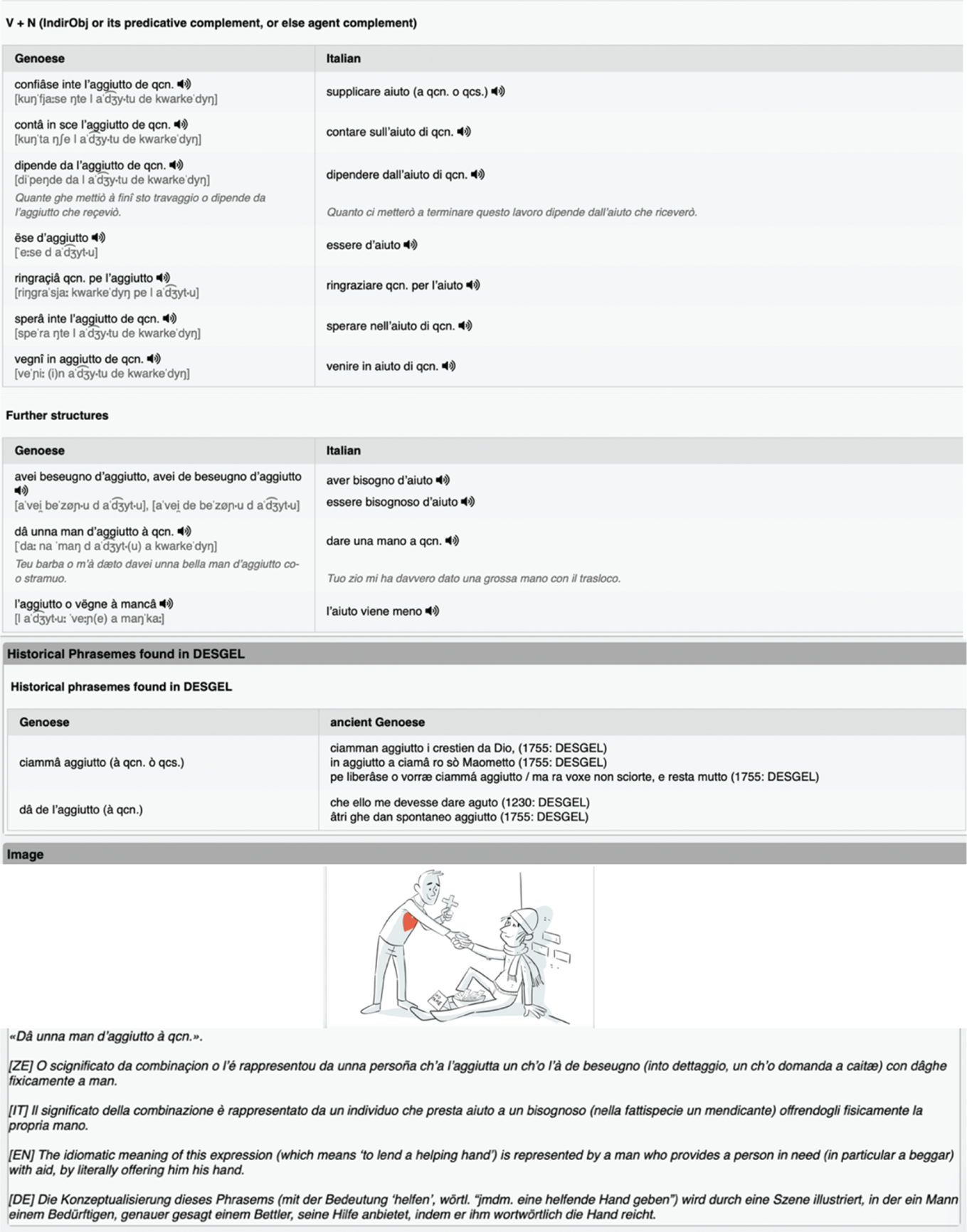
This dictionary is quite innovative in its structure, and in the reliable and modern translations into Italian provided; the sample sentences are created according to 30 precise criteria (see chapter 3.1.2), and report, within others, also Genoese phrasemes that had never previously been documented in written form. Moreover, the dictionary also contains audio files, phonetic transcriptions, a user-friendly database including a Genoese keyboard (allowing different spellings to be searched), and extensive metalexicographic information in many entries giving scope for a more detailed description of each phraseme listed.
3.1 The sample sentences in GEPHRAS2
3.1.1 Historical sample sentences in GEPHRAS2
As mentioned above, some varieties are still not covered by open corpora, and this is also the case for Genoese. Except for blogs, social medias, videos and songs and various kinds of texts that one could analyse on his own, the only big corpus currently available for the project GEPHRAS2 is the as yet unedited work DESGEL by Toso who collected different types of texts dating back to the first documents written in different Ligurian varieties till 1815. As a partner of the GEPHRAS and GEPHRAS2 projects and co-author of the dictionary, Toso has provided the team with historical phrasemes found either in whole sample sentences or only in parts of them (for easier readability); these were taken from his extensive historical corpus. The linguistic and historical awareness of the lexicographer(s) makes it possible to search for phrasemes with different spellings. Thus, for example, within the lemma æña (‘sand’) one can find:
As can be seen from Table 1, these sample sentences correspond to unmodified parts of historical texts, that are useful to help us understand how a certain phraseme was once used. In the past one could still find the intervocalic <r> (probably [ɹ]) in arena (nowadays æña), which can also still be found in the article ra (nowadays a); moreover, in arenna, some writers chose to use nn instead, some nn- (very common in many Genoese texts and in writing proposals such as the one by the Académia Ligùstica do Brénno) or <ñ> (also found in 18th and 19th century literature, cf. Autelli 2021: 29). On the internet, one can also find “personal” spellings that are not part of any official proposals, such as n-n.
Some historical phrasemes taken from the lemma æña ‘sand’ in GEPHRAS / GEPHRAS2
| Genoese | Ancient Genoese |
| æña de mâ / de sciumme | como l’arenna de lo mar (f. s. XIII: DESGEL) |
| granin d’æña | quante granne d’arenna ha ra marinna (1636: DESGEL) |
In addition, as one can see in Table 2, in the phrasemes to be found under the lemma bocca (‘mouth’) there are many variants and diachronic changes: compare, for example, the orthographical choices within the first example (meaning ‘to kiss somebody a thousand times on his mouth’), using baxâ vs. bassià. The second example (meaning ‘he saw a big dragon with his mouth opened’) shows bocca vs. boca, while the third example (meaning ‘it touched the opening [literally ‘the mouth’] of the stomach’) exemplifies steumago vs. stoemagho and do vs. dro (without the <r> in the preposition). Finally, the last example compares çê vs. cè (meaning ‘and they will have a sour taste’, whereby the single phraseme cè dra bocca, literally meaning ‘sky of the mouth’, refers to the palate).
Some historical phrasemes taken from the lemma bocca ‘mouth’ in GEPHRAS / GEPHRAS2
| Genoese | Ancient Genoese |
| baxâ qcn. in sciâ bocca | in bocca mille vote ro bassià (s. XVI: DESGEL) |
| bocca averta | ello vi’ um gram dragon chi tegnea la boca averta (s. XIV: DESGEL) |
| bocca do steumago | o me toccava ra bocca dro stuoemagho (s. XVII: DESGEL) |
| çê da bocca | e che ro cè dra bocca han bell’amaro (1636: DESGEL) |
The following section will explain how the modern Genoese-Italian sample sentences for GEPHRAS2 were created.
3.1.2 Criteria used to create the GEPHRAS2 contemporary sample sentences
For general lexicography, several criteria to formulate good sample sentences have already been proposed (cf. Jacinto García 2015: 80–82). Unfortunately, these are often very vague (cf. Lea 2014: 87) and to date there are no lists that show how to develop sample sentences for phraseological dialectal dictionaries. Although online dictionaries offer greater volume of content than paper format, it is still a worldwide debate as to how many sample sentences they should include. Indeed, some lexicographers think “the more the better”, but sometimes, among other reasons, due to better visibility or time issues, the selection of a certain number of sample sentences is requested. There is still no standard rule as to the number of sample sentences to be integrated (cf. also Altmanova 2013: 24). Moreover, some might be easier to translate while others might be too specific or complicated; therefore, it also depends on the needs of the user as to which sample sentences are to be provided. In the GEPHRAS and GEPHRAS2 projects, all users are invited to provide feedback on the content of the dictionary by writing an e-mail to the authors or to the team (gephras@uibk.ac.at). Any proposals received will be considered by all the team members who will discuss the adoption of any suggestions made. The dictionary is based on the dominant (urban) Genoese variety so all proposals should be in this.
As far as the contemporary synchronic sample sentences are concerned, the sample sentences in GEPHRAS2 are given both in dialect (Genoese) and in Italian, similar to the system adopted in other dialectal dictionaries, for example, the Vocabolario Milanese-Italiano (Cherubini 1814), the Vocabolario del dialetto del territorio orvietano (Mattesini and Ugoccioni 1992), and the Vocabolario del dialetto di Gallesano d’Istria (Balbi and Muscarda Budić 2013). Most of the sample sentences inserted in 2021 were formulated by a former Genoese-Italian native speaker involved in the project (S. Lusito) following a list of criteria provided by the project leader (see the 30 criteria listed in chapter 3.1.2); currently they are being formulated and/or translated, except for the project leader, by other Genoese-Italian co-workers involved in the project (A. Guasoni and B. Pedemonte). It is important to underline that the idea of creating criteria to write sample sentences for phraseological dictionaries is not new. The project leader was inspired by the work with Christine Konecny for a dictionary of Italian-German collocations (cf. Autelli and Konecny 2017) and some of the criteria formulated were adopted for GEPHRAS2. However, in order to create sample sentences for dialect dictionaries, several additional reflections and changes had to be made, as GEPHRAS2 includes several kinds of phrasemes (collocations, idioms, comparative, communicative and structural phrasemes) and concerns Genoese and Italian. Dialect often regards orality and thus it is important to also provide spontaneous sentences, which contain, for example, demonstrative pronouns, and which often address someone directly. The criteria that will be explained below are just some of the possible suggestions for writing sample sentences for a dialectal phraseological dictionary, thus GEPHRAS2 can only serve as a model for other dialect dictionaries.
Of course, one of the initial issues to deal with in a dialect dictionary is what variety to choose for that particular work, and this applies also to the sample sentences. This implies the choice of the most exact diatopic variety with its particular features. For example, we have focused on the urban Genoese, although one should be aware that there is a slight continuum and that it is not possible to trace exact boundaries. Moreover, a decision should be made as to whether to include or not vulgar expressions and registers of several kinds, both in the entries themselves and in the sample sentences.
In GEPHRAS and GEPHRAS2, sample sentences of different kinds have been given. We include different contexts (criterion 1), registers (criterion 2; most of these are, however, informal and spontaneous, and therefore typical of the spoken dialect), tenses and persons (criterion 3, e.g., imperative, conditional, first or third person singular or plural), and sentence types (criterion 4: the sentences can be negative, positive, interrogative, exclamative and affirmative),[8] as in:
| (1) | Ô voei tiâ un pö zu, sto volumme? M’ei za fæto unna testa comme un ballon co-a vòstra diascoa de muxica! / Lo volete abbassare, ’sto volume? Mi avete fatto una testa come un pallone con la vostra musica del cavolo! ‘Would you turn that down, please? You’ve made my head hurt (lit. ‘like a balloon’) with your stupid music!’ |
| (2) | Into basket un zugou incarregou de unna remissa feua do campo o no peu toccâ o ballon in sciô campo primma che o mæximo o l’agge toccou un atro zugou. / Nella pallacanestro un giocatore incaricato di una rimessa da fuori campo non può toccare la palla in campo prima che la stessa abbia toccato un qualsiasi giocatore. ‘In basketball, a player in charge of an off-court throw-in may not touch the ball on the court before it has touched any player.’ |
| (3) | Lascilo stâ, no ti veddi ch’o l’à o bellin amao? / Lascialo perdere, non vedi che ha le scatole girate? ‘Forget about him, can’t you see he’s got a screw loose?’ |
| (4) | O vegio castello do paise o s’attreuva in sce un bricco tramezo a-i bòschi. / Il vecchio castello sorge su una collina in mezzo ai boschi. ‘The old castle stands on a hill in the middle of the woods.’ |
| (5) | Pe dâ un pö de savô a-o soffrito, beseugna che ti gh’azzonzi ancon un pittin d’aggio. / Per rendere il soffritto più saporito, dovresti aggiungere ancora un po’ d’aglio. ‘To make the sauté tastier, you should add a little more garlic.’ |
In most cases, an attempt is made to provide “simple” sentences, i.e., with few subordinate clauses (criterion 5); if necessary, we provide two simple sentences instead of a single complex sentence to provide some context, as in:
| (6) | Mæ pai o Menego e a Lidia an fæto anâ a cascia e i peteni into maiezzo. Ei visto quante gente an invitou? / Domenico e Lidia devono aver speso fino all’ultimo centesimo per il loro matrimonio. Avete visto quanti invitati c’erano? ‘Domenico and Lidia must have spent every last penny on their wedding. Did you see how many guests were there?’ |
Moreover, it is worth reflecting on which orthography is to be used in order to be coherent (we have chosen that published by Acquarone 2015), although this applies to the whole dictionary and not only to the sample sentences.
In addition, it is important to pay attention not only to the “starting” diatopic variety, but also to that used for the translations (criterion 6), which in this case is Italian. The Italian equivalents are given in standard Italian. Thus, for example, we have not translated bronzin (‘sink’, ‘tap’) with the Genoese regionalism bronzino, but with the standard Italian equivalent rubinetto, for example:
| (7) | Dæto che ancheu an fæto di travaggi inte cannæ, saià megio lasciâ corrî un pö o bronzin primma de piggiâghe de l’ægua. / Dato che oggi hanno svolto dei lavori alle tubature, sarà meglio far scorrere un po’ il rubinetto prima di usare l’acqua. ‘As work has been carried out on the pipes today, it would be better to leave the tap running for a while before using the water.’ |
Furthermore, we have avoided regional expressions such as ci vediamo dalla chiesa (‘see you by the church’; in Liguria the preposition “da” is also used for places and not only for people).
However, one of the aims of the dictionary is to ensure that the sample sentences sound as natural as possible (criterion 7); for this purpose, Chapman (1974: 94) suggested trying to write “a sentence that you and other native speakers […] would rate as normal [using] linguistic intuition”. To this purpose, the sample sentences of GEPHRAS and GEPHRAS2 are read out by a Genoese poet, Bruna Pedemonte, who is a mother-tongue speaker of both Genoese and Italian. She actually speaks standard Italian, but one can easily recognise that her prosody is Ligurian (the prosody changes visibly depending on each Italian region). Up to the now, audio recordings of such dialectal sample sentences in the dictionaries have been quite rare. To guarantee some balance between male and female voices, it was decided to ask a woman to read out the sentences as two male voices and only one female voice had already been used for the single audio recordings of the phrasemes.
One of the other urgent questions to resolve in GEPHRAS2 was how to choose the phrasemes on which to build the sample sentences, with regards to time but especially because too many examples might make the entries very long and thus represent an obstacle to learners or translators, who cannot lose too much time in writing or translating a text. The number of sample sentences chosen for the project should depend on the total number of phrasemes reported in each entry: it is proportional to the number of documented phrasemes (criterion 8) as some lemmas include a wider range of combinations than others. The rule to follow in GEPHRAS2 is: “2 sentences for 5 phrasemes, 3 for 5–10 phrasemes, and at least 4 for more than 10”. A sample sentence should be given as many phraseological and morpho-syntactic categories as possible (criterion 9). In addition, a sample sentence for each phraseme is given if it is not polysemous; if it is, several sample sentences should be provided (criterion 10) as the meaning might vary according to context (cf. Arsenteva 2011: 87). However, this rule is not always applicable, as some meanings might no longer be in frequent use, making it difficult, if not impossible, to provide authentic sentences with one of the possible meanings. An example for this is allargâ e ae in its meaning ‘make it his own way’. It was possible to provide a sample sentence for its idiomatic meaning:
| (8) | Ammia ben de no stâ à allargâ e ae, eh, che ancheu ti ne piggi! / Vedi bene di non alzare la cresta, eh, che oggi le prendi! ‘Don’t you dare get ahead of yourself, otherwise you’ll get knocked down today!’ |
On the contrary, there is a literal translation but this is no longer widely used and thus does not sound very natural; therefore, no sample sentence was provided for the literal meaning.
In order to avoid matters of copyright, no sample sentences should be copied from other dictionaries (criterion 11); however, the team consults other dictionaries and a few corpora as reference (criterion 12: consult corpora). As no public Genoese corpora are available online, the lexicographers have had to rely on an unpublished historical corpus provided by the team partner Professor Toso (see above). Moreover, the team is making use of Italian corpora, in particular of Sketch Engine’s corpus itTenTen (cf. Jakubíček et al. 2013), as many Italian phrasemes are used in similar ways as Genoese phrasemes in similar contexts and might suggest appropriate sample sentences in Genoese.
We insert such examples mostly underneath useful phrasemes in everyday life (criterion 13) in order to be able to promote easy communication, instead of giving sample sentences for very specific phrasemes such as cavallo coronou (cavallo coronato in Italian), meaning ‘crowned horse’. One example given in the dictionary is:
| (9) | Sto cavallo o l’obbedisce de lengê: pe fâlo camminâ basta portâlo pe-a man. / Questo cavallo è molto obbediente: per farlo camminare basta guidarlo con la mano. ‘This horse is very obedient: all you have to do to make it walk is guide it with your hand’. |
This sentence represents a concrete situation and helps communicate meaning when giving instructions to somebody willing to learn how to guide a horse by hand.
Having decided which varieties and phrasemes to include and where to collocate the sample sentences in the dictionary, it is important to create examples which can be easily understood (criterion 14), with the relevant phraseme embedded in a specific context. Where possible, concrete referents (instead of pronouns) should be addressed (criterion 15), for example, making reference to the priest instead of using a pronoun, such as in:
| (10) | O præve o l’à dæto o battezzo a-o figgeu con l’ægua beneita. / Il sacerdote ha battezzato il bambino con l’acqua benedetta. ‘The priest baptised the child with holy water.’ |
The content of the sample sentences should not only possibly sound plausible (criterion 16), but also take into account some ethical issues. Indeed, one might sometimes tend to formulate the utterances in a way that might sound critical or even discriminating against somebody, even if this was not intended. For this reason, a list of criteria was created to respond to these issues.
First of all, gender aspects need to be addressed to avoid discrimination (criterion 17). Both male and female names are used for the sample sentences in the GEPHRAS2 project. These have been chosen at random from a list of different names provided by the project leader; the chosen names are all common in Italy. In addition, several targets, e.g., young or older people, should receive equal treatment (not writing only positive or only negative sentences for a single group) (criterion 18).
Despite using explicit referents (instead of personal pronouns) (criterion 19), anonymity was ensured by not using family names (criterion 20). As some negative and vulgar expressions are also part of any language/dialect and culture, they are included in the dictionary despite their rather dubious nature (they might, however, often be extremely emtertaining in Genoese). No offence is intended toward anybody, and with this in mind, authentic sentences such as the following are also included:
| (11) | Me ven vergheugna d’anâ in gio co-o Mattia. O parla comme un camallo. / Mi mette vergogna andare in giro con Mattia. Parla come uno scaricatore di porto. ‘I’m ashamed to walk around with Mattia. He talks like a docker.’ |
Both in Genoese and Italian (but also in other varieties), the phrase ‘talking like a docker’ indicates a person uses a very low register. The given sample sentence represents an authentic sentence that one might hear, but there is nothing personal against dockworkers.
Political correctness was also an objective in compiling the dictionary, in the sense of the protection of privacy (criterion 21); no specific names of well-known persons or of acquaintances are mentioned. An example referring to certain politicians who are not named is:
| (12) | A l’é delongo a mæxima canson. Pe fin che a-o governo ghe saià i mæximi, di cangi inte sta costion no ghe ne peu ëse. / È sempre lo stesso discorso. Finché al governo ci saranno le stesse persone, non ci possono essere cambiamenti in materia. ‘It is always the same. As long as the same people are in government, this issue will not change.’ |
The lexicographers should consider wider issues when writing and translating such examples: first, if they exist, proper names should be given in Genoese, thus not keeping the Italian name (criterion 22), such as in:
| (13) | T’æ sacciuo da Tëxinin? Pâ ch’a se segge attrovâ l’amigo… / Hai saputo di Teresa? Sembra si sia trovata l’amico… ‘Did you hear about Teresa? Looks like she found her buddy...’ |
As we can see, we did not use “Teresa” in the Genoese sentence, but “Tëxinin” because there is an exact Genoese equivalent.
In general, one should give the exact equivalents if any exist (and not synonyms or paraphrases for the translations) (criterion 23) in order to promote greater understanding, as in:
| (14) | A luña a l’é scentâ into çê, coverta da-e nuvie. / La luna è scomparsa nel cielo, coperta dalle nuvole. ‘The moon has disappeared in the sky, covered by clouds.’ |
If realia are used, some explanation should be provided (criterion 24), as in:
| (15) | O gianco e o bleu rappresentan i coî caratteristichi di “azulejos” [= laggioin] portogheixi. / Il bianco e il blu rappresentano i colori caratteristici degli “azulejos” [= piastrelle in ceramica] portoghesi. ‘White and blue are the characteristic colours of Portuguese azulejos [ceramic tiles].’ |
In the example above, the “azulejos” (‘ceramic tiles’) are defined in brackets.
Particular attention should be paid to the use of singular/plural (criterion 25), of articles (criterion 26), and prepositions (criterion 27); they might sometimes diverge or might sound more natural expressed in another way, as in:
| (16) | Tutte e vòtte che penso a-o reisego ch’emmo schivou me ven a carne de galliña. / Ogni volta che penso al pericolo che abbiamo scampato mi viene la pelle d’oca. ‘Every time I think of the danger we escaped, I get goose bumps.’ |
Moreover, while translating, attention should also be paid to the focus (criterion 28), to the connotation (criterion 29), and, especially, to false friends (criterion 30). For example, in the phraseme æña affogâ, affogâ might sound and look the same as the Italian affogata = ‘drowned’, but it actually means ‘on fire’ and thus the whole combination means sabbia ardente/arroventata/rovente (‘hot sand’), which is relevant to for the meaning of the whole sentence.
In GEPHRAS2, the team aims to be coherent and to follow all the 30 criteria that have been shown, in an attempt to guarantee user-friendly and phraseologically relevant sample sentences. Though some of the hints provided might seem obvious for such a referential work, it should be remembered that so far no list of criteria for sample sentences in dialectal phraseological dictionaries has ever been published and some points might not be that obvious after all. Given the general unsystematic approach adopted in dialect dictionaries, this article could represent a first step towards providing a system for the formulation and presentation of sample sentences that contain certain phrasemes both in a specific dialect and their equivalents in a chosen standard language (in this case, Genoese and Italian).
4 Conclusions
It is to be hoped that the 30 principles explained in this paper might help in the compiling of phraseological dictionaries of a certain diatopic variety and will stimulate further research. It was shown that one of the main problems when compiling this kind of dictionary is a lack of electronic corpora in many varieties that also often contain texts written in different ways. For this reason, electronic research can be very challenging even if access to dialectal corpora is available; the researcher needs to be familiar with every orthography that has been used, as many people manage the documentation according to their own personal choice. Moreover, it is difficult to choose which variety to include, as the sample sentences need to sound as natural as possible. This is why, in this case, diction rules were not followed: for GEPHRAS2 the prosody of a Ligurian poet is accepted when reading in Italian (these audio files will be uploaded over the next few months).
It is important to underline that many dialect dictionaries do not offer any sample sentences, even though these are extremely useful in helping to understand the use of certain phrases in a specific context. In fact, native speaker competence is required in order to be able to judge the naturality of the sentences, but they should also be written in such a way as to be understood easily by the reader(s). This is more likely if they are systematically planned, with due attention to content, taking into account their common use, and ensuring that they are not too complex; such an approach will facilitate both comprehension and learning. Indeed, Potgieter writes that the aim should be to provide “natural, typical, informative and intelligible example sentence[s]” (2012: 270). In order to guarantee objective sentences, it is recommended to ask for feedback directly from the users. This can be achieved through questionnaires or, as in the GEPHRAS2 project, through a semi-collaborative approach that invites the public to interact and write to the project team. The lexicographer(s) can then evaluate whether to include the comments received from the public, according to the concepts behind the dictionaries and the needs of the wider audience.
This article shows that further studies on dialect phraseography are needed, especially as only a few phraseological dialect dictionaries that are also structured systematically have been compiled so far. Creating a list of criteria for writing sample sentences for the GEPHRAS2 project was challenging and further improvements can certainly be made. However, it does offer suggestions as to how to start documenting varieties. Such a system is urgently needed, particularly with regards to those varieties in danger of dying out, as these need to be documented as soon as possible.
References
Acquarone, Andrea. 2015. Scrivere la lingua. In Andrea Acquarone (ed.), Parlo ciæo: la lingua della Liguria. Grammatica, letteratura, storia, tradizioni, 87–94. Genova: Secolo XIX & De Ferrari.Suche in Google Scholar
Altmanova, Jana. 2013. L’exemple-phrase dans la lexicographie bilingue contemporaine: fonctions et critères de sélection. In Pierluigi Ligas & Giovanni Tallarico (eds.), Lexíque Lexíques. Théories, méthode et perspectives en lexícologie, lexicographie, terminologie et phraséologie, 21–38. Verona: QuiEdit.Suche in Google Scholar
Arsenteva, Elena. 2011. The Main Problems of Multilingual Phraseological Compilation. In Antonio Pamies, Lucía Luque Nadal & José Manuel Pazos Bretaña (eds.), Multi-Lingual Phraseography: Second Language Learning and Translation Applications (Phraseologie und Parömiologie 28), 81–88. Baltmannsweiler: Schneider Verlag Hohengehren.Suche in Google Scholar
Autelli, Erica. 2020. Phrasemes in Genoese and Genoese-Italian lexicography. In Joanna Szerszunowicz & Eva Gorlewska (eds.), Applied linguistics perspectives on reproducible multiword units: Foreign language teaching and lexicography (Intercontinental Dialogue on Phraseology 8), 101–127. Białystok: University of Białystok: Publishing House.Suche in Google Scholar
Autelli, Erica. 2021a. Il genovese poetico attraverso i secoli. Con una presentazione di Fiorenzo Toso (Studia Romanica et Linguistica 63). Berlin et al.: Peter Lang.10.3726/b17703Suche in Google Scholar
Autelli, Erica. 2021b. Le nouveau dictionnaire phaséologique Génois-Italien online: GEPHRAS. In Claude Passet (ed.), La langue génoise, expression de la terre et de la mer, langue d’ici et langue d’ailleurs. Actes du 16e colloque international de langues dialectales (Monaco, 16 Novembre 2019). Préface de S.A.S. le Prince Albert II de Monaco, 269–280. Monaco: Editions EG.Suche in Google Scholar
Autelli, Erica. 2022. Ein Modell zur systematischen Erfassung genuesischer Phraseme in Wörterbüchern, illustriert am Beispiel der Forschungsprojekte GEPHRAS und GEPHRAS2. Linguistik Online 115(3). 3–38.10.13092/lo.115.8621Suche in Google Scholar
Autelli, Erica. In print. La fraseologia settoriale dei dizionari genovesi-italiani. In Geneviève Henrot Sostero (ed.), Alle radici della fraseologia europea. Atti del VII Convegno dell’Associazione Phrasis 2021 (Linguistic Insights). Berlin et. al.: Peter Lang.Suche in Google Scholar
Autelli, Erica & Christine Konecny. 2017. Lexikographische Beispielsätze für ein bilinguales Kollokationswörterbuch: Herausforderungen und mögliche Strategien bei ihrer Auswahl. Talk given at the 3rd International Conference on Translation and Interpreting Studies “Redefining and refocusing Translation and interpreting Studies”. Innsbruck, December 7th–9th 2017.Suche in Google Scholar
Autelli, Erica & Christine Konecny. 2020. Nuevos retos y oportunidades para la lexicografía dialectal en línea: GEPHRAS – el primer diccionario fraseológico genovés-italiano online. PHRASIS – Rivista di studi fraseologici e paremiologici 4 (special volume edited by Antonio Pamies & Daniela Natale, Fraseologia: cultura, variazione e trattamento informatico). 22–45.Suche in Google Scholar
Autelli, Erica & Christine Konecny (eds.). In prep. Fraseologismi e costruzioni nella lessicografia delle varietà diatopiche – studi in prospettiva inter- e intralinguistica. Studi in onore di Fiorenzo Toso (provisory title). Linguistik Online.Suche in Google Scholar
Autelli, Erica, Christine Konecny & Stefano Lusito. 2019. GEPHRAS: il primo dizionario combinatorio genovese-italiano online. In Fiorenzo Toso (ed.), Il patrimonio linguistico storico della Liguria: attualità e futuro, 21–32. Savona: inSedicesimo.Suche in Google Scholar
Autelli, Erica, Christine Konecny & Stefano Lusito (eds.). In print a. Concezione, struttura e aspetti didattici del dizionario fraseologico GEPHRAS. In Erica Autelli, Christine Konecny & Stefano Lusito (eds.), Dialektale und zweisprachige Phraseographie – Fraseografia dialettale e bilingue – Fraseografía dialectal y bilingüe (Sprachkontraste und Sprachbewusstsein). Tübingen: Edition Julius Groos im Stauffenburg-Verlag.Suche in Google Scholar
Autelli, Erica, Christine Konecny & Stefano Lusito (eds.). In print b. Dialektale und zweisprachige Phraseographie – Fraseografia dialettale e bilingue – Fraseografía dialectal y bilingüe. (Sprachkontraste und Sprachbewusstsein). Tübingen: Edition Julius Groos im Stauffenburg-Verlag.Suche in Google Scholar
Bergenholtz, Henning & Sven Tarp (eds.). 1995. Manual of specialised lexicography: The preparation of specialised dictionaries. Amsterdam & Philadelphia: John Benjamins.10.1075/btl.12Suche in Google Scholar
Burger, Harald. 2002. Dialektale Phraseologie am Beispiel des Schweizerdeutschen. In Elisabeth Piirainen & Ilpo Tapani Piirainen (eds.), Phraseologie in Raum und Zeit. Akten der 10. Tagung des Westfälischen Arbeitskreises „Phraseologie/Parömiologie“ Münster 2001. Baltmannsweiler: Schneider Verlag Hohengehren.Suche in Google Scholar
Burger, Harald & Peter Zürrer. In print. Probleme dialektaler Phraseographie. In Erica Autelli, Christine Konecny & Stefano Lusito (eds.), Dialektale und zweisprachige Phraseographie – Fraseografia dialettale e bilingue – Fraseografía dialectal y bilingüe (Sprachkontraste und Sprachbewusstsein). Tübingen: Edition Julius Groos im Stauffenburg-Verlag.Suche in Google Scholar
Caro Cedillo, Anna. 2004. Fachsprachliche Kollokationen. Ein übersetzungsorientiertes Datenbankmodell. Deutsch-Spanisch. Tübingen: Narr.Suche in Google Scholar
Carriscondo Esquivel. 2004. Lingüística, lexicografía, vocabulario dialectal: El Vocabulario andaluz de A. Alcalá Venceslada. Berlin & New York: Mouton De Gruyter.10.31819/9783865278531Suche in Google Scholar
Chapman, Robin S. 1974. Appendix D. Instructions and sample sentences given to raters. In Robin S. Chapman (ed.), The Interpretation of deviant sentences in English. Berlin & New York: Mouton De Gruyter.Suche in Google Scholar
Cini, Monica. 2005. Problemi di fraseologia dialettale. Roma: Bulzoni.Suche in Google Scholar
Cowie, Anthony P. 1999. English dictionaries for foreign learners: A history. Oxford: OUP & Clarendon Press.10.1093/oso/9780198235064.001.0001Suche in Google Scholar
Dobrovol’skij, Dmitrij. 2014. The use of corpora in bilingual phraseology. In Andrea Abel, Chiara Vettori & Natascia Ralli (eds.), Proceedings of the XVI EURALEX International Congress: The user in focus. 15–19 July 2014, 867–884. Bolzano, Bozen: Institute for Specialised Communication and Multilingualism.Suche in Google Scholar
Drysdale, Patrick D. 1987. The role of examples in a learner’s dictionary. In Anthony P. Cowie (ed.). The dictionary and the language learner. Papers from the EURALEX Seminar at the University of Leeds, 1–3 April 1985. Lexicographica 17, 213–223. Tübingen: Niemeyer.10.1515/9783111340500-018Suche in Google Scholar
Fanfani, Massimo. 2007. Phraseographie des Italienischen. In Harald Burger, Dmitrij Dobrovol’skij, Peter Kühn & Neal R. Norrick (eds.), Phraseologie / Phraseology. Ein internationales Handbuch der zeitgenössischen Forschung. An international handbook of contemporary research, vol. 2, 975–986. Berlin & New York: Mouton De Gruyter.10.1515/9783110190762.975Suche in Google Scholar
Fanfani, Massimo. In print. Modi di dire non toscani nel Vocabolario toscano di Pietro Fanfani. In Erica Autelli, Christine Konecny & Stefano Lusito (eds.), Dialektale und zweisprachige Phraseographie – Fraseografia dialettale e bilingue – Fraseografía dialectal y bilingüe (Sprachkontraste und Sprachbewusstsein). Tübingen: Edition Julius Groos im Stauffenburg.Suche in Google Scholar
Ferro Ruibal, Xesús, María Jesús Anido Silvosa, María do Carme Lamela Villaravid & María Clara Viqueira Liñares (eds.), 1998. Actas do I Coloquio Galego de Fraseoloxía. Santiago de Compostela: Centro Ramón Piñeiro para a investigación en Humanidades, Xunta de Galicia.Suche in Google Scholar
Fourment-Berni Canani, Michèle. 2005. La fonction des exemples culturelles dans un dictionnaire bilingue d’apprentisage. Éla. Études de linguistique appliqauée 128. 467–479.10.3917/ela.128.0467Suche in Google Scholar
Franceschi, Temistocle. 1994. Il Proverbio e la scuola geoparemiologica Italiana. Paremia 3. 27–36.Suche in Google Scholar
Franceschi, Temistocle. 1999. L’Atlante Paremiologico Italiano e la geoparemiología. In Salvatore C. Trovato (ed.), Proverbi, locuzioni, modi di dire nel dominio linguistico italiano, 1–22. Roma: Il Calamo.Suche in Google Scholar
Franceschi, Temistocle. 2000. Ventimila detti proverbiali raccolti in ogni regione d’Italia.Alessandria: Edizioni dell’Orso.Suche in Google Scholar
Gouws, Rufus H. 1989. Leksikografie. Cape Town: Academica.Suche in Google Scholar
Häcki-Buhofer, Annelies. 2011. Lexicography of collocations between theoretical and practial requirements. In Antonio Pamies, Lucía Luque Nadal & José Manuel Pazos Bretaña (eds.), Multi-Lingual phraseography: Second language learning and translation applications (Phraseologie und Parömiologie 28), 17–38. Baltmannsweiler: Schneider Verlag Hohengehren.Suche in Google Scholar
Häcki-Buhofer, Annelies. In print. Kollokationen. Schwierigkeiten der quantitativen und qualitativen Identifikation in den Dialekten und Standardsprachen des Deutschen. In Erica Autelli, Christine Konecny & Stefano Lusito (eds.), Dialektale und zweisprachige Phraseographie – Fraseografia dialettale e bilingue – Fraseografía dialectal y bilingüe (Sprachkontraste und Sprachbewusstsein). Tübingen: Edition Julius Groos im Stauffenburg-Verlag.Suche in Google Scholar
Hünert-Hofmann, Else. 1991. Phraseologismen in Dialekt und Umgangssprache. Marburg: Elwert.Suche in Google Scholar
Herbst, Thomas. 1989. Dictionaries for foreign language teaching: English. In Franz Hausmann, Josef Oskar Reichmann, Herbert E. Wiegand & Ladislav Zgusta (eds.), Dictionaries: An international encyclopedia of lexicography. Handbooks of Linguistics and Communication Science, 1379–1385. Berlin & New York: Mouton De Gruyter.Suche in Google Scholar
Herbst, Thomas & Michael Klotz. 2003. Lexikografie. Paderborn et al.: Schöningh.Suche in Google Scholar
Jacinto García, Eduardo José. 2015. Forma y función del diccionario. Hacia una teoría general del ejemplo lexicográfico. Torredonjimeno (Jaén): Universidad de Jaén.Suche in Google Scholar
Korhonen, Jarmo. 2007. Probleme der kontrastiven Phraseologie. In Harald Burger, Dmitrij Dobrovol’skij, Peter Kühn & Neal R. Norrick (eds.), Phraseologie / Phraseology. Ein internationales Handbuch der zeitgenössischen Forschung. An international handbook of contemporary research, vol. 1, 574–587. Berlin & New York: Mouton De Gruyter.10.1515/9783110171013.574Suche in Google Scholar
Laufer, Batia. 1992. Corpus-based versus lexicographer examples in comprehension and production of new words. In Hannu Tommola, Krista Varantola, Tarja Salmi-Tolonen & Jürgen Schopp (eds.), EURALEX 1992 Proceedings, 71–76. Tampere: University of Tampere.Suche in Google Scholar
Lea, Diana. 2014. Making a learner’s dictionary of Academic English. In Andrea Abel, Chiara Vettori & Natascia Ralli (eds.), Proceedings of the XVI EURALEX International Congress: The user in focus. 15–19 July 2014, 867–884. Bolzano / Bozen: Institute for Specialised Communication and Multilingualism.Suche in Google Scholar
Marcato, Carla. 2007. Dialetto, dialetti e italiano. Bologna: Il Mulino.Suche in Google Scholar
Marello, Carla. 1987. Examples in contemporary Italian bilingual dictionaries. In Anthony P. Cowie (ed.), The dictionary and the language learner. Papers from the EURALEX Seminar at the University of Leeds, 1–3 April 1985 (Lexicographica. Series Mayor 17), 224–237. Tübingen: Niemeyer.10.1515/9783111340500-019Suche in Google Scholar
Martin, Samuel E. (1975) [1962]. Selection and presentation of ready equivalents in a translation dictionary. In Fred W. Householder & Sol Saporta (eds.), Problems in lexicography, 3rd edn, 153–159. Bloomington: Indiana University.Suche in Google Scholar
Matešić, Josip. 1988. Frazeologija i Dijalektologija. Izvorni znanstveni članak Primljeno XII(1988). 83–88. https://core.ac.uk/download/pdf/212470701.pdf (accessed 17 December 2020).Suche in Google Scholar
Melchior, Luca. In print. Tu âs cjatât chel dal formadi: considerazioni critiche sul trattamento dei fraseologismi nella lessicografia friulana. In Erica Autelli, Christine Konecny & Stefano Lusito (eds.), Dialektale und zweisprachige Phraseographie – Fraseografia dialettale e bilingue – Fraseografía dialectal y bilingüe (Sprachkontraste und Sprachbewusstsein). Tübingen: Edition Julius Groos im Stauffenburg-Verlag.Suche in Google Scholar
Mogorrón Huerta, Pedro & Analía Rosa Cuadrado Rey. 2000. Anexo 7: Fraseología y variaciones (socio)lingüísticas y diatópicas. https://revistaelua.ua.es/issue/view/2020-nAnexo%207 (accessed 17 December 2020).Suche in Google Scholar
Newell, Leonard E. 2000. Competency versus authority and example sentences in the dictionary. Lexicographica 16. 8–13.Suche in Google Scholar
Pamies Bertrán, Antonio. 2017a. Comme on dit dans mon village : les métaphores sont-elles si dialectale que ça ? Rev. de Letras 36(1). 21–37.Suche in Google Scholar
Pamies Bertrán, Antonio. 2017b. Fraseología y variación diatópica en español. Verba Hispanica XXV. 55–81.10.4312/vh.25.1.55-81Suche in Google Scholar
Pamies Bertrán, Antonio. In print. El tratamiento de la diatopía en fraseografía. In Erica Autelli, Christine Konecny & Stefano Lusito (eds.), Dialektale und zweisprachige Phraseographie – Fraseografia dialettale e bilingue – Fraseografía dialectal y bilingüe (Sprachkontraste und Sprachbewusstsein). Tübingen: Edition Julius Groos im Stauffenburg-Verlag.Suche in Google Scholar
Piirainen, Elisabeth. 1995. Mänden häbbt groote Aorne un könnt doch nich häörn. Zum usualisierten Wortspiel im Westmünsterländischen. Niederdeutsches Wort 35. 177–204.Suche in Google Scholar
Piirainen, Elisabeth. 1999. Se lött nix Potte braanen. Geschlechtsspezifische Idiome in der westünderländischen Mundart. In Peter Wagener (ed.), Sprachformen. Deutsch und Niederdeutsch in europäischen Bezügen. Festschrift für Dieter Stellmacher zum 60. Geburtstag, 147–156. Stuttgart: Steiner.Suche in Google Scholar
Piirainen, Elisabeth. 2000a. Phraseologie der westmünsterländischen Mundart. Teil 1: Semantische, kulturelle und pragmatische Aspekte dialektaler Phraseologismen. Baltmannsweiler: Schneider Verlag Hohengehren.Suche in Google Scholar
Piirainen, Elisabeth. 2000b. Phraseologie der westmünsterländischen Mundart. Teil 2: Lexikon der westmünsterländischen Redensarten. Baltmannsweiler: Schneider Verlag Hohengehren.Suche in Google Scholar
Piirainen, Elisabeth. 2006. Phraseologie in arealen Bezügen: ein Problemaufriss. In Ken Farø & Erla Hallsteindóttir (eds.), Neue theoretische und methodische Ansätze in der Phraseologieforschung. Linguistik Online 27(2). 195–218. https://bop.unibe.ch/linguistik-online/article/view/751/1282 (accessed 14 June 2022).10.13092/lo.27.751Suche in Google Scholar
Piirainen, Elisabeth. 2007. Dialectal phraseology: Linguistic aspects. In Harald Burger, Dmitrij Dobrovol’skij, Peter Kühn, Peter & Neal R. Norrick (eds.), Phraseologie / Phraseology. Ein internationales Handbuch der zeitgenössischen Forschung. An international handbook of contemporary research, vol. 1, 530–540. Berlin & New York: Mouton De Gruyter.10.1515/9783110171013.530Suche in Google Scholar
Piirainen, Elisabeth. 2016. Dialektale Phraseologie: Randererscheinung, Ergänzung oder Herausforderung einer modernen Phraseographie? In Elisabeth Piirainen (ed.), Phraseologie und figuratives Lexikon (Linguistik 89), 310–328. Tübingen: Stauffenburg.Suche in Google Scholar
Potgieter, Lietzt. 2011. Die ontwerp van vertalende vakwoordeboeke met vertalers as teikengebruikers: ’n teoretiese model. Doctoral Dissertation. Stellenbosch: University of Stellenbosch.Suche in Google Scholar
Potgieter, Lietzt. 2012. Example Sentences in Bilingual School Dictionaries. Lexikos 22. 261–271.10.5788/22-1-1007Suche in Google Scholar
Rey-Debove, Josette. 2005. Dictionnaires d’apprentissage : que dire aux enfants ? In Michaela Heinz (ed.), L’example lexicographique dans les dictionnaires français contemporains. Actes des Premières Journées allemandes des dictionnaires, Klingenberg am Main, 25–27 June 2004 (Lexicographica. Series Maior), 15–20. Tübingen: Niemeyer.10.1515/9783110924466.15Suche in Google Scholar
Rundell, Michael. 1998. Recent trends in English pedagogical lexicography. International Journal of Lexicography 11(4). 315–342.10.1093/ijl/11.4.315Suche in Google Scholar
Schmidlin, Regula. 2007. Phraseological expressions in German Standard varieties. In Harald Burger, Dmitrij Dobrovol’skij, Peter Kühn, Peter & Neal R. Norrick (eds.), Phraseologie / Phraseology. Ein internationales Handbuch der zeitgenössischen Forschung. An international handbook of contemporary research, vol. 1, 551–562. Berlin & New York: Mouton De Gruyter.10.1515/9783110171013.551Suche in Google Scholar
Suzete, Silva (ed.). 2021. Fraseologia & Cia. Brasil e Cuba. Homonegam a Cárdenas, Carnedo e Tristá, vol. 3. Campinas: Pontes.Suche in Google Scholar
UNESCO Atlas of the World’s Languages in Danger. (1995–2010). http://www.unesco.org/languages-atlas/, (Language name “Ligurian”) (accessed 9 November 2020).Suche in Google Scholar
Wiegand, Herbert Ernst. 1984. On the structure and contents of a general theory of lexicography. In Reinhard R.K. Hartmann (ed.), LEX’eter ’83 Proceedings, 13–30. Tübingen: Niemeyer.10.1515/9783111593166-005Suche in Google Scholar
Wiegand, Herbert Ernst. 1998. Wörterbuchforschung. Berlin & New York: Mouton De Gruyter.10.1515/9783110802467Suche in Google Scholar
Wiegand, Herbert Ernst, Michael Beißwenger, Rufus H. Gouws, Matthias Kammerer, Angelika Storrer & Werner Wolski (eds.). 2020. Wörterbuch zur Lexikographie und Wörterbuchforschung, vol. 3. Berlin & Boston: Mouton De Gruyter.Suche in Google Scholar
Zgusta, Ladislav. 1971. Manual of lexicography. The Hague: Mouton.10.1515/9783111349183Suche in Google Scholar
Zöfgen, Ekkehard. 1994. Lernerwörterbücher in Theorie und Praxis. Ein Beitrag zur Metalexikographie mit besonderer Berücksichtigung des Französischen. Tübingen: Niemeyer.10.1515/9783111341156Suche in Google Scholar
Zürrer, Peter. 2007. Phraseme aus germanistisch-dialektologischer Sicht. In Harald Burger, Dmitrij Dobrovol’skij, Peter Kühn, Peter & Neal R. Norrick (eds.), Phraseologie / Phraseology. Ein internationales Handbuch der zeitgenössischen Forschung. An international handbook of contemporary research, vol. 1, 540–550. Berlin & New York: Mouton De Gruyter.10.1515/9783110171013.540Suche in Google Scholar
Dictionaries and corpora
Autelli, Erica, Stefano Lusito, Christine Konecny & Fiorenzo Toso. 2018–2021. GEPHRAS: The ABC of Genoese and Italian phrasemes (collocations and idioms). With drawings by Matteo Merli and linguistic support of Alessandro Guasoni. https://romanistik-gephras.uibk.ac.at (accessed 15 January 2022).Suche in Google Scholar
Autelli, Erica, Christine Konecny, Alessandro Guasoni, Stefano Lusito & Fiorenzo Toso. In prep. GEPHRAS2: The D-Z of Genoese and Italian phrasemes (collocations and idioms). With drawings by Matteo Merli. https://romanistik-gephras.uibk.ac.at/ (accessed 14 June 2022).Suche in Google Scholar
Balbi, Maria & Maria Muscarda Budić. 2013. Vocabolario del dialetto di Gallesano d’Istria. Fiume: Unione Italiana.Suche in Google Scholar
Beliakov, Vladimir. 2013. Dictionnaire russe-français des expressions phraséologiques / Pyccкo-фpaнцузcкий фpaзeoлoгичecкий cлoвapь. Toulous: Le Mirail.Suche in Google Scholar
Bencistà, Alessandro. 2012. Il vocabolario del vernacolo fiorentino e toscano. Firenze: Sarnus.Suche in Google Scholar
Biagalke, Rainer. 2009. Nuovo Dizionario Dialettale della Basilicata, 2nd edn. Hamburg: Dr. Kovač. banca dati del Dipartimento di Studi Occitani di Limousin. https://la-biaca.org/ (accessed 17 December 2020).Suche in Google Scholar
Boerio, Giuseppe. 1867. Dizionario del dialetto veneziano, 3rd edn. Venezia: Cecchini.Suche in Google Scholar
Bove, Rosanna & Romano, Antonio. 2014. Vocabolario del dialetto di Galatone. Lecce: Grifo.Suche in Google Scholar
Casaccia, Giovanni. 1876. Dizionario genovese-italiano, 2nd edn. Genova: Schenone.Suche in Google Scholar
Cherubini, Francesco. 1814. Vocabolario milanese-italiano, tomo I. Milano: Stamperia reale.Suche in Google Scholar
Cherubini, Francesco. 1827. Vocabolario mantovano-italiano. Milano: Gio. Batista Bianchi.Suche in Google Scholar
Fanfani, Pietro. 1863. Vocabolario dell’uso toscano. Firenze: Barbèra.Suche in Google Scholar
Gagny, Anita. 1993. Dictionnaire du français régional de Savoie. Paris: Bonneton.Suche in Google Scholar
Galiani, Ferdinando. 1789. Vocabolario del dialetto napoletano, che più si scostano dal dialetto toscano. Con alcune ricerche etimologiche sulle medesime degli Accademici Filopatridi. Napoli: Porcelli.Suche in Google Scholar
Gambini, Carlo. 1850. Vocabolario pavese-italiano e italiano-pavese. Firenze: Tipografia Fusi e Comp.Suche in Google Scholar
Gasser, Markus, Annelies Häcki Buhofer, Lorenz Hofer. 2010. Neues Baseldeutsch Wörterbuch. Basel: Merian.Suche in Google Scholar
Häcki Buhofer, Annelies, Marcel Dräger, Stefanie Meier, Meier & Tobias Roth. 2014. Feste Wortverbindungen des Deutschen. Kollokationenwörterbuch für den Alltag. Tübingen: Narr Francke Attempto.Suche in Google Scholar
Kilgarriff, Adam, Pavel Rychly, Pavel Smrž & David Tugwell. 2004. The Sketch Engine. In Geoffrey Williams & Sandra Vessier (eds.), Euralex 2004 Proceeding, 105–116. Lorient: Université de Bretagne-Sud.Suche in Google Scholar
Konecny, Christine & Erica Autelli. In prep.: Kollokationen Italienisch-Deutsch. Hamburg: Buske.Suche in Google Scholar
Jakubíček, Miloš, Adam Kilgarriff, Vojtěch Kovář, Pavel Rychlý & Vít Suchomel. 2013. The TenTen Corpus Family. In Proceedings of the 7th International Corpus Linguistics Conference CL 2013, the United Kingdom, July 2013, 125–127.Suche in Google Scholar
Lepri, Luigi. 2009. Bacajèr a Bulåggna. Fraseologia dialettale bolognese. Bologna: Pendagron.Suche in Google Scholar
Mattesini, Enzo & Nicoletta Ugoccioni. 1992. Vocabolario del dialetto del territorio orvietano. Prefazione di Baldelli, Ignazio. S.n.: Perugia.Suche in Google Scholar
Melchiori, Giovan Battista. 1817. Vocabolario bresciano-italiano, tomo I. Brescia: Tipografia Franzoni e socio.Suche in Google Scholar
Monti, Pietro. 1845. Vocabolario dei dialetti della città e diocesi di Como. Milano: Società Tipografica de’ classici italiani.Suche in Google Scholar
Núñez Román, Francisco. 2015. Dizionario di fraseologia dell’italiano regionale. Roma: Aracne.Suche in Google Scholar
Paccagnella, Ivano. 2012. Vocabolario del pavano (XIV-XVII secolo). Padova: Esedra.Suche in Google Scholar
Pellizzari, Bartolommeo. 1759. Vocabolario bresciano e toscano. Compilato per facilitare a’ Bresciani col mezzo della materna loro lingua. Il ritrovamento De’ Vocaboli Modi di dire e Proverbj Toscani a quella corrispondenti. Brescia: Camerale.Suche in Google Scholar
P.F.B. 1873. Vocabolario tascabile genovese-italiano per il popolo. Genova: R. I. Sordo-Muti.Suche in Google Scholar
Pipino, Maurizio. 1783. Vocabolario piemontese del medico Maurizio Pipino. Stamparia Reale: Teoria.Suche in Google Scholar
Pisano, Antonio. 2011. Dizionario dialettale calabrese. https://www.soveratoweb.it/images/librodialetto.pdf (accessed 17 December 2020).Suche in Google Scholar
Scoppa, Lucio Giovanni. 1511. Spicilegium, Spicilegium, in quo cum nomina, tum verba latina popularibus expressa, varij in utraque lingua elegantiarum modi traduntur, ex optimis authoribus desumptum. ed. Pr.: Napoli.Suche in Google Scholar
Stiftung Merian, Christof (ed.). 2010. Neues Baseldeutsch Wörterbuch. Basel: Stiftung Merian.Suche in Google Scholar
Toso, Fiorenzo. In progress. DESGEL: Dizionario etimologico-storico genovese e ligure.Suche in Google Scholar
VSI = Vocabolario dei dialetti della Svizzera italiana, Lugano (ora Bellinzona): Mazzuconi (ora Centro di dialettologia e di etnografia), 1952.Suche in Google Scholar
© 2023 Erica Autelli, published by De Gruyter, Berlin/Boston
This work is licensed under the Creative Commons Attribution-NonCommercial-NoDerivatives 4.0 International License.
Artikel in diesem Heft
- Frontmatter
- Editorial
- Editorial (English)
- Editorial (Deutsch)
- Articles
- Criteria for sample sentences in phraseological dialect dictionaries: a proposal based on GEPHRAS2
- ¿Coger con las manos en la masa es una locución o una colocación?
- The contextual behaviour of specialised collocations: typology and lexicographic treatment
- Lexical bundles in the academic writing of the Arts and Humanities: from corpus to CALL
- Proverbial markers and their significance for linguistic proverb definitions: an experimental investigation
- Polysemie, Ambiguität und Vagheit der Idiome aus kognitiver Perspektive
- Idioms in Syrian Arabic: a semantic and grammatical approach to the verb
- Book reviews
- Book reviews
- Book reviews
- Book reviews
- Book reviews
- Book reviews
- Book reviews
- Obituary
- Elena Arsenteva In Memoriam (1956–2022)
Artikel in diesem Heft
- Frontmatter
- Editorial
- Editorial (English)
- Editorial (Deutsch)
- Articles
- Criteria for sample sentences in phraseological dialect dictionaries: a proposal based on GEPHRAS2
- ¿Coger con las manos en la masa es una locución o una colocación?
- The contextual behaviour of specialised collocations: typology and lexicographic treatment
- Lexical bundles in the academic writing of the Arts and Humanities: from corpus to CALL
- Proverbial markers and their significance for linguistic proverb definitions: an experimental investigation
- Polysemie, Ambiguität und Vagheit der Idiome aus kognitiver Perspektive
- Idioms in Syrian Arabic: a semantic and grammatical approach to the verb
- Book reviews
- Book reviews
- Book reviews
- Book reviews
- Book reviews
- Book reviews
- Book reviews
- Obituary
- Elena Arsenteva In Memoriam (1956–2022)
