Rematerialisation
-
Katrine Dirckinck-Holmfeld

Abstract
The essay takes up Eve Kososky Sedgwick’s influential call for a reparative reading or practice, understood primarily as a performative and literary reading practice, in an attempt to inform what I call a reparative critical image practice. Montaging my own experiences learning from filmmaker Harun Farocki during the Labour in a Single Shot workshop (Cairo 2012) together with reflections from my work with the video-installation Leap into Colour (Cairo, Beirut, Copenhagen 2012-2015), the essay speculates how the reparative critical image undergoes a process of rematerialisation. The essay explores how the image migrates between different contexts, compressions, codecs and formats, and how this route, or line of flight, is enfolded into the image’s texture. I argue that montaging these layers of intensities can create a collaborative, historically dense, fabulous image, held together by affect.
Allow me to begin with an anecdote about something which happened to me, not long ago, on an October night in Alexandria in Egypt. Harun Farocki was showing his films In Comparison and Videograms of a Revolution at the Goethe Institute. Initially, the two films seemed to have very little in common: in Videograms of a Revolution , Farocki and Andrei Ujică assembled VHS and video footage shot by amateurs and newsreel cameramen to reconstruct the events that led to the fall of the Ceauşescus in Romania in 1989. In Comparison traces the making of bricks, from hand-moulded bricks in Burkina Faso and India to the highly-industrialised production of standardised bricks in Germany and France. At the end, the camera settles on a robot constructing a relief from bricks, each of which constitutes a pixel in a larger image.
As I was sitting there in the Goethe villa, watching the digitised, poor version of the original VHS tapes and films burned onto a DVD copy, a chilly breeze blowing from the Mediterranean Sea transported my childhood memories of watching the live transmission of the same event and superimposed them onto the screen. These were memories I had forgotten: It was a cold Christmas. Due to heavy snow the oil-truck could not deliver oil to the local heating system. We gathered around the woodstove as the TV showed the live transmission of Nicolae and Elena Ceauşescu waiting to die.
The tenses, formats, and contexts dizzy my consciousness. “I shudder over a catastrophe, which has already occurred” (Barthes 1981, 97), or which is taking place in this very moment: I am not sure.
Leap into Colour, still from video, Katrine Dirckinck-Holmfeld 2015
Some people nowadays are too eager to criticize this numerical organization, denouncing it as a military or even concentration-camp society where people are no longer anything more than deterritorialized ‘numbers’. But that is false. Horror for horror, the numerical organization of people is certainly no crueller than the lineal or state organizations. Treating people like numbers is not necessarily worse than treating them like trees to prune, or geometrical figures to shape and model.
(Deleuze/Guattari 1987, 390)
Motivated by my encounter with Farocki’s films, in this essay I will discuss: What, if anything, will one be able to assemble of the events sweeping across the Arab-speaking world, if we are to go back after the events like Farocki and Ujică did in Romania, to assemble the videograms, pixels, and fragments captured on countless cellular phones, video cameras and satellite phones? And how to assemble or repair an incongruent image from the fragments?[1]
My aim is to shift Eve Kosofsky Sedgwick’s proposition for a reparative critical reading or practice (Sedgwick 2003), from a hermeneutic practice in which the subject gathers the part objects and fragments she encounters and creates, into a digital image practice, through a discussion of the processes of rematerialisation that the reparative practice entails. I will establish the conceptual framework of rematerialisation by splicing elements of my own experience watching and learning from Farocki with reflections from my own work with the video-installation Leap into Colour.
Seeing In Comparison and Videograms of a Revolution together made me aware how the films’ content become analogous to the films’ own migration between multiple different formats, platforms and contexts. In Comparison traces the manual processes involved in the production of hand-moulded bricks from clay in Burkina Faso to the industrialized fabrication of bricks in Germany, but at the same time the film itself switches from analogue to digital. The film’s content as well as its format can be said to migrate from “texxture” to “texture.” According to Eve Kosofsky Sedgwick’s reading of Renu Bora “Texxture” with two Xs is when the history of the object’s making is enfolded in the surface (the hand-moulded brick, film), while “texture” is the willed erasure of that history (standardized brick, digital image) (Sedgwick 2003).[2] In the end of In Comparison, a robot assembles a brick relief from the pixels in an image. Even though the enormous brick image is constructed digitally and hyper-industrially, it still has a shallow depth, which complicates a clear-cut textural division between manual manufacture and mechanical production.
As I watch In Comparison together with Videograms of a Revolution, the filmmakers and their post-production editing board become the machinic assemblage that stitches fragments of videograms and VHS together to reassemble – or rematerialise – the missing seconds of a revolution that was omitted from the official broadcast. Farocki and Ujică’s montage technique indeed shows that the missing seconds of the Romanian Revolution were not in fact missing, but there was a proliferation of moments captured by amateur photographers which the filmmakers were able to splice back together.

Labour in a Single Shot, still from video, Katrine Dirckinck-Holmfeld 2012
Farocki’s Method: the Metal Souk
Harun Farocki asked me to go back and re-shoot the man mending the iron-fence in the Metal Souk of Cairo. I never went back. Farocki passed away but the man is most probably still there, splicing his fences with a steady persistency, while trucks, horses, flocks of sheep, tea-vendors, scooters and cars pass over his metal work. Like the production of subjectivity itself, the iron-fence enfolds the fluxes that pass over it – animal parts, body parts, spare parts, shoe imprints, machine parts, dust and exhaust fumes. Maybe going back and re-filming the shot would have brought me closer, not only to Farocki’s method – the steady persistency with which he treats his shots, but also to the reparative critical practice as an assemblage of images.
My failure to fulfil Farocki’s wish left me with an aspiration: the reparative critical practice is not in need of a story or text to make itself legible but becomes an image in itself through the juxtaposition of images and blocks of movements/duration (Deleuze/Kaufman 1998). The reparative critical practice becomes a commentary on images through its own means and its own technology – montage. Farocki notes “a montage must hold together with invisible forces the things that would otherwise become muddled” (cf. Ehmann/Eshun 2009, 069-074).
In the e-flux journal published to commemorate the life and work of Farocki, Kodwo Eshun (2014) attests to Farocki’s methods, an immense contribution to the field by creating an image repertoire in which images comment on images or study images by the means of the images themselves. Eshun shows how Farocki’s method of “soft montage” amasses, gathers and juxtaposes images to report on images with little if any written commentary. The composition is not based on the advancement of a story or narrative but on the topology of the images themselves. The role of the filmmaker becomes montage – a soft montage – of organizing and juxtaposing the shots, the blocks of movements/duration and affects/percepts (cf. Ehmann/Eshun 2009, 064-074).[3] The robot at the end of In Comparison that constructs the brick-relief based on an analysis of pixels made me realise how my own mental camera was making up blocks of movement and duration and intercutting and superimposing them onto the screen. The montage is not exclusive to the filmmaker. The different blocks that make up the montage begin to acquire agentic powers of their own and operate on their own and in relation to each other.[4] The Montage becomes a collaborative practice where the viewer is invited to sculpt with the bricks and blocks of movement offered to us by the filmmaker and to intercut these fragments with our own (involuntary) memory or mental footage of the events.
Farocki notes the process of digitisation is not a withdrawal away from matter but a process of re-materialisation (Farocki 2010). It is not only the film which enters into a process of rematerialisation in its migration from analogue film to video, to digital; the formats blur, pixels interchange with video streams, with film light, with my own mental images. I translate pixels into compounds of images. I burrow backward and forward in my own discarded memory, stitching the bits and pieces into a whole. The result is an incongruent image – part pixel, part film, part video, part electromagnetic flow, part woman, part memory – presenting itself as a relief with a shallow depth. If the montage is comprised of heterogeneous components which are able to act on each other and rip themselves from the totality of which they should form part and enter into new assemblages, what then holds the montage together without filling it up?

Leap into Colour, still from video, Katrine Dirckinck-Holmfeld 2015
Leap into Colour
Instead of going back and re-filming the man in the Souk I embarked upon the production of the video installation, Leap into Colour, which had taken me to Cairo in the first place.
Leap into Colour researches the photographic practice of the Armenian Egyptian photographer Armenak [Armand] Azrouni (1901-1963). While working and living in Beirut, I used to see Armand’s photographs of the famous Egyptian singers and actors Abdel Wahab, Samia Gamal, Lola Sidky and Madiha Yusri as preserved by the Arab Image Foundation in Beirut.[5] I did not realize that these photographs were taken by Armand, the father of Philippe Arzrouni, whom I had known my entire life and who was like a grandfather to me, living in Hvidovre, a suburb of Copenhagen, Denmark.
Initially, I thought that Leap into Colour was about memory, retrieving the memory of Philippe, but also of a whole period in Egypt’s history which to a certain extent is unavailable to the present. But it occurred to me that the project was becoming less about memory as storage, with or without access, but rather about memory as a process of re-materialisation and migration. Like the man mending the metal fence in Cairo where the entire context of the metal Souk – the horse carriages, tea vendors, flocks of sheep, scooters which passed over the metal fence – left a trace on the final texture of the metal work, is it possible to acknowledge that all these different contexts act on the material? And that for each of the different contexts, its route or line of flight is enfolded into the material’s textures? Is it possible to imagine that a snippet of those contexts will be able to unfold in the experience of the final image? And that this unfolding creates, at least in theory, a possibility for a collaborative multiplicity of heterogeneous space-times to exist in the same frame at the same time in the same moment?
In my work with Leap into Colour it became apparent that Armand’s photographic practice had leapt or rematerialised itself in several ways:
a) In the 1930s – 50s, Cairo was an international hub for political, royal, and economic elites and witnessed a bourgeoning of the art, film and music industries. Armand portrayed the celebrities and regular clients who frequented his studios in downtown Cairo. Armand used various black-and-white techniques, including exaggerated use of light and shadow, superimposing layers and textures; adding dust and fingerprints; and etching into the image surface during the development of the print, which he would then later hand-colour.[6] After Armand’s death in 1963, Armand’s oldest son, Armand Jr., took over the studio and continued using his father’s name and signature. With the dissolution of the studio, the photographic oeuvre was divided up: the Arab Image Foundation (AIF) in Beirut has preserved around 300 of the negatives.[7] A small part was kept in Cairo in Armand Jr.’s “Chambre Secret” (secret room) where he maintains the remains of the studio. The rest of Armand’s work has been dispersed all over the world, sold to private collectors. The remaining Arzrouni family members who, like the photographs, have spread across the globe have preserved a small part. Finally a rumour within the city has it that many of the silver gelatine negatives in Cairo were sold by the kilo for the price of silver and remelted back to silver.[8]
b) In their various locations, the photographs continue a process of re-materialisation: The Arab Image Foundation (AIF) has digitised a large part of Armand’s work, and the public can browse through low-resolution versions of the photos on the AIF website and developed contact sheets in the archive. Each photograph has been assigned a number and a meta-text that describes the photo’s content. Since what have been preserved by the AIF are the black-and-white negatives and not the hand-coloured prints, what is available in the present is the black-and-white version. The photographs have, so to speak, leapt first from black-and-white to colour and then back to black-and-white. But then they have also leapt from full format negatives to low resolutions/variable resolutions. In addition, the images’ meta-text differs between the description available in the public database and the internal database.
c) The images scattered across the globe are no longer accessible to the general public; they hide in various locations. From time to time, an original photograph belonging to the person portrayed appears on the Internet, uploaded by private people in various places around the world.[9] These personal uploads might be accompanied by personal memories of the person portrayed which creates a different meta-data than the data in the archive.
d) If it is not merely a rumour that some of the silver gelatine negatives have been remelted back to silver, then those negatives have also leapt first from silver halide, or latent image, to actual photograph – and then back to silver and then perhaps acquired a new host in the form of a necklace, a silver-draped garment or a new photograph.
Walid Raad’s on-going research project Scratching on Things I Could Disavow (Ahmed 2008), researching into the loss of accessibility to the cultural heritage and specifically the modernist artists from the Arab region, made me realise that it is not only people who get affected but that colours, shapes and forms equally get affected. Informed by his collaboration with artist and writer Jalal Toufic (Raad/Toufic 2009), Raad speculates how those artists, as well as the colours and shapes that they used to employ, are “withdrawn” – unavailable to the present. Sensing the forthcoming disaster, colours, shapes, and forms leap; they hide in other formats and materials – such as notebooks, index cards, stationery, ledgers etc. – materials which are anonymous and bureaucratic by nature. According to Raad (2014), the forms, shapes and colours are made accessible to him again through a kind of “telepathic” intervention from the future. But this process is not an “ immaterial withdrawal ” of literary, philosophical texts, films, or music, which has not been directly or materially damaged as Toufic to some degree argues (Raad/Toufic 2009), rather this process takes place materially (while perhaps not being recognised as such) and this is not a withdrawal from materiality alone but a process of radical re-materialisation. Sensing the forthcoming disaster, the colours leap, they take hide in new materials, but they still retain aspects of their initial shape, hue, tone, which they incorporate into the new materials they take refuge in. Through this process they create a third material, somewhere in-between – hence the colour-red-in-a-modernist-painting-becoming-bank-note in Raad’s example.
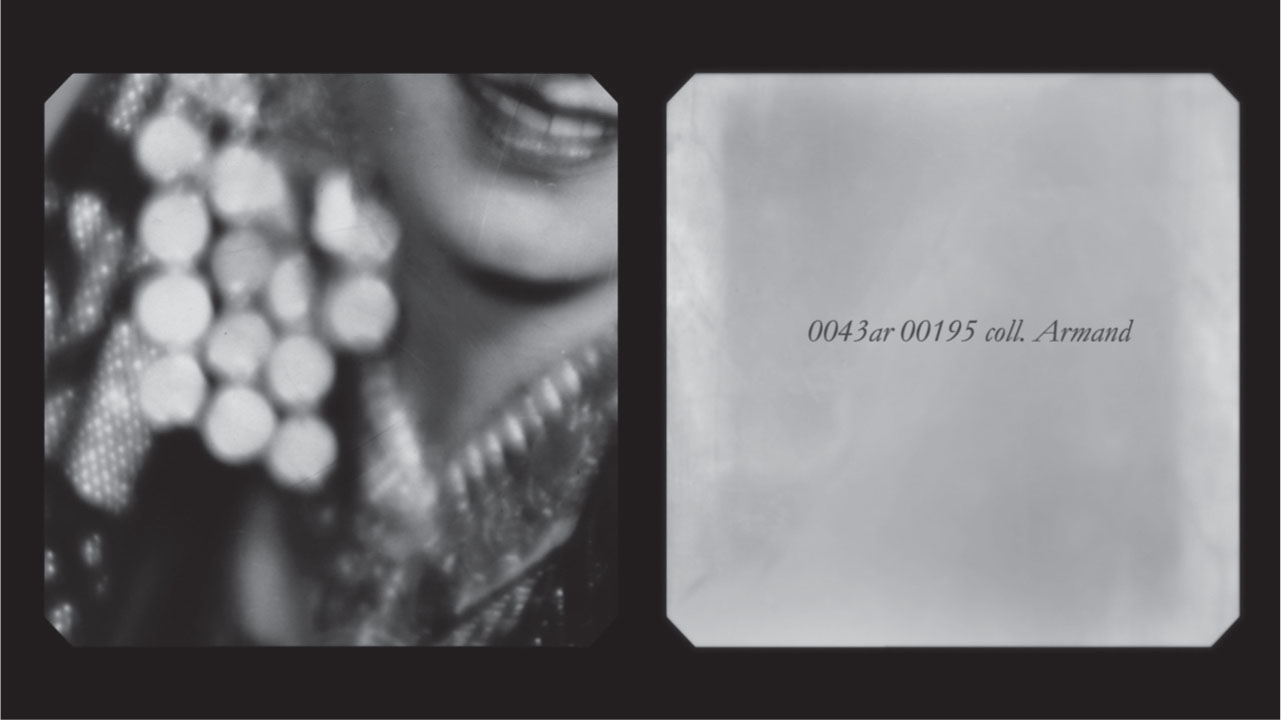
To use an example from the archive, number 0043ar00195 is an image of Philippe’s mother Marguerite Arzrouni. In the online public database the caption says: “Studio portrait of a woman in traditional clothing. Egypt/Cairo, 1945.” In the internal archive the caption accompanying the image says: “The image of Armand’s wife before their marriage”. The photograph was most probably not taken in 1945 since it was taken before Philippe was born in 1942. In addition, the meta-text does not mention that she was a Swiss woman living in Cairo. There is a great deal of performativity going on in this photograph in that she is posing in full Upper Egyptian Tulle Assuit.[10] The process of rematerialisation here takes place not only on a discursive or “immaterial” level but also materially in the very image itself. The large format negative was printed and hand-coloured but what remains in the archive is the black-and-white negatives in variable resolutions.
This process does not make the archive less truthful or incoherent but testifies to that it has been developed through contingent practices where various different sources and actors have added to the inscription of the image, its legacy and future form. Such digital archival processes as well as their analogue predecessors are not stable storage processes but a constant process of reactivation in which the material will never be the same material[11]. These processes of rematerialisation were already present in Armand’s studio. Armand developed the latent silver halide image, treated it with different textures, dust and fingerprints in the chemical development process, and then hand-coloured the print. The analogue image was not more stable than the digital but was at all times in a transient state of becoming. But in this process they still bear some of their initial material in their making – just like the hand-moulded bricks retain the initial clay. The editor, artist, brick-maker cannot help but enter into some sort of rematerialisation of her materials. And in so doing she makes herself apprentice to the signs, the materials and the affordances offered to her by the material’s texture.[12]
According to Judith Butler, the “materialization” of bodies “is never quite complete”. Indeed it is precisely the instabilities, “the possibilities of rematerialization ” that create a possibility of rearticulation in which “the hegemonic force of that very regulatory law” is called into question (Butler 1993, 2). Through my work with Leap into Colour it became possible to extend Butler’s concept of rematerialisation of bodies which are never fixed and thus temporal to include bodies which are not organisms but informational – the image archive of Armand (2008). By juxtaposing the archival footage with restaged footage and Philippe’s personal memory it became apparent that matter is able to tear itself from the totality of which it should form part and enter into a process of rematerialisation. As such, the affect enfolds the materiality of the initial body which produced it.[13] The affect is able to tear itself away from that body or totality of which it formed part and is raised into a state of entity – [a brick], [a close-up], [a videogram] or a [pixel]. But this entity is again able to affect and be affected and enters into a process of rematerialisation in which a third entity is produced. This third entity still carries the history of its making in its newfound form, hence the [video[gram]pixel] [clay [handmoulded]brick].
To further develop what this process of rematerialisation will look like in relation to digital images I will montage Elizabeth Freeman’s concept of bad timing, Hito Steyerl’s poor image and Deleuze’s time image.

Time: Aalborg | Space: 2033, Installation shot, Katrine Dirckinck-Holmfeld. Kunsten: Museum of Modern Art Aalborg 2010
Bad Time Poor Image
A while ago I met an extremely interesting developer in Holland. He was working on smart phone camera technology. A representational mode of thinking photography is: there is something out there and it will be represented by means of optical technology ideally via indexical link. But the technology for the phone camera is quite different. As the lenses are tiny and basically crap, about half of the data captured by the sensor are noise. The trick is to create the algorithm to clean the picture from the noise, or rather to define the picture from within noise. But how does the camera know this? Very simple. It scans all other pictures stored on the phone or on your social media networks and sifts through your contacts. It looks through the pictures you already made, or those that are networked to you and tries to match faces and shapes. In short: it creates the picture based on earlier pictures, on your/its memory. It does not only know what you saw but also what you might like to see based on your previous choices. In other words, it speculates on your preferences and offers an interpretation of data based on affinities to other data. The link to the thing in front of the lens is still there, but there are also links to past pictures that help create the picture. You don’t really photograph the present, as the past is woven into it. The result might be a picture that never existed in reality, but that the phone thinks you might like to see. It is a bet, a gamble, some combination between repeating those things you have already seen and coming up with new versions of these, a mixture of conservatism and fabulation.
(Jordan n.d.)
Hito Steyerl’s anecdote left me wondering whether this fabulation of the smart phone camera is per se a conservatism. And whether this form of speculation is not always already present in digital cameras that film progressively, including those whose lenses are not crap.
When we shot the three-channel video installation Time: Aalborg | Space: 2033, we were filming a close-up of the main character Ludvig driving his car. The three Canon 7Ds were rigged in the car and filming progressively and synchronously. Each time the car passed a bump in the road, the camera made a small jump, but the memory card continued writing by filling in the blank with its own imagination. A blur, a leftover, a noise, a digital artefact entered the image to “make up” the missing pixels in Ludvig’s face, with the effect of morphing it.[14] A similar thing, but in reverse, occurred when we shot the train scene in Cairo for Leap into Colour. Due to a defect in the memory card, the train was moving too fast for the memory card to keep up with the movement. The result was a distorted image full of gaps and digital artefacts.
In my own encounter with Farocki’s films, I superimposed my childhood memories onto the film. Consciousness becomes a digital, [CAM[P]era] technique, where perception, like subjectivity or camp performance, burrows backwards and forwards in history’s or my own mental camera’s repertoire of discarded bits, pixels and visual dust. If “affection is what occupies the interval, what occupies it without filling it in or filling it up” (Deleuze 2009, 67-68), as argued by Deleuze, then the visual dust, the noise in the camera that fills the missing space between the zeroes and ones operates from a similar modus of indetermination. The result is unsettling; part image, part man, part visual dust, part pixel. The image, before us, comes to resemble Elizabeth Freeman’s figure of “temporal drag”, as a counter-genealogical practice of “ archiving culture’s throwaway objects, including the outmoded masculinities and femininities from which usable pasts may be extracted” (Freeman 2010, xxiii). Temporal drag becomes an aggregate or assemblage of different temporalities existing within the same body (here body is taken in its widest possible sense). Freeman’s concept of bad timing signifies something or someone who cannot catch up with the etiquette of time; who does not fit or wear time properly, who “appear[s] untimely, clunky, out of joint” (ibid., 19). Freeman’s concept of bad timing allows us to consider the temporality of Steyerl’s poor image as well. According to Steyerl, the poor image is “the wretched of the screen”, the low-resolution image which cannot live up to the high resolution requirements of audiovisual capitalism (Steyerl 2009). Hence, the bad-time-poor image does not have control over its body or pixel. It is made up of heterogeneous parts and components, which are ripped or raised into separate entities and come to operate on their own. And each one of them carries its own micro-temporalities within itself, while existing in the same frame. The bad time-poor image has lost its own diachronic means of “mechanical reproduction” (Benjamin 1969), it has lost the control of its own production and reproduction mechanisms which in turn have become a socio-technical machinic assemblage. “Its genealogy is dubious” (Steyerl 2009, 32); it has been reedited, compressed, uploaded, downloaded, ripped, and all these processes have enfolded the different contexts and platforms in its very texture. The result is a fabulation, untraceable back to an original truth, however this becomes the truth in its power of being false.
Gilles Deleuze’s concept of the time image in its third variation is the power of the false. What is central here is the coexistence of relations or the simultaneity of the elements internal to time. The third time image concerns the “ series of time, which brings the before and the after in a becoming, instead of separating them; its paradox is to introduce an enduring interval in the moment itself ” (Deleuze 1989, 150). What I want to propose here with the bad time-poor image is that it introduces enduring intervals, semi-autonomous movements within the frame itself and creates a possibility for letting heterogeneous micro-temporalities exist within the same frame at the same time in the same moment.
A Brick Relief: Multiple Contexts Enfolded
Leap into Colour was an attempt to allow different registers, temporalities, spaces, formats, compressions, concepts and practices inhabit the same page, sentence, screen. The production and post-production came to reflect both Armand’s photographic practice and the way in which the photographs had migrated first from Armenia to Egypt, to Beirut (Arab Image Foundation), to Copenhagen (Philippe’s personal archive) and dispersed to the rest of the world, sold to private collectors. The production and post-production of Leap … were a collaboration between different people based in different geographic locations. We produced the actual shots in Cairo and Alexandria; I consulted the archive and carried out some of the re-enactments in Beirut, Lebanon; some shots were made in Denmark where Philippe Arzrouni is based; the post-production and sound design were a collaboration between Ali Kays in Beirut, Khaled Yassine in Doha, Qatar, Maurice Louca in Cairo, Egypt, and myself in Copenhagen.
Our workflow was a constant process of somebody working on a piece of the film and then sending it to the others for feedback or reworking. Each one worked with full resolution, but due to the variable internet connections, when we sent off the material to each other we had to compress the material to a lower quality – mp3 or H.264 – which was then uploaded, re-packed and rematerialised anew when downloaded in Cairo, Doha, Beirut or Copenhagen. In Leap into Colour the glue that used to hold an analogue montage together was replaced with digital compositing, which enabled us to amass various materials together in one multi-layered image, with multiple micro-temporalities within the same frame. It took me X layers, a notebook and archival interface to realise what had been available to me from the first image I found in the archive: the close-up of Marguerite Arzrouni draped in Tulle Assiut – a garment made by incorporating metal and silver into the pixelated grid of tulle. If we acknowledge that all these different contexts, its route or line of flight is enfolded into the material’s textures, then the unfolding or folding together of all these different practices and materials create a possibility for a radical rematerialisation that destabilises the regulatory frames and territorial borders and creates a possibility for a collaborative, shared memory where different space-times are able to exist in the same frame at the same time in the same moment.
Back in the Goethe Institute in Alexandria, it was as if watching the two films In Comparison and Videograms of a Revolution together left me with a hope, even though a fragile one. Farocki’s soft-montage offers a way to re-imagine how it is possible to reconstruct or rematerialise the fragments we are left with, to create a relief and relief even from the lowest possible resolution. The trick is not so much “to create the algorithm to clean the picture from the noise” but to find that algorithm which binds the bits and pieces together into new compositions, new fabulations.[15]
References
Ahmed, Sara (2008): Imaginary Prohibitions: Some Preliminary Remarks on the Founding Gestures of the New Materialism. In: European Journal of Women’s Studies 15 (1): 23-39.10.1177/1350506807084854Suche in Google Scholar
Barthes, Roland (1981): Camera Lucida: Reflections on Photography. Translated by Richard Howard. New York: Hill and Wang.Suche in Google Scholar
Benjamin, Walter (1969): The Work of Art in the Age of Mechanical Reproduction. In: Illuminations: Essays and Reflections. Edited by Hannah Arendt, trans. by Harry Zohn. New York: Schocken Books, 217-252.Suche in Google Scholar
Butler, Judith (1993): Bodies That Matter: On the Discursive Limits of „Sex“. New York: Routledge.Suche in Google Scholar
Callon, Michel (2007): What Does It Mean to Say That Economics Is Performative? In: Donald A. MacKenzie/Fabian Muniesa/Lucia Siu (eds.): Do Economists Make Markets? On the Performativity of Economics. Princeton: Princeton University Press, 311-357.10.1515/9780691214665-013Suche in Google Scholar
Deleuze, Gilles (1989): Cinema 2: The Time Image. London: The Athlone PressSuche in Google Scholar
Deleuze, Gilles (2000): Proust and Signs. Translated by Richard Howard. London: The Athlone Press..Suche in Google Scholar
Deleuze, Gilles (2009): Cinema 1: The Movement-Image. London: Athlone.Suche in Google Scholar
Deleuze, Gilles/Guattari, Félix (1987): A Thousand Plateaus: Capitalism and Schizophrenia. Minneapolis: University of Minnesota Press.Suche in Google Scholar
Deleuze, Gilles/Kaufman, Eleanor (1998): Having an Idea in Cinema. In: Gilles Deleuze/Eleanor Kaufman (eds.): Deleuze & Guattari: New Mappings in Politics, Philosophy, and Culture. Minneapolis: University of Minnesota Press, 14-19.Suche in Google Scholar
Dirckinck-Holmfeld, Katrine (2010): TIME: AALBORG | SPACE: 2033. 3 channel video installation. https://vimeo.com/45495478. (last accessed 30 September 2016).Suche in Google Scholar
Dirckinck-Holmfeld, Katrine (2015): Affect Image Touch Image. In: Devika Sharma/Frederik Tygstrup (eds.):Structures of Feeling. Berlin, Boston: De Gruyter, 50-57.10.1515/9783110365481.50Suche in Google Scholar
Dirckinck-Holmfeld, Katrine (2015): Leap into Colour. Apple ProRes.Suche in Google Scholar
Ehmann, Antje/Eshun, Kodwo (2009): Harun Farocki, Against What? Against Whom? London: Koenig books.Suche in Google Scholar
Eshun, Kodwo (2014): A Question They Never Stop Asking. In: E-Flux Journal #59 (November 2014). http://www.e-flux.com/journal/59/61076/a-question-they-never-stop-asking/ (last accessed 25 October 2016).Suche in Google Scholar
Farocki, Harun (2009): In Comparison. Berlin: Harun Farocki Filmproduktion.Suche in Google Scholar
Farocki, Harun (2010): Harun Farocki on Materiality. Interview by Maria Stahl and Alexander Waszynki. Video, 3 June 2010. https://www.youtube.com/watch?v=YuVLOzW3J-k (last accessed 30 September 2016).Suche in Google Scholar
Farocki, Harun/Ujică, Andrei/Harun Farocki Filmproduktion/Bremer Institut Film/Fernsehen/Facets Video (Firm) (1992): Videogramme einer Revolution Videograms of a revolution.Suche in Google Scholar
Freeman, Elizabeth (2010): Time Binds: Queer Temporalities, Queer Histories. Durham/NC: Duke University Press.10.2307/j.ctv1198v7zSuche in Google Scholar
Helsvig, Simen Joachim (2015): Mediearkeologen. In: Kunstkritikk (November 2015). http://www.kunstkritikk.dk/artikler/mediearkeologen/?do_not_cache=1 (last accessed 31 March 2015).Suche in Google Scholar
Jordan, Marvin (n.d.): Hito Steyerl | Politics of Post-Representation. In: DIS Magazine. http://dismagazine.com/disillusioned-2/62143/hito-steyerlpolitics-of-post-representation/ (last accessed 19 November 2014).Suche in Google Scholar
Raad, Walid (2007): Scratching on Things I Could Disavow. Ongoing, http://www.scratchingonthings.com/(last accessed 14 September 2014).Suche in Google Scholar
Raad, Walid (2014): Index XXVI: Red. Edited by Julieta Aranda/Brian Kuan Wood/Brian Vidokle. In: E-Flux Journal #54 (April 2014). http://www.eflux.com/journal/index-xxvi-red/ (last accessed 2 April 2015).Suche in Google Scholar
Raad, Walid/Toufic, Jalal (2009): The Withdrawal of Tradition Past a Surpassing Disaster. Los Angeles: Redcat.Suche in Google Scholar
Sedgwick, Eve (2003): Touching Feeling: Affect, Pedagogy, Performativity. Durham: Duke University Press.10.2307/j.ctv11smq37Suche in Google Scholar
Steyerl, Hito (2009): In Defense of the Poor Image. In: E-Flux Journal #10 (November 2009). http://www.e-flux.com/journal/in-defense-of-the-poor-image/ (last accessed 16 February 2014).Suche in Google Scholar
Zaatari, Akram (1999): Portraits du Caire, Van Leo, Armand, Alban. Edited by Fondation Arabe pour l’image. Arles: Fondation Arabe pour l’image and Actes Sud.Suche in Google Scholar
© 2016 Walter de Gruyter GmbH, Berlin/Boston
Artikel in diesem Heft
- Frontmatter
- Editorial
- Editorial
- Introduction: From Comparative Arts to Interart Studies
- I. Frictions
- Israel / Palästina retten: Kunst und der binationale Staat
- I. Frictions
- Rematerialisation
- I. Frictions
- Is Brazil a Postcolonial Country?
- I. Frictions
- Myth-Science and the Fictioning of Reality
- II. Fictions
- Speculation and the End of Fiction
- II. Fictions
- “All Data is Credit Data”
- II. Fictions
- Yet Unborn Realities
- II. Fictions
- Deception and Fiction as Forms of World-making in Contemporary Art
- III. F(r)ictions
- Existentielle Dringlichkeit
- III. F(r)ictions
- Between Nostalgia and History in the US South: Fictions of the Black Waiter on Film
- III. F(r)ictions
- It’s (Still) About Time
- III. F(r)ictions
- Images of the Human Being
- III. F(r)ictions
- Autorinnen und Autoren
Artikel in diesem Heft
- Frontmatter
- Editorial
- Editorial
- Introduction: From Comparative Arts to Interart Studies
- I. Frictions
- Israel / Palästina retten: Kunst und der binationale Staat
- I. Frictions
- Rematerialisation
- I. Frictions
- Is Brazil a Postcolonial Country?
- I. Frictions
- Myth-Science and the Fictioning of Reality
- II. Fictions
- Speculation and the End of Fiction
- II. Fictions
- “All Data is Credit Data”
- II. Fictions
- Yet Unborn Realities
- II. Fictions
- Deception and Fiction as Forms of World-making in Contemporary Art
- III. F(r)ictions
- Existentielle Dringlichkeit
- III. F(r)ictions
- Between Nostalgia and History in the US South: Fictions of the Black Waiter on Film
- III. F(r)ictions
- It’s (Still) About Time
- III. F(r)ictions
- Images of the Human Being
- III. F(r)ictions
- Autorinnen und Autoren
